Thursday, November 12, 2026
Home Blog Page 78

Search for Missing US Soldiers in Lithuania Continues as Crews Work to Extract Vehicle

0

The president of Lithuania on Friday visited swampland near his country’s border with Belarus, saying he was “hoping for a miracle” as military and civilian rescue crews worked frantically to extract a heavy United States Army vehicle carrying four American soldiers that disappeared in the waterlogged forest area on Tuesday.

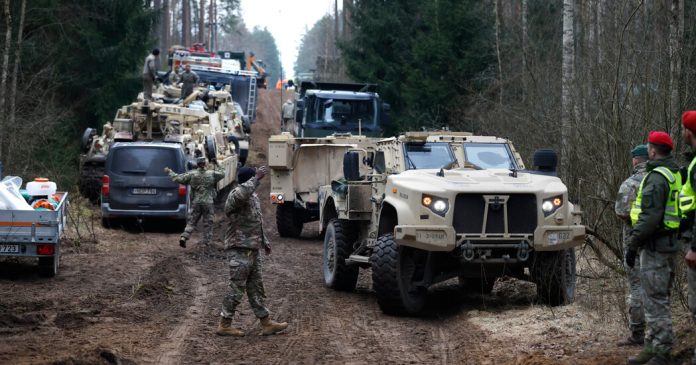
The American vehicle, an M88 Hercules, went missing during a military training exercise and was found on Wednesday submerged in a muddy bog. The soldiers have not been found, and efforts to reach the vehicle have been hampered by deep mud and water from a nearby lake.

A Lithuanian official involved in the rescue mission who was not authorized to speak publicly about the matter said tracks in the ground indicated that the American vehicle had veered off a sandy path toward a small pond and then turned abruptly into a wooded area that ended up being a swamp. It seemed to have sunk quickly, the person said, but it was unclear what happened to the crew.

“Although many skeptics would probably say that there is nothing to hope for in these circumstances, I want to hope,” President Gitanas Nauseda of Lithuania said during a visit to the site on Friday. “I am still hoping for a miracle,” he added.

The missing soldiers, from the First Brigade, Third Infantry Division, were training near Pabrade, a city in eastern Lithuania near the border with Belarus, a close ally of Russia and a stalwart supporter of Moscow’s war in Ukraine.

Both Belarus and Russia have frequently criticized Lithuania, a member of NATO that used to be part of the Soviet Union, for hosting American and other allied troops.

Amid rising alarm in Lithuania and other formerly communist countries in Eastern Europe that President Trump will weaken the NATO alliance, frantic joint efforts to recover the missing U.S. soldiers by Lithuanian and American rescue crews have showcased what Mr. Nauseda on Friday said was the value of allies acting together. Poland, Lithuania’s neighbor and another member of NATO, has also sent military engineers to help.

“Such minutes, such circumstances,” the Lithuanian president said “only confirm how strong we are when we are together, when we are in the NATO alliance and feel the support of our friends.”

Mr. Trump and his senior officials have made it clear in recent weeks that the security of Europe is no longer the first priority of the United States, which wants to concentrate resources on its own border and the Indo-Pacific, where China has become a peer rival.

Mr. Trump suggested this month that Washington might not protect NATO members that he believed were not paying enough for their own defense, calling it “common sense.”

Whether the disaster in Lithuania will reinforce the administration’s view that the United States is paying too high a price to defend Europe or help convince it that European allies are pulling their weight remains to be seen.

The U.S. military, in a statement issued on Thursday, praised Lithuania for its efforts to find the missing soldiers.

“We are incredibly appreciative of the dedicated and professional efforts of our Lithuanian allies in ensuring the safety of U.S. personnel,” said Maj. Gen. Curtis Taylor, the commanding general of First Armored Division. “They have worked tirelessly alongside us over the last 48 hours and we continue to be grateful for their support.”

Also visiting the site on Friday was the United States ambassador to Lithuania, Kara C. McDonald, who praised Lithuania, which has rushed divers, military engineers and civilian rescue crews to find and work to extract the sunken American military vehicle.

“This place is a symbol of our alliance and of working hand in hand, shoulder to shoulder, in the search for our missing soldiers,” the ambassador said, describing Lithuania as an exemplary U.S. ally.

Ms. McDonald said a team of American Army engineers had arrived on Thursday night and would be assisted in the rescue operation by Navy engineers who were expected to arrive on Friday afternoon.

The submerged M88 Hercules, essentially a giant armored tow truck, disappeared on Tuesday after being sent to extract another Army vehicle that had become disabled during the training exercise, according to the military.

“Due to the terrain, this is an incredibly complex engineering effort,” Maj. Robin Bruce, a 1st Armored Division engineer, said in the Army statement. Major Bruce added, “The team is exploring every available option to speed up this process.”

Lithuania’s defense minister, Dovilė Sakaliene, told local news media that the country’s fire and rescue service had worked overnight to pump out water from the swamp but had not uncovered the vehicle, which she said was buried at least five yards beneath the surface. She added that a large dredger would join the effort later on Friday.
Vance tours U.S. base in Greenland as Trump talks up takeover of territory : NPR

0

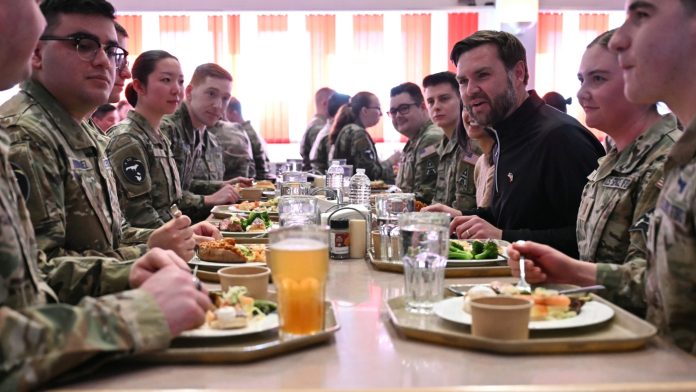
Vice President JD (at right), seated next to second lady Usha Vance, eats at a table with soldiers at the U.S. military’s Pituffik Space Base on March 28 in Pituffik, Greenland.

Jim Watson/Pool/Getty Images)


hide caption

toggle caption

Jim Watson/Pool/Getty Images)

Vice President JD Vance landed at a U.S. military base in Greenland on Friday, amid concerns that the U.S. is seeking to seize control of the Danish island territory.

“The president is really interested in Arctic security, as you all know, and it’s only going to get bigger over the coming decades,” Vance told U.S. troops at Pituffik Space Base.

Vance made the trip to the Danish territory with the second lady, Usha Vance, National Security Adviser Michael Waltz, Energy Secretary Chris Wright and other leaders.

It was actually a scaled-down itinerary , after Greenland and Denmark leaders criticized the U.S. for not having been informed. The original plans called for a solo visit by the second lady to the capital city, Nuuk, for a cultural tour and to attend a dogsled race.

President Trump has repeatedly expressed interest in acquiring the territory.

“They really like the idea because they have been somewhat abandoned, as you know. They haven’t been taken well, good care of. And I think Greenland is going to be something that maybe is in our future,” Trump told reporters on Monday. When Vance announced he was joining his wife on the trip, he said the Trump administration wants to “reinvigorate” security there given that “a lot of other countries have threatened to use its territories and its waterways” to threaten the U.S.

Polls show that most Greenlanders oppose the idea of becoming part of the United States. It also sparked some of the island’s largest protests, with angry Greenlanders holding “Yankees Go Home” signs and wearing “Make America Go Away” caps. Greenland and Denmark have both said that Greenland is not for sale.

This story will be updated.

What We Know About the Earthquake in Myanmar

0

A 7.7-magnitude earthquake struck central Myanmar on Friday, sending shock waves across Southeast Asia and leaving a trail of death and destruction.

The military junta in Myanmar said that 144 people had died and 732 had been injured. The death toll there is expected to rise, with many injured arriving at hospitals in the country’s second-largest city, Mandalay.

The earthquake collapsed a skyscraper under construction in Bangkok, killing at least seven people and leaving dozens missing. It also shook buildings in China and rattled bridges and homes as far away as Vietnam.

Myanmar is in the throes of a civil war that has left nearly 20 million people without proper food and shelter. Censorship imposed by its military government has limited the spread of information from the heart of the disaster, even as the scale of damage in Thailand and other countries is slowly becoming clear.

The quake struck near Mandalay, in central Myanmar, at roughly 12:50 p.m. local time, according to the U.S. Geological Survey. Approximately 12 minutes later, an aftershock with a magnitude of 6.4 hit the same area.

An earthquake with a magnitude of 7.7 is considered major. The magnitude of the aftershock is categorized as strong and likely to cause damage, particularly in densely populated areas, according to the agency.

Central Myanmar, where large plates of the Earth’s crust are in motion, is prone to powerful earthquakes. The country lies on the eastern end of the Alpide Belt, one world’s most active zones of seismic activity. Three quakes of magnitude 7.7 or greater have struck in or near Myanmar in the last century, according to a U.S.G.S. database, with the most recent in 1988.

The earthquake on Friday struck at a relatively shallow depth of six miles, meaning it was likely to cause more violent shaking. That shaking was felt as far away as Thailand’s capital, Bangkok, more than 800 miles away from the epicenter.

Despite the limited information from the authorities in Myanmar, the earthquake was almost certainly most destructive there. The city of Mandalay, the largest major city near the epicenter, has an estimated population of 1.5 million people.

Neighboring Thailand also felt the might of the earthquake, particularly in Bangkok, where around 11 million people live in the metropolitan area. Prime Minister Paetongtarn Shinawatra declared the city an “area of emergency,” asking residents to evacuate from tall buildings to avoid aftershocks.

In China, news media outlets in Yunnan Province, neighboring Myanmar, reported damage to buildings in the busy border city of Ruili.

The shaking was also felt in Bangladesh, to Myanmar’s west, but there were no immediate reports of damage.

The toll is expected to rise as rescue workers dig through the rubble and injured people make their way to hospitals. Myanmar’s military government said that 144 people had been killed and 732 injured, but the full extent of the toll was hard to assess in a country that has largely been isolated from the rest of the world.

In Mandalay, video showed that the Ava Bridge, originally built by the British in the 1930s, had partly collapsed, according to footage verified by The New York Times. But heavy censorship enforced by Myanmar’s military government has made it hard to see the full extent of the damage.

In Thailand, at least seven people died and dozens were missing when a skyscraper that had been under construction collapsed in Bangkok. At least 20 people were trapped in an elevator shaft, an official said, and it was unclear if they were still alive. The city’s elevated train service was shut down and people fled from tall buildings after the city was placed in a state of emergency.

Chinese state media reported that an unspecified number of people were injured, with houses and buildings damaged in the city of Ruili.

In Myanmar, the areas worst hit are in the center of the country, which are controlled by the military junta. When disasters have struck the past, like Cyclone Mocha in 2023 and Cyclone Nargis in 2008, the military government avoided asking for international assistance and throttled aid in areas not under its control.

After the powerful earthquake on Friday, the junta made a rare appeal for help. The plea signaled that the authorities were bracing for a high death toll.

“We will cooperate with them to ensure the best care for the victims,” Gen. Zaw Min Tun, Myanmar’s military spokesman, said after the government declared a state of emergency in six regions.

Areas of the country that are controlled by rebel forces are farther from the epicenter of the quake. These areas appear to be relatively unscathed, but information in these often isolated areas may be slow to emerge.

The World Health Organization said that it was looking at sending trauma supplies to support Myanmar. The International Federation of Red Cross and Red Crescent Societies said that teams in the country were assessing the situation.

Reporting was contributed by Sui-Lee Wee, John Yoon, Keith Bradsher, John Keefe, Richard C. Paddock, Muktita Suhartono, Adam Satariano and Paul Mozur.

Maps: 7.7-Magnitude Earthquake Strikes Myanmar

0

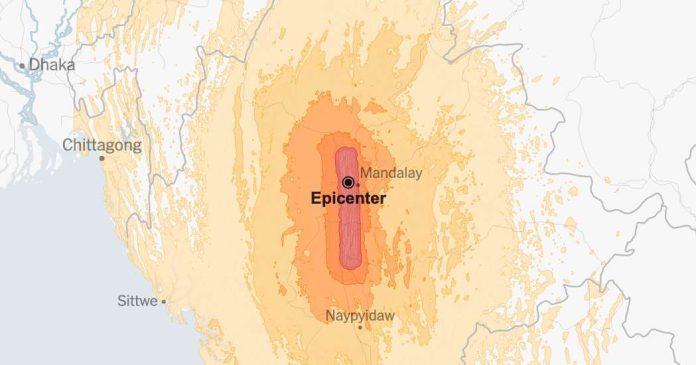
Note: Map shows the area with a shake intensity of 4 or greater, which U.S.G.S. defines as “light,” though the earthquake may be felt outside the areas shown. The New York Times

A major, 7.7-magnitude earthquake struck in Myanmar on Friday, according to the United States Geological Survey. At a depth of about six miles, the quake was relatively shallow, which made it likely to cause violent shaking.

The temblor happened at 12:50 p.m. Myanmar time about 10 miles northwest of Sagaing, Myanmar, data from the agency shows.

The area near the quake is heavily populated, suggesting that the death toll may rise significantly. Mandalay, Myanmar’s second-largest city, sits near the epicenter. And heavy damage to buildings was reported as far as Bangkok, the capital of Thailand, 650 miles away.

Myanmar’s junta has repeatedly shut off the internet, complicating efforts to determine the full extent of the damage. But modeling by the United States Geological Survey roughly estimates that the death toll is likely to surpass 1,000, and could be much higher.

Earthquakes of this size are rare on the mainland of Southeast Asia. Only three quakes of magnitude 7.7 or greater have struck in or near Myanmar in the last century, according to a U.S.G.S. database.

Collapsed buildings were seen across a vast expanse of Southeast Asia. The quake will without a doubt deepen the humanitarian crisis in Myanmar, a country that has been battered in a bloody civil war since 2021.

Here is what the damage looked like in some of the region’s largest cities:

Bangkok

In Bangkok, a 30-story skyscraper under construction collapsed, killing at least three people.

@Khon Su Cheevit Adeet Mai Suay Rok Na/Facebook, via AFP

The city’s streets were full of people who were afraid of aftershocks or were not allowed back into their buildings. Traffic was at a virtual standstill.

Prime Minister Paetongtarn Shinawatra of Thailand declared Bangkok to be an “area of emergency,” asking residents to evacuate from tall buildings to avoid aftershocks.

Mandalay

In Mandalay, the city closest to the epicenter, the damage may be wide-ranging. A hospital there was overwhelmed with injured people lined up on stretchers, or cardboard, in 100-degree heat.

A bridge on the Irrawaddy River collapsed.

Before: Google Maps user image; After: Still image from video by Khaing Zar Thin/Facebook, via Agence France-Presse

Naypyidaw

Sai Aung Main/Agence France-Presse — Getty Image

Buildings collapsed and roads buckled in Myanmar’s capital city, The emergency department of a hospital was damaged, and injured people had to be treated outside in the compound.

Before: Google Maps user image; After: Sebastien Berger/Agence France-Presse — Getty Images

Aftershocks in the region

About 11 minutes after the initial 7.7-magnitude earthquake, a strong, 6.4-magnitude aftershock struck the same area, according to the U.S. Geological Survey.

Quakes and aftershocks within 100 miles

An aftershock is usually a smaller earthquake that follows a larger one in the same general area. Aftershocks are typically minor adjustments along the portion of a fault that slipped at the time of the initial earthquake.

Aftershocks can occur days, weeks or even years after the first earthquake. These events can be of equal or larger magnitude to the initial earthquake, and they can continue to affect already damaged locations.

When quakes and aftershocks occurred

Source: United States Geological Survey | Notes: Shaking categories are based on the Modified Mercalli Intensity scale. When aftershock data is available, the corresponding maps and charts include earthquakes within 100 miles and seven days of the initial quake. All times above are Myanmar time. Shake data is as of Friday, March 28 at 2:39 a.m. Eastern. Aftershocks data is as of Friday, March 28 at 11:22 a.m. Eastern.

Two major law firms sue Trump administration over executive orders targeting them : NPR

0

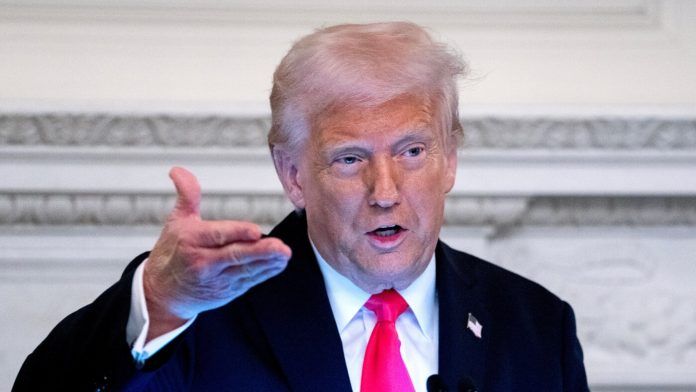
President Trump speaks at the White House on Thursday, when he signed an executive order targeting WilmerHale, marking the latest expansion of the president’s campaign against law firms tied to his political enemies or investigations into his actions.

Chris Kleponis/CNP/Bloomberg via Getty Images


hide caption

toggle caption

Chris Kleponis/CNP/Bloomberg via Getty Images

Two major law firms are taking the Trump administration to court on Friday, seeking to block executive orders that the firms say target them for zealous representation of clients and their hearty pro bono work.

The lawsuit by the Jenner & Block firm, filed in federal district court in Washington, D.C., alleges violations of the First Amendment guarantees to free speech and free association. It also alleges the order violates the due process clause of the Fifth Amendment by hurting the firm’s ability to practice law; and violates the Sixth Amendment, for undermining the relationship between attorneys and their clients, and clients’ right to lawyers of their choosing.

A separate lawsuit by the WilmerHale law firm said the executive action Trump took on Thursday punishes the firm for employing former special counsel Robert Mueller and other public servants who worked alongside him.

WilmerHale’s lawsuit said the White House is retaliating against it for representing the Democratic National Committee, the campaigns of Democratic politicians Joe Biden and Kamala Harris, and for suing the administration this year over its firing of several inspectors general.

The lawsuits come after President Trump signed executive orders this week, which attempted to restrict both firms’ access to federal buildings, yank any active security clearances held by its personnel, and direct government employees not to meet with the firm or its members.

“For more than 100 years, Jenner has tirelessly advocated for its clients against all adversaries, including against unlawful government action,” the lawsuit said. “With this suit, the Firm takes up that charge once again. To do anything else would mean compromising Jenner’s ability to zealously advocate for its clients and capitulating to unconstitutional government coercion.”

Jenner, which employs about 500 lawyers, has one of the nation’s strongest pro bono programs, which represents immigrants and LGBTQ people, among other clients.

Trump referred to some of that work in his March 25 executive order. And he blasted the firm for once employing Andrew Weissmann, a member of the special counsel team that investigated Trump. Weissmann has not worked at Jenner for years but he remains a critic of the president.

Jenner is seeking to have the case heard by Judge Beryl Howell, who recently blocked enforcement of a similar executive order against the law firm Perkins Coie. The Justice Department has attempted to disqualify Howell, but the judge cast that effort as an attempt to intimidate the independent judiciary.

Trump accused of attacking legal system

Trump moved against WilmerHale only hours before that firm went to court Friday morning.

“The Executive Order targeting our firm is a plainly unlawful attack on the bedrock principles of our nation’s legal system—our clients’ right to counsel and the First Amendment,” a firm spokesman said in a written statement. “The terms of a nearly identical Executive Order have already been enjoined by a federal judge and today we have filed for immediate relief to protect the rights of our clients.”

Wilmer is represented by former solicitor general Paul Clement, a major figure in the conservative legal movement.

Clement said in court papers that the executive order against the firm flouts the fundamental separation of powers and that Trump has no authority to sanction a law firm “for representing his political opponents or handling lawsuits that he perceives to be contrary to his interests or those of the United States.”

Two other law firms have sought to reach settlements with the White House after Trump targeted them in executive orders. But in a statement, Jenner said “capitulating to unconstitutional government coercion” is not in its DNA.

Myanmar Earthquake Pushes a Hospital in Mandalay to Its Limits

0

In the parking lot of Mandalay General Hospital, dozens of patients — many with their heads and arms bandaged — were lined up on stretchers, or cardboard, in 100-degree heat. Many more lay directly on the concrete.

“More injured people keep arriving, but we do not have enough doctors and nurses,” said Dr. Kyaw Zin, a surgeon at the hospital. “The cotton swabs have almost run out.”

He said the hospital was so jammed with injured people after the 7.7-magnitude earthquake on Friday that “there is no space to stand.” Phone lines were down so he has not been able to contact his parents. “I’m very worried about my parents,” he added. “But I can’t go back home yet. I have to save lives here first.”

Even before the quake, the health care system in Myanmar had been pushed to its limits. The military junta that has led the country since a 2021 coup has cracked down on doctors and nurses, who have been at the forefront of a nationwide civil disobedience movement that has opposed the regime. Myanmar is one of the most dangerous places in the world to be a health worker, according to New York-based Physicians for Human Rights.

Dr. Kyaw Zin said that he was about to start surgery when the earthquake struck. Everybody, including patients, ran outside.

On Friday afternoon, ambulance sirens shrieked. The injured kept coming. Nurses checked on patients in the parking lot, some of whom were hooked up to intravenous drips. People moaned for help. The smell of blood hung in the stifling heat.

The junta said it did not have the full death toll. Damage to infrastructure could hinder access to regions that have already been struggling amid a bloody civil war. The epicenter of the earthquake, the Sagaing region, has been a focus of resistance to military rule.

The World Health Organization said information was still hard to get because of aftershocks and disruptions to communications systems. The agency added that it was looking to send trauma supplies from its logistics hubs to support Myanmar.

Trump moves to end union rights for federal employees : NPR

0

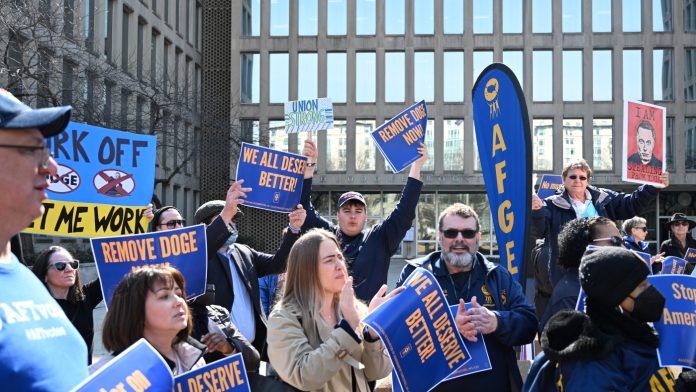
Protesters hold signs in solidarity with the American Federation of Government Employees at a March 4 rally in support of federal workers at the Office of Personnel Management in Washington, D.C.

Alex Wroblewski/AFP via Getty Images


hide caption

toggle caption

Alex Wroblewski/AFP via Getty Images

President Trump has signed an executive order ending collective bargaining for wide swaths of federal employees, as part of his broader campaign to reshape the U.S. government’s workforce. The largest federal employee union says the order affects over 1 million workers.

In a fact sheet, the White House says the Civil Service Reform Act of 1978 (CSRA) gives him the authority to halt collective bargaining at agencies with national security missions.

This provision has traditionally applied to certain employees at agencies such as the CIA, the FBI or the National Security Agency.

But Trump’s order is more far-reaching, and includes employees whose jobs touch on national defense, border security, foreign relations, energy security, pandemic preparedness, the economy, public safety and cybersecurity.

It notably excludes law enforcement. “Police and firefighters will continue to collectively bargain,” the White House fact sheet states.

Trump had previously issued executive actions eroding employee rights under union contracts. For example, one directive sought to invalidate collectively bargained telework provisions, declaring that they were in conflict with management rights. He’s also taken aim at the amount of time employees serving in union leadership positions could spend on collective bargaining and other union-related business.

The administration had also already ended collective bargaining rights for Transportation Security Administration officers who run airport checkpoints.

The executive order signed Thursday night covers all or some unionized employees at 19 agencies, including the departments of Agriculture, Veterans Affairs, Health and Human Services, State, Justice, Energy, Interior, Treasury, Defense and others.

Unions point out that the CSRA granted federal workers collective bargaining rights in order to provide them a way to address workplace issues without disrupting government operations.

“Labor organizations and collective bargaining in the civil service are in the public interest,” the CSRA states.

In its fact sheet, the White House made clear it thought unions were standing in its way.

“Certain Federal unions have declared war on President Trump’s agenda,” the fact sheet states. “The CSRA enables hostile Federal unions to obstruct agency management.”

Federal employee unions have sued the Trump administration to block a number of its actions, including the mass firings of probationary employees, the dismantling of USAID and access to sensitive data.

Unions have also pushed back on the administration’s return-to-office demands, citing provisions in their contracts allowing for some telework, and were prepared to bargain over procedures related to upcoming reductions-in-force as their contracts allowed.

Now, labor leaders are calling Trump’s new executive order a “retaliatory attack.”

“President Trump’s latest executive order is a disgraceful and retaliatory attack on the rights of hundreds of thousands of patriotic American civil servants—nearly one-third of whom are veterans — simply because they are members of a union that stands up to his harmful policies,” wrote Everett Kelley, president of the American Federation of Government Employees, in a statement.

AFGE, which represents 800,000 civil servants, has vowed “immediate” legal action to fight it.

“AFGE isn’t going anywhere,” wrote Kelley. “Our members have bravely served this nation, often putting themselves in harm’s way, and they deserve far better than this blatant attempt at political punishment.”

Just Stop Oil Announces It Will Change Its Protest Actions

0

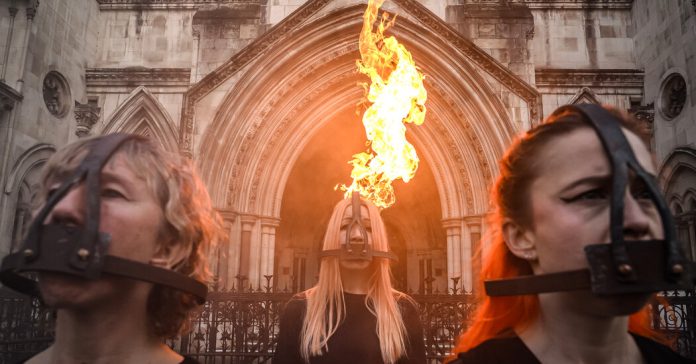
Just Stop Oil, the British environmental activist group known for attention-grabbing protests — including throwing tomato soup at famous artworks and spraying orange powder on Stonehenge — said it was ending such actions after a final protest in London next month.

The group said on Thursday that it had achieved its primary goal of preventing new oil and gas licensing in Britain, and would soon be regrouping to plan its next phase of actions.

“We achieved what we set out to achieve,” James Skeet, a spokesman for the group, said in an interview.

Here’s what to know.

Just Stop Oil activists made headlines beginning in 2022 for: throwing tomato soup at Vincent van Gogh’s “Sunflowers,” gluing themselves to John Constable’s “The Hay Wain,” and smashing the glass that protected Diego Velázquez’s “Rokeby Venus.”

The group has said that it used the tactics to convey the urgency of the climate crisis, and draw attention to the political and social changes needed to tackle it. The group has noted that its actions have not damaged the masterpieces, and that the works were specifically chosen because they were protected by glass. But critics have argued that some of the works’ centuries-old frames were harmed.

A wave of similar protest actions began in Paris when a man smeared cake on the Mona Lisa, and others occurred in Germany, Italy and the United States.

Just Stop Oil, which also disrupted sporting events, awards shows and live theater, as well as spraying the monoliths at Stonehenge with orange powder, grew out of Extinction Rebellion, a British environmentalist group that promoted nonviolent protests to push governments to address the climate crisis.

Politicians, museum managers and many others on social media have condemned the group’s actions. In Britain, former Prime Minister Rishi Sunak called Just Stop Oil “a disgrace,” and Keir Starmer, the current leader, called the group “pathetic” after its Stonehenge protest.

Many of the activists who participated in the 2022 protests at the National Gallery in London were arrested, and some were sentenced to jail time. A judge sentenced two of the activists who threw soup at the “Sunflowers” painting to about two years in jail in 2024, and a protester who glued himself to the frame of another van Gogh work was sentenced to three weeks in prison in 2022. The case of the activists involved in the Stonehenge protests is ongoing.

The activists who threw soup at “Sunflowers” had their sentences upheld this month. But six activists who were convicted of conspiracy for blocking a major highway near London in 2022 during a Just Stop Oil protest had their sentences reduced.

Mr. Skeet said 15 people were currently in prison related to Just Stop Oil protests and 16 others were facing sentencing in the coming months.

The museum campaign also had its defenders. They argued that the actions drew needed attention to the climate crisis. It also sparked a debate about whether vandalizing art should be a vehicle for protest.

Mr. Skeet, the group’s spokesman, said Just Stop Oil’s tactics were narrowly focused on pushing for an end to new oil and gas licensing in Britain. The Labour Party, which swept into power last year, committed to a ban on new licensees for oil and gas, and doubled down on its pledge this month.

The group’s final action will take place in London on April 26, but the organization made clear on its website that it will be “a lower-risk action, and we won’t be pushing for arrest.”

Mr. Skeet added: “The idea around the strategy was to aim for a winnable demand and basically sort of prove the effectiveness of the tactics, essentially. We’ve done so. So now it’s on to moving on to the next thing.”

“My first priority is to take a break,” Mr. Skeet said. He said the last few years have exhausted many of the members.

Mr. Skeet also said that the group’s style of protesting has become increasingly criminalized since the organization first began. In 2023, a new law, the Public Order Act, gave the police in England and Wales more power to detain and charge protesters. Mr. Skeet said the group would need to “assess the lay of the land” before regrouping for further action.

Medieval Tales of Merlin and Arthur, Hidden for Centuries, Return to Light

0

Torn, folded, stitched and bound into a book of property records from the 1500s, rare tales of Merlin shapeshifting into King Arthur’s court and Sir Gawain gaining power from the sun had gone unnoticed for centuries, stacked among the records of an English manor and then among the millions of volumes of a university library.

At least until an archivist took another look, setting off a yearslong project to identify and then reassemble the medieval manuscript, which someone in Tudor England had taken apart and used to help hold together a ledger.

The manuscript turned out to be a priceless find: extremely rare stories of Arthurian romance, copied by a scribe between 1275 and 1315, and part of the “Suite Vulgate du Merlin,” an Old French sequel to the start of the Arthur legend. Cambridge University researchers announced their findings this week and published a digitized version of the manuscript online.

There are fewer than 40 copies of the Suite Vulgate sequel known to exist, and no two are exactly the same.

“Each manuscript copy of a medieval text, handwritten by a scribe, is going to be changed little by little,” said Irène Fabry-Tehranchi, the French specialist at the university library. “As the copies come along, each scribe imposes his own taste.”

The manuscript tells two stories.

The first is about Sir Gawain, nephew of King Arthur, whose rivals include both rebellious barons at home and pagan Saxons invading from abroad. Among the intransigent nobles is Gawain’s own father, and Gawain sides with Arthur to defeat him. Then it’s on to the Saxons.

Wielding Excalibur, the sword of myth, Gawain grows more powerful as the sun rises, reaching peak strength at midday. His victory for Arthur’s side is no less satisfying for being predictable.

In the second episode, Arthur and his queen, Guinevere, are presiding over a feast when it is interrupted by a mysterious visitor, a blind harpist, guided into court by a white dog. Charmed by his music, Arthur agrees to the strange man’s even stranger request: to bear the king’s standard on the battlefield — a seemingly fatal wish.

The harpist is Merlin, disguised, though the members of court realize this only long afterward. “The standard, thanks to Merlin’s magic, can become this magical dragon who blows fire on the battlefield,” Dr. Fabry-Tehranchi said.

At the time of its creation, the manuscript was “a luxury item,” she added, most likely imported to England by aristocrats familiar with Old French as the Arthurian romances grew in popularity. But as the stories were translated into English, the value of such manuscripts fell.

Unless one had a bunch of deeds or the like lying around and in need of a little binding. That may explain how someone at Huntingfield Manor in Suffolk in the 16th century settled on the old parchment as a bit of raw material to strengthen a ledger.

The manor’s collection came to Cambridge in the 1970s, but it was only in 2019 that an archivist realized that the hidden manuscript deserved a closer look. The painstaking process wound up taking years, given that the fragile, battered manuscript had been recycled inside a book that was itself centuries old.

“We really needed to go into the nooks and crannies of this object,” Dr. Fabry-Tehranchi said.

Researchers used multispectral imaging, which relies on different wavelengths of light like ultraviolet and infrared, to reveal details in the manuscript that the naked eye could not spot. With help from their colleagues in the zoology department, they also employed a CT scanner usually used for fossils to uncover the parchment’s layers without physically dismantling the book.

The restorers also used mirrors, magnets, prisms and other tools to take hundreds of photographs of parts of the manuscript that were hidden under folds or stitched into the binding. The result was a sort of medieval, Old French jigsaw puzzle that had to be assembled into a legible text.

“This project is fabulous primarily for its use of new technology to recover the material culture of the past, which may survive physically but remain inaccessible for a variety of reasons,” said Hannah Weaver, a professor of medieval literature at Columbia University, who was not involved in the work.

It was not just the innovative use of imaging, Dr. Weaver said. It was what came next, and what it might mean for other researchers.

“It was the digital unfolding that really astonished me,” she said. “I can’t wait to see that new technique applied on other tricky in-situ manuscripts.”

Dr. Fabry-Tehranchi expressed a similar hope.

“There are still things to be discovered,” she said.

How pro-Trump right-wing media is covering the Signal leak : NPR

0

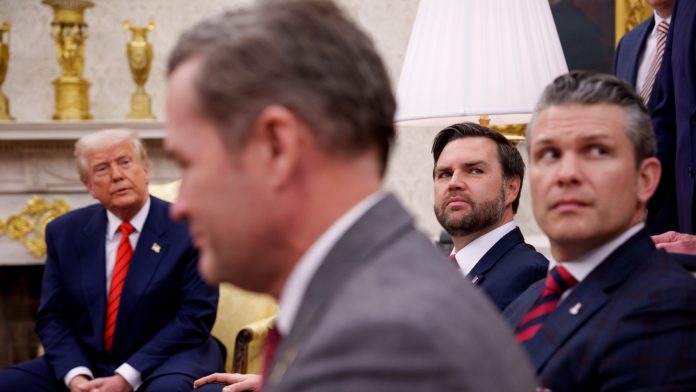
President Trump, National Security Adviser Michael Waltz, Vice President JD Vance, and Defense Secretary Pete Hegseth, listen to a question from a reporter during a meeting in the Oval Office on March 13, 2025. Waltz, Vance, Hegseth and other top Trump officials were on a text thread together on the messaging app Signal discussing military plans to strike Yemen when Waltz inadvertently added journalist Jeffrey Goldberg to the group.

Andrew Harnik/Getty Images


hide caption

toggle caption

Andrew Harnik/Getty Images

Spin and conspiracy theories have swirled on right-wing media in recent days, as conservative commentators and MAGA-influencers attempted to frame news that senior Trump administration officials shared details of a forthcoming U.S. military operation over a group chat on the Signal messaging app that inadvertently included a journalist.

Hours after The Atlantic’s editor-in-chief Jeffrey Goldberg published his first story Monday that described how he was unexpectedly included in the Signal group, some pro-Trump influencers tried to argue the senior officials had deliberately added Goldberg for strategic reasons.

“If you think for one second they’d be having these chats over Signal and then be stupid enough to accidentally let a opposition journalist into the chat, man, you really fell for it hook line and sinker,” said influencer Joey Mannarino in a video on X. “You probably also believe all the stuff you hear in the news about Trump is real.”

He added, “This is called misdirection, and this is called strategy.”

On Fox News on Monday, Sean Hannity referred to it as a smear from the left, and criticized the media’s focus on it.

“More feigned, phony outrage,” Hannity said. “This is now the scandal of the week that you will see nonstop 24-7 that nobody will care about.”

Fellow Fox News host Jesse Watters said it “could have been a wee bit of a security breach” and reminded his audience of cases where Democrats had mishandled classified documents in the past.

Another common narrative on right-wing media was to try to discredit Goldberg, something Trump officials also did in their response.

The criticism of Goldberg took a darker turn on social media, said Welton Chang, which he tracks as the CEO of Pyrra Technologies, a company that provides threat monitoring services.

“They are criticizing Jeffrey Goldberg for being a member of the chat,” Chang said. “I’ve seen numerous death threats on these platforms.”

After Trump administration officials insisted nothing classified was discussed, Goldberg published most of the Signal discussion on Wednesday.

Pro-Trump influencer Benny Johnson told his viewers the newly-released messages showed, “the information on there wasn’t classified – in fact, the information on there looks incredible and immaculate for the Trump Administration.”

Johnson titled the Wednesday episode of his show “Hoax Busted” and also suggested the supposed “deep state” could be behind the Signal app.

“Maybe that’s why they install it on every government agents’ phone so that they’d have a secret back door to all their comms,” Johnson said. “Maybe, just maybe, this was a op. Maybe, just maybe, this was a new hoax.” (Last year, the Department of Justice revealed that Johnson was among a group of influencers who had unwittingly been paid by Russia to spread content that aligned with the Kremlin’s interests).

Other conservative commentators said Trump officials made a mistake.

Tomi Lahren posted to X, “Trying to wordsmith the hell outta this signal debacle is making it worse. It was bad.”

Dave Portnoy, the founder of Barstool Sports and a Trump supporter, called for accountability in a video on X for what he called “a major, major, major glitch in intelligence and just a huge mistake.”

He suggested that Michael Waltz, the National Security Advisor who had created the group chat and taken responsibility for inadvertently inviting Goldberg to it, should be fired.

Podcast host Charlie Kirk, who has a close relationship with President Trump, also said that Waltz was responsible and accused him of having “a ton of Biden holdovers” working for him. On his Thursday show, he defended Defense Secretary Pete Hegseth and shared unproven suspicions about Waltz’s deputy.

“What is going on is a fight for the soul of the Republican party,” Kirk said, noting divisions within the GOP over foreign policy priorities. He accused “neo-conservatives on Capitol Hill, the neo-conservatives within our deep state of government” of using the fallout from the Signal chat as an opportunity to try to oust Hegseth.

On Steve Bannon’s show the War Room, Bannon asked the far-right influencer Jack Posobiec, who served in the Navy Reserve as an intelligence officer, if he thought the texts released by Goldberg contained classified information. Posobiec is known for promoting the Pizzagate conspiracy theory and multiple media outlets reported in 2017 his security clearance was under review and his access to classified information was suspended.

“If I was in the intel community, I wouldn’t be sharing that information over open comms,” Posobiec answered. “Operational stuff that I’ve always seen has always been at the secret level,” he said, referring to a level of classification, before noting that the defense secretary can choose to declassify information.

Posobiec then pivoted back to attacking the Democratic members of Congress who had grilled Director of National Intelligence Tulsi Gabbard and CIA Director John Ratcliffe at a House Intelligence Committee hearing on Wednesday.

“These Democrats don’t care,” Posobiec said. “This is a drama act.”

NPR CEO Katherine Maher chairs the board of Signal Foundation that’s behind the Signal app.