Thursday, November 12, 2026
Home Blog Page 77

Model Who Says She Dated Andrew Tate Accuses Him of Sexual Assault in Lawsuit

0

A Los Angeles woman is suing Andrew Tate, the online influencer known for promoting misogynistic views, accusing him of physically and sexually abusing her while they were in a relationship.

The civil complaint, filed on Thursday in Superior Court in Los Angeles County by Brianna Stern, a model, claimed that Mr. Tate choked, beat and verbally degraded her while they were in a relationship that began last July and included a hotel stay in California this month.

It is the latest legal accusation against Mr. Tate, who is also being investigated by the authorities in Britain and Romania on allegations of human trafficking, money laundering and sex crimes.

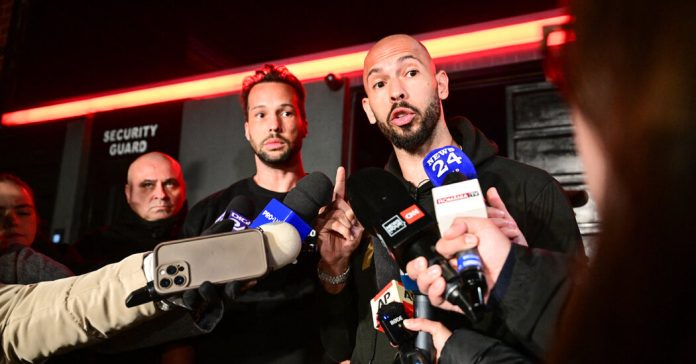
Mr. Tate and his brother, Tristan Tate, spent about two years in and out of house arrest in Romania amid an investigation by the authorities there and were allowed to leave the country in February.

Mr. Tate denied Ms. Stern’s allegations through his representatives.

“This is a blatant cash grab — a desperate attempt by a sad individual to exploit Andrew’s success and reputation for personal gain,” his U.S. legal team said in a statement. “Ms. Stern has chosen to air her false claims in the press, revealing her true motives: money and attention, not justice.”

In the 30-page lawsuit, Ms. Stern accused Andrew Tate of threatening her with violence and psychologically controlling her during their relationship.

She asked the court for a restraining order, saying that Mr. Tate had forced her to install an app on her phone so that he could track her, and give him the passwords to her social media accounts.

Tony Buzbee, a lawyer for Ms. Stern, said in an email on Friday that his client was courageous for shedding light on the alleged abuse.

According to the lawsuit, Ms. Stern and Mr. Tate met in July 2024.

Ms. Stern, a model and influencer with her own cryptocurrency coin, was searching for advice, the lawsuit said, and Mr. Tate was looking for models to join him in Romania to help promote his crypto meme coin.

She went to Romania and they began a relationship, discussing plans to live together in the United States, the lawsuit said. At times, Mr. Tate was loving and kind, the lawsuit said, but he also berated her and hit her.

To exert his control over her, the lawsuit said, he asked Ms. Stern to get a tattoo with the words “Property of Tate,” which the lawsuit said he had required of several former girlfriends.

Ms. Stern said in the suit that Mr. Tate assaulted her during a stay at The Beverly Hills Hotel on March 10. Mr. Tate choked and beat Ms. Stern until she nearly lost consciousness despite her pleading for him to stop, according to court papers.

“While doing so, Tate told her repeatedly that if she ever crossed him, he was going to kill her,” the lawsuit said.

Ms. Stern said she sought medical attention after their stay at the hotel and was diagnosed with post-concussion syndrome.

She waited to report the assault to the police until after the brothers left the United States — they returned to Romania on March 22 for a hearing there — because she was afraid of retaliation, the complaint said.

In her lawsuit, Ms. Stern provided screenshots of what she said were text messages that she had exchanged Mr. Tate: “if you ever betray me you will regret it.”

In another text, the lawsuit said, Mr. Tate wrote, “Whats the point in having you” and continued, “if i don’t beat you and impregnate you.”

The Beverly Hills Police Department did not immediately respond to requests for comment about the allegations in the lawsuit.

In a statement shared on her social media accounts on Thursday, Ms. Stern said that she had been in love with Mr. Tate, but added that the events described in the lawsuit had prompted her to end the relationship.

“Coming out about this is really terrifying in all aspects,” she wrote. “The entire situation is very traumatic and extremely difficult.”

Ms. Stern said that she was reluctant to speak up.

“I know he and his followers will insult me and attack me,” she said. “I don’t care because I speak the truth.”

Although they are allowed to travel outside of Romania after the authorities there lifted travel restrictions on them, Mr. Tate and his brother are still being investigated for allegations of criminal wrongdoing.

A group of women in Britain who sued Andrew Tate over claims of sexual assault have also lobbied the British government to extradite the brothers, while another lawsuit is playing out in a Florida court between the brothers and an American woman who gave testimony to Romanian authorities.

The brothers’ arrival in Florida last month was met with alarm from women’s rights groups. The state’s attorney general, James Uthmeier, opened a criminal investigation into the brothers.

But some conservatives welcomed the brothers’ arrival. They have since returned to Romania to face criminal proceedings in Bucharest and remained there on Friday.

Susan C. Beachy contributed research.
Judge prevents Trump administration from dismantling CFPB : NPR

0

Demonstrators raise signs at a rally to protest the closing of the Consumer Financial Protection Bureau last month in Washington, D.C.

Jemal Countess/Getty Images for MoveOn/Getty Images North America


hide caption

toggle caption

Jemal Countess/Getty Images for MoveOn/Getty Images North America

A federal judge on Friday blocked the Trump administration from dismantling the Consumer Financial Protection Bureau and ordered that all terminated employees be reinstated.

The temporary injunction from Judge Amy Berman Jackson at the U.S. District Court in Washington, D.C., also prevents the administration from firing any more CFPB workers or from deleting any of the agency’s data or records, as part of a sweeping ruling to protect the agency.

“There is a substantial risk that the defendants will complete the destruction of the agency completely in violation of law well before the Court can rule on the merits, and it will be impossible to rebuild,” Berman Jackson wrote in her order.

The order comes as a case proceeds in a lawsuit filed by the National Treasury Employees Union, which represents employees of the CFPB after the Trump administration effectively shuttered the agency last month.

The administration along with Elon Musk’s team — the Department of Government Efficiency — had closed the CFPB’s headquarters, ordered employees to cease most work and terminated over 100 probationary and term employees.

Judge Berman Jackson has yet to issue a final order on the case.

Representatives of the Trump administration and the CFPB did not immediately respond to requests for comment.

Deepak Gupta, a lawyer representing the CFPB’s union welcomed the temporary ruling.

“Today’s victory blocks the unprecedented plan to dismantle the CFPB—an agency that Congress created to protect Americans’ financial security. This ruling upholds the Constitution’s separation of powers and preserves the Bureau’s vital work,” Gupta said in an email.

“We’re heartened by the decision and look forward to continuing to press our case in court,” he added.

Berman Jackson has been skeptical of government efforts

Through the hearings so far, Judge Berman Jackson has appeared skeptical of the government’s arguments, asking pointed questions to the attorneys representing the Trump administration.

Some work at CFPB has slowly resumed while the hearings were taking place, but Berman wrote on Friday that it was all “more likely a charade for the Court’s benefit.”

The Trump administration has made no secret of its ire for the bureau, which has long been unpopular with some Republicans and Wall Street and Silicon Valley executives who say it is too heavy-handed in its regulations.

The bureau was created by Congress as part of the Dodd-Frank Act, in the wake of the 2008 financial crisis. The CFPB is required to carry out a number of statutory requirements stipulated by Congress; some of the statutes predated Dodd-Frank and were unified under the CFPB’s responsibility.

Pope Francis Came Near Death in Hospital, His Doctor Says

0

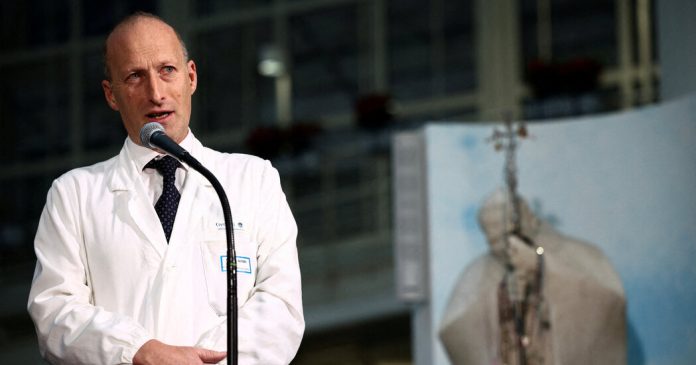
The pope’s doctors did not think he was going to make it.

“It’s terrible,” Pope Francis gasped during a breathing crisis last month. The pope, his hand bruised with needle pricks and his oxygen saturation dipping to a dangerously low 78 during his long hospitalization, acknowledged in a failing voice that he might die. He held his doctor’s hand.

Francis had ruled out intubation, which would mean being kept unconscious, the leader of the medical team, Dr. Sergio Alfieri, said in an interview. So his doctors decided to treat the pneumonia in both his lungs with a last-ditch barrage of drugs that risked damaging his organs.

The pope’s closest aides had tears in their eyes as doctors asked the pope’s personal nurse, empowered to make life-or-death decisions, for permission to go ahead with more aggressive treatment. He consented and, ultimately, the pope responded positively.

Even so, the worst had not yet passed. Less than a week later, Francis regurgitated some food and started choking. The doctors, fearing he might die on the spot, immediately suctioned his airway but worried that the inhalation would aggravate his deeply infected lungs. His chief doctor worried all was lost.

But it was not.

On Sunday 38 days after he entered the Agostino Gemelli hospital, Dr. Alfieri discharged the leader of the Roman Catholic Church to return to the Vatican. He implored his patient, who had resisted going to the hospital in the first place, to rest and convalesce so as not to waste the chance he had been given.

“It was a miracle that he left the hospital,” said Dr. Alfieri, adding that the pope was now “not in danger.”

But when Francis made a brief appearance over the weekend, the public received a sobering glimpse of the toll the health crisis had taken on the 88-year-old pope. Greeting well-wishers from a hospital balcony, his voice was so weak it bordered on inaudible, his breathing so strained it sometimes looked like he gasped for air.

“You can see the decline,” Carlos Aguirre, a pilgrim from Colorado Springs said as he watched Francis struggle to speak.

Francis’ doctor said the pope agreed to a two-month convalescence that would put him on the road to full recovery. But prelates close to Francis are guarding against the possibility that his frail state is really the new normal. They have depicted his physical weakness as a powerful teaching moment about human dignity, and argued that his evident lack of energy has no bearing on his authority, even if it temporarily loosened his hands-on style of governance.

Over the next two months, Francis will be less visible, harder to hear, more cloistered and more likely to stick to the script. The constraints, Vatican experts and officials say, will be a challenge for Francis, who, over the last dozen years, made far-flung travel, physical closeness to his flock, dramatic gestures and a freewheeling style the hallmarks of his pontificate.

Those touchstones of Francis’ papacy will now be on hold. The Vatican said on Thursday that the pope’s participation in Easter rites in a special Jubilee year is uncertain, depending on his improvement.

Buckingham Palace announced that King Charles III had postponed a Vatican visit, “as medical advice has now suggested that Pope Francis would benefit from an extended period of rest and recuperation.” A papal schedule once packed with appearances has given way to written statements and remarks.

“Nothing will be as scintillating as it was before,” Alberto Melloni, a church historian and the director of the John XXIII Foundation for Religious Sciences in Bologna, said of Francis’ convalescence.

Dr. Alfieri said he instructed the pope to keep to his Vatican residence, which would be outfitted with oxygen but no other special equipment, and Francis agreed. He implored the pope to avoid large groups and especially exposure to small children, for fear of new infection.

During that time, he will take oral medications in the hopes of definitively curing his lung infection. He said the pope could work but should not overly exert himself for the time being.

“His voice will return as before,” as Francis’ respiratory muscles strengthen, Dr. Alfieri said. Anything could happen given the pope’s age and history of illness, he said — Francis has had respiratory ailments throughout his life, including one that required removal of part of a lung when he was a young man. But the doctor said he expected that over time, Francis could increase his workload as long as his health held.

Vatican analysts said that while the pope has been lying low, he runs the church as before.

“He is able to command even from a bed,” said Sandro Magister, a veteran Vatican watcher. “Knowing his character, he would react quite harshly to any attempt to keep him, let’s say, under control.”

Some of Francis’ allies in the Church hierarchy went further, saying his frailty was a new attribute that would allow him to embody his own teachings.

“People say he doesn’t speak, he doesn’t speak with his mouth,” Archbishop Vincenzo Paglia, president of the Pontifical Academy for Life, said while introducing a summit on longevity at the Vatican. The pope’s condition amounted to a “deafening voice” for the reality of human limits and the dignity of old age, he added. “We have to get out of an overly functionalist mind-set.”

Much the same was said two decades ago of Pope John Paul II as he deteriorated in public view, his body hunched and trembling, his head slumped to one side. It is likely to become an increasingly common theme as popes, like everyone else, live longer, a societal change that prompted the Vatican’s summit this week on longevity.

Francis’ predecessor, Benedict XVI, stepped down at 85, citing his age and frailty — and then lived another decade.

Weeks after Francis came close to death, his gradual improvement was a relief to his doctors and the Roman Catholic faithful.

Dr. Alfieri said that when the treatment started working and the pope’s health improved, his humor did too. He had his staff order pizza for the hospital floor, and went into the halls so that his fellow patients could see him and have a shared sense of their common vulnerability.

When it came time for Francis to leave, and he changed in his room into his white cassock and zucchetto, Dr. Alfieri was not just the pope’s physician.

“To see the pope,” he said, “who was dressed as a patient in pajamas, and then to see him again dressed as pope, is certainly, for a Catholic, an enormous feeling.”

Elisabetta Povoledo contributed reporting from Rome.

Appeals court rules Trump can fire independent agency board members : NPR

0

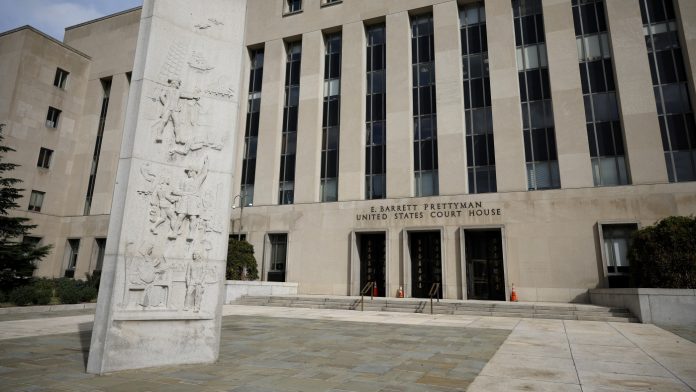
The E. Barrett Prettyman U.S. Courthouse is seen in Washington, D.C.

Kevin Dietsch/Getty Images North America


hide caption

toggle caption

Kevin Dietsch/Getty Images North America

In a win for the White House, the D.C. Circuit Court of Appeals has cleared the way for President Trump to fire two Democratic members of independent agencies. In a 2-1 decision, the court found that restrictions on the president’s power to remove officers of the executive branch are unconstitutional.

The ruling is significant, as a number of legal challenges to Trump’s firings appear headed for the Supreme Court. While the same panel of judges earlier ruled that Trump’s firing of U.S. Special Counsel Hampton Dellinger could go forward, this latest ruling was the first Appeals Court decision involving firings at agencies led by multiple-member boards since Trump took office.

The case involves National Labor Relations Board Member Gwynne Wilcox, whom Trump fired in January, and Merit Systems Protection Board Member Cathy Harris, who was fired in February. Both agencies hear cases involving workplace complaints.

These agencies and many others have historically operated with a degree of autonomy granted by Congress. Their structure, with Democratic and Republican members serving staggered terms, has helped ensure some distance and independence from the White House.

Members are nominated by presidents and confirmed by the Senate. But in creating those agencies, Congress held that presidents can only fire members for cause, such as neglect of duty or malfeasance.

In 1935, the Supreme Court upheld those limits on the president’s power in a case known as Humphrey’s Executor about another independent agency, the Federal Trade Commission. Now the future of that 90-year-old decision is highly uncertain.

Already, the Court’s current conservative supermajority has been chipping away at that precedent, finding that it doesn’t apply to agencies with a single head.

U.S. district judges ruled that it did apply in Wilcox’s and Harris’ cases, and ordered them returned to their seats.

Those decisions led the government to ask the D.C. Circuit Court for stays in both cases. Arguments were heard last week.

Since taking office, Trump has moved swiftly to bring independent agencies under his control, issuing an executive order requiring them to “regularly consult with and coordinate policies and priorities” with the White House.

Trump has fired more than 10 Democratic members of independent agencies, most recently the two Democrats on the Federal Trade Commission, who filed a lawsuit this week in federal court.

The White House has argued that since the Constitution holds the president accountable for the actions of the executive branch, he must be able to hire and fire at will.

D.C. Circuit Judge Justin Walker agreed, writing in a concurring opinion that Article II of the Constitution vests the president with the “entire” executive power, quoting from a recent Supreme Court decision. That includes the ability to remove executive officials, he wrote.

Already, there are concerns that if Humphrey’s Executor is overturned, Trump would be at liberty to fire members of other independent agencies, including the Federal Reserve.

A group of law professors filed an amicus brief with the Supreme Court in a separate case, expressing such concerns.

“The functioning of the Federal Reserve is essential to the stability of the American economy,” the law professors wrote. “Concerns (warranted or unwarranted) that its operations could be disrupted could foster financial and political instability and cause lasting harm.”

Sludge-Fertilizer Giant Leaves Texas Town Amid ‘Forever Chemicals’ Crisis

0

The City of Fort Worth, Texas, is ending its contract with Synagro, the Goldman Sachs-backed provider of fertilizer made from sewage sludge, over concerns that “forever chemicals” in the fertilizer are contaminating local farmland and groundwater.

Fort Worth this month also sued several manufacturers of the chemicals, also called per- and polyfluoroalkyl substances or PFAS, alleging that they contaminated the city’s water supplies.

The New York Times reported last year on a group of ranchers in Johnson County, just south of Fort Worth, who sued Synagro, blaming the fertilizer used on neighboring farmland for contaminating their crops and livestock.

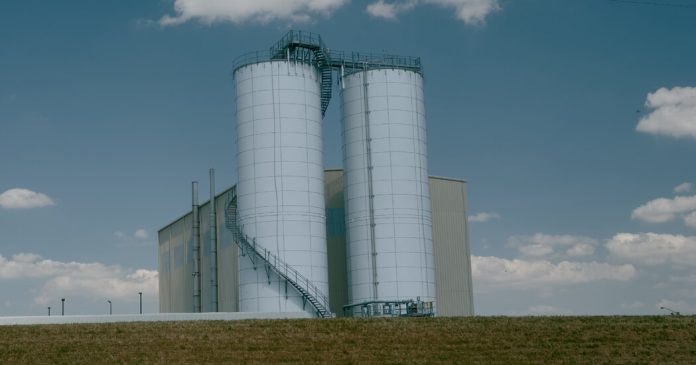
The sewage-sludge fertilizer came from Synagro, which had a contract to take sewage from Fort Worth’s sewage treatment plant, treat it further, and distribute it to farmers as fertilizer. Johnson County has since launched a criminal investigation into Synagro.

A growing body of research has shown that sewage sludge, much of which is used as fertilizer, can be contaminated with PFAS, a synthetic chemical used widely in everyday items like nonstick cookware and stain-resistant carpets.

The chemicals, which are linked to a range of illnesses including an increased risk of cancer, do not break down in the environment. When tainted sludge is used as fertilizer on farmland, it can contaminate the soil, groundwater, crops and livestock.

In January, the Environmental Protection Agency warned for the first time that PFAS present in sewage fertilizer, also known as biosolids, can pose human health risks. Maine, the only state that has started to systematically test farmland for PFAS, has detected the chemicals at dozens of dairy farms. But there has been little testing on farms in other states.

Fort Worth’s city council voted unanimously on Tuesday to cancel a 10-year contract signed with Synagro in 2019. The contract will end on April 1, and staff at the city’s water utility are working on new contracts for its biosolids operations, according to council records.

The city did not cite a reason for terminating the contract. But in a recent lawsuit filed by Fort Worth against the manufacturers of PFAS chemicals, the city cited the presence of PFAS in the city’s drinking-water sources and wastewater infrastructure.

Synagro said in a statement that the company and the city of Fort Worth “mutually agreed to part ways and settle all claims following ongoing disagreements regarding contract requirements.” It said that the termination was unrelated to PFAS. The city’s water department did not immediately respond to a request for comment.

Synagro, owned by Goldman Sachs Asset Management, has disputed claims that its biosolids have contaminated Texas farmland. This month, the company filed a motion to dismiss the Johnson County ranchers’ claims, citing an independent investigation it had commissioned that concluded that sludge fertilizer could not be the source of high PFAS levels found in the ranchers’ livestock.

Synagro also said testing had shown far lower levels of PFAS in the soil than claimed by the ranchers. The company has not publicly released the investigation.

Lawyers representing the ranches could not be reached for comment. The ranchers have stopped sending their cattle to market, while continuing to care for them, and say they face financial ruin.

Dana Ames, an environmental investigator leading Johnson County’s probe of Synagro, said an “exhaustive investigation” had found high levels of PFAS on the rancher’s property. “We have ruled out all other sources of contamination. We also tested the biosolids and found contamination,” she said.

At the council meeting, Luanne Langley, a resident of Grandview, Texas, accused the city of standing by while Synagro “dumped biosolids on unsuspecting landowners and farmers.” She said canceling the contract was not enough. “How is that going to help the families whose lives have been destroyed?” she said.

Visiting Greenland, Vance Finds the Weather and the Reception Chilly

0

President Trump has been less than subtle in his insistence that the United States will “get” Greenland one way or another, reiterating on Friday that the United States cannot “live without it.”

By the time he uttered those words in Oval Office, the highest-level American political expeditionary force ever to step foot on the vast territory had already landed to inspect the real estate prospects. But they were confined inside the fence of a remote, frozen American air base, the only place protesters could not show up.

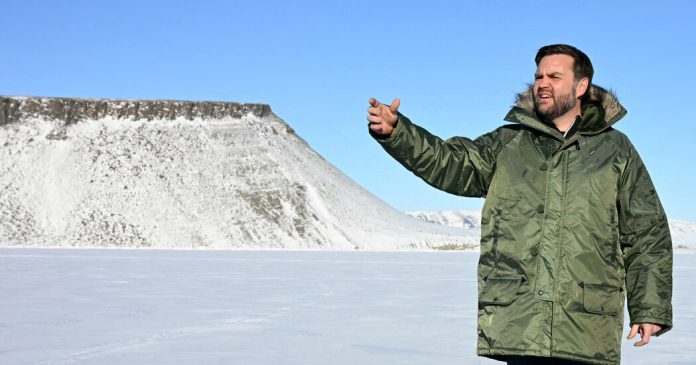
Led by Vice President JD Vance, the American visitors quickly discovered what past administrations have learned back to the 1860s: The meteorological conditions are as forbidding as the politics. When Mr. Vance’s plane touched down in the midday sunshine, 750 miles north of the Arctic Circle, it was minus 3 degrees outside.

Mr. Vance used a jocular and slightly vulgar epithet to describe the temperature, where he was wearing jeans and a parka, but no hat or gloves. “Nobody told me,” he said to the troops at the Pituffik Space Base as he entered their mess hall for lunch. The U.S. Space Force Guardians, who run what was once known after World War II as Thule Air Force Base, broke out laughing.

But for all the humor, the trip was simultaneously a reconnaissance mission and a passive-aggressive reminder of Mr. Trump’s determination to fulfill his territorial ambitions, no matter what the obstacles. As if to drive home the point, Mr. Trump told reporters in the Oval Office on Friday: “We have to have Greenland. It’s not a question of ‘Do you think we can do without it.’ We can’t.”

In fact, of the four territories Mr. Trump has discussed acquiring — Greenland, the Panama Canal, Canada and Gaza — it is Greenland that he seems most determined to get. Perhaps it is the vast expanse of the territory, far larger than Mexico. Perhaps it is its strategic location, or his determination to have an American “sphere of influence,” a very 19th-century view of how great powers deal with each other.

Yet one of the mysteries hanging over the Vance tour is how far Mr. Trump is willing to go to achieve his goal. That has been the question since early January, when Mr. Trump, awaiting his inauguration, was asked whether he would rule out economic or military coercion to get his way. “I’m not going to commit to that,” he said. “You might have to do something.”

Not since the days of William McKinley, who engaged in the Spanish-American War in the late 19th century and ended up with U.S. control of the Philippines, Guam and Puerto Rico, has an American president-elect so blatantly threatened the use of force to expand the country’s territorial boundaries. And the visit on Friday appeared designed to make that clear, without quite repeating the threat.

Mr. Vance is the first sitting vice president to visit a land that Americans have coveted for more than a century and a half. The fact that he was accompanied by the embattled national security adviser, Michael Waltz, and the energy secretary, Chris Wright, was clearly designed to underscore the strategic rationale that Mr. Trump cites as a justification for his territorial ambitions.

Before he landed, the leader of Greenland suggested that he viewed Mr. Waltz’s presence, in particular, as a show of Mr. Trump’s aggressive intent.

“What is the national security adviser doing in Greenland?” Múte Bourup Egede, Greenland’s 38-year-old prime minister, told the local newspaper Sermitsiaq on Sunday. “The only purpose is to demonstrate power over us.”

Mr. Egede and other Greenland officials made it clear that the Americans were not welcome for a visit. The White House had to scrap a good-will tour by Usha Vance, the vice president’s wife, who had been planning to attend a dog sled race and hold conversations with ordinary Greenlanders. As it became clear that the roads around Nook, the capital, would be lined with protesters, the visit was moved just to the Space Force base, where distance from any population center and high fences assured there would be no visible dissent.

Mr. Trump is not wrong when he claims that there are strategic advantages to acquiring the territory. William Seward, the secretary of state under Abraham Lincoln and Andrew Johnson, was negotiating to buy the territory for a bit more than $5 million in 1868 — with Iceland thrown in — just after he acquired Alaska. But the deal never came to fruition. Harry Truman wanted the territory after World War II, recognizing that failure to control it would give advantage to the Soviets, and make the United States more vulnerable to Soviet submarines.

Today Greenland is the site of a surface and undersea competition with China and Russia for access to the Arctic, a territory with vastly increased military and commercial importance since global warming made traversing polar routes easier. And Mr. Trump has made clear he is interested in Greenland’s untapped mineral reserves and rare earths, as he is in Ukraine, Russia and Canada.

“If you look at the globe, you can see why we prefer that the Russians and the Chinese don’t control this,” said Doug Bandow, a senior fellow at the libertarian Cato Institute in Washington. “But we don’t need to own it to protect it and prevent them from taking control.”

Mr. Trump, he said, “wants the resources of Greenland, but in today’s world you can buy resources.” And by expanding the American presence, he could defend against growing Chinese or Russian influence without seizing control of the land.

But Mr. Trump looks at the world through the eyes of a real estate developer, and he clearly cherishes territorial control. In his inaugural address he talked about “manifest destiny” and praised Mr. McKinley. James K. Polk’s portrait has made it on the wall of the Oval Office, along with a selection of other past presidents; he was the president who oversaw much of the American expansion to the West Coast.

Mr. Vance’s audience was American troops, not Greenlanders, once his wife’s trip was turned into a vice-presidential mission. But he was clearly talking to a larger audience when, before getting back on his plane and returning to warmer climes in Washington, he made the case that the United States would be a far better steward for Greenland than Denmark has been for several hundred years.

“Let’s be honest,” he said. “This base, the surrounding area, is less secure than it was 30, 40, years ago, because some of our allies haven’t kept up as China and Russia have taken greater and greater interest in Greenland, in this base, in the activities of the brave Americans right here.”

He charged that Denmark, and much of Europe, has not “kept pace with military spending, and Denmark has not kept pace in devoting the resources necessary to keep this base, to keep our troops, and in my view, to keep the people of Greenland safe from a lot of very aggressive incursions from Russia, from China and from other nations.”

It was a remarkable public critique of a NATO ally, but milder than what Mr. Vance said to his national security colleagues about European partners in the Signal chat that became public earlier in the week.

“Our message to Denmark is very simple, you have not done a good job by the people of Greenland,” Mr. Vance said, all but goading Greenlanders into declaring independence from Denmark. “You have underinvested in the people of Greenland and you have underinvested in the security architecture of this incredible, beautiful land mass, filled with incredible people.”

In an exchange with reporters, Mr. Vance seemed to acknowledge that the drive to acquire the territory had as much to do with Mr. Trump as the national security threat. “We can’t just ignore this place,” he said at one point. “We can’t just ignore the president’s desires. But most importantly, we can’t ignore what I said earlier, which is the Russian and Chinese encroachment in Greenland.”

“When the president says we’ve got to have Greenland, he’s saying this island is not safe,” he said. “A lot of people are interested in it. A lot of people are making a play.” But he was careful to say the decision about whom to partner with was Greenland’s. (Mr. Trump himself has not put it in such voluntary terms.)

Just before he left, Mr. Vance was asked if military plans had been drafted to take Greenland if it declines to become an American protectorate.

“We do not think that military force is ever going to be necessary,’’ he said. “We think the people of Greenland are rational and good, and we think we’re going to be able to cut a deal, Donald Trump-style, to ensure the security of this territory, but also the United States of America.”

How will the Smithsonian be affected by Trump’s executive order? : NPR

0

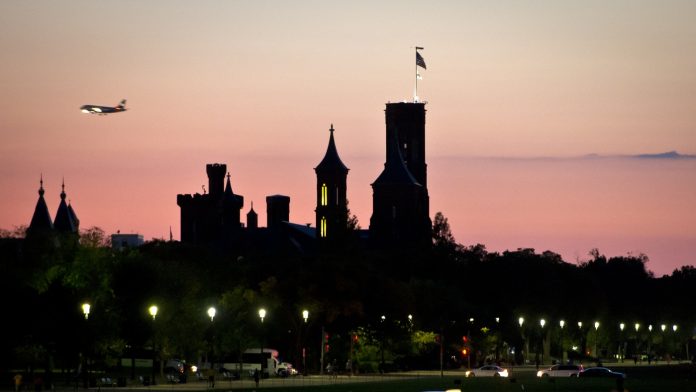
A view of the Smithsonian Institution Building in Washington, D.C., at sunset in September 2013.

Mladen Antonov/AFP via Getty Images


hide caption

toggle caption

Mladen Antonov/AFP via Getty Images

The Trump Administration has been moving quickly to eliminate what it considers “woke ideology” from the country’s arts and culture institutions.

On Thursday, President Trump signed an executive order that targets two recipients of federal funds: The Smithsonian Institution, a vast collection of research centers, museums and galleries, including the Air & Space Museum and the American Art Museum; and the monuments and memorials overseen by the Department of the Interior.

What does the order say?

The order is called “Restoring Truth and Sanity to American History” and the White House says the goal is “revitalizing key cultural institutions and reversing the spread of divisive ideology.”

It says that the Smithsonian promotes “narratives that portray American and Western values as inherently harmful and oppressive.”

But Jim Grossman, the executive director of the American Historical Association, says, “It misrepresents the work of the Smithsonian, which is one of the great research institutions in the world. Arguing that the Smithsonian somehow misleads people, somehow is unpatriotic, somehow is saying things that are not true. That’s simply not true.”

Yet the order directs Vice President JD Vance – who is on the Smithsonian’s board – to eliminate “improper, divisive, or anti-American ideology” from the museums, and to work with Congress to keep from funding exhibits or programs that “divide Americans by race.”

It singles out the forthcoming American Women’s History Museum, which does not yet have a physical building, and orders that it does not “recognize men as women.” This is how the Trump Administration has been referring to transgender women. An exhibit the museum curated, which is currently at the National Museum of American History, includes a T-shirt from a trans, non-binary athlete.

The executive order also directs the Department of the Interior, which oversees the National Parks and other public lands, to restore markers, statues and other memorials that have been “improperly removed or changed in the last five years to perpetuate a false revision of history or improperly minimize or disparage certain historical figures or events.”

Five years ago, in 2020, statues around the country were defaced or demolished as part of the Black Lives Matter protests. But national parks and historic sites around the country also have revised their messaging to reflect a more complicated understanding of American history, which includes not only American achievements but also the country’s underbelly, like the slaveholding of the Founding Fathers, the invisibility of LGBTQ people throughout much of history, and the taking of Native American land.

A portrait of President Trump in the America’s Presidents exhibition at the National Portrait Gallery in Washington, D.C., in May 2021.

A portrait of President Trump in the America’s Presidents exhibition at the National Portrait Gallery in Washington, D.C., in May 2021.

Win McNamee/Getty Images


hide caption

toggle caption

Win McNamee/Getty Images

What is possible for the administration to do?

The Smithsonian isn’t a federal agency — it’s a public-private partnership. But it does receive federal funds, and its employees are a mix of civil servants and people with “trust fund positions,” which are roles funded through sources that include business activities and grants.

Its governing body is a Board of Regents, whose members include the Vice President, the Chief Justice of the United States, three Senators, three Representatives and nine citizens. In the executive order, Trump said Vice President JD Vance would work with Congress to appoint citizens who were broadly in agreement with the order.

It is not clear what power the administration currently has over the Board of Regents, but the order ties future funding to compliance.

What is the Smithsonian’s response?

The Smithsonian has not yet released a statement.

But in response to a January executive order from President Trump, which forbid organizations receiving federal funds from operating Diversity, Equity and Inclusion programs, it did close its diversity office.

High Toll Is Feared After Earthquake Batters Myanmar and Thailand

0

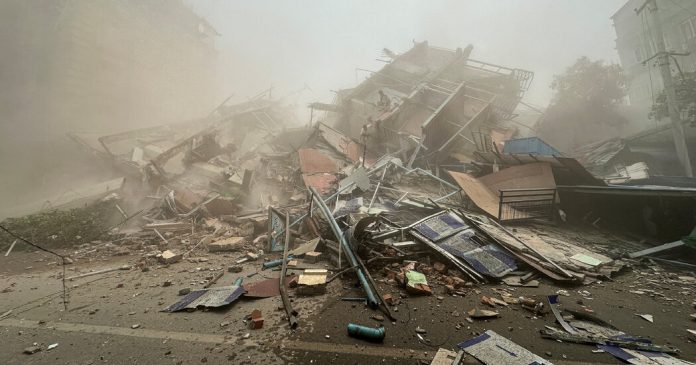
A powerful earthquake struck central Myanmar on Friday, gouging open roads, toppling century-old religious monuments and destroying multistory buildings as it shook a vast expanse of Southeast Asia and dealt another severe blow to a country that has been ripped apart by civil war.

While the death toll remains unclear, expert estimates warned it could be extraordinary, given the dense population and vulnerable structures near the epicenter, just outside Mandalay, Myanmar’s second-largest city. Modeling by the United States Geological Survey estimated that the death toll was likely to surpass 10,000, and that there was a strong possibility of a much higher toll.

A preliminary count from Myanmar’s military government said that at least 144 people had been killed and 732 injured in just three cities — but that did not include Mandalay.

The quake, measured by the U.S.G.S. at magnitude 7.7, was strong enough that it leveled a 33-story building that was under construction more than 600 miles away in Bangkok, in neighboring Thailand. At least eight people were confirmed dead there, and dozens more were missing, according to the authorities. They were all presumed to be members of the 320-person crew of workers who were putting up the new building for the Thai government.

The earthquake, which struck at about 12:50 p.m. local time, was only the third of its size to hit the region in the past century, and the U.S.G.S. analysis placed the epicenter just 10 miles from the heart of Mandalay, a city of about 1.5 million people. An aftershock of magnitude 6.7 was recorded about 11 minutes later, the first of several sizable tremors that followed the first one.

The shaking was felt as far away as Bangladesh, Vietnam, Thailand and southern China, where state news media reported that an unspecified number of people had been injured in Ruili, near the Myanmar border. Prime Minister Paetongtarn Shinawatra of Thailand declared Bangkok an “area of emergency” and urged residents to evacuate tall buildings in case of aftershocks.

In Myanmar, as bleeding victims rushed to hospitals by ambulance, car and motorbike, a surgeon at Mandalay General Hospital said that so many people had arrived for treatment that nurses had run out of cotton swabs and that he had nowhere to stand.

“More injured people keep arriving, but we do not have enough doctors and nurses,” said the surgeon, Dr. Kyaw Zin. Because phone lines were down, he said, he was unsure if his parents had survived.

“But I can’t go back home yet,” he said. “I have to save lives here first.”

Dozens of patients at the hospital — the main medical center in Mandalay — fled the building when it jolted and shuddered, jamming together in a nearby parking lot.

Some patients were still connected to intravenous drips and oxygen tanks. Others had their heads and arms bandaged and were lined up on stretchers, moaning. Many more were lying on cardboard, or directly on the concrete in the 100-degree heat.

Outside the hospital, Daw Kyi Shwin, 45, who was bleeding heavily, said that her 3-year-old daughter had been killed when their house began to collapse while they were having lunch. “I tried to run to her,” she said, “but before I could, bricks fell on me, too.”

Photos and videos from Myanmar showed scenes of stunning devastion. The Ava Bridge, a giant metal span, had partially collapsed into the Irrawaddy River. In Mandalay, monks in reddish robes cried out in shock as a multistory building at the New Masoeyein monastery fell near a toppled clock tower.

At a Buddhist monastery in Pindaya, about 70 miles from the epicenter, women wailed as the spire atop a century-old golden dome called a stupa toppled over, one of several that were damaged there. Rescue workers in other parts of the country dug through piles of twisted rebar and jagged concrete where buildings had been destroyed. Among the hard-hit places was Naypyidaw, the capital of the military government, about 150 miles from Mandalay.

The disaster compounded the monumental challenges facing Myanmar’s military rulers, who overthrew an elected government in 2021 and have restricted the country’s contact with the outside world. The junta has been steadily weakened since then, losing ground to rebels amid a bloody civil war that has left nearly 20 million of the country’s roughly 54 million people without enough food or shelter even before the quake, according to U.N. officials.

During past disasters, such as Cyclone Mocha in 2023 and Cyclone Nargis in 2008, Myanmar’s military rulers restricted the flow of international aid to hard-hit areas that were dominated by their foes.

But this time, the junta’s leaders immediately appealed for international help and declared a state of emergency in six regions of the country, news agencies reported, including Mandalay and Naypyidaw.

“We need and want the international community to provide humanitarian aid,” said a military spokesman, Gen. Zaw Min Tun. “We will cooperate with them to ensure the best care for the victims.”

The secretary general of the United Nations, António Guterres, said the organization was mobilizing to help people in need. The U.N. said it had allocated an initial $5 million from its emergency fund to help lifesaving operations in Myanmar.

President Trump said the United States would also provide assistance to Myanmar. “It’s a real bad one, and we will be helping,” he said in the Oval Office. “We’ve already spoken with the country.”

Aid organizations said that it was difficult to assess the full scope of the damage in many parts of Myanmar because electricity and communication lines were down. In addition, the junta has repeatedly shut off the internet and cut off access to social media, isolating the country.

The crackdown on internet access, intended to stifle dissent, could make it difficult to coordinate the delivery of aid.

The military has ruled Myanmar oppressively for most of the time since 1962; and even during periods of limited liberalization, the armed forces remained a major political power.

Michael Martin, a nonresident fellow at the Center for Strategic and International Studies, said the military could slow the delivery of supplies, deny visas to relief workers or direct more aid to areas nominally under its control, shortchanging areas under opposition control.

Mr. Martin said it was unclear to what extent the United States would help, given the Trump administration’s hostility to foreign aid programs and major cuts to the U.S. Agency for International Development.

Even before the quake, Myanmar’s health care system had been pushed to its limits. The junta has cracked down on doctors and nurses, who have been at the forefront of a civil disobedience movement opposed to the regime. Myanmar is considered one of the most dangerous places in the world to be a health worker, according to the New York-based Physicians for Human Rights.

Backed by military and financial support from China, India, Russia and Thailand, the junta controls about 20 percent of Myanmar, mainly urban areas. Its leader, Senior Gen. Min Aung Hlaing, has been accused of crimes against humanity by the International Criminal Court.

The military has persecuted ethnic minorities, and this month arrested the leader of an armed group that has sought to protect Rohingya Muslims from a scorched-earth campaign of arson, mass rape and killing that the United States has called genocide.

In Bangkok, rescue workers were toiling into the night after the 33-story building collapsed. Video of the collapse showed panicked construction workers running for safety and people on the street scrambling for cover, as a thick cloud of dust quickly enveloped the scene.

About 70 people were taken to local hospitals and two people were rescued from the rubble. Hours later, rescue workers and dogs searched for survivors amid fears that scores of people had been buried in the collapse.

In Mandalay, as the night deepened, terrified residents dragged mattresses and mosquito nets onto the streets to sleep. Others planned to spend the night in their cars. Many were too scared to return to their homes.

Myanmar is in one of the world’s most seismically active regions, where the Eurasian and Indian plates of the Earth’s crust grind against each other. In 2011, a magnitude 6.8 earthquake in eastern Myanmar killed more than 70 people and shattered hundreds of buildings.

Sui-Lee Wee and Richard C. Paddock reported from Bangkok, John Yoon from Seoul and Michael Levenson from New York. Reporting was contributed by Muktita Suhartono, Pablo Robles, Agnes Chang, Jenny Gross, Lara Jakes, Adam Satariano, Paul Mozur, Keith Bradsher and Vivian Wang.

In Photos: An Earthquake Rocks Myanmar and Thailand

0

A strong earthquake struck near Mandalay, Myanmar’s second-largest city, on Friday, damaging or collapsing bridges and buildings across a swath of Southeast Asia, killing nearly 150 people in Myanmar and injuring more than 700 others in just three cities, according to Myanmar’s military government.

The 7.7-magnitude quake struck just before 1 p.m. local time, and a strong, 6.4-magnitude aftershock followed 11 minutes later. The shaking was felt in southern China and Vietnam and as far away as Bangkok, Thailand’s capital, where a 30-story skyscraper under construction collapsed, killing at least seven people.

Details of casualties and damage in Myanmar, which has been ravaged by a four-year-long civil war, were not immediately clear. In Bangkok, people flooded into the streets out of fear of aftershocks, traffic was at a standstill, and videos captured water surging from the rooftop pools of hotels and residential towers.

Trump asks Supreme Court to allow deportations under Alien Enemies Act : NPR

0

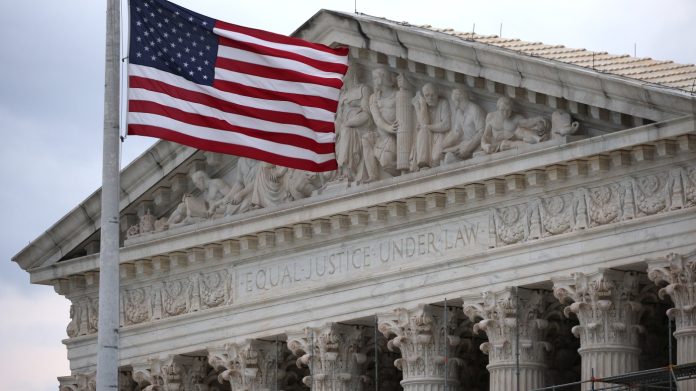
The U.S. Supreme Court is shown March 17, 2025 in Washington, D.C.

Win McNamee/Getty Images


hide caption

toggle caption

Win McNamee/Getty Images

President Trump’s administration asked the U.S. Supreme Court on Friday to lift a lower court’s order and allow it to use the Alien Enemies Act to swiftly remove alleged members of a Venezuelan gang.

Trump invoked the rarely used wartime power earlier this month when it sent more than 200 Venezuelan men to a maximum security prison in El Salvador. But U.S. District Judge James Boasberg temporarily blocked the use of the Alien Enemies Act. And a three-judge panel from the D.C. Circuit Court of Appeals earlier this week in a 2-1 ruling agreed to keep Boasberg’s order in place.

“This case presents fundamental questions about who decides how to conduct sensitive national-security-related operations in this country—the President, through Article II, or the Judiciary,” Acting Solicitor General Sarah Harris wrote in the appeal to the Supreme Court. “The Constitution supplies a clear answer: the President. The republic cannot afford a different choice.”

She added that Boasberg’s orders “have rebuffed the President’s judgments as to how to protect the Nation against foreign terrorist organizations and risk debilitating effects for delicate foreign negotiations.”

The American Civil Liberties Union and Democracy Forward sued the Trump administration over its use of the Alien Enemies Act. They said the administration removed people without due process.

Judge Patricia Millett said seemed to concur during oral arguments at the D.C. Circuit this week. “Nazis got better treatment under the Alien Enemies Act than what has happened here,” she said. “They had hearing boards before they were removed.”

The White House has said the Venezuelans removed to El Salvador belonged to Tren de Aragua, a criminal organization designated by the Trump administration as a foreign terrorist group. But the administration has provided little evidence to back those claims.

In fact, the administration has conceded in court documents that many of the people on these flights to El Salvador didn’t have criminal records in the U.S. But it says that “the lack of specific information about each individual actually highlights the risk they pose.”