Tuesday, November 10, 2026
Home Blog Page 10

A federal school choice program is advancing in Congress : NPR

0

A private school student works on a lesson at St. Luke’s Lutheran School in Oviedo, Fla.

Willie J. Allen Jr./Tribune News Service/Getty


hide caption

toggle caption

Willie J. Allen Jr./Tribune News Service/Getty

A first-of-its-kind effort to leverage federal tax dollars to help families pay for private school tuition anywhere in the U.S. is one step closer to becoming a reality.

Republicans on the House Ways and Means Committee voted this week to include a federal school voucher program, worth $20 billion over four years, in the broader reconciliation bill that would also extend President Trump’s 2017 tax cuts.

The voucher vote was hailed by Republicans and school choice advocates.

“Expanding President Trump’s tax cuts is about preserving the American Dream. Giving parents the ability to choose the best education for their child makes the dream possible,” Sen. Bill Cassidy, R-La., said in a statement. Cassidy helped lead the voucher effort in the Senate.

“We are one step closer to bringing school choice to every state in America,” Tommy Schultz, CEO of the American Federation for Children, said in a statement. “Ultimately, every child, especially from lower-income families, should have access to the school of their choice, and this legislation is the only way to make that happen.”

The response from traditional public school advocates was withering.

“Vouchers weaken public education and limit opportunities for students,” said NEA President Becky Pringle, head of the nation’s largest teacher union. “They siphon crucial funding from public schools—serving 90 percent of students—and redirect it to private institutions with no accountability.”

Public schools receive a portion of their funding based on per-pupil student enrollment. If they lose students to private schools, they will eventually lose that funding as well.

Among the measure’s strongest critics are advocates for students with disabilities, who argue it would not protect them from being poorly served or even turned away by private schools.

Public schools must follow federal disability law, which requires that they provide every child with a disability a free and appropriate public education. Private schools are not bound by the same rules.

“It is quite possible that families with disabilities will use a voucher under the pretense that their child will have the same rights when in fact they do not,” said Jacqueline Rodriguez, CEO of the National Center for Learning Disabilities.

Rodriguez said any promise to parents guaranteeing students will enjoy the same rights and protections in private schools that they do in public schools “is disingenuous at best and crooked at worst.”

How the proposed national school voucher would work

The proposed plan would use the federal tax code to create a national school voucher even in states where voters have fought such efforts.

Funding for these vouchers would come from private citizens who make charitable donations to what are known as Scholarship Granting Organizations (SGOs). To incentivize these donations, the federal government would give these donors a generous dollar-for-dollar tax credit.

For example: A donor who gives $5,000 to an SGO, to be used for private school scholarships, would then be able to reduce their overall tax burden by $5,000.

“It’s about three times as generous as what you’re gonna get from donating to a children’s hospital or a veteran’s group or any other cause,” said Carl Davis at the Institute on Taxation and Economic Policy. “It really preferences voucher groups over every other kind of charity.”

This is tax revenue the federal government is choosing to forego in the name of supporting education options outside the traditional public school system.

The SGO would then distribute the donated money in the form of scholarships for students to use on a range of expenses, including private school tuition, books and homeschooling costs.

The bill language would cap the tax credit at $5 billion dollars in each of the next four years, from 2026 through 2029.

This proposal is not targeted simply at low-income students, as some smaller, state-based voucher programs have been. In fact, under this federal proposal, most students in the U.S. could qualify for a voucher, as the household income limit would be set at 300% of a given area’s median gross income. Put another way, a student from an area of the country where the median gross income is $70,000 could qualify as long as their household income is below $210,000.

What we know about school voucher programs

School voucher programs have been around for decades, but broadly accessible, statewide programs have exploded in recent years – and with them the fight over whom and how much these programs really help.

Early results from these voucher programs show much of the money has gone to students who were already enrolled in private schools. After Oklahoma enacted its voucher program, state data revealed fewer than 10% of applicants were public school students.

In Iowa, a review also found that many private schools raised tuition after the launch of a statewide voucher program.

In terms of academic benefits, a recent review of Ohio’s program found voucher students were more likely to enroll in and complete college than their public school peers, and early studies of student test scores from small, targeted voucher programs showed some promise, though reviews of larger, newer programs have found a host of worrying results for students, including lower achievement in math and other subjects.

“The bigger and the more recent the voucher system, the worse the results for kids,” says Josh Cowen, a professor at Michigan State University who, after studying vouchers for more than two decades, publicly opposes them.

“If you think that test scores are the be all and end all measure of the effectiveness of a school choice intervention, then private school choice programs of late have fallen short,” says Patrick Wolf, a professor of education policy at the University of Arkansas. But Wolf points out, opinion polling suggests parents who turn to private school vouchers have more on their minds than just academic rigor, including safety and a fear of bullying.

President Trump tried and failed to pass a similar federal voucher initiative during his first term.

This current push to create a federal voucher program coincides with an unprecedented effort by the Trump administration to otherwise gut the federal government’s role in education.

The measure currently in the House must next survive a full vote there and ultimately find agreement in the Senate, where Republicans would need a simple majority to pass the bill.


Republicans voice concern over Trump’s support for a new Air Force One from Qatar : NPR

0

President Trump arrives in the Qatari capital Doha on Wednesday. Trump touched down at Hamad International Airport, with relations between the two governments in the spotlight over Qatar’s offer to Trump of a $400 million luxury aircraft to serve as a new Air Force One.

Brendan Smialowski/AFP via Getty Images


hide caption

toggle caption

Brendan Smialowski/AFP via Getty Images

Republican lawmakers are signaling growing concern over President Trump’s openness to accepting a $400 million plane from Qatar to serve as the new Air Force One, an unprecedented move fraught with ethical and legal issues that is testing even his biggest loyalists.

The chorus of reservations being expressed by Republican lawmakers represents a rare break with the president, who typically enjoys near total unanimity from the party.

On Wednesday, Rep. Michael McCaul, R-Texas, was among those taking issue with the idea. McCaul said he certainly received gifts in his former role as chair of the House Foreign Affairs committee and believed countries can gift to other countries, but a luxury Boeing 747 jet may go too far.

“This one’s pretty lavish!” McCaul said in a brief interview. “I would certainly sweep to make sure there aren’t any surveillance bugs on it.”

Missouri Sen. Josh Hawley said the move signals that Qatar is looking to get close to the U.S., but should instead be cutting ties with militant Islamic groups. He argued the president’s plane should not come from a foreign nation.

“I prefer a big, beautiful plane built in the United States, made in America, bought in America,” he said.

National security and aviation experts say the offer, first reported by ABC News, comes with plenty of risks. For his part, Trump has said the existing Air Force One planes are old and expensive to maintain, and he has long complained about the time it has taken for Boeing to deliver a pair of replacements that he agreed to pay $3.9 billion for during his first term.

Shortly before leaving for his current Middle East tour, Trump said it would be “stupid” not to accept the jet. On Tuesday night he again defended the plan, saying the plane was being offered as a gift to the Department of Defense, not to him.

“Why should our military, and therefore our taxpayers, be forced to pay hundreds of millions of Dollars when they can get it for FREE from a country that wants to reward us for a job well done,” Trump said on social media.

President Trump speaks to members of the press on Air Force One while flying over Saudi Arabia on his way to Qatar on Wednesday.

President Trump speaks to members of the press on Air Force One while flying over Saudi Arabia on his way to Qatar on Wednesday.

Brendan Smialowski/AFP via Getty Images


hide caption

toggle caption

Brendan Smialowski/AFP via Getty Images

The move would call for the Qatari plane to be retrofitted to serve as the new Air Force One, a complicated process that could stretch for years. Trump has said the plane would be decommissioned after his term and then put on display at his presidential library. He has also said he would not use it after leaving office.

Some Republicans say the plan is far from final

His comments followed remarks Tuesday by some of his biggest supporters, including Sens. Ted Cruz of Texas and Rand Paul of Kentucky, who say the effort presents security and legal challenges.

Some inside the party, including Senate Majority Leader John Thune, R-S.D., cautioned the plan is far from a sure thing.

“I don’t think there’s anything official out there, this is a hypothetical,” Thune told reporters. “I am sure if and when it’s no longer a hypothetical, I can assure you there will be plenty of scrutiny of whatever that arrangement might look like.”

Sen. Lisa Murkowski, R-Alaska, said there are enough questions surrounding the gift to trigger pause for the president.

“I got a lot of lot of concerns,” she said. “I don’t imagine it’s going to go forward, but maybe? Maybe they’re looking at it differently than me.”

Others in the party were less worried, and dismissed concerns that the gift represented a potential avenue for spying on the U.S.

“Yeah, 100% support it,” said Oklahoma Sen. Markwayne Mullin, a member of the Armed Services Committee.

“For anybody that has security concerns about it, they’re absolutely ignorant on intelligence. We are the best in the world at it, we understand what they could do and we understand how to find it better than anybody,” Mullin said.

Democrats say the plan could impact arms sales to Qatar

Senate Democrats are already planning to bring up a resolution of disapproval on the plans to gift the plane, but several concede that’s expected to fail. Democrats say the gift is a clear violation of the Constitution’s Foreign Emoluments Clause, which forbids office holders from accepting a present “of any kind whatever, from any King, Prince, or foreign State.”

Rhode Island Democratic Sen. Jack Reed, the party’s top member on the Senate Armed Services Committee, said Democrats plan to ask the Department of Defense for estimates to retrofit the jet — a figure he argues could bring the total price tag close to $1 billion.

“These aircraft are so unique,” Reed said. “You have to ensure that there’s nothing in the plane that’s an intelligence source for someone else — you literally have to take it apart the plane and put it together.”

He also noted “one of the other ironies” was that the U.S. manufacturer who would likely be needed to retrofit the plane for the president is Boeing — the same company already contracted to build new planes to be used as Air Force One.

Sen. Chris Murphy, D-Conn., admitted that Democratic efforts to force a vote on a resolution disapproving of the gift are unlikely to succeed. So he pointed to an upcoming vote to approve U.S. arms sales to Qatar as the chance to make Republicans go on the record.

“There’s no doubt that vote will be a proxy on whether you think it’s OK for a foreign government to hand a $400 million plane to the president of the United States.”

The debate over the plane has put plenty of Republicans in a bind over how to respond. House Speaker Mike Johnson, R-La., avoided addressing the dilemma with reporters on Wednesday. Johnson said his focus was on the reconciliation bill that House Republicans are hoping to pass by Memorial Day to enact the president’s domestic agenda.

“There are authorities that police the executive branch,” Johnson said. “That’s not me.”

Despite Johnson’s remark, Congress does in fact have the authority to investigate the executive branch. When Democrats controlled the House during Trump’s first term, for example, they conducted oversight of the Trump hotel and maintained his arrangement on the lease and money from foreign dignitaries who stayed in the hotel violated ethics rules.

Luke Garrett, Elena Moore and Barbara Sprunt contributed reporting.

The latest roadblock for House Republicans’ ‘big beautiful bill’: Senate Republicans : NPR

0

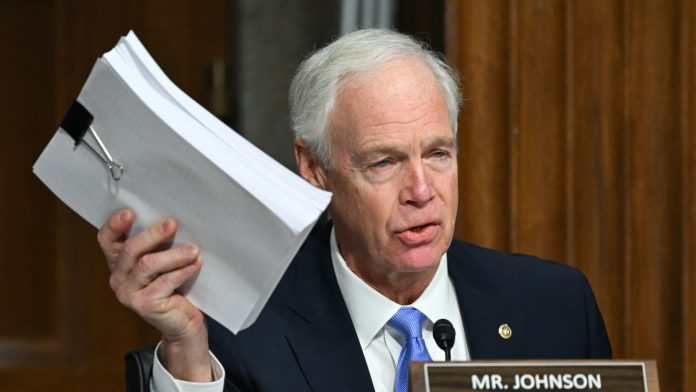
Wisconsin Republican Sen. Ron Johnson called the House budget plan a “sad joke.” He and other Senate Republicans are already raising questions about the legislation, even before the House finalizes their work.

ANDREW CABALLERO-REYNOLDS/AFP via Getty Images/AFP


hide caption

toggle caption

ANDREW CABALLERO-REYNOLDS/AFP via Getty Images/AFP

As House Speaker Mike Johnson, R-La., feverishly works to finalize the details of a massive package that includes major portions of President Trump’s agenda, many Senate Republicans are dismissing the legislation before it is even finished in the House.

“Unfortunately, it’s a sad joke,” Wisconsin GOP Sen. Ron Johnson said Wednesday

“Wimpy,” and “anemic” were the words Sen. Rand Paul, R-Ky., used to describe the spending cuts in the proposal.

The House package, which the speaker still says he wants to advance through the chamber before the Memorial Day recess, aims for $1.5 trillion in spending cuts to offset the costs of making the 2017 Trump tax cuts permanent. It also contains tax breaks that Trump campaigned on in 2024 — no taxes on tips and overtime — but those provisions are temporary.

Some conservatives in the House are pushing for $2 trillion in cuts– but that’s not far enough for Johnson who wants spending levels to revert back to what they were pre-pandemic. Sen. Johnson told reporters that he believes it was a mistake for leaders to try to pass so much of Trump’s agenda in one single bill, instead of three separate pieces of legislation that could be considered individually. As a result, he said he’d oppose the House bill “as it’s currently constructed.”

Other opponents include Sen. Josh Hawley, R-Missouri, who has been a vocal critic of the Medicaid program changes House Republicans have proposed. He publicly rebuked fellow Republicans’ efforts to restructure the health care program for low-income, elderly and disabled in a recent editorial published in the New York Times.

Hawley specifically opposes adding co-pays for some Medicaid recipients and freezing state taxes on hospitals that help boost how much federal money goes to rural hospitals as items that are non-starters.

“I’m not going to support this bill from the House, in this form. I think it’s clear it’s got to change before it can pass the Senate,” Hawley told CNN on Wednesday.

A chance for the Senate to make changes

One solution could be for Senators to put their own stamp on whatever the House passes.

“It’s a good start,” Sen. John Cornyn, R-Texas, said Wednesday.

Cornyn told NPR he expects the Senate rules will impact the final version of the bill. Republicans are using a feature of the budget process known as reconciliation to advance the legislation without the threat of a filibuster by Senate Democrats — but that process has special rules and procedures.

“I’m confident the Senate will have its own ideas and we will pass a bill here that may differ some from the House but then ultimately have to work out the differences,” He said.

Cornyn didn’t weigh on his GOP Senate colleagues’ criticisms on various pieces of the House bill, saying, “I’m more interested in saving the American people from a multi-trillion dollar tax increase.”

New York Rep. Nick LaLota told reporters “dozens” of his fellow House Republicans have told Speaker Johnson they are worried they will vote for a package that is disregarded by the Senate.

“Those members are insisting that either the Senate go first or the Senate and the president bless off whatever bill that we’re ultimately asked to vote on.” LaLota said.

He pointed to the experience in 2017 when some Republicans in Congress at the time backed a bill and felt burned after Trump later called the proposal “mean.”

LaLota is part of a group negotiating with the speaker to restore a tax break dubbed “SALT” that allows their constituents to deduct more of their state and local taxes. But any move to increase the cap on the SALT deduction will add to the overall price tag of the bill.

The issue of that deduction, which impacts largely blue states, isn’t a major concern among Senate Republicans.

Sen. Paul also said he opposed the House bill’s provision to lift the country’s borrowing authority by $4 trillion, “I’m not for increasing the debt ceiling 4 or 5 trillion [dollars] — I’m for balanced budget, limited constitutional government, so I’m just not for that.”

Hardline anti-abortion movement leans into 'manhood' debate to broaden appeal

0

A small network of anti-abortion rights activists has been making progress pushing for bills that would classify people who get abortions as criminals.

Book claims to outline Biden’s cognitive decline, staff coverup : NPR

0

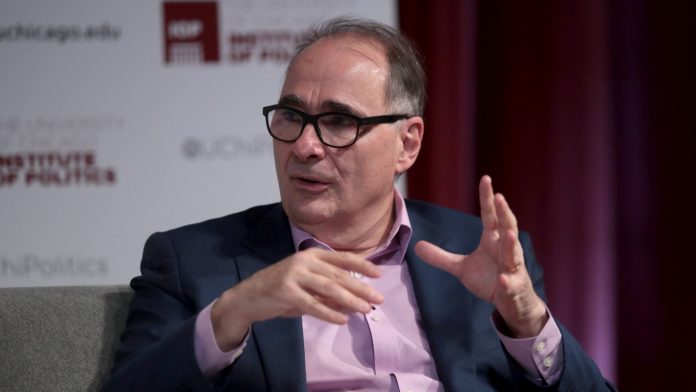
David Axelrod asks Pete Buttigieg questions during an event at the University of Chicago on October 18, 2019, in Chicago, Illinois.

Scott Olson/Getty Images/Getty Images North America


hide caption

toggle caption

Scott Olson/Getty Images/Getty Images North America

A forthcoming book by two political reporters claims to reveal extensive details about the physical and cognitive decline of former President Joe Biden, and what the authors describe as a concerted effort by his aides to keep it hidden from public view.

Original Sin: President Biden’s Decline, Its Cover-Up, and His Disastrous Choice to Run Again, by CNN’s Jake Tapper and Axios reporter Alex Thompson, is set for release later this month. NPR’s Morning Edition team has not obtained an advance copy of the book. But an excerpt published in The New Yorker describes several behind-the-scenes episodes, including a now-infamous California fundraiser in June 2024 where Biden appeared disoriented and reportedly didn’t recognize actor George Clooney, a longtime supporter and friend.

David Axelrod, senior CNN political commentator and former adviser to President Barack Obama, told NPR’s Michel Martin that the details in the excerpt were “somewhat stunning.” Axelrod added that what was described was indicative of a deeper issue within Biden’s inner circle, the Democratic Party, and in Biden’s family that, in Axelrod’s view, enabled it to happen.

“What struck me was that when you are president of the United States, fatigue and strain is your daily existence,” Axelrod said. “And this is why I said in 2022 that it was going to be hard to make the case that he should be president for four more years.”

The book joins a growing list of titles scrutinizing Biden’s presidency, with some already released. In Uncharted: How Trump Beat Biden, Harris, and the Odds in the Wildest Campaign in History, author Chris Whipple discussed how Biden’s family and closest advisers seemed to operate in a “fog of delusion and denial.”

Tapper and Thompson argue in their book that Biden’s decision to run for re-election at 81 was the “original sin” of the 2024 race, followed by what they describe as “aggressive efforts to hide his cognitive diminishment.”

A spokesperson from Biden’s office said the former president did not review the book nor were they contacted for fact checks. They also characterized the book’s release as an effort to make a profit and said. “We continue to await anything that shows where Joe Biden had to make a presidential decision or where national security was threatened or where he was unable to do his job,” said the spokesperson. They added, “He was a very effective president.”

In his conversation with Martin, Axelrod spoke about the excerpts released from the book and his thoughts on Biden’s decision to make public appearances so soon after leaving office.

Interview highlights

Michel Martin: I don’t know if you’ve had a chance to read the book. The official release date is May 20. But portions have been coming out. There’s an excerpt, for example, in The New Yorker. What strikes you about what’s been reported so far?

Axelrod: I haven’t gotten a chance to read the whole book yet. But the details in the New Yorker excerpt were somewhat stunning. The public saw what was reported there at the event in California with George Clooney and this sort of disconnection of President Biden.

Martin: You’re talking about that high profile fundraiser, which was co-hosted by superstar George Clooney, at which it was reported later that Biden didn’t seem to recognize him, somebody he’d known for years.

Axelrod: The details behind it were troubling. The thing that I was struck by was the reporting on his schedule before this event, and the rigors of what he was up to, and people dismissing his kind of being vacant, not being able to identify George Clooney, a friend of two decades, when he saw him, dismissed it as a function of jet lag and fatigue. What struck me was that when you are president of the United States, fatigue and strain is your daily existence. The presidency is relentless. And this is why I said in 2022 that it was going to be hard to make the case that he should be president for four more years.

Martin: So there were signals of his decline in his public appearances. But Thompson and Tapper write of what they say was a concerted effort to hide how serious President Biden’s health issues were. They have a lot of anecdotes about the various steps that were taken to try to minimize those realities being seen. Is it fair to say that the White House was simply lying about the President’s health?

Axelrod: I don’t know whether lying is the right word. Because I don’t know if there is a particular condition that he was laboring under. What is clear is that they did everything they could to adapt his public appearances and adapt his schedule to his declining condition. And even as they were making the argument to the American people that he was equipped to serve another four years, I think they were motivated by a belief in him, by a desire to see him continue. But it was an irresponsible decision on his part, and I have to say, on his family’s part.

Martin: What do you make of the former president making these public appearances? I mean it’s noteworthy in that, former President Obama, former President George W. Bush, former President George H.W. Bush, rarely made public appearances. What do you make of these appearances that Biden is making? What do you think he’s doing?

Axelrod: The same people who were giving him bad advice before continue to give him bad advice. Because all he’s doing is making the story larger. I thought he was poignant on The View, you know, trailing off at times. And the First Lady jumping in to finish his thoughts. –And it just stirred the whole thing up again. If he’s concerned about President Trump and some of the things that President Trump is doing, then he should want the Democratic Party to be in a position to move on and do well in the midterm elections. Him being out there does not serve that purpose. I think he’s doing himself a disservice. And I think he continues to do the party and the country a disservice. It’d be best to just allow this to pass. But I think he feels strongly that he wants to rebut this book. And I’m not sure that his appearances so far have effectively done that.

Ryan Routh wants assassination case against Trump dropped : NPR

0

Ryan Routh, the man accused in a 2024 assassination attempt of Donald Trump at a West Palm Beach, Fla. golf course, had a federal court hearing Wednesday in Fort Pierce, Fla. In this file photo of the Alto Lee Adams Sr. United States Courthouse, attorneys argued several merits of the case — including what can and can’t be used in the trial.

Joe Raedle/Getty Images


hide caption

toggle caption

Joe Raedle/Getty Images

FORT PIERCE, Fla. — The man charged with attempting to assassinate Donald Trump when he was running for president last year has asked a judge to dismiss some of the charges against him.

Prosecutors say Ryan Routh was planning an assassination attempt before he was detected by a Secret Service agent at Trump’s West Palm Beach club in September. Routh has pleaded not guilty.

At a hearing in federal court here on Wednesday, Routh’s defense lawyers argued that two of the charges against him should be dismissed because they violate his Second Amendment rights. Routh is accused of illegally owning a firearm as a convicted felon and possessing a firearm with an obliterated serial number.

Federal public defender Sonia Fahrezi told U.S. District Judge Aileen Cannon that recent court decisions show, “The Second Amendment doesn’t just apply to law-abiding citizens.” Routh has two prior felony convictions, including one for illegally possessing dynamite. Fahrezi says those convictions should not preclude him from exercising his constitutional right to own a firearm. And she said, “The absence of a serial number doesn’t remove a firearm from the Second Amendment text.”

Ryan Routh, shown here being interviewed during a rally in Kyiv, Ukraine in 2022, is accused in the assassination attempt of Donald Trump in 2024 at Trump's golf course in West Palm Beach, Fla.

Ryan Routh, shown here being interviewed during a rally in Kyiv, Ukraine in 2022, is accused in the assassination attempt of Donald Trump in 2024 at Trump’s golf course in West Palm Beach, Fla.

Nicolas Garcia/AFP via Getty Images


hide caption

toggle caption

Nicolas Garcia/AFP via Getty Images

Justice Department prosecutor John Shipley said the statute that prohibits felons from possessing firearms is still law. And he said, “A firearm with an obliterated serial number has no lawful purpose.”

Judge Cannon was appointed by President Trump. She’s the same judge who dismissed charges against the president for mishandling classified documents at his home in Mar-a-Lago.

In addition to the felony gun counts, Routh faces three other charges, including attempting to assassinate a presidential candidate.

Routh has been in federal custody since his arrest in September. A Secret Service agent who was part of Trump’s security detail says he saw a gun barrel poking from the tree line a few holes ahead of where the then-presidential candidate was golfing. The agent fired at the person holding the gun. A man later identified as Routh fled the scene and was arrested a short time later driving north on Interstate-95.

On Wednesday, Routh’s lawyers asked Judge Cannon to suppress the testimony of the witness who identified their client as the person who was seen running from Trump’s golf club.

Two hours after the incident, the witness, identified in court by his initials, TCM, was flown by helicopter to a location on I-95. Routh’s lawyer Renee Sihvola said, he saw from the helicopter the traffic stopped on the interstate, and was taken by car to a location where he was presented with a single suspect, a handcuffed Routh. The defense says that was “impermissibly suggestive” and created a “substantial likelihood” that he was misidentified.

Sihvola asked Judge Cannon to order a hearing to explore how Routh was identified as the person TCM saw running from the golf club. Sihvola said, “The totality of the circumstances suggest it was unreliable.”

Prosecutor Christopher Browne told the judge the witness, TCM, was a “good Samaritan” who heard gunshots and made a U-turn in his vehicle to get a better look at the person he saw running from the golf club. “There is zero potential for misidentification in this case, “he said.

Prosecutors also asked the judge to exclude Routh’s lawyers from arguing their client lacked the mental or physical capacity to pose a real threat to Trump.

The SKS-style rifle left at the scene wasn’t fired and had a scope attached to it in a makeshift manner using electrical tape. Routh’s lawyers want their own experts to testify on how well or whether it would have worked if fired at Trump that day. The judge granted a defense request to conduct a live-fire test of the weapon, but said it could not be tested for range or accuracy.

Routh’s trial is set to begin in September.

Medicaid cuts will ‘hurt families,’ says Gov. Andy Beshear : NPR

0

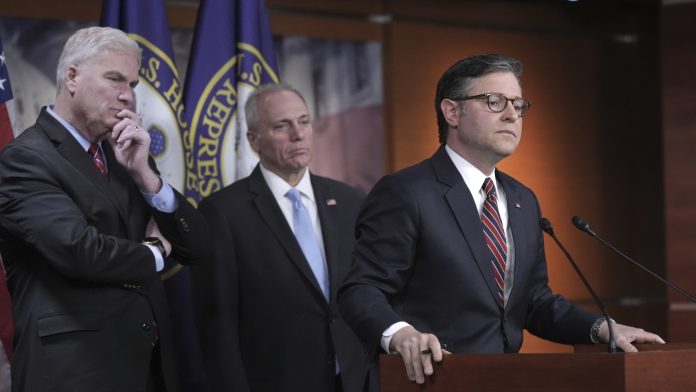
Speaker of the House Mike Johnson, R-La., joined (from left) by House Majority Whip Tom Emmer, R-Minn., and House Majority Leader Steve Scalise, R-La., talks to reporters at the Capitol in Washington, April 8, 2025.

J. Scott Applewhite/AP


hide caption

toggle caption

J. Scott Applewhite/AP

The country’s Democratic governors are sounding the alarm over a Republican plan that they say would leave millions of people without access to health care.

A bill drafted by House Republicans calls for hundreds of billions of dollars in cuts and steps to make it harder to enroll in or stay in Medicaid, the program that provides health coverage for low- and middle-income households. Among the changes are tougher eligibility requirements and work requirements, the Associated Press reports.

The nonpartisan Congressional Budget Office estimates that at least 8.6 million people would lose health insurance coverage by 2034 with the proposed cuts and changes to Medicaid. Republicans also proposed cuts to the Supplemental Nutrition Assistance Program (SNAP).

All 23 Democratic governors signed a statement saying that “Republicans’ proposed cuts would be disastrous – ripping away quality, affordable health care from families, forcing rural hospitals to close their doors, and causing fiscal chaos across the country.” The statement also says that the notion that states will be able to backfill the cuts with state resources is “simply inaccurate and impossible.”

Kentucky Gov. Andy Beshear speaks during the Semafor World Economy Summit 2025 at Conrad Washington on April 23 in Washington, DC.

Kentucky Gov. Andy Beshear speaks during the Semafor World Economy Summit 2025 at Conrad Washington on April 23 in Washington, DC.

Kayla Bartkowski/Getty Images


hide caption

toggle caption

Kayla Bartkowski/Getty Images

In an interview with Morning Edition, Gov. Andy Beshear of Kentucky, one of the governors who signed the statement, called Republicans’ bill a “bad plan that is going to hurt families” and warned Republicans that they will face electoral backlash.

Beshear also discussed his state’s reliance on Medicaid, where cuts to the program will hurt the most and how Democrats can push back against the GOP while being fully out of power in Washington.

This interview has been lightly edited for length and clarity.

Interview highlights 

Michel Martin: So what are your biggest concerns should this bill become law? How do you see it playing out in your state? What are your top three worries?

Gov. Andy Beshear: My biggest concerns are the people who need health care coverage are going to lose it. Medicaid covers the people we love the most, our parents and our kids. Half of Kentucky’s kids are covered by Medicaid, and 70% of our long-term care costs are covered by Medicaid.

And so when the analysis that is coming out about this bill shows that millions of people will lose their health care. One set of analysis set up to eight and a half million. That’s almost double the entire population of my state. It means that kids will lose health care. It means that seniors will lose health care. And what that means is that families will struggle to make up those dollars and to make up that care.

Now, Medicaid is something that also drives and fuels rural health care. And if you remove coverage for millions of people, you remove significant revenue going into those hospital systems. So what we’ll see are layoffs. We will see closures and we’ll see folks that live in rural America having to drive hours just to see a doctor.

And then finally, the cuts to snap are just mean and cruel. You know, my faith teaches me that there should be enough food for everyone. The miracle of the fishes and the loaves is in every single book of the gospel. And in a country where we grow food for all of our people, a program like SNAP just makes sure that we don’t have hungry kids, that we don’t have hungry families, and that ultimately everybody has the basic food that they need to get healthy and to get into that workforce.

Martin: So Republicans argue two things. One is that there’s a lot of fraud and waste in Medicaid. And the second is that the program has expanded beyond what it was intended for. And if you address those things, it’ll preserve the program for the people who really need it. What do you say to that?

Beshear: If you’re worried that there’s fraud and abuse, there are units that are already out there that are going after bad providers. I ran one of them. Just about every attorneys general office has one. And if you want to ferret out fraud, better fund those units and you will get those results. But what this plan tries to do is to add burdens to those that are on Medicaid to fill out forms more often, to check the right box, to create just more challenges so that someone will not fill out something correctly and they’ll lose coverage for a certain period of time. It’s what I’m also concerned that this administration is trying to do on Social Security by shutting down offices and shutting down the call center and making those on a fixed income drive an hour or two to show up to an office and to not have the right forms. This is an effort just to make it harder for people who already qualify to get the health care that they need.

Martin: So there are some people within the Republican Party who wanted more aggressive cuts to Medicaid who think these cuts don’t go far enough and things that they wanted are not in this bill, like, for example, per capita limits on Medicaid spending. So this represents a compromise from their perspective. Are there things that Democrats should be willing to consider in order to address their concerns?

Beshear: I think you should always be willing to consider a plan that’s out there. But the more hardline Republicans would have it almost eliminated, if not fully eliminated, rural health care. You look at rural hospital systems that are the second largest employer in most of the counties that they’re in after the public school systems. Many of them have up to 40% of their total revenue in Medicaid. Major slashes to Medicaid, even this plan, threaten that rural health care. And I think that rural Americans ought to be able to see a doctor, ought to be able to go to a clinic, ought to be able to see a nurse practitioner in their own communities. And so what I’d say to those hard liners is go out and talk to the people in your communities. They are not for this. People understand Medicaid in a different way than they did 20 years ago. They realize how important it is to their local economy and to their family.

Martin: Given the Republican Party’s control of both houses of Congress and the White House, is there really anything that Democrats can do beyond issuing statements like the one that the Democratic governors did to stop this?

Beshear: We can speak up and we can speak out and so can all of the American people. This is a really bad plan that is going to hurt families. And when you look at anything from polling numbers to what I hear in communities, they are going to react and react negatively to this Republican plan. This is going to cost Republicans not just in swing districts, but in many districts their seats. And so I hope they don’t do it. I hope they don’t do it to preserve health care for families. But if it takes electoral pressure, then so be it.

The radio version of this story was edited by Arezou Rezvani. The digital version was edited by Treye Green.

8th Circuit rules on Voting Rights Act in North Dakota case : NPR

0

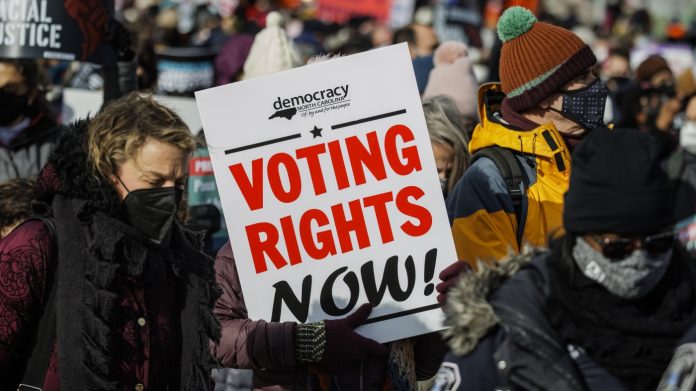
A demonstrator carrying a sign that says “VOTING RIGHTS NOW” walks across the Frederick Douglass Memorial Bridge in 2022 in Washington, D.C.

Samuel Corum/Getty Images


hide caption

toggle caption

Samuel Corum/Getty Images

A panel of the 8th U.S. Circuit Court of Appeals has struck down one of the key remaining ways of enforcing the federal Voting Rights Act in seven mainly Midwestern states.

For decades, private individuals and groups have brought the majority of lawsuits for enforcing the landmark law’s Section 2 protections against racial discrimination in the election process.

But in a 2-1 ruling released Wednesday, the three-judge panel found that Section 2 cannot be enforced by lawsuits from private parties under a separate federal statute known as Section 1983.

That statute gives individuals the right to sue state and local government officials for violating their civil rights. Section 1983 stems from the 1871 Ku Klux Klan Act that Congress passed after the Civil War to protect Black people in the South from white supremacist violence, and voting rights advocates have considered it an antidote to a controversial 2023 decision by a different federal appeals panel that made it harder to enforce Section 2 in the 8th Circuit.

That earlier panel found that Section 2 is not privately enforceable because the Voting Rights Act does not explicitly name private individuals and groups. Only the head of the Justice Department can bring these types of lawsuits, that panel concluded.

Under the current Trump administration, the Justice Department has stepped away from Section 2 cases that had begun during the Biden administration.

The 8th Circuit includes Arkansas, Iowa, Minnesota, Missouri, Nebraska, North Dakota and South Dakota. The latest ruling comes out of a North Dakota redistricting lawsuit by the Turtle Mountain Band of Chippewa Indians and the Spirit Lake Tribe. Citing Section 1983 as a basis for bringing the case as private groups, the tribal nations challenged a map of state legislative voting districts, which was approved by North Dakota’s Republican-controlled legislature after the 2020 census.

In a part of the state where voting is racially polarized, the tribal nations argued, the redistricting lines drawn by the state lawmakers reduce the opportunity for Native American voters to elect candidates of their choice.

“For the first time in over 30 years, there are zero Native Americans serving in the North Dakota state Senate today because of the way the 2020 redistricting lines were configured,” Mark Gaber, an attorney with the Campaign Legal Center, which is representing the tribal nations, said during a court hearing in October 2024.

A lower court struck down the redistricting plan for violating Section 2 by diluting the collective power of Native American voters in northeastern North Dakota.

But the state’s Republican secretary of state, Michael Howe, appealed the lower court’s ruling to the 8th Circuit, arguing that, contrary to decades of precedent, Section 1983 does not allow private individuals and groups to bring this kind of lawsuit.

Since 2021, Republican officials in Arkansas and Louisiana have made similar novel arguments in redistricting lawsuits after Justice Neil Gorsuch, President Trump’s first Supreme Court appointee, issued a single-paragraph opinion that said lower courts have considered whether private individuals can sue an “open question.” For this North Dakota lawsuit, 14 GOP state attorneys general signed on to a friend-of-the-court brief arguing that private parties don’t have a right to sue with Section 2 claims.

In a separate Arkansas-based case before the 8th Circuit, GOP state officials have also questioned whether there is a private right of action under another part of the Voting Rights Acts — Section 208, which states that voters who need assistance to vote because of a disability or inability to read or write can generally receive help from a person of their choice.

Many legal experts consider this questioning of a private right of action as the prelude to the next potential showdown over the Voting Rights Act at the Supreme Court, where multiple rulings by the court’s conservative majority have eroded the law’s protections over the past decade.

Edited by Benjamin Swasey

Arab and Black communities are trying to reconcile after Trump’s election : Code Switch : NPR

0
Two hands sharing food at an iftar

Trump’s win exposed political tensions between Arab-American voters — who were critical of Democratic support of Israel’s war in Gaza, and Black voters — who remain the Democrats’ most loyal supporters. That friction is especially pronounced in the majority Arab city of Dearborn, Michigan, and its majority Black neighbor, Detroit.

This week, we go to a testy iftar dinner in Dearborn, where Arab and Black folks sat down to begin having tough conversations about how to move forward.

This episode was produced by Xavier Lopez and Jess Kung. It was edited by Courtney Stein. Our engineer was Robert Rodriguez.

Okla. education standards cite 2020 election ‘discrepancies’ : NPR

0

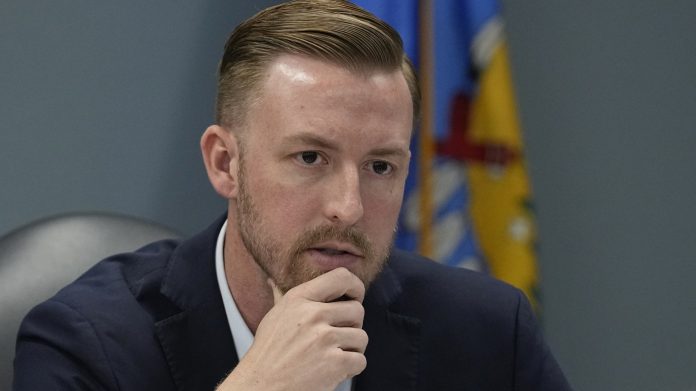
Oklahoma Superintendent of Public Instruction Ryan Walters, seen here in 2023, has championed the new state education standards that include instructions for students to “identify discrepancies in 2020 election results.”

Sue Ogrocki/AP


hide caption

toggle caption

Sue Ogrocki/AP

TULSA, Okla. — New academic standards in Oklahoma call for the teaching of “discrepancies” in the 2020 election results, continuing the spread of a false narrative years after it was first pushed by President Trump and his allies.

The standards were enacted last month after the Republican-controlled legislature declined to block them. And while the process to advance the standards has drawn ire from members of Oklahoma’s majority party, the question of the standards’ content has gotten little pushback.

What the standards say — and how they took effect

The social studies standard for high school U.S. history references baseless claims about the ballot counting process and the security of mail voting.

It says students must: “Identify discrepancies in 2020 elections results by looking at graphs and other information, including the sudden halting of ballot-counting in select cities and in key battleground states, the security risks of mail-in balloting, sudden batch dumps, an unforeseen record number of voters, and the unprecedented contradiction of ‘bellwether county’ trends.”

The new standards have been championed by Ryan Walters, the state superintendent of public instruction and a conservative firebrand.

“These new standards will ensure that kids have an accurate and comprehensive view of historical events, while also reinforcing the values that make our country great,” Walters said at a February State Board of Education meeting.

The new standards were quietly introduced just hours before that February meeting, and Walters falsely told board members that to make legislative deadlines, the standards needed to be approved that day. They were.

New board members spent the next two months asking the state legislature to return the standards back to the board, saying there had not been enough time to review the changes.

Citing that rushed process, Senate Republicans authored a joint resolution to reject the standards, and GOP Gov. Kevin Stitt also requested the legislature send the standards back to the board.

But in April, after a closed-door meeting with Walters, the state legislature declined to block the standards.

Oklahoma Republicans, like House Speaker Kyle Hilbert, have defended the standards’ content.

“I think that students should be challenged to think critically about that particular election and what led to that high turnout as well as all the reforms that you saw states pass in the wake of that,” Hilbert said at a March press conference. “So I think if you’re going to talk about the 2020 election, that’s a centerpiece of the conversation, of challenging students to think critically about those important questions.”

Navigating teaching false election claims

Others say critical thinking is not what the standards prescribe students to do.

Anton Schulzki, the interim executive director of the National Council for the Social Studies, points out that the 2020 election standard seems to instruct students that so-called “discrepancies” are an accepted position.

“And that’s not necessarily in the best practice,” Schulzki said. “If you want someone to really do some inquiry, then you would have to let the student ask the question.”

Tammy Patrick, chief programs officer for the Election Center, objects to the standards’ mention of “batch dumps” of ballots, for instance. She says without a conversation about how late-night counts are often standard operating procedure, it is a recipe for misunderstanding.

“That is not teaching critical thought,” Patrick said. “Teaching critical thought is to frame it in such a way that instructs the students to find something that sounds odd to them, and then to dig deeper into, why is it the case that the thing that sounds strange to you, when you put it into context, is it still odd? Or do you now understand better the complexity of conducting elections in the United States of America?”

Patrick said false claims about the election have eroded public confidence in the system.

“And it will continue to erode if we continue to have these false narratives being repeated continually and used in an academic setting as though they are truth and fact by teachers, educators [and] state boards putting this out as though this is the same level of accuracy and correctness as a mathematical or scientific theorem,” Patrick said.

Academic standards in Oklahoma are the required list of topics that teachers must cover to maintain their certifications and a school’s accreditation status. School districts choose the textbooks and curriculum to meet the standards.

Aaron Baker is an Oklahoma City high school government teacher. Because the standard is for U.S. History, he won’t teach them in his classroom. But he said if he had to, he would include a fact check.

“I would have no qualms at all about telling my students — in fact, I’ve been telling my students for four years — that the courts have declared over and over again, multiple times, that there was not widespread voter fraud in the 2020 election,” Baker said.

Another issue that critics like Baker decry about the new standards is how they came into existence.

Late into the review process, the standards were overhauled by state officials, dismissing months of work by educators. Walters tapped leading conservative figures like Kevin Roberts, president of the Heritage Foundation, which put out the Project 2025 blueprint for a second Trump term, and Prager U’s Dennis Prager for the standards’ Executive Review Committee.

And while Walters has not answered questions about the committee’s reach, Baker said the move sent a message to Oklahoma educators: “No. 1, we don’t care what you think about these standards. And No. 2, we don’t care that this is uniquely Oklahoma. These are Oklahoma students being taught by Oklahoma educators, but the leadership at the state [education] department is perfectly comfortable with bringing in outside voices to tell us what our students should learn and what we should teach them.”

While the standards are set to go into effect next school year, a lawsuit filed by a GOP former Oklahoma attorney general could stall their implementation.

But like other criticisms coming from Republicans, the lawsuit calls out problems in the approval process — not the standards themselves.