Tuesday, November 10, 2026
Home Blog Page 11

Trump meets Syria’s interim president al-Sharaa : NPR

0

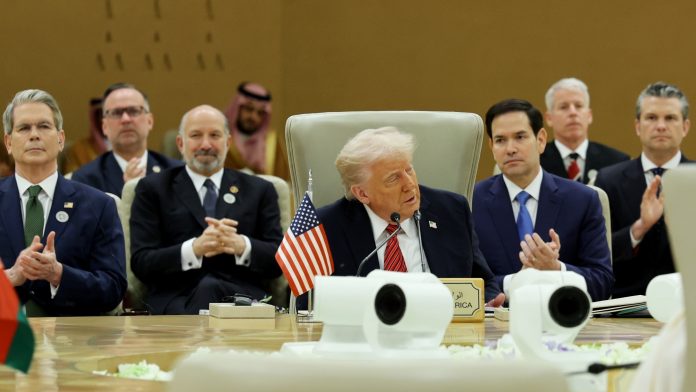
President Trump speaks with leaders at the Gulf Cooperation Council on May 14, 2025 in Riyadh, Saudi Arabia. He met briefly with Syria’s interim President Ahmed al-Sharaa earlier on Wednesday.

Win McNamee/Getty Images Europe


hide caption

toggle caption

Win McNamee/Getty Images Europe

RIYADH, Saudi Arabia — President Trump met Wednesday with Syria’s interim President Ahmed al-Sharaa, spending about half an hour speaking with him on the sidelines of a visit to Saudi Arabia.

The meeting was added to Trump’s schedule as he announced he would lift U.S. sanctions against Syria, a move hailed by Syria’s foreign minister as “pivotal” to rebuilding a country devastated by more than a decade of civil war and international isolation.

“The sanctions were really crippling, very powerful,” Trump said in remarks to the Gulf Cooperation Council. He said lifting the sanctions would Syria “a chance for greatness.”

“It’s not going to be easy anyway. So it gives them a good, strong chance, and it was my honor to do so,” Trump said, noting that Saudi Crown Prince Mohammed bin Salman and Turkish President Recep Tayyip Erdoğan had asked him to remove sanctions.

Trump encouraged Sharaa to normalize relations with Israel by signing on to the Abraham Accords, and urged him to deter terrorism, White House press secretary Karoline Leavitt said on social media. The White House posted an image of the meeting, but reporters traveling with Trump were not allowed in the room.

The U.S. had slapped sanctions several times on Syria over the past 20 years, aimed at the regime of Bashar al-Assad, who had taken over the country following the death of his father, Hafez al-Assad. Hafez had ruled Syria for decades with an iron fist.

But the sanctions had remained in place after Assad fled the country in December in the wake of a surprise lightning campaign led by Sharaa and his coalition of rebel fighters. Sharaa was himself on the U.S. list of designated terrorists at the time for his past links to al-Qaida and Islamic State, but that designation was swiftly removed as Sharaa vowed to build an inclusive society with protection for all of Syria’s myriad ethnic and religious minorities.

The sanctions, however, remained in place as many countries were still wary of his past. A series of deadly clashes between factions loyal to Sharaa’s government and ethnic minorities raised fears that he may try to maintain his rule by force.

But Sharaa has shown himself to be an able diplomat, and has toured the Arab world and other nations trying to ease those fears and raise support for an end to sanctions and his efforts to rebuild the country. This month, he flew to Paris to meet President Emmanuel Macron, who has also called for an easing of sanctions.

Sharaa and those around him have even hinted at friendly ties with Israel, which has been carrying out a series of airstrikes inside Syria since the fall of the Assad regime, at first saying it wanted to avoid weapons falling into the hands of extremists, and then to protect the Druze minority who live on both sides of the Israel-Syria border, and who have fought clashes with Sunni factions allied with the new government. Israeli troops have also taken over positions along the border with the Israel-controlled Golan Heights that were once held by Syrian forces, a move Israel says is to protect its own territory.

Trump’s announcement Monday that he planned to lift the sanctions, which have starved Syria of desperately needed international investment, was met with prolonged applause at the Saudi investment forum where he was speaking, an accolade led by Saudi Crown Prince Mohammed bin Salman himself.

The sanctions had threatened to force Syria to seek financial support from Russia, which had allied itself with the former regime and whose war planes had bombed opposition-held cities. Moscow took in Assad and his family and still has two military bases inside Syria.

Gulf states are keen to invest in Syria, which has important mineral and oil reserves, but had been prevented from doing by the U.S. restrictions.

David Axelrod discusses allegations of former President Biden's declining health

0

NPR’s Michel Martin speaks with Democratic political adviser David Axelrod about the stunning allegations in a new book regarding the health of former President Joe Biden.

Federal judge OKs use of Alien Enemies Act to deport Venezuelans : NPR

0

Relatives of Venezuelan migrants in the U.S. who were flown to a prison in El Salvador by the U.S. government, which alleged they were members of the Tren de Aragua gang, protest outside the United Nations building in Caracas, Venezuela, Tuesday, April 22, 2025.

Cristian Hernandez/AP


hide caption

toggle caption

Cristian Hernandez/AP

A federal judge says President Donald Trump can use the Alien Enemies Act to deport Venezuelan citizens who are shown to be members of the Tren de Aragua gang.

The ruling Tuesday from U.S. District Judge Stephanie Haines in Pennsylvania appears to be the first time a federal judge has signed off on Trump’s proclamation calling Tren de Aragua a foreign terrorist organization and invoking the 18th century wartime law to deport people labeled as being members of the gang.

Also Tuesday, another federal judge in the western district of Texas temporarily barred the Trump administration from using the Alien Enemies Act to deport people in that region. At least three other federal judges have said Trump was improperly using the AEA to speed deportations of people the administration says are Venezuelan gang members.

Haines, a Trump appointee, also said the administration hasn’t been giving enough notice to people facing removal under the AEA. She ordered the administration to provide at least 21 days notice — far longer than the 12 hours that some deportees have been given.

“This case poses significant issues that are deeply interwoven with the constitutional principles upon which this Nation’s government is founded,” Haines wrote. “In approaching these issues, the Court begins by stressing the questions that it is not resolving at this time.”

The ruling doesn’t address whether the administration can remove people under other immigration laws, nor does it address whether Trump can invoke the Alien Enemies Act to deport people who simply migrated to the U.S. and who aren’t members of a foreign terrorist organization, Haines wrote. She also did not weigh in on whether people suspected of being members of other gangs could be removed under the act.

But she did say the Act can be used to remove Venezuelan citizens who are at least 14 years old, who are in the U.S. without legal immigration status, and who are members of Tren de Aragua.

“Having done its job, the Court now leaves it to the Political Branches of the government, and ultimately to the people who elect those individuals, to decide whether the laws and those executing them continue to reflect their will,” Haines wrote.

Trump issued a proclamation in March claiming that Tren de Aragua was invading the U.S. He said he had special powers to deport immigrants, identified by his administration as gang members, without the usual court proceedings. After the proclamation, the administration began deporting people designated as Tren de Aragua members to a notorious prison in El Salvador.

The proclamation and deporations sparked a flurry of lawsuits in multiple states — including the one that led to Haines’ ruling Tuesday. That case was brought a Venezuelan national who says he fled to the U.S. with his wife and children in 2023 after facing extortion in his own country. He was arrested in February after a neighbor reported that he is a member of Tren de Aragua — a claim the man vehemently denies.

Haines initially approved the case as a class action, temporarily blocking the Trump administration from using the AEA to deport any migrants in her district. But she lifted that designation Tuesday, clearing the way for deportations to resume as long as the people being removed are given at least 21 days notice in English and Spanish as well as an “opportunity to be heard” on any objections they might have.

In the Texas case, a woman said she fled Venezuela after she was subjected to repeated harassment, assault and intimidation as a form of political persecution. She came to the U.S. in 2023 and was granted temporary protected status, and is currently seeking asylum.

But last month she was arrested in Ohio and accused of being a gang member, which she denies. She is currently being held in El Paso, and asked Senior U.S. District Judge David Briones to stop the Trump administration from deporting her and other detainees in the region because, she said, the president’s proclamation violates the due process rights of people facing removal and wrongly equates Tren de Aragua as an invasion by a foreign government.

Briones said she was likely to succeed on the merits, and temporarily barred the administration from transferring the woman or other people in the region accused of being Tren de Aragua members into other districts or deporting them under the Alien Enemies Act.

White House welcomes Afrikaners to the U.S., but drops protection for Afghan allies : NPR

0

Families evacuated from Kabul, Afghanistan, wait to board a bus after they arrived at Washington Dulles International Airport, in Chantilly, Va., on Aug. 27, 2021.

Jose Luis Magana/AP


hide caption

toggle caption

Jose Luis Magana/AP

As many as 9,000 Afghan refugees are at risk of deportation, as the Trump administration has ended the temporary protected status (TPS) that allowed them to stay in the U.S. legally. The White House says their country is no longer dangerous for them, a contention that confounds Afghanistan watchers.

“It’s a death penalty for them if they return,” said Zia Ghafoori, who worked as an interpreter in combat with U.S. Army Special Forces from 2002 to 2014.

Ghafoori was received by President Trump at the White House in 2019 and became a U.S. citizen in 2020.

“He’s a big supporter of our veterans and that’s what we love about the president,” Ghafoori said. “Maybe he’s not aware how the policy is going to affect our Afghan allies. I don’t know what’s happening behind the scenes.”

“I hope we can keep those promises that we made,” he added. “But unfortunately, right now I don’t know how to explain that to the families that are here and living in stress and depression without any immigration status.”

Ghafoori says the move also affects thousands of Afghans in limbo, including 13 members of his own family that had been set to fly to the U.S. from Pakistan when the Trump administration canceled flights for Afghans earlier this year.

Ending TPS for Afghans is part of the administration’s stated goal of realigning the United States refugee admissions program.

“This administration is returning TPS to its original temporary intent,” said Homeland Security Secretary Kristi Noem in a statement on Monday.

“We’ve reviewed the conditions in Afghanistan with our interagency partners, and they do not meet the requirements for a TPS designation. Afghanistan has had an improved security situation, and its stabilizing economy no longer prevent them from returning to their home country,” she said.

Not forgotten

A chorus of dissenting voices has condemned the change as a betrayal to those who helped the U.S. at war or were stranded by the abrupt withdrawal from Afghanistan in 2001.

“To our Afghan allies, you are not alone, you are not forgotten,” said Jack McCain, a veteran of the Afghan war and son of the late Sen. John McCain.

“Allies here in the United States who fought alongside people like me … who risked their lives and the lives of their families to execute our foreign policy are at the very real credible risk of deportation and in many many cases, death,” said McCain in a statement on social media.

Bill Frelick with Human Rights Watch called the move to revoke the status for Afghans “a betrayal of U.S. commitments.”

“The only justification for revoking temporary protection would be if permanent protection was being offered since Taliban rule clearly makes returns unsafe,” he said.

As for Noem’s assertion that the country is now safe, it left advocates wondering where the DHS is getting its information.

“I wonder if Secretary Noem is operating on the assumption that the Taliban has given promises that they’re not going to put people that worked with the U.S. in harm’s way?” said Morwari Zafar, with the Georgetown University Center for Security Studies.

“Even if that were true, even if we could trust their word, it’s not just the Taliban. You’ve got an environment where there are hostilities towards the population that would be coming back just based on the fact that they worked with the U.S. military – and also that they were the ones that got out,” she said.

Veterans of the post-9/11 wars are among the most passionate advocates for protecting Afghans status. Many had taken encouragement that two of Trump’s cabinet picks were staunch supporters of TPS for Afghans. Secretary of State Marco Rubio was one; he’s recently gone quiet on the issue. Former National Security Adviser and Afghanistan war vet Mike Waltz was the other, and he appears to have been marginalized.

Some Republicans who condemned the Biden administration’s ending of the Afghan war are now criticizing Trump.

“The Biden administration’s withdrawal from Afghanistan was a catastrophe. Deporting Afghans who bravely helped us would be Trump’s catastrophe,” said Bradley Bowman with the Foundation for Defense of Democracies. Bowman is an Afghanistan vet who also taught at West Point. He called deporting Afghan allies immoral but also short-sighted from an American national security standpoint.

“Around the world, countries are looking at the actions of the United States to determine whether Washington is a good partner that honors its commitments and stands by its friends,” he said. “If we deport such individuals, the consequences for those Afghans and their families may be severe and the decision will rightly be viewed as a betrayal.”

The immigration advocacy group CASA announced it has sued the Trump administration over its termination of TPS for Afghans and also Cameroonians. That action came at the same time the Trump administration made good on a promise to accept white South Africans into the U.S., citing what Trump baselessly claimed was a racial genocide against them.

Democratic Rep. Seth Moulton of Massachusetts, a Marine combat veteran, said the contrast was stark.

“As every Iraq or Afghanistan veteran knows, this is textbook betrayal. To say that the conditions in Afghanistan have improved as our allies are being hunted down is clearly absurd,” he said in a statement to NPR. “I know Kristi Noem doesn’t understand the idea of risking your life for our country, but perhaps she understands outright racism in accepting Afrikaner ‘refugees’ in their place,” he said in a statement to NPR.

Fight builds over USDA’s demand for sensitive food stamp data : NPR

0

Customers shop for produce at a grocery store on Feb. 12, 2025 in Austin, Texas.

Brandon Bell/Getty Images


hide caption

toggle caption

Brandon Bell/Getty Images

As the U.S. Department of Agriculture (USDA) makes sweeping demands on states and their contractors for the sensitive, personal data of tens of millions of food assistance recipients, one payment processor has so far signaled it intends to turn over data to the federal agency.

Meanwhile, privacy and civil liberties advocates say the USDA’s unprecedented demand for sensitive state data is unlawful, and warn the request through third-party contractors could be a new playbook for the federal government to gain access to data traditionally maintained by states.

The controversy over participant data from the Supplemental Nutrition Assistance Program, known as SNAP, comes as Republican lawmakers are proposing deep cuts to the program and the ad-hoc Department of Government Efficiency has been amassing data on Americans and residents from various federal agencies for purposes that include immigration enforcement and searching for fraud. Privacy advocates warn the data compiling effort could lead to government surveillance on a scale never seen before.

Last week, an advisor for USDA’s Food, Nutrition and Consumer Services sent a letter to states demanding personal data from SNAP applicants and recipients that included, but was not limited to, “names, dates of birth, personal addresses used, and Social Security numbers” going back to Jan. 1, 2020.

The letter said the federal agency would request the data through third-party payment processors that contract with states, and would use the data to ensure the integrity of the food assistance program and verify the eligibility of recipients.

The letter cited President Donald Trump’s March 20, 2025 executive order, “Stopping Waste, Fraud and Abuse by Eliminating Information Silos,” which calls for “unfettered access to comprehensive data from all state programs that receive federal funding” including from “third-party databases.”

Civil liberties and privacy advocates say the USDA’s directive could set an alarming precedent.

“If any private company who processes and has access to states’ sensitive data complies with these kinds of federal demands, that is a dangerous and very slippery slope,” said Nicole Schneidman, an attorney and technology policy strategist with Protect Democracy, which describes itself as “a cross-ideological nonprofit group” dedicated to defeating authoritarian threats and protecting freedoms.

“It would validate a tactic where government pressure on vendors effectively allows the federal government access to states’ data while making an end run around states,” Schneidman said.

Fidelity Information Services, or FIS, which contracts with many states to process electronic benefit transfer transactions for SNAP programs, signaled to its state partners on Friday it intended to comply with the USDA’s request, according to an email reviewed by NPR.

The email said based on the USDA’s recent guidance, “[W]e understand that USDA is entitled to receive the requested information and that FIS as your ‘contractor’ is required to disclose it.” The email asked states to “confirm your written consent” by May 14.

FIS declined to respond to NPR’s questions about what data the company retains on SNAP recipients. The company’s email to states referred to USDA’s “request for records regarding SNAP cardholder and transaction data.”

A legal warning

Late Monday, a coalition of legal groups sent letters to FIS and two other SNAP payment processors, Conduent and Solutran, arguing the USDA’s data demand does not comply with various federal laws, including the Privacy Act, Paperwork Reduction Act or the agency’s own legal requirements, and therefore should not be followed.

“Because the request itself is legally deficient, your companies may incur liability under state law for sharing individuals’ [personal identifying information] in the absence of a valid government request,” the letter reads. It is signed by attorneys from Protect Democracy, the Center for Democracy & Technology and the Electronic Privacy Information Center.

The legal coalition forwarded the letter to states attorneys general.

Conduent, the other leading payment processor for SNAP, told NPR in a statement from spokesperson Neil Franz that the company “understands the critical importance of properly handling privacy data.”

“In our role as a provider of contract support, we are the custodians of data on behalf of our clients,” Franz wrote in an email on Tuesday. He wrote, “Conduent is communicating directly with our clients” regarding USDA’s request.

The USDA’s letter demanding data warns, “Failure to grant processor authorizations or to take the steps necessary to provide SNAP data to FNS may trigger noncompliance procedures.”

Several states told NPR they are reviewing the data request.

Summer Griffith, a spokesperson for Illinois Department of Human Services, wrote in an email that the agency “has concerns about possible sharing of individual data among federal agencies in violation of the parameters established by law, including federal regulations specifically restricting the disclosure of SNAP data.”

She wrote the agency is “evaluating each data request carefully and considering all legal options to protect individuals’ privacy.”

How the current administration is using and accessing data is being litigated in more than a dozen federal lawsuits that contest DOGE’s access to sensitive personal and financial records.

On Monday, a federal judge declined to block the Internal Revenue Service from sharing some kinds of immigrants’ tax data with Immigration and Customs Enforcement to aid deportation efforts.

NPR’s reporting found that before the USDA sent the letter to all states last week, the agency’s Office of Inspector General had asked the country’s largest states for even more extensive data on SNAP recipients — including in at least one state, citizenship status, emails obtained by NPR show.

The USDA told NPR in a statement last week that, “All personally identifiable information will comply with all privacy laws and regulations and will follow responsible data handling requirements.”

NPR’s Ximena Bustillo and Stephen Fowler contributed reporting.

Have information you want to share about SNAP, DOGE access to government databases and immigration? Reach out to Jude Joffe-Block at JudeJB.10, Ximena Bustillo at ximenabustillo.77 and Stephen Fowler at stphnfwlr.25. Please use a nonwork device.

RFK Jr. will face Congress after his sweeping overhaul of health agencies : Shots

0

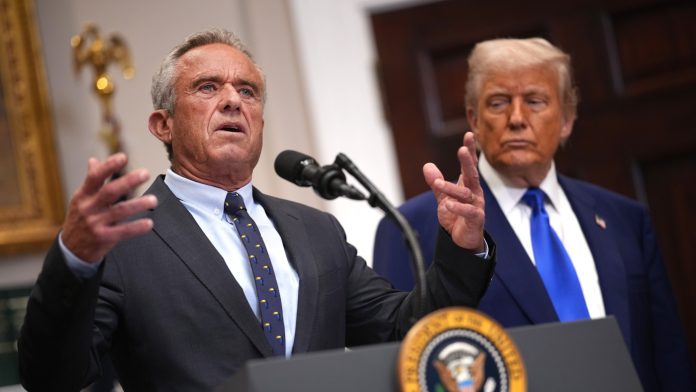
Health and Human Services Secretary Robert F. Kennedy Jr. has been carrying out President Trump’s vision to shrink government. On Monday, they announced an executive order aimed at drug prices.

Andrew Harnik/Getty Images


hide caption

toggle caption

Andrew Harnik/Getty Images

Since taking the helm of the Department of Health and Human Services in February, Secretary Robert F. Kennedy Jr. has moved quickly to shrink the agency, firing thousands of agency staffers. He’s canceled billions in grants to universities and public health departments, purged some leadership and shaken up the norms of the scientific review process.

Both the firings and grant cancellations have been challenged in court. A federal judge has temporarily paused the staff cuts for several weeks.

Kennedy heads to Capitol Hill Wednesday to testify before lawmakers for the first time as HHS Secretary.

Former HHS leaders weigh in

“I think some of the cuts are necessary — I wish they’d learn a little bit more about the department before they do it,” says one of Kennedy’s predecessors, Tommy Thompson, who served as health secretary under President George W. Bush. “I’m not one of those that’s going to criticize the administration or Bobby Kennedy for cutting back, because I think it’s necessary in government at all levels.

“I hope that they don’t cut programs that are absolutely necessary for public health,” he adds.

Another former secretary, Donna Shalala, who served under President Bill Clinton, panned Kennedy’s approach. “There’s no strategy and there’s no vision. There’s just a bunch of words and an inability to even implement their words,” she says.

Kennedy has, at times, seemed unfamiliar with programs and staff that had been cut, and suggested as many as 20% of the people fired could be brought back if they are deemed essential.

HHS did not respond to NPR’s repeated requests to interview Kennedy for this story. On Wednesday Kennedy will face the House Appropriations committee in the morning and the Senate’s Health, Education, Labor and Pensions committee in the afternoon. The purpose is to discuss President Trump’s proposed budget for the agency, which would make the restructuring of the agency and dramatic cuts to staff and the budget permanent.

“The reorganization has been put forward without a lot of explanation,” says Dr. Joshua Sharfstein, who served as principal deputy commissioner at the FDA in the Obama administration and is now a professor at Johns Hopkins University. “In a time when the slogan of HHS is ‘radical transparency,’ the department and the secretary really should be more transparent about what’s happening and be able to answer these legitimate questions that are coming up about their plans.”

Wednesday’s hearings could answer some of the big questions about the future of HHS as Kennedy tries to fundamentally reshape it.

Government as a protector of health goes way back

The U.S. public health service got its start in the 1700s caring for seamen who were sick or injured. The corps of uniformed physicians grew, helping to prevent the spread of yellow fever and smallpox in the 1800s, and eventually doing disease research and work on sanitation.

Another foundational function of the federal government in health is making sure the food and medicine Americans consume are safe. Around 1900, someone who bought milk might have been actually buying milk thinned with pond water. “It was noticed when the family found worms wiggling in the bottom,” science writer Deborah Blum told NPR in 2020. Dairies thinned milk to stretch their profits and then reconstituted it with things like plaster dust, yellow lead for color, and formaldehyde as a preservative, she said.

The federal government stepped into this free-for-all to regulate it, says Edward Berkowitz, emeritus professor of history at George Washington University. “At the beginning of the 20th century there were pure food and drug laws that were passed when Teddy Roosevelt was president,” he explains.

Both the public health corps and food regulation existed in different parts of the federal government, Berkowitz says, until President Dwight Eisenhower created the Department of Health, Education and Welfare in 1953. “That’s our modern department that we still have, but there have been a few little changes along the way,” Berkowitz says, including the spinning out of both Social Security and Education into their own agencies. The name Health and Human Services dates back to President Jimmy Carter.

America’s largest health insurer

Today’s HHS does a lot more than those original functions. It runs Medicare and helps states run Medicaid — along with Healthcare.gov, the marketplace for health insurance created by the Affordable Care Act. Through those three entities, the federal government helps insure about half of Americans. (These divisions of HHS also account for more than 60% of the agency’s budget.)

HHS encompasses the National Institutes of Health, the Centers for Disease Control and Prevention, FDA, and smaller divisions, including an agency for mental health and one that enables elderly and disabled people to have support they need to live at home, and another that supports domestic violence shelters.

When the year began, HHS had a staff of 82,000 and a budget of nearly $2 trillion. Kennedy has described the agency’s structure as “incomprehensible,” arguing it had too many administrative departments. “HHS has more than 100 communications offices and more than 40 I.T. departments and dozens of procurement offices and nine H.R. departments,” he explained in a social media video announcing the restructuring plan.

“We’re going to eliminate an entire alphabet soup of departments and agencies while preserving their core functions by merging them into a new organization called the Administration for a Healthy America or AHA,” he added.

But Congress was deeply involved in the creation of that “alphabet soup” and lawmakers may object to Kennedy’s sweeping, sudden restructuring. “There has always been bipartisan support for HHS programs, that’s how they survived,” says Shalala, who served in Congress after her term as secretary. During the COVID-19 pandemic, Republican support for agencies like NIH and CDC began to fracture, although it’s unclear if lawmakers will uphold all of the changes Kennedy is now trying to make at HHS.

Kennedy’s new vision — and view of past ‘failures’

At times, Kennedy has praised the staff of HHS. In a social media video from his first week on the job, he says he was “bowled over” by the enthusiastic reception he received from personnel at HHS headquarters. “My main vision at HHS, which I hope that you will all join me, is to reverse the chronic disease epidemic in America,” he tells staff in the video.

At other times, Kennedy has accused HHS staff of being “sock puppets” of industries like Big Food and Big Pharma. He also draws a direct line between failures of HHS staff and Americans’ health. “The rate of chronic disease and cancer increased dramatically as our department has grown,” he said in the restructuring video announcement.

“You know how bureaucracies work — every time a new issue arises, they tack on another committee. This leads to tremendous waste and duplication and, worst of all, a loss of any unified sense of mission,” he added. “The resulting pandemonium has injured American health and damaged department morale.”

His overhaul cuts the size of the staff by 20,000, between people being fired and those who chose early retirement or buyouts. While thousands of employees losing their jobs is “heartbreaking,” Kennedy told CBS in April, “it’s something that has to be done if we’re going to save our country and restore it.”

The way staff was fired this spring created its own pandemonium. After the “reduction in force” notices were sent on April 1, it was difficult to ascertain who had been cut, let alone why. Some supervisors resorted to emailing their teams to find out who remained. Others found out they had been fired when they arrived at work to find their badge had been deactivated, or when they were told by email to leave the building because they were expected to be fired soon.

Adding to the confusion was Kennedy’s assertion in interviews that several thousand of the people who were fired might later be brought back. “There are going to be casualties and there’s going to be mistakes, and what our job is as we reconstitute this agency to make sure that those mistakes are rectified,” Kennedy told CBS. He said going through each person’s job to ensure they weren’t needed before the notices went out “takes too long and you lose political momentum.”

In prioritizing speed over precision, the overhaul seems to be affecting some of the foundational functions of HHS. FDA labs that monitor the food supply have lost staff, and some inspections have already been delayed or canceled. Scientists working on some of Kennedy’s stated priorities were fired as well, including those focused on chronic diseases. Grants canceled to states have kept them from holding vaccination clinics, even as measles continues to spread.

Staff fulfilling tasks required by Congress were also cut, including statisticians working on an ongoing national survey on drug use and epidemiologists that work on rape prevention.

HHS spokesperson Emily Hilliard wrote to NPR in a statement in April: “All statutorily required positions and offices will remain intact, and as a result of the reorganization, will be better positioned to execute on Congress’s statutory intent.”

HHS has been reorganized before

Former HHS secretaries interviewed by NPR agreed that making changes is an expected and appropriate part of leading the agency, although they did not agree with Kennedy’s criticism of HHS scientists.

“It’s been quite a while since I was there, so things have changed I’m sure, but I was always impressed by the vast majority of scientists at the department,” says Thompson, the secretary under Bush.

Which is not to say that he was hands-off in running HHS. “I wanted to streamline everything,” he says. “The biggest change since the start of Medicare was under my leadership.” Thompson says he also overhauled the organ transplant system, food security services and obesity and childhood diabetes programs.

He says he made these changes after studying the department and moving his office to each division for a week to see how they worked from the inside. “I don’t think anybody’s ever done that except me. That’s my style. I wanted to learn.”

Kathleen Sebelius, who served as Health Secretary under President Barack Obama, oversaw several restructuring efforts as well, including combining two agencies into a single one after months of input from Congress, advocates and patients. She says she’s “alarmed” by the process and scope of Kennedy’s overhaul.

“I always thought that dismissing people was a last resort once your budget is cut, not the first thing that you do as part of a reorganization,” she says. “With agencies that touch people from birth to death and everything in between, there is absolutely no way that reductions made in such an arbitrary fashion won’t impact the services that people rely on every day.”

Health Secretary Robert F. Kennedy Jr. with President Trump in the Oval Office on May 5, 2025. Kennedy is standing; Trump is sitting behind the Resolute Desk.

Health Secretary Robert F. Kennedy Jr. with President Trump in the Oval Office on May 5, 2025.

Alex Wroblewski/AFP via Getty Images


hide caption

toggle caption

Alex Wroblewski/AFP via Getty Images

Shalala says she thinks restructuring just “sucks up time and it gets you unfocused on outcomes.” She says firing talented people is the wrong way to streamline the agency. “Look, they want to go after waste, fraud and abuse — that’s what we did. We brought billions back, we extended the life of Medicare, with a beefed up [inspector general] and with an FBI that beefed up the unit that went after health care fraud. They’ve decimated those units,” Shalala says. “There’s no evidence that, when they’re breaking down the government with a hammer and bludgeoning these agencies, they know how to put them back together with a new strategy.”

Roger Severino, a fellow at the conservative Heritage Foundation who directed the HHS Office for Civil Rights in the first Trump administration, thinks Kennedy is right about the problems in the department and his approach to the overhaul. “HHS lost its way, it lost its vision from making sure the outcomes were there of improving longevity and quality of life, and instead, it turned into a money-dispensing machine,” he says. “Why? Because special interests have captured HHS, and RFK Jr. is committed to ending it.”

Sharfstein gives Kennedy credit for asking big picture questions about America’s health, but questions his approach. “Even as the department can be improved and its focus can move to major solutions to outstanding problems, you don’t want to lose all the advantages of science for the health of the American people,” he says.

A look at the challenges Trump faces after his first few months back in office

0

President Trump has done a lot with his first few months in office, but much of what he’s promised to accomplish is still incomplete. NPR looks at the challenges and where Trump stands at this point.

Why aren’t Americans filling the manufacturing jobs we already have? : Planet Money : NPR

0

Robyn Beck/AFP via Getty Images

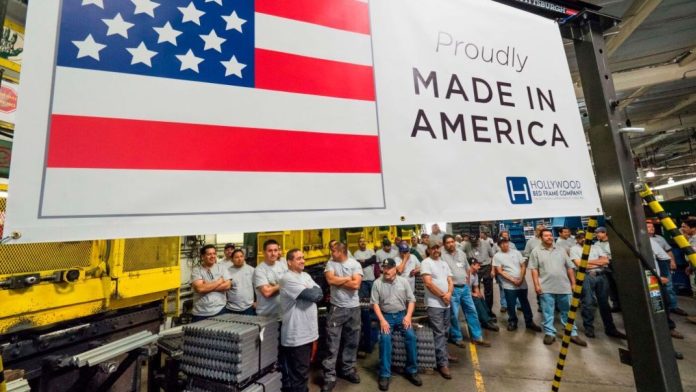
President Trump has been upending the global economy in the name of bringing manufacturing back. President Joe Biden signed into law massive investments aimed at doing something similar. The American manufacturing sector is reviving after decades of decay.

But there’s something a bit weird undercutting this movement to reshore factory jobs: American manufacturers say they are struggling to fill the jobs they already have.

According to data from the Bureau of Labor Statistics, there are nearly half a million open manufacturing jobs right now.

Last year, the Manufacturing Institute, a non-profit aimed at developing America’s manufacturing workforce, and Deloitte, a consultancy firm, surveyed more than 200 manufacturing companies. More than 65% percent of the firms said recruiting and retaining workers was their number one business challenge.

Part of the story has been a tight labor market. There have been similar worker recruitment and retention issues in other sectors, like construction and transportation. But the shortfall of manufacturing workers is about more than just that — and, with both parties pushing to reshore manufacturing, analysts expect the industry’s workforce issues to get even more challenging.

The Biden administration invested over $2 trillion on initiatives aimed at reinvigorating American industry, in legislation like the Infrastructure Investment and Jobs Act (IIJA), the CHIPS and Science Act, and the Inflation Reduction Act (IRA). There’s now an explosion of spending to construct new factories in America, and analysts expect the demand for manufacturing workers to pop.

The average manufacturing worker is also relatively old, and the industry expects a tidal wave of retirements in the coming decade.

The Manufacturing Institute and Deloitte projected that the industry will need 3.8 million additional workers by 2033, and that as many as “1.9 million of these jobs could go unfilled if workforce challenges are not addressed.”

These estimates, mind you, were calculated before President Trump’s recent tariffs, which, at least theoretically, are supposed to compel even more manufacturers to build factories in America. If things go to plan, we may need even more Americans to start working in manufacturing in coming years.

Today in the Planet Money newsletter: If manufacturing jobs are so great, why aren’t more Americans doing the ones we already have? And what can the industry and the government potentially do to address this issue? (If you have been forwarded this or are reading it online, you can subscribe to our weekly newsletter here).

Industry Whiplash

Gordon Hanson is an economist at Harvard Kennedy School who has published influential research on American manufacturing, including on what happened to it in the face of competition with China (We interviewed Hanson about his “China Shock” research in a past newsletter).

Hanson sees what you might call whiplash in an industry seeing a reversal of fortune. “A period in which there’s been a substantial increase in manufacturing — it’s a very recent phenomenon,” Hanson says. “ I think we can fill those jobs, but we’re just not gonna fill ’em overnight.”

One big reason manufacturers can’t fill these jobs overnight is because they require workers to have particular skills. And it’s not just skills needed to work on assembly lines. Only around two in five manufacturing jobs are directly involved in making stuff. Manufacturers also employ people to do research and development, engineering, design, finance, sales, marketing, and so on.

Part of the political appeal of bringing manufacturing back is that, historically, they’ve provided good jobs and career ladders for people without a college education. However, many manufacturing jobs these days actually require college degrees.

Carolyn Lee, the president and executive director of the Manufacturing Institute, says that roughly half of the open positions in manufacturing require at least a bachelor’s degree.

That said, the other half of open manufacturing jobs don’t require a bachelor’s degree. And manufacturers say they are also struggling to fill those.

Lee says some of the most in-demand positions in manufacturing right now are maintenance technicians, machine operators, material handlers, and forklift operators.

Is manufacturing pay high enough?

A classic solution to so-called worker shortages: offer higher pay. That would probably convince workers to invest in acquiring coveted skills and enter the manufacturing workforce.

Which is one reason why Oren Cass, the chief economist and founder of American Compass, a conservative think tank, says he’s skeptical whenever employers complain about worker shortages.

“ I have less than zero sympathy for employers who go around complaining about labor shortages and skills gaps,” Cass says. He joked that he has a side hustle, running an “incredibly innovative” biotech firm. “It employs leading scientists at $10 an hour to develop extraordinary cures. I have 500,000 job openings as well, and I have not been able to fill one of them.”

Cass has a point. We’ve covered a similar phenomenon in trucking: trucking companies have complained of a “worker shortage” for decades, yet relatively low wages and challenging work conditions are clearly a huge factor behind that industry’s workforce woes. Addressing those issues would probably go a long way to dealing with their “shortage.”

Manufacturers have, however, hiked their pay in recent years. That has helped slash the number of open manufacturing positions, from their peak of over one million open positions in April 2022. (Like many other industries during the COVID-19 pandemic, manufacturers saw a wave of retirements, deaths, and quits).

Offering higher paychecks would likely compel more Americans to flock to the remaining open positions.

But the higher pay that Americans demand to work in manufacturing is one of the big reasons why many manufacturers left America in the first place. And so this wage issue begs the question whether many manufacturers, particularly labor-intensive ones, can be profitable and globally competitive in the United States.

Cass believes that tariffs can help even the playing field with foreign competitors. And he stresses that one of the keys to reshoring manufacturing — while maintaining good-paying manufacturing jobs — is higher productivity.

“ If somebody in the United States is 20 times as productive as somebody in China and you have to pay them 20 times as much, you are equally competitive,” Cass says.

So, if American manufacturers can prove to be much more productive than foreign competitors — meaning American workers can make more in less time — they can pay the higher wages needed to attract and retain American workers while still remaining globally competitive.

That, however, is a big if. American manufacturing has been seeing an alarming slowdown in productivity growth in recent years.

The manufacturing PR and skills problems

Lee agrees that manufacturers will be able to entice more people into the industry by offering higher pay. However, she says, the industry’s issues with recruitment and retention go beyond dollars and cents.

For one, she suggests, manufacturing has a PR problem. Many Americans have outdated notions of what manufacturing jobs actually entail. She suggests that many imagine they’re the dirty, monotonous, and dangerous factory jobs depicted in Charles Dickens novels. But, Lee says, they’re actually “clean and bright and full of technology.” She sees changing American perceptions about manufacturing as one crucial part of convincing more young people to work in the sector. More generally, if the industry is seen as vibrant and growing, as opposed to dying, that will probably help with recruitment.

But even if the word gets out and more young Americans want to do these jobs, they’ll still need the skills to be able to do them.

“These jobs are in factories that are completely different from the factories of 25 years ago,” Hanson says. “They require people to know how to use pretty sophisticated machinery.”

“The hardest skills to find are the ones that maintain and fix equipment,” Lee says. “Every company we speak with is trying to hire technicians. Every single one. The challenge is that there is no one walking around on the street with these skills, and it takes 1-2 years to teach those skills and another 1-2 years to contextualize those skills to the specific plant environment.”

Harry Moser, the founder and president of the Reshoring Initiative, argues that America should invest much more heavily in apprenticeships to build the manufacturing workforce of the future. Apprenticeships provide young people with pathways to learn vocational skills without having to obtain an expensive, four-year college degree. Moser says American leaders have overemphasized college to the detriment of vocational training, and that our system of apprenticeships pales in comparison to the ones in countries like Germany and Switzerland.

According to Third Way, a centrist think tank, in 2022 only 0.3% of the American working-age population was in apprenticeship programs. For comparison, in Switzerland, that number was 3.6%, or 12 times higher.

Apprenticeships and other means to help Americans obtain vocational skills may be especially important for the high-tech manufacturing jobs we have today. Lee says today’s manufacturing jobs often require some combination of “knowledge of electrical systems, mechanical systems, logic controllers, hydraulic power, and robotics.”

The Manufacturing Institute has been working to develop better apprenticeship programs to help Americans build the skills the manufacturing sector needs. “ The very best models of workforce development that we see and that we engage in at the Manufacturing Institute are locally and regionally led public-private partnerships, where manufacturers come to the table — and with the support of the community college system and the local business community — they build the talent pipelines that they need,” Lee says.

Lee told us about one particular apprenticeship program that she’s very excited about. It’s called The Federation for Advanced Manufacturing Education, or FAME.

FAME was founded by Toyota back in 2010. The car company had trouble finding machine technicians at their manufacturing plant in Georgetown, Kentucky. So they did something proactive: they partnered with other local companies and a community college and developed an apprenticeship program to create the workforce they needed.

Lee says FAME is a 21-month program in which students juggle work and school. Each week, they spend three days at the factory and two days at a community college, learning how to operate and repair high-tech equipment, and other crucial skills.

“And  at the end of the 21 months, students come out with, in most cases, no college debt,” Lee says. These students also see dramatically higher earning potential.

One study, by the Brookings Institution and Opportunity America, found much higher graduation rates for students who entered the FAME program. “Earnings and employment gaps were if anything more pronounced,” the authors write. “Five years after completion, FAME graduates were earning nearly $98,000, compared to roughly $52,783 for non-FAME participants — a difference of more than $45,000 a year.” It pays to have scarce, in-demand skills.

Lee says that FAME has become a model of workforce development for other manufacturing companies. In 2019, she says, Toyota “recognized we’re a car company, not an apprenticeship operating company,” so they handed the program over to the Manufacturing Institute to expand it around the country.

All the sources we spoke to agreed that the government and businesses need to do more to invest in programs like these to provide opportunities to Americans and develop the workforce that the manufacturing industry needs.

“As we go from this period of declining jobs to expanding jobs, we shouldn’t expect that we’re just gonna automatically reincorporate all that labor overnight,” Hanson says. “It takes a workforce system to make it happen.”

Late last month, President Trump issued an executive order aimed at “preparing Americans for the high-paying skilled trade jobs of the future.” President Trump ordered various administration officials to create “a plan to reach and surpass 1 million new active apprentices.”

We’ll be watching to see what the details of this plan are, and whether that plan becomes action.

But what is clear is that bringing American manufacturing roaring back will likely require more than just slapping up tariffs or investing lots of money to build new factories. Leaders may need to regear our education system to help more Americans acquire the skills that manufacturers need for a productive and capable workforce.

Which brings us to an even bigger question: What warrants all these interventions to boost one particular sector of the economy? Is manufacturing actually special? And, if so, what makes it so special? That’s next week in the Planet Money newsletter.


Trump’s agenda faces crucial stretch with House Republicans this week : NPR

0

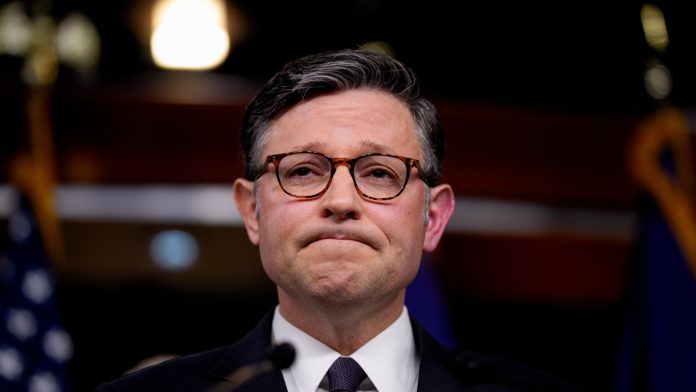
Speaker of the House Mike Johnson, R-La., appears at a news conference at the U.S. Capitol on May 6. Republicans are working to pass a sweeping multi-trillion dollar plan to reshape tax, energy and immigration policy.

Andrew Harnik/Getty Images


hide caption

toggle caption

Andrew Harnik/Getty Images

By the end of this month, House Republicans hope to finalize the details of President Trump’s “big beautiful bill” that includes sweeping changes to tax, immigration and energy policy. House Speaker Mike Johnson, R-La., has already muscled a budget blueprint for the plan through the chamber. But this week poses a much thornier task, as three key House committees are putting pen to paper defining policies that will have far-reaching impacts on Americans’ pocketbooks and for many, their healthcare.

Johnson is balancing demands between two competing camps inside his conference. Swing district Republicans are worried dramatic cuts to safety net programs and popular tax incentives could endanger their reelection prospects. More conservative members are arguing voters put a GOP trifecta in place to slash the deficit and restructure government programs.

“I think the final product is going to be favorable to everybody,” Johnson predicted last week.

The fiscal equation Republicans are trying to solve is how to reach the $1.5 trillion in spending cuts called for in their blueprint to offset the cost of extending President Trump’s 2017 tax cuts. A large chunk of the GOP conference views the real target as $2 trillion in savings.

Last week, Texas Republican Chip Roy told reporters there were still roughly “20 plus issues” that need to be resolved. Johnson wants to get the bill through the House and to the Senate by Memorial Day, with the goal of having it to President Trump for his signature by July 4.

But the real deadline for Republicans is mid-July. That’s when Treasury Secretary Scott Bessent says Congress needs to increase the country’s borrowing authority to avoid a potentially catastrophic government default. GOP leaders plan to increase the debt ceiling for five years in this package.

That time frame will be put to the test as Republicans try to resolve the most contentious and wide-reaching policies in the coming days. Here is a brief look at some of the key sticking points.

Medicaid

Republicans are considering a range of structural changes to the joint federal/state healthcare program that covers roughly 72 million low-income, elderly and disabled Americans. The House Energy and Commerce Committee, which oversees the program, released their planned changes late Sunday and have zeroed in on a handful of reforms that are broadly supported among both conservative and moderate GOP lawmakers.

They’ve committed to adding work requirements for “able-bodied” adults who receive benefits, requiring those enrolled to report working at least 80 hours a month. They also outlined changes to parts of the enrollment process and placed restrictions on states’ ability to raise taxes on healthcare providers, a practice that in turn attracts more federal matching dollars. The bill also references an overarching goal of eliminating “waste, fraud and abuse” within the program.

Missing from the committee’s proposal are drastic changes to how the government pays for the Medicaid expansion that increased eligibility for lower-income childless, working-age adults as part of the Affordable Care Act. Conservative hardliners had pushed for a decrease in federal contributions to states with this expanded coverage. The plan also does not include the per person cap on federal spending that some lawmakers had called for. 

Talks are continuing this week and it’s unclear how proposed changes will play among a divided House GOP that needs nearly total unity to get the eventual spending bill passed. The proposed changes to Medicaid are expected to reap at least $715 billion in savings, along with another $197 billion from additional changes unrelated to Medicaid, according to an estimate by the nonpartisan Congressional Budget Office. As a result of these changes, the CBO also found that at least 8.6 million people would lose their health insurance in the next 10 years.

Extending Trump’s tax cuts

Republicans propose making the 2017 Trump tax cuts that will expire at the end of 2025 permanent. In their full plan released Monday, the House Committee on Ways and Means added new tax breaks that the president campaigned on in 2024 — including no taxes on tips or overtime pay. But if Republicans can’t hit $1.5 trillion in spending cuts to offset the costs of tax cuts, they will be forced to scale back their ambitions.

One potential revenue source that’s absent from the plan are any new income taxes on high earners. President Trump had floated allowing the tax bracket for high earners — those making between $2.4 million and $5 million — to go from 37% to 39.6%. But on Friday he pulled back from that, writing on social media that although he backed the “TINY” change, Democrats would use it as a campaign issue against Republicans. “Republicans should probably not do it, but I’m OK if they do!!!” Trump said.

President Trump speaks during a press conference in the Roosevelt Room of the White House on Monday. Trump has said Republicans should "probably not" raise taxes on high earners, "but I’m OK if they do!!!"

President Trump speaks during a press conference in the Roosevelt Room of the White House on Monday. Trump has said Republicans should “probably not” raise taxes on high earners, “but I’m OK if they do!!!”

Andrew Harnik/Getty Images


hide caption

toggle caption

Andrew Harnik/Getty Images

Johnson and other top GOP leaders are on the record opposing raising taxes.

The plan released by the Ways and Means committee would also establish a new type of trust called a “MAGA account,” which stands for “money account for growth and advancement.” Based on the text of the bill, it appears to be a tax-exempt trust created by the federal government for younger Americans. Up to $5,000 can go into the accounts annually and beneficiaries can use the funds to pay for higher education, a small business and their first home. It terminates when the beneficiary turns 31.

SALT

One of the most contentious issues remaining in budget talks is also one of its most obscure: the state and local tax deduction, or SALT.

The 2017 tax bill capped the amount that taxpayers in several (mostly blue states) can deduct for state and local taxes at $10,000 per year. During his 2024 reelection campaign, Trump vowed to get rid of the cap, but doing so would add significant costs to the GOP package and most Senate Republicans don’t support scrapping the cap.

The fight over SALT is expected to be a major sticking point when the Ways and Means committee begins its markup of the bill on Tuesday. The committee has proposed lifting the cap on SALT to $30,000. However, a handful of GOP lawmakers representing districts in states like New York, New Jersey and California with high local property taxes are leading the push for a higher cap. They insist the bill must include a provision with a number north of $30,000.

Rep. Nick LaLota, R-N.Y., has been a staunch advocate for a higher deduction as part of the bill. He told reporters last week that discussions have “a lot more to go now,” but ultimately he thinks Republicans will reach a deal. The issue is a red line for him and at least four other colleagues. And with Republicans clinging to a razor-thin majority in the House, their opposition could sink the bill.

“There is no bill unless there’s a fix on SALT,” LaLota said. “The five of us will vote no on a bill unless there’s a fix on SALT.”

Federal food assistance

Republicans are also discussing plans to shift some of the costs of the Supplemental Nutrition Assistance Program (SNAP) to the states, which is expected to result in major cuts in the numbers of people who currently receive the benefits. Some Republicans who represent swing districts are cautioning that they want to ensure no cuts in benefits result from any changes to the program.

Judge refuses to block IRS from sharing tax data to identify people illegally in U.S. : NPR

0

U.S. Immigration and Customs Enforcement officers use a chain to more comfortably restrain a detained person using handcuffs positioned in front.

Alex Brandon/AP


hide caption

toggle caption

Alex Brandon/AP

A federal judge on Monday refused to block the Internal Revenue Service from sharing immigrants’ tax data with Immigration and Customs Enforcement for the purpose of identifying and deporting people illegally in the U.S.

In a win for the Trump administration, U.S. District Judge Dabney Friedrich denied a preliminary injunction in a lawsuit filed by nonprofit groups. They argued that undocumented immigrants who pay taxes are entitled to the same privacy protections as U.S. citizens and immigrants who are legally in the country.

Friedrich, who was appointed by President Donald Trump, had previously refused to grant a temporary order in the case.

The decision comes less than a month after former acting IRS commissioner Melanie Krause resigned over the deal allowing ICE to submit names and addresses of immigrants inside the U.S. illegally to the IRS for cross-verification against tax records.

“The plaintiffs are disappointed in the Court’s denial of our preliminary injunction, but the case is far from over. We are considering our options,” Alan Butler Morrison, the attorney representing the nonprofit groups, wrote in an email. He noted that the judge’s ruling made it clear that the Department of Homeland Security and the IRS can’t venture beyond the strict limitations spelled out in the case.

“So far, DHS has not made formal requests for taxpayer data and plaintiffs will be keeping a close watch to be sure that the defendants carry out their promises to follow the law and not use the exception for unlawful purposes,” Morrison said.

The IRS has been in upheaval over Trump administration decisions to share taxpayer data. A previous acting commissioner announced his retirement earlier amid a furor over Elon Musk’s Department of Government Efficiency gaining access to IRS taxpayer data.

The Treasury Department says the agreement with ICE will help carry out President Donald Trump’s agenda to secure U.S. borders and is part of his larger nationwide immigration crackdown, which has resulted in deportations, workplace raids and the use of an 18th century wartime law to deport Venezuelan migrants.

The acting ICE director has said working with Treasury and other departments is “strictly for the major criminal cases.”

Advocates, however, say the IRS-DHS information-sharing agreement violates privacy laws and diminishes the privacy of all Americans.

In her ruling, Friedrich said the agreement doesn’t violate the Internal Revenue Code, so the IRS hasn’t substantially changed the way it handles taxpayer information. Instead, the Trump administration has decided to use already existing “statutorily authorized tools” to help with criminal investigations, Friedrich wrote.

Federal law allows the IRS to release some taxpayer information to other agencies if the information may assist in criminal enforcement proceedings, and the requesting agency meets certain criteria, the judge said.

Still, that doesn’t mean that all the information the IRS holds can be turned over, Friedrich said.

First, the investigating agency has to already have the name and address of the person whose information is being sought. Then the agency has to provide that information to the IRS, along with the time span for which the information relates, the law that allows the information to be released and the reason why any IRS-disclosed information would be relevant to the investigation.

“In other words, the IRS can disclose information it obtains itself (such as through audits), but not information it obtains exclusively from the taxpayer (such as a tax return filed by the taxpayer),” Friedrich wrote. She noted the law contains a significant exception — a taxpayer’s identity, including the individual’s name, address or taxpayer identifying number, isn’t considered part of the protected tax return information.