Tuesday, November 10, 2026
Home Blog Page 12

DOGE tried to embed in the Corporation for Public Broadcasting : NPR

0

A control room at the Arizona PBS offices in Phoenix is seen Friday, May 2, 2025. Earlier this month, President Trump issued an executive order claiming to direct CPB’s board to end federal funding to PBS and NPR.

Katie Oyan/AP


hide caption

toggle caption

Katie Oyan/AP

Less than a day after President Trump attempted to fire three Corporation for Public Broadcasting board members last month, DOGE staffers also attempted to assign a team to review its operations.

CPB leaders denied that request, citing federal law that establishes the independent nonprofit outside of the control of the federal government. The request comes as the president is launching a broad assault against the country’s two largest public broadcasters. At the same time, the informal Department of Government Efficiency has sought to embed itself in numerous independent agencies Trump wants to shutter.

Those revelations come in court documents filed Friday in a lawsuit where CPB is challenging Trump’s April 28 efforts to remove the board members, and after the president issued an executive order May 1 that also purports to end any federal funding to the Public Broadcasting Service and National Public Radio.

According to the filing, Nate Cavanaugh, a DOGE staffer with the General Services Administration sent an email addressed to the two board members not targeted by Trump asking for a meeting just before the initial court hearing in the CPB case.

“I would like to learn more about the Corporation for Public Broadcasting and discuss getting a DOGE team assigned to the organization,” Cavanaugh wrote in an email dated April 29.

An April 30 response from CPB’s executive vice president and general counsel Evan Slavitt reiterated the organization’s stance that federal law states that CPB “will not be an agency or establishment of the United States Government.”

“Accordingly, neither DOGE, the GSA, nor any other component of the executive branch has any role supervising or having any activity relating to CPB,” Slavitt wrote.

Slavitt also said the DOGE email was sent to two email addresses that are only used by CPB’s expense reimbursement system and are not the way to contact board members.

The Trump administration contends the Constitution gives the president “the power to remove personnel who exercise his executive authority,” White House spokesperson Taylor Rogers previously told NPR.

The law appears to say otherwise.

Federal law is explicit about CPB’s structure and independence

In a section of the Public Broadcasting Act of 1967 subtitled “Federal interference or control,” the statute does not allow “any department, agency, officer, or employee of the United States to exercise any direction, supervision, or control over public telecommunications, or over the Corporation or any of its grantees or contractors.”

After Trump issued his executive order claiming to direct CPB’s board to end federal funding to PBS and NPR, leaders of the three organizations said the directive was illegal as well, citing a section of the act that established CPB in a manner “to afford maximum protection from extraneous interference and control.”

The law also says that funds allocated by Congress and distributed by CPB “may be used at the discretion of the recipient,” and spells out what percentage of the funds may be used for public television, public radio at the local and national levels.

Congress allocated $535 million to CPB for the current fiscal year, a number that was left unchanged in the latest stopgap spending plan that all but two Republican lawmakers voted for in March. The president has indicated interest in asking Congress to claw back that funding using a process known as rescission, though that request has not been made and approval is not guaranteed.

The executive order also directs federal agencies to end any “direct or indirect” funding of NPR and PBS. Last week, the Department of Education notified CPB it was terminating its “Ready to Learn” grant for educational television programing.

In asking the court to block Trump’s attempted removal of board members, CPB says it would not have a quorum to conduct any business if the firings were upheld, pointing to a previously-scheduled meeting for Tuesday, May 13 that would include discussing legislative communications plans with Congress, pending and potential litigation, and approving grant awards.

“Without a legally constituted Board, it cannot approve or give direction on any of these matters,” the filing reads.

And though CPB says it is not subject to the president’s authority, it is worth noting that without a quorum, the board would also be unable to enact Trump’s executive order allegedly seeking to defund PBS and NPR.

The next hearing in the case is scheduled for May 14.

Disclosure: This story was reported and written by NPR reporter Stephen Fowler and edited by Padmananda Rama, Emily Kopp, Vickie Walton-James and Gerry Holmes. Under NPR’s protocol for reporting on itself, no corporate official or news executive reviewed this story before it was posted publicly.

Have information you want to share about DOGE access to independent agencies? Reach out to this author through encrypted communication on Signal. Stephen Fowler is at stphnfwlr.25. Please use a nonwork device.

White Afrikaner refugees arrive in U.S. from South Africa : NPR

0

White Afrikaaner South Africans demonstrate in support of U.S. President Donald Trump in front of the U.S. embassy in Pretoria, South Africa, Feb. 15.

Jerome Delay/AP


hide caption

toggle caption

Jerome Delay/AP

JOHANNESBURG, South Africa — A group of 59 white Afrikaners who have been given refugee status by the Trump administration arrived at Dulles airport outside Washington, D.C., on Monday on a charter flight paid for by the U.S. government.

The Afrikaners, descendants of mainly Dutch colonists, left Johannesburg on Sunday night. They were seen at the airport in Johannesburg with carts full of suitcases, but declined to speak to the media. They are being greeted by U.S. officials and are expected to give a news conference shortly. 

One document seen by NPR said there would be food and “items for the children” upon arrival. It said the refugee services office of the Catholic diocese of Virginia would be onsite to offer assistance. After the press conference the families will depart for their end destinations in several states including Minnesota, Nevada, and Idaho.

The South Africans will now have a pathway to U.S. citizenship and be eligible for government benefits.

Another document seen by NPR included detailed guidance for the South Africans arriving. American family members of Afrikaners granted refugee status would be asked to help them. Those who didn’t have family in the country would be “placed in a location that has a local organization to provide you with support,” it said.

“Your case manager will pick you up from the airport and take you to housing that they have arranged for you. This housing may be temporary (like a hotel) while a local organization helps you identify more long-term housing,” it said.

The South Africans are also informed: “You are expected to support yourself quickly in finding work. Adults are expected to accept entry level employment in fields like warehousing, manufacturing, and customer service. You can work toward higher level employment over time.”

However, the document stated that “Any credentials from your home country may not automatically transfer to the United States.” That last point will be of interest to many Afrikaner applicants — some of whom are farmers and have previously told NPR they hope to continue farming in the U.S.

South Africans incredulous

The resettlement effort comes after President Trump signed an executive order in February claiming minority Afrikaners were being unfairly treated in South Africa, and offering them possible resettlement in the U.S. Trump also cut off aid to South Africa, which has been in his crosshairs since he returned to office for its DEI policies and support of the Palestinians.

Trump also says the South African government is taking land from Afrikaners, but there is no evidence of this. On Monday, speaking at the White House, Trump repeated this claim. “It’s a genocide that’s taking place that you people don’t want to write about,” Trump told journalists. “They happen to be white, but whether they’re white or black makes no difference to me, but white farmers are being brutally killed, and their land is being confiscated in South Africa.”

The South African government did pass a land reform law earlier this year, allowing in rare circumstances for expropriation without compensation, but zero land has been seized. In fact, while whites in South Africa account for some 7 percent of the population, they still own about 70% of commercial farmland.

The South African government has been surprised by Trump’s attacks, saying he has been taken in by disinformation. After learning from news reports that the first group of Afrikaners had been granted refugee status and were headed to the United States, President Cyril Ramaphosa’s spokesman slammed Washington.

“These people won’t be stopped from going, albeit under a false narrative,” the spokesman, Vincent Magwenya, told NPR. “There’s no legal or any factual basis for the executive order sanctioning this action. None of the provisions of international law on the definition of refugees are applicable in this case.”

“Disturbingly, one has to admit that our sovereignty as a country is being grossly undermined and violated by the United States,” Magwenya added.

And it’s not only the South African government that has expressed disagreement. Many South Africans — Black and white — bar a small rightwing minority, are incredulous. NPR spoke to ordinary citizens who were concerned race relations were being set back, three decades after the end of the racist system of apartheid — an Afrikaner policy — when Nelson Mandela ushered in a multiracial democracy.

Many South Africans have taken to social media to post memes and comedic videos, casting doubt on claims that whites who leave for the U.S. are persecuted, joking they will miss their “privileged lives, domestic workers, and beach holidays.”

But not all Afrikaners in South Africa are prosperous. And — like people across the racial spectrum — some have suffered from violent crime and attacks. It will likely be these stories that they tell on arrival at Dulles.

Refugee advocates in the U.S. have noted how unusual it is that the Afrikaners were processed so quickly — there were about three months between Trump’s executive orders and the first group’s departure for the U.S. Often, applications for refugee status in the U.S. can take years to process.

The Episcopal Church announced on Monday that it is terminating its partnership with the government to resettle refugees, citing moral opposition to resettling the Afrikaner refugees.

In a letter sent to members of the church, the Most Rev. Sean W. Rowe — the presiding bishop of the Episcopal Church — said that two weeks ago the government informed them that “we are expected to resettle white Afrikaners from South Africa whom the U.S. government has classified as refugees.”

The request, Rowe said, crossed a moral line for the Episcopal Church, which is part of the global Anglican Communion that boasts among its leaders the late Archbishop Desmond Tutu, a South African icon and celebrated opponent of apartheid.

A U.S. government employee, who was not authorized to speak to the media, told NPR they considered what is happening in this case “immigration fraud.”

The Afrikaners arrival comes after Trump effectively suspended the U.S. refugee admissions program in January.

“Across the country, refugee resettlement agencies have closed or cut staff, and for refugees about to fly to the U.S., their travel authorizations were canceled, thousands are now stuck waiting and face growing danger,” Kenn Speicher, who founded NOVA Refugees, a support network in the DC-region, told NPR.

House preps bills to advance Trump agenda

0

House committees are planning a series of hearings this week to advance legislation around President Trump’s agenda.

Qatar’s plane for Trump fuels ethical concerns : NPR

0

President Trump walks off Air Force One on April 29 at Selfridge Air National Guard Base, Michigan. Qatar has offered to replace Air Force One with a luxury Boeing 747 jet.

Scott Olson/Getty Images


hide caption

toggle caption

Scott Olson/Getty Images

While not yet finalized, the Trump administration’s plan to accept a luxury plane from the Qatari government to serve as Air Force One has already drawn fierce criticism from Democratic lawmakers and independent watchdogs who say such a move violates the Constitution.

The White House confirmed on Sunday that Qatar had offered to donate a plane to the Department of Defense, but that it will not be presented or accepted during President Trump’s visit to the Middle East this week.

The president has expressed frustration about the long-delayed delivery of two upgraded Air Force One jets from Boeing, dating back to a 2018 contract. On Monday, he told reporters that Qatar had offered a replacement to use in the meantime.

“I mean, I could be a stupid person and say, ‘No, we don’t want a free, very expensive airplane,’ ” Trump said. “But I thought it was a great gesture.”

The Boeing 747 plane — which industry groups say could be worth around $400 million — would be one of the biggest foreign gifts ever received by the U.S. government. That’s controversial because the Constitution’s Foreign Emoluments Clause forbids public office holders from accepting a present “of any kind whatever, from any King, Prince, or foreign State.”

Trump said Monday that the plane isn’t a gift to him, but to the Department of Defense. He added that it will be decommissioned after his term for his presidential library, and that he will not use it after leaving office.

Richard Briffault, a Columbia Law School professor who specializes in government ethics, says that distinction doesn’t matter: If the plane goes to Trump’s presidential library after he leaves office, “then it’s not really a gift to the United States at all.”

Briffault says accepting the plane would constitute a personal gift and a “pretty textbook case of a violation of the Emoluments Clause.” Like other ethics experts, he worries it could lead to Trump feeling beholden to the Qatari government.

“[Gifts are] designed to create good feelings for the recipient and to get some kind of reciprocity,” Briffault says. “But the thing that [Trump] can give, of course, is public policy — weapons deals or whatever. And then, of course, it’s an incentive to other countries to give similar gifts as another way of influencing presidential decision-making.”

Jordan Libowitz, vice president in communications for the nonprofit watchdog Citizens for Responsibility and Ethics in Washington (CREW), told NPR that the gift is especially concerning because of Trump’s personal business dealings in the Gulf and in Qatar specifically.

The Trump Organization — of which Trump handed formal control to his sons in 2017 — did not pledge to avoid making deals with private companies abroad during his second term, unlike his first. In late April, the company announced a deal to build a luxury golf resort in Qatar.

“Clearly he is trying to make money there, and that puts us in an uncomfortable situation,” Libowitz says. “Is America’s best interest being served, or is it the best interests of the Trump Organization?”

The Qatari-owned jet, which Trump toured at Palm Beach International Airport in West Palm Beach, Fla., in February.

The Qatari-owned jet, which Trump toured at Palm Beach International Airport, in West Palm Beach, Fla., in February.

Ben Curtis/AP


hide caption

toggle caption

Ben Curtis/AP

Experts say the gift is unprecedented 

Presidents typically receive gifts like cufflinks and bottles of wine, Libowitz says, and are required to turn such gifts over to the U.S. government — generally the National Archives — unless they pay fair market value to keep them.

“We have never seen something on this level before, and especially when you add in his government or his personal business in the country, it raises significant red flags,” he says.

CREW sued Trump during his first term, arguing that he was illegally “getting cash and favors from foreign governments, through guests and events at his hotels, leases in his buildings, and valuable real estate deals abroad.” The case made its way to the Supreme Court, but was dismissed as moot after he left office in 2021.

Trump, responding to Democratic critics on Sunday, wrote on Truth Social that the plane would replace the “40 year old Air Force One, temporarily, in a very public and transparent transaction.”

But Libowitz says “a lot of things can be public without being ethical.”

Much is still unknown about the deal and the discussions behind it, as well as the particulars of the plane. For example, it’s not clear when the transaction would happen or how long it would take for the plane to be ready for the president’s use. Both Briffault and Libowitz said it would presumably need to be checked in great detail, both for structural integrity and potential tracking or listening devices.

“This is a process that could take years before it’s ready, and at that point, he won’t be president anymore,” Libowitz says.

Trump says he will be following in the footsteps of former President Ronald Reagan, who has a decommissioned Air Force One plane at his presidential library in California. The Associated Press reported in March that Trump’s team was scouting Florida locations for a potential presidential library.

Challenges — and consequences — seem unlikely 

Ali Al-Ansari, Qatar’s media attaché to the U.S., told NPR in a statement on Monday that the possible transfer of the aircraft from Qatar’s Ministry of Defense to the U.S. Department of Defense “remains under review by the respective legal departments.”

Trump’s plans have been roundly criticized by various prominent Democrats, including Senate Minority Leader Chuck Schumer, who called it “premium foreign influence with extra legroom.”

Rep. Ritchie Torres, D-N.Y., wrote a letter asking the U.S. Government Accountability Office, the acting Department of Defense inspector general and the Office of Government Ethics to conduct an immediate review.

“The American people are witnessing, in real time, what can only be described as a ‘flying grift,’ ” he wrote. “If we fail to draw the line here, there may soon be no line left to draw.”

Torres is asking them to issue a formal advisory opinion on whether the gift violates federal ethics regulations, and to recommend policy reforms “to prevent the conversion of foreign gifts into private property” by any president.

But, while details of the potential transaction haven’t been disclosed, experts doubt there is an authority that can actually stop it from happening.

Rep. Jamie Raskin, D-Md., a former constitutional law professor, posted on X that “Trump must seek Congress’ consent” to accept the gift, citing the language of the Foreign Emoluments Clause.

But Briffault says the only way Congress can prevent the gift — or reprimand Trump afterward — is by impeaching him, which seems unlikely given Republicans’ control of both chambers.

“It’s not clear what they can do,” he says. “I mean, there’s not much control on the president.”

Briffault says Trump has ignored many of the existing guardrails on the presidency — from firing over a dozen inspectors general of federal agencies to ousting the head of the Office of Government Ethics.

“I’m not sure what there is, frankly, other than public reaction and maybe his reaction to public reaction,” he adds.

First Afrikaners arrive in U.S. under radically reshaped refugee program : NPR

0

Newly arrived South Africans listen to representatives from Homeland Security and the State Department deliver welcome statements in a hangar at Atlantic Aviation Dulles near Washington Dulles International Airport on May 12, 2025 in Dulles, Va.

Chip Somodevilla/Getty Images


hide caption

toggle caption

Chip Somodevilla/Getty Images

The first group of White South African refugees arrived in the U.S. on Monday under President Trump’s executive order mandating they be prioritized for resettlement — even as the broader refugee program remains largely on hold.

The 59 Afrikaners underwent expedited reviews that took months, were brought to the U.S. on a government-chartered flight, and were greeted at Dulles International Airport by federal officials — all unconventional steps for the refugee resettlement program, which can take years to process.

The admission has drawn scrutiny from resettlement agencies in the U.S., who’ve have faced sharp budget, resource, and personnel cuts since Trump took office.

Among his first executive actions, Trump temporarily paused the refugee resettlement program. Various agencies including the State Department have also paused disbursing funding for critical services such as the home, job and school assistance the Afrikaners are poised to receive.

The pause sent the refugee resettlement agencies into turmoil as refugees already cleared to arrive in the U.S. received notice their flights had been cancelled.

Among those left in limbo were Afghans who worked with the U.S. military, a move that even some Republicans have criticized. Judges have ordered the government to at least resume the refugee program for those who had already been approved to travel, but the administration is fighting the court order.

Episcopal Church ends refugee partnership

The Episcopal Church on Monday announced it would terminate its partnership with the government to resettle refugees, citing moral opposition to resettling white Afrikaners.

Episcopal Migration Ministries said it had been notified by the federal government that it was expected to resettle some of the refugees.

“It has been painful to watch one group of refugees, selected in a highly unusual manner, receive preferential treatment over many others who have been waiting in refugee camps or dangerous conditions for years,” wrote Most Rev. Sean Rowe, the presiding bishop of the church, adding that others including the Afghans and Christians fleeing persecution have been denied refuge.

Trump, his South African-born adviser Elon Musk, and Secretary of State Marco Rubio have all been vocal about what they say is persecution Afrikaners — many of whom are farmers — face in South Africa.

“What’s happening in South Africa fits the textbook definition of why the refugee program was created,” Deputy Chief of Staff Stephen Miller told reporters last week. “This is persecution based on a protected characteristic, in this case, race. This is race-based persecution.”

Miller doubled down on the administration’s efforts to limit the broader refugee program.

“The U.S. Refugee Program has been a catastrophic failure,” he said of past administrations’ application of the program. Trump’s changes, he continued, are “an example of the president returning the refugee program to what it was intended to do.”

More Afrikaners eligible for resettlement

On Monday, the U.S. Embassy and Consulate in South Africa published a notice about the refugee admissions program for “for Afrikaners and disfavored minorities in South Africa who are victims of unjust racial discrimination,” indicating this cohort is the first of more to come.

To be eligible for resettlement consideration individuals must be of South African nationality, be of Afrikaner ethnicity or a member of a racial minority in the country, and must be able to articulate a past experience of persecution or fear of future persecution.

One of the agencies assisting with resettlement is the U.S. Committee for Refugees and Immigrants. They are providing services to 14 Afrikaners across Idaho, Iowa and North Carolina.

“We’ll continue to do our part regardless of country of origin,” Eskinder Negash, USCRI President and CEO, said in a statement to NPR. “We are hopeful that the arrival of this group of refugees indicates the government’s intention to restart the U.S. refugee program and help other refugees in need of resettlement services.”

—With assistance from Jack Jenkins of Religion News Service

Hamas releases Israeli-American hostage Edan Alexander : NPR

0

A woman holds a poster bearing a portrait of an Israeli hostage held by Hamas in Gaza since October 2023 next to several portaits, including two (C) of Israeli-US captive Edan Alexander, at Hostages Square in Tel Aviv as people wait for his release on May 12, 2025.

Menahem Kahana/AFP via Getty Images


hide caption

toggle caption

Menahem Kahana/AFP via Getty Images

TEL AVIV, Israel — Hamas has released U.S.-Israeli hostage Edan Alexander, according to a statement by Hamas and an Israeli official who spoke to NPR on condition of anonymity because the official was unauthorized to speak publicly.

On Sunday, Hamas said his release would be a step toward reaching a ceasefire agreement with Israel after it had been holding talks with the U.S. for the last several days.

Alexander, a 21-year-old Israeli soldier raised in New Jersey, was the last remaining U.S. citizen captured by Hamas on Oct. 7, 2023 and held in Gaza, who was believed to still be alive. The bodies of four other Americans are still held in Gaza, according to the U.S.

President Trump posted on his social media platform that the release is a “step taken in good faith” to put an end to the war.

Hamas said the release was part of a ceasefire effort to open Gaza’s border crossings and bring aid to Gaza. Israel has blocked all aid including food and medical supplies for more than 10 weeks to pressure Hamas to release more hostages. Humanitarian groups say it is driving rampant hunger in the territory.

A Hamas official says the U.S. has made promises in return for hostage release

A Hamas official, speaking on condition of anonymity because he was not authorized to speak publicly, told NPR that the release was in return for unspecified gestures the U.S. promised.

The official hinted Hamas anticipated Israel would release some Palestinian prisoners and ensure some aid into Gaza, and expected the U.S. to negotiate a broader deal with Israel that guarantees the end of the war.

“The ball is now in the American and Israeli court. We gave the Americans what they asked for. They need to get the other side to give things too,” the Hamas official said.

Israel denies it must offer concessions in exchange for hostage release

A statement from Israeli Prime Minister Benjamin Netanyahu’s office on Monday said that Alexander’s release “without anything in return” is thanks to President Trump’s diplomacy and the Israeli military’s pressure in Gaza.

The statement said Israel has not agreed to a ceasefire in exchange for Alexander’s release.

Supporters of the hostages expressed frustration that the Israeli leadership has not achieved their freedom while the U.S. struck its own deal with Hamas for the release of a U.S. citizen.

“Trump is doing a great job in maintaining and continuing to get these hostages back, and I am not sure what our government is doing to ensure the release of the hostages,” said Maya Weinrich, a 27-year-old medical student and dual U.S.-Israeli citizen.

Palestinians in Gaza praised President Trump

In Gaza City, Palestinian resident Awni Abu Kumail said he understands why Hamas agreed to release Alexander.

“Hamas wants to prove to the U.S. that it isn’t the one holding up the ceasefire talks,” Abu Kumail said.

“Trump has shown Israel that the United States is stronger,” said resident Ahmed Abu Hadid in Gaza City. “Without the U.S. there would never be any solutions.”

Hostage release deal is latest U.S. sidestep of Israel

Alexander’s release comes as Trump heads to visit Gulf countries on Monday, in his first overseas trip during his second term. He is not expected to visit Israel, but is expected to discuss the future of Gaza with Arab leaders.

Netanyahu met with the U.S. president’s special envoy to the Middle East, Steve Witkoff, and U.S. Ambassador to Israel Mike Huckabee. The prime minister’s office said that an Israeli negotiations team will leave for Doha on Tuesday.

The U.S.-Hamas deal is the latest in a series of major decisions Trump has made in the Middle East while sidestepping Israel’s leadership. Those moves include U.S. nuclear talks with Iran, a truce with the Houthis in Yemen that did not guarantee the end of Houthi missile attacks on Israel, and U.S. talks for a Saudi civilian nuclear program that would not be conditioned on Saudi Arabia establishing diplomatic ties with Israel in return.

Earlier this year, both Hamas and the U.S. confirmed that the two parties had been holding direct talks starting as early as January — in a major shift in American policy, as the U.S. had not engaged directly with Hamas since it designated it a terrorist organization in 1997. It has been a long-standing U.S. policy not to negotiate directly with groups it designates as terrorists.

Qatar and Egypt — two countries that have played key roles in negotiation efforts between Israel and Hamas throughout the war, along with the U.S. — issued a joint announcement welcoming Alexander’s release, calling it an “encouraging step” toward a ceasefire in Gaza.

Scores of other hostages remain in Hamas captivity as Israel wages war

There are 59 hostages remaining in Gaza, including Alexander, more than half of whom are believed to be dead, according to Israel. Hamas had released 38 hostages in exchange for thousands of Palestinian prisoners and detainees held by Israel under a ceasefire deal that began on Jan. 19. But Israel’s military broke that ceasefire in March, after negotiations between the two parties failed to produce an extension of the truce.

Israel has since gained control of about a third of Gaza’s territory, and has imposed a complete blockade on all aid including food and fuel, while continuing a deadly and destructive air campaign. Earlier this month it said it planned to expand its offensive there.

Gaza health authorities say more than 52,000 Palestinians have been killed by Israeli attacks on the territory since the start of the war in October 2023. About 1,200 people in Israel were killed in the Hamas-led attacks that month and some 250 people were taken hostage, according to Israel.

Daniel Estrin, Itay Stern and Carrie Kahn contributed to this report from Tel Aviv, Anas Baba from Gaza City, and Abu Bakr Bashir from London.

D.C. Bar Association race draws outsize attention amid attacks on law firms : NPR

0

Attendees hold inverted U.S. flags, a sign of distress, during a rally organized by the Bar Association of San Francisco in support of attorneys and law firms targeted by President Donald Trump on May 1.

Stephen Lam/San Francisco Chronicle via Getty Images


hide caption

toggle caption

Stephen Lam/San Francisco Chronicle via Getty Images

Election season is under way in Washington and the candidates are not holding anything back.

The race to lead the nonprofit D.C. Bar Association is taking place at a precarious moment in national politics—and that’s reflected in the rhetoric on the campaign trail.

“I’ve been a member of the D.C. Bar for 30 years and this is the first time that the election has generated this kind of interest,” said Bob Spagnoletti, the chief executive officer of the legal group.

One of the two candidates running for bar president, which is largely an administrative role, is Brad Bondi, the younger brother of President Trump’s Attorney General Pam Bondi.

The race comes as the Trump administration has punished big law firms because of their partners and clients, lobbed rhetorical attacks against judges, and fired career lawyers at federal agencies.

Spagnoletti said more than 30,000 people have already voted in the election. That’s more than triple the previous record set in 1990.

Some of that interest was on display recently at a reception to meet the candidates.

Diane Seltzer, the other candidate in the race, is an employment attorney who operates her own small firm. Seltzer told the crowd about the fear she’s hearing from lawyers across Washington.

“We’re no longer afraid of, ‘What if I’m not prepared’ or if I missed a case I should have known,” Seltzer said. “We’re literally afraid of terrible consequences just for doing our jobs.”

Seltzer said she’s listening to those people and making their concerns the center of her campaign.

“My priority is making sure that the rule of law is upheld, that we feel that we are safe to do our jobs and that we can go forward every day representing the clients we choose,” she said, to a round of applause from lawyers who attended the reception.

The bar president mostly plays an administrative role and has no say in attorney discipline.

Seltzer is running against prominent securities attorney Brad Bondi, the attorney general’s brother. Bondi has represented billionaire Elon Musk and the Trump Media and Technology Group.

On a Zoom forum last week, Bondi explained why he’s in the race.

“I’m running to lead our bar with the same care that I’ve brought to serving my clients, to teaching at Georgetown and George Mason law schools, to raising my five children,” he said.

Bondi said the bar is at a crossroads—and that it should steer clear of political debates.

“I need your vote to keep our bar apolitical, as it’s meant to be, and I need you to spread the word to your colleagues,” he said.

So far, Seltzer has racked up endorsements from nearly two dozen former D.C. Bar presidents.

George Conway is a prominent critic of President Trump and his Justice Department. Conway drew national attention to the election a few weeks ago, when he posted about the race on Instagram.

“I’m asking you to vote—and most importantly, to vote against somebody—to vote against Brad Bondi,” Conway said.

Conway is not a member of the D.C. Bar and he’s not eligible to vote there. But his video seems to have struck a nerve.

The National Review magazine wrote a story headlined, “Don’t Blame Brad Bondi for His Sister.”

And Bondi used the issue to criticize his opponent, at the online candidate forum last week.

“She posted on her social media claims that I was involved in a conspiracy to destroy the rule of law and was an existential threat to the country,” Bondi began.

Seltzer interjected to challenge his assertion, prompting Bondi to clarify that he was talking about Conway’s social media post, that his children had seen.

Seltzer replied that none of those words had come out of her mouth.

Then, the moderator stepped in to end the debate.

Voting for the D.C. Bar presidential election ends June 4. Results will be announced a few days later.

Political strategist Rina Shah discusses Republican efforts to get a budget approved

0

NPR asks political strategist Rina Shah about the balancing act Republicans are performing while trying to get a budget approved while also fulfilling some of Trump’s campaign promises.

Republicans hope to finish work on Trump budget despite policy differences

0

House Republicans hope to finish work this week on President Trump’s “big beautiful bill,” but several big policy differences are getting in their way.

Student loan repayment plans may be changing. Here’s what to know : NPR

0

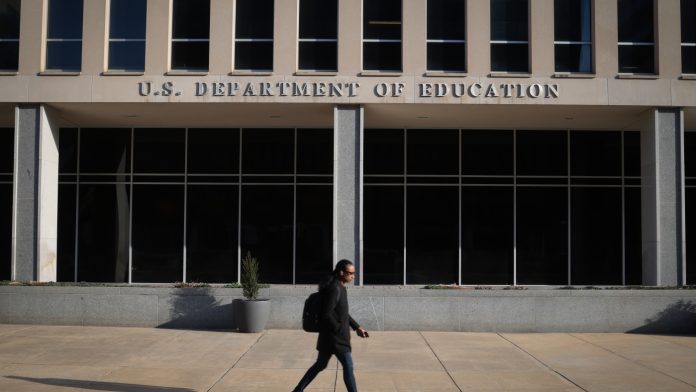
The U.S. Education Department’s Office of Federal Student Aid administers the sprawling federal student loan portfolio.

Win McNamee/Getty Images


hide caption

toggle caption

Win McNamee/Getty Images

Congressional Republicans are quietly working toward one of the most consequential overhauls in the history of the federal student loan program – one that would affect the lives of millions of borrowers.

At the center of that overhaul is an effort to sunset most of the current student loan repayment plans and offer future borrowers a simple binary: pay the same amount every month or tie your payments to your income.

The overhaul is part of Republicans’ reconciliation package, which, if passed, would also extend Trump’s 2017 tax cuts.

If you want to read the overhaul’s 103 pages of legalese, have at it. If not, here’s a breakdown of how Republicans want to reimagine student loan repayment:

1. The standard plan

Under this new standard plan, new borrowers would agree to a repayment window between 10 and 25 years, depending on the size of their debt, with what they owe being divided up, along with interest, into equal monthly payments, like a home mortgage.

Under this plan, borrowers with larger debts would qualify for a longer repayment period:

  • A borrower who owes less than $25,000 would repay over 10 years. 
  • Owe between $25,000 and $50,000? Repayment would expand to 15 years.
  • Between $50,000 and $100,000: Repay over 20 years.
  • Anyone owing more than $100,000 would repay over a 25-year period. 

Borrowers with current loans would not have access to this plan but would still have access to a host of older plans, including standard repayment options ranging from 10 to 30 years.

2. The Repayment Assistance Plan 

For borrowers worried they don’t earn enough to cover the rigid monthly payments of the standard plan, Republicans are also creating what they call their Repayment Assistance Plan for future and current borrowers alike.

Payments would, for the most part, be based on borrowers’ total adjusted gross income (AGI).

Borrowers earning $10,000 or less would be asked to pay $10 a month. Those earning between $10,000 and $20,000 would have a payment based on 1% of their AGI. Between $20,000 and $30,000, it would be 2% of AGI and so on up the income scale with repayment topping out at 10% of AGI for borrowers earning $100,000 a year or more.

What does any of that actually mean?

Monthly payments for many borrowers would be lower relative to Obama-era income-driven repayment plans, according to multiple experts. Though, it would require a minimum monthly payment of $10, ending the $0 payment option of previous income-driven plans.

This new $10 minimum payment wouldn’t make a big difference to the government’s coffers, says Jason Delisle at the Urban Institute. Instead, he says, the purpose likely stems from “emerging research that requiring people to make some payment each month is good because it keeps them connected to the loan and makes it less likely that they’ll default.”

But some borrower advocates worry this new minimum payment could have the opposite effect.

For the lowest-income borrowers, asking for $120 a year is “significant,” says Roxanne Garza, director of higher education policy at the liberal-leaning EdTrust. “I think having that be a required minimum payment will likely push more borrowers into default.”

The plan would also waive any interest that is left after a borrower makes their payment. 

If a borrower’s monthly payment is $50 but they owe $75 a month in interest, the $50 would be applied to interest, and the remaining $25 of interest would be waived by the government.

The result: Borrowers would no longer see their loans grow.

In fact, Republicans want to make sure borrowers see their balances go down every month.

Using our previous example, of a borrower who pays $50 a month entirely toward interest, this provision would also have the government knocking $50 a month off their principal.

For borrowers whose monthly payments are less than $50, the government would match whatever they do pay and apply it toward the principal.

Borrowers whose monthly payments already reduce their principal balance by at least $50 would get no extra help from the government.

“It’s a form of monthly loan forgiveness,” Delisle says. “It’s a drip drip drip of loan forgiveness, rather than waiting for the big payout at the end of 20 years.”

While previous plans offered forgiveness after 20 or 25 years, this plan would extend that to 360 qualifying payments, or 30 years. Any qualifying payments borrowers made before this transition would count toward satisfying that requirement.

This drip-drip change is a way of encouraging borrowers, says Beth Akers at the conservative-leaning American Enterprise Institute. When people make payments but don’t see their balances go down, “we know [they] get tremendously discouraged.” This new principal payment, Akers says, “really tends to that emotional need borrowers have” to feel like they’re making progress.

In creating the Repayment Assistance Plan, Republicans would also eliminate President Biden’s legally frozen SAVE Plan.

Delisle says the borrowers who will feel the biggest difference between this plan and previous income-driven plans are those with large amounts of graduate school debt. These borrowers average more than $110,000 in debt, and under older plans, they could make relatively low monthly payments while keeping a patient eye on forgiveness.

Under this new plan, Delisle says, graduate school borrowers (who tend to earn more income than undergraduate borrowers) would end up paying more upfront, and, delaying total forgiveness for 30 years instead of 20 or 25 means most would likely pay off their debts first.

Finally, borrowers should know: If they enroll in this plan, they cannot change plans later.

“It’s a roach motel,” Delisle says. “You go in, and you can never check out.”

3. Extra options for current borrowers 

The first two options will be the only ones available to borrowers who take out loans after July 1, 2026. But current borrowers have a few more choices – and may feel a little confused.

Current borrowers will still have access to several older plans, including the current standard plan. They’ll also get access to a version of the old Income-Based Repayment (IBR) plan (new borrowers will not). That’s right. Unlike future borrowers, current borrowers will get to choose between two different income-driven plans:

The new Repayment Assistance Plan and IBR.

What’s the difference? Well, we’ve already covered the former. Under the latter, IBR:

  • Borrowers’ payments would be based on 15% of their discretionary income.
  • The repayment window would be shorter: 20 and 25 years for undergraduate and graduate borrowers, respectively.

Compared to Biden’s SAVE Plan, borrowers’ “payments would be much higher,” says Roxanne Garza, of EdTrust.

The SAVE Plan based monthly payments on 5% of an undergraduate borrower’s discretionary income, Garza explains. Under this IBR plan, monthly payments would be based on 15% of discretionary income. That would mean considerably higher payments.

Delisle says, most lower- and middle-income borrowers would likely have lower monthly payments on the new Repayment Assistance Plan compared to IBR.

The one reason borrowers with older loans might want to enroll in IBR anyway is if they’ve been in repayment for close to 20 or 25 years, and are approaching forgiveness, Delisle says.