Tuesday, November 10, 2026
Home Blog Page 13

Biden-era rule widens path to green cards for temporary workers : NPR

0

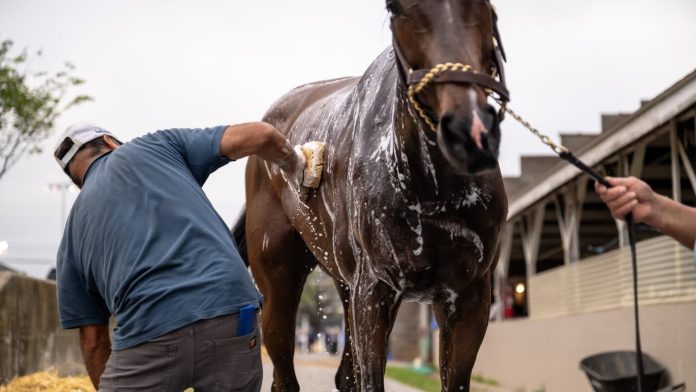
A worker bathes a racehorses on the backside of a horse racing track in Louisville, Ky., on April 30, 2025.

Lydia Schweickart for NPR


hide caption

toggle caption

Lydia Schweickart for NPR

LOUISVILLE — On a recent spring day, Gerardo Serrano works with the thoroughbred racehorses at a barn at Churchill Downs, the famous racecourse that hosts the Kentucky Derby.

The 1,000-pound animals peep their heads from the white stalls, while others amble in circles inside the barn’s wooden fence. Serrano pushes a large broom to clear the hay from the barn’s opening.

Originally from Morelia, Michoacán, he came to the U.S. on a temporary visa about 12 years ago.

He is one of thousands of workers who used the temporary H-2B visa for nonagricultural seasonal labor to care for racehorses across the country. These visas are meant for temporary positions only — up to a year at a time. They’re common in seasonal work in hospitality, landscaping — or working in the equine industry.

But Serrano ultimately managed, three years ago, to gain U.S. permanent residence, or a green card.

“Thanks to God, we went through the visa process, legally, and then we were able to go into the next process,” Serrano tells NPR outside a stable, speaking of himself and his family. Thanks to his green card, his two children, ages 12 and 16, were able to come to the U.S. too within the last year.

A job in the horse-racing industry pays off in multiple ways. Workers like horse grooms get a cut of a winning horse’s cash prize, which can top tens of thousands of dollars.

But there’s another potential incentive: the chance at a permanent residence in the United States.

Thanks to a regulatory change that took effect just three days before President Trump’s inauguration, more workers could soon be joining Serrano in seeking to turn temporary employment into something permanent.

That’s particularly true in the horse-racing industry, where employers may be more willing to pony up thousands of dollars upfront for the right workers that would give them a competitive edge in the next race.

A worker hangs rags used for cleaning on a clothesline outside of horse racing stables in Louisville, Ky., on April 29, 2025. Workers on the backside of the track are responsible for general upkeep of the stables and bathing the race horses.

A worker hangs rags used for cleaning on a clothesline outside of horse racing stables in Louisville, Ky., on April 29, 2025. Workers on the backside of the track are responsible for general upkeep of the stables and bathing the race horses.

Lydia Schweickart for NPR


hide caption

toggle caption

Lydia Schweickart for NPR

Easing the green card application

In the past, legal experts said applying for a green card while in the U.S. on a temporary visa would draw more scrutiny to applications from immigration officials. Temporary workers had to attest their intent to only be in the U.S. on a short-term basis. Still, having a green card application pending could not only jeopardize an H-2B worker’s chances of visa renewal, but also increase the risk of the green card itself being denied.

But the new rule explicitly clarifies that such workers are eligible to apply for permanent residency in the U.S. without risking their visa status.

“Everyone is letting out a collective deep breath right now that the process got a little bit easier,” said Keith Pabian, a lawyer who specializes in H-2B visas for the hospitality sector. He said most of his clients pursue the option.

“Everyone’s feeling a lot more confident that the green card will go through without issue and that we’re not having to fight so hard during the application process to keep people here on H-2B visas.”

The Biden-era rule, which could take the Trump administration years to undo, leaves open one pathway to immigration for tens of thousands of workers on temporary visas even as the administration seeks to close down others, like certain asylum or parole programs.

Getting workers on a green card also provides employers with more certainty about keeping their most prized employees, amid uncertainty about lower caps and competition for H-2B visas in the future.

“They want to have something in place so that anytime they are out-competed for those visas, they have a fallback plan of having their workers obtain green cards,” said Nataly Mualem, founding attorney of Mualem Law, which specializes in workforce visas.

Employers consider the process

Although data is hard to come by, industry experts believe that between 20% to 70% of the workforce on any race track is made up of H-2B visa workers.

It’s not known how common industry-wide acquiring green cards is. It is up to the trainer to decide if they want to do it. But lawyers interviewed for this article say they’ve seen more interest from employers for sponsoring workers for green cards in recent months.

And there are barriers. Employers must shoulder an expensive upfront cost and workers could seek other work once it’s done. It is also lengthy, taking up to five years.

But employers explore the option as an alternative to a work visa to have a workforce that can take on specialized responsibilities, or because they have made close personal connections.

“More commonly, the reason they want to do it is they’ve invested a lot of time in training those workers through the H-2B program,” Mualem said, noting about a fifth of her clients explore the option. “By having them here permanently, they’re able to do more tasks in the off-season, they’re able to train others, they’re able to take on more diverse tasks.”

Workers talk amongst themselves in between tasks on the backside of a horse racing track in Louisville, Ky., on April 29, 2025.

Workers talk amongst themselves in between tasks on the backside of a horse racing track in Louisville, Ky., on April 29, 2025.

Lydia Schweickart for NPR


hide caption

toggle caption

Lydia Schweickart for NPR

Lawyers say employers see a lot of uncertainty over the availability of foreign labor given changes under the Trump administration and increased immigration enforcement. So employers are trying to find other ways to add more stability to their workforce.

More employers, they said, are now inquiring about the green card application process. The new rule makes it easier to consult clients through the process.

“As there’s immigration crackdowns, more employers will be joining the H-2B program because that’s going to be their only alternative,” Mualem said. Across many labor sectors, such as hospitality, the equine industry, or others, portions of the workforce may lack legal status.

But the temporary work visa for non-agricultural labor has a 66,000 annual cap.

“It’s going to become more competitive [to get visas] and that’s pushing more employers to try [green cards] out,” Mualem said. “And even though it’s a long-term plan there are significant benefits to both the employer and employee.”

Visa to green card pipeline helps trainers secure labor

Trainers see workers as a part of the competition. After all, the workers not only reap the benefits of a champion horse but are responsible for its well-being and competitive readiness.

These are roles that are considered specialized: not just anyone can walk into a barn and work with a thoroughbred. And trainers form close personal connections with their workers over the years.

“They’re good people, man,” said Dallas Stewart, a racehorse trainer at Churchill Downs. “They help us hold our game together, so they help us hold my whole business together.”

Dallas has sponsored 10 visas for his workers, who come from Mexico and Peru.

“It costs a lot of money for visas so once you get on a green card, it works out in the long-run,” said Ian Wilkes, another Churchill Downs-based trainer who has sponsored green cards and visas for his workforce, which is mostly from Guatemala and Mexico. He said his green cards each cost about $10,000.

H-2B visas require that the employer first try to seek a domestic worker to fill the role. Then employers have to cover the cost of applying for the visa, providing transportation, housing and healthcare.

“The whole whole issue is I don’t have any Americans walking in the barn looking for a job at 4:30 in the morning,” Wilkes said. “So without these visas, I wouldn’t have any help.”

And even with a pathway to permanent status, trainers said these workers are not replacing domestic jobs.

“Any of the trainers that are on the pipeline, the main goal is once they can secure a worker they would love to be able to get them to that point of having a green card,” said Eric Hamelback, the CEO of the National Horsemen’s Benevolent and Protective Association. “There is at least an understanding that this is not a workforce that can’t just be created if we don’t have these programs in place.”

Riders on horseback travel through the backside of Churchill Downs in Louisville, Ky., on April 30, 2025.

Riders on horseback travel through the backside of Churchill Downs in Louisville, Ky., on April 30, 2025.

Lydia Schweickart for NPR


hide caption

toggle caption

Lydia Schweickart for NPR

Trainers fear changes to the programs

But visas don’t guarantee labor. That 66,000-visa cap means the workforce is ultimately unreliable.

“It’s cumbersome,” Dale Romans, a trainer in Kentucky, said during a press conference in May focused on labor needs in the industry. “And it’s hard to plan for the future because every year you’re reapplying, every ten months, you reapply for new visas and there’s no guarantee that you’re going to get them.”

The ultimate goal is keeping the same workforce. Trainers told NPR that they see value in the same workers grooming, walking and training the same horses.

Employers are also concerned about increased workplace enforcement and lower caps in the future.

Herbert Cardona Marroquin came to the U.S. from Guatemala on the H-2B visa and has worked in Kentucky and Florida.

His trainer has advised him to carry paperwork and identification with him at all times in case he is approached by law enforcement.

“I love horses and now I have the opportunity to be here with a visa and I am very happy to be here working,” Cardona Marroquin said. But he wants more stability and a permanent status.

“But hopefully one day I’ll have the opportunity to get everything in order, which is what we all want, right?”

Employers do face the risk of workers leaving once they have a green card – unlike H-2 visas, workers with permanent residency aren’t tied to a particular employer.

“That’s the gamble of it,” Wilkes, the trainer, said. “It’s heartbreaking sometimes, but you’ve got to move on.”
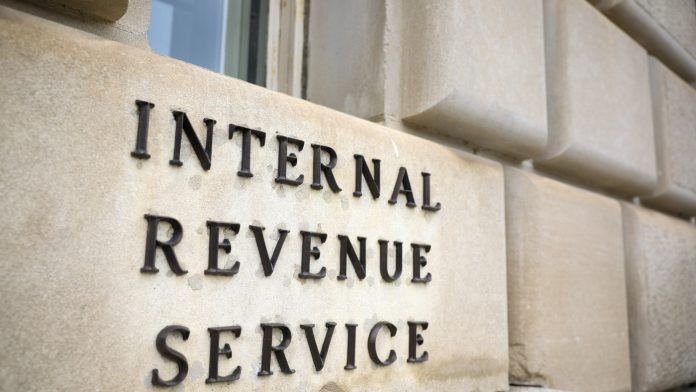
When it comes to the IRS, Trump draws parallels to Nixon : NPR

0

President Trump has threatened to strip Harvard University and other non-profits of their tax-exempt status. It’s one of several ways in which the president has tried to influence the tax collection agency.

Tasos Katopodis/Getty Images North America


hide caption

toggle caption

Tasos Katopodis/Getty Images North America

From utilizing tax data to trace immigrants without legal status to threatening Harvard University’s tax exemption, President Trump has been trying to use the IRS for his own political purposes, in ways that may seem unprecedented.

But they’re not. Former President Richard Nixon laid the groundwork more than four decades ago, when he tried to use the tax collector to punish his enemies and assist his friends.

“One of the things that Nixon did consider was threatening the tax-exemptions of universities,” says Joseph Thorndike, director of the Tax History Project at Tax Analysts. “And that sounds very familiar if you’re reading the paper these days.”

Nixon was angry at universities for not cracking down on Vietnam war protesters. Trump has similarly complained about Harvard and other Ivy League schools not doing more to silence protests against the war in Gaza, amid an administration crackdown on antisemitism on college campuses.

“We are going to be taking away Harvard’s Tax Exempt Status,” Trump wrote in a social media post. “It’s what they deserve!”

Trump is drawing on Nixon’s old playbook, despite laws put in place after Watergate to prevent that kind of meddling by the White House.

Congress has protections in place for the IRS

Oval Office recordings from 1971 reveal how Nixon sought to install a hand-picked enforcer at the IRS to do his political bidding.

“I want to be sure he’s a ruthless son of a bitch,” Nixon told aides about a potential IRS nominee. “That he will do what he’s told. That every income tax return I want to see, I see. That he’ll go after our enemies and not go after our friends. It’s as simple as that.”

Richard Nixon is shown on a television screen.

Richard Nixon is shown on a television screen.

Keystone/Getty Images/Hulton Archive


hide caption

toggle caption

Keystone/Getty Images/Hulton Archive

Nixon’s plans to snoop on tax returns, or have the IRS investigate targets from his “enemies list,” were not always successful, Thorndike says.

But not for lack of trying.

“Nixon tried very hard to misuse the IRS,” Thorndike says. “Congress certainly saw that as a danger afterwards. If the president is developing enemies lists and sending them to the IRS and essentially saying, ‘I want you to audit all these people I don’t like,’ that’s worrisome. And so Congress was very interested in preventing that.”

After Nixon left office, Congress passed laws to protect the IRS — and taxpayers — from political interference from the White House. Those laws are now being tested by the Trump administration.

Sharing tax information with agencies outside the IRS

For example, Congress passed a law to strictly limit who can access information that taxpayers voluntarily provide to the IRS.

But last month, the tax collection agency struck a deal to share some of that taxpayer data with immigration officials to help find and deport people who are in the country illegally.

Immigration advocates are seeking a court order to block the IRS from sharing data with other government agencies.

In response to an inquiry from NPR about the data-sharing agreement, a Treasury Department spokesperson defended the initiative as “breaking down data silos.” But critics say those silos were put there for a reason after the Nixon era.

“If the IRS is now forced to share data with people who it’s not supposed to, that increases the risks of political targeting,” says Mike Kaercher, deputy director of the Tax Law Center at New York University.

An acting commissioner at the IRS resigned shortly after the data-sharing agreement was reached. Trump is now on his fourth acting commissioner since taking office less than four months ago. His nominee for the permanent job, former Rep. Billy Long, R-Mo., is still awaiting a confirmation hearing.

Seeking to use the IRS to target groups

Congress also tried to prevent a rerun of Nixon’s enemies list by prohibiting the president and people around him from requesting or interfering with an IRS investigation.

“I used to work at the IRS,” Kaercher says. “If you’re an IRS person and you’re on the receiving end of an improper request from a political official to use the IRS as a weapon, you’re supposed to go to the inspector general and report that, right away.”

That hasn’t stopped Trump from insisting the IRS should strip Harvard and other non-profit groups of their tax-exempt status — which would presumably require an investigation.

Losing the tax break would be a severe blow to Harvard, which depends on tax-free gifts and its tax-free endowment for nearly half its annual budget.

“I think Harvard is a disgrace,” Trump told reporters last month. “Tax-exempt status, I mean, that’s a privilege. That’s really a privilege. And it’s been abused.”

While Nixon’s plans for the IRS were secretly recorded in the Oval Office, Trump unveils his on social media and live television.

“Donald Trump just says it right out loud,” Thorndike says. “Talking about politicizing the agency quite visibly — I guess I’d say that’s a choice. I don’t think it’s a good choice for the president.”

President Trump speaks in the Cross Hall of the White House in Washington, D.C., during an event on April 30, 2025.

President Trump speaks in the Cross Hall of the White House in Washington, D.C., during an event on April 30, 2025.

Andrew Harnik/Getty Images North America


hide caption

toggle caption

Andrew Harnik/Getty Images North America

Trump told reporters last month that he’s not personally involved in the decision over revoking Harvard’s tax exemption. But leading Democratic senators have called for an investigation of the president’s actions by the inspector general who oversees the IRS.

The inspector general did not respond to NPR’s request for comment.

“The fact that there’s even a question of whether the administration is violating these laws that prevent weaponization of the IRS is deeply troubling,” says Kaercher.

Gutting tax enforcement at the IRS

At the same time the administration is calling for the IRS to investigate individual targets, it is also severely limiting the agency’s ability to go after wealthy tax cheats more generally.

According to an inspector general’s report, the administration has cut more than 11,000 jobs at the IRS, including nearly a third of the tax auditors. More downsizing is expected in the months to come, as part of a widespread effort to shrink the federal government.

That’s likely to hurt the federal budget, since every dollar spent on tax enforcement more than pays for itself in increased tax collections.

“A functioning, effective IRS is in all of our interests,” Thorndike says. “And just starving the agency of staff, that really blows back immediately on taxpayers.”

D.C. Bar Association election gets outsized attention as lawyers face Trump attacks

0

A typically routine election to lead the District of Columbia Bar Association has drawn outsized attention as lawyers and law firms come under attack from the Trump administration.

U.S. and China cite progress in trade talks but release few details : NPR

0

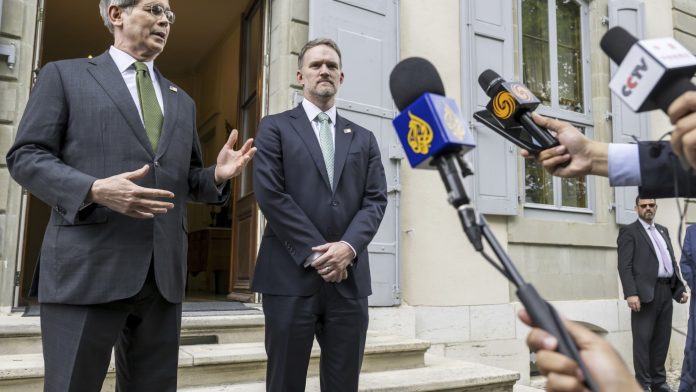
U.S. Secretary of the Treasury Scott Bessent, left, and U.S. Trade Representative Jamieson Greer speak to the press after the second day of a bilateral meeting between the United States and China, in Geneva, Switzerland, on Sunday, May 11, 2025.

Martial Trezzini/Keystone via AP


hide caption

toggle caption

Martial Trezzini/Keystone via AP

GENEVA — Negotiating teams from both the U.S. and China have ended two days of trade talks in Switzerland on a positive note, amid severe tensions between the world’s two largest economies.

U.S. Treasury Secretary Scott Bessent said Sunday evening that the two sides had made what he called “substantial progress,” but that more details would be announced Monday.

Chinese Vice Premier He Lifeng said the atmosphere had been collegial and professional, and the meeting had been an important first step to resolving differences through dialogue.

The next concrete steps will include the creation of a new consultation mechanism that will involve senior officials from both countries, He said.

The discussions started early Saturday morning in a villa owned by the Swiss government, with sweeping views of a sun-lashed Lake Geneva. On the villa’s front steps late Sunday, Bessent described the conversations as “productive,” and said that President Trump had been kept up to date with developments.

U.S. Trade Presentative Jamieson Greer, who joined Bessent as part of the U.S. delegation, meanwhile highlighted the speed at which both sides had found common ground.

“It’s important to understand how quickly we were able to come to agreement,” said Greer. It was something, he said, “which reflects that perhaps the differences were not so large as far as maybe thought.”

Several Trump administration officials still in Washington, including Kevin Hassett, director of the National Economic Council, and Commerce Secretary Howard Lutnick, had also spoken on television Sunday morning about the positive tone of the talks.

But He, as the senior Chinese official leading his delegation, acknowledged that sources of friction remained, while describing the conversations as collegial and professional throughout the course of the weekend.

“The atmosphere of the meeting was candid, in-depth and constructive,” he said. “The meeting achieved substantial progress and reached important consensus.”

He was speaking inside his country’s mission to the World Trade Organization, in Geneva. He said Beijing had not wanted the trade war that President Trump created, but China was not afraid and would fight to the end — a stance that senior Chinese officials have repeated several times in recent weeks.

After weeks of frazzled financial markets, investors are likely to react positively to this development as a sign that the significant disruption to trade between the two countries could soon resume, with improved economic consequences.

But businesses worldwide will want much more detail before making any decisions, and – after just two days of talks — this is far from a done deal.

“I would caution against too much reading of the tea leaves,” according to Dmitry Grozoubinski, a former Australian trade negotiator based in Geneva. “It’s probably more likely that they agreed on what their conversation should cover — on what are the kind of things they are both prepared to discuss.

Both countries have said their officials will make further appearances Monday morning in Geneva.

Qatar is said to be giving Trump a new plane : NPR

0

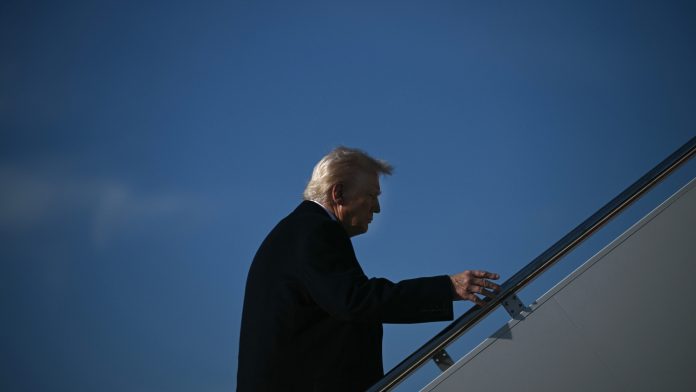
President Trump, seen here boarding Air Force One Joint Base Andrews on March 21, is said to have been offered a new plane by Qatar.

BRENDAN SMIALOWSKI/AFP via Getty Images


hide caption

toggle caption

BRENDAN SMIALOWSKI/AFP via Getty Images

The Trump administration is in talks with the Qatari government about accepting a luxury Boeing 747 airplane, a senior White House official said, that could temporarily serve as Air Force One.

The offer, which was first reported by ABC News, comes on the eve of Trump’s visit to the Middle East. The president is scheduled to visit Saudi Arabia, Qatar and the United Arab Emirates.

The senior White House official, who spoke on condition of anonymity because they were not authorized to speak publicly, confirmed that Qatar has offered to donate a plane to the Department of Defense, but said the gift will not be presented nor accepted this week while in Qatar.

ABC and The New York Times reported that the plane would be donated to Trump’s presidential library when he leaves office. The offer would be one of the biggest foreign gifts ever received by the U.S. government, and raises legal and ethical questions.

Trump pushed back against those concerns in a post on his Truth social Sunday night.

He wrote: “So the fact that the Defense Department is getting a GIFT, FREE OF CHARGE, of a 747 aircraft to replace the 40 year old Air Force One, temporarily, in a very public and transparent transaction, so bothers the Crooked Democrats that they insist we pay, TOP DOLLAR, for the plane. Anybody can do that! The Dems are World Class Losers!!!”

Karoline Leavitt, the White House spokeswoman, said that any “gift given by a foreign government is always accepted in full compliance with all applicable laws.”

“President Trump’s Administration is committed to full transparency,” she said.

Democrats questioned whether the deal was even legal.

“This isn’t a good idea even if the plane was being donated to the U.S. government,” Sen. Chris Murphy of Connecticut said on X. “But Trump GET TO KEEP THE PLANE??? It’s simply a cash payment to Trump in exchange for favors. Just wildly illegal.”

In his first term, Trump struck a deal with Boeing to supply the next generation of Air Force One. Under the terms of that deal, Trump agreed to pay $3.9 billion for two customized 747s. But the president has expressed frustration about the time the beleaguered aircraft manufacturer is taking to deliver the aircraft.

Hamas says it will release last living American held hostage in Gaza : NPR

0

Varda Ben Baruch holds a photo of her grandson Israeli American hostage Edan Alexander during a rally of families of hostages held in the Gaza Strip on April 20 in Nir Oz, Israel.

Amir Levy/Getty Images


hide caption

toggle caption

Amir Levy/Getty Images

TEL AVIV, Israel — Hamas says it will release Israeli American Edan Alexander from Gaza as a step toward reaching a ceasefire agreement with Israel, according to a statement on the militant group’s Telegram channel.

Alexander is a 21-year-old Israeli soldier with dual U.S.-Israeli citizenship who was captured while on duty in the Hamas-led attacks on southern Israel on Oct. 7, 2023. He is the last remaining American citizen held by Hamas in Gaza who is believed to still be alive. The bodies of four other Americans are still held in Gaza, according to the U.S.

In the statement, Hamas said it had been holding secret talks with the U.S. for the last several days, and that Alexander “will be released as part of the steps taken to establish a ceasefire.” It said his release would come as part of ceasefire efforts to open Gaza’s border crossings and bring aid to Gaza after more than 10 weeks of an Israeli blockade that international humanitarian groups say is driving rampant hunger in the territory.

President Trump took to social media on Sunday to confirm the agreement with Hamas on Alexander’s release, saying that it was made to “put an end to this very brutal war and return ALL living hostages and remains to their loved ones.”

Israeli officials have not yet commented publicly on whether they were aware of the talks, but a statement from Israeli Prime Minister Benjamin Netanyahu’s office said the U.S. had “informed Israel of Hamas’s intention to release soldier Edan Alexander as a goodwill gesture to the Americans, without any conditions or compensation.” It said Israel is “preparing for the possibility” of his release.

Earlier this year, both Hamas and the U.S. confirmed that the two parties had been holding direct talks starting as early as January — in a major shift in American policy, as the U.S. had not engaged directly with Hamas since it designated it a terrorist organization in 1997. It has been a long-standing U.S. policy to not negotiate with groups it designates as terrorists.

Qatar and Egypt — two countries who have played key roles in negotiation efforts between Israel and Hamas throughout the war, along with the U.S. — issued a joint announcement welcoming the release of Alexander, calling it a “encouraging step” toward a ceasefire in Gaza.

The announcement about Alexander’s possible release comes shortly before Trump departs for the region to visit Arab allies in the Gulf on Monday, in his first overseas trip during his second term. He is not expected to visit Israel, but is expected to discuss the future of Gaza with Arab leaders.

Hamas has not yet said when Alexander would be released, although Steve Witkoff, Trump’s special envoy to the Middle East, told NBC news on Sunday that he is traveling to Israel, and “picking him up probably tomorrow.” He said the release was happening largely because of President Trump. Witkoff’s office did not immediately respond to NPR’s request for comment.

There are 59 hostages remaining in Gaza, including Alexander, more than half of whom are believed to be dead, according to Israel. Hamas had released 38 hostages in exchange for thousands of Palestinian prisoners and detainees held by Israel under a ceasefire deal that began on Jan. 19. But Israel’s military broke that ceasefire in March, after negotiations between the two parties failed to produce an extension of the truce.

Israel has since gained control of about a third of Gaza’s territory, and has imposed a complete blockade while continuing a deadly and destructive air campaign throughout. Earlier this month it said it planned to expand its offensive there.

Gaza health authorities say more than 52,000 Palestinians have been killed by Israeli attacks on the territory since the start of the war in October 2023. About 1,200 people in Israel were killed in the Hamas-led attacks that month and some 250 people were taken hostage, according to Israel.

Kat Lonsdorf reported from Washington, D.C., and Daniel Estrin reported from Tel Aviv. Itay Stern contributed to this report from Tel Aviv, Ahmed Abuhamda contributed from Cairo and Nuha Musleh from Ramallah. 

Dr. Casey Means, Trump's pick for Surgeon General, faces criticism across the spectrum

0

Dr. Casey Means, a health care entrepreneur and social media influencer, is Trump’s pick for surgeon general. But she’s facing pushback for her unconventional resume.

Politics chat: Confusion over Trump's agenda with tariffs and trade war

0

There’s confusion over what the president wants with his trade war and whether the GOP’s big spending bill should include raising taxes on the rich in order to fund Trump’s domestic priorities.

Federal employee unions fight for survival as Trump attacks : NPR

0

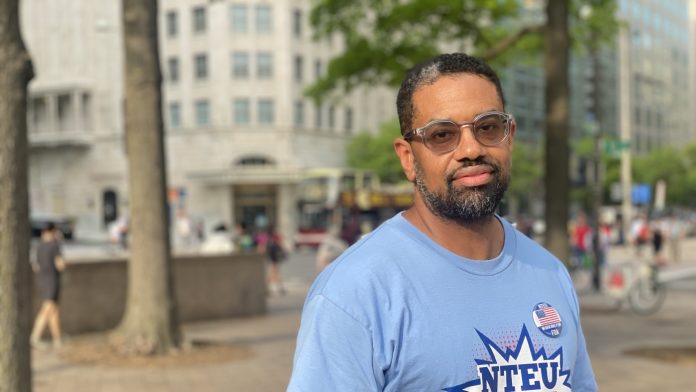
Anthony Lee is president of NTEU Chapter 282, the union representing close to 9,000 employees at the Food and Drug Administration.

Andrea Hsu/NPR


hide caption

toggle caption

Andrea Hsu/NPR

By late March, Anthony Lee should have gotten a heads up that mass layoffs at the Food and Drug Administration were about to begin.

Instead the union president found out when he started getting panicked calls early one morning.

Employees were learning they were being fired while swiping their badges to get into work. A green light meant go. A red light meant stop.

“For dozens, hundreds of employees, it just went red and they weren’t able to enter the building,” Lee says. “That’s the way a lot of people did find out that their federal service was ending.”

Lee is president of NTEU Chapter 282, the union representing close to 9,000 FDA employees. Under the union’s collective bargaining agreement, the government is required to provide advance notice of any reduction in force.

But the Trump administration gave no such notice. Nor did it consult with Lee when it ended the union’s telework agreement.

“Basically we’ve been ignored,” says Lee.

Attacks on unions “exponentially worse”

President Trump’s antipathy toward federal sector unions is well known. Still, Lee says Trump’s attacks on unions now are “exponentially worse” than in the president’s first term.

“Even our ability to exist in the federal workplace — to be able to represent employees — is threatened by this administration,” he says.

Trump’s efforts to slash the federal workforce by hundreds of thousands of workers could decimate union bargaining units. And even where workers remain, he has moved to end the right to union representation for wide swaths of the workforce.

In late March, Trump issued an executive order ending collective bargaining rights for most federal workers, citing a provision in federal law that gives presidents the authority to do so at agencies that have national security as a primary mission.

Already, employees at agencies such as the CIA, the FBI and the National Security Agency have no collective bargaining rights.

Trump’s executive order went much further, sweeping up a broad array of agencies those exclusions have never applied to, including the Environmental Protection Agency, the Department of Veterans Affairs and the FDA.

Multiple lawsuits are challenging that order. In late April, a federal judge issued an injunction, blocking it for now, but the Trump administration has appealed that decision.

Collective bargaining as a check on presidential power

Trump has argued that having to negotiate with unions over workplace matters impedes his ability to manage the government as he sees fit.

Some would say that’s by design.

In a New York University Law Review article, Nicholas Handler, an associate professor of law at Texas A&M School of Law, argues that collective bargaining serves as a check on presidential power. The binding agreements that unions negotiate with federal agencies over personnel matters such as working conditions, performance reviews, and grievance procedures “restrain and reshape the President’s power to manage the federal bureaucracy,” he writes.

A union supporter holds a sign at a press conference on federal workforce rights outside the U.S. Capitol on March 28, 2025 in Washington, D.C. Lawmakers and union leaders spoke out against President Donald Trump's executive order ending collective bargaining with federal labor unions.

A union supporter holds a sign at a press conference on federal workforce rights outside the U.S. Capitol on March 28, 2025 in Washington, D.C.

Kevin Dietsch/Getty Images North America


hide caption

toggle caption

Kevin Dietsch/Getty Images North America

Civil servants did not always have this leverage. In the first half of the 20th century, even as labor unions gained strength elsewhere, there was a fear of giving federal workers too much say over how the nation’s laws were carried out. After all, civil servants serve the American people.

As such, federal employees have never had the right to strike. They also can’t negotiate over wages.

A recruiting crisis led to a turning point

But in the early 1960s, the federal government was facing a labor crunch. It needed scientists, economists and lawyers to staff growing agencies, but it couldn’t pay big salaries. What it could offer was stability, job protections, and — after President John F. Kennedy signed a 1962 executive order — the right to unionize.

“Collective bargaining becomes an attractive tool for presidents to recruit people into the federal civil service and take advantage of a lot of those highly skilled workers that otherwise might be difficult to recruit,” says Handler.

Congress later codified those labor protections in the Civil Service Reform Act of 1978, asserting that the right to organize and collectively bargain “contributes to the effective conduct of public business” and “safeguards the public interest.”

Through the law, Congress also created for itself and the courts a way to police the executive branch, Handler says.

Consider a scenario in which a president wants to weaken a particular agency, such as the EPA. One way to undermine the agency would be to make life for EPA workers miserable, he explains. Collective bargaining gives those employees a way to push back, to preserve their ability to carry out their agency’s mission as Congress intended.

Now, Trump says those labor rights Congress established in 1978 make federal workers unaccountable.

“The CSRA enables hostile Federal unions to obstruct agency management,” states a White House document explaining his executive order. “This is dangerous in agencies with national security responsibilities.”

Losing protections that made the jobs worthwhile

Lee, a 23-year veteran of the FDA in addition to being union president, worries that if Trump gets his way, workers will lose the stability and protections that made working for the government worthwhile.

He’s especially concerned that scientists will become vulnerable to political pressure. Under the union contract, employees who review food ingredients, drugs and medical devices have a right to flag safety or efficacy concerns without fear of retribution.

“It remains to be seen as to whether or not they’re going to allow employees to do the job that the public expects, protecting and promoting the health and safety of the public,” Lee says.

A debate over efficiency

Armando Rosario-Lebron is eastern region vice president for the National Association of Agriculture Employees, the union representing approximately 3,000 federal workers in the Plant Protection and Quarantine program of the USDA's Animal and Plant Health Inspection Service.

Armando Rosario-Lebron is eastern region vice president for the National Association of Agriculture Employees, the union representing approximately 3,000 federal workers in the Plant Protection and Quarantine program of the USDA’s Animal and Plant Health Inspection Service.

Andrea Hsu/NPR


hide caption

toggle caption

Andrea Hsu/NPR

One of Trump’s repeated complaints is that unions make it too hard to get rid of poor performers. Many union contracts spell out lengthy processes for doing so.

But others contend unions help make the government run more smoothly.

“Our collective bargaining agreement is a huge efficiency boost for the government,” says Armando Rosario-Lebron, a vice president of the National Association of Agriculture Employees, which represents employees of the U.S. Department of Agriculture’s Animal and Plant Health Inspection Service.

His bargaining unit includes people who are tasked with keeping invasive pests and plants out of the country, work that requires a lot of overtime. Rosario-Lebron says the union largely manages that.

“You have some employees who want as much overtime as possible to earn as much income as they can. You have other employees who don’t want to be overworked to death, so to speak,” he says.

Figuring out how to assign overtime and being the liaison between management and employees probably represent the union’s biggest savings to the government, says Rosario-Lebron.

“I know that a lot of managers love that,” he says.

Rosario-Lebron says he tries to resolve most disputes outside the formal grievance process. He says there are plenty of times he’s advised employees against pursuing complaints he sees as frivolous.

“I don’t recommend you go down that path because it’s not going to end well for you,” he says he’s told them.

Employees are more likely to listen to the union on such matters, he says.

He has a warning for the Trump administration: Get rid of the union and management will be on its own.

The new pope is American. Will that have an impact on US politics?

0

Congressman Brendan Boyle on how the new pope affects American politics, on issues both in line and at odds with the Trump administration