


Máximo Napa Castro, a Peruvian fisherman, was reunited with his family last Friday after being rescued from his fishing boat adrift in the Pacific Ocean. He had been stranded there since Dec. 7.
VA to deny gender dysphoria treatment to new patients : NPR

The seal of the Department of Veterans Affairs is seen outside the agency’s building in Washington, D.C. The VA says it will no longer offer medical treatment for gender dysphoria to veterans.
Charles Dharapak/AP
hide caption
toggle caption
Charles Dharapak/AP
The Department of Veteran Affairs said that, effective immediately, it will no longer offer medical treatment for gender dysphoria to veterans who are not already receiving the treatment from the VA or the Department of Defense.
“If Veterans want to attempt to change their sex, they can do so on their own dime,” VA Secretary Doug Collins said in a press release Monday announcing the new policy.

It is the latest in a series of actions the department has taken to strip recognition and services away from transgender veterans. The agency said it’s following the Trump administration’s executive order that says it’s now U.S. policy to “recognize two sexes, male and female,”
While the VA never offered gender-affirming surgery, it offered treatments like hormone therapy and prosthetics, as well as tools to help transgender veterans present as their gender identity.
The agency provides healthcare and benefits for about nine million veterans — VA estimates that fewer than 0.1% identify as trans.
“If as a country we tell ourselves that we want the very best for America’s veterans, this recent action by the VA flies in the face of that and makes one wonder if it’s one that VA physicians would agree with,” said Allison Jaslow, CEO of advocacy group Iraq and Afghanistan Veterans of America. “Veterans have dealt with enough at the hands of politicians during our service, especially those of us who’ve served in wartime, we don’t need to continue to be beaten on as we’re just trying to live our lives post-service.”
Collins said the agency would continue to provide healthcare that’s not related to gender affirming care to transgender veterans, whom the release refers to as “trans-identifying.”

Last Friday, the agency scrapped a policy that had laid out the kind of care trans patients could receive at VA facilities, but also instructed healthcare providers to respect the patients’ pronouns and assign them rooms that matched their gender identity.
VA’s research shows that veterans who are sexual minorities — including LGBTQIA, non-binary, intersex and other veterans — are more likely than average veterans to take their own lives; that figure is higher for transgender veterans. Veterans have a higher average suicide rate than the general population.
The Pentagon has paused gender-affirming treatment for its service members and has been telling trans service members to come forward and leave the military by the end of March. Those policies are being contested in court.
NPR’s Quil Lawrence contributed reporting.
Émilie Dequenne, Belgian Actress Who Starred in ‘Rosetta,’ Dies at 43

Émilie Dequenne, who won best actress honors at age 17 at the Cannes Film Festival for her role in the Belgian film “Rosetta,” died on Sunday in Villejuif, France. She was 43.
Her death, at a hospital, was confirmed by Marie-Laure Calmette, an assistant to Ms. Dequenne’s longtime agent, Danielle Gain. Ms. Dequenne had been diagnosed with adrenal cancer.
Ms. Dequenne was starring in her first film role when she played the lead in “Rosetta,” a 1999 film directed by the brothers Jean-Pierre and Luc Dardenne. The film, about a working-class teenager fighting to hang onto a job, won the Palme d’Or, the top honor at Cannes.
Ms. Dequenne revealed in October 2023 that she had been diagnosed with adrenocortical carcinoma, a rare and aggressive adrenal cancer.
She talked about her diagnosis in an interview on the television show “Sept à Huit,” on the French network TF1, which aired in December 2024.
Ms. Dequenne appeared in nearly 50 films and won numerous awards, including a César, one of France’s top film honors, for best supporting actress in “Love Affair(s),” (“Les Choses Qu’on Dit, les Choses Qu’on Fait”), a 2020 film directed by Emmanuel Mouret.
She was perhaps best known for her roles in the 2012 drama “Our Children” (“À perdre la raison”), by the Belgian director Joachim Lafosse, and “Rosetta.” When she auditioned for the role in “Rosetta,” she made an immediate impression, Luc Dardenne recalled in an interview with the French radio station FranceInfo that aired on Monday.
“The first day she shot in front of a real camera, she managed to bring the whole team together,” Mr. Dardenne told the Belgian broadcaster RTBF. “That’s what happened, and it got better and better as the shoot progressed.”
Ms. Dequenne was born in Beloeil, Belgium, on Aug. 29, 1981. She studied drama at the Académie de Musique et des Arts de la Parole de Baudour in Belgium. She began her acting career at a company based in a region of Belgium near the border with France.
She is survived by her husband, Michel Ferracci, and a daughter, Milla Savarese, with her former partner, the Belgian DJ Alexandre Savarese.
Last May, while her cancer was in remission, she celebrated the 25th anniversary of “Rosetta” at the Cannes Film Festival. She also promoted a new film, “Survive,” released last year. Most recently, she appeared in “TKT,” a film about bullying that is set at a Belgian high school.
California Democrats seek to balance climate with cost of living : NPR

State leaders, especially those with ambitious climate goals, are trying to decide between slowing climate change and the cost of living, especially on an ever-warming planet.
AILSA CHANG, HOST:
In California, Democrats’ grip on the state legislature took a slight hit last November when Republicans gained a handful of seats amid rising concerns about the cost of living. Now Democrats in Sacramento say reducing costs is their top priority. But that could force some big changes in California’s nation-leading efforts to fight climate change. From member station KQED, here’s Guy Marzorati.
GUY MARZORATI, BYLINE: Southern California legislator Jacqui Irwin can easily list the ways that the effects of climate change are hitting the state.
JACQUI IRWIN: Cycles of intense flooding.
MARZORATI: Historic droughts.
IRWIN: Rising seas that threaten our coastlines.
MARZORATI: Unprecedented heat waves.
IRWIN: And closest to home for me, devastating wildfires.
MARZORATI: Those fires, like the ones that tore through Los Angeles earlier this year, are making life more expensive for all Californians.
IRWIN: Whether through rising utility bills…
MARZORATI: Because power companies are raising prices to update their equipment and limit the risk of starting wildfires. On top of that…
IRWIN: …Insurance premiums.
MARZORATI: Which are going up for homeowners to cover the massive losses insurers like State Farm are incurring in these disasters.
JAMES GALLAGHER: Poll after poll has shown this is the No. 1 issue for California voters – the cost of living.
MARZORATI: That’s James Gallagher, the Republican leader in the State Assembly. His party sees an opportunity to use anxiety over costs to chip away at the supermajorities Democrats hold in both houses.
GALLAGHER: We need to do something. We need to act urgently on this issue, and Republicans are prepared to do so.
MARZORATI: But Republicans still have no real leverage at the California capitol. It’s Democrats who are now facing the challenge of weighing affordability against another top party priority – reducing greenhouse gas emissions that are worsening these climate disasters. And that balancing act could result in changes to the state’s landmark climate initiative, known as Cap-and-Trade. That program is a key way states like California and Washington have come to fight climate change on their own, apart from the federal government. Here’s how it works. Cap-and-Trade starts with the goal of reducing greenhouse gas emissions, says Meredith Fowlie of the Energy Institute at UC Berkeley.
MEREDITH FOWLIE: We set a target. You know, California has some emissions targets that say, we want to reduce our emissions by X percent by this date.
MARZORATI: That creates a cap – a statewide limit on pollution. Then California requires companies to buy and trade credits that allow them to pollute under the cap, creating a market for carbon.
FOWLIE: You can think of a carbon market like an auction.
MARZORATI: And those auctions raise a lot of money for California, with around 3- to $4 billion a year flowing into state coffers. Michael Wara, a climate research scholar at Stanford, says right now, the state spends most of that money to further reduce carbon emissions.
MICHAEL WARA: In California, we invest a lot of money in high-speed rail.
MARZORATI: In building housing near train and bus stops.
WARA: And lots in NN EVs.
MARZORATI: But the question in front of lawmakers…
WARA: Is whether that approach is sustainable or whether we need to be thinking about giving money back to people.
MARZORATI: That could mean taking some dollars away from transit and housing and instead giving it back to Californians to help pay for the rising cost of things like electricity or gas. Those are the tradeoffs facing California lawmakers as they seek to balance global climate leadership with an electorate already feeling the cost of a warming planet.
For NPR News, I’m Guy Marzorati, in San Jose.
(SOUNDBITE OF DRAKE SONG, “BLEM”)
Copyright © 2025 NPR. All rights reserved. Visit our website terms of use and permissions pages at www.npr.org for further information.
NPR transcripts are created on a rush deadline by an NPR contractor. This text may not be in its final form and may be updated or revised in the future. Accuracy and availability may vary. The authoritative record of NPR’s programming is the audio record.
Israel Carries Out ‘Extensive Strikes’ in Gaza

Israeli forces launched a large-scale strike in Gaza early Tuesday, officials said, in what appeared to be the first major attack on the territory since its cease-fire with Hamas began roughly two months ago.
The Israeli Defense Forces said on Telegram just before 2:30 a.m. that it and the Israeli Security Agency were “conducting extensive strikes on terror targets belonging to the Hamas terrorist organization in the Gaza Strip,” adding that more details would be released later.
Since the cease-fire between Israel and Hamas took effect in mid-January, the Israeli military has conducted a string of smaller strikes on Gaza, which Hamas claims have killed more than 150 people, at least some of them civilians. It has accused Israel of repeatedly violating the truce agreement by continuing military operations.
Israel and Hamas are supposed to be negotiating the next steps in the cease-fire agreement, which would involve a permanent end to the war that began with the Hamas-led attack on Israel on Oct. 7, 2023. But mediators including the United States, Qatar and Egypt have made little headway, given the entrenched disagreements between the two sides.
This is a developing story.
Judge seeks sworn declaration from Justice Department in deportation case : NPR

President Trump invoked the Alien Enemies Act against alleged members of the Tren de Aragua gang and called for their immediate detention and removal from the United States. The deportation of more than 250 people over the weekend has been challenged in court.
Anna Moneymaker/Getty Images
hide caption
toggle caption
Anna Moneymaker/Getty Images
A federal judge Monday ordered the U.S. Justice Department to provide a sworn declaration by noon ET Tuesday with details on how planeloads of alleged members of Tren de Aragua were deported despite his order to turn the planes around.
The hearing on Monday centered on whether the government complied with Judge James Boasberg’s temporary restraining order, and it included a debate about when exactly the order was issued and where U.S. custody over deportees ends. Also discussed: whether an oral order versus a written order holds the same weight when it comes to restraining government action.
It came after Boasberg’s emergency order Saturday that told the administration to stop using wartime powers to immediately deport people it said were part of the Tren de Aragua gang, and turn around any planes already in the air. Senior Justice Department officials in a filing on Sunday argued that the order came too late to stop the deportations, as planes were already outside U.S. territory.
The American Civil Liberties Union and Democracy Forward had sought to block the deportations of five Venezuelan men for 14 days and later broadened the request to all people who could be deported under Trump’s Alien Enemies Act proclamation concerning Tren de Aragua.
Government lawyers on Sunday wrote that “some gang members subject to removal under the Proclamation had already been removed from United States territory” by the time the judge issued his written order at 7:26 p.m. ET on Saturday.
But lawyers from the civil rights groups argued that even though the judge’s written order came at 7:26 p.m., the judge had actually issued an oral order between 6:45 p.m. ET and 6:48 p.m. ET that directed the government to turn around any planes carrying people being removed under the Alien Enemies Act. And that oral order should hold the same weight, they said.
The groups quote the judge as saying “that you shall inform your clients of this immediately, and that any plane containing these folks that is going to take off or is in the air needs to be returned to the United States. … However that’s accomplished, whether turning around a plane or not embarking anyone on the plane or those people covered by this on the plane, I leave to you. But this is something that you need to make sure is complied with immediately.”
“Plaintiffs remain extremely concerned that, regardless of which time is used, the government may have violated the Court’s command,” the groups wrote in a filing on Monday. They said that the U.S. government retained custody of people until the planes landed and they were turned over to El Salvador — and that it didn’t matter whether the plane was over international waters or not.
On Monday, White House press secretary Karoline Leavitt said there were “questions about whether a verbal order carries the same weight as a legal order as a written order, and our lawyers are determined to ask and answer those questions in court.”
The plaintiffs cited FlightAware data that showed two planes carrying the deportees were still in the air by the time of the judge’s written order at 7:26 p.m. A third plane took off at 7:37 p.m., after the written order was released, they said.
Alone at Sea for 95 Days, a Peruvian Fisherman Clung to Hope

For 95 days, Máximo Napa Castro, 61, was alone and lost at sea, praying to God and clinging to the hope that he would one day see his mother again.
Without food or water, he ate cockroaches, birds and finally a turtle, whose blood he drank to slake his thirst.
He talked to God, getting angry at points. “I said to him, ‘What am I going to find here?’” he said. “Who’s going to save me?”
Then he asked for forgiveness.
“Someone is coming or a helicopter is coming,” he recalled thinking. “And then the next day, he sent me a helicopter.”
It was March 12, and Mr. Napa Castro, a Peruvian fisherman, had been spotted by the crew of an Ecuadorean tuna boat hundreds of miles off the Peruvian coast, the Peruvian news source RPP News reported.
He had been at sea since Dec. 7, when he left the Peruvian port of Marcona, Peruvian news outlets reported.
Mr. Napa Castro had set out on a voyage to catch roe, or fish eggs, packing enough food for a month, according to Andina, a Peruvian state news outlet.
But on Dec. 20, after less than two weeks at sea, the engine on his boat broke down, RPP News reported. He rationed his food supplies, including rice and crackers that he had on board, and collected rain to drink, his family told Peruvian news media.
But there were days when Mr. Napa Castro did not eat at all and there was no rain to collect. Still, he believed he would survive. “I said to myself, ‘I won’t die, because I have my children and mother,’” he said.
Catching the turtle was a major break, he said, but he did not like having to kill it. “It’s either you or me,” he recalled thinking.
Mr. Napa Castro’s daughter, Ines Napa Torres, told RPP News that local fishermen had searched for her father, to no avail. She said the family had also urged the authorities to conduct an aerial search. His boat didn’t have a radio beacon, which would have made it easier to locate, RPP News reported.
Still, Ms. Napa Torres told RPP News, “We, as a family, never lost faith — the hope — that we would find my father.”
After he was spotted by the tuna boat, Mr. Napa Castro was taken by helicopter to a Peruvian Coast Guard vessel, where he was given medical attention, according to the Peruvian Navy, which posted a photo on Instagram of a medic treating him.
Ms. Napa Torres said her father was sunburned and dehydrated. She called it a “miracle” that he had survived.
On Friday, Mr. Napa Castro walked off a dock in Peru and was embraced by his brother, who was there to greet him, video showed. Both men sobbed.
“I didn’t want to die, for my mother,” Mr. Napa Castro told reporters through tears. “I have a 2-month-old granddaughter. I clung to her. Every day, I thought about my mother.”
Later, Mr. Napa Castro told reporters that he was looking forward to a home-cooked meal of arroz con pollo, a pork stew called carapulcra and a noodle dish called sopa seca.
He was also welcomed home with a celebration, where cheering friends, relatives and neighbors presented him with a cake adorned with decorative birds, cockroaches and a turtle.
His mother, Elena Castro, who sat by his side at the celebration, said she had prayed that she would see her son again.
“I told God: Whether he’s alive or dead, bring him here, even if it’s just to see him,” she told Andina. “But my daughters never lost faith. They kept telling me, ‘Mom, he’ll come back; he’ll come back.’”
Consider This from NPR : NPR
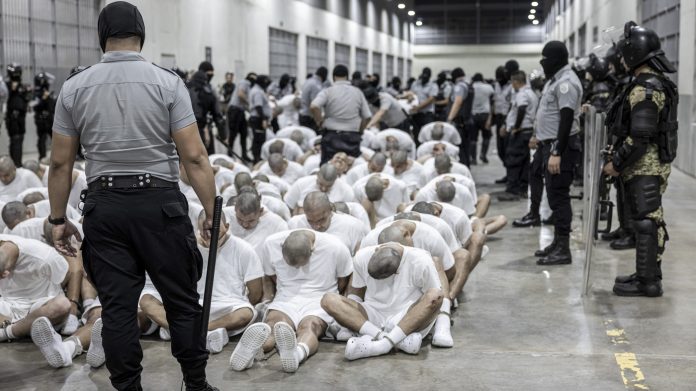
In this photo provided by El Salvador’s presidential press office, a prison guard transfers deportees from the U.S., alleged to be Venezuelan gang members, to the Terrorism Confinement Center in Tecoluca, El Salvador, Sunday, March 16, 2025.
AP/El Salvador presidential press office
hide caption
toggle caption
AP/El Salvador presidential press office

In this photo provided by El Salvador’s presidential press office, a prison guard transfers deportees from the U.S., alleged to be Venezuelan gang members, to the Terrorism Confinement Center in Tecoluca, El Salvador, Sunday, March 16, 2025.
AP/El Salvador presidential press office
“Oopsie, too late.” That post on X from the President of El Salvador got retweeted by Secretary of State Marco Rubio over the weekend with a laugh-crying emoji over a headline about a judge’s ruling.
The judge ordered the Trump Administration not to deport Venezuelans to El Salvador.
That came after a Brown University physician in the United States on an H1-B visa from Lebanon was sent back. Even though a federal judge issued an order that she appear at an in-person hearing on Monday.
In a court filing today, lawyers for the government said US Customs and Border Patrol officers said they didn’t learn of the order until after the doctor was sent back.
The administration insists it is not defying court orders. Trump hasn’t yet openly and explicitly defied the courts. Can he undermine them just by flirting with defiance?
For sponsor-free episodes of Consider This, sign up for Consider This+ via Apple Podcasts or at plus.npr.org.
Email us at [email protected].
This episode was produced by Connor Donevan.
It was edited by Courtney Dorning.
Our executive producer is Sami Yenigun.
Nayib Bukele, El Salvador’s Leader, Sees Opportunity in Trump’s Deportations

Shortly after the Trump administration deported hundreds of Venezuelans to El Salvador this weekend, the Salvadoran president, Nayib Bukele, posted a three-minute video on social media. It featured shackled men being marched off a plane over a dramatic electronic soundtrack and into prison, where they were shaved bald.
Mr. Bukele also taunted the U.S. judge who unsuccessfully ordered the flights turned around, posting on X, “Oopsie … Too late,” with a laughing emoji. Secretary of State Marco Rubio shared the video, as did Elon Musk. Mr. Trump thanked Mr. Bukele online, saying, “We will not forget!”
El Salvador’s role in the Trump administration’s deportation strategy signals a new level of power and global visibility for Mr. Bukele, who became president at 37 in 2019 and was re-elected by a landslide last year.
He has become Latin America’s most popular leader for his takedown of gangs, even as he has suspended key civil liberties and has been accused by U.S. prosecutors of secretly negotiating with the same gangs. He is now positioning himself as a crucial regional ally to Mr. Trump.
The world’s ‘coolest dictator’
Mr. Bukele uses social media to project a slick and casual look — often wearing a backward baseball cap and aviator shades — and to respond to criticism of his iron-fisted approach to crime and violence.
In spring 2022, after a surge in gang violence rocked El Salvador, the government imposed a state of emergency that has been in place ever since. Mr. Bukele empowered police and the military forces to carry out mass arrests, which human rights groups say have ensnared without due process people who have no gang ties.
Many of the 85,000 Salvadorans apprehended have disappeared into the prison system, held for years without trial and without their families knowing if they are alive.
Mr. Bukele has also been accused of undermining democratic institutions. He has embraced the criticism, referring to himself as the world’s “coolest dictator.”
Adding to his tough-on-crime persona are the highly produced videos and photos that his government regularly releases. They feature shirtless men in handcuffs or prisoners working in factory-like conditions. And they often include footage from the forbidding Terrorism Confinement Center, known as CECOT, a hulking site that can house up to 40,000 inmates.
An alliance with Trump
Mr. Bukele’s embrace of emergency security powers and his promotion of the cryptocurrency Bitcoin have earned him praise in Mr. Trump’s inner circle.
He was given a standing ovation at the conservative CPAC event last year and recently met with Mr. Musk at a Tesla plant in Texas.
Last month, Mr. Bukele took Mr. Rubio on a sun-drenched tour of the presidential residence outside San Salvador. Afterward, Mr. Rubio announced that Mr. Bukele had offered to take in deportees of any nationality, including Americans, and to house them in CECOT — for a fee.
Included in that group, Mr. Rubio said, would be “any illegal alien in the United States who is a criminal of any nationality, whether from MS-13 or the Tren de Aragua,” the Salvadoran and Venezuelan gangs.
A White House spokeswoman said on Monday that El Salvador would receive $6 million for taking in the Venezuelan deportees, who the U.S. government said were members of Tren de Aragua, without offering evidence or the detainees’ names.
The deportation created panic among Venezuelan families, who feared their relatives were among those handed over to the Salvadoran authorities.
Bringing MS-13 members back
The day after Mr. Rubio’s announcement, the Salvadoran ambassador to Washington, Milena Mayorga, said Mr. Bukele had asked to include MS-13 leaders among those deported to El Salvador, “as a matter of honor.”
“The president was blunt and told Rubio: I want you to send me the gang leaders who are in the United States,” Ms. Mayorga said.
The deportees also included two Salvadoran men described by Mr. Rubio as “dangerous top MS-13 leaders.”
Mr. Bukele’s relationship to MS-13 — which began in El Salvador but has spread through Latin America and the United States — is complicated.
Under the Biden administration, the Department of Justice accused Mr. Bukele and his administration of secretly negotiating a pact with certain gang leaders: In exchange for helping keep down homicide numbers, Salvadoran officials offered them privileges behind bars, the department said.
Top Salvadoran officials, the Justice Department said, also helped an MS-13 boss escape the country even though the United States had requested his extradition.
In 2021, the Treasury Department imposed sanctioned against members of the administration for doling out favors to gang leaders. Mr. Bukele and members of his administration were named in U.S. indictments of MS-13 leaders.
Mr. Bukele has denied making a deal with gang leaders.
Though his popularity has soared, some analysts say the Salvadoran leader may be fearful of losing his grip on power if his alleged collaboration with gang leaders were to fully come to light.
Mr. Bukele said the deportees would be held for at least a year and made to perform labor and attend workshops under a program called “Zero Idleness.”
In announcing the arrival of this weekend’s flights, he called them “the first.”
Gabriel Labrador contributed reporting from San Salvador.
Experts worry that DEIA bans are part of a push to undo the 1964 Civil Rights Act
Civil rights experts worry bans on DEIA in education and government are part of a larger, ongoing push to undo the country’s 1964 Civil Rights Act.