Thursday, November 12, 2026
Home Blog Page 119

Israel’s Newest Army Recruits: the Ultra-Orthodox

0

They weren’t supposed to fight.

At Israel’s founding in 1948, the new nation’s leaders agreed that ultra-Orthodox men — known as the Haredim, or God-fearing, in Hebrew — would be spared from mandatory military service. In exchange, Haredi leaders lent their support for the largely secular state.

The arrangement held for Israel’s first 75 years, until the Hamas-led attack on Oct. 7, 2023.

The resulting war in Gaza pulled hundreds of thousands of Israelis into battle — but hardly any ultra-Orthodox. The dynamic exacerbated tensions that had been simmering for years.

The Haredim, who average more than six children per family, now make up 14 percent of the nation, up from 5 percent in 1948. In 40 years, they are on track to account for half of all Israeli children.

As the numbers of Haredim have grown, many Israelis have become frustrated that their own sons and daughters are sent to fight while the Haredim receive government subsidies to study the Torah.

Last summer, the tensions broke open. Under pressure, the Israeli Supreme Court ruled that ultra-Orthodox men were no longer exempt from service. The military has since sent draft orders to 10,000 Haredi men. Just 338 have shown up for duty.

Israel is now confronting one of its messiest and most fundamental dilemmas: Its fastest growing sect won’t serve in the military.

After the Supreme Court decision, The New York Times began following three Haredi teenagers who represent the divergent paths for the Haredim and Israel.

Chaim Krausz, 19, studies the Torah for 14 hours a day, just like his father before him. He has protested the Supreme Court decision and believes armed service is not only a sin, but also a threat to ultra-Orthodox traditions.

Itamar Greenberg, 18, a former ultra-Orthodox seminary student, has also protested against the Israeli state, but his reasons are not religious. “They’ve been committing a massacre in Gaza,” he said.

Yechiel Wais, 19, also once studied in a seminary, but had dreams of a life outside his strict ultra-Orthodox community and left for the work force. Then his draft orders arrived.

“It’s not an entry ticket to Israeli society,” Mr. Wais said of a position in the Israeli military. “But it’s the minimum requirement.”

Growing up, Mr. Wais wore a black-and-white suit. Like most ultra-Orthodox males, it was practically his only outfit.

But one year for Purim, a Jewish holiday when many children wear costumes, he dressed up as an Israeli soldier. He lived near an Israeli Air Force base and loved watching the F-16 fighter jets from behind a fence.

The idea of him, a Haredi boy, growing up to be a soldier felt impossible. “I didn’t even fantasize about it,” he said.

Ultra-Orthodox men are supposed to devote themselves to a life of study and prayer. For many, that includes isolation from the outside, secular world: no internet, no television and no radio.

At Mr. Wais’s home, even the CD player was “kosher” — its radio antenna removed. One day, when Mr. Wais was listening to music, he suddenly heard a voice through static. His headphones had unwittingly picked up a radio signal. After that, he spent hours surreptitiously listening to the radio, discovering a very different world.

It was the beginning of his exit from a strict ultra-Orthodox life. When he turned 17 in 2022, he told his parents he wanted to leave the yeshiva to work. They were stunned, but acquiesced. They took him to a mall to shop for clothes for his new life.

He found a job outside Tel Aviv. Then, when he heard about the Supreme Court decision, he found a new path, fighting for his country.

Mr. Krausz has no interest in secular Israeli society.

He spends most of his time under the tutelage of rabbis who warn against a long list of sins, including any contact with women outside his family before marriage. He hardly leaves his densely packed ultra-Orthodox neighborhood, where signs — including above his family home — warn passers-by to dress modestly so as not to offend residents.

It is how he wants to live.

Thousands of Haredi men in Israel receive government subsidies to study the Torah, while their wives often work. In Israel, 53 percent of Haredi men are employed, versus 80 percent of Haredi women. For Israelis who are not ultra-Orthodox, employment rates exceed 80 percent.

The Haredi population is also soaring — from 40,000 in 1948 to 1.3 million today.

Mr. Krausz is one of 18 children. In his four-room house, people sleep around the dining room table. He wants the same big family. “The more the better,” he said. His parents are searching for a wife for him.

The government had long funded at least a fifth of yeshivas’ budgets; donors cover the rest. Then earlier this year, an Israeli court halted public funding to yeshivas that teach military-age men, part of the push to get more Haredim into the military.

The decision doesn’t bother Mr. Krausz. One of the reasons he resists military service is that he opposes the concept of the Israeli state.

Mr. Krausz’s sect, Yahadut Haharedi, says there should not be a Jewish state until the messiah arrives.

In the weeks before his new life in the military, Mr. Wais headed out for a night out with friends. Sliding into the car, Mr. Wais wrinkled his nose and said, “The lefty sitting next to me is sweaty.”

That “lefty” he referred to was his friend, Mr. Greenberg, who was indeed far to the left ideologically — and sweaty. He had come directly from an antiwar demonstration and had stickers on his shirt to show for it.

The two had met on social media months earlier and formed a friendship as young Haredi men trying to fit into broader society.

At age 12, Mr. Greenberg began questioning his faith with a censored version of the internet as a guide, dreaming of life outside his community. “The only way to become a part of Israeli society is to get drafted,” he recalled thinking. “That was one of the most accurate realizations I had in my life.”

By 16, his views had evolved further — and to the left. He became a vegan, stopped believing in God and developed a fierce opposition to the Israeli occupation.

He also opposes the drafting of the ultra-Orthodox, but for different reasons than most. “It’s important to integrate the ultra-Orthodox people into Israeli society,” he said. “And to work for equality. But I don’t care about equality in killing and oppression.”

In the car to Jerusalem, Mr. Wais and Mr. Greenberg jokingly exchanged digs. They drank colorful cocktails at a friend’s apartment and then headed to a Haredi haunt that served traditional Jewish foods like chopped liver and cholent, a slow-cooked stew. Eventually the conversation turned to politics.

“I’m not willing to take part in a system that commits such crimes,” Mr. Greenberg said to Mr. Wais in the car.

“Which crimes?” Mr. Wais responded.

“Do you want a list?” Mr. Greenberg said.

It would be their last night out together. Both had been drafted. While Mr. Wais was preparing for basic training, Mr. Greenberg was preparing to report to a military prison as a conscientious objector. His ultra-Orthodox family reluctantly accepted his new views, including his father, a rare Haredi man who serves in the Army reserves.

He was not accepted by his bunk mates. Once in prison, Mr. Greenberg realized that his fellow inmates were not activists like him, but soldiers accused of crimes. They taunted and threatened him, he said, and guards sometimes put him in solitary confinement for his own protection. “They hate the army,” he said of the other prisoners, “but they hate me more.”

Last month, after 197 days incarcerated across five separate prison stints, Mr. Greenberg walked out of the prison for what he hoped was the final time. “The army’s decided to release me,” he said, dressed in a green sweatshirt with smiley faces.

“But the broader goal was to build a better future, for everyone from Jordan to the sea,” he added. “I’m not done with that yet.”

Over the past several decades, hundreds of Haredi men had defied their community and volunteered for military service, but most had been kept away from combat. Mr. Wais wanted to be different: He wanted to fight.

“I don’t like war,” he said. “But I like action in the street — the soldiers and rockets.”

Yet after a medical exam revealed he needed ear surgery, military officials told him he was not cut out for combat. Instead, he would maintain aircraft.

In August, he arrived at an air force base in Israel’s north and was assigned to a unit with two dozen other Haredi soldiers. They shed their traditional black-and-white garb for mechanics’ jumpsuits, but kept their kipas, or traditional skullcaps. Many also still wore payot, or side curls, common among the ultra-Orthodox. Mr. Wais had shaved his years earlier.

Their barracks and lunch tables were separated from other soldiers to avoid mixing with women, which could violate Haredi principles. Their food was cooked to even stricter kosher standards. They prayed and studied religious texts for two to three hours a day — the most Mr. Wais said he had studied since leaving the seminary.

“There isn’t a soldier here who could complain how we’re being treated with regard to religious issues,” he said.

On a recent day, Mr. Wais and two fellow Haredi soldiers went through final training on maintenance for an F-16 fighter jet. They were the same jets he used to watch as a child.

Afterward, the soldiers gathered for a sermon from a Haredi rabbi. They were set to graduate from training the next day.

“We are in the middle of the biggest war of all,” the rabbi, David Viseman, told the teenagers.

“You have to prepare your souls to cling to goodness in the world,” he added. “To erase evil.”

Now he is working as an aircraft technician in a special ultra-Orthodox unit of the Israeli Air Force’s 105th Scorpion Squadron.

“We are the new pioneers,” he said. “We are marching at the head of a movement.”

To Mr. Krausz, the evil are the Haredim in the military.

“It’s the way I look at any Jew who breaks the Shabbat,” he said, referring to the Jewish day of rest. “It’s forbidden to love them.”

He was more forgiving of secular soldiers. “Of course they don’t know better,” he said, puffing on a strawberry-kiwi-flavored vape at his dining room table, shelves of religious texts behind him.

His biggest fear is that the ultra-Orthodox faith won’t survive if Haredi men must fight.

After the Supreme Court decision, Mr. Krausz joined thousands of other Haredi men in the streets. They crowded around an enlistment office and harassed the Haredi draftees going in.

The Israeli Army said in a statement that Haredi men who ignore draft orders “may face criminal sanctions.”

Yet unlike Mr. Greenberg, who turned himself in to the authorities, Mr. Krausz and his peers have largely avoided consequences.

Any effort to force them to serve, Mr. Krausz warned, would not be taken lightly.

“We are willing to die to not go to the army,” he said.

Myra Noveck contributed reporting from Jerusalem and Haifa, Israel.
Children Try to Cheer Pope Francis During His Hospital Stay

0

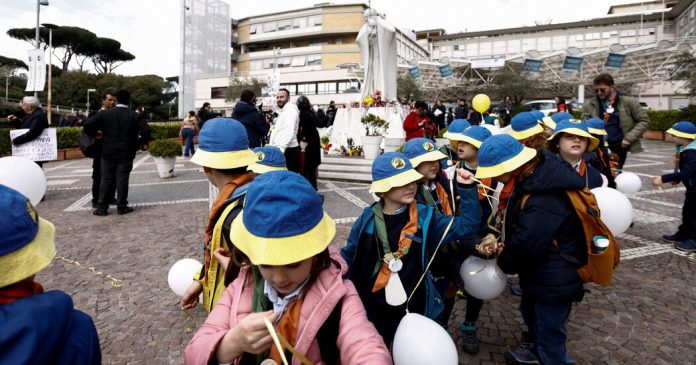
Flying balloons in the Vatican colors of yellow and white, dozens of children gathered on Sunday in the square of the Policlinico A. Gemelli, where Pope Francis has been hospitalized for more than four weeks, and chanted “Papa Francesco” and cheered, “Viva la Pace” — hurray for peace.

Many held up signs, hoping that the pope might peek out of the windows of his 10th-floor hospital suite to see their art. They offered encouragement, wishing that the pope get well soon. One boy with a boisterous group of blue-and-yellow capped “castorini,” or beavers, as children too young to be Cub Scouts are known in Italy, held a sign that said “Ciao Papa Cesco, I love you a lot.”

The pope did not appear, but he acknowledged the children’s presence in his traditional Sunday blessing and prayer.

“I know that many children are praying for me; some of them came here today to Gemelli as a sign of closeness,’’ the pontiff said in offering his traditional Sunday blessing, which was not delivered live for the fifth time. “Thank you, dearest children! The pope loves you and is always waiting to meet you,’’ Francis wrote.

The Rev. Enzo Fortunato, the president of the pontifical committee for World Children’s Day, who organized the gathering, said “children transmit joy” and their presence in the square was a “symbolic medicine for Pope Francis.”

The posters and letters will be saved and waiting for the pope when he returns to the Casa Santa Marta, the Vatican guesthouse where the pontiff lives, Father Fortunato said, adding he was certain that the pope would personally respond to the messages when he’s able to.

Francis was admitted to the Gemelli hospital on Feb. 14 with respiratory infections and bronchitis that developed into pneumonia in both lungs. He suffered several setbacks, including mild kidney failure and a few respiratory crises. He was in critical condition until last Monday, when doctors said he was no longer in imminent danger of dying from pneumonia.

Even so, his condition remains complex because of his age — 88 — as well as his pre-existing lung disease. In 1957, Francis had part of his right lung removed.

His condition has been stable for the past week. The Vatican said Saturday that Francis still required “inpatient medical therapy, motor and respiratory physiotherapy,” treatments that “show further, gradual improvements.” The Vatican also said doctors were gradually reducing the need for noninvasive mechanical ventilation at night, substituting it with high-flow oxygen therapy.

In Sunday’s written address, Francis acknowledged his frailty.

“I am facing a period of trial, and I join with so many brothers and sisters who are sick: fragile, at this time, like me,” he said. “Our bodies are weak but, even like this, nothing can prevent us from loving, praying, giving ourselves, being for each other, in faith, shining signs of hope.”

In his teachings and messages, Francis has often had special words for children struggling because of war, famine, migration or poverty. In 2024 he celebrated the first World Children’s Day, which brought thousands of children to the Vatican. Last month, shortly before he was admitted to the hospital, he announced he would write an apostolic document dedicated to children.

“We think that the voice of children is the first voice to arrive to the heart of God, and they are praying for his recovery,” said Sister Mariella D’Ippolito, the national secretary of an organization of Roman Catholic schools, who came with some local children.

Some 50 children from Caivano, an impoverished town on the outskirts of Naples, woke up at dawn to be at the Gemelli.

“The pope for them is the pope of peace, he’s their hero in a contemporary world where heroes are in short supply,” said Andrea Iacomini, spokesman of Unicef Italy, who accompanied them.

Despite moments of drama and some tears, mostly involving flyaway balloons, the children appeared to have fun.

“The prayer of children and their affection for the pope is a great strength,” said Marco Impagliazzo, the president of the Community of St. Egidio, a Rome-based charity, which brought some 15 children from some of Rome’s roughest suburbs to the Gemelli. “They hope to see him again soon as we all do,” he said.

A tale of two states: Florida and Illinois's responses to the Trump administration

0

A look at Florida and Illinois shows how legislatures in the country’s often polarized state politics are responding to the Trump administration. States hold a lot of power over what gets done.

How Trump’s Crackdown Is Drastically Driving Down Migration

0

Illegal crossings at the U.S.-Mexico border are down to their lowest level in decades. Once-crowded migrant shelters are empty. Instead of heading north, people stranded in Mexico are starting to return home in bigger numbers.

The border is almost unrecognizable from just a couple of years ago, when hundreds of thousands of people from around the world were crossing into the United States every month in scenes of chaos and upheaval.

President Joseph R. Biden Jr., facing a swell of public outrage during the 2024 election campaign, clamped down on asylum seekers and pushed Mexico to keep migrants at bay. By the end of his term, the border had quieted significantly and illegal crossings had fallen to the lowest levels of his presidency.

Now, President Trump has choked off the flow of migrants even more drastically, solidifying a sweeping turn in U.S. policy with measures that many critics, especially those on the left, have long considered politically unpalatable, legally untenable and ultimately ineffective because they don’t tackle the root causes of migration.

“The entire migration paradigm is shifting,” said Eunice Rendón, the coordinator of Migrant Agenda, a coalition of Mexican advocacy groups. Citing Mr. Trump’s array of policies and his threats targeting migrants, she added, “Families are terrified.”

Mr. Trump is employing several hard-line tactics simultaneously: halting asylum indefinitely for people seeking refuge in the United States through the southern border; deploying troops to hunt down, and, perhaps just as crucially, scare away border crossers; widely publicizing deportation flights in which migrants are sent home in shackles; and strong-arming governments in Latin America — like Mexico’s — to do more to curb migration.

The new approach has yielded some eye-popping statistics.

In February, the U.S. Border Patrol said it had apprehended 8,347 people trying to illegally cross the border, down from a record high of more than 225,000 apprehensions in December 2023.

Those numbers had already been dropping sharply since the Biden administration unveiled its immigration restrictions last year. In December, the final full month Mr. Biden was in office, the Border Patrol apprehended 47,330 migrants at the U.S.-Mexico border.

At 1,527 migrants a day, that was the lowest daily average for any month during the entire Biden presidency. But it was still five times as much as the number in February, the first full month after Mr. Trump took office.

If that trend holds for a full year, migrant apprehensions in the United States could fall to levels unseen since around 1967, according to Adam Isacson, a migration expert at the Washington Office on Latin America, a nongovernmental organization.

There are signs that figures are plummeting farther south in the region, too. The number of people trying to reach the United States through the Darién Gap — the forbidding land bridge connecting South America and Central America that is a barometer of future pressure at the U.S.-Mexico border — dropped to 408 in February, down from more than 37,000 in the same month last year, according to Panama’s Immigration Institute.

The shift is cause for celebration among figures who have been calling for tougher restrictions for years.

Under Mr. Biden, “the White House leadership promoted a narrative of impotence when it came to immigration,” said Kenneth T. Cuccinelli II, a former acting deputy Homeland Security secretary in the first Trump administration.

“Securing the border is easy if you have the will to do it,” said Mr. Cuccinelli, a prominent hawk on immigration issues. “In the first Trump administration, Trump didn’t have the will to do it,” he argued. “But he does now.”

Mr. Trump’s hardened stance on migration is, in some ways, an extension of Mr. Biden’s moves at the end of his term. Mr. Biden had promoted less-restrictive policies that swelled the number of migrants entering the United States during his first three years in office.

But as the backlash to the surge grew, Mr. Biden barred asylum for migrants if they crossed illegally and pressured the Mexican and Panamanian governments to do more to curb migrant flows, delivering to his successor a relatively calm situation at the border.

Political sentiment in the United States has also shifted. Leaders who once championed their cities as sanctuaries for migrants are growing quieter in their resistance to Mr. Trump’s policies. And some Democratic governors have highlighted areas of potential cooperation on migration enforcement.

Upon taking office in January, Mr. Trump plowed ahead with his anti-immigration measures. They included using the U.S. military base in Guantánamo Bay, Cuba, to hold migrants; firing off online posts to taunt and threaten potential migrants; and vowing to revoke visas for foreign officials thought to facilitate illegal immigration to the United States.

Still, caveats abound. A similar lull in migration at the start of Mr. Trump’s first term, though less precipitous than the current decline, proved to be temporary. Migration experts warn that sanctions and other measures targeting Venezuela and Cuba, two large sources of migration, could worsen economic conditions in those countries and produce a new exodus.

The Trump administration’s embrace of tariffs is also weighing on larger economies in the region, potentially intensifying economic desperation among poor families struggling to get by, a top factor influencing migration. Uncertainty over the tariffs could have already pushed Mexico into a recession, economists fear.

But developments on the ground in Mexico illustrate how migration dynamics are shifting.

On a recent morning, hundreds of migrants stood in line under the scorching sun outside the Mexico City offices of the country’s refugee agency, COMAR.

Many had been in line since the crack of dawn, and others had camped outside the building, sleeping on the sidewalks or in the middle of a dirt road, hoping to increase their chances of getting an appointment and starting their asylum process.

“Obviously, staying here was not our plan,” said Peter Martínez, a migrant from Cuba, who said his asylum appointment in the United States was canceled in January.

Asked whether he planned to go back to Cuba, given the struggles, he said, “Mexico can be dangerous and hard, but it is still better than going back to our country.”

Many migrants like Mr. Martínez are stranded in Mexico and having second thoughts about crossing into the United States. Some plan to put down stakes in Mexico, while others are doing all they can to return home.

The number of migrants in Mexico seeking help to return to their own countries rose to 2,862 in January and February, according to the International Organization for Migration, Reuters reported.

A survey of more than 600 migrants in January by the International Rescue Committee also found that 44 percent of respondents who had initially intended to reach the United States now planned to stay in Mexico.

“When people see that one door shuts down in front of them, another window opens,” said Rafael Velasquez García, the former head of the International Rescue Committee office in Mexico.

This decision does not come without limitations, he said, including that migrants face significant obstacles to gain access to employment.

In other countries in the region, migrants from Venezuela and other nations automatically receive humanitarian visas that allow them to look for jobs. But in Mexico, the only option for migrants is to request asylum, which can take months to complete.

All of this is unfolding before other hard-line measures championed by Mr. Trump, like his vow to drastically ramp up mass deportations, get underway. He is also planning to invoke an obscure American law, the Alien Enemies Act of 1798, to accelerate deportations of undocumented immigrants while providing them little to no due process.

Migration experts say the closest parallel to the current crackdown date to the 1950s, when anger over an influx of Mexican laborers produced “Operation Wetback,” a short-lived military-style offensive that derived its name from a slur used to describe Mexican border crossers and that aimed to deport more than one million Mexican immigrants.

“You need to go back to the Eisenhower administration to see anything like this,” said Mr. Isacson, the migration expert.

White House deports hundreds of alleged gang members to El Salvador : NPR

0

US Secretary of State Marco Rubio met with El Salvador’s President Nayib Bukele in El Salvador on Feb. 3, 2025.

Mark Schiefelbein/Pool/AP/AFP via Getty Images


hide caption

toggle caption

Mark Schiefelbein/Pool/AP/AFP via Getty Images

The Trump administration deported more than 200 alleged members of Tren de Aragua, a Venezuelan prison gang, to El Salvador this weekend, multiple members of the Trump administration said on social media on Sunday.

It was not immediately clear if the deportations happened before or after a federal judge in D.C. on Saturday issued an emergency order that told the administration to stop using wartime powers to deport anyone, and turn around any planes already in the air.

President Trump on Saturday issued a proclamation invoking the Alien Enemies Act of 1798, a seldom-used law that gives the president authority to detain or deport nationals of an enemy nation during wartime. It’s the first time the act has been used since World War II.

“Thanks to the great work of the Department of State, these heinous monsters were extracted and removed to El Salvador where they will no longer be able to pose any threat to the American People,” White House press secretary Karoline Leavitt said in a statement.

The deportations to El Salvador also included 2 alleged leaders of the MS-13 gang, which has its origins in El Salvador, and 21 other members of the gang, according to posts from Secretary of State Marco Rubio and from El Salvador’s President Nayib Bukele.

“Ooopsie… too late,” Bukele posted, in response to a news headline about the judicial order.

Bukele posted a video on Sunday of what he says is 238 members of Tren de Aragua arriving in El Salvador. He said they would be transferred to CECOT, the Terrorism Confinement Center in the country, for a period of one year.

Rubio, the U.S. secretary of state, last month said El Salvador’s president had agreed to accept deportees from the U.S. of any nationality. Bukele’s social media posts on Sunday refer to “a very low fee” that the United States paid to El Salvador for the deportations.

“Thank you for your assistance and friendship, President Bukele,” Rubio said on social media on Sunday.

The American Civil Liberties Union and Democracy Forward in a lawsuit on Saturday sought to block the deportations of five Venezuelan men for 14 days, and later broadened the request to all people who could be deported under Trump’s “Alien Enemies Act” proclamation. Judge James Boasberg agreed to block the deportations of the five men. He later broadened the order to anyone covered by Trump’s proclamation. Another hearing in the case is set for March 21.

The Trump administration has already appealed the judge’s rulings to the U.S. Court of Appeals for the District of Columbia Circuit.

It Fought to Save the Whales. Can Greenpeace Save Itself?

0

Greenpeace is among the most well-known environmental organizations in the world, the result of more than 50 years of headline-grabbing protest tactics.

Its activists have confronted whaling ships on the high seas. They’ve hung banners from the Eiffel Tower. They’ve occupied oil rigs. A (fictional) activist even sailed with Greenpeace in an episode of “Seinfeld,” in hopes of capturing Elaine’s heart.

Now, Greenpeace’s very existence is under threat: A lawsuit seeks at least $300 million in damages. Greenpeace has said such a loss in court could force it to shut down its American offices. In the coming days, a jury is expected to render its verdict.

The lawsuit is over Greenpeace’s role in protests a decade ago against a pipeline near the Standing Rock Sioux Reservation in North Dakota. The pipeline’s owner, Energy Transfer, says Greenpeace enabled illegal attacks on the project and led a “vast, malicious publicity campaign” that cost the company money.

Greenpeace says that it played only a minor, peaceful role in the Indigenous-led protest, and that the lawsuit’s real aim is to limit free speech not just at the organization, but also across America, by raising the specter of expensive court fights.

The suit comes at a time of immense challenges for the entire environmental movement. Climate change is making storms, floods and wildfires more frequent and more dangerous. The Trump administration has commenced a historic effort to overturn decades of environmental protections. Many of the movement’s most significant achievements over the past half-century are at risk.

And in recent years the potential costs of protest have already risen.

The International Center for Not-for-Profit Law has tracked a wave of bills proposed since 2017 that toughen penalties against protesters. Many became law in the wake of the demonstrations against the pipeline at the center of the Greenpeace case (the Dakota Access Pipeline) and also the Black Lives Matter movement, which rose to prominence after the murder of George Floyd in 2020 by a police officer in Minnesota. More recently, the Trump administration has moved to deport international students who protested the war in Gaza.

Sushma Raman, interim executive director of Greenpeace USA, has called the trial in North Dakota “a critical test of the future of the First Amendment.”

Energy Transfer, one of the biggest pipeline companies in the country, has said that the lawsuit is over illegal conduct, not free speech. “It is about them not following the law,” the company said in a statement.

Founded in Vancouver in 1971, Greenpeace was hugely successful early on at what is now called “branding,” with its catchy name and daredevil stunts. But it has also faced major challenges: infighting, missteps, legal battles and questions about how to widen its base and remain relevant as it became an institution.

The larger environmental movement has grown, but also has struggled to gain attention in an increasingly fractured media landscape and as it has pivoted to the issue of climate change, which can be less tangible than previous targets of activism, like say opposing logging or oil-drilling in specific places.

“What they made their name on was the media spectacle, especially the ability to conduct a high-profile action that requires incredible tactical organization,” said Frank Zelko, a history professor at the University of Hawaii at Mānoa and the author of “Make It a Green Peace! The Rise of Countercultural Environmentalism.” That became “less efficacious” over time, he said, as competition for eyeballs grew and spectacular images, whether real or not, abound.

Greenpeace was founded as an offshoot of the Sierra Club based on the principles of ecology and anti-militarism. But pulling off daring stunts in pursuit of those principles, while also operating as a worldwide professional network, has always been a delicate balancing act.

After friction and fights for control of the organization in the late 1970s, Greenpeace International was established in the Netherlands as the head office, coordinating the activities of independent Greenpeace offices around the world, including Greenpeace USA.

The activities of its American branch are at the center of the lawsuit. Greenpeace International says its role was limited to signing one open letter. Greenpeace International has also countersued Energy Transfer in the Netherlands, seeking to recoup its legal costs under European laws that essentially allow it to challenge the Energy Transfer lawsuit as a form of harassment.

In Greenpeace’s Washington office, the Energy Transfer case has contributed to turbulence in the group’s highest levels.

In early 2023, the organization celebrated the appointment of Ebony Twilley Martin as sole executive director, calling Ms. Twilley Martin the first Black woman to be the sole director of a legacy U.S. environmental nonprofit. But she left that role just 16 months later, a development that two people familiar with the matter said was in part over disagreements about whether to agree to a settlement with Energy Transfer.

Greenpeace was born out of a moment of fear and upheaval, amid the Vietnam War, the nuclear arms race, acid rain and smog blanketing cities. Rex Weyler, 77, an early member, chronicled the history in his 2004 book “Greenpeace: How a Group of Ecologists, Journalists and Visionaries Changed the World.”

In Vancouver, Mr. Weyler met Bob Hunter, a columnist for The Vancouver Sun, and Dorothy and Irving Stowe, older Quakers who had left the United States in protest over war taxes and weapons testing. They were meeting like-minded people who saw a need for an ecology movement that would employ nonviolent direct action, following the examples of Mohandas K. Gandhi in India and the civil rights movement in the United States.

They would soon become an offshoot of a more traditional environmental group, the Sierra Club, after a disagreement over protest tactics.

Their first campaign was a mission to block U.S. nuclear weapons tests on Amchitka, a volcanic island in Alaska. An idea this group had floated within the Sierra Club — to sail a boat to stop the bomb — had been reported in The Vancouver Sun, though the head office of Sierra Club in San Francisco had not approved that plan.

“The Sierra Club was not amused when they saw this story, because they said, ‘You know, a lot of our members are just tree-huggers, and they don’t care about nuclear disarmament,’” said Robert Stowe, son of Dorothy and Irving and a behavior neurologist. “Had the Sierra Club agreed to do this, Greenpeace could probably never have been founded.”

The name Greenpeace came up during a planning meeting, when Irving Stowe said “peace” at the end of the gathering and another activist, Bill Darnell, replied offhandedly, “Make it a green peace.”

“Greenpeace” was emblazoned on the fishing boat they used. Irving Stowe organized a concert by Joni Mitchell, James Taylor and Phil Ochs to raise money for the trip.

The boat set sail in September 1971. The Coast Guard intercepted it, and the vessel never reached Amchitka. But the stunt garnered considerable public attention, a core part of the group’s strategy in the years since.

Greenpeace’s next campaign is perhaps its most well known: saving the whales.

The idea came from Paul Spong, who had studied orca whales and argued that the highly intelligent creatures were being hunted to extinction. That led to a copiously documented, dramatic sailing expedition to confront Soviet whaling ships.

A worldwide moratorium on commercial whaling has been in place since 1986. Greenpeace and other groups who worked on the issue have claimed it as a major victory.

The group also tried to stop seal hunting in northern Canada, a controversial move that alienated a large number of residents, including in Indigenous communities. Greenpeace Canada apologized to the Inuit people for the impacts of the campaign in 2014, and the organization said it did not oppose small-scale subsistence hunting.

The ship Rainbow Warrior, a crucial vessel in the anti-whaling campaign, was added to the fleet in 1978. That ship was protesting French nuclear testing in the Pacific in 1985 when it was bombed by agents for the French spy agency D.G.S.E., killing Fernando Pereira, a photographer, and igniting international outrage.

France later apologized and was ordered to pay $8 million in damages to Greenpeace, and reached a separate settlement with Mr. Pereira’s family.

A new Rainbow Warrior is now one of three Greenpeace vessels in operation. It is sailing this month in the Marshall Islands to “elevate calls for nuclear and climate justice,” the group said, and to support research on the effects of past nuclear weapons testing.

By the 1990s, Greenpeace’s attention-grabbing environmentalism was capturing the imagination of a new generation of people like Valentina Stackl, 39, who learned of its exploits as a girl in Europe. She worked with Greenpeace USA from 2019 to 2023.

“The idea of Greenpeace ships, and save the whales and hanging off a bridge or something like that was truly magical,” she said. “And on the best days Greenpeace really was like that. Of course, there’s also the slog of the day-to-day that is less sparkly.”

One constant concern was fund-raising: Greenpeace USA is largely funded by individual donations, which can fluctuate. Tax filings show its revenue has been stable in recent years.

The group’s priorities shifted to climate and how to incorporate what is known as “environmental justice,” the fact that pollution and other environmental hazards often disproportionally affect poor and minority areas. The historically mostly white and male-dominated organization had to grapple with how to increasingly collaborate with a diverse range of other groups. And it had to reckon with historical tensions with Indigenous communities over its whaling and sealing campaigns, as well as other missteps.

One of those mistakes occurred in Peru in 2014, when there was an uproar over a Greenpeace action that damaged the Nazca lines, ancient man-made patterns etched in the desert. Activists from Greenpeace Germany entered the restricted area to place a protest message about renewable energy. The Peruvian cultural minister called it an act of “stupidity” that had “co-opted part of the identity of our heritage.”

The organization apologized, and the episode prompted Greenpeace USA to adopt a formal policy on interactions with Indigenous communities, according to Rolf Skar, the group’s campaigns director. In short, Greenpeace would not get involved in struggles led by Indigenous people unless specifically asked to do so.

That policy has come up in this month’s trial in North Dakota. Greenpeace argued that it had offered support in the Dakota Access Pipeline protest only after it was asked to do so by Indigenous leaders, and did not seek any major role in the demonstrations.

On Monday in a courtroom in the small city of Mandan, N.D., jury members are expected to start hearing closing arguments, after which they will consider Greenpeace’s fate.

Tim Walz is touring Republican-held congressional districts in Iowa and Nebraska

0

Minnesota Gov. Tim Walz is holding town halls in Republican-held Congressional districts in Iowa and Nebraska this weekend, highlighting opposition to the Trump administration.

Ukraine Retreats From All but a Sliver of Land in Russia’s Kursk Region

0

Ukrainian troops have withdrawn from all but a sliver of land in Russia’s Kursk region, according to military analysts and soldiers, as their monthslong campaign to seize and occupy Russian territory appears to be nearing an end in the face of Moscow’s counterattacks.

At the height of the offensive, Ukrainian forces controlled some 500 square miles of Russian territory. By Sunday, they were clinging to a narrow strip of land along the Russian-Ukrainian border, covering barely 30 square miles, according to Pasi Paroinen, a military analyst with the Finland-based Black Bird Group.

“The end of the battle is coming,” Mr. Paroinen said in a phone interview.

The amount of Russian territory still under Ukrainian control could not be independently confirmed, and soldiers reported fierce fighting in the area. But amid a swift Russian advance backed by relentless airstrikes and drone assaults, Ukrainian troops over the past week have withdrawn from several villages in the Kursk region as well as from Sudzha, the main town under their control.

The Ukrainian military command said that the troops had pulled back to what it described as more defensible ground inside Russia along the border, using hilly terrain to gain better fire control over approaching Russian forces. On Saturday, it released a map of the battlefield showing the sliver of land that Ukraine still controls in the Kursk region.

But it remains unclear how long Ukrainian forces can hold onto that patch.

The continuing fighting in Kursk is now less about holding Russian territory, Ukrainian soldiers said, and more about controlling the best defensive positions to prevent the Russians from pushing into the Sumy region of Ukraine and opening a new front in the war.

“We continue to hold positions on the Kursk front,” an assault platoon commander, who asked to be identified only by his call sign, Boroda, said by phone. “The only difference is that our positions have shifted significantly closer to the border.”

While the Ukrainian retreat from most of the Kursk region has been quick, military experts said it came after months of Russian assaults and bombings that steadily eroded Ukraine’s foothold in the area and severed its supply routes, eventually forcing a withdrawal.

“What happened in the last few months was a shaping operation that set the conditions for a successful push,” said Franz-Stefan Gady, an Austrian military analyst who visited Ukraine’s Sumy region on the border with Kursk last month to speak with Ukrainian commanders.

Starting in December, Russian forces, reinforced by newly deployed North Korean troops, launched repeated attacks on the flanks of the Ukrainian-held bulge in the Kursk region. By mid-February, they had advanced within five miles of Ukraine’s main resupply routes into Sudzha, allowing them to target the roads with swarms of drones.

Late last week, Russia’s Defense Ministry claimed it had retaken Sudzha; on Saturday it said Russian forces had retaken two villages outside the town.

Unlike previous retreats by Kyiv’s forces elsewhere, like in parts of eastern Ukraine, military analysts said what has happened in Kursk was relatively orderly and did not result in the encirclement of large number of troops — despite claims to the contrary made by President Vladimir V. Putin of Russia and President Trump.

“There was no threat of encirclement of Ukrainian troops, and no evidence suggests otherwise,” said Serhii Kuzan, the chairman of the Ukrainian Security and Cooperation Center, a nongovernmental research group.

Kyiv had hoped to use its control over Russian land in Kursk as leverage in any negotiation to end the war. Ukraine has agreed to support a U.S.-backed monthlong cease-fire, as long as Russia does the same. The Kremlin has not yet agreed, and appeared to be prolonging negotiations over the cease-fire that Washington and Kyiv proposed last week by laying out conditions.

The State Department said that Secretary of State Marco Rubio and Foreign Minister Sergey V. Lavrov of Russia spoke by phone on Saturday about “next steps,” without providing further details.

Russia’s foreign ministry in a separate statement on Sunday said that Mr. Lavrov and Mr. Rubio discussed “concrete aspects of the implementation of understandings” reached in U.S.-Russia talks held last month in Saudi Arabia. It also offered no further details.

Nataliya Vasilyeva contributed reporting.

Politics chat: Trump signs stopgap measure, gives DOJ speech; DOGE targets 7 agencies

0

A budget stopgap hangover for congressional Democrats, consumer confidence slips following federal funding cuts, and the president’s norm-busting speech at the Department of Justice.

Nightclub Fire Kills at Least 59 in North Macedonia

0

At least 59 people were killed and another 155 were injured when a fire broke out overnight in a nightclub in North Macedonia, the country’s interior minister, Panche Toshkovski, said on Sunday.

Mr. Toshkovski told a news conference that the blaze had occurred during a pop concert at the club in the eastern town of Kocani. He said that fireworks had been set off, causing the roof to catch fire.

Mr. Toshkovski said that one police officer had been killed and that 35 of the dead had been identified so far.

Prime Minister Hristijan Mickoski called it “a difficult and very sad day” for the country, writing on X that “the loss of so many young lives is irreparable, and the pain of the families, loved ones and friends is immeasurable.”

North Macedonia, a small country of about two million people, is nestled between Albania, Greece, Bulgaria, Kosovo and Serbia. The town where the blaze occurred is about 50 miles east of the capital, Skopje.

“It’s a terrible tragedy,” Ognen Cancarevik, a reporter for Telma, a national television station, said in a phone interview. “People are shocked. People are angry. People want answers, and people want to know who is responsible.”

Kocani is a small town, he said, and many people in the region work in agriculture. Young people often leave the country to look for work or higher salaries abroad, he said, and many Macedonians are frustrated by low salaries and corruption.

“The morale is low,” Mr. Cancarevik said. “The last thing we need is a tragedy of this scale where young and innocent kids die.”