Thursday, November 12, 2026
Home Blog Page 129

David Raven, British Drag Performer Known as Maisie Trollette, Dies at 91

0

David Raven, who was better known as Maisie Trollette and was believed to be the oldest drag performer in Britain, died on Wednesday in Brighton, England. He was 91.

His death was confirmed by a friend, Scott St. Martyn, who said that Mr. Raven had been living in a nursing home.

Mr. Raven performed as Maisie Trollette for over half a century, wearing a blonde wig, a thick layer of makeup and long sequined dresses while singing old show tunes and cracking naughty jokes. He became a mainstay of the British drag circuit, a regular presence at the Brighton and Hove Pride event and a mentor to younger drag queens.

He came out as gay in his 20s, at a time when “homosexual acts” were still illegal in Britain. (The law changed in 1967 in England.) Mr. Raven began performing in drag as the form became popular with the rise of Danny La Rue, a famous British drag performer (who was, according to Mr. St. Martyn, a big fan of Mr. Raven’s).

Early in his career, Mr. Raven described himself as a “pantomime dame,” Mr. St. Martyn, an actor who became friends with Mr. Raven in the 1980s, said in an interview. “He always tried to legitimize it by being a professional actor.”

Mr. Raven rose to fame in the 1960s as one half of the drag duo the Trollettes alongside Jimmy Court, who performed as Jimmy Trollette.

“They were kind of slapstick comedians,” said Dave Lynn, a longtime friend of Mr. Raven’s who performed with him in the 1980s and ’90s. “You never knew what was going to come from them, most of it was ad-lib.”

Eventually, Mr. Raven branched out as a solo act, performing as Maisie in charity shows and venues across Britain, and appearing in the inaugural parade for Brighton and Hove Pride, the largest Pride festival in Britain, in 1973.

“Maisie was such a staple,” said Christopher Dennis, better known as his drag alter ego, La Voix, who met Mr. Raven in the early 2000s. “Everyone knew of him even if you hadn’t seen him. You just knew the name.”

Though Mr. Raven was well-known on the drag circuit and in Brighton, where he lived, little was known about his early life and childhood. Even friends who knew him for decades said he never spoke about his past.

David Raven was born Aug. 15, 1933, in Cornwall, England, and was raised by adoptive parents in Norfolk. He had no immediate survivors; his partner, Don Coull, whom he referred to as his “idol” and his “other half” in “Maisie,” a 2021 documentary, died from complications of AIDS about two decades ago.

While Mr. Raven was an undisputed pillar of British drag, he was serious about separating his alter ego from his day-to-day identity, reprimanding anyone who called him Maisie when he was not in character.

“He came from a very cold background,” Mr. Lynn said. “He couldn’t be a queen full time.”

Mr. Raven continued to perform well into his 80s, eventually using a walking stick onstage. “I can’t believe that I’ve been doing this for 50 years,” he said in the 2021 documentary.

While Mr. Raven was a singular figure in Britain, he did have an American counterpart: Walter Cole, also known as Darcelle XV, an American drag queen who earned a Guinness World Record as the world’s oldest drag performer. (Mr. Cole died at 92 in 2023.)

In the documentary “Maisie,” the two octogenarian performers have a meal together and prepare for a performance in Brighton. Standing next to each other, they pose for photos and exchange quips and (sometimes dirty) jokes.

Mr. Raven had a wicked sense of humor, and his friends described him as “naughty” and a “prankster.” On trips with friends, he would hide in closets or under beds to scare them. In his free time, he loved betting, especially on race horses. Even later in life, when he was too unwell to leave the house, Mr. Raven would ask people to place bets for him, Mr. St. Martyn said.

His longevity inspired younger performers, and he offered deep encouragement to younger acts in an effort to help Britain’s drag scene flourish, Mr. Lynn said.

“There’s a feeling in the arts that there’s an expiry date,” Mr. Dennis said. “And David showed us there’s no expiry date on being fabulous.”

Thousands of federal workers must be offered reinstatement, judge says : NPR

0

Protesters hold signs in solidarity at a rally in support of federal workers at the Office of Personnel Management in Washington, D.C., on March 4.

Alex Wroblewski/AFP via Getty Images


hide caption

toggle caption

Alex Wroblewski/AFP via Getty Images

Thousands of federal employees fired by the Trump administration must be offered job reinstatement within the next week, a U.S. district judge in San Francisco has ruled, because he said they were terminated unlawfully.

“It is a sad day when our government would fire some good employee and say it was based on performance when they know good and well that is a lie,” Judge William Alsup, an appointee of former President Bill Clinton, said before issuing his ruling from the bench.

The Thursday decision marks a significant stand against President Trump’s sweeping efforts to remake the federal government. The White House pledged to appeal.

The administration’s job cuts targeted federal workers with probationary status, which usually means newer workers, and makes them easier to let go. Employees recently promoted into a new position can also be considered probationary.

Many probationary employees were fired for “performance reasons,” according to their termination notices, even though many employees had received positive feedback from supervisors.

“It was a sham in order to try to avoid statutory requirements,” Alsup said.

The judge also ordered the U.S. Office of Personnel Management (OPM) to prove within seven days that it had offered reinstatement to all fired probationary employees at the Departments of Agriculture, Defense, Energy, Interior, Treasury and Veterans Affairs.

The White House is blasting the decision. “A single judge is attempting to unconstitutionally seize the power of hiring and firing from the Executive Branch,” White House press secretary Karoline Leavitt said in a statement. “The President has the authority to exercise the power of the entire executive branch – singular district court judges cannot abuse the power of the entire judiciary to thwart the President’s agenda. If a federal district court judge would like executive powers, they can try and run for President themselves.”

Leavitt added: “The Trump Administration will immediately fight back against this absurd and unconstitutional order.”

Requests for comment were submitted to the agencies affected by the judge’s ruling. Spokespeople for the VA and the Interior Department said they don’t comment on pending litigation.

The decision comes as a result of a lawsuit brought by a group of unions and civic groups on behalf of workers fired from a host of agencies and sub-agencies.

In a charged, sometimes confrontational court hearing on Thursday, Judge Alsup challenged the government’s argument that OPM, which acts as the government’s HR department, had not directly ordered the termination of probationary employees but had left that decision to individual federal agencies and served merely as a coordinating body.

“The court rejects the government’s attempt to use these press releases and to read between the lines to say the agency heads made their own decision with no direction from OPM,” Alsup said.

The judge also bridled that OPM’s acting director, Charles Ezell, and his senior adviser, Noah Peters, did not attend the hearing.

“You will not bring the people in here to be cross-examined. You’re afraid to do so because you know cross-examination would reveal the truth,” Alsup said, addressing OPM’s legal team. “I tend to doubt that you’re telling me the truth.”

The American Federation of Government Employees is one of the plaintiffs in the case, and its president, Everett Kelley, said in a statement that AFGE is pleased with the reinstatement of “probationary federal employees who were illegally fired from their jobs by an administration hellbent on crippling federal agencies and their work on behalf of the American public.”

“These mass-firings of federal workers were not just an attack on government agencies and their ability to function, they were also a direct assault on public lands, wildlife, and the rule of law,” Erik Molvar — executive director of Western Watersheds Project, which is also a plaintiff in the case — said in a statement.

Earlier this month, the same judge issued a temporary restraining order in the same case, saying the firings were illegal but noted many federal agencies had yet to rehire probationary workers. “Maybe that’s why we need an injunction that tells them to rehire them,” he said Thursday.

Judge Alsup did make it clear that agencies are allowed to reduce their workforce, as long as it’s done legally.

Have information you want to share about ongoing changes across the federal government? NPR’s Chris Arnold can be reached at [email protected] or contacted through encrypted communications on Signal at ChrisArnold.07. NPR’s Emily Feng is at [email protected] and at emilyzfeng.96 on Signal.

NPR’s Andrea Hsu contributed to this report.

‘We Hear You, Mr. President:’ The World Lines Up to Buy American Gas

0

President Trump’s cabinet has been busy rolling back regulations that will make it far easier to extract and produce fossil fuels. But who will buy them?

Nearly everyone, it turns out, particularly under the threat of tariffs.

At an annual energy-industry conference in Houston, executives spoke openly about how companies from around the world are seeking to buy American liquefied natural gas as a way of placating Mr. Trump’s demands to either balance trade or face punitive measures.

“If you’re a nation who has a trade imbalance with the U.S., they’re all asking themselves, ‘What can we do to try to level the playing field?’” said Meg O’Neill, chief executive of Woodside Energy, Australia’s biggest oil and gas company.

They are cutting deals now, she said, in large part “so their government can say, ‘We’re taking action. We hear you, Mr. President.’” Her characterization was echoed by Ryan Lance, chief executive at ConocoPhillips, one of the largest U.S. oil and gas producers, and other speakers at the conference.

Since President Trump took office, oil and gas companies from nearly every continent have dangled the possibility of investing billions of dollars in the United States.

This month Japanese, Taiwanese and Korean companies revived a $44 billion idea — long considered all but financially impossible — to build pipelines and a giant terminal in Alaska that would export natural gas to Asia. Ukraine, eager to preserve its weapons supply from Washington, has signaled it will buy more American gas. South Africa, its aid frozen by Mr. Trump, is trying to cut a deal to expand U.S. companies’ drilling rights in its waters.

Whether all this will translate into firm deals is not yet clear. But the potential deals would lock in decades of investment in fossil fuels at a time when the global energy transition to cleaner energy sources is faltering. The burning of fossil fuels is the main contributor to greenhouse gas emissions that are dangerously warming the planet.

South Africa, which had its U.S. aid frozen by an executive order that accused it of discriminating against its white citizens, is trying to negotiate a new trade deal with Washington. In that deal, the United States would get more access to gas exploration in the region, and South Africa would buy more of its gas from America, according to a government spokesman.

Ukraine, which is desperately trying to gain Mr. Trump’s support as negotiations for a peace deal with Vladimir Putin develop, is signaling to Washington that it will buy U.S. gas in addition to trying to cut a deal on mineral revenues.

Ukraine’s moves mirror a wider push in Europe to buy more gas from the U.S. as Mr. Trump engages the European Union in tit-for-tat tariffs.

The state-owned gas company in India, one of the world’s fastest growing markets for gas, said it would either buy a stake in an American L.N.G. plant or enter into a new contract for long-term supply.

Speaking at the conference in Houston, the head of the Abu Dhabi National Oil Company, Sultan al Jaber, who just a year and a half ago presided over the annual climate-change negotiations in the United Arab Emirates, said his company would also soon announce a major investment in U.S. gas production. “Make energy great again,” he told a room full of oil and gas executives.

The negotiations Mr. al Jaber shepherded in 2023 were the first in which all nations agreed to “transition away” from fossil fuels by midcentury. But a key clause in the agreement noted that “transitional fuels” — widely acknowledged as a euphemism for gas — would be key to making the transition “orderly.”

The potential deals pit climate concerns against foreign-policy strategy. Expanding gas consumption — purchasing contracts are usually for decades worth of fuel — would in many cases complicate carbon-neutrality pledges that companies and countries have made.

Gas emits less carbon dioxide than oil and coal when burned, but is nearly entirely made up of methane, a far more potent greenhouse gas. U.S. methane emissions have been steadily rising as its gas industry has grown to dominate the world’s trade in the fuel.

The new U.S. energy secretary, Chris Wright, is a former fracking executive. In an interview in Houston he said the Biden administration’s temporary pause in early 2024 on federal approvals for new export terminals had made countries wary of investing in U.S. gas, despite the fact that L.N.G. exports soared under President Biden.

Mr. Wright said he had been meeting with prospective buyers in Europe and Asia and they had all been asking him, “Can you assure me that the United States is going to be a long-term reliable supplier?”

Xi Nan, who heads Rystad Energy’s L.N.G. research team, said that because of the long timelines for developing any gas project, announcements shouldn’t be taken as inevitabilities.

“Fundamentally, our forecasts haven’t changed in terms of long-term L.N.G. demand,” Ms. Xi said. “What’s changed is that the forecast for renewable energy demand is lower.”

As a result, the energy transition “is going to take longer than we thought,” she said.

In ‘pick your poison’ moment, Senate Democrats weigh options : NPR

0

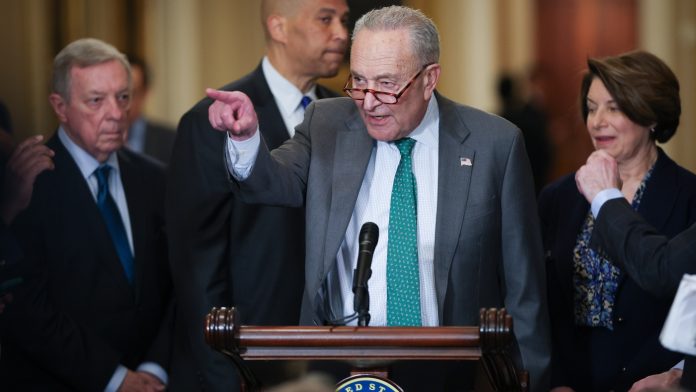
WASHINGTON, DC – MARCH 11: Senate Minority Leader Chuck Schumer (D-NY) speaks during a press conference following a policy luncheon at the U.S. Capitol on March 11, 2025 in Washington, DC. Schumer answered a range of questions during the press conference. (Photo by Win McNamee/Getty Images)

Win McNamee/Getty Images/Getty Images North America


hide caption

toggle caption

Win McNamee/Getty Images/Getty Images North America

Senate Democrats are facing a dilemma as the clock ticks down to a government shutdown at midnight on Friday: help Republicans pass a bill to avoid a shutdown or block the bill and be blamed for triggering one.

After the House approved a bill funding agencies through September largely along party lines Senate Democrats have been debating, discussing and wavering about their next move. The party’s base is demanding they fight President Trump and Elon Musk’s rapid fire cuts to the federal workforce and block the funding bill that was crafted without Democratic input.

But some worry about the unpredictable impact and length of a shutdown, and what the plan would be to get out of one. Also weighing on Democrats hoping to regain control of at least one chamber of Congress is 2026 is the political impact. Republicans control the House, Senate and White House, but Trump has a large microphone and Senate Democrats will end up determining what happens.

On Wednesday Senate Minority Leader Chuck Schumer said the GOP doesn’t have the 60 votes needed to get around a filibuster on the bill known as the continuing resolution (CR) that passed the House. 

“Funding the government should be a bipartisan effort,” Schumer said on the Senate floor on Wednesday. “But Republicans chose a partisan path, drafting their continuing resolution without any input, any input, from Congressional Democrats. Because of that, Republicans do not have the votes in the Senate to invoke cloture on the House CR.”

Senate Republicans hold a 53 seat majority, but likely need eight Democratic votes in the GOP-led chamber to overcome a filibuster in the GOP-led chamber to pass the measure, known as a continuing resolution.

Senate Republicans will see at least one defection because Kentucky GOP Sen. Rand Paul said last week he would vote no on the plan, unless it could codify cuts led by Elon Musk, the billionaire and advisor to President Trump.

So far only one Senate Democrat, John Fetterman of Pennsylvania, has said publicly he would vote with the GOP to approve the CR. Fetterman said he wants to avoid a shutdown: “that’s chaos and I will never vote for chaos.”

Schumer instead called for a four week stopgap measure on Wednesday, which would keep agencies funded at current levels through April 11 as both parties negotiate on the annual spending bills.

This alternative gives Democrats the chance to say they are working to avoid any lapse in government funding.

Senate Majority Leader John Thune told reporters Thursday he was open to giving Democrats an opportunity to vote on their proposal, but he didn’t expect it to pass. He said he had not heard any offer from Democrats yet.

“If they want to vote on that in exchange for getting us the votes to pass to September 30, I think we’re open to that. But as you all know, the House is gone, so whatever happens is going to have to be, I think, the final action here,” Thune said. 

In the hours that followed Schumer’s push for the short term bill, two Senate Democrats up for re-election in 2026, Sens. Mark Warner, D-Va, and John Hickenlooper, D-Colo. said they would vote no on the GOP-backed measure. And although Schumer signaled his caucus was united, not all Democrats agree.

But Fetterman argued Schumer’s plan doesn’t have a chance.

“Shut the government down, plunge the country into chaos, risk a recession or Exchange cloture for a 30 day CR that 100% fails,” Fetterman said Thursday on social media platform X. “The House GOP CR will then pass the Senate because it only needs 51 votes. Total theater is neither honest with constituents nor a winning argument.”

Several Senate Democrats have yet to say how they’d like to vote on the plan.

“We have to make determinations how this affects Arizona,” Freshman Sen. Ruben Gallego, D-Az., told reporters ahead of Schumer’s announcement.

Many Democrats described the choice facing them it as a “pick your poison” moment with no easy answer. Helping Republicans pass the CR avoids a shutdown and issues they argue impact defense and other programs that are relying on increases instead of flat funding. But blocking it opens them up to the uncertainty of what the Trump administration would decide about who qualifies as essential workers and what other cuts they could impose during a shutdown.

Sen. Mark Kelly told reporters he was “weighing the badness of each option.”

This, as several Senate Democrats said early on they would vote no on the plan. That includes Sen. Elizabeth Warren, D-Mass.

“I don’t know how anybody can vote for this,” she told reporters Wednesday.

House Democrats remained largely united on opposing the plan, and many took to social media to urge their Senate Democratic counterparts to do the same.

Messaging war already in full swing

Oregon Democratic Sen. Ron Wyden who says he opposes the CR told NPR that the Trump administration is “engaging in what I call colossal lawlessness-basically upturning so many programs that are vital for veterans, for seniors and for kids. And I’m not going to have any part in that.” He pointed to the 4 week bill as the best option. 

The number two Senate GOP Leader, John Barrasso told reporters the plan is to vote on the House passed CR on Friday. And he signaled the GOP message arguing Democrats would be the ones to pay a price.

“So to get into this shutdown they are going to cause it, to get out of the shutdown they are going to have to come up with a solution that they are going to be responsible for  – and all the pain that results of the Democrats’ actions,” Barrasso said.

In a Europe Adrift, Macron Seizes the Moment

0

In the weeks after President Emmanuel Macron called a snap election last summer that resulted in a deeply divided French Parliament, if his name came up it was often to call for his resignation.

The unpopular president, long derided by critics as aloof, all-controlling and arrogant, looked certain to ride out the final three years of his term as a lame duck atop an unstable government of his own creation, with a rotating cast of prime ministers, and little to show for it.

But President Trump has changed that. The American leader has abruptly reversed 80 years of friendly policy toward Europe, withdrawing support for Ukraine and siding with Russia, leaving European leaders panicked and lost. In doing so, he has made this Mr. Macron’s moment.

The French president, who once seemed on the verge of disappearing, is now in the headlines daily. Mr. Macron has gathered European leaders repeatedly in Paris, rushed to Washington and later to London, and generally become the focal point of Europe’s struggling effort to stand on its own feet.

After years of warning of the “imminent brain death” of NATO, Mr. Macron’s admonition now seems prescient as Mr. Trump threatens to turn his back on the alliance.

Mr. Macron’s talk of European boots on the ground to help keep the peace in Ukraine, rejected not long ago as impossible by incredulous allies, is now a plan being worked through as a plausible way to stem the fighting.

Similarly, Mr. Macron’s vision of a Europe with “strategic autonomy” from the United States was once largely dismissed as a distant idea from a man more prone to sweeping statements than follow through. The Russian invasion of Ukraine has since caused him to put more emphasis on a “European pillar” within NATO. But other European leaders seem ready to follow him toward the goal of allowing Europeans to better defend themselves.

“Crises are very good for a president. They put them back in the center,” said Vincent Martigny, a professor of political science at the University of Nice, Côte d’Azur.

In addition, he said, “Macron is the only one who can be the leader.”

Germany’s next likely chancellor, Friedrich Merz, has yet to form a government. Though the crisis has pushed Prime Minister Keir Starmer of Britain closer to the European Union, his country is no longer an E.U. member. And it is not clear that the efforts by Prime Minister Giorgia Meloni of Italy to mediate tensions with European allies particularly interest Mr. Trump.

So Mr. Macron has stepped into the leadership vacuum.

After Vice President JD Vance castigated European leaders during his speech at the Munich Security Conference last month, signaling the American president’s radical shift in foreign alliances, the French president and his office sprang into action.

Mr. Macron called a first meeting of European leaders in Paris almost immediately after the conference ended, followed by a second one the next day. He was the first European leader to go to Washington to speak directly to Mr. Trump, briefing his fellow European Union colleagues on the meeting afterward.

A few days after a disastrous visit to the White House by the Ukrainian president, Volodymyr Zelensky, both Mr. Macron and Mr. Starmer coached their ally on how to repair the situation.

According to a French diplomat close to Mr. Macron, the French president speaks to Mr. Trump every second day, on average, and to Mr. Zelensky and Mr. Starmer even more regularly.

The path forward for Europe now appears to follow much the course Mr. Macron has pointed to for years.

In recent days, his once distant-seeming plan for European troops to enforce any peace deal between Russia and Ukraine has begun to take more solid form. Britain and France have already committed troops, and, the Danish foreign minister, Lars Lokke Rasmussen, said on Monday that his country was also prepared to take part.

On Tuesday, Mr. Macron welcomed military leaders from some 30 countries who gathered in Paris for a defense and security conference, to solicit further commitments.

One of Mr. Macron’s boldest gestures has been to open discussions with European leaders about sharing the protection of France’s nuclear arsenal with them. Besides Russia, France and Britain are the only two countries in Europe with nuclear weapons.

The suggestion spoke to the leadership status Mr. Macron wants for France, a country that has long prided itself on the independence of its nuclear arsenal.

But it also reflects the new distrust of the American commitment to European allies, and Mr. Macron’s conviction that Russia’s aggression would expand farther if left unchecked without the promise of nuclear protection.

“We are entering a new era,” he said during a televised speech at the top of the French news last week. “Peace is no longer guaranteed on our continent.”

He added, “I want to believe the United States will remain by our side, but we must be ready if that doesn’t happen.”

Yet it remains far from certain whether any of Mr. Macron’s frantic action will prove successful. Ukraine has said it would be open to a cease-fire with Russia, and Moscow responded on Thursday by saying that it, too, was open, though more discussion was needed.

Mr. Trump’s own position has been mercurial, both badgering Europe to spend on its own defense and, on Thursday, threatening it with a 200 percent tariff on wine and alcohol.

Mr. Macron’s presumption of European leadership has also at times irritated some allies. During a call to debrief his fellow European leaders about his trip to Washington, Ms. Meloni of Italy challenged Mr. Macron about in what capacity he had gone to the White House, according to people familiar with the call.

Italy’s defense minister, Guido Crosetto, accused Mr. Macron of offering European troops to Ukraine without having “the decency” to consult other E.U. countries.

“You don’t send troops like you send a fax,” Mr. Crosetto, whose government has opposed deploying troops to Ukraine, wrote on X, the social media platform.

Then there are all the practical issues, of how Mr. Macron will fund such a spending increase while France is facing a budgetary crisis.

He has prepared his country for the threat of war, announcing an increase of military spending over the next five years — with no additional taxes, he promised — and an expansion of weapons manufacturing. After the United States, France is the second biggest arms exporter in the world.

Other European countries, too, have announced that they will increase their military spending, potentially aided by proposals from the European Commission, including a €150 billion, about $164 billion, loan program to pay for more weapons and technology.

But the larger existential crisis has eclipsed all finnicky practicalities for the moment. In France, recent polls show the president’s approval rating is up from 4 to 7 points to the high 20s and low 30s — the biggest jump since the arrival of Covid in 2020, according to the monthly barometer by the French Institute of Public Opinion.

The French populace largely agree with him — that Europe must continue to support Ukraine and invest more in its own defense against a potential Russian threat, and that the United States can no longer been seen as a dependable ally.

Even many of the president’s political opponents have praised his diplomatic efforts and agreed with his analysis.

“I’m not a Macronist at all, but he was pretty good. The important thing is to try to unite people and convince them that the situation is pretty serious and that we obviously need a national mobilization,” said Cédric Perrin, a senator with France’s Republican Party who presides over the French Senate’s foreign affairs and armed forces committee.

Rather than the man meeting the moment, it seems the moment has arrived to what Macron has been saying since soon after he was first elected in 2017, when he delivered his first long speech at the Sorbonne extolling the urgent need for Europe to step from America’s shadow.

Back then, a Czech politician, Andrej Babis, who months later became the country’s prime minister, offered a back-handed slap: “He should really concentrate on France.”

Today, many in Europe concede Mr. Macron was right all along.

“In Czechia we strongly appreciate the leadership of the president of France,” said Czech Ambassador to France, Jaroslav Kurfürst. “Emmanuel Macron has earned a lot of credibility in our part of the world.”

Reporting was contributed by Emma Bubola in Rome, and Aurelien Breeden in Paris.

Trump plans to make rare visit to the Justice Department : NPR

0

President Trump speaks before signing an executive order in the Oval Office at the White House on March 7.

Anna Moneymaker/Getty Images


hide caption

toggle caption

Anna Moneymaker/Getty Images

President Trump is set to visit the Department of Justice Friday to make remarks on “restoring law and order,” his press secretary, Karoline Leavitt, said.

Trump will also talk about “ending the weaponization of justice against Americans for their political leanings,” Leavitt said in a statement to NPR.

It’s unusual for a sitting president to give a speech from the Justice Department. There is typically a separation between politics and the DOJ, but Trump has repeatedly made attacking the department part of his campaign speeches and said on the trail last year that he would use the DOJ to go after people he sees as disloyal.

Last year, Trump faced two federal special counsel investigations into his actions around the Jan. 6 attack on the U.S. Capitol and related to his handling of classified documents. The Justice Department officially dropped those cases after Trump won the 2024 election — in line with its longstanding view that a sitting president cannot be prosecuted.

Trump’s visit on Friday comes as the Trump administration has spent the last several weeks trying to reconfigure the department, demoting attorneys who worked on cases related to Jan. 6 and firing officials who investigated the president himself.

Trump has also put in place some of his closest allies in the leadership positions. Trump ally Pam Bondi is leading the department as attorney general. Last month, the Senate — where Republicans are the majority — confirmed Kash Patel as FBI director. Patel has promoted conspiracy theories about the “deep state” and is a longtime critic of the FBI and DOJ.

U.N. Accuses Israel of Targeting Reproductive Health Facilities in Gaza

0

A United Nations commission on Thursday accused Israel of targeting hospitals and other health facilities in Gaza that provide reproductive services, including an I.V.F. clinic where thousands of embryos were destroyed, in what it called an effort to prevent Palestinian births.

The report by the U.N. Commission of Inquiry on the Occupied Palestinian Territory, called that and other actions that cause harm to women and girls “genocidal acts” and accused Israel of punishing Palestinians collectively for the Hamas-led Oct. 7, 2023, attack that killed 1,200 people.

Israel’s mission to the United Nations in Geneva immediately rejected the report, saying in a statement that the commission was engaged in “a shameless attempt to incriminate” the Israeli military “to advance its predetermined and biased political agenda.” Israel’s prime minister, Benjamin Netanyahu, accused the United Nations Human Rights Council of attacking the country with “false accusations.”

The commission, set up by the Human Rights Council in 2021 and made up of three lawyers with expertise in human rights, said its report drew on earlier investigations it had carried out since the Hamas attack on southern Israel and on some 25 interviews conducted over recent months with medical experts, as well as victims and witnesses of the violence in Gaza. Some of the testimony was aired over two days of hearings in Geneva this week.

The report marked the first time a United Nations committee has found that Israel has committed genocidal acts under the Rome Statute, which created the International Criminal Court, and under the international treaty that criminalizes genocide.

“Israeli authorities have destroyed in part the reproductive capacity of the Palestinians in Gaza as a group, including by imposing measures intended to prevent births, one of the categories of genocidal acts in the Rome Statute and the Genocide Convention,” the commission said.

Israeli officials have long accused the rights council of singling Israel out, arguing that U.N. officials and committees condemn the country with far greater frequency than it does dictatorships like North Korea. In February, Gideon Saar, the Israeli foreign minister, said Israel would stop participating in the council, accusing it of demonizing Israel.

The Israeli military’s bombardment and invasion decimated Gaza’s health care system in a way that aid groups and international bodies have called “systematic.” The report said this included damage to clinics and other facilities that provide maternity services affecting more than half a million women and girls of reproductive age in Gaza.

Israel has said that Hamas fighters have embedded themselves in hospitals and other buildings. Under international law, if there is doubt about whether a hospital is being used for military purposes, it should be presumed not to be, according to the Red Cross, and civilians should not be targeted.

The report cited in particular the destruction of Al Basma I.V.F. clinic, Gaza’s largest fertility clinic, which was destroyed in December 2023 by artillery fire, which is typically less accurate than missiles. The commission heard from expert witnesses that the clinic’s destruction caused the loss of some 4,000 embryos and other reproductive material from Palestinian patients for whom it often represented a last chance to have children.

Federal hiring freeze derailed these towns’ special census : NPR

0

In 2016, Donald Trump, as the then-presumptive Republican nominee for U.S. president, addresses a campaign rally at the Grand Park Events Center in Westfield, Ind., where Trump’s current federal hiring freeze has forced a special local census to be put on hold.

Tasos Katopodis/AFP via Getty Images


hide caption

toggle caption

Tasos Katopodis/AFP via Getty Images

Unless the White House changes its order, counting can’t start in White House, Tenn.

It’s one of at least three communities in the South and Midwest with plans for a special local census this year that are now on ice because of President Trump’s hiring freeze on federal government employees.

“This was unexpected. We didn’t think that it would affect something like this. But it did,” John Corbitt, White House’s mayor, tells NPR.

The Tennessee town — about an hour north of Nashville and named after what was once a white-painted inn — paid the U.S. Census Bureau more than $581,000 upfront last August for a local head count ahead of the next once-a-decade, national census in 2030. A more up-to-date tally could boost the town’s share of population-based funding from the state by as much as $875,000 a year, local officials estimate.

“We’ve experienced some pretty rapid growth along with the rest of Middle Tennessee,” Corbitt says. “We realized that the [last national] census that was done five years ago had us a little under 13,000 people. And based on the number of houses that have gone up, people that have moved here, we know we’re well above that.”

In Tennessee, only a certified population count produced through either a special local census or the national tally can be used to determine state funding levels. Results from a bureau-conducted special census can also be factored into the federal government’s annual population estimates, which are used to distribute federal money to communities.

But exactly how close today’s White House is to local officials’ estimate of 18,000 residents will remain a mystery for now.

After Trump issued a memorandum in January restricting the federal government from hiring civilian employees, Corbitt says the bureau told local officials they had to pause their special census plans, which included rolling out an online questionnaire in February and sending door knockers to visit unresponsive households starting in April.

“They’re the ones doing the hiring, so technically, they’re federal employees,” Corbitt explains.

The bureau’s public information office did not respond to a request for comment.

Still, NPR has confirmed the federal hiring freeze has also halted special censuses in the towns of Aurora, Ill., and Westfield, Ind., which set aside close to $1.8 million to pay for a local tally to start in May.

“If the census will not occur, we would expect refund so that we can invest those funds in local projects, such as infrastructure needs,” Scott Willis — the mayor of Westfield, a northern Indianapolis suburb — tells NPR in a statement.

There are signs of trouble for ongoing local counts and the U.S. census in 2030

Trump’s hiring freeze has not stopped the bureau-run local tallies in the Chicago suburbs of Volo, Ill., and West Dundee, Ill., where counting began in January.

But Kelly Mastera, assistant to the village manager in West Dundee, says census workers who started knocking on doors last month have reported getting a lot of pushback from some residents they tried to interview, including questions about why this special census is taking place at the beginning of Trump’s second administration.

“When we were looking at this from a strategic standpoint at the village level, we were not at all looking at the federal elections. We were more monitoring it and seeing when the data would be available in calculating out the cost-benefit of doing a special census,” Mastera says.

Advocates of the U.S. census are watching to see how the hiring freeze could affect preparations for the national 2030 count, which is set to be used to determine each state’s share of congressional seats, Electoral College votes and federal funding in the coming decade.

With thousands of temporary workers needed for a major 2030 census field test coming up next year, the hiring freeze could derail efforts to improve the counts of people of color, young children and other historically undercounted populations, says Meeta Anand, senior program director of census and data equity at The Leadership Conference on Civil and Human Rights.

“Failing to conduct the test properly, you know, sadly leads us to worry that that means that the 2030 census will not count all communities accurately,” Anand warns. “2030 sounds like it’s a long way away, but we’re at a crucial and critical point of the cycle.”

For the mayor of Tennessee’s White House, though, the focus remains on getting his town counted again first.

“We’ve paid for the special census, so there’s really no way to plan except just to stay in touch with the Census Bureau and get updates from them,” Corbitt says. “We’re sort of in the dark here.”

Edited by Benjamin Swasey

Israel-Hamas Talks Deadlocked as Trump Envoy Turns to Ukraine

0

The Israel-Hamas negotiations to extend the cease-fire in Gaza were in limbo on Thursday as the Trump administration turned its attention to talks with Russian officials in Moscow over the Ukraine war.

Steve Witkoff, Mr. Trump’s Middle East envoy, was expected to leave the latest round of Gaza talks in the Gulf emirate of Qatar for Russia on Thursday. Mr. Trump has effectively charged Mr. Witkoff with working to resolve two of the world’s most fraught conflicts — the wars in Gaza and Ukraine.

The latest round of indirect negotiations between Israel and Hamas in the Qatari capital of Doha this week have borne little fruit amid entrenched disagreements over the deal’s next steps, according to an Israeli official familiar with the talks, who spoke on condition of anonymity because they were not authorized to speak publicly.

In mid-January, the two sides agreed to a multiphase truce that would ultimately end Israel’s military campaign against Hamas in Gaza and free the Israeli and foreign hostages held by Palestinian militants there. The cease-fire began with a six-week pause in the fighting, during which Hamas released more than 30 hostages in exchange for more than 1,000 Palestinian prisoners held by Israel.

During the initial phase of the truce, Israel and Hamas were meant to negotiate a second phase that envisioned an end to the war, the full withdrawal of Israeli forces from Gaza, and the release of all of the surviving hostages still held in the territory.

But the two sides remain far apart on how to move ahead. Israel is still vowing to destroy Hamas and is insisting on the demilitarization of Gaza. Hamas has largely refused to disband its armed battalions or send its Gaza leaders.

The 42-day first phase elapsed in early March without a deal on the second phase, although the fragile truce has held up so far without it, at least for now.

Critics in Israel have accused Benjamin Netanyahu, the prime minister, of dragging his feet on an agreement for fear it would loosen his grip on power. His far-right allies in the governing coalition are pressing to go on with the war against Hamas despite concerns from the families of the remaining hostages that their loved ones may not survive.

Up to 24 living hostages are still being held in Gaza along with the remains of more than 30 others who were taken captive, according to the Israeli government. Hamas seized about 250 people in the Oct. 7, 2023 attack that killed about 1,200 people in Israel and ignited the devastating 15-month-war in Gaza.

Earlier this month, Israel imposed harsh restrictions on humanitarian aid entering Gaza, barring the entry of food and other much-needed goods. The Israeli authorities later cut off electricity to a wastewater treatment center in Gaza.

That has prompted fears of a resurgent humanitarian crisis in Gaza. The widespread wartime deprivation had eased somewhat since the cease-fire and trucks of aid had begun to enter freely.

Qatar, which has been brokering the truce alongside Egypt and the United States, has criticized the Israeli decision to close crossings to aid as a violation of the cease-fire agreement.

Last week, Mr. Trump’s pick for special envoy on hostages, Adam Boehler, met with senior Hamas leaders in Qatar, sidestepping the moribund cease-fire talks. The talks broke with the United States’ yearslong precedent of generally refusing to negotiate directly with Hamas, a U.S.-designated terrorist group.

But even those efforts — which focused on freeing Edan Alexander, the last remaining Israeli American captive believed to be alive, and securing the release of the bodies of four others — did not produce an agreement. Marco Rubio, the secretary of state, later called the attempt a “one-off” that “hasn’t borne fruit.”

Bumble Bee Foods Is Accused of Tolerating Forced Labor in Supply Chain

0

On a ship that caught tuna for American consumers, fishermen said they were fed so little that they resorted to eating the bait. On another, a worker said he was beaten repeatedly by the captain, sometimes with a metal hook. On a third, a man who experienced severe burns in a kitchen accident said he was denied medical care and survived only by treating himself with Vaseline.

All three boats offloaded their catch to other vessels, remaining at sea for months. For those who wanted to leave, there was little hope.

These accusations are central to a new lawsuit filed by four Indonesian fishermen. They say they want to right a wrong that, according to them, was tolerated by one of America’s oldest tuna brands, Bumble Bee Foods.

They are suing the company in federal court in California, accusing it of being aware of and benefiting from forced labor on ships operated by its suppliers. Bumble Bee, which is based in San Diego, said it would not comment on pending litigation.

“I want justice,” Muhammad Syafi’i, one of the plaintiffs, said in a Zoom interview from his home in the Indonesian city of Yogyakarta. “For myself, for my fate. And for my friends who are still out there.”

In 2021, he was employed as a cook on a boat that caught tuna that was sold to Bumble Bee (but also had to help with the fishing). He was forced to fork over nearly half of his $320 monthly salary for months. That July, he was severely burned when hot oil from his wok spilled onto the lower half of his body. He said the captain refused to get him medical care for days. Eventually, he was allowed to return home.

Rights groups say the growing global demand for tuna — an industry worth over $40 billion — is abetting human rights abuses. Much of that demand comes from the United States, the world’s largest seafood importer in terms of money. About 80 percent of the seafood eaten in America is imported.

The International Labor Organization, a United Nations agency, estimated in 2021 that there were roughly 128,000 people trapped in forced labor in the global fishing industry. The figure, it said, was most likely higher.

In 2022, the environmental group Greenpeace said that it had been able to track fish caught by a ship that U.S. authorities had flagged as using forced labor, using codes on a Bumble Bee can sold in a grocery store in Arlington, Va. That raised the possibility of more tainted products being on U.S. supermarket shelves.

Bumble Bee, which has been owned by the Taiwanese tuna trading company FCF since 2020, did not respond to those accusations. The next year, the company agreed to remove some claims about its fishing practices from its marketing materials, after it was accused by the Global Labor Justice-International Labor Rights Forum of falsely claiming that its supply chain was fair and safe.

In a report last December, Greenpeace said it had found 10 Indonesian fishermen, who said they were lured by promises of good jobs but later were subjected to violence and hunger every day on the seas. When their ordeal was over, the men said that they often ended up with little or no money.

The accounts from Greenpeace helped form the basis of the lawsuit, which was filed on Wednesday in a U.S. District Court in San Diego. The plaintiffs sued under a law that authorizes survivors of human trafficking, regardless of their citizenship, to sue companies that knew or should have known that they were benefiting from forced labor.

The lawsuit, filed by Mr. Syafi’i and three others, Akhmad, Angga — both of whom go by one name — and Muhammad Sahrudin, seeks unspecified monetary damages from Bumble Bee.

Many of the workers onboard such tuna ships are often poor Indonesians, who are lured by brokers with the promise of high pay. Enforcement of labor laws is often weak in Indonesia, especially in informal sectors like fishing. Rights groups say there is also a lack of official oversight, making it easy for companies to exploit workers.

Mr. Syafi’i said he was still shaken about his experience on a Chinese-flagged vessel called Lu Rong Yuan Yu 211. He returned to Indonesia in July 2022 and had the first of many surgeries. He says he still cannot lift heavy objects, and his genitals, which were severely burned, have not fully healed. He was given about $6,000 in compensation by the broker who found him the job.

He is now unemployed. “I no longer have the desire to work on a ship, ever again, even if they offer me a huge amount of money,” he said. He says he wants to share his experience with other fishermen before they head out to sea.

Before he took that job, he said a friend had told him, “that life on a boat is work, eat, sleep. Repeat. But in reality, no one dared to be truly open about the real conditions.”