Thursday, November 12, 2026
Home Blog Page 132

Trump is trying to remake the presidency. Here’s why : NPR

0

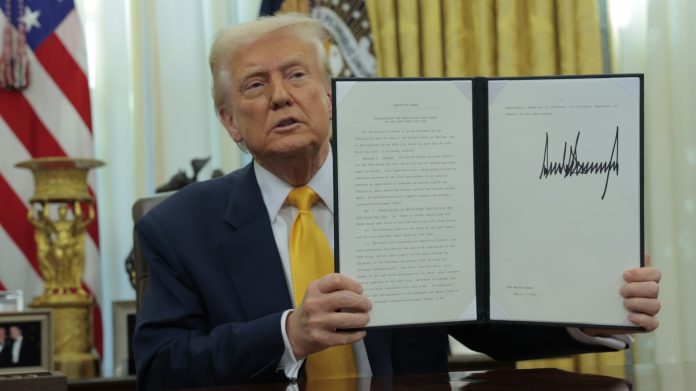
President Trump, through orders, firings and other changes, is remaking the existing system of checks on the president. Supporters say that is exactly the point.

Anna Moneymaker/Getty Images/Getty Images North America


hide caption

toggle caption

Anna Moneymaker/Getty Images/Getty Images North America

No one can say he wasn’t upfront about it.

“It’s good to have a strongman at the head of a country,” then-candidate Donald Trump declared at a New Hampshire campaign rally back in January 2024.

In his successful comeback bid, Trump spent the entire campaign praising strongman leaders, vowing to uproot the administration state and seek retribution against his political enemies and, asked to promise that he would never “abuse power as retribution against anybody” by Fox News host Sean Hannity in 2023, he replied “Except for day one.”

“We’re closing the border, and we’re drilling, drilling, drilling. After that, I’m not a dictator. OK?” Trump continued.

Since he assumed office just seven weeks ago, the second-term president has unleashed an unprecedented assault on the workings of the executive branch: challenging the independence of the Justice Department, firing independent inspectors general across 18 federal agencies, effectively shuttering watchdog agencies like the Consumer Financial Protection Bureau and attempting to take operational control of independent agencies like the Securities and Exchange Commission — which oversees Wall Street — and the Federal Election Commission — which oversees elections.

“All of these actions are setting up legal fights as to the scope of executive power,” said Tara Malloy, who directs appellate litigation and strategy at the Campaign Legal Center, a government watchdog group.

“That said, I fear that we should not see them as some sort of academic, legal argument or fight,” Malloy added. “This administration is attempting to exert control and authority over the operations of federal government in a way that’s unprecedented.”

The CLC is particularly opposed to Trump’s attempt to fire Ellen Weintraub, the chair of the Federal Election Commission. Independent agencies cannot be both neutral and fair enforcers of the law and simultaneously only answerable to the president, Malloy said.

“I think you can see the basic unfairness. If you were to flip the situation, if, for instance, the Biden administration had exerted presidential control over the FEC, would President Trump think that his 2024 campaign was getting a fair shake? This seems completely contrary to everything we know about Trump.”

The case for a more ‘energetic’ executive

Trump’s actions have sparked chaos across the executive branch, but there is a theory that ties it all together, according to John Yoo, a conservative legal scholar who served in the Justice Department under George W. Bush.

Prior to Watergate, American presidents enjoyed far fewer constraints on their power. After President Nixon resigned in scandal over his abuses of that power, Congress — under the control of Democrats at the time — spent years passing laws to constrain or check presidential power by, for instance, creating the inspectors general role to serve in federal agencies to report on waste, wrongdoing and inefficiencies.

“We’re still living with those laws today, and one way to understand what Trump is trying to do, and I’m not saying even that Trump understands this is what he’s doing, but the presidency, the way it’s designed, urges him to do it, as he’s trying to snap those bounds that were imposed on the presidency in the post-Watergate era,” Yoo said.

This idea, called the “unitary executive theory,” has long been popular in far-right conservative circles, and promoted in the conservative government blueprint Project 2025, but it is now being tested in real time by the Trump administration.

The argument, according to supporters like Yoo, is that the Constitution puts the power of the executive branch into one person, the president, and as a result the president should have the power to command the executive branch at will. In the simplest terms: the president can hire or fire whoever they want.

“Now, that can be risky or dangerous, of course, but [the founders] thought that was outweighed by the virtues of having a single person who could act quickly, could act with speed, could act with decision and capability,” Yoo said, “The famous phrase of Hamilton used is good government is defined by ‘energy and the executive.’ And to have that energy, you need to have the power in one person.”

Deputy White House chief of staff Stephen Miller explained the administration’s view on Trump’s power during a Feb. 20 press briefing while discussing cuts made by White House adviser Elon Musk and his government efficiency project.

“A president is elected by the whole American people. He’s the only official in the entire government that is elected by the entire nation. Right? Judges are appointed. Members of Congress are elected at the district or state level. Just one man,” Miller said. “And the Constitution, Article Two, has a clause, known as the vesting clause, and it says, ‘The executive power shall be vested in a president,’ singular. The whole will of democracy is imbued into the elected president. That president then appoints staff to then impose that democratic will onto the government.”

He went on to describe tenured civil servants “who believe they answer to no one” as a “threat to democracy.”

Watchdogs sounding the alarm 

Watchdogs say Trump’s actions are having a chilling effect not only on the forces of government aimed at stopping corruption, but also on the government officials who remain in these agencies waiting to see what happens next.

“I don’t think it’s inconsequential that removing the heads of those officers whose job it is to protect whistleblowers and prevent corruption and wrongdoing were the early targets of the Trump administration. I think what’s also important is the signal that that sends to all those who are left behind,” said Danielle Brian, executive director of the Project on Government Oversight, which investigates corruption. “All of the offices and the laws that have been set up to prevent corruption and abuse of power are explicitly being targeted and undermined.”

Scott Greytak, director of Advocacy for Transparency International U.S. and an anti-corruption lawyer and advocate, was more measured.

“Multiple lights in the sky doesn’t necessarily mean there is a constellation, and I’m hoping there’s not a constellation, but it’s simply factually too early to tell,” he said, “I don’t think that this comes from some coordinated, whole-of-government nexus of corruption. I just don’t think we’re there yet. I think we’re going to find out if we get there, and we may find out as soon as in the next six months.”

The Trump administration has also yet to issue an executive order imposing ethical guidelines for his administration and high level political appointees — which presidents typically do — despite employing more billionaires than any cabinet in history with many financial conflicts before the government.

“I’m not saying that there is necessarily corruption in the administration, but I am saying that it creates a much bigger risk that there will be at least an appearance, and when that happens, there needs to be accountability, because we need to know, again, the government is operating in the public interest,” said Daniel Weiner, director of the elections and government program at the Brennan Center for Justice, a center-left research organization.

Who asked for this

There’s little evidence that the American public is clamoring for a more powerful president.

If anything, voters seem to like the separation of powers the way it is. According to 2024 polling by Vanderbilt University’s Unity poll, just six percent of Americans support increasing presidential power. The vast majority — 63 percent — were happy with the status quo.

Just last month, a CNN poll showed a narrow majority of Americans, 52%, say Trump has gone too far in exercising presidential power. However, a second-term president is not as captive to popular political sentiment since he is barred from appearing on the ballot again (although Trump has repeatedly raised the idea that he could challenge the two-term constitutional limit on the president).

For now, the check on Trump’s power is in federal courts, where more than 100 cases challenging his executive actions are underway.

But the courts move slowly and Trump has not shied away from criticizing judges, nor has his adviser, businessman Elon Musk, who has publicly called for some judges to face impeachment for rulings that have slowed or stopped Trump’s efforts to remake the federal government.

What’s at stake

There are scores of lawsuits making their way through the federal courts challenging the Trump administration’s actions, but Yoo said that is part of Trump’s strategy.

“Trump is clearly setting up a test case to go back to the Supreme Court,” said Yoo, who said the administration is likely to test a 1935 Supreme Court ruling that limits presidential power to remove certain officials serving in the executive branch. A 6-3 conservative Court is a more hospitable place for Trump to have that legal fight, and the Court has been sympathetic in recent years to these arguments.

In 2020 the Court ruled that the president had the power to fire the head of the CFPB. “It’s almost like Trump is heeding the call of the Supreme Court to test whether any of these independent agencies can really remain in the framework of our 18th century Constitution anymore,” Yoo said.

The Supreme Court already handed Trump nearly absolute power over the Justice Department in a 2024 ruling regarding presidential immunity — including the ability to have conversations about criminal cases and other enforcement actions.

If Trump is successful in breaking all or some of the binds put on the president in the post-Watergate era, it would usher in a new era of American politics with little or no independent checks on the president and politicized agencies.

Accountability could still come in two forms: the ballot box and the other branches of government. Voters can oust unpopular presidents and Congress can still pass laws to reign one in, as well as exercise the impeachment powers to remove a president.

While that might be true for future presidents, Trump is not as swayed by public opinion as a second-term president, and a Congress ruled by the same party is much more willing to acquiesce to the demands of the executive.

Yoo acknowledged the expanding executive power isn’t a one party advantage.

“It used to be after World War II, in the wake of FDR and Truman, Kennedy and LBJ, Democrats used to be the ones who liked the unitary executive, and it was Republicans like Taft who opposed it,” he said, “So I don’t think it’s a really Republican-Democrat thing at all. These reforms will ultimately play to an advantage of a Democratic president someday.”

Why Rodrigo Duterte Was Arrested Now

0

The arrest warrant was delivered to President Ferdinand R. Marcos Jr. of the Philippines in Manila at 3 a.m. Monday. The person named on it: his predecessor, Rodrigo Duterte, the firebrand whose war on drugs left thousands of people dead.

But acting on the warrant from the International Criminal Court was not straightforward, since the Philippines is not a member of the court. So at 6:30 a.m., Mr. Marcos’s government received another warrant for Mr. Duterte, this time from Interpol, which was acting on the court’s behalf and of which the Philippines is a member.

Mr. Marcos recalled his next step in an address to the nation on Tuesday. “OK, we’ll put all our plans into place, and let’s proceed as we had discussed,” he relayed having told the head of his justice department.

Just over 24 hours later, Mr. Duterte — who long seemed above the law — was arrested in Manila. By the end of Tuesday, he had been put on a plane bound for The Hague to face charges of crimes against humanity.

It was a swift coda to a long chapter of impunity in the Philippines. Only a handful of people have been convicted in connection with the killings in Mr. Duterte’s drug war, in which as many as 30,000 are estimated to have died. Now, the man who publicly took credit for the carnage was being sent to a court of law to face justice, in part because of a shift in political winds.

Mr. Marcos, the son of the dictator Ferdinand E. Marcos, rose to power after forming an alliance with Sara Duterte, a daughter of Mr. Duterte’s. Running on a platform of national unity, they won the presidency and vice presidency in 2022. But their marriage of convenience started unraveling quickly, driven by mistrust.

Ms. Duterte, who is leading in the polls to succeed Mr. Marcos, has railed against him, saying that she wanted to cut his head off and threatening to dig up his father’s body and throw it into the ocean. Her own father called the younger Mr. Marcos a “drug addict” and a “weak leader.”

Mr. Marcos mostly brushed off the comments and said little in public. But his allies impeached Ms. Duterte last month, imperiling her political career.

Then came the arrest of her father, which she and her allies denounced as political oppression, although Mr. Marcos said he had simply been following international convention in complying with the Interpol warrant.

“This was justice, regardless of how we got here,” said Maria Ressa, the Nobel Prize-winning journalist who has long been a target of Mr. Duterte because her news website, Rappler, has investigated the drug war.

“Now, is there politics involved? There is always politics involved,” she added. “But it’s a reminder to the rest of the world that accountability comes for you sooner or later and that impunity doesn’t last forever.”

It was still hard for some Filipinos to believe that such a moment had arrived.

Florecita Perez and Joemarie Claverio’s son, Jenel Claverio, 27, was killed by masked men in Navotas in December 2019. This week, Ms. Perez said in an interview, she pumped her first in the air when she heard about Mr. Duterte’s arrest, but waited until nighttime to tell her partner, because she thought the news would make him cry.

As they were about to sleep, she hugged him from behind. “I said, ‘Hon, Duterte has been arrested.’ He turned to me and said, ‘Oh? Won’t he be able to get away?’”

Mr. Duterte landed in the Netherlands on Wednesday evening, and he was to be taken to The Hague, where both the I.C.C. and its detention facilities are based. A court official said that Mr. Duterte would not be expected to appear in court on Wednesday, but he would likely be arraigned before a three-judge panel in the next few days.

The I.C.C. typically has lengthy pretrial proceedings, and a planned trial is not expected to start for months.

Ms. Duterte was also on her way to The Hague, to help organize her father’s legal team. Another daughter of the former leader’s, Veronica Duterte, posted screen grabs of video calls with their father while he was on the plane. In one Instagram post, she wrote: “A flight lasting more than eight hours but left with just a sandwich to eat???”

But thousands of people rejoiced when the chartered flight carrying Mr. Duterte took off from an air base in Manila. To some, it was reminiscent of when Mr. Marcos’s father was ousted nearly four decades ago and fled to the United States.

“It’s not quite what it must have been like for my parents on Feb. 25 with those headlines in the newspaper, saying: ‘It’s all over, Marcos leaves,’ but it felt pretty close,” said Sol Iglesias, an assistant professor of political science at the University of the Philippines. (Critics accuse the younger Mr. Marcos of trying to whitewash history by not properly recognizing the significance of that day in 1986.)

Ms. Iglesias said it was clear that the current president had given clearance for the broad campaign to curtail the Dutertes’ power in recent months.

“None of these would have been possible without his assent,” she said.

Despite having once pledged not to cooperate with the I.C.C., Mr. Marcos told reporters in November that he would not block the court and that it had obligations with Interpol.

Mr. Duterte left office with one of the highest approval ratings in Philippine history, and Ms. Duterte is still leading polls for the presidency in 2028, but the arrest now leaves her in a highly vulnerable position. And in recent months, the Dutertes have not been able to galvanize large crowds for their protests.

In approving Mr. Duterte’s arrest, Mr. Marcos is gambling that he can eliminate the Dutertes as a political force without any major backlash. The issue is now likely to be front and center during the midterm elections, seen as a proxy battle between the Marcoses and the Dutertes, in May.

Two Duterte allies — his former aide, Christopher “Bong” Go; and a former police chief, Ronald “Bato” Dela Rosa, the architect of Mr. Duterte’s drug war — are seeking re-election to the Senate. Later this year, Philippine senators will decide whether to convict Ms. Duterte over her impeachment. A ruling against her would all but put her out of the running for the top job.

So far, public sentiment seems to be behind Mr. Marcos. A March 2024 survey of more than 1,700 Filipinos showed that nearly three in five approved of the I.C.C. investigation.

On Wednesday night, in the city of Cotobato, a stronghold of Mr. Duterte, residents held banners and lit-up cellphones in protest of his arrest. A few hundred people turned up, but the demonstration soon petered out.

Marlise Simons contributed reporting from Paris, and Aie Balagtas See and Camille Elemia from Manila.

Parents, teachers and more react to Education Department layoffs : NPR

0

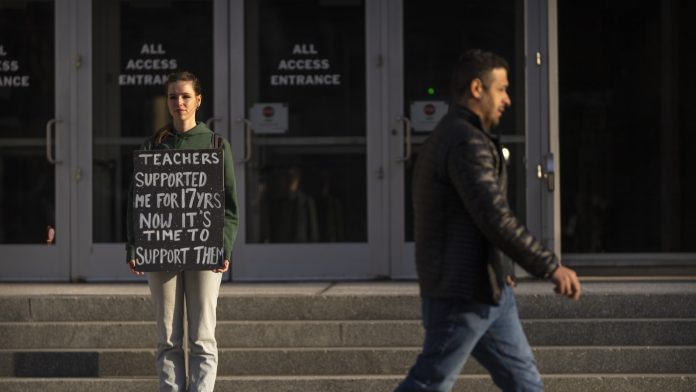
Chloe Kienzle of Arlington, Va., holds a sign as she stands outside the U.S. Department of Education, in Washington, D.C., on Wednesday – the day after the Trump administration announced widespread job cuts at the agency.

Mark Schiefelbein/AP


hide caption

toggle caption

Mark Schiefelbein/AP

Reaction to massive job cuts at the U.S. Department of Education came swiftly, with teachers unions and some parents groups condemning the moves, while supporters of school choice cheered them.

Employees of the department help send federal funding to high-poverty districts and students with disabilities; they make sure students aren’t being discriminated against at school, and they help college students pay for their degrees.

And now, their ranks are being cut by nearly 50%.

On Tuesday, the department announced that more than 1,300 positions would be terminated, and roughly another 600 employees had already accepted voluntary resignations or retired. Shortly after that announcement, workers began receiving emails telling them they would soon be out of a job.

National education groups were quick to respond. Teacher unions and some parent groups condemned the cuts.

Randi Weingarten, the head of the American Federation of Teachers – one of the nation’s largest teacher unions with 1.8 million members – denounced the cuts as “an attack on opportunity that will gut the agency and its ability to support students, throwing federal education programs into chaos across the country.”

In a statement, Weingarten said that 10 million students “who rely on financial aid to go to college or pursue a trade will be left in limbo. States and districts will be forced to navigate funding crises without federal support, hurting millions of students with disabilities and students living in poverty.”

The National Parents Union, which represents more than 1,800 parent organizations across the country, said in a statement, “Parents will not stand by and watch our children’s future be dismantled. We are ready to fight back.”

School choice advocates say cuts will help usher in “a golden age in American education”

Trump and his education secretary, Linda McMahon, have made it clear they intend to expand the federal government’s role in supporting school choice. Advocacy groups promoting charter schools, vouchers and other choice initiatives hailed Tuesday’s move as a step in that direction.

“This news is another signal that the bureaucratic state is coming to an end in America, ushering in a golden age in American education that is centered on sending education back to the states and parents,” the American Federation for Children said in a statement. “The time is now for school choice in every state and dismantling the federal education bureaucracy.”

On Wednesday, President Donald Trump addressed the cuts, saying, “The dream is we’re going to move the Department of Education – we’re going to move education into the states, so that the states, instead of bureaucrats working in Washington, so that the states can run education.”

Most public school funding comes from state and local governments. The federal government, in general, provides only a small fraction of schools’ overall funding – between 6 and 13%, according to a 2018 report from the U.S. Government Accountability Office.

The Center for Education Reform, another group working to expand school choice, said in a statement that this reduction in force “paves the way for ensuring that remaining federal program dollars not restricted by statute are directed to follow students where they are educated, regardless of the type of school.”

Democratic members of Congress generally oppose school choice, arguing it takes resources away from local public schools. And while Trump campaigned on expanding school choice, Republicans don’t all agree on the best policy approaches.

During McMahon’s confirmation hearing, Republican Sen. Lisa Murkowski of Alaska pointed out that many rural Republicans oppose school choice because, “it works if you’re in a city,” but in many remote Alaska districts, “there is no choice.”

Reporting contributed by: Cory Turner and Jonaki Mehta

In Trump’s Shadow, Greenland Votes for a New Government

0

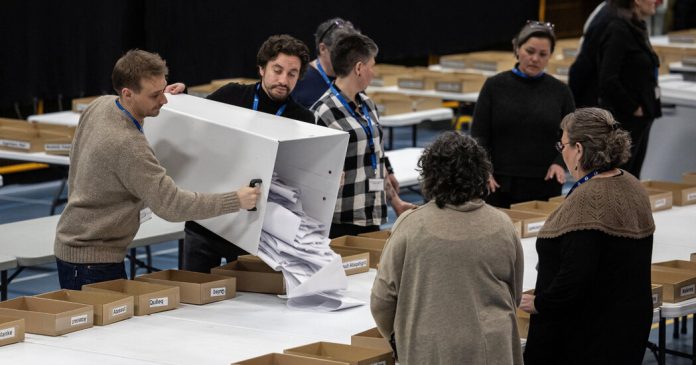
With Greenland thrust into the spotlight by President Trump’s insistence that the United States will somehow “get” it, Greenlanders held a closely watched election on Tuesday that took on unusual importance — not just for the outside world, but for them as well.

Voter turnout hit its highest level in more than a decade, and polling stations on the remote, sparsely populated island, which is partly controlled by Denmark, stayed open late to accommodate long lines.

But with all votes counted early Wednesday morning, the results were mixed.

The winner was Demokraatit, a party that has been critical of Mr. Trump’s rhetoric. It has taken a moderate stance on the subject of independence from Denmark, which most Greenland politicians support as a long-term goal.

The second most popular party, Naleraq, however, has pushed hard for independence as soon as possible — which some of its members have said would enable Greenland to associate more freely with other countries, including the United States. One of Naleraq’s most prominent figures is very pro-Trump and attended the American president’s inauguration.

Greenlanders are clearly divided, experts said, on how to handle this crossroads.

“What has become clear during the election — and what Denmark must now recognize — is that across the political spectrum, there is dissatisfaction with the current constitutional arrangement,” said Ulrik Pram Gad, a researcher at the Danish Institute for International Studies in Copenhagen. “Regardless of the outcome, there will be calls for renegotiating the structure of the kingdom of Denmark.”

Denmark colonized Greenland more than 300 years ago, and while the island is now considered a semiautonomous territory, Denmark still controls foreign policy, defense and other aspects of its governance. Demokraatit — which won just under 30 percent of the vote, ahead of Naleraq’s 24.5 percent — has consistently argued that independence must not imperil economic and social stability. There are only 56,000 people living on the island, and the difference between first and second place in this election was around 1,500 votes.

Lars Trier Mogensen, a political analyst based in Copenhagen, said he did not expect any drastic changes in Greenland’s geopolitical situation, at least for now.

“The new Greenlandic government is unlikely to rush into major shifts in U.S. relations anytime soon,” he said.

In interviews with voters these past few weeks and during town hall events with candidates, it was local issues like health care, schools and fishing (the island’s main industry) that kept coming up. Some observers said the two leading parties were clearer about what needs to be changed.

For example, they both campaigned on revamping the fisheries law, said Svend Hardenberg, a mining executive and, more recently, a star in a popular Danish Netflix series that, serendipitously, had a whole season about Greenland.

“The main direction is independence,” he said. “I think that can go quicker than most people expect.”

Greenland boasts a trove of minerals and is strategically located near increasingly important Arctic Ocean shipping lanes. Mr. Trump, in an address to Congress last week, said, “I think we’re going to get it — one way or the other, we’re going to get it.”

On Sunday, two days before the election, in a social media post, he made a direct pitch to Greenlanders: “We are ready to INVEST BILLIONS OF DOLLARS to create new jobs and MAKE YOU RICH.”

But Greenlanders have been clear that despite Mr. Trump’s entreaties, they don’t want to be absorbed by the United States, with polls showing that at least 85 percent oppose the idea. “Greenland is not a house that can be bought,” Demokraatit’s leader, Jens-Frederik Nielsen, has said.

Still, Kuno Fencker of Naleraq, who is Greenland’s most pro-Trump politician, got far more votes than he did in the last election, in 2021. Mr. Fencker attended Mr. Trump’s inauguration and took a tour of the West Wing, and his push for stronger ties with the United States drew fierce criticism from his rivals, some of whom labeled him a traitor. In a recent podcast, Mr. Fencker argued that Mr. Trump had been “misunderstood.”

Naleraq’s second-place finish means that pro-independence voices will remain influential, and the party could push for greater engagement with Washington. But Mr. Fencker’s enthusiasm for Mr. Trump might have turned off some voters, analysts said.

“Naleraq positioned itself in a way that made it seem like a vote for them would bring Trump too close,” Mr. Gad said.

Naleraq doubled its seats, from four to eight, in Greenland’s 31-seat Parliament, the Inatsisartut. At an election night party on the outskirts of Nuuk, the capital, party members and supporters embraced, danced and cheered.

Analysts predicted that Demokraatit was likely to form a governing coalition with the more moderate Inuit Ataqatigiit party, or I.A., which finished third, with 21.4 percent of the vote. Inuit Ataqatigiit, the dominant party in the outgoing governing coalition, embraced a go-slow approach to breaking off from Denmark.

Greenland, the world’s biggest island, is home to a mostly Inuit population that Denmark sidelined during the colonial era. Over time, demands for self-rule have led to greater autonomy and a Greenlandic government. One of Naleraq’s selling points, Mr. Gad said, was its “activist language” inspired by international movements like #MeToo and Black Lives Matter.

Today, Greenland manages most of its domestic affairs. But full independence is not going to be easy. Denmark sends hundreds of millions of dollars to the island each year that pays for nice schools, cheap gas and strong social services — a Scandinavian standard of living in a very remote place. Many Greenlanders, even if they are leaning toward independence, have said they are reluctant to jettison all that, which is why the subject of breaking off from Denmark is so sensitive.

Many voters also expressed skepticism, worry and even anger about the way Mr. Trump has talked about their homeland. People have been living on this icy island for thousands of years, surviving off hunting and fishing. The sense of Greenlandic identity runs strong, and during the election, ballots had to be transported by helicopter, boat and snowmobile.

In the final televised debate on Monday, five of the six party leaders said they did not trust Mr. Trump. Only Karl Ingemann of the small Qulleq party said he did. And Mr. Ingemann failed to win a seat.

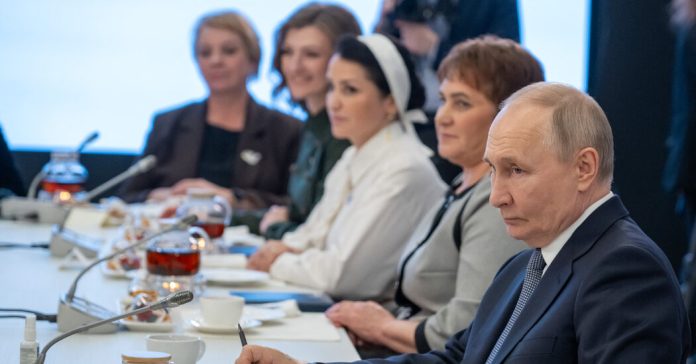
Putin Is ‘Carefully Studying’ Proposed Ukraine Cease-Fire

0

As recently as January, President Vladimir V. Putin of Russia emphatically rejected the idea of a temporary cease-fire in Ukraine.

But after a month in which President Trump turned American foreign policy on its head and Russian forces made progress in a key battle, the Kremlin now appears keen at least to entertain the 30-day cease-fire proposal made by Ukraine and the United States on Tuesday.

Dmitri S. Peskov, Mr. Putin’s spokesman, told reporters on Wednesday that the Kremlin was “carefully studying” the outcome of Tuesday’s talks between the United States and Ukraine, and their call for a monthlong cease-fire.

He said he expected the United States to inform Russia in the coming days of “the details of the negotiations that took place and the understandings that were reached.” He raised the possibility of another phone call between Mr. Putin and Mr. Trump, signaling that the Kremlin saw the cease-fire proposal as just a part of a broader flurry of diplomacy.

Mr. Putin has seen a dizzying reversal in his geopolitical fortunes over the last month as Mr. Trump realigned American foreign policy in Russia’s favor, antagonized U.S. allies and excoriated President Volodymyr Zelensky of Ukraine at the White House.

But the emergence of a joint cease-fire proposal from the United States and Ukraine complicates things for Mr. Putin. It deepens the tension between his desires for a far-reaching victory in Ukraine and for close ties with Mr. Trump.

While Mr. Trump says he wants to end the war as soon as possible, Mr. Putin has signaled he will not stop fighting until he extracts major concessions from the West and from Kyiv, including a pledge that Ukraine will not join NATO and that the alliance will reduce its presence in Central and Eastern Europe.

On Jan. 20, when he congratulated Mr. Trump on his inauguration, Mr. Putin made clear that the goal of any Ukraine talks must “not be a short cease-fire, not some kind of respite.” Russia, he said, sought “a long-term peace based on respect for the legitimate interests of all people, all nations who live in this region.”

Analysts say Mr. Putin’s opposition to a temporary cease-fire stemmed from the simple calculation that with Russian forces gaining on the battlefield, Moscow would only give up its leverage by stopping the fighting without winning concessions.

But a Feb. 12 phone call between Mr. Putin and Mr. Trump, and the White House’s subsequent alignment with Russia at the United Nations and elsewhere, may have affected Mr. Putin’s calculus by making him more eager to stay on Mr. Trump’s good side, analysts say.

That sets up a delicate balancing act for the Kremlin.

Ilya Grashchenkov, a political analyst in Moscow, said the Kremlin could be tempted to accept a truce that would be “tactically unfavorable but strategically favorable” in order to “show that it’s a peacemaker.”

While Russians were not present at Tuesday’s talks in Jeddah, Saudi Arabia, the Trump administration has kept up its engagement with the Kremlin. John Ratcliffe, the C.I.A. director, spoke to his Russian counterpart, Sergei Naryshkin, on Tuesday, Russian news agencies reported on Wednesday.

Steve Witkoff, the envoy for Mr. Trump who met with Mr. Putin for several hours last month, plans to return to Russia in the coming days, according to two people familiar with the matter, who requested anonymity to discuss internal plans. On Tuesday afternoon, Mr. Trump told reporters that he thought he would speak with Mr. Putin this week and that he hoped a lasting cease-fire would be negotiated in the coming days.

“It certainly is not impossible that the Russians would accept this,” Samuel Charap, a Russia analyst at the RAND Corporation, said of the 30-day offer. “Not because they want an unconditional, temporary cease-fire, but because they now have a stake in relations with Washington.”

In another sign of Moscow’s charm offensive directed at the Trump camp, Russia’s foreign ministry released a 90-minute interview on Wednesday that the foreign minister, Sergey V. Lavrov, gave to three American video bloggers, including the former Fox News personality Andrew Napolitano.

Mr. Lavrov, speaking English, praised the Trump administration for reversing the Democrats’ “departure from Christian values” and said Russia was ready for the “normal relations” that the United States was offering.

Mr. Putin’s calculus could also be affected by Russia’s progress in recent days in pushing Ukrainian troops out of Kursk, the Russian border region where Ukraine occupied several hundred square miles of territory in a surprise incursion last August.

Mr. Zelensky had said he planned to use that land as a bargaining chip in future talks, but the Kremlin signaled that it would refuse to negotiate so long as Ukraine held the territory.

With the Kursk region mostly back in Russian hands, Mr. Putin no longer risks losing face by agreeing to a cease-fire that would leave Ukraine in control of a swath of Russian territory, said Sergei Markov, a pro-Kremlin political analyst in Moscow.

A further incentive to agree, Mr. Markov said, was to make sure that Russia “doesn’t look like a war maniac” in the eyes of non-Western countries that have avoided imposing sanctions on Moscow. But, he said, he expected Mr. Putin to insist on preconditions, such as a halt on weapons supplies to Ukraine for the duration of the cease-fire.

“Russia will very likely say, ‘Yes, but —,’ ” Mr. Markov said in a phone interview.

Russia’s popular pro-war bloggers on Wednesday did not display much enthusiasm for a cease-fire. Some of them expressed concern that a truce could eventually lead to a broader deal with the United States that, in their view, would betray the original goals of the war and eventually lead to a Russian withdrawal from Ukraine.

One blogger, who goes by the name Alex Parker Returns, argued in a post on Wednesday that a peace deal would allow Ukraine “to get off easily and get ready for the next round.”

Ivan Nechepurenko contributed reporting.

Sen. Chris Coons is voting “no” on spending bill that would stop a government shutdown : NPR

0

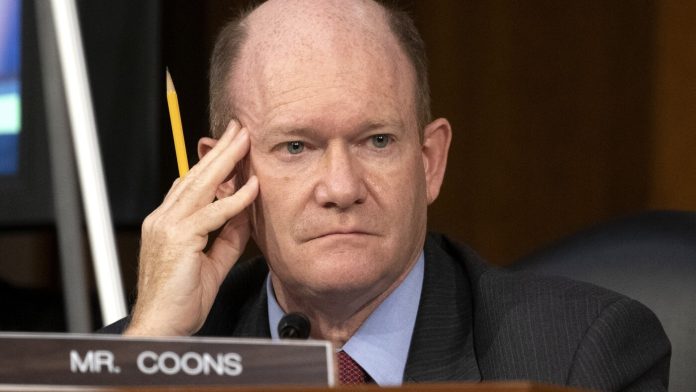
U.S. Sen. Christopher Coons (D-DE) looks on as Supreme Court nominee Judge Amy Coney Barrett testifies before the Senate Judiciary Committee.

Pool/Getty


hide caption

toggle caption

Pool/Getty

A short-term spending bill to avoid a government shutdown will be voted on by the Republican-controlled Senate this week. The bill must pass and be signed into law by President Donald Trump before midnight this Friday to avert a government shutdown.

The bill narrowly passed the House of Representatives earlier this week in a 217 to 213 vote, with only one Democrat, Representative Jared Golden of Maine, voting yes. Only one Republican, Thomas Massie of Kentucky, voted against the legislation. Trump vowed to “lead the charge” to unseat Rep. Massie after his ‘no’ vote.

The bill would largely preserve the spending levels as they existed under former President Joe Biden’s administration. Key differences in the bill include cutting a billion dollars from the District of Columbia’s budget, and increasing military spending by $6 billion. The bill will also not include funds for any projects in lawmakers districts or states.

The short-term funding bill will need 60 votes to overcome a filibuster in the Senate. Republican Senator Rand Paul, R-Ky., has already said he plans to vote ‘no’ on the bill, which means Senate Republicans will need eight Democrats to move on to final passage, if no other Republicans oppose the bill. President Trump has made it clear on X, formerly known as Twitter, he plans to blame Democrats if the government shuts down.

“President Trump and Elon Musk are already shutting down the government,” Senator Chris Coons of Delaware said on NPR’s Morning Edition.

Sen.Coons spoke to NPR’s Michel Martin about his decision to vote ‘no’ on the spending bill.

This interview has been edited for length and clarity. 

Interview highlights

Michel Martin: Have you decided how you’re going to vote?

Senator Chris Coons: I’m an appropriator. I am going to vote against this dirty continuing resolution because I don’t want my vote to give an imprimatur to what President Trump is doing. We can and should find more efficient ways to spend federal government dollars, but the ways in which he is cutting veterans mental health services, tens of thousands of employees out of critical agencies that keep us safe and support our country. And the rising threats in recent comments from Elon Musk and others close to Trump to go after Social Security, Medicaid and Medicare alarm me and will not have my support.

The argument in favor is that, well, this is bad. And, well, almost every Democrat in the House and almost every Democrat in the Senate opposes what Donald Trump and Elon Musk are doing. The risks of shutting the government down may be greater because we don’t know what this unusual president might do to further break the guardrails. So court after court that has reviewed his abrupt and cruel spending cuts have said they were illegal or unconstitutional. President Trump is coloring outside the lines. And so I respect those senators who have real concerns about what more Trump might do in the midst of a government shutdown.

Martin: Republicans, starting with Trump, have made it clear they’re going to blame the Democrats for shutting down the government if that happens. What are the arguments for voting against it?

Senator Coons: President Trump and Elon Musk are already shutting down the government for the time he’s been president now just over 50 days. They have torn through agency after agency. A government shutdown is already underway and it’s being done piecemeal, without planning, without any kindness or decency to folks who’ve served as veterans and helped keep our nation safe and help run our Social Security agency. So first, the argument for not giving President Trump and Elon Musk more power to do more bad, to move money around at will, to shut down more organizations and to give it our vote.

Martin: Is this more about what’s in the bill or is it all about taking a stand against the actions of the Trump administration more broadly?

Senator Coons: It’s both. This is not what we call in the Senate a clean continuing resolution. It’s a dirty continuing resolution. It doesn’t have positive provisions that ensure that the president will follow the law or that ensure that there is a congressional role in oversight, as the president uses this as a slush fund to move billions of dollars here and there.

What a continuing resolution really means is that, yes, the funding levels are roughly similar to what they should have been last year, although with real cuts, to the District of Columbia government, but to lots of domestic agencies. But it also gives the president more range to move money around the federal government, around the country at will. And we’re already seeing him use that power to extract concessions.

Martin: Do you expect that all Democrats will vote against this bill as you have planned to and if they don’t? Does this further signal that the Democrats don’t have a coherent response to this administration?

Senator Coons: No Democrats in the Senate are going to fight for our appropriations bills that we’ve already done on a bipartisan basis that are ready for action. We’re going to work to get a vote on the floor of a 30 day continuing resolution to keep the government open while we finish our appropriations bills.

And Michel, let’s be clear. It’s President Trump who is already shutting down the government, and it’s Elon Musk who’s been cheering on those who want to shut down the government.

This story was edited by Kristian Monroe. The audio version of this story was produced by Nia Dumas and edited by Lisa Thomson.

Rubio Says a Cease-Fire in Ukraine Could Happen in ‘Days’ if Russia Agrees

0

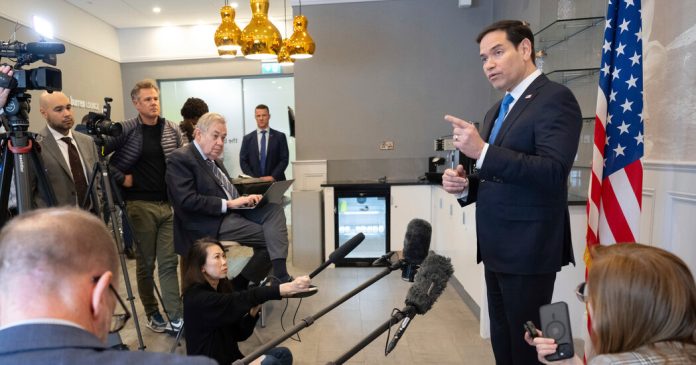
Secretary of State Marco Rubio said on Wednesday that he hoped a cease-fire between Russia and Ukraine could take place within “days” if Russian leaders agreed, and that he planned to get diplomats from the Group of 7 allied nations to focus on ending the war in a meeting this week in Canada.

“Here’s what we’d like the world to look like in a few days: Neither side is shooting at each other — not rockets, not missiles, not bullets, nothing, not artillery,” he told reporters during a refueling stop in Ireland as he flew from Saudi Arabia to Canada. “The shooting stops, the fighting stops, and the talking starts.”

Mr. Rubio also downplayed any notion that he would encounter hostility from American allies because of President Trump’s recent tariffs. And he said he expected to have cordial talks with Canadian officials, despite Mr. Trump’s threat to annex Canada and make it the 51st state. The president has also imposed coercive tariffs on Canada.

“That’s not what we’re going to discuss at the G7, and that’s not what we’re going to be discussing in our trip here,” he said. “They’re the host nation, and I mean, we have a lot of other things we work on together.”

“It is not a meeting about how we’re going to take over Canada,” he added.

Mr. Rubio and Michael Waltz, the White House national security adviser, met for hours on Tuesday with Ukrainian officials in Jeddah, Saudi Arabia, to work out how to start a negotiation process with Russia to end the war. Hostilities began in 2014 when Russia invaded and annexed Crimea, and then launched a full-scale invasion in 2022.

After the meeting on Tuesday, Ukrainian officials said they had agreed to an American proposal for a 30-day interim cease-fire. After berating the president of Ukraine, Volodymyr Zelensky, in the White House, Mr. Trump withheld U.S. weapons and intelligence aid to the Ukrainians to try to force them into negotiations. U.S. officials said after the Jeddah meeting that aid had restarted.

Mr. Rubio said U.S. officials planned to “have contact” with Russian officials on Wednesday to discuss the proposed cease-fire.

“If their response is no, it would be highly unfortunate, and it’d make their intentions clear,” he added.

Mr. Rubio said that when he, Mr. Waltz and Steve Witkoff, Mr. Trump’s special envoy to the Middle East, met with Russian officials in Saudi Arabia last month, the Russians appeared open to the idea of a settlement to the war. “They expressed a willingness under the right circumstances, which they did not define, to bring an end to this conflict,” he said.

Mr. Rubio said one of his main goals at the Group of 7 meeting was corralling the other countries — Britain, Canada, France, Germany, Italy and Japan, all supporters of Ukraine — to have a united front on encouraging peace talks. The meeting begins with a reception in Quebec City on Wednesday night.

He said a “perfect statement” to be issued from the meeting “would be that the United States has done a good thing for the world in bringing this process forward, and now we all eagerly await the Russian response and urge them strongly to consider ending all hostilities, so people will stop dying, so bullets will stop flying and so a process can begin to find a permanent peace.”

Ukrainian officials want to ensure several issues are addressed in any talks, he said, including exchanges of prisoners of war, the release of Ukrainian children abducted by Russia and humanitarian assistance.

When asked what was the American position on Ukraine’s request for security guarantees to help deter any future Russian assaults, Mr. Rubio simply said deterrence would be part of peace talks.

“There’s no way to have an enduring peace without the deterrence piece being a part of it,” he said, adding that any commercial minerals agreement between the United States and Ukraine would help enrich Ukraine, but was not a deterrent against Russian aggression.

Mr. Trump has insisted that the United States and Ukraine sign such an agreement, suggesting that investment by American companies in Ukraine would help stave off a hostile Russia.

Mr. Rubio said European promises to provide security to Ukraine would be part of peace talks as well. He said it was unclear when those nations would become more involved in negotiations, though European countries have insisted they would be central players in a settlement, if one were to happen.

“I would imagine that in any negotiation, if we get there hopefully with the Russians, that they will raise the European sanctions that have been imposed upon them,” Mr. Rubio said. “So I think that the issue of European sanctions are going to be on the table, not to mention what happens with the frozen assets and the like.”

The foreign ministers gathered in Quebec City expect to discuss the war, but Mr. Trump’s hostility to U.S. alliances, his alignment with Russia and his unpredictable tariff actions have created a host of issues that the diplomats intend to raise.

Mr. Rubio said Mr. Trump was imposing tariffs not to punish other nations but “to develop a domestic capability” for manufacturing, especially in defense industries.

Canadian officials, including the incoming prime minister, Mark Carney, are taking reciprocal actions on the tariffs and grappling with Mr. Trump’s other threats. Mr. Rubio said Mr. Trump’s statements on annexation were based on both economic and security concerns.

“What he said is they should become the 51st state from an economic standpoint,” Mr. Rubio said. “He says if they became the 51st state, we wouldn’t have to worry about the border and fentanyl coming across because now we would be able to manage that. He’s made an argument that it’s their interest to do so. Obviously, the Canadians don’t agree, apparently.”

What Trump's cuts to the Department of Education mean for schools and students

0

The DoE is cutting staff, halting grants and pressuring schools on various administration priorities. Washington Post writer Laura Meckler discusses its destabilizing effect on the education system.

Syria Violence Marked by Sectarian and Revenge Killings, War Monitor Says

0

Armed groups and foreign fighters linked to the government but not yet integrated into it were primarily responsible for sectarian massacres in Syria’s coastal region over the past week, a war monitoring group said in a new report.

The U.S. secretary of state, Marco Rubio, said on Wednesday that the U.S. would “watch the decisions made by the interim authorities” after hundreds of civilians were killed in just several days in areas dominated by the country’s Alawite religious minority. He added that Washington was concerned by “the recent deadly violence against minorities.”

The ousted dictator Bashar al-Assad was an Alawite and some members of his minority community enjoyed a privileged status under his rule.

The Syrian Network for Human Rights, which monitors the country’s civil war, said in a report released late on Tuesday that the violence in recent days “included extrajudicial killings, field executions, and systematic mass killings motivated by revenge and sectarianism.”

The clashes erupted almost a week ago in Latakia and Tartus Provinces — the Alawite heartland of Syria — between fighters aligned with the new government and Assad loyalists. The new government is led by Islamist former rebels who fought Mr. al-Assad in a 13-year civil war.

The violence was triggered when pro-Assad militants ambushed security forces last Thursday and killed more than a dozen of them. The government then poured security forces into the coastal region.

The Syrian Network for Human Rights monitor said armed groups and foreign Islamist fighters aligned with the government “but not organizationally integrated into it” were “primarily responsible” for the sectarian and revenge-driven mass killings. Thousands of foreign fighters poured into Syria amid the civil war, many of them joining Islamist rebel groups opposed to the Assad dictatorship.

The Syrian government did not immediately respond to a request for comment on the report. (The New York Times could not independently corroborate the findings.)

Another war monitoring group, the Syrian Observatory for Human Rights, has said that more than 1,300 people have been killed since Thursday, adding on Tuesday that more than 1,000 civilians were among the dead. Most of the killings took place in Latakia and Tartus Provinces.

The Syrian Network for Human Rights has not been providing tolls for the overall number of dead since the violence began. But the group said more than 800 people were killed from Thursday to Monday — both civilians and combatants — in “extrajudicial killings.”

The group also said in its report that the large number of groups involved in the conflict and the confusion over their exact roles during this transitional period makes it “extremely difficult to determine individual legal responsibility” for the violence.

The figures provided by both war monitors could not be independently verified and it was not immediately clear why there were discrepancies. But the situation has been murky and exact numbers of civilians and fighters killed have been hard to pin down during the chaos of recent days.

The U.N. Human Rights Office said on Tuesday that it had documented the killing of 111 civilians so far, but it was still verification the figures and the actual number is “believed to be significantly higher.”

The United Nations’ high commissioner for human rights, Volker Türk, urged the government on Tuesday to ensure that the investigations are “prompt, thorough, independent and impartial.”

Syria’s new government has ordered a complex web of armed groups across the fractured country to dissolve, and several prominent militias have agreed to work with the new authorities. However, the security situation has remained unstable and it appears that all the militias have yet to be fully integrated into a single national army.

The interim Syrian president, Ahmed al-Shara, said on Sunday that the government was forming a fact-finding committee to investigate the violence and to bring the perpetrators to justice. Syrian officials have blamed Assad loyalists for the unrest, and have not acknowledged any responsibility for the bloodshed.

A small number of gunmen have been arrested by government security forces in recent days after videos spread across social media showing civilians being killed.

Mr. al-Shara’s government is under intense pressure to bring stability to the country after more than a decade of civil war. But sectarian tensions are threatening to undermine his pledges to unite the nation and protect Syrians of all ethnic and religious backgrounds.

Opposition wins most votes in Greenland election amid Trump takeover talk : NPR

0

Jens-Frederik Nielsen, center, chairman of Demokraatit Party, plays guitar as he reacts during the election party at Demokraatit by cafe Killut in Nuuk, early Wednesday, March 12, 2025.

Mads Claus Rasmussen/AP


hide caption

toggle caption

Mads Claus Rasmussen/AP

NUUK, Greenland — The center-right Demokraatit Party won the most votes in Greenland’s parliamentary elections, a surprise result as the territory went to the polls in the shadow of U.S. President Donald Trump’s stated goal of taking control of the island one way or another.

Both Demokraatit — the Democrats — and the second place party, Naleraq — “Point of Orientation” — favor independence from Denmark but differ on the pace of change.

Demokraatit’s upset victory over parties that have governed the territory for years indicates that many in Greenland care just as much about health care, education, cultural heritage and other social policies.

“I think this is a historic result in Greenland’s political history,” Demokraatit party leader Jens-Frederik Nielsen said at the election party after the results.

Greenlandic newspaper Sermitsiaq wrote that Nielsen, 33, appeared to be surprised by his party’s gains, with photos showing him sporting a huge grin and applauding at the election party.

The Danish Broadcasting Corporation DR reported that Nielsen said his party would reach out to all other parties to negotiate the future political course for Greenland.

“We had not expected that the election would have this outcome,” Nielsen told Greenlandic Broadcasting Corporation KNR TV. “We are very happy.”

Nielsen also said that Greenland needs to stand together “in a time of great interest from outside,” KNR TV reported.

Prime Minister Mute Bourup Egede had called the early vote in February, saying the country needed to be united during a “serious time” unlike anything Greenland has ever experienced.

On Wednesday, after the results were known, Egede thanked voters in a Facebook post for turning out and said the parties were ready to turn to negotiations to form a government.

Danish Defense Minister Troels Lund Poulsen congratulated the Demokraatit party and said the future Greenlandic government would likely have to “deal with massive pressure from U.S. President Donald Trump,” according to DR.

He added that “it’s not the case that you can just take part of the Danish Realm — the future of Greenland is based on what the Greenlandic people and government want,” DR reported.

Trump has been outspoken about his desire to control Greenland, telling a joint session of Congress last week that he thought the U.S. was going to get it “one way or the other.”

Greenland, a self-governing region of Denmark, straddles strategic air and sea routes in the North Atlantic and has rich deposits of the rare earth minerals needed to make everything from mobile phones to renewable energy technology.

Egede’s Inuit Ataqatigiit (United Inuit) had been widely expected to win, followed by Siumut — two parties which had dominated Greenland’s politics in recent years.

A break from Denmark wasn’t on the ballot, but it was on everyone’s mind. The island of 56,000 people has been on a path toward independence since at least 2009, and the 31 lawmakers elected will shape the island’s future as it debates whether the time has come to declare independence.

Four of the five main parties in the race sought independence, but disagreed on when and how.

Naleraq is the most aggressively pro-independence, while Demokraatit favors a more moderate pace of change.

“What approach to independence will win the day will ultimately depend on if Demokraatit decides to form a coalition government, and if so, with which party,” said Dwayne Menezes, managing director of the Polar Research and Policy Initiative.