Thursday, November 12, 2026
Home Blog Page 135

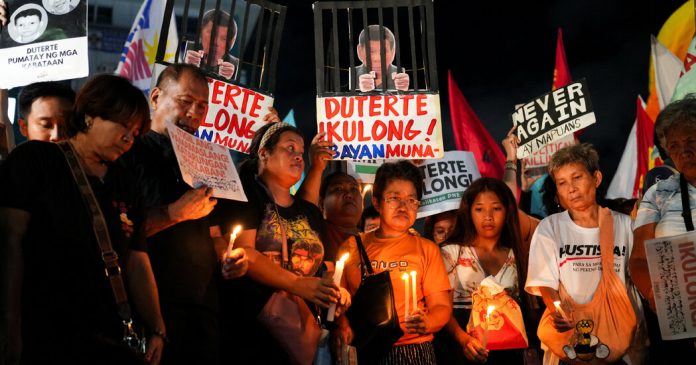
Duterte’s Arrest Shows Power and Limits of the International Criminal Court

0

The police in the Philippines arrested Rodrigo Duterte, the country’s former president, on Tuesday on charges of crimes against humanity under a warrant by the International Criminal Court.

While in office, Mr. Duterte encouraged the police to hunt down and kill people whom they suspected of being involved in the illegal drug trade. Human rights groups say that more than 30,000 people were killed in extrajudicial executions.

The arrest represents a significant victory for the I.C.C., an independent judicial body that investigates and tries people accused of genocide, war crimes, crimes against humanity and the crime of aggression from its base in The Hague.

But Mr. Duterte’s arrest also shows the limits of the court’s power: Although its jurisdiction is sweeping, the court cannot carry out arrests on its own. It relies on the cooperation of national governments to execute its warrants, which leaves it at the mercy of domestic politics.

Arresting Mr. Duterte was possible because he was out of office and politically weakened. By contrast, there appears to be essentially no chance that the I.C.C. arrest warrants for President Vladimir V. Putin of Russia or Prime Minister Benjamin Netanyahu of Israel will be carried out anytime soon.

On paper, the I.C.C. has the ability to order the arrest of anyone who is alleged to have committed a crime listed in the Rome Statute, the 1998 treaty that established the court, and who is either a national of an I.C.C. member state or committed the crime on the territory of one. Even sitting leaders are not immune from prosecution — a notable departure from the usual rules of international law. (Mr. Duterte withdrew the Philippines from the court during his presidency, but a panel of I.C.C. judges found that the court still has jurisdiction because his alleged crimes took place before that withdrawal.)

But in practice, the court has little to no ability to go after sitting leaders, or people under their protection.

Mr. Duterte may have expected to be protected by his successor, Ferdinand Marcos Jr., who initially pledged to shield him from international inquiry. But then Mr. Duterte’s family — especially his daughter Sara Duterte, who is vice president — had a dramatic falling out with Mr. Marcos (Ms. Duterte said she wanted to cut Mr. Marcos’s head off and threatened to dig up the body of his dead father and throw it into the ocean).

As the relationship deteriorated, so did Mr. Duterte’s protection from the international court. Mr. Marcos began allowing I.C.C. investigators into the country.

Experts say this narrow set of circumstances created a way for the I.C.C. to act.

“We can’t expect a new institution to substantially counteract the operation of power, or real entrenched interests of powerful actors,” said Kate Cronin-Furman, a professor at University College London who studies accountability for mass atrocities. “But what we do hope that they’ll do is adjust things along the margins, and over time shift things toward a more just world.”

“In the absence of the I.C.C., Duterte probably happily lives out his life, responsible for the massacre of thousands,” she added.

Most of the outstanding I.C.C. arrest warrants have not gone the same way. Many of the court’s most high-profile warrants have not resulted in arrests, including the cases of Mr. Putin and Mr. Netanyahu.

For political leaders who are targeted by the I.C.C., the power of their offices can often be enough to protect them from arrest. But with Mr. Duterte as a notable example, that dynamic creates an additional incentive for them to stay in office for as long as possible.


Thank you for being a subscriber

Read past editions of the newsletter here.

If you’re enjoying what you’re reading, please consider recommending it to others. They can sign up here. Browse all of our subscriber-only newsletters here.

I’d love your feedback on this newsletter. Please email thoughts and suggestions to [email protected]. You can also follow me on Twitter.
Trump buys a Tesla from Elon Musk at the White House : NPR

0

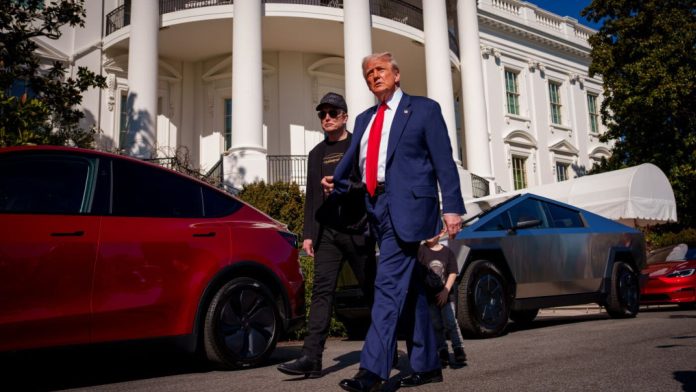
President Trump and White House senior adviser, Tesla and SpaceX CEO Elon Musk depart after looking at Tesla vehicles on the South Lawn of the White House on Tuesday.

Andrew Harnik/Getty Images


hide caption

toggle caption

Andrew Harnik/Getty Images

President Trump stepped into a car outside the White House on Tuesday afternoon — but not the usual high-security presidential limousine known as “The Beast.”

Instead of the presidential motorcade of large, black SUVs lined up on the driveway of the South Lawn, there were five Teslas for Trump to peruse.

Trump announced his intention to buy a Tesla on Monday night to support his close adviser billionaire Elon Musk, who is the CEO of the car company.

“That’s beautiful,” Trump said, getting into the front seat of a red Model S on Tuesday.

That the president made such a public backing of a private company is unusual, and a possible ethical violation. The White House did not immediately respond to a request for comment on if ethics rules were followed.

Trump’s purchase is also another example of Musk blurring the line between his roles in government, where he leads the administration’s government efficiency effort, and in the private sector, as the head of Tesla, SpaceX and X, formerly known as Twitter. His companies receive billions in federal contracts, even as the administration slashes spending across the government.

Richard Painter, former chief White House ethics lawyer under former President George W. Bush, said the display appears to violate federal rules prohibiting the use of public office for private gain, though those rules do not apply to the president.

“It looks like a way of saying this economy will be driven by favoritism,” Painter said. “It looks like government picking winners and losers, and the government saying, ‘Tesla is the winner.’ “

Trump, who has revoked Biden-era efforts to incentivize electric vehicles, said he’d pay for the car with a check, and would keep it at the White House for staff to use.

Tesla sales have plummeted in recent weeks, and there have been protests and attacks on Tesla cars and charging stations. Sales are down not only in the U.S., but across Europe, China and Australia, too.

“I think he’s been treated very unfairly by a very small group of people, and I just want people to know that he can’t be penalized for being a patriot, and he’s a great patriot, and he’s also done an incredible job with Tesla,” Trump said of Musk.

Asked if buying a car would help Tesla with its sales, Trump said, “I hope it does.”

NPR’s Bobby Allyn contributed to this report.

Wednesday Briefing: U.S. Resumes Aid to Ukraine

0

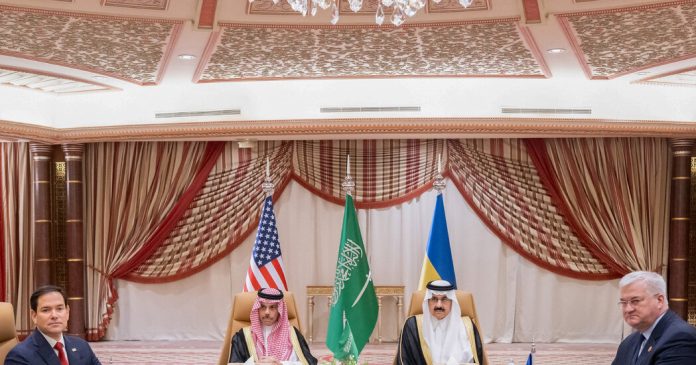
The U.S. said it would immediately lift the pause on intelligence sharing and resume military assistance to Ukraine after hours of meetings in Saudi Arabia. Kyiv said it would support the Trump administration’s proposal for a 30-day cease-fire with Russia.

In a joint statement, the U.S. and Ukraine acknowledged that the terms of any cease-fire would be subject to Russia’s approval. They also agreed to conclude a deal to develop Ukraine’s critical mineral resources “as soon as possible.”

The U.S. and Ukraine also discussed humanitarian relief efforts that could occur once a cease-fire was in place, and the exchange of prisoners of war. There was no immediate comment from Russia, which did not have officials at the talks.

President Trump told reporters that he might speak this week with Russia’s leader, Vladimir Putin, and that he hoped a lasting cease-fire would be negotiated in the coming days.

What’s next: After the meetings, Secretary of State Marco Rubio said that the agreement now put the pressure on Russia to end the war. “The ball is now in their court,” he said.

Defense: President Emmanuel Macron of France gathered the chiefs of staff of more than 30 armed forces yesterday to review the formation of a multinational peacekeeping force to monitor any cease-fire in Ukraine.

Urban warfare: Russian officials said Ukraine attacked Moscow before dawn yesterday, with at least three people killed and 18 others injured in the broader Moscow region.


It was a day for confusion and threats. After spending the earlier half of yesterday threatening Canada with doubling tariffs on steel and aluminum, President Trump pulled back after Ontario dropped the surcharges it had imposed on electricity it exports to the U.S. The planned 25 percent tariffs on Canadian steel and aluminum were still set to go into effect, a White House spokesman said.

Markets whipsawed, as investors tried to puzzle through Trump’s commitment to tariffs. Stocks dropped in early trading before recovering late in the day.

Context: Trump’s latest tariff salvo was in response to Ontario’s plan to add a 25 percent surcharge to the electricity it exports to Michigan, Minnesota and New York.

The 51st state: Trump repeated his desire to annex Canada. He said that “the only thing that makes sense” was for the U.S.’s northern neighbor to become its 51st state. He laid out in the clearest terms yet how he envisions that happening, saying it would “make all Tariffs, and everything else, totally disappear.”


Philippine authorities yesterday arrested former President Rodrigo Duterte at Manila’s main airport as he returned from a trip to Hong Kong, acting on a warrant issued by the International Criminal Court. The I.C.C. has accused Duterte of crimes against humanity for his past antidrug campaigns, which rights groups say killed roughly 30,000 people, many of whom were not involved with the drug trade.

What’s next: Duterte was flown on a plane bound for The Hague, where the court is based. The case will test the legal reach of the I.C.C., which draws its jurisdiction from the Rome Statute, a treaty currently signed by 125 countries. Here’s what else to know.


Kigali, Rwanda’s capital, has presented itself as an orderly city with ample attractions and premier sporting events. But that image, and Rwanda’s position as a security partner in Africa, are increasingly at odds with the war that has killed thousands in the Democratic Republic of Congo, where Rwanda backs M23, a rebel group. Tourism brought Rwanda $620 million in 2023, but sanctions are piling up.

Lives lived: Joey Molland, a guitarist and songwriter who was the last surviving member of the band Badfinger, died at 77.

As the producers of the hit West End musical “Operation Mincemeat” prepared to go to New York, they asked a question: “Are we too British for Broadway?” The answer, they hoped, would come from Americans before opening night, later this month.

The show, a comedy about a World War II spy operation, went across the pond armed with an Olivier Award for best new musical and a request for preview audiences to email feedback to the director. Tweaks were made for Broadway palates.

“American audiences are quick and sophisticated, but they also love the dumb stuff, like the slapstick,” the director said. “Almost more than the British.”

Cook: Pav bhaji — mashed vegetable curry with buns — is a popular street food originally from Mumbai.

Move: These explosive exercises can help you age well.

Former Navy SEALs say they’re making marine conservation cool : NPR

0

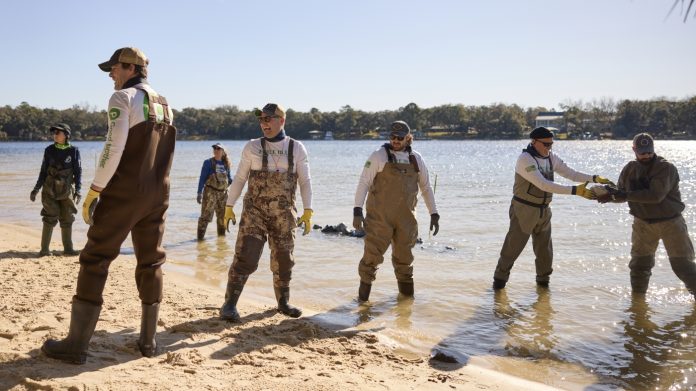
Veterans and volunteers with Force Blue use an assembly line to transport stones to build a rubble wall in Ft. Walton Beach, Fla.

Blake Jones for NPR


hide caption

toggle caption

Blake Jones for NPR

When Steve “Gonzo” Gonzalez retired after a 34-year career as a Navy SEAL, he knew pretty much everything about working underwater — except that it could be beautiful.

“I was always diving at midnight, two in the morning, and you can barely see your hand in front of your face,” he says. “So to see the vibrant colors, in warm water with amazing visibility, and nobody’s trying to hunt you down? Yes, it was definitely different.”

Retired Navy SEAL Master Chief Steve “Gonzo” Gonzalez transports stones during a Force Blue project.

Blake Jones for NPR


hide caption

toggle caption

Blake Jones for NPR

Now Gonzales gets to enjoy the stunning undersea landscape all the time as events director for Force Blue, a veterans’ nonprofit that does coral reef restoration and other ocean conservation work. They bring mostly veteran volunteers for projects that also provide “mission therapy” to veterans who miss the camaraderie and the sense of purpose they got while in the service.

A few dozen Force Blue volunteered earlier this year to build a living shoreline in Choctawhatchee Bay, on the Florida panhandle. Military veterans and local conservationists came out on a chilly morning to carry chunks of limestone the size of soccer balls into the bay at low tide. It’s easy to see where heavier high tides and frequent storms are eating away at the shore, washing roadway runoff into the water.

Alison McDowell directed the project for the Choctawhatchee Basin Alliance of Northwest Florida State College.

Blake Jones for NPR


hide caption

toggle caption

Blake Jones for NPR

A local conservation group invited Force Blue here to help build three 50-foot rubble barriers that just peek above the water at low tide. One goal for the barrier is that the bay’s native oysters will quickly attach to the limestone and grow to filter millions of gallons of water.

“We love working with Force Blue. They come and they bring a whole lot of energy, and they’re a lot of fun,” says Alison McDowell, who directed the project for the Choctawhatchee Basin Alliance of Northwest Florida State College.

Native grasses on the shore are at risk without an erosion barrier in place.

Blake Jones for NPR


hide caption

toggle caption

Blake Jones for NPR

When the wall is done McDowell will get local volunteers and students to come plant native grasses in the shallows behind it, creating even more of a filter and also a natural net for runoff.

A repurposed mission: conservation work

Angelo Fiore, a former Navy diver who directs operations for Force Blue, calls the SEALs he hires to help with marine projects across the country “the best trained in the world.”

“These guys are the best trained divers in the world. We take their skills that they learn from the military, repurpose them for conservation work … from coral restoration to marine debris cleanup to building a living shoreline defense system,” he says.

Angelo Fiore

Former Navy diver Force Blue Angelo Fiore directs operations for Force Blue.

Blake Jones for NPR


hide caption

toggle caption

Blake Jones for NPR

“It’s kind of full circle because, here we are a military force that’s trained for basically, weapons of mass destruction and here we are, weapons of mass construction,” Fiore says with a grin, as he wades into the chilly water with a small boulder in each hand.

The Force Blue volunteers know they’re not stereotypical environmentalists, but “Gonzo” Gonzales jokes that grizzled Navy SEALs like him can be pretty good public advocates.

“We’re making conservation cool,” he says, “because in the end, it doesn’t matter if you get it from the left side of the boat or the right side of the boat. We’re all in the same boat to care for this planet.”

Two sets of hands pass a large rock along the shoreline in front of the stone barrier in the water.

Force Blue hosts veteran volunteers for projects that also provide “mission therapy” to veterans who miss the camaraderie and the sense of purpose they got while in the service.

Blake Jones for NPR


hide caption

toggle caption

Blake Jones for NPR

He says these missions give veterans a way to serve again. Transition from military service has been flagged as a time when suicide and mental health issues spike. And that’s not only for veterans who saw combat.

Nathan Quinn was a special forces medic but never deployed to war. When he came to his first Force Blue mission, rebuilding damaged coral reefs in the Florida Keys, they told him he needed to get a mental health check up as part of the deal. At first he said “no way.” Sure, he was feeling a bit lost, without purpose, but he wasn’t shell shocked.

“I didn’t deserve the support,” he says he thought at the time. “I didn’t lose my legs. I hadn’t gotten shot.”

One goal for the barrier is that the bay’s native oysters will quickly attach to the limestone and grow to filter millions of gallons of water.

Blake Jones for NPR


hide caption

toggle caption

Blake Jones for NPR

But the Force Blue team told him: no mental health screening, no dive. It turned out he was struggling, and Force Blue got him some help. Now he returns again and again to do more missions – for the companionship and also because, he says, healing the ocean and the living coral is another kind of therapy.

Building the living shoreline in Choctawhatchee Bay was supposed to take two days but the Force Blue folks moved 40 tons of rock by hand and finished by midafternoon on the first day, with a break for lunch.

“It really is a swords to plowshares kind of thing, and you’re also basically giving your lifeblood to this creature that you’ve only just met. These are just absolutely stunning, bright colored coral. And by building those reefs back, we can actually prevent devastation for the next storm,” says Quinn.

A 50-foot rubble barrier peeks above the water at low tide at the end of the Force Blue project.

Blake Jones for NPR


hide caption

toggle caption

Blake Jones for NPR

Portugal’s Government Falls in No-Confidence Vote After Just a Year

0

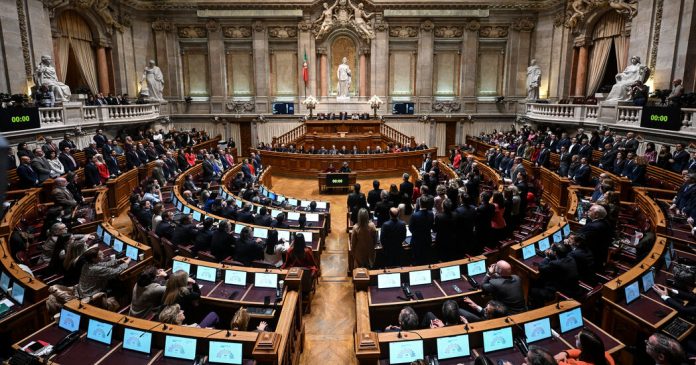
Portugal’s Parliament ousted the center-right government in a vote of no confidence on Tuesday, forcing the third national election in little more than three years.

The year-old government of Luís Montenegro was precarious from the start, controlling far less than a majority in the Parliament, and it has recently been tarnished by a controversy over his business dealings.

President Marcelo Rebelo de Sousa said that the election to form a new government could take place in May.

Mr. Montenegro’s Democratic Alliance, a coalition of conservative parties, finished first in the March 2024 election, but with only 29 percent of the vote, barely ahead of the Socialist Party. The hard-right Chega party, just a few years old, secured 18 percent of the vote to finish third.

With no party able to assemble a majority coalition, Mr. Montenegro formed a minority government.

Last month, Portuguese newspapers reported that the prime minister’s family owned a real estate and consulting company, and that among its clients was a casino operator whose concession contracts depended on government decisions.

Mr. Montenegro said he had transferred his ownership stake to his wife in 2022, and had not profited directly from it since taking power. But opposition parties said the revelations raised concerns about potential serious conflicts of interest and demanded investigations, prompting the vote of confidence that the government lost on Tuesday.

The Socialist Party, which governed from 2015 to 2024, and Chega stand to benefit from the damage to the mainstream conservatives, but both of those leading opposition parties have been accused of ethical failings of their own.

A Chega lawmaker was charged in January with stealing luggage at Lisbon’s airport, and in February a senior party member was accused of paying a minor for sex, a blow to the party’s law-and-order image. Both were expelled from the party.

In January 2022, the Socialist Party won an absolute majority of seats in the Parliament, enabling it to govern without coalition partners. But in November 2023, Prime Minister António Costa’s name was linked to an investigation of suspected ties between government officials and lithium and hydrogen exploration businesses, leading to his resignation and snap elections.

Mr. Costa was not charged, and has since become president of the European Council, the group of European Union heads of government, but a former chief of staff of his does face charges in the case.

Education Department closes offices amid talk of layoffs : NPR

0

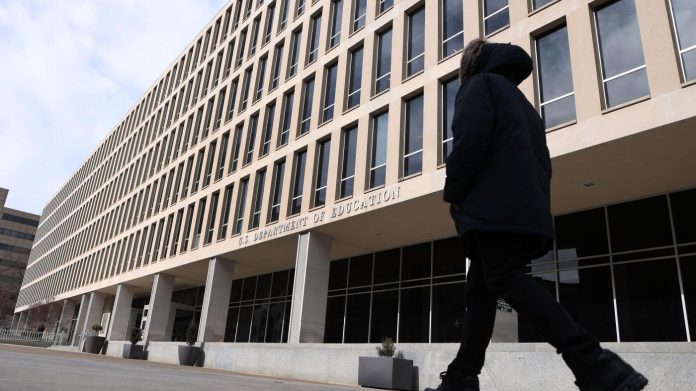
A man walks past the U.S. Department of Education building in Washington, D.C., on Feb. 7.

Gent Shkullaku/Zuma Press Wire via Alamy


hide caption

toggle caption

Gent Shkullaku/Zuma Press Wire via Alamy

Employees of the U.S. Department of Education received an email on Tuesday advising them to vacate all department offices by 6 p.m. Staff members were instructed by the department’s Office of Security, Facilities and Logistics to plan to work from home on Wednesday.

The email included little explanation, saying department offices would be closed “for security reasons” and would reopen Thursday.

Employees of the department shared the email with NPR. We are not naming them because the employees fear retribution. Neither the White House nor the Education Department responded to a request for comment.

The email further unsettled department employees, who have spent the past several weeks anticipating sweeping staff cuts by the Trump administration.

This Thursday, agency heads are expected to turn in their “reorganization” plans to the Office of Management and Budget (OMB) and the Office of Personnel Management (OPM).

A guidance memo from OMB and OPM sent in late February instructed agency heads to achieve “large-scale reductions in force (RIFs)” through attrition and “by eliminating positions that are not required.”

Already, at least 75 department staff members have been placed on paid administrative leave, according to a tally by AFGE Local 252, a union that represents Education Department employees. This count does not include managers and supervisors. Many of those workers on paid leave attended a diversity, equity and inclusion workshop that the department has offered for many years, including during the first Trump administration.

The union also says at least 75 probationary department staffers, who were hired more recently and are legally easier to lay off, have also had their jobs terminated.

The Education Department did not respond to a request for an official tally of staffers currently on leave or who have been laid off since the beginning of the Trump administration.

Russia Begins Assault on Ukrainian-Occupied Town of Sudzha in Kursk Region

0

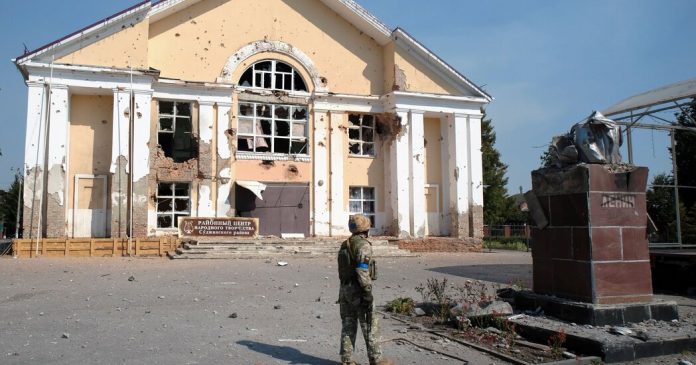
Russian forces have begun an assault on the town of Sudzha, the main population center in the Kursk region that was captured by Ukraine last year, a top Russian commander said on Tuesday. The advance puts Moscow on the verge of ending the first invasion of Russian territory since World War II.

“We have surrounded Sudzha from almost all sides,” Lt. Gen. Apti Alaudinov, a top Russian commander in Kursk, told Russian state television on Tuesday.

Russia’s recent rapid moves around Sudzha have erased a large share of the territorial gains made by Ukrainian forces during their surprise attack into western Russia in August. Kyiv had held on to territory in Kursk despite heavy casualties in the hope of using it as a bargaining chip in peace talks.

Amid Ukraine’s advance, 2,000 to 3,000 Russian civilians had taken refuge in Sudzha by February, according to Russian activists and Ukrainian officials. Their fate is unclear.

By Tuesday afternoon, Ukrainian forces had retreated from the eastern side of town across the Psel River, Ian Matveev, an antiwar Russian military analyst, wrote on his Telegram channel. He cited videos posted on social media of Russian soldiers in the town. Deepstate, a Ukrainian group with ties to the Ukrainian Army that maps the battlefield, made a similar assessment on Tuesday.

Mr. Matveev wrote that it remained unclear whether Ukrainian soldiers would try to mount a defense in the western side of Sudzha or continue retreating toward the Ukrainian border, a few miles west.

On Tuesday morning, Russian state media published a photo of a Russian soldier standing at the eastern entrance of Sudzha, a county seat in Kursk that became the main logistical and administrative hub for Ukraine’s occupation forces. The New York Times verified the location of the photo.

On Tuesday morning, the Russian Defense Ministry claimed that its forces had liberated 12 Kursk villages and 38 square miles in the past 24 hours, and analysts speculated that Ukraine’s presence in Russia could end within days.

The Kursk offensive is part of a wider effort by Russia and Ukraine to improve their positions ahead of peace talks mediated by the Trump administration, the Russian military analyst Valery Shiryaev wrote on his Telegram channel on Monday.

As Moscow’s forces pressed forward in Kursk, Ukraine on Tuesday launched the largest drone attack on Russian cities since the start of the war, a move that analysts interpreted as an attempt by Kyiv to show Washington that it can still take the fight to Russia.

“Everyone is putting on the table the cards that they have,” Mr. Shiryaev wrote.

The rapid crumbling of Ukrainian defenses around Sudzha signals an end to Kyiv’s determined attempts to hold on to captured Russian territory, which at its peak measured more than 500 square miles. To keep the territory, Ukraine had transferred to Kursk some of its best reserves, a strategy that critics said weakened Kyiv’s ability to defend itself against Russian attacks in eastern Ukraine.

Ukrainian officials have repeatedly defended their strategy in Kursk in political terms, saying that territory could be traded for land that Russia has occupied in Ukraine — a possibility that was vanishing rapidly by Tuesday.

Russian soldiers and commanders fighting in Kursk previously said in interviews that they had expected the battle for Sudzha to last months and become one of the bloodiest standoffs of the three-year war, which began with Russia’s full-scale invasion of Ukraine in 2022. It had taken Moscow’s soldiers half a year to grind through Ukrainian defenses and reach the outskirts of the town earlier this year — at the cost of thousands of casualties by most estimates.

Ukraine’s glacial retreat suddenly turned into a rout in the past week.

Russian military analysts said the breakthrough in Kursk began on Saturday with a surprise attack on the Ukrainian rear. Russian officials said 800 fighters walked about 10 miles through a disused gas pipeline measuring 4.5 feet wide to emerge inside Ukrainian-held territory and engage the enemy in Sudzha’s northern suburbs.

Russian propagandists and officials described the operation as a heroic feat, while Ukrainian sources called it a death sentence, with some Russian attackers allegedly suffocating from residual methane in the pipeline. That claim could not be independently verified.

“I respect them for this creativity,” said a Ukrainian military official who spoke on the condition of anonymity because he was not authorized to speak publicly. He added that the Russian attackers had suffered heavy casualties and that only 90 had made it from the pipeline into Sudzha.

While the effectiveness of the pipeline operation is debatable, it coincided with breaches of Ukrainian defenses by Russian troops in several parts of Kursk.

Ukraine’s top military commander, Gen. Oleksandr Syrsky, said on Monday night that Kyiv was dispatching reinforcements to Kursk, but rejected Russian claims that a large contingent of Ukrainian soldiers there was at risk of encirclement.

“A decision was made to reinforce our group with the necessary forces and resources,” he said. He added that Ukrainian forces were retreating to more favorable defensive positions, which some commentators interpreted as a possible prelude to a complete withdrawal from Kursk.

Russian military analysts said a withdrawal was likely to merely shift the battle to Ukrainian territory, pitting Kyiv’s forces in the Sumy region that borders Kursk against tens of thousands Russian soldiers and their North Korean allies.

Sanjana Varghese, Marc Santora and Michael Schwirtz contributed reporting.

Perkins Coie sues Trump over executive order targeting it : NPR

0

President Trump signs executive orders in the Oval Office on March 6, including the order terminating the security clearances of those who work at the law firm Perkins Coie.

Alex Wong/Getty Images


hide caption

toggle caption

Alex Wong/Getty Images

The law firm Perkins Coie is suing the Trump administration, alleging that a recent executive order targeting the firm is unconstitutional and aims to punish it for representing clients and causes that are opposed to the administration.

President Trump signed an executive order last week, “Addressing Risks from Perkins Coie LLP,” that accused the firm of “dishonest and dangerous activity” that sought to overturn laws and elections, and also said it “racially discriminates against its own attorneys and staff” through its diversity, equity and inclusion programs.

In the lawsuit filed Tuesday in federal court in Washington, D.C., attorneys for Perkins Coie call the executive order “an affront to the Constitution and our adversarial system of justice.”

“Its plain purpose is to bully those who advocate points of view that the President perceives as adverse to the views of his Administration, whether those views are presented on behalf of paying or pro bono clients,” the lawsuit says.

Trump’s executive order, it adds, presents a threat to Perkins’ Coie’s ability to represent the interests of its clients and its ability to operate as a business. The suit is asking the court to strike down the order and to prevent it from being implemented.

The Justice Department did not immediately respond to a request for comment.

Trump’s executive order accused Perkins’ Coie of a range of nefarious actions over the years allegedly seeking to undermine democratic elections as well as the integrity of U.S. courts and law enforcement.

The order specifically mentions the firm’s representation of Hillary Clinton’s 2016 campaign, and the role attorneys at Perkins Coie played in the creation of a dossier of unsubstantiated allegations about possible Trump-Russia ties.

The lawsuit pushes back against any allegation of wrongdoing. It notes that Trump filed a lawsuit in 2022 against Perkins Coie, Hillary Clinton and others alleging a conspiracy against Trump. The case was dismissed months later by a federal court.

It also notes that the two attorneys who led the firm’s work for the Clinton campaign no longer work for Perkins Coie. One of lawyers, Michael Sussmann, was charged by a Justice Department special counsel in connection with his work related to the dossier. A jury found him not guilty at trial.

Trump’s order also accuses the law firm of racial discrimination because of it diversity, equity and inclusion policies.

The lawsuit pushes back on that accusation as well. Perkins Coie, it says, is committed to diversity and inclusion, but “does not discriminate against its attorneys or employees on the basis of race or otherwise.”

The firm’s attorneys say Trump’s order is unconstitutional on several grounds, including violations of the First, Fifth and Sixth Amendments.

Meghan Sussex? Even Meghan Markle’s Last Name Inspires Debates.

0

In “Romeo and Juliet,” the star-crossed heroine asks: “What’s in a name? That which we call a rose, by any other name would smell as sweet.”

People far less infatuated have wrestled with this concept for hundreds of years: How much should a name signify, and does it actually affect what or who a person is?

Meghan, Duchess of Sussex, would like a word.

In her new Netflix series, “With Love, Meghan,” the duchess, who is married to Prince Harry, told the actress Mindy Kaling that her last name was Sussex, correcting Ms. Kaling, who had referred to her by a more familiar name: Meghan Markle.

“It’s so funny, too, that you keep saying Meghan Markle,” Meghan said in the second episode of the series, which premiered last week. “You know I’m Sussex now.”

Meghan cited the importance of sharing a last name with her children.

“I didn’t know how meaningful it would be to me but it just means so much to go, ‘This is our family name, our little family name,’” she said.

Ms. Kaling, who initially seemed surprised, replied, “Well, now I know and I love it.”

It’s understandable that Meghan, whose representatives did not immediately respond to a request for comment, insists on usage of what she feels is the correct form of her name. But as with most Meghan-related news, the clip quickly made waves online as people took to social media to criticize her. Some commenters thought she was being pretentious, and others called her out for seemingly having confused her royal house with the family’s surname.

There was similar confusion over how to refer to the duchess after she and Prince Harry announced in 2020 that they would “step back” from their official royal duties and move to the United States.

Two days after the new series premiered, during an appearance on “The View,” Ms. Kaling said that she had “a great time” on the show, despite critics who felt like Meghan had behaved in a passive aggressive way toward her.

There is still some debate, however, on Meghan’s last name.

“She’s either totally oblivious to what her actual name is, she doesn’t understand it or she’s lying,” Hilary Fordwich, a royal family expert, said in a phone interview.

Ms. Fordwich explained that while it isn’t new for a member of the royal family to choose to go by their birth titles (Prince Harry went by Harry Wales during his time in the British army), that doesn’t make it their family name.

“By established protocol, he can use Harry Sussex, which I’ve never heard him use,” she said. “She could choose to use Meghan Sussex, but it’s not their surname. This was the issue in that Netflix clip.”

However, Rachel Bowie, the royals editor for the lifestyle website PureWow, didn’t think what Meghan said was problematic at all, adding that it’s “totally within royal protocol” and she didn’t see it as a formal change.

“Even though Archie and Lili were christened ‘Mountbatten-Windsor,’ Harry and Meghan are borrowing Sussex from their title to make up their last name,” Ms. Bowie, who was previously the co-host of the “Royally Obsessed” podcast, said in a phone interview.

“I never read it as Meghan formally changing her name, but more as this symbolic thing for herself, that she feels this connection, between the four of them, that they move through the world under the name Sussex,” she added.

Opinions have continued to roll in, even from relatives of Harry and Meghan.

Lord Ivar Mountbatten, a cousin of King Charles III and a reality television star on “The Traitors,” claimed she had been wrong about her own surname in an interview he gave to Town & Country, saying the family’s surname is Mountbatten-Windsor.

“Her children are called Archie and Lilibet Mountbatten-Windsor; they’re not called Archie and Lilibet Sussex, because Sussex is a title,” he said.

And Thomas Markle, Meghan’s estranged father, complained to the Daily Mail on Saturday about her decision to no longer use the name Markle, despite the fact that it’s still fairly common for a woman to adopt her husband’s name after getting married.

Understanding exactly how to refer to the royal family requires a look at its evolving history regarding names. According to the official website for the British Royal Family, “Members of the Royal Family can be known both by the name of the Royal house, and by a surname, which are not always the same.” It’s uncommon for core members of the Royal Family to be referred to by a surname at all.

Members of the Royal Family had no surname at all before 1917 and were referred to only by the name of the house or dynasty they belonged to. That year, King George V adopted Windsor as the name of the house and surname of his family.

In 1960, Queen Elizabeth II and Prince Philip, Harry’s grandparents, altered the name to distinguish their direct descendants from the rest of the extended Royal Family, making their new surname Mountbatten-Windsor, which included Philip’s family name.

“For the most part, members of the Royal Family who are entitled to the style and dignity of HRH Prince or Princess do not need a surname, but if at any time any of them do need a surname (such as upon marriage), that surname is Mountbatten-Windsor,” the site reads, using the abbreviation for His or Her Royal Highness.

Meghan now lives outside that structure, meaning those rules do not necessarily apply to her. So her choice to be referred to as Meghan Sussex, for now, will simply be added to the list of things she’s either criticized, or embraced, for.

White House says more pro-Palestinian protesters face possible arrest : NPR

0

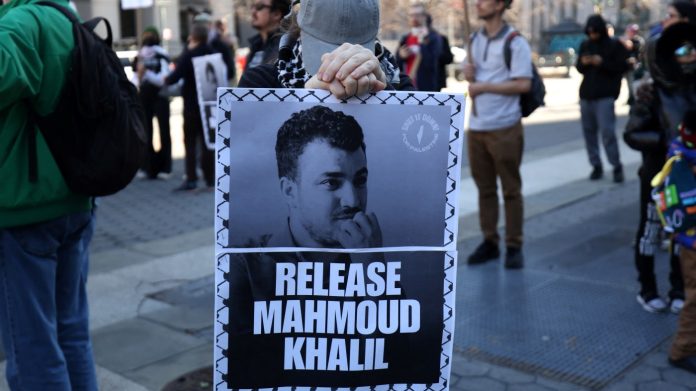
Pro-Palestinian protestors demonstrate in Lower Manhattan on Monday, after immigration officers arrested a leader of the protests at Columbia University against Israel’s war against Hamas in Gaza. Mahmoud Khalil, one of the most prominent faces of the university’s protest movement, was arrested on March 9.

Timothy A. Clary/AFP via Getty Images


hide caption

toggle caption

Timothy A. Clary/AFP via Getty Images

The White House is defending the arrest of pro-Palestinian protest leader and Columbia University graduate student Mahmoud Khalil, and says the Department of Homeland Security plans to arrest more protesters moving forward.

On Tuesday afternoon, White House Press Secretary Karoline Leavitt said the decision to arrest Khalil, a green card holder who is of Palestinian descent, fell in line with President Trump’s recent executive order aimed at cracking down on antisemitism on U.S. campuses. The order allows the administration to revoke visas and deport international students if they’re determined to be “pro-jihadist” or “Hamas sympathizers.”

“Since the President signed that executive order, and since Secretary [Kristi] Noem has taken the oath at DHS, they have been using intelligence to identify individuals on our nation’s colleges and universities, on our college campuses, who have engaged in such behavior and activity, and especially illegal activity,” Leavitt said.

While Leavitt did not offer an estimate of how many additional arrests could be coming, she said she knew that “DHS is actively working on it.” Leavitt noted that Columbia had been given names of other individuals on campus “who have engaged in pro-Hamas activity,” but said the school has refused to help DHS.

Leavitt’s comments echoed remarks by President Trump, who on Monday said his administration “will find, apprehend, and deport these terrorist sympathizers from our country — never to return again.”

White House Press Secretary Karoline Leavitt takes a question from a reporter during the daily press briefing at the White House on Tuesday. Leavitt said immigration officials were working on arrests of additional pro-Palestinian protesters as part of a crackdown on antisemitism on U.S. campuses.

White House Press Secretary Karoline Leavitt takes a question from a reporter during the daily press briefing at the White House on Tuesday. Leavitt said immigration officials were working on arrests of additional pro-Palestinian protesters as part of a crackdown on antisemitism on U.S. campuses.

Andrew Harnik/Getty Images


hide caption

toggle caption

Andrew Harnik/Getty Images

Columbia did not immediately respond to a request for comment following Leavitt’s remarks. In a statement released Sunday, Columbia said there had been reports of ICE officers around campus and that the school “has and will continue to follow the law.”

“Consistent with our longstanding practice and the practice of cities and institutions throughout the country, law enforcement must have a judicial warrant to enter non-public University areas, including University buildings,” the statement said. “Columbia is committed to complying with all legal obligations and supporting our student body and campus community.”

Khalil, who was awaiting his diploma this spring, was one of the pro-Palestinian student protesters who negotiated on behalf of Columbia students last year as they protested Israel’s war with Hamas in Gaza and demanded that the university divest from Israel.

On Saturday, he was arrested in his university-owned apartment building by ICE agents and is now being held in the Jena/LaSalle Detention Facility in Jena, La.

Khalil’s lawyers have since filed a habeas corpus challenge arguing that Khalil’s detention is unlawful. A hearing in his case is expected Wednesday.

Baher Azmy is the legal director at the Center for Constitutional Rights, one of the groups representing Khalil. In an interview with NPR, he characterized Khalil’s arrest as a “chilling use of executive power,” and rejected claims that Khalil engaged in activity that could be deemed antisemitic.

“All he has ever done is advocate for the human rights of Palestinians and try to draw attention to the urgent issue of an ongoing genocide against Palestinians,” he said. “The executive branch does not get to decide what speech they think … is offensive and punishable. That principle couldn’t be more central to American democracy.”

Khalil’s arrest came just a day after the administration canceled $400 million in federal grants to Columbia, saying the school failed to curb antisemitism on its campus.

Columbia was a site of significant political division within its student body in response to the ongoing war between Israel and Hamas. Last fall pro-Palestinian demonstrators staged massive protests on the campus, eventually resulting in arrests and the university moving its classes fully remote for the rest of the spring term.

NPR’s Joel Rose contributed to this report.