Thursday, November 12, 2026
Home Blog Page 145

Remains in Manitoba Landfill Are Identified as Serial Killer’s Victim

0

The police in Manitoba have identified some of the human remains found in the search of a landfill near Winnipeg last month as those of Morgan Beatrice Harris, one of four Indigenous victims of a serial killer, the authorities said on Friday.

Ms. Harris and three other women, who were all from the Winnipeg area, were killed between March and May 2022. Ms. Harris, a member of the Long Plain First Nation, was 39.

Until Friday, only the remains of one woman, Rebecca Contois, 24, had been found and identified.

Jeremy Anthony Michael Skibicki was convicted in the killings late last year and sentenced to life in prison with no chance of parole for 25 years. He had expressed support for the far right on social media, filling his Facebook page with white supremacist, misogynistic and antisemitic comments.

The other two victims were Marcedes Myran, 26, and an unidentified woman whom First Nations elders call Mashkode Bizhiki’ikwe, or Buffalo Woman.

The issue of whether to search the Prairie Green Landfill near Winnipeg for the remains became a political issue during the 2023 provincial elections. The Progressive Conservatives, who were defeated, ran campaign ads and put up billboards opposing a search, citing its cost, the risks to investigators and what the party contended were slim chances of finding anything.

Indigenous groups pointed out the contrast with the case of Robert Pickton, a serial killer in British Columbia, who had preyed on women, mostly Indigenous, in an impoverished Vancouver neighborhood.

In 2002, the Royal Canadian Mounted Police turned his pig farm near Port Coquitlam, British Columbia, into the site of Canada’s largest crime scene investigation. Mr. Pickton was eventually convicted of killing six women, although he boasted of killing dozens more.

The identification of Ms. Harris’s remains was announced in a statement Friday by the New Democratic Party government, which had promised during the campaign to search the landfill. The party’s leader is Wab Kinew, the first Indigenous person to serve as a provincial premier.

“Please keep our families in your hearts tonight and every day going forward as we trust this process,” Ms. Harris’s daughter, Cambria, wrote in a social media post. “It is a very bittersweet moment.”

Ms. Contois’s remains were recovered in 2022. Evidence had suggested that the remains of Ms. Harris and Ms. Myran could be at Prairie Green. The provincial government announced late last month that the police had found “potential human remains in the search material” at the landfill.

In Manitoba’s legislature, the Progressive Conservatives’ interim leader apologized this week for the party’s decision to not launch a search.

“We lost our way in regards to empathy and also lost our way in regards to closure being brought forward to the families of the victims,” the leader, Wayne Ewasko, said.

Cambria Harris, in a social media post, rejected the apology.

“Unless your actions want to prove me otherwise, anything you are saying right now is mere words,” she wrote.

At Least 12 Injured in Toronto Pub Shooting

0

Three men wearing masks and carrying handguns and an assault rifle entered a pub in Toronto late Friday night and “opened fire indiscriminately,” injuring 12 people, the police said.

Six people were taken to the hospital with gunshot wounds, Paul MacIntyre, a police superintendent with the organized crime enforcement unit, said during a news conference on Saturday, and six were otherwise injured, including by broken or flying glass.

But, he added, “by the grace of God,” there were no fatalities. The suspects remained at large, the police said.

It was a typical night at a neighborhood pub, Superintendent MacIntire said. People stood at the bar or sat at booths, socializing with friends over food and drinks, as the bar, Piper Arms, on Progress Avenue in the Scarborough district, celebrated its opening night.

Then at around 10:40 p.m., three men burst into the pub and “just looked at the crowd and opened fire,” said Superintendent MacIntyre, who reviewed surveillance video of the attack.

Patrons began “ducking for cover or they’re falling on the floor because they’ve been struck,” he said. Some of the patrons tried to escape the shooting, fleeing to the basement to hide.

The suspects then got into a vehicle and drove away, the police said.

“When officers arrived on scene, there were some people laying on the floor,” Superintendent MacIntyre said. “There were others sitting in the booth or the chairs, sitting where they’d been shot.”

The shooting left behind an “eerie” crime scene, he said, with food abandoned at tables, scattered shoes and handbags, shattered glass walls and “blood all over the floor.”

Calls to the Piper Arms on Saturday were not immediately picked up.

Superintendent MacIntyre said that the police had “no idea” where the suspects were, and that their motive was still unclear.

Asked if they posed a danger to the general public, he said it was “hard to say ‘no,’” adding: “What we had right now is we had three guys walk into a pub and open fire. So yeah, I’m concerned.”

“This was a brazen and reckless act of violence that’s really shaken our community and the city itself,” he said.

In a social media post early Saturday, Mayor Olivia Chow called it “an early and ongoing investigation,” adding that she was “deeply troubled” by the reports of the shooting.

“My thoughts are with the victims and their families,” she said.

Africa Received Billions in U.S. Aid. Here’s What It Will Lose.

0

The United States is cutting almost all its spending on aid. The biggest loser will be Africa.

For years, sub-Saharan Africa has received more U.S. aid money than any other region — except for 2022 and 2023, when the United States came to Ukraine’s aid after the Russian invasion.

In 2024, $12.7 billion of $41 billion in American foreign assistance went straight to sub-Saharan Africa, and billions more went to global programs — including health and climate initiatives — for which Africa was the main beneficiary.

Practically all of that aid is set to disappear in the wake of President Trump’s decision to dismantle the U.S. Agency for International Development. The cuts are expected to undo decades of efforts to save lives, pull people out of poverty, combat terrorism and promote human rights in Africa, the world’s youngest, fastest-growing continent.

Trump officials have accused the agency of waste and fraud. In his speech to Congress on Tuesday, Mr. Trump railed against aid to Africa, saying the United States was spending millions to promote L.G.B.T.Q. issues “in the African nation of Lesotho, which nobody has ever heard of.”

The Supreme Court on Wednesday ruled that U.S.A.I.D. and the State Department must pay contractors as much as $2 billion for work already completed, but the ruling will have little affect on the wider consequences of eliminating most U.S. foreign assistance.

A New York Times examination of government spending data found that most aid has been spent on humanitarian, health and disaster assistance. In many African countries, it will be harder to accurately track the consequences of these tragedies, since a major program focused on collecting global health data has also been axed.

Surveys show that Americans are divided on whether foreign aid is valuable or effective. ​But W. Gyude Moore, a scholar and former Liberian minister, said the way it is being dismantled is “almost gratuitous in its cruelty.”

Seven of the eight countries most vulnerable to the U.S.A.I.D. cuts are in Africa (the other is Afghanistan). Here is a breakdown of what Africa stands to lose as the United States draws down its aid contributions across the world.

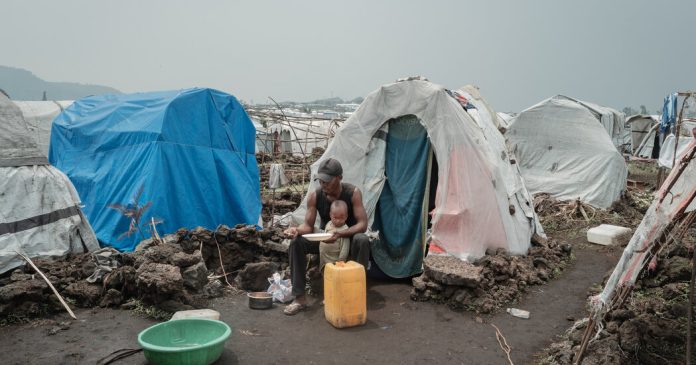
Africa is struggling with several humanitarian crises marked by extreme hunger and violence, from warring factions in Sudan to armed groups ravaging eastern Congo and a wave of extremist violence destabilizing the Sahel.

Last year the United States spent $4.9 billion helping people flee such conflicts or survive natural disasters like floods and hurricanes.

The biggest American humanitarian program in the world in 2024 was in the Democratic Republic of Congo, where the United States spent $910 million on food, water, sanitation and shelter for more than seven million displaced people, according to Bruno Lemarquis, the United Nations’ humanitarian coordinator in the country.

As a donor, the U.S. was “ultra dominant” in Congo, Mr. Lemarquis said, paying 70 percent of the humanitarian costs last year. Now 7.8 million people stand to lose food aid, and 2.3 million children risk facing deadly malnutrition, he said.

Last week, the U.N. said Congo needs $2.54 billion to provide lifesaving assistance to 11 million people in 2025.

The United States was also the biggest donor last year to Sudan, where it funded over 1,000 communal kitchens to feed starving people fleeing a brutal civil war. Those kitchens have now shuttered, and Sudan is facing “mass deaths from famine,” according to the United Nations human rights chief, Volker Turk.

For decades, the United States led efforts to combat famine worldwide, but now famines will likely multiply and become deadlier, according to the International Crisis Group, an independent, nongovernment organization that seeks to prevent and resolve conflict.

In 2003, President George W. Bush created the U.S. President’s Emergency Plan for AIDS Relief, which has since invested over $110 billion to fight H.I.V. and AIDS globally.

The program’s primary focus has been sub-Saharan Africa, where the majority of people living with H.I.V. reside — 25 million of the globe’s 40 million patients.

For many African governments facing limited resources, the program has been a lifeline, filling gaps in national health budgets, paying health care workers and putting millions of H.I.V. patients on antiretroviral drugs.

In countries where the program was active, new H.I.V. cases have been reduced by over a half since 2010, according to the U.N. But experts have warned the cuts could reverse that progress: more than half a million people with H.I.V. will die unnecessarily in South Africa alone, according to one estimate.

In Congo, when fighting recently prevented patients from taking their antiretroviral drugs, 8 percent of them died in one month, Mr. Lemarquis said. Based on that mortality rate, 15,000 people in Congo could die in a month because of the U.S.A.I.D. cuts, he said.

In Ivory Coast, where the program provides half the funding for the national H.I.V. response, approximately 516 health care facilities have been forced to shut this year.

But the U.S. funding on global health extends beyond H.I.V. The U.S. President’s Malaria Initiative, also launched by Mr. Bush, has spent over $9 billion to fight malaria since inception in 2005.

Nigeria and Congo, which together account for over a third of the world’s malaria infections, are both major recipients of U.S. global health funding, and Nigeria relies on it for about 21 percent of its national health budget.

With the funding gone, every year there will be up to 18 million more cases of malaria, 200,000 children paralyzed by polio and one million more children not treated for the most fatal kind of hunger, according to U.S.A.I.D. estimates.

The Trump administration’s decision to dismantle U.S.A.I.D. is in line with a global trend among Western nations of scaling back on foreign assistance programs.

France reduced its aid by a third last year, while Germany — one of the world’s most generous donors — cut aid and development assistance by $5.3 billion in the past three years. The Netherlands has cut aid, too.

But none of these countries’ aid programs were anywhere near the size of what has been provided by the United States.

The United States has spent less than 0.3 percent of its Gross National Income on aid since 1972. But in Africa — by far the poorest continent — that was big money.

With the United States now in retreat, China is poised to take on an even bigger role on a continent where U.S. influence has lately been slipping. Last year, China promised the continent investment, loans and aid worth $50 billion over three years, and pledged to create one million jobs.

China has largely focused on developing infrastructure and accessing African resources. It is unlikely to provide health and humanitarian aid on the scale the West has done in the past, experts say.

“Trump has unleashed something, and development aid as we know it will probably never be the same again,” said Mr. Moore.

Last week, court filings revealed that Secretary of State Marco Rubio had decided to eliminate over 90 percent of U.S.A.I.D. grants and 40 percent of those from the State Department.

Several aid organizations and advocacy groups have sued the Trump administration, trying to stop it from permanently gutting U.S.A.I.D. These cases are now going through the courts.

In the meantime, Mr. Rubio said the government would temporarily continue lifesaving assistance abroad, issuing waivers for humanitarian aid including emergency food in January. But even those programs that received waivers have struggled to carry on, as U.S.A.I.D.’s payments system has been blocked, and thousands of agency workers have been fired or put on leave.

For some of those affected by the cuts, survival appears to depend on whether Elon Musk, the billionaire leading the Department of Government Efficiency, takes notice of their cause.

Last week the chief exec of a company in Georgia that makes pouches of special fortified peanut butter for severely malnourished children told C.N.N. that U.S.A.I.D. had canceled all his company’s contracts.

After a podcast host brought the interview to Mr. Musk’s attention, the contracts were reinstated. But because those who transport the peanut butter are not getting paid, the food may never reach the children who need it.

Each pouch is labeled, “From the American people.”

Gaza War Led to Deaths of More Than 3 Dozen Hostages, Officials Say

0

Itay Svirsky, 40, was a therapist who loved philosophy. Eden Yerushalmi, 24, was training to become a Pilates instructor. Alex Lobanov, 32, a father of three, never met his youngest child.

They are among the 41 hostages killed since being taken captive by Hamas and its allies during their Oct. 7 attack on Israel, according to an analysis by The New York Times of forensic reports and military investigations into their deaths, as well as interviews with more than a dozen Israeli soldiers and officials, a senior regional official and seven relatives of hostages.

Some were killed by Hamas, some by Israeli fire, some their cause of death unknown. The losses — and most acutely, the scale of them — are now at the heart of an anguished debate within Israeli society about whether more people could have been brought back alive if a truce had been reached sooner.

The Israeli prime minister, Benjamin Netanyahu, has long contended that only military force could compel Hamas to free the hostages. Mr. Netanyahu’s opponents argued that the longer the war, the likelier that the hostages would be executed by Hamas or killed in Israeli strikes.

The debate has gained more resonance in recent days as the country faces the prospect of returning to war since the lapse of the recent truce. The Israeli government recently upended the process by proposing a new framework, immediately rejected by Hamas, that called for a seven-week extension during which the group would release half the living hostages and return the remains of half the deceased ones.

Of the 59 hostages still believed held in Gaza, the Israel government has said that only 24 are alive. The fear and uncertainty over their fates has been seared on the national psyche.

In late February, thousands of Israelis lined the streets along the funeral route of Shiri Bibas and her two young sons, Ariel and Kfir, who were kidnapped during the Hamas-led attack on Israel and killed in Gaza. Many held signs that read “sorry,” an apology for not doing enough to save them.

Of the 251 people abducted during the Hamas-led raid that ignited the war in October 2023, more than 130 have been exchanged alive for Palestinian detainees. The Israeli military has retrieved the corpses of more than 40 others, many of whom were taken dead into Gaza during the attack. Hamas has handed over eight bodies as part of the latest cease-fire agreement.

A few hostages were almost certainly killed in the first days of the war, before it was possible to seal a truce, according to two Israeli officials. But many others have died since the brief first cease-fire collapsed in November 2023 and the fighting continued in a war that has killed tens of thousands of Palestinians.

The soldiers and officials all spoke on condition of anonymity to discuss the sensitive findings.

Although Israel and Hamas neared another cease-fire deal in July, the talks collapsed, and it took another five months to strike an agreement, one largely similar to the one discussed in the summer. Mr. Netanyahu’s political rivals and some of the hostages’ relatives have said that the months of extra fighting, while degrading Hamas and its allies in Lebanon and Iran, led to the deaths of more hostages and ultimately failed to defeat Hamas.

“We could have brought home more hostages — earlier and for a smaller price,” Yoav Gallant, Israel’s defense minister until November, said in a televised interview last month.

While Mr. Netanyahu’s office declined to comment, he has long blamed Hamas for the failure to reach a truce. “Only continued military pressure, until total victory, will bring about the release of all of our hostages,” the prime minister said last year.

The Israeli military declined to comment on the specific circumstances in which the hostages were killed but said in a statement that it has carried out operations with numerous precautions taken to protect the captives.

The statement added that it “expresses deep sorrow for every incident in which hostages were killed during their captivity and is doing everything in its power to prevent such occurrences.” The military also said that it regularly updates the families of hostages on the status of their loved ones.

Seven hostages were executed by their captors as Israeli soldiers drew near, and four others died in Israeli airstrikes, according to Israeli officials and the public findings of military investigations.

Three hostages were killed by Israeli soldiers who mistook them for Palestinian militants, the Israeli military said publicly; one was shot dead in crossfire. The circumstances surrounding the deaths of 26 others remain inconclusive.

In some cases, there are conflicting claims, such as in the case of the Bibas family. Hamas said that the three were killed in an Israeli strike, but the Israeli military said they were murdered.

Neither side has offered evidence for their conclusions. After examining the bodies, Dr. Chen Kugel, the director of Israel’s national forensic institute, said in a statement that there is no evidence they were killed in a bombing.
Some relatives of the hostages blame Hamas alone for these deaths. Nira Sharabi’s abducted husband was killed in an Israeli airstrike, according to a military inquiry. She said in an interview that Hamas was ultimately responsible “because they took him and put him there.”

Others believe that the government cared more about fighting Hamas than saving their loved ones.

“The government deceived the public by downplaying the risks the war posed to hostages,” said Merav Svirsky.

Her brother survived an Israeli airstrike only to be executed by his Hamas captor days later, according to three Israeli officials and Ms. Svirsky, who was briefed by military.

“The captor murdered my brother. But the reason he shot him was the military’s campaign,” Ms. Svirsky added.

When Israel hit a subterranean Hamas command center in November 2023, the strike killed two Hamas commanders, including Ahmed al-Ghandour, a Hamas general who Israel said helped organize the October attack.

A month later, Israeli infantry scouring the site of the strike discovered the bodies of three unintended victims: an Israeli kidnapped from a music festival on Oct. 7 and two soldiers captured at a nearby military base.

The military has tried to prevent harm to hostages. Throughout the war, intelligence officers gathered information about each captive and maintained records of their last known location, according to more than 12 officials.

But the military couldn’t pinpoint the whereabouts of many hostages, especially in the first weeks of the war when information was scarce and aerial bombardments were at their most intense, according to three military officials. If there was no clear indication of a hostage’s location, the air force was able to strike, as in the attack on al-Ghandour.

After eventually concluding in March 2024 that the airstrike had killed hostages, the military didn’t inform their relatives for months, according to two defense officials. The military declined to comment on the incident.

In January 2024, the military allowed relatives to see a forensic report, later reviewed by the Times, that suggested the men may have been suffocated by noxious gases.

Maayan Sherman, the mother of one of the victims, soon began a public campaign to press the military to admit that the gases were emitted during an explosion caused by an Israeli missile.

It was not until September that the military acknowledged the men were killed in one of its own airstrikes. It has not disclosed the exact cause of death.

In late August, Israeli commandos advanced through a town in southern Gaza, hoping to find Hamas’s top leader in Gaza, Yahya Sinwar, according to five Israeli defense officials.

As they were hunting for Mr. Sinwar, the Israeli military assessed there were people potentially being held in tunnels in the same neighborhood. The commandos confirmed the presence of at least one hostage on Aug. 27, when they discovered a living captive, Farhan al-Qadi, an Arab Israeli, in a tunnel.

Fearing their presence might endanger other hostages, the forces initially suspended their mission, according to a military investigation.

The area was already previously marked as restricted for operations on military maps, which were reviewed by the Times. Three officials said that by operating in the area, the military risked their lives, since militants had been ordered to kill captives if cornered.

Ultimately the need to hunt Mr. Sinwar took higher priority, according to four defense officials.

After a daylong pause, the commandos pressed ahead on Aug. 28 with their search.

On Aug. 31, instead of Mr. Sinwar, the commandos discovered the bodies of six hostages who had been shot, killed and abandoned in a narrow tunnel.

Hamas issued conflicting messages shortly after the incident — one official blamed Israel for killing them, while another strongly suggested they were killed by Hamas fighters.

The military inquiry later concluded that they had been killed by their guards as the Israeli forces approached.

Mr. Sinwar was ultimately killed in another operation on Oct. 16.

One night in December 2023, a squad of Israeli commandos thought they were on the cusp of rescuing a female hostage. The squad stormed a Hamas hide-out in Gaza, expecting to find an Israeli woman in a separate room from her captors, according to three Israeli officials.

Instead, they found themselves in a gun battle with Hamas militants. The woman was nowhere in sight. Without Israeli intelligence officers realizing, Hamas appeared to have swapped her for a male hostage, Sahar Baruch, according to the officials.

Soon, Mr. Baruch was dead — killed in crossfire that also injured Israeli soldiers, the officials said. It is unclear whether Mr. Baruch was killed by friendly fire or his captors; Hamas later released a video of his body.

Mr. Baruch’s remains are still in Gaza.

Johnatan Reiss contributed reporting

Week in politics: Trump's new stance on DOGE, California Gov. Newsom eyes new base

0

President Trump says his cabinet secretaries will carry out cuts to the government workforce, under the supervision of Elon Musk.

Days of Clashes in Syria Kill More Than 300 Civilians, War Monitor Reports

0

Three days of clashes between forces from Syria’s new government and fighters loyal to the ousted dictator Bashar al-Assad have killed more than 300 civilians and scores of combatants from both sides, a war monitoring group said on Saturday.

The British-based Syrian Observatory for Human Rights, which has monitored the Syrian conflict since 2011, said that more than 400 people in total have been killed across two Syrian coastal provinces. Fighters affiliated with the government killed most of the civilians, according to the Observatory. The allegations could not be independently verified.

Information Ministry officials, responding to the allegations of killing civilians, said that they rejected “undocumented allegations accusing government forces of committing violations.” But they also said the government was committed to conducting comprehensive investigations and would hold to account those found to have harmed civilians.

“The Syrian government confirms that its forces operate according to strict standards that respect international humanitarian law and are keen to protect civilians during their operations,” a ministry statement said.

The unrest has been the bloodiest outbreak of violence since the Assad regime was ousted in early December by rebels who became the country’s new leaders. It presents a major test of the new government’s authority and has raised the specter of a larger sectarian conflict in Syria, where tensions were already high as a result of the civil war.

The clashes began on Thursday after Assad loyalists killed 16 government security personnel in Latakia province, in the deadliest attack yet on Syria’s new security forces, according to government officials and the Observatory.

Violence quickly spread across Latakia and Tartus provinces, longtime strongholds of Mr. al-Assad along the Mediterranean coast and home to most of the country’s minority Alawite population, to which the ousted president belongs. Armed remnants of the ousted regime are believed to be scattered across the two provinces and have presented a challenge to the country’s new leaders as they try to exert their authority and unite a fractured country after more than 13 years of civil war.

The government responded to the initial attack on Thursday by deploying thousands of security forces and soldiers from other parts of the country to the restive coast. Those forces sought to reestablish control over a few towns and villages that the armed gunmen had effectively seized overnight between Thursday and Friday.

The government has sought to present the clashes as a legitimate authority fighting the remnants of a brutal regime.

Government forces deployed helicopters outfitted with machine guns on Thursday around the mountainside of the coastal region, according to a government official on the coast, who asked not to be named because he was not authorized to speak to reporters. The helicopters were deployed to areas where armed Assad loyalists were stationed, the official added.

A video verified by The New York Times and filmed along the coast west of Latakia airport appears to show government fighters dropping crudely made bombs from the rear of a helicopter. A spokesman for the government in Latakia did not respond to a request for comment about the video.

Christina Goldbaum and Muhammad Haj Kadour contributed reporting.

States sue Trump administration over firings of federal employees : NPR

0

The Maryland State Capitol building is seen in Annapolis. Maryland is among the states suing the Trump administration for the mass firing of federal employees.

Jim Watson/AFP via Getty Images


hide caption

toggle caption

Jim Watson/AFP via Getty Images

The attorneys general of Washington D.C., Maryland, and 18 other states are suing the Trump administration over the mass firing of federal employees.

Their lawsuit joins several other legal challenges seeking relief for tens of thousands of fired workers.

The Democratic attorneys general argue that federal agencies falsely told probationary employees — those relatively new on the job — through termination letters that they were being fired because of their performance.

In fact, the states argue that more than 20 agencies, who are named as defendants in the lawsuit, were trying to shrink their headcount through a process called a reduction in force, but failed to follow proper procedures for doing so.

Federal law requires agencies to notify states generally 60 days in advance when laying off 50 or more people, so that states can jump into action.

“Economic dislocation of workers can easily create a cascade of instability throughout a regional economy,” the attorneys general wrote in their complaint.

Under federal law, they explain, states are required to have rapid response teams to provide workers with support, including job transition services. The goal of these teams is to reduce fired employees’ reliance on public assistance.

Advance notice of mass layoffs helps states quickly identify who will need help before they are fired, the complaint contends.

The attorneys general have asked a federal judge in Maryland for a temporary restraining order, halting the firings of probationary employees and reinstating those who have been terminated. A hearing is scheduled for March 12.

North Korea Says It’s Building a Nuclear-Powered Submarine

0

North Korea said on Saturday that it was building its first nuclear-powered submarine to enhance its nuclear weapons abilities, and the state news media showed the nation’s leader, Kim Jong-un, inspecting part of what appeared to be a new submarine larger than any owned by the country.

The announcement, made in the state news media, came as United States and South Korean officials feared that the North may be receiving technological help from Russia to help modernize its military in return for sending troops and conventional weapons to help in its war against Ukraine.

Mr. Kim “learned about the building of a nuclear-powered strategic guided missile submarine,” the North’s official Korean Central News Agency said in a report on Saturday about his visit to an unidentified naval shipyard. The agency carried photographs showing what appeared to be the hull of a submarine under construction.

It was the first time that North Korea claimed that a nuclear-powered submarine was under construction and claimed to show a photograph of it.

North Korea has dozens of old Soviet-era submarines, all diesel-powered, which would have to resurface frequently to recharge their batteries during a long-distance trip like crossing the Pacific. A nuclear-powered submarine, which can cover a long distance without resurfacing, would enhance North Korea’s ability to approach a faraway enemy like the United States without being detected, and to strike it with nuclear missiles.

The state news media on Saturday quoted Mr. Kim as saying that his country’s naval might would be “fully displayed in any necessary waters without limitation.”

North Korea has vowed to try to build a nuclear-powered submarine since Mr. Kim designated it as one of his top military priorities in his ruling Workers’ Party meeting in 2021.

Outside analysts have doubted that North Korea has technical and engineering capabilities to build a nuclear submarine, including a small nuclear reactor that would propel the vessel. But Mr. Kim’s submarine project may get a boost if Russia helps North Korea clear technological hurdles in return for the thousands of troops and large shipments of artillery shells and missiles that it sent to aid Russia’s war against Ukraine, said Yang Moo-jin, the president of the University of North Korean Studies in Seoul.

North Korea’s old submarines can be used to carry spies to South Korea or launch torpedoes. The United States and its allies have closely watched the North’s attempts to develop a missile-launching sub since the country began testing missiles designed for submarines about a decade ago.

In 2023, North Korea announce​d the completion of a “tactical nuclear attack submarine.” It was a remodeled Soviet-era diesel-powered vessel that it said was capable of launching nuclear missiles. But South Korea’s military expressed skepticism about the vessel’s abnormal design, saying that it did not look capable of normal operation. There has been no evidence that North Korea has test-launched a missile from the vessel.

The newly unveiled submarine appeared to be larger than the 2023 model, said Hong Min, an expert on the North Korean military at the Korea Institute for National Unification in Seoul.

Although little is known about the new vessel, the name “nuclear-powered strategic guided missile submarine” suggests that it was designed to launch both nuclear ballistic and cruise missiles that the North has been developing, Mr. Hong said.

USDA releases frozen funds for dairy farmers but uncertainy remains : NPR

0

Tammy Fritsch, a dairy farmer from Freedom, Wisc., stands next to her cheese vat. She has been waiting on thousands of dollars in promised federal funds. On Friday, the USDA released those funds to farmers like Fritsch.

Chuck Quirmbach/WUWM


hide caption

toggle caption

Chuck Quirmbach/WUWM

President Trump’s narrow victory in Wisconsin last November was partly due to his success in rural communities, where agriculture remains an economic engine. But agricultural groups say many farmers in the so-called Dairy State — and elsewhere — now face uncertainty, due to federal spending freezes and cuts made by the Trump Administration.

That includes farmers like Tammy Fritch. Fritsch owns what she and her daughter call Two Guernsey Girls Creamery. It’s licensed as a micro-dairy, only 13 cows, and just a few employees.

On a recent morning, Fritsch stood over a stainless steel vat about the size of a large bathtub and removed a plastic sheet covering blocks of white cheddar cheese. She took a knife and started a process called flipping the cheese. At the end, it’ll be a cubed, often squeaky-to-eat snack called curds.

“We are making cheese curds today. So, I have approximately 72 pounds of cheese in there,” Fritsch later explained.

Fritsch says using the milk from her Guernsey cows — which is easier for some people to digest — she now wants to make and sell ice cream. Last year, she won just under $100,000 through a Dairy Business Innovation grant.

DBI, as it’s known, was created under the Farm Bill Trump signed in 2018 during his first term.

A bag of cheese curds from Two Guernsey Girls Creamery in Freedom, Wisc. Owner Tammy Fritsch hopes to start making ice cream with funds from a Dairy Business Innovation grant from the USDA.

Chuck Quirmbach/WUWM


hide caption

toggle caption

Chuck Quirmbach/WUWM

Like the grant requires, Fritsch invested in her farm first. She bought equipment, and got a bank loan to afford it. She started hiring a couple employees. Then, in late February, Fritsch got the word that the U.S. Department of Agriculture halted the funding that she and other innovation grant winners are counting on to be paid back the money they spent on their farms.

Her voice breaking slightly, Fritsch said, “Plain and simple, I mean, these are not tax dollars that are wasted. We are growing to help our community, where we’re producing a great product here.”

Friday, the USDA reversed course and okayed the DBI reimbursements. As much as $28.6 million will be reimbursed to more than 400 dairy processors and farmers across the nation.

Rep. Derrick Van Orden, a Republican, praised Agriculture Secretary Brooke Rollins for releasing the funds.

“Our dairy farmers and processors work incredibly hard, and I commend Secretary Rollins for her swift action to ensure its continuation,” he said in a statement.

Rebekah Sweeney of the Wisconsin Cheesemakers Association explained that it’s been a challenging time.

“The last two weeks have been filled with tears and fear,” Sweeney said. “The amount of stress that some of these farmers and processors have been under knowing that funding was paused was significant.”

Across the state, farmer Travis Forgues is scheduled to get a $92,000 DBI grant.

He recently added a large freezer to temporarily store some of the cheese he makes from the milk of 300 sheep, before the cheese goes to retailers.

Forgues used his family’s money and line of credit to buy the freezer. While he should be able to pay off that debt soon, his farm is waiting on $55,000 in another federal grant for renewable energy. That money is still frozen.

“We have the contracts signed. Did I think perhaps in the future these grants wouldn’t be available? Absolutely, because that’s what happens with different leaders in place,” Forgues said.

“But did I, in my wildest dreams think they wouldn’t honor their word as our federal government? Absolutely not,” he added.

Lightening Up – The New York Times

0

Daylight is adding up, about three minutes more each day as March progresses, give or take. Tomorrow, we bank a full hour at once: Change your clocks, change your smoke detector batteries, start planning menus around tender lettuces. Spring hasn’t arrived yet, but her plane’s definitely left the ground.

I call this time of year The Great Thaw, or sometimes The Great Unclenching. Despite winter’s cozy associations with holiday gathering, with mugs of cocoa enjoyed before the blazing hearth, it’s always felt to me like a time of contraction, of hoarding. We button and zip ourselves up into ourselves and move quickly past one another. We sleep more and default to indoors. The days are always ending again.

When the light returns, something unclenches in me, and I like to imagine that it does in all of us, although I know better than to impute my own longing for the warmer months to the bewildering characters who prefer the cold. “Daylight Saving Time Begins.” That entry on the calendar always reads like a triumphant return, a welcome back. We tried this “standard time” thing all winter, tried being measured and responsible with how we spent our time, and now, exhale, finally, that’s over. Now, we will loosen up. Now we will stop being so withholding and rigid with our time, with our presence, with our imaginations. Now a perfectly good Saturday plan is just to meet up outside and see what develops. The season of scarcity is coming to a close and now we will spend ourselves with abandon.

Whether or not you feel a sort of inner unleashing happening this time of year, opening up is a seductive prospect, isn’t it? If there’s a tension between the seasons — fall and winter’s contraction vs. spring and summer’s expansion — then there’s a similar tension in us. Being timid vs. living out loud. Rushing in from the cold vs. lingering. Playing it safe vs. risking it. Keeping ourselves small and contained vs. letting loose our full splendor. Sometimes we need inducements to be our most expansive selves, an invitation to open up.

Let tomorrow’s onset of longer, brighter days serve as that invitation. Why not? We change the clocks by an hour, making this deliberate shift from dark to light in our external worlds. How can we do this internally as well? How will we meet this unofficial beginning of the lighter, looser half of the year? How will we thaw out, unclench, let go?

The Trump Administration

🎬 “Mickey 17” (out now): The latest effort from the Oscar-winning “Parasite” director Bong Joon Ho features Robert Pattinson as Mickey, a hapless man working on a spaceship as its “Expendable” — an experimental guinea pig who is repeatedly killed and reborn in the name of expedition research. Our critic Manohla Dargis calls it “a movie that teeters close to apocalyptic despair,” but also one that “lifts you to the skies.”

To match the imminent sunshine with bright, vegetable-full fare, Hetty Lui McKinnon’s sweet and sour cauliflower is an excellent choice. A vegetarian riff on sweet and sour dishes at Chinese American restaurants, cauliflower stands in for the usual chicken or pork. The secret to the brick red sauce is ketchup, which provides some necessary sweetness tempered by vinegar, soy sauce and garlic. It will bring the sunshine into your kitchen, too.

Click here to read this weekend’s issue of T, The Times’s style magazine.

Manchester United vs. Arsenal, Premier League soccer: Arsenal holds the No. 2 spot in the Premier League standings, but the club had struggled recently: Before this week, it had failed to score a goal in three of its previous four matches. Thankfully, for fans, it got back on track Tuesday with a 7-1 rout of the Dutch club PSV. Manchester United is not having a great season, though anything can happen in a rivalry match; last time these two played, in January, United won in a penalty shootout. Sunday at 12:30 p.m. Eastern on NBC