Thursday, November 12, 2026
Home Blog Page 146

Trump freeze leaves new refugees in U.S. scrambling to adjust : NPR

0

Jefferson, a political refugee from Nicaragua, sits in the one-bedroom apartment he shares with another refugee in Riverdale, Md., on Feb. 27. Soon after arriving in the U.S. his resettlement case manager was laid off because of a federal funding freeze.

Dee Dwyer for NPR


hide caption

toggle caption

Dee Dwyer for NPR

When 21-year-old Jefferson arrived in the U.S. in December, a case manager from a resettlement agency met him at the airport and took him straight to an apartment. Within a month, the manager also helped him land a job operating a machine that packs lettuce.

Jefferson’s new life in America was taking shape. Then suddenly, in late January, his case manager disappeared.

“I was left alone, with no one to provide guidance in this new country,” he says, speaking in Spanish because he doesn’t yet know much English.

It turned out the case manager had been let go — and their work phone shut down — after the Trump administration froze refugee resettlement.

Jefferson is a political refugee from Nicaragua. NPR has agreed not to use his last name because he is afraid of retribution against family still there. He says he’s grateful to have been allowed into the U.S., a process that often takes years and includes intense vetting. But he says losing such crucial support in adapting to his new country was a harsh blow.

“I felt abandoned,” he says.

Refugee aid groups say their “existence … is at risk”

Thousands of recently arrived refugees like Jefferson are stuck in limbo across the U.S.

On his first day in office, President Trump issued an executive order suspending the U.S. Refugee Admissions Program, citing concerns over the country’s ability to absorb large numbers of refugees. That stranded about 10,000 people who were barred from boarding flights to the U.S., including Afghans who had risked their lives working for the American government or military.

Jefferson, a refugee residing in the Parkview Apartments community in Riverdale, Md.

The federal funding freeze included money for Jefferson’s rent for the next month. His roommate paid it instead, leaving himself with hardly anything else to live on.

Dee Dwyer for NPR


hide caption

toggle caption

Dee Dwyer for NPR

A few days later, the administration issued a stop work order that ended services for refugees already in the U.S. That, along with the funding freeze, has hobbled resettlement agencies nationwide, forcing them to lay off hundreds of staff and even shut down offices.

“The further existence of our organization is at risk at this point, because we are unable to pay all of our bills,” says Kristyn Peck, CEO of Lutheran Social Services of the National Capital Area.

She says she’s had to cut a third of the staff and is owed more than $2 million in federal money for work already done. “We just haven’t been reimbursed for services since before December,” she says.

Refugee resettlement agencies have filed multiple lawsuits challenging the Trump administration actions. A U.S. Supreme Court decision on Wednesday could lead to reimbursement for some services already rendered. But the State Department also has terminated all contracts with resettlement groups. For now, those groups are scrambling to help recently arrived refugees most in need.

A “retraumatizing” experience when the promise of help is broken

Jefferson was placed in a sparsely furnished, one-bedroom apartment in Riverdale, Md., with another refugee who arrived last August. After losing his case manager, he says he struggled on his own for more than a month.

He had acute pain from a toothache but had no idea how to find a dentist. His biggest fear, though, was how he was going to pay the rent. He’d only just started his job. Typically, the federal government helps cover housing for the first three months after someone arrives.

A sign that reads "we welcome refugees" hung on the gates of the Parkview Apartments located in Riverdale, Md.

Jefferson’s apartment complex in Riverdale, Md. Resettlement agencies hit by the funding freeze are prioritizing rental payments for those facing eviction, and they’re pleading for patience from landlords.

Dee Dwyer for NPR


hide caption

toggle caption

Dee Dwyer for NPR

His roommate panicked, worrying they’d be evicted — and decided he had to pay the full rent for both of them, despite how tough it would be.

“Basically, I was left with no money,” says Raemifael Abraham. “I barely had enough to pay the bus fare to my job.”

They cut back on food and made it work. But then Abraham lost his job packing air-conditioner filters, in what he was told was a seasonal downsizing.

The federal government’s abandonment of newly arrived refugees has been “retraumatizing,” says Amy Hoang Wrona, development director with the nonprofit Homes Not Borders. She says some new arrivals were placed in hotels and just left there.

“Many, many, many have lived in refugee camps for months, if not years, with the promise of help. And then they come here and then sit in a hotel for one to two months with no communication,” she says.

Wrona’s group readies apartments for refugees, but it has stepped up fundraising so it can do more for them. “We are filling in the gaps,” she says. That includes paying rent for more than two dozen refugee families, and checking in on those who lost case managers.

“We would literally knock on people’s doors asking them, like, ‘Have you had your kids enrolled in school yet?’ ” says Laura Thompson Osuri, executive director of Homes Not Borders. “They’d been here for a month, and it hadn’t happened.”

The organization has also hired some case managers who got laid off by the funding freeze. One of them is Federico Rostran, who’s now working again with Jefferson and his roommate. “It’s hard for them to identify what do they need to do, where do they need to go,” he says.

Federico Rostran poses for a portrait in front of in the Parkview Apartments community in Riverdale, Md.

Refugee case manager Federico Rostran was laid off after the federal freeze on resettlement but has been hired back, thanks to stepped up fundraising. He says guidance for newly arrived refugees is important to set them up for success in the long term.

Dee Dwyer for NPR


hide caption

toggle caption

Dee Dwyer for NPR

Rostran helps refugees apply for a social security card, sign up for health insurance and get a work permit. His ultimate aim is to set them up for success.

“Teach people how to do things on their own, and get confident about it, and not be intimidated,” he says.

A political divide over refugee levels has widened in the past decade

A clash over refugees also played out in Trump’s first term, when he sought to give state and local authorities the power to reject refugees from being resettled in their communities. His administration set a record low cap for new refugees, at 15,000. In 2018, the Pew Research Center found a growing number of Republicans said the U.S. did not have an obligation to welcome refugees.

When President Joe Biden came into power, he reversed course. Last year, his administration approved a cap of 125,000 refugees, the highest in three decades.

The Trump administration frames its most recent pause as part of its broader crackdown on immigration. The president’s executive order says the U.S. lacks the ability to absorb large numbers of refugees “in a manner that does not compromise the availability of resources for Americans, that protects their safety and security, and that ensures the appropriate assimilation of refugees.”

By contrast, advocates note the government’s own assessment finds that refugees are a net gain for the nation’s economy. Peck, with the local chapter of Lutheran Social Services, says the ability to “provide a beacon of hope and safety and freedom to people who are fleeing persecution” is a tenet of U.S. democracy.

Normally, Peck’s staff serves refugees for years, offering workforce development, mental health support and legal guidance. But with its staff and budget dramatically shrunk, she says they are prioritizing the most vulnerable among recent arrivals. The group is tracking who has gotten eviction notices, paying what it can, and pleading for patience from landlords.

And if federal funding does not come back?

An exterior view of Parkview Apartments located in Riverdale, Md.

Across the country, the funding freeze has forced refugee aid groups to lay off hundreds of workers and shut down some offices.

Dee Dwyer for NPR


hide caption

toggle caption

Dee Dwyer for NPR

“I think people will be at risk for homelessness,” she says. “They’ll be at risk for food insecurity, for joblessness.”

Meanwhile, Jefferson, the refugee from Nicaragua, is studying English at a community college and working six days a week. Homes Not Borders was able to pay his last month’s rent.

The future still feels uncertain, but he hopes his case manager can stay on the job. After one year here, Jefferson will be required to apply for a green card — to live and work permanently in the U.S. — and he’d really like expert legal guidance with that.

Russian Strikes Kill 20 in Eastern Ukraine

0

Russian strikes killed 20 people in the war-torn eastern Ukrainian region of Donetsk on Friday night, a sign that Moscow is stepping up bombardments of cities critical for Ukrainian logistics and support and taking advantage of Washington’s decision to pause military aid and intelligence sharing with Kyiv.

President Volodymyr Zelensky of Ukraine said on Facebook on Saturday that Russian forces had fired two ballistic missiles into the small city of Dobropillia, and that after emergency services arrived, another Russian attack had rained down on the rescuers. The strikes killed 11 people in the city, according to Vadym Filashkin, the head of the Donetsk regional military administration.

The attack came a week after the disastrous meeting in the White House with Mr. Zelensky and President Trump and Vice President JD Vance. A deal that was supposed to have been signed during Mr. Zelensky’s visit — and that would have promised some future U.S. involvement in Ukraine — fell apart. Since then, the United States has suspended military aid and intelligence sharing with Ukraine, saying that Mr. Zelensky has not demonstrated that Ukraine is ready for peace.

On Friday, Mr. Trump was asked by reporters in the Oval Office whether President Vladimir V. Putin of Russia was capitalizing on the void left by the United States’ dropping its aid to Ukraine.

“I actually think he’s doing what anyone else would do,” Mr. Trump said.

At the same time, Mr. Trump complained that Russia was “bombing the hell out of Ukraine,” and threatened sanctions against Russia unless it stopped attacking.

Still, he described his dealings with Mr. Putin in positive terms. Mr. Trump also described Ukraine as being more challenging to deal with as he pressed for a peace deal.

On Friday, the Washington-based Institute for the Study of War posted a chart showing that Russia had intensified drone and missile strikes on Ukraine after Mr. Trump’s inauguration in January.

“Russia, not Ukraine, is the obstacle to peace,” George Barros, an analyst at the institute who focuses on Russia and Ukraine, wrote on X. He added: “Ukraine has offered many concessions to start peace processes. Russia has offered zero.”

On Friday night, Russia launched three missiles — one of which Ukraine’s air defenses intercepted — and 145 attack drones at Ukraine, officials said. Air defense forces shot down 79 drones; another 54 were lost from radar tracking without causing any damage.

In Dobropillia, the shelling damaged eight five-story buildings, an administrative building and 30 cars, and set several of the buildings on fire, Ukraine’s state emergency service said. Another 30 people were wounded, including five children.

Photographs posted by the emergency service showed what appeared to be a five-story apartment building on fire. Officials said that Russian forces had attacked again while firefighters were struggling to extinguish the blaze.

“Yesterday’s strike on Dobropillia was one of the cruelest in recent times,” Mr. Filashkin said on the Telegram messaging app.

Another nine people were killed in shelling elsewhere in the part of Donetsk still controlled by Ukrainian forces.

As of Tuesday, about 288,000 civilians remained in the Ukrainian-controlled areas of the Donetsk, the regional state administration said. About 31,000 live in communities classified as active combat zones.

Trump and Musk’s DOGE are now coming for federal buildings : NPR

0

The General Services Administration, which manages federal real estate, is identifying property to divest, and the agency has abruptly fired more than 1,000 workers and is targeting an overall 63% reduction in headcount at its Public Building Service division.

Al Drago/Bloomberg via Getty Images


hide caption

toggle caption

Al Drago/Bloomberg via Getty Images

Elon Musk’s Department of Government Efficiency is on a mission to slash the federal government — and it eagerly touts its moves on social media.

A recent entry cited more than $100 million in savings from terminating hundreds of federal building leases. Yet it promised federal workers there would still be “plenty of available office space.”

Some of those cancellations could affect public-facing services, like an Internal Revenue Service taxpayer assistance center in Parkersburg, W. Va.; the Bureau of Indian Affairs’ Osage Agency in Pawhuska, Okla.; a Social Security office in Minot, N.D.; and a Farm Service Agency office in the heart of Hurricane Helene-struck western North Carolina.

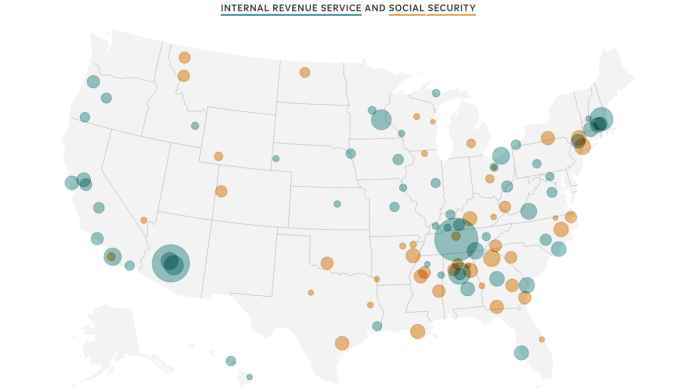
These are just some of more than 1,000 properties leased or owned by the federal government that the Trump administration has marked for potential downsizing as it presses forward with plans to dramatically shrink its physical footprint in communities across the country.

The government is preparing to shed up to a quarter of its 360 million square feet of real estate in the coming months, an NPR analysis of DOGE’s “receipts” page of lease terminations and lists of possible cuts circulating at federal agencies found.

At the same time the General Services Administration, which manages federal real estate, is identifying property to divest, the agency has abruptly fired more than 1,000 workers and is targeting an overall 63% reduction in headcount at its Public Building Service division, according to multiple current and former GSA employees. They are among more than a dozen people who spoke to NPR for this story and requested anonymity because they fear speaking publicly would make them targets for reprisal from the Trump administration in their jobs and future employment prospects.

Some current and former GSA employees told NPR they think the firings are illegal and that the proposed cutbacks are indiscriminate.

“There’s just been no time,” said one GSA manager who was fired earlier this week. They said it appeared that the agency is just “ cutting buildings and people without even, like, analyzing anything.”

“All [job termination] notifications were conducted in accordance with [federal] policies and guidelines,” a GSA spokesperson said in a statement to NPR. The spokesperson added that the potential property sales “will result in increased service quality to our customers and savings to the American taxpayer.”

Like other aspects of the DOGE-inspired efforts to slash the size and scope of the federal government in recent weeks, the process of cutting leases and identifying buildings that could be sold has been marked by confusion, errors and an ever-changing list of potential targets.

This week, the GSA even posted — then deleted — a list of “non-core” government buildings that could be sold, including federal courthouses, the headquarters of the Justice Department and the American Red Cross, and even the home of the GSA itself.

It’s not clear what the lease terminations and proposed building sales would mean for the services and activities carried out by affected agencies, such as Social Security and IRS offices where members of the public come for help.

GSA said it is exploring options “including public-private partnerships, ground leases, sale leasebacks, and interagency co-working agreements” in order to “optimize” the government’s real estate portfolio.

That could mean that some agencies may not have to relocate — but the lack of information and clarity is leaving federal workers worried.

Shifting lists of properties targeted for cuts

According to DOGE’s “wall of receipts,” as of March 6 the GSA has moved to terminate roughly 750 leases covering around 10 million square feet — less than 5% of the government’s total footprint.

These cuts include 61 IRS spaces, 47 with the Social Security Administration, several U.S. attorneys’ offices and a nuclear waste storage facility in New Mexico.

A separate, overlapping list of Interior Department leases slated for termination — shared by a current employee at the agency — includes 25 Bureau of Indian Affairs offices and a Louisiana office housing two Interior bureaus that handle offshore energy projects.

The administration is also considering terminating leases for properties housing vital weather forecasting services and fisheries operations at the National Oceanic and Atmospheric Administration, according to two former NOAA officials and a current NOAA contractor.

Like many other DOGE claims, the list of lease terminations on its website uses opaque methodology to generate apparently inflated savings numbers. By matching DOGE’s data with federal lease inventory, the purported terminations appear to include some leases that the government does not appear to have the right to terminate yet, and some that were already set to end soon.

One that was already set to end: Atlanta office space provided to the late former President Jimmy Carter, who died at the end of last year, before President Trump took office and DOGE came into existence. The list claims more than half a million dollars in savings from that.

A spokesperson for DOGE did not respond to questions about how its lease savings are calculated or verified.

Beyond the lease terminations, a proposal to sell off federal buildings sent shockwaves through the government on Tuesday when GSA released a list of 443 properties it said it was looking to divest because they are “not core to government operations.”

While a list of “core” properties shared with NPR by a GSA employee primarily included facilities on the U.S. southern border or for law enforcement work, the “non-core” list included federal courthouses, historic buildings, sprawling facilities in Indianapolis, Chicago, Los Angeles and Atlanta, and the Washington, D.C., headquarters of agencies including the Justice, Agriculture and Labor Departments, and GSA itself.

Later on Tuesday, GSA pared the list down to 320 buildings — deleting many of the best-known buildings and D.C. properties — before removing it from the agency’s website entirely without explanation.

Have information you want to share about DOGE or other restructuring changes across the federal government? Reach out to these authors through encrypted communications on Signal. Stephen Fowler is at stphnfwlr.25, Jenna McLaughlin is at JennaMcLaughlin.54, Chris Arnold is at ChrisArnold.07, and Shannon Bond is at shannonbond.01.

GSA said in its statement to NPR: “Since publishing the initial list on March 4, 2025, we have received an overwhelming amount of interest. We anticipate the list will be republished in the near future after we evaluate this initial input and determine how we can make it easier for stakeholders to understand the nuances of the assets listed.”

It added: “To be clear, just because an asset is on the list doesn’t mean it’s immediately for sale. However, we will consider compelling offers (in accordance with applicable laws and regulations) and do what’s best for the needs of the federal government and taxpayer.”

Public-serving IRS, Social Security and Indian Affairs offices could face disruption

While the lists of planned sales and lease terminations include high-profile properties in Washington, D.C., and underutilized office space, they also span facilities that provide crucial public services, including in rural and far-flung communities.

DOGE’s lease termination list includes locations that house IRS Taxpayer Assistance Centers, which offer in-person help to people with their taxes, as well as Social Security Administration offices providing public assistance. Additional Social Security offices appeared on GSA’s list of “non-core” properties marked for potential sale.

“If they close field offices then it will be harder for beneficiaries to access services,” said one senior SSA official. “If people can’t get to the office because the closest one is too far away or supports so many people that you can’t make an appointment, then you have been denied services.”

SSA said in a press release this week that “space savings” were part of $800 million the agency has flagged for cost cuts this year. “Social Security remains committed to identifying more ways to save taxpayers money and implementing more solutions that free up frontline employees to help more customers,” it said.

The Bureau of Indian Affairs (BIA) offices targeted for lease termination include the Pawnee Agency, which serves around 7,200 members of four tribes in Oklahoma. Its work includes child welfare and real estate services. Also on the list is Oklahoma’s Osage Agency which manages mineral, oil and gas leases on behalf of the Osage Nation.

“Indian Affairs provides direct, essential services to tribes and tribal members. These agencies are essential to providing efficient services,” a BIA employee told NPR. “None of these agencies are close to other agencies. If they are closed, BIA would have to pay to relocate all of the employees.”

The Department of the Interior is pushing back on attempted closures, particularly because most of its employees perform congressionally mandated work on the environment and conservation, according to two Interior employees. Were those facilities to be closed, they would need alternative space to complete that work and meet their legal requirements.

In a statement to NPR, an Interior spokesperson said the department and its bureaus “are committed to upholding federal responsibilities to communities and tribes. We are working with GSA to ensure facilities or alternative options will be available for the continued delivery of Interior services as we embrace new opportunities for optimization and innovation in workforce management.”

GSA staff caught off guard by abrupt firings and real estate moves

NPR spoke to eight current and former GSA workers based around the country who said the breakneck pace of lease terminations and building sale proposals gives no evidence of a well-thought-out plan to target waste, fraud and abuse.

GSA, the largest landlord in the United States, is deeply embedded in the functioning of the rest of the federal government.

“If GSA is no longer able to service those spaces, those agencies then suffer, and those agencies work for the public,” one of the GSA employees said.

By the time of publication, GSA’s Public Building Service had already fired more than 1,000 permanent employees and probationary staff all across the country, according to workers who spoke to NPR.

Staffing cuts across GSA’s 11 regions appear indiscriminate and, in some places, deep. That includes leaving just a skeleton crew in offices that serve the Pacific Northwest, the Southwest and the Southeast.

 ”We ask, like, ‘How are they coming up with these buildings? How are they coming up with these RIF lists?'” the fired manager said. “And all our directors and supervisors can say is like, ‘We don’t know … we know as much as you know.'”

“ It’s just mind boggling,” said Michelle Bercovici, an employment attorney who has been petitioning a government oversight agency to hire back thousands of federal workers.

Bercovici said the directive to fire employees seems to run counter to the agency’s staffing and resource needs.

“This is not a case where you have Congress saying, ‘Hey, agency, we are slashing your budget by 50% because you don’t need these personnel, you’re not doing these functions,'” Bercovici said. “I don’t know if there’s any rhyme or reason, and that’s really unusual. Agencies have statutory functions they have to carry out, and agencies also do have reporting obligations to Congress.”

Workers at GSA told NPR they are scrambling to reach their union representatives and calling lawyers to figure out if they have any recourse.

“I am trying to save every penny so I can pay rent in April,” said another GSA worker who fears they will soon lose their job. “I went to a food bank last week so I could save more money.”

Several GSA employees compared the destruction of their agency to being bought by a private equity firm, which are notorious for steep cost-cutting and selling off assets in pursuit of maximizing returns for investors.

The firings across the federal government are already being challenged in courts.

A judge ruled last week that the firing of thousands of federal workers who were on probationary status, which often refers to newer employees, was in fact illegal. That case is still playing out. Meanwhile, a federal oversight board this week ordered the U.S. Department of Agriculture to temporarily hire back more than 6,000 federal workers, finding reasonable grounds to believe the agency had acted illegally in terminating them.

Multiple GSA workers expressed concern that as large swathes of GSA are fired, from maintenance to safety workers, chronically underfunded federal buildings will fall further into disrepair, employees could get sick, and contractors working with GSA, including small businesses, won’t get paid.

“These are the folks who actually turn wrenches. They flush buildings with air and water to make sure everything is fresh and healthy,” said one of the GSA employees.

In its statement, GSA said the agency “will not only maintain facility services including repairs, maintenance, janitorial and security through our existing partners, but we will exceed the quality of service to enable our agency customers to fulfill their missions.”

Firings and real estate changes raise red flags for security

GSA’s role in managing federal buildings also includes managing extremely sensitive information, from floor plans and blueprints to network connections and private data on the employees who work in them. If that information were stolen or released, it could pose a serious threat.

“All these [fired] federal workers are vulnerable to be targeted [for recruitment] by God knows who, Russia, China, name a foreign adversary,” one of the GSA employees told NPR. “They know how everything works.”

In a press release on March 3, the GSA announced a program called “Space Match” that would help federal workers find co-working spaces in light of impending office closures. GSA Commissioner Michael Peters said the plan would help provide flexibility to staffers who are required to return to the office, while saving on rent and promoting collaboration across agencies.

The press release noted that agencies like the Department of Labor, the Department of Homeland Security, the Executive Office for Immigration Review and the Environmental Protection Agency are already looking into participating in the initiative.

However, individual federal agencies and employees have unique security concerns when protecting data relating to everything from national security to private medical information. They have different classification systems and technical requirements for their workspaces, making it nearly impossible or at least very expensive to securely house them in co-working spaces.

“Federal spaces come with so many technical requirements, [identity verification] cards, pass codes,” said the same GSA employee who noted that federal workers could be vulnerable to foreign recruitment. “They can’t do that … agencies cannot work side by side. That’s a pipe dream.”

Methodology: NPR’s data analysis of the federal government’s real estate footprint included creating a database using the General Service Administration’s Inventory of Owned and Leased Properties (IOLP) and Real Estate Across the United States (REXUS) data files as of Feb. 28. Then, NPR matched identifying data released by the Department of Government Efficiency about purported lease terminations, a list of proposed Interior Department terminations and GSA’s initial and revised list of “non-core” buildings that could potentially be sold to calculate the impact of potential changes.

South Korea’s President, Yoon Suk Yeol, Released From Detention

0

Yoon Suk Yeol, South Korea’s impeached president, who is standing trial on insurrection charges over his decision to impose martial law in December, was released from a detention center on Saturday, a day after a court ruled that his detention was invalid.

The Seoul Central District Court ruled on Friday that prosecutors had violated procedural rules by holding Mr. Yoon in detention longer than legally allowed before indicting him in January. The procedural violation rendered Mr. Yoon’s detention invalid, the court said.

Prosecutors, who had a week to appeal the decision, requested instead that he be released.

Mr. Yoon smiled broadly, waving at supporters as he walked out of a detention center south of Seoul, where he had been held since Jan. 15.

His release does not affect the insurrection charge he faces in a Seoul criminal court related to his martial law declaration, or the separate proceedings at the Constitutional Court. That body is deliberating whether his parliamentary impeachment was legitimate, and if he should be formally removed from office. But it does mean that he will be free while standing trial.

This is a developing story. Check back for updates.

Russia Pushes Back Ukraine’s Offensive With Drones and North Korean Troops

0

Russian and North Korean forces have made significant battlefield advances in recent days in the Kursk region of Russia, threatening Ukraine’s supply lines and its hold on a patch of land it hopes to use as a bargaining chip in future negotiations, according to Ukrainian soldiers, Russian military bloggers and military analysts.

Working together, a new influx of North Korean soldiers and well-trained Russian drone units, advancing under the cover of ferocious artillery fire and aerial bombardment, have been able to overwhelm important Ukrainian positions, Ukrainian soldiers said.

“It’s true; we can’t stop them,” said Oleksii, the commander of a Ukrainian communications unit fighting in the area, when reached by phone. “They just sweep us away, advancing in groups of 50 North Koreans while we have only six men on our positions.”

“Decisions are being made here, but I don’t know how effective they will be,” he said.

If Ukrainian forces were cut off or forced to retreat, it would be a significant setback for Kyiv. Not only was the incursion into Kursk a signature operation that boosted morale and embarrassed President Vladimir V. Putin of Russia, but holding territory in Russia gave Ukraine a potential bargaining chip in any peace negotiations. Pulling out could weaken its bargaining position at a moment when President Trump is trying to force through settlement talks.

Ukrainian forces first swept across the border last summer in an unexpected assault, overrunning unprepared Russian positions and securing a bridgehead of some 200 square miles around the Russian town of Sudzha, which sits about six miles from the border.

It was the first time that a foreign army had crossed into Russian territory since World War II.

Military analysts remain divided on whether the surprise decision to carry out an offensive into Russian territory served a useful purpose or was a strategic mistake.

Russian and North Korean soldiers have retaken about two-thirds of the land lost in the summer — but at a horrendous cost, with at least 4,000 troops killed in combat, according to Ukrainian, South Korean and Western intelligence estimates.

Ukrainian officials have said the offensive served multiple goals: thwarting a looming Russian offensive into the Sumy region of Ukraine; demonstrating that Western fears of escalation were overwrought; forcing Russia to divert resources away from the frontline in Ukraine; and possibly serving as leverage in future peace negotiations.

The recent setbacks in Kursk have come as Ukrainian forces in eastern Ukraine have managed to stall Russian offensive efforts for months and largely stabilize their lines.

Three years into Russia’s full-scale invasion of Ukraine, Mr. Putin, who keeps tight control over all information in Russia, has paid no apparent political price for the military embarrassment in Kursk, even as the Kremlin has lost thousands of soldiers in grueling battles to drive the Ukrainians out.

As the battles dragged on, the Russians brought in an estimated 12,000 North Koreans to join the fight. North Korea was already supplying Russia with millions of artillery shells Moscow desperately needed, as well as artillery and ballistic missiles.

For months, Russian and North Korean forces have been attacking in some of the most ferocious clashes of the war, the intensity rising and falling but never really subsiding, soldiers said.

The North Koreans were forced to withdraw from the battlefield in January and regroup, but they soon returned.

President Volodymyr Zelensky of Ukraine said on Feb. 8 that “Russia has once again deployed North Korean soldiers alongside its troops.” Four Ukrainian soldiers all said in interviews that North Koreans were at the vanguard of the latest waves of attacks, along with elite Russian drone units.

Ukrainian soldiers said the North Koreans were now better adapted to waging war on a battlefield that has been transformed by the proliferation of drones. They still engage in the same ferocious frontal assaults that led to so many casualties, but they are operating more cohesively.

“The North Koreans’ application of tactics is constantly improving,” said Andrii, a drone commander fighting in Kursk. They are working in better coordination with North Korean artillery units and supported by Russian drone operators, he said.

They have helped the Russians break through Ukrainian lines in the western part of the Ukrainian-held pocket near the border, south of Sudzha, according to DeepState, a group of analysts mapping the battlefield based on sources in the Ukrainian military, and open-source data like satellite imagery, photos and video posted on social media.

Ukrainian soldiers in the fighting said that their lines were broken south of the small village of Kurylivka, where the enemy troops were able to cross a narrow river in January. They quietly amassed forces, soldiers said, but by early March, there were simply too many North Koreans, and when they attacked they overran the Ukrainian positions.

Ukrainian forces retreated in an organized manner along designated defensive lines, Ukrainian soldiers said. The enemy advance has been halted, for the moment.

In addition to having an overwhelming edge in troops and firepower, the Russians have saturated the battlefield with fiber-optic drones. Unlike radio-controlled drones, these are immune to jamming because they are controlled by ultrathin fiber optic cables that unspool as their pilots guide them to their targets.

Capt. Oleksandr Shyrshyn, a battalion commander in the 47th Mechanized Brigade fighting in Kursk, said that the Russians appeared to have increased the range the drones can fly while bringing some of their best operators to the Kursk region.

Small Russian assault units of just a couple of soldiers are also now sometimes moving forward with the drones, further extending the range pilots can fly them.

“Once they storm in, at approximately 200 to 300 meters from the front line, they start using them from there,” he said.

This, he said, has allowed the Russians and North Koreans to strike more effectively at Ukraine’s main supply line: the only road leading from Ukraine to Sudzha.

That route has long been a target of Russian attacks. On a visit to the border this winter, it was littered with the wreckage of blasted-out armored tanks and other military vehicles that had failed to safely run the gauntlet.

The Russians can now keep that road under near-constant fire.

Captain Shyrsyn said that his soldiers were still able to hold their positions even under increasing pressure, but other soldiers said the situation was growing more difficult by the day.

Andrii, the drone commander, said, “The enemy has strongly focused on cutting our logistics, which affects our ability to hold the defense.”

“This was influenced by the number of their drones and the training of their crews,” he said. “It feels like they have gathered their best crews here, and, accordingly, their numbers are large.”

“We have losses,” he added, “but we are still carrying out the tasks assigned to us.”

Liubov Sholudko and Yurii Shyvala contributed reporting.

Alfred, No Longer a Tropical Cyclone, Still Threatens Australia with Flooding

0

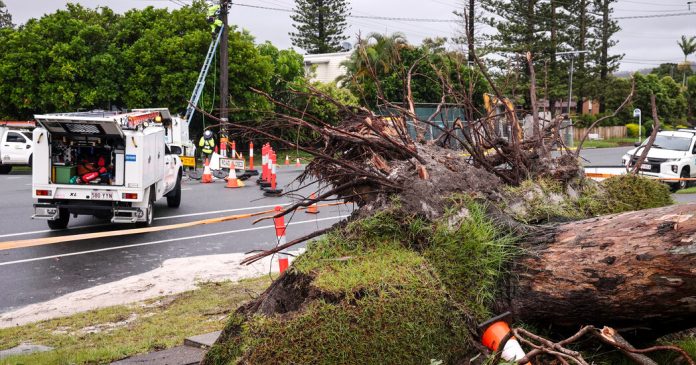
One person was missing, hundreds of thousands of homes were without power and communities were at risk of major flooding in eastern Australia on Saturday after the weakened storm formerly known as Tropical Cyclone Alfred neared the coast, still bringing heavy rains and dangerous winds.

Australia’s third-largest city, Brisbane, which had been in the cyclone’s path, appeared to have mostly escaped the storm’s impact. But the slow-churning system combined with high tides was causing widespread flooding down the coast in the nearby state of New South Wales.

Chris Minns, the state’s premier, said crews were searching for a man reported missing in the small town of Dorrigo, which was pummeled with more than 10 inches of rain overnight after days of heavy downpour.

“This emergency is not over,” he said. “The rivers are full, the rain is continuing and expected to keep falling in the days ahead, and wind conditions are very high and extreme.”

The police said the missing man had been driving a car that was swept away. He managed to get out of the car and onto a tree but was again overtaken by floodwaters before emergency workers were able to get to him.

More than 300,000 customers lost power in areas affected by the storm, according to the ABC, the country’s main public broadcaster. Emergency responders in New South Wales said they had carried out 30 flood rescues in the previous 24 hours, mostly of people in cars who had tried to drive through inundated streets.

Dozens of communities remained under evacuation orders in an area known as the Northern Rivers region, including parts of Lismore, a small city about eight hours north of Sydney. Lismore was inundated in a devastating flood in 2022 when the waters rose six feet higher than the previous record, killing 22 people.

Forecasters said Saturday afternoon that there was a danger that heavy rainfall would lead to floodwaters overtopping levees in the city.

Mr. Minns said officials were gearing up for a swift recovery in the storm’s aftermath, naming a point person to coordinate the efforts. In the 2022 floods, the authorities’ response was criticized by residents as inadequate and delayed, leaving people to take rescues and recovery into their own hands.

Remains in Manitoba Landfill Are Identified as Serial Killer’s Victim

0

The police in Manitoba have identified some of the human remains found in the search of a landfill near Winnipeg last month as those of Morgan Beatrice Harris, one of four Indigenous victims of a serial killer, the authorities said on Friday.

Ms. Harris and three other women, who were all from the Winnipeg area, were killed between March and May 2022. Ms. Harris, a member of the Long Plain First Nation, was 39.

Until Friday, only the remains of one woman, Rebecca Contois, 24, had been found and identified.

Jeremy Anthony Michael Skibicki was convicted in the killings late last year and sentenced to life in prison with no chance of parole for 25 years. He had expressed support for the far right on social media, filling his Facebook page with white supremacist, misogynistic and antisemitic comments.

The other two victims were Marcedes Myran, 26, and an unidentified woman whom First Nations elders call Mashkode Bizhiki’ikwe, or Buffalo Woman.

The issue of whether to search the Prairie Green Landfill near Winnipeg for the remains became a political issue during the 2023 provincial elections. The Progressive Conservatives, who were defeated, ran campaign ads and put up billboards opposing a search, citing its cost, the risks to investigators and what the party contended were slim chances of finding anything.

Indigenous groups pointed out the contrast with the case of Robert Pickton, a serial killer in British Columbia, who had preyed on women, mostly Indigenous, in an impoverished Vancouver neighborhood.

In 2002, the Royal Canadian Mounted Police turned his pig farm near Port Coquitlam, British Columbia, into the site of Canada’s largest crime scene investigation. Mr. Pickton was eventually convicted of killing six women, although he boasted of killing dozens more.

The identification of Ms. Harris’s remains was announced in a statement Friday by the New Democratic Party government, which had promised during the campaign to search the landfill. The party’s leader is Wab Kinew, the first Indigenous person to serve as a provincial premier.

“Please keep our families in your hearts tonight and every day going forward as we trust this process,” Ms. Harris’s daughter, Cabria, wrote in a social media post. “It is a very bittersweet moment.”

Ms. Contois’s remains were recovered in 2022. Evidence had suggested that the remains of Ms. Harris and Ms. Myran could be at Prairie Green. The provincial government announced late last month that the police had found “potential human remains in the search material” at the landfill.

In Manitoba’s legislature, the Progressive Conservatives’ interim leader apologized this week for the party’s decision to not launch a search.

“We lost our way in regards to empathy and also lost our way in regards to closure being brought forward to the families of the victims,” the leader, Wayne Ewasko, said.

Cambria Harris, in a social media post, rejected the apology.

“Unless your actions want to prove me otherwise, anything you are saying right now is mere words,” she wrote.

China Hits Canada With Tariffs in Indirect Riposte to Trump

0

China announced tariffs of up to 100 percent on canola, pork and other foods from Canada on Saturday, in retaliation for Canada’s decision last August to collect steep taxes on imports of Chinese electric vehicles, steel and aluminum.

The Chinese tariffs, which take effect on March 20, were also a clear warning to Canada — and, indirectly, Mexico — not to cooperate with the United States on trade. The Trump administration, like the Biden administration before it, has been demanding that Canada and Mexico not serve as back doors for low-cost Chinese goods to enter the U.S. market under North American free trade agreements.

China’s State Council Tariff Commission announced on Saturday that it would impose tariffs of 100 percent on canola oil, which is Canada’s largest export to China, and on peas, and 25 percent on Canadian pork and seafood. The commission said the measures were in response to Canada’s 100 percent tariffs on electric cars from China and its 25 percent tariffs on Chinese steel and aluminum, which took effect in October.

China’s Ministry of Commerce said in a separate statement that “China urges Canada to immediately correct its wrong practices, lift restrictive measures and eliminate adverse effects.”

The Canadian government had no immediate comment.

The Chinese agencies’ statements were carefully worded to comply with World Trade Organization rules and did not mention any effort to influence Canada or Mexico during their current trade discussions with the United States. But a commentary released by China’s state television left little doubt that a key goal for China is dissuading officials in Ottawa and Mexico City from acceding to American pressure for higher Canadian and Mexican tariffs on Chinese goods.

The Chinese tariffs are “a powerful countermeasure to Canada’s wrong choice, and a strong warning to some countries that intend to impose additional tariffs on China in exchange for the United States not to impose additional tariffs on them,” China Central Television said.

Prime Minister Justin Trudeau of Canada announced tariffs on imports from China last year, partly to protect heavy government-supported investments by automakers in electric car factories in Canada. But there were also growing concerns and complaints from the Biden administration — recently echoed by the Trump administration — that Chinese goods were flooding into Canada.

Partly because of that influx from China, Canadian steel mills, aluminum producers and other manufacturers rely heavily on the American market for their sales, taking advantage of duty-free shipments. Canada and Mexico have both had steeply rising trade surpluses recently with the United States.

By imposing tariffs on Canada’s extensive shipments of canola and other agricultural products to China, Beijing’s leaders have sent a pointed reminder that China is also a large market.

Canada exported $3.29 billion worth of canola, also known as rapeseed and used in animal feed and cooking, to China last year, which was 13.4 percent of Canada’s overall exports to China. Canadian exports of rapeseed to China surged last autumn as traders rushed to sell supplies to Chinese stockpiles before tariffs could take effect.

The Chinese government had said in late September that it would take up to a year to decide how to respond to the Canadian tariffs. It decided to act sooner after President Trump imposed 25 percent tariffs this week on imports from Canada and Mexico but then quickly suspended them for cars and many other goods.

China may have a little more trade leverage with Canada than with Mexico. For each dollar of Canadian or Mexican goods that China imports, China sells $3 of goods to Canada and almost $5 of goods to Mexico.

China’s exports to Mexico have doubled since 2019 as gasoline-powered Chinese cars in particular have rapidly increased their sales there at the expense of American and European manufacturers with factories in Mexico.

China’s action on Saturday is certain to reawaken unpleasant memories in Canada about a similar Chinese tariff on Canadian canola for two years starting in February 2019. China imposed that tariff after the Canadian authorities detained Meng Wanzhou, a top executive of the Chinese telecommunications giant Huawei, on a warrant from the United States.

China also imprisoned two Canadians then under harsh conditions, while Canada allowed Ms. Meng to live in a Vancouver mansion while awaiting a decision on her legal status. The United States, Canada and China eventually worked out a deal in which all three detainees were allowed to return to their home countries, but public opinion of China in Canada soured considerably during the dispute.

Amy Chang Chien contributed research.

Daughter of Pelicot Accuses Him of Rape in Police Complaint

0

The daughter of the convicted rapist Dominique Pelicot, whose trial horrified France as it detailed his years of abusing his wife with strangers, filed a police complaint against him this week that accused him of drugging and raping her as well.

Mr. Pelicot was found guilty last December of drugging and raping his wife, Gisèle Pelicot, for about a decade, and inviting dozens of men to their home in southern France to rape her along with him. Fifty other men were also found guilty, mostly for raping or sexually assaulting Ms. Pelicot while she was in a deeply sedated state.

The four-month trial ignited deep discussion in the country about rape culture, the understanding of consent and the widespread use of basic sleep and anti-anxiety drugs to prey on people — a predation strategy that in France is called chemical submission.

During the trial, the Pelicots’ daughter, Caroline Darian, confronted her father twice, saying she was sure he had drugged and also raped her. Mr. Pelicot repeatedly denied that he had drugged or even touched his daughter, let alone raped her.

Prosecutors did not charge Mr. Pelicot with drugging or abusing his daughter last year. The complaint Ms. Darian filed this week will be examined by a prosecutor, who will decide whether there is enough evidence or not to indict Mr. Pelicot on new charges.

Mr. Pelicot was also found guilty last year of taking intimate photos of his daughter and daughters-in-law. Investigators found about 20,000 photos and videos investigators on his computers and hard drives that documented many of the hundreds of rapes he orchestrated on his sedated wife, and which allowed the police to identify other rapists.

There were also images taken at different times that captured his daughter sleeping in underwear that she said was not hers, with the covers pulled back and the lights on.

His explanations for the photos changed during the trial. He variously said that he had not taken the photos, that he did not believe they were of her, and that he had taken them because he was being blackmailed.

Ms. Darian, who goes by a pen name, had hoped that her accusations during last year’s trial would be examined in detail, she said in an interview this week.

“I hoped to get the truth,” she said. “That never happened.”

She added, “I can’t stop there. It’s not principle, because my case was not investigated as it should have been.”

Florence Rault, a lawyer hired by Ms. Darian to work on a new case, said there was evidence that had not been examined by investigators in last year’s trial.

“There are elements that were absolutely not brought to light, that’s very clear. They erased part of the file,” she said.

Mr. Pelicot’s lawyer, Béatrice Zavarro, said she was not surprised but had yet to see the complaint that Ms. Rault said contained 10 charges including rape, attempted rape, sexual assault and drugging someone against their will.

Already France’s most infamous sexual predator, Mr. Pelicot has been indicted for two other cold cases: the rape and murder of a then 23-year-old woman in 1991, and the attempted rape of a then 19-year-old woman in 1999.

Both women were real estate agents attacked by a prospective client using a blade, and drugging them with ether while viewing properties. Mr. Pelicot admitted to drugging one of the women, but denied any involvement in the murder, according to investigative documents read out in court during the trial last year.

Ségolène Le Stradic contributed reporting.

Trains Delayed After World War II Bomb Is Uncovered Near Paris

0

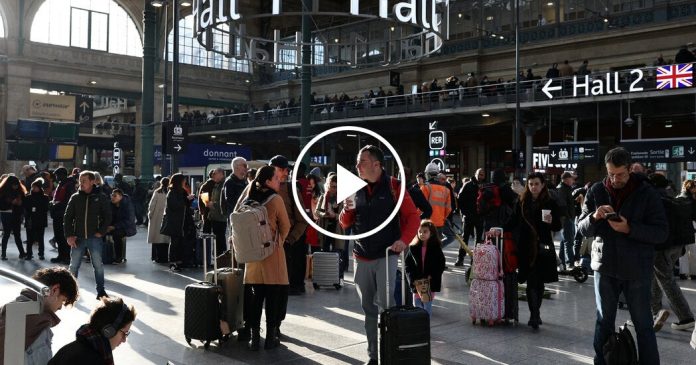
new video loaded: Trains Delayed After World War II Bomb Is Uncovered Near Paris

transcript

transcript

Trains Delayed After World War II Bomb Is Uncovered Near Paris

The discovery of the unexploded bomb, which weighed more than 1,000 pounds, near one of France’s largest trains stations caused travel disruptions in Paris and other parts of Europe.

Well, we just flew a red eye from Houston to London. We’re going to do four days in Paris for our spring break, and we got to the train station and they said there are no trains today. I mean, we had a lot of stuff booked and prepaid and it’s unfortunate, but that’s what happens. We’ll get some food, rest and try it again tomorrow.

Recent episodes in Europe