Thursday, November 12, 2026
Home Blog Page 148

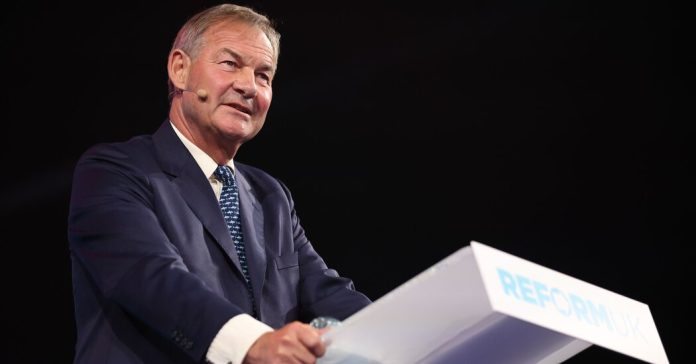
Nigel Farage’s Reform U.K. Refers Lawmaker to Police Over Claims of Threats to Another Party Official

0

The anti-immigration party led by Nigel Farage said on Friday it had referred one of its lawmakers to the police for allegedly threatening a senior colleague, in the biggest crisis to hit Britain’s insurgent right-wing party since its success in last year’s general election.

In a statement, the party, Reform U.K., said the lawmaker, Rupert Lowe, had been accused of making “threats of physical violence” against Reform’s chairman, Zia Yusuf. The party also said that it was investigating complaints that Mr. Lowe had bullied female staff members, and that it had suspended him.

In a statement posted on social media on Friday, Mr. Lowe, 67, denied the allegations, adding that it was “no surprise” that “vexatious” claims had been lodged after he recently made critical comments about Mr. Farage and the party’s structures.

In recent months, Reform U.K. has surged in opinion polls, overtaking the main opposition Conservative Party and closing in on the governing Labour Party, which is led by Prime Minister Keir Starmer.

But in the past, parties led by Mr. Farage have proved prone to internal divisions, and the drama on Friday suggested that Reform U.K. could be following the same pattern.

The new, explosive developments appeared to turn on the growing tension between Mr. Lowe, a businessman and the former chairman of Southampton F.C. soccer club, and Mr. Farage, Reform U.K.’s charismatic but divisive leader.

Mr. Farage had campaigned for Brexit and helped the party to win 14 percent of the vote in last year’s general election — propelling it to the forefront of the country’s politics.

Mr. Lowe, who represents Great Yarmouth on the eastern coast of England, has been praised by the technology billionaire Elon Musk, who this year withdrew his support from Mr. Farage and stated that the Reform U.K. leader “does not have what it takes.”

Mr. Musk did not explain his reasoning. But it appeared to be linked to Mr. Farage’s refusal to endorse the billionaire’s demand that a far-right agitator, Tommy Robinson, be released from prison. Mr. Farage has distanced himself from Mr. Robinson, whose real name is Stephen Yaxley-Lennon and who has several criminal convictions and a history of Islamophobic statements.

Mr. Lowe directly criticized Mr. Farage in a recent interview with The Daily Mail, arguing that Reform U.K. remained a “protest party led by the Messiah” under its leader.

Mr. Farage, asked in a TV interview why he thought Mr. Lowe had made his comments, replied: “Perhaps he wants to be prime minister. Most people in politics do.”

In its statement, Reform U.K. said it had appointed a senior lawyer to investigate the accusations that Mr. Lowe had bullied two female employees in offices in Parliament and in his constituency.

“Evidence was provided to us of workplace bullying, the targeting of female staff who raised concerns, and evidence of derogatory and discriminatory remarks made about women including reference to a perceived disability,” the statement said.

It added, “In addition to these allegations of a disturbing pattern of behavior, Mr. Lowe has on at least two occasions made threats of physical violence against our party chairman. Accordingly, this matter is with the police.”

In his response on social media Mr. Lowe said that the “allegations of physical threats are outrageous and entirely untrue” and that one “staff member in question only raised a vexatious complaint once disciplinary proceedings had been initiated against them for serious wrongdoing.” He also said that “the other individual mentioned dropped her appeal.”

Mr. Lowe suggested that the party’s action was an unwarranted response to his criticism of Mr. Farage and that “a complete inability to accept even the most mild constructive criticism without such a malicious reaction is not effective leadership.”

Reform U.K. denied any link. “The investigation into the very serious allegations was started long before his interview with The Daily Mail,” the party said in a statement.

Democrats ask Rubio for answers about Tesla plans : NPR

0

Visitors look over a 2024 Cybertruck in the Tesla display at the Electrify Expo, last July.

David Zalubowski/AP


hide caption

toggle caption

David Zalubowski/AP

Two top Congressional Democrats on foreign policy matters pressed Secretary of State Marco Rubio on Friday about a now-cancelled effort to purchase $400 million worth armored electric vehicles made by Tesla.

In a letter citing NPR’s recent reporting on the Trump administration’s move to acquire $400 million of Teslas, U.S. Reps. Gregory Meeks of New York, the ranking member of the House Committee on Foreign Relations, and Jared Moskowitz of Florida, who’s the top Democrat on the committee’s oversight subcommittee, said the plans represent “a serious violation of federal procurement laws” that would “unlawfully enrich Mr. Musk,” the billionaire tech mogul serving as a top official in the White House.

Earlier this week, Democratic Sen. Richard Blumenthal of Connecticut also wrote Rubio a letter demanding details about plans to purchase Teslas.

Last month, a State Department spokesperson told NPR the $400 million figure was “an estimate,” and that there are now no plans of moving forward with the purchase. The spokesperson said a plan to begin studying the viability of using Teslas as armored vehicles first started in the Biden administration.

A document from the Biden White House obtained by NPR shows that the State Department planned to spend $483,000 on electric vehicle acquisition in 2025, less than 1% of the $400 million estimated expenditure that first showed up in a spreadsheet of expected State Department contracts. When reports first circulated of the spreadsheet item, a State official edited the document to say the award was for “armored electric vehicles,” not “armored Tesla,” which the lawmakers homed in on in their letter to Rubio on Friday.

“This raises serious questions about whether the Department not only scrubbed the document to remove any references to Tesla but also may have backdated the publicly available documentation to give the false impression that every element of these procurement plans – including the $400 million value – originated in the prior Administration,” wrote the Democratic congressmen.

The State Department and Musk did not return requests for comment.

The lawmakers ask Rubio if State Department officials intentionally changed the electric vehicle purchase amount from $483,000 to $400 million, who oversaw the change and for proof that the contract has been “definitively abandoned.”

While the Biden administration document obtained by NPR appears to show the push for the government to buy $400 million of Teslas started under Trump, who exactly put the item in the spreadsheet, and at whose direction, remains unclear.

How Trump’s ‘51st State’ Canada Talk Came to Be Seen as Deadly Serious

0

After President Trump imposed tariffs on Canada on Tuesday, Prime Minister Justin Trudeau made an extraordinary statement that was largely lost in the fray of the moment.

“The excuse that he’s giving for these tariffs today of fentanyl is completely bogus, completely unjustified, completely false,” Mr. Trudeau told the news media in Ottawa.

“What he wants is to see a total collapse of the Canadian economy, because that’ll make it easier to annex us,” he added.

This is the story of how Mr. Trudeau went from thinking Mr. Trump was joking when he referred to him as “governor” and Canada as “the 51st state” in early December to publicly stating that Canada’s closest ally and neighbor was implementing a strategy of crushing the country in order to take it over.

Mr. Trump and Mr. Trudeau spoke twice on Feb. 3, once in the morning and again in the afternoon, as part of discussions to stave off tariffs on Canadian exports.

But those early February calls were not just about tariffs.

The details of the conversations between the two leaders, and subsequent discussions among top U.S. and Canadian officials, have not been previously fully reported, and were shared with The New York Times on condition of anonymity by four people with firsthand knowledge of their content. They did not want to be publicly identified discussing a sensitive topic.

On those calls, President Trump laid out a long list of grievances he had with the trade relationship between the two countries, including Canada’s protected dairy sector, the difficulty American banks face in doing business in Canada and Canadian consumption taxes that Mr. Trump deems unfair because they make American goods more expensive.

He also brought up something much more fundamental.

He told Mr. Trudeau that he did not believe that the treaty that demarcates the border between the two countries was valid and that he wants to revise the boundary. He offered no further explanation.

The border treaty Mr. Trump referred to was established in 1908 and finalized the international boundary between Canada, then a British dominion, and the United States.

Mr. Trump also mentioned revisiting the sharing of lakes and rivers between the two nations, which is regulated by a number of treaties, a topic he’s expressed interest about in the past.

Canadian officials took Mr. Trump’s comments seriously, not least because he had already publicly said he wanted to bring Canada to its knees. In a news conference on Jan. 7, before being inaugurated, Mr. Trump, responding to a question by a New York Times reporter about whether he was planning to use military force to annex Canada, said he planned to use “economic force.”

The White House did not respond to a request for comment.

During the second Feb. 3 call, Mr. Trudeau secured a one-month postponement of those tariffs.

This week, the U.S. tariffs came into effect without a fresh reprieve on Tuesday. Canada, in return, imposed its own tariffs on U.S. exports, plunging the two nations into a trade war. (On Thursday, Mr. Trump granted Canada a monthlong suspension on most of the tariffs.)

Glimpses of the rupture between Mr. Trump and Mr. Trudeau, and of Mr. Trump’s aggressive plans for Canada, have been becoming apparent over the past few months.

The Toronto Star, a Canadian newspaper, has reported that Mr. Trump mentioned the 1908 border treaty in the early February call and other details from the conversation. And the Financial Times has reported that there are discussions in the White House about removing Canada from a crucial intelligence alliance among five nations, attributing those to a senior Trump adviser.

But it wasn’t just the president talking about the border and waters with Mr. Trudeau that disturbed the Canadian side.

The persistent social media references to Canada as the 51st state and Mr. Trudeau as its governor had begun to grate both inside the Canadian government and more broadly.

While Mr. Trump’s remarks could all be bluster or a negotiating tactic to pressure Canada into concessions on trade or border security, the Canadian side no longer believes that to be so.

And the realization that the Trump administration was taking a closer and more aggressive look at the relationship, one that tracked with those threats of annexation, sank in during subsequent calls between top Trump officials and Canadian counterparts.

One such call was between Secretary of Commerce Howard Lutnick — who at the time had not yet been confirmed by the Senate — and Canada’s finance minister, Dominic LeBlanc. The two men had been communicating regularly since they had met at Mar-a-Lago, Mr. Trump’s home and club in Florida, during Mr. Trudeau’s visit there in early December.

Mr. Lutnick called Mr. LeBlanc after the leaders had spoken on Feb. 3, and issued a devastating message, according to several people familiar with the call: Mr. Trump, he said, had come to realize that the relationship between the United States and Canada was governed by a slew of agreements and treaties that were easy to abandon.

Mr. Trump was interested in doing just that, Mr. Lutnick said.

He wanted to eject Canada out of an intelligence-sharing group known as the Five Eyes that also includes Britain, Australia and New Zealand.

He wanted to tear up the Great Lakes agreements and conventions between the two nations that lay out how they share and manage Lakes Superior, Huron, Erie and Ontario.

And he is also reviewing military cooperation between the two countries, particularly the North American Aerospace Defense Command.

A spokesperson for Mr. Lutnick did not respond to a request for comment. A spokesperson for Mr. LeBlanc declined to comment.

In subsequent communications between senior Canadian officials and Trump advisers, this list of topics has come up again and again, making it hard for the Canadian government to dismiss them.

The only soothing of nerves has come from Secretary of State Marco Rubio, the four people familiar with the matter said. Mr. Rubio has refrained from delivering threats, and recently dismissed the idea that the United States was looking at scrapping military cooperation.

But Canada’s politicians across the spectrum, and Canadian society at large, are frayed and deeply concerned. Officials do not see the Trump administration’s threats as empty; they see a new normal when it comes to the United States.

On Thursday, at a news conference, a reporter asked Mr. Trudeau: “Your foreign affairs minister yesterday characterized all this as a psychodrama. How would you characterize it?”

“Thursday,” Mr. Trudeau quipped ruefully.

Players Tussle in English Town’s Centuries-Old Football Game

0

new video loaded: Players Tussle in English Town’s Centuries-Old Football Game

transcript

transcript

Players Tussle in English Town’s Centuries-Old Football Game

The Atherstone Ball Game, a tradition since 1199 in the town of Atherstone, England, is one of a dwindling number of folk football games played across Britain.

“Five, four, three, two, one.” [horn sounds] “Go on, lad.” “Kick it.” “Yay!” “Good lads.” “OK, let’s get going.” “Yes, jump in.” “Yeah!” [horn sounds]

Recent episodes in Europe

Panama Will Release Migrants From Detention Camp, Challenging Trump’s Deportation Efforts

0

Panama will release 112 migrants who had been deported from the United States last month and were being held in a remote jungle camp under conditions that lawyers and advocates said violated Panamanian and international laws.

They come from countries that the United States cannot easily return deportees to, often because those nations will not receive them.

Panama was issuing 30-day temporary humanitarian passes to the migrants, with a possible extension of up to 90 days, to give them time to arrange their return to their homelands or to other countries willing to take them, Panama’s Security Minister Frank Ábrego told reporters on Friday.

It was not clear whether the migrants would receive any kind of help once they were released.

The decision to release the migrants could represent another challenge to President Trump’s efforts to deport millions of migrants from the United States.

In mid-February, when the United States began sending planeloads of people from Asia, Africa and the Middle East to Panama and Costa Rica — and then those countries began locking up the deportees — it appeared that he had enlisted two pliant nations to help with his ambitious deportation plans.

The images of people locked in a hotel in Panama seemed a potentially powerful deterrent for those thinking about migrating.

But the decision by Panama to release the migrants suggests that it may be harder than the Trump administration had hoped to press other nations into aiding him in carrying out these mass expulsions.

Mr. Ábrego said that of the 299 migrants that had arrived from the United States, 177 had already returned voluntarily to their countries of origin and another 10 were waiting for flights back home.

The remaining 112, including several children, come from Afghanistan and Iran and had been held for more than two weeks in a camp about four hours from Panama’s capital. They would be released in the coming days, Panamanian officials said.

People detained in the United States who cannot be easily repatriated present a major hurdle for the Trump administration’s plan for major deportations.

So last month the administration found a workaround by exporting them to countries willing to take them in, like Panama, which is under enormous pressure to placate Mr. Trump, who has threatened to take over the Panama Canal.

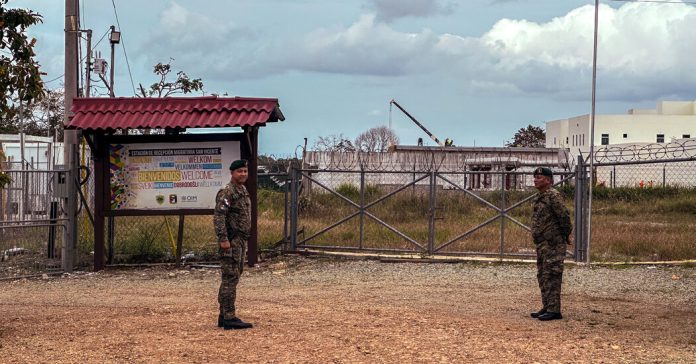
The migrants were flown to Panama in mid-February, and locked for several days in a downtown hotel. Those who did not agree to be deported back to their countries, or who could not easily be sent back for logistical reasons, were bused to a remote camp in eastern Panama, at the edge of the jungle known as the Darién Gap.

The decision to release them comes as Panama’s president, Raúl Mulino, faces growing pressure from human rights groups over the country’s decision to detain the group without charges.

It was also becoming apparent that it was going to be very difficult to deport some of the migrants — as Panama said it was planning to do — because many came from countries that do not have diplomatic relations with the Central American nation.

If the government of Panama had chosen to hold these people until it could deport them, it might have been holding them for months or more.

At the beginning of March an international coalition of lawyers filed a lawsuit against the government of Panama before the Inter-American Commission on Human Rights claiming that the detention of the migrants violated domestic and international laws, such as the American Convention on Human Rights.

Farnaz Fassihi contributed reporting.

26,000 images flagged for removal in Pentagon’s DEI purge : NPR

0

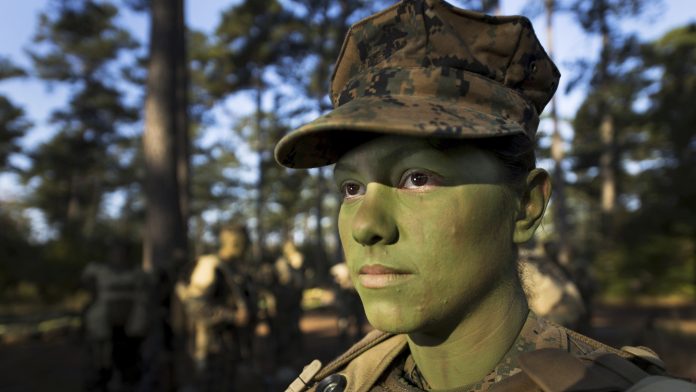
Pfc. Christina Fuentes Montenegro prepares to hike to her platoon’s defensive position during patrol week of Infantry Training Battalion near Camp Geiger, N.C., in 2013.

Sgt. Tyler Main/U.S. Marine Corps via AP


hide caption

toggle caption

Sgt. Tyler Main/U.S. Marine Corps via AP

WASHINGTON — References to a World War II Medal of Honor recipient, the Enola Gay aircraft that dropped an atomic bomb on Japan and the first women to pass Marine infantry training are among the tens of thousands of photos and online posts marked for deletion as the Defense Department works to purge diversity, equity and inclusion content, according to a database obtained by The Associated Press.

The database, which was confirmed by U.S. officials and published by AP, includes more than 26,000 images that have been flagged for removal across every military branch. But the eventual total could be much higher.

The Boeing B-29 named the "Enola Gay" is seen on Tinian in the Marianas Islands.

The Boeing B-29 named the “Enola Gay” is seen on Tinian in the Marianas Islands.

U.S. Air Force/via AP


hide caption

toggle caption

U.S. Air Force/via AP

One official, who spoke on condition of anonymity to provide details that have not been made public, said the purge could delete as many as 100,000 images or posts in total, when considering social media pages and other websites that are also being culled for DEI content. The official said it’s not clear if the database has been finalized.

Defense Secretary Pete Hegseth had given the military until Wednesday to remove content that highlights diversity efforts in its ranks following President Donald Trump’s executive order ending those programs across the federal government.

The vast majority of the Pentagon purge targets women and minorities, including notable milestones made in the military. And it also removes a large number of posts that mention various commemorative months — such as those for Black and Hispanic people and women.

Armorers and other ground personnel undergo training at Chanute Field, Ill., during World War II.

Armorers and other ground personnel undergo training at Chanute Field, Ill., during World War II.

U.S. Air Force/via AP


hide caption

toggle caption

U.S. Air Force/via AP

But a review of the database also underscores the confusion that has swirled among agencies about what to remove following Trump’s order.

Aircraft and fish projects are flagged

In some cases, photos seemed to be flagged for removal simply because their file included the word “gay,” including service members with that last name and an image of the B-29 aircraft Enola Gay, which dropped the first atomic bomb on Hiroshima, Japan, during World War II.

Staff Sgt. Krysteena Scales, a 816th Expeditionary Airlift Squadron Flying Crew Chief, performs pre-flight checks before departing on a mission in a C-17 Globemaster III in 2009.

Staff Sgt. Krysteena Scales, a 816th Expeditionary Airlift Squadron Flying Crew Chief, performs pre-flight checks before departing on a mission in a C-17 Globemaster III in 2009.

Senior Airman Andrew Satran/U.S. Air Force via AP


hide caption

toggle caption

Senior Airman Andrew Satran/U.S. Air Force via AP

Several photos of an Army Corps of Engineers dredging project in California were marked for deletion, apparently because a local engineer in the photo had the last name Gay. And a photo of Army Corps biologists was on the list, seemingly because it mentioned they were recording data about fish — including their weight, size, hatchery and gender.

In addition, some photos of the Tuskegee Airmen, the nation’s first Black military pilots who served in a segregated WWII unit, were listed on the database, but those may likely be protected due to historical content.

The Air Force briefly removed new recruit training courses that included videos of the Tuskegee Airmen soon after Trump’s order. That drew the White House’s ire over “malicious compliance,” and the Air Force quickly reversed the removal.

Many of the images listed in the database already have been removed. Others were still visible Thursday, and it’s not clear if they will be taken down at some point or be allowed to stay, including images with historical significance such as those of the Tuskegee Airmen.

World War II Medal of Honor recipient Pfc. Harold Gonsalves during World War II.

World War II Medal of Honor recipient Pfc. Harold Gonsalves during World War II.

U.S. Marine Corps/via AP


hide caption

toggle caption

U.S. Marine Corps/via AP

Asked about the database, Pentagon spokesman John Ullyot said in a statement, “We are pleased by the rapid compliance across the Department with the directive removing DEI content from all platforms. In the rare cases that content is removed that is out of the clearly outlined scope of the directive, we instruct components accordingly.”

He noted that Hegseth has declared that “DEI is dead” and that efforts to put one group ahead of another through DEI programs erodes camaraderie and threatens mission execution.

Some images aren’t gone

In some cases, the removal was partial. The main page in a post titled “Women’s History Month: All-female crew supports warfighters” was removed. But at least one of the photos in that collection about an all-female C-17 crew could still be accessed. A shot from the Army Corps of Engineers titled “Engineering pioneer remembered during Black History Month” was deleted.

Other photos flagged in the database but still visible Thursday included images of the World War II Women Air Service Pilots and one of U.S. Air Force Col. Jeannie Leavitt, the country’s first female fighter pilot.

Also still visible was an image of then-Pfc. Christina Fuentes Montenegro becoming one of the first three women to graduate from the Marine Corps’ Infantry Training Battalion and an image of Marine Corps World War II Medal of Honor recipient Pfc. Harold Gonsalves.

It was unclear why some other images were removed, such as a Marine Corps photo titled “Deadlift contenders raise the bar pound by pound” or a National Guard website image called “Minnesota brothers reunite in Kuwait.”

Why the database?

The database of the 26,000 images was created to conform with federal archival laws, so if the services are queried in the future, they can show how they are complying with the law, the U.S. official said. But it may be difficult to ensure the content was archived because the responsibility to ensure each image was preserved was the responsibility of each individual unit.

In many cases, workers are taking screenshots of the pages marked for removal, but it would be difficult to restore them if that decision was made, according to another official, who like the others spoke on the condition of anonymity to provide additional details that were not public.

A Marine Corps official said every one of its images in the database “either has been taken down or will be taken down.” The Marines are moving on the directive as fast as possible, but as with the rest of the military, very few civilian or contractor employees at the Pentagon can perform content removal, the official said.

In the Marine Corps, just one defense civilian is available to do the work. The Marine Corps estimates that person has identified at least 10,000 images and stories for removal online, and after further review, 3,600 of those have been removed. The total does not count more than 1,600 social media sites that have not yet been addressed.

Many of those social media sites were military base or unit support groups created years ago and left idle. No one still has the administrative privileges to go in and change the content.

The Marine official said the service is going through each site and getting new administrative privileges so it can make the changes.

On Feb. 26, the Pentagon ordered all the military services to spend countless hours poring over years of website postings, photos, news articles and videos to remove any mentions that “promote diversity, equity and inclusion.”

If they couldn’t do that by Wednesday, they were told to “temporarily remove from public display” all content published during the Biden administration’s four years in office.

France’s Ex-Intelligence Chief Convicted in Influence Peddling Trial Involving LVMH

0

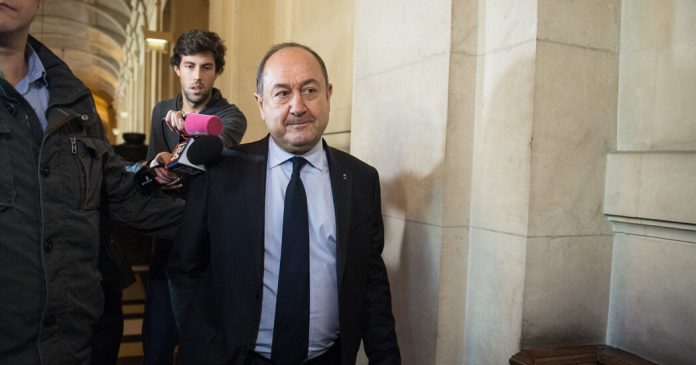
In the packed Paris courtroom, the corporate magnate portrayed himself as a successful business leader who had labored to turn LVMH into the world’s top luxury conglomerate, with 75 brands, including Louis Vuitton and Dior, and 200,000 employees worldwide. When Mr. Arnault first took over the company in the 1980s, it had just 10,000 employees.

He denied ever knowing of any illegal surveillance.

Mr. Squarcini was tried alongside nine other defendants — mostly civil servants, police officers and consultants. Two of them were found not guilty.

As the main defendant in the case, Mr. Squarcini was convicted of myriad offenses, including mishandling classified information and complicity in the unauthorized activity of a private investigator. He was found not guilty on a range of other charges.

In its verdict, the court said Mr. Squarcini had, in particular, “misappropriated state resources in order to satisfy the clandestine concerns” of his key client, LVMH. The court added that Mr. Squarcini had “designed and validated a system of close surveillance” of Mr. Ruffin and a satirical publication that he headed, Fakir, whose staff members helped make the film, “Merci Patron,” which portrayed Mr. Arnault as a symbol of corporate greed.

“The court handed down severe sentences, but with a severity commensurate with the seriousness of the attacks made by Mr. Squarcini and his acolytes on freedom of the press, freedom of expression, the rights of Francois Ruffin and the rights of the Fakir newspaper,” Benjamin Sarfati, Mr. Ruffin’s lawyer, said in an interview on Thursday. “But we would have liked LVMH to be on trial, because the people convicted today acted at LVMH’s request,” he added.

She was fired from her dream job at CDC, then got it back. But she’s moving on : Shots

0

Bri McNulty does public health outreach at a conference in Iowa.

Liz Orton


hide caption

toggle caption

Liz Orton

Cancer outreach worker Bri McNulty, 23, was one of 750 employees at the Centers for Disease Control and Prevention who was terminated abruptly over email in mid-February, amid a slew of federal workforce dismissals.

On Tuesday, McNulty got an equally surprising email hiring her back. She was one of an unknown number of probationary employees at the CDC to be asked back in a perfunctory email.

McNulty was part of the agency’s elite Public Health Associate Program, assigned to the Iowa Cancer Consortium, a small group working on statewide efforts to combat what is the country’s second-highest cancer rate.

New plans

McNulty says her cohort of Public Health Associates included 66 people. People in the Laboratory Leadership Service program also had their jobs restored, according to NPR’s reporting.

But McNulty has been busy making other plans since that mid-February bombshell dropped by Elon Musk’s government downsizing effort.

She contacted a former employer at Penn State and quickly got a job offer. She’s made arrangements to move out of Iowa City, where she’s been since late 2023. She’s even found a new place to live near the new job.

“Yesterday morning, I had signed the offer letter,” McNulty told NPR on Wednesday. “I signed my lease for an apartment and I was in the parking lot of FedEx to return my CDC laptop and everything.”

McNulty decided to check her email on the laptop one last time. That’s when she saw the subject line: “Read this email immediately.”

“You should return to duty under your previous work schedule. We apologize for any disruption this may have caused,” the email reads, in part.

Like a bad romance

McNulty says that once again, she wasn’t sure what to make of it all.

“It’s sketchy again because the email is from a contact we don’t have,” she says. It came from [email protected]. “And it’s also not signed off by anyone. It just says, ‘Thanks,’ and that’s the email. And also, the apology for any disruption this may have caused is just salt in the wound, if I’m being honest.”

McNulty grew up dreaming of working in public health at the CDC. Watching the movie Contagion lit her curiosity, and the pandemic solidified that commitment.

McNulty says that dream job soured suddenly, like a bad romance.

“The way I’m kind of thinking about this is that this has been such an abusive relationship in the sense of like, we got let go and now this is the job or the abusive partner, like texting us randomly again, asking what we’re up to,” McNulty says.

No word to her boss

Kelly Wells Sittig is executive director for Iowa Cancer Consortium and had been McNulty’s boss until three weeks ago. Sittig says CDC has informed her nothing about plans to bring back McNulty or the agency’s elite Public Health Associate Program that sponsored her.

“There’s so much uncertainty and lack of clarity not only in this situation, but I think in a lot of other ways about resources that are going to be available for things like cancer control, but also more broadly, public health, health care research,” Sittig says.

Bri McNulty decided not to take back the CDC job. But it’s not for lack of loving it, or the work.

“I don’t trust the job to last again,” she says. “And I personally have kind of come to this point of CDC is not off the table for life for me, but it is off the table for the next four years.”

McNulty says she hopes that those working in public health, like her, will focus on surviving to see better days.

“We can’t focus on progress when they’re trying to dismantle all these agencies and organizations,” McNulty says. “So we need to focus on making sure we don’t lose what we already have. But we can’t think about going forward.”

CDC spokespeople did not respond to requests seeking comment.

Scalpel vs. hatchet

On Thursday, President Trump indicated that Cabinet secretaries would have more control of job cuts going forward.

In a social media post, he wrote: “[N]ow that we have my Cabinet in place, I have instructed the Secretaries and Leadership to work with DOGE on Cost Cutting measures and Staffing. As the Secretaries learn about, and understand, the people working for the various Departments, they can be very precise as to who will remain, and who will go. We say the ‘scalpel’ rather than the ‘hatchet.'”

The president echoed what Trump voter and Iowa cancer patient Kathie Evenhouse told NPR last week. “It is hurtful to the good things to cut it off — but I do think that we have to do something,” Evenhouse said. “I think it could have been done with a scalpel instead of a hatchet.”

German Court Convicts Five Over Plot to Kidnap Health Official and Spread Chaos

0

Five people have been sentenced to prison over what the authorities in Germany described as a plot to kidnap the country’s health minister on live television in 2022 in an attempt to destabilize the German state.

After a nearly two-year trial, a court found on Thursday that the five, under a group billed as the “United Patriots,” had planned to create a widespread weekslong power outage and then use the chaos to reinstate a 19th-century Constitution ceding power to an all-powerful Kaiser.

They were convicted of founding or joining a terrorist group, of treason and in some cases of owning illegal guns, rifles and explosives.

Jörn Müller, a spokesman for the court, in Koblenz in western Germany, said the trial had “shown that a democratic constitutional state is capable of dealing with its alleged opponents on the basis of law and order in a fair and independent trial.”

The court sentenced a 46-year-old man whom it had determined to be the group’s central figure to eight years in prison. A 77-year-old woman who holds a Ph.D. in theology and frequently interrupted the court hearings with antisemitic and conspiracy-theory-laced diatribes was handed a sentence of seven years and nine months. Three other men, all in their 50s, received sentences ranging from six and a half years to two years and 10 months.

In accordance with German privacy laws, the court identified the defendants only by their initials.

The five were part of the Reichsbürger scene, a loosely affiliated antisemitic far-right grouping that does not accept the legitimacy of the modern German state. Their planned overthrow was not directly related to a far more complex, and far more dangerous, plot surrounding a disgruntled prince that is currently being tried in three separate courts in Germany.

After meeting and radicalizing on a Telegram chat group during the pandemic, members of the plot tried to buy and hoard weapons and other tools for their plans, according to the case brought by the prosecutors. Police searches after their arrest in 2022 yielded 52 packets of low-grade explosives, with which the authorities said the group hoped to use to disable large parts of the power grid.

Members of the group were arrested while trying to buy AK-47 assault rifles, mines and bulletproof vests. The seller was an undercover police officer and the exchange was a setup.

The five convicted on Thursday had focused their ire on Germany’s health minister, Karl Lauterbach, a medical doctor and former professor who has taught at the Harvard School of Public Health. During the pandemic, he was an outspoken proponent of vaccination rules, often appearing on television panel shows to explain the medical science behind the spread of the coronavirus.

On Thursday, he thanked the German police for keeping him safe. “The state has shown that it can defend itself against violent conspiracy theorists,” he said on social media.

Atherstone Ball Game Continues an 826-Year-Old Tradition in England

0

In England, the Tuesday before lent is traditionally celebrated by eating a stack of pancakes.

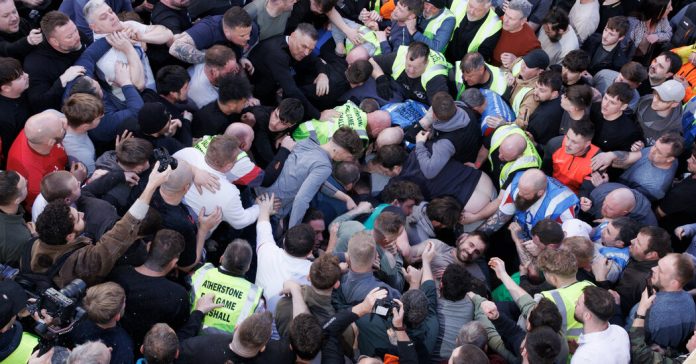
But in Atherstone, a small town about 100 miles northwest of London, the locals gathered for a more bloody ritual: At 3 p.m. on the town’s main street, a ball was thrown out of the second-story window of a mortgage broker’s office, and dozens of men roared in unison as they piled on top of it.

They punched and shoved each other as they scrambled for the ball, eventually emerging from the scrum with road rash and swollen faces. One young player smiled at onlookers, revealing a mouth of bloodied braces.

This is the Atherstone Ball Game, an 826-year-old tradition in this Warwickshire town, and one of a dwindling number of ancient football games played across Britain on Shrove Tuesday, known as Fat Tuesday in the United States. King John is said to have initiated the town’s first match, between Leicestershire and Warwickshire, in 1199. He offered a bag of gold for the winner, the story goes, creating a frenzied competition whose spirit lives on in today’s game.

Locals often say there are only two rules to the game: Keep the ball on the town’s main street, and don’t kill anyone. In reality, there’s a bit more to it than that, organizers say (and the no-killing rule is hyperbole).

But at its core, the game is simple. Participants kick and carry a leather ball up and down the city’s main street for two hours. In the final minutes, they fight for possession of the ball until a klaxon sounds, ending the game.

The winner: whoever is holding the ball at the end.

To gain an advantage, many players organize teams out of local pubs, though in the end only one person can emerge victorious. Shoving, kicking, biting, punching — most uses of force, really — are fair game, particularly in the frantic final moments, said Noel Johnston, a 57-year-old retired factory worker who served as one of the game’s chief marshals, a type of volunteer referee.

“This game is for men,” he said. (Though women are not barred from competing, they rarely do.)

On game day, “friendships can be tested,” Mr. Johnston added, and “everyone wants to be the alpha male.” Kyle Crawford, a 28-year-old who boxes in his spare time, said participating felt like the “closest thing to getting into the ring.”

Ahead of the game, thousands squeezed along Long Street, the town’s main thoroughfare, to watch the action unfold. Schoolchildren, who were given the day off for the occasion, clung to storefront windows that had been boarded up to prevent any damage. Police drones buzzed overhead. They, along with a few dozen officers, were there to monitor anyone who might use the game as “an excuse for criminal violence,” the Warwickshire Police said.

As the game began and the scrum thrashed on the street, Ryan James, who oversaw first aid for the event, didn’t seem worried. His company, Choice Response, brought eight medics and an ambulance.

“It looks quite brutal,” he said, but the most serious wounds he had treated by the end of the day were a minor concussion and a head gash — which he said initially made it look as if the victim “had half of his head decapitated,” but turned out to be a minor laceration.

Throughout the afternoon, the onlookers played their own game of chicken with the action, gathering around the mass of competitors, only to run and scream when the ball got too close to them. Marshals paused the game every few minutes to let children kick the ball and pose for photos.

“The day itself is a family day,” said Rob Bernard, the chairman of the event’s organizing committee. In the weeks leading up to the game, the ball is paraded around town to pubs, businesses and schools to drum up excitement and raise money for charity.

Folk football, as this type of game is known, began as a pagan ritual and laid the foundations for soccer and rugby, as well as American, Australian and Gaelic football, the author Desmond Morris wrote in his book “The Soccer Tribe.”

While the tradition has died out in many places, it has remained a fixture in Atherstone, passed down through generations, said Pamela Colloff, who helps run the town’s heritage center. Historically, the ballgames were a way for people to blow off steam, have fun and settle scores.

“For any sort of friction, it would be quite common to say, ‘We’ll sort that out on ballgame day,’” Ms. Colloff said. That was particularly true during the bitter miner’s strike in the 1980s, she said, when workers on opposite sides of the strike found themselves facing off in the ballgame.

Mr. Johnston, the marshal, said many outsiders misunderstood the game, seeing its violence but not its boost to civic pride. The game was particularly important now, he said, as working-class English towns like Atherstone had been hollowed out. When he was younger, Atherstone was a bustling little town, he said, with a strong pub culture.

“Now, you could fire an AK-47 straight down the town at 9 o’clock on a Saturday night and shoot no one,” he said, adding an expletive. But not on ballgame day, he said while holding a pint in a pub that soon had a line flowing out the door.

“We’ve got to cling on to our traditions,” he said.

As the clock ran down on Tuesday, the game’s chaotic roots surfaced. The ball was pinned under a group of players on a sidewalk, and the men began to swarm. Occasionally, someone would try to climb across the mob to get closer to the ball, crowd surfing on their competitors while also kicking and punching them.

At one point, a young man climbed onto the awning of a Costa Coffee shop to line up his next attack, but the structure buckled under his weight and he tumbled, along with a sheet of metal, onto the men below. The crowd cheered its approval.

Finally, the klaxon blew. Marcus Cooper, a 31-year-old construction worker who had spent 40 minutes at the bottom of the scrum, emerged as the winner. He was “tired, but buzzing,” he said.

His prize? The ball, and the adoration of the town for the next 12 months.