Thursday, November 12, 2026
Home Blog Page 149

What We Know About the Clashes in Syria

0

The Syrian Observatory for Human Rights, a Britain-based monitoring group, has reported attacks on Alawite civilians, frequently by unknown gunmen. The country’s new rulers have pledged to bring all armed groups under the state’s control, but the security situation remains unstable, with some Syrians seeking vengeance.

There does not yet appear to be a single unifying force responsible for orchestrating the attacks on Syria’s western coast, and so far the violence is largely attributed to small-scale cells of Assad loyalists, according to the Institute for the Study of War, a Washington-based research group.

The attacks against security forces on Thursday, however, marked the “first time that pro-Assad loyalist activity demonstrated clear coordination and prior planning,” according to Charles Lister, the director of the Syria and counterterrorism programs at the Middle East Institute.

On Thursday, as security forces came under attack, a group calling itself the “Military Council for the Liberation of Syria” issued a statement vowing to overthrow the country’s new leadership. The statement announced the establishment of the group, and was signed by a former general in the Assad regime’s elite Fourth Division, which was headed by Mr. al-Assad’s brother Maher al-Assad.

It remains unclear if the former general, Gaith Dalah, established this military council himself, or if the group is claiming him as their leader, according to the Institute for the Study of War. But its formation comes on the back of similar announcements by a trickle of other pro-Assad armed groups that have sprung up since the government’s fall.

In recent days, some of those groups have released videos showing gunmen calling for the overthrow of Syria’s new leadership, and have claimed responsibility for attacks against security forces on their social media channels. The New York Times has not independently verified the videos.

Anas Khattab, the new head of Syria’s intelligence services, said in a statement on Friday that former Assad regime military leaders were behind the violence, with support from unspecified “fugitives” outside the country.

The government has poured security forces into the coastal region in a bid to restore order, with SANA, Syria’s state-run news agency, posting photographs of long lines of armored vehicles deploying in coastal cities. Curfews have been extended in the cities of Latakia and Tartus where the violence has centered, with residents ordered to stay home as security forces conduct “combing operations” aimed at armed remnants of the Assad government, according to SANA.

“The choice is clear: Lay down your weapons or face your inevitable fate,” Col. Hassan Abdul Ghani, a spokesman for the Syrian Ministry of Defense, said in a statement, adding that thousands of militants had surrendered their arms, but that some continued to fight.

Elon Musk’s emails are stressing out VA mental health workers : NPR

0

Mental health professionals at the Veterans Health Administration say the stress caused by the Trump administration’s actions is negatively impacting patient care.

Deagreez/iStockphoto/Getty Images


hide caption

toggle caption

Deagreez/iStockphoto/Getty Images

Elon Musk has called his “What did you do last week?” emails to the entire federal workforce “pulse check” reviews.

“Do you have a pulse and two neurons?” he said to laughter at a White House Cabinet meeting last week.

Some mental health professionals with the Veterans Health Administration do not find it funny. They liken the email campaign to psychological warfare: a blitz attack, with each email hitting like a flash-bang grenade aimed at discombobulating the federal workforce.

“Many of us feel like we are being bullied to justify our existence and worth,” said one licensed clinical psychologist, who noted that the VA has long tracked everything she does — how many people she sees, how many phone calls she makes, what time those appointments start and end, what topics they discuss and even what handouts or homework she provides.

With the weekend approaching, many federal workers are wondering whether another “What did you do last week?” email will soon hit their inboxes, reminding them to send in five bullet points of what they accomplished by Monday.

The White House did not immediately respond to a request for comment on federal employees’ reactions to the emails — or whether another one would be sent this weekend.

The mental health professionals who spoke with NPR about their stress asked to remain anonymous out of fear of retaliation by the government.

No choice but to respond

Musk’s demand for a weekly accounting of accomplishments, sent from an Office of Personnel Management (OPM) email address during off-hours, has roiled federal workers across the government. And yet, because the VA has instructed its employees to respond, the mental health workers who spoke to NPR feel they cannot ignore the ask.

On social media, Musk suggested employees could lose their jobs if they failed to respond. At his Cabinet meeting, President Trump said those who don’t respond “are on the bubble, as they say.”

Without citing evidence, Trump and Musk suggested that there may be people collecting government paychecks who have moved on to other jobs or may even be dead.

“We’re just literally trying to figure out are these people real, are they alive and can they write an email,” said Musk.

But the stress brought on by the emails — on top of all the other disruptions hitting the federal workforce, including notifications of mass layoffs ahead — is taking a toll, the psychologist said.

“I have to keep it together and placate OPM emails, or get terminated, while also answering veterans’ concerns about whether I will be there for them the next week or month,” she said. “Instead of being able to do good work to address their depression, PTSD, sexual trauma, combat trauma, etc., I have to spend time calming their nerves.”

Paranoia in the workplace out of fear of being monitored

A psychiatrist from a different veterans health facility says she was in a parking lot at Costco when she saw the first “What did you do last week?” email, which was sent on a Saturday when she was off work and trying to relax with her family.

“As someone who specializes in mental health, I can say with confidence that this weekend emailing is meant to psychologically upset federal workers,” she told NPR.

And it’s working.

“I am anxious and irritable at home,” she said. “I find myself doomscrolling for the first time ever, which is negatively impacting my mental health and something I tell my veterans to not do.”

The psychiatrist also describes a paranoia that has set in at work. Colleagues are careful about what they say in online messages and at meetings, out of fear that they are being monitored by Musk and his Department of Government Efficiency, she said.

She assumes that all the responses to the “What did you do last week?” email are being analyzed using artificial intelligence, but doesn’t know to what end.

“I truly believe this is a nefarious process,” she said.

Amy Edmondson, a professor and social psychologist at Harvard Business School, understands where that suspicion is coming from.

Normally, an employer doesn’t reach out to a worker on their day off unless it’s a real emergency, she says. In the context of the Trump administration’s broad push to shrink the federal workforce, a seemingly simple request to list five accomplishments from the prior week could be worrisome at best and distressing at worst.

“You don’t know what’s underneath it,” explains Edmondson. “What does the sender really want? Who’s it for? How will it help?”

A call to duty

This week, the Department of Veterans Affairs laid the initial groundwork for mass layoffs as part of the Trump administration’s efforts to “eliminate waste, reduce management and bureaucracy, reduce footprint, and increase workforce efficiency,” with an initial goal of cutting more than 80,000 positions across the department, according to a VA memo shared by the American Federation of Government Employees.

The mental health professionals who spoke with NPR do not know whether they will be affected. While they have thought about jobs outside the government, they love their work and don’t want to leave the veterans they’ve been helping behind.

“In the private sector, I could be working with ‘easier’ or less complicated patients,” the psychologist said. “The reality is that those of us that opt to come to work for the VA do so because of our call to duty to serve those that served us.”

Have information you want to share about ongoing changes across the federal government? NPR’s Andrea Hsu can be contacted through encrypted communications on Signal at andreahsu.08.

Migrant Boats Capsize Off Yemen and Djibouti, U.N. Says

0

CAIRO — At least two people have died and 186 others were missing after four boats carrying migrants from Africa capsized overnight in waters off Yemen and Djibouti, the United Nations migration agency said on Friday.

Two vessels capsized off Yemen late Thursday, said Tamim Eleian, a spokesman for the International Organization for Migration. Two crew members were rescued, but 181 migrants and five Yemeni crew members remain missing, he said.

Two other boats capsized off the tiny African nation of Djibouti around the same time, he said. Two bodies of migrants were recovered, and all others onboard were rescued.

Strong winds caused the two boats to capsize near the beach in Djibouti after they started sailing off, said Abdusattor Esoev, the head of the mission for the I.O.M. in Yemen.

The third boat, which capsized off Dhubab district in Taiz governorate, in southwestern Yemen, was carrying 31 Ethiopian migrants and three Yemeni crew.

The fourth boat, which capsized near the same area, was heading to Ahwar district in Abyan governorate, and was carrying 150 Ethiopian migrants and four Yemeni crew.

Yemen is a major route for migrants from East Africa and the Horn of Africa seeking to reach Gulf countries for work, with hundreds of thousands trying the route each year.

To reach Yemen, migrants are taken by smugglers on often dangerous, overcrowded boats across the Red Sea or Gulf of Aden.

The numbers making it to Yemen reached 97,200 in 2023 — triple the number in 2021. Last year, the number dropped to just under 61,000, probably because of greater patrolling of the waters, according to an I.O.M. report released this month.

Over the past decade, at least 2,082 migrants have disappeared along the route, including 693 known to have drowned, according to the migration agency. Some 380,000 migrants are in Yemen.

What’s next for the U.S. Postal Service as Trump proposes merger : NPR

0

U.S. Postal Service delivery vehicles are parked outside a post office in Boys Town, Neb., on Aug. 18, 2020.

Nati Harnik/AP


hide caption

toggle caption

Nati Harnik/AP

The U.S. Postal Service could be at a critical tipping point in its history.

Last month, at the swearing-in ceremony for Howard Lutnick, the new secretary of commerce, President Trump said he’s thinking of moving the Postal Service under the umbrella of the Commerce Department.

“We want to have a post office that works well and doesn’t lose massive amounts of money,” Trump said. “We’re thinking about doing that, and it’ll be a form of a merger, but it’ll remain the Postal Service, and I think it’ll operate a lot better than it has been over the years. It’s been just a tremendous loser for this country.” 

The Postal Reorganization Act of 1970 remodeled the Postal Service from a cabinet department to an independent agency under the executive branch. As a result, the president can nominate members to the board of governors, but has no direct jurisdiction over Postal Service operations.

And one of Trump’s big ideas from his first term — privatization of the Postal Service — is still under consideration.

If these proposals go through, they would be some of the biggest upheavals the Postal Service has faced since it became an independent agency over 50 years ago.

In 2018, Trump commissioned a task force put together by the Treasury Department to recommend reforms to USPS. It concluded that rural communities would suffer from privatization.

In December, Trump did not explicitly say if he is still for privatization, but that “it’s an idea that a lot of people have liked for a long time. We’re looking at it.”

Kevin Kosar, a senior fellow at the conservative American Enterprise Institute who researches the USPS, said an executive order would likely not be enough to merge the agencies or privatize the service. 

Executive orders cannot override existing laws, so an attempt to place the Postal Service under another agency would likely be challenged in federal court, Kosar said. However, there is the option to maintain it as an independent agency overseen by the executive branch, but privatize operations such as mail hauling and sorting, he said. 

What would privatization mean for consumers?

Privatizing the Postal Service could limit some Americans’ access to its services. Private companies are not beholden to the universal service obligation that the Postal Service has, which sets a minimum level of service for all Americans. So a privatized Postal Service would likely focus on delivering to areas that turn the biggest profits — cities, said Brian Renfroe, the president of the National Association of Letter Carriers union.

A postal worker can deliver to more addresses in less time in urban areas, as opposed to having to travel a half a mile or so between homes, which is typical in rural areas, Renfroe said. Higher productivity can lead to more efficiency and lower operational costs, which helps maximize profits. 

“A private business … will do things and take on work and customers where it is profitable for them, but typically where it’s not profitable, they will not do that work, which is what they should do in private business,” Renfroe said.

Renfroe said the National Association of Letter Carriers is prepared to push back against some of Trump’s proposals.

NALC members protested in Washington, D.C. in late February against Trump trying to “dismantle the Postal Service,” Renfroe said in a video captured by the Associated Press. He said the workers have rallies mainly to raise public awareness, but the organization will take legal action if needed. 

“I think it’s very clear this administration has no interest in protecting public service, working people or really the public good,” he said. “They want to throw us away to create an unreliable, inefficient, expensive private delivery service. And what do we say to that?”

“Hell no,” the crowd answered back. 

Louis DeJoy, who spearheaded a plan to transform the Postal Service, plans to leave

Louis DeJoy, the postmaster general, announced to the Postal Service’s board last month that they should start looking for his replacement, about halfway into his 10-year “Delivering for America” plan to overhaul the agency and make it more profitable.

In DeJoy’s letter to the board telling them to look for his replacement, dated Feb. 17, he wrote that the Postal Service’s business model “has been broken for over two decades.”

“Postmaster General is a demanding role made more difficult by the devastating condition I found the Postal Service in when I arrived and the almost unceasing resistance to change — without offering any viable solutions — from stakeholders motivated by both parochial and political purposes,” he said.

DeJoy was appointed as postmaster general in 2020 by President Trump, and in 2021, he unveiled his “Delivering for America” plan. It detailed some of the challenges DeJoy believed the Postal Service faced, such as more demand for packages than paper mail and a workforce reduced by the pandemic and high turnover among “non-career” employees.

To fix this, the plan proposed that the Postal Service would invest $40 billion toward processing more mail and upgrading trucks, retail stores and IT systems, among other things.

The Postal Regulatory Commission, an independent agency that helps monitor the Postal Service, has criticized DeJoy’s plan. It said in a report published in January that the plan’s financial goals are “overly optimistic and unsubstantiated,” that it is not ready to be put into place and that rural communities would receive a lower standard of service. 

In response, the Postal Service said the commission “presents a completely one-sided narrative that unjustifiably ignores or dismisses as unlikely to occur all of the positive benefits of the proposal.”

Still, it agreed to implement some of the commission’s recommendations, such as ensuring any service changes would be communicated clearly to the public. 

It is unclear if the Postal Service will proceed with the Delivering for America plan under new leadership, but DeJoy said in his letter he would help make the transition as smooth as possible.

Kevin Kosar, the senior fellow at AEI, said DeJoy’s plan has had some road bumps. For example, delivery speeds slowed in places where network changes were implemented, such as Richmond, Va., and Atlanta. But ultimately, he commends DeJoy for revamping a system that has not had significant upgrades since 1970, and has struggled to keep up with the ascension of email and e-commerce.

Under DeJoy’s tenure, the Postal Service made a $144 million profit in the first quarter of fiscal year 2025, compared to a loss of $2.1 billion during the same period last year.

At the same time, the Postal Service had $8.1 billion in cash as of December 2024, and predicts it will lose $6.9 billion in 2025. And the agency can no longer borrow money from the Treasury Department, as it has hit its $15 billion limit.

“The new guy is going to be under intense pressure due to the fact that the Postal Service may run out of money within two years, and when it runs out of money, either it shuts down or the taxpayers have to bail it out,” Kosar said. 

Renfroe, the union president, said DeJoy had been “fairly dynamic” in maintaining round-the-clock service while trying to modernize such a large organization. 

“To be just very honest about it, in the decade or so before he became postmaster general, that need for modernization had been neglected,” he said. 

The Postal Service did not respond to requests for comment. 

Russia Hits Ukrainian Power and Gas Facilities in Widespread Attack

0

Russia unleashed a furious bombardment aimed at critical Ukrainian infrastructure overnight on Thursday and on Friday amid increasing worries that the American decision to withhold intelligence assistance could leave Ukraine more vulnerable to attacks.

Ukraine’s energy minister, German Galushchenko, said Russian forces launched a “massive missile and drone” assault on power and gas facilities across the country.

The Ukrainian Air Force reported that Russia sent 261 attack vehicles — 67 missiles of various types and 194 drones, some which were outfitted with dummy warheads to confuse and overwhelm air defense crews.

Ukraine shot down or disabled most of the attack drones, the air force said, but only destroyed 35 of the 67 missiles. Ten more missiles did not reach their targets, the air force said, without elaborating.

French Mirage-2000 fighter jets that arrived in Ukraine one month ago joined F-16’s in the skies for the first time, the air force said, helping in the defense.

The bombardment came just days after the United States said it was suspending intelligence sharing with Kyiv, which Ukrainian officials and analysts have said could compromise Ukraine’s ability to detect and defend against Russian bombardments.

American intelligence gathered from a sophisticated satellite network contributes to Ukraine’s early warning system, giving millions of civilians precious minutes to seek shelter and providing air defense teams with vital information they need to try and intercept inbound missiles and drones.

Russia will try and exploit Ukraine’s vulnerability by intensifying drone and missile strikes, warned the Institute for the Study of War, a Washington-based think tank.

The percentage of missiles Ukraine has been able to destroy in large-scale bombardments has fluctuated throughout the war, often in relation to the pace of deliveries of air defense systems from its Western allies.

Ukrainian officials did not comment on the impact the suspension of intelligence sharing played in defending against the latest bombardment.

Russia has been engaged in a relentless campaign to shatter Ukraine’s infrastructure for more than three years, a tactic aimed at degrading services like water and electricity and demoralizing the Ukrainian public.

Heaving already ravaged the country’s power plants, Moscow has stepped up attacks on oil and gas facilities. Ukraine’s largest national oil and gas company, Naftogaz Group, said the overnight attack was the 17th aimed at its facilities during the course of the war,

“We are doing and will continue to do everything possible to ensure the country has gas,” Roman Chumak, the head of the company, said in a statement. “The process of dealing with the aftermath of the attack and assessing the damage is ongoing.”

The Russian attacks are also aimed at crippling the nation’s industrial capacity, undermining Kyiv’s efforts to scale up its own domestic arms production.

With the U.S. withholding military support, Ukraine’s domestic production takes on added significance. Despite being under constant pressure, Ukrainian arms makers now supply about 40 percent of all the equipment used by soldiers on the front, according to the Ukrainian government.

The Ukrainian government does not comment on successful strikes on military targets.

Major General Vadym Skibitskyi, the deputy chief of Ukraine’s military intelligence agency, told Ukrainian media that “one of the priorities” of the Russians will be targeting “our defense industry enterprises, where weapons are manufactured, where we have increased production of many types of weapons, ammunition, unmanned aerial vehicles and systems.”

The Trump administration has been applying increasing pressure on Kyiv at the same time as it aligns itself with the Kremlin.

Ukrainians and many western analysts have warned that the Trump policy would not lead to peace but only embolden the Kremlin, which says it will stop its invasion only on its own terms. Ukrainians and their allies in Europe believe those terms amount to total Ukrainian capitulation.

“These Trump administration policies are undermining the leverage that the United States needs to get Russian President Vladimir Putin to accept any peace agreement that is in the interests of the United States, Ukraine, and Europe,” the I.S.W. said, echoing a common critique among Ukraine’s European allies.

Senior U.S. and Ukrainian officials are planning to meet next week in Saudi Arabia to discuss a possible path to bring the war to an end.

In the latest Russian bombardment,

the port city of Odessa in southern Ukraine was hit for the fourth night in a row, DTEK, a prominent Ukrainian power company, said in a statement.

In Kharkiv, which is about 25 miles from the Russian border in eastern Ukraine, Mayor Ihor Terekhov said rescue workers were racing to put out flames after an apartment was damaged in strikes that appeared aimed at critical infrastructure.

“Rescuers pulled a woman from the rubble — she is alive and currently being examined by doctors,” he said. “Search and rescue operations are ongoing.”

At least eight people were injured, he said.

Nataliia Novosolova contributed reporting.

What is Trump’s White House crypto summit? : NPR

0

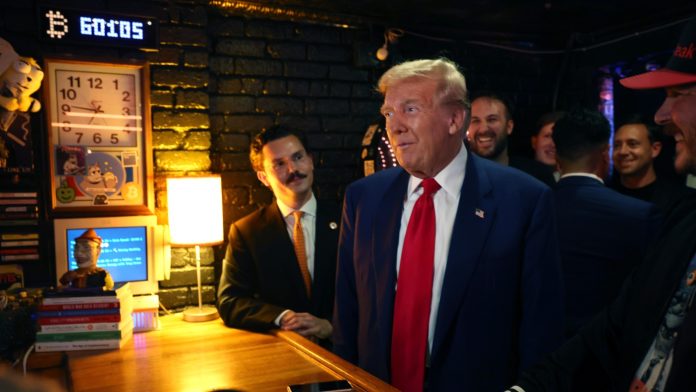
President Trump embraced cryptocurrency during his campaign, including during this visit to a cryptocurrency-themed bar called Pubkey in New York City on Sept. 18.

Spencer Platt/Getty Images


hide caption

toggle caption

Spencer Platt/Getty Images

The White House is hosting a summit on cryptocurrency on Friday, a first-of-its-kind event that is expected to highlight the significant shift in posture that the Trump administration is taking on crypto compared with its predecessors.

Trump, who has a financial stake in a crypto business called World Liberty Financial that he and his family launched in September 2024 and his own meme coin, promised on the campaign trail to make the United States the “crypto capital of the planet.”

The White House has not released any details about the format of the summit and who is attending, but the event will be hosted by White House AI and crypto czar David Sacks, as well as Bo Hines, who advises the White House on digital assets.

Sacks said on social media on Thursday evening that Trump had made good on a promise to create a cryptocurrency strategic reserve, signing an executive order to do so. It will be seeded with an estimated 200,000 bitcoins seized through court proceedings, and Trump authorized officials to look for “budget-neutral” ways to buy additional bitcoin for what Sacks described as a “digital Fort Knox.”

The government will also stockpile other types of digital assets seized in court actions, he said, but won’t seek to buy more of them.

Trump: “My attitude is different”

Trump has been critical of the Biden administration’s enforcement push through the Securities and Exchange Commission in trying to crack down on cryptocurrency.

“You have a very hostile SEC. … They’ve been very hostile toward crypto, toward all of it, and extremely hostile like nobody can believe,” Trump said in September. “My attitude is different. If we don’t do it, China’s going to do it. China’s doing it anyway.”

In recent weeks, his administration has rolled back investigations and lawsuits against crypto businesses, and Trump has announced he wants to create a government cryptocurrency strategic reserve. The Senate also voted to get rid of a Biden-era rule that required some crypto businesses to report information to the IRS.

The summit is one of the first steps in figuring out how to create a regulatory framework for cryptocurrency, says Campbell Harvey, a professor of finance at Duke University.

“Over the past four years, at least, the regulatory complex has been very combative, almost in a warlike situation, against the innovators in the space,” Harvey said. “So it’s time to step back and to look at the possible benefits of this new technology and weigh them against the costs.”

Trump Wants Europe to Defend Itself. Here’s What It Would Take.

0

President Trump has never had much love for the NATO alliance, which he thinks is overdependent on American largess, and in his first term, talked about abandoning the collective defense pact.

In his second term, Mr. Trump and his senior officials have made it clear that the security of Europe is no longer the first priority of the United States, which wants to concentrate resources on its own border and the Indo-Pacific, where China has become a peer rival.

On Thursday, Mr. Trump suggested that the United States might not protect NATO members that he believed were not paying enough for their own defense, calling it “common sense.”

But what would Europeans need to do to replace the enormous American contribution to NATO?

The answer comes down to money, personnel, time and cooperation with Washington, said Ivo Daalder, a former American ambassador to NATO and a coauthor of a recent report from Harvard’s Belfer Center on how to create “a strong European pillar” in the alliance.

The central problem is that NATO was built as an American-dominated alliance, intentionally dependent on American leadership, sophisticated weaponry, intelligence and airlift. The current NATO command structure is essentially owned and operated by the United States, led by Gen. Christopher G. Cavoli.

“The United States is the linchpin of the alliance so we could control our allies and get them to do what we want,” Mr. Daalder said. More practically, the United States military is the skeleton of NATO, and “if you suddenly pull out the skeleton, the body dies.”

Relative to other challenges, money is the easiest part of the European quandary. The question, as ever, is political will and commitment to spending larger sums — and the trade-offs and political costs it will entail.

Prime Minister Donald Tusk of Poland put it simply last week, saying: “500 million Europeans ask 300 million Americans to protect them from 140 million Russians.” What Europe lacks, he said, is “the belief that we are truly a global force.”

Friedrich Merz, who is on course to be the next chancellor of Germany, offered a bold response this week to the new pressures on Europe, proposing to spend nearly 1 trillion euros, or $1.07 trillion, on the military and infrastructure over the next 10 years.

Britain, Belgium, Poland and Denmark have also recently said they would spend more. On Thursday, E.U. leaders agreed to boost military spending outside normal debt limits. But overall, European nations remain far shy of the spending that experts say they will need to replace the American commitment.

Those estimates vary, but could mean a hike of €250 billion a year, or about 1.5 percent of the European Union’s gross domestic product, according to a study from two research institutions, Bruegel and the Kiel Institute for the World Economy.

The study recommends that European nations spend at least 3.5 percent of G.D.P. per year on the military; currently just five of 32 NATO members, including the United States, spend above 3 percent.

The Europeans possess a lot, but also need a lot more sophisticated weaponry, now largely provided by the United States. The biggest gaps are in integrated air and missile defense and long-range precision strike capability, said Ben Hodges, a former commander of the U.S. Army in Europe.

Europe also lacks “strategic enablers,” including transport aircraft, sophisticated drones and satellites — crucial systems for intelligence, surveillance and reconnaissance.

It has the capacity to produce more of its own weapons, he said. But that would require better coordination among nations to invest in the right industries and purchase jointly.

Ideally, Europe should have sufficient stocks of ammunition and missiles to fight a high-intensity war for at least six months, but those are badly depleted from the war in Ukraine.

A study by the International Institute for Strategic Studies found that even fundamentals like the number of combat battalions and in-service battle tanks have remained static or fallen since 2014, despite Russia’s annexation of Crimea.

Political will matters here, too — to overcome bureaucratic constraints and requirements on manufacturers.

The European Investment Bank is prohibited from providing loans to make weapons, though the European Union is rethinking the rule.

And German law requires that weapons makers have direct orders from the government before production can even start. That makes production for potential future sales impossible even if they have excess capacity now.

Right now, there are only about 100,000 U.S. troops in Europe — a number that could fit into the University of Michigan’s football stadium — said Mr. Hodges, who used to command them.

Yet it seems almost impossible that the Europeans, even if they increase military spending, could quickly replace the bulk of them, let alone fight on their own for any extended period.

Of the U.S. troops, 20,000 were sent to Europe after Russia invaded Ukraine three years ago, to shore up NATO deterrence. Analysts expect the Trump administration to pull out those troops before too long.

Another 40,000 of the U.S. troops, Mr. Hodges said, are in Europe on expensive rotations, which Mr. Trump is also likely to want to stop.

There are multiple problems for Europe in replacing such numbers.

Only a handful of European nations still have conscription forces. And attracting the right recruits is hard; pay scales and career prospects are better in the civilian world. Even once soldiers are trained, especially in high-tech warfare or “back office” jobs like engineering or mechanics, it is hard to retain them.

Recent suggestions that Europeans put troops into Ukraine to secure a potential peace deal would put extra strain on personnel, potentially for the long term.

NATO is already pressing members to meet requirements for a new force model. Under that agreement, more than 300,000 troops would need to be available within 30 days to reinforce the alliance’s eastern flank against Russia in the event of a crisis.

For now, there are simply not enough soldiers, logistics specialists and intelligence officers to go around.

“European armies are too small to handle even the arms that they’ve got now,” said Jim Townsend, a former U.S. deputy assistant secretary of defense who is now at the Center for a New American Security.

“The British and the Danes, to pick two examples, are good militaries, but they would not be able to sustain intense combat for more than a couple of weeks,” he said. “It doesn’t matter how good you are if there aren’t enough of you.”

The scale of what the Americans now handle for NATO is too big to replace quickly. To buy or produce the necessary equipment and recruit and train the necessary troops will simply take time.

In normal times, it would take a decade for Europe to catch up, said Camille Grand, a former NATO assistant secretary general, who wrote a detailed report about the problem for the European Council on Foreign Relations last year.

Today’s accelerated sense of urgency might help the Europeans do it a little sooner. But critics argue that Europe has waited far too long to respond to clear signaling from Mr. Trump’s first presidency, let alone to his Russia-friendly comments during the campaign.

American officials from both parties have been urging European allies to do more for their own defense for 50 years, and President Emmanuel Macron of France’s warnings in 2019 about fading American commitment to NATO were heard but largely unheeded.

The Europeans are finally trying to address the money problem. But they cannot magically reduce the time needed to make a transition from American domination of NATO in a way that would not damage their security sufficiently to tempt Russia to test the alliance.

Most importantly, it would require that the United States aid the transition and synchronize its withdrawals with the European buildup.

To move from a U.S.-dominated conventional defense of Europe to a European one could be very dangerous without American cooperation.

A sudden American withdrawal would be tremendously tempting for President Vladimir V. Putin of Russia, who wants to undermine NATO. The United States must be willing to wait to withdraw key capabilities until Europeans are ready to take them over, Mr. Daalder said.

Even in Ukraine, with its 900,000 soldiers helping to pin down the Russian army, a European commitment of even 30,000 to 40,000 peacekeeping troops could undercut NATO’s ability to deter Russia from testing the alliance in the Baltics, for example.

That has led some experts to suggest that a European force in Ukraine should be a NATO force, without U.S. troops on the ground, something Mr. Trump has in any case ruled out. But a NATO force, at least, could use existing NATO assets, like surveillance planes and intelligence capabilities, within the NATO command structure.

Others, like Max Bergmann of the Center for Strategic and International Studies, think it’s time to revisit the concept of a European army, which had long been opposed by the United States.

A unified army, he suggests, would go a long way to ending duplication and making spending more efficient. But who would command such an army, and under what political authority, are difficult questions to answer.

A standing European army, he argues, need not replace the United States in each capacity but could be integrated into NATO and be robust enough to do its main job: to deter Russia from invading member states.

After all, he notes, “Europe on paper has nearly 2 million personnel in uniform and spends roughly $338 billion per year on defense, more than enough to deter Russia and enough to make Europe collectively a military power.”

The short history of Trump’s tariff chaos — and more that happened this week : NPR

0

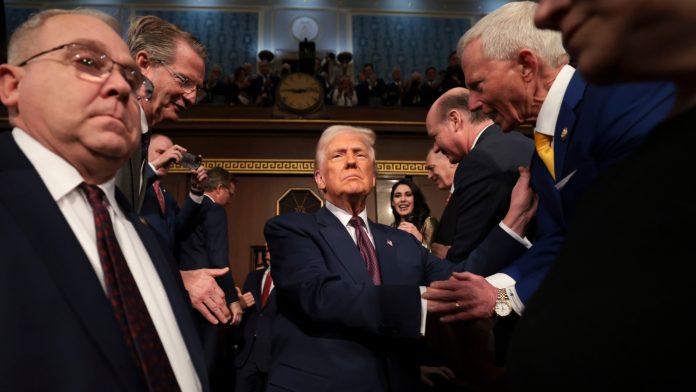
President Trump arrives for a joint session of Congress in the U.S. Capitol in Washington, D.C., on March 4.

Win McNamee/Bloomberg via Getty Images


hide caption

toggle caption

Win McNamee/Bloomberg via Getty Images

We’ll be recapping what you need to know every Friday morning for the first 100 days of the Trump administration. Get more updates and analysis in the NPR Politics newsletter.

After drops in the stock market, outcry from the Big Three automakers in the U.S. and a conversation with Mexico’s president, President Trump again reversed himself and is delaying tariffs against Mexico and Canada.

It was just the latest chapter in a chaotic rollout of one of Trump’s favorite economic tools, one that economists broadly say will lead to higher prices. Many tariffs on lots of goods are still in place, and the delay on the rest only extends until April 2, leaving companies and consumers unsure of what to expect, sometimes hour to hour.

“It may be a little bit of an adjustment period,” Trump said in his address to a joint session of Congress Tuesday, acknowledging economic repercussions that could result from tariffs, and he asked Americans, farmers in particular, to “bear with me.”

Here’s a look at just some of Trump’s back-and-forth on tariffs since taking office, leading up to this week:

Jan. 20: On the day of Trump’s inauguration, he promises tariffs on Mexico, Canada and China will be implemented Feb. 1.

Feb. 1: Trump signs executive order to implement tariffs on Canada, Mexico and China, set to start on Feb. 4. Canada announces retaliatory 25% tariffs.

Feb. 3: Trump delays tariffs on Canada and Mexico by a month. He says Mexico will send 10,000 troops to the U.S. border in order to curb migration, and he was trying to work out an economic structure with Canada.

Feb. 4: 10% tariffs are, in fact, put in place against China with China issuing retaliatory tariffs. The Postal Service puts a ban on packages from Hong Kong and China.

Feb. 5: The Postal Service reverses course and lifts the ban it put in place on Chinese packages because of the potential to create massive disruptions for online retailers and U.S. shoppers.

Feb. 10: Trump says he will impose 25% tariffs on steel imports from all countries, and he raises aluminum tariffs from 10% to 25%.

Feb. 13: Trump signs a memorandum that sets the stage for “reciprocal tariffs” to go into effect across the board on April 2.

Feb. 26: Trump says at Cabinet meeting he might give Canada and Mexico a one-month reprieve on tariffs until April 2.

Feb. 27: Trump reverses course and says they will go into effect March 4.

A line of trucks traveling into Canada are pictured at the Pacific Highway U.S.-Canadian border crossing in Blaine, Wash., on March 5.

A line of trucks traveling into Canada are pictured at the Pacific Highway U.S.-Canadian border crossing in Blaine, Wash., on March 5.

Jason Redmond/AFP via Getty Images


hide caption

toggle caption

Jason Redmond/AFP via Getty Images

March 1: Trump signs executive order to increase U.S. lumber production and orders probe into potential lumber import tariffs. The U.S. imports billions of dollars in lumber products from Canada.

March 2: Commerce Secretary Howard Lutnick says tariffs on Canada and Mexico remain a “fluid situation” and that they could be less than 25%.

March 3: Lutnick again says it’s possible the tariffs don’t go into effect, but Trump later confirms they will.

March 4: Trump levies 25% tariffs against Mexico, Canada and China. China hits the U.S. with retaliatory tariffs, including on some agricultural imports, including chicken, pork, soy and beef. Canadian Prime Minister Trudeau blasts Trump for cozying up to Russian President Putin and imposing tariffs against allies. He threatens to hit the U.S. with retaliatory tariffs; Mocking Trudeau as “governor,” Trump says he will hit back if that happens. The stock market tumbles in response. Lutnick says some of the tariffs could be rolled back as soon as the next day.

March 5: Trump delays tariffs related to autos until April 2.

March 6: Trump delays tariffs on Mexican goods. Later, he does the same for Canadian goods. The reprieve expires April 2.

Lots more happened this week — from Trump’s address to Congress, the suspension of aid and intelligence sharing with Ukraine, more firings at agencies, Health and Human Services Secretary Robert F. Kennedy Jr. talking up vitamins instead of vaccines to combat measles, and more.

The pace has been frenetic these first six weeks, but Trump made clear on Tuesday that it’s just the beginning.

“We are just getting started,” Trump said during his joint address, in which he focused heavily on the culture war issues that have made him popular with his MAGA base.

Here’s a day-by-day look at what happened since last Friday in a continuing effort to chronicle the major events and actions during the first 100 days the Trump administration:

Friday, Feb. 28:

  • Vice President JD Vance speaks before National Catholic Prayer Breakfast. Vance chided bishops over immigration earlier in February.
  • Health and Human Services Secretary Robert F. Kennedy Jr. moves to curtail the public comment process on health regulations.
  • FBI Director Kash Patel wants to form a training partnership with Ultimate Fighting Championship. UFC’s CEO Dana White is a supporter of Trump’s.
  • Another email is sent to federal workers asking what they did at work last week.
  • White House Oval Office meeting with Ukrainian President Volodymyr Zelenskyy descends into a shouting match. Trump says that Zelenskyy can come back to the White House “when he’s ready for peace.” 
  • Secretary of State Marco Rubio says Zelenskyy should apologize.
  • RFK Jr. plans for shake up in vaccine planning, Forbes reports.
  • Justice Department demotes prosecutors who oversaw Jan. 6 cases.
  • About 3,000 more troops to be sent to the U.S. southern border.
  • Politico reports that the Department of Education is offering a $25,000 for employees to resign by Monday.
The U.S. Department of Education headquarters is seen on March 6, in Washington, DC.

The U.S. Department of Education headquarters is seen on March 6, in Washington, DC.

Chip Somodevilla/Getty Images


hide caption

toggle caption

Chip Somodevilla/Getty Images

Saturday:

Sunday:

  • Defense Department stops offensive cyber operations against Russia, NBC News reports.
  • National Security Adviser Mike Waltz says on CNN that it is “going to take concessions on territory” from Ukraine for there to be a peace deal. He also says Russia will have to concede “security guarantees.” He says those would be “European-led.”
  • Lutnick suggests tariffs against Canada and Mexico could be less than 25%, calling it a “fluid situation.”
  • A Kremlin spokesman says Trump’s foreign policy “largely coincides with our vision.”

Monday: 

  • Study finds that car prices could spike by thousands if tariffs against Canada and Mexico go into effect. 
  • In an op-ed for Fox News, RFK Jr. touts the benefits of the measles, mumps and rubella vaccine, but also says, “The decision to vaccinate is a personal one,” and he contends, “Good nutrition remains a best defense against most chronic and infectious illnesses.”
  • Defense Department Secretary Pete Hegseth releases a video urging civilian employees at the department to respond to the email asking what they did the week before. The deadline to respond is Monday. 
  • Deadline for Education Department employees to accept the $25,000 buyout.
  • Trump goes after Zelenskyy on his social media platform for saying that the end to the war with Russia is far off. Trump said he’s not going to “put up with it for much longer!”
  • NSA Waltz says on Fox News that Zelensky needs to express regrets for the Friday meeting in the Oval Office and say that he wants peace in order to sign the mineral deal with the United States.
  • Trump announces that Taiwan Semiconductor Manufacturing Co. will spend $100 billion on creating chips in the U.S.
  • Commerce Secretary Lutnick again opens the possibility that the tariffs won’t go into effect Tuesday. “Let’s see how the president weighs that today,” he said on CNN. 
  • Trump, though, later says tariffs will, in fact, go into effect. 
  • Linda McMahon is confirmed as education secretary.
  • Trump pauses aid to Ukraine. 
  • DOGE deletes even more errors. 
  • Senate blocks ban on transgender athletes’ participation in school sports. 
  • The Justice Department says it’s reviewing the case of a former Colorado clerk who was found guilty on state charges of tampering with voting machines. She was sentenced to nine years in prison. 
  • James Dennehy, head of the New York FBI field office, resigns under pressure. He had sent an email last month telling agents to “dig in.”

Tuesday:

  • Tariffs to go into effect, markets plunge, prices expected to rise. China hits the U.S. with retaliatory tariffs. Canadian Prime Minister Justin Trudeau hits back at Trump. Trump again calls Trudeau “governor” on his social media platform and says that any tariffs imposed by Canada on the U.S. will see an equal increase from the U.S.  
  • Trump delivers an address to a joint session of Congress. He defends his actions and policies so far and says there’s more to come. Rep. Al Green, D-Texas, is escorted out of the chamber by the sergeant-at-arms for disrupting. Sen. Elissa Slotkin, D-Mich., gives the Democratic response, saying that making change is understandable but not “reckless” change. She invokes late-Republican President Ronald Reagan, saying she’s glad he was in charge during the Cold War and that Trump would have lost it. 
  • Russia hits Ukraine with hundreds of drone strikes.
  • Vice President Vance heads to Capitol Hill, says Trump wants Ukraine to come to the negotiating table. He says the administration is trying to “send a very explicit message” by cutting off aid. He falsely contends, as Trump has, that Europeans have been given a better deal. 
  • Zelenskyy sends a more conciliatory message to Trump, saying the White House meeting was “regrettable.” He touts Trump’s “strong leadership,” and says, “It is time to make things right” and that he is seeking “a peace that lasts.”
  • Reuters reported that Trump wanted to to sign the minerals deal with Ukraine before his address to Congress but that didn’t materialize.
  • Musk indicates he might be supportive of a pardon for Derek Chauvin, the police officer found guilty of killing George Floyd. Chauvin is serving multiple decades in prison on state charges.
  • Lutnick tells Fox News that Trump might pull back tariffs Wednesday. The stock market plummeted with the news of the tariffs being put in place. The Dow dropped 670 points. 
  • The Justice Department argues that pardons for those convicted for their actions on Jan. 6 cover other, unrelated crimes.
  • In a Fox News interview, RFK Jr. touts vitamins and cod liver oil as a way to treat or prevent measles. “The best thing Americans can do is keep themselves healthy. It’s very difficult for measles to kill a healthy person.” He said HHS is shipping doses of Vitamin A to Gaines County, Texas, where the measles outbreak is centered.
  • The Trump administration has plans to cut up to half of IRS workers, the New York Times, CNN and others report.
  • Trump threatens to cut off potentially $50 million in funding to Columbia University for not doing enough to combat anti-semitism.
  • The Government Services Administration posts a list of 440 properties up for lease from the federal government, but hours later, the list was revised with 120 of those listings taken off.
  • Musk meets with Republicans on Capitol Hill to discuss turning DOGE cuts into law.

Wednesday:

  • U.S. suspends intelligence sharing with Ukraine. “We have taken a step back and are pausing and reviewing all aspects of this relationship,” Waltz says. He adds that he had a good conversation with his Ukrainian counterpart on where the next round of negotiations would take place and what they’d include. “I think we are going to see movement in short order” and Ukraine will “come to the table.”
  • The Supreme Court rejects Trump’s bid to not pay USAID contractors; many in MAGA movement online go after Justice Amy Coney Barrett for siding with Chief Justice John Roberts and liberals, derisively referring to her as a “DEI” justice.
  • Trump and Trudeau speak. Lutnick again says some tariffs could be rolled back with a one-month exemption related to autos. Reciprocal tariffs would take place April 2. White House Press Secretary Karoline Leavitt says the heads of Stellantis, Ford and GM called the president to discuss. Trump said in his address to Congress: “Spoke to the majors today, all three, the top people, and they’re so excited.” 
  • Musk’s “Starlink” stands to benefit from the Commerce Department’s overhaul of “Internet for all.” 
  • Reuters reports that the Trump administration plans to fire 80,000 workers at Veterans Affairs.
  • A federal judge temporarily blocks certain NIH funding cuts.
  • USDA freeze on funding for already awarded grants for things like solar panels to make greenhouses work year round is affecting farmers.
  • Nearly 6,000 fired USDA workers are ordered back to work.
  • Washington, D.C.’s matter decides to paint over Black Lives Matter plaza after talks with the White House.
  • Trump warns Hamas on social media to release remaining hostages “or it is OVER for you.” Hamas responds, saying that Israel is backing out of the original ceasefire deal and not engaging in negotiation for the next round of hostages to be released. The U.S. is in direct communication with Hamas.
  • Big-city mayors push back on GOP immigration policy at congressional hearing. 
  • Hamilton cancels at Kennedy Center, citing the partisan policies that led to a Trump takeover of the center. 
  • Trump nominee to be NIH director faces scrutiny during Senate hearing. He says he’s open to research about vaccines and autism —- for which there is no link and he said he does not believe there is one, but he didn’t want to offend some who think otherwise. That outraged Sen. Bill Cassidy, a Republican and a doctor, who told him sometimes people need to hear the truth. “Some people think Elvis is alive,” Cassidy said. 
  • Trump is prepping executive action to shut down the Department of Education. 
  • The U.S. Court of Appeals for the District of Columbia removed Hampton Dellinger as Special Counsel of the U.S. Office of Special Counsel — an agency which works to protect the rights of federal workers — as the legal challenge to his firing continues.
  • Gov. Gavin Newsom, D-Calif. breaks with other Democrats on trans athletes in girls’ school sports on podcast with Charlie Kirk. He said it’s an issue of “fairness,” and he criticized 2024 Democratic nominee Kamala Harris’ response to an anti-transgender ad that many believe hurt her campaign.
  • The Centers for Disease Control and Prevention reverses about 180 firings, asking them to come back to work.
  • A Musk-backed group is running deceptive ads in a Wisconsin state Supreme Court race that are made to look like they’re coming from or boosting the Democrat in the race. Democrats have tried to make the race something of a referendum on Musk.
  • Trump personal lawyer Todd Blanche confirmed, 52-46, as deputy attorney general.
  • The State Department will stop sharing air-quality data from its embassies and consulates around the world that other countries and scientists used.
  • New Zealand’s top diplomat in the U.K. was removed from his post after critical comments of Trump and comparisons to appeasement before World War II when some advocated for Hitler taking parts of the then-Czechoslovakia. 
  • The Wyoming legislature overrides the Republican governor’s veto of a law requiring an ultrasound for women planning to have an abortion by pill.

Thursday: 

  • White House Press Secretary Leavitt says reports of Trump preparing to sign an executive order to dismantle the Department of Education is “fake news.” 
  • The House votes to censure Rep. Al Green, D-Texas, over his protest in the House chamber during Trump’s address to a joint session of Congress on Tuesday.
  • Hampton Dellinger, who has challenged the Trump administration’s decision to fire him as head of the U.S. Office of Special Counsel, which protects whistleblowers and those fired without cause, says that his legal battle is “now over.” He said: “I think the circuit judges erred badly because their willingness to sign off on my ouster — even if presented as possibly temporary – immediately erases the independence Congress provided for my position, a vital protection that has been accepted as lawful for nearly fifty years. Until now. And given the circuit court’s adverse ruling, I think my odds of ultimately prevailing before the Supreme Court are long.”
  • Ipsos finds economic confidence has dropped 14 points since November. 
  • Trump announces on social media that he will exempt more imported goods from Mexico from his 25% tariffs on Mexican goods. “I did this as an accommodation, and out of respect for, President Sheinbaum.” 
Mexico's President Claudia Sheinbaum speaks during her daily press conference at the National Palace in Mexico City on March 6.

Mexico’s President Claudia Sheinbaum speaks during her daily press conference at the National Palace in Mexico City on March 6.

Alfredo Estrella/AFP via Getty Images


hide caption

toggle caption

Alfredo Estrella/AFP via Getty Images

  • Trump says he’s deciding on whether to revoke temporary legal status for Ukrainian refugees. There are about 240,000 Ukrainians in the U.S., who fled after Russia’s invasion.
  • Trump is moving to make big changes at Voice of America, led by Kari Lake, an ex-local-TV-anchor-turned-Trump-ally, who lost bids for both governor and U.S. Senate.
  • A Columbia University student received notice from the university that she was being investigated for antisemitic harassment. She wrote an op-ed in the school newspaper, calling Israel’s actions in killing tens of thousands of Gazans after Hamas’ Oct. 7 massacre a “genocide.”
  • The Trump Justice Department drops an Idaho case about the right to an emergency abortion. The Biden Justice Department had argued the emergency rooms were required to perform the procedures if the life of the mother or serious health consequences were at stake.
  • The Army says 1,140 more troops are set to be sent to the southern border.
  • Trump appears to rein in DOGE, saying now that his Cabinet is in place, he wants to see more coordination with agency heads and a “scalpel” rather than “hatchet” approach. When asked about DOGE in the Oval Office by reporters, he says he wants “good people” to be kept and underperforming ones to be fired, like those who don’t show up to work. But he also backed Musk’s efforts so far. “I think they’ve done an amazing job,” he says and then repeats false claims that many dead people are getting checks, and he speculates that there were “probably kickbacks” federal workers were taking from the billions DOGE is claiming to have saved.

Unexploded World War II Bomb Found at Gare du Nord in Paris Halts Trains

0

Traffic ground to a halt at one of France’s busiest train stations on Friday after an unexploded World War II bomb was uncovered just north of Paris, the authorities said.

The bomb was discovered overnight in the Saint-Denis suburb near tracks that lead into the Gare du Nord, a major Parisian transit hub that serves northern France and Europe.

Traffic on high-speed and commuter railways was stopped for hours as the Paris police sent in mine-sweeping crews to clear out the bomb. Eurostar trains, which connect France to Britain, Belgium and the Netherlands, were also disrupted, stranding travelers at the station, which served over 226 million travelers in 2023.

“Trains from and to Gare du Nord are halted until midafternoon at the request of the police,” France’s national railway company said in a travel notice on Friday.

The type of bomb and the circumstances of its discovery were not immediately clear.

Philippe Tabarot, France’s transportation minister, told Sud Radio that there were “no worries” regarding the situation, but that the authorities were taking all necessary precautions to safely remove the bomb.

“Clearing out abandoned luggage happens occasionally, but it’s rather rare for bombs from World War II,” Mr. Tabarot said, adding that he expected train traffic to remain disrupted throughout the day.

It is not uncommon in Europe for construction workers to come across unexploded ordnance from the conflicts that tore the continent apart during the 20th century, but it is rarer to find them in highly populated areas.

Last month, more than 175 practice bombs that had been used for training in the Second World War were found under a children’s playground in northern England. In 2018, thousands of people were evacuated in Berlin after an 1,100-pound World War II-era bomb was uncovered.

Rep. Al Green, D-Texas, censured for protesting at Trump's address to Congress

0

Rep. Al Green, D-Texas, says his protest at President Trump’s Tuesday address to Congress was about standing up for constituents. Ten fellow House Democrats voted with Republicans to censure him.