Thursday, November 12, 2026
Home Blog Page 150

Brisbane and Eastern Australia Brace for Powerful Cyclone Alfred

0

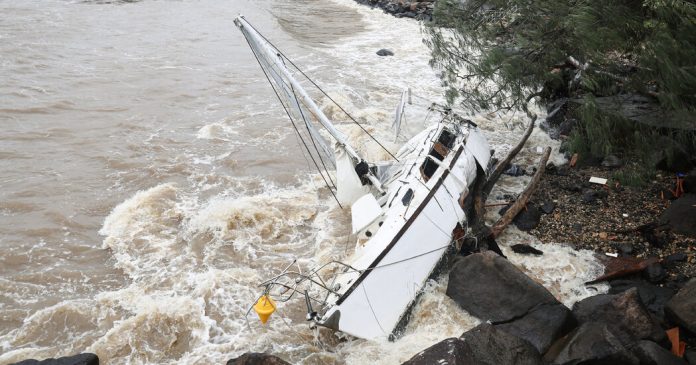
At least 15,000 people were ordered to evacuate, tens of thousands more were without power and flood rescues were already underway in a swath of Australia’s eastern coast in the track of Tropical Cyclone Alfred, projected to be the first to make landfall in the region in decades.

Alfred was expected to come ashore Saturday morning near Brisbane, the capital of Queensland state and home to about 2.7 million people. As of Friday afternoon, it was hovering about 80 miles off the coast of the city and already causing flooding with abnormally high tides.

To the south, in the neighboring state of New South Wales, local officials said about 29,000 dwellings were considered at risk of flooding as of Friday afternoon, with about 15,000 people in the state under evacuation orders. The authorities counted about 38,000 in the state without power and 46,000 in Queensland.

Officials warned that the storm’s slow churn westward, moving about 5 miles per hour on Friday, could amplify its impact on coastal communities by prolonging the rainfall and storm surges. Among the areas threatened by the storm is Lismore, a small city about eight hours north of Sydney which suffered devastating floods in 2022 in which 22 people died.

On Friday, Alfred was already hitting coastal areas with damaging wind gusts up to 75 miles per hour. And, forecasters warned, there was a danger of life-threatening flash-flooding even before it made landfall. It would be the first cyclone to come ashore along the southeastern coast of the state of Queensland since 1974, according to Australia’s Bureau of Meteorology.

Hundreds of schools and multiple airports were already closed and public transportation suspended in southern Queensland and northern New South Wales earlier in the week. Grocery store shelves have been emptied by shoppers and people formed long lines to get sandbags as the cyclone, originally expected to remain offshore, changed course and began advancing toward land.

Even as authorities were warning about the danger ahead, the record swell brought droves of devoted surfers to the coast in recent days, along with crowds to watch them ride the cyclone-powered waves.

Prime Minister Anthony Albanese said Thursday that he would approve emergency federal funds for the states of Queensland and New South Wales for post-storm recovery efforts.

China’s foreign minister slams Trump’s ‘two-faced’ policies : NPR

0

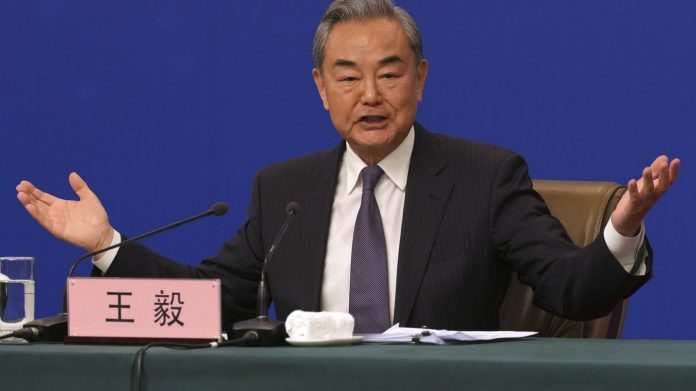
Chinese Foreign Minister Wang Yi speaks during a press conference on the sideline of the National People’s Congress in Beijing on Friday.

Ng Han Guan/AP


hide caption

toggle caption

Ng Han Guan/AP

BEIJING — China’s top foreign policy official, Wang Yi, cast Beijing as a force for good and blasted the U.S. for being “two-faced” at a news conference during China’s annual session of parliament on Friday.

Last month, the Trump administration imposed a 10% tariff on all Chinese imports to the U.S., and on Tuesday added another 10%, arguing that China needs to do more to stop the flow of the deadly opioid fentanyl into the U.S.

China has accused Trump of using fentanyl as a pretext to threaten the country economically and Beijing has retaliated with counter-tariffs and other measures.

Wang addressed the escalating trade war with the U.S. and promoted China as an “anchor” on the global stage as America retreats from international involvement. Here’s what he had to say on five key issues.

China’s relationship with the U.S.

Wang, who is a member of the elite Politburo and the country’s foreign minister, had very little positive to say about China-U.S. relations, and instead offered criticisms of America’s policies and exhortations to mend its ways.

Wang said the combination of tariffs on Chinese goods and President Trump’s expressions of willingness to have good relations with Beijing were incongruous.

“No country should expect to suppress and contain China on one hand while developing a good relationship with it on the other. Such a two-faced approach not only undermines the stability of bilateral relations but also fails to build mutual trust,” he said.

On fentanyl, Wang said the problem is fundamentally the responsibility of the U.S.

“In the spirit of humanitarianism, China has provided various forms of assistance to the U.S., and the U.S. should not repay goodwill with resentment or impose unjustified tariffs. This is not the behavior of a responsible major power,” he said.

Wang said science and technology “should not be tools for building iron curtains” — a reference to a range of U.S. policies, including bans on the sale to China of the most advanced microchips.

“Wherever there is a blockade, there will be breakthroughs; wherever there is suppression, there will be innovation,” Wang said. “High walls cannot block innovative thinking; decoupling and severed links will only isolate those who impose them.”

More broadly, Wang took aim at the United States’ confrontational approach to China.

“The U.S. should review what has been gained from years of tariff and trade wars. Has the trade deficit been reduced or increased? Has the competitiveness of manufacturing risen or declined? Has inflation improved or worsened? Have the lives of the people improved or deteriorated? Sino-U.S. economic and trade relations are mutual and reciprocal. Cooperation will lead to mutual benefit and win-win results, but if one side insists on pressure, China will take resolute countermeasures,” he said.

Trump’s “America First” foreign policy

Wang was asked directly if Trump’s retreat from multilateral forums, freezing of foreign aid and strained relations with allies presented a strategic opening for China on the global stage. He demurred.

“Imagine if every country prioritized itself above all else and placed blind faith in power and status — this world would regress to the law of the jungle, where smaller and weaker nations would bear the brunt of instability, and the international order and rules-based system would face severe disruption,” Wang said.

He said major powers have a responsibility to fulfill their international obligations and act with accountability. “Pursuing self-interest at the expense of others, or wielding power to intimidate, is unacceptable,” Wang said.

China’s stability will help “anchor an uncertain world.”

China-Russia relations

President Trump’s tilt toward Russia has raised questions about him doing a possible “reverse Nixon”, i.e. cozying up to Moscow to isolate Beijing, flipping President Nixon’s script from the early 1970s when America engaged in detente with China to pressure the Soviet Union, its primary Cold War rival.

But Wang said “the historical logic” of China’s good relations with Russia was steadfast.

“I want to emphasize that regardless of changes in the international landscape, the historical logic of the China-Russia friendship remains unchanged, and the internal driving forces behind our relationship remain strong,” Wang said.

“Both sides have deeply reflected on historical experiences and have committed to long-term good-neighborly relations, comprehensive strategic coordination and mutually beneficial cooperation. This approach best serves the fundamental interests of both peoples and aligns with the broader trends of global development and progress. China and Russia have established a unique model of engagement — one that is non-aligned, non-confrontational, and not directed at any third party,” he said.

Wang said a “mature, resilient, and stable” relationship “will not change due to temporary events, nor will it be swayed by external influences. It is a constant in an uncertain world, not a variable in geopolitical competition.”

Ukraine war

China has tried to position itself as a potential mediator able to help bring the war in Ukraine to an end, but since Trump’s foreign policy shift toward Russia, Beijing has been left largely on the sidelines.

“China welcomes and supports all efforts aimed at achieving peace. However, it is also important to recognize that this crisis has deep and complex historical roots — it was not created overnight, and it cannot be resolved overnight,” Wang said.

He said China is willing to work with the international community “in line with the wishes of the relevant parties, to play a constructive role in achieving a lasting resolution.”

“The world must move toward a new security vision based on common, comprehensive, cooperative, and sustainable security. Only by doing so can we achieve lasting peace and stability — not just in Eurasia, but across the entire world,” he said.

Gaza

Wang was unequivocal when asked about Trump’s plan to boot Palestinians from Gaza and turn the territory over to the U.S. to develop.

“Gaza belongs to the Palestinian people and is an inseparable part of Palestinian territory,” Wang said.

“Any attempt to forcibly change Gaza’s status will not bring peace but will only trigger further turmoil… The will of the people must not be violated, and justice cannot be ignored. If great powers truly care about the people of Gaza, they should push for a comprehensive and lasting ceasefire, increase humanitarian aid, uphold the principle of ‘Palestinians governing Palestinians,’ and contribute to Gaza’s reconstruction,” he said.


At Least 70 Killed as Syria’s Security Forces Clash With Assad Loyalists

0

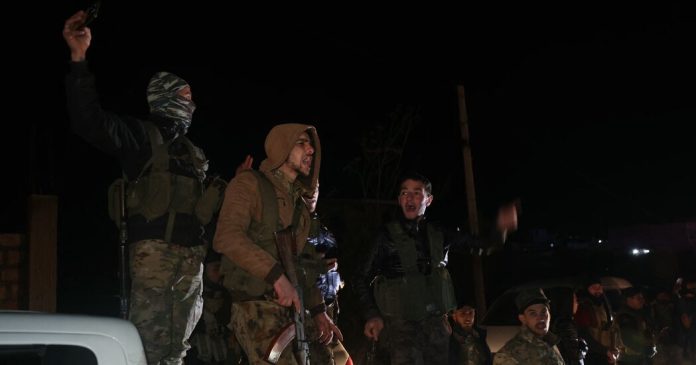
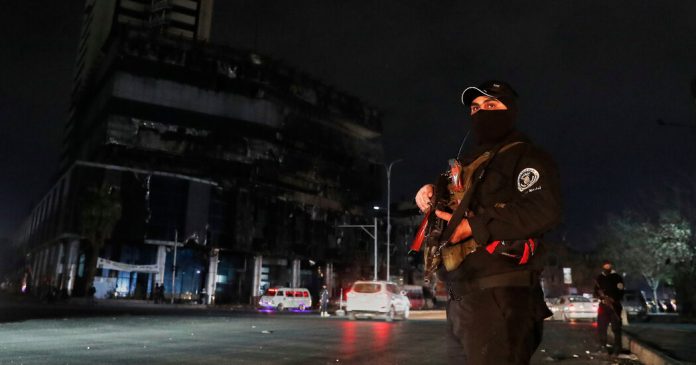
At least 70 people were killed and dozens wounded in overnight clashes between the new authorities in Syria and gunmen loyal to the ousted dictator Bashar al-Assad, a war monitor said, in the bloodiest skirmishes since the collapse of the Assad government.

The fighting unfolded in Latakia and Tartous provinces, longtime strongholds for Mr. al-Assad along Syria’s Mediterranean coast. It came hours after the killing of 16 security personnel by Assad loyalists in the Latakia countryside on Thursday afternoon, the deadliest attack yet on Syria’s new security forces.

Thousands of protesters flooded streets in the cities of Latakia and Tartous to demand that government forces stand down and withdraw from the countryside, the first wide-scale demonstrations against the new authorities since they assumed power in December.

The government deployed more security forces to the coast late Thursday night to restore order. On Friday morning, government convoys were patrolling the roads of both cities, and residents were told to stay home as security forces conducted “combing operations” aimed at armed remnants of the Assad regime, according to state media.

“Thousands have chosen to surrender their weapons and return to their families, while some insist on fleeing” justice and continuing to fight, a spokesman for the Syrian Ministry of Defense, Col. Hassan Abdul Ghani, told the state-run Syrian Arab News Agency. “The choice is clear: Lay down your weapons or face your inevitable fate,” he added.

The flaring tensions have become a critical test for Syria’s new leaders, whose rebel coalition toppled the Assad regime and installed an Islamist transitional government that has sought to consolidate control.

The coastal provinces have posed a significant challenge for the Sunni Muslim-led government as it exerts its authority. The region is the heartland of Syria’s Alawite minority, including the Assad family.

Despite making up only 10 percent of the country’s population, the Alawites exerted outsized influence over the country during the Assad family’s more than 50 year rule. The Alawites, who practice an offshoot of Shiite Islam, dominated the ruling class and upper ranks of the military under the Assad government.

Since seizing power, Syria’s new leaders have faced sporadic hit-and-run attacks on their forces in Latakia and Tartous by armed men affiliated with the Assad government.

The new government has called on all members of Mr. al-Assad’s security forces to relinquish their ties to the former government and surrender their weapons and vehicles to the new authorities at “reconciliation centers.”

The authorities have not promised blanket amnesty to those who do so, and many remnants of the former government have refused to take part in the process.

The overnight skirmishes came hours after security personnel conducted an operation in the Latakia countryside to arrest an official from the Assad government, according to a government official who asked not to be identified because he was not authorized to speak to the news media.

As the security forces left one village, Beit Aana, gunmen ambushed their convoy, said village residents and the official. At least 16 security personnel were killed, according to the war monitor, the Syrian Observatory for Human Rights.

The Beit Aana ambush sparked additional clashes between government forces and armed Assad loyalists in rural Latakia.

Artillery and machine-gun fire rang out across the area throughout the afternoon as hundreds of people from Beit Aana and nearby villages fled to the countryside, the residents said. It was not immediately clear whether any civilians or Assad loyalists had been killed.

As news of the clashes spread, protests erupted in major cities across Syria, some supporting the government and others demanding that its forces stand down on the coast.

In Tartous, a port city, protesters chanted, “One, one, one — Tartous and Jableh are one,” referring to the area, Jableh, where the clashes had unfolded, according to residents.

In other parts of the country, including the cities of Homs and Idlib, thousands of people joined protests to support the government. Some called for a crackdown on armed remnants of the Assad government.

The authorities imposed a curfew from 10 p.m. Thursday to 10 a.m. Friday in many major cities, according to the Syrian Arab News Agency.

By Friday morning, few people in Tartous and Latakia seemed to be venturing outside their homes as the security convoys patrolled the streets.

Reham Mourshed contributed reporting.

Court orders South Korean President Yoon released from jail : NPR

0

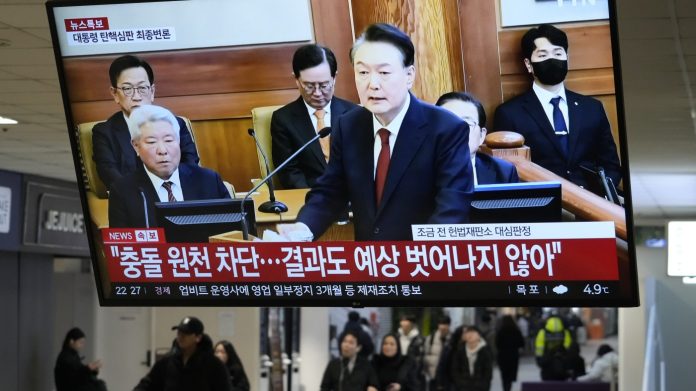
A TV screen shows footage of impeached South Korean President Yoon Suk Yeol’s address at the final hearing of his trial during a news program at a bus terminal in Seoul, South Korea on Tuesday, Feb. 25, 2025.

Ahn Young-joon/AP


hide caption

toggle caption

Ahn Young-joon/AP

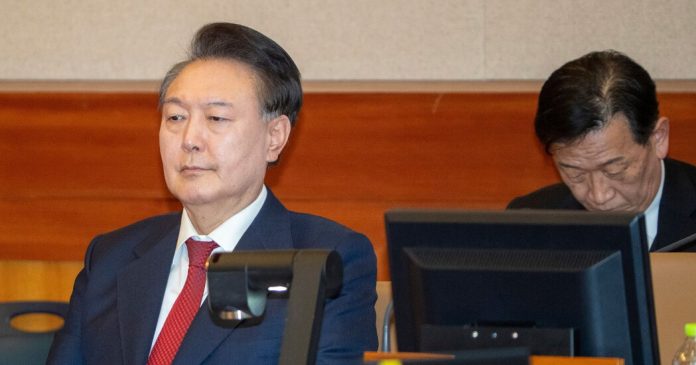
SEOUL, South Korea — A South Korean court on Friday ordered impeached President Yoon Suk Yeol to be released from jail, more than a month after he was arrested and indicted over his short-lived imposition of martial law.

The decision by the Seoul Central District Court would allow Yoon to stand his criminal trial while not being physically detained. The hearings in his impeachment trial concluded in late February and the court is expected to rule soon on whether to uphold his impeachment or remove him from office.

The Seoul Central District Court said it accepted Yoon’s request to be released from jail because the legal period of his formal arrest expired before he was indicted in late January. The court said the investigative agency that detained Yoon before his formal arrest didn’t have legal rights to investigate the criminal rebellion charges.

Investigators have alleged that the martial-law decree amounted to rebellion. If he’s convicted of that offense, he would face the death penalty or life imprisonment.

Yoon’s martial law decree, which involved the dispatch of troops to the National Assembly, evoked traumatic memories of past military rules among many South Koreans. The decree lasted only six hours as enough lawmakers managed to get into an assembly hall and voted to overturn it unanimously. Yoon later argued his decree was only meant to inform the people of the danger of the main liberal opposition Democratic Party, which undermined his agenda and impeached top officials.

If the Constitutional Court upholds Yoon’s impeachment, he will be officially thrown out of office and a national election will be held to choose his successor within two months.

South Korean Court Orders Impeached President’s Release From Jail

0

A South Korean court on Friday ordered the release from jail of Yoon Suk Yeol, the country’s impeached president, who is standing trial on insurrection charges over his decision to impose martial law in December.

The Seoul Central District Court ruled that prosecutors had violated procedural rules by holding Mr. Yoon in detention longer than legally allowed before indicting him last month.

But Mr. Yoon was not immediately freed from the detention center south of Seoul where he is being held, said one of his lawyers, Seok Dong-hyun. Prosecutors have a week to appeal the ruling, during which time Mr. Yoon will remain in custody, Mr. Seok said.

Mr. Yoon was detained on Jan. 15 and formally indicted 11 days later on the insurrection charges, which stem from his short-lived imposition of martial law in December. His lawyers have fought since then to get him freed from jail, making the argument that a three-judge panel accepted on Friday: that prosecutors had held Mr. Yoon longer than the law permitted.

The ruling was limited to a narrow dispute over whether prosecutors had followed all procedures correctly when they arrested and indicted Mr. Yoon. It did not address the charges that Mr. Yoon faces at his criminal trial.

Mr. Yoon unexpectedly declared martial law on Dec. 3, accusing the opposition-controlled National Assembly of “paralyzing” his government. The assembly voted against his martial law decree, forcing him to rescind it after about six hours. But it has set off South Korea’s worst political crisis in decades.

As protesters called for Mr. Yoon’s ouster, the Assembly impeached him on Dec. 14, suspending him from office. The country’s Constitutional Court is deliberating whether the impeachment was legitimate and if he should be formally removed from office. Separately, criminal investigators detained Mr. Yoon on the insurrection charges.

He is the first president in South Korean history to face criminal charges while still in office.

Friday Briefing

0

Talks about Ukraine.

Defunded Aid Programs Are Asked by Trump Administration to Prove Their Value, on a Scale of 1 to 5

0

Last week, the Trump administration terminated nearly all of the United States’ foreign aid contracts after telling a federal court that its review of aid programs had concluded, and it had shut down those found not to be in the national interest.

But over the last few days, many of those same programs have received a questionnaire asking them for the first time to detail what their projects do (or did) and how that work aligns with national interests.

The survey, obtained by The New York Times, is titled “Foreign Assistance Review.” Some agencies received it with instructions stating that data collected will “support the next stage of the administration’s foreign assistance review.” The deadlines given for returning the surveys range from March 7 to March 17.

Many of the projects under scrutiny have already fired their staff and closed their doors, because they have received no federal funds since the review process ostensibly began. President Trump issued an executive order freezing aid on Jan. 20, pending a review. Within some organizations, there are no staff members left to complete the survey.

The distribution of the survey is the latest twist in an eight-week-long roller coaster ride for aid organizations. The chaos began with a stop-work order for employees and contractors of the United States Agency for International Development and a freezing of all funds, including reimbursements for hundreds of millions of dollars already spent. That was followed by a process allowing organizations that provided lifesaving medical treatment and food aid to seek a waiver allowing them to continue their work.

Then came terminations, last Wednesday, of more than 5,000 projects and programs. Since then, some projects have been told they were fully restored, and others that they are restored only to the terms of their original waiver, which runs out next month. Almost none have seen any of the funds they are owed unfrozen.

On Wednesday, the Supreme Court ruled that the administration must heed a lower court’s order to release frozen foreign aid. However, that ruling came after thousands of projects had already been bankrupted by the eight-week-long freeze.

The new questionnaire had been sent to many organizations before the Supreme Court ruling. The State Department did not respond to a request for comment.

“This whole process is baffling: first we were asked to restart lifesaving programs, but we haven’t been given money to do it, and now we’re being asked to review programs which were, in theory, previously reviewed and already terminated,” said Christy Delafield, a spokeswoman for FHI 360, an organization providing health and humanitarian aid in 60 countries.

The new surveys ask grant recipients — including thousands of emergency food aid, malaria control and tuberculosis treatment projects — more than 25 questions on how their projects contribute to U.S. national interests. It also provides a checklist that includes some of the Trump administration’s top political goals, including stopping illegal immigration and defending “against gender ideology.”

It allows answers of up to 150 characters (about 35 words), and awards from 1 to 5 points based on how well a project serves each goal.

Among the survey questions, quoted verbatim below:

  • Can you confirm that this is not a DEI project and that there are no DEI elements of that project?

  • Can you confirm this is not a climate or “environmental justice” project or include such elements?

  • How much does this project directly impact efforts to counter malign influence, including China?

  • What impact does this project have on limiting the flow of fentanyl, synthetic drugs, and precursor chemicals into the U. S.?

  • Does this project directly impact efforts to strengthen U.S. supply chains or secure rare earth minerals?

  • Does this project directly contribute to limiting illegal immigration or strengthening U.S. border security?

In a sworn statement on Feb. 26 responding to a lawsuit filed by aid organizations, Peter Marocco, the State Department official who has been overseeing the cuts to U.S.A.I.D., stated that “the process for individually reviewing each outstanding U.S.A.I.D. obligation has concluded” and that Secretary of State Marco Rubio had “now made a final decision with respect to each award.” He indicated that approximately 297 State Department contracts (rather than grants) were still to be reviewed.

In a March 5 filing, the government said it had “nearly completed an individualized review of existing contracts and grants” and that “nearly all” of the State Department and U.S.A.I.D.’s foreign aid funding had been “individually reviewed.”

In a report on compliance with a court order submitted March 6, the government said that “most of” the contracts “have been individually reviewed.”

David A. Super, a professor of law at Georgetown University, said that by repeatedly saying they had conducted an individualized review when there was little evidence they had done so, state department staff members were “exposing themselves to contempt of court and their attorneys to serious consequences.”

While it was not a requirement that the review involved collecting information from grant recipients, by sending out this questionnaire, the government has implied that it does require the information, he added.

“Here they are saying that to know whether your activities support the foreign policy of the United States, we need to know these things, but we didn’t know these things when we performed our review,” he said.

The survey was sent to projects that were funded through 32 different U.S.A.I.D. divisions, including the Bureau of Global Health, the Bureau for Food Security, the Office of the Chief Economist and the Bureau for Democracy, Human Rights, and Governance.

Karoun Demirjian contributed reporting.

Deadly Clashes Pose Test for Syria’s New Leaders

0

At least 16 security personnel were killed on Thursday by gunmen loyal to Syria’s ousted dictator Bashar al-Assad, a war monitor said, in one of the deadliest clashes for Syria’s new leaders since the collapse of the Assad government.

The attack in Latakia Province, long a stronghold for Mr. al-Assad along Syria’s Mediterranean coast, set off an hourslong clash between government forces and the gunmen. It also prompted protests across the coastal region, with thousands calling on government forces to withdraw from the area.

“I heard some demonstrators threatening to return with weapons,” said Alaa Mousa, 30, a resident of Tartous, a port city. He said he felt like “the situation is on the verge of collapse.”

The clashes were among the most violent since a rebel coalition toppled the Assad government in December and installed an Islamist transitional government that has sought to exert its authority across the fractious country.

The coastal region has emerged as one of the most challenging areas for the Sunni Muslim-led government. It is the heartland of Syria’s Alawite minority, which includes the Assad family. The Alawites, who practice an offshoot of Shiite Islam, make up around 10 percent of Syria’s population and dominated the ruling class and upper ranks of the military under the Assad government.

The flaring tensions have become a critical test for the country’s new leaders.

Ibrahim al-Assil, a senior fellow at the Middle East Institute in Washington, said that if government forces “act in a disciplined manner, they might succeed in restoring order and maintain popular support.” But, he said, if “individual fighters or rogue units engage in revenge attacks against locals, the situation could spiral into sectarian clashes, further destabilizing the country.”

The clashes began Thursday afternoon as security personnel for the new government were conducting an operation in the countryside of Latakia, according to the war monitor, the Syrian Observatory for Human Rights. The security personnel were trying to arrest an official from the Assad government, according to a government official who asked to remain anonymous because he was not authorized to speak to the press.

Upon leaving one village, Beit Aana, the government forces were ambushed by gunmen and several were killed, according to two village residents.

The ambush sparked additional clashes between government forces and armed men loyal to Mr. al-Assad in that village and surrounding areas, according to the Syrian Observatory.

Artillery and machine-gun fire were heard throughout the afternoon, and at least one helicopter fired on the village, according to the war monitor and the two residents. The chaos prompted hundreds of people from Beit Aana and nearby villages to flee to the nearby countryside, the residents said.

It was not immediately clear if any civilians or the gunmen were killed.

The clashes prompted protests across Syria’s western coast, with thousands pouring into the streets of Latakia City, the provincial capital, and nearby Tartous, and calling for government forces to withdraw from the Latakia countryside.

In Tartous, protesters gathered around Al-Assadi Square, chanting “One, one, one — Tartous and Jableh are one,” referring to the area, Jableh, where the clashes had unfolded, according to residents. Outside one government building, government security forces fired into the area to try to disperse the crowd.

Protests by people who support the new government also erupted in major cities, including Homs and Idlib. The rebel coalition now in control of Syria governed Idlib in the later years of the country’s civil war.

On Thursday evening, the Syrian authorities announced a curfew from 10 p.m. to 10 a.m. Friday in many major cities, according to the Syrian Arab News Agency, the state media. The government also deployed additional security forces to the coast.

Late Thursday night, most streets in Tartous had emptied, with people obeying the curfew. But the city remained tense.

“This calm seems to be the calm before the storm,” Mr. Mousa said.

Reham Mourshed contributed reporting.

Trump’s Tariffs by Whim Keep Allies and Markets Off Balance

0

When the White House finally released the text of Mr. Trump’s orders on Thursday evening, it appeared that some of the tariffs — those covered in the U.S.-Mexico-Canada trade agreement that Mr. Trump negotiated and celebrated in his first term — were indeed permanently suspended. Other tariffs were merely paused.

Most everyone involved was confused, which may well have been the point.

As Mr. Trump hands down tariff determinations and then pulls them back for a month or so, world leaders call to plead their case, a bit like vassal states appealing to a larger power. Chief executives put in calls as well, making it clear that Mr. Trump is the one you need to deal with if you are bringing in car parts from Canada or chips from China.

And the president responds, as if he is granting reprieves, though not pardons. If, in a usual presidency, tariffs are debated by layers of experts and aides, their potential impact weighed with care, in the Trump White House the determinations are part whim, part weave, part pique. Explanations for what triggered the imposition of tariffs shift, and decisions to delay or suspend them are not accompanied by detailed rationales. Mr. Trump himself says he makes the call based on his latest conversations.

“This was a short-term deal,” he told reporters in the Oval Office on Thursday afternoon, when asked about his calls the previous day with top executives of American car makers. “They came back to me yesterday. They said, ‘Could we have some help on the tariffs because of the speed?’ And I said, ‘Look, I’m going to do it, but that’s it.’ They’ll come back to me after the second. April 2.”

He quickly added: “I don’t want to hear from you after April 2.”

Whether he will hold firm is once again an open question. It may depend on the markets, or whether more industry pronouncements come like the one Target’s chief executive, Brian Cornell, made this week, before the latest tariff shift. The retail chain leader said customers looking for avocados and lettuce and other staples would “likely see price increases over the next couple days.”

New Zealand Dismisses Top Diplomat in U.K. After His Remarks on Trump

0

New Zealand on Thursday recalled its top diplomat in Britain after he made comments questioning President Trump’s understanding of history at a public event, in a sign of the unease and sensitivities around expressing disagreements with the Trump administration.

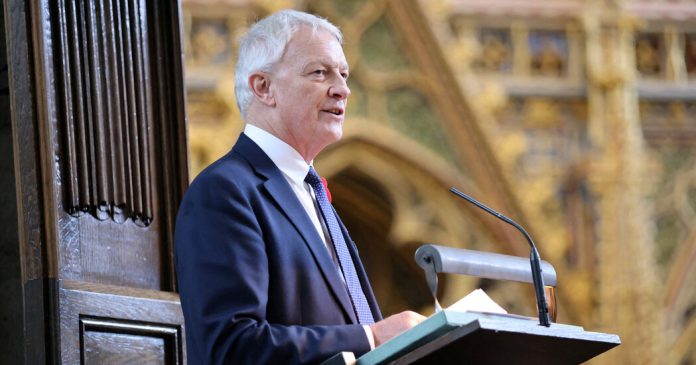
Phil Goff, New Zealand’s high commissioner to Britain — the equivalent of an ambassador between Commonwealth countries — made the comments in London on Tuesday at an event about the war in Ukraine and peace in Europe.

Mr. Goff spoke up with a question after a speech by Finland’s foreign minister, Elina Valtonen, at the Chatham House think tank, in which she spoke about the role of Europe in the face of Russian aggression and resolving the war in Ukraine.

Citing Winston Churchill on the choice between dishonor and war, Mr. Goff asked: “President Trump has restored the bust of Churchill to the Oval Office, but do you think he really understands history?”

The audience laughed. Invoking Churchill’s criticism of his predecessor as prime minister, Neville Chamberlain, for reaching a deal with Hitler, Mr. Goff appeared to make a wry allusion to Mr. Trump’s embrace of President Vladimir V. Putin of Russia. Mr. Trump has falsely suggested that Ukraine, not Mr. Putin, is responsible for the war.

But Ms. Valtonen deflected, saying that Churchill had “made very timeless remarks.”

In a statement on Thursday, New Zealand’s foreign minister, Winston Peters, described Mr. Goff’s remarks as “deeply disappointing” and said that they made his position “untenable.”

“When you’re in that position, you represent the government and the policies of the day,” Mr. Peters told reporters in New Zealand after summarily dismissing Mr. Goff. “You’re not able to free think — you are the face of New Zealand.”

Mr. Goff is a longtime politician and the former mayor of Auckland, New Zealand’s largest city. He was appointed to the London post in 2022 under Prime Minister Jacinda Ardern, who was often championed as a leading liberal voice against Mr. Trump in his first administration. But New Zealand’s politics have since shifted sharply, with voters electing its most conservative government in decades.

Mr. Peters said that Mr. Goff’s removal was not about the U.S. government, but about conduct as a diplomat. “If he had made that comment about Germany, France, Tonga or Samoa, I’d have been forced to take this action,” Mr. Peters said.

Nevertheless, it reflected how touchy U.S. allies are becoming in trying to stay in Mr. Trump’s good graces. When reporters asked New Zealand’s prime minister, Christopher Luxon, about Mr. Trump’s Oval Office confrontation with President Volodymyr Zelensky of Ukraine, he appeared to refrain from criticizing Mr. Trump. He went on to say that he still trusted Mr. Trump as an ally.

In recent months, Australia’s ambassador to the United States, Kevin Rudd, has also faced questions about whether he could continue in the job over his scathing past criticism of Mr. Trump. The comments were made before Mr. Rudd’s appointment to the position.

The Australian government backed Mr. Rudd, who deleted the critical posts from his X account. He later said in a statement that he did not want them to be construed as reflecting the views of Australia’s government.