Thursday, November 12, 2026
Home Blog Page 151

Pentagon aide’s past comments criticized as antisemitic : NPR

0

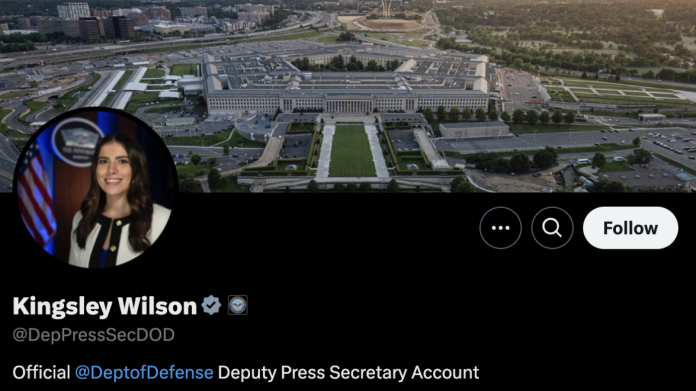
Members of Congress and Jewish civil rights organizations are criticizing the new deputy press secretary at the Department of Defense, Kingsley Wilson, for a series of online posts and past political commentary she made before joining the Trump administration.

Over the last several years, Wilson posted and commented prolifically on podcasts in her position at the right-wing think tank the Center for Renewing America. Wilson praised Russian President Vladimir Putin and attacked Ukrainian President Volodymyr Zelenskyy, promoted theories widely seen as antisemitic, excoriated Republicans in Congress who supported Ukraine, frequently used a slur for people with intellectual disabilities and also appeared to support political violence.

Now that Wilson is serving in the Pentagon, her comments have raised new scrutiny.

Amy Spitalnick, the CEO of the Jewish Council for Public Affairs, told NPR Wilson’s hiring was “one of the more concerning examples I’ve seen over the last few months of extremists being given prominent roles in the federal government.”

Among Wilson’s comments that drew the toughest criticism were those regarding Leo Frank, a Jewish man who was lynched by an antisemitic mob in Georgia in 1915.

Historians widely believe that Frank was falsely accused of raping and murdering a 13-year-old girl, and the state of Georgia granted Frank a posthumous pardon in 1986. But many antisemitic extremists continue to argue that Frank was guilty. In 2023, neo-Nazis protested the Broadway musical “Parade,” which dramatizes Frank’s trial and lynching.

“Leo Frank raped & murdered a 13-year-old girl. He also tried to frame a black man for his crime,” Wilson wrote in 2023. She repeated the same sentiment in a post last year.

Spitalnick said that Wilson’s comments about Frank are especially notable, because they so closely align with neo-Nazi talking points.

“This is something that is a deep cut in terms of the sorts of antisemitic ideas that neo-Nazis and others latch on to,” Spitalnick said. “So for someone who is now in a senior role in the federal government to have directly and explicitly engaged in this sort of conspiracy theory tells me that she is frequently trafficking in these neo-Nazi and other antisemitic spaces.”

“Anyone who posts antisemitic conspiracy theories lifted right out of the neo-Nazi playbook should not be in public office,” wrote the American Jewish Committee on X, calling Wilson “unfit” for her job.

Mother Jones and Jewish Insider first reported many of Wilson’s comments, including her stated belief in the “great replacement theory,” which the Anti-Defamation League describes as a “racist conspiracy theory” amplified by white nationalist groups. The “great replacement theory” poses that societal elites, often cast as Jewish leaders, are orchestrating mass migration to the United States in order to displace white people and seize power.

Republican U.S. Sen. Deb Fischer told Politico that Wilson’s comments were “horrible” and “just not appropriate.”

Wilson is not the first Trump administration official whose online commentary has attracted criticism. Marko Elez, an employee working with the Trump administration’s Department of Government Efficiency, resigned over racist posts he had written in recent years. “Normalize Indian hate,” one post read. “Just for the record, I was racist before it was cool,” Elez said in another.

Soon after his resignation, the Trump administration rehired Elez, who is 25 years old. Vice President JD Vance wrote, “I obviously disagree with some of Elez’s posts, but I don’t think stupid social media activity should ruin a kid’s life.”

Seen in that light, Wilson’s history of extreme rhetoric “should be shocking, but it’s certainly not surprising,” said Spitalnick, “because this administration has over and over again normalized platformed and emboldened extremism.”

The Department of Defense did not respond to NPR’s request for comment.

NPR has identified additional comments that raise questions about Wilson’s views and the Pentagon’s decision to hire her.

In a 2023 interview on the right-wing channel One America News, Wilson said Ukrainian President Volodymyr Zelenskyy “should be arrested on sight for what he has done to the American taxpayer.”

By contrast, Wilson has praised Putin. Last year, Wilson touted Putin’s “encyclopedic knowledge of his people’s history,” calling it “beyond impressive.” At the same time, she has attacked U.S. intelligence services, which include her current employer, the Department of Defense.

“The American intelligence apparatus is more evil than Vladimir Putin,” Wilson posted in 2022, months after Russia’s invasion of Ukraine.

Wilson also criticized U.S. defense contractors for their role in providing military equipment for the Ukrainian war effort.

“The U.S. Military Industrial Complex genocided an entire generation of Ukrainian men because PUTIN BAD” she wrote in 2024.

Among Wilson’s other targets are Republican leaders in Congress.

In one podcast interview from 2024, she said House Speaker Mike Johnson was “weak-willed” and lacked “testicular fortitude,” because he supported U.S. aid to Ukraine, adding that continuing to provide military support was “an un-Christian thing to do.”

“Mini-Mike Johnson is an embarrassment,” she posted later that year.

“DEPORT Lindsey Graham & ship him to Ukraine!” she posted regarding the Republican U.S. Senator from South Carolina over his support for that country.

Wilson is 26 years old and comes from a political family. Her father is Steve Cortes, a former Trump campaign adviser. Like many young right-wing activists, she appears to have adopted a deliberately edgy and often trolling online persona. The Trump administration’s media strategy has also shunned mainstream news organizations, while embracing figures who were once on the fringe.

Over the course of several posts, Wilson used a slur for people with intellectual disabilities to attack former Vice President Kamala Harris, members of NATO and libertarians.

And she has seemed to justify political violence.

In the fall of 2022, former Brazilian president Jair Bolsonaro, a conservative, called for his supporters to “be peaceful” after he lost his reelection campaign.

Wilson responded online, “I’m so tired of being the ‘good guys.’ Our ancestors answered violence with violence.”

The following year, she wrote, “There can be virtue in violence.”

In other posts, she has expressed support for colonialism, the Confederacy of the United States and a belief that the U.S is based on “blood and soil.”

“Colonialism was a humanitarian venture,” Wilson wrote of Haiti in 2024.

Wilson called Confederate General Robert E. Lee, who fought to preserve slavery, “One of the greatest Americans to ever live.” She also praised “Pickett’s Charge,” an infantry assault by the Confederates during the battle of Gettysburg in 1863, as one of the most “daring” ever attempted.

In 2023, Wilson wrote that “America is quite literally based on blood and soil.”

According to the U.S. Holocaust Memorial Museum, the phrase “blood and soil” was “an early Nazi slogan used in Germany to evoke the idea of a pure ‘Aryan’ race and the territory it wanted to conquer. The concept was foundational to Nazi ideology and its appeal.” Some white nationalists have since adopted the rhetoric of “blood and soil” to advocate for restricting immigration, and the slogan was used at the 2017 Unite the Right rally in Charlottesville, Va.

Wilson has also frequently expressed opposition to immigration.

“American communities across the country are being conquered by an invading horde of Third World migrants,” Wilson wrote in 2024. “Foundational Americans, who were never asked or consulted, are being made strangers in their own country.”

“I think it’s totally fair for us as American citizens to say, ‘Not all cultures are equal. I recognize that some cultures don’t assimilate well into my culture. And I don’t want more of those people here,'” Wilson said on a right-wing podcast in 2024.
U.S. and Ukrainian Officials to Meet Next Week About Path to End War

0

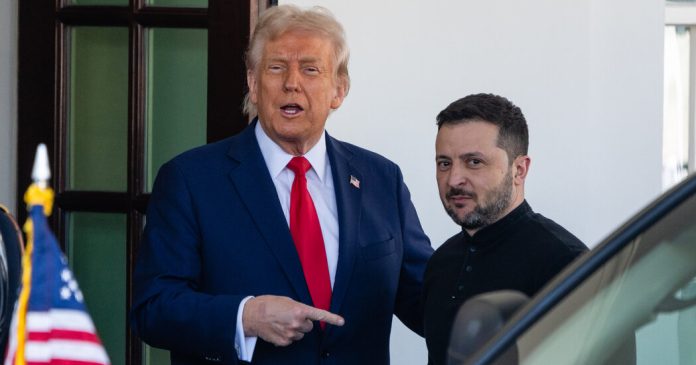
Senior U.S. and Ukrainian officials are planning to meet next week to discuss the first steps of a deal that could seek an end to the war in Ukraine, after a week of U.S. moves casting doubt on its support for the country.

Both President Trump and President Volodymyr Zelensky of Ukraine confirmed the meeting, which is expected to take place in Saudi Arabia.

The planned meeting was announced just under a week after an Oval Office blowup between the two men in which Mr. Trump attacked Mr. Zelensky as ungrateful for U.S. support and threatened to abandon Ukraine in its fight against Russia’s invasion. Mr. Trump later paused all military aid to Ukraine.

Since then, Mr. Zelensky has expressed regret in general terms over how that meeting went, and both sides have showed willingness to sign a deal in which the United States would share in revenue from Ukraine’s mineral resources.

“Ukrainian and American teams have resumed work, and we hope that next week we will have a meaningful meeting,” Mr. Zelensky said in a statement on Thursday.

Mr. Zelensky said that Ukraine would send a delegation to meet with “military representatives of countries that are ready to make greater efforts to reliably guarantee security within the framework of ending this war.” He said the meeting was scheduled for Tuesday, but did not specify who would attend.

Russian officials met last month with top Trump officials in Saudi Arabia as Russia has signaled an openness to talks, though it has not said if it would accept a cease-fire or an agreement to end the war.

There remains significant doubt among European leaders as to whether they can serve as the ultimate security backstop for Ukraine if America abandons the war-torn country. The Trump administration suspended military assistance and intelligence sharing with Ukraine this week in a bid to pressure Kyiv to negotiate on its terms, although it has not outlined any specific peace plan.

Outside the White House on Thursday, Steve Witkoff, the Trump administration’s special envoy to the Middle East, told reporters that the negotiations would take place in Saudi Arabia.

“We are now in discussions to coordinate a meeting with the Ukrainians in Riyadh or even potentially Jeddah; the city is moving around a little bit,” Mr. Witkoff said. He added, “The idea is to get down a framework for a peace agreement and an initial cease-fire as well.”

Mr. Witkoff said Mr. Zelensky’s comments after the Oval Office showdown, praising the strength of Mr. Trump’s leadership, had helped Ukraine’s standing with America. Last Friday, Mr. Trump and Vice President JD Vance lectured the Ukrainian president for not showing enough gratitude for the United States’ more than $100 billion in military support.

“He felt that Zelensky’s letter is a very positive first step,” Mr. Witkoff said, adding: “President Zelensky has demonstrated that he’s intent on that good-faith path back. He’s apologized. He’s said he’s grateful. He said he wants to work toward peace.” Mr. Witkoff added that he believed Mr. Zelensky was willing to sign a minerals deal to create a U.S.-controlled fund that would receive revenue from Ukraine’s natural resources.

At next week’s meeting, Mr. Zelensky said the Ukrainians would insist on a number of commitments from Russia to test whether a lasting peace could ultimately be reached. Those demands include Russian pledges not to attack Ukraine’s energy or other civilian infrastructure; a truce for missiles, bombs and long-range drones; and no military operations in the Black Sea.

“Ukrainians truly want peace, but not at the cost of giving up Ukraine,” Mr. Zelensky said. “The real question for any negotiations is whether Russia is capable of giving up the war.”

Moscow has given no public indication it would accept any truce, cease-fire or end to the war it launched three years ago. But Mr. Witkoff said Russia had shown openness to continuing discussions.

Of the talks with Ukraine, Mr. Witkoff said: “Hopefully that will be a good signal to the Russians because they have been proactive too in wanting to get something done here.”

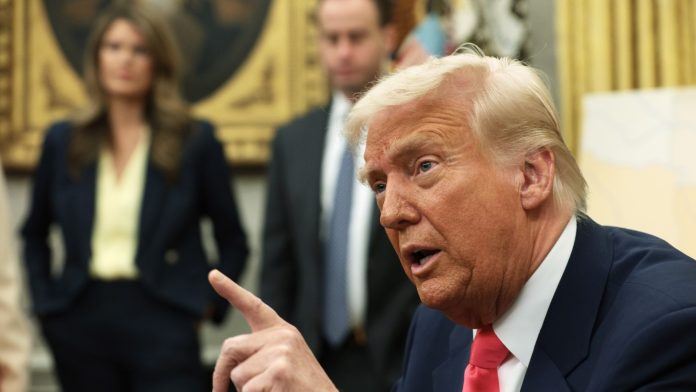
Speaking to reporters in the Oval Office, Mr. Trump noted that France was willing to put soldiers in Ukraine “for safety reasons”; the country has suggested assembling a European peacekeeping force after the war’s end. He also said that U.S. negotiators had “made a lot of progress with Ukraine and a lot of progress with Russia over the last couple of days.”

He also expressed optimism about an eventual peace agreement.

“I think what’s going to happen is Ukraine wants to make a deal because I don’t think they have a choice,” Mr. Trump said. “I also think that Russia wants to make a deal because in a certain different way — a different way that only I know, only I know — they have no choice.”

Trump says his Cabinet, not Musk, is in charge of agency cuts : NPR

0

President Trump speaks after signing executive orders in the Oval Office on Thursday.

Alex Wong/Getty Images


hide caption

toggle caption

Alex Wong/Getty Images

President Trump told his Cabinet members on Thursday that they are in charge of staff reductions, not Elon Musk, amid continuing questions over the billionaire adviser’s role in a drastic reshaping of the federal government.

Trump said he’d told his Cabinet as much in a closed-door meeting with most of his secretaries, which Musk also attended.

“I don’t want to see a big cut where a lot of good people are cut. I want the Cabinet members to keep the good people, and the people that aren’t doing a good job, that are unreliable, don’t show up to work, etc., those people can be cut,” Trump told reporters in the Oval Office.

“If they can cut, it’s better. And if they don’t cut then Elon will do the cutting,” the president said.

Musk is the public face of the Trump administration’s efforts to slash federal spending and staffing through the Department of Government Efficiency, or DOGE, which despite its name is not an actual federal agency. However, the White House says Musk is not the administrator of DOGE but instead a “special government employee” who advises the president and has no power to set policy.

The opacity over who is leading DOGE and what authority Musk wields has fueled criticism and legal challenges to DOGE and to mass firings carried out at many agencies. Trump himself added to the confusion when he said in his address to Congress this week that DOGE is “headed” by Musk.

Trump’s comments Thursday mark a rare instance of the president publicly reining in Musk. That’s after lawmakers of both parties raised concerns that Cabinet secretaries, not Musk, should be the ones calling the shots over hiring and firing.

On Tuesday, Senate Majority Leader John Thune, R-S.D., told CNN that while Musk’s goals and objectives are right, agency leaders are “probably better attuned to the individual programs.”

The Trump administration is planning further widespread reductions in force across federal agencies. In a social media post on Thursday, Trump wrote: “[N]ow that we have my Cabinet in place, I have instructed the Secretaries and Leadership to work with DOGE on Cost Cutting measures and Staffing. As the Secretaries learn about, and understand, the people working for the various Departments, they can be very precise as to who will remain, and who will go. We say the ‘scalpel’ rather than the ‘hatchet.'”

Trump added: “It’s very important that we cut levels down to where they should be, but it’s also important to keep the best and most productive people.”

Sudan Accuses U.A.E. of Being Complicit in Genocide

0

Sudan’s government filed a complaint at the International Court of Justice this week accusing the United Arab Emirates of being complicit in genocide by arming and funding a rebel militia in the country’s brutal civil war.

The United Arab Emirates quickly called the complaint a “cynical publicity stunt” aimed at diverting attention from the “widespread atrocities” committed by the Sudanese government.

The International Court of Justice is the United Nations’ highest court. It deals with disputes between countries and violations of international treaties. In this case, the court can claim jurisdiction because both Sudan and the United Arab Emirates have adopted the 1948 Genocide Convention.

Sudan is one of the poorest countries on the African continent. Its population of 50 million has seen almost one-third of its people displaced during the civil war, which began in April 2023 and has led to widespread killing, hunger and disease.

Tens of thousands have died and more than three million are believed to have fled the violence. The U.N. has said Sudan is suffering the world’s worst hunger crisis, affecting an estimated five million people.

Both sides of the conflict — government forces and the rebels — have committed atrocities against civilians, according to reports by the United Nations and other human rights groups.

Sudan took its complaint to the International Court of Justice on Tuesday. It focuses on the actions of the Rapid Support Forces, a paramilitary group, and its allied Arab militias, which have dominated Khartoum, the capital, and been accused of committing massacres of the non-Arab Masalit tribe in West Darfur.

Sudan accuses the rebels of committing “genocide, murder, theft, rape” and other violations, a statement by the court said. “According to Sudan, all such acts have been, ‘perpetrated and enabled by the direct support’ given by the United Arab Emirates,” the statement said.

Sudan has asked the court’s judges to issue an urgent restraining order against the United Arab Emirates, by telling the Emiratis that any armed units or persons over whom they have influence or control must be prevented from committing genocidal acts against the Masalit people.

It is unclear whether the judges will grant the restraining order. But even if they do, they have little power to enforce it. Judges issued such an order against Russia after it invaded Ukraine. They also handed down several orders against Israel over attacks against civilians in Gaza. All were ignored.

Even though a central charge — whether a country is committing genocide — may take many months to be decided, governments are still eager to take their cases before the world’s highest court and ask for restraining orders.

Asking the court for emergency orders, even if they are not granted or fail to be effective, offers a platform for nations to lay out their case before a prestigious international legal body.

A look at VP Vance's role in the Trump White House

0

American vice presidents sometimes play the role of attack dog, to let the president remain above the fray. But analysts say Vice President JD Vance doesn’t fall neatly into that category.

Bourbon Is Banned, California Wine Canceled, as Canada Pulls U.S. Alcohol

0

Giovanni Cassano, a restaurant owner in the Canadian province of Ontario, was not going to let a trade war get in the way of his diners’ thirst for Californian wine, Jim Beam Kentucky bourbon or Texan-made Tito’s vodka.

Soon, however, he and his diners might not have a choice.

When President Trump announced planned tariffs on the country last month, Canadian politicians threatened to pull American alcohol brands off the shelves of government-run liquor stores in retaliation.

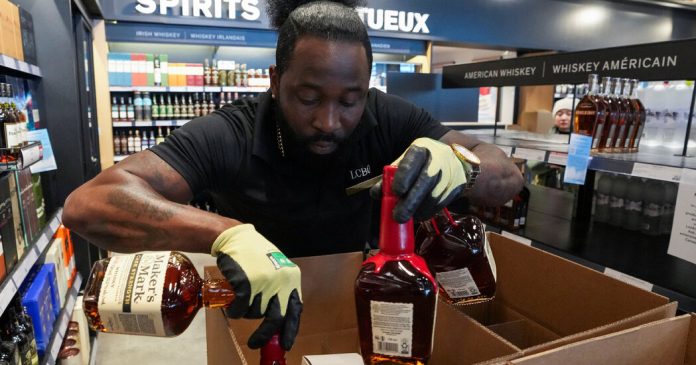
On Tuesday, those tariffs briefly went into effect, and American spirits and wine were boxed up and hidden away in much of Canada. Television broadcasts were filled with footage of employees packing up glass bottles and leaving behind barren shelves.

“People are going to get frustrated, but I think they’ll adapt,” said Mr. Cassano, the owner of a cafe and an adjacent oyster bar in Windsor, Ontario, a border city that is the heart of Canada’s auto industry and an important battleground in the trade war.

Ahead of Tuesday, Mr. Cassano stockpiled just enough cases of American spirits and wine to give himself time to transition to Canadian-made products at his two businesses, which sit not far from the distillery where Canadian Club whiskey is made and largely exported to the United States.

“Obviously, we’re all in this position, but some classics you can’t replace,” Mr. Cassano said.

A taste for American liquor could be one of the casualties in the trade war against Canada, after Mr. Trump placed a 25 percent tariff on Canadian exports. Prime Minister Justin Trudeau of Canada retaliated with a 25 percent tariff on $20.5 billion dollars’ worth of American goods, that will grow to add roughly another $85 billion of products in three weeks.

On Thursday, the United States announced it would grant Canada a second reprieve, until April 2, on most exports, throwing the two countries’ economic and political relations into more upheaval.

It’s not yet clear what, if anything, the delay will mean for American alcohol and the Canadian drinkers hoping to consume it. But boycotting American products has become part of the country’s national pride, uniting Canadians in online forums and grocery aisles.

In the prelude to Tuesday’s tariffs, Premier Doug Ford of Ontario, the country’s most populous province, warned that provincially owned liquor stores would pull about 3,600 American products from sale.

Every other province has since announced it will follow suit. Manitoba did so with theatrical flair, with Premier Wab Kinew sharing a social media video in which he imitates Mr. Trump signing an executive order.

“This order, it’s a wonderful order, it’s a beautiful order,” Mr. Kinew said. “This order is pulling American booze off the liquor market shelves.” The staff members behind him erupted in applause.

(Some Canadian provinces allow private liquor sales, so American products won’t disappear entirely from Canada.)

Lawson Whiting, the chief executive of the corporation that owns the Tennessee whiskey brand Jack Daniel’s, told investors during an earnings conference call on Wednesday that Canada represented about 1 percent of the company’s sales.

“Not just beverage alcohol, but a lot of American-made products have come off the shelves in Canada, which is tough,” Mr. Whiting said, describing it as an overreaction. “That’s worse than a tariff because it’s literally taking your sales away.”

After Mr. Trump announced the pause on most tariffs on Thursday, Chris Swonger, the president of the U.S. trade association for distilled spirits, expressed hope that the industry could avoid further harm.

“We are hopeful that constructive dialogues continue between the U.S., Canada and Mexico that permanently brings back zero for zero tariffs for spirits trade between our three countries,” he said. “We want toasts not tariffs.”

American alcohol products make up a small share of Canadian sales. In Ontario, the provincial government-owned alcohol retailer said American alcohol generated up to 965 million Canadian dollars in annual sales, part of the retailer’s over 7 billion dollars in annual revenue.

But a grass-roots movement to buy domestic products is gathering steam as Canadians protest what they perceive as a betrayal by the United States, the country’s closest ally, as well as Mr. Trump’s comments about annexing Canada.

DOGE cuts at VA and Pentagon cause confusion

0

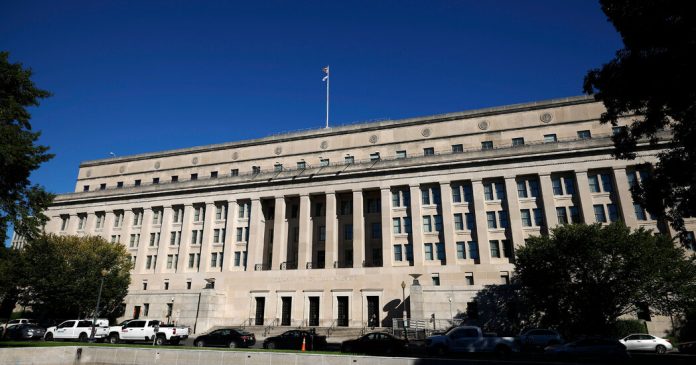
DOGE says its busy at work at both the Pentagon and the Department of Veteran’s Affairs.  But at this point, it’s not entirely clear what that means.

Russian Missile Strikes Hotel in Zelensky’s Hometown

0

new video loaded: Russian Missile Strikes Hotel in Zelensky’s Hometown

transcript

transcript

Russian Missile Strikes Hotel in Zelensky’s Hometown

Residents and aid workers said they received warnings only a few minutes before a missile struck a hotel in the hometown of President Volodymyr Zelensky in central Ukraine.

We got to the hotel at 8 p.m. We got the alert. We stood up to go to the shelter. This was 10 p.m., and before we had left the table, the missile struck. We were very fortunate because the restaurant was on the ground floor. We couldn’t get back to the lobby because that was destroyed. So we climbed out of a window.

Recent episodes in Ukraine Crisis

DOGE wants to cut $1 trillion this year. Why that would be tough : NPR

0

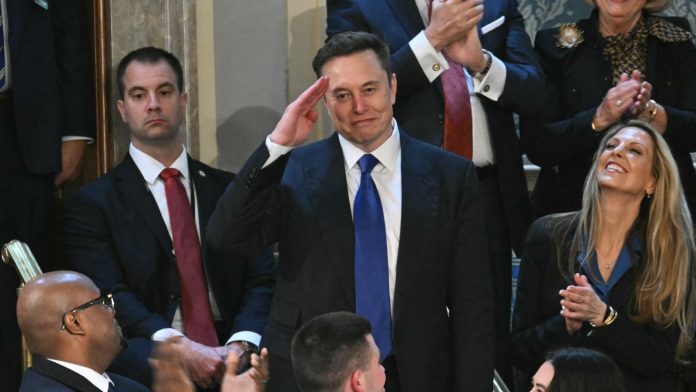
Elon Musk stands as he is recognized by President Trump during the latter’s address to a joint session of Congress on Tuesday.

Saul Loeb/AFP via Getty Images


hide caption

toggle caption

Saul Loeb/AFP via Getty Images

Elon Musk and his Department of Government Efficiency have an ambitious goal of cutting $1 trillion in federal spending by the end of the fiscal year in September.

But DOGE’s moves so far to cancel contracts, end leases and push federal agencies to reduce their workforces barely make a dent in the government’s overall balance sheet — even if you take DOGE’s savings claims at face value.

And as NPR has reported, those early DOGE savings claims have been inaccurate and drastically overstated.

In Congress, where decisions about trillions of dollars in spending are debated and authorized in appropriations bills, House Republicans have approved a framework that would include $4.5 trillion in tax cuts and a goal of $2 trillion in spending cuts. There are several more steps until legislation like that could get final approval.

It’s through congressional action, not DOGE, where any changes to spending and revenue collection would happen at a meaningful scale, said Jessica Riedl of the center-right Manhattan Institute.

“Think of Congress and its budget as the debt-ridden dad on the way to buy a $250,000 Ferrari on the credit card, and DOGE is the $2-off gas card he used along the way,” Riedl said. “It’s great that he saved $2 on gas, but I think his wife may be more concerned about the $250,000 car.”

DOGE’s alleged savings are a drop in the budget bucket

For every dollar that the federal government has spent so far since the start of this fiscal year in October 2024, DOGE — which began operating in mid-January — has claimed to save the equivalent of about four pennies.

From Oct. 1, 2024, through Jan. 31, 2025, the federal government collected $1.6 trillion and spent $2.4 trillion, leaving a deficit of nearly $840 billion so far this fiscal year.

As of March 3, DOGE claimed savings of $105 billion from a combination of things like lease terminations, contract cancellations and firing federal workers.

For context, that’s more than double what the Department of Homeland Security reported spending during the first quarter of this fiscal year and slightly less than what the Department of Veterans Affairs has spent on benefits and health care for millions of veterans. It’s also a third of what the government has paid in interest on the $36 trillion national debt during the first four months of the fiscal year.

DOGE’s claim of $105 billion saved in six weeks can’t be proved, however, and the “wall of receipts” that accounts for a fraction of that number is full of inaccurate data that has been revised several times for accuracy. Government contracting experts also say DOGE’s website inflates claims of “savings” by including misleading math about contract cancellations.

The White House did not respond to NPR’s questions about how DOGE calculates its savings totals or how the DOGE effort could work with Congress on federal spending.

But even DOGE’S unverifiable $105 billion number is less than half the pace of what Musk himself says is needed to meet its savings goal.

“It requires saving $4 billion per day every day from now through the end of September,” Musk said during President Trump’s Cabinet meeting last week. “But we can do it, and we will do it.”

DOGE has so far focused on things like contracting and employee head count, which account for a small slice of the government spending pie.

It recalls a similar move for Musk, who, after he bought Twitter in 2022, got rid of most of the staff. But unlike private industry, where employee salaries and benefits are the top expense, in the federal government personnel costs make up just about 4% of spending.

What’s the biggest part of the federal budget?

So far this fiscal year, about 64% of the government’s spending has been on Social Security, Medicare, health programs, income security and veterans’ benefits and services.

Add in another 14% for national defense and 13% for interest on the debt, and it’s clear what the biggest savings targets are.

Riedl, of the Manhattan Institute, says any reduction in the government wasting taxpayer dollars is a good thing, no matter the dollar amount.

But as someone who has spent a quarter-century studying ways to cut extraneous spending, Riedl reiterates that Congress is the only place to find real savings, and even then it requires tough choices.

“DOGE has created this false perception that the entire budget deficit can be eliminated by going after waste, fraud and abuse and without making the difficult decisions elsewhere in the budget,” Riedl said. “And this exaggeration is making it even harder to do the real hard things that are going to be needed to fix the deficit beyond waste.”

Have information you want to share about contracting, spending, DOGE or other restructuring changes across the federal government? Reach out to this author. Stephen Fowler is available through encrypted communications on Signal at stphnfwlr.25.

NPR’s Bobby Allyn contributed reporting.

State Dept. Plans to Close Diplomatic Missions and Fire Employees Overseas

0

Senior State Department officials have drawn up plans to close a dozen consulates overseas by this summer and are considering shutting down many more missions, in what could be a blow to the U.S. government’s efforts to build partnerships and gather intelligence, American officials say.

The department also plans to lay off many local citizens who work for its hundreds of missions. Those workers make up two-thirds of the agency’s work force, and in many countries they form the foundation of U.S. diplomats’ knowledge of their environments.

The shrinking is part of both President Trump’s larger slashing of the federal government and his “America First” foreign policy, in which the United States ends or curtails once-important ways of exercising global influence, including through democracy, human rights and aid work.

The moves come at a time when China, the main rival of America, has overtaken the United States in number of global diplomatic posts. China has forged strong ties across nations, especially in Asia and Africa, and exerts greater power in international organizations.

Any broad shutdowns of missions, especially entire embassies, would hinder the work of large parts of the federal government and potentially compromise U.S. national security.

Embassies house officers from the military, intelligence, law enforcement, health, commerce, trade, treasury and other agencies, all of whom monitor developments in the host nation and work with local officials to counter everything from terrorism to infectious disease to collapsing currencies.

The prospect of wide cuts has already generated some anxiety within the Central Intelligence Agency. The vast majority of undercover American intelligence officers work out of embassies and consulates, posing as diplomats, and the closure of diplomatic posts would reduce the C.I.A.’s options for where to position its spies.

The cuts come as the State Department is hemorrhaging senior staff members via voluntary resignations, and a hiring freeze means the work force is shrinking through attrition. A current five-week course mainly for senior career diplomats, including ambassadors, choosing to retire has about 160 people in it, one of the largest cohorts of retiring officers in recent memory, one American official said.

About 700 employees — 450 of them career diplomats — have handed in resignation papers in the first two months of this year, the official said. That is an astonishing rate: Before 2025, about 800 people had resigned over an entire year.

The efforts to cut diplomatic posts and overseas staffing are part of an internal campaign to reduce the State Department’s operations budget, perhaps by as much as 20 percent, according to two U.S. officials with knowledge of the evolving discussions. Like others who spoke for this article, they discussed the sensitive plans on the condition of anonymity.

The possible cuts and related proposals could evolve as internal debate continues.

The process has been accelerated by a team led by Elon Musk, which has embedded itself in government agencies in the hunt for what it calls government waste. One member of the team, Edward Coristine, a 19-year-old engineer who publicly goes by “Big Balls,” is in the State Department helping to direct the budget cuts at the agency. Its budget and employee numbers are tiny compared with those of the Pentagon.

A memo circulating within the department proposes closing a dozen consulates, mainly in Western Europe, according to three U.S. officials who have seen or been briefed on the memo. That action is occurring as Mr. Trump distances the United States from its democratic allies in Europe in favor of strengthening relations with Russia.

The United States’ 271 global diplomatic posts lag behind China’s 274, but the United States currently has an edge in Europe, according to a study by the Lowy Institute.

The State Department notified two congressional committees last month of the closures. And on Monday, department officials told the committees that they also planned to close a consulate in Gaziantep, Turkey, which has been a hub for U.S. officials to work with refugees from neighboring Syria and humanitarian aid groups there.

Those consulates are small operations, usually with one or two American diplomats and a staff of local citizens. But they help collect and disseminate information in places away from capitals, and issue visas.

In mid-February, Secretary of State Marco Rubio sent a memo to chiefs of mission, who are usually ambassadors, telling them to ensure that staffing at overseas posts was “kept to the minimum necessary to implement the president’s foreign policy priorities.” He also said any positions left vacant for two years should be abolished, said a U.S. official who has seen the memo.

A cable sent from Washington on Wednesday to global missions tells all employees to look for “waste, fraud and abuse,” the phrase that Mr. Musk uses to justify his deep cuts across the government. Officials are told to help with Mr. Musk’s mission by reviewing all contracts that cost $10,000 to $250,000, said a U.S. official who has seen the cable.

That could contribute to a proposed slashing of up to 20 percent of the State Department’s operating budget. The U.S. official said the phrase “across the board” cuts has been used, but it is unclear what that means. Under one proposal, the work of shuttered embassies could be absorbed by another embassy in the same region, or by a regional mission hub.

The plan to close a dozen consulates mainly in Western Europe is more concrete. State Department officials have shared a list with Congress, though it could still change. The list includes consulates in Florence, Italy; Strasbourg, France; Hamburg, Germany; and Ponta Delgada, Portugal. It also includes a consulate in Brazil, according to a U.S. official who has seen the list. Some details of the planned closures were reported earlier by Politico.

“The State Department continues to assess our global posture to ensure we are best positioned to address modern challenges on behalf of the American people,” the agency said in a statement on Thursday when asked about the various proposed changes.

In his remarks to employees on his first day at the department, Mr. Rubio said that he valued the diplomatic corps, but that “there will be changes.”

“The changes are not meant to be destructive; they’re not meant to be punitive,” he said. “The changes will be because we need to be a 21st-century agency that can move, by a cliché that’s used by many, at the speed of relevance.”

Since then, Mr. Rubio has overseen drastic foreign aid cuts and allowed Mr. Musk and Pete Marocco, a divisive political appointee, to fire or place on leave thousands of employees at the United States Agency for International Development, a sister agency to the State Department. That has raised doubts among diplomats over Mr. Rubio’s commitment.

The unease among diplomats is further fueled by the fact that they have seen no sign that Mr. Rubio has tried to push back against Mr. Trump’s efforts to weaken democratic Ukraine and embrace Russia, which could signal a broader acquiescence to White House directives. Diplomats have noted a viral photo of Mr. Rubio slouched stone-faced on a couch in the Oval Office last Friday as Mr. Trump shouted at Volodymyr Zelensky, the president of Ukraine.

Employees in the State Department’s Foreign and Civil Services are bracing for rounds of layoffs. The department has about 76,000 employees, with 50,000 of those local citizens abroad. Of the rest, about 14,000 are trained diplomats who rotate overseas, called Foreign Service officers, and 10,000 are members of the Civil Service and work mostly out of Washington.

The chiefs of mission were asked by senior department officials to submit a list by mid-February of the bare minimum number of local citizens they would need to maintain mission operations, a U.S. official said.

Diplomats and civil servants could be pushed out through reduction-in-force orders, a mechanism that government agencies can use to lay off workers. Another U.S. official said those kinds of orders are supposed to take into account seniority and job performance.

In recent weeks, a list of 700 Civil Service workers who potentially could be fired circulated within the department, but so far only 18 who were on probationary status have been let go, a U.S. official said.

One attempt to cut workers has been rolled back for now. In early February, the department issued orders to contracting companies to end the work of 60 contractors in the Bureau of Democracy, Human Rights and Labor. The companies put the workers, who include tech and area specialists, on unpaid leave. But after internal discussions, the bureau asked most or all of them to return this week.

Top officials are discussing consolidating parts of the department. One proposal would downgrade, through a merger, the democracy and human rights bureau as well as bureaus working on counternarcotics and refugee and migration issues. The department’s office of foreign aid and the tiny remnants of U.S.A.I.D. would be put under the same umbrella.

Officials have also proposed merging some of the department’s regional bureaus. Those are run by assistant secretaries in Washington and oversee policy and operations across large swaths of the globe. The bureaus are central to American diplomacy.