Thursday, November 12, 2026
Home Blog Page 154

Trump rhetoric on Canada could harm tourism to the U.S. : NPR

0

People take pictures with the Las Vegas sign in that city on July 29, 2023. Tourism industry leaders warn that recent actions by the Trump administration may be causing a drop in Canadians traveling to the U.S.

Patrick T. Fallon/AFP via Getty Images


hide caption

toggle caption

Patrick T. Fallon/AFP via Getty Images

Leena Yousefi and her family typically visit Hawaii four or five times a year. The Vancouver attorney used to live in Maui and had booked another trip for this year.

But that was before President Trump, shortly after taking office in January, said he would impose 25% tariffs on many Canadian goods and repeated his wish to turn the country into the 51st U.S. state.

“Obviously out of loyalty to Canada and our values and just holding our ground, we had to cancel,” Yousefi said.

Her family was even considering buying a two-bedroom condo in Hawaii given how often they vacation there. “But now we’re looking at Costa Rica,” she said.

The Trump administration’s recent attacks on its northern neighbor have been met with confusion, frustration and anger by many Canadians, some of whom are now abandoning their trips south and boycotting travel to the U.S. in protest.

Tourism industry leaders say that could pose a major threat to the U.S. travel sector, which relies heavily on Canadian visitors. According to the U.S. Travel Association, Canadians are the largest group of foreign visitors to the U.S. annually and accounted for $20.5 billion in spending last year alone.

Florida, California, Nevada, New York and Texas are the top U.S. states for Canadian tourists.

Canadians are scrapping their U.S. travel plans

Signs of a Canadian tourist backlash are cropping up from accommodations in Vermont to campgrounds in New Jersey.

Bookings at U.S. hotels just over the Canadian border are also down. The data analytics firm CoStar Group found that the demand for hotel rooms in a four-week period covering part of January and most of February had decreased 8% year over year in Niagara Falls, N.Y., and 12% in the Bellingham area of northwest Washington, about 50 miles south of Vancouver.

Catherine Prather, president of the U.S.-based National Tour Association, said she’s heard reports from “dozens” of members about Canadian travelers cancelling the tours they had booked to the U.S. — particularly in response to Trump’s stated goal of annexing the longtime ally. “Canadians feel disrespected, and that’s very challenging to them because we have always been such loyal, loyal partners,” she said.

Not everyone is as worried about a potential decline in Canadian travel to the U.S.

Beth Potter, president of the Tourism Industry Association of Canada, said there has been an increase in Canadians booking domestic vacations but that the tourism industry is viewing the situation as a “small blip” in the longstanding relationship between the two countries.

Marriott recently downplayed concerns that Canadians would quit traveling to the U.S., and Air Canada Executive Vice President Mark Galardo said in an earnings call that there “could be a slowdown” but that the carrier wasn’t seeing it yet.

Still, according to a poll released last month by the market research firm Leger, nearly half of Canadians surveyed said they were less likely to travel to the U.S. this year. Most of them said they planned to travel within Canada instead.

The shift in Canadians’ travel preferences dovetails with a souring national mood toward the U.S. An Ipsos poll for Global News released in early February, after Trump had announced the tariffs, found that 68% of residents surveyed thought less of their southern neighbor.

Lorna Hundt, CEO of the tour company Great Canadian Holidays, said most of the firm’s U.S. tours are now “dead in the water” because so many of their Canadian customers have backed out.

“The anger is not with the American people. The anger is with Donald Trump,” Hundt said. “And the feeling is that if he is going to go to war with Canada — something we never asked for, an economic war — then why on Earth would they spend a nickel in the United States when they don’t have to?”

In early February, Canadian Prime Minister Justin Trudeau encouraged Canadians to spend their money domestically in response to the U.S. tariffs.

“It might mean changing your summer vacation plans to stay here in Canada and explore the many national and provincial parks, historical sites and tourist destinations our great country has to offer,” Trudeau said.

After rebounding from COVID, the U.S. tourism industry faces another crisis

Tourism industry leaders say it’s too early to tell how much of an impact would be felt by a dip in Canadian tourism, but estimates suggest the U.S. has a lot to lose if Canadians snub the States en masse.

Prather of the National Tour Association said cancellations could mean “millions” in lost revenue to tour companies, hotels, restaurants and more. The U.S. Travel Association estimated that even a 10% reduction in Canadian tourism to the U.S. would spell a $2.1 billion drop in spending and a loss of 14,000 American jobs.

An expanded trade war ensnaring Canada, Mexico, China and even Europe, according to the research firm Tourism Economics, could result in a $22 billion loss in tourism revenue from international visitors.

This all comes as the tourism industry continues to dig out of the hole left by the COVID-19 pandemic, which clobbered the hospitality sector.

American Bus Association President Fred Ferguson says there are still more American tourists leaving the country than there are foreign visitors coming in, but Canadian travelers are helping lessen that deficit.

“Canada has been one of the bright spots post-COVID of closing the gap, but I think with the rhetoric, with the news, we are going to see slowdowns in Canadian travel,” Ferguson said.

And it’s not just the resentment created by the tariffs but also the tariffs themselves that will impact the U.S. tourism industry. The association says motor coach equipment manufacturers are mainly located in Canada and Europe, and many motor coach buses are imported.

Those economic pressures are squeezing the U.S. tourism industry just as it prepares for the busy spring and summer travel seasons, Ferguson added.

“We’re just now kind of ramping up to be hosting this influx of visitation,” he said. “And I think people are really concerned that if this rhetoric continues — which seemingly it is — people are just going to say, ‘You know what, we’re not coming. We’re going to stay local, stay in Canada, stay in Europe, and not deal with the U.S.’ “
Missile Strikes Hotel in Zelensky’s Hometown in Ukraine

0

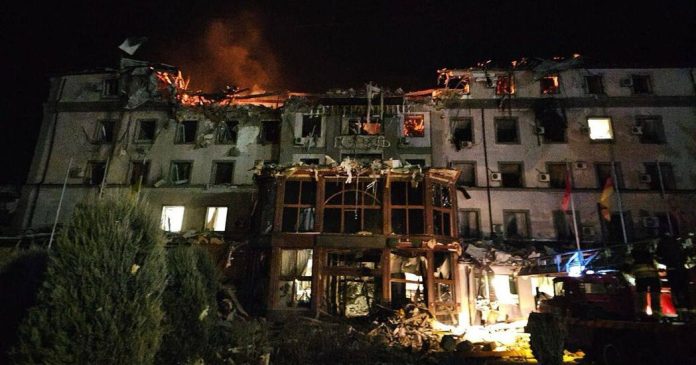
A Russian missile slammed into a hotel before dawn on Thursday in the hometown of President Volodymyr Zelensky in central Ukraine, killing at least four people and injuring more than 30 others, the Ukrainian authorities said.

“Just before the attack, volunteers from a humanitarian organization — citizens of Ukraine, the United States and the United Kingdom — had checked into the hotel,” Mr. Zelensky said in a statement. “They survived because they managed to get down from their rooms in time. Unfortunately, four people were killed in this attack.”

“There must be no pause in the pressure on Russia to stop this war and terror against life,” he said.

As rescue workers raced to pull wounded civilians from the ruined building in Mr. Zelensky’s hometown, Kryvyi Rih, air-defense crews across the country scrambled to defend against bombardments that have become routine during the winter.

In total, the Ukrainian Air Force reported, Russia launched two ballistic missiles and 112 drones — including some with dummy warheads designed to expose and exhaust air defenses.

Most of the deadly drones were shot down, the Air Force reported, but it did not say whether either of the missiles had been downed.

After the United State announced this week that it was suspending both military and intelligence assistance to Ukraine, there has been growing concern that the nation’s air-defense capabilities would be among the first elements of its defense to be compromised.

The American-made Patriot system has proved to be Ukraine’s most reliable defense against Russia’s most sophisticated ballistic missiles. The pause in American military assistance could leave Ukrainians short of the sophisticated interceptor missiles that have helped provide a blanket of protection over the capital, Kyiv, and other cities.

At the same time, Ukraine’s air-raid alerts are informed, to some degree, by the early warning data provided by American satellites, which can detect aircraft and missile launches deep in Russian territory. It is not clear if the pause on intelligence sharing included information related to those systems.

Ukrainian authorities sought to reassure the public that they were taking steps to address the fallout from the sudden moves by its primary military ally as Washington increasingly aligns itself with Moscow as it applies pressure to Kyiv ahead of peace negotiations.

Even as Kyiv works to persuade Washington that it should be applying pressure to Russia to bring the war to an end rather than taking steps that weaken Ukraine’s ability to defend itself, Ukraine is also appealing directly to the American public.

Ukrainian operators of Patriot systems have followed the lead of F-16 fighter pilots in calling directly on the American people to stand with Ukraine.

“Thanks to your support, we are still alive, and we are able to protect our cities and the civilians who live there,” said one operator in a video released by the military. “Thank you to the American people!”

President Trump has maintained that President Vladimir V. Putin of Russia has sent “strong signals” that he is ready for peace.

However, since the two men spoke on Feb. 12, Russia’s unrelenting bombardment of Ukrainian infrastructure and towns and cities from the front has only intensified.

More than 70 civilians have been killed since then, according to publicly available reports from Ukrainian officials compiled by The New York Times.

Most of the worst attacks are in the towns and cities closest to the front.

Russian warplanes have been bombarding the city of Kostiantynivka — an important logistics center for Ukrainian forces fighting in the east — with increasing ferocity.

“The enemy has dropped 108 aerial bombs on the city of Kostiantynivka over the past week alone,“ said Vadym Filashkin, the head of the Donetsk regional military administration. The bombs are among the most powerful in the Russian arsenal, weighing from 500 pounds to 6,000 pounds.

“The attacks have killed 16 people and injured 38,” he said.

As rescue crews in Kryvyi Rih continued to dig through the rubble of the hotel, Liudmyla Taran, the mother of two small children, said the air-raid alert came just two minutes before the missile struck.

“The explosion was massive, the windows were blown out, and the apartment started to smell strongly of smoke,” she said. “We got scared that the apartment was on fire, so we ran outside as we were, without getting dressed, and waited for help.”

Dmytro Klymenko, a 20 year-old local journalist, said the alert indicated that the ballistic missile was launched from Crimea and he barely had time to get dressed and run outside before the strike.

“As I was heading to the shelter, another alert came in, saying there were only seconds left before impact,” he said. “I sped up and made it into the underground shelter just as I heard the explosion.”

“Luckily, I only got away with a scare,” he said. “But I feel so sorry for those who suffered because of Russia.”

Liubov Sholudko and Nataliia Novosolova contributed reporting.

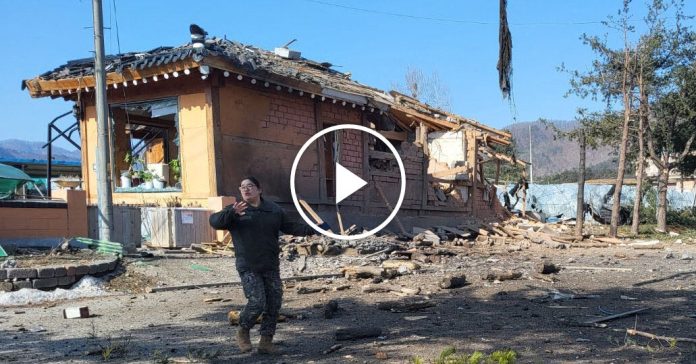
South Korean Military Accidentally Drops Bombs on Homes

0

The South Korean village of Nogok was shelled after two fighter jets misfired during a drill. The village is in the town of Pocheon, near the border with North Korea.

Thursday Briefing

0

What President Trump’s moves could mean for Ukraine.

Brisbane, Australia, Braces for Powerful Cyclone

0

A swath of Australia’s eastern coast around Brisbane, the country’s third-largest city, was bracing for the first cyclone forecast to make landfall in the region in decades, as the authorities warned of the potential for widespread flooding and destructive winds.

The slow-moving Tropical Cyclone Alfred was expected to come ashore late Friday or early Saturday near Brisbane, where about 2.7 million people live. At midday on Thursday, it was hovering about 150 miles off the city and already creating towering waves of record heights. Local authorities have issued “prepare to evacuate” warnings for parts of the city and nearby regions, saying tens of thousands of structures in low-lying areas were at risk of being flooded.

Wind gusts up to about 95 miles per hour were expected in coastal areas, and dangerous levels of storm tide could engulf parts of the region, forecasters warned. Alfred would be the first cyclone to make landfall along the southeastern coast of the state of Queensland since 1974, according to Australia’s Bureau of Meteorology.

More than 900 schools and multiple airports were being closed and public transportation suspended in southern Queensland and northern New South Wales ahead of the storm making landfall. Grocery store shelves have been emptied by shoppers and people formed long lines to get sandbags in recent days as the cyclone, originally expected to remain offshore, changed course and began advancing toward land.

Even as authorities were warning about the danger ahead, the record swell brought droves of devoted surfers to the coast in recent days, along with crowds to watch them ride the cyclone waves.

Officials warned that the storm’s slow advance could amplify its impact on coastal communities by prolonging the rainfall and storm surges. Among the areas threatened by the storm is Lismore, a small city about eight hours north of Sydney which suffered devastating floods in 2022 in which 22 people died.

Prime Minister Anthony Albanese said Thursday that he would approve emergency federal funds for the states of Queensland and New South Wales for post-storm recovery efforts.

Europe Races to Craft a Trump-Era Plan for Ukraine and Defense

0

European leaders find themselves plunged into a hostile new era of less cooperation from the United States, a greater threat from Russia, and an increasingly uncertain outlook for Ukraine. On Thursday, they will gather in Brussels to try to figure out what to do about that.

They will need to walk a fine line: Figuring out how to support Ukraine and bolster their own defenses while avoiding further alienating their tempestuous allies in Washington.

The specially called and much anticipated gathering will include the heads of state or government from the European Union’s 27 member countries and is the latest in a series of quickly arranged summits focused on defense.

They are expected to discuss how to finance a ramp up of European military spending, hoping to make the continent better armed to deal with Russia without as much backup from across the Atlantic. They will also review what a peace plan for Ukraine might look like, and how they can support it.

In some ways, the meeting marks the start of a new chapter for the European Union. Created to foster cooperation and peace, the bloc is being forced to contemplate its role in a world riven by conflict and animosity, even among allies.

The pressing question is whether the E.U., with its consensus-focused, clunky structure, can adapt itself quickly enough to ensure that Europe doesn’t get left behind as Mr. Trump rapidly changes the global order.

“There’s clearly a sense that, in a time like this, Europe needs to prepare for the worst,” said Jacob Funk Kirkegaard, a senior fellow at the Brussels-based think tank Bruegel.

In less than two months, President Trump has changed the game when it comes to security in Europe. He is demanding a rapid peace in Ukraine, and has prodded President Volodymyr Zelensky toward negotiations by berating him publicly and halting aid to his embattled nation. He opened talks with Russia without directly involving Europe, or Ukraine.

He has at the same time insisted that European nations spend more on their own defense, assailing members of the North Atlantic Treaty Organization for paying too little to protect themselves in an “unfair” system.

That one-two punch — and the disastrous meeting last week between Mr. Trump and Mr. Zelensky — has forced European leaders to move with new urgency.

In the wake of the meltdown between the two leaders, Mr. Zelensky on Tuesday offered a course of action that he said could end the war, in a bid to appease Mr. Trump. He did so after days of counseling from the leaders of France and Britain, and although that outreach seemed to be received well by Mr. Trump, it remains unclear what happens next.

The United Kingdom and France have indicated a willingness to send troops as a peacekeeping force if a deal is reached, but it is an open question exactly how many nations might join in what Prime Minister Keir Starmer of Britain has called a “coalition of the willing.”

Nor is it clear how the E.U. will support such a coalition. What is clear is that the bloc wants to be in the conversation as the continent’s future is determined.

On Wednesday, the French president, Emmanuel Macron, said he would talk with European allies about the possibility of using France’s nuclear deterrent to protect the continent in the wake of threats from Russia.

In one sign that Europe appears to be pulling together more, several countries that are not in the bloc — including the U.K., Norway and Turkey — are expected to be briefed by top E.U. officials after the Thursday meeting, according to a European Union official.

Mr. Zelensky has been invited to the gathering and is expected to join, according to another E.U. official, although Mr. Zelensky’s office declined to comment on the upcoming meeting.

The officials spoke on the condition of anonymity to discuss internal matters.

Despite the increased cooperation among nations, the bloc continues to struggle to speak with one voice on Ukraine at a moment when Viktor Orban, the Hungarian prime minister, has been vocal in his support of Mr. Trump and in his disagreement with his European colleagues over Ukraine.

E.U. officials have been discussing further aid for Ukraine, but plans for giving it a fresh pot of money are unlikely to be finalized on Thursday, according to a senior E.U. diplomat who spoke on condition of anonymity to discuss internal plans.

The discussions Thursday are also expected to go beyond Ukraine’s plight and focus on how Europe can better protect itself as a whole.

Among other things, leaders are expected to talk about a novel plan unveiled this week by Ursula von der Leyen, the head of the E.U.’s executive branch.

What she is calling a proposal to “re-arm” Europe would create a 150 billion euro loan program for defense investment, while making E.U. budget rules more flexible to enable countries to invest more without breaching tough deficit rules. In all, officials estimate that it could help to boost spending on security by as much as 800 billion euros.

As she unveiled the proposals on Tuesday, Ms. von der Leyen noted the import: “We are living in the most momentous and dangerous of times.”

Trump to order dismantling of Education Department : NPR

0

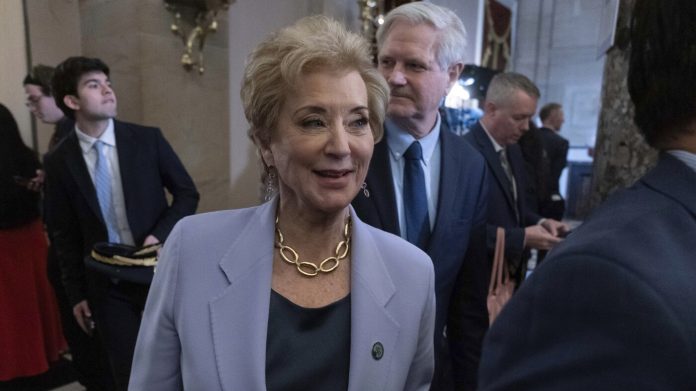
U.S. Education Secretary Linda McMahon leaves the House Chamber after President Donald Trump’s joint address to Congress on Tuesday.

Jose Luis Magana/AP/FR159526 AP


hide caption

toggle caption

Jose Luis Magana/AP/FR159526 AP

President Trump is expected to issue an executive action as early as Thursday calling on Education Secretary Linda McMahon to “take all necessary steps to facilitate the closure of the Department of Education,” according to a draft of the action obtained by NPR.

The move has been expected since early February, when the White House revealed its intentions but withheld the action itself until after McMahon’s Senate confirmation.

The Senate voted Monday to make McMahon the next education secretary. Democrats uniformly opposed her after McMahon publicly committed to unwinding the department.

The draft action instructs McMahon to act “to the maximum extent appropriate and permitted by law,” an acknowledgement that the department and its signature responsibilities were created by Congress, are protected by statute and cannot legally be altered without congressional approval, which would almost certainly require 60 votes to overcome a Democratic filibuster.

News of the action was first reported by The Wall Street Journal.

The White House did not respond to a request for comment.

The order offers as justification for the department’s closure that, “since its founding in 1979, the Department of Education has spent more than $1 trillion without producing virtually any improvement in student reading and mathematics scores.”

According to The Nation’s Report Card, one of the oldest and most reliable barometers of student achievement in the U.S., reading scores changed little between 1992 and 2019, though math achievement improved considerably. The pandemic though wrought havoc on student achievement, with many learning gaps remaining nearly five years after schools first closed.

The draft executive action declares “the experiment of controlling American education through Federal programs and dollars … has failed our children.”

On average, federal dollars make up roughly 10% of public schools’ funding, the lion’s share coming from states and local taxes. Those federal dollars are also largely targeted to help the nation’s most vulnerable students: those living in low-income communities, including millions of rural students, and children with disabilities. The department is prohibited by law from telling schools what, or how, to teach.

Within hours of McMahon’s confirmation Monday, she shared a lengthy message with Education Department staff attempting to rally support for the department’s unwinding, calling it “our opportunity to perform one final, unforgettable public service to future generations of students.”

Early moves to reduce the department

The executive action also arrives as the department has already been the subject of widespread cuts and staff departures. Last month, the administration gutted the Institute of Education Sciences (IES), which is responsible for gathering and disseminating data on a wide range of topics, including research-backed teaching practices and the state of U.S. student achievement.

Among the canceled department grants were programs exploring how to accelerate students’ math learning and efforts to study how best to prepare some students with disabilities for the difficult transition from high school into the working world.

The Trump administration has also laid off dozens of newer, probationary employees and put dozens more on paid leave for having any associations with DEIA programs, including some who were encouraged to attend a diversity workshop during the first Trump administration.

During her Senate confirmation hearing, McMahon was asked about this looming executive action and whether she would faithfully execute it. She would, she said.

“We’d like to do this right,” McMahon told the committee, saying she would present Congress with a plan to unwind even the department’s key, statutory responsibilities “that I think our senators could get on board with.”

Key programs target poor communities and students with disabilities

Multiple senators asked whether the department’s dismantling would include cuts to two key federal funding streams for K-12 schools: Title I for students in lower-income communities and the Individuals with Disabilities Education Act (IDEA) for students with disabilities.

McMahon said repeatedly that she considers the department separate from that funding. The former, she said, can be dismantled without affecting the latter. “It is not the president’s goal to defund the programs. It was only to have it operate more efficiently.”

Later, McMahon elaborated that IDEA funding, for example, is protected by statute and would not be targeted for cuts. But, she offered, it might be more effectively administered by a different agency, perhaps the Department of Health and Human Services.

The department also has legal authority to enforce federal civil rights laws on behalf of students, and it’s unclear how its unwinding would affect the department’s Office for Civil Rights. Though the Trump administration has already sent a warning to all schools that receive federal money, K-12 and colleges alike, that they must stop all DEIA programs or risk being investigated by the department and potentially losing their federal funding.

House Republicans have tried before to close the department and failed, and Republicans enjoy only narrow majorities in the House and Senate. Many of the department’s statutory responsibilities enjoy the support of Republicans as well as Democrats.

The Education Department is among the smallest of all federal agencies, with roughly 4,200 employees. According to the website for the Department of Government Efficiency (DOGE), the wages of Education Department employees account for 0.31% of all federal wages.

In an NPR/PBS News/Marist poll taken late last month, 63% of Americans surveyed said they would oppose getting rid of the department, compared with 37% who supported its closure.

Trump’s Decision to Halt Aid to Ukraine Could Reorder the Battlefield

0

On the battlefields of Ukraine and western Russia, a stalemated war has ground on, with Ukrainian troops defending against Russian progress that can be measured sometimes in mere yards. The cost has been heavy casualties on both sides.

President Trump’s decision this week to pause military assistance and intelligence sharing could reorder the battlefield, either halting the fight or potentially giving Russia a decisive advantage.

With help from Europe, both with arms and intelligence support, Ukraine could continue the fight through the summer without additional American aid. But the loss of one of its most important benefactors will make it easier for Russia to assault Ukrainian lines of defense, analysts say.

“Despite the disadvantage in munitions and forces, Ukrainians have done admirably well in preventing any kind of Russian breakthrough,” Seth G. Jones, a senior vice president with the Center for Strategic and International Studies, said in an interview.

Trump administration officials have suggested that the pause in support could be relatively short-lived if Ukraine’s president, Volodymyr Zelensky, bends to the demands of the White House. Mr. Trump, in his address to Congress on Tuesday night, said he appreciated that Mr. Zelensky had said earlier in the day that he was ready to “come to the negotiating table.”

For now, the Trump administration is putting maximum pressure on Ukraine, and relatively little on Russia’s president, Vladimir V. Putin, or the Russian military, which has continued to attack Ukrainian cities. If the United States is seen as a completely unfair broker of peace, Ukraine could look for ways to continue the fight with the support of Europe.

The Russians still have not established air superiority since invading Ukraine three years ago. They have not effectively managed to combine military units in the joint operations, and have suffered so many casualties that Mr. Putin brought in 11,000 North Korean troops to help relieve the strain, military experts said.

But that was before Mr. Trump threw his weight behind Russia.

“The immediate hit will be on troop morale — bolstering the Russians and depressing the Ukrainians,” said Alexander Vindman, a Ukrainian-born former U.S. Army officer who served on the National Security Council in 2019.

Mr. Trump’s decision affects billions of dollars in arms and ammunition in the pipeline and on order. It halts deliveries of equipment from Pentagon stockpiles as well as aid through the Ukraine Security Assistance Initiative, which provides funds that Kyiv can use to buy new military hardware directly from U.S. defense companies.

Ukraine also stands to lose advanced weapons, including surface-to-surface ballistic missiles, long-range rocket artillery, parts, and maintenance and technical support.

Critically, the pause in U.S. military aid will halt the delivery of interceptor missiles for Patriot and NASAMS air defense systems, which have saved an untold number of lives as they shielded Ukrainian cities from missile and drone attacks.

The intelligence pause will withhold information that Ukraine uses to target Russian forces.

Withholding the aid, according to Trump administration officials, is meant to pressure Mr. Zelensky into signing a deal to give American companies access to Ukrainian minerals. If he makes an agreement, said one Trump administration official, the intelligence sharing will continue and the military supplies already allocated by the Biden administration will flow once more.

But how much new military aid Mr. Trump would be willing to provide is not clear.

Russian forces have been trying to claw back more of the territory in the Kursk region of Russia that Ukraine seized last year, and preparing for more fighting along the main front lines in Ukraine’s eastern Donbas area.

“They’ve been regenerating in place and trying to repair some damage from last fall’s offensive,” said Dara Massicot, a Russian military specialist at the Carnegie Endowment for International Peace. “I would expect another push to begin probably by May.”

Ukraine, which has bolstered its own weapons production, and Europe are not without their own resources.

Europe, in particular France and Britain, supplies Ukraine with satellite imagery that can be used to find Russian targets on the battlefield. Still, European satellites have not been as focused on Russian miliary movements as American spy satellites, and Ukrainian officials concede that if the intelligence pause continues there will be consequences.

And if the halt in deliveries extends beyond early summer, Ukraine would lose its supply of some advanced weapons, including advanced air defense systems, surface-to-surface ballistic missiles, navigation systems and long-range rocket artillery.

A prolonged shortage of those arms would hurt Ukraine’s ability to strike longer-range targets and could make Ukrainian cities and troops more vulnerable to missile, rocket and drone attacks.

The Trump administration has sent some of the weapons the Biden administration promised Ukraine, including “hundreds of Guided Multiple Launch Rocket Systems (GMLRS) and antitank weapons and thousands of artillery rounds,” the Pentagon said on Monday.

Under Mr. Trump’s directive, those deliveries would stop, at least until the president determined that Ukraine had demonstrated a good-faith commitment to peace negotiations with Russia, a senior administration official said.

Still, “the nature of the kinds of weapon systems that the Ukrainians are presently using are different than the ones that they were reliant upon very heavily in the early months of the war,” said George Barros, a Russia expert at the Institute for the Study of War. “The Ukraine defense industrial base has grown significantly, and they could produce a lot of stuff that they need.”

In fact, in recent weeks the pace of Russian assaults has slowed along some of the hottest parts of the front, and Russian troops “have suffered heavy losses during their offensive actions,” Col. Oleksii Khilchenko, a Ukrainian brigade commander in eastern Ukraine, said in a phone interview.

“Assaults that previously involved 10 to 15 soldiers have now been reduced to small group attacks of up to five soldiers,” he said.

Mr. Barros said that most of the casualties Ukrainian troops were inflicting on Russia were caused by homemade drones and other weapons produced in Ukraine.

“So it’s not as if Ukrainians on the front lines are going to be running out of their most basic tools right away,” he said.

But what Ukraine will run out of, he and other experts say, are interceptors for the Patriots, which have aided the country’s air defenses.

European countries have Patriot interceptors, but they would have to sacrifice parts of their own air defense umbrella. That might be a big ask at a time when NATO allies can no longer assume that the United States will help defend them if they are attacked.

European leaders have said that they will convene in Brussels on Thursday with two things on the agenda: how to support Ukraine and how to shore up their own military capabilities.

It was unclear where the Starlink satellite internet service stands in Mr. Trump’s pause. Operated by Elon Musk’s SpaceX, Starlink has been critical to the Ukrainian military since the early days of the war, allowing soldiers to communicate and share information without having to resort to text messages on cellular networks that can more easily be intercepted.

During a tense meeting in the Oval Office last week, Mr. Trump told Mr. Zelensky that he was not in a good position. “You don’t have the cards right now,” Mr. Trump said.

But no one can predict what the pause in aid and intelligence sharing will mean for the war, military officials said.

“To say that the Ukrainians ‘don’t have the cards’ indicates to me that those around POTUS don’t actually understand the nature of war or why men and women are actually willing to fight, even if outnumbered,” said Frederick B. Hodges, a retired lieutenant general and a former top U.S. Army commander in Europe.

Ukraine could win, or at least be in a much better position, if the Europeans deliver the support “they’re capable of delivering,” he said. “And they’ll have done it without the U.S. The result will be lost credibility and lost influence.”

The other scenario — where Russia succeeds in Ukraine — could be even dimmer for the Trump administration, military experts said. A Russian victory could embolden Mr. Putin’s expansionist aims, eventually leading to a major war in Europe.

Mr. Jones, of the Center for Strategic and International Studies, noted that the United States tried in the past to stay out of major-powers wars in Europe, and was unsuccessful.

Hundreds of Children Are Among the Rape Victims of Sudan’s War, U.N. Says

0

Armed men in Sudan have raped hundreds of children, including some as young as 1, the United Nations children’s agency said this week, as a catastrophic civil war nears its third year.

Health providers in Sudan have recorded 221 cases of rape since the start of 2024, according to the UNICEF report. Among the victims, 147 were girls and 74 were boys. Sixteen children were younger than 5 and four were only a year old.

The report incorporates firsthand accounts by victims and witnesses, including one in which captive children are described as being selected by armed men and later returned to their quarters covered in blood and nearly unconscious. Some were subjected to gang rape.

The children’s agency recorded instances of serious physical injury, psychological abuse and child marriage. Some of the victims were infected with H.I.V. and other sexually transmitted viruses.

There is no comprehensive data about sexual violence in Sudan, but a 2024 U.N. fact-finding mission reported that gender-based violence, including rape and sexual slavery, was prevalent in areas where the war between the Sudanese military and a paramilitary group, the Rapid Support Forces, was being waged.

The war, which broke out in April 2023, has been marked by atrocities on both sides, ethnically driven killings and accusations of genocide. The conflict has killed many tens of thousands of people and displaced more than 11 million, according to some estimates.

The 2024 U.N. mission found that both sides in the conflict had perpetrated sexual violence, but that armed men wearing Rapid Support Forces uniforms or the attire often worn by the group’s allies were identified as perpetrators in “a large majority” of cases.

Tess Ingram, a UNICEF spokeswoman and the lead author of the new report, said she had spent weeks talking to survivors of childhood sexual violence in Sudan. She was struck by the impossible choices survivors often face after the violence.

“Some people may think the horror and the suffering ends when the rape ends, but that’s not the case, especially in Sudan,” Ms. Ingram said.

Survivors must decide whether or not to the disclose the rape to their family and others in the community and risk being disowned, publicly identified or seen as a collaborator.

“In Sudan, socially, it’s the survivors and not the perpetrators who carry that cultural burden of stigma and shame associated with rape,” Ms. Ingram said.

Ms. Ingram said some of the children who became impregnated by their attackers chose to give their babies up for adoption, while others chose to keep them.

She recounted the experience of one survivor who grew up in foster care and decided to raise her child herself, because she did not want the baby to go through the same ordeal she had. But shelters did not want to take in a pregnant woman.

“Now, the baby’s 8 months old and still doesn’t have a home to live in,” Ms. Ingram said.

Pakistan Needs Support Fighting Terrorism. A Happy Trump Could Help.

0

As President Trump delivered a speech to Congress on Tuesday night for the first time since re-entering the White House, one country made a surprising cameo: Pakistan.

Mr. Trump thanked the Pakistani government for its role in capturing a regional Islamic State leader linked to an attack in 2021 at the airport in Kabul, Afghanistan, that killed 13 American service members and dozens of Afghan civilians.

The president’s announcement of the arrest signaled a possible strengthening of counterterrorism ties between Pakistan and the United States, just as the Pakistani government is seeking international support to combat a resurgence of terrorism within the country’s borders.

Pakistan, a nuclear-armed nation of about 250 million people, is navigating a complex web of internal and external pressures. Domestically, armed groups like the Pakistani Taliban in the north and ethnic separatists in the south have dramatically ramped up attacks. At the same time, the country is grappling with deepening economic instability and ongoing political turmoil after the ouster of Prime Minister Imran Khan in 2022.

Outside of Pakistan’s borders, the departure of the United States from Afghanistan in 2021 has altered regional dynamics. Pakistani leaders have increasingly been at odds with the Taliban government in Afghanistan, where militant groups — some aligned with the Taliban and some opposed to them — have a growing foothold. And Pakistan’s expanding alliance with China has strained relations with the United States, which has reduced assistance to Pakistan since the end of the Afghan war.

Mr. Trump’s statement about the detention of what he called a “top terrorist” comes as Pakistan has experienced three suicide bombings in two volatile provinces over just four days.

One of those attacks, on an Islamic seminary in Pakistan long associated with the Afghan Taliban, was believed to have been carried out by the regional Islamic State affiliate, known as ISIS-K. That suggests the group’s wave of assaults targeting Taliban leaders in Afghanistan has now entered Pakistan with the killing of pro-Taliban figures.

Adam Weinstein, deputy director of the Middle East program at the Quincy Institute, a think tank in Washington, said that “a thank-you from President Trump is no small win for Pakistan,” a country seeking recognition for its counterterrorism efforts in the region.

He emphasized, however, that Pakistan’s powerful military seeks more than gratitude. It wants a security partnership that actively targets its enemies, particularly Tehreek-e-Taliban Pakistan, also known as the Pakistani Taliban. Pakistani leaders accuse the Taliban administration in Afghanistan of harboring the group and allowing it to conduct cross-border attacks, allegations that Taliban officials in Kabul deny.

Experts noted that the operation to capture the man linked to the Kabul airport attack in 2021 highlighted ongoing intelligence cooperation between the United States and Pakistan — at least against mutual threats like ISIS-K, a group that poses global security risks.

In a social media statement on Wednesday, Pakistan’s prime minister, Shehbaz Sharif, thanked Mr. Trump for “acknowledging and appreciating” his country’s support in counterterrorism efforts across the region.

U.S. and Pakistani officials said that the United States had provided intelligence to Pakistan that led to the capture of Mohammad Sharifullah, an Afghan national who is a leader of ISIS-K.

Mr. Sharif said that Mr. Sharifullah had been arrested “in a successful operation conducted in the Pakistan-Afghanistan border region.” The prime minister did not say exactly where Mr. Sharifullah had been captured.

On Wednesday, a spokesman for the Taliban administration in Afghanistan, Zabihullah Mujahid, claimed that the arrest served as “proof” of ISIS-K hide-outs on Pakistani soil.

Iftikhar Firdous, editor of The Khorasan Diary, a research organization based in Islamabad that monitors militant groups, said Mr. Sharifullah had been involved in dozens of attacks in Afghanistan since joining ISIS-K in 2016.

He said that Mr. Sharifullah had previously been arrested by the U.S.-backed Ashraf Ghani administration in Kabul but was released when the Taliban freed about 1,700 hard-core militants after taking power in 2021.

A Justice Department news release implicated Mr. Sharifullah in the ISIS-K attack last year in suburban Moscow that killed more than 130 people. Mr. Sharifullah was flown to the United States on Wednesday and charged with violating terrorism statutes.

“The coordination between the C.I.A. and Pakistan’s prime intelligence agency” in arresting Mr. Sharifullah, Mr. Firdous said, “marks yet another instance of a long history of cooperation that both the U.S. and Pakistan will depend on each other, even if it’s not boots on the ground.”

A global terrorism index published by the Institute for Economics and Peace, an international think tank, ranks Pakistan as the country second most affected by terrorism, after Burkina Faso.

Terrorist attacks in Pakistan are at their highest level since 2014. Deaths related to terrorism surged by 45 percent in 2024 over the year before, to 1,081, while attacks more than doubled, from 517 to 1,099.

On Tuesday evening, two suicide bombers associated with a local Pakistani Taliban commander drove vehicles packed with explosives into a military base in the Bannu district in the northwestern province of Khyber Pakhtunkhwa before other attackers stormed the compound. At least 18 people were killed, including five soldiers, and dozens were wounded, according to the Pakistani military.

On Monday, a suicide bomber targeted a security forces convoy in Kalat, in the southwestern province of Balochistan, killing a paramilitary soldier and injuring four others.

On Friday, in the suspected ISIS-K suicide attack on the seminary, six worshipers in a mosque there were killed in the Nowshera district of Khyber Pakhtunkhwa.

While the U.S.-Pakistani collaboration in arresting the suspect in the Kabul airport attack raised hopes in Pakistan of further help in combating terrorist groups, it also had political repercussions.

Supporters of Mr. Khan, the prime minister who was ousted after falling out with the military, have hoped that the Trump administration will push for his release from prison. That expectation was heightened after close allies of Mr. Trump made statements supportive of Mr. Khan.

But those hopes may now be diminished after Mr. Trump’s praise of the Pakistani government, which has long been guided behind the scenes by the military, political analysts said.

Pakistan’s military chief “just won another round in his showdown with Imran Khan,” Sadanand Dhume, a senior fellow at the American Enterprise Institute, said on social media. The Pakistani Army, he added, “hasn’t lost its uncanny ability to ingratiate itself with whoever is in power in Washington.”