Thursday, November 12, 2026
Home Blog Page 155

Trump administration can remove ethics watchdog Hampton Dellinger, court rules : NPR

0

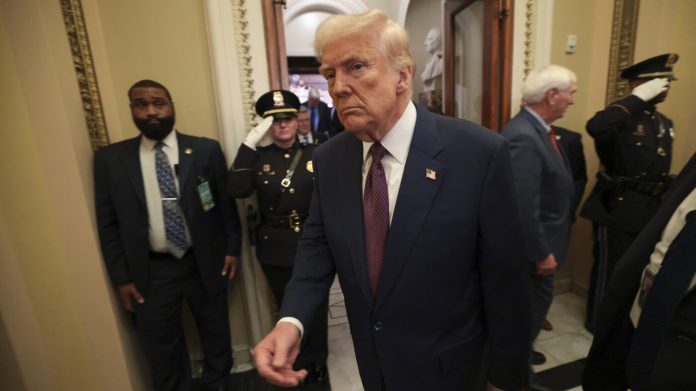
President Trump leaves the chamber after addressing a joint session of Congress on Tuesday. The administration is locked in a legal battle over the firing of the head of a federal watchdog agency.

Win McNamee/POOL Getty Images


hide caption

toggle caption

Win McNamee/POOL Getty Images

WASHINGTON — An appeals court in Washington on Wednesday removed the head of a federal watchdog agency in the latest twist in a legal fight over Republican President Donald Trump’s authority to fire the special counsel.

The U.S. Court of Appeals for the District of Columbia sided with the Trump administration in allowing the immediate removal of Hampton Dellinger as head of the Office of Special Counsel while the court battle continues. Dellinger is likely to appeal to the U.S. Supreme Court.

Dellinger sued Trump last month after he was fired even though the law says special counsels can be removed by the president “only for inefficiency, neglect of duty, or malfeasance in office.” U.S. District Judge Amy Berman Jackson, who was nominated to the bench by Democratic President Barack Obama, quickly reinstated Dellinger in the job while he pursued his case.

Dellinger’s lawyers say allowing the president to fire the special counsel without cause would have a chilling effect on the important duties of the office to protect whistleblowers. The ruling comes as Dellinger is also challenging the removal of probationary workers who were fired as part of the Trump administration’s shakeup of the federal government.

The Trump administration has argued that the law protecting the special counsel from removal is unconstitutional and unfairly prevents the president from rightfully installing his preferred agency head.

Jackson on Saturday ruled that Dellinger’s firing was unlawful and ordered that he remain in his post. But the appeals court lifted Jackson’s order blocking his removal while the court considers legal arguments in the case.

The Office of Special Counsel is responsible for guarding the federal workforce from illegal personnel actions, such as retaliation for whistleblowing. It investigates whistleblower claims of reprisal, can pursue disciplinary action against employees who punish whistleblowers and provides a channel for employees to disclose government wrongdoing.

After a request from Dellinger’s office, a government panel that enforces workers’ rights ruled Wednesday that more than 5,000 employees fired by the Trump administration should be put back on the job at the U.S. Department of Agriculture.

While the order applies only to the USDA workers, Dellinger released a statement “calling on all federal agencies to voluntarily and immediately rescind any unlawful terminations of probationary employees.”
France Open to Discussing Extension of Nuclear Deterrence, Macron Says

0

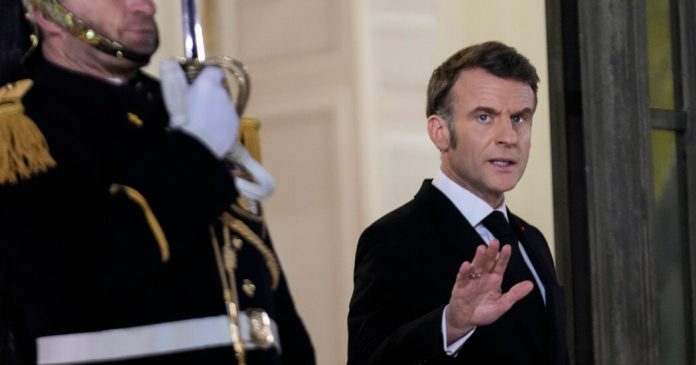
France is willing to discuss extending the protection afforded by its nuclear arsenal to its European allies, President Emmanuel Macron said on Wednesday, as the continent scrambles to fend off heightened Russian aggression and diminishing American support.

France and Britain are the only two countries in Europe with their own nuclear weapons; only France is in the European Union. Russia and the United States are also nuclear powers.

“Our nuclear deterrent protects us — it is comprehensive, sovereign and French through and through,” Mr. Macron said in a televised address that was mostly devoted to the war in Ukraine and Europe’s safety. “Since 1964, it has played an explicit role in preserving peace and security in Europe.”

“I have decided to open the strategic debate on protection through deterrence for our allies on the European continent,” Mr. Macron added.

In 2020, well before Russia’s invasion of Ukraine, he expressed support for a “strategic dialogue” with European partners “on the role played by France’s nuclear deterrence in our collective security.”

At the time, those ideas had received little traction with France’s allies, many of whom have come to rely on America’s nuclear capabilities.

Now, though, President Trump’s decisions to drop support for Ukraine, pull back America’s traditional security blanket in Europe and pressure allies to spend more on defense have forced the continent to rapidly rethink its security architecture.

In his speech, Mr. Macron painted a stark picture of Europe caught between an unreliable American ally and an increasingly aggressive Russia, which he said was now pouring 40 percent of its state budget into military spending.

“Russia has become a threat to France and Europe for years to come,” he said.

“I want to believe that the United States will remain by our side, but we need to be ready if that were no longer the case,” said Mr. Macron, as he announced that France would convene a meeting of European army chiefs in Paris next week to discuss the possible deployment of peacekeeping troops in Ukraine after the war ends.

“The future of Europe should not be decided in Washington or in Moscow,” he added.

Mr. Macron said opening a debate on nuclear deterrence was “in response to the historic call from the future German chancellor” — a reference to Friedrich Merz, the center-right politician who is almost certain to be Germany’s next leader.

Mr. Merz said last month that German authorities needed to talk with French and British counterparts about extending their nuclear umbrellas.

“We have a shield; they don’t,” Mr. Macron said of France’s European allies in an interview with Le Parisien last week. “And they can no longer depend on the American nuclear deterrent. We need a strategic dialogue with those who don’t have it, and that would make France stronger.”

Mr. Macron was speaking ahead of a meeting of European leaders in Brussels on Thursday, but his office said that the possibility of extending a nuclear umbrella, which has also been raised in Britain, was not expected to be a main topic of discussion.

Mr. Macron has said that France could partner with other countries for joint deterrence drills, although the exact contours of a French or French-British nuclear umbrella for Europe are still fuzzy.

But the idea is contentious for some in France, where Mr. Macron’s political opponents have called it an unacceptable breach of French sovereignty.

Marine Le Pen, the French far-right leader, told lawmakers this week that Mr. Macron was “undermining our model of deterrence,” while Laurent Wauquiez, a top lawmaker with the conservative Les Républicains party, argued that “you don’t share the nuclear button.”

Mr. Macron has insisted that France would firmly remain in control of its nuclear weapons and of any decision to use them. His allies have also argued that France’s nuclear deterrence had always been designed with a broad, if purposefully ill-defined, European element in mind.

“Our nuclear deterrence is French and will remain so,” Sébastien Lecornu, France’s defense minister, said on X last week. He said Mr. Macron was merely following a long line of French presidents, stretching back to Charles de Gaulle, who have argued that the country’s vital interests were not limited to its own territory.

“So yes, we need to answer our European partners’ questions about what our deterrence is, what it can mean for them, and what it will remain,” Mr. Lecornu said.

National Endowment for Democracy Sues Top Trump Aides Over Funding Freeze

0

The National Endowment for Democracy, a nonprofit that has had bipartisan support over decades for its work promoting democracy abroad, is suing the U.S. government and cabinet officials for withholding $239 million in congressional appropriations.

Members of the group’s board, which includes current and former Republican and Democratic politicians, said the organization filed the lawsuit on Wednesday afternoon as a last resort because it had been unable to get the State Department to restart the flow of money.

The group has had to put about 75 percent of its staff on unpaid leave, and about 1,200 grant recipients have received no money for projects since late January, after President Trump signed an executive order freezing all foreign aid.

In the lawsuit, filed in Federal District Court for the District of Columbia, the group argues that its money from Congress is not foreign aid and does not fall under the purview of the State Department, which manages the transfer of funds, or any other executive branch agency. Withholding the funding, the board members say, is illegal.

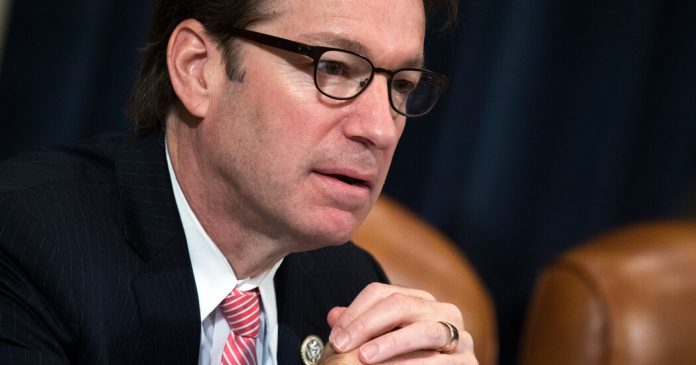
Peter Roskam, a former Republican congressman from Illinois who chairs the nonprofit, said the board voted on Tuesday to go to court.

“We’d be delighted to learn that this was just an oversight and someone just forgot to hit the send button,” he said in an interview on Wednesday, minutes before the lawsuit was filed. “But clearly that’s not what’s going on.”

The endowment’s plight is emblematic of the colossal shift in foreign policy that is taking place in the second Trump administration, as the president tries to move the government away from overseas democracy and human rights work and toward an approach that eschews alliances in favor of a more transactional and nationalistic approach.

Some senior administration officials have adopted language, including phrases once common among progressive critics of the U.S. government, about the downside of American projects that seek to extend influence abroad, calling such programs “nation-building” and attempts at “regime change.”

Spokespeople for the White House, the State Department and the Justice Department did not immediately respond to requests for comment.

Elon Musk, the billionaire adviser to Mr. Trump, posted scathing criticism of N.E.D. online last month, saying it was “RIFE with CORRUPTION!!” “That evil organization needs to be dissolved,” he wrote, using the same conspiratorial language he has employed to describe the U.S. Agency for International Development, which Mr. Musk has helped dismantle.

Representative Elise Stefanik, a New York Republican who is Mr. Trump’s pick for ambassador to the United Nations, was on the N.E.D. board until she had to step down to prepare for Senate confirmation for her new job. Senator Todd Young, Republican of Indiana, is currently on the board.

Mr. Trump’s “America First” policy has also been brought into sharp relief in recent weeks by his criticism of Ukraine in its fight against Russia; his imposing of tariffs on allies Canada and Mexico; his insistence on taking mineral-rich Greenland from Denmark, another ally; and his decision to cut off almost all foreign aid, which strategists have seen as an important component of American soft power.

The grants N.E.D. gives out are focused on promoting democracy, free speech and religious freedoms in more than 100 countries and territories, including ones that the first Trump administration and the Biden administration considered rivals or adversaries like China, Russia, Iran, North Korea, Venezuela and Cuba. The grants fund projects such as developing software that allows citizens to access banned websites.

Mel Martinez, a former Republican senator representing Florida, said the Trump administration’s unwillingness to release funding for organizations that support overseas dissidents was an affront to exiles from Cuba, Nicaragua and Venezuela. “That entire group of people are politically active,” he said. “Many have been strong supporters of the president.”

In Venezuela, for example, grants support independent groups that monitor elections and defend dissidents targeted by the autocratic government.

Authoritarian governments, including those of China and Russia, have denounced the work of N.E.D. over many years.

The group traces its origins to a speech by President Ronald Reagan to the British Parliament in 1982. He vowed that “the march of freedom and democracy” would “leave Marxism-Leninism on the ash-heap of history.” Congress passed a law establishing N.E.D. the following year.

N.E.D. gives funding to several sister nonprofits, notably the International Republican Institute and the National Democratic Institute. Those groups are also ending programs because of the funding freeze. Several Senate allies of Mr. Trump, including Tom Cotton of Arkansas and Dan Sullivan of Alaska, sit on the I.R.I. board.

Secretary of State Marco Rubio, a defendant in the lawsuit, is a former board member.

The Republican group’s website says it has had to disable its operations to save on expenses, but a page still reminds people to remember the work that it does: “Dictators are afraid of their own people. Helping citizens have a voice in their country is at the heart of what I.R.I. does.”

David Super, a professor who studies administrative law at Georgetown University, said N.E.D.’s case had some similarities to a lawsuit filed by contracting companies for U.S.A.I.D. The Trump administration also froze that agency’s funds. In both cases, Mr. Super said, Congress had passed “clear, mandatory authorizing and appropriations statutes.” Withholding money from N.E.D., he said, “is clearly violating both laws.”

Consider This from NPR : NPR

0

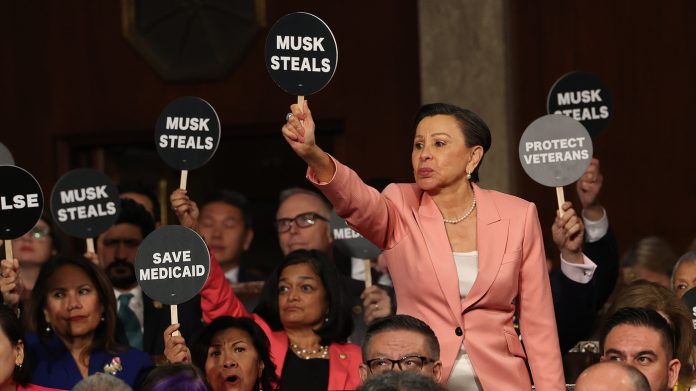
U.S. Rep. Nydia Velázquez (D-NY) holds a protest sign with fellow Democrats as U.S. President Donald Trump addressed a joint session of Congress at the U.S. Capitol.

Win McNamee/Getty Images


hide caption

toggle caption

Win McNamee/Getty Images


U.S. Rep. Nydia Velázquez (D-NY) holds a protest sign with fellow Democrats as U.S. President Donald Trump addressed a joint session of Congress at the U.S. Capitol.

Win McNamee/Getty Images

A hundred minutes — that’s how long President Trump had the floor — literally — last night.

A hundred minutes he used to lay out his agenda, his grievances and what he argued are the accomplishments of his first six weeks in office.

This all came during his “joint address” to Congress — the State of the Union that’s not a State of the Union.

Since Trump returned to office in January, there’s been little room left for democrats to make their case to the American people.

Democratic moderates think they have an answer for Trump 2.0. What does their playbook look like?

For sponsor-free episodes of Consider This, sign up for Consider This+ via Apple Podcasts or at plus.npr.org.

Email us at [email protected].

This episode was produced by Alejandra Marquez Janse, Connor Donevan and Jeffrey Pierre.

It was edited by Courtney Dorning
Our executive producer is Sami Yenigun.

Trump to Pause Auto Tariffs for Canada and Mexico for One Month

0

President Trump said on Wednesday that he would pause tariffs on cars coming into the United States from Canada and Mexico for one month, after a 25 percent tariff that he placed on America’s closest trading partners a day earlier roiled stock markets and prompted stiff resistance from industry.

Karoline Leavitt, the White House press secretary, read a statement from Mr. Trump on Wednesday saying that White House had spoken with the three largest auto makers, and that a one-month exemption would be given to cars coming in through United States-Mexico-Canada Agreement.

“At the request of the companies associated with U.S.M.C.A., the president is giving them an exemption for one month so they are not at an economic disadvantage,” the statement said. The three automakers that Mr. Trump spoke with were General Motors, Ford Motor and Stellantis.

Asked why Mr. Trump granted only a one-month reprieve, Ms. Leavitt said the president expected the automakers to move production back to the United States. The message, she said, was to “get on it, start investing, start moving, shift production here to the United States of America where they will pay no tariffs.”

The reprieve was a demonstration of the haphazard approach Mr. Trump has taken to trade policy, with the president announcing, pausing and then proceeding with a policy that is deeply influential for the North American economy within a matter of weeks. The decision came after Mr. Trump hosted a conference call Tuesday with Mary T. Barra, the chief executive of General Motors; John Elkann, the chairman of Stellantis; William C. Ford, the chairman of Ford Motor; and Jim Farley, Ford’s chief executive, according to a person briefed on the call.

The executives told the president that putting tariffs on cars and parts from Canada and Mexico would effectively erase all of their companies’ profits by imposing billions of dollars of new costs on them, the person said. They asserted that cars built in those countries supported jobs in the United States at parts factories, dealers and other related businesses.

They said they had invested in factories across North America because they were assured by Nafta and the U.S.M.C.A., the trade agreement Mr. Trump negotiated with Canada and Mexico in his first term, that the continent would be a free-trade zone, the person said. Changing the rules of that zone abruptly would have devastating consequences.

Executives from the three companies said they would not object to tariffs being imposed on cars imported from outside North America, the person said. Aside from Canada and Mexico, the United States imports a large number of cars from Japan, South Korea and Germany.

It was unclear what the reprieve means for carmakers, such as BMW, that manufacture cars in Mexico but are not fully in compliance with the terms of the trade treaty. Currently BMW pays a 2.5 percent tariff to import vehicles from a factory in San Luis Potosí, Mexico. BMW also makes cars in Spartanburg, S.C., which is one of the German company’s largest factories.

Mr. Trump has said that the levies were aimed at getting Canada and Mexico to stop flows of drugs and migrants across the U.S. border. But after months of threats, he chose to put the tariffs into effect this week, even after Canada and Mexico pledged to devote more resources to policing the border and drug trade.

The leaders of Mexico and Canada have called on Mr. Trump to drop the tariffs, saying that they are unfair and unjustified.

But Mr. Trump declined to offer a broader reprieve to Canada, despite fresh overtures by Prime Minister Justin Trudeau. Mr. Trump wrote on social media that he had talked with Mr. Trudeau and was still not convinced that Canada had done enough to stop the flow of fentanyl over the border.

On Truth Social, Mr. Trump wrote that he had told Mr. Trudeau that “many people have died from Fentanyl that came through the Borders of Canada and Mexico, and nothing has convinced me that it has stopped.”

The president added: “He said that it’s gotten better, but I said, ‘That’s not good enough.’”

Data shows only a small amount of fentanyl comes into the United States through Canada, and Canadians have bristled at assertion that they are a significant source of drugs for the United States.

On Tuesday, Canada requested consultations with the United States at the World Trade Organization over the tariffs, saying that they violated the pledges the United States had made at the W.T.O.

Vice President JD Vance and Howard Lutnick, the commerce secretary, were on the call with Mr. Trump and Mr. Trudeau. The discussion lasted 50 minutes, a senior Canadian official said, adding that the president brought up access to the Canadian dairy market for U.S. producers.

Mr. Lutnick and Canada’s finance minister, Dominic LeBlanc, will continue the conversation throughout the day to find a de-escalatory compromise. Mr. Trudeau is not prepared to lift Canada’s retaliatory tariffs on U.S. goods, the official said, but is open to considering selective tariff reduction or removal if the United States decides to remove or lower tariffs on specific Canadian goods. The official spoke on condition of anonymity because they were not authorized to brief the press on the ongoing negotiations.

In a news conference Wednesday, President Claudia Sheinbaum of Mexico defiantly repeated several times, “we will not submit.”

Ms. Sheinbaum said she had a call with Mr. Trump scheduled for Thursday, but had no updates or information on Mr. Lutnick’s assertions about a change to the tariffs. She said that if tariffs remained in place, the Mexican government would announce retaliatory measures on Sunday, when it has also called a demonstration in Mexico City.

“Between us all, we have to defend our sovereignty,” she said.

Ms. Sheinbaum also said that, in response to the tariffs, her government was already conferring about new trade partnerships, including with Canada and Chile.

“We will look to have more agreements and partnerships with other countries,” she said.

Mr. Trump’s move to impose a 25 percent tariff on most products from Canada and all products from Mexico, as well as an additional 10 percent tariff on all imports from China, caused stock markets to plummet globally Tuesday, before shares for some industries recovered somewhat.

Shares of some automakers bounced back on Wednesday on hopes that Mr. Trump would scale back his tariffs on Canada and Mexico. General Motors, Ford Motor and Stellantis all rose. Most carmakers rely on factories and suppliers in those countries for cars and parts and cannot easily or quickly shift production to the United States.

A one-month reprieve will do little to resolve the industry’s longer-term exposure to Mr. Trump’s parade of tariffs. They include steel and aluminum tariffs that take effect on March 12 and “reciprocal” levies that Mr. Trump plans to impose on April 2.

But it may give automakers a chance to stockpile cars and parts made in Mexico and Canada and blunt the impact if tariffs go into effect later.

Kevin Roberts, director of economic and market intelligence at CarGurus, an online vehicle shopping site, said it was unrealistic to expect that car companies could move their factories to the United States in a month.

“The auto industry is so global and so highly interconnected, you’re not going to be able to shift a large amount of production in a month’s time,” Mr. Roberts said.

A 25 percent tariff would add almost $12,000 to the average price of a car coming from Canada, Mr. Roberts estimated, and $10,000 to the average price of a car imported from Mexico.

Annie Correal, Matina Stevis-Gridneff, Vikas Bajaj and Neal E. Boudette contributed reporting.

Can Democrats find their way out of the wilderness?

0

NPR’s Juana Summers talks to Bennett from the centrist think tank Third Way, about what he heard from leaders in the Democratic party and what he thinks about Trump’s joint session of Congress speech.

South Africa’s Play to Ease Tensions With Trump: A New Trade Deal

0

South Africa is preparing a new trade offer to present to President Trump, hoping to appeal to his transactional approach to foreign policy and ease boiling tensions with Washington, a spokesman for South Africa’s president said this week.

The spokesman, Vincent Magwenya, said in an interview that South African officials are anticipating Mr. Trump will call for an end to the African Growth and Opportunity Act, a decades-old trade agreement that has been an economic boon to the 32 African nations that it includes.

The act allows billions of dollars worth of goods — from produce to cars — from sub-Saharan Africa to enter the United States without duties. It is scheduled to expire this year but could be reauthorized by Congress.

Although officials in South Africa hope the program will be renewed, they plan to offer the United States a bilateral deal that would increase trade in sectors such as energy, Mr. Magwenya said.

A future without the African Growth and Opportunity Act would represent a significant shift for the continent’s largest economy. South Africa has for years lobbied against threats to expel it from the program on the grounds that its economy had grown too advanced.

South African officials argue that the African Growth and Opportunity Act has kept businesses confident in the South African economy, helped maintain stability across the continent and fostered a healthy relationship with the United States.

Relations between South Africa and the United States were upended last month when Mr. Trump accused the country of using a new land law to discriminate against white citizens. President Cyril Ramaphosa of South Africa fired back, accusing Mr. Trump of spreading misinformation.

The land bill allows the South African government to take privately owned land without providing compensation, though supporters say any such seizures would be rare and subject to strict judicial review.

In response, Mr. Trump signed an executive order freezing American aid to South Africa. The order also criticized Mr. Ramaphosa’s government for accusing Israel of genocide in Gaza and for developing a nuclear agreement with Iran.

In the weeks since the executive order was signed, South African leaders have debated how to respond.

Mr. Ramaphosa’s administration decided a renegotiated trade deal with the United States — South Africa’s second-largest trading partner behind China — could lead to a thaw.

“When you take a step back and you put the emotions aside, you realize there’s an opportunity here to reset the relationship,” Mr. Magwenya said. “There is enough substance from a trade point of view for us to be able to do that.”

One option under consideration is to increase cooperation between the two countries on gas, with the United States getting more access to gas exploration in South Africa and South Africa sourcing more of its gas from America, he said. The proposal also would include a plan for what South Africa would consider fair tariffs, he said.

While South African officials are betting that a favorable trade deal will convince Mr. Trump to work with them, serious obstacles remain.

Emma Louise Powell, a South African lawmaker who met with the Trump administration and members of Congress in Washington last week, said she had been warned South Africa should expect further punitive actions from the United States.

Ms. Powell led a delegation sent by the Democratic Alliance, the second-largest party in South Africa’s governing coalition. It was not an official government mission, but was intended to help de-escalate tensions and learn what South Africa could do to repair the relationship with the United States, Ms. Powell said.

The delegation did not receive a definitive answer, Ms. Powell said, but “it is clear that a significant amount of work needs to be done to rebuild trust.”

During Joseph R. Biden Jr.’s presidency, lawmakers on both sides of the aisle called on the United States to punish South Africa for its foreign policy decisions, including maintaining ties to Hamas and Russia. They also criticized the country for supporting Iran’s bid to join BRICS, the economic coalition with Brazil, Russia, India, China and South Africa.

The Trump administration has taken its frustration with South Africa even further. It has embraced the cause of some white South Africans who argue that they are discriminated against by laws meant to address stark racial inequalities lingering from apartheid.

Mr. Magwenya, the spokesman, said that when South Africa has a trade deal to offer Mr. Trump, the country would also engage the administration on other contentious issues, such as the land bill. South African officials believe a favorable economic deal will convince Mr. Trump that it is in the interest of the United States to maintain close trade ties, despite disagreements over other policies, Mr. Magwenya said.

In 2023, South Africa exported $13.9 billion worth of goods to the United States, with just under a quarter of it going through the preferential African trade program. Although South Africa takes in much less — $7.2 billion in 2023 — from the United States than it sends out, it was the biggest importer of American goods in sub-Saharan Africa.

Thursday Briefing: How Trump’s Aid Halt May Affect Ukraine

0

European leaders are set to meet in Brussels today to discuss how to support Ukraine and strengthen their own military capabilities. President Trump’s decision yesterday to halt U.S. intelligence sharing with Ukraine, on the heels of his pause on military aid shipments, could reorder the battlefield.

U.S. officials have suggested that the pause in weapons shipments and intelligence sharing could be relatively short-lived if Ukraine’s president, Volodymyr Zelensky, bends to White House demands.

My colleague Andrew Kramer, our Kyiv bureau chief, told me that “if Russia sees potential for quick military gains from a weakened Ukraine, the incentive for talks will diminish for Moscow.”

By halting U.S. assistance, Andrew added, Trump “is essentially asking Ukraine to agree to terms in advance, without knowing what they are.”

Without American-made weapons, Ukraine’s forces could start to buckle in as little as four months, analysts said. About 20 percent of Ukraine’s military hardware comes from the U.S. But that 20 percent “is the most lethal and important,” an expert said.

Fence-mending: To smooth things over with Trump after a clash at the White House last week, Zelensky is receiving some coaching from European leaders to get back in his good graces.

Russia: State-controlled television in the country is changing its tune: The U.S. isn’t so bad after all.


The Supreme Court yesterday rejected President Trump’s request to freeze nearly $2 billion in foreign aid as part of his efforts to slash government spending. The vote, 5 to 4, moved the aid freeze decision back to a lower court, where a judge had said the Trump administration had offered no explanation for the blanket suspension of aid.

Two conservative justices joined the three liberal members of the Supreme Court to issue the ruling, one of the court’s first moves in response to Trump’s spending cuts. The fact that a majority of the court ruled against Trump on one of his signature projects suggests that he’ll have to face a more skeptical Supreme Court than its mostly conservative composition might indicate.


Three years ago, a video blogger stumbled upon a shack in a village in eastern China.

Inside was a woman — dazed, shivering and chained up by the neck. That video set off what many observers called the biggest moment for women’s rights in recent Chinese history. For weeks, the Communist Party struggled to quash the nationwide outcry. Eventually it did, though not entirely: In secret, a new generation of more determined activists had risen.

The Yellow Bittern hardly looks like London’s most divisive eatery, but its chef, a communist, has enraged half the city. Critics say the restaurant is full of paradoxes — the stew costs 20 pounds but the wine costs hundreds, and the chef scolds patrons for not spending enough money.

What really chafes some are the hours: The place is only open for weekday lunch, when most Londoners are too busy for an expensive, leisurely meal.

Lives lived: Peter Sichel, who played a crucial role in the C.I.A. as a station chief in Cold War Berlin and Hong Kong and later popularized Blue Nun wine, died at 102.

French audiences are leading the charge back to movie theaters.

According to fresh data, the country was one of the few that saw an increase in big-screen attendance last year compared with 2023. The trend is related to a French idea about a moral obligation to support the arts outside the home, and to a film industry that has helped shape Paris’s urban landscape.

France’s uptick is different than that of other countries which have seen higher box office revenue because of premium theaters. “It’s almost mystical,” an analyst said.

Far-Right Israeli Minister Visits Washington After Years of Being Shunned

0

Under the Biden administration, Israel’s far-right finance minister was the rare Israeli official whom the United States rebuked by name for his views, like his opposition to a cease-fire in Gaza.

Under the Trump administration, he is a welcome guest in Washington, where top U.S. officials are now aligning with some of his beliefs about the Israeli-Palestinian conflict.

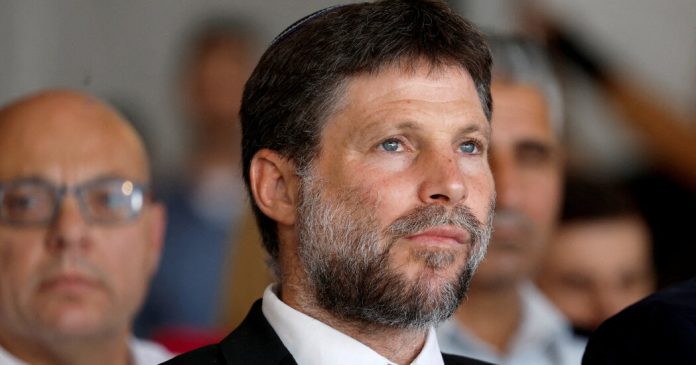
The minister, Bezalel Smotrich, met with Treasury Secretary Scott Bessent on Wednesday, remarking in a statement about his embrace after years of being effectively shunned.

“After four years during which, under the Biden administration, there was no ministerial-level meeting between the U.S. Treasury Department and the Israeli government, ​​we are now entering the Treasury Department,” Mr. Smotrich said. He called Wednesday’s meeting “very important.”

After it concluded, Mr. Smotrich posted on social media a picture of himself shaking hands with Mr. Bessent and said in a statement that they had agreed to “enhance collaboration” on issues including economic policy, technology and financial regulation.

“This is a critical time to shape a new strategic economic future for both countries, reinforcing American global leadership and Israel’s role as a key economic partner,” the statement said.

The Treasury Department did not immediately respond to questions seeking further detail.

The meeting highlighted the Trump administration’s welcome of people and positions espoused by Israel’s far right that the United States had long eschewed and that many nations and rights activists have condemned. Those positions include the mass removal of Palestinians from Gaza, which Mr. Trump proposed last month and which experts say would violate international law.

In contrast to the outcry at Mr. Trump’s plan, Mr. Smotrich gave it his full support, saying he would work to implement it.

The Israeli finance minister has long backed not only Israeli occupation of the West Bank but also indefinite Israeli rule of the territory. He holds a powerful role overseeing funds for the Palestinian Authority, which administers part of the West Bank, and also a role in the defense ministry that has allowed him to advance Jewish settlements.

As a religious hard-liner and settler leader, Mr. Smotrich believes that the West Bank, which Israel seized in a war with Jordan in 1967, was promised to Jews by God in the Bible. His efforts to cripple the Palestinian Authority and support Jewish settlers frustrated Biden officials, but Mr. Trump has now elevated several figures who share Mr. Smotrich’s views.

Mr. Trump has picked former Gov. Mike Huckabee of Arkansas, a Christian Zionist and former Baptist minister, for ambassador to Israel and Elise Stefanik, a U.S. representative who has said she believes Israel had a biblical right to the West Bank, for ambassador to the United Nations.

Much of the world regards Jewish settlements in the West Bank as illegal, and some are illegal under Israeli law. The territory is home to about three million Palestinians and about half a million Jewish settlers. Palestinians in the West Bank live under military rule and cannot vote in Israel, while Israelis in the area live under civil law.

Israel has tacitly and explicitly allowed settlement expansion, and at a particularly rapid pace in recent years. The government argues that the territory remains disputed and says its fate should be determined in negotiations.

Mr. Smotrich has used his position as finance minister to cut off and threaten the flow of funds to the Palestinian Authority, which relies on the transfer of taxes collected by Israel and must transact with Israeli banks.

His actions led to clashes with his counterparts abroad, including former Treasury Secretary Janet Yellen, who last year warned Israel against cutting off ties between Palestinian and Israeli banks.

Mr. Smotrich said he had been responding to three European countries declaring their recognition of a Palestinian state, and he ultimately released funds in exchange for the Israeli government legalizing additional settlements. In October, he extended the waiver under pressure from Ms. Yellen, who did not visit Israel as treasury secretary in part because he was her counterpart.

Mr. Smotrich also drew condemnation from the Biden administration for statements opposing a cease-fire and hostage deal between Israel and Hamas, among other things. A group of Democratic members of Congress had called for sanctions to be imposed on Mr. Smotrich, under an executive order that Mr. Trump has since withdrawn.

U.S., Hamas Hold Direct Talks Over Hostages in Gaza, Officials Say

0

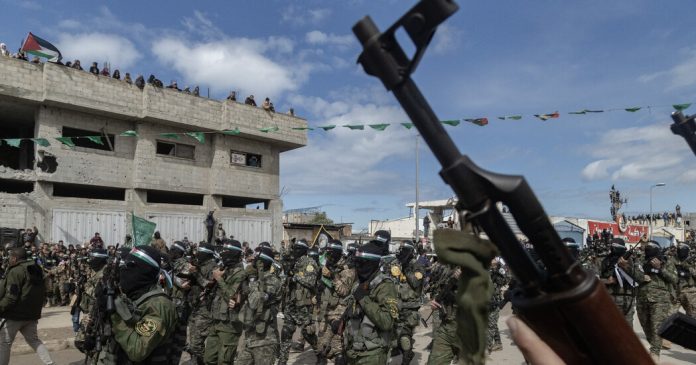
U.S. and Hamas officials held talks in Qatar about hostages held in the Gaza Strip, breaking with a long-running American policy of refusing to directly engage with the militant group, according to an Israeli official and a diplomat briefed on the matter.

Adam Boehler, President Trump’s nominee to be special envoy for hostage affairs, participated in the talks this week with Hamas officials, the diplomat said. Both people discussed the meetings on condition of anonymity because they were not authorized to speak publicly about the sensitive diplomacy.

The scope of the discussions was not immediately clear, but mediators have been seeking to extend the current truce between Israel and Hamas and free the remaining hostages in Gaza. About 24 living hostages — including Edan Alexander, an American citizen — and the bodies of at least 35 others are believed to still be held in Gaza, according to Israel.

The secret talks, which Axios first confirmed, marked a significant departure from previous negotiations involving the United States and Hamas, which the U.S. government has for decades designated as a terrorist group. American officials, like their Israeli counterparts, have generally relied on mediators to relay messages to the group rather than sit down with Hamas leaders.

U.S. and European officials hoped the no-contact policy with Hamas would isolate and weaken the group after it seized control of the Gaza Strip in 2007. Critics occasionally questioned the effectiveness of the boycott, which continued through years of deadlock and little apparent shift in Hamas’s positions.

Since the Hamas-led attack on Oct. 7, 2023, ignited the war in Gaza, mediators including Qatar and Egypt have played major roles in brokering efforts to end the fighting and free Israeli and other hostages seized by Palestinian militants.

Hamas and its allies seized about 250 captives during the attack on southern Israel, according to the Israeli government. More than 100 were freed during a weeklong truce in late 2023, while another 30 — and the bodies of eight more — have been released since the current cease-fire began in mid-January.

Israel and Hamas are currently deadlocked over terms for the current deal’s second phase: a comprehensive truce that would end the war and free the remaining living hostages still held by Palestinian militants in Gaza.

President Trump nominated Mr. Boehler to serve as a special envoy on hostage affairs in early December. A health care executive who held roles in Mr. Trump’s first administration, Mr. Boehler has yet to be confirmed to the job by the U.S. Senate.

The State Department had no immediate comment. The Israeli prime minister’s office declined to comment and Hamas did not immediately respond to requests for comment.

Ed Wong and David E. Sanger contributed reporting from Washington.