Thursday, November 12, 2026
Home Blog Page 156

Trump’s Canada tariffs to face Senate vote, Sen. Kaine says : NPR

0

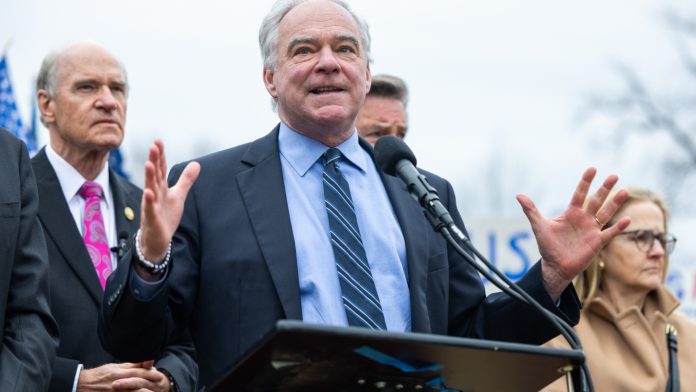
Sen. Tim Kaine, D-Va., speaks at a rally outside of the U.S. Capitol in support of USAID in Washington, DC on February 5, 2025.

Nathan Posner/Anadolu via Getty Images


hide caption

toggle caption

Nathan Posner/Anadolu via Getty Images

A defiant President Trump defended imposing new tariffs on Canada, China and Mexico – three of the United States’ largest and most crucial trading partners – at a joint session of Congress Tuesday night.

Economists have repeatedly said that the 25% tariffs that went into effect this week on the three countries will raise prices on businesses and U.S. consumers. The tariffs are likely to affect car prices, groceries and other goods.

But Trump said during his record-length address the tariffs were about defending American jobs and “protecting the soul of our country.”

Despite the president’s confidence about these tariffs, Sen. Tim Kaine, D-Va., told Morning Edition that Republicans in Congress may be feeling anxious and “nervous” about the likelihood that a lot of goods are about to get more expensive.

Kaine said he plans to file a challenge in the Senate to Trump’s tariffs on Canada, which were imposed using emergency economic powers, arguing that the reason they’ve been enacted is invalid. Trump has stated the tariffs were needed to stem the flow of fentanyl into the U.S.; federal data shows less than 1% of fentanyl is smuggled in from Canada.

“So sometime by the end of March, you’re going to see a vote on this,” Kaine said. “And I know a lot of Republicans are really worried about the effect these tariffs are going to have on their citizens.”

Kaine led a similar vote last month against Trump’s energy emergency declaration. It failed after a party-line vote.

Kaine also spoke to Morning Edition‘s Michel Martin about how the president’s address to Congress unfolded and the impacts the new administration is having on his constituents.

This interview has been edited for length and clarity.

Michel Martin: Let me touch on the atmosphere since you were there. Rep. Al Green, D-Texas, stood up and shouted that the president doesn’t have a mandate. He was escorted out. Other times, Democrats sat on their hands or waved small signs with different messages on them. What’s your take on how that went?

Sen. Tim Kaine: The State of the Union always has some fun theater to it. When the Senate processes in, the House members welcome us. Pomp and circumstance, the diplomatic corps. And there was that veneer last night, but I will say the mood in the room had a lot more anxiety and not just on the Democratic side, anxiety undercurrents than any that I’ve been in.

There was anxiety about the economy with the tariff issue. There’s anxiety about security in the aftermath of the horrible meeting in the Oval Office with the president of Ukraine last Friday. And there’s even lingering anxiety about our democracy itself, when you have a guy like Elon Musk seemingly in charge and people are remembering that the president just pardoned the Jan. 6 protesters.

Editor’s note: Tuesday night’s speech was not an official State of the Union address.

Martin: So you’re telling us that you feel the Republicans were also feeling that anxiety, but what about how the Democrats responded in the moment? The reviews from some of the commentators were mixed. I mean, some took that as a kind of a metaphor for how the Democrats are responding to Mr. Trump overall, which is kind of incoherent. What’s your response to that?

Kaine: I think it was Will Rogers who said, “I don’t believe in organized political parties. That’s why I’m a Democrat.” We pride ourselves on being iconoclastic and individualistic. So folks, you know, did it differently. Some chose to wear things or waved signs. Rep. Green heckled the president. Some didn’t attend. Some did attend. But I think the bottom line message that we strongly believe – and I think Elissa Slotkin did a great job with this – is that Americans are worried about the economy. They’re worried about security, and they’re worried about democracy. And on the economy, that’s number one. It’s what President Trump campaigned on. And thus far, the results he’s delivering are abysmal.

Martin: As you mentioned, Sen. Slotkin’s basic message was that Trump said what he’s going to do, but he’s not really going to do that. Is there anything in particular you want to add or is there anything in particular that you want to fact check?

Kaine: I’m in Virginia and I’m watching the layoff of all these employees because of this DOGE project led by Trump, Office of Management and Budget director Russell Vought and Elon Musk. When they’re laying off FAA safety employees right after a tragic accident that killed 67 people at Reagan National Airport a month ago – are you kidding me? They’re waging a war on veterans because 30% of the federal workforce is veterans. So when you lay a lot of people off, you are laying off veterans and Donald Trump and these guys know it because they know who the federal workforce is. They are not just hurting the economy, but they’re hurting a group of people that does not deserve to be a punching bag.

Martin: Interestingly, your state exports a lot more than I think many people might realize that it does. President Trump defended tariffs on Canada and Mexico in his speech. Last year, some 15% of your state’s exports went to Canada, things like cars and transportation equipment. How do you respond to his defense of those tariffs?

Kaine: It’s disastrous to put these tariffs on the three biggest trading partners of our country, who are also the three biggest trading partners of Virginia. And we’ve got a particular soft spot for Canada because it’s not just about exports out of our port and through railroad. Canadians also come to our beaches a lot. So we are very used to Canadians coming for tourism. They’re just going to raise prices on everybody. And that’s why I’m challenging the president’s tariffs on Canada because, since he did it by emergency order, I can file a challenge and force the Senate to vote on it.

Martin: Say more about that. What exactly are you going to do about that?

Kaine: The president is imposing these tariffs pursuant to a declared emergency. Now we know the president is declaring emergencies not really because of an emergency, but he just wants to bypass Congress. Last week, I forced a vote on a president’s declared energy emergency. He said we’re in an energy emergency even though America is producing more energy than we ever have in the history of this country. We voted on it last week. No Republicans would break with the president, but I’m now going to challenge the Canadian tariffs.

He cited fentanyl at the border, but the fentanyl issue is not a real issue with Canada. There’s more fentanyl that goes from the U.S. to Canada than from Canada to the U.S. And it’s a footnote to the real fentanyl problem, which is China and Mexico. So he’s just inventing this Canadian emergency to start a trade war that’s going to hurt Virginians.

Martin: So I understand that you and Sen. Mark Warner, also from Virginia, have this legislation challenging these tariffs because you say they’re based on a false premise, but you have not been able to get any Republicans to vote with you so far on a similar challenge. What hope do you have that they will join you on this?

Kaine: I think they’re very, very nervous about these Canadian tariffs. And the good thing about this bill is I’m guaranteed a vote. It ripens and becomes the business of the Senate 15 days after I file it. So sometime by the end of March, you’re going to see a vote on this. And I know a lot of Republicans are really worried about the effect these tariffs are going to have on their citizens.
‘We Have Given Him Everything’: Trump’s Tariffs Stun Mexico

0

Up to the last minute, Isaac Presburger, like a lot of other Mexican businessmen, still could not believe that President Trump would deliver on his promise to hit Mexico with tariffs. Little did it matter that Mr. Trump had announced that very day that he would go ahead with the planned taxes.

“I am still incredulous,” said Mr. Presburger, director of sales at Preslow, a family-run apparel business in Mexico. “We know by now that Trump pressures you so you give him what he wants. We have given him everything and he has not let loose of his grip.”

In response to Mr. Trump’s threat to impose 25 percent tariffs on Mexican products, Mexico made a major effort: Leaders agreed to send more than two dozen alleged cartel heads to be tried in the United States, a departure from the government’s previous stance on extraditions.

President Claudia Sheinbaum dispatched thousands of National Guard troops to the state of Sinaloa, the hub of fentanyl trafficking, where they seized vast amounts of the synthetic opioid and busted hundreds of laboratories. She sent thousands more to the U.S. border, contributing to a plunge in the number of illegal crossings.

Ms. Sheinbaum bent further than anyone had expected to show the Trump administration that her government was serious about meeting U.S. demands, analysts say.

And yet, in spite of it all, the tariffs struck after midnight on Tuesday.

That has left people in Mexico’s government, business and civil society reeling, but also feeling exasperated, even betrayed.

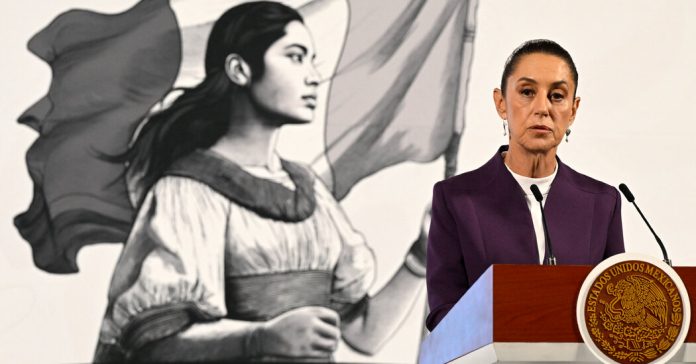
“We are emphatic,” Ms. Sheinbaum said in a news conference on Tuesday morning, hours after Mr. Trump’s tariffs took effect on its biggest trading partners, including Mexico and Canada. “There is no reason, justification or excuse that supports this decision that will affect our people and nations.”

She ticked off what she described as her government’s “significant actions” against organized crime, and noted a 50 percent drop in fentanyl seizures between October and January at the U.S.-Mexico border.

“We have worked and delivered results on security matters,” she said.

The tariffs represent not just a rift in the fabric of two economies that have been deeply interwoven for decades, but a sudden departure from a relationship that had long been collaborative and from what many in Mexico expected would take place: a last-minute deal.

Through late last week, a delegation from Mexico had been frantically negotiating with officials in Washington, and leaders had been projecting confidence. Even the financial markets held steady in Mexico.

Mexico’s economy minister, Marcelo Ebrard, posted to social media on Friday, “Mexico and the United States have a great future working together,” with three thumbs-up emojis. Business leaders across the country shared the same optimism until Monday.

José de Jesús Rodríguez, president of Mexico City’s chamber of commerce, said Mr. Trump’s decision surprised him, particularly in light of the American leader’s suggestion that he would not impose tariffs if Mexico produced results on migration and drug trafficking. The results it delivered included a barrage of high-level arrests and the handover of the 29 accused drug bosses that the U.S. government had long sought to get on its own soil.

But Mr. Trump, whose criticism of Mexico had focused on illegal fentanyl, shifted his terms on Monday, saying that Canada and Mexico needed to relocate automotive factories and other manufacturing to the United States. “What they have to do is build their car plants, frankly, and other things in the United States, in which case they have no tariffs,” he said.

“It is extremely disappointing and frustrating,” Mr. Rodríguez said. “The United States broke their word, and it dictates the future of our commercial relationship.”

“It’s time for us to look to other regions,” he added.

Ms. Sheinbaum said she had a call scheduled with Mr. Trump for Thursday, and told reporters on Tuesday that if the tariffs remained in effect afterward, her government would go ahead with a number countermeasures, including retaliatory taxes, which would be announced on Sunday. Canada also announced reciprocal tariffs.

“We don’t want to enter into a trade war,” she said. “That only affects the people.”

Ms. Sheinbaum’s approval ratings in Mexico have soared, with many praising her coolheaded approach to handling Mr. Trump, who called her a “wonderful woman.”

But the trade wars that are now underway will test not only that relationship but how much the government can insulate its economy and its population from chaos and pain.

Mr. Presburger, the Preslow sales director, said that he still hoped the tariffs wouldn’t last more than a few days, or that Mr. Trump would change his mind. Otherwise, “it will be disastrous for Mexico.”

The United States buys more than three quarters of Mexico’s exports, and tariffs will hit manufacturing, agriculture and other businesses, immediately disrupting the supply chain and most likely raising the cost of Mexican goods sold in the United States.

Just hours before the tariffs went into effect, Manuel Sotelo, president of the association of transporters of Ciudad Juárez, said the uncertainty hovered over the many who truck goods into the United States.

He said if tariffs applied to all Mexican products, they would affect everyone. But if they also applied to raw materials coming from businesses on the border, “then the situation is going to get worse for the region.”

He said the transportation industry could not last even a week if trade were frozen.

When Mr. Trump hit Mexico with tariffs during his first term, it carried out a surgical response, targeting the retaliatory tariffs at products that were produced in Republican states considered part of Trump’s base — such as Kentucky bourbon.

The tariffs were lifted after about a year.

Preparing for the worst, Mexican business owners and trade groups were already starting to scramble.

Antonio Lancaster, president of the council of industrial chambers of the state of Jalisco, one of the largest exporters of food and beverages — including tequila — to the United States, said the chambers’ leaders were already in talks with the state and federal government about plans to bolster local production and pursue other export markets.

“We saw this coming, and this means we will pursue a rearrangement of our exports,” Mr. Lancaster said. He added, “We will end up exporting to Europe, Asia or anywhere else.”

Businessmen like Mr. Lancaster argued that the tariffs will ultimately end up hurting American consumers as well as Mexican producers.

“We all lose here,” he said.

Jesús Manuel Salayandía, coordinator of a business group on the border, said that corporate leaders mostly based in the United States have been meeting to plan their response to the tariffs.

“They are analyzing whether they will move to Central America, to the southern part of the country, if they will return to the United States, or if they will automate or robotize certain production lines,” he said. “All of that is being considered.”

Mr. Salayandía said that the Mexican government, perhaps expecting a last-minute deal, had not worked to prepare.

They had been thinking, “Let’s wait for Trump to tell us what will happen,” he said. “But they’re not working on a plan to strengthen the domestic market or to offer incentives to the companies already here.”

Marcelo Vázquez, state delegate of the National Association of Importers and Exporters of the Mexican Republic in Chihuahua, said for the last few weeks some companies had workers on duty virtually around the clock to export goods into the United States before the tariffs came into effect.

“But that’s just an aspirin for the headache; it doesn’t really solve the problem.”

Rocío Gallegos contributed reporting from Ciudad Juárez, Mexico.

More than 5,000 USDA workers fired by Trump to get jobs back, MSPB rules : NPR

0

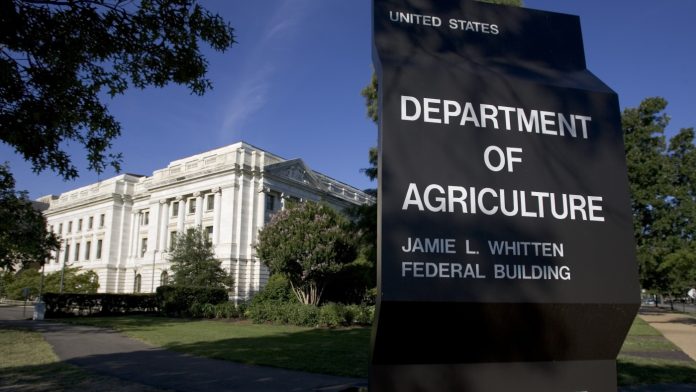
The U.S. Department of Agriculture building is shown in Washington, D.C.

Saul Loeb/AFP via Getty Images


hide caption

toggle caption

Saul Loeb/AFP via Getty Images

An independent federal agency has ordered the U.S. Department of Agriculture (USDA) to temporarily give more 5,000 employees fired since Feb. 13 their jobs back, finding reasonable grounds to believe the agency acted illegally in terminating them.

The Merit Systems Protection Board (MSPB) issued a stay, ordering USDA to return the fired workers to their jobs for 45 days while an investigation into the firings continues. The MSPB acts as an internal court to consider federal employees’ complaints against the government.

The order, from board member Cathy Harris, covers probationary employees who received identical termination letters informing them that, based on their performance, they had not demonstrated that their further employment “would be in the public interest.”

Since the middle of February, the Trump administration has fired tens of thousands of probationary employees across the federal government, typically those in their first or second year on the job.

The order comes in response to a request from the U.S. Office of Special Counsel (OSC), which is investigating the firings of probationary employees. It follows a similar decision issued last week that temporarily reinstated six probationary workers fired from six different agencies.

In a statement, Special Counsel Hampton Dellinger urged all federal agencies to reinstate probationary employees, even without a direct order.

“Agencies are best positioned to determine the employees impacted by these mass terminations,” Dellinger wrote. “That’s why I am calling on all federal agencies to voluntarily and immediately rescind any unlawful terminations of probationary employees.”

(The OSC, which investigates allegations of wrongdoing by the government against federal employees and job applicants, is separate from the special counsels appointed by the Justice Department.)

Investigation at USDA led to request for a broad stay

Dellinger requested the broad stay for USDA employees last week after gaining a clear picture of how the firings of more than 5,000 people occurred.

“Documents that OSC obtained and interviews that OSC conducted with USDA officials confirmed that USDA relied heavily on OPM guidance in terminating its probationary employees,” he wrote, referring to the U.S. Office of Personnel Management, the agency that handles many human resource functions for the government.

He concluded that USDA did not take into consideration the performance or conduct of employees. Rather, he says, the department fired the workers after determining that their positions were not “mission-critical,” as OPM had instructed and using a template letter OPM provided.

“Whether USDA terminated each probationary employee therefore depended entirely on the nature of that employee’s position, not on the adequacy of their performance or fitness for federal service,” Dellinger wrote.

Therefore, he wrote, USDA had improperly used the probationary status of employees to shrink the workforce, but did so without following proper procedures for mass layoffs, which include providing employees with 60 days’ notice.

At the USDA and elsewhere, the Trump administration has begun that process, known as a reduction in force, as it seeks to shed large swaths of the federal workforce, even as legal challenges to its summary firings of probationary employees gain steam.

Both Dellinger and Harris themselves were fired by Trump only to be reinstated by courts in recent weeks, after judges found that they had been improperly removed.

A separate challenge to the Trump administration’s firing of probationary employees is advancing in federal court. Last week, a federal judge in San Francisco ruled that the mass firings likely violated multiple statutes. On Tuesday, OPM revised a January memo to federal agencies, noting that it was not directing them to take any personnel actions, and that decision-making authority was in their hands.

French Child Sex Abuse Trial of Ex-Doctor Highlights Unheeded Warnings

0

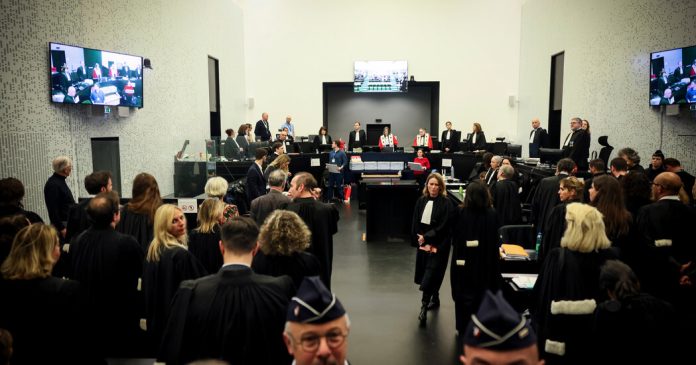
The alarms about Joël Le Scouarnec’s sexual desire for children had been ringing for years, well before he was charged with raping or sexually assaulting 299 people, most of them children under his care when he was a surgeon.

His wife’s sister said she expressed concerns to her sister after she thought she had witnessed him kissing her daughter’s bottom, according to court documents. His own sister confronted him directly after her youngest daughter told her “in children’s words” that he had touched her. And he had already been convicted in 2005 of possessing child sexual abuse imagery, and given a suspended sentence.

“Nothing, nothing, nothing,” Marie-France Lhermitte, now his former wife, said as the mass child sex abuse trial opened last week. She was responding to a question posed repeatedly about whether there were warning signs that she should have acted upon.

Mr. Le Scouarnec was a gastric surgeon who worked for more than three decades in multiple clinics and private hospitals in western and central France before he was arrested in 2017 for exposing himself to a 6-year-old neighbor. That arrest, and the police search of his home, led to the discovery of evidence — diaries and other writings — of much wider abuse over 25 years. In 2020, he was convicted of sexually assaulting or raping four little girls, including his sister’s two young daughters, and is serving time.

The latest trial — considered the country’s largest ever pedophilia case — is based mainly on those diaries and writings, which investigators used to identify the hundreds of listed victims.

Mr. Le Scouarnec, now 74, has admitted to the “vast majority” of the charges against him, his lawyer Maxime Tessier told the court in Vannes, where the trial is being held. The rape charges are mostly related to touching or penetrating children’s vaginas and anuses with his fingers. He has denied some of those charges on the grounds that those were part of medical procedures.

Throughout the first days of the trial, Mr. Le Scouarnec, who lost his medical license in 2017, has repeatedly voiced remorse for ruining not just his family’s lives, but also those of his former patients. Many of them are now adults and watch the proceedings from a nearby auditorium as support dogs wander the aisles. Many are expected to testify.

In the trial’s first week, the judges, the main prosecutor and lawyers for the former patients tried to uncover the roots of Mr. Le Scouarnec’s desire to sexually touch children. They also were trying to understand how he got away with abuses for a quarter-century without anyone in his family moving to stop him, despite at least some of them having suspicions.

In testimony, his three sons, two siblings, former wife, a cousin and a close family friend painted a portrait of a tight-knit family riven with sexual abuse and infused with a culture of silence and secrecy.

Mr. Le Scouarnec’s son Fabien Le Scouarnec testified that his grandfather Joseph Le Scouarnec had sexually abused him. (The grandfather, now deceased, had told people during his lifetime that he was himself abused, the court heard.) Mr. Le Scouarnec’s sister, Annie Jobard, said that she was raped by two boys when she was 14 and had never told her family.

His former wife said she had been raped by two male relatives when she was a child. She kept it a secret, she said, even from her husband.

“When you are raped, you feel dirty,” she testified. “So, you don’t talk about it.”

Family members described Mr. Le Scouarnec as a good husband, good brother and good father who loved reading and opera and who worked long hours.

His three sons said he was not home often, but when he was, he helped them with studies, took them to museums and ensured that they had music lessons. They described their childhoods as happy. Their father never abused them and they were completely unaware of his pedophilia, they said.

“We had everything we needed to be happy, and perversion exploded like an atomic bomb throughout the family,” Fabien, 42, said.

“It’s Dr. Jekyll and Mr. Hyde,” he later added. “There is a part of my father’s personality that I don’t know.”

But Mr. Le Scouarnec’s sister, Ms. Jobard, knew of at least one case. She told the court that she had confronted her brother in 2000, after her younger daughter told her the reason she did not want to go to dinner with him: He had been sexually abusing her. Chain-smoking in her car, Mr. Le Scouarnec admitted to the abuse and said he would work the rest of his life to make amends, she testified in court. She said she told him to get treatment.

Asked why she did not go to the police back then, Ms. Jobard said she thought her youngest daughter was the only victim. At the time, she did not know that Mr. Le Scouarnec had also victimized her elder daughter.

“I didn’t realize he was someone dangerous,” said Ms. Jobard, now 72, a retired English teacher. “For me, it was inconceivable that my brother was someone like that.”

Even when she later learned that Mr. Le Scouarnec had been arrested on charges of owning child sexual abuse imagery, and after Fabien told her about the abuse he had suffered from his grandfather, she said she did not make the connection that there was a much deeper problem in the family.

In retrospect, she said, “I think it was denial.”

Ms. Lhermitte, Mr. Le Scouarnec’s former wife, also testified.

Sitting in a swivel chair in the middle of the courtroom, she denied that her sister, whom she called a birdbrain, or her sister-in-law, Ms. Jobard, had ever spoken to her about their fears he was abusing their children.

She also said she did not know that her husband had been convicted of owning child sexual abuse images, despite having been at home when the police arrived to search the house. She went shopping during the search, she said, and when she returned, her husband was relaxed and told her it was all a big mistake.

She separated from him soon after the police search, but divorced him only more recently and continues to visit him in prison.

When Aude Buresi, the presiding judge, asked her about her sessions with a psychiatrist and whether they had helped her to understand the root of abuse in her family, she refused to talk about it, stating that it was her private life.

Judge Buresi tried to force her to confront the abuse by projecting photographs found on her husband’s many confiscated hard drives onto screens in the courtroom. They revealed naked, intimate pictures of the two nieces he was convicted of abusing.

“You are destroying us,” she said to the judge, adding later: “It’s so abusive of you. I don’t have the intellect to take in all that. I don’t know how I will survive that.”

Testifying in court this week, Mr. Le Scouarnec repeatedly defended Ms. Lhermitte, whom he still referred to as his wife. He argued that he had lied to her for 30 years, though he said she knew “some things” without giving details.

“I had two lives,” said Mr. Le Scouarnec, who was mostly composed as he addressed the court. “A family life, a social life, a professional life, and next to that, the life of a pedo-criminal, a pedophile who thought of nothing else.”

But he was also vague when asked key questions, like why he had destroyed some of his diaries. Most often he answered that he did not remember.

Though the court spent days demanding illumination from Mr. Le Scouarnec’s relatives and then from him, the source of his pedophilia remained elusive.

Ms. Jobard tearfully asked him if their father had also abused him.

Mr. Le Scouarnec stood up in the courtroom’s glassed-in box for the accused to offer a response.

“I have talked to psychologists for a very long time, I asked this myself, and I still don’t know,” he said. “What I am certain of, and I repeat: I was never abused by anyone.”

The next day, addressing his elder son Renan Le Scouarnec for what he said might be the last time, he caused a commotion in the courtroom when he disclosed another distressing family secret.

“I acknowledge having committed acts of sexual abuse on my granddaughter,” he said.

Then he asked for his son’s forgiveness.

The court abruptly adjourned as the son and son’s wife were whisked away into the care of two psychologists.

How did 'DEI' become part of a larger political agenda — and a slur?

0

Georgetown professor Ella Washington and Harvard professor Frank Dobbin discuss the beneficiaries and misperceptions of DEI, and who will be hurt as it’s dismantled across public and private sectors.

A Viral Video of a Chained Woman in China and the Secret Campaign to Save Her

0

The video blogger had visited Dongji Village, in eastern China, to find a man known for raising eight children despite deep poverty. The man had become a favorite interview subject for influencers looking to attract donations and clicks.

But that day, one of the children led the blogger to someone not featured in many other videos: the child’s mother.

She stood in a doorless shack in the family’s courtyard, on a strip of dirt floor between a bed and a brick wall. She wore a thin sweater despite the January cold. When the blogger asked if she could understand him, she shook her head. A chain around her neck shackled her to the wall.

The video quickly spread online, and immediately, Chinese commenters wondered whether the woman had been sold to the man in Dongji and forced to have his children — a kind of trafficking that is a longstanding problem in China’s countryside. They demanded the government intervene.

Instead, local officials issued a short statement brushing off the concerns: The woman was legally married to the man and had not been trafficked. She was chained up because she was mentally ill and sometimes hit people.

Public outrage only grew. People wrote blog posts demanding to know why women could be treated like animals. Others printed fliers or visited the village to investigate for themselves. This was about more than trafficking, people said. It was another reason many young women were reluctant to get married or have children, because the government treated marriage as a license to abuse.

The outcry rippled nationwide for weeks. Many observers called it the biggest moment for women’s rights in recent Chinese history. The Chinese Communist Party sees popular discontent as a challenge to its authority, but this was so intense that it seemed even the party would struggle to quash it.

And yet, it did.

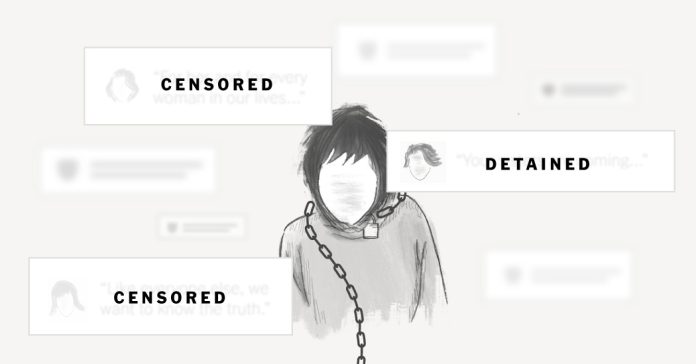
To find out how, I tried to track what happened to the chained woman and those who spoke out for her. I found an expansive web of intimidation at home and abroad, involving mass surveillance, censorship and detentions — a campaign that continues to this day.

The clampdown shows how rattled the authorities are by a growing movement demanding improvements to the role of women in Chinese society. Though the party says it supports gender equality, under China’s leader, Xi Jinping, the government has described motherhood as a patriotic duty, jailed women’s rights activists and censored calls for tougher laws to protect women from mistreatment.

Yet even as the crackdown forced women to hide their anger, it did not extinguish it. In secret, a new generation of activists has emerged, more determined than ever to continue fighting.

Who Is the Chained Woman?

At first sight, Dongji looks like any other village in China’s vast countryside. Two hours from the nearest city, it sits among sprawling wheat and rice fields in Jiangsu Province, half empty, most residents long departed to look for better lives elsewhere.

But when a colleague and I visited recently, one house, with faded maroon double doors, appeared to be guarded by two men. A surveillance camera on a nearby pole pointed directly at the entrance.

This was the street where the chained woman had lived.

Officially, there was little reason that her house should still be under watch, since in the government’s telling, the case had been resolved.

After widespread outrage over the government’s initial statement, in January 2022, officials promised a new investigation. Over the next month, four government offices released statements that at points conflicted with each other — offering different dates for when she was first chained, for example, or alternately suggesting that she had been homeless or gotten lost before arriving in Dongji. Finally, under intense public pressure, provincial officials in late February that year issued what they said was the definitive account.

According to that report, the woman was named Xiaohuamei, or “Little Flower Plum.” (The government did not specify whether that was a nickname or a legal name.) She was born in Yagu, an impoverished village in Yunnan Province, in China’s southwest.

As a teenager, she at times spoke or behaved in ways that were “abnormal,” the report said, and in 1998, when she was around 20, a fellow villager promised to help her seek treatment. Instead, that villager sold her for about $700.

Trafficking women has been a big business in China for decades. A longstanding cultural preference for boys, exacerbated by the one-child policy, created a surplus of tens of millions of men, many of whom could not find wives. Poor, rural men in eastern China began buying women from the country’s even poorer western regions.

Xiaohuamei was sold three times, finally to a man in Dongji — more than 2,000 miles from her hometown — who wanted a wife for his son, Dong Zhimin, the government said.

Over the next 20 years, she gave birth to eight children, even as her mental health visibly deteriorated, the government said, citing interviews with Mr. Dong and villagers. When she first arrived in Dongji, she had been able to take care of herself; by the time she was found, she had trouble communicating.

The government report did not say whether other villagers knew she had been trafficked. But self-styled charity bloggers had been visiting Mr. Dong and presenting him as a doting father since at least 2021. (The woman appeared in some videos, but unchained.)

“My biggest dream is to slowly bring the children up into healthy adults,” Mr. Dong told one blogger, before the video of the shack emerged.

Mr. Dong’s social media posts portray him as a doting father

Privately, though, Mr. Dong had been chaining the children’s mother around the neck and tying her with cloth ropes since 2017, the government said. He also did not take her to the hospital when she was sick.

Censors deleted the bloggers’ videos of the family and of the woman in chains. In April 2023, Mr. Dong was sentenced to prison, along with five others accused of participating in the trafficking.

The official story ended there.

Step 1: Hide the Victim

As we approached the house where the men were sitting, they jumped up and asked who we were. One made a phone call, while another blocked me from taking photos.

Ten more people soon arrived, including police officers, propaganda officials and the village leader, who insisted that the scandal had been overblown. “Everything is very normal, extremely normal,” he said. When we asked where the woman was, officials said they believed that she didn’t want visitors. Then they escorted us to the train station.

The chained woman may be choosing to stay out of the public eye. But the Chinese government often silences victims of crimes or accidents that generate public anger. Relatives of people killed in plane crashes, coronavirus patients and survivors of domestic violence have all been shuffled out of sight, threatened or detained.

Some weeks later, we tried to go back. This time, we visited a hospital where China’s state broadcaster said the woman was sent after the video went viral — her last known whereabouts.

We tracked down Dr. Teng Xiaoting, a physician who had treated her. Dr. Teng said the woman was no longer there, but said she did not know where she had gone.

Other locals we asked had no information either. But several people in neighboring villages said it was common knowledge that many women in the area, including in their own villages, had been bought from southwestern China. Some called it sad; others were matter-of-fact.

Still, it was clear that talking about such trafficking could be risky.

As we got closer to Dongji, a black Volkswagen began tailing us. Then, at least eight villagers surrounded us, calling us race traitors (we are both of Chinese heritage) and at times pushing my colleague. One said that if we had been men, they would have beaten us.

They eventually escorted us back to the main road after we called the police. Along the way, one man said it was in our own interest to be more cautious.

“If you two were taken to the market and sold,” he said, “then what would you do?”

Step 2: Silence Discussion

After the woman’s story emerged in January 2022, the controls were tightest in Dongji. But the government sprang into action across the country to suppress the debate that followed.

Legal scholars observed that the penalty for buying a trafficked woman — three years’ imprisonment — was less than that for selling an endangered bird. Others noted that judges have denied divorce applications from women known to have been abused or trafficked, and that the government has repeatedly ignored calls to criminalize marital rape.

To halt such conversations, the police tracked down people like He Peirong, a veteran human rights activist, who had traveled 200 miles to the area around Dongji to try to look for other trafficked women.

After she returned home, police officers knocked on her door, asking her why she had gone. They visited her roughly 20 times over the next month, forcing her to delete online posts about her trip and threatening to arrest her.

They also named journalists she had been in contact with, to show they were watching her communications. They even took her to nearby Anhui Province on a forced “vacation” — a common tactic used to control dissidents’ movements.

Similar crackdowns were taking place farther away. A lawyer named Lu Tingge, a resident of Hebei Province, about 600 miles from Dongji, said in an interview that a Jiangsu official had traveled to his city, urging him to withdraw a petition he’d submitted for more information about the case (he refused, but said he never received the information).

Bookstores that put up displays recommending feminist reading were forced to remove them. Numerous online articles about the woman were censored; China Digital Times, a censorship tracker, archived at least 100 of them, though there were many more.

The campaign even extended overseas. A woman living abroad said in an interview that the police called her parents in China after she posted photos of herself in chains online.

Ms. He, the veteran activist, realized that the government was more worried about feminism than she had thought. She had been detained previously for other activism, but this monthslong pressure “far surpassed that,” she said.

Step 3: Detain Those Who Persist

To avoid arrest, Ms. He stopped posting about the case. She eventually left China for Thailand.

Those who refused to stop, however, suffered the consequences.

Two other women also traveled to Jiangsu after the video emerged, to visit the chained woman at the hospital. Identifying themselves on social media only by nicknames, Wuyi and Quanmei, they said they were just ordinary women showing solidarity.

“Your sisters are coming,” Wuyi posted.

They were barred from entering the hospital or the village, according to videos on Wuyi’s Weibo. So they drove around town instead, with messages about the woman scrawled on their car in lipstick.

They quickly attracted enormous followings, their updates viewed hundreds of millions of times.

Before long, they were detained by the local police. After their release several days later, Quanmei went quiet online.

Wuyi, though, refused to be silenced. On Weibo, she said police had put a bag over her head and beat her. She shared a photo of her bruised arm, saying she was shocked that her small actions could elicit such ferocity.

“Everything I always believed, everything the country had always taught me, all became lies,” she wrote.

About two weeks later, Wuyi disappeared again. This time, the police detained her for eight months, according to an acquaintance. She was eventually released on bail and has not spoken publicly since.

The Resistance Goes Into Hiding

After Wuyi’s disappearance, the few voices still speaking out fell silent.

But the activism has not evaporated, only moved underground.

It includes people like Monica, a young woman who asked to be identified only by a first name. We met at her home, where she asked that I not bring my cellphone to avoid surveillance. Soft-spoken but assured, she recounted how police scrutiny forced her to embrace new tactics.

When the chained woman story erupted, she joined an online group of several hundred people that decided to conduct research on the trafficking of women with mental disabilities in China.

Within days, the police tracked down and interrogated participants. At around the same time, anonymous articles appeared online that doxxed some members of the group and labeled them “extreme feminists.” The group disbanded.

But the intimidation only made Monica angrier.

So a few months later, Monica and several others quietly regrouped, using an encrypted messaging platform. Rather than campaign publicly, they tried to impose pressure on the government behind the scenes.

For weeks, they studied hundreds of court cases and news stories about women who had been abused or trafficked. They wrote a 20-page report explaining the chained woman episode and laying out suggestions for reform. In July 2022, they submitted it anonymously to a U.N. committee reviewing China’s record on disability rights.

They later submitted similar reports to two other U.N. committees. A member of one of the committees, speaking anonymously because of the sensitivity of the matter, said the reports were crucial sources of independent information from China. That person had not heard of the chained woman before.

In May 2023, U.N. officials raised the chained woman’s story during a public meeting with Chinese government representatives. The government said it had imprisoned Mr. Dong and that the woman was being cared for. Still, Monica felt proud — and emboldened: “You feel that you can still do some risky things.”

“Feminism in China really is the most vocal and active movement. It’s also very hard to completely scatter or kill off,” she said. “I think the authorities are right to be worried.”

Others have tried to subtly keep the chained woman’s legacy alive in other ways. An all-female band released a song called “So Who Has My Key?” An artist spent 365 days wearing a chain around her neck. A writer published a thinly disguised retelling of Snow White.

In December, a woman whose family had reported her missing 13 years ago was found living with a man to whom she had borne two children. The authorities claimed the woman had a disability and the man had “taken her in” — the same language officials used in an early report about the chained woman.

Social media users erupted, accusing the government of glossing over trafficking again.

Then the censors stepped in and stifled that discussion, too.

Siyi Zhao contributed research.

C.I.A. Director Says U.S. Has Paused Intelligence Sharing With Ukraine

0

The C.I.A. director John Ratcliffe said on Wednesday that intelligence sharing with Ukraine had been paused alongside military aid to pressure its government to cooperate with the Trump administration’s plans to end the country’s war with Russia.

Speaking on Fox Business, Mr. Ratcliffe applauded the Ukrainian president Volodymyr Zelensky’s statement on Tuesday praising President Trump and insisting that he supported peace with Russia. Mr. Ratcliffe said he thought intelligence sharing would resume.

“President Zelensky put out a statement that said, ‘I am ready for peace and I want President Donald Trump’s leadership to bring about that peace,’” Mr. Ratcliffe said. “And so I think on the military front and the intelligence front, the pause that allowed that to happen, I think will go away, and I think we’ll work shoulder to shoulder with Ukraine as we have, to push back on the aggression that’s there.”

On Tuesday, after Mr. Trump ordered a halt to military assistance, officials differed on whether the United States was continuing to share intelligence. One official said all intelligence that was not directly related to the protection of Ukrainian troops had been put on hold. Another official said that exception covered most intelligence sharing, and information still was flowing to Ukrainian forces.

Mr. Ratcliffe said on Wednesday that Mr. Trump asked for a pause on intelligence sharing. And his comments suggest that the C.I.A. put at least some of its intelligence sharing with Ukraine on hold for a short time.

Trump administration officials have said the pauses were a warning to the Ukrainians of the consequences if they did not cooperate with Mr. Trump’s peace plan. The details of those plans remain unclear. Mr. Trump has spoken approvingly of President Vladimir V. Putin of Russia, and his aides have endorsed elements of the country’s ideas for ending the war.

But European countries are trying to develop their own plan that could win over both Mr. Trump and Mr. Zelensky.

Rep. Adriano Espaillat responds to immigration claims in Trump’s address : NPR

0

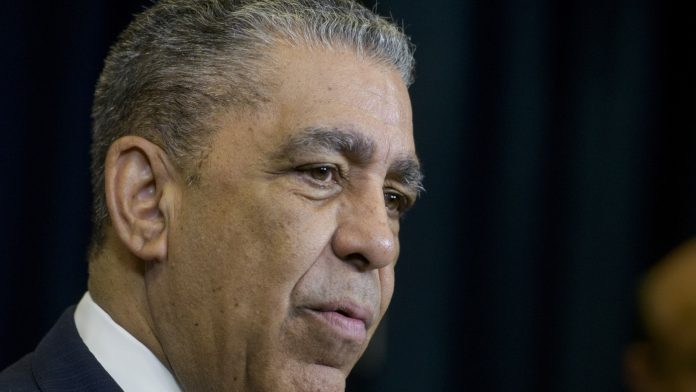
Rep. Adriano Espaillat, D-N.Y., speaks during a press conference by the Congressional Hispanic Caucus on immigration and border priorities, on Feb. 6, 2025, in Washington.

Rod Lamkey/AP


hide caption

toggle caption

Rod Lamkey/AP

New York Rep. Adriano Espaillat delivered the Democrats’ Spanish-language rebuttal to President Trump’s joint address to Congress Tuesday night, with a significant focus on the president’s immigration policy. In particular, Espaillat noted a recent executive order making English the national language and efforts to limit emergency aid.

“My people, although we have been here for 20 generations, 20 years or 20 days, we all came to the United States of America for the American dream — the possibility to achieve a better life and create a better future for our children by working hard, embracing diversity and taking the opportunity this great nation gives us all,” Espaillat said in Spanish.

Espaillat accused Trump of creating an “environment of fear among the immigrant community” and voiced his opposition to tariffs, proposed tax cuts and the recent reduction of the federal workforce. But he often refocused his speech to immigration.

He told the anecdote of working with House Minority Leader Hakeem Jeffries to help a “neighbor” who he alleges was detained by U.S. Immigration and Customs Enforcement despite being a U.S. citizen, though he did not give further detail.

“Trump’s migration policy is not designed the way he and his allies say, to deport those who really should be deported,” Espaillat said. “We want a new immigration law that secures the border, protects the DREAMers, the agricultural workers and maintains our families unified.”

Earlier that night, Trump spent portions of his remarks highlighting his immigration-related priorities, including his declaration of a national emergency along the U.S.-Mexico border, the deployment of military to the border and arrest rates.

U.S. Customs and Border Protection agents had about 30,000 encounters with migrants attempting to enter the U.S. illegally in January, the agency reported. CBP has not reported the numbers for February.

In his remarks, Trump asked for funding from Congress to carry out “the largest deportation operation in American history, larger even than current record holder President Dwight D. Eisenhower,” a reference to 1954’s “Operation Wetback,” — a racist term used to refer to migrants who crossed the Rio Grande River. The U.S. government estimates that the effort rounded up more than a million Mexican immigrants and some U.S. citizens.

Several guests at the joint address also highlighted Trump’s focus on immigration and border security. “Border czar” Tom Homan was a guest of House Speaker Mike Johnson. Guests of the White House included Roberto Ortiz, a U.S. Border Patrol agent who Trump said was shot by cartels while on duty, and the family members of Laken Riley and Jocelyn Nungaray. Riley was killed by men who entered the country illegally, and two men in the U.S. without legal status have been indicted in Nungaray’s death.

Follow for more coverage:

King Charles III, a Quiet Diplomat, is Stepping Up

0

King Charles III flew by helicopter to the H.M.S. Prince of Wales in the English Channel on Tuesday, where he mingled with sailors and watched as fighter jets took off from the deck of the ship, a Royal Navy aircraft carrier. It might have been a welcome getaway from his suddenly complicated social life.

In the span of five days, Charles had invited President Trump for a rare second state visit to Britain and then played host to two of Mr. Trump’s biggest antagonists, President Volodymyr Zelensky of Ukraine and Prime Minister Justin Trudeau of Canada, at his country estate northeast of London.

None of those gestures by Charles was overtly political. As is customary in Britain’s constitutional monarchy, he acted at the behest of the government. But they have nevertheless drawn the 76-year-old king into a swirling diplomatic drama in a way that is almost unheard-of for a British sovereign.

Charles’s invitation to Mr. Trump, delivered with much fanfare by Prime Minister Keir Starmer on Thursday in the Oval Office, has become more contentious since the president clashed with Mr. Zelensky over American support for Ukraine the day after his more harmonious session with Mr. Starmer.

“Now Stop the State Visit for ‘Bully’ Trump,” The Mail on Sunday, a right-wing tabloid, said on its front page. It cited a chorus of demands by lawmakers and other critics that the government rescind the invitation to Mr. Trump to telegraph Britain’s displeasure with the president and solidarity with Ukraine.

Symbolically, Charles may have done the next best thing: hosting Mr. Zelensky at his estate, Sandringham, after the president attended a summit meeting on Sunday devoted to Ukraine. Buckingham Palace did not disclose what they talked about but said Mr. Zelensky was “warmly received” by Charles, who served him tea in Sandringham’s Saloon room.

For Mr. Trump’s critics, the icing on the cake came on Monday, when Mr. Trudeau, whose country has come under sweeping American tariffs and which Mr. Trump says he wants to annex as the 51st state, made the pilgrimage to Sandringham to meet Charles. The king, of course, is also Canada’s ceremonial head of state.

Mr. Trudeau said in a social media post that they discussed “matters of importance to Canadians — including, above all, Canada’s sovereign and independent future.” Charles himself was silent, which frustrated some Canadian politicians, who argued that he should have publicly reaffirmed Canada’s sovereignty. Given his nonpolitical role, that was not going to happen. But the symbolism of the sovereign, smiling as he greeted a prime minister whom Mr. Trump refers to as governor, was lost on no one.

“It’s been a really interesting week in British and royal diplomacy,” said Ed Owens, a royal historian. “People have talked about how this royal family has become a secret weapon for British diplomacy. We saw Keir Starmer wielding the king and the monarchy as such in his interactions with Trump.”

Mr. Owens said Mr. Trump’s well-established affection for the king and the royal family was an intangible factor that could stick in the back of the American president’s mind as he deals with Britain over Ukraine. Mr. Starmer has positioned himself as a bridge between Europe and the United States on the issue. And the president was plainly delighted by the invitation from Charles.

“A beautiful man, a wonderful man,” a beaming Mr. Trump told Mr. Starmer, from the same chair where he sat 24 hours later, as he chastised Mr. Zelensky, telling the Ukrainian president: “Don’t tell us what we’re going to feel. You’re in no position to dictate that.”

Buckingham Palace declined to comment on the status of the invitation to Mr. Trump, noting that the government is in charge of such issues. Mr. Starmer brushed aside calls for the visit to be canceled on Sunday, saying in a BBC interview that critics were “trying to ramp up the rhetoric without really appreciating what is the single most important thing at stake here — we’re talking about peace in Europe.”

Two people with knowledge of the palace said it was highly unlikely that the invitation would be rescinded, given the ill will that would generate with the White House — though the challenge of matching the calendars of two heads of state could mean that the state visit does not take place for months, they added.

In his letter, the king broached the idea of Mr. Trump first seeing him in Scotland, where the president has a golf club, Trump Turnberry, and Charles has a castle, Balmoral, to make the arrangements for the state visit at a later time. The Scotland meeting would be more informal, without the honor guard and lavish banquet in Buckingham Palace that Mr. Trump enjoyed in his last state visit in 2019.

“The idea of it being indefinitely delayed until a peace agreement is reached, on terms that are acceptable to Ukraine and Europe, is interesting,” Mr. Owens said, adding that the royal family “has bought Britain influence within these negotiations that it might not have had otherwise.”

For all his adherence to the monarch’s nonpolitical role, Charles is known to be more politically aware and opinionated than his late mother, Queen Elizabeth II. Early in his reign, he came under criticism for welcoming the president of the European Commission, Ursula von der Leyen, to Windsor Castle, after she signed a deal on Northern Ireland with Rishi Sunak, who was then Britain’s prime minister.

Critics saw it as putting a royal imprimatur on the government’s deal. They said that Charles, whose support of the European Union was well documented, had allowed himself to be used by Downing Street.

The king has been demonstrative in his backing of Ukraine, issuing statements and making regular visits to relief organizations that help refugees from the war. Early in the conflict, when he was still Prince of Wales, he visited a group in London and spoke to a family that had been evacuated from Kharkiv, in eastern Ukraine.

“So, what do you think the aim of the Russians is?” Charles asked them. “Is it to remove people?”

Given the king’s strong feelings and the delicacy of the moment, royal watchers said the government should be careful not to overextend what has so far been a beneficial role. His value as an agent of British “soft power,” they say, resides in his being above politics.

Even his long-planned visit to the aircraft carrier was symbolic, given Britain’s pledge to deploy troops to a peacekeeping force for Ukraine. The H.M.S. Prince of Wales is in training exercises before deploying on an eight-month mission to Asia.

Speaking to crew members in his dress uniform, Charles could have been addressing Mr. Starmer, a relatively new prime minister, who has been struggling to calm the tempest between Ukraine and the United States.

“Your deployment in the next month comes amidst new challenges in an ever-changing and more unpredictable world,” the king said. “It will undoubtedly demand tenacity and determination, both at sea and for those you leave behind at home.”

The R-word is back. But why?

0

Over the past few years, Brittany has noticed the resurgence the R-word – a word that otherwise left the cultural lexicon. And while that’s troubling in and of itself, its return may also have larger implications that affect policy, culture, and how we treat each other.

Disability advocate Imani Barbarin joins the show to break down how ableism can take root in casual conversation, and why words matter.

Support public media and receive ad-free listening & bonus content. Join NPR+ today.