Thursday, November 12, 2026
Home Blog Page 157

How Soon Could Ukraine’s Forces ‘Start to Buckle’ Without U.S. Weapons?

0

Without billions of dollars in American-made weapons, it may be only a matter of time before Ukraine’s forces falter against Russia.

How much time, however, depends on how quickly Europe and Ukraine can make up for the artillery, missiles, air-defense systems and other arms that Trump administration officials said on Monday were being put on hold.

The United States had committed to delivering as much as $11 billion in weapons and equipment to Ukraine this year. Some of it was from Pentagon stockpiles, while some was ordered through new defense contracts, according to a new analysis by the Center for Strategic and International Studies in Washington. A former senior U.S. defense official on Tuesday said the actual figure was likely closer to $9 billion.

Despite Europe’s pledges of unwavering support for Ukraine, which have only intensified since the Trump administration began pulling back, it would be nearly impossible for it to fill the weapons gap quickly. European defense industries have ramped up, but only in fits and starts. And individual countries need to maintain their own weapons stockpiles.

“Europe can’t possibly replace American aid,” the former deputy of Ukraine’s military general staff, Lt. Gen. Ihor Romanenko, said last month.

Ukraine itself has been churning out drones and building up domestically made artillery systems, and it plans to spend 26 percent of its budget on defense this year. But some top Ukrainian officials say the military will be in dire straits if American support is not restarted.

“Ukraine definitely has a safety margin of about six months even without systematic assistance from the United States, but it will be much more difficult, of course,” one lawmaker, Fedir Venislavskyi, told the news agency RBC-Ukraine on Tuesday.

Some analysts say they think even that may be overly optimistic.

“Certainly, by the four-month time period, their forces would start to buckle, because they just wouldn’t have enough munitions and equipment to replace what they’ve lost,” said one of the authors of the Center for Strategic and International Studies study, Mark F. Cancian, a former White House weapons strategist.

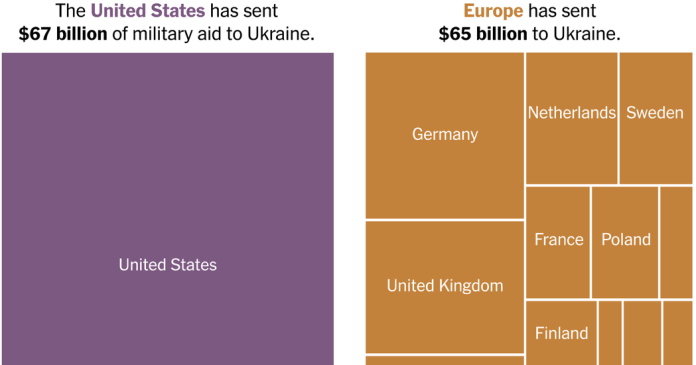
Of the $136 billion in military aid that allies provided Ukraine from the start of the full-scale Russian invasion in February 2022 to the end of last year, nearly half came from the United States, according to the Kiel Institute for the World Economy, a German research organization.

The American share has dwindled over time as the defense industries in Ukraine and Europe have accelerated production. Only about 20 percent of military hardware currently supplied to Ukraine comes from the United States, according to recent estimates by the Royal United Services Institute, an analytical group affiliated with the British military.

“But the 20 percent is the most lethal and important,” said Malcolm Chalmers, the institute’s deputy director general. Ukraine won’t abruptly collapse without the American weapons, Mr. Chalmers predicted. “The effect,” he said, “will be cumulative.”

The United States, the world’s largest economy, simply has more resources at its disposal. Its Air Force, for example, has 17 large electronic surveillance aircraft, while Britain has only three, according to Douglas Barrie, a military aerospace expert at the International Institute for Strategic Studies in London. The United States contributes over half of all NATO’s fighter jets and ground-attack aircraft.

Citing the “short-term urgency to act,” the president of the European Commission, Ursula von der Leyen, on Tuesday announced a $841 billion plan to increase defense budgets across Europe and encourage joint procurement among states to speed weapons manufacturing. But previous efforts have fallen short, with E.U. countries pulled between domestic spending priorities and defense contractors unable to produce vast amounts of costly weapons without upfront capital.

Ms. von der Leyen seemed to acknowledge this.

“The real question in front of us is whether Europe is prepared to act as decisively as the situation dictates, and whether Europe is ready and able to act with speed and with the ambition that is needed,” she said.

Artillery production in Europe is now nearly able to keep up with the wartime demands, said Camille Grand, who was NATO’s assistant secretary general for defense investment when Russia invaded. That is a remarkable turnabout for an industry that had atrophied after the end of the Cold War in 1991.

But manufacturers of more advanced weapons like the air defenses Ukraine says are crucial to its survival are still struggling to quickly produce those systems in large numbers. It can take years to hire and train additional workers, expand factory space and obtain rare earths and other raw materials in a competitive market that has been slowed by a limited supply chain.

And industry executives say they cannot invest in those improvements without the guarantee of contracts that generally run for at least a decade, and that some governments have been unwilling to provide.

“We are not on a real war economy footage as we speak, certainly by comparison with Russia,” said Mr. Grand, now a weapons expert at the European Council on Foreign Relations. He said it would take more political will in Europe to get defense contracts rolling: “Money is not sufficient to solve everything.”

Ukraine’s prime minister, Denys Shmyhal, insisted on social media this week that “of course, our military, the government, have the capabilities, the tools to maintain the situation on the front line.” But he would not disclose what is left in Ukraine’s stockpile, likely to prevent exposing any vulnerabilities to Russia.

Mr. Shmyhal said that Ukraine would be able to produce enough artillery for itself by later this year, and that it was building its own armored vehicles and antitank weapons. Last year, Ukraine built more than one million first-person-view drones, and intends to increase production in 2025.

Ukraine is also reportedly trying to produce air defenses as sophisticated as the American-made Patriot system, which can intercept ballistic missiles. Each Patriot system — consisting of interceptor missiles, launchers, radar and a command center — can cost $1 billion and takes up to two years to build.

Of the seven Patriot air defense systems that the United States and Germany have given Ukraine, at least two have been destroyed, according to the weapons tracking site Oryx. Shorter-range air defenses have been sent by Britain, France, Italy, the Netherlands and Romania, among others.

But Ukraine is the second-largest country in Europe, and the Russian bombardment has been incessant. “You’re always going to have to pick and choose — you aren’t going to be able to defend against everything,” said Mr. Barrie, the military aerospace expert.

In his study, titled “Is Ukraine Now Doomed?” Mr. Cancian predicted that without U.S. military aid, Kyiv would be forced to accept an unfavorable cease-fire agreement with Russia. That might mean ceding a fifth of its territory and giving up its aspirations to join NATO.

And some allies might now decide to cut back their own aid, reasoning that without American support, “this is a lost cause,” Mr. Cancian said in an interview.

It is not clear if the Trump administration will also cut off intelligence sharing with Ukraine. Fears also have been raised recently that Ukraine will lose access to the Starlink satellite internet system that facilitates military communication and is owned by Elon Musk, Mr. Trump’s close ally.

But it is clear that “halting security assistance will only make it more challenging for Ukraine to reach a just and lasting end to this war,” said David Shimer, who was the National Security Council’s director for Eastern Europe and Ukraine during the Biden administration.

“It will reduce Ukraine’s leverage, weaken the Ukrainian military, and therefore undermine Ukraine’s negotiating position with Russia,” Mr. Shimer said. “The United States should be focused on strengthening, not weakening, Ukraine’s hand ahead of a negotiation.”

Michael Schwirtz contributed reporting.

Democratic Sen. Tim Kaine reacts to President Trump's joint address to Congress

0

NPR’s Michel Martin speaks with U.S. Sen. Tim Kaine of Virginia about Democrats’ reactions to President Trump’s address before a joint session of Congress.

Arab Plan for Gaza Leaves Thorny Issues Unanswered

0

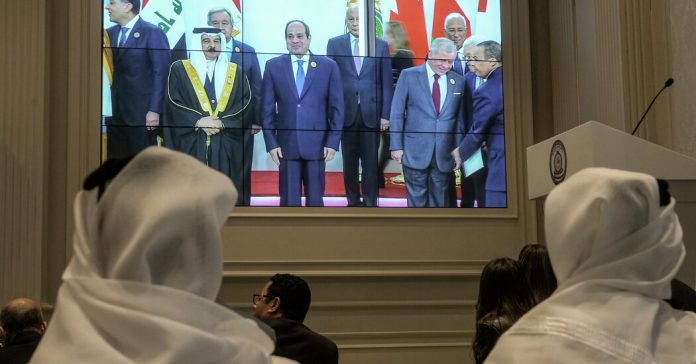
When President Trump said last month that he wanted to move all of Gaza’s roughly two million residents out of the strip to Egypt and Jordan and transform the territory into a beachfront “Riviera” for tourism, Arab leaders rejected the idea and hurried to present their own grand plan.

At an emergency Arab summit in Cairo on Tuesday, they laid out their vision: Rebuild Gaza without forcing out the Palestinians who live there. Sideline Hamas, the armed group that currently controls Gaza, and appoint a committee of skilled bureaucrats to initially run the strip before handing over to the internationally recognized Palestinian government in the West Bank. Then reunite the territory with the West Bank as one Palestinian state — a long-held dream of Palestinians and many Arabs across the Middle East.

But given that the plan leaves several central questions still unanswered, and Israel remains deadlocked with Hamas over key issues, Gaza’s postwar future appears no closer to a resolution.

For one thing, the statement signed by Arab countries on Tuesday night did not directly address whether or how to disarm Hamas. While both Israel and the Trump administration say that dismantling the group’s armed wing is nonnegotiable because of the threat it poses to Israel, that is a deal breaker for Hamas.

The furthest the document goes is an oblique reference to Gaza’s security being managed by a single armed force and a single legitimate authority. Elsewhere, it calls for the internationally recognized Palestinian Authority to govern Gaza alongside the West Bank in the future, implying that it would be the authority in charge of security, not Hamas.

That is not to say that Arab countries want to see Hamas keep its weapons. Egypt, which hosted the emergency summit and borders Gaza to the south, has serious national security concerns about Hamas. Other Arab countries agree.

Still, even if they were unified on the need to demilitarize Hamas, no one seems to have a plan for how to do so or who would enforce it. The group, which welcomed the statement on Tuesday, has expressed no openness to giving up its weapons.

Another fundamental impasse centers on the issue of Palestinian statehood. Less road map than wish list, the Arab countries’ calls for establishing a Palestinian state are almost certain to run headlong into Israeli objections.

Israel’s hard-right government, along with much of the population, opposes granting the Palestinians their own country. Though the United States has not explicitly scrapped its decades-old support for a two-state solution to the conflict, the Trump administration seems to be moving in lock step with Israel on many issues, raising questions about its commitment to Palestinian statehood.

Arab leaders say that turning Mr. Trump’s “Gaza Riviera” notion into reality would mean destroying any prospect of a Palestinian state. But Israel has embraced it, with Israel’s foreign ministry saying on X on Tuesday night that Mr. Trump’s idea was “an opportunity for the Gazans to have free choice based on their free will. This should be encouraged!”

The Arab blueprint laid out on Tuesday is most solid when it comes to rebuilding Gaza, a process that the document says could last until 2030 and cost $53 billion. It calls for a conference next month to mobilize international funding and investments for the plan, but it is unclear who will put money down.

Wealthy Gulf Arab states are often called on to pay for reconstruction and development across the Arab world. Egypt’s foreign minister, Badr Abdelatty, has also suggested that Europe could pitch in; and António Costa, the president of the European Council, which brings together European Union leaders, said in a speech at Tuesday’s summit that the bloc “stands ready to provide concrete support.”

Yet Gulf monarchies who would likely have to foot much of the bill, including Saudi Arabia and the United Arab Emirates, are wary of spending so much to rebuild Gaza only to see the territory destroyed again if war returns.

Only two Gulf heads of state attended the Cairo summit — the leaders of Bahrain and Qatar — undercutting the strong, unified front Egypt had hoped to present and raising questions about the Gulf countries’ support for the plan.

A recap of President Trump's Tuesday night address to Congress

0

In his address to a joint session of Congress, President Trump talked about his work to secure the border, slash the size of the government and his new tariffs, among other things. Hear a full recap.

As U.S. Tariffs Become Reality, Canadians Prepare for Economic Pain

0

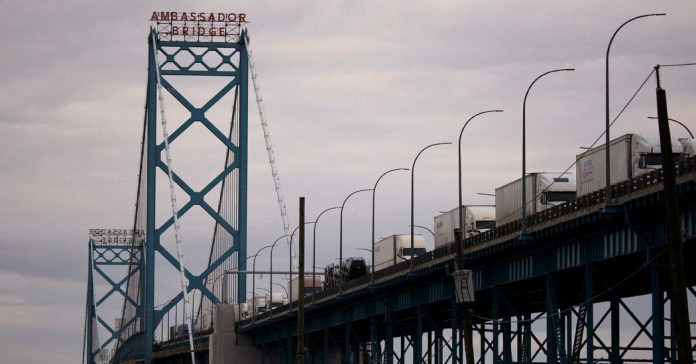
The trucks that carry about $300 million worth of auto parts each day over the bridge from Windsor, Ontario, to Detroit are still rolling as usual. But in the aftermath of President Trump’s decision to impose 25 percent tariffs on most categories of Canadian exports, the mood in Windsor, like all of Canada, was transformed.

Mr. Trump’s move has ignited a sense of economic anxiety and anger among Canadians about how they are being treated by their neighbor, ally and best customer. Most are still puzzling over Mr. Trump’s motivations and objectives for the tariffs, as well as his comments about annexing Canada as the 51st state.

And as they turned their attention to getting the potentially crippling tariffs, and a 10 percent levy on Canadian oil and gas and some minerals, lifted, politicians, business people and ordinary Canadians say that the relationship between the two countries will never return to what it once was.

Flavio Volpe, the head of a Canadian auto-parts maker trade group, said that his members could start shutting down factories in days, and that he feels betrayed by the United States.

“We’ve built two societies on the same values,” said Mr. Volpe, who is also a member of Prime Minister Justin Trudeau’s Council on Canada-U.S. Relations. “The man in the White House did a U-turn and drove right over us.”

Mr. Trudeau and anxious business leaders throughout Canada said that their country’s focus must be on ending the tariffs as quickly as possible.

Most forecasts project that Canada’s export-dependent economy will be sent into a recession, although they differ on timing and its initial severity.

“We have a limited experience for this magnitude of a trade shock,” the Royal Bank of Canada, the country’s largest financial institution, said this week. Some Canadians reached back for comparison to the Smoot-Hawley tariffs of 1930, which raised the average U.S. import duty to a staggering 59.1 percent. Many economists believe that they worsened the Great Depression, but the two countries’ economies were far less integrated at that time.

Aside from oil and gas, Canada’s largest export sector is the auto industry. On Tuesday, Mr. Trump suggested that the only way out of tariffs for the sector is to move all of its production to the United States. Aside from abandoning a skilled work force, that would require billions of dollars in new investments.

Historically, automotive trade has been largely balanced between the United States and Canada. Parts often swirl around between Canada, the United States and Mexico, sometimes crossing borders repeatedly before winding up in vehicles in a dealer’s showroom.

Mr. Volpe, of the Automotive Parts Manufacturers’​ Association in Canada, said that, aside from the tariffs, trade remained unchanged on Tuesday, an assessment backed up by the usual migration of trucks to the Ambassador Bridge.

The 25 percent tariffs are being paid by the importers, either other parts makers or automakers. Most contracts allow an automaker to deduct tariffs it pays when settling a parts company’s bill.

Mr. Volpe said that those deductions will make parts suppliers, which have generally have single-digit profit margins, instantly and deeply unprofitable.

He expects that most of his members can cover those losses from their cash reserves for about a week. After that, they will be forced to stop shipments.

“No one is going to burn up their cash reserve for the president of the United States,” he said.

For more parts, automakers usually have no alternative suppliers, let alone ones in the United States. Setting up new suppliers would take time and substantial investment. The result, experts say, will be a parts shortage that rapidly cascades into assembly-line shutdowns. Thousands of workers in Canada, the United States and Mexico would be left idle.

Some industries began idling small numbers of workers before the tariffs came into effect.

Bill Slater, the president of a United Steelworkers local in Sault Ste. Marie, Ontario, said that Algoma Steel laid off about 20 of his members who are salaried employees, citing the tariffs. He said that a number of probationary hourly workers were also let go by the mill.

Truck drivers had a mixed experience. Stephen Laskowski, the president of the Ontario Trucking Association, said that some had a surge in business as companies moved to get products into the United States before the tariffs came into effect, while others were laying off drivers because customers were canceling shipments.

Canada’s forestry industry knows tariffs all too well. Special U.S. duties on softwood lumber go back decades and were a factor in Canada seeking the 1989 free trade agreement with the United States, which was later expanded to include Mexico. (Canada has repeatedly failed to get an exemption from the U.S. trade complaints system that imposes the softwood lumber tariffs.)

But Kurt Niquidet, the president of the British Columbia Council of Forest Industries, said that adding the 25 percent tariff “really puts us into unprecedented territory.”

Lumber mills in the western province are facing a dizzying array of tariffs. This week’s 25 percent tariff is on top of a 14.4 percent tariff that the U.S. government expects to raise this summer, to more than 27 percent. Then Mr. Trump announced last weekend that he’s opened an investigation into lumber imports that could result in even more tariffs.

While the United States supplies about 70 percent of its own lumber, Mr. Niquidet, an economist, said that American forests and mills cannot replace all the lumber from Canada, nor can it be sourced from other countries.

“There will still be imports from Canada,” he said. “Prices in the U.S. will rise.” Some Canadian lumber mills, however, may not survive the trade assault, he added.

While Mr. Trudeau speculated that Mr. Trump was seeking a “total collapse of the Canadian economy, because that’ll make it easier to annex us,” Mr. Volpe said he was not sure it’s that complicated.“If it looks like he is dismantling the structure of the postwar economy, then he is,” Mr. Volpe said. “What are you going to do about it?”some Canadians believe that their country is simply being used as part of Mr. Trump’s plan to fund substantial U.S. tax cuts with tariffs.

Jean Simard, the president of the Aluminum Association of Canada, fought a successful battle over the 10 percent tariff on Canadian exports of the metal Mr. Trump enacted in during his first administration. Now Mr. Simard, another member of Mr. Trudeau’s council, is attempting to fend off additional tariffs that Mr. Trump has promised to put on top of Tuesday’s 25 percent. He said that he believes the president is telling the world: “This is what I’m able to do to my closest allies — think about what’s awaiting you.”

Mr. Simard added: “It’s an old barbarian approach to war.”

As the tariffs were rolled out, actions against American goods quickly came into play. Government-owned liquor stores, including in Ontario, pulled U.S. beer, wine and spirits from off their shelves, and that province canceled a 100 million Canadian dollar ($69 million) contract with Elon Musk’s Starlink satellite service to provide internet in rural areas.

Some Canadians are also vowing not to travel south, a decision perhaps also informed by the decline of the Canadian dollar brought on by the tariffs.

Most winters, Lee Miller, a retired electrician from Saint John, New Brunswick, would be traveling in his motor home through sunny warm states, including Florida.

“As soon as Trump started talking tariffs, I said, ‘Nope, not going,’” Mr. Miller said. After canceling this year’s trip, he plans not to enter the United States as long as Mr. Trump is president. That will, however, mean missed visits with friends and family who live across the border.

“This is one of those things that tears families apart,” he said.

6 takeaways from President Trump’s address to Congress : NPR

0

President Trump speaks during an address to a joint session of Congress on Tuesday night.

Allison Robbert/AFP via Getty Images


hide caption

toggle caption

Allison Robbert/AFP via Getty Images

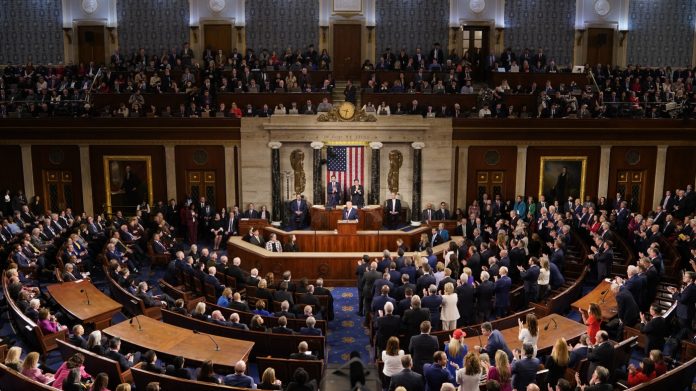
After a firehose of a first six weeks back in the White House, President Trump delivered a boastful and partisan address to a joint session of Congress Tuesday night.

Coming in just under 100 minutes, it was the longest such speech in modern history. And it saw a Democratic member of Congress be kicked out, several other Democrats walk out at various points and a Republican Party firmly and enthusiastically backing their president.

Here are six takeaways:

1. Trump boasted about what he’s done so far, leaning into even the most controversial things.

“America is back,” Trump proclaimed at the beginning of his speech. It was, ironically, a line also delivered by Joe Biden at the beginning of the Democrat’s term in office following Trump’s first four years.

The echo underscores that the country is deeply divided about what its values should be, about what America is and means and where it should go going forward.

Trump has attempted radical change, what he called Tuesday night a “commonsense revolution” that has seen “swift and unrelenting action.”

That action has been spearheaded by Elon Musk and his Department of Government Efficiency. Trump gave Musk the spotlight and praised him, and Musk’s moves have been cheered by many in the GOP base.

But those changes have been loudly and strongly opposed by many others, including independents. In the latest NPR/PBS News/Marist poll, independents gave Trump just a 34% approval rating and Musk and DOGE a 34% favorability rating. Two-thirds said they think Trump is moving too fast to make changes to the federal government without considering the impact.

2. It was a very partisan speech, most appealing to MAGA supporters.

Americans are about split on the direction Trump is moving the country, the poll found, but this was not a speech that sought to reach across the aisle and expand those numbers. Quite the opposite.

He essentially dismissed Democrats. He referred to them as “these people” and “radical left lunatics” and even used his derisive “Pocahontas” nickname for Sen. Elizabeth Warren when talking about how long the war in Ukraine should continue. (In response, Warren said she was applauding U.S. aid for Ukraine, which Trump has now halted.)

He said Democrats would never vote for anything he’d ever do, so instead he mostly focused on the things MAGA likes — the anti-trans culture war, the targeting of pro-diversity programs, his effort to make English the official language of the country and changing the name of North America’s highest point back to Mount McKinley. (The Alaska peak was renamed Denali, which means “high” or “tall,” during the Obama years to reflect the preference of most Alaskans.)

“Our country will be woke no longer,” Trump said.

During his address, Trump spoke more passionately about cracking down on illegal immigration than he did about the economy and prices, despite high prices being arguably what got him over the finish line in the 2024 election.

Presidents generally get too much credit and too much blame for the economy, and they have very few tools to make prices come down. But they do have a blunt tool that economists say is likely to make prices go up in short order — tariffs.

Trump delivered his speech on the day steep tariffs against Mexico and Canada took effect, and in the address, he defended them, describing tariffs as saving the “soul” of the country — another Biden line, but about something very different.

Experts, business owners and most Americans disagree. In the NPR poll, taken before Trump put the latest round of tariffs in place, 57% said they believed prices would go up in the next six months, and more people narrowly said Trump’s approach on the economy would make things worse rather than better.

The subject got scant attention in Trump’s speech, and he spent a lot of time blaming Biden. In fact, Trump mentioned Biden 13 times in the speech.

“Joe Biden especially let the price of eggs get out of control,” Trump said. “The egg prices, out of control. And we’re working hard to get it back down.”

The recent increase in the price of eggs is largely due to a bird flu outbreak.

Every president tries to blame their predecessor for negative things that happen in their term, Republicans and Democrats, alike. But, at some point, they stick to the person actually in office.

3. There were lots of false and inaccurate things said.

There were so many things said that were false and inaccurate, they won’t all fit in this space. NPR did an in-depth annotated fact check of more than 20 things that Trump said that can be found here.

But there were a handful of doozies, including:

— That DOGE had found hundreds of billions in fraud, but DOGE’s numbers just don’t add up. Trump even overstated the amount DOGE itself claims to have found.

— That lots of dead people over 120 years or older are getting Social Security payments. Even Trump’s own head of the Social Security Administration says that’s not true. These are people who don’t have dates of death registered, not that they are receiving benefits. There have been improper payments made but it’s only to about 1% of people, and they’re to people who are alive.

— That the country brought in trillions of dollars from tariffs on China during Trump’s first term. That’s not correct. Tariffs were put on roughly $380 billion worth of goods, but that did not lead to a net-positive for the U.S. economy. In fact, experts said they may have, in the long term, reduced the gross domestic product of the country and certainly did not bring in trillions of dollars in revenue.

— That the country has spent $350 billion on the war in Ukraine. This is something Trump has continued to repeat. The total the country has spent is around $115 billion over the last three years — and not all of that has gone directly to Ukraine in aid. Some of it has been on building weapons domestically. The U.S. has spent more on military aid for Ukraine than any other single country, but, collectively, Europe has spent about $130 billion to $140 billion, a larger amount in military, humanitarian and financial aid.

4. There were asks of the Republican-led Congress that will tell us what Trump’s legislative focus may be in the next year.

That included asking for:

  • more money for deportations;
  • another round of major tax cuts;
  • enhanced police protections (there was no mention of Jan. 6 and the assault on police at the U.S. Capitol that day);
  • a new crime bill;
  • mandating the death penalty for anyone who murders a police officer (the death penalty varies by state);
  • creating a “Golden Dome” missile defense system. (Israel has an Iron Dome that responds to rockets lobbed into its country, but it is much closer to adversaries like Iran, Hezbollah and Hamas.)

5. It’s Trump, so of course, there were some made-for-reality TV moments.

Trump is always one for theatrics, though this speech was lackluster compared to the pomp and melodramatic moments of past Trump addresses to Congress. Nevertheless, there was:

  • the unveiling of a new executive action naming a wildlife refuge for a girl allegedly killed by immigrants in the U.S. without permanent legal status;
  • the naming of a 13-year-old cancer survivor as an honorary Secret Service agent;
  • the announcing of admission to West Point for a high school student;
  • and the announcing of the capture of the alleged terrorist behind the Abbey Gate bombing in Afghanistan.

6. Elissa Slotkin delivered an important address, one Democrats should pay attention to.

Democratic Michigan U.S. Sen. Elissa Slotkin rehearses the Democratic response to Trump's address.

Democratic Michigan U.S. Sen. Elissa Slotkin rehearses the Democratic response to Trump’s address.

Paul Sancya/Pool/AFP via Getty Images


hide caption

toggle caption

Paul Sancya/Pool/AFP via Getty Images

The senator from Michigan gave arguably the best response to an address to Congress since former Sen. Jim Webb’s fiery response to George W. Bush in 2007 with the country embroiled in the Iraq war.

Many who have been in this slot — in both parties — have found themselves the subject of ridicule, but Slotkin was a presence. Standing in front of a wall of American flags, she drew on her biography as a former CIA officer, daughter of a Republican father and Democratic mother, and as someone who won in a state that Trump also did in 2024.

Slotkin noted that the “middle class is the engine of our country,” said change should be made but not in a “reckless” way, warned Trump wants to give billionaires tax cuts at the expense of other things that are important to most people, went after Musk and “his gang of 20-year-olds” poking through sensitive personal information, and invoked Ronald Reagan.

“As a Cold War kid, I’m thankful it was Reagan and not Trump in office in the 1980s,” she said, noting the “spectacle” in the Oval Office between Trump and Ukrainian President Volodymyr Zelenskyy. “Trump would have lost us the Cold War.”

Democrats have been struggling in these first six weeks of the Trump presidency with what to focus on and how to respond. Slotkin laid out a roadmap that could help Democrats decide what to focus on going forward.

Her poised and in-command speech also served as a contrast to the cane-waving Rep. Al Green’s shouting responses to Trump that resulted in his being escorted from the chamber by the sergeant-at-arms.

U.S. Rep. Nydia Velázquez, D-N.Y., holds a "Musk Steals" protest sign with fellow Democrats as Trump speaks during his address to Congress.

U.S. Rep. Nydia Velázquez, D-N.Y., holds a “Musk Steals” protest sign with fellow Democrats as Trump speaks during his address to Congress.

Win McNamee/Pool/AFP via Getty Images


hide caption

toggle caption

Win McNamee/Pool/AFP via Getty Images

Ukrainians Worried After Trump Suspends Military Aid

0

new video loaded: Ukrainians Worried After Trump Suspends Military Aid

transcript

transcript

Ukrainians Worried After Trump Suspends Military Aid

Across Ukraine, people were shocked and upset about the potential effects of the United States’ decision.

You got to be more thankful. Because let me tell you, you don’t have the cards. With us, you have the cards. But without us you don’t have any cards. It was clear from Friday that we are in a very bad situation. Now we are moving to catastrophic situation. I understand that we have crisis in relationships right now after Friday’s meeting in Oval Office, but I just want to ask President Trump, just to reconsider, to give some time to Ukraine.

Recent episodes in Ukraine Crisis

President Trump's view of the world on display during his joint address to Congress

0

In his address to Congress, President Trump repeated his plans to take over Greenland and the Panama Canal, and suggested that an end to the war in Ukraine might be close.

Why the Philippines Is Confident of Defense Ties With Trump Administration

0

We are not Ukraine.

That is the overarching message from officials in the Philippines, who say that they are certain they have the full backing of the United States despite President Trump’s dramatic shifts in foreign policy, including his stunning blowup with Ukraine’s leader. Their confidence, they say, comes from the fact that both Washington and Manila have a common adversary: China.

Mr. Trump is embroiled in a trade war with China, while the Philippines has been involved in increasingly tense standoffs with China in the South China Sea over Beijing’s expansive territorial claims. Manila’s biggest deterrent against China is a mutual defense treaty with the United States. Last month, Washington restored about $400 million in military assistance to the Philippines that had been suspended as part of Mr. Trump’s freeze on foreign aid.

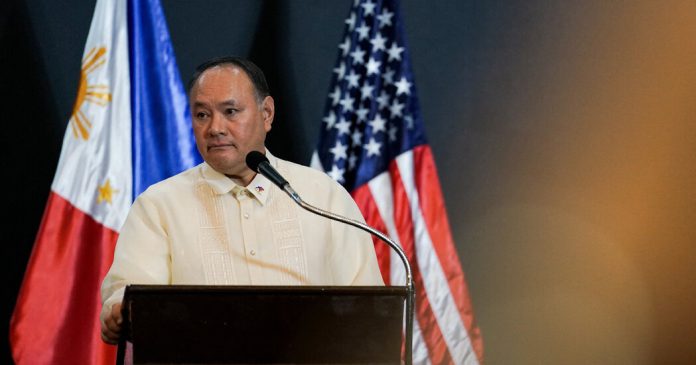
That was the “best proof” that ties between the two countries were intact, Gilberto Teodoro Jr., the Philippines defense secretary, said in an interview in Manila on Tuesday, hours after Mr. Trump suspended military aid to Ukraine.

In recent weeks, Mr. Teodoro and his colleagues have spoken with members of Mr. Trump’s cabinet and received assurances that Washington remains committed to the Philippines and the defense treaty.

“We have no reason to doubt the commitments made by the highest officials of the Trump administration,” said Mr. Teodoro, who flew to Washington in January to meet with Mike Waltz, Mr. Trump’s national security adviser.

But Mr. Trump has exhibited a willingness to tear apart decades-old alliances. He has imposed tariffs on Canada, undermined Europe and rebuffed NATO. While he has not publicly addressed ties with the Philippines, or the broader Indo-Pacific, his actions have caused jitters here.

“We have to prepare for the day when the U.S. could withdraw from the South China Sea,” said Antonio Carpio, a former Supreme Court justice who helped the Philippines win a landmark international ruling against China over its claims in the South China Sea.

Beijing claims about 90 percent of the South China Sea, parts of which are also claimed by Vietnam, Malaysia, Brunei, Indonesia and the Philippines. Manila has been at the forefront of the territorial fight, saying that Chinese ships have been blocking access to fishing sites as well as oil and gas deposits in the waters that are in its exclusive economic zone.

Those tensions have escalated dramatically in recent years, raising the risk that Washington could be drawn into a conflict.

President Ferdinand R. Marcos Jr. has embraced the U.S., reversing a pivot to China by his predecessor. And he has expanded U.S. access to military bases, including to some that face Taiwan, another flashpoint between Washington and Beijing.

Last April, Washington deployed a missile system called Typhon to the Philippines as part of joint military drills. The ground-based launcher can fire cruise missiles that can reach the Chinese mainland from the Philippines.

The Typhon missile system in Laoag, Philippines can target mainland China.Credit…Planet Labs Inc., via Reuters

The United States has a vested interest in maintaining freedom of navigation in the South China Sea, which is one of the world’s busiest shipping lanes. U.S. officials are also concerned about how China has expanded its military footprint there by building and fortifying outposts and airstrips on tiny patches of land.

Jonathan Malaya, the assistant director general of the Philippines’ National Security Council, said that Mr. Trump would not withdraw from the region. He pointed out that Mr. Trump’s first administration introduced the phrase — a “free and open Indo-Pacific.”

He added that Washington’s financial commitments in the Philippines paled in comparison to the billions of dollars in aid it has given Ukraine. And, he emphasized, that Mr. Trump had never supported the Biden administration’s position on the Ukraine war. (On Tuesday, Mr. Trump appeared to cool tensions with President Volodymyr Zelensky of Ukraine.)

In December, Mr. Trump spoke with the Philippines’ ambassador to the United States, Jose Manuel Romualdez. He recalled meeting Imelda Marcos, Mr. Marcos’s mother, several times, including at a party in New York in the 1990s.

“As you know, President Trump believes in personal relationships, so he was looking forward to having a meeting with President Marcos at some point,” said Mr. Romualdez, a cousin of Mr. Marcos.

Even before Mr. Trump’s re-election, the Philippines moved to diversify its reliance on the United States, signing military cooperation agreements with Japan and New Zealand. It is also increasing its defense budget this year by 14 percent, to $4.7 billion.

Now it wants to buy the Typhon missile system from the United States to improve its deterrence, according to Mr. Teodoro, the defense secretary.

Beijing has called that plan “a substantial threat to peace and security.”

Mr. Trump’s approach to the Philippines could rest on how his relationship with Xi Jinping, China’s top leader, plays out, according to Ronald Llamas, who was an adviser to the late President Benigno Aquino III.

“With the post-World War II international order turned upside down, a disruptive Trump can go either way,” Mr. Llamas said.

Camille Elemia contributed reporting.

A look at the human toll of the construction of the Panama Canal : Code Switch : NPR

0

Author Cristina Henriquez next to the cover of her new novel, The Great Divide

Brian McConkey/Ecco


hide caption

toggle caption

Brian McConkey/Ecco


Author Cristina Henriquez next to the cover of her new novel, The Great Divide

Brian McConkey/Ecco

President Donald Trump says he wants the U.S. to take back control of the Panama Canal. The Canal has been dubbed the greatest engineering feat in human history. It’s also (perhaps less favorably) been called the greatest liberty mankind has ever taken with Mother Nature. So how did we get here?

Today on the show, we’re talking to Cristina Henriquez, the author of the novel, “The Great Divide.” Her book explores the making of the Canal. It took 50,000 people from 90 different countries to carve the land in two — and the consequences of that extraordinary, nature-defying act are still echoing through our present.

This episode was produced by Christina Cala. It was edited by Leah Donnella. Our engineer was James Willets.