Thursday, November 12, 2026
Home Blog Page 159

China Signals Confidence in Economy Despite Sluggish Growth and U.S. Trade War

0

China’s top leaders sought to project confidence in the country’s economy on Wednesday despite sluggish growth, an escalating trade war with the United States and growing geopolitical uncertainty caused by the Trump administration.

The government will aim to expand China’s economy by “around 5 percent” this year, said Premier Li Qiang, China’s highest-ranking official after Xi Jinping, at the opening of the annual session of the country’s rubber-stamp legislature.

“Achieving this year’s targets will not be easy, and we must make arduous efforts to meet them,” Mr. Li said, acknowledging that the economy faced many challenges. But he struck a positive note about the country’s prospects, saying: “The underlying trend of long term economic growth has not changed and will not change. The giant ship of China’s economy will continue to cleave the waves and sail steadily toward the future.”

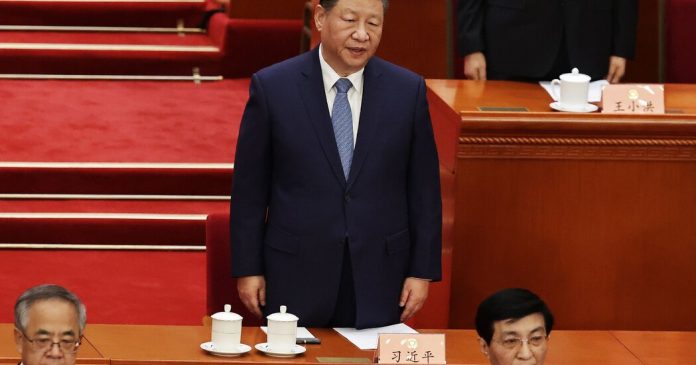
The meeting in Beijing, called the National People’s Congress, is a tightly scripted political pageant, showcasing how Mr. Xi plans to lead China through what he has often described as “great changes unseen in a century” around the world.

That vision includes lifting China’s technological prowess and self-reliance and beefing up its military capabilities so it can dominate the Asia-Pacific region. It is focused on strengthening the ruling Communist Party’s grip on power by making national security a priority for all facets of Chinese society.

Security at the legislative session, which brings around 3,000 delegates to the Great Hall of the People, is also a top priority. Uniformed and plainclothes police and soldiers were posted at several checkpoints on major roads near the venue and on pedestrian bridges, while entrances at nearby subway stations were temporarily closed.

Mr. Xi and his top officials have been trying to restore faith in the economy, which has struggled to regain momentum after being battered by the pandemic and a housing market crash that wiped out much of the wealth of many middle-class Chinese. But reaching that target of around 5 percent growth will be even harder than in previous years because of a trade war with the United States that shows few signs of abating.

Mr. Xi has held firm against Washington, signaling that China must be treated as an equal. He refused to bow to U.S. pressure like the leaders of Canada and Mexico did by engaging with Mr. Trump after the American president first called for 25 percent tariffs on their countries in January. China has instead responded with retaliatory trade measures, the latest of which were announced on Tuesday and targeted U.S. agricultural states that swung heavily for Mr. Trump in last year’s election.

To help shore up growth, the government said it would raise its deficit to 4 percent of the overall economy’s output. Such a significant policy shift signals China’s readiness to increase public borrowing, money that can be used to stimulate the economy.

But more than that, China needs households to start spending again to turn its fortunes around. Consumer confidence has been hit badly by the crisis in the housing market. In an acknowledgment of this, Beijing lowered its target for consumer prices inflation to 2 percent, its lowest level in more than two decades.

China has not missed a growth target since 2020, when its economy shrank because of the Covid pandemic, though economists overseas have long debated the veracity of the country’s economic data.

Under Mr. Xi, Beijing has emphasized the state sector’s dominance in the economy and rattled entrepreneurs with crackdowns on private firms. But in recent months, Chinese leaders, including Mr. Xi himself, have been more willing to acknowledge the importance of private companies in fueling growth.

Last month, Mr. Xi held a rare meeting with business leaders, including Jack Ma, the founder of the internet giant Alibaba, who had been sidelined for four years for criticizing Chinese regulators. Mr. Xi has extolled technology as a leading driver of development and a means for China to become less vulnerable to pressure from the United States.

Analysts say China is better prepared for Mr. Trump now than it was in his first term, showing a resolve to engage in tit-for-tat trade measures and increasing diplomatic engagement to counter U.S. pressure.

That was underscored on Tuesday when China announced that it would put tariffs of up to 15 percent on some U.S. agricultural products and impose punitive trade measures on 15 American companies, including the drone maker Skydio. It also added 10 other American companies to what it called an “unreliable entities list,” preventing them from doing business in China.

The moves were in response to the Trump administration’s imposition of an additional 10 percent tariff on Chinese goods on Tuesday. The administration has accused China of not doing enough to stem the flow of fentanyl and migrants into the United States.

But the trade war is only one of the fronts in which China is confronting the second Trump presidency. It is also weighing its options as Mr. Trump imposes a dramatic reversal of American foreign policy. He has upended relations with historical U.S. allies like Canada, Mexico and Europe, seemingly turned his back on Ukraine and aligned himself with his country’s longtime rival Russia, China’s most important major partner on the global stage.

China, in turn, has been courting Europe while also stepping up diplomatic exchanges with Russia, with Mr. Xi telling President Vladimir V. Putin in a call last week that China and Russia were “true friends.”

At the same time, Beijing signaled that economic doldrums would not slow the country’s military spending. China’s military outlays would rise 7.2 percent in 2025, reaching the equivalent of about $246 billion, according to a Ministry of Finance budget report issued at the meeting.

Last year, China’s military budget also grew by 7.2 percent. The country has had an unbroken record of annual increases in military spending for decades, usually a little over 7 percent every year in the past few years, even as economic growth has slowed.

China’s increases in military spending have funded a buildup of advanced missiles, fighter jets, naval ships and submarines, including forces focused on Taiwan, the democratically governed island that has resisted Beijing’s claims of sovereignty over it. Recently, China flexed its growing military reach by sending three warships to seas near Australia and New Zealand, where they practiced firing their artillery.

Mr. Li, the Chinese premier, indicated that the military budget this year would also focus on technological advances. “We will step up military training and combat readiness, speed up the development of new combat capabilities,” he told the congress.

Li You contributed research from Beijing.

NPR coverage of President Trump’s address and the Democratic response : NPR

0

President Trump will address a joint session of Congress Tuesday night to outline his vision and priorities for his administration’s first year. NPR’s live special coverage tonight — which will also include the Democratic response to the speech — starts at 9 p.m. EST/6 p.m. PST.

Here are ways to listen:

Follow NPR for coverage throughout the night for fact checks, analysis and context. And also check out:

Florida Attorney General Opens Criminal Investigation Into Tate Brothers

0

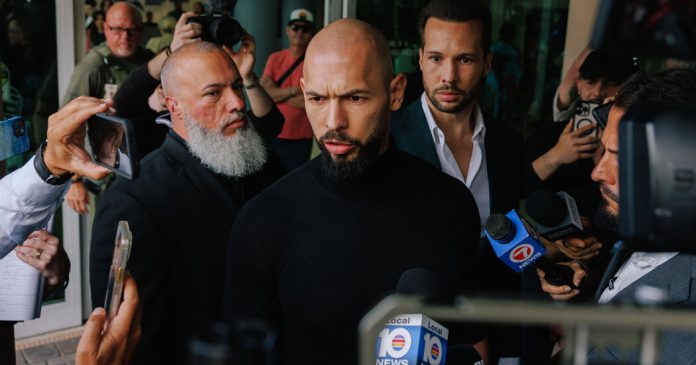
Florida’s attorney general on Tuesday opened a criminal investigation into Andrew Tate and his brother Tristan Tate, the British American online influencers who face human-trafficking charges in Romania and Britain, after they arrived in the state last week.

Attorney General James Uthmeier of Florida said in a statement on Tuesday that he had directed his office “to work with our law enforcement partners to conduct a preliminary inquiry into Andrew and Tristan Tate.”

Mr. Uthmeier said in an exchange with a reporter posted to X that his office had “secured and executed subpoenas and warrants” in the criminal investigation into the Tate brothers.

The brothers, who have millions of followers on social media and are known for their misogynistic views and excessive displays of wealth, had been barred from leaving Romania for more than two years after they were arrested there in 2022 on accusations of luring women to the country and sexually exploiting them.

But last week, the two brothers arrived in Florida after the travel restrictions were lifted.

In a separate investigation, British authorities have also sought the Tates’ arrest over criminal accusations of rape and human trafficking. Four British women who sued Andrew Tate have urged the British government to request the extradition of the brothers.

Florida officials have said that the brothers, who arrived at Fort Lauderdale-Hollywood International Airport in a private jet last Thursday morning, are not welcome in the state.

“Florida is not a place where you’re welcome with that type of conduct,” Gov. Ron DeSantis told reporters last week. Mr. DeSantis added that he had not known about the Tates’ arrival in his state, but found out through the media. “I don’t know how it came to this,” he said. “We were not involved, we were not notified.”

Mr. Uthmeier, the attorney general, said he would use the “full force of law” against the brothers.

“These guys have themselves publicly admitted to participating in what very much appears to be soliciting, trafficking, preying upon women around the world,” Mr. Uthmeier told a reporter who posted the exchange on social media. “This type of behavior is viewed as atrocious, we’re not going to accept it.”

Joseph McBride, the Tate brothers’ lawyer, maintained the siblings’ innocence in a scathing statement filled with vulgarities that vilified Mr. DeSantis and Mr. Uthmeier on Tuesday. Mr. McBride called the notion that the brothers committed a crime in Florida “complete nonsense.”

“What are Andrew and Tristan Tate guilty of? I’ll tell you. They are guilty of wielding massive influence over young men,” Mr. McBride said. “They are guilty of posting mean tweets.”

Andrew Tate posted on X on Tuesday expressing his “disappointment” to his more than 10 million followers on the platform. “Absolute communism. I’ve been in America for 5 days. I sat on my laptop and did a podcast,” he wrote. “Insanity. I am super disappointed in the United States.”

Romanian prosecutors said in a news release that they were still pursuing criminal investigations against two British American citizens. They did not name the people, but said they had been allowed to leave Romania and had to “appear before judicial authorities whenever summoned.”

The brothers are known for promoting an antagonistic, anti-feminist brand of masculinity and have denied all of the accusations against them, arguing that their wealth and outspokenness have made them targets.

Alan Feuer contributed reporting.

Follow NPR’s annotated fact check of President Trump’s address to Congress : NPR

0

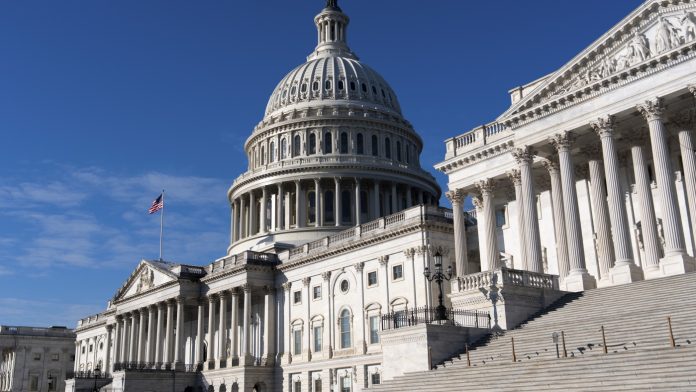
The Capitol on March 3, the day before President Trump will deliver is State of the Union address in Washington.

Julia Demaree Nikhinson/AP


hide caption

toggle caption

Julia Demaree Nikhinson/AP

NPR is bringing you the latest from President Trump’s joint address to Congress. Watch here. And for more updates get our NPR Politics newsletter or the NPR Politics Podcast.

President Trump delivers an address to a joint session of Congress in the U.S. Capitol tonight, six weeks into his second term. Since his inauguration, he has worked briskly to try to radically reshape the government and signed dozens of executive orders, many upending policies created by former President Biden. Trump is expected to take stock of what he’s done so far and lay out his vision for the economy, immigration and foreign affairs.

Follow this page tonight for an annotated fact check by reporters from across NPR’s newsroom as the speech unfolds.

The address is set to start at 9 p.m. EST/6 p.m. PST.

Catch up on NPR coverage ahead of the address:

➡️Fired federal workers are among the guests invited to Trump’s speech to Congress

➡️Trump will address Congress. Why isn’t this first speech called a State of the Union?

➡️Poll: Majorities say state of the union is not strong, and Trump is rushing change

➡️What you need to know about Trump’s address to joint session of Congress

➡️What will Trump say in his Tuesday address? We look to the past for some clues

In Oct. 7 Report, Israeli Security Agency Puts Some Blame on Netanyahu Government

0

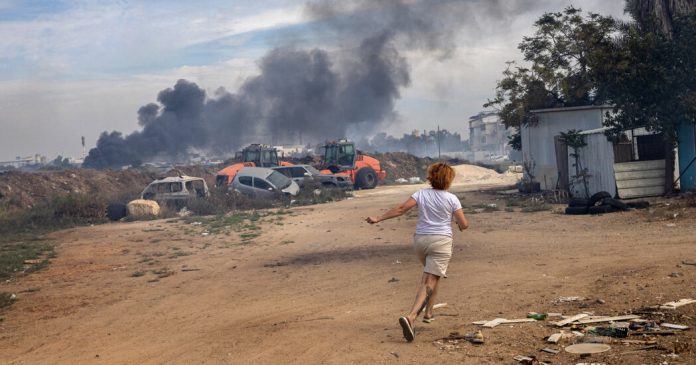
Israel’s domestic security service on Tuesday assumed responsibility for failing to heed warning signs of a planned Hamas attack before the militants’ devastating strike on Oct. 7, 2023. But the agency also faulted the Israeli government for policies it said had allowed Hamas to quietly amass weapons, collect funds and gain support, among other failures.

The conclusions from the Shin Bet, as the security agency is known, were published days after a similar inquiry by Israeli military found that senior officers had vastly underestimated Hamas and misinterpreted early warnings that a major attack was coming.

The report published on Tuesday consisted only of a declassified summary, leaving an unknown amount of material undisclosed. But even the summary made the agency’s lapses clear.

Plans for a Hamas raid on southern Israel reached the desks of intelligence agents in 2018 and again in 2022, the summary said, but the agency did not treat the warnings as a meaningful threat. As a result, the agency said, it did not include it in scenarios exploring future confrontations with the militant group.

While the Shin Bet said that it took Hamas seriously, it acknowledged that it had not responded appropriately to early indications of attack plans, or to the later signs of impending bloodshed.

The Israeli authorities said they were publishing the findings, even as they kept parts of the report classified, in light of the gravity of the attack. About 1,200 people were killed that day, and some 250 people taken hostage, setting off the war in the Gaza Strip.

The government of Prime Minister Benjamin Netanyahu has resisted an independent review of the events leading up to the deadliest day in Israel’s history. It has instead allowed each of the country’s security institutions to investigate itself, despite public demands for a commission of inquiry.

In a debate in the Israeli Parliament on Monday, Mr. Netanyahu said he supported the creation of a commission to investigate the Hamas attack, but suggested that such an inquiry would inevitably generate biased findings aimed at targeting him politically.

“I am not deterred by fabricated investigations and a political manhunt,” he said. “I will continue to insist on the truth. I will continue to demand a balanced commission of inquiry that will reach the truth.”

Mr. Netanyahu’s resistance to an inquiry and to calls for his resignation contrasts with the actions of some other Israeli officials.

The former military chief of staff, Lt. Gen. Herzi Halevi, resigned this month after taking responsibility for what he called his “terrible failure” to prevent the attack. The Shin Bet chief, Ronen Bar, told the Israeli news media on Tuesday that he did not intend to resign until all the hostages taken from Israel were repatriated, but he acknowledged that the attack could have been prevented.

In its report, the Shin Bet also said it had failed to coordinate sufficiently with the military and to establish a clear chain of responsibility. “This is not the standard that we expected from ourselves and the public from us,” the agency said.

At the same time, the Shin Bet report, unlike the recent military one, directly pointed to government policies as contributing factors to the attack. It said that the government had allowed Hamas to accumulate arms and to raise money for its military wing through Qatar. And it pointed to government reluctance to undertake “offensive” initiatives, including targeting Hamas leaders in Gaza.

The agency also cited the treatment of Palestinian prisoners in Israeli detention and “the perception that Israeli society has weakened.” Before the attack, Mr. Netanyahu advanced a plan to overhaul Israel’s judiciary, setting off protests nationwide, and many Israelis have blamed Mr. Netanyahu for the Hamas attack, citing domestic unrest as a factor that emboldened the militants.

The Shin Bet report echoes the findings of an article by The New York Times published weeks after the attack, based on interviews with Israeli, Arab, European and American officials, as well as a review of Israeli government documents and evidence.

Mr. Netanyahu’s office declined a request for comment on the Shin Bet’s findings. The Israeli news media reported that the office released an unofficial statement to a small group of local reporters that was “attributed to Prime Minister Benjamin Netanyahu’s inner circle.” That statement said the intelligence agency had presented “an ‘investigation’ that answers no questions” and did not correspond to “the magnitude of the organization’s enormous failure.”

The prime minister’s office laid out a series of failures by intelligence agents, including an assessment presented just days before the attack “definitively stating” that Hamas wanted to avoid a campaign against Israel. It accused Mr. Bar of falling short.

“The head of the Shin Bet did not see fit to wake the prime minister on the night of the attack — the most basic and obvious decision one could imagine,” it said.

Johnatan Reiss contributed reporting.

OPM alters memo but doesn’t reverse probationary worker firings : NPR

0

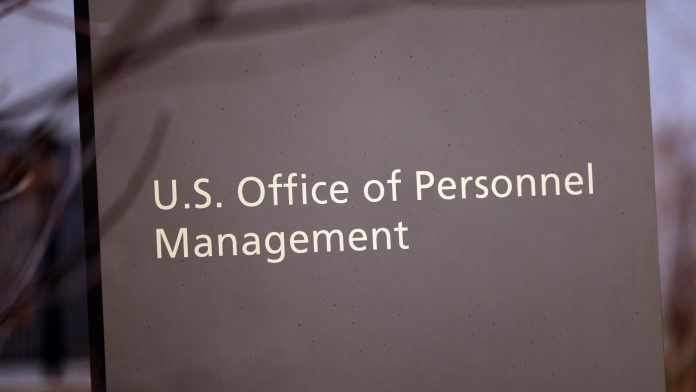
The Theodore Roosevelt Federal Building headquarters of the U.S. Office of Personnel Management is seen on February 3, 2025 in Washington, D.C.

Kevin Dietsch/Getty Images North America


hide caption

toggle caption

Kevin Dietsch/Getty Images North America

The Trump administration has revised a Jan. 20 memo asking federal agencies to provide a list of all probationary employees to the Office of Personnel Management, adding a disclaimer that OPM is not directing agencies to take any specific action.

But the memo doesn’t call for a reinstatement of the tens of thousands of probationary employees who have been fired. Probationary employees are typically in their first or second year on the job.

A new paragraph in the revised memo updated Tuesday merely states “Please note that, by this memorandum, OPM is not directing agencies to take any specific performance-based actions regarding probationary employees. Agencies have ultimate decision-making authority over, and responsibility for, such personnel actions.”

On Tuesday afternoon, the American Federation of Government Employees, a union representing 800,000 civil servants, called on agencies to act anyway.

“Every agency should immediately rescind these unlawful terminations and reinstate everyone who was illegally fired,” wrote AFGE National President Everett Kelley in a statement.

Judge had ruled probationary firings likely violated multiple statutes

OPM issued the revised memo in part to provide clarity in light of a recent court order, an agency spokesperson confirmed, referring to last week’s ruling from a federal judge in San Francisco.

U.S. District Judge William Alsup ruled that OPM had likely violated multiple statutes in ordering agencies to carry out the firings and ordered OPM to rescind the Jan. 20 memo, along with another issued Feb. 14 that asked agencies to terminate probationary employees by Feb. 17.

“No statute — anywhere, ever — has granted OPM the authority to direct the termination of employees in other agencies,” Alsup wrote in his memorandum opinion.

In court last week, the Trump administration’s attorney argued that OPM had merely asked agencies to carry out the firings.

“Asking is not ordering,” Assistant U.S. Attorney Kelsey Helland argued.

Alsup was unconvinced, concluding at the end of the hearing that OPM had in fact ordered agencies to fire probationary employees, an act that he said was “illegal and should be stopped.”

The National Science Foundation confirmed Monday that it had reinstated with back pay all 86 probationary employees it had fired “based on updated guidance from OPM and the Federal Courts.”

OPM inserts new language about how performance is to be measured

Another modification to the Jan. 20 memo seeks to recast how probationary periods should be used.

The original Jan. 20 memo reads: “Probationary periods are an essential tool for agencies to assess employee performance and manage staffing levels.”

The March 4 revision reads: “Probationary periods are an essential tool for agencies to assess employee performance and ensure that ‘a probationer’s conduct and performance have established that the individual will be an asset to the Government.'”

The new language echoes guidance that OPM issued in that same Feb. 14 memo, instructing agencies on how they should measure probationary employees’ performance when deciding whether they should be retained.

“An employee’s performance must be viewed through the current needs and best interest of the government, in light of the President’s directive to dramatically reduce the size of the federal workforce,” the memo reads.

In their lawsuit challenging the firings, the plaintiffs said that guidance “has no basis in law,” writing “Neither OPM nor any agency may lawfully terminate a probationary employee based on performance for reasons that have nothing to do with the employee’s performance.”

Alsup has scheduled another hearing in the case on March 13.

Have information you want to share about ongoing changes across the federal government? NPR’s Andrea Hsu can be contacted through encrypted communications on Signal at andreahsu.08.

A federal efficiency team was axed. They were working on one of Trump's goals

0

The Trump administration is firing some 80 people focused on making government digital services more efficient. Members of the 18F team say they did exactly what the DOGE unit says it’s trying to do.

Mexico Gave Trump Much of What He Wanted. Tariffs Came Anyway.

0

Facing the threat of tariffs from President Trump after he took office, Mexico bent over backward to comply with his demands.

Almost immediately, the government moved to secure its northern border, severely stanching migration to the United States. Then it hunted cartel leaders in a dangerous fentanyl stronghold. And just last week, in a once-in-a-generation move, it delivered into U.S. custody 29 of the country’s most powerful drug lords.

But even after all of that, Mr. Trump imposed the tariffs anyway, shaking global markets. The move left officials in both countries baffled about what the White House was trying to accomplish and frantically asking the same question: What was Mr. Trump’s endgame?

Even some people close to the president seem to disagree on the answer.

Some outside advisers predict that the tariffs, which are currently at 25 percent on most imports from Mexico and Canada, will result in a steady stream of revenue for the United States.

Others maintain that they are Mr. Trump’s attempt to shake up the global order and flex his muscles on the world stage.

Many believe that the president, who has seen trade deficits as a crisis for decades, is simply trying to follow through on a threat that he has dangled over Mexico for months. By pressing forward, they say, Mr. Trump is seeking to ensure that he is seen as tough among world leaders as he pushes his foreign policy agenda in other global hot spots, including Gaza and Ukraine.

Mr. Trump had initially announced the tariffs shortly after taking office. But he delayed their imposition right before they were to take effect in early February, after speaking with President Claudia Sheinbaum of Mexico and Prime Minister Justin Trudeau of Canada. He gave them about another 30 days to show results.

On Monday, the White House said that the tariffs were going forward because both Mexico and Canada had “failed to adequately address” the flow of drugs into the United States, noting that the cartels have “an intolerable relationship with the government of Mexico.”

That statement prompted some experts in Mexico to theorize that perhaps Mr. Trump wanted Mexico to go harder after politicians accused of corruption.

“Trump keeps insisting on this point, and Sheinbaum has done absolutely nothing on those links,” said Eduardo Guerrero, a security analyst based in Mexico City.

Still, there was little more to go on than theories at this stage. And regardless of what Mr. Trump’s actual motivations might be, his decisions have resulted in a state of confusion and frustration on both sides of the border.

Two Mexican officials said that they had reached a limit on what they were able to offer in an effort to avoid the tariffs, and that it was unclear what more Mexico could have done on security. They cautioned, though, that they still had very little understanding of what else Mr. Trump might want.

Mr. Trump’s moves have also bewildered some American officials who have worked for years on issues related to drug cartels. They expressed concern that without a clear path forward, the tariffs could jeopardize any future security cooperation with Mexico, according to two people familiar with the matter.

Even some within the Trump administration recognized that the imposition of the tariffs may have finally exhausted the Mexican government’s willingness to work with the United States and that the country may have little additional capacity to deliver further wins.

But even though there was some internal pushback about the tariffs, Mr. Trump’s advisers no longer voice the sort of robust disagreement on what he wants that they did during his first term.

The puzzlement about the tariffs was being felt even after high-level meetings last week in Washington between a delegation from Mexico and senior U.S. officials to hammer out a security agreement between the two countries.

The goal of the talks from the Mexican perspective was to avoid the tariffs altogether by reaffirming Mexico’s desire to work in concert with the United States on cracking down on the cartels and stemming the flow of illicit drugs across the border.

U.S. officials used the talks as the backdrop to reveal a secretive but spectacular development they hoped would appeal to Mr. Trump. Just before the delegation left Washington, Mexican officials announced that they were delivering into U.S. custody dozens of cartel leaders and were even speeding up the process of turning them over by skirting their country’s normal extradition laws.

That move, lauded as a win for Mr. Trump, was widely viewed as one of the most important efforts by Mexico in decades to send drug traffickers to face charges in American federal courts. While the deal was based on negotiations that had started during the last administration, it was hastily concluded by diplomats and law enforcement officials in time to be ready for the meetings last week, according to the people familiar with the matter.

Those expelled from Mexico were some of the most powerful and violent cartel leaders in the country’s history.

Among them was Rafael Caro Quintero, a Sinaloa cartel figure who masterminded the torture and murder of Enrique Camarena, an agent for the U.S. Drug Enforcement Administration who was working under cover in Guadalajara in 1985.

Mexico also released into American hands Miguel Ángel Treviño Morales, a former leader of the Zetas cartel, which helped perfect the practice of using carnage as a message.

The handovers were just one in a series of concessions by Mexico.

Since Mr. Trump first started floating the idea of tariffs in November, the Mexican government has intensified its military crackdown in Sinaloa state, a major hub of fentanyl production. The region is the home base of the Sinaloa cartel, which the U.S. government blames for much of the synthetic opioids flooding over the border.

A slew of arrests, drug lab raids and fentanyl seizures have struck at the core of cartel operations in Culiacán, the state capital of Sinaloa, prompting some producers to shut down manufacturing of the drug altogether, according to interviews with six cartel operatives.

Ms. Sheinbaum announced the deployment of 10,000 National Guard troops at the border in early February, and the government has ratcheted up enforcement has contributed to a plunge in illegal crossings into the country. Kristi Noem, the homeland security secretary, announced last week that only 200 people had been apprehended at the southern border one Saturday in February, which she said was the lowest daily figure in more than 15 years.

The tariff announcement on Monday was met with shock in Mexico, but experts said it was unlikely that even after what was seen as unfair punishment, Ms. Sheinbaum would shut down collaboration on security issues. The risks, they said, were simply too high.

“While she’s a very nationalist and leftist woman, she’s also very pragmatic in terms of her relationship with the U.S.,” Mr. Guerrero said. “If that relationship goes badly, it would be a disaster for her government.”

What to expect in President Trump's address to a joint session of Congress tonight

0

President Trump will give an address to a joint session of Congress Tuesday night. Here’s what to expect. It’s the first big speech since his meeting with Ukrainian President Volodymyr Zelenskyy.

Von Der Leyen Unveils Sweeping Plan to Boost E.U. Military Spending.

0

A top European official on Tuesday laid out a sweeping framework aimed at rearming the continent, trying to fill a void as President Trump retreated from supporting Ukraine and pressured Europe to spend more on its own defense.

The official, Ursula von der Leyen, president of the European Commission, the European Union’s executive branch, set out a broad but vague proposal to ramp up European defense spending by as much at 800 billion euros, or some $843 billion, including a €150 billion loan program to pay for more weapons and technology.

The plans signal an important policy shift at a tenuous moment, as European leaders panic about Mr. Trump’s demands.

While the E.U. has long seen itself as a project built for peace and open trade, the world has abruptly changed around it. “We are in an era of rearmament,” Ms. von der Leyen said on Tuesday from Brussels in a statement to the news media.

Mr. Trump has been pivoting away from Ukraine and toward Russia in recent weeks. The shift intensified this week, when he suspended the delivery of all U.S. military aid to Ukraine, according to senior administration officials.

America’s realignment has left Europe racing to help Ukraine in the short term and to ensure that it is prepared to defend itself from a more aggressive Russia in the long term.

The options proposed by Ms. von der Leyen mostly involve loans and looser budget rules. Ultimately, the decisions about whether to boost military spending will be made by E.U. member states, whose finances are already under pressure.

But with Ukraine facing a critical shortfall in weaponry in its war against Russia, the timing is increasingly urgent. Ms. von der Leyen unveiled her proposal ahead of a meeting of heads of state and government from across the bloc’s 27 member nations in Brussels on Thursday.

Perhaps the most novel part of the proposal is the €150 billion program to make defense-related loans from the E.U. to member states. The funds could be used to pay for a range of investments: air and missile defense, artillery, drones and anti-drone systems, cybertechnologies and infrastructure projects.

Funding for the program would be raised in capital markets, according to senior European Commission officials. To set it up, the E.U. would rely on an emergency provision that allows for financial assistance to member states in exceptional circumstances. The plan would have to be approved by slightly more than a majority of the European Council — a relatively low barrier.

The loans would be meant to pave the way for big investments that would not overlap. The money would be allocated to member states by the Commission based on demand, officials said.

“It will help member states to pool demand and to buy together,” Ms. von der Leyen said. “With this equipment, member states can massively step up their support to Ukraine.”

Ms. von der Leyen had already announced that she would propose exempting defense investments from strict European Union deficit rules.

European defense spending has climbed 30 percent since 2021, but it remains well below the levels that officials say are needed for Europe to become more truly independent from the United States. And budget limitations are already biting.

E.U. countries are supposed to keep their deficits — the gap between how much they spend and how much money they bring in through taxes and fees — to below 3 percent of their economic output, while limiting their debt. Failure to do so can result in fines. Eight countries, including Belgium and Poland, are already bumping up against the limits or are seriously in breach of them, as is France.

Given that, Europe has been trying to find ways to allow individual nations to spend more on defense without making drastic cuts elsewhere, for instance to health care or social services.

Ms. von der Leyen suggested on Tuesday that a budget “escape clause” would be a central part of her plan.

She suggested that if European nations used the space to increase spending by another 1.5 percent of gross domestic product — nearly doubling it from just under 2 percent now — that would add up to about €650 billion over four years.

But even if the European Council approves the escape clause, it’s not clear whether individual states would decide to spend the extra money and increase their deficits.

Other programs that the E.U. already has underway could be redirected toward defense, Ms. von der Leyen suggested.

She proposed allowing member states to use what is called “cohesion” funding — which usually helps poorer member states pay for economic development — to pay for military spending.

Another option is to use the European Investment Bank to help to fund the defense buildup. The bank has already been increasing its lending to security-related projects, though it is somewhat limited by its lending criteria.

European officials have called for rule changes that would allow the bank to invest in purely military projects, which it cannot do currently.

If Ms. von der Leyen’s proposal had an overarching theme, it was that it can be done quickly within the E.U.’s existing framework. But the proposal stopped short of some more ambitious ideas — and lacked a few widely anticipated details.

Defense analysts have been watching to see how the E.U. might work with Britain and Norway, which are not in the bloc. Keir Starmer, the prime minister of Britain, promised this week the formation of a “coalition of the willing” to support Ukraine. But there was nothing in the proposal about a broader collaboration.

Likewise, it is not clear what specific help is coming for Ukraine, versus what will be used to beef up European defense more broadly. E.U. countries have been talking about cobbling together a package for Ukraine financial support that could be worth as much as €20 billion, but Ms. von der Leyen did not talk about those plans on Tuesday.

Given that, the fresh proposal is most likely a starting point. More detail could come on and after Thursday, and even more when the Commission is set to present a paper on defense in March.

“It’s a start, it’s a good signal, but she didn’t go as big as maybe most of us would have expected,” said Maria Martisiute, a policy analyst at the European Policy Center focused on defense. “She’s not revealing all her cards now.”