Thursday, November 12, 2026
Home Blog Page 160

Here are the guests are attending Trump’s address to Congress : NPR

0

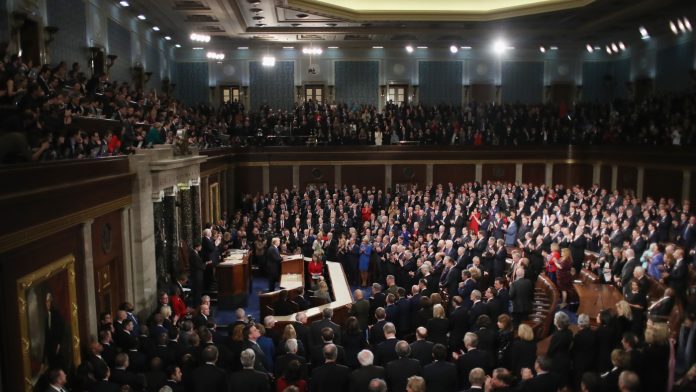
The view as President Trump delivered a State of the Union address in the chamber of the U.S. House of Representatives in January 2018.

Mark Wilson/Getty Images


hide caption

toggle caption

Mark Wilson/Getty Images

President Trump’s joint address to Congress — his first since returning to office — gives him a chance to talk up his controversial agenda in prime time. And almost as revealing as what he will say is who he will say it to.

The president and first lady, as well as members of Congress across the political spectrum, have invited guests to the address, as is customary.

Plus-ones typically represent the themes of a president’s address. They put a human face on the administration’s priorities — and signify a lawmaker’s support or opposition to them.

This year’s guest list is no different, according to the announcements ahead of Trump’s speech, which is expected to touch on everything from immigration to the economy to foreign policy.

On Tuesday, the White House named roughly a dozen invitees, meant to bring “incredible stories about the disaster wrought by the previous administration, and the historic achievements President Trump has already enacted to usher in the Golden Age of America.”

The guests include family members of Laken Riley and Jocelyn Nungaray, who were killed by men in the U.S. without legal status; as well as anti-transgender advocates, the relatives of Corey Comperatore, the man who was killed at the rally where Trump survived an assassination attempt and Marc Fogel, the American teacher that Trump helped free from Russian prison last month.

Democrats, on the other hand, are bringing people they say have been hurt by Trump’s policies.

House Minority Leader Hakeem Jeffries has urged Democrats to “elevate the stories of everyday Americans who are being harmed in real time by House Republicans and the Trump administration.”

Many of the Democrats’ guests are former federal workers who were laid off from various agencies as part of the government restructuring initiative known as the Department of Government Efficiency (DOGE).

Other guests rely on Medicaid. Republican lawmakers are pushing deep cuts to the health insurance program as a way to finance Trump’s agenda. Republicans hope to make those cuts later this year using a feature of the budget process known as reconciliation.

Here’s a look at some of the names on the guest list — and the themes they represent.

Fired federal workers 

Many Democrats invited people from their home state who were fired from various federal agencies in recent weeks. Here’s a sampling:

  • Sen. Richard Blumenthal of Connecticut, a member of the Senate Veterans’ Affairs Committee, is bringing Michael Missal, the former Inspector General for the Department of Veterans Affairs. 
  • Sen. Michael Bennet of Colorado is bringing Jamie Werner, a former program management specialist at White River National Forest who was laid off from the U.S. Forest Service last month. 
  • Sen. Tim Kaine of Virginia has invited Jason King, a disabled veteran who was fired from his position in the Federal Aviation Administration’s safety division. 
  • Rep. Ilhan Omar of Minnesota is bringing Chris Wicker, an Air Force veteran who was fired from the Minnesota district office of the Small Business Administration, then told his termination was a mistake, then fired again days later. 
  • Rep. Elissa Slotkin of Michigan, who will be delivering the Democratic response to Trump, is bringing Andrew Lennox, a Marine veteran recently fired from the VA.
  • Sen. Elizabeth Warren of Massachusetts is bringing Doug Kowalewski, who was fired from the National Science Foundation after working there more than three years. 

Beneficiaries of Medicaid 

Other Democrats are bringing constituents who depend on Medicaid for health insurance and life-saving care, including:

  • Sen. Maggie Hassan of New Hampshire’s guest, Cheri Bryer, was able to access residential addiction treatment, enter recovery and return to work — supporting moms in recovery — all because of her Medicaid eligibility.  
  • Sen. Jacky Rosen of Nevada is bringing Dominic Rampa, a teenager who relies on Medicaid to cover essential treatments for health conditions associated with nine genetic disorders, which costs a minimum of $200,000 per year. 
  • Former House Speaker Nancy Pelosi is bringing Elena Hung and her daughter Xiomara, whom she says “was born with serious medical conditions and is thriving today because of Medicaid.”
  • Senate Minority Leader Chuck Schumer ‘s guests include two Medicaid recipients who are both cancer survivors: Jessica Martinez, who needs Medicaid in order to afford the multiple sclerosis treatments that allow her to live independently, and Ana Medina Garcia, who works as a home health care worker for seniors. 

Firefighters and law enforcement officers

Two California Democrats are bringing firefighters who battled the Los Angeles fires earlier this year, highlighting the need for federal aid in the region as well as better treatment for federal firefighters.

  • Sen. Adam Schiff is bringing Capt. Vincent Culliver, a 25-year federal firefighter for the Vandenberg Space Force Base Fire Department and president of the union of the International Association of Firefighters at the base. 
  • Sen. Alex Padilla is bringing Frank Líma, a longtime Los Angeles City fire captain and the general secretary-treasurer of the International Association of Fire Fighters. 

Some Republicans, meanwhile, are bringing members of local law enforcement from their communities.

  • South Dakota Rep. Dusty Johnson is bringing Meade County Sheriff Pat West and Clay County Sheriff Andy Howe, whom he said will be glad to hear “how the President will partner with our law enforcement community to make America safe again.”
  • Fox News reported that House Speaker Mike Johnson’s guests include Tom Homan, a veteran of immigration law enforcement who serves as the Trump administration’s border czar.
  • Guests of the White House include Roberto Ortiz, a U.S. Border Patrol agent whom it says has been “shot at repeatedly by cartel members while performing his duties near the Rio Grande River in Texas.”

Small business owners fearing tariffs

Several lawmakers are bringing people whose industries are threatened by Trump’s long-promised tariffs against Canada and Mexico, which prompted retaliatory measures shortly after taking effect on Tuesday.

  • Vermont Sen. Peter Welch, a Democrat, invited Allison Hope, executive director of the Vermont Maple Sugar Makers Association, who recently said the tariffs endanger the state’s status as the country’s top maple syrup producer. 
  • Sen. Jeanne Shaheen, D-N.H., is bringing Rebecca Hamilton, the co-owner and co-CEO of a family-owned personal care products manufacturer called Badger. Shaheen said it is one of dozens of small businesses in the state that would be “devastated” by the tariffs.
  • Sen. Amy Klobuchar, D-Minn., is bringing third-generation farmer Gary Wertish, whom she called one of many worried about their farms’ futures under a potential trade war, layoffs at local U.S. Department of Agriculture offices, and proposed cuts to Farm Bill programs. 

Americans impacted by the Israel-Hamas war

Lawmakers on both sides of the aisle are bringing people directly affected by the war in Gaza, including several family members of Israelis who were kidnapped on Oct. 7 and are still held hostage by Hamas.

Speaker Johnson is reportedly bringing Noa Argamani, who was rescued from Gaza in June 2024 and appealed for a ceasefire at the U.N. Security Council last week.

  • Rep. Tom Suozzi, D-N.Y., is bringing Ronen Neutra, whose son Omer Neutra — an American-Israeli citizen — was killed on Oct. 7 and whose body is still held in Gaza.
  • Jeffries and New Jersey Rep. Josh Gottheimer, also a Democrat, are bringing the family members of Edan Alexander, the last living American known to be held by Hamas. 
  • Rep. Bonnie Watson Coleman, D-N.J., is bringing Dr. Adam Hamawy, a plastic surgeon and Army veteran who recently returned from his second volunteer mission in Gaza. 

Pop culture and culture war figures 

Politicians also are inviting prominent figures in conservative media — both the subjects of coverage and some commentators themselves.

  • The White House is bringing Payton McNabb, a former high school athlete whom it says suffered a traumatic brain injury after a transgender athlete hit her in the head with a volleyball during a 2022 match, and has campaigned to ban transgender athletes from women’s sports. 
  • Rep. Mariannette Miller-Meeks, R-Iowa, is bringing Riley Gaines, a former collegiate swimmer who has become an outspoken advocate of banning transgender athletes from women’s sports. 
  • Rep. Pete Stauber, R-Minn., a former professional hockey player, is bringing Minnesota hockey legend Phil Verchota — a member of the 1980 “Miracle on Ice” Olympic Hockey Team — as well as Jennifer Hegseth, the wife of Defense Secretary Pete Hegseth. 
  • Majority Whip Tom Emmer, R-Minn., is bringing guests including Buzz Schneider and Rob McClanahan, hockey legends who were also part of the 1980 Olympic team. 
  • Johnson told Fox News his guest list includes Ben Shapiro and Matt Walsh, both of the conservative media outlet The Daily Wire.  

Not Time’s Fool: A Rare Version of a Shakespeare Sonnet Is Discovered

0

“What was once a kind of erotic, playful love poem,” Professor Shapiro said, had “been repurposed to speak to people in the midst of a civil war — in which their loved ones are fighting and dying.”

Consider the opening lines of “Sonnet 116”:

Let me not to the marriage of true minds

admit impediments; love is not love

Which alters when it alteration finds …

The nod to “marriage” might be why it’s a favorite at weddings, said Prof. Michael Dobson, the director of the Shakespeare Institute in Stratford-upon-Avon, who was not involved in the discovery. But the commitment to loving someone forever, just as they are, also resonates.

“It makes an implausible vow of eternal constancy, which is what marriages are all about,” said Professor Dobson, who has “love’s not time’s fool” etched into his wedding band.

The opening of the variation reads as much more righteous — almost scolding — instead of musing.

Self blinding error seize all those minds

Who with false appellations call that love

Which alters when it alterations finds …

Practically, the additional lines were added to create more singable verses, according to Oxford. But in the context of the civil wars, the Oxford release said, “the additional lines could also be read as an appeal toward religious and political loyalty.”

Could the self-blinding error have been the push to leave the monarchy behind? Are the parliamentarians the minds who were making such false appeals?

The CFPB drops its case against payment app Zelle : NPR

0

The Consumer Financial Protection Bureau has dropped its lawsuit against the payment network Zelle and three of its owner banks.

Roy Rochlin/Getty Images for Zelle


hide caption

toggle caption

Roy Rochlin/Getty Images for Zelle

The Consumer Financial Protection Bureau has dropped its lawsuit against the operator of payment platform Zelle and three of its parent banks, in the latest move by the Trump administration to undo actions of the bureau’s prior leadership.

The bureau had filed the lawsuit in late December against the operator of Zelle, Bank of America, JPMorgan Chase and Wells Fargo “for failing to protect consumers from widespread fraud.” Customers of the top three banks lost more than $870 million over seven years due to the banks’ failures to protect them, according to the CFPB.

“This is about financial institutions fulfilling their basic obligations to protect customers’ money and help fraud victims recover their losses,” then-CFPB Director Rohit Chopra said at the time. “These banks broke the law by running a payment system that made fraud easy, and then refusing to help the victims.”

However, that was then. On Tuesday the administration dropped its case against Zelle, according to a filing in U.S. District Court in Arizona.

Zelle and its parent banks are just the latest enforcement target to be abandoned by the CFPB, which is currently led by acting director Russell Vought. Last week the bureau dropped cases it was litigating against five companies including Capital One, Rocket Homes and others. It had earlier dropped its case against online lending platform SoLo Funds.

The CFPB has also been decimated in a matter of weeks, with agency’s employees ordered to stop essentially all work, while some 150 employees have been fired. The bureau’s D.C. headquarters has also been shuttered.

“Dismissing this lawsuit against the big banks that own Zelle is another troubling sign that the CFPB’s new leadership is dramatically pulling back from enforcing the law and protecting consumers who have been mistreated by banks and other financial firms,” said Chuck Bell, advocacy program director at Consumer Reports, in a statement.

“Fraud has become increasingly common on payment apps like Zelle and consumers have little chance of recovering their money from their bank if they get tricked into sending a payment to scammers,” Bell added.

Meanwhile, the Consumer Bankers Association CEO Lindsey Johnson said the banks had followed the law.

“In a time when fraud and scam activity is surging across industries and government alike, we look forward to moving past finger pointing and political grandstanding and, instead, working constructively with policymakers to counter the root causes of these threats,” Johnson said in a statement.

The bureau long been unpopular with Republicans, Wall Street, and Silicon Valley who say it is too heavy-handed in its regulation. When President Trump was asked last month whether his goal was to have CFPB totally eliminated, Trump said yes. Elon Musk has tweeted “CFPB RIP.”

The bureau was created by Congress as part of the Dodd-Frank Act, in the wake of the 2008 financial crisis.

Why Is Trump Pausing Aid to Ukraine? What to Know.

0

The Trump administration’s decision to suspend the delivery of all military assistance to Ukraine left Ukrainians and Europeans figuring out on Tuesday how to fend for themselves.

The decision — which potentially affects at least $9 billion in arms, ammunition, and air defense systems in the pipeline and on order, according to new estimates — made real a fear that has racked Kyiv since President Trump’s re-election.

Here’s what to know.

The United States has provided about $67 billion in military weaponry and equipment to Ukraine since the war began in 2022 — nearly half of the total $136 billion that allies have given. But Mr. Trump’s overtures toward Russia after taking office in January aggravated fears among allies that he would cut American aid, spurring President Volodymyr Zelensky of Ukraine to shore up European support.

After an explosive confrontation in the Oval Office last week, during which Mr. Trump castigated the Mr. Zelensky for not being grateful enough for U.S. support, the White House decided to pause weapons shipments, according to senior administration and military officials who spoke on the condition of anonymity to discuss internal deliberations. Few details have been released about the move, which appears aimed at forcing Mr. Zelensky to agree to a cease-fire on terms Mr. Trump dictates — or be condemned to larger battlefield losses.

The officials said the directive would be in effect until Mr. Trump determined that Ukraine had demonstrated a good-faith commitment to peace negotiations with Russia, which launched a full-scale invasion of it in February 2022. It was not immediately clear what that might look like or how long the suspension will last, but for now, it will be up to Kyiv and its European allies to try to keep Ukraine’s guns firing.

Mr. Trump’s move has few direct precedents in recent American history.

The United States has paused the transfer of specific weapons systems to allies and partners, like when President Joseph R. Biden Jr. suspended deliveries of 2,000-pound bombs to Israel because of their disproportionate impact oncivilians in Gaza. But a full cutoff is unusual, and is essentially an ultimatum.

It is not the first time Mr. Trump has blocked aid to Ukraine. During his first term, he pushed Mr. Zelensky to help tarnish Mr. Biden when he was the leading Democratic candidate for president, withholding military aid to Ukraine. He released it only after pressure from advisers and Republican senators. Revelations about those actions led to Mr. Trump’s first impeachment.

Some top Ukrainian officials say the military will be in dire straits in about half a year if the American support is not restarted.

“Ukraine definitely has a safety margin of about six months even without systematic assistance from the United States, but it will be much more difficult, of course,” one member of Parliament, Fedir Venislavskyi, told the news agency RBC-Ukraine on Tuesday.

The United States was set to deliver around $11.1 billion in weapons and equipment to Ukraine this year, funds that were already spent on defense contracts and arms from Pentagon stockpiles still waiting to be shipped, according to a new analysis by the Center for Strategic and International Studies in Washington. A former senior American defense official said the number was likely closer to $9 billion.

The ever-shifting number of weapons from allies flowing into Ukraine and out to the battlefields makes it difficult to estimate stockpile levels. Experts say that how much remains, or can be quickly replenished, largely depends on the type of weapon.

Artillery, for example, was as recently as last year a bellwether of Ukraine’s battlefield success.

Ukraine is currently firing about 5,000 artillery rounds each day — slightly less than its estimated average for much of the war, said Jack Watling, an expert at the Royal United Services Institute, an analytical group affiliated with the British military. Ukraine has said it should be able to produce enough artillery for itself by later this year, and other European nations should be able to help maintain the balance.

Ukraine is also building its own armored vehicles and anti-tank weapons, having burned through more than 4,000 tanks, personnel carriers and other combat trucks since 2022. And the vast majority of drones, which have surpassed other weapons in lethality on the front lines, are made in Ukraine.

But the air defenses needed to protect Ukraine’s cities, military posts and critical infrastructure from Russian missiles and bombs — among the American weapons systems that Mr. Zelensky has in the past deemed “crucial” to his country’s survival — remain sparse. That is partly because Ukraine uses missiles needed to intercept airstrikes almost as quickly as they are delivered, especially those that can stop Russian ballistic missiles and glide bombs that are difficult and costly to block.

Adding to the uncertainty, for much of February, the Trump administration halted U.S. exports of sensitive dual-use items that can be used in weapons, stirring alarm among European defense industry executives that they would be unable to produce interceptor missiles and other ammunition.

The pledges of support and continued military aid for Ukraine from leaders around Europe and in Canada have become increasingly pitched since Mr. Trump’s election.

So far this year, air defense missiles have been pledged by Britain, Germany, Lithuania and Sweden. Canada is sending more combat vehicles and flight simulators for training fighter pilots. France and the Netherlands have delivered more fighter jets. And Norway and Finland are each spending hundreds of millions of dollars to buy weapons for Ukraine.

“Europe is ready to massively boost its defense spending, both to respond to the short-term urgency to act and to support Ukraine, but also to address the long-term need to take on more responsibility for our own European security,” Ursula von der Leyen, president of the European Commission, said in Brussels on Tuesday.

She announced a $841 billion plan to increase defense budgets across Europe and to encourage joint procurement among states to speed weapons manufacturing.

But such efforts have previously fallen short, with countries pulled between domestic spending needs and defense contractors unable to produce vast amounts of costly weapons without upfront capital.

Eric Schmitt contributed reporting.

In Michigan, Arab and Muslim voters react to Trump’s presidency : NPR

0

Islamic Center of America in Dearborn, North America’s largest mosque

Sarah McCammon/NPR


hide caption

toggle caption

Sarah McCammon/NPR

Until November, Faye Nemer never voted for a Republican for president.

“I think it was surprising for me to vote for a candidate other than a Democrat,” she recalled.

Nemer is founder and CEO of the MENA American Chamber of Commerce in Dearborn, Mich., which represents around 3,500 business leaders from Middle Eastern and North African backgrounds. She says many felt abandoned by the Biden-Harris administration’s support for Israel in the war with Hamas in Gaza, and decided to vote for Trump instead, hoping that he could bring peace to the region.

Arab and Muslim voters helped deliver the key swing state of Michigan to President Trump last year. But now, some are expressing concern about his rhetoric regarding the Middle East.

Nemer supports a two-state solution for the Israeli-Palestinian conflict, and she believes Trump could make his mark by pushing the United States to recognize a Palestinian state.

“That’s the only pathway to the long, lasting peace that President Trump wants to accomplish,” she said. “And that could be a defining moment for his presidency to finally achieve peace in the Middle East.”

The U.S. and some key European allies have taken the position that a Palestinian state should be the product of a negotiated solution that includes Israel.

Ibrahim Duhaini, a medical physicist from Dearborn, also voted Republican for the first time last year hoping that Trump would bring peace to the region, and beyond.

“So if you could do that, you could be the chosen person from God, I would say,” Duhaini said. “But we hope that [he] could accomplish this, at least in the Middle East, and…other parts of the world, especially Ukraine and Russia.”

Trump also made significant gains in nearby Hamtramck, which has an all-Muslim city council and mayor, Amer Ghalib. Ghalib, who endorsed Trump, thinks many Arabs and Muslims have increasingly felt alienated from the Democratic Party — on both foreign policy and domestic cultural issues.

Hamtramck Mayor Amer Ghalib

Hamtramck Mayor Amer Ghalib endorsed Trump in 2024 and became a high profile voice advocating for him in Michigan.

Sarah McCammon/NPR


hide caption

toggle caption

Sarah McCammon/NPR

“We used to utilize our force, our votes, our resources, to support the Democratic Party,” Ghalib said. “And despite all of that, the attack came from them.”

That attack, he explained, happened in 2023, when Hamtramck’s city council voted unanimously during June, Pride month, to ban most flags — including Pride flags — on public property.

The vote prompted criticism from some Michigan Democrats.

Ghalib said that served to distance some local Muslims from the Democratic Party. Meanwhile, Republicans reached out, with Trump campaigning in Hamtramck and Dearborn before the election.

“Our community is conservative. They care about raising their kids the way they want, not letting others implement some values that conflict with our values,” Ghalib explained. “We hear good stuff from his side about this – protecting the next generation and the family values.”

Since taking office, though, several of Trump’s statements about the Middle East have raised concerns among Arab and Muslim Americans; like his repeated suggestion that the U.S. should take over Gaza and oversee its redevelopment as a seaside resort. That idea has been roundly rejected by Arab leaders.

And, according to the latest NPR poll, more than two-thirds of Americans oppose it.

Last week, Trump posted an apparently AI-generated video of a so-called “Trump Gaza” development, which featured an image of Trump sunbathing with Israeli Prime Minister Benjamin Netanyahu.

Reached by phone after seeing the video, Ibrahim Duhaini said it made him regret supporting Trump, and he would not have done so if he’d known Trump would post such a message.

“He didn’t say anything like that before,” Duhaini said. “When he came to Dearborn, to the community, he said that he would strive for peace and justice for the whole region.”

Faye Nemer, MENA American Chamber of Commerce CEO and Founder

Faye Nemer, MENA American Chamber of Commerce CEO and Founder, voted for Trump in 2024, saying she hoped he would be able to bring peace to the Middle East.

Sarah McCammon/NPR


hide caption

toggle caption

Sarah McCammon/NPR

Faye Nemer, with the MENA American Chamber, calls the video “unbecoming” to the president and “destabilizing” to peace talks in the region. She said it’s also counterproductive to Michigan Republicans’ efforts to build on Trump’s success in the last election.

“Midterm elections are coming up. There’s various windows of opportunity in swing states that will have contentious elections,” she said. “And the Republicans were hoping through outreach efforts to be able to continue to garner support of the Arab American voting bloc as well as the Muslim American voting bloc.”

“Those prospects are most certainly being harmed by this rhetoric,” she added.

Nemer called on Trump to take down the video in a statement to NPR and urged him to issue a statement aimed at reconciling with the Arab and Muslim American community.

But so far, the White House has doubled down. In a statement, a spokeswoman called Trump a “visionary” and said his plan would “resettle” Palestinians, without specifying where they’d be relocated.

World’s Largest Iceberg Runs Aground

0

After months of drifting, the world’s largest iceberg has come to a halt near the island of South Georgia in the South Atlantic Ocean.

While a “Titanic II” scenario isn’t very likely, and the area’s penguins seem to be mostly safe, the berg may be a symptom of unwelcome change to the Antarctic and the planet.

A23a, as the iceberg is officially known, was born in 1986 when it broke off from another iceberg, A23, that had torn away from Antarctica earlier that year. The separation of a smaller ice chunk from a larger one is called calving.

Its early life was uneventful; it sat in the Weddell Sea, east of the Antarctic Peninsula, for decades.

A23a’s travels began in 2020, when it freed itself from the sea floor and began to move. By 2023, it was ready to leave Antarctic waters entirely.

This spring its progression hit a snag when it began spinning about in place, caught in a current known as a Taylor column near the South Orkney Islands.

Escaping after several months of spinning, it then headed for South Georgia, an island east of the southern tip of South America that is a British territory and home to a couple dozen people and many seals and penguins.

Yes. It couldn’t make it all the way to South Georgia, and is now stuck on the continental shelf, about 50 miles from the island.

So far it seems to be sitting peacefully and has not begun breaking into smaller pieces, as some other giant bergs have after splitting from Antarctica.

Initially it was measured to be about 1,500 square miles. It has lost some of that girth, but still is believed to be more than 1,300 square miles. In contrast, New York City is 300 square miles.

Icebergs that big are rare, Andrew Meijers, an oceanographer at British Antarctic Survey, said in a statement on the group’s website. “There have been two other similarly sized bergs in the same region over the past five years or so, and sporadically before that,” he said.

“It looks like land, that’s the only way to describe it,” Alexander Brearley, a physical oceanographer at the British Antarctic Survey, said last summer.

The iceberg that sank the Titanic was perhaps a quarter-mile long, a laughably tiny thing in comparison.

That’s science for you. “A” indicates the region of Antarctica in which the iceberg was formed. The numbers are assigned sequentially, and the little “a” means it broke off from a bigger berg.

More colorful coinages like “superberg” or “icemonster” would be sadly unscientific.

A23a will begin to break up and melt, though it will probably take a while, maybe years.

“Now it’s grounded, it is even more likely to break up due to the increased stresses, but this is practically impossible to predict,” Dr. Meijers said. “Large bergs have made it a long way north before — one got within 1,000 kilometers of Perth, Australia once — but they all inevitably break up and melt quickly after.”

It is unlikely that the seals and penguins of South Georgia will be affected by the iceberg. Still, “Potentially, it could interrupt their pathway to feeding sites and force the adults to expend more energy to travel around it,” Dr. Meijers said. “This could reduce the amount of food coming back to pups and chicks on the island, and so increase mortality.”

The iceberg also contains nutrients that are released into the sea as it melts: “If the berg is stimulating ocean productivity, this could actually boost populations of local predators like seals and penguins,” he said.

There is little fear of a “Titanic II” as boats in the region will be well aware of the iceberg’s location. Once A23a breaks up, though, the smaller bergs will be harder to track, increasing the danger.

But while the berg itself may pose little direct threat, it could be a symptom of what is unwell in the Antarctic.

The ice shelves have lost billions of tons of ice over the last 25 years, which scientists attribute to climate change. Losing all this ice can contribute to a rise in the level of the sea.

“The climate is changing, and it is impacting how ice shelves melt,” Indrani Das, a glaciologist at the Lamont-Doherty Earth Observatory at Columbia University, said in 2023, when the berg was still moving. “Ice shelves are losing mass because the ocean is warming. Calving is a natural process, but that natural calving could be enhanced by climate.”

Still, it was ever thus. Mammoth icebergs “are a completely normal part of the life cycle of the Antarctic and Greenland ice sheets,” Dr. Meijers said.

U.S. stock markets plunge as Trump’s tariffs spark trade war fears : NPR

0

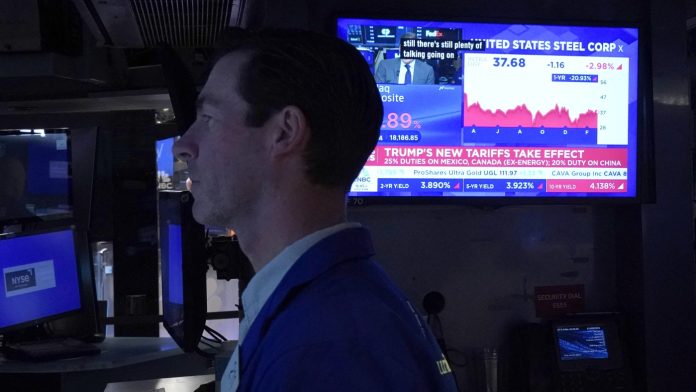
Traders work on the floor of the New York Stock Exchange in the Financial District in New York City on Tuesday.

Timothy A. Clary/AFP via Getty Images


hide caption

toggle caption

Timothy A. Clary/AFP via Getty Images

U.S. stock markets plummeted on Tuesday morning as a new global trade war began.

China and Canada announced new retaliatory measures on Tuesday after President Trump’s long-promised tariffs took effect overnight. Trump imposed a 25% levy on most imports from Canada and Mexico, with a separate 10% tariff on Canadian energy exports. Tariffs on Chinese goods were increased from 10% to 20%.

U.S. investors continued a sell-off that had started on Monday after Trump announced that there was “no room left” for negotiation with Mexico or Canada.

The Dow fell 1.8%, or more than 770 points, in midmorning trading on Tuesday. The Nasdaq and S&P 500 also dropped more than 1.5%. The price of bitcoin fell below $83,000, shedding all of its gains from a weekend rally after Trump said he would create a U.S. “strategic reserve” of cryptocurrencies, including bitcoin.

Canada, Mexico and China are the country’s three largest trading partners. The escalating trade war is likely to result in consumers paying higher prices for a wide range of products, including fruits and vegetables, flat-screen TVs and auto parts.

Shares of major U.S. automakers Ford and GM also plunged on Tuesday. So did the shares of Best Buy and Target, as those large retailers warned that the new tariffs could increase the prices their customers pay.

Mexico Vows Retaliatory Tariffs on the United States

0

President Claudia Sheinbaum of Mexico said her government would impose countermeasures if President Trump’s 25 percent tariffs on Mexican goods remained in effect later in the week.

JD Vance is under fire for comments about European peacekeeping plan for Ukraine : NPR

0

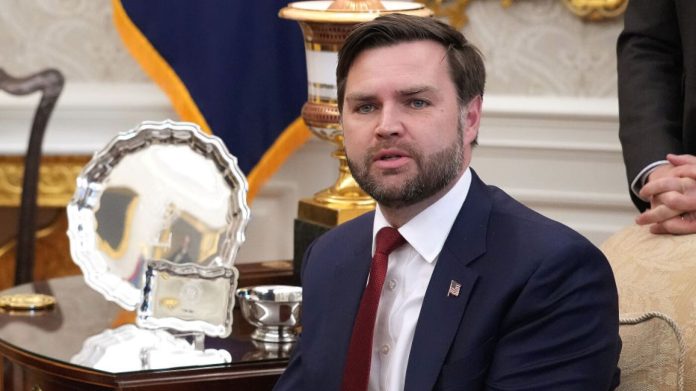
Vice President Vance speaks during a meeting with President Trump and Ukrainian President Volodymyr Zelenskyy in the Oval Office on Feb. 28.

Andrew Harnik/Getty Images


hide caption

toggle caption

Andrew Harnik/Getty Images

Vice President Vance is defending himself Tuesday after triggering a furious reaction for suggesting that a proposal to put European peacekeepers in Ukraine would not be enough to prevent Russia from invading again.

During an interview with Fox News, Vance said a better “security guarantee” for Ukraine was for Kyiv to sign a proposed critical minerals deal with Washington.

“If you want real security guarantees, if you want to actually ensure that Vladimir Putin does not invade Ukraine again, the very best security guarantee is to give Americans economic upside in the future of Ukraine,” Vance told Fox’s Sean Hannity, in an interview broadcast Monday night. “That is a way better security guarantee than 20,000 troops from some random country that hasn’t fought a war in 30 or 40 years.”

The interview followed Friday’s confrontational White House meeting with Ukrainian president Volodymyr Zelenskyy, where they were set to discuss and potentially sign a deal that would give the U.S. access to Ukraine’s critical minerals. President Trump called off the signing, charging that Zelenskyy was “not ready for peace.”

On Capitol Hill Tuesday, Vance said a deal is still possible. “I think the president is still committed to the mineral deal. I think we’ve heard some positive things, but not yet, of course, the signature from our friends in Ukraine,” he told reporters.

Zelenskyy posted on X that the White House meeting “did not go the way it was supposed to be. It is regrettable that it happened this way.”

“Regarding the agreement on minerals and security, Ukraine is ready to sign it in any time and in any convenient format,” he wrote Tuesday. “We see this agreement as a step toward greater security and solid security guarantees, and I truly hope it will work effectively.”

The Trump administration argues that the deal would give Ukraine more economic security and ensure U.S. interest in physical security against Russian aggression.

Backlash from allies abroad

Soon after the Fox interview aired Monday night, Vance’s comments were circulating overseas across Europe. Current and former European leaders quickly responded with some seeing them as a swipe against the proposed United Kingdom and French-led peacekeeping mission in Ukraine.

James Cartlidge, a conservative British lawmaker who serves as the opposition party’s shadow defense secretary, called Vance’s comments “deeply disrespectful.”

“Britain and France came to [the U.S.’s] aid, deploying thousands of personnel to Afghanistan, including my own brother and numerous parliamentary colleagues, past and present. It’s deeply disrespectful to ignore such service and sacrifice,” Cartlidge wrote on X.

The British Prime Minister Keir Starmer and French President Emmanuel Macron have pushed for a more specific security “backstop” beyond the mineral deal.

Vance later took to social media where he called it “absurdly dishonest” to argue that he had been referring to the UK or France, despite the two countries leading the effort.

“I don’t even mention the UK or France in the clip, both of whom have fought bravely alongside the US over the last 20 years, and beyond,” he wrote. “But let’s be direct: there are many countries who are volunteering (privately or publicly) support who have neither the battlefield experience nor the military equipment to do anything meaningful.”

America vs. The World: Trump Shows How Far He Is Willing to Take ‘America First.’

0

On the campaign trail, President Trump made no secret about how he would approach a second term: He would get tough with nations around the world, even friends and allies, that he believed were taking advantage of the United States’ economic and military might.

The result — which has seemingly caught many international leaders off guard — has been a fraying of military alliances and aggressive tariffs against America’s closest neighbors.

Gone is the alliance-first foreign policy of past administrations. The first weeks of the second Trump term have taken on the feel of America vs. the world.

“The free world needs a new leader,” Kaja Kallas, the European Union’s foreign policy chief wrote on social media after Mr. Trump clashed with President Volodymyr Zelensky of Ukraine in the Oval Office last week. “It’s up to us, Europeans, to take this challenge.”

Now Mr. Trump has imposed tariffs — 25 percent on most imports from Canada and Mexico and two rounds of 10 percent levies on imports from China — which he has said are punishment for their failure to stem the flow of drugs into the United States.

The moves have quickly sparked a trade war: China and Canada retaliated immediately, imposing their own tariffs on U.S. goods on Tuesday. Mexico said it would announce its countermeasures, including retaliatory tariffs, on Sunday.

The list of countries targeted by Mr. Trump has continued to grow. He has mocked Canada as the 51st state and called its prime minister, Justin Trudeau, a “governor.” (As a result, Mr. Trudeau’s low approval risings got a noticeable rise after Mr. Trump targeted the country.)

He has threatened to seize the Panama Canal and annex Greenland from Denmark. He has frozen military aid for Ukraine as the country attempts to fight off a Russian invasion. He has cut off foreign aid that benefits countries throughout Africa, South America and Asia. Now he has imposed tariffs on China, Canada and Mexico.

Some of his many threats may just be that — threats or negotiating tactics — but Mr. Trump has shown a willingness to follow through particularly when it comes to tariffs and withholding foreign aid.

“It means uncertainty, because right now, it isn’t always clear what is a tactic and what is actually meant,” said Nicholas J. Cull, professor of public diplomacy at the University of Southern California. “So it’s very confusing for people, and I suspect that a lot of foreign policy is being played for domestic audiences to get cheers from the base and to keep people uncertain.”

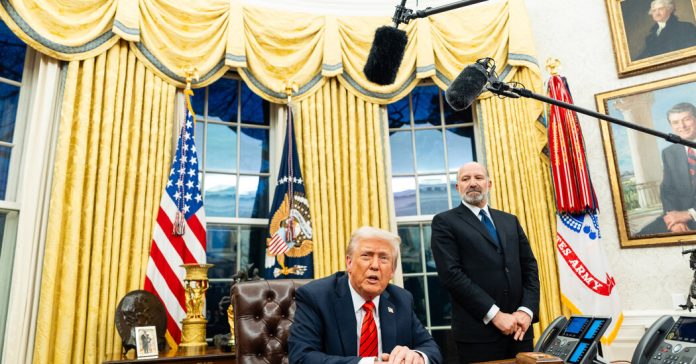
Slightly more Americans approve of Mr. Trump than disapprove after the first weeks in office of his second term, according to averages of polls. He will give a joint address to Congress this evening.