Friday, November 13, 2026
Home Blog Page 163

Greenland’s Minerals: The Harsh Reality Behind the Glittering Promise

0

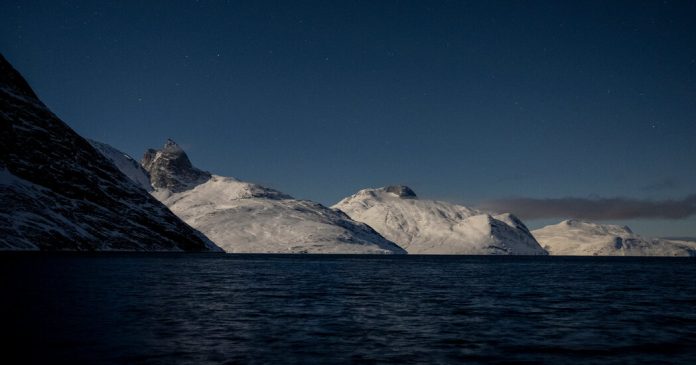
More than a decade ago, Canadian miners prospecting for diamonds in western Greenland saw on the horizon a huge white hump.

They called it White Mountain and soon discovered it was a deposit of anorthosite, a salt-and-pepper color mineral used in paints, glass fibers, flame retardants and other industries. The same mineral creates a ghostly glow on the moon’s surface.

The White Mountain deposit proved to be several miles long and several miles wide, and “only God knows how deep it goes,” said Bent Olsvig Jensen, the managing director of Lumina Sustainable Materials, the company mining the area.

Lumina is backed by European and Canadian investors, but Mr. Jensen said it wasn’t easy to turn the deposit into a mountain of cash.

“You cannot do exploration all year round; you are in the Arctic,” he explained.

He told of fierce winds grounding helicopters and knocking out communications, pack ice blocking ships and temperatures dropping to such a dreadful low — sometimes minus 40 degrees Fahrenheit — that the hydraulic fluid powering the company’s digging machines “becomes like butter.”

Sitting in Lumina’s humble offices in Nuuk, Greenland’s capital, with wet snow flakes scissoring down outside the windows, Mr. Jensen brought a dose of sobriety to all the talk of Greenland as the land of incalculable mineral riches. He noted that though the island has dozens of exploratory projects, there are only two active mines: his and a small gold operation.

The gigantic semiautonomous island in the Arctic has seized the world’s attention after President Trump insisted in January that the United States take it over. Part of the attraction is its rare earths minerals that are vital to high-tech industries and a source of competition across the world.

China dominates in the world’s critical minerals, and has severely restricted the export of certain minerals to the United States. The Trump administration, determined to secure mineral assets overseas, has turned to high-pressure tactics. The natural resources agreement that Ukraine was all set to sign with the administration until the talks spectacularly blew up on Friday was focused on critical minerals.

The European Union is just as fixated. It recently signed a strategic minerals deal with Rwanda, which is suspected of fomenting instability in mineral-rich Congo next door.

It should be no surprise, then, that Mr. Trump and his allies are excited about Greenland’s mineral scene. Vice President JD Vance has spoken of Greenland’s “incredible natural resources,” and Republican senators recently held a hearing on “Greenland’s Geostrategic Importance,” highlighting its rare earths.

Tech giants like Bill Gates and Jeff Bezos, along with some of Mr. Trump’s allies, including Howard Lutnick, his commerce secretary, have invested in companies prospecting here. According to a recent Danish study, 31 of 34 materials defined as critical by the European Union, like lithium and titanium, are found on the island.

But for every square on the periodic table that Greenland can fill, there’s an even longer list of challenges.

Besides the extreme weather, the island has fewer than 100 miles of roads, only 56,000 residents (which means a tiny labor pool) and a few small ports.

Equally daunting for miners is Greenland’s environmentalist lobby. Many Greenlanders say they need more mining to become economically and politically independent of Denmark, which keeps it afloat with hundreds of millions of dollars in annual subsidies.

But Greenlanders have also expressed caution about any new heavy industry. They are protective of their environment, which is being shaken up by climate change: The Arctic is warming nearly four times as fast as the rest of the world, which will most likely make the mineral resources more accessible.

The island’s governing political party swept into office four years ago on an environmentalist platform and shut down one of the most promising mining projects. The next elections are on March 11, and, along with independence from Denmark and closer relations with the United States, safeguarding the environment is at the top of the agenda.

For many Greenlanders, nature is a part of their identity and something they connect to through fishing, hunting, hiking and spending time outdoors.

“We have lived with nature for as long as we have been here, in sustainable ways,” said Ellen Kristensen, an environmentalist in South Greenland.

Not far from her community is the small gold mine. Amaroq Minerals, which is backed by Icelandic, Canadian and other Western investors, extracted its first gold in November. Its chief executive, Eldur Olafsson, says the remoteness of his mine means the company has to be self-sufficient in energy, supplies and transportation — just about everything.

“Operating in Greenland is unlike anything else,” he said.

The Danes, who have controlled Greenland for more than 300 years, have had mixed success. Danish engineers discovered a huge supply of cryolite in the late 18th century. Cryolite used to be a component of aluminum production, and Danish operators mined it until the 1980s, when synthetic alternatives became widely available.

The Danes made billions, and many Greenlanders say they were exploited. The same complaints have been lodged against a large coal mine that Denmark developed last century, though it closed in the 1970s.

Greenland is littered with shuttered projects and abandoned sites. A ruby mine near the east coast closed in 2022 amid soaring debts. Around the same time, Greenland’s government formally abandoned its oil ambitions, citing the lack of commercial viability and the unacceptable environmental risks.

Even the search for diamonds has yet to lead to a commercially viable mine.

These days, much of the interest lies in rare earths, but a big rare earth mine in southern Greenland remains a cautionary tale.

Energy Transition Minerals, an Australian mining enterprise with a sizable investment from a Chinese company, claims its site in Greenland has one of the world’s largest deposits of rare earth oxides. The company spent more than $100 million developing it, only to have Greenland’s governing party, Inuit Ataqatigiit, which had campaigned on killing the project, do exactly that.

The opposition was strongest in Narsaq, the town closest to the site, where residents feared radioactive contamination. Uranium is often found in deposits of rare earth minerals, and the concern was that the mine could send toxic dust floating over the community.

Among the residents leading the protests was Ms. Kristensen, whose husband is a sheep farmer. “Nobody wants to buy meat from sheep grazing next to a uranium mine,” she said.

Like many others, she marched through Narsaq’s snowy streets carrying bright yellow signs that said in Greenlandic language, “Urani? Naamik,” which means: “Uranium? No.”

The mining company says that its operations are safe and that it has completed copious environmental studies proving so. It is fighting the decision, and the dispute is tied up in arbitration and court cases.

China has invested in other joint ventures in Greenland, but none have panned out, either because of stalled production or heavy financial burdens. Still, China’s leader, Xi Jinping, has pushed to expand cooperation with Denmark in the Arctic, promoting his country as a polar power.

China has built research stations and icebreakers to stamp its presence at each end of the earth, and it has proposed a “Silk Road on Ice” — a web of shipping routes and investments that would embed China in the Arctic.

Part of the reason Mr. Trump is so covetous of Greenland is he wants to box out China. He said that China has “boats all over the place.”

One Greenlander working to help Mr. Trump is Jørgen Boassen, a bricklayer who says he has followed American politics since he was a teenager and was instantly drawn to Mr. Trump. Mr. Boassen campaigned door to door for him in the United States last election and was invited to inauguration activities.

Mr. Trump, Mr. Boassen says, is “a man worth betting on.”

In January, Mr. Boassen helped organize a visit by Donald Trump Jr. to Nuuk. The younger Trump insisted it was a private trip, and it seems he didn’t do much besides sightseeing for a few hours and hosting a dinner for Trump supporters and some people off the street.

A few weeks later, Mr. Boassen guided around Tom Dans, an adviser on Arctic affairs to Mr. Trump during his first term. Mr. Dans said he had come to explore investment opportunities and connect with entrepreneurs.

Mr. Dans said Greenland’s minerals scene was “very exciting.” But he cautioned, “There’s no quick buck.”
Linda McMahon has been confirmed as U.S. Secretary of Education : NPR

0

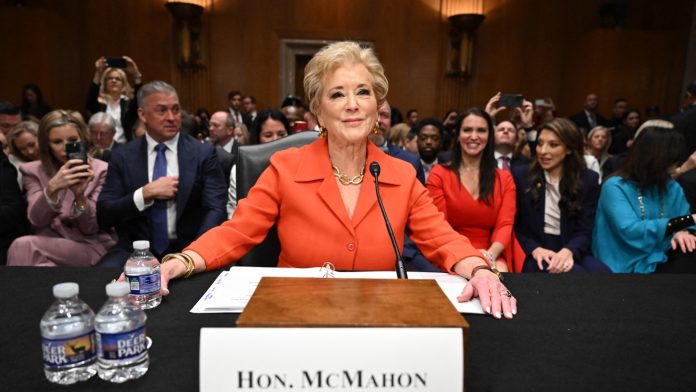
Linda McMahon, pictured here at her Senate confirmation hearing in February, previously led the U.S. Small Business Administration and World Wrestling Entertainment (WWE).

Saul Loeb/AFP via Getty Images


hide caption

toggle caption

Saul Loeb/AFP via Getty Images

On Monday, the Republican-led Senate voted to confirm Linda McMahon as the new secretary of the U.S. Department of Education.

McMahon, a former professional wrestling magnate who led the U.S. Small Business Administration during President Donald Trump’s first term, was confirmed by a 51-45 vote along party lines.

McMahon has a limited background in education, though she served on Connecticut’s State Board of Education for about a year.

In a statement announcing her nomination, Trump said, as secretary of education, McMahon will “empower the next Generation of American Students and Workers, and make America Number One in Education in the World.”

In her confirmation hearing, which was heated at times and interrupted repeatedly by the protesters shouting about protections for students, McMahon decried a public education “system in decline” and vowed to “reorient” the U.S. Department of Education and “invest in teachers not Washington bureaucrats.”

The White House has been clear that it intends to dismantle the department and that it will be McMahon’s job to oversee that effort. The administration has already made cuts to department staff, programs and research, but it cannot officially close the department, as it was created by an act of Congress in 1979 and can only be closed by that same body.

A new NPR/PBS News/Marist poll finds there isn’t much public support for shuttering the agency: 63% of poll respondents opposed getting rid of the Education Department, compared to 37% in favor.

The Education Department is among the smallest of all federal agencies and one of its primary roles is to administer federal funding for K-12 schools, including through Title I (for students in lower-income communities) and the Individuals with Disabilities Education Act (IDEA, for students with disabilities).

McMahon said repeatedly at her confirmation hearing that she considers the Education Department and education funding to be two different things. The former, she said, can be dismantled without affecting the latter. “It is not the president’s goal to defund the programs. It was only to have it operate more efficiently.

At the hearing, Sen. Maggie Hassan, a New Hampshire Democrat, expressed exasperation at McMahon and Republicans who say they want the department to use its enforcement authority to punish schools that flout the new administration’s demands – including their guidance on DEI and transgender athletes in sports – while they also say they want to strip the department of this very enforcement authority. She called this “elegant gaslighting.”

Republican Sen. Lisa Murkowski of Alaska, who has spoken out against school choice policies, asked if McMahon’s primary role as education secretary would be “to support and strengthen our public schools”?

Her answer: “I absolutely do believe that our public schools are the bedrock of our education. You know, they go back to the very founding of our country.”

Read more about Linda McMahon here.

Released From Hamas Captivity, a Hostage Finds His Family Gone

0

Hollow-eyed and emaciated after nearly 500 days in captivity in Gaza, Eli Sharabi stood on a podium flanked by masked Hamas gunmen, unaware of what most Israelis already knew.

During the Hamas-led assault on Oct. 7, 2023, a dozen gunmen had burst into Mr. Sharabi’s house in the border community of Kibbutz Be’eri, where he had been hiding in a safe room with his wife and two teenage daughters. Hoping to save them, he said he gave himself up without a fight and was taken to Gaza.

After emerging from Hamas’s tunnels last month, he would soon learn that his wife, Lianne, 48, and his daughters — Noiya, 16, and Yahel, 13 — had been shot and killed in the family home that day, along with the family’s dog, Mocha.

One of his brothers, Yossi, who was also kidnapped from Be’eri, died in Gaza after 100 days in captivity.

Mr. Sharabi and several other released hostages were flying to the United States on Monday to meet this week with administration officials, including a potential audience with President Trump.

Mr. Sharabi’s mother and three remaining siblings rejoiced over his return on Feb. 8, part of a cease-fire involving exchanges of hostages for Palestinian prisoners. But they said they had agonized beforehand, not knowing whether he was aware of the fate of his family or how they might break the news to him.

Forced by his captors to speak during the live broadcast at his handover ceremony, Mr. Sharabi said he was happy to be returning to his wife and daughters. His surviving brother, Sharon Sharabi, told The New York Times shortly after his release that his brother’s captors had told him his family was waiting.

Trump’s 25% tariffs on Canada and Mexico will hurt automakers : NPR

0

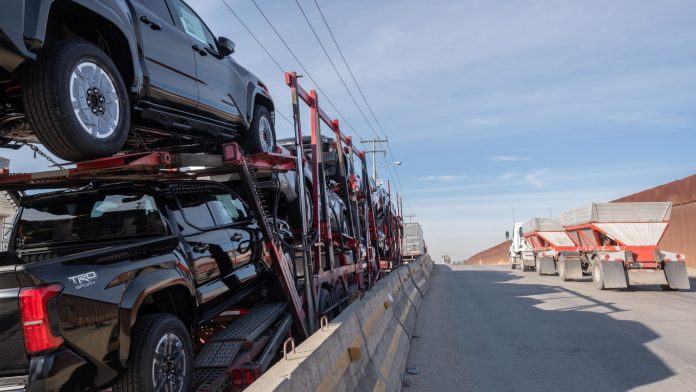
A car carrier trailer drive to cross to the U.S. at Otay Commercial port in Tijuana, Mexico on January 31. President Donald Trump’s threatened tariffs on Mexico and Canada, set to go into effect on Tuesday, would hurt the Mexican economy — but also hurt auto plants in the U.S.

Guillermo Arias/AFP via Getty Images


hide caption

toggle caption

Guillermo Arias/AFP via Getty Images

As President Trump’s once-postponed 25% tariffs on Canada and Mexico are poised to transition from a threat to a reality, the auto industry is preparing for higher costs and an extraordinary disruption to their North American supply chains.

“The tariffs are all set,” Trump told reporters on Monday afternoon, saying that there was no room for Canada or Mexico to negotiate another reprieve. “They go into effect tomorrow.”

Trump also says he will double the tariffs he imposed on China last month, from 10% to 20%.

Speaking on Monday, Trump called his announcement “very exciting” for the auto industry and said it would benefit from his tariff plan. “So what they have to do is build their car plants, frankly, and other things in the United States, in which case they have no tariffs,” Trump said.

But the auto industry itself has been vocally opposed to these tariffs. And that’s in large part because car plants in the U.S. rely on parts from Canada and Mexico.

“Let’s be real honest,” Ford CEO Jim Farley told an investor conference in February. “Long term, a 25% tariff across the Mexico and Canadian border will blow a hole in the U.S. industry that we have never seen.”

In fact, Farley noted, because U.S. plants have built supply chains that span North America, U.S.-based manufacturing will be hit especially hard. Analysts at Bernstein Research have similarly found that the Detroit automakers will be particularly vulnerable, compared to their international competitors.

As parts criss-cross borders, tariffs will hike prices

The North American auto supply chain is, to use the industry parlance, “highly integrated.” That means factories in the U.S., Canada and Mexico ship components back and forth. For decades, trade agreements — first NAFTA and then the Trump-negotiated replacement, USMCA — supported this arrangement.

In fact, the same car part can cross a U.S. border multiple times as it travels through the manufacturing process. NPR has previously shown how this happens with bundles of wires, and The Wall Street Journal recently visualized that journey for transmission modules.

A worker assembles electronic car keys at a manufacturing plant in Tlajomulco de Zuniga, Jalisco State, Mexico, on February 20. The small, handheld remote controls are assembled in Mexico, but they cross borders in North America several times before being finished, like countless other auto parts.

A worker assembles electronic car keys at a manufacturing plant in Tlajomulco de Zuniga, Jalisco State, Mexico, on February 20. The small, handheld remote controls are assembled in Mexico, but they cross borders in North America several times before being finished, like countless other auto parts.

Ulises Ruiz/AFP via Getty Images


hide caption

toggle caption

Ulises Ruiz/AFP via Getty Images

So while cars made in the U.S. are not subject to these tariffs, the parts that go into them often are. In February, Patrick Anderson of Anderson Economic Group presented research to the Automotive Press Association breaking down the increase in component costs for specific U.S.-made vehicle models, assuming that companies do their best to manage the costs. He said that the tariffs could boost manufacturing costs by $4,000 to more than $10,000 per car, depending on vehicle model.

Now, companies could try to mitigate these costs by stockpiling parts or relocating some production; carmakers have been assuring their investors for months now that they have contingency plans in place. And to protect sales, they also might absorb some costs, rather than passing them all along to car buyers.

But multiple analysts still anticipate that consumers will see car prices rise; thousands of dollars in additional production costs overnight are just too hard to avoid, even with savvy management. The investment bank Jefferies has predicted prices would go up by about 6% on average, or $2,700, while two analyses cited by Kelley Blue Book agreed on a $3,000 average price bump.

Vehicle prices, of course, are already quite high, averaging about $48,000, which is out of reach for many car shoppers. Although they have recently leveled off, prices remain up significantly from pre-pandemic levels — which, in turn, has put pressure on used car prices.

Other tariffs, and uncertain timelines, complicate planning

Meanwhile, other tariffs — some already scheduled, and some merely proposed — would also upend automaker supply chains. Higher tariffs on steel and aluminum, two key raw materials, kick in this month. Trump has proposed a 25% tariff on imported vehicles from Europe, as well as other country-specific tariffs.

For weeks, automakers had hoped the tariffs on Mexico and Canada would remain threats, not actual policy. Now they’re hoping that the tariffs are short-lived.

And as companies try to navigate these shifting trade policies, one challenge is that the Trump administration’s stated goals for tariffs are often contradictory. A tariff designed as a diplomatic lever might be lifted as soon as a goal is achieved — and the Trump administration has said that tariffs on Canada and Mexico are a response to inadequate border and drug enforcement. But a tariff meant to promote U.S. jobs or raise revenue might be made permanent.

Companies are reluctant to make long-term plans, like building new factories, with so much uncertainty.

Analysts at Jefferies wrote in a note to clients on Monday that “the only thing we know for sure is that we don’t know what Trump will do.” Last month, S&P Global Mobility, an automotive data and intelligence firm, warned that “the uncertainty chaos” around tariffs would delay companies’ decisions about what vehicles to build and where.

And that’s before factoring in the specter of retaliatory tariffs — hikes imposed by other countries in response to U.S. actions.

Gustavo Flores-Macias, a professor of government and public policy at Cornell University who focuses on economic reforms, thinks that’s likely to come next. “While Canada and Mexico have sought to find a diplomatic solution to the White House’s demands regarding undocumented migration and fentanyl trafficking, both countries are likely to retaliate in kind even if they stand more to lose economically,” he said in an emailed statement.

Oil Prices Fall After OPEC Plus Affirms Plan to Raise Production

0

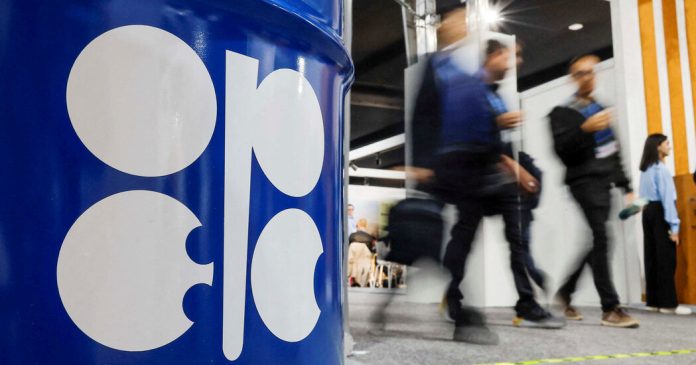
Oil prices fell on Monday afternoon to their lowest level of the year after the OPEC oil cartel and its allies affirmed plans to gradually increase crude production beginning in April.

Opening the taps in countries such as Saudi Arabia and Russia, which have voluntarily throttled supply to prop up prices, increases the risk that the world could soon find itself with more oil than it needs. The group said it would raise production by 2.2 million barrels a day, or around 2 percent of global demand, over many months.

That would be good news for consumers, who generally benefit when energy costs less, but squeeze the profits of oil producers and the countries and states where they operate.

U.S. oil prices settled at $68.37 a barrel on Monday, down 2 percent. At that price it’s generally profitable to drill new wells in the United States, which produces more oil than any other country by far. Many more wells are no longer profitable when oil sells for $60 a barrel or less.

OPEC Plus, the name used by the Organization of the Petroleum Exporting Countries and allies like Russia, has been saying since December that a group of eight countries would begin ramping up output in April. However, oil traders took those statements with a grain of salt because the cartel delayed similar plans several times last year, worried that supply would outpace demand and depress oil prices.

“The decision to move ahead with a gradual ratcheting up of output does not seem to be in response to stronger-than-expected demand for their barrels, but rather in response to increasing political pressure, especially from the Trump administration,” a Barclays analyst, Amarpreet Singh, wrote in a note to investors on Monday. The move by OPEC Plus, he said, came as a surprise.

President Trump campaigned on lowering energy prices by at least half, a target that economists have said is unrealistic. And in January, he said he would lean on Saudi Arabia and OPEC to lower the cost of oil.

“You got to bring it down, which, frankly, I’m surprised they didn’t do before the election,” he told the World Economic Forum.

The oil producers may adjust their plans based on market conditions, OPEC said in a statement. “This flexibility will allow the group to continue to support oil market stability.”

Why Elon Musk is pouring money into a state supreme court race in Wisconsin

0

The race for a state Supreme Court justice in Wisconsin could offer some clues about the upcoming 2026 election cycle — and, about Elon Musk’s power in politics.

Gazans Worry as Israeli Border Block Sends Food Prices Climbing

0

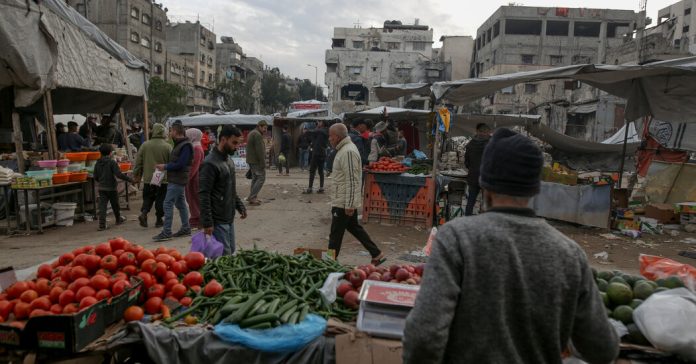
One day after Israel began halting the entry of all goods and humanitarian assistance into the Gaza Strip, Palestinians there are already feeling the effects of the sweeping measure, with prices of essential goods on the rise.

“It was a complete shock,” Iman Saber, a 24-year-old nurse from northern Gaza, said of Israel’s decision on Sunday to block aid and commercial shipments.

Already, said Ms. Saber, who has been living in a tent with her father, a cancer patient, and her mother and sister, prices for sugar, oil and chicken have gone up, and hopes raised by the cease-fire between Israel and Hamas have proved fleeting.

“We couldn’t wait for shops to reopen and prices to drop, to feel some relief,” Ms. Saber said in a phone interview. “But now everything is becoming expensive again.”

Israel’s halt on goods and aid, including fuel, was aimed at pressuring Hamas into accepting its new proposal for extending the cease-fire, which paused the war in Gaza after 15 months of fighting and has since expired. Hours before the border closure was announced, Israel proposed a seven-week extension during which Hamas would have to release half the remaining hostages seized during the Oct. 7, 2023, attack on Israel that set off the war.

The renewed aid blockade affected not just humanitarian aid, which is distributed free, but also commercial goods, and the effect on prices in the devastated enclave was almost immediate, Gazans said. The ban on shipments came as many were already struggling to observe the holy month of Ramadan, usually a festive time of fasting and worship.

“We were able to breathe for a bit and feel some hope again,” said Ms. Saber. “But now, we’re feeling depressed again,” she said.

The United Nations and several aid groups sounded the alarm over Israel’s decision to block the supply shipments.

“Humanitarian aid is not a bargaining chip for applying pressure on parties,” the aid group Oxfam said in a statement, calling Israel’s decision “a reckless act of collective punishment, explicitly prohibited under international humanitarian law.”

Doctors Without Borders, too, declared that “humanitarian aid should never be used as a tool of war. ” Doing so, it said, will “have devastating consequences” in Gaza, where it has “created uncertainty and fear, causing food prices to spike.”

The U.N. under secretary general for humanitarian affairs, Tom Fletcher, condemned Israel’s action. “International humanitarian law is clear: We must be allowed access to deliver vital lifesaving aid,” he said on Sunday. And Hamas itself denounced the Israeli move as “blackmail.”

Israeli officials have said that the government believes that the aid and goods that have entered Gaza in recent months and during the cease-fire meant there were enough supplies for several more months.

But in Israel, five nonprofit organizations filed a motion to the High Court of Justice calling for an interim order barring the government from cutting off the supply of aid to Gaza. Gisha, a human rights group leading the motion, argued that halting the provision of aid was illegal, even if, as Israel maintains, there is enough aid already there.

And even if food is available, it may now be even further out of reach for many Gazans.

“A kilogram of sugar was six shekels yesterday, but now, after Netanyahu said he will not allow anything to enter, its price has already risen to 10 shekels,” said one 30-year-old Palestinian, Amani Aata, who is from Beit Hanoun, in northern Gaza.

And it is not only sugar, Ms. Aata said in a voice message on Sunday. “Everything, everything will become expensive again,” she said.

Abdulrahman Mohammed, a 35-year-old father of four from Gaza City, said that the prices of fruits and vegetables were also on the rise, with a kilogram of tomatoes surging from eight to 20 shekels.

Mr. Mohammed said that some traders and merchants were also deliberately withholding goods from the market to sell later at inflated prices, exacerbating the financial strain on Gazans.

On Monday, the Gazan Interior Ministry urged people to report price increases in markets and shops, as well as any merchants who appeared to be trying to turn the situation to their advantage. A day earlier, the ministry said it would take “strict measures against anyone who raises prices.”

Police forces have also deployed to markets across the territory “to monitor the availability of basic goods at their current prices,” the ministry said.

The aid halt came after a dramatic surge in humanitarian supplies entering Gaza during the first phase of the cease-fire thatbrought temporary relief to the enclave amid warnings of a looming famine.

When the fighting was underway, fewer than 100 trucks a day were entering the enclave, and even those deliveries were at times suspended. Relief agencies accused Israel of overly restricting deliveries with stringent inspections and the closure of border crossings. Israel denied those claims.

Ameera Harouda contributed reporting from Doha, Qatar.

Trump tariffs on Canada and Mexico will go ahead, he says : NPR

0

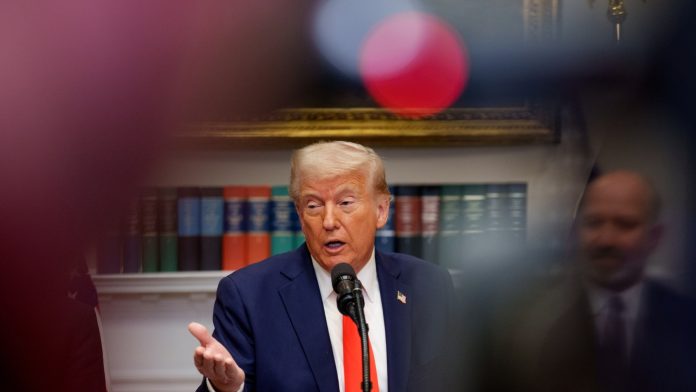
President Trump speaks in the Roosevelt Room of the White House on March 3, 2025 after announcing that Taiwan Semiconductor Manufacturing Company plans to invest $100 billion in new manufacturing facilities in the United States.

Andrew Harnik/Getty Images


hide caption

toggle caption

Andrew Harnik/Getty Images

President Trump on Monday declared that he would slap 25% tariffs on imported goods from Canada and Mexico starting on Tuesday, after weeks of speculation that the threat would be lifted or the rate lowered.

Trump said the tariffs would punish Canada and Mexico — partners in a trilateral trade agreement — for fentanyl trafficking. But he also said the move would encourage car manufacturers and other businesses to move their production to the United States.

“I would just say this to people in Canada or Mexico: if they’re going to build car plants, the people that are doing them are much better off building here, because we have the market where they sell the most,” Trump told reporters at the White House.

Trump is also set to add another 10% to tariffs on imports of Chinese goods, after initially applying tariffs of 10% last month.

The fate of Trump’s tariff threat has been up in the air for weeks

Trump’s tariff threats have weighed on markets, although there has been considerable uncertainty over whether he would go ahead with the 25% tariffs.

Trump had originally said the tariffs would begin on Feb. 1, but then gave leaders of the two countries a month to show they were curbing illegal immigration into the United States as well as drug trafficking.

Last week, he briefly said he would put off the tariffs until April 2 — then a day later, said that March 4 was the deadline.

During the weekend, Commerce Secretary Howard Lutnick said that the decision on the tariff rate was still up in the air, telling Fox News that the two nations had “done a reasonable job” curbing migration but not fentanyl.

“He’s sort of thinking about right now how exactly he wants to play it with Mexico and Canada, and that is a fluid situation,” Lutnick said on Sunday.

Trump said there was no wiggle room left for talks

During an event with Taiwan Semiconductor Manufacturing Co (TSMC) chief executive C.C. Wei at the White House on Monday, Trump said that the 25% tariffs would go ahead.

Asked whether there was any wiggle room for the two countries to negotiate the rate, Trump said: “No room left for Mexico or for Canada.”

“The tariffs, they’re all set, they take effect tomorrow,” he said.

Canada and Mexico have vowed to retaliate.

TSMC announced on Monday that it plans to spend $100 billion on semiconductor plants in Arizona, bringing the company’s total investments in the United States to about $165 billion.

Lutnick noted that TSMC had received a $6 billion grant from the CHIPS Act which spurred its plans to spend $65 billion on plants in Arizona — but is now spending $100 billion because of Trump’s threat to put tariffs on semiconductor imports.

Tuesday Briefing: Trump’s Tariffs Set to Take Effect

0

President Trump’s threats to impose stiff tariffs on goods imported from Canada, Mexico and China are expected to become a reality today. Trump said yesterday that there was no chance for a deal to avert them. Company executives and foreign officials scrambled to prepare.

The tariffs will add a 25 percent fee on all Mexican and Canadian exports coming across those borders and an additional 10 percent for Chinese goods. Canada was poised to retaliate, potentially setting off a trade war, and Mexico’s president, Claudia Sheinbaum, said: “Whatever the decision is, we will also make our decisions.”

Trump has described the tariffs as an effort to pressure those countries to stop the flows of migrants and deadly drugs. Howard Lutnick, the commerce secretary, said yesterday that Mexico and Canada had “done a nice job on the border” but that fentanyl deaths had not fallen enough.

China: The president’s threat to add another 10 percent on top of all existing Chinese tariffs has yet to get Beijing to come running with concessions.

President Volodymyr Zelensky went back to Ukraine yesterday after a whirlwind tour that included both humiliation, by President Trump, and a warm embrace, from European leaders. He vowed to use all available avenues to pursue an end to the war with Russia but acknowledged there was “a long way to go.”

Russia has given no indication that it will accept any terms other than full surrender and permanent conquest of a large part of Ukraine. Trump, who appears to be standing with Moscow, was expected to begin discussions on suspending or canceling U.S. military aid to Ukraine, according to an official.

Support: Britain and France have promised a “coalition of the willing” to secure a truce between Ukraine and Russia. But how many countries will step up, and does that even matter, given Russia’s rejection of such a coalition as part of any settlement?

Warfare: Drones now do most of the killing in the Ukraine war, causing about 70 percent of deaths and injuries, commanders say.


As cease-fire discussions continue between Israel and Hamas, the two sides are preparing for those efforts to fail and for the conflict to pick back up. Hamas is collecting unexploded bombs to make improvised explosive devices, recruiting new members and replacing commanders, according to a member of Hamas’s military wing. Israel has prepared extensively for a new, more intense campaign in Gaza, Israeli officials said.

Cuttlefish, masters of deception, use camouflage to quickly hide from predators, but they also use visual tricks to bamboozle prey. Researchers observed the cuttlefish in the wild convincingly imitating pale green leaves or the shapes of coral as they hunted. Their wide range of abilities could be a sign of a higher level of cognition.

Lives lived: Khalil Fong, a Hong Kong singer-songwriter who infused a soul and R&B sensibility into Chinese pop songs, died at 41.

There was plenty to take in during the Academy Awards on Sunday night, including a “Wicked” opener, Conan O’Brien gags and memorable speeches (good and bad). Sean Baker, the director of “Anora,” took home four statues. He tied the record set by Walt Disney in 1954, but even Disney didn’t pull off four Oscars on one night for the same movie.

That’s it for today. See you tomorrow. — Emmett

P.S. David Leonhardt, the anchor of The Morning newsletter, is taking on a new role as editorial director.

We welcome your feedback. Send us your suggestions at [email protected].

Consider This from NPR : NPR

0

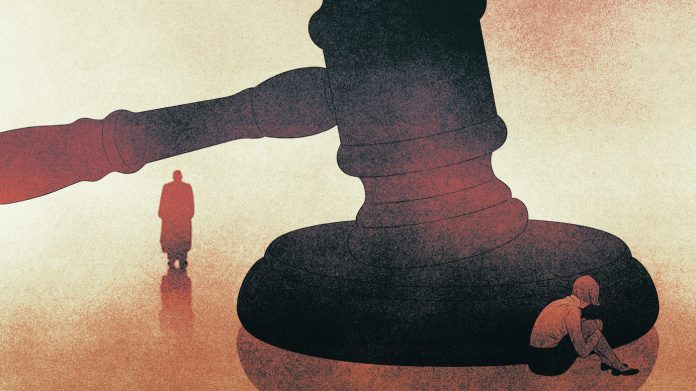
An NPR investigation finds federal judges have enormous influence with few checks on their power. Law clerks and other judicial employees are vulnerable to mistreatment and have few job protections.

Isabel Seliger for NPR


hide caption

toggle caption

Isabel Seliger for NPR


An NPR investigation finds federal judges have enormous influence with few checks on their power. Law clerks and other judicial employees are vulnerable to mistreatment and have few job protections.

Isabel Seliger for NPR

People who work for the federal court system don’t have the same kinds of job protections that most other Americans do.

A nearly year-long NPR investigation has found problems with the way the courts police sexual harassment and bullying…and a pervasive culture of fear about blowing the whistle.

A warning to our listeners, this piece contains a description of sexual assault.

For sponsor-free episodes of Consider This, sign up for Consider This+ via Apple Podcasts or at plus.npr.org.

Email us at [email protected].

This episode was produced by Monika Evstatieva and Elena Burnett. It was edited by Barrie Hardymon, Krishnadev Calamur, and Courtney Dorning.
Our executive producer is Sami Yenigun.