Friday, November 13, 2026
Home Blog Page 164

Pope Experiences Another Setback With Respiratory Crises

0

Pope Francis had two acute respiratory crises on Monday, the Vatican said, stoking further concerns about the health of the 88-year old pontiff, who has been hospitalized in Rome in serious condition for more than two weeks.

The pope has been undergoing treatment for double pneumonia and a complex infection in a Rome hospital, and his condition has been alternating between improvements and setbacks. On Friday, Francis suffered a bronchial spasm that caused him to inhale his vomit after a coughing fit.

The Vatican said that Monday’s episodes were caused by a significant accumulation of mucus in his bronchial tubes as a consequence of pneumonia. Doctors examined the inside of the pope’s lungs, and then suctioned abundant secretions of mucus from his airways, the Vatican said.

The Vatican said in a statement that “The Holy Father has remained consistently alert, oriented, and cooperative.”

The pope’s medical prognosis remained guarded, implying that he was not out of danger as he spent his 18th day at the Gemelli Hospital in Rome.

Jeffrey Millstein, an internal medicine professor at the University of Pennsylvania Perelman School of Medicine, said that such bronchial spasms are common in older people who don’t always have the muscular strength to expel accumulations of mucus.

“It sounds like he is struggling with the typical things that older, weaker folks struggle with when they have pneumonia,” he said.

Pope Francis was admitted to the hospital with bronchitis on Feb. 14, and later was diagnosed with pneumonia in both lungs. That raised particular concerns given his age and the fact that as a young man, Francis had part of a lung removed.

The pope has continued to do some light work during his stay at the hospital, including by signing off on the appointment of bishops and has moved five people along the path to canonization as saints, according to the daily bulletin on the Vatican website. On Monday morning the Vatican said he had been resting well.

Francis’s hospitalization has raised concerns about what happens if his health does not improve, and spurred speculation about the possibility of his resigning. Cardinal Pietro Parolin, the Vatican’s secretary of state, has dismissed such talk as “useless speculation.”

But news of the pope’s latest health crisis only heightened the concerns of many faithful.

“As a doctor, I am really worried,” said Gianluigi Radici, 60, a general practitioner from Bergamo, a city in northern Italy, as he walked in St. Peter’s Square with his family. They had come to Vatican City for the Jubilee, a holy year for Roman Catholics, Mr. Radici said.

“We really feel the pope’s absence,” he said.

Gina Kolata contributed reporting.
Rising Temperatures Are Scrambling the Base of the Ocean Food Web

0

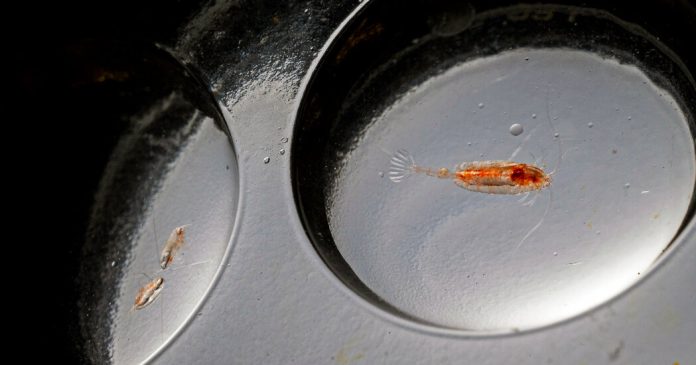
Humans are living in a plankton world. These minuscule organisms are spread across the oceans, covering nearly three-quarters of the planet, and are among the most abundant forms of life on Earth.

But a warming world is throwing plankton into disarray and threatening the entire marine food chain that is built on them.

A year ago, NASA launched a satellite that provided the most detailed view yet of the diversity and distribution of phytoplankton. Its insights should help scientists understand the changing dynamics of life in the ocean.

“Do you like breathing? Do you like eating? If your answer is yes for either of them, then you care about phytoplankton,” said Jeremy Werdell, the lead scientist for the satellite program, called PACE, which stands for “Plankton, Aerosol, Cloud, ocean Ecosystem.”

Historically, research from ships has captured limited snapshots in time, offering only glimpses of the ever-changing oceans. The advent of satellites gave a fuller picture, but one still limited, like looking through glasses with a green filter.

“You know it’s a garden, you know it’s pretty, you know it’s plants, but you don’t know which plants,” explained Ivona Cetinic, a NASA oceanographer. The PACE satellite effectively removes the filter and finally reveals all the colors of the garden, she said. “It’s like seeing all the flowers of the ocean.”

These flowers are phytoplankton, tiny aquatic algae and bacteria that photosynthesize to live directly off energy from the sun. They are eaten by zooplankton, the smallest animals of the ocean, which, in turn, feed fish and larger creatures.

Consider This from NPR : NPR

0

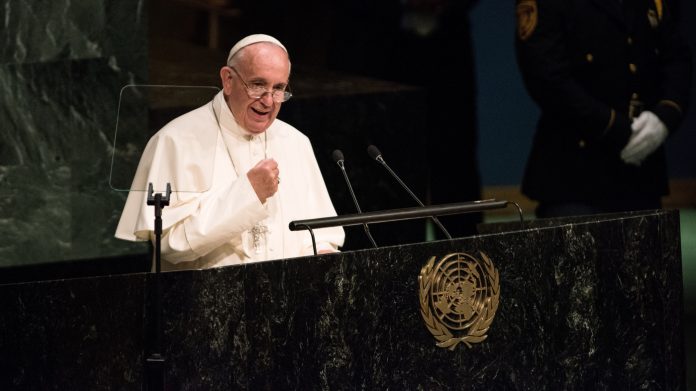
Pope Francis addresses the 70th session of the United Nations General Assembly on September 25, 2015 at United Nations Headquarters in New York City.

Andrew Renneisen/Getty Images


hide caption

toggle caption

Andrew Renneisen/Getty Images


Pope Francis addresses the 70th session of the United Nations General Assembly on September 25, 2015 at United Nations Headquarters in New York City.

Andrew Renneisen/Getty Images

Unlike any other religious leader around the world, the leader of the world’s one billion Catholics is also the leader of a sovereign nation. And Pope Francis hasn’t been shy about using that political power.

He’s pushed for an end to the wars between Hamas and Israel, and Russia and Ukraine.

And he’s repeatedly tried to point the world’s attention to two ongoing challenges: immigration and climate change.

Much of the world has spent the last two weeks focused on Pope Francis’ health. And the reason why has as much to do with the fact that he’s a powerful geopolitical force as it does with the fact he’s a key religious figure.

For sponsor-free episodes of Consider This, sign up for Consider This+ via Apple Podcasts or at plus.npr.org.

Email us at [email protected].

This episode was produced by Tyler Bartlam. It was edited by Courtney Dorning and Eric McDaniel.

Driver Arrested After Crashing Car Into Crowd in Germany

0

At least one person was killed and several others were injured when a car drove into a lunch-hour crowd in the southwestern German city of Mannheim.

Zelensky Turns to Diplomacy in a War With ‘a Long Way to Go’

0

President Volodymyr Zelensky returned to Ukraine on Monday after a whirlwind diplomatic mission that included both humiliation, by President Trump, and a warm embrace, from European leaders. He vowed to use all diplomatic avenues to pursue an end to Ukraine’s war with Russia, but acknowledged there was “a long way to go.”

Russia has given no indication that it will accept any terms other than Ukrainian capitulation and permanent conquest of a large swath of Ukraine — and Mr. Trump makes clearer by the day that his intent is to stand with Moscow.

Ukrainians have insisted they will not lay down their arms unless they receive security guarantees, supported by the United States, that would prevent the Kremlin from regrouping and attacking again.

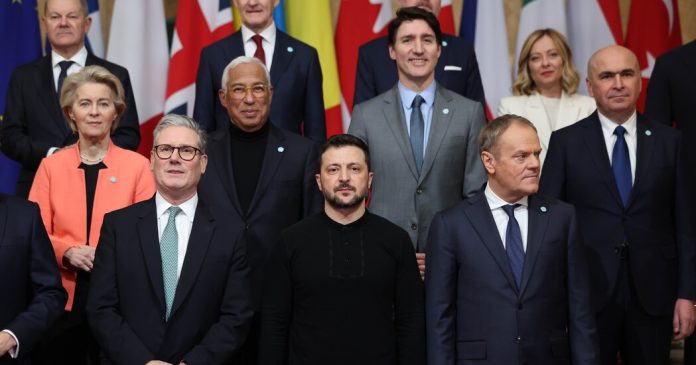
After a disastrous meeting with Mr. Trump on Friday, in which the American president and Vice President JD Vance berated him for being ungrateful, Mr. Zelensky received a show of support from Europe’s democracies on Sunday, who pledged to work with Ukraine to come up with a peace plan that it could then present to the United States.

Mr. Zelensky himself said American buy-in for a peace plan was important and seemed to go further in his efforts to smooth things over with the White House. “We are grateful for all the support we have received from the United States,” he said in his address to the nation Sunday night. “There hasn’t been a single day when we haven’t felt grateful.”

“There will be diplomacy for peace,” Mr. Zelensky said. “And for the sake of all of us standing together — Ukraine, the whole of Europe, and necessarily America.”

But the Ukrainian leader still faces a monumental challenge in repairing his relationship with Mr. Trump and his advisers, as the American president made clear in a scathing social media post Monday afternoon.

Seizing on Mr. Zelensky’s suggestion that the path to peace would be long and difficult, Mr. Trump wrote on Truth Social: “America will not put up with it for much longer!” He added: “It is what I was saying, this guy doesn’t want there to be Peace as long as he has America’s backing.”

Once again, Mr. Trump seemed to be placing the burden of ending the war on Ukraine while saying he believes President Vladimir V. Putin of Russia wants peace despite Moscow’s continuing aggression.

A day earlier, in a series of coordinated interviews on American television on Sunday, top Trump administration officials assailed the Ukrainian leader, often in remarkably personal terms.

National security adviser Mike Waltz compared him to “an ex-girlfriend that wants to argue everything that you said nine years ago, rather than moving the relationship forward.”

The new director of National Intelligence, Tulsi Gabbard, questioned whether Ukraine and the United States really share common values and extended her critique to European countries who rallied around Mr. Zelensky, saying, they “don’t stand with us around these fundamental values of freedom.”

When asked by the host of Fox News Sunday if Russia stood for the same values as Americans, she said “that’s not really what we’re talking about here.”

The Oval Office meeting fed into propaganda from the Kremlin, which added to the pile-on on Monday.

The meeting showed that “the Kyiv regime and Zelensky don’t want peace, they want continuation of the war,” the Kremlin spokesman, Dmitri S. Peskov, told reporters on Monday. His comments connoted a tightening bond between Moscow and Washington as they falsely portray Ukraine as the aggressor, unwilling to make peace. Attempts by Washington and Moscow “will clearly not be enough” to end the fighting, Mr. Peskov said. “An important element is missing.”

He implied that Russia could now push for a harder bargain than it did during the failed peace talks at the start of the war, given Russia’s military gains. “Since then, 2 ½ years later, the situation has changed,” Mr. Peskov said. “Only the blind can’t see that or the deaf not wanting to hear that.”

Mr. Zelensky sought to defend himself from being painted as the obstacle to peace — a criticism many Ukrainians find hard to understand given that their country that has been under fierce attack for three years.

Ukrainians almost universally want peace, just not peace at any cost. “We need peace, not endless war,” Mr. Zelensky said once again as he returned to Ukraine.

But bitter experience has Ukrainians worried that a cease-fire without security guarantees would only provide a brief respite for Russian forces to regroup and attack again. They point to the fact that Ukraine has been fighting Russia in the eastern Donbas region since 2014 and that Mr. Putin has violated multiple peace accords aimed at ending the violence there. The Russian leader also claimed he had no intention of mounting a broader invasion of Ukraine right up until his tanks rolled across the border three years ago.

Mr. Zelensky’s insistence on pushing for security guarantees was one of the things that apparently angered Mr. Trump.

As Mr. Zelensky now works with European leaders to come up with a peace plan, he said once again that there are some fundamental principals not open to negotiation.

“We need to proceed from the understanding of international law,” he said during a meeting with reporters in London. “We don’t want anything that doesn’t belong to us, but when you occupy something or when you break the law, everything will come back to you,” he said.

He emphasized that Ukraine will never recognize the occupied territories as Russian: “For us, this will be temporary occupations.”

Russia, he said, would need to take concrete actions before any deal.

“The cease-fire must begin with the exchange of prisoners and the return of children,” his office wrote in a statement. “This would be a step to demonstrate Russia’s genuine intent for peace.”

The International Criminal Court has issued an arrest warrant for Mr. Putin and accused him of war crimes, based on Russia’s abduction and deportation of thousands of Ukrainian children during the war.

The French have also suggested a staged process, perhaps with a truce regarding strikes on energy infrastructure by both sides.

For now, the fighting rages on as violently as ever.

Since Mr. Trump spoke with Mr. Putin two weeks ago, there has been no letup Russian attacks. Dozens of Ukrainian civilians have been killed in the past two weeks, according to Ukrainian officials, as Russia continues to launch nightly drone and missile attacks.

At the same time, Ukraine has kept up its campaign targeting Russian oil and gas refineries, hoping to deepen the economic pressure on Moscow.

In one attack, drones reportedly took aim at the Ufimsky refinery plant, more than 800 miles from the nearest Ukrainian-held territory. It was not possible to immediately assess the impact of the attack.

Hopeful that America’s turn against Kyiv could do for him what his military has failed to do, Mr. Putin has stuck to his maximalist goals in public comments in recent days.

Those include a desire to take control over wide swaths of land his forces do not yet occupy and which at the current pace of the Russian military’s creeping advances it would take many years to capture.

Anatoly Kurmanaev contributed reporting from Berlin.

What’s Behind Trump’s Love-Hate Relationship With Canada

0

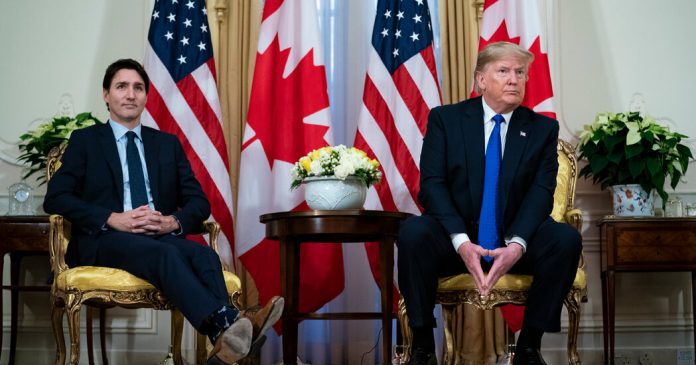
There is the theory that President Trump is still bitter about his Canadian hotel ventures that went bust.

Some, on social media, have speculated that a 2019 photograph in which Justin Trudeau appeared poised to kiss Melania Trump, the first lady, at a Group of 7 gathering in France, left Mr. Trump with a grudge against the dashing Canadian prime minister.

And then there is the transactional view, that Mr. Trump sees the acquisition of Canada as the 51st state as the ultimate real estate deal that would seal his presidential legacy.

As Mr. Trump prepares to push ahead with a new round of tariffs on the United States’ neighbors to the north and south, he has expressed a special brand of loathing for Canada. The bullying of a country whose most prominent stereotype is that its people are “nice” has led to political upheaval in Canada and created both consternation and speculation about why Mr. Trump wants to engage in a trade war with one of America’s biggest trading partners.

“I can’t quite figure it out,” said Stephen Moore, the Heritage Foundation economist and former adviser to Mr. Trump. “Whether it’s some kind of strategic leverage, I don’t know.”

Noting that there is “no love lost” between the president and Mr. Trudeau, Mr. Moore added: “With Trump, politics is personal.”

Mr. Trump has threatened to hit Mexico and Canada with 25 percent tariffs on all imports on Tuesday unless the countries do more to prevent migrants and drugs from flowing into the United States. On Saturday, the president picked another trade fight with Canada, this time over lumber.

Intrigue abounds in Canada about why Mr. Trump has repeatedly belittled a neighbor and threatened to destabilize its economy with tariffs, a process that has brought relations between the two countries to a low point not seen in decades.

In contrast to the close and supportive relationship that Mr. Trudeau, who is entering his final week in office, enjoyed with another U.S. president, Barack Obama, his relationship with Mr. Trump has been fractious.

In 2018, following the Group of 7 summit meeting in Charlevoix, Quebec, Mr. Trump heckled Mr. Trudeau on social media, accusing him of being “very dishonest and weak” and of making up “false statements” while suggesting that he might impose tariffs on Canadian-made autos.

While Mr. Trudeau was generally circumspect in his public remarks about Mr. Trump during the president’s first administration, the two men have dramatically different personal and political styles. Mr. Trump bombastically denigrates people he perceives as opponents, whereas Mr. Trudeau often speaks about the value of bringing people together, what he once called a “sunny ways” approach to political life.

In candid remarks to a group of business leaders last month that was captured by a microphone, Mr. Trudeau offered a theory for Mr. Trump’s Canada obsession that is widely shared in the country.

“Not only does the Trump administration know how many critical minerals we have, but that may be even why they keep talking about absorbing us and making us the 51st state,” Mr. Trudeau told the gathering in Toronto.

“They’re very aware of our resources,” Mr. Trudeau said, “of what we have, and they very much want to be able to benefit from those.”

He added: “But Mr. Trump has it in mind that one of the easiest ways of doing that is absorbing our country. And it is a real thing.”

Mr. Trump does have a particular affinity for minerals. He has been pushing to broker a deal to secure access to Ukraine’s supply of rare earths as he seeks to broker an agreement to end its war with Russia.

As a businessman, Mr. Trump had two dealings with Canada that, while relatively limited, were both failures. The Toronto hotel and condominium project, owned by a Toronto investor who licensed the Trump name and hired a Trump company to manage it, went into receivership in 2016. The following year, a hotel owned by Malaysian investors bearing the Trump name, again under license and with a similar management contract, opened in Vancouver, British Columbia. (Promotional material exaggerated the building’s height.) It failed, as well.

Both hotels, which now operate under different names and management, were magnets for protesters in a country where Mr. Trump has long been unpopular for his “America First” views and disparagement of Canada. Before the Vancouver opening, the city’s mayor at the time, Gregor Robertson, wrote to the building’s owners asking that they not use the Trump name on it.

“Trump’s name and brand have no more place on Vancouver’s skyline than his ignorant ideas have in the modern world,” Mr. Robertson wrote.

Before delving into politics, Mr. Trump expressed little ill will toward Canada.

In 2012, when the Obama administration was delaying a decision on approving the Keystone XL Pipeline, which would have transported oil from Canada to the United States, Mr. Trump declared on social media that the project must move forward.

“We need to use our resources and support allies like Canada,” Mr. Trump said.

But by 2015, his perceived failings of the North American Free Trade Agreement between the United States, Canada and Mexico became a central issue of Mr. Trump’s first presidential campaign. Mr. Trump routinely called the deal a “disaster” for American workers, and prioritized scrapping the pact as a first order of business if he won the election.

An agreement to overhaul the trade deal was signed in 2020 after fraught negotiations between the three countries that often grew contentious. At one point, Mr. Trump suggested leaving Canada on the sidelines and proceeding with a deal between the United States and Mexico.

Now back in office, Mr. Trump has made clear that the agreement he signed did not do enough for the United States and must be rewritten. In recent days he has lashed out at Chrystia Freeland, the Canadian official who negotiated it on behalf of Canada.

“She’s a whack,” Mr. Trump said of Ms. Freeland, who was Canada’s deputy prime minister and finance minister during the president’s first term, in an interview with The Spectator.

As Mr. Trump has wielded the threat of new tariffs on Canada over the last month, his tone toward the departing prime minister has been even more derisive. He has nicknamed Mr. Trudeau “governor” amid persistent suggestions that the United States might annex Canada.

Mr. Trump even called for the former Canadian hockey player Wayne Gretzky to run for prime minister, suggesting late last year that he would “win easily.” Mr. Gretzky, who does not support Canada’s joining the United States, has faced backlash at home from citizens who view him as a traitor because of his association with Mr. Trump.

The insults have led to a boom in nationalism in Canada, including “Made in Canada” Facebook groups. In one group, which has more than a million members, Canadians compared notes on pancake mixes that are made in Canada and offered recommendations on flavors of Cove Soda, a potential alternative to Coca-Cola.

“There’s a generalized sense of patriotism that has not been evident in Canada in many years in response to Trump and Trump’s hostility,” said Ira Wells, a professor at the University of Toronto’s Victoria College.

But Mr. Trump appears unfazed by Canada’s declarations of independence. He indicated last week that the United States was also prepared to sever ties with Canada without changes to the trade relationship between the two countries.

The United States, Mr. Trump said, has no need for Canadian products such as lumber, and he asserted that Canada could not survive without American military protection and favorable trade terms.

“I love Canada, I love the people of Canada,” Mr. Trump said at a cabinet meeting at the White House. “It’s not fair for us to be supporting Canada — If we don’t support them, they don’t subsist as a nation.”

At Least One Killed After Car Drives Into Crowd in Germany

0

One person was killed and several others injured when a man drove a car into a lunch-hour crowd in the southwestern German city of Mannheim, the police said on Monday.

The police said the driver had been arrested, and that they were investigating whether other perpetrators had been involved.

Details about the driver were not released. The police did not say whether they believed the crash was deliberate, and they asked people to refrain from sharing video of the incident and the subsequent investigation on social media. The police did not say how many people had been injured.

The authorities asked people to avoid the city center on Monday.

There have been several recent attacks with vehicles in Germany. Two weeks ago, a 24-year-old Afghan man who was seeking asylum intentionally drove into a union demonstration in Munich, killing a 2-year-old and her mother and wounding several dozen others.

And in December, a Saudi doctor who had been living in Germany for more than a decade was suspected of having driven his car into a Christmas market in the central city of Magdeburg, killing six people and injuring hundreds of others.

In Mannheim, the driver reportedly entered a pedestrian-only stretch of the city center from its landmark water tower and drove roughly 700 yards toward the square known as Paradeplatz. The incident occurred at about 12:15 p.m., according to the police, when lunchtime crowds were enjoying unseasonably warm weather.

Detached pieces of the car could be seen along the vehicle’s path, media reports.

A day earlier, a parade with 70 floats and 2,500 participants passed through the same zone in an annual carnival celebration. The police said about 250,000 people had attended.

Mannheim, which has a population of about 320,000, was in the headlines last year when an Afghan citizen living in Germany stabbed people at a far-right demonstration, killing a police officer who had rushed in to stop the attack.

On Mexico’s Once-Packed Border, Few Migrants Remain

0

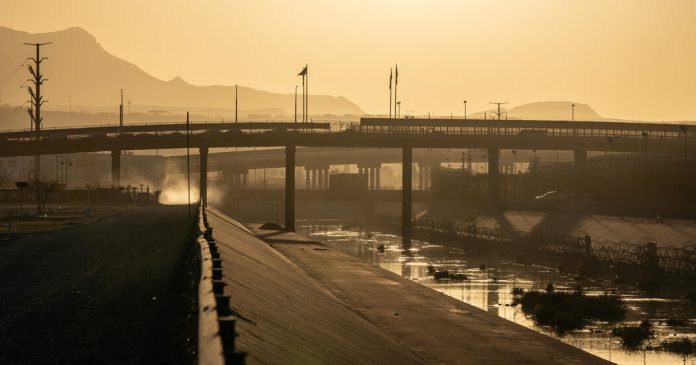
On the eve of President Trump’s deadline to impose tariffs on Mexico, one thing is hard to miss on the Mexican side of the border: The migrants are gone.

In what were once some of the busiest sections along the border — Ciudad Juárez, Tijuana, Matamoros — shelters that used to overflow now hold just a few families. The parks, hotels and vacant buildings that once teemed with people from all over the world stand empty.

And on the border itself, where migrants once slept in camps within feet of the 30-foot wall, only dust-caked clothes and shoes, rolled-up toothpaste tubes and water bottles remain.

“All that is over,” said the Rev. William Morton, a missionary at a Ciudad Juárez cathedral that serves migrants free meals. “Nobody can cross.”

Last week, the U.S. Department of Homeland Security secretary, Kristi Noem, announced that Customs and Border Protection had apprehended only 200 people at the southern border the Saturday before — the lowest single-day number in over 15 years.

Mr. Trump has credited his crackdown on illegal immigration for the plunging numbers, even as he has also announced he will send thousands more combat forces to the border to stop what he calls an invasion.

But according to analysts, Mexico’s own moves to restrict migration in the last year — not just at the border but throughout the country — have yielded undeniable results. In February, the Trump administration said it would pause for a month the imposition of 25-percent tariffs on Mexican exports, challenging the government to further reduce migration and the flow of fentanyl across the border.

That progress has put Mexico in a far stronger negotiating position than when Mr. Trump first threatened tariffs, during his first term.

“Mexico has new leverage compared to 2019,” Ariel G. Ruiz Soto and Andrew Selee, analysts with the Migration Policy institute, a nonpartisan think tank, wrote in a report. Mexico’s cooperation, they said, has made it “indispensable” to the United States.

In recent years, the Mexican government has significantly stepped up checks on migration. It has established checkpoints along migrant routes, imposed visa restrictions, dispersed migrant caravans and bused people who arrived from places like Venezuela to remote corners of southern Mexico to stop them from reaching the U.S. border. All of that has vastly reduced the number of migrants at the border.

Since last spring, the Mexican authorities have been apprehending more people than their American counterparts every month. Now, the numbers at the border have fallen to almost nothing.

“We no longer have major flows of people coming — they have declined by 90 percent,” Enrique Serrano Escobar, who leads the Chihuahua State office responsible for migrants, in Juárez, said last week.

And those migrants who do make it to the border are no longer trying to enter the United States, shelter operators say.

“They know they can’t cross,” said Father Morton, in Juárez. “All the holes underground, the tunnels, the holes in the wall, they’ve virtually sealed it — it’s much, much more difficult.”

In Mexican border cities, the scene at migrant shelters is much the same: tables sitting empty at meal time, bunk beds, unused.

Even before Mr. Trump took office, the number of people apprehended trying to cross the border had been dramatically dropping, according to U.S. government data.

Many of those waiting in border cities had appointments through CBP One, an application that allowed people to make asylum appointments with the authorities rather than to cross the border, shelter operators say.

After Mr. Trump canceled the app on his first day in office, people gave up after a few days and headed south to Mexico City or even for the southern border, said the Rev. Juan Fierro, a pastor at the Good Samaritan shelter in Ciudad Juárez.

At a once-crammed shelter in Matamoros whose name translates to Helping Them Triumph, only a handful of Venezuelan women and their children remain, according to its directors.

In Tijuana, at a shelter complex within view of the border wall, the Foundation Youth Movement 2000, which once held hundreds of people of all nationalities, there are now just 55, according to its director, José María Lara.

They are the same people who have been there since Mr. Trump’s inauguration.

“There have been the same number” Mr. Lara said. They include people from Venezuela, Honduras, Nicaragua, El Salvador, Colombia and Guatemala, as well as Mexican migrants from states considered dangerous to return to, such as Michoacán.

There are no figures available for how many migrants like these may be living in the border’s shelters, hotels and rented rooms, and biding their time.

.

“We are going to wait to see if God touches Mr. Trump’s heart,” said a 26-year-old woman from Venezuela, who asked to be identified only by her first name, Maria Elena, as she sat eating with her 7-year-old son at the cathedral in Ciudad Juárez.

In response to Mr. Trump’s demands last month, Mexico’s president, Claudia Sheinbaum, dispatched 10,000 national guardsmen to the border and sent hundreds more troops to Sinaloa state, a major fentanyl trafficking hub.

Officials and those who work with migrants are split on whether the troops, several hundred of which began to appear in and around every border city over the last month, have had an effect on illegal border crossings.

At the end of the border wall between Tijuana and San Diego, Calif., the National Guard has set up large tents on the Mexican side, in an area called Nido de las Águilas. About 15 miles from downtown Tijuana, it has long been used by coyotes, the smugglers who take advantage of the steep hills and lack of police presence to lead migrants into California, the authorities say.

The guard has also placed checkpoints at spots up and down the border.

In Tijuana, José Moreno Mena, a spokesman for the Coalition for the Defense of Migrants, said that the presence of the guard has been a major deterrent to migration, along with Mr. Trump’s promised mass deportations in the United States.

“This doesn’t mean that they won’t keep coming,” Mr. Moreno said. “It’s just a pause, perhaps, until they see better conditions.”

But in the state of Tamaulipas, where more than 700 guardsman arrived last month in places like Matamoros, the guardsman do not appear to be curbing migration, residents say. They seem to be concentrated on the bridge into the United States, while migrants are now seeking to enter through the desert or other rural areas.

In Ciudad Juárez, where hundreds of guardsman were also dispatched in early February, the troops and military personnel have been stopping cars to inspect them, and searching for border tunnels.

“They have inspection spots at night, in the street,” Father Morton said. “There are more here, ostensibly to stop the fentanyl, but I doubt they know where it is.” He said they mainly stopped young men who were driving souped-up cars or had tattoos, creating an environment of “low intensity conflict.”

The real work of curbing migration has been happening far from Mexico’s northern border.

At the southernmost point in Mexico, in Tapachula, few migrants are entering. Shelters that recently housed 1,000 people now serve just a hundred or so, according to operators. Waiting for visas that allow them to head north, and dispersed if they try to form caravans, these migrants are all but blocked.

Many are weighing their options. Some have even asked the Mexican government to deport them on flights back to their country.

The migrants who now sit on the U.S. border are generally those who come from places they cannot return to.

“They can’t go back,” said the Rev. Francisco González, president of a network of shelters in Juarez called We Are One for Juarez.

While his 12 shelters housed only 440 people last week after often being filled to their capacity of 1,200 in recent years, the people who are arriving are staying longer, he said.

Some are starting to fill out forms to gain asylum in Mexico, fearing they could be caught and deported if they have no legal status, Mr. González said.

“We still have faith and hope that at some point Trump will recover from his insanity,” said Jordan García, a former mining worker from Venezuela who said he and his wife and three daughters had spent seven months making the journey to Ciudad Juárez.

Mr. García carried his infant, Reina Kataleya, through the dangerous jungle pass known as the Darién Gap when she was seven months old. Now the family’s makeshift home consists of a bunk bed in one of Mr. González’s shelters on the outskirts of Ciudad Juárez, draped in plush blankets for privacy.

But shelters at the border have started to shut down. In Ciudad Juárez, 34 were open in November; by last month, that number had dropped to 29. Shelter operators say that not only are there significantly fewer arrivals but that they are losing backing from international groups such as the U.N. International Office for Migration, and UNICEF, which relied on foreign aid frozen under Mr. Trump.

Before the new American administration, “there were more people, and there was more support,” said Olivia Santiago Rentería, a volunteer at one of the shelters run by We Are One for Juarez. “Now,” she said, “everyone here is living with that uncertainty.”

Reporting was contributed by Rocío Gallegos from Ciudad Juárez, Mexico; Aline Corpusfrom Tijuana; Enrique Lerma from Matamoros; and Lucía Trejo from Tapachula.

How Trump’s Canada Tariffs Could Impact Both the U.S. and Canada

0

It is not an exit anyone would have expected. Justin Trudeau will end his final days as Canada’s prime minister with the country tossed into economic turmoil if President Trump follows through on his plan Tuesday to impose 25 percent tariffs on Canadian exports.

While Canadian officials have spent much of last week in Washington trying to fend off the president’s tariffs, which will also apply to Mexico, those efforts have so far been futile. If tariffs do go into effect, Canada is poised to retaliate, setting off a trade war.

Mr. Trump has offered various rationales for the tariffs, which were supposed to go into effect at the beginning of February but were suspended for 30 days. He says the United States has been destabilized by large numbers of unauthorized migrants, as well as large quantities of fentanyl, crossing the border from Canada and Mexico. U.S. government statistics do not support either claim.

Mr. Trump has also claimed that Americans “subsidize Canada” by providing hundreds of billions of dollars a year — though he has not provided any evidence — and has urged companies to move their plants out of Canada to the United States. Mr. Trump has complained about Canada’s trade surplus with the United States, which is mostly driven by oil and gas exports and totaled $63 billion last year.

Whatever the reason, there is widespread consensus in Canada that tariffs would inflict major damage on the country’s economy, which is dependent on exports as well as industries that are tightly integrated with the American market.

Jean Simard, the president of the Aluminium Association of Canada, recalled the effect of a 10 percent U.S. tariff on Canadian aluminum exports during the first Trump administration.

“The 10 percent tariffs years ago were highly disruptive,” Mr. Simard said. “Twenty-five percent tariffs will be highly destructive.”

Just 19 kilograms of fentanyl were intercepted last year at the Canada-U.S. border, compared with almost 9,600 kilograms at the border with Mexico, according to U.S. Customs and Border Protection. And an investigation by The Globe and Mail, a newspaper in Toronto, found that the Canadian figure was inflated by the inclusion of seizures that were not related to the border.

U.S. authorities last year arrested roughly 24,000 people crossing illegally from Canada into the United States, compared with more than two million people who were apprehended at the southern border.

Still, Mr. Trudeau’s government moved swiftly to placate Mr. Trump’s concern about both issues by investing 1.3 billion Canadian dollars (about $900 million) on a series of measures to fortify the border.

They included the appointment of a “fentanyl czar,” providing the Royal Canadian Mounted Police with two Black Hawk helicopters to monitor the 5,525-mile-long border, assigning a large number of its officers to border patrol and purchasing of a variety of electronic surveillance devices, including drones.

The increased border security has led to the apprehension of a small number of people entering Canada from the United States.

While Mr. Trump said last week that he had seen improvement at both borders on migration, he added that he was not satisfied with how Canada and Mexico handled fentanyl smuggling.

While Mr. Trump insists that Canadian exporters will cover the cost of the tariffs, the levies would have to be paid by American importers. It is unclear if they would be able to recover the cost from Canadian firms.

The result, an overwhelming majority of economists agree, would be inflation and supply disruption in the United States, while Canadian industries could face large-scale layoffs.

Mr. Simard said that just the threat of the tariffs had already significantly raised the cost of aluminum in North America. If the tariffs go into effect, he estimates, the resulting aluminum price increases will add about $3,000 to the cost of making a Ford F-150 pickup truck.

Automotive trade between the two countries is roughly equivalent, and many auto parts cross the border several times before winding up in an assembled vehicle.

Because 25 percent is far higher than the profit margins on cars and trucks, as well as the parts used to make them, industry executives predict that parts makers would soon stop shipping and factories would quickly close in all three countries, laying off thousands of workers.

“A 25 percent tariff across the Mexico and Canadian border will blow a hole in the U.S. industry that we have never seen,” Jim Farley, the chief executive of the Ford Motor Company, said last month.

American farmers would also face increased prices for potash, a vital fertilizer. About 80 percent of potash in the United States comes from Canada because of limited U.S. reserves.

Mr. Trump has repeatedly suggested that the easiest way for Canada to avoid tariffs is to become the 51st U.S. state. His call for Canada’s annexation, as well as his repeated denigration of it as a viable nation, has infuriated many Canadians. That’s already led to calls to boycott American goods, caused Canadians to cancel U.S. vacations and rekindled affection for the maple leaf flag.

Mr. Trudeau has promised that Canada is prepared to respond with tariffs on U.S. imports. It would initially target 30 billion Canadian dollars’ worth of products, including Kentucky bourbon, from Republican states whose elected officials might have sway with Mr. Trump.

There have been proposals to cut off shipments of oil, gas and electricity to the United States or impose steep export taxes on those products.

While the tariffs are a clear violation of the free trade deal among Canada, Mexico and the United States that Mr. Trump renegotiated during his first administration, using its dispute-settlement system to strike levies down could take years. Nor is it clear that Mr. Trump would accept any ruling against the United States.

Canada also faces a global 25 percent tariff Mr. Trump has promised to apply on steel and aluminum. Canada is the largest foreign supplier of both materials to the United States, and Mr. Trump has suggested that those tariffs will be stacked on top of the 25 percent tariff he has promised will come on Tuesday.

He has also talked about creating specific tariffs against automobiles and copper.

And next month, Mr. Trump plans to introduce a worldwide reciprocity-based tariff system. It would set tariffs based on other countries’ policies that affect trade with the United States, such as tariffs, taxes and subsidies. These were the terms of the trading relationship between Canada and the United States in the 19th and early 20th centuries.

The potential effect on Canada is unclear. Because of the free-trade agreement between the three countries, Canada charges relatively few tariffs on American goods, so reciprocal tariffs from Washington would be similarly limited. The tariffs Canada does impose are mostly on dairy, poultry and eggs.

NY Gov. Kathy Hochul discusses President Trump's interventions in state politics

0

NPR’s Michel Martin speaks with Democratic New York Gov. Kathy Hochul about President Trump’s interventions in state politics.