Wednesday, November 11, 2026
Home Blog Page 17

Economists warn research cuts could have dire consequences : NPR

0

The International Space Station serves as an orbiting scientific laboratory where astronauts conduct experiments. The Trump administration has proposed cutting its budget by roughly $500 million and reducing research at the outpost.

AP/Roscosmos Space Agency Press Service


hide caption

toggle caption

AP/Roscosmos Space Agency Press Service

When Casey Dreier saw President Trump’s proposed budget for NASA, he couldn’t believe the numbers.

“This is the worst NASA budget I’ve seen in my lifetime,” says Dreier, the chief of space policy for the Planetary Society, a nonprofit that advocates for space exploration.

The budget proposes deep cuts for NASA’s Science Mission Directorate, which oversees everything from telescopes peering deep into space to robotic probes exploring planets like Mars. Many of these projects cost billions of dollars to build and launch, but the budget cuts are so deep “that it will require NASA to turn off active spacecraft that are producing good science for pennies on the dollar for what the U.S. taxpayer paid for them,” Dreier says.

It’s not just spacecraft — Trump’s proposed budget for the federal government would switch off huge swaths of America’s scientific enterprise. The National Science Foundation (NSF) would be slashed in half. The National Institutes of Health would lose $17 billion in funding. Other agencies like the Energy Department, the U.S. Geological Survey and the National Oceanic and Atmospheric Administration would all see deep cuts totaling billions of dollars.

These proposals “would be catastrophic if they were implemented,” says Sudip Parikh, the CEO of the American Association for the Advancement of Science. If the Republican-controlled Congress follows Trump’s budget outline, Parikh warns, it will slash science at every university and laboratory in the United States.

“It hollows out science across the country, not just in the places that I know the administration sometimes likes to single out, but across the entire country,” he says.

This photo shows the aurora australis glowing lime green in the starry dark sky near the South Pole Atmospheric Research Observatory in Antarctica. Snow covers the two-story lab and the surrounding ground.

The aurora australis glows near the South Pole Atmospheric Research Observatory in Antarctica. The lab is operated by staff from the National Oceanic and Atmospheric Administration in conjunction with the National Science Foundation. Both agencies are facing deep cuts to research.

Patrick Cullis/AP/NOAA


hide caption

toggle caption

Patrick Cullis/AP/NOAA

Long-term losses

So far, much of the focus of Trump’s economic policy has been on tariffs. The president has said that they could raise the prices of some items, causing short-term pain.

But some economists warn that his dismal budget for research, unveiled last week as part of a larger plan, also carries long-term risks.

That’s because fundamental science underpins America’s economic growth, according to Andrew Fieldhouse, an economist at Texas A&M University who studies R&D’s effect on the economy.

“In dollar terms, the economic returns are really, really high,” he says. Since World War II, “government R&D investments are pretty consistently driving about 20 to 25 percent of all U.S. private-sector productivity growth.”

Consider NSF grant 8107494. It was given to a scientist named John J. Hopfield in 1981 for the theoretical study of biological molecules and processes. The grant was worth just under $300,000 back then (a hair beneath a million dollars today), and it funded Hopfield’s work on an obscure topic: artificial neural networks. That science now underpins the multibillion-dollar AI revolution powering the tech economy. It also won Hopfield a Nobel Prize in physics last year.

Some economists believe the private sector could have done the same thing. Richard Stern, who directs economic and budget policy studies at the conservative Heritage Foundation, believes that industry should be funding most of the basic research in the United States.

“I think getting the federal money out of this — making these labs sing for their supper and get money from private entities that want to research things that are practical for people — I think is the better way to stimulate growth by far,” he says.

However, even Stern says these cuts to scientific research wouldn’t be a priority for him.

“If I was rank-ordering government spending to get rid of, this would not be at the top of the list,” he says.

And many other economists say industry can never replace the government as a funder of basic research.

“Very often, the private sector ends up underinvesting in these fundamental basic research areas,” says Vasudeva Ramaswamy, an economist at American University.

The knowledge generated is too general, and the economic payoff too distant, he says.

The president’s proposed cuts are just that — proposals. It’s Congress that actually sets the budget. But if lawmakers choose to follow Trump’s budget outline, Ramaswamy projects that America’s future gross domestic product could be more than 4% smaller as a result of these cuts. That’s roughly the size of the contraction experienced during the Great Recession, which lasted from December 2007 to June 2009 and was the country’s longest recession since World War II.

Ultimately, he says, these cuts could end up costing the government itself a lot of money.

“The economy tomorrow is going to be smaller because you decided to cut that funding today,” he says. “And if your economy tomorrow is smaller, you’re going to be raising less in taxes.”

States enact new restrictions on citizen-led ballot measures : NPR

0

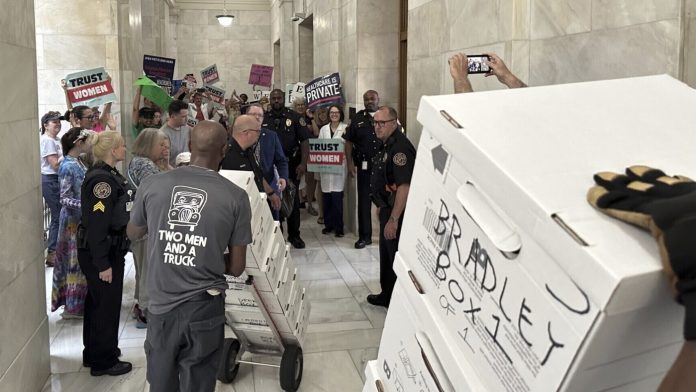
Boxes containing signatures supporting a proposed ballot measure to scale back Arkansas’ abortion ban are delivered to the state Capitol in Little Rock, Ark., on July 5, 2024. Arkansas lawmakers this year passed new restrictions on citizen-led ballot measures.

Andrew DeMillo/AP


hide caption

toggle caption

Andrew DeMillo/AP

Mark Johnson, a Republican state senator in Arkansas, was attending a festival in his district last year when he came across people gathering signatures for a proposed ballot measure that would protect abortion rights in the state.

“They said this was about women’s health,” he recalled. “And I said, ‘Oh, really?’ … They didn’t make clear what it was. I knew exactly what it was because I had read it very carefully.”

The abortion measure ultimately didn’t make the ballot, but this year, Johnson and others in the state’s Republican-led legislature passed a bill requiring that the title of a proposed ballot measure be read in full and out loud by either the petition-signer or the signature-gatherer.

The bill was one of several passed in Arkansas creating new rules for efforts to get measures on the state ballot. The rules also require petition-signers to show a photo ID and confirm that they know fraud is a crime. And if they sign without doing any of this, the person collecting signatures could be charged with a crime.

Two dozen states allow citizens to propose ballot measures, and Republican lawmakers in Arkansas and other states are now passing new restrictions that they say will combat fraud in the process.

But opponents say these laws strip voters of a realistic way to address issues that their lawmakers won’t address.

“It’s really a problem, you know, in terms of time, ability to recruit folks to be canvassers, getting folks to sign petitions, getting as many people as you can to sign,” said Bonnie Miller, president of the League of Women Voters of Arkansas. “This is one of the biggest, the most egregious, laws that they passed.”

Miller’s group is suing state election officials over the ballot title-reading requirements, which they say are unconstitutional. She said her group is worried they will create “a chilling effect.”

“Because who is going to go canvass with these rules?” she said. “And then it has a chilling effect on the folks who are willing to sign these petitions, because who wants to stand around and listen to that? And also, it’s very possible that you may be talking to somebody who has already read the ballot title on their own at home or is very familiar with the subject.”

Miller said she thinks Republicans are afraid that an effort to put a pro-abortion rights measure on the ballot could come back, since advocates got very close last time.

Johnson, however, said this is not about preventing voters from getting measures on the ballot.

“We don’t want to take away their rights, but we want to protect them from special interests that will abuse the process and confuse them,” he said.

Kelly Hall — the executive director of the Fairness Project, a group that works to pass economic and social justice policies through ballot measures — said she’s seen more state bills to limit citizen-initiated ballot measures this year than ever before.

“This is an absolute high watermark for the number of attacks on citizen-initiated ballot measures that we’ve ever seen,” she said. “It doesn’t mean it’s brand new this year, but it is in much more full force, and that’s showing up in a few different ways.”

While states like Arkansas are creating new restrictions for groups that gather signatures, Hall points out that others are trying to increase the threshold for a measure to pass, to 60%.

Florida already has this higher threshold. Last year a clear majority of Florida voters — 57% — supported a measure protecting abortions in the state, but it didn’t pass because of this threshold.

“It’s already really difficult to even get a measure on the ballot and then it’s difficult to pass it once it’s on the ballot,” said Letitia Harmon, director of policy and research for a social justice advocacy group called Florida Rising. “And yet they have made attacks on ballot initiatives, the governor has made attacks on ballot initiatives, one of his highest policy priorities.”

Florida Gov. Ron DeSantis speaks out against a proposed amendment to protect access to abortion during a news conference on Oct. 21, 2024, in Coral Gables, Fla. DeSantis has signed new restrictions on the ballot measure process.

Florida Gov. Ron DeSantis speaks out against a proposed amendment to protect access to abortion during a news conference on Oct. 21, 2024, in Coral Gables, Fla. DeSantis has signed new restrictions on the ballot measure process.

Lynne Sladky/AP


hide caption

toggle caption

Lynne Sladky/AP

Last week, Florida Gov. Ron DeSantis signed House Bill 1205 that he said will “combat petition fraud and prevent the special interest-abuse of our constitutional amendment process.” It’s already drawn a legal challenge.

The bill requires people to show ID before signing a petition, like the law Arkansas just enacted. It also prohibits people from gathering more than 25 signatures beyond their own and those belonging to their immediate family. If a person collects more than that number, they could face criminal penalties.

Like DeSantis, Florida Republican state Sen. Jennifer Bradley said the measure’s purpose is to combat fraud.

“This is not a bill to restrict,” Bradley said during debate over the legislation. “It is a bill to protect to make sure that our constitutional system is one of integrity and that it’s free of fraud.”

Fraud among signature-gatherers is not a new or isolated problem in elections. Many of the issues, experts have said, are among paid gatherers; some states also allow gatherers to be paid per signature and not by the hour, which experts say contributes to higher rates of fraud.

But advocates say there are ways to address fraud without making it harder for voters to get issues on the ballot.

“There are already laws and provisions in place that make fraud a crime,” Harmon said.

State officials who investigate and prosecute election crimes in Florida have been arresting paid signature-gatherers in recent years. They asked legislators to make the rules tougher, though.

Harmon said many of the claims of fraud that leaders in Florida have pointed to are typical human error that now will be criminally penalized.

The Fairness Project’s Hall says she sees these laws as a broader failing of the relationship between representatives and their voters.

“Direct democracy should be an opportunity for voters to speak to their politicians,” she said. “‘This is really what we want. You should listen to us.’ … And instead, not only are we not taking up these issues, we’re going to make it harder for our voters to take them up themselves.”

Once-fringe activists are fighting to be the voice of the anti-abortion movement : NPR

0

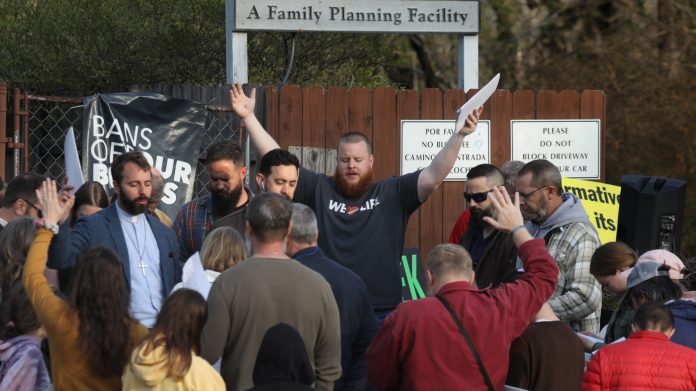
Anti-abortion activists pray and protest in front of the Greenville Women’s Clinic in Greenville, S.C., in March.

Jim Urquhart for NPR


hide caption

toggle caption

Jim Urquhart for NPR

On a chilly March morning, Jason Storms stood on a patch of lawn across from a women’s health clinic in Greenville, S.C. It’s one of three clinics in that state that perform abortions. Dozens of other anti-abortion rights activists joined him, from Wisconsin, Florida and Mississippi.

Storms had convened the group there for a conference to highlight what he felt to be the failures of the anti-abortion movement since Roe v. Wade was overturned. He said there should be no excuse for abortions still happening in a deep red, Bible Belt state like South Carolina.

“We’re thankful for the overturning of Roe, but that certainly did not translate into massive criminalization of abortion across the country,” said Storms.

Storms is national director of the militant anti-abortion rights group called Operation Save America (OSA). It’s a rebrand of the national Operation Rescue that staged huge blockades of women’s health clinics in the ’80s and ’90s. With its denunciation of women who obtain abortions as “murderers,” the movement once represented the fringe of the anti-abortion movement. But since Roe fell, some Republican legislators have shown a new openness to its policy prescriptions. Storms is working to persuade more.

Anti-abortion activist Jason Storms of Operation Save America organized a protest in front of the Greenville Women's Clinic in Greenville, South Carolina, March 14, 2025. Jim Urquhart for NPR

Jason Storms is national director of Operation Save America, a militant anti-abortion group, who organized a protest in front of the Greenville Women’s Clinic.

Jim Urquhart for NPR


hide caption

toggle caption

Jim Urquhart for NPR

“What it’s done is it’s lifted the fog off the battlefield,” said Storms. “People can now see … the excuses that were being made by a lot of Republicans and professing pro-lifers that ‘we can’t do anything, our hands are tied, Roe won’t let us do anything.’ That excuse is gone … and it’s made it easier for people to see a lot of what we had previously been saying, that a lot of these guys are fake pro-lifers, they’re pro-life frauds.”

Storms and aligned activists call themselves “abortion abolitionists,” and they are working on multiple fronts. At statehouses, they are lobbying legislators to support hardline anti-abortion bills. At least 14 states saw bills filed during the current or most recent sessions that would establish fertilized eggs as full legal persons, and classify abortion as homicide. At the same time, they are leveraging the cultural zeitgeist around questions of gender — specifically, heightened discussion over the state of manhood in America — to broaden grassroots appeal.

“I think that right now they see this tremendous opportunity for them,” said Jessica Valenti, author of Abortion: Our Bodies, Their Lies, and the Truths We Use to Win. “They see this as a moment in time where the anti-abortion movement could go one way or the other.”

The movement has sparked a fight within the right

Since Roe ended, those within this movement have argued that criminal punishment for people who get abortions has only become more necessary. In the immediate aftermath, one in three women was left without access to elective abortions and dozens of clinics closed. Despite that, estimates of abortion in the U.S. increased. Self-described abortion abolitionists believe self-managed abortion, by pill, is to blame. Storms says that even the most restrictive abortion bans in states like Texas, Idaho and Oklahoma are falling short.

“What all these laws have done is, if the doctor would perform an abortion, the doctor could face felony charges in most of these states,” said Storms. “But the mother’s granted complete and total legal immunity.”

Storms believes the threat of harsh penalties for mothers could close this “loophole,” as he calls it. He and aligned activists are focusing their lobbying efforts on GOP lawmakers. They are making progress.

“Whereas Republican legislators used to talk about these bills as ‘these are outliers, these are extremists, they have nothing to do with, you know, the Republican Party,’ now they’re sort of saying, ‘Well, it’s good to hear everyone out,'” said Valenti. “They’re saying that they want them to be a part of the conversation.”

But bills to criminally punish women who get abortions are a political minefield for mainstream Republicans. In 2023, one such effort was filed in South Carolina. When a national publication wrote that it would make women who obtain abortions eligible for the death penalty, nearly half of its sponsors withdrew their names. NPR reached out to all 17 members of the state’s House Republican Caucus leadership to talk about the more recent bill filed there. Those who responded declined interviews.

There is also the challenge of winning legislators over to a measure that could undermine popular IVF services. In Georgia, this was a sticking point for many Republicans.

The tensions over these questions trace back, in part, to the fact that many in the abortion abolition movement are rooted in a nationalistic, fundamentalist interpretation of Christianity that is declining. Some adherents to this interpretation of the faith use the term “child sacrifice” to refer to abortion, underscoring a belief that abortion is a ritual that empowers demonic forces. They also see no discrepancy between calling themselves “pro-life,” and advocating for policies that could, in states like South Carolina, subject women to the death penalty.

“Those are all semantics,” said Coleman Boyd, a medical doctor from Mississippi who was with anti-abortion protesters outside the Greenville clinic. “God created us and gave us the laws that are good for mankind, and the law declares ‘He who sheds the blood of man, his blood shall be shed’… Every murder deserves the death penalty.”

Anti-abortion activist Coleman Boyd (right) holds a sign that says "Seek the Lord" while protesting in front of a catering business while flanked by pro-abortion counter protester Hannah McSherry (left) who holds a sign that says "Silence Christo-Fascism" in Greenville.

Anti-abortion activist Coleman Boyd (right) protests in front of a catering business while flanked by pro-abortion counter protester Hannah McSherry (left) in Greenville.

Jim Urquhart for NPR


hide caption

toggle caption

Jim Urquhart for NPR

Boyd was among 23 people pardoned by President Trump at the start of his second term for conspiring to violate the Freedom to Access Clinic Entrances Act (FACE). For Boyd and other activists, abortion looms above nearly all other issues of concern at this moment in the U.S. But it is just one part of a broader political and religious imperative they feel, to bring the U.S. under Old Testament biblical law. Some pastors within this movement also consider same-sex relations, no-fault divorce and adultery to be cause for criminal punishment.

Those who are watching this movement’s legislative efforts closely believe there is little chance that any of these bills will become law anytime soon. Typically, they stall in committee and fail to reach a full floor vote. Still, Valenti says she does not discount the effort.

“Abortion rights are very, very much about a small group of extremist legislators imposing their will on the vast majority of Americans who do not want these laws,” said Valenti.

While most Americans may balk at the idea of charging women who get abortions with homicide, some legal experts say those norms could shift. Fetal personhood, for example, was a fringe concept until a panic over “crack babies” helped inject it into state criminal codes. That, in turn, laid the groundwork for the codification of punishment of pregnant people.

“Where it really gained a foothold was in criminal law,” said Dana Sussman, senior vice president at Pregnancy Justice, a nonprofit that does legal advocacy work on behalf of pregnant people. “And that is where pregnant women have been charged with crimes for engaging in allegedly risky behavior during their pregnancies and being charged with things like child abuse, neglect or endangerment.”

Though the abolitionist movement is pushing these bills, many within it say they ultimately believe laws are not necessary to achieve their goals. They assert that the Bible instructs Christians to defy state or federal laws that are “immoral,” including ones that protect access to abortion. And so they are also working at a hyper-local level to encourage lower-level officials to flout the law.

The movement encourages local officials to defy laws that protect abortion access

Storms speaks during a pastors' breakfast outside Greenville.

Storms speaks during a pastors’ breakfast outside Greenville.

Jim Urquhart for NPR


hide caption

toggle caption

Jim Urquhart for NPR

The morning after protesting outside the clinic in Greenville, Storms and almost two dozen other pastors gathered in a storefront church for a brunch. The pastors, all men, sat in chairs facing a speaker at the head of the room. To the side, facing away from the room, two women sat on a couch, disengaged from the purpose of the gathering.

At the podium, Derin Stidd, assistant national director of OSA, shared strategies for building grassroots pressure on state legislators. After he concluded, one pastor in the audience who did not give his name raised his hand to say that the business of state politics feels far away from his day-to-day reality.

“I’m a pastor in a small town,” he said. “Is there a different approach to a small town mayor than there is a representative at the state Capitol?”

In response, Storms recommended a book, called The Doctrine of the Lesser Magistrates. Published more than a decade ago, it has seen increased interest in recent years among local officials, law enforcement agencies and pastors. It argues that “lesser magistrates,” such as mayors, sheriffs or council members, have a Christian duty to defy state and federal laws or authorities that they deem to be immoral.

Its author, a militant anti-abortion rights activist and pastor in Wisconsin named Matthew Trewhella, is Storms’ father-in-law. In 1993, he co-signed a statement endorsing the use of force to oppose abortion and calling the murder of a women’s doctor outside a health clinic “justifiable.” In his book, he claims that Americans have three “boxes” with which to resist tyranny: the ballot box, the jury box and the cartridge box.

Because they believe laws that protect abortion access to be morally illegitimate, activists are even working in states where they have extremely low chances of success. In Missouri, for example, legislators have introduced an abolitionist bill, though a majority of voters enshrined a right to abortion in the constitution. Bradley Pierce, president of a Texas-based nonprofit called the Foundation to Abolish Abortion (FAA), called the Missouri amendment “null and void.”

“We are relying on the principle of higher law in the state of Missouri,” Pierce wrote in an email. “State and local officials,” he wrote, “have the duty to obey the higher law of God.”

The FAA, which, like OSA, has been also labeled by the Southern Poverty Law Center as a hate group, helped craft the model legislation for a dozen “Prenatal Equal Protection” bills introduced in statehouses recently.

Valenti said that focusing on local officials can be a highly effective strategy. She said it can mean that the information that women receive about abortion resources is limited to pregnancy crisis centers — often Christian-run establishments that deter women from getting abortions. Or, in states that have established fetal personhood, officials might pass ordinances that could ensnare pregnant people in human trafficking charges.

“If they can institute a chilling effect in their communities, if they can make people think, in their town, that it’s illegal to leave the state for an abortion, then they’ve done their job,” said Valenti.

Hardline activists are leveraging discussion about “manhood” to build a base

The impact of these strategies on women’s lives could ultimately be profound. But at the Greenville conference gatherings, women are conspicuously absent from leadership roles and strategy sessions. The dynamic is further heightened by messaging woven into OSA’s materials about the nature of manhood, including signs that some activists held outside the clinic that said “What is a Man? Provide. Protector. Spiritual leader.”

“Every abortion involves a man, right?” said Storms, whose shirt featured the slogan “Restoring Manhood” across its back. “I would argue probably the majority of abortions involve a selfish and irresponsible man, who is failing to properly love the woman in his life.”

A group of young men protest in front of the Greenville Women's Clinic. One person holds a sign that reads "Man protects the innocent!"

A group of young men protest in front of the Greenville Women’s Clinic.

Jim Urquhart for NPR


hide caption

toggle caption

Jim Urquhart for NPR

The movement promotes a traditional, nostalgic and inflexible interpretation of what manhood should be. It leans into a supercharged discussion that is taking place nationally, about a purported crisis of manhood — amplified by tech CEOs like Mark Zuckerberg,a former Fox News host and a congressman on the House floor. At its most extreme, it has propelled to fame figures like Andrew Tate, a celebrity misogynist who has been charged with rape and human trafficking in Romania. Tate denies the charges and has filed a civil defamation suit in connection with sexual assault allegations against him.

Storms follows Tate on social media.

“He influences millions of, particularly, young men. So I like to stay up to date with what he’s doing and the influence he’s having on young people,” Storms said. “That being said, Andrew Tate … there’s a lot of truth in some of the things that he says. One of the big ideas that he has is that men in this culture have been weakened and made effeminate.”

Storms says that what he offers is an alternative model of masculinity to what Tate represents, which he calls “Biblical manhood.”

“What is Christ-like masculinity? What does Biblical manhood look like, contrasted with what our world is presenting to young men,” Storms said. “On one side, sort of a weak, passive. On the other side, sort of the overcompensated gangster rapper. But both are faulty images of masculinity.”

Storms said Christian men should be chivalrous, like “knights in shining armor.” But he also teaches those who listen to his sermons that Christian men should prepare to be violent.

“There is a time for war. There is even a time to kill. There is a time to fight. There is a time for Christian men to engage in physical conflict,” he said in a video sermon during the early months of the Covid-19 pandemic.

In speeches, Storms has advocated for Christian men to form militias and train continuously for combat. He said he joined up with men from his church during the pandemic to do this.

“Get an AR-15, get a combat weapon and get some other combat gear,” he instructed.

Storms takes a photo with protesters in front of the Greenville Women's Clinic.

Storms takes a photo with protesters in front of the Greenville Women’s Clinic.

Jim Urquhart for NPR


hide caption

toggle caption

Jim Urquhart for NPR

The belief within this movement that men should conform to a certain stereotype is paired with a narrow view about how women and girls should behave. For Caroline Hodges, a 26-year-old who once affiliated with an abortion abolitionist group called the Michigan Holiness Revival, the treatment of women was sometimes jarring. She recalled one episode where a pastor had invited her to attend a convening of activists at his property, and where she had shared some remarks.

“Afterwards, before people had left, he started yelling at me for speaking in the presence of men,” she recalled. “I was like, What? It was awful. It was humiliating.”

In 2022, Hodges (then Davis) was among 11 anti-abortion activists charged in relation to the FACE Act. She made a deal and testified against others and now refers to the group as a “cult.” She said the network of organizations across the nation that included the Michigan Holiness Revival and OSA were led by “a bunch of dudes.”

“There’s sects all over the United States that have like mini leaders,” she said. “There’s like, this man looks up to this man, and this man looks up to this man… Then you have this web of people who have people underneath them all over the country that go out to abortion clinics, that meet up at churches.”

Hodges, who still is against abortion, said she no longer protests at clinics.

“I have spent a lot of time outside clinics and had a lot of conversations with women seeking abortion, with their partners, with their family,” she said. “And when it comes down to it, there’s just so much going on in each individual person’s life that no one could ever understand unless they were living it themselves fully.”

This story was made possible in part by the Pulitzer Center on Crisis Reporting.

A clinic escort directs patients where to park, holding a pink sign that reads "Keep moving. Park at back of lot," as anti-abortion activists protest in front of the Greenville Women's Clinic. An anti-abortion protester holds a sign that reads "All life is precious! Protect both baby and mother."

A clinic escort directs patients where to park as anti-abortion activists protest in front of the Greenville Women’s Clinic.

Jim Urquhart for NPR


hide caption

toggle caption

Jim Urquhart for NPR

States win injunction in Institute of Museum and Library Services lawsuit : NPR

0

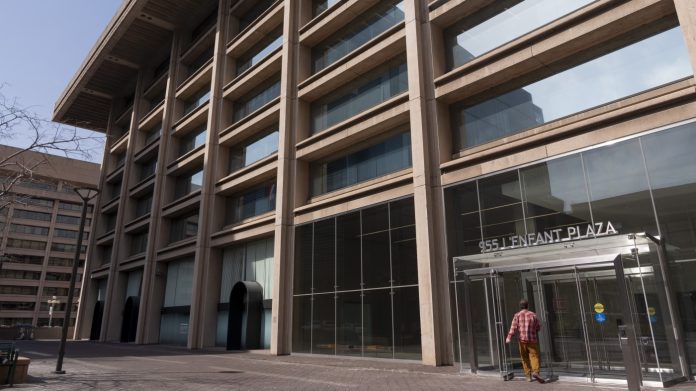
On Tuesday, a federal judge issued a preliminary injunction on President Trump’s attempt to dismantle the Institute of Museum and Library Services. Above, the building that houses the offices of the IMLS in Washington, D.C.

Jacquelyn Martin/AP


hide caption

toggle caption

Jacquelyn Martin/AP

A federal judge has halted President Trump’s attempt to eliminate the Institute of Museum and Library Services – the agency which provides federal funding to libraries and museums across the country.

On March 14, Trump issued an executive order calling for the elimination “to the maximum extent consistent with applicable law,” of seven government entities, including the IMLS. In response, attorneys general from 21 states sued the president to stop him from dismantling three of those agencies – the IMLS, the Minority Business Development Agency and the Federal Mediation and Conciliation Service.

District court Judge John J. McConnell Jr., who was nominated to the court by President Obama in 2011, issued an injunction on the EO Tuesday, stating that it violated the Administrative Procedure Act.

“It also disregards the fundamental constitutional role of each of the branches of our federal government; specifically, it ignores the unshakable principles that Congress makes the law and appropriates funds, and the Executive implements the law Congress enacted and spends the funds Congress appropriated,” McConnell wrote.

Rhode Island attorney general Peter Neronha called the preliminary injunction a “win for the public interest” in a statement Tuesday. “When the Trump Administration attempts to dismantle these agencies, it is making a targeted, concerted effort to prohibit everyday people from accessing their full potential.”

NPR has reached out to lawyers from the Trump administration, but has yet to hear back.

The IMLS was established by Congress in 1996. It is the main source of federal funding for public libraries. Through its Grants to States program, it particularly helps small and rural libraries provide services for its patrons. In 2024 the IMLS budget was $294 million.

Shortly after President Trump issued his EO, he installed Keith E. Sonderling as the IMLS’s new acting director. And on March 31, the agency’s employees were put on administrative leave with pay for up to 90 days. Some states also had their grants rescinded, while others were left in limbo with no one staffed at the agency to process grants.

There is currently a separate lawsuit against President Trump to stop the dismantling of IMLS, coming from the American Library Association and the American Federation of State, County and Municipal Employees (AFSCME), the largest union representing museum and library workers.

Senate confirms Trump’s pick Bisignano to run Social Security : NPR

0

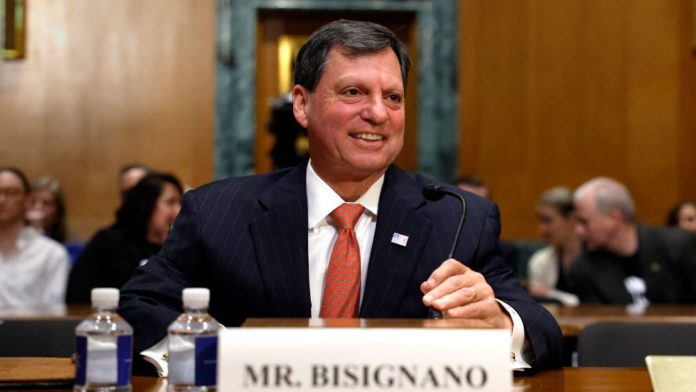
Frank Bisignano, President Trump’s nominee to be commissioner of the Social Security Administration, testifies at his Senate Finance Committee confirmation hearing on Capitol Hill on March 25.

Kevin Dietsch/Getty Images


hide caption

toggle caption

Kevin Dietsch/Getty Images

In a 53-47 vote along party lines, the U.S. Senate on Tuesday confirmed the nomination of tech CEO Frank Bisignano to be the commissioner of the Social Security Administration (SSA).

Bisignano, a donor to President Trump and the former CEO of payments technology company Fiserv, will lead the federal agency that runs programs providing retirement, survivor and disability benefits, as well as supplemental income for the very poor.

Former commissioners and advocates for older and disabled Americans have raised serious concerns about proposed widespread restructuring and mass layoffs at the agency, which has a staff of more than 55,000 employees and serves more than 73 million Americans.

Those advocates say changes like new requirements for beneficiaries, regional office closures, cuts to overtime pay and plans to cut 7,000 jobs from the agency will lead to longer wait times for services for millions of Americans.

Democrats in the Senate have also raised concerns about Bisignano’s alleged communication with members of billionaire Elon Musk’s team, known as the Department of Government Efficiency, or DOGE.

Sen. Ron Wyden, D-Ore., accused Bisignano of lying “about his actions and communications with DOGE and the Social Security Administration prior to his hearing.” During Bisignano’s confirmation hearing before the Finance Committee, Wyden said a whistleblower told his office that the nominee “personally intervened to get DOGE officials installed … and got basically approved in the middle of the night as a result of [Bisignano’s] insistence.”

Bisignano denied multiple times during the hearing that he has been in contact with leaders at the Social Security Administration, as well as DOGE.

“I was not involved in onboarding anybody in the middle of the night,” he said.

Former and former SSA employees have said that the agency’s recent problems stem from DOGE’s involvement in the agency. On April 2, a group of disability advocates filed a federal lawsuit against SSA leaders, Musk and DOGE. In the lawsuit, they say agency leaders, “under the direction of Elon Musk and DOGE” have “systematically dismantled, and continue to dismantle, the core functions of SSA, abandoning millions of Americans to poverty and indignity.”

On Tuesday, U.S. District Judge Amit Mehta, who was appointed by former President Barack Obama, denied the group’s request to block the Trump administration’s proposed changes at the agency. In his ruling, he said the plaintiffs in the case “have not carried their burden to demonstrate irreparable harm.”

Nancy Altman, president of Social Security Works, said in a statement during the Senate’s consideration of the nomination that “Social Security needs a commissioner whose loyalty is to beneficiaries, not Elon Musk.” She said Bisignano is not that person.

“Bisignano describes himself as ‘a DOGE person,'” Altman said. “That’s something he has in common with the current acting commissioner, Lee Dudek, who has slashed staff and services at the direction of Elon Musk’s DOGE. … He is not only unqualified, with no expertise regarding this vital program — he is dangerous to it.”

During his hearing, Bisignano told senators that he thinks the issues plaguing the agency right now stem from the interim commissioner, Dudek, who has been working closely with Musk’s team, not the DOGE team itself.

“We have somebody in the acting role and you hear him in the papers every day,” Bisignano said. “I don’t know if this is a DOGE issue. I think we have a leadership issue, and that’s why I’m hopeful, if I’m to be confirmed, that I will be in charge of the agency.”

Trump offers financial incentives for self-deportation : NPR
0

An asylum seeker with a canceled appointment to enter the United States waits to speak to a Mexican immigration official as he reviews the CBP One app at the El Chaparral border crossing port in Tijuana, Mexico, in January 2025.

Carlos Moreno/NurPhoto via Getty Images


hide caption

toggle caption

Carlos Moreno/NurPhoto via Getty Images

The Trump administration announced it is offering a $1,000 incentive to migrants who “self-deport” using the CBP Home App that was once used to seek asylum.

The Homeland Security Department pitched the monetary incentive as a more cost-effective (for the government) and “dignified” way to leave the country. The department has been working to ramp up the speed and number of arrests, detentions and removal of of immigrants without legal status over the last few months — a costly and resource-intensive endeavor.

The department estimates the average cost of arresting, detaining , and removing someone without legal status amounts to around $17,121.

Immigration enforcement officials have noted that detention capacity is maxed out and the administration is seeking to streamline removals.

Trump’s border czar Tom Homan told Fox News on Monday that more than 7,000 people have used the app since it was rebranded from facilitating asylum requests to promoting removals.

Officials canceled asylum appointments on the app within hours of President Trump’s inauguration in January. The administration then launched a new effort last month that urged migrants to leave “immediately” using the app.

The administration is banking on the fact that migrants would rather leave the country than risk being arrested by immigration officials and face a fine — a choice many are now grappling with.

DHS also announced it has already used the monetary incentive once to transport someone from Chicago to Honduras. The agency added that people without legal status have booked additional plane tickets for this week and next.

But immigrant advocates are skeptical. Even if some people may take the administration up on their offer, immigration advocates say most don’t believe they will ever receive the incentive and eventually be able to apply for legal status, as the administration has suggested.

DHS did not respond to questions about how many people were set to be paid and how the incentive is issued.

There are some 11 million people without legal status in the country, according to estimates from 2022.

“They’re clearly out of touch with the reality that immigrant families and communities and individuals face in this country, and why they’re here in the first place,” said Esther Reyes, campaign strategist for the Protecting Immigrant Families coalition.

Reyes says families targeted by this messaging have long felt the threat of removal.

“A lot of the fear that communities feel has been around for a long time; particularly for people who are here without any kind of legal status, every day is a risk,” Reyes said. “Unfortunately, folks are used to the threats, whether small or large, that come their way on a regular basis.”

Critics warn DOJ is being politicized despite vows to end its purported weaponization : NPR

0

President Trump arrives with Attorney General Pam Bondi to speak at the Justice Department on March 14.

AP/Pool


hide caption

toggle caption

AP/Pool

At her confirmation hearing in January to become attorney general, Pam Bondi vowed to fight violent crime and restore confidence and integrity to the Justice Department.

“The partisanship, the weaponization will be gone,” she told lawmakers. “America will have one tier of justice for all.”

Like President Trump, Bondi argues that the Justice Department was politicized under the Biden administration to target Trump and conservatives more broadly, and they point to the prosecutions of Trump himself as prime examples.

But more than 100 days into Trump’s second term, critics argue that despite Bondi’s talk of ending the purported weaponization of the department, she’s weaponizing it herself.

Bondi’s supporters, however, brush aside such talk. John Lauro, who served as Trump’s defense attorney in some of his criminal cases, says Bondi is tackling weaponization head-on.

“What the present administration has done, and Attorney General Bondi has made it very clear, is a retrenchment from that weaponization,” Lauro said at a recent event with the conservative Federalist Society.

“So we now see no political prosecutions, no sham indictments, no fake grand jury proceedings, but instead, a way of looking at the Department of Justice in terms of restoration and ensuring that the rule of law will be carried out going forward.”

But critics say something very different is afoot.

“I think what’s happening in the Department of Justice right now is that it’s being transformed into Donald Trump’s personal law firm,” said Liz Oyer, the former pardon attorney at the department.

“The attorney general has made it clear that directions are coming from the very top, from the president, and she is there to do his bidding,” Oyer said. “That means pursuing enemies of the president. That means doing favors for friends of the president. The Department of Justice is essentially whatever the president wants it to be right now.”

Oyer was fired in March after she declined to restore gun rights to actor Mel Gibson, who is a prominent supporter of Trump. Oyer says she had public safety concerns due to Gibson’s domestic violence conviction.

Ultimately, Bondi gave Gibson his gun rights back.

The example points to broader concerns for Oyer about what is driving decision-making for Bondi and her leadership team.

“Career professionals, experts in their field, are being marginalized, and decisions are being driven by political considerations, uninformed by the knowledge and expertise of the career staff,” Oyer said.

Bondi and her top lieutenants previously served as Trump’s personal defense attorneys. Under their leadership, the department has fired prosecutors who worked Capitol riot cases or investigated Trump, pushed out senior officials at the FBI and dropped cases against the president’s political allies.

A former senior Justice Department official from Trump’s first term said Bondi and her team of political appointees came in “with the assumption that they’re in a hostile environment.”

“I think they’d be better off if they saw themselves less at war with career folks in the building. Some folks’ conduct can be questioned, but most career lawyers are trying to serve the political leadership,” said the former senior official, who spoke on condition of anonymity in order to speak candidly.

“I understand the concerns and share in some of it, but they don’t seem to be taking full advantage of the career attorneys, and an interesting question is whether that’s sustainable.”

The former official also said the White House is directing the positions that the department takes in court and appears to be shaping the language it submits in legal filings. Both the White House and the department “would be better off if there was more pushback” from the Justice Department on that.

The Justice Department declined to comment for this story.

One example that critics point to of politics allegedly driving department decisions is the corruption case against New York City Mayor Eric Adams. In that instance, the department leadership directed prosecutors to dismiss the Adams case, suggesting that it interfered in the mayor’s ability to help Trump with immigration enforcement.

Nearly a dozen prosecutors resigned in protest.

One of them was Ryan Crosswell. He worked in the Public Integrity Section in Washington, D.C. After prosecutors in New York refused to drop the case, the then-acting deputy attorney general gave lawyers in Crosswell’s office one hour to find two attorneys among them to sign the court papers dismissing the Adams case.

“There were essentially three options — sign it, resign or be fired — is how we looked at it,” Crosswell said.

In the end, one attorney signed it, Crosswell said, to save the Public Integrity Section and its mission — prosecuting corruption, including criminal conflicts of interest and people who profit from their government positions.

“It’s an incredibly important section that was created in the aftermath of Watergate,” he said. “Corruption can affect every aspect in the community, state, country, and the idea to lose something like that was a lot.”

Days later, Crosswell resigned.

He had been a federal prosecutor for around a decade — over four administrations. He disputes that the department ever was weaponized, and he finds the current leadership’s talk of ending it ironic.

“Even if you did think that it was weaponized, then the correction to weaponizing the department is not to do it yourself,” he said.

It’s normal for enforcement and policy priorities to shift from administration to administration, particularly with a change in party. What’s going on now, Crosswell said, is something altogether very different.

“Will the Justice Department that will drop charges against people who acquiesce to its demands bring charges against those who won’t?” he said. “That’s definitely a concern because there’s not much of a distinction.”

Trump meets Canadian Prime Minister Mark Carney amid trade war : NPR

0

Canadian Prime Minister Mark Carney holds an election rally in Windsor, Ontario, on April 26.

Dominic Gwinn/AFP


hide caption

toggle caption

Dominic Gwinn/AFP

President Trump is set to meet Canadian Prime Minister Mark Carney at the White House Tuesday after Trump’s steep tariffs and harsh comments about making Canada the “51st state” created tension between the two neighbors and allies.

Carney, the leader of the center-left Liberal Party, won Canada’s election last week in a campaign dominated by concerns about Trump’s rhetoric and the impact of tariffs on the country’s trade-dependent economy.

“As I’ve been warning for months, America wants our land, our resources, our water, our country,” Carney told supporters on election night. “These are not idle threats. President Trump is trying to break us so America can own us. That will never, ever happen.”

Trump has repeatedly floated the idea of annexing Canada and using “economic force” to do so. In an interview with NBC’s Kristen Welker that aired Sunday, Trump said it was “highly unlikely” that the U.S. would use military force, but “it could happen.”

“If Canada was a state, it wouldn’t cost us,” Trump told NBC. “It would be great. It would be such a great — it would be a cherished state.”

Trump often cites U.S. trade deficits with Canada as justification for making it the 51st state. His administration has imposed a 25% tariff on many Canadian goods.

Trump — who has noted more than once that Carney’s party failed to win a majority in Parliament — downplayed the meeting on Monday.

“He’s coming to see me. I’m not sure what he wants to see me about, but I guess he wants to make a deal. Everybody does. They all want to make a deal because we have something that they all want,” Trump said.

It’s the chance for a reset in the relationship

Carney is a former central banker who took over after Prime Minister Justin Trudeau resigned in January. Their party was down in the polls until Trump started talking about annexation, raising the ire of Canadians.

“President Trump single-handedly helped the Liberal Party recover from a very large popular-opinion deficit in Canada to win the election, ironically,” said Jon Parmenter, a professor of history at Cornell University.

“It’s quite shocking to see the extent to which that attitude [toward the U.S.] has changed in response to the initiatives that the Trump administration has taken since Inauguration Day,” Parmenter said.

Trade is likely to be a topic of discussion between the two leaders, but Carney signaled in a news conference last week that Tuesday’s meeting would be only the start of negotiations.

Carney’s willingness to stand up to Trump’s rhetoric was a big part of his appeal to voters, said Asa McKercher, a public policy professor at St. Francis Xavier University in Nova Scotia — describing the “elbows up” slogan adopted by Carney’s campaign. It’s a hockey term used to describe a defensive stance.

Tuesday’s meeting could be an opportunity to “reset the relationship” between the U.S. and Canada, “because it’s pretty bad,” McKercher said. “Canadians are really upset at the president of the United States.”

The Foundation for Government Accountability aims to reshape state safety nets : Shots

0

Stewart Whitson, a senior director at the Foundation for Government Accountability, testified before Rep. Marjorie Taylor Greene’s DOGE subcommittee in Washington, D.C., on Feb. 12. The hearing was titled “The War on Waste.”

Al Drago/Getty Images


hide caption

toggle caption

Al Drago/Getty Images

PHOENIX — As an Arizona bill to block people from using government aid to buy soda headed to the governor’s desk in April, the nation’s top health official joined Arizona lawmakers in the state Capitol to celebrate its passage.

Health and Human Services Secretary Robert F. Kennedy Jr. said to applause that the legislation was just the start and that he wanted to prevent federal funding from paying for other unhealthy foods.

“We’re not going to do that overnight,” Kennedy said. “We’re going to do that in the next four years.”

Those words of caution proved prescient when Arizona’s Democratic governor, Katie Hobbs, vetoed the bill a week later. Nevertheless, state legislation to restrict what low-income people can buy using Supplemental Nutrition Assistance Program benefits is gaining momentum, boosted by Kennedy’s touting it as part of his “Make America Healthy Again” platform. At least 14 states have considered bills this year with similar SNAP restrictions on specific unhealthy foods such as candy, with Idaho and Utah passing such legislation as of mid-April.

Healthy food itself isn’t largely a partisan issue, and those who study nutrition tend to agree that reducing the amount of sugary food people eat is a good idea to avoid health consequences such as heart disease. But the question over the government’s role in deciding who can buy what has become political.

The organization largely behind SNAP restriction legislation is the Foundation for Government Accountability, a conservative policy think tank in Florida, and its affiliated lobbying arm, which has used the name Opportunity Solutions Project.

FGA has worked for more than a decade to reshape the nation’s public assistance programs. That includes SNAP, formerly known as food stamps, which federal data shows helps an average of 42 million people afford food each month. It also advocates for ways to cut Medicaid, the federal-state program that connects 71 million people to subsidized health care, including efforts in Idaho and Montana this year.

FGA’s proposals often seek to limit who taps into that aid and the help they receive. Those backing the group’s mission say the goal is to save tax dollars and help people lift themselves out of poverty. Critics argue that FGA’s proposals are a backdoor way to cut off aid to people who need it and that making healthy food and health care more affordable is a better fix.

Now, FGA sees more room for change under the Trump administration and the Kennedy-led health department, calling 2025 a “window of opportunity for major reform,” according to its latest annual report.

As the Arizona veto shows, opportunity isn’t a guarantee of success, reflecting the FGA’s history of policy hits and misses.

A vision for limiting government benefits

Tarren Bragdon, a former Maine legislator, founded FGA in 2011 to promote policies to “free millions from government dependency and open the doors for them to chase their own American Dream,” he said in a statement on FGA’s website. The main foundation started out as a staff of three with about $60,000 in the bank. As of 2023, it had a budget of more than $15 million and a team of roughly 64, according to the latest available tax documents, and that’s not counting the lobbying arm.

The foundation got early funding from a grant from the State Policy Network, which has long backed right-leaning think tanks with ties to conservative activists including brothers Charles and David Koch.

FGA declined several interview requests for this article.

In recent years, the nonprofit helped draft a 2017 Mississippi law, the Jackson Free Press found, which intensified eligibility checks for public aid that made it more difficult for some applicants to qualify. It successfully pushed a 2023 effort in Idaho to impose work requirements for food benefits that health care advocates said led some recipients to lose access.

The same year, the group helped pass SNAP restrictions affecting eligibility in Iowa. Since those restrictions have taken effect, the Food Bank of Iowa has seen a record number of people show up at its pantries amid rising grocery prices and a scaling back of COVID pandemic-era federal support, said Annette Hacker, a vice president at the nonprofit.

Part of the group’s strategy is to pass legislation state by state, with the idea that the crush of new laws will increase pressure on the federal government. For example, states can’t limit what food is purchased through SNAP without federal approval through a waiver process. And in the past, some of FGA’s efforts have stalled because states never got that approval.

U.S. Health Secretary Robert F. Kennedy Jr. is pictured beneath a large sign that reads "Food Distribution."

U.S. Health Secretary Robert F. Kennedy Jr. tours a food bank in Mesa, Ariz., on April 8, 2025. Arizona Gov. Katie Hobbs vetoed a law backed by Kennedy and FGA to keep SNAP benefits from being spent on soda.

Ross D. Franklin/AP


hide caption

toggle caption

Ross D. Franklin/AP

Kennedy’s agenda now echoes some of FGA’s key messages, and he has said states can expect approval of their waivers. Meanwhile, congressional leaders are eyeing nationwide Medicaid cuts and work requirements, which FGA considers among its major issues. The foundation also has a connection working inside the administration: Its former policy director, Sam Adolphsen, was tapped to advise President Donald Trump on domestic matters.

“We’re excited to fight from Topeka to Washington, D.C., as opposed to Washington, D.C., to Topeka,” Roy Lenardson, FGA’s state government affairs director, told Kansas lawmakers in February when testifying in support of SNAP legislation there.

Shaping state policies

In the states, FGA has become known as a conservative “thought leader,” said Brian Colby, vice president of public policy for Missouri Budget Project, a progressive nonprofit that provides analysis of state policy issues.

“Conservatives used to try to chop away at the federal budget,” Colby said. “These guys are doing it at the state level.”

In its 14 years, FGA has created a playbook to shape state policy discussions about public benefits behind the scenes. In Montana, retired Republican state legislator Cary Smith, who worked with FGA, said not all of the think tank’s ideas split along party lines.

“They offer a buffet of options,” he said. “Their agenda is making government accountable; it’s in the name.”

He said besides drafting legislation, FGA provides talking points and data to help policymakers support their arguments.

“They would go in and would say, ‘This is what Medicaid fraud is costing us,'” Smith said. “That would be the number you’d want to use in your bill.”

In January, FGA released a memo for states to “stop taxpayer-funded junk food.” In February, Stateline reported that Wyoming Republican state Rep. Jacob Wasserburger said the group asked him to sponsor a SNAP restriction bill. The state sponsor of similar legislation in Missouri has repeated at least one of FGA’s talking points, as reported by the Missouri Independent. In Arizona, Republican Rep. Leo Biasiucci, who sponsored the SNAP legislation there, told KFF Health News FGA was behind that bill as well.

Opponents of such bills argue the proposals are not as simple as they sound. Amid debate on a SNAP bill in Montana, Kiera Condon, with the Montana Food Bank Network, testified that the legislation would force grocery store workers to sort through what counts as soda or candy, “which could result in retailers not participating in SNAP at all.” State lawmakers tabled the Montana bill in April.

Montana legislators also easily passed a bill to extend the state’s Medicaid expansion program even after FGA began publishing a series of papers that asserted the program was “breaking” Montana’s budget. FGA had presented data saying most Montanans on the program don’t work, which state data refutes.

Ed Bolen, who leads food aid strategies at the left-leaning Center on Budget and Policy Priorities think tank, said FGA has a pattern of proposing technical changes to existing laws and “unworkable work requirements” that cause people to lose benefits.

The Kansas example

After working with policymakers in Kansas for a decade, FGA helped pass legislation that limited how long people can access cash assistance, added work requirements to SNAP, and banned the state from spending federal or state funds to promote public aid. Many of those changes came through 2015 legislation known as the “HOPE Act” drafted by FGA, The Washington Post reported.

Analysis from Kansas Appleseed, an advocacy organization for low-income Kansans, found the SNAP caseload sharply declined after the bill was enacted because of the new hurdles, dropping from 140,000 households in January 2014 to 90,000 as of January 2020.

“It’s death by a thousand cuts,” said Karen Siebert, an adviser for Harvesters, a community food bank network in Kansas and Missouri. “Some of these FGA proposals are such complex policies, it’s hard to argue against and to explain the ripple effects.”

In 2024, the foundation produced more than two dozen videos featuring state politicians from across the nation touting the organization’s goals and dozens of research papers arguing public benefits are wrecking state budgets. FGA also has its own polling team to produce data out of the states it’s working to influence.

The organization released a list of 14 states it labeled as “redder and better” places to exert more influence. That included Idaho, where the group has four registered lobbyists in the state Capitol.

In 2023, FGA helped present and successfully lobby for legislation there to require people receiving food aid to work at least 80 hours a month. The organization called the resulting law “landmark welfare reform” years in the making.

And this year, Idaho lawmakers passed more requirements for people enrolled in Medicaid who can work. FGA staffers worked with one of the co-sponsors of the legislation on a similar bill last year that failed, then again this year. A compromise bill passed with FGA’s backing, marking another victory for the foundation.

David Lehman, a lobbyist for the Idaho Association of Community Providers, which represents health organizations that have opposed FGA bills, said Idaho illustrates how FGA works with sympathetic lawmakers in conservative states to gain more ground.

“They’re pushing an already rolling rock downhill,” he said.

KFF Health News is a national newsroom that produces in-depth journalism about health issues and is one of the core operating programs at KFF — the independent source for health policy research, polling, and journalism.

Democratic Rep. Suzan DelBene discuss campaign targeting GOP seats in midterms

0

The Democratic Congressional Campaign Committee is targeting an expanded list of Republican House seats in next year’s midterms. NPR talks with Rep. Suzan DelBene of Washington state, who chairs the DCCC.