Wednesday, November 11, 2026
Home Blog Page 18

Consider This from NPR : NPR

0

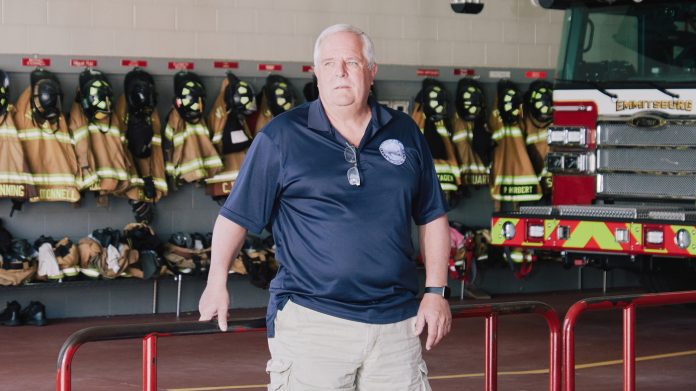
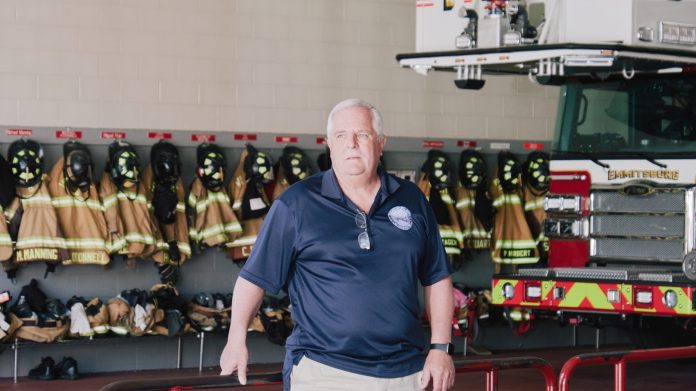
Emmitsburg Mayor Frank Davis voted for Donald Trump in hopes he would cut federal spending. Now Davis hopes those cuts don’t include the permanent cancellation of classes at the National Fire Academy, which is part of the town’s identity and helps drive its economy. Davis is also a chief at Emmitsburg’s firehouse, known as the Vigilant Hose Company.

Justin T. Gellerson for NPR


hide caption

toggle caption

Justin T. Gellerson for NPR


Emmitsburg Mayor Frank Davis voted for Donald Trump in hopes he would cut federal spending. Now Davis hopes those cuts don’t include the permanent cancellation of classes at the National Fire Academy, which is part of the town’s identity and helps drive its economy. Davis is also a chief at Emmitsburg’s firehouse, known as the Vigilant Hose Company.

Justin T. Gellerson for NPR

President Trump’s rapid-fire spending cuts have affected communities all over the country — including strongholds of his supporters.

One of them is Rising Sun, Maryland. The town had won two FEMA grants designed to mitigate the effects of catastrophic flooding. And though the area voted overwhelmingly to support Trump’s re-election, his administration has now cancelled the program that funded those grants.

Across the state in the Trump-voting town of Emmitsburg, Maryland, a similar scenario is playing out. The town is home to the National Fire Academy — a sort of national war college for training firefighters in America. In March, the Trump administration abruptly cancelled classes at the academy, and locals are concerned about how that will affect the town’s economy — and emergency preparedness across the country.

For sponsor-free episodes of Consider This, sign up for Consider This+ via Apple Podcasts or at plus.npr.org.

Email us at [email protected].

This episode includes reporting by Rebecca Hersher and Bente Birkeland. It was produced by Connor Donevan and Brianna Scott, with engineering by Zo vanGinhoven. It was edited by Catherine Laidlaw, Ravenna Koenig and Christopher Intagliata. Our executive producer is Sami Yenigun.

Former Palantir workers condemn company’s work with Trump admin : NPR

0

The logo of the big data analytics software company Palantir Technologies on display during the World Economic Forum (WEF) annual meeting in Davos, on Jan. 23, 2025.

Fabrice Coffrini/AFP via Getty Images


hide caption

toggle caption

Fabrice Coffrini/AFP via Getty Images

Thirteen former employees of influential data-mining firm Palantir are condemning the company’s work with the Trump administration weeks after Immigration and Customs Enforcement reached a deal to pay Palantir $30 million to provide the agency with “near real-time visibility” into the movement of migrants in the U.S.

In a letter shared exclusively with NPR, the ex-Palantir workers, former software engineers, managers and an employee who worked in the firm’s privacy and civil liberties team, say when they joined the powerful tech company, they believed in its code of conduct stating that its software should uphold democracy and ensure the responsible development of artificial intelligence.

“Early Palantirians understood the ethical weight of building these technologies,” the thirteen former employees wrote in the letter. “These principles have now been violated, and are rapidly being dismantled at Palantir Technologies and across Silicon Valley.”

Palantir and the White House did not return requests for comment.

Palantir, co-founded by Trump ally billionaire Peter Thiel, offers data-analyzing software that uses AI to pull information from a multitude of sources and compiles it into charts, tables and heat maps. Its products have become popular with large corporations, the military and law enforcement.

Their customers include the Israel Defense Forces and the U.S. Department of Defense. Now, its surveillance tools are being tapped by the Trump administration to help speed up the president’s goal of deporting 1 million migrants this year. Since Trump was elected, Palantir’s share price has surged more than 200%.

Although about a dozen former workers are just a fraction of a company employing 4,000, the letter is still significant. Much of Palantir’s work is secretive and few former workers criticize the company after leaving due to non-disparagement agreements most are asked to sign upon leaving. Many former employees also hold company stock. Palantir’s market valuation stands at nearly $300 billion – about the same as Bank of America.

Alex Karp, Palantir's CEO, speaks on a panel at the U.S. Capitol on April 30, 2025 in Washington, DC.

Alex Karp, Palantir’s CEO, speaks on a panel at the U.S. Capitol on April 30, 2025 in Washington, DC.

Kevin Dietsch/Getty Images


hide caption

toggle caption

Kevin Dietsch/Getty Images

While top brass at Silicon Valley’s largest companies have been showing support for the Trump administration, studies have found that rank-and-file tech workers tend to oppose Trump and hold liberal views on a host of social issues.

Big Tech employees resisted the first Trump administration’s policies, including the attempts to restrict immigration and travel from foreign countries, yet the former Palantir employees say the resistance has been muted among tech workers in Trump’s second term.

They wrote: “democracy faces escalating threats: biometric data collection on immigrant children, journalists being targeted, science programs defunded, and key U.S. allies, like Ukraine, sidelined. Trump’s administration has sought to greatly expand executive powers while alluding to monarchy,” adding that: “Big Tech, including Palantir, is increasingly complicit, normalizing authoritarianism under the guise of a ‘revolution’ led by oligarchs. We must resist this trend.”

The signees highlight what they say is Palantir’s “increasingly violent rhetoric,” a nod to Palantir chief executive Alex Karp, who publicly boasts about how the company’s tools are used to kill enemies. He once jokingly said that Wall Street analysts who “tried to screw” the company should be sprayed with “light fentanyl-laced urine.”

The letter also zeros in on Elon Musk’s Department of Government Efficiency team, which has hired a number of former Palantir employees to assist in slashing and burning the federal government.

The tech workers admonish the White House for its moves with DOGE and beyond to undo diversity, equity and inclusion initiatives, arguing that those principles “remain essential for critiquing power” and ensuring advanced AI is deployed ethically.

“As Musk’s DOGE operation dismantles U.S. government institutions under the guise of exposing corruption, opposition remains silent,” the workers write. “Government databases are already erasing references to transgender people and gender-affirming care. These injustices could be facilitated by the very software infrastructure we help build.”

The former Palantir workers write that they are issuing a warning in hopes of triggering a “domino effect” in Silicon Valley.

They say that more tech workers should resist what they see as the misuse of AI and other tools in the Trump administration’s policies, including its immigration enforcement and deportation policies that courts and critics say have at times ignored due process rights.

Their aim, they write is “to speak out while we still can, and to work against the dangerous path in the history of technology we are currently heading down towards.”

Marco Rubio’s 2 roles diminish Trump control, says John Bolton : NPR

0
US Secretary of State Marco Rubio leaves after high-level talks on Ukraine and its security, at the French Foreign Ministry in Paris Thursday, April 17.

US Secretary of State Marco Rubio leaves after high-level talks on Ukraine and its security, at the French Foreign Ministry in Paris Thursday, April 17.

Julien de Rosa/Pool via AP


hide caption

toggle caption

Julien de Rosa/Pool via AP

For the first time since Henry Kissinger in the 1970s, the same person will simultaneously serve as both Secretary of State and national security adviser.

Marco Rubio has been tapped to serve as interim national security adviser after President Trump announced that Mike Waltz, who held the role, has been nominated to represent the U.S. at the United Nations.

This comes after Waltz inadvertently added The Atlantic‘s editor-in-chief to a group chat where sensitive information was shared about March strikes against the Houthis in Yemen. Vice President Vance denies that the move is a “firing.”

Before Rubio, Henry Kissinger led both the State Department and the National Security Council for two years under Presidents Richard Nixon and Gerald Ford. Kissinger was hugely influential in shaping the post World War-II era of global politics.

If President Trump believes the move gives him more control, he is “dead wrong,” his former national security adviser John Bolton told Morning Edition. The move may actually be “diminishing” his own control over the State Department and the various national security agencies, Bolton continued.

And while it puts Rubio in an advantageous position, Bolton said it won’t be easy.

“There’s some overlap between those jobs, inevitably. But they are so fundamentally different that I think…that no one individual can really handle them, particularly given the threats and challenges we face in the world today,” Bolton said, noting he was not intending to criticize Rubio.

Bolton, who was also ambassador to the United Nations during the George W. Bush administration, spoke to NPR’s Michel Martin about why Trump may have made this change and how it might affect decision making in the White House.

This interview has been edited for length and clarity.

Interview highlights

Michel Martin: So for people who don’t keep up with this kind of thing, what is the core responsibility of each job?

John Bolton: Well, the national security adviser is in charge of coordinating discussions among the various departments and agencies that form part of the national security responsibilities of the president to help provide the president with the information that he needs to make decisions, given the options that are available to him and the pros and cons of each. And then after he makes a decision, to coordinate the implementation across the bureaucracy – State Department, Defense Department, intelligence community, Homeland Security, Treasury and on and on.

The Secretary of State is charged with being the lead diplomat for the United States, running a 75,000-person department with embassies and consulates all over the world, and really trying to achieve through diplomacy what the country’s foreign policy objectives are.

Martin: My recollection from when I was a White House correspondent is that the national security adviser stuck pretty close to the president. He or she would brief the president every day, whereas the secretary of state was constantly on the road. So just on that basis alone, what is your sense of this decision? Why do you think they’ve made it?

Bolton: I think Trump has had a longstanding suspicion of the National Security Council staff. He believed elements of it represented the deep state and were trying to subvert his presidency. So he may well think that minimizing the role of the NSC staff will be a plus for him. He’s dead wrong on that. In fact, he is, in effect, reducing his own scope of control by combining these two roles. But it certainly puts Marco Rubio in a very advantageous position indeed. Over the weekend, Trump said that he looked at not only J.D. Vance, his vice president, but Marco Rubio as a potential successor. So from Rubio’s point of view this is a real opportunity.

Martin: You think that, in fact, this is not as advantageous to President Trump as he may think that it would be. Say more about that.

Bolton: One of the criticisms of Kissinger that ultimately led Gerald Ford to split the positions again and make Brent Scowcroft, the national security adviser, was the Defense Department and other agencies felt that Kissinger biased decision making below the presidential level in his favor. And it’s one reason why the national security adviser is often called an honest broker, that there are disputes between departments based on institutional disagreements, differences in their functions, that the NSC staff process is designed to help mitigate.

Moreover, the whole idea that the secretary of state – really almost alone – should be by the President that much time, I think, will diminish the president’s capacity through the bureaucracy to keep control of the State Department and keep control of the other agencies, too. All of these jobs are more than full time. And when you diminish one aspect of one of the jobs, you’re going to tilt the system in a way that’s ultimately disadvantageous to the president, even though he may not see it that way and probably disadvantageous to the country, too.

Secretary of State Marco Rubio speaks during a cabinet meeting at the White House, Wednesday, April 30, in Washington, as President Donald Trump look on.

Secretary of State Marco Rubio speaks during a cabinet meeting at the White House, Wednesday, April 30, in Washington, as President Donald Trump look on.

Evan Vucci/AP


hide caption

toggle caption

Evan Vucci/AP

Martin: So I also want to mention that Marco Rubio is also overseeing what’s left of USAID and the National Archives, although it seems clear that the president doesn’t value the work of USAID. You mention that the national security adviser is an honest broker. I’m wondering if President Trump doesn’t want an honest broker.

Bolton: Well, he wants everything centered in him. And obviously, the president ultimately makes the decisions. The issue is whether he makes informed decisions or whether he’s surrounded by a bunch of yes men and yes women who, when he says, “Let’s reopen Alcatraz, what a great idea,” they all say, “Yes, sir.” And they don’t say, “Well, here are the considerations you might want to take in mind. Here are the pros and cons of that.”

The president will decide one way or the other. If that’s what he wants to do, his decision will prevail, but he can either make a spur of the moment decision, which is Trump’s typical style, or he can make an informed decision. And downplaying the role of national security adviser, I feel, will lead to more displays of fealty by Trump’s staff, but fewer informed decisions.

Martin: Now, all of this is happening because President Trump removed Michael Waltz as national security adviser. He nominated him to be ambassador to the United Nations. That’s a post that you once held. Given all the circumstances behind that, what do you think it says that the president is sending Mike Waltz to the United Nations?

Bolton: I think he’s exiling him to New York. Different presidents have different styles and they listen to different people in different regards on different issues. It’s very hard to characterize. But there’s no doubt if Waltz is in New York doing his job, he’s not in Washington talking to the president. And you can give [him] the UN ambassadorship cabinet rank — really doesn’t make any difference — just to show up around the table every once in a while. I did it in the reverse way: UN ambassador first, national security adviser later. And I think that’s a more normal line of progression than what we’re seeing now.

Julie Depenbrock produced the radio version of this story.

A Maryland town wanted Trump to cut waste. Now it’s a target : NPR

0

Emmitsburg Mayor Frank Davis voted for Donald Trump in hopes he would cut federal spending. Now Davis hopes those cuts don’t include the permanent cancellation of classes at the National Fire Academy, which is part of the town’s identity and helps drive its economy. Davis is also a chief at Emmitsburg’s firehouse, known as the Vigilant Hose Company.

Justin T. Gellerson for NPR


hide caption

toggle caption

Justin T. Gellerson for NPR

EMMITSBURG, Md. — Frank Davis saw a lot of waste during his decades in the federal government. In November, he voted for Donald Trump to get rid of it. So far, Davis likes a lot of what he’s seen.

“I’m probably gonna get shot for this, but he is doing what he said he was going to do,” says Davis, who serves as mayor of this town of about 3,000 people in Western Maryland, just south of Gettysburg, Pa.

In March, the Trump administration suddenly cancelled in-person classes at the National Fire Academy here, which trains the country’s firefighters. The academy is not only a big part of Emmitsburg’s identity, it also helps drive the local economy.

Davis says the administration is reviewing the academy’s operations, and he is hopeful it will restore classes. If not, he says, he’ll see the administration somewhat differently.

“It will change my outlook to say that they’re not being fair,” says Davis, who also serves as emergency medical services captain at the local firehouse, known as the Vigilant Hose Company. “They’re just going in to cut and not caring what they cut.”

Emmitsburg voted for President Trump in November. NPR interviewed about two dozen people here. Almost all of them voted for Trump, and many said his plans to cut federal spending were a key attraction. Now, they say they are puzzled as to why the administration would cancel national training for firefighters.

Ott House, an Emmitsburg pub, is a home-away-from-home for firefighters training at the nearby Nation Fire Academy. Visiting firefighters have come here for decades and thousands of patches from their departments now line the pub's walls.

Ott House, an Emmitsburg pub, is a home-away-from-home for firefighters training at the nearby National Fire Academy. Visiting firefighters have come here for decades, and thousands of patches from their departments now line the pub’s walls.

Justin T. Gellerson for NPR


hide caption

toggle caption

Justin T. Gellerson for NPR

Denis Onieal is also puzzled. He served for two decades as superintendent of the academy, which he says trained 8,000 to 10,000 firefighters on campus each year. The academy, often referred to as the national war college for firefighting, offers courses in everything from leadership and management for fire chiefs to how to conduct fire, arson and explosion investigations.

“The National Fire Academy takes men and women out of their comfort zone and … exposes them to real serious tragedies, and forces them to work through … what kind of decisions they’re going to make,” says Onieal, who lives over the border in Pennsylvania.

If the courses aren’t restored, Onieal says Americans will pay.

“We’re on a very long, slow path to self-destruction,” he says. “Every day that this training is unavailable to the locals is one day closer to a disaster they can’t handle or won’t know how to handle.”

The Federal Emergency Management Agency oversees the academy, which pays for firefighters to come to Emmitsburg. When NPR asked why classes were cancelled, FEMA did not answer directly, but suggested in a statement that it had to do with travel costs.

“The bottom line is we are no longer paying for non-employee travel,” the statement read. “We are only authorizing travel for mission critical programs, this isn’t one. Some of these classes are still available online.”

The fire academy website does show some upcoming in-person courses. They’ve been left up for now in case the administration changes its mind.

The National Fire Academy sits inside this complex in Emmitsburg in Western Maryland. Thousands of firefighters come here for training each year, but the Trump administration cancelled in-person classes in early March to cut costs.

The National Fire Academy sits inside this complex in Emmitsburg in Western Maryland. Thousands of firefighters come here for training each year, but the Trump administration cancelled in-person classes in early March seemingly to cut costs.

Justin T. Gellerson for NPR


hide caption

toggle caption

Justin T. Gellerson for NPR

John Beck, who serves as fire chief of the Waynesboro Volunteer Fire Department nearby in Pennsylvania, had applied for a weekend leadership and development course at the academy in July. It would be his first one, but he doesn’t expect it’ll happen now. He also says online courses don’t cut it.

Beck, who runs a landscaping company, works for free as fire chief. He voted for Trump and supports cutting waste and making government smaller. But Beck doesn’t see how training first responders is wasteful.

“We’re only 100-plus days in,” Beck says of Trump’s current term. “I wish things were going differently.”

Beck doesn’t regret his vote — yet.

“I’m not 100% there yet, but it may not take much more,” he says.

Back in Emmitsburg, the dinner crowd is arriving at Ott House, a family run pub and home-away-from-home for firefighters who train at the academy. Over the decades, firefighters have left thousands of patches from their departments, which now blanket the walls of the pub. They include patches for a government fire bureau in Taiwan, and departments in Bath, Maine, and Juneau, Alaska.

Firefighters make up more than 30% of the pub’s business. Co-owner Susan Glass is worried about the long-term impact.

“I’ve already told a lot of our employees that it’s a possibility they won’t have a job for the summer, but we’re hoping things open back up,” Glass says.

In fact, many of the town’s residents hold out hope that the administration will see the value of the academy and start classes again. Glass also voted for Trump, but feels the administration is moving too fast.

The Vigilant Hose Company in Emmitsburg, Maryland.

The Vigilant Hose Company in Emmitsburg, Md.

Justin T. Gellerson for NPR


hide caption

toggle caption

Justin T. Gellerson for NPR

“I agree with a lot of things that they’re doing, but sometimes I disagree on how they’re doing them,” says Glass, who thinks the administration shouldn’t try to do so much at once. “Maybe … spread it out a little bit. It just seems like it’s just one hammer after another.”

Some members of Maryland’s congressional delegation have pressed the administration for answers about the cancellation of the academy’s classes, but say they’ve heard nothing back.

“I have no idea why they’re doing this,” says Rep. April McClain Delaney, whose district includes Emmitsburg. “It is absolutely nonsensical.”

Sen. Chris Van Hollen, a fellow Democrat, says he’s equally baffled.

“It’s extremely short-sighted and dangerous to cut this program,” he says.

The National Fallen Firefighters Memorial sits at the National Fire Academy in Emmitsburg, Md. Each year, thousands come to town for a memorial weekend to honor those who have died.

The National Fallen Firefighters Memorial sits at the National Fire Academy in Emmitsburg, Md. Each year, thousands come to town for a memorial weekend to honor those who have died.

Justin T. Gellerson for NPR


hide caption

toggle caption

Justin T. Gellerson for NPR

John Bolton discusses Marco Rubio's dual roles in government

0

Marco Rubio is now secretary of state and acting national security advisor. NPR speaks with former national security adviser John Bolton about whether it’s really possible to juggle both roles.

Former Vice President Mike Pence given Profile in Courage Award for actions on Jan. 6

0

Former Vice President Mike Pence has been awarded the John F. Kennedy Profile in Courage Award for certifying the 2020 presidential election after rioters attacked the Capitol on Jan. 6, 2021.

Memorial to people killed by gun violence is removed from ATF headquarters : NPR

0

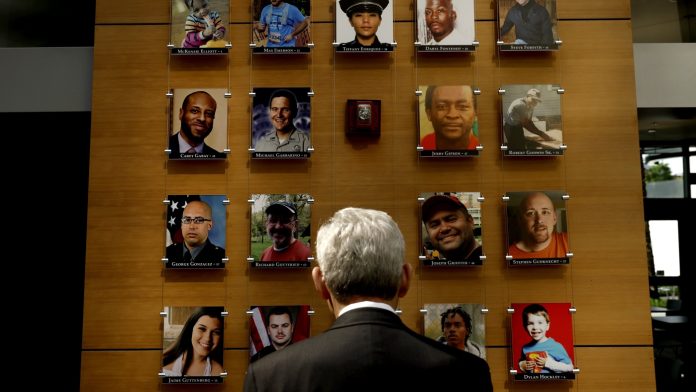
Attorney General Merrick Garland looks at an exhibit titled the Faces of Gun Violence while on a tour led by Steve Dettelbach, director of the Bureau of Alcohol, Tobacco, Firearms and Explosives, at ATF headquarters on April 23, 2024, in Washington, D.C. The display has now been taken down.

Anna Moneymaker/Getty Images


hide caption

toggle caption

Anna Moneymaker/Getty Images

An exhibit showing victims of gun violence has been taken down at the headquarters of the Bureau of Alcohol, Tobacco, Firearms and Explosives (ATF), the Department of Justice has confirmed.

The exhibit showed the portraits of 120 people killed in gun violence. A digital kiosk with biographies of each person was also part of the exhibit. An online version has also been taken down.

The ATF enforces federal gun laws and is tasked with regulating the firearms industry. It is within the Department of Justice.

One of those portraits taken down was of Robert Lee Godwin Sr., who was shot to death in Cleveland in 2017 while he was out collecting aluminum cans.

On the wall, Godwin was pictured smiling and preparing fish he’d just caught for a family meal. Godwin’s daughter, Brenda Joiner, describes her father as an avid fisherman, who was humble and beloved. She says his place in the inaugural exhibit was special.

Robert Lee Godwin Sr. is pictured with his daughter Brenda Joiner. Godwin's portrait was part of the Faces of Gun Violence exhibit at the ATF headquarters.

Robert Lee Godwin Sr. is pictured with his daughter Brenda Joiner. Godwin’s portrait was part of the Faces of Gun Violence exhibit at the ATF headquarters.

Brenda Joiner


hide caption

toggle caption

Brenda Joiner

“It was absolutely an honor and a very proud moment and I felt like this country was actually taking recognition and taking note of all the lives that are lost to gun violence,” she told NPR.

In a statement to NPR on Sunday, a DOJ spokesperson suggested it will still honor victims in other ways, but not only of gun violence: “The ATF will continue to honor the memory of all victims of violent crime while at the same time preserving the rights of law-abiding Americans.”

Faces of Gun Violence honored victims of mass shootings and school shootings, as well as victims of domestic violence, people who died by suicide, and other victims of gun violence. Portraits of law enforcement officers killed by gun violence were also part of the exhibit.

The removal was first reported by The Washington Post.

The Justice Department dedicated the exhibit in April 2024. The Biden administration planned for a new group of 200 victims to be honored by the memorial each year.

Former ATF Director Steven Dettelbach said in a statement at the time of the dedication last year: “The ‘Faces of Gun Violence’ exhibit is a permanent reminder of what ATF comes to work to do every day — a reminder of why agents risk their lives and why everyone at ATF dedicates their careers to this mission: to honor the fallen and protect the living.”

The Biden administration had already chosen the new group of honorees who were supposed to be installed in the next exhibit, replacing the inaugural group, according to Kris Brown, president of Brady: United Against Gun Violence. Brown says her organization and other groups provided input in the selection process and new families were anticipating the installation of their loved ones to the exhibit last month.

“For people who were already traumatized enough by gun violence, just the unceremonious lack of care taken here is deeply, deeply troubling,” said Brown in an interview with NPR.

Brown views the DOJ’s decision to take down the exhibit as political and an example of the Trump administration’s efforts to roll back firearms regulations.

“What they want to do is deny the reality that gun violence exists and that makes me very angry,” said Brown. “What we will see over time is absolutely a rise in gun violence; we will see a rise in homicide; we will see a rise in suicide; we will see a rise in unintentional injury of kids with guns in the home.”

Fred Guttenberg’s daughter Jaime was pictured on the Faces of Gun Violence memorial. She was among the 17 people shot and killed at Marjory Stoneman Douglas High School in Parkland, Fla., in 2018.

“I worked with the ATF to honor my daughter Jaime and other victims of the Parkland shooting in the creation of the ‘Faces of Gun Violence’ memorial at headquarters. … We are here saddened by the reality that her photo has been removed and sits in an ATF trash can, completely disregarded by this heartless Administration who could clearly care less about my child or any child being gunned down in America,” Guttenberg said in a statement.

The Justice Department didn’t answer a question from NPR asking where the portraits are now located.

Brenda Joiner joined the Brady team after her father’s death. She has made ending gun violence her life’s work.

“I can’t bring my dad back, but I darn well can do some good fighting for other people, and that’s what that wall meant for me,” she said.

U.S. autoworkers react to Trump's tariff policies

0

President Trump has repeatedly promised that he would save the U.S. auto industry and that aggressive tariffs would drive that industry revival. But how are U.S. autoworkers feeling?

During TV interview, President Trump questions due process rights of U.S. residents

0

During an interview on NBC’s “Meet the Press,” President Trump questioned the due process rights of people in the United States.

Does a president need to uphold the Constitution? Trump says ‘I don’t know’ : NPR

0

President Donald Trump arrives to give a commencement address at the University of Alabama, Thursday, May 1, 2025, in Tuscaloosa, Ala.(AP Photo/Manuel Balce Ceneta)

Manuel Balce Ceneta/AP/AP


hide caption

toggle caption

Manuel Balce Ceneta/AP/AP

President Trump — when asked if he thinks he needs to uphold the Constitution on “Meet the Press with Kristen Welker” — said, “I don’t know,” but added that his lawyers “are obviously going to follow what the Supreme Court said.”

The response came after a series of questions regarding the right to due process for people living in the United States and the Fifth Amendment. During this exchange, Trump said he wants to deport millions of undocumented immigrants — who he called “some of the worst people on Earth.”

“I was elected to get them the hell out of here and the courts are holding me from doing it,” Trump said.

Immigration enforcement was one of the top issues ahead of the 2024 presidential elections. It has been a strong issue for Trump, but recent polls show that Americans are disapproving of his handling of immigration.

Welker then pressed Trump on whether he, as president, needs to abide by the Constitution and the rights it provides to people in the U.S.

“I don’t know,” Trump said. “I have to respond by saying, again, I have brilliant lawyers that work for me, and they are going to obviously follow what the Supreme Court said. What you said is not what I heard the Supreme Court said. They have a different interpretation.”

During the wide-ranging interview with NBC News, Trump also ruled out running for a third term — which the Constitution prohibits.

“This is not something I’m looking to do,” Trump said. “I’m looking to have four great years and turn it over to somebody.”

Previously, Trump said he was “not joking” about a third term and contended “there are methods.”

When asked about his successor, Trump complimented both Vice President JD Vance and Secretary of State Marco Rubio.

“JD’s doing a fantastic job,” he said. “Marco is great… We have a lot of good people in this party.”

On the economy, Trump blamed former-President Joe Biden for the “bad parts,” while taking credit for “good parts” of the economy.

“Ultimately, I take responsibility for everything,” Trump said when pressed by Welker. “But I’ve only just been here for a little more than three months.”

Trump also celebrated his tariff policies — which have roiled financial markets and increased the possibility of a recession. He said the tariffs could be permanent.

Last week, the Commerce Department reported that the U.S. economy shrank by a annual rate of 0.3% in the first quarter of the year.

“The fake news was giving me such press on the tariffs,” Trump said. “The tariffs are going to make us rich. We’re going to be a very rich country.”

When asked if the president believes a recession in the short term could benefit the country long term, Trump said the country is in a time of transformation.

“Look, yeah, it’s everything’s OK,” he said. “What we are. I said, this is a transition period. I think we’re going to do fantastically.”

The president continued his criticism of Federal Reserve Chairman Jerome Powell for not lowering interest rates as quickly as Trump would like, but the president notably said he has no plans to remove Powell before the end of his term in 2026. Previously, Trump threatened to terminate the chairman — sending shock waves in the markets over worries that the Federal Reserve would lose its independence.

Later in the interview, Trump refused to rule out the use of military force on Greenland and said, “it could happen.”

“We need Greenland very badly,” he said. “Greenland is a very small amount of people, which we’ll take care of, and we’ll cherish them, and all of that. But we need that for international security.”

Trump also said he plans to continue to talk about annexing Canada and making it the 51st state, but he said it’s “highly unlikely” he’d use military force against Canada. Trump is set to meet with newly elect Canadian Prime Minister Mark Carney soon.

When asked about worries that he is taking the country down an authoritarian path, Trump rebuffed the suggestion.

“Those people are going to be very happy,” Trump said of those critics who see the country headed down an authoritarian path. “They’re going to have to see some results.”

Welker then asked Trump whether he believes his critics have the right to speak against him without fear of retribution.

“Absolutely,” he said. “Yeah, I do. That I do.”

Trump has frequently railed against his political critics in his social media posts, pulled the security clearances and details for some, and vowed investigations against others.