Friday, November 13, 2026
Home Blog Page 174

With a Letter From King Charles, Starmer Was Welcomed Into Trump’s Court

0

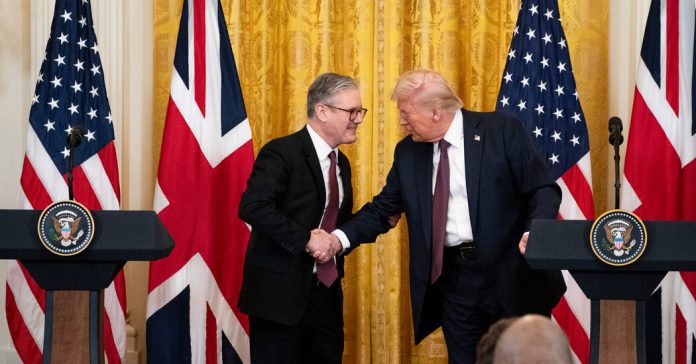
King Charles III was not in the Oval Office on Thursday afternoon. But his regal presence loomed over the meeting between President Trump and Prime Minister Keir Starmer, which felt at times less like a big-power showdown over Ukraine than a courtesy call between two Renaissance royal courts.

From the moment Mr. Starmer pulled an embossed letter from his breast pocket and handed it to Mr. Trump, with an invitation from the king for the president to make a state visit to Britain, the much-anticipated encounter between these two leaders relaxed into something friendlier, but also somehow less momentous.

“A beautiful man, a wonderful man,” Mr. Trump said, after poring over the two-page letter, which was signed “Charles R” in a bold, oversized hand not unlike that used by the president to sign dozens of executive orders.

It fell to Mr. Starmer to explain the diplomatic novelty represented by the invitation: Mr. Trump is the first elected leader in the modern era to be honored with two state visits to Britain. “This is really special,” Mr. Starmer told the assembled press corps. “This has never happened before.”

The prime minister might have added: Never has an elected British leader deployed the monarchy so transparently to win the favor of another head of state.

Mr. Starmer is well aware of Mr. Trump’s enchantment with the royal family. The president viewed his last state visit in 2019, during which Queen Elizabeth II threw him a lavish banquet at Buckingham Palace, as a highlight of his first term. Mr. Trump has lately taken to referring to himself in royal terms: “LONG LIVE THE KING!” he posted on social media, after moving to kill New York City’s congestion pricing program.

With Mr. Trump on the brink of an epochal split with Britain and the rest of Europe over how to deal with Russia’s war on Ukraine, Mr. Starmer apparently calculated that a little royal stardust might bridge the gap — or at least paper it over.

On some counts, he seemed to have succeeded.

Mr. Trump gave Mr. Starmer little comfort on his biggest ask: that the United States provide a security “backstop” for British and European troops that could keep the peace after a potential Trump-brokered settlement between Ukraine and Russia. But he won Mr. Trump’s endorsement of a deal relinquishing British sovereignty over a string of strategically important islands in the Indian Ocean. And he got a welcome sign that Britain might wriggle out of American tariffs.

Back home, Mr. Starmer won praise, even from the normally antagonistic right-wing press. “What an Unlikely Bromance!” The Daily Mail said. “Special Delivery,” said The Sun, over a photo of a tickled Mr. Trump showing off the invitation from Charles. “Keir’s Trump Card,” said the more reliably friendly Daily Mirror.

Given all the ways that the meeting could have gone wrong, Mr. Starmer returned to London with a tidy political victory. Mr. Trump’s apparent approval of his deal to hand over the Chagos Islands to Mauritius in return for the right to keep operating a British American military base on Diego Garcia, will deprive the opposition Conservative Party, as well as the right-wing disrupter Nigel Farage, of a major talking point against Mr. Starmer’s Labour government.

Mr. Starmer also got credit from Mr. Trump for arguing his case on why Britain should be spared the tariffs that Mr. Trump appears ready to impose on the European Union. The president said he expected Britain and the United States to strike a trade deal that would make tariffs unnecessary.

“He was working hard, I’ll tell you that,” Mr. Trump said, after Mr. Starmer lobbied him over a lunch of salad, grilled sea bass and chocolate caramel cake. “He earned whatever the hell they pay him over there.”

Still, on the most critical item on Mr. Starmer’s agenda, the prime minister made little headway. Mr. Trump brushed aside questions about whether the United States would provide a security guarantee to Ukraine to prevent President Vladimir V. Putin of Russia from launching another invasion. Mr. Trump insisted Mr. Putin would “keep his word” if a peace deal was reached.

The presence of American workers in Ukraine, Mr. Trump added, presumably there to help extract the rare-earth minerals that President Volodymyr Zelensky of Ukraine has agreed to share with the United States, would be an insurance policy to prevent Russia from attacking Ukraine again.

Asked if he would come to the aid of British troops if they were targeted by Russia in Ukraine, Mr. Trump equivocated. “I’ve always found about the British, they don’t need much help,” he said. “They can take care of themselves very well.” Then he added, “If they need help, I’ll always be with the British, OK?”

That fell short of Mr. Starmer’s hope for an ironclad American security guarantee. But like President Emmanuel Macron of France, who met Mr. Trump on Monday, Mr. Starmer was determined to avoid a public split with the president over the issue. He lavished praise on Mr. Trump for his peacemaking efforts, adding only that it “can’t be peace that rewards the aggressor or that gives encouragement to regimes like Iran.”

Fresh from announcing a landmark increase in military spending and back in London, where he will play host Sunday to a meeting of 18 leaders to discuss Ukraine, Mr. Starmer has rebranded his premiership. No longer is he defined solely by his failure to jump-start Britain’s torpid economy.

“The first few months of the Labour government were confusing for a lot of people,” said Steven Fielding, a political historian at the University of Nottingham. “In a sense, this has given him an identity as a patriotic leader who supports Ukraine and who is willing to stand up to Trump and Putin.”

And yet, at the White House, Mr. Starmer was so solicitous that he appeared at times to be less a world leader than a well-mannered messenger for one. When Mr. Starmer was asked by a reporter what he made of Mr. Trump’s desire to annex Canada — of which King Charles is the ceremonial head of state — he replied, “I think you’re trying to find a divide between us that doesn’t exist.”

“That’s enough, thank you,” said a clearly irritated Mr. Trump, cutting off the reporter and gesturing for the next question.

Earlier, in the Oval Office, Mr. Starmer dutifully performed his role as a courtier for the king. It was a strange turn of events for a Labour leader who once told a filmmaker, “I often used to propose the abolition of the monarchy.” He has long since disavowed such statements as youthful indiscretions, and even has a knighthood that was bestowed by Charles.

Sir Keir, taking back the letter from Mr. Trump, said that the president’s last state visit had been a “tremendous success” and that “His Majesty the king wants to make this even better than that. So, this is truly historic.”

“What I haven’t got yet is your answer,” Mr. Starmer added, laughing anxiously as he perched on his chair next to the president.

“The answer is yes,” Mr. Trump replied, drawing out the words as he turned to the forest of cameras and microphones. “On behalf of our wonderful first lady, Melania, and myself, the answer is yes.”
Trump, Zelenskyy to talk minerals deal at White House : NPR

0

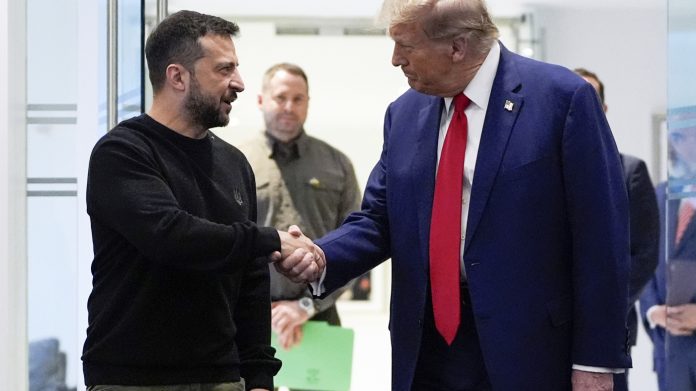
Trump and Ukraine’s President Volodymyr Zelenskyy shake hands during their meeting at Trump Tower, Sept. 27, 2024, in New York.

Julia Demaree Nikhinson/AP


hide caption

toggle caption

Julia Demaree Nikhinson/AP

KYIV — President Trump is set to meet Ukrainian President Volodymyr Zelenskyy at the White House today to sign a preliminary deal to give the U.S. access to Ukraine’s critical raw materials in exchange for possible aid in the future.

It’s the first face-to-face meeting between Zelenskyy and Trump since Trump’s inauguration, and it comes about a week after Trump called Zelenskyy a dictator and repeated Kremlin talking points, including suggesting that Ukraine started the war with Russia.

“The significance of this meeting is that it’s happening at all,” says Serhii Fursa, deputy director of Ukrainian investment firm Dragon Capital, who has been following the minerals deal closely. “I do not think President Zelenskyy will enjoy this trip personally. He just has to do it.”

The deal on the table appears to offer no explicit security guarantees, though Zelenskyy says he will push to include them in a final agreement because Ukraine needs protection from Russia. Instead, it broadly outlines the development of a Reconstruction Investment Fund, managed by both countries. The fund would collect and reinvest revenues from Ukrainian natural resources, including deposits of oil and gas as well as rare earth metals and critical minerals, which are used in high-tech devices.

“We will need the U.S. to continue being our strategic partner,” Yurii Sak, an adviser to Ukraine’s Ministry of Strategic Industries, told NPR. “So we need to rebuild our country after we end the war, and this agreement is going to work toward that goal.”

Zelenskyy rejected earlier versions of the agreement, saying that the terms would have left Ukrainians in debt. He also pushed back on Trump’s insistence that the revenue be used to pay back aid Ukraine has already received from the U.S.

“It was a very, very unpleasant offer that looked like colonial-style behavior, like what the Spanish conquistadors offered to the Incas,” Fursa said.

In the current framework, he said, the terms are more favorable to Ukraine, with the revenue appearing to go to future investments.

In Kyiv, Ukrainians say they’re nervously watching how the Trump-Zelenskyy meeting will unfold.

Anna Kolesnyk, a communications manager in Kyiv, said she worries Trump might get angry at Zelenskyy again and retaliate.

“God help us not to lose a lot,” she said, “meaning our territories, our raw materials, or our minds, and to gain as (many) benefits from this meeting.”

NPR’s Polina Lytvynova contributed reporting from Kyiv.

Why ‘Emilia Pérez,’ a Film About Mexico, Flopped in Mexico

0

“Emilia Pérez,” the movie about a transgender Mexican cartel leader who reconciles with her past, enters the Academy Awards on Sunday with 13 nominations, the most of any film this year. It is also the most nods ever for any non-English language film. The film has already won several accolades, including best comedy or musical at the Golden Globe Awards.

In Mexico, the reception has been exactly the opposite.

It has been widely criticized for its depiction of the country, the minimization of the cartel violence that has ravaged so many and the few Mexicans involved in its production.

Comments about Spanish by its French writer-director, Jacques Audiard, which some saw as denigrating the language, and by its lead, Karla Sofía Gascón, about Islam and George Floyd, stoked the discontent in Mexico and made matters worse.

“Emilia Pérez” wasn’t released in Mexican theaters until Jan. 23 — five months after its debut in France and two months after its U.S. release. In Mexico, theaters showing the film have been largely empty. Some unhappy moviegoers have even demanded refunds.

An online Mexican short film parodying the French roots of “Emilia Pérez,” on the other hand, was a hit. “Emilia Pérez” has been the fodder of many social media memes. And it has been denounced by the families of victims of violence in Mexico.

“It has become a real disaster,” said Francisco Peredo Castro, a film expert and a history and communications professor at the National Autonomous University of Mexico.

A main critique of “Emilia Pérez” is that it trivializes Mexico’s ongoing struggle with organized crime. There have been more than 460,000 homicides since 2006, when the president then declared war on the cartels. The movie is a musical, with glitzy song-and-dance numbers, including lyrics about bodies disposed of in acid.

“We should keep things in perspective and say, ‘We’re not going to sing or dance about this subject,’” said Artemisa Belmonte, 41, who became an activist after her mother, three uncles and a cousin disappeared in 2011 in Chihuahua state, a region hit hard by the drug war. More than 100,000 people have vanished in Mexico since 2006, according to government data.

Ms. Belmonte wondered if Hollywood or the European cinema industry would dare to make musicals about the Sept. 11, 2001, terrorist attacks.

During a news conference before the film’s release in Mexico, Mr. Audiard said he apologized if he handled a delicate subject “too lightly.” In a different interview, he said that “cinema doesn’t provide answers; it only asks questions, but maybe the questions in ‘Emilia Pérez’ are incorrect.” (He has also said that he didn’t study Mexico much before making the film.)

Netflix, which bought the U.S. distribution rights for “Emilia Pérez” at the 2024 Cannes Film Festival, declined to comment. It recently announced a $1 billion investment to produce series and films in Mexico over the next four years.

David Chelminsky, the director of Zima Entertainment, which distributed the film in Mexico, said in an interview that he had never had a film in his career generate such hatred in the country.

“All criticism is valid, but there was a very virulent, very aggressive criticism that didn’t leave room for other opinions,” he said. “So people who liked the film or who wanted to see it preferred to stay a little bit on the sidelines because there were constant attacks against anyone who came out to say, ‘I liked it.’”

He suggested there were tinges of xenophobia and transphobia in some critiques.

Not all Mexicans have condemned the movie. Guillermo del Toro, a three-time Oscar winner, said that Mr. Audiard was “one of the most amazing filmmakers alive” and that his view of Mexico was “hypnotic and beautiful.” Elisa Miller, another acclaimed Mexican filmmaker, said it was “nice” to serve as an adviser on Mexican matters for Mr. Audiard.

After a recent showing at a Mexico City theater, Alberto Muñoz, 37, a visual designer, said he understood the concerns about the movie but also appreciated its technical qualities. “It’s an entertaining movie,” he said.

But Ms. Belmonte, whose relatives disappeared in Chihuahua, said that after streaming the film while in California for Christmas, she was so troubled by it that she created an online petition in January calling for a halt on awards and its release in Mexico.

“The movie has been successful with people who have not experienced disappearances,” Ms. Belmonte said.

While she understood Mr. Audiard’s defense that the film is fiction, Ms. Belmonte was also disturbed at the way the Emilia Pérez character shifted from being a notorious cartel leader to a champion of the disappeared.

Critics have also taken issue with the lack of Mexican talent in front and behind the camera. “Emilia Pérez” was largely shot on French soundstages because, Mr. Audiard said, he preferred the controlled environment.

Adriana Paz is the only Mexican performer who plays a leading character. Mexicans felt slighted when the film’s casting director said that while crew members searched for actors in Mexico and other Latin American countries, they decided to go with the best options, even if they were not Mexican.

Mr. Audiard has said that they wanted bigger-name stars in order to be able to finance the film.

Mexicans have also pointed to the accents of the lead actresses: Zoe Saldaña, an American of Dominican descent who has won awards for her performance and is up for an Oscar for best supporting actress; Ms. Gascón, who is from Spain and has lived and acted in Mexico; and Selena Gomez, an American of Mexican descent who worked to regain her Spanish fluency for the film. (Ms. Gascón is the first openly transgender actress to be nominated for an Oscar.)

After Eugenio Derbez, a well-known Mexican actor and filmmaker, called Ms. Gomez’s pronunciation “indefensible,” she apologized, saying “I did the best I could with the time I was given.”

In Mexico City, some audience members laughed during a recent screening when the Ms. Saldaña and Ms. Gascón’s characters used Mexican colloquialisms.

“The dialogues are completely inorganic — what the characters are saying doesn’t make sense,” said Héctor Guillén, 26, a Mexican screenwriter and producer. (Ms. Gascón has said she is “more Mexican than cactus.”)

Given the controversy surrounding the movie, he said, “in a few years this movie will be one of the biggest embarrassments of European film.”

But Mr. Peredo Castro, the professor, questioned why the backlash against “Emilia Pérez” was so strong, arguing that there were 120 years’ worth of depictions of Mexicans in “insensitive” and “insulting” ways.

He pointed not only to “greaser” films of the early 1900s that featured Mexicans as villains, but recent music genres, telenovelas and shows (scripted and reality) that glorified narco-trafficking. And he said the bigger American and European film industries have frequently looked at Mexico through the lens of misery.

Mr. Peredo Castro said “Emilia Pérez” had been released at a time of upheaval under President Trump, who has repeatedly targeted the United States’ biggest trading partner over fentanyl and migration. The criticisms, he said, have “greatly exacerbated the sensitivity” of Mexico at being the center of attention for violence, drugs and corruption.

In response to “Emilia Pérez,” Camila Aurora, a Mexican trans content creator, made the short film parody, “Johanne Sacreblu.” Filmed in the streets of Mexico City with Mexican performers using stilted French accents and stereotypical attire, it has gained 3.2 million views on YouTube in a month and was released in some theaters.

“Emilia Pérez,” on the other hand, has drawn tepid audience numbers. Since its debut in Mexico and through last weekend, it has made $832,000 with about 210,000 tickets sold, according to figures from the Mexican National Chamber of the Film Industry.

In comparison, “Captain America: Brave New World,” which came out three weeks later, sold 2.9 million tickets through last weekend.

On Sunday, Ms. Belmonte, who created the online petition against the film, said she had no plans to watch the Oscars, even though she considers it her Super Bowl, a must-see annual event. This time, she said, “I’ve lost the desire.”

The WWE vs. the American education system

0

President Trump is calling for the end of the U.S. Department of Education, but so have other Republicans since the day it was formed in 1979. So why do Republicans hate it enough to lambast it, but love it enough to keep it around?

Brittany is joined by NPR’s education correspondent Cory Turner and author Josephine Riesman to talk about Trump’s pick for education secretary, former WWE CEO Linda McMahon. And how Trump and McMahon are using the WWE playbook to reshape the American public education system.

For more on this topic check out Cory’s latest piece for NPR, Republicans’ love/hate relationship with the Education Department, and Josie’s investigation into the WWE, Ringmaster: Vince McMahon and the Unmaking of America.

Support public media and receive ad-free listening & bonus content. Join NPR+ today.

West Bank Operation Tests Palestinian Leaders’ Ability to Root Out Militants

0

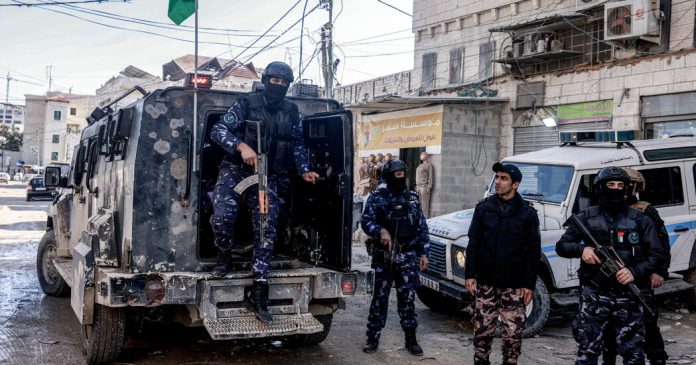
The Palestinian Authority was carrying out one of the most extensive security operations in its history, pursuing armed militants in the West Bank city of Jenin. For weeks, the authority’s forces slowly advanced on the militants’ densely populated stronghold, Palestinian officials said.

When the Israeli military launched its own wide-scale raid there in January, the authority was expected to abandon its operation.

But it did not.

Instead, when dozens of militants fled to nearby villages, Palestinian security forces swooped in to arrest them, officials said. “We made very important progress in reinforcing law and order,” Brig. Gen. Anwar Rajab, the spokesman for the authority’s security forces, said in a phone interview.

The authority, which has limited governing powers in the Israeli-occupied West Bank, had for years largely ceded the fight against militants to Israel. But as questions swirl over whether it can take on governance and security in Gaza, the group’s leaders appear eager to demonstrate that they will not shy away from fighting — even if it means angering Palestinians who say the authority is abetting an operation that is destroying large parts of the West Bank and displacing tens of thousands.

Jenin, and in particular the Jenin camp, a sprawling neighborhood built for refugees in the aftermath of the 1948 Israeli-Arab war, had become a haven for Iran-backed armed fighters from Hamas and Palestinian Islamic Jihad. Over the years, they have grown more sophisticated in their ability to develop explosives and obtain advanced weaponry, like M16 rifles smuggled from Israel.

Since Oct. 7, 2023, when Hamas led an attack on Israel that started the war in Gaza, Israel has carried out scores of raids in the West Bank, including with airstrikes, killing many civilians. Israel says it carries out these raids in accordance with international law. The authority mostly avoided a direct confrontation with the militants, trying to encourage them to turn themselves in.

But in December, the authority decided to take more forceful action. Security forces had arrested an Islamic Jihad operative while he was picking up tens of thousands of dollars smuggled into the West Bank, according to Palestinian officials.

The New York Times spoke to more than a dozen Palestinian officials about the operations in Jenin. They all spoke on condition of anonymity to discuss internal deliberations and operational plans.

The militants responded by hijacking two government trucks and parading through the city, in a scene caught on video and widely shared on social media. The episode was a stark representation of the authority’s weakness: It was broad daylight and the trucks were draped in the flags of Islamic Jihad and Hamas.

The authority’s leader, Mahmoud Abbas, was so enraged that he felt he had to act immediately after he saw the video, according to Palestinian officials.

The authority deployed elite forces and armored vehicles; it set up checkpoints and engaged in daily gun battles with militants in the camp. More than a dozen people were killed, including six security officers, a journalist, a woman and three teenage boys. It also led to the displacement of thousands and widespread losses of water and power.

Hundreds of people were arrested, Gen. Rajab said at a news conference in January, though it was unclear how many were gunmen.

The authority was cautious about making hasty moves on the militants, wary that could lead to a large number of civilian deaths, according to officials. After weeks in which the authority struggled to make progress in its operation, Israel raided Jenin.

It was widely assumed that the authority’s operation would end, but Palestinian security chiefs stayed in Jenin, directing intelligence-based arrest operations in nearby villages, some of the Palestinian officials said. The chiefs recently pulled back to Ramallah, the administrative headquarters for the authority, but arrest operations continue around Jenin, the officials said.

In the days after Israel raided the city, the authority’s security forces arrested 120 gunmen who had left the camp, General Rajab said on Wednesday.

The extent to which the authority and Israel have been coordinating on this operation is unclear. Both sides have long shared information and worked to avoid running into each other, several Palestinian officials said, a policy that many Palestinians have criticized.

General Rajab would only say that the authority was doing “what it needed to do” in Jenin. In the face of criticism from Palestinians, the authority has said that many of the militants have criminal backgrounds.

Lt. Col. Nadav Shoshani, a spokesman for the Israeli military, said at a news briefing in January that Israel and the authority maintained de-confliction protocols “to make sure we don’t get in each other’s way,” but he did not go into detail about how that has worked in Jenin.

Israel’s recent operation has inflicted some of the most severe damage in years, ripping up roads, demolishing dozens of buildings and killing more than 25 people in the broader Jenin area, according to the authority’s Health Ministry, which does not distinguish between civilians and combatants. Israel Katz, the Israeli defense minister, has vowed that the military will remain there long term, raising alarm among authority officials.

Israel’s military has said it killed dozens of militants across several cities in the northern West Bank.

The authority has refused to step away from its operation in Jenin, arguing that it must seize every opportunity to subdue the militants, whom it has accused of giving Israel pretext to destroy the city.

That has hardly raised its standing among residents of the West Bank, who broadly see it as a corrupt entity that colludes with Israel. Many Palestinians also see the armed groups in Jenin as fighting for them against forces occupying the West Bank.

“They are two sides of the same coin,” said Shadi Abu Samen, 47, a resident of the Jenin camp, referring to Israel and the authority.

In phone interviews with The New York Times, militants in the Jenin Brigade of Islamic Jihad said they had taken up weapons to confront Israeli soldiers raiding their neighborhood. Abu Mohammed, a member of the brigade, said he believed the authority and Israel were pursuing a similar goal: “Eradicate the resistance and its spirit.”

“They want us to surrender but we won’t accept that,” said Abu Mohammed, 33, using his nom de guerre.

The Times spoke to Abu Mohammed before Israel’s latest operation in Jenin and has since been unable to reach him.

Some Palestinian analysts said that the focus on security wouldn’t be enough if neither Israel nor the authority made any attempt to improve living conditions as well.

“We’re talking about a place that lacks so many basic resources,” said Ibrahim Dalalsha, the director of the Horizon Center, a Palestinian research group in Ramallah. “Any security operation needs to be accompanied by a social, economic, development operation.”

Civilians have paid a clear price for the operations. Almost all of the residents of the Jenin camp have been displaced over the past two months, according to the United Nations.

“We’re living through a violent storm,” said Hilal Jalamneh, 50, a resident of the camp. “The last bit of hope we were holding on to is now gone.”

AOC talks to NPR about Trump’s political tipping point : NPR

0

Alexandria Ocasio-Cortez is trying to find her party’s path back into power.

The New York Democrat is a more seasoned figure than when she burst onto the national scene during the first Trump administration. Elected by surprise in 2018, Ocasio-Cortez was a progressive insurgent, a democratic socialist, a frequent critic of her own party, and a social media sensation. She was also a leading character on Fox News, a figure conservatives loved to hate.

Seven years later, she remains an outsized public figure, who also has built relationships inside Congress with Democrats and even some Republicans. At 35, she is a veteran lawmaker.

We sat with Ocasio-Cortez this week just after House Democrats managed a show of unity: they all voted against a Republican budget plan, which barely passed. We talked through her party’s path toward political recovery.

Here are a few key points from our video interview.

She thinks Republicans’ early moves will hurt them.

“The Republican Party is making certain large errors right now,” she said, predicting that an $880 billion cut to Medicaid would affect many voters’ health care, and that the president’s bid to fire many federal workers will degrade critical services.

She’s still defending people without legal status.

Since their election defeat, some Democrats have suggested their party needs a fresh approach to immigration. Many voters saw President Biden’s administration as too lax toward people in the U.S. without legal status.

Ocasio-Cortez insists that she still favors a path to citizenship. And she publicly feuded with Tom Homan, President Trump’s border czar, after she held an online know-your-rights seminar for people who feared being confronted by immigration agents.

When threatened with investigation, she challenged the Justice Department to try it.

Homan told Fox News that he had asked the Justice Department if she was violating the law by trying “to educate people how they evade law enforcement.”

“I was informing all of my constituents of their constitutional protections and in particular, their constitutional protections against illegal search and seizure,” Ocasio-Cortez told NPR. She said she intended to put a question to the Justice Department herself: “Well, there is a member of the Trump administration who is threatening and seeks to open an inquiry. And are you going to do it?”

After the interview, the Democrat sent a letter to Attorney General Pam Bondi, which she shared with NPR. “I write to request clarity on whether the Department of Justice has yielded to political pressure and attempts to weaponize the agency against elected officials whose speech they disagree with.”

Like Trump, she says government doesn’t work for many people.

“Everything feels increasingly like a scam,” she said. “Not only are grocery prices going up, but it’s like everything has a fee and a surcharge. And I think that anger is put out at government.”

The Democrat asserts that in her view, government is working very well for the wealthy, while often failing ordinary people.

Unlike Trump, she doesn’t want to drastically cut government.

“I mean to the FAA? No. To the NIH? No,” she said. “I actually don’t want someone taking a wrecking ball to someone’s chemotherapy to just see what happens.”

She said she was open to examining “certain things like Medicare Advantage that I think is a scam, ” allowing private insurers to collect extra premiums.

Reena Advani and Adam Bearne produced and edited this story for broadcast. Majd Al-Waheidi edited it for the web.

South Korean Police Investigate Japanese Woman for Kissing BTS Star Jin

0

The South Korean police have summoned a Japanese woman for questioning after she was accused of kissing Jin, a member of the K-pop supergroup BTS, without consent during a public event last year.

The Japanese woman, whose name was not revealed, was in a crowd of fans at the event in Seoul ​last June that celebrated Jin’s discharge from the South Korean military after his mandatory 18 months of service. Jin, whose real name is Kim Seok-jin,​ was offering hugs to his fans when the Japanese woman abruptly kissed him on his​ cheek.

Video footage that went viral showed Jin looking uncomfortable when a couple of female fans tried to kiss him. Subsequently, someone filed a formal legal complaint on a government website, which the authorities can react to if they consider them worthy of investigation.

The South Korean police have since identified a Japanese woman with the help of Japanese police, said the Songpa police station in southern Seoul.

BTS member Jin during the event where the incident took place in Seoul, in June in 2024, in this still image obtained from a social media video.Credit…@Seoshoom, via X, via Reuters

If the ​woman accepts the summons, she ​will face questioning on possible charges of sexual harassment, the police station said. They didn’t say what additional steps they might take if she did not oblige.

It did not provide personal details on the woman, but South Korean news media said the woman ​was in her 50s ​and bragged online about how her lips had touched Jin’s “soft” skin.

​Hybe, the firm that created and manages the boy band, did not immediately respond to a request for comment.

Despite historical disputes rooted in Japan’s colonial rule of Korea in the early ​20th century, South Korea and Japan maintain ​brisk tourist exchanges. South Korean TV dramas and K-pop groups like BTS are a major attraction for Japanese fans, who visit locations where the dramas were​ filmed or attend K-pop fan meetings.

BTS has a legion of global fans who call themselves the BTS “Army.” ​

Like all other eligible young South Korean men, the seven boy-band members were obliged to finish military service. That led to a pause for one of the biggest musical acts in the world​.

Jin, 32, the oldest member of the band​, was the first to join the military in 2022.​ The band’s management has said that the group would ​reconvene this year once all its members are back from military service.

Alexandria Ocasio-Cortez tells NPR: 'Everything feels increasingly like a scam'

0

Steve Inskeep talks with Congresswoman Alexandria Ocasio-Cortez (D-NY) about how Democrats are responding to President Trump’s agenda.

Workers Strike Across Greece on Anniversary of Deadly Train Crash

0

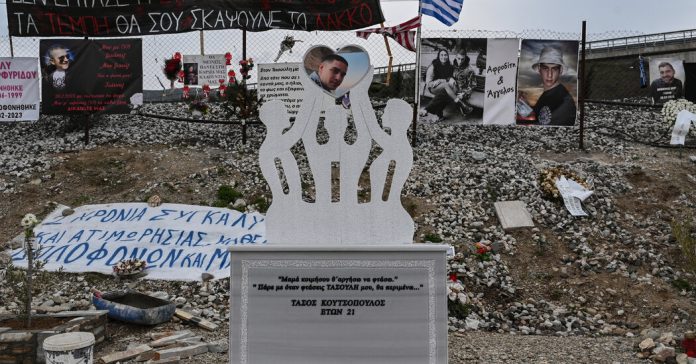
A general strike in Greece on Friday halted trains and ferries, grounded flights and disrupted public services as thousands of workers walked off the job on the second anniversary of Greece’s worst-ever railway disaster.

The 24-hour walkout, called by Greece’s two main labor unions, is the latest in a series of public protests over a dragging judicial investigation into the crash, in which 57 people were killed. There is still lingering anger in the country over the government’s failure to put any of its politicians under scrutiny over the loss of life.

Here is what to know about the strike and the enduring anger over the accident.

The strike involves public- and private-sector workers.

Rallies were taking place in Athens and across Greece, with protesters calling for those at fault in the crash to be punished and for rail safety to be improved.

All commercial flights to and from Greek airports were grounded, and no ferries or trains were running. Limited public transportation was operating in Athens to allow demonstrators to get to the rally. Although taxi drivers joined the strike, some volunteers were offering protesters free rides to rallies.

Schools and hospitals were also affected as teachers and health care workers joined the action. Lawyers and ambulance workers walked out, too, while many shops closed. Several popular artists have canceled planned shows.

On the night of Feb. 28, 2023, a passenger train and a freight train collided head-on on a route linking Athens with the northern port of Thessaloniki. Many of the 57 people who died in the crash were young students returning from a holiday weekend.

At the time, the Greek authorities blamed human error, saying that a routing mistake by a station master had put the passenger train onto the same track as an oncoming freight train. But they also admitted to shortfalls in Greece’s railway infrastructure and delays in installing modern safety systems that could have averted the disaster.

The deadly episode set off days of protests as people demanded accountability and greater rail safety.

Two years later, questions remain about the exact circumstances of the crash.

A report by an independent rail and air investigation authority set up after the tragedy, whose results were made public on Thursday, found that delays in installing electronic signaling and remote surveillance systems played a key role in the collision, as did chronic understaffing and underfunding resulting from cutbacks enforced during Greece’s decade-long financial crisis.

The report also criticized the Greek authorities for flawed mapping of the crash site, a factor that it said resulted in the loss of “potentially vital information.”

Investigators added that an “enormous fireball” from the crash, which probably killed five to seven of the victims, may have been stoked by a “hitherto unknown fuel.” They called for further investigation into that.

Polls conducted in recent weeks showed that most people in the country were unhappy with the government’s handling of the disaster.

Many also suspect a cover-up of who was responsible — a charge that the government denies, accusing opposition parties of exploiting public sensitivities for political gain.

Greece has made some progress in improving railway safety since the crash. Greece’s infrastructure and transportation minister, Christos Staikouras, told Greek television on Thursday that modern signals and remote surveillance systems had been added along the entire Athens-to-Thessaloniki route after the accident, with work finishing by September 2023.

However, a cyclone later that month damaged the systems, leaving them not fully functional on “a significant part” of that route. He said that the damage would be repaired by the summer of 2026 and that Greece was working on an plan agreed upon with the European Commission to improve training for railway workers.

But the European Commission said in December that shortcomings persisted, including a failure to comply with a European Union rail safety directive from 2016. “Shortcomings are systemic and also stem from a lack of safety culture within the organizations involved,” it said.

The authorities have said that a judicial investigation is continuing into who may be responsible for the crash. The dozens under investigation so far are mostly railway officials.

The largest burden has fallen on one person: the station master, now 61, who is accused of the routing mistake that put the passenger train on the same line as the freight train.

He faces charges of endangering transportation safety and multiple counts of negligent homicide and bodily harm. But many in the country felt that he was scapegoated over systemic failures that were to blame for the tragedy.

China’s Military Puts Pacific on Notice as U.S. Priorities Shift

0

China has in recent weeks staged military drills off Australia and Vietnam, sending pointed warnings near and far. Neither was a full-fledged exercise. But taken together, China’s recent shows of force, experts said, conveyed a message: the region must not ignore Beijing’s power and claims.

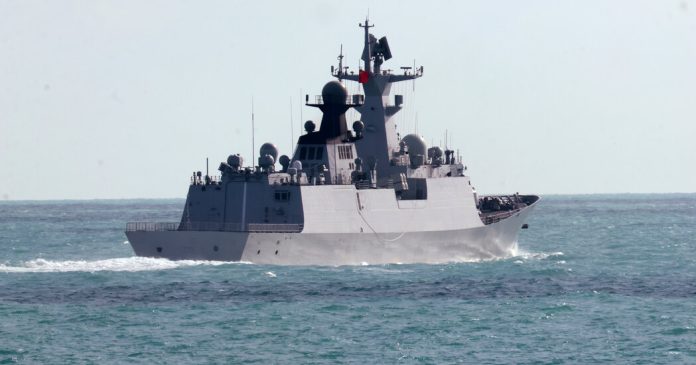
Three Chinese naval ships, including a cruiser with 112 missile tubes, showed up in the waters near Australia this month, only announcing plans to fire artillery for practice after the exercise had started. A few days later, on Monday, Chinese forces held live-fire drills in the Gulf of Tonkin, after Vietnam pressed its territorial claims in the gulf. Meanwhile, Chinese military aircraft buzz the skies near Taiwan almost daily.

While Washington is consumed with other matters, from Ukraine and the Middle East to budget cuts at the Pentagon, China keeps pressing. The exercises, while relatively brief, highlight that China’s military reach is likely to keep growing, regardless of whether the Trump administration ultimately tries to confront China or pull it into some kind of deal.

The series of drills aimed to show scale and scope, “showcasing China’s expanding naval capabilities and ability to project power across multiple theaters simultaneously,” said Nguyen Khac Giang, a visiting fellow with the Singapore-based ISEAS-Yusof Ishak Institute.

“The timing, with many in the Indo-Pacific region concerned about the U.S. commitments under President Donald Trump, is just perfect.”

The People’s Liberation Army had been growing more active long before Mr. Trump took office, and China held far larger exercises near Taiwan last year. In its own sometimes ominous way, experts said, China is trying to persuade governments in the Asia-Pacific region that, like it or not, their future lies in accommodating Beijing. And that includes its claims to democratically governed Taiwan and over much of the South China Sea, which is disputed by Vietnam and other countries.

Beijing’s message may gain more traction if American influence in the region ebbs.

“In purely military terms, these actions — the live firing training or three ships in seas near Australia — don’t have much significance,” said Su Tzu-yun, a research fellow at the Institute for National Defense and Security Research, an organization in Taipei that is funded by Taiwan’s ministry of defense. “But they can be seen as political signaling.”

Dan Blumenthal, a senior fellow at the American Enterprise Institute in Washington who studies East Asian security, said that China’s displays of military power should not be dismissed as mere theater. The displays matter because they are backed by a real and growing ability by China’s leaders to raise the military stakes in disputes.

“The low-intensity war that China conducts daily only works if the threat to escalate conventionally is credible,” he said in an interview.

Asian governments have long turned to Washington to offset Chinese power in the region. But Mr. Trump has sent contradictory signals about whether he wants to contain or cooperate with Beijing — or, somehow, both. He has ideas for a big trade deal with China’s leader, Xi Jinping, and has sometimes spoken admiringly of Mr. Xi, but has also imposed additional tariffs and trade restrictions on China, with more set to come.

Mr. Trump’s defense secretary, Pete Hegseth, has called for big cuts in American military spending across much of the globe so that the United States can concentrate on countering China in the Asia-Pacific. Yet it remains unclear whether and how that shift will happen. Mr. Trump has also complained that Asian countries spend too little on their defense.

The Trump administration has not commented on the recent Chinese drills, and the White House has yet to spell out a broader plan for the region.

Vietnam mostly fears being caught in a tidal wave of Trump tariffs after leaning closer to the United States on security in recent years. The country of 100 million people has sought to keep relations with the United States and China in balance. Vietnam did not respond strongly to the drills held in the Gulf of Tonkin on Monday, though they occurred a few days after Vietnam reinforced its rival territorial claims in the Gulf with what is known as a new baseline declaration. Experts said the drills were within China’s maritime boundary, and seemed to be smaller than previous efforts.

Like Vietnam, Australia has tried to maintain ties to both China, a major trade partner, and the United States, its primary ally for defense. After a thaw in relations with Beijing, which had shunned and punished Australia over political and diplomatic disputes, the arrival of three Chinese navy vessels struck much of Australia as a setback, if not outright intimidation.

The warships were cruising in the Tasman Sea, without having previously declared the mission — according to Australian officials — as the top U.S. commander for the region, Adm. Samuel J. Paparo, finished a three-day trip to Australia. Earlier this month, Admiral Paparo warned that American forces were ill-prepared for China’s military buildup in the Asia-Pacific.

China’s ambassador to Australia, Xiao Qian, said the ships did not pose a threat.

“As a major power in this region, as a country that has so many things to look after, it is normal for China to send their vessels to different parts of the region to conduct various kinds of activities,” Ambassador Xiao said, in an interview with Australia’s main public broadcaster.

The warships were outside Australia’s territorial waters, but they traveled within about 150 nautical miles of Sydney. Anxiety there grew after the Chinese naval ships said last week that they were holding live fire exercises, and 49 commercial planes were forced to suddenly divert their routes to avoid the area. A New Zealand frigate said it had spotted firing from one of the Chinese warships on Saturday.

New Zealand’s defense minister, Judith Collins, said the drills were the “most significant” that region has seen from China. Australian officials said Beijing did not provide proper notice.

The most acute uncertainties about the role of the United States in Asia are perhaps felt by Taiwan, which has for decades relied on Washington for military and political support and is regularly tested by Chinese military forces. In addition to the Chinese aircraft that flew near Taiwan this week, Taiwan’s defense ministry said on Wednesday that Chinese ships had warned that they planned to hold live fire training to the south of the island. But the ships ultimately did not fire any weapons there, two Taiwanese security officials said, on condition of anonymity.

Mr. Trump’s recent actions, including turning against embattled Ukraine, have magnified anxieties among Taiwanese policymakers. Mr. Trump has also demanded that Taiwan dramatically increase its military spending, and this week he refused to say whether the United States would step in if China launched a war against Taiwan.

“I never comment on that. I don’t comment on any — because I don’t want to ever put myself in that position,” Mr. Trump said in answer to a reporter’s question about stopping China from using force to take Taiwan. “And if I said it, I certainly wouldn’t be saying it to you.”

Mr. Trump’s unwillingness to comment on the defense of Taiwan echoed the calculated ambiguity of previous decades of U.S. policy, when administrations also avoided clearly committing to entering war over Taiwan. President Biden, however, had repeatedly said that Washington would intervene.

Mr. Trump’s administration includes longtime supporters of Taiwan, such as the secretary of state, Marco Rubio, but Mr. Trump may undercut their influence with his demands toward Taiwan and attention on bargaining with China’s leader, Mr. Xi.

After his comment on Taiwan, Mr. Trump said: “But I can tell you what, I have a great relationship with President Xi. I’ve had a great relationship with him. We want them to come in and invest.”

Victoria Kim in Sydney, Amy Chang Chien in Taipei and Vivian Wang in Beijing contributed reporting.