Friday, November 13, 2026
Home Blog Page 196

India’s Outrage Machine Devours a Star YouTuber Over a Crude One-Liner

0

The Indian internet is a boisterous place, not always for the faint of heart. But sometimes India itself turns fainthearted in the face of the internet. Or livid, when family values are at stake.

Until a couple of weeks ago, Ranveer Allahbadia, 31, was riding high as a podcaster, influencer and all-around successful hyper-bro — a Joe Rogan for online Indians, especially young men. His handle, BeerBiceps, presented him to his eight million followers as a lighthearted, overgrown boy’s boy.

He interviewed celebrities like Arnold Schwarzenegger and Priyanka Chopra, as well as government ministers who build highways and plot foreign relations. He signed deals with brands like Sony, Skechers and Spotify. Last April, he shared a stage with Prime Minister Narendra Modi while being named “Disrupter of the Year” at India’s first National Creators Awards.

It all came crashing down for BeerBiceps on Feb. 8, when “India’s Got Latent,” a YouTube-based talent show with a clever title and almost a half-million subscribers, broadcast an episode with him performing as a judge.

Mr. Allahbadia told a joke that sounded like a throwaway line, racy if unoriginal. But it landed.

“Would you rather,” he said, “watch your parents have sex every day for the rest of your life, or would you join in once and stop it forever?” The studio audience oohed, whooped and laughed, and the show went on.

Indians are extremely familiar with this form of obscenity — the two most common terms of abuse in Hindi refer to illicit sex acts within a family. But BeerBiceps’s jest seemed somehow a step too far. India has become fitfully intolerant of entertainment that offends certain sensibilities, often religious. Comedy, its reach lengthened by the ubiquity of YouTube and WhatsApp, has become riskier.

The outrage that descended on Mr. Allahbadia can hardly be exaggerated. It started with people on social media howling with offense at a clip posted online. Soon, minor celebrities chimed in, some with death threats: Saurav Gurjar, a former pro wrestler and TV actor, wrote on Instagram that BeerBiceps had “crossed all limits.”

“If I see him at a party, show or anywhere,” Mr. Gurjar said, “neither his security nor any force in the world will be able to save him from me.”

He was joined by political leaders. Devendra Fadnavis, an ally of Mr. Modi and the head of the state of Maharashtra, home to Mumbai and the Hindi film industry, said that such “vulgar, blasphemous content, passed off as comedy,” must be prevented from influencing young minds. Supriya Shrinate, of the opposition Congress party, wrote online that “we can’t normalize perverted behavior as cool.”

Next came criminal charges. A cyberpolice unit in the state of Assam filed a case on the basis that BeerBiceps had used an obscenity in public. Maharashtra lodged charges against Mr. Allahbadia and 30 other people involved in “India’s Got Latent,” and other states prepared to follow suit.

Worried about having to defend himself in courts around the country, and about threats to himself and his family, Mr. Allahbadia asked the Supreme Court to consolidate the cases and protect his personal safety.

It obliged, grudgingly, saying that the government should censor such crude content in the future — or the court would do so itself.

Justice Surya Kant threw in his own opinion of BeerBiceps. “There is something dirty in his mind that has been vomited,” Mr. Kant wrote, and as a result, “parents will be ashamed, mothers and sisters will be ashamed.”

The court asked Mr. Allahbadia to surrender his passport and ordered that “he shall not air any show on YouTube” or other platforms until further notice.

Mr. Allahbadia offered profuse apologies, conceding that “humor is not my forte,” and for the moment, he remains a free man.

But what of freedom of speech?

A well-known comedian, who was afraid to speak on the record, told of a chilling effect as audiences become more likely to take offense. The circle of what is acceptable to joke about is shrinking, the comedian said, as first religion and then politics have been marked out of bounds.

One fear is that politicians will see the BeerBiceps uproar as an opening to regulate online content. Mr. Modi’s government has already blocked dozens of news channels on YouTube and has its sights set on other parts of the web.

Apar Gupta, a lawyer and founder of the Internet Freedom Foundation, argued in The Hindu, an Indian newspaper, that Mr. Allahbadia and his friends were “mere pawns in the great game for control of our digital media.”

Whatever happens next, the outrage has already had a harsh and immediate effect on the careers of the team behind “India’s Got Latent,” where up-and-coming performers were judged on their “latent” talents.

Arti Raghavan, a lawyer defending a famous comedian who was accused of criminal contempt in 2020, said that in India’s legal system, once charges are brought, “you’re talking about at least a decade of hardship for the accused.”

“Speech laws are wide and vague, and that makes them ripe for abuse,” she said. That affects everyone.

This year’s CPAC is a victory lap for Trump’s first month in office : NPR

0

The annual Conservative Political Action Conference is underway outside of Washington, D.C. A major theme has been the array of actions President Trump has taken during his first month in office.


SCOTT DETROW, HOST:

The annual Conservative Political Action Conference, CPAC, is underway just outside of Washington, D.C. This year’s event comes one month into President Trump’s return to office, a return that has seen a dizzying array of executive actions and efforts to reshape the federal government. NPR’s Stephen Fowler joins us from CPAC, where Trump is set to speak tomorrow. Hi, Stephen.

STEPHEN FOWLER, BYLINE: Hey, Scott.

DETROW: Set the scene for us.

FOWLER: So I stepped out into the lobby of this massive hotel conference center on my way outside the convention main hall past a media row. There’s attendees milling about. I saw conservative podcasters and streamers polling audience members to talk about Trump’s latest actions. There’s an exhibition hall where people are advocating for conservative causes around health care, selling January 6-related merchandise.

Yesterday opened up with a conversation with Vice President JD Vance defending recent remarks he made at a conference in Munich, and he shared his views on masculinity. But so far, the biggest reaction and the undercurrent of CPAC has been Elon Musk, the billionaire Trump adviser tasked with overseeing the DOGE effort that’s implementing Trump’s vision to shrink spending, scope and size of the federal government. He spoke Thursday.

DETROW: I mean, Musk has been the overwhelming storyline of the Trump administration so far. What did he say at CPAC, and how has the DOGE effort been received by the crowd?

FOWLER: He came out like a rock star. He had sunglasses on, a dark, gothic MAGA hat, as he described it. He was handed a golden chainsaw from the president of Argentina as a nod to cutting bureaucracy. He was treated like a rock star in one of his interviews that he did with a conservative TV host and by the attendees that gave him some of the biggest applause out of anyone I’ve seen here so far.

So many other speakers, Scott, also nodded to DOGE and its mentality of rooting out waste, fraud and abuse, taking it to the deep state, including conservative speakers from other countries that say that he’s a model. I guess I wouldn’t say that DOGE is the new MAGA, per se, but it’s the latest version of this populist, antiestablishment brand of conservatism that only a few people can wield but plenty are on board with.

DETROW: And President Trump is going to speak during the final day of the conference tomorrow. He has often made a lot of headlines with CPAC speeches. What should we expect to hear from him?

FOWLER: Well, pretty much everything that’s happened at CPAC this week is a preview of Trump 2.0. I mean, I was struck by comments from Senator Jim Banks of Indiana, who said Trump has already accomplished so many things – rooting out that massive waste, fraud and abuse, crippling the deep state. He mentioned the largest-ever deportation effort in American history.

And so many of the Cabinet secretaries have also been here, speaking about different parts of Trump’s agenda and how it fits in with what they’re doing and the successes. We had the attorney general, the energy secretary, the housing and urban development secretary. It’s also a peak example of how almost everything in the GOP and the conservative arena right now has just been subsumed into Trumpism. And, Scott, it’s only been a month, and many of Trump’s actions have been held up by the courts or will take time to implement, but I wouldn’t be surprised to see Trump’s speech here be treated like the opening of a victory lap.

DETROW: Yeah. That is NPR’s Stephen Fowler speaking to us from CPAC in National Harbor, Maryland. Thanks a lot.

FOWLER: Thank you.

(SOUNDBITE OF MUSIC)

Copyright © 2025 NPR. All rights reserved. Visit our website terms of use and permissions pages at www.npr.org for further information.

NPR transcripts are created on a rush deadline by an NPR contractor. This text may not be in its final form and may be updated or revised in the future. Accuracy and availability may vary. The authoritative record of NPR’s programming is the audio record.

Trump’s legislative agenda faces a crucial test next week in the House : NPR

0

Senators in D.C. were up into the early morning hours doing a “vote-a-rama.” It’s part of a budget resolution process being used to unlock a path to implement President Trump’s legislative agenda.


SCOTT DETROW, HOST:

Here in Washington, senators were up all night for what is known as a vote-a-rama. It is part of the budget process as Republican lawmakers try to implement President Trump’s legislative agenda. Here with the latest is NPR congressional correspondent Barbara Sprunt. Hey, Barbara.

BARBARA SPRUNT, BYLINE: Hello.

DETROW: So what was actually in this budget resolution?

SPRUNT: Well, it includes $175 billion in funding to secure the Southern border and 150 billion in increased military spending. Now, this is a big part of President Trump’s agenda. What it does not include, which is sort of the source of a lot of drama on Capitol Hill between the Senate and the House, is extending the tax cuts from the first Trump administration.

DETROW: Which is really interesting because they are high on Trump’s wish list, getting extension of those tax cuts. So why aren’t they in the Senate version?

SPRUNT: Yeah, that’s right. Well, the House and the Senate have very different ideas about how best to go about implementing Trump’s agenda. The House wants to do one big bill that incorporates the border resources, changes to energy policy and extending the tax cuts all at once. Now, they have their reasons for that. House Speaker Mike Johnson has a fractious conference. And the thinking is it’s hard enough to get everyone on board, particularly with a very narrow majority, once, let alone twice.

DETROW: Right.

SPRUNT: But the Senate wants to move quickly. They want to get resources to the border now, they say. So they want to do one bill on the border and military spending and energy policy and then do a second bill later on this year to address those tax cuts, which actually do expire at the end of the year.

DETROW: OK. So Senate – they want two bills. House – they want one bill. Where does President Trump stand?

SPRUNT: It’s an excellent question. Trump earlier this week said he prefers the House approach. But then yesterday, he thanked the Senate for their efforts right as they were about to start this marathon vote-a-rama on their version of the budget resolution. So I think the thinking there is that if the House can’t deliver, then this Senate budget resolution can act as sort of a backup.

DETROW: The House was out this week. Its members are returning next week. So what do they do next?

SPRUNT: House Majority Leader Steve Scalise has said that he plans to bring up the House version of the budget resolution to the floor next week. Whether it can pass quickly is another matter altogether. In order to appease members who are concerned about the national debt, House GOP leaders did have to make some earlier adjustments to their resolution that would direct up to $2 trillion in spending cuts. Trump has said that he doesn’t want to touch Medicaid as part of that. But analysts say that reaching the levels to offset those cuts without touching Medicaid or Medicare or Social Security is nearly impossible.

It’s worth noting that on the Senate side of things, last night, you did see two Republicans vote alongside Democrats on an amendment that would have blocked tax cuts for the wealthy if any Medicaid funding were to be cut. So there’s going to be a lot of conversation around Medicaid next week. And as a reminder, both chambers ultimately have to be on the same page to get this legislation across the finish line.

DETROW: That is NPR’s Barbara Sprunt. Thanks so much.

SPRUNT: Thank you.

Copyright © 2025 NPR. All rights reserved. Visit our website terms of use and permissions pages at www.npr.org for further information.

NPR transcripts are created on a rush deadline by an NPR contractor. This text may not be in its final form and may be updated or revised in the future. Accuracy and availability may vary. The authoritative record of NPR’s programming is the audio record.

Small Businesses Sound Alarm Over Weakening German Economy

0

Thousands of the small and midsize companies that form the backbone of the German economy warned this week that the country was losing its edge, as the country’s central bank signaled the threat of a recession would loom over Germany in the first three months of 2024.

“Every day, Germany is losing its ability to remain internationally competitive,” read an open letter to the government signed by 18 associations representing the businesses, in industries ranging from technology to trucking to taxi companies.

The aim of the letter was to urge lawmakers to overcome partisan fighting that is blocking passage of a law intended to provide tax credits for investments that speed the transition to a green economy. But the sweeping statement ticked off a list of concerns facing businesses, including high energy prices, labor shortages, slow efforts to digitize the bureaucracy and high taxes. “The economic downturn is homemade,” it said.

Those strains are reflected in a report released on Monday by Germany’s central bank, the Bundesbank, which said that the country’s economy, Europe’s largest, was poised to shrink in the first three months of the year. After a contraction of 0.3 percent in the final months of 2023, a second consecutive decline would land the country in a technical recession.

The Bundesbank cited a weak export market, price-conscious consumers who remain cautious about spending and a lack of investment by companies spooked by higher borrowing costs.

The country’s minister for the economy, Robert Habeck, called the state of the economy “dramatically bad” last week.

On Wednesday, he presented the government’s economic report for 2024, which included projections of just 0.2 percent annual growth, scaled back from the 1.3 percent expansion forecast issued last year. “We are emerging out of the crisis more slowly than hoped,” Mr. Habeck said.

Mr. Habeck’s ministry has drafted legislation, inspired by the U.S. Inflation Reduction Act, to provide billions in tax credits to companies that invest in green energy. The idea is to attract many German firms that have shifted their investments to the United States.

Corporate taxes in Germany are among the highest in Europe, at more than 29 percent, compared with about 25 percent in neighboring France and the Netherlands. .

The lower house of Parliament passed the law in November, but members of the conservative opposition parties are blocking its final passage through the upper house. They point out that application of the proposed law will fall to the states, which lack sufficient resources. They are also demanding that planned cuts for subsidies to agricultural diesel fuel — a proposal that sent farmers into the streets in nationwide protests last month — should be dropped in exchange for their support.

The public appeal from the business associations is an unusual campaign for groups that usually remain in the background. It reflects the frustration felt by many of the small and midsize firms — known as the Mittelstand — over the government’s willingness to spend billions to attract large firms such as the chipmaker Intel or the battery producer Northvolt, said Jens Südekum, a professor of economics at the Heinrich Heine University in Düsseldorf.

“That’s why this law is so important — it is an instrument for everybody,” Mr. Südekum said. “For small and midsize enterprises, this is really essential.”

Judge largely blocks Trump executive orders ending support for DEI programs : NPR

0

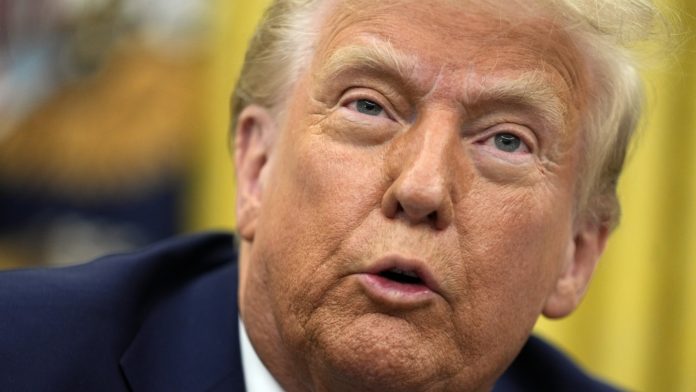
President Donald Trump talks to reporters as he signs executive orders in the Oval Office of the White House on Jan. 23, 2025, in Washington.

Ben Curtis/AP


hide caption

toggle caption

Ben Curtis/AP

WASHINGTON (AP) — A federal judge on Friday largely blocked sweeping executive orders from President Donald Trump that seek to end government support for programs promoting diversity, equity and inclusion.

U.S. District Judge Adam Abelson in Baltimore granted a preliminary injunction blocking the administration from terminating or changing federal contracts they consider equity-related.

Abelson found that the orders likely carry constitutional violations, including against free-speech rights.

Trump signed an order his first day in office directing federal agencies to terminate all “equity-related” grants or contracts. He signed a follow-up order requiring federal contractors to certify that they don’t promote DEI.

The White House didn’t immediately return a message seeking comment Friday evening.

The plaintiffs — including the city of Baltimore and higher education groups — sued the Trump administration earlier this month, arguing the executive orders are unconstitutional and a blatant overreach of presidential authority. They also allege the directives have a chilling effect on free speech.

“What’s happening is an overcorrection and pulling back on DEI statements,” attorney Aleshadye Getachew said during a nearly three-hour hearing Wednesday.

The Trump administration has argued that the president was targeting only DEI programs that violate federal civil rights laws. Attorneys for the government said the administration should be able to align federal spending with the president’s priorities.

“The government doesn’t have the obligation to subsidize plaintiffs’ exercise of speech,” said Justice Department attorney Pardis Gheibi.

Abelson, who was nominated by Democratic President Joe Biden, agreed with the plaintiffs that the executive orders discourage businesses, organizations and public entities from openly supporting diversity, equity and inclusion.

“The harm arises from the issuance of it as a public, vague, threatening executive order,” he said during the hearing.

Abelson’s ruling does allow for the attorney general to investigate and prepare a report on DEI practices in accordance with one of the orders, but it blocks enforcement.

In his written opinion, Abelson found reason to believe the orders are unconstitutionally vague, leaving federal contractors and grant recipients with “no reasonable way to know what, if anything, they can do to bring their grants into compliance.”

He described a hypothetical scenario where an elementary school received Department of Education funding for technology access and a teacher used a computer to teach about Jim Crow laws. Or if a road construction grant covered the cost of filling potholes in a low-income neighborhood instead of a wealthy neighborhood, “does that render it ‘equity-related’?” the judge asked.

Efforts to increase diversity have been under attack for years by Republicans who contend the measures threaten merit-based hiring, promotion and educational opportunities for white people. However, supporters say the programs help institutions meet the needs of increasingly diverse populations while addressing the lasting impacts of systemic racism.

Their purpose was to foster equitable environments in businesses and schools, especially for historically marginalized communities. Although researchers say DEI initiatives date back to the 1960s, more were launched and expanded in 2020 during increased calls for racial justice.

Attorneys for the plaintiffs argued in their complaint that Trump’s efforts to abruptly end such programs will cause widespread harm, not least because of the vague language in his executive orders.

“Ordinary citizens bear the brunt,” they wrote. “Plaintiffs and their members receive federal funds to support educators, academics, students, workers, and communities across the country. As federal agencies make arbitrary decisions about whether grants are ‘equity-related,’ Plaintiffs are left in limbo.”

The plaintiffs include the city of Baltimore, which receives federal funds for public safety, housing, the environment, infrastructure and more, according to the complaint.

Baltimore Mayor Brandon Scott, who won reelection last year, has championed efforts to increase opportunities for the city’s most vulnerable residents, including people of color. Scott became the subject of racist attacks online last year as some commenters labeled him a “DEI mayor,” and he recently coined the phrase “Definitely Earned It” to highlight the accomplishments of Black figures throughout history.

In addition to the mayor and the Baltimore City Council, the plaintiffs include the National Association of Diversity Officers in Higher Education, the American Association of University Professors and the Restaurant Opportunities Centers United, which represents restaurant workers across the country.

Their attorneys claim the groups are already suffering the effects of the executive orders as Trump encroaches on the powers of Congress and seeks to suppress views he doesn’t agree with.

“But the President simply does not wield that power,” they wrote in the complaint. “And contrary to his suggestions otherwise, his power is not limitless.”

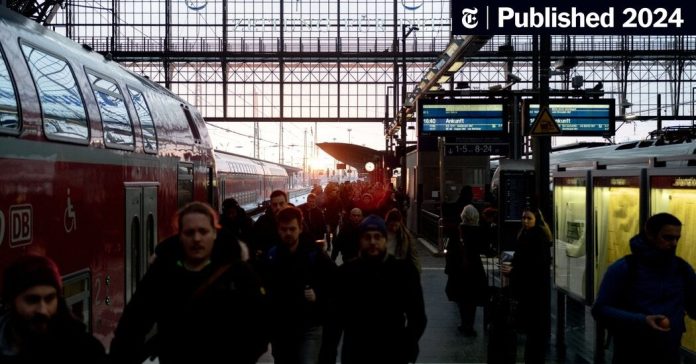
When Germany Votes, It Will Be About the Economy

0

When German voters go to the polls on Sunday, the fate of companies like SKW Piesteritz will be at the top of their minds. The chemical factory halved its annual Christmas bonus for workers last year, and it just shut down one of its two ammonia plants.

Hammered by high energy costs and what they call excessive German regulation, executives say they might be forced to move production abroad. That would jeopardize 10,000 jobs in and around the small community of Lutherstadt Wittenberg in the country’s economically depressed eastern region, which has already been hurt by pullbacks at the company.

“It is a catastrophe,” said Torsten Zugehör, the local mayor.

The German election has in part focused on hot-button issues like immigration and more recently on the threat to the Atlantic alliance presented by President Trump. But the overriding concern in daily German life, according to interviews and polls, and the thing most likely to drive the choice of voters, is the nation’s anemic economy.

Business executives, workers and politicians alike agree that the next German chancellor must move quickly to repair the country’s ailing industrial sector, or risk economic and political disaster for years to come.

German competitiveness, long a source of national pride, “was never as bad as it is today,” said Petr Cingr, chairman of the board of SKW, which makes products such as fertilizers and an additive for diesel motors.

The German economy has not grown in five years. Its once-powerful industries are suffering through what corporate and labor leaders call a crisis of competitiveness. Structural problems, including crumbling public infrastructure, from bridges and roads to schools; a lack of high-speed broadband networks; and public services that still work with paper have dragged on growth. So have regulations, tax rates and, in particular, high energy costs.

Energy prices spiked when Russia invaded Ukraine in 2022. They have fallen slightly since, but remain nearly 20 percent higher than the European average, according to Eurostat. Company leaders say measures from Berlin and Brussels that are meant to reduce fossil fuel emissions and combat climate change have exacerbated the problem.

Increasing competition from China, which is able to produce machinery and other industrial products more cheaply than German firms, and the looming threat of tariffs from the United States have added to the pressure on Germany’s industry.

BASF, the world’s largest chemical company, has already begun closing its factories in Germany and shifting production to China and the United States.

SKW fears it could be next.

“If this becomes a permanent loss-making operation, then we can’t rule out the possibility that some of the production will be relocated to France, to Austria,” said Carsten Franzke, the company’s head of operations.

The leading candidates for chancellor have all promised changes to jolt growth. Olaf Scholz, the incumbent chancellor from the Social Democrats, has pledged to increase government spending in targeted industries. Posters across the country cast him as the “Made in Germany” candidate.

The favorite to supplant Mr. Scholz, Friedrich Merz of the Christian Democrats, has promised to slash regulation — including scaling back some climate goals — reduce taxes and build new advanced nuclear fusion reactors in a bid to push energy costs down.

“Germany is stuck in stagnation,” Robert Habeck, the economic minister and the chancellor candidate for the Green Party, said late last month.

Not all the economic news is grim. Even as Germany’s traditional industries, such as auto manufacturing, are suffering, the country has seen its service sector expand in recent years. The unemployment rate is low, at 3.2 percent, and some economists point out that the country has experienced industrial ups and downs before.

“Germany has repeatedly experienced phases of deindustrialization,” said Marcel Fratzscher, president of the German Institute for Economic Research. He pointed to the textile industry that disappeared in the 1970s and the electronics industry a decade later. “For the companies and employees affected, it was difficult, but Germany came back stronger in other sectors,” he said.

SKW operates in multiple European countries. But since its founding in 1993, the company, which sits on the Elbe River, has focused on tailoring its products to meet the needs of local farmers.

“We live and die with Germany and Europe,” Mr. Frantzke said.

Lutherstadt Wittenburg lives and dies, for now, with SKW. Aside from its tax bill, the company has opened its on-site day care and medical center to the public. It has donated money for playgrounds, sports teams and local events. Area firefighters train with the factory fire brigade. The company sponsors the local high school prom.

It has stopped new donations this year, and its lack of profits means it will not pay local business taxes. City officials say they will need to cut spending on sports and culture to balance this year’s budget.

If SKW relocated operations, there is no other industry to replace it, said Mr. Zugehör, the mayor. Many of the well-educated, highly skilled workers and their families would leave, gutting a region that has spent the past three decades working to create an attractive standard of living, he said.

“We would not be able to compensate for the loss,” he said.

One of those at risk of leaving would be Valentin Koch, 27, who arrived seven years ago from the western region of Rhineland Palatinate, because he saw more opportunities to find a good job and build a life here. He got a job at SKW and has worked his way up, becoming a plant operator and deputy shift manager.

His hope had been to spend the next two to three decades at the company, but he fears that might not be possible much longer.

Mr. Koch said he was able to handle the unexpected drop in last year’s Christmas bonus, despite having recently purchased his first home. But not everyone was so lucky.

“I know some people who counted on that, who calculated their loans on the bonus payments,” Mr. Koch said. “That makes people more worried. And it all depends on politics.”

Many companies, including SKW, say government directives have raised their costs and hurt profits, especially those aimed at meeting Germany’s ambition to be carbon neutral by 2045. Mr. Franzke hopes that a new government will grant companies more freedom and flexibility to reach carbon neutrality, including by using technologies the government has not championed.

Asked about his preferred future government, Mr. Franzke praised the Christian Democrats. He was on his way last week to personally deliver a letter with industry recommendations for the economy to Mr. Merz, ahead of a campaign rally.

“We hope that at some point common sense will prevail and that competition will reassert itself in Germany,” Mr. Franzke said.

Mr. Koch was also hopeful, but he was less sold on Mr. Merz. A few days before the election, he said he still had not decided which party to back.

“It’s difficult,” he said. “It’s really difficult.”

Trump fires chairman of the Joint Chiefs of Staff Gen. Charles Q. Brown Jr. : NPR

0

U.S. Air Force General Charles Brown testifies during his confirmation hearing on July 11, 2023.

Alex Wong/Getty Images


hide caption

toggle caption

Alex Wong/Getty Images

President Trump has fired the chairman of the Joint Chiefs of Staff, Air Force Gen. Charles Q. Brown Jr., and announced he will nominate a retired three-star general to succeed him as the nation’s top military officer.

Trump announced Brown’s dismissal in a post Friday on TruthSocial, in which he thanked Brown “for his over 40 years of service to our country,” and called him a “fine gentleman and an outstanding leader.” Brown, a former combat pilot, rose to become the first Black man to lead a branch of the military as Air Force chief before he was nominated by former President Joe Biden as chairman of the Joint Chiefs in 2023.

Trump said he would be nominating Air Force Lt. Gen. Dan Caine to succeed Brown.

“General Caine is an accomplished pilot, national security expert, successful entrepreneur, and a ‘warfighter’ with significant interagency and special operations experience,” Trump wrote, adding that Caine “was instrumental in the complete annihilation of the ISIS caliphate.”

The announcement came amid a broader shake-up underway at the Pentagon, part of a dramatic attempt by the Trump administration to restructure the federal workforce and slash government spending. The Pentagon announced Friday that it plans to fire approximately 5,400 probationary workers beginning next week. The Pentagon has also proposed cutting 8% of its budget in each of the next five years — amounting to some $50 billion each year.

Gazans Returning Home to Jabaliya Embrace Reopened Market

0

When people talk about which parts of the Gaza Strip have been most devastated in the war, Jabaliya nearly always comes up.

A town in the north of the enclave, Jabaliya was once home to some 116,000 people. But many fled south after the Israeli military launched its assault on Hamas, in retaliation for the militant group’s deadly attack on Israel on Oct. 7, 2023.

By the time the war was nearing its first anniversary, The New York Times calculated that four out of five structures in Jabaliya had been damaged or destroyed. And Israeli forces, which describe the town as a stronghold for Hamas, bombarded Jabaliya many more times since.

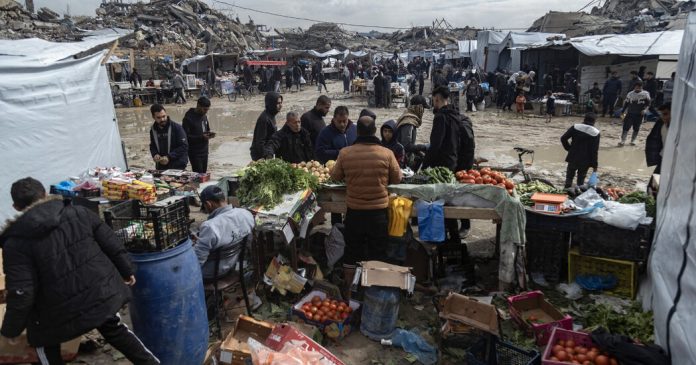
The photograph above was taken late in the morning of Feb. 13, a little more than three weeks into the first phase of a cease-fire that allowed food and other supplies to flood into Gaza, easing its humanitarian crisis.

The combat in Jabaliya had for months mostly prevented market vendors there from selling their wares, but as displaced Gazans returned, so did the stalls. Residents came home to an unrecognizable landscape, with craters sunken into the earth where many homes had once stood. They looked for their dead, and salvaged what they could from the ruins.

At the market that morning the talk was largely of survival. Questions mixed in the air with the smells of sewage and dust kicked up by bulldozers. Where could you find water? How about gas, and tents? How did you apply for aid? Most ominously, was the fighting truly over?

But few of those making their way around the reopened marked could ignore the tables around them, laden with fruit and vegetables after so many months of want. The townspeople, at least those who had a little money, ate voraciously.

Federal judge hears arguments to decide the future of Trump’s federal funding freeze : NPR

0

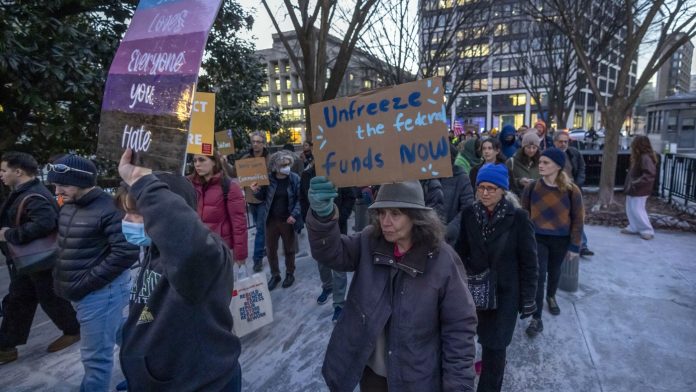
People protest near the White House in Washington on Jan. 28. against a funding freeze of federal grants and loans following a push from President Trump to pause federal funding.

Ben Curtis/AP


hide caption

toggle caption

Ben Curtis/AP

A federal judge in Rhode Island heard arguments on Friday about whether to further block the Trump administration from freezing trillions of dollars in federal grants and other spending.

It’s the latest development in a lawsuit brought by Democratic attorneys general in 22 states and the District of Columbia, who argue that the freeze is unlawful and would have devastating consequences nationwide. The White House, in turn, has said the pause is necessary to review federal funding and ensure spending aligns with President Trump’s priorities.

The funding freeze had already been blocked by U.S. District Judge John McConnell Jr. last month through a temporary restraining order. Two weeks later, McConnell ruled that the Trump administration was not in compliance with the court order after plaintiffs presented examples of federal funds that were still being delayed or inaccessible.

On Friday, McConnell said he would leave the temporary restraining order in place, but that he hoped to have a final ruling on the case in about a week.

The case represents a pivotal test for the administration, as it pursues a dramatic restructuring of the federal workforce and government spending. The White House has faced legal challenges on multiple fronts in response to that effort, several of which have resulted in orders to restore funding — at least temporarily. Yet the administration has sought to maneuver around orders, as in the Rhode Island case and a case dealing with funding of the U.S. Agency for International Development.

The arguments

At stake in Friday’s arguments was the fate of countless programs and projects touching on everything from healthcare and child care, to food assistance, education and other areas that rely on federal money. A similar suit filed by a group of nonprofits is also playing out in Washington, D.C.

The plaintiffs began their argument by describing what they said was the harm and chaos triggered by the spending freeze as it was first spelled out last month in a memo by the Office of Management and Budget. The White House rescinded the memo after an initial uproar and wave of confusion, but later said its efforts to review spending would continue.

During arguments, Sarah Rice, deputy chief with the Rhode Island Attorney General’s office, pointed to the example of California, which she said was expecting about $200 million for Medicaid on the night of Jan. 27 when the memo came out.

“They did not get it,” Rice claimed. “They would not have been able to operate beyond January 28th if that funding [had] not been turned back on.”

Rice later argued that many states are unable to afford to make up for lost federal funds, meaning programs that heavily rely on them would simply shut down if the pause were to become permanent.

The plaintiffs also sought to push back against the sweeping nature of the spending freeze, arguing that such a move was done without discretion and is unconstitutional.

Rabia Muqaddam with the New York State Attorney General’s office said that refusing to disperse congressionally appropriated funds is a violation of the separation of powers.

Daniel Schwei, an attorney with the Department of Justice representing the Trump administration, argued that the freeze is within the president’s authority and that the Office of Management and Budget has emphasized in guidance that agencies cannot pause money that’s legally required.

At times, Schwei faced skeptical questions from the judge. Early into his arguments, McConnell asked Schwei outright, “Where does the president’s power to issue that kind of categorical freeze come from?”

Schwei answered, “We’re not claiming that power. We’re saying that the agency actions here tell agencies to follow the law, but if the law gives you the discretion to pause, then you should pause these types of funding.”

McConnell pushed back that the Trump administration did not initially frame it that way, to which Schwei disagreed.

Schwei went on to say that both sides in the case agree there are lawful ways to pause funding. “So the question is just how big is that universe versus how big is the universe of mandatory programs where a pause would not be lawful?” he added.

He argued the plaintiffs should have focused on identifying specific funding streams where a pause would have been unlawful, instead of making a broad accusation of illegality.

Did the Covid-19 Pandemic Change How You Travel? Let Us Know.

0

Those dark days began almost five years ago.

On March 11, 2020, the World Health Organization declared Covid-19 a pandemic, and four days later, U.S. states began to order shutdowns and travel restrictions.

By the end of the month, the European Union had barred nonessential travel from outside the bloc, cruise ships were under a no-sail order in U.S. waters and state governors had issued stay-at-home orders to prevent the spread of the virus. Nonessential travel would be frozen for months.

After Covid vaccines became widely available in the spring of 2021, travel began to rebound, albeit with face coverings mandatory on planes and in transportation hubs. As the masks slowly came off and borders reopened, travelers sought to make up for lost time, a phenomenon known as “revenge travel.”

The freeze quickly turned into a flood as hot spots like Venice, Iceland, Barcelona and Dubrovnik, Croatia, filled with visitors. A dearth of tourism suddenly became overtourism, and many destinations started enacting restrictions and charging fees to dissuade the hordes.

The last five years have been quite a roller coaster. We want to hear how those ups and downs have affected your relationship with travel.

We will read every response to this questionnaire and reach out if we are interested in learning more about your story. We won’t publish any part of your response without following up with you first and verifying your information. And we won’t share your contact information outside the Times newsroom or use it for any reason other than to get in touch with you.