Friday, November 13, 2026
Home Blog Page 198

Federal agencies like HHS and USDA reverse some layoffs : NPR

0
Demonstrators hold signs including one reading "stop firing us."

Demonstrators rally in support of federal workers outside of the Department of Health and Human Services in Washington, D.C. on Friday, amidst a wave of mass layoffs across the federal government.

Mark Schiefelbein/AP


hide caption

toggle caption

Mark Schiefelbein/AP

Thousands of federal workers are losing their jobs as part of the Trump administration’s efforts to drastically downsize the government.

The sweeping cuts are being felt across areas and agencies, from public health to consumer protection to national parks. Staffers at some agencies say the notification process has been chaotic, leaving their employment status and teams’ futures unclear.

To add to the confusion, some employees have received termination notices only to have their firings reversed within days or even hours.

This effort by the informal Department of Government Efficiency (DOGE) — the cross-agency team tasked by President Trump to slash federal spending — is not the first to try to downsize the federal government.

Nick Bednar, an associate professor of law at the University of Minnesota who specializes in executive branch politics, says that what makes this moment different is how quickly and indiscriminately the layoffs are happening.

“The way we’ve traditionally reduced the size of the federal workforce is to take a scalpel and kind of target particular programs where we think there might be bloat,” he said. “This is more like taking a sledgehammer to the entire executive branch.”

A number of agencies appear to be trying to reinstate employees they just fired. That’s been the case for dozens of workers at agencies including the U.S. Department of Energy, the Department of Health and Human Services and the U.S. Department of Agriculture (USDA).

“Part of the problem is that a lot of these political appointees don’t necessarily know what these programs are or what they’re designed to do,” Bednar says. “Things break almost immediately when these employees leave, and so you have to call them back.”

Another contributing factor is likely political pressure from Congress, Bednar says, even if it’s happening behind closed doors. The majority of the federal workforce is located outside of Washington, D.C., and he’s seen that many lawmakers are concerned about their constituents.

But even if agencies are able to reinstate some laid-off employees, they’re not all guaranteed to come back. Bednar says the haphazard layoffs process has done “damage to the reputation of the federal government as an employer” that might leave longtime civil servants looking to the private sector instead.

“You don’t feel comfortable or secure in your position if you’re laid off one day and then told, ‘Oh, never mind, we figured out you’re actually an important part of our team,’ ” he adds. “And you’re left wondering, ‘Well, at what point will you decide that I’m no longer important?’ “

He says it’s also jarring for the broader public to watch this back and forth happen, especially since so many people don’t have a nuanced understanding of how federal agencies work in the first place. The patchwork of terminations and reversals further “suggests something about mismanagement of government,” he adds.

Billionaire Elon Musk, who effectively oversees DOGE, has defended the administration’s work but acknowledged that it’s imperfect.

“We are moving fast, so we will make mistakes, but we’ll also fix the mistakes very quickly,” he said last week.

Here’s a look at some of the agencies involved.

Hundreds of Indian Health Service workers got their jobs back

Approximately 950 Indian Health Service (IHS) employees were told they would receive layoff notices last Friday, IHS Public Affairs Director Nicole Adams told NPR.

But their jobs were quickly saved after newly-confirmed Health and Human Services Secretary Robert F. Kennedy Jr. rescinded the layoffs via phone calls later that day, Adams confirmed.

In a statement shared with NPR, Kennedy said American Indians “suffer the highest level of chronic disease of any demographic” and promised that “IHS will be a priority over the next four years.”

“The Indian Health Service has always been treated as the redheaded stepchild at HHS,” Kennedy said. “My father often complained that IHS was chronically understaffed and underfunded. President Trump wants me to rectify this sad history.”

The National Indian Health Board, a nonprofit based in D.C., said on Facebook that while Kennedy’s intervention is “something to celebrate,” layoffs at other agencies — including the Department of the Interior, the Bureau of Indian Affairs and the Bureau of Indian Education — are still cause for concern.

“The services these organizations provide to Tribes are non-negotiable, and were secured by our ancestors through trusts and treaties,” it wrote. “Tribes have long advocated for these programs, and these layoffs not only undermine the promises our ancestors made, but also put lives at risk.”

Whiplash for nuclear weapons workers 

Last week wrought days of chaos at the National Nuclear Security Administration (NNSA), a civilian agency within the Department of Energy that oversees the U.S. nuclear weapons stockpile.

After being told they would not get an exemption for national security purposes, officials were given hours to fire more than 100 employees. Workers were abruptly shut out of their government email accounts and told to clear out their desks on the spot, as NPR has reported.

NPR spoke to several employees who were involved in the NNSA terminations and rehirings. They asked to remain anonymous because they currently serve in the federal government and are not authorized to speak to the press.

Those who were fired spent Friday worrying about what to do next. “That mental game was horrible,” says one NNSA employee who received a termination notice.

On Capitol Hill, lawmakers were incensed about the firings, given the sensitive nature of the agency’s work, which includes making safety and security upgrades to nuclear warheads, overseeing emergency response plans at nuclear storage facilities and trying to prevent terrorists from acquiring weapons-grade plutonium and uranium.

Behind the scenes, pressure built on Energy Secretary Chris Wright to reverse the terminations. By Saturday, many employees were rehired, without explanation.

“I think they were, like, ‘Oopsie, let’s just say you didn’t work Friday,’ ” said another NNSA employee who watched the firing process unfold.

According to an NNSA statement sent to NPR on Sunday, fewer than 50 employees were ultimately dismissed. The employee who watched the firing process said the number of people permanently terminated was around half that number.

“I probably moved a little too quickly there,” Wright told Scripps News on Wednesday. “When we made mistakes on layoffs at NNSA, we reversed them immediately — less than 24 hours.”

For the dozens who were terminated and rehired, though, things have changed.

“When we lose people and people are on edge, they get disheartened,” the fired and rehired employee told NPR, predicting that the work of the nuclear agency is likely to slow as a result.

A hydropower agency rescinds dozens of firings

Power lines from Bonneville Dam head cross the Columbia River in North Bonneville, Wash.

Power lines from Bonneville Dam head cross the Columbia River in North Bonneville, Wash. The Bonneville Power Administration is cutting several hundred jobs.

Don Ryan/AP


hide caption

toggle caption

Don Ryan/AP

The Bonneville Power Administration (BPA) — a nonprofit federal power marketing administration within the Department of Energy, headquartered in Portland, Oregon — is also reversing some job cuts.

Oregon Public Broadcasting reported that the BPA is bringing back 30 employees it fired last week, citing multiple sources familiar with the agency’s operations. They asked not to be named out of fear of retaliation from the current administration.

BPA, one of four federal power marketing administrations in the country, distributes hydropower from 31 federal dams and operates 75% of the Northwest’s power grid.

Some 130 of BPA’s more than 3,000 employees were notified of their dismissal last week as part of the administration’s downsizing push.

But 30 probationary workers were later brought back because, according to a senior official at BPA, they did “mission critical work” to manage power across the Pacific Northwest.

Even so, many more jobs are still being eliminated, the same official said: The 100 other probationary employees are still fired, another roughly 240 resigned in exchange for a buyout and 90 job offers were rescinded due to the administration’s federal hiring freeze.

USDA moves to bring back its bird flu staff

Days after touting “an aggressive plan to optimize its workforce,” the USDA confirmed it is trying to reverse the terminations of an unspecified number of staffers who had been working on the federal government’s response to the highly pathogenic avian influenza (HPAI).

“Although several positions supporting HPAI were notified of their terminations over the weekend, we are working to swiftly rectify the situation and rescind those letters,” an agency official speaking on the condition of anonymity told NPR on Wednesday.

The widespread H5 bird flu has caused outbreaks in poultry and dairy cows, sending egg prices skyrocketing and infecting more than 60 people in the U.S.

The Centers for Disease Control and Prevention — which was also hit by layoffs — considers the current public health risk low, but continues to monitor its spread. The USDA says it will continue to prioritize its response to the outbreak.

“Several job categories, including veterinarians, animal health technicians, and other emergency response personnel have been exempted from the recent personnel actions to continue to support the HPAI response and other animal health priorities,” the official added.

Uncertainty at the VA 

Lawmakers speak at a rally outside the Department of Veterans Affairs headquarters in Washington, DC.

Sen. Amy Klobuchar, D-Minn., and other lawmakers speak at a rally outside the Department of Veterans Affairs headquarters in Washington, D.C. on Thursday.

Al Drago/Bloomberg via Getty Images


hide caption

toggle caption

Al Drago/Bloomberg via Getty Images

The Department of Veterans Affairs announced the dismissal of 1,000 employees last week, a move it said would save some $98 million annually. It said many of those laid off were probationary employees who were not covered by a collective bargaining agreement, while “mission-critical positions” were exempt.

Even so, the mass layoffs — at an agency already battling severe staffing shortages — prompted concerns from lawmakers on both sides of the aisle, including many current and former members of the House Veterans’ Affairs Committee.

Ranking Member Mark Takano, D-Calif., said in a statement that the fired employees include “100% service-connected disabled veterans, military spouses, and critical medical researchers who have devoted their careers to improving veterans’ lives.”

“These dismissals will have far-reaching consequences — not only for the now-unemployed workers and their families but also for the quality of care our veterans receive,” he added.

Some Democratic lawmakers have said publicly in recent days that the layoffs included employees who worked on the Veterans Crisis Line, a 24/7 support line for service members, veterans and their loved ones.

“DOGE needs to hear this: firing people — like USDA workers tracking bird flu and VA workers answering the Veterans Crisis Line — and then rehiring them is deeply inefficient,” tweeted Rep. Sara Jacobs, D-Calif.

Sen. Tammy Duckworth, D-Ill., told CNN on Wednesday that roughly a dozen of the VA employees laid off had worked on the Veterans Crisis Hotline, and at least two of those employees had since told her office they were being rehired.

VA press secretary Peter Kasperowicz told NPR on Thursday that no Veterans Crisis Line responders have been laid off, but did not elaborate on whether any had been fired and rehired.

This week, a group of 36 Democratic senators released a letter calling on the VA to reinstate all 1,000 employees and commit to no future “widespread terminations” without detailed justification and notifying Congress in advance.

NPR’s Geoff Brumfiel contributed reporting.  

Chinese Navy Drills in Tasman Sea Unnerve Australia and New Zealand

0

Chinese warships that have been sailing south along the eastern coast of Australia gave notice on Friday of their intent to conduct live fire exercises in international waters between Australia and New Zealand, forcing commercial flights to divert and putting the two countries on edge.

The three naval vessels, which include one of the most powerful warships in the Chinese navy’s fleet, were outside Australia’s exclusive economic zone when the drills took place, Prime Minister Anthony Albanese of Australia told reporters.

The ships were first detected in the region last week, according to Australian officials.

While the Chinese vessels appeared to have acted in accordance with international law, the Australian and New Zealand militaries were closely monitoring them, Mr. Albanese said. He said it was not immediately clear what, if any, live fire drills were conducted Friday.

Analysts have said that the unannounced presence of the warships near Australian territorial waters — thousands of miles away from the Chinese mainland — was a show of force.

In Beijing, a spokesman for China’s foreign ministry described the actions of the ships as “far seas exercises.” They were organized by the People’s Liberation Army’s Southern Theater Command, which also oversees the navy’s activities in the South China Sea.

“The drill was carried out in a safe, standard and professional manner in accordance with relevant international law and international practice,” the spokesman, Guo Jiakun, said.

Airservices Australia, which manages air traffic in the region, said in a statement that it had advised airlines and radioed pilots with planned flights to avoid parts of the Tasman Sea “as a precaution.”

Australia’s foreign minister, Penny Wong, said that she was concerned about the lack of “transparency” in relation to the exercises and the notice given Friday, and said she would raise it with her counterpart, Wang Yi. They were scheduled to meet later Friday at the G20 meeting in South Africa.

The ships, a guided missile cruiser, a frigate and a supply vessel, were first detected off Australia’s northeast coast last week. This week, they passed through waters about 150 nautical miles from Sydney, well outside Australia’s territorial waters but inside its exclusive economic zone.

Australian officials have stressed that the Chinese ships have been traversing regional waters legally, but that they were closely monitoring their movements.

Li You contributed research.

Senate adopts budget resolution after marathon vote-a-rama. Now what? : NPR

0

Workers bring boxes of pizza into the U.S. Capitol ahead of a Senate “vote-a-rama” on Feb. 20, 2025 in Washington, D.C.

Kayla Bartkowski/Getty Images


hide caption

toggle caption

Kayla Bartkowski/Getty Images

The Senate passed its budget resolution early on Friday, which acts as a framework to implement President Trump’s legislative agenda. It would provide $175 billion for border security and $150 billion in military funding.

The Senate’s adoption is an early step in the process, which requires detailed work by committees to work out the details of spending, as well as of any offsets to help pay for the additional funds.

The budget resolution is at odds with the House’s approach, and both chambers ultimately have to be on the same page to get the legislation across the finish line.

Kentucky Sen. Rand Paul was the only Republican who did not vote for the Senate’s resolution. He said he opposed a measure adding more than $300 billion to the deficit and argued instead Congress should be voting to approve more spending cuts.

The adoption of the Senate resolution came after an overnight vote-a-rama: a marathon voting session on amendments that are non-binding but aimed at forcing lawmakers from both parties to go on the record about potentially contentious issues.

The vote-a-rama was a rare opportunity for Democrats as the party in the minority to bring legislation to the floor. Democrats used the vote-a-rama to try to force votes on preventing tax cuts for billionaires and opposing cuts to Medicaid, the federal-state health insurance program for those with low incomes.

GOP Sens. Susan Collins of Maine and Josh Hawley of Missouri supported a Democratic amendment that ultimately failed, that would have blocked tax cuts for the wealthy if any Medicaid funding were to be cut.

The Senate forged ahead with its plan to vote on the budget resolution despite President Trump coming out earlier in the week to share his preference for the House’s strategy.

Both chambers have been at odds for months over the best way to implement the president’s agenda on securing more resources for the southern border and extending the tax cuts passed in the first Trump administration.

The Senate wants to tackle the border, military spending and energy policy sooner rather than later —– and proposes a second bill later this year to address tax cuts. The House, concerned that getting its fractious conference on board with two bills is too precarious, wants to address all the priorities in one big bill.

On Thursday, Trump thanked the Senate for its efforts to fund his border agenda.

“Your work on funding this effort is greatly appreciated!” he wrote.

House Majority Leader Steve Scalise plans to bring up the House’s budget resolution to the floor next week. Whether it can pass quickly is another story.

In order to appease members of the Freedom Caucus, House GOP leaders made adjustments to their resolution that would direct up to $2 trillion in spending cuts, with a large chunk likely coming from Medicaid.

Both chambers are using the budget resolution as part of a process called reconciliation — a budget tool that will enable Republicans to pass large swaths of Trump’s agenda without any Democratic support. Importantly, both chambers ultimately need to pass the same resolution.

The 2017 tax cuts that Congressional Republicans want to renew expire at the end of 2025 — a looming deadline for both chambers.

NPR’s Deirdre Walsh contributed to this report.

As Russia Talks Peace, Moscow Threatens New Ukraine Region

0

As the United States and Russia begin talks to end the war, Moscow is pressing its advantage on the battlefield by closing in on Dnipropetrovsk, one of Ukraine’s largest regions and one with a major industrial base. Russian troops are now less than three miles from the region’s border, and they have been pushing forward in recent days.

Should the Russian Army cross from the eastern Donetsk region into Dnipropetrovsk, it would deal a big blow to morale in Ukraine — marking the fifth region to face partial Russian occupation and expanding Moscow’s control over the war-torn country. It could also complicate Kyiv’s position in territorial negotiations that might arise during peace talks.

The Russian advance has already reshaped the landscape of Dnipropetrovsk’s border area, once a quiet expanse of rolling fields and small villages. Now, trenches and anti-tank ditches line roads where convoys of armored vehicles pass. Tanks are concealed in tree lines. In villages closest to the front, soldiers have taken over buildings damaged by bombing or abandoned by locals.

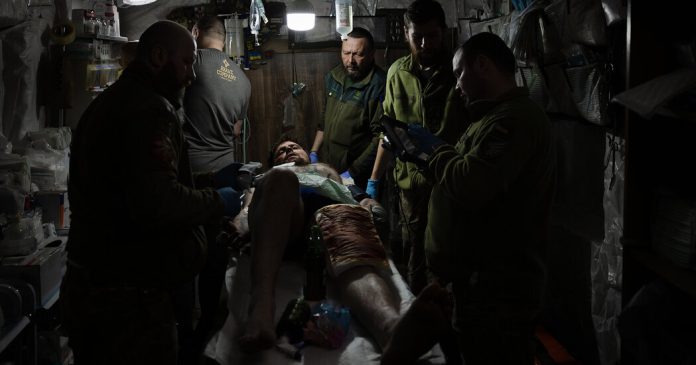
The Ukrainian backpedaling can be seen in the westward relocation of the aid station where medics of the 33rd Mechanized Brigade treat wounded soldiers. Late last year, they retreated three times in as many months, hauling medical beds and blood banks in trucks with them.

The medics never thought they would be forced to entirely abandon Donetsk, an area where their unit had fought for a year, and retreat over its western boundary into Dnipropetrovsk.

Earlier this year, that became a reality. Now, the medics fear Moscow’s troops will soon follow.

“It always happens this way,” said Lt. Vitalii Voitiuk, head of the brigade’s medical unit. “When medical units start moving into an area, it means the front line isn’t far behind.” He was speaking at his new aid station near the frontline where injured soldiers receive lifesaving care before being sent to a hospital farther behind the lines.

Outside the aid station, the distant rumble of outgoing artillery fire echoed through the night. “That alone tells you the war is getting closer,” said Mr. Voitiuk, a burly 34-year-old.

Civilians, too, are bracing for the fight. Some have already evacuated — including those who fled the war in the east earlier and do not want to be caught in the violence again — while others are making plans to relocate.

“When we read the requests to evacuate people from Dnipropetrovsk, it felt terrifying,” said Bohdan Zahorulko, a worker at East SOS, a Ukrainian nongovernment organization helping internally displaced people. “But it was also a wake-up call about the reality of the fight.”

Russia’s push toward Dnipropetrovsk, an area of more than three million people with major steel mills, builds on six months of rapid advances in Donetsk. Since August, its troops have captured an average of about 180 square miles of territory each month in Ukraine, nearly four times the size of San Francisco, according to the Black Bird Group, a Finland-based research company. Most of those gains were in Donetsk.

In recent weeks, Russia’s advance has slowed. Franz-Stefan Gady, a Vienna-based military expert who recently returned from a research trip in eastern Ukraine, attributed the slowdown to bad weather hindering Russian mechanized assaults and airstrikes. He also noted Ukraine’s effective use of drones to hit troops and armored vehicles.

“But drones can’t hold territory,” said Lt. Col. Vadim Balyuk, commander of the Shkval Special Forces Assault Battalion in Ukraine’s 59th Brigade. Speaking from a small wooden house in the border area, where he monitors live battlefield footage on screens, he said his unit’s job is to do what drones cannot: secure control of villages and clear a path for Ukrainian infantry to move in.

Colonel Balyuk said his unit had recently cleared two settlements of Russian forces, which could have been used to support their push toward Dnipropetrovsk. But he had no illusions that the fight was over. “The enemy is just regrouping now,” he said.

Soldiers returning from the Donetsk front said Ukraine’s biggest battlefield challenge remains unchanged: an enemy whose overwhelming manpower advantage allows for relentless assaults.

Dmytro, a 35-year-old infantryman with a concussion, was evacuated to the 33rd Mechanized Brigade’s aid point one recent night. He described a four-hour trench battle so fierce that he could not lift his head above the parapet to spot attacking Russian troops. But from the incoming fire, he said, he could tell they were advancing in small groups, methodically closing in.

“All the soldiers from my section of the trench were evacuated,” said Dmytro, who declined to give his last name per military rules.

One of the clearest indications of the approaching fighting is a blue and yellow roadside sign marking the entrance to Donetsk from Dnipropetrovsk. Over three years of war, the site has become a symbol of Ukraine’s resistance, with soldiers heading to battle signing and putting up Ukrainian flags around it. But now, with the front line just 12 miles away, the sign has been draped in a large net to protect it from drone strikes.

In Mezhova, a small town in Dnipropetrovsk standing in the path of the Russian advance, the number of soldiers at times appears to outnumber civilians — they queue at the post office and crowd into cafes, and their olive-green pickups line the streets.

The new reality weighs heaviest on refugees who fled the Donetsk region earlier in the war and resettled in Mezhova and nearby settlements. Over the past three years, the population has surged from 14,000 to 21,000 with their arrival.

“For so long, we thought this place was safe,” said Nelia Seimova, who moved to Mezhova in August after escaping Novohrodivka, which is now under Russian occupation. “I had plans — buying a house, getting a job, sending my child to school. A normal life.”

Now, Ms. Seimova, 33, is planning to move again, farther west. She knows from experience not to wait for the town to be hit with regular bombardment. “We’ve been through this before,” she said, tears filling her eyes.

Each day, Mr. Zrazhevsky studies a battlefield map marked with circles indicating which cities are within the range of the bombs as Russian forces advance. For now, Mezhova is safe. “But we understand that if it happens — and it will at some point — we’ll need to take drastic measures,” he said, possibly mandatory evacuations.

Lists from East SOS, the group assisting refugees, show that some Mezhova residents have already started evacuating. On a recent afternoon in Pavlohrad, a city in Dnipropetrovsk where the group has set up a transit center, refugees who had just been evacuated from towns and villages near the Dnipropetrovsk-Donetsk boundary streamed in.

All were bleary-eyed and some had faces streaked with soot from weeks of burning firewood to keep warm after attacks knocked out the power grid. Among them were elderly women bundled in thick woolen scarves, children in puffer coats and their parents in tears, uncertain of what the future would hold.

Some in Ukraine believe the Trump administration’s push for peace talks might freeze the front line, stopping the Russian advance. Mr. Zrazhevsky, the mayor of Mezhova — which means “border line” in Ukrainian — clings to the hope that a cease-fire will spare his town from evacuation and turn it instead into the new “eastern capital of Ukraine.”

Mykhailo Afendikov, 52, who recently fled Komar, a village in Donetsk, after a glide bomb destroyed his home, struck a more somber tone. Even if the Russians do not capture Komar, he said, “Where can I go back to? There’s no house left.”

The Man Who Broke Germany’s Government Wants a Chance to Fix It

0

It has been a rocky few months for Christian Lindner, and for the German political system that he has thrown into chaos.

In November, Mr. Lindner, who was the federal finance minister, effectively toppled Germany’s fragile government in a bid for his political life. He goaded Chancellor Olaf Scholz into expelling him from the ruling coalition.

That set off a snap election. It means that Mr. Lindner is the primary reason the country will select a new parliament on Sunday, at a time of European and global upheaval in the early weeks of the new Trump administration, and not next fall as originally scheduled.

Mr. Lindner’s move was a bid to save his party, which had slumped in the polls, from its association with an unpopular government. He was trying to avoid a temporary death sentence in federal politics. The question is whether it will work.

In the final week of the campaign, Mr. Lindner and his pro-business Free Democrats remain just under 5 percent of nationwide support in most polls. That is a crucial threshold in German politics. Score above 5 percent, and your party gets into parliament. Fall below it, and you are almost certainly out.

And yet — because of how Germany’s political system is structured — Mr. Lindner retains a chance to play a kingmaker role in the formation of the next government. He just needs to scrape together a little more support, somehow.

“He doesn’t have good cards,” said Stefan Merz, a director at Infratest dimap, a polling firm in Berlin. “But it can’t be ruled out.”

Mr. Lindner is an outlier in German politics, where unflashy, stoic characters abound. He is fond of hunting and sports cars, with an aversion to autobahn speed limits.

Mr. Lindner’s campaign declined interview requests from The New York Times. In an interview last fall with the podcast Hotel Matze, shortly before he initiated the end of the governing coalition, he mused about his fans and detractors alike.

“Those who like you say, ‘The last hope of bourgeois politics in Germany, the last free-market economist in politics,’” Mr. Lindner said. Critics, he added, call him a government debt fetishist, a “neoliberal exploiter and misanthropist.”

“I deal with it in a relaxed manner,” he added.

Mr. Lindner’s grandparents were bakers. His parents divorced when he was a young boy. His mother taught him to prioritize financial independence. From a young age, he yearned to move fast.

A video on YouTube captures a television show for young people recorded in 1997 in which an 18-year-old Mr. Lindner, wearing a suit with a monstrous cow-patterned tie, talks about the advertising business he had started with a friend. It earned him enough to buy his first Porsche by the age of 20.

He was also a political prodigy. Mr. Lindner joined the Free Democrats, or F.D.P., a neoliberal party that favors low taxes on business and high earners — and no speed limits on the highway — at age 16. At age 34, he became the youngest chairman in party history, and he brought it back from the political wilderness.

After failing to win 5 percent of the vote in Germany’s 2013 elections, the Free Democrats spent four years out of parliament. Mr. Lindner brought the party back in 2017, though he pulled out of negotiations to join a ruling coalition with Angela Merkel’s conservative Christian Democrats and the liberal Green Party. “It is better not to govern than to govern wrongly,” Mr. Lindner said at the time.

In 2021, Mr. Lindner helped the Free Democrats score 11 percent of the vote, in part by leading a charge against government restrictions on daily life and economic activity. He joined Mr. Scholz’s Social Democrats and the Greens in a so-called “traffic light” coalition. It was always a troubled partnership, but it worsened as Germany’s economy stagnated and the government’s approval ratings sank.

A fissure opened: Mr. Scholz and the Greens wanted to relax a limit on government borrowing — known as the debt brake — in order to juice economic growth. Mr. Lindner refused.

He also saw ominous signs in the polling. All the ruling parties had lost support, but of the three, only the Free Democrats had slipped below 5 percent. His core of support remains “wealthy entrepreneurs in West Germany,” said Marcel Fratzscher, the president of the German Institute for Economic Research.

Mr. Lindner hatched a plan to collapse the government, in hopes of saving his party. Publicly, it began with a leaked document in which he demanded swift changes from the Green Party’s economy minister, Robert Habeck, and Mr. Scholz.

His requests included tax cuts, regulatory relief and the relaxation of some climate goals that he said were pushing energy prices higher. He was daring Mr. Scholz to fire him. On the day after President Trump won another term in the United States, Mr. Scholz obliged, forcing early elections in the process.

Days later, Die Zeit newspaper revealed that Free Democratic leaders had spent weeks preparing to break with the coalition partners, including drafting a script for it. Mr. Lindner never denied the report. He explained that his party simply was seeking an economic turnaround in order “to make Germany successful again.”

In a blistering statement defending his firing, Mr. Scholz said Mr. Lindner cared only for his base electorate and for “the short-term survival of his own party.”

The ensuing political fallout has been shadowed by the opening weeks of Mr. Trump’s administration, including threats of tariffs on European exports and a pullback of America’s military security blanket that has protected Germany since the end of World War II.

Mr. Lindner has tried frantically to pull the Free Democrats above the 5 percent line. In an early bid to grab attention, he posted on the social media platform X that Germany needed more disruptive thinking like the billionaire Elon Musk has. Mr. Musk instead endorsed a different party — the anti-immigrant Alternative for Germany, or AfD — parts of which have been deemed extremist by German intelligence agencies.

Undaunted, Mr. Lindner continues to preach tax cuts and deregulation, to defend Germany’s constitutional curb on government debt, and to slam his former government partners for their management of the economy.

Mainstream parties have said they will not invite the AfD into a government. So Mr. Lindner’s party may still make a possible coalition partner for the poll-leading Christian Democrats and their chancellor candidate, Friedrich Merz. It could be a valuable one if the returns on Sunday are especially fractured.

But for now, Mr. Merz, who was a guest at Mr. Lindner’s wedding, is not tipping his hand.

As Mr. Lindner hovered a point below 5 percent this month, Mr. Merz was asked in an interview with German media about Mr. Lindner’s Free Democrats. “Four percent,” he said, “is four percent too much.”

Hamas Didn’t Return the Body of Shiri Bibas. What Now?

0

Israel said on Friday that one of the bodies Hamas handed over as part of the cease-fire deal did not belong to an Israeli woman taken hostage in 2023, as the Palestinian militant group had claimed.

The revelation prompted further alarm over the future of the brittle truce and hostage-for-prisoner swap deal between Hamas and Israel. Hamas acknowledged there may have been a mix-up.

Here’s what we know so far.

Hamas said on Thursday that it had handed over the remains of four hostages: Shiri Bibas, 32; her two children, Ariel, 4, and Kfir Bibas, less than a year old; and Oded Lifshitz, 83. All four were kidnapped from Nir Oz, a village near Gaza that was devastated in Hamas’s surprise attack on Israel on Oct. 7, 2023.

For many Israelis, the Bibas family had become emblematic of the brutality of the Hamas attack. Footage of a terrified Ms. Bibas clutching her two children while being led away by Palestinian gunmen has been seared into the Israeli public consciousness.

Hamas asserted that all four hostages were killed in Israeli airstrikes. But Israel said that three of the four returned on Thursday — which were identified through DNA testing as belonging to Mr. Lifshitz and the two Bibas children — had been murdered by their captors.

Daniel Hagari, the Israeli military spokesman, said the Bibas children’s captors had killed them “with their bare hands.” He said Israel had shared the forensic and intelligence findings with its allies.

But neither Israel nor Hamas had yet presented evidence for public scrutiny.

Hamas handed four coffins to the International Committee of the Red Cross in a televised ceremony. Each coffin bore the photo of a captive whose body was supposed to be turned over to Israel, including that of Ms. Bibas.

The display was condemned internationally, including by Volker Türk, the United Nations high commissioner for human rights, who called it “abhorrent and cruel.”

Israeli officials brought the remains to the country’s main forensic institute in Tel Aviv, where three were confirmed to be whom Hamas said they were.

But the fourth was an “anonymous, unidentified corpse,” the Israeli military said early Friday, ruling out that the remains were those of Ms. Bibas.

Israel has called the failure to return Ms. Bibas’s remains a severe breach of the cease-fire. Prime Minister Benjamin Netanyahu vowed that Hamas “would pay the full price for this cruel and vicious violation.”

Hamas acknowledged in a statement “the possibility of a mistake or a mixing up of corpses” and said it would investigate, calling on Israel to return the body. The group said it was committed to moving forward with the cease-fire agreement.

Israel and Hamas were set for another hostage-for-prisoner exchange on Saturday — one that would free six Israeli hostages held in Gaza for a number of Palestinians jailed by Israel. Although Israeli officials expressed outraged over Ms. Bibas’s fate, they seemed eager for the next swap to go ahead as planned.

On Friday, the Hamas-linked Prisoner Information Office said that more than 600 detainees would be released in exchange. They were to include 50 Palestinian serving life sentences for deadly attacks against Israelis and another 60 serving long sentences, the office said.

The rest include more than 400 other Gazans detained during the war were also to be released, the office said. These Gazans had generally been imprisoned without formal charges and were often held incommunicado for long periods.

It was unclear how that exchange would go ahead given Israel’s accusation that Hamas did not uphold its end of the deal.

Even if the swap on Saturday does go forward, big questions hover over the future of the truce, which paused 15 months of devastating fighting in Gaza that killed tens of thousands of Palestinian civilians and combatants.

The first phase of the cease-fire deal expires in less than two weeks, and Israel and Hamas have yet to agree on terms to extend it to a second phase.

Europe Vows to Step Up Baltic Sea Security After a New Cable Break

0

The European Union vowed on Friday to increase security in the Baltic Sea as the Swedish authorities said they were investigating a new cable break, the latest example of damage to underwater infrastructure in the region.

The European Commission, the bloc’s executive arm, said it would take new steps to prevent and detect threats to submarine cables, which carry internet traffic and transmit electricity.

The severing of several undersea cables in the Baltic Sea in recent months has raised concerns that Russia is using the moves to retaliate against NATO countries that have supported Ukraine. Alliance officials have pointed to Russia as a possible culprit, but have said that it is difficult to prove.

“We want to make sure Europe is equipped not only to prevent and detect sabotage to cables, but also to actively deter, repair and respond to any threat to critical infrastructure,” said Henna Virkkunen, the European Union official who announced the initiative. The recent episodes were of “great concern,” she said, adding that the bloc was taking “decisive action” to protect the cables.

The measures, which the bloc said would be rolled out over the next two years, would bolster security and threat-detection in the region, and prioritize funding for new cables. The measures also strengthened enforcement of sanctions and diplomatic measures against what were termed hostile actors and the “shadow fleet.”

NATO has also stepped up its military presence in the area with a new patrol and surveillance operation, called Baltic Sentry, aimed at protecting infrastructure in the sea.

A spokesman for the Swedish police, Mathias Rutegard, declined to comment on the ownership of the latest damaged cable, but it appeared to be the C-Lion1, a major telecommunications line that runs between Finland and Germany, after its Finnish owner, Cinia, said on Friday that it had detected damage. The cable connects the telecommunications networks of Central Europe to the Nordic countries.

The company said in a statement that the damage was minor and that telecommunications were transmitting as normal, but this would be the third time in recent months that the C-Lion1 had been damaged.

It was unclear what had caused the damage. The authorities in Finland said on Friday that they were investigating after the rupture of a sea cable had been discovered two days earlier.

The Swedish police also opened a preliminary investigation, Mr. Rutegard said, because the damage occurred in the country’s Exclusive Economic Zone, an area where Sweden has rights but which is beyond its territorial waters.

Prime Minister Ulf Kristersson of Sweden said on Friday that his government took “all reports of possible damage to infrastructure in the Baltic Sea very seriously.” Such reports, he said, had to be seen in light of the “serious security situation that prevails.”

The Swedish Coast Guard was informed of the cable break on Thursday and was heading to the area off the eastern island of Gotland, Mattias Lindholm, a spokesman for the service, said.

Cinia, which is majority-owned by the Finnish state, said it had asked the Finnish criminal authorities to investigate. Finland’s interior minister, Mari Rantanen, told the Finnish public broadcaster Yle on Friday that the authorities were still waiting for answers, but that “the possibility of an accident is very small.”

Telecommunications using the C-Lion1 cable, which has been in service since 2016, were interrupted in December, Cinia said, a disruption it attributed to a probable cable cut in the Gulf of Finland. Another break that downed services was detected in late November, Cinia said, east of the Swedish island Oland.

The Finnish authorities in December seized an oil tanker suspected of cutting several vital underwater cables and accused it of being part of a Russian “shadow fleet.” Western officials have said they believe Russia has been using such tankers to elude sanctions. Analysts have said that if Russia is also using shadow fleets to sabotage vital infrastructure in Europe, it would be an escalation in Moscow’s conflict with the West.

Sweden, NATO’s newest member, said in January that it was investigating another incidence of damage to an undersea cable running between Sweden and Latvia. The Swedish authorities boarded a cargo ship it suspected of committing “gross sabotage.”

Archaeologists Find a Pharoah’s Tomb, the First Since King Tut, Egypt Says

0

Archaeologists have found a pharaoh’s tomb in an Egyptian valley west of Luxor, Egypt’s ministry of antiquities announced this week, in what officials called the first excavation of a royal tomb since Tutankhamen’s burial chamber was unearthed over a century ago.

The newly identified tomb belonged to Thutmose II, who is believed to have reigned around 1480 B.C. It was “the last missing royal tomb of the 18th Dynasty,” the Egyptian ministry said in a statement.

The excavation was a joint project by Egyptian and British researchers that began in 2022, when the entrance and main corridor of the tomb were found.

The archaeologists at first thought the tomb belonged to a royal consort, because of its location near the burial places of royal wives and that of Hatshepsut, a queen who took the throne for herself after Thutmose II’s death.

The tomb was also in an unlikely place for a king’s burial: beneath two waterfalls and at the bottom of a slope, during the much wetter conditions of the 15th century B.C.

But evidence from within the tomb showed that it had in fact been built for a king, including fragments of alabaster jars naming Thutmose II as the “deceased king,” and inscriptions naming Hatshepsut. Part of the ceiling was still intact, too, showing blue paint with yellow stars on it, which the archaeologists said were only found in king’s tombs.

This image released by Egypt’s Ministry of Antiquities and Tourism shows artifacts uncovered during archaeological excavations that discovered the tomb of King Thutmose II.Credit…via Agence France-Presse — Getty Images

“Sometimes discoveries are made, but only later does their true significance become clear with additional exploration,” said Peter Der Manuelian, a professor of Egyptology at Harvard who was not involved in the excavation.

He noted a similar case when, a few decades ago, a tomb in the Valley of the Kings turned out to be “larger and more unusual than anyone had previously realized.” It turned out to have been built for the many sons of Ramses II, one of the most powerful pharaohs of ancient Egypt.

Thutmose II, Professor Manuelian said, “lived during a fascinating period of Egyptian history: the imperialistic and cosmopolitan 18th Dynasty.” His reign was perhaps overshadowed by those of his father, his son and his queen, who reigned for nearly 20 years and built a major temple and tomb for herself.

“We’re still trying to understand the ins and outs of this era,” Professor Manuelian said, “and a ‘new’ tomb will doubtless provide us with additional clues.”

Despite the ministry’s assertion that this was the first such discovery since 1922, not everyone will agree: Archaeologists reported finding pharoahs’ tombs in 1940 and in 2014. A member of the recent research team did not immediately respond to questions seeking clarification.

Nonetheless, the secretary general for Egypt’s Supreme Council of Antiquities, Mohamed Ismail Khaled, described the find as one of the most significant in decades. “This is the first time funerary furniture belonging to Thutmose II has been discovered,” he said in a statement.

But unlike Tutankhamen’s tomb, whose chambers were found packed with artifacts during a 1922 excavation, the tomb of Thutmose II had been all but emptied out.

The archaeologists believe that it flooded shortly after the king’s death, and that its contents were moved to another location. (The mummified remains of Thutmose II were found at Deir el-Bahari, a mortuary complex, in the 19th century.)

“Water damage caused severe deterioration, leading to the loss of many original contents, which are believed to have been relocated during ancient times,” according to Mohamed Abdel Badie, the head of the Egyptian side of the archaeological mission.

He said that archaeologists had been able to restore parts of fallen plaster “adorned with intricate designs, including blue inscriptions, yellow star motifs and elements of the Book of Amduat, a key religious text used in royal tombs.”

In Charts: Germany’s Economy Was Once the Envy of Europe. Not Anymore

0

While the United States and most of the European Union have shrugged off the pandemic recession and restarted their economic engines, Germany remains idled.

Its economy shrank slightly in 2024, after adjusting for rising prices. Forecasts for this year don’t look much better.

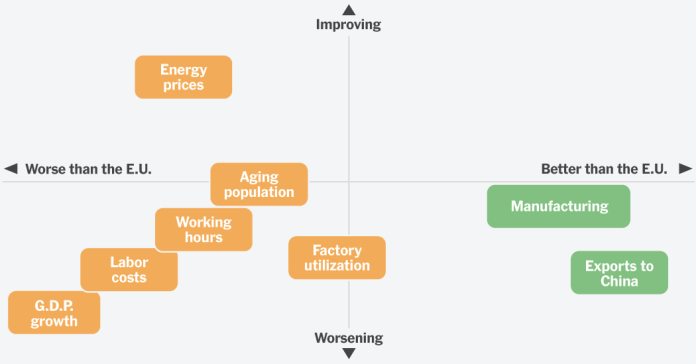
And other measures look even worse. They show an economy rapidly sliding backward, stunning declines that have emerged as one of the biggest issues in the parliamentary election set for Sunday.

Source: Eurostat

Note: The horizontal axis shows the percentage difference between Germany and the total for the 27 countries in the European Union in the most recent data. The vertical axis shows how that metric has changed in Germany over the most recent 12 months of data. Both axes are plotted on a logarithmic scale.

The situation is nothing short of a national crisis. A country that has long prided itself on its work ethic and its manufacturing might is now watching global rivals race past it.

“Economic policy in Germany is in tatters,” Stefan Pallesch, a kitchen supply store owner from the nation’s wine region said this month on the sidelines of a political rally in the town of Stromberg. He went on to list several industries in crisis, including construction, traditional automaking, and electric vehicles.

Business leaders and many worried voters use the same word when describing what’s gone wrong: competitiveness. They feel as if they are a soccer star who suddenly can’t find the net, or a marathoner who can’t keep up with the lead group. And they feel like it’s happened almost overnight.

“I definitely believe that we can compete,” said Christian Klein, the C.E.O. of German-based software giant SAP, “but some fundamentals have to change.”

The charts below show just what it looks like when an economy rapidly loses its edge. They tell a stark story of industrial woe and workforce challenges, with few opportunities for a near-term turnaround of the sort German politicians are promising as they vie for the chancellorship.

‘Stuck in stagnation’

In the big picture, it’s impossible to miss Germany’s struggles. Start with growth, which helped make Germany the world’s third-largest economy but has only cracked 2 percent per year once since 2017. After adjusting for rising prices, the German economy is no larger today than it was five years ago. Government forecasters predict an anemic 0.3 percent growth rate this year.

Germany’s economic growth has stagnated.

Higher than the E.U. Lower than the E.U.

–10 –5 0 5 10  pct. pts. 15 2005 2010 2015 2020 2025 Germany E.U.

Note: Shows year-on-year economic growth, adjusted for inflation.

“Germany is stuck in stagnation,” the economic minister, Robert Habeck, said late last month.

That’s partly because German leaders made a big bet on globalization that has not yet paid off. Even with a large consumer base at home, German companies rely on foreign markets for sales growth. More than four-fifths of the German economy depends upon trade, compared to about a quarter of the American economy. The threat of a global trade war, spurred by tariffs from the Trump administration, looms over everything.

The market that once looked most promising, China, increasingly looks fraught. German exports to China peaked in 2022 and have been declining, even though China is growing. That has drained fuel for growth. German companies have not yet found other markets to replace their slowing Chinese sales.

Germany exports more to China compared to other E.U. economies, but exports are declining.

Higher share of G.D.P. from exports to China

0.5 1.0 1.5 2.0 2.5 % 3.0 2005 2010 2015 2020 2025 Germany E.U.

Note: Shows exports to China as a share of G.D.P.

High costs, low demand

Much of Germany’s economic identity is wrapped up in its factories: cars, chemicals, pharmaceuticals, even espresso makers. That makes the sector’s struggles all the more painful.

Manufacturing is still the backbone of the economy, but it is declining.

Higher share of G.D.P. from manufacturing than the E.U.

14 15 16 17 18 19 % 20 2005 2010 2015 2020 2025 Germany E.U.

Note: Shows the share of G.D.P. contributed by the manufacturing sector.

Manufacturing is falling as a driver of Germany’s economy. While German factories used to be the envy of Europe, they aren’t anymore. They’re not even above-average, in terms of output.

After decades of German manufacturing humming at much higher rates than its European counterparts, Germany idled more of its production lines last year than the European Union as a whole.

Germany’s factories have more idle capacity, and are now falling behind Europe’s.

Less idle capacity than the E.U. More idle capacity than the E.U.

70 75 80 85 % 90 2005 2010 2015 2020 2025 Germany E.U.

Note: Shows industrial capacity utilization.

Factory owners, executives and workers all name the same culprit for that slide: soaring energy costs. It takes a lot of power to run a factory, and Germans pay more for it than their neighbors do. German politicians pushed the country before the pandemic to shutter its nuclear power plants and ramp up imports of natural gas from Russia. When Russia invaded Ukraine, the flow of gas stopped and energy costs soared.

Germany’s energy costs remain high, though are easing.

Cheaper than the E.U. More expensive than the E.U.

0.05 0.10 0.15 €0.20 2005 2010 2015 2020 2025 Germany E.U.

Note: Shows the price per kilowatt-hour for consumers using between 70,000 MWh and 149,999 MWh, excluding taxes and levies.

The country has rapidly invested in renewable sources like wind and solar, but the country’s high energy costs remain a huge burden on companies trying to compete with rivals in Europe, Asia and America, where electricity costs less.

A less competitive workforce

Along with high energy costs, economists and business leaders complain that characteristics of Germany’s labor pool put it at a disadvantage. German workers are more expensive than their counterparts across Europe, largely because hourly wages are significantly higher than in peer countries.

Germany’s labor costs are high, and still rising.

Higher than the E.U.

20 25 30 35 €40 2005 2010 2015 2020 2025 Germany E.U.

Note: Shows the cost of employing a worker, including compensation of employees, taxes, and subsidies.

And as a whole, its population works less.

Germans work less per week than those in the E.U., and their hours are still falling.

Lower working hours than the E.U.

35 36 37 38  hours per week 39 2005 2010 2015 2020 2025 Germany E.U.

Note: Shows the average number of hours worked per week by full-time employees.

The country has also experienced shifts in worker preferences, often influenced by government policies.

In 1991, shortly after the fall of the Berlin Wall, about 14 percent of Germans worked part-time. That number has more than doubled, to 30 percent.

Even full-time workers are logging fewer hours. And Germany has seen a surge in the number of days that workers call out sick, with an average of 22 recorded in 2023, according to the German Economic Institute.

Politicians across the political spectrum agree the country needs more workers, and will for decades to come. Germany’s post-war baby boom came later than America’s, and it is only beginning to see the wave of worker retirements from that generation.

Germany has more retirees per worker than the E.U.

Older than the E.U.

24 26 28 30 32 % 34 2005 2010 2015 2020 2025 Germany E.U.

Note: Shows the number of people aged 65 or over as a percentage of the population aged 15 to 64.

Conservative politicians in the chancellor race have promised to curb government welfare payments to people who can work, but choose not to. Economists say the country’s policies, and its social norms, discourage women in particular from working more.

The workforce crisis would look even worse if not for the millions of refugees and other migrants Germany has taken in from countries like Syria, Afghanistan and Ukraine over the past decade. Economists say they’ve helped fill in the holes left by retirements and the shift to part-time work.

Last year, researchers at the Organization for Economic Cooperation and Development in Paris reported that Germany had a 70 percent employment rate for immigrants in 2022. That was significantly higher than most other European Union countries.

The migration surge, though, has also strained German society and emerged as a top voting issue. Particularly in parts of the country where factory production has fallen, voters have embraced politicians who promise to block new refugees and deport those already there.

For some voters, it’s a complaint bound tightly to their experience of economic decline: the country, they say, no longer looks like the Germany they grew up in, and they want the old one back.

Why influencer Jack Posobiec is traveling with Trump officials : NPR

0

Jack Posobiec during the 2024 Conservative Political Action Conference on Feb. 23, 2024.

Dominic Gwinn/AFP via Getty Images


hide caption

toggle caption

Dominic Gwinn/AFP via Getty Images

Far-right activist Jack Posobiec – who has a long history of promoting antisemitic and white supremacist content – last week claimed that he joined top U.S. officials including Treasury Secretary Scott Bessent on a trip to Ukraine. Posobiec, who is best known for promoting the “Pizzagate” conspiracy theory, posted a selfie from an empty conference room featuring Ukrainian and U.S. flags and claimed he was at a meeting with Ukrainian President Volodymyr Zelenskyy.

The Washington Post first reported that Posobiec had been invited to join Defense Secretary Pete Hegseth’s European trip. A U.S. official speaking on background because they weren’t authorized to speak publicly confirmed to NPR that Posobiec had been invited on Hegseth’s trip but didn’t go. Posobiec later told Politico that he joined Bessent’s delegation as part of the press corps.

“[Hegseth] sees him as a guy whose messaging he trusts. He’s a guy who can get Trump’s message out to Republicans,” said Michael Edison Hayden, an expert on right-wing populism and extremism who’s monitored Posobiec for years. “It’s a really scary proposition because by inviting Jack Posobiec, you are sending a message to armed service members that this is how you should be. ‘You should be like this guy.'”

Neither the Defense Secretary or the Treasury Secretary’s offices responded to requests for comment.

Posobiec’s inclusion on trips by Trump officials is part of a wider trend of the new administration welcoming far-right media into official settings.

The “Pizzagate,” conspiracy theory claimed that Democratic politicians were engaged in systematic pedophilic abuse. The false rumor inspired a gunman to fire multiple shots inside a crowded Washington, D.C., pizza restaurant in 2016. No one was hurt. The gunman was arrested and sentenced to prison.

“If [Posobiec] were a recording artist, Pizzagate would be his top-selling song and be the number one thing on Spotify,” said Hayden. Pizzagate, Hayden said, is just one example on a long list of false and destructive conspiracy theories Posobiec has promoted.

Posobiec has a track record of making inflammatory remarks, which he later describes as satire. After promoting Pizzagate, Posobiec later claimed he’d always thought the theory was “stupid.” At last year’s Conservative Political Action Conference, Posobiec told attendees “Welcome to the end of democracy. We are here to overthrow it completely. We didn’t get all the way there on Jan. 6, but we will endeavor to get rid of it.” He then held up a cross necklace, saying “we will replace it with this, right here.” He later told NBC News his comments made fun of the Biden administration.

Because of his tendency toward pulling stunts — including trying to embed as an anti-Trump protester with a “Rape Melania” sign — Posobiec has been characterized as a “troll” by some journalists. Hayden disputes that characterization.

“I think the idea of Jack Posobiec as a troll, in retrospect now, is kind of a misunderstanding,” said Hayden. “He provides spin for authoritarian politicians, including Trump — especially Trump. And he also sows disinfo publicly through social media that benefits authoritarians.”

Posobiec’s profile was lifted after Trump began retweeting Posobiec’s posts days after the deadly 2017 Unite the Right rally in Charlottesville, Va.

At the time “Jack [Posobiec] was promoting spin on Twitter as he does, and sort of [saying]: Hey, what about all this violence in Chicago?” said Hayden, explaining that “Black-on-Black crime” tropes have long been invoked by white supremacists to deflect attention away from systemic racism. Posobiec, at the time a U.S. Naval reserve officer, lost his security clearance shortly thereafter.

Today, Posobiec has 3 million followers on X.

According to research by Hayden while at the Southern Poverty Law Center, Posbiec has an extensive history of ties to avowed white nationalists and neo-fascist movements abroad. He has amplified what Hayden describes as “obscure” neo-Nazi media and websites to his large social media following. Of one example, Hayden said, “I mean, it was extreme far right, antisemitic, racist, misogynistic, violent content on that site. Without any context, he tweets it out, which tells you that he’s on that site.”

Posobiec, who has, among other things, participated in far right, antisemitic meme culture and live-streamed himself joking about the Holocaust, has previously denied being antisemitic himself. Asked for comment, Posobiec told NPR by email that Hayden is a “hysterical lunatic” and called his reporting “psychopathic babble.”

Kristopher Goldsmith, a U.S. Army veteran and founder of the Task Force Butler Institute, a nonprofit that trains veterans to research and counter extremism, is particularly alarmed by Posobiec’s promotion of ‘great replacement theory,’ a false, antisemitic conspiracy theory that Jewish people deliberately encourage non-white immigration in order to dilute the whiteness of a given country. “That lie has led extremists to walk into Walmarts and synagogues and churches and movie theaters to murder people,” said Goldsmith.

Posobiec has also amplified Russian disinformation campaigns, though it’s unclear whether he’s been a willing proponent or a target of those efforts.

Posobiec’s presence on the trip sends the message to U.S. allies that “the America that you knew is no longer that the America that’s coming to the negotiating table or to the alliance meeting that we had planned,” said Matthew Kriner, the executive director of the Institute for Countering Digital Extremism.

Posobiec himself did not respond to specific requests for details about who invited him or what he did on the trip, instead telling NPR “enjoy being defunded.”

NPR’s Tom Bowman contributed reporting.