Friday, November 13, 2026
Home Blog Page 203

Bucha, Site of Massacre, Feels Sting of Trump Shift on Ukraine

0

Andrii Pobihai wore his army uniform to the funeral in Bucha, even though he’s retired. He was one of about 40 people to brave the freezing temperatures and air-raid sirens on Wednesday to say goodbye to his friend, who had died of a heart attack at the age of 48 after serving more than 10 years in the military.

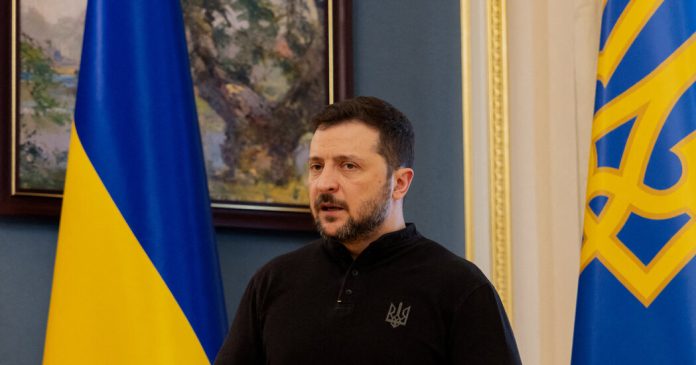
Mr. Pobihai, who held a red carnation in his weathered hand, said he was disgusted by what President Trump had said only hours earlier: that this war with Russia was somehow Ukraine’s fault. He wondered what those comments portended, after a day of negotiations on ending the war that included high-level representatives from the United States and Russia, but none from the country the Russians invaded.

“I’m very, very angry,” said Mr. Pobihai, 66, who retired as a commander in the rifle company of the 11th Separate Motorized Infantry Battalion in 2019, three years before Russia launched its full-scale invasion. He had led 54 men near Mariupol, but since then, he said, the Russians have killed all those Ukrainian soldiers — the last just four days earlier.

“The best guys are dying,” Mr. Pobihai said. “How can you talk to these jackals?”

Bucha, a suburb of 37,000 about 20 miles northwest of the capital, Kyiv, has become a notorious symbol of Russian brutality. The Russians took it over within days of invading in February 2022, and in the month that followed, they killed more than 400 civilians, Ukrainian officials say, leading to global accusations of war crimes.

Images from that time ricocheted around the world: The priest left dead in a garage, his mouth open. The church choir singer and his family, their limbs cut off, their bodies burned. The woman shot dead pushing her bicycle home on Yablunska Street.

On Wednesday, many in Bucha seemed to be struggling to take in Mr. Trump’s comments. When the Biden administration was in power, the United States was Ukraine’s most powerful ally. Now they had many questions: Was Mr. Trump just speaking off the cuff? Was the United States really siding with Russia, a pariah on the world stage?

“Now he’s going to help the Russians?” asked Alla Kriuchkova, 40, waiting outside a military recruitment center in Bucha for her husband, who had just been called in. “They destroyed everything here, and now we’re supposed to give up? How does that work?”

Then she answered her own question: “If America leaves us, we are screwed.”

The ghosts of the massacre are still everywhere in Bucha. In the Bucha municipal cemetery on Memory Street, the body of Oleksiy Onyshchenko, Mr. Pobihai’s friend, rested maybe 50 yards from where scores of bodies in black plastic bags were once stacked.

On the corner of Yablunska and Vokzalna Streets — ground zero of the destruction in Bucha — Iryna Abramova lives in a boxy new house built to replace the home that was burned down almost three years ago. Whenever Ms. Abramova leaves for work, she has to walk past the spot where Russian soldiers shot her husband, Oleh, point-blank in front of her.

Then there’s the pink four-story building constructed during Soviet times, where Russian soldiers set up camp after invading. After Bucha was liberated in April 2022, trash as high as one’s knees was found in the building. A slick of blood had dried on the floor.

Now a man wearing thick-lensed glasses worked on a computer in the front window. Behind the building, eight young pine trees were tagged with the names of the men who were shot dead there in the early days of the war. “Anatolii,” read one. “Andriy,” read another. A few trees still had Christmas decorations, tinsel in the blue and yellow of the Ukrainian flag, balls of red and green.

Ms. Abramova, 50, who now works at a dry cleaner, said she had unsuccessfully tried therapy and medication. She said investigators told her recently that they had identified the Russians who had killed her husband.

“Now I am afraid that the court will do nothing, because of what’s happening politically,” Ms. Abramova said. “They will say that the Russians are fine. The thing I’m most afraid of is that they will say we are guilty ourselves. That we are guilty of killing ourselves.”

The Rev. Andriy Halavin, an Orthodox priest at the Church of St. Andrew, Bucha’s largest church, carries his city’s memories with him, flipping through photos on his phone.

There is one of a smiling Myron Zvarychuk, the priest who founded their church community in the 1990s, and then one of him dead. Other photos show the burned bodies of the singer and several men, bent over, their hands tied, found shot dead in the cellar of a children’s camp. Still another portrays the bodies of the eight men memorialized by the trees near the onetime Russian encampment. (A ninth escaped alive, because the Russians didn’t notice he was still breathing.)

Father Halavin also showed a new satirical cartoon by a Ukrainian artist which depicts Mr. Trump pointing at the feet of Jesus on the cross. “I tried to find a very telling picture,” said Father Halavin, a wry smile on his face. “It’s Trump saying to Jesus, ‘This wouldn’t have happened if I were president.’”

A memorial outside the church identified those who were killed — from Timur Kozyrev, only 18 months old, to Iryna Rudenko, killed 18 days shy of her 99th birthday — mere feet away from where a mass grave once held 116 bodies.

Father Halavin pointed out a red home just beyond it where a mother and her two young sons once lived. They had fled Donbas, in the east, in 2014, shortly after the Russians seized Crimea and Russian-backed separatists occupied parts of eastern Ukraine.

“They moved here to escape, and then they were killed,” he said.

At the Bucha municipal cemetery, 52 graves were marked only with numbers, like 230 and 318. These bodies have not been identified.

In the military section of the cemetery, Ukrainian flags flew over every headstone. “Slaves are not allowed into heaven,” one grave marker proclaimed. Another bore a photo of a sergeant with the call sign Hedgehog; he was critically wounded in Bakhmut and died in a Kyiv hospital on June 12. “Infinite pain,” the epitaph said. “You’re not here, but you’re everywhere, forever with us.”

Other soldiers from Bucha had call signs like Viking, Lover and even Bucha, who died April 13 fighting in the east.

Mr. Onyshchenko, the soldier who was being buried on Wednesday, had collapsed Saturday at his post in Mykolaiv. A heart attack, his family and friends said. Mr. Pobihai said they had served together in the 11th Battalion in Mariupol and Popasna in 2014 and 2015. The Russians now control both areas.

“If not us, then who?” Mr. Onyshchenko had asked after enlisting, according to an obituary posted on Facebook by the mayor of Bucha.

After Mr. Onyshchenko’s coffin was placed into a freshly dug grave, Mr. Pobihai walked through the military cemetery, looking at the headstones. He figured there was a good chance that Mr. Trump would eventually change his mind.

“When Russia captures Ukraine and mobilizes the best Ukrainian fighters into the Russian Army, then goes against NATO and Europe, maybe then,” he said with a shrug.

Oleksandr Chubko contributed reporting.
Meet Germany’s Far-Right Leader, a Study in Contradictions

0

When Vice President JD Vance criticized his German hosts last week for sidelining far-right parties, he did not mention by name the Alternative for Germany, known as the AfD.

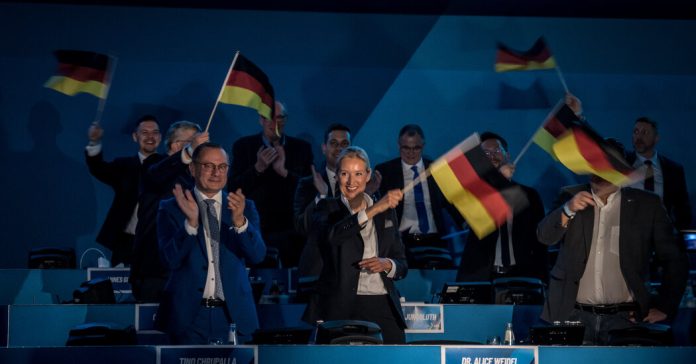
But soon after his speech at the Munich Security Conference, in which he stunned the room by comparing democracy in today’s Europe to Soviet-era totalitarianism, Mr. Vance met with Alice Weidel, the leader of the AfD.

A former investment analyst who is raising two sons with her Sri Lankan-born wife in Switzerland, Ms. Weidel, 46, has become the unlikely face of the AfD. Her nationalist party campaigns on a platform that is anti-immigrant and defines family as a father and a mother raising children.

A favorite of the new American administration — receiving an endorsement from Elon Musk — she has been essential to AfD’s effort to break into the mainstream, helping to vault the party into a comfortable second place ahead of Sunday’s national election.

Ms. Weidel, whose turtleneck sweaters or open-collared shirts and pearl necklaces have become signatures, has lent a more cosmopolitan image to a party that has been linked to neo-Nazis and plots to overthrow the state.

But her AfD is no less extreme. “With Alice Weidel at the helm, the AfD has steadily become more radical,” said Ann-Katrin Müller, an expert on the AfD who reports for Der Spiegel, one of Germany’s most prominent news outlets.

The AfD is polling well ahead of the center-left Social Democrats of the incumbent chancellor, Olaf Scholz, and behind the conservative Christian Democrats of Friedrich Merz, the front-runner to be the next chancellor.

Those parties insist that they would never partner with Ms. Weidel’s party to form a government. But Ms. Weidel’s latest success in presenting the AfD as just another party came on Sunday, when she joined a televised debate with her mainstream rivals, who also included Robert Habeck, running for the Greens.

Ms. Weidel’s performance was widely judged to be uneven, but she left the event a winner nonetheless — it was the first time that AfD had been invited to such a debate, watched by millions of voters. At one point in the campaign, polls ranked her as the most popular chancellor candidate, across all parties.

But if Ms. Weidel’s professorial air and personal story suggest a softening of the party line, her language does not. She has promised to tear down wind turbines and to dismiss gender-studies professors. She has spoken about “remigration,” a term used by the far right that is widely interpreted as code for deportations.

“Make it absolutely clear to the whole world: German borders are closed,” she told a cheering crowd when the AfD officially nominated her as its candidate last month.

Ms. Weidel declined to speak to The New York Times for this article. In interviews with the German news media, she has been alternately charming and biting.

She has consistently refused to distance herself from her party’s most extreme members, some of whom have minimized the Holocaust and Germany’s Nazi past.

“She and the people behind her now dominate the party — and they are ideologically very close to Björn Höcke,” Ms. Müller said, referring to an AfD state leader who has been fined by a court for using Nazi language.

On Sunday Ms. Weidel told Bild, Germany’s largest tabloid, that she would put Mr. Höcke into her cabinet if she were to become chancellor.

Ms. Weidel grew up in a middle-class Catholic family in Harsewinkel, a town in North Rhine-Westphalia, in the country’s west, with two siblings and a dachshund. Her father was a salesman and her mother was a homemaker.

Her grandfather was a Nazi party member and was named a military judge in occupied Warsaw, Die Welt, a conservative daily, reported. Ms. Weidel responded that she did not know her grandfather, who died when she was 6, and that the Nazi past was never a topic of discussion in her family.

While finishing a Ph.D. in economics in Bavaria, she spent time in China. By her own account, she learned Mandarin. She later worked at Credit Suisse and Goldman Sachs as an analyst. In interviews with the German news media, she has spoken about her love of feng shui, and of swimming and tennis when she was a girl.

Officially she divides her time between her home in a small town in central Switzerland and a house in her voting district on Lake Constance, in southern Germany. But Ms. Weidel admitted that she does not spend much time at the German address.

She says it is because of safety concerns. Despite her party’s gains, she remains a lightning rod of public outrage in a country where a majority of Germans believe the AfD should be shunned.

Her absence from Germany has become something of a sore subject for the leader of a nationalist party. She walked out of an interview aired this week with a public broadcaster when she was asked how many nights she had slept at her German address. In the same interview, she admitted she did not know how many people lived in the district she represents as a member of Parliament.

In November, Ms. Weidel told a group of business leaders in Zurich that her security situation had grown so difficult that it was hard even to spontaneously go out dancing or to dinner with her spouse, Sarah Bossard, a filmmaker.

“I am incredibly grateful to my wife for putting up with it,” she said.

Despite having been asked many times, Ms. Weidel refuses to explain how she reconciles the apparent contradiction between her personal life and the vision of society her party represents.

“I am not queer,” Ms. Weidel told an interviewer this summer, using the English word, “but I am married to a woman I have known for 20 years,” she said.

Experts say the fact that Ms. Weidel’s personal life defies party orthodoxy actually enhances her claim to carry the AfD banner and makes the party appear more mainstream.

“Ms. Weidel has become the face of the party because of her biography and her background, and also because of her ability to speak clearly — even if it is without much empathy,” said Werner Patzelt, a political scientist who has long studied the AfD.

Ms. Weidel joined the AfD in 2013, when it was virtually a single-issue party built on opposition to the common European currency, before working her way up to become its chancellor candidate — the party’s first.

Partially owing to the fact that no one will work with her party, she’s never held any government post before. She was elected to Parliament for the first time in 2017.

Even before her prominent new role, she was a fixture on political debate shows on German television. She argues that her party is libertarian, not right-wing nationalist, a position that puts her at odds with some of the AfD’s more fervent members.

Her fluent English has helped her build a relationship with Mr. Musk, President Donald J. Trump’s billionaire adviser, who interviewed Ms. Weidel on his social media platform X.

Mr. Musk surprised the party in December when he was beamed onto a big screen, at a campaign event in Halle, where he endorsed the AfD and told assembled members that Germans had “too much of a focus on past guilt.”

Mr. Musk himself stirred controversy by giving what was widely interpreted as a Nazi salute to a rally of supporters after Mr. Trump’s inauguration.

Throughout the X interview, Mr. Musk portrayed Ms. Weidel as “a very reasonable person” and distanced her and the AfD from the Nazis.

Despite efforts to downplay associations with the Nazi past, some party faithful seem to have missed the message.

As Ms. Weidel took the stage in Halle, the crowd started a chant that was a not-too-subtle play on a Nazi slogan, “Everything for Germany,” a phrase once carved on the knives of Nazi storm troopers. It is banned in Germany.

The crowd tweaked it ever so slightly. “Alice for Germany!” they cried.

Jim Tankersley contributed reporting.

The Evolution of Presidential Power : Throughline : NPR

0

Olivier Douliery-Pool/Getty Images

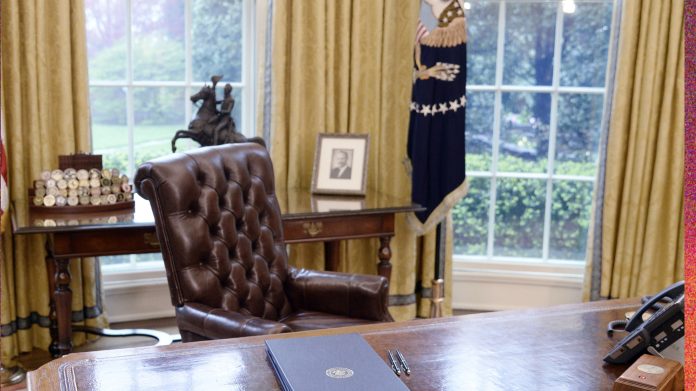
WASHINGTON, DC - MARCH 31: WASHINGTON, DC - MARCH 31: Executive Orders regarding trade lay on the Resolute desk in the Oval Office of the White House March 31, 2017 in Washington, DC. President Trump signed two executive orders that aim to boost U.S. manufacturing by addressing foreign trade. (Photo by Olivier Douliery-Pool/Getty Images)

Olivier Douliery-Pool/Getty Images

What can and can’t the president do — and how do we know? The framers of the U.S. Constitution left the powers of the executive branch powers deliberately vague, and in doing so opened the door for every president to decide how much power they could claim. Over time, that’s become quite a lot. This episode originally ran in 2020 and has been updated with new material.

Guest:

Andrew Rudalevige, professor of government at Bowdoin College.

If you would like to read more about the topic:

To access bonus episodes and listen to Throughline sponsor-free, subscribe to Throughline+ via Apple Podcasts or at plus.npr.org/throughline.

Hamas to Hand Bodies of 4 Hostages Back to Israel

0

Hamas fighters were expected on Thursday to hand over the bodies of four Israelis who had been abducted during the Hamas-led Oct. 7, 2023, attack, including a woman and her two young children, in exchange for Palestinians jailed by Israel.

Large crowds gathered in the southern Gazan city of Khan Younis to observe the exchange, amid triumphant music. Palestinian gunmen were deployed around a stage on which four coffins had been placed.

Miles away, Israelis watched in horror. The four dead hostages were named as Shiri Bibas, 32, and her redheaded young children Ariel, 4, and Kfir, nine months old, as well as Oded Lifshitz, 84.

All four were abducted during the Oct. 7 attack in which roughly 1,200 people were killed and 250 taken hostage, according to Israel. For many Israelis, the deliberate abduction of Ms. Bibas and her children epitomized the viciousness of the attackers.

It was not immediately clear how they had died, although Hamas has said they were killed in Israeli airstrikes. Israeli officials have yet to confirm the cause of death.

Israel’s relentless campaign against Hamas in Gaza quickly followed, killing tens of thousands of Palestinians and leaving much of the enclave in ruins.

In late January, Israel and Hamas reached an agreement to stop the fighting for at least six weeks. Hamas agreed to turn over 25 living Israeli hostages and the bodies of eight others in exchange for more than 1,500 Palestinian prisoners held by Israel.

Since then, Israelis and Palestinians have witnessed emotional homecomings — hostages reuniting with their families after a terrifying year in Hamas’s underground tunnel network — as returning Palestinian prisoners have embraced loved ones outside of prison for the first time in decades.

Hamas has used the hostage releases to hold elaborate ceremonies demonstrating its dominance in Gaza, deploying dozens of well-organized gunmen and occasionally forcing hostages being freed to give speeches from makeshift stages.

Rawan Sheikh Ahmad contributed reporting from Haifa, Israel.

Thursday Briefing

0

Here’s what you need to know.

Hegseth directs Pentagon to find $50 billion in cuts this year : NPR

0

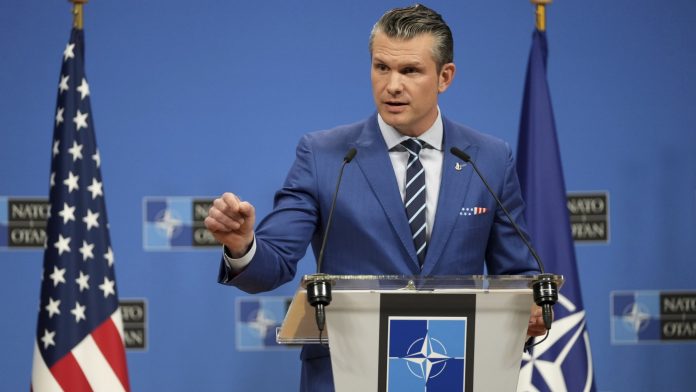
United States Secretary of Defense Pete Hegseth speaks during a media conference after a meeting of NATO defense ministers at NATO headquarters in Brussels on Feb. 13.

Virginia Mayo/AP


hide caption

toggle caption

Virginia Mayo/AP

WASHINGTON — Defense Secretary Pete Hegseth has directed the military services to identify $50 billion in programs that could be cut next year in order to redirect those savings to fund President Donald Trump’s priorities.

Hegseth has committed to redirecting Pentagon spending to more directly support warfighters. In a statement late Wednesday, Robert Salesses, who is performing the duties of deputy secretary of defense, said “the time for preparation is over” and “excessive bureaucracy” and programs targeting climate change or “other woke programs” such as diversity, equity and inclusion initiatives would be targeted.

“To achieve our mandate from President Trump, we are guided by his priorities including securing our borders, building the Iron Dome for America, and ending radical and wasteful government DEI programs and preferencing,” Salesses said.

Iron Dome is envisioned as an extensive, multilayered air defense system for the U.S. that Trump has said should include the ability to shoot down incoming missiles from space.

The roughly $50 billion would represent about 8% of the military’s budget. It was not immediately clear which parts of the Pentagon’s spending on diversity and equity programs, or its spending to address climate change — such as buying alternate fuels for aircraft, or making bases more resistant to the effects of extreme weather, such as the 2018 hurricane that caused significant damage to Tyndall Air Force Base in Florida — would be targeted or could add up to $50 billion in savings.

The spending cuts mandate comes as the military is quickly trying to build its fiscal year 2026 request, a congressional process that often starts late during transitions between new presidential administrations. Hegseth has asked the Pentagon to find offsets — programs that can be cut to achieve spending elsewhere — for fiscal year 2026, which starts Oct. 1.

The cuts would be as drastic as the single-year ordered savings across the military in the 2013 sequestration, a law passed by Congress that was intended to force the legislative branch to reach agreement on budget deficit reductions and instead forced the services to cut $56 billion in a matter of months.

Because of the way the military budget is structured, long-term, high-dollar procurement programs at the time were protected, as were most entitlements such as military retirement and health care.

At the time, the accounts that were easier to cut were found in operations, maintenance and personnel. The services lost noncommissioned officers — highly trained mid-level enlisted personnel — and cut training such as flight hours. Military training accidents quickly climbed.

In the years since the sequester, Congress and the services have directed additional protections to operations and maintenance spending.

China Uses Public Shaming to Motivate State Workers

0

Chinese government workers have a lot to worry about these days. Cash-strapped local governments are struggling to pay their salaries. Political controls are tightening in the name of national security. A yearslong anti-corruption purge shows no sign of ending.

Now, the workers also have to make sure not to get slapped with a “Snail Award” — a designation that more localities are rolling out to shame their lowest-performing employees.

“Through this sarcastic ‘encouragement,’ the awardees can blush and sweat and refresh their minds,” read one commentary on a Communist Party-affiliated website, noting that they had hurt the party and the government’s credibility by just “getting by.”

Perhaps now more than ever, the Chinese government cannot afford to have its officials slacking off. As economic growth slows, it needs leaders to introduce new projects, attract investors and inspire ordinary people — in essence, unleash the dynamism that powered China’s rise.

But many officials seem unmotivated, if not outright afraid to act. Under China’s hard-line leader, Xi Jinping, the state has cracked down on various sectors, from internet companies to private-tutoring firms to finance. It has become impossible to guess what might be next in line. Any policy that deviates from the central government’s could be seen as politically disloyal.

Whereas officials once competed to claim flashy infrastructure projects, officials have more recently been punished for raising money or pushing forward construction projects without authorization. The safest route, it seems, is to do nothing.

Until it’s not. Amid the flurry of calls for officials to step up, at least three cities have been giving out snail awards, according to People’s Daily, the party’s official mouthpiece. Video clips on Chinese social media, taken from a state-run television show in Sichuan Province, show stony-faced men in suits being handed framed certificates.

That is one of the gentler punishments. An urban district in Guangdong Province said that it had set up a database to track officials it said were “lying flat” — Chinese slang for slacking off. Other places have boasted of reassigning or firing employees.

The Central Commission for Discipline Inspection, the party’s internal anti-corruption body, said last month that it punished 138,000 officials in 2024 for offenses including “irresponsibility,” “inaction” or “pretending to work.” That was more than double the number the year before, and by far the category with the most people punished. The second-most-common offense, improperly giving or receiving gifts, had half as many culprits.

“Taking tough measures to deal with ‘lying flat cadres’ is actually to protect the enthusiasm and initiative of those who are doing things and being enterprising,” the anti-graft body said in a recent article.

Trying to frighten already scared officials into action, of course, may not be a recipe for success. So the central authorities have also tried to strike a more reassuring tone. On Monday, Mr. Xi met with some of the country’s top entrepreneurs, which many observers saw as a signal of a renewed embrace of the private sector. That could nudge local governments to be more willing to collaborate with them.

In December, two top commissions that oversee state-owned companies’ investments pledged to “reasonably tolerate normal investment risks.” If a project failed to meet expectations, the people responsible could be exempted from punishment, the commissions said.

Officials have also suggested that party members can be given a second chance. An official in Sichuan Province who directed unauthorized funds toward a public toilet construction project was let off with just a warning, the local disciplinary committee there said, because he had not been seeking personal gain.

But local officials are unlikely to be convinced, because the overall trend toward tighter political controls is clear, said Dongshu Liu, a professor of Chinese politics at City University of Hong Kong. Even if Beijing is encouraging officials to be proactive now, the space for doing so is limited. “They want you to work hard, but they want you to work hard on following central orders,” Professor Liu said.

Indeed, speaking to the disciplinary commission last month, Mr. Xi doubled down on his calls for political purges, urging officials to “not give a single step” in cracking down on corruption and other bad behavior.

Even if Beijing can convince lower-level officials that it is politically safe to take risks again, those officials may have other reasons not to do so. Some local governments have reportedly been unable to pay their workers. The most low-level officials must also contend with growing workloads, often involving frequent in-person checks on residents and businesses, as Mr. Xi pushes for the state to increase its presence in daily life.

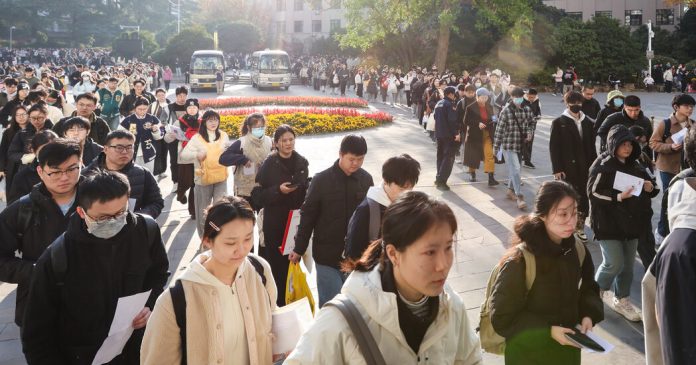
And yet, record numbers of young Chinese are still competing for civil service positions. That might seem surprising, given the pressures of the job. But the underlying reason may be the same as why the government is so eager to kick officials back into action: the weak economy. For all their downsides, civil service jobs are seen as stable.

“Yes, being a civil servant is not as good as it was 10 years ago,” Professor Liu said. “But other choices are even worse.”

Siyi Zhao contributed research.

Government watchdogs are making new tools to track spending and cuts : NPR

0

Thanks to the U.S. government’s tradition of data transparency, there is a way to see exactly what money is going to government programs and agencies. O research group used it to create a widget.


SCOTT DETROW, HOST:

With the Trump administration and its DOGE team moving quickly to make big cuts across so many agencies, it has been hard for the usual government watchdogs to know what’s really going on. So they are making new tools. Mary Childs from our Planet Money podcast tells us the story of one of them.

MARY CHILDS, BYLINE: Lauren Bauer is a researcher at the Brookings Institution, a nonpartisan think tank. She pays a lot of attention to government social programs, so when the administration started talking about spending cuts, she knew exactly where to check to see just what was being cut.

LAUREN BAUER: I had experience with something that’s called the Daily Treasury Statement.

CHILDS: The Daily Treasury Statement. It’s a simple PDF published every business day showing how much money the U.S. Treasury has sent and to whom through its secure payment system. And this is not a tremendously popular document. It’s a small accounting report published quietly on a Treasury website. She showed it to me.

BAUER: This is fiscaldata.treasury.gov. So if you click it, it opens. Look, I’ve already done it once today. You can get the Daily Treasury Statement.

CHILDS: This PDF has a very official, fancy Treasury insignia at the top. It’s two columns. On the left, deposits, incoming money. On the right, money going out to Medicaid and Veterans Affairs and Customs and Border Protection, the Library of Congress, the SEC.

BAUER: People could see whether the Trump administration had actually stopped the flow of funds.

RACHEL SNYDERMAN: That’s extraordinary access the public has. And I think it demonstrates the values that our government does place on transparency and communication.

CHILDS: That’s Rachel Snyderman. She’s a managing director at the Bipartisan Policy Center, and she traces this kind of digital access back to bipartisan laws starting in 2006 that mandated that all federal spending data be displayed publicly online in one place.

SNYDERMAN: Before that time, there was really no single way to track government spending across agencies. And it made it really difficult to use data to inform evidence-based policy decisions.

CHILDS: You know, so American citizens can see if their tax dollars are being spent wisely or are being wasted, because if the public doesn’t know the facts, Snyderman says, it can’t make informed decisions. Transparency is crucial to a working democracy.

SNYDERMAN: It’s really powerful what can be done with all of this data.

CHILDS: So when Lauren Bauer of Brookings started to see reports of funding freezes and that maybe USAID was being defunded, Bauer and her team decided to take that Daily Treasury Statement data and make it into a tool people could read themselves.

BAUER: We built, like, the roughest version of it basically on Day 1.

CHILDS: Her team took hundreds of older Treasury statements and set up a way to automatically add the new data as it is published each day. The result is an interactive graph showing over time what money went to each line item. And on Monday, February 3, they hit refresh and one of the lines, the one for USAID, drops to zero.

BAUER: That was when it became clear that this tool could, in fact, show that the money was not sent to USAID.

CHILDS: So even without official announcements, Bauer can see precisely what programs are still getting money, which aren’t and what’s changing down to the day. Mary Childs, NPR News.

DETROW: On the latest episode of Planet Money, you can hear more about the act of impoundment and what money a U.S. president can legally withhold from spending.

(SOUNDBITE OF MUSIC)

Copyright © 2025 NPR. All rights reserved. Visit our website terms of use and permissions pages at www.npr.org for further information.

NPR transcripts are created on a rush deadline by an NPR contractor. This text may not be in its final form and may be updated or revised in the future. Accuracy and availability may vary. The authoritative record of NPR’s programming is the audio record.

Delta Offers $30,000 to Passengers on Plane That Crashed in Toronto

0

Delta Air Lines said on Wednesday that it was offering $30,000 to each passenger who was aboard the flight from Minneapolis that crashed and flipped upside down this week while trying to land in Toronto.

All 80 people — 76 passengers and four crew members — who were on Delta Flight 4819 survived after the jet made a rough landing and rolled over, ending belly-up with its right wing sheared off at Toronto Pearson International Airport on Monday.

Of the 21 passengers who were taken to hospitals, all but one had been released by Wednesday morning, Delta said. None of the passengers had life-threatening injuries.

Delta confirmed on Wednesday that it had made the $30,000 offer to passengers. Its representatives were telling the passengers that the offer came with “no strings attached and does not affect rights,” a company spokesman said via email.

It came as Rochon Genova, a Canadian law firm, said it had been retained by some of the passengers.

Days after the crash, officials have released few details about the investigation. On Wednesday, Ed Bastian, Delta’s chief executive, said in an interview on CBS that the flight had been staffed by an “experienced crew” but provided little further information.

On Wednesday evening, what was left of the aircraft was removed from Toronto Pearson International Airport, Canada’s busiest, where it had been blocking the two longest runways, Delta said.

Consider This from NPR : NPR

0

U.S. President Donald Trump speaks during an executive order signing in the Oval Office earlier this month.

Andrew Harnik/Getty Images


hide caption

toggle caption

Andrew Harnik/Getty Images


U.S. President Donald Trump speaks during an executive order signing in the Oval Office earlier this month.

Andrew Harnik/Getty Images

Is the United States headed toward autocracy?

That’s a question prompted by a steady stream of executive orders seeking to consolidate power in the White House and upend long held policies and norms.

New York Times Opinion writer M. Gessen lived through much of Russia’s slide into autocracy, and wrote a book about it.

They argue that one of the ways Vladimir Putin consolidated power… was by making a series of arguments that seemed outrageous at the time — like the idea that the LGBT population was a threat to Russian sovereignty.

President Donald Trump’s second term has been marked by a string of policy proposals that would have been unthinkable in any other administration.

Even if they don’t go anywhere, they’re reshaping the boundaries of our democracy.

For sponsor-free episodes of Consider This, sign up for Consider This+ via Apple Podcasts or at plus.npr.org.

Email us at [email protected].

This episode was produced by Mia Venkat and Connor Donevan.

It was edited by Courtney Dorning and Nadia Lancy.

Our executive producer is Sami Yenigun.