Friday, November 13, 2026
Home Blog Page 204

Trump Falsely Suggests Ukraine Is to Blame for the War: What to Know

0

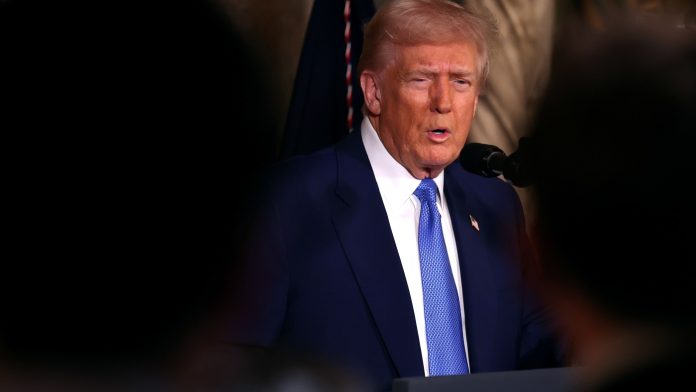
In comments that stunned America’s allies in Europe and angered Ukraine’s government, President Trump on Tuesday appeared to blame Ukraine’s leaders for Russia’s invasion.

He also suggested that they do not deserve a seat at the table for the peace talks that he has initiated with President Vladimir V. Putin of Russia.

“You should have never started it,” Mr. Trump said, referring to Ukraine’s leaders. “You could have made a deal.” He followed up on Wednesday in a post on social media, calling Ukraine’s president, Volodymyr Zelensky, a “dictator without elections” and saying he had “done a terrible job” in office.

Here’s a look at how the war began, the state of the peace talks and Ukraine’s election record.

There is no doubt that Russia started the war by invading Ukraine. Russian troops stormed over the border almost exactly three years ago, with the explicit aim of toppling the pro-Western government of Mr. Zelensky in Kyiv, the capital. Russia’s military attacked from the east and north, including from Belarus, as well as from the Russian-occupied southern province of Crimea. That attack started the biggest conflict in Europe since World War II.

Leaders around the world, including former President Joseph R. Biden Jr., denounced Russia’s invasion as an act of unprovoked aggression against a sovereign state, and the U.N. General Assembly passed a resolution calling for Russia’s immediate withdrawal. Since then, Russian firepower has leveled whole cities and killed more than 12,000 Ukrainian civilians, according to the United Nations.

Hundreds of thousands of soldiers have also been killed and wounded, and Russian soldiers have committed a series of atrocities, not least in the city of Bucha, north of Kyiv. The Kremlin has said its soldiers do not commit war crimes.

The International Criminal Court has also accused Mr. Putin of war crimes in Ukraine and issued a warrant for his arrest, along with another senior Russian official. Last year it also issued warrants for the arrest of two Russian commanders.

Mr. Putin and the Kremlin have referred to the invasion as a “special military operation,” avoiding the term “war,” and he has said he sought to demilitarize but not occupy Ukraine. He put forward several explanations for the move, saying that in part he was acting to protect civilians in Ukraine’s east.

He also characterized the invasion as a last-ditch effort to thwart what he called the West’s expansion toward Russia’s borders. The enlargement of the NATO military alliance to incorporate countries in Eastern Europe since the end of the Cold War, he claimed, was effectively a plot to destroy Russia.

And Mr. Putin said that Russia, and specifically the Bolshevik revolutionary leader Vladimir Lenin, created modern Ukraine, a position historians deride as false. Ukrainians voted in 1991 in a democratic referendum to leave the Soviet Union. Mr. Putin also said that the invasion aimed to demilitarize Ukraine and combat “Nazis,” an apparent reference to far-right parties and elements of the Ukrainian Army. Far-right parties won about 2 percent of the vote in the country’s 2019 election. Mr. Zelensky, who is Jewish, signed a law several months before the invasion combating antisemitism.

In a speech on the war’s first day, Mr. Zelensky vowed that his country would resist Russian aggression and framed Moscow’s invasion as an attack on freedom itself. “Putin began a war against Ukraine, and against the entire democratic world,” he said. Since then, Mr. Zelensky has repeatedly said that Ukraine stood as Europe’s first line of defense against Russian encroachment.

Before the full-scale invasion, Russia seized the Ukrainian province of Crimea, which it annexed illegally in 2014, and also took territory in the eastern Donbas region, including the provincial capitals of Donetsk and Luhansk.

In all, Russia now occupies around 20 percent of Ukraine, but so far it has failed in its key objectives of breaking Ukraine’s military and securing Kyiv. The fighting is largely confined to a front line in the east and south of the country, with Russian forces creeping forward amid heavy losses.

Last August, Ukraine launched a surprise incursion into the Russian region of Kursk, where Russian forces assisted by soldiers from North Korea have been fighting back.

Military experts say that in the immediate term, Ukraine has little chance of recapturing its lost territory, particularly if the United States slows or stops the flow of military aid.

Representatives of Ukraine and Russia held talks in the weeks after the start of the war in 2022 but failed to reach a cease-fire agreement. Since then, Ukraine has tried to gain international support for its own 10-point Peace Formula, which demands a full withdrawal of Russian forces, the prosecution of war crimes and the payment of reparations.

The prospect of peace talks, however, has gathered pace since President Trump’s inauguration last month. Mr. Trump held a lengthy call with Mr. Putin last week, which blindsided Ukraine’s government and allies in Europe and suggested that the two men intended to negotiate Ukraine’s fate directly without their involvement, a priority for the Kremlin.

In a major change from former President Biden’s policy that Ukraine would decide whether to make concessions in exchange for peace, the U.S. defense secretary, Pete Hegseth, said that it was unrealistic for Ukraine to regain the territory it held before Russia’s 2014 invasion, and that Mr. Trump did not support Ukraine’s entry into NATO. In a further blow to Ukraine, Mr. Hegseth said that after a peace deal, the responsibility for guaranteeing the country’s security would fall mainly on European countries rather than on NATO.

At a meeting in Saudi Arabia on Tuesday, Secretary of State Marco Rubio and Sergey V. Lavrov, Russia’s foreign minister, agreed to reset their countries’ relationship and to work on a peace plan for Ukraine. Mr. Zelensky, who was not invited to the meeting, sharply criticized it and said his country would “never” accept a peace deal if Ukraine did not have a seat at the negotiating table.

The Kremlin has called Mr. Zelensky an illegitimate leader because his five-year term has elapsed. Elections in Ukraine were suspended under martial law after Russia’s invasion, with frontline towns and cities governed solely by military administrations.

Mr. Trump also appeared to cast doubt on Mr. Zelensky’s legitimacy as president on Tuesday, and appeared to use that doubt to justify not inviting the Ukrainian leader to peace talks. “I would say that when they want a seat at the table, you could say the people have to — wouldn’t the people of Ukraine have to say, like, you know, it’s been a long time since we had an election?” Mr. Trump said. “That’s not a Russia thing. That’s something coming from me and coming from many other countries also.”

Mr. Trump also said Mr. Zelensky was “down at 4 percent in approval rating.” Although Mr. Zelensky’s approval rating has fallen from once-lofty heights, it is at around 50 percent in recent polls, not too far from Mr. Trump’s rating.

Mr. Zelensky became president after winning an election in 2019 by a landslide. A fresh election was due in 2024, but under the country’s constitution, it cannot be held while martial law is in force. Holding an election would also be a logistical nightmare, as Russian missiles rain down on the country and fighting rages.

Election experts say that any vote held during wartime would effectively disenfranchise citizens living in Russian-occupied areas, those who have fled the country as refugees and soldiers in combat.

However, internal political tensions over the use of martial law have been rising, and the mayor of Kyiv is among the officials who have accused the president’s office of abusing its powers. At the same time, Ukraine’s leaders have been under pressure from their allies over the issue, not least as part of wider efforts to demonstrate good governance.

Military medical units get deployment orders to Guantanamo : NPR

0

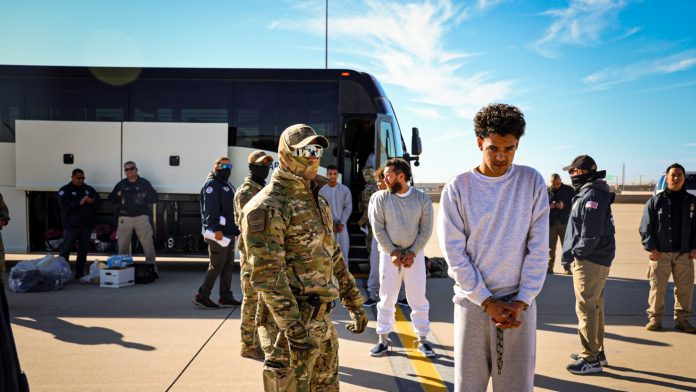
The Department of Homeland Security released photos of migrants as they boarded planes for Guantánamo Bay, Cuba.

U.S. Department of Homeland Security


hide caption

toggle caption

U.S. Department of Homeland Security

Military medical units, including surgeons and OB-GYN specialists in the U.S. Air Force and Army, are preparing for deployment to Guantanamo Bay this weekend as part of the Trump administration’s efforts to expand detention there for those without legal status in the U.S.

An order obtained by NPR on Wednesday that was sent to service members showed that they were instructed about a deployment for more than 180 days, to a location that was redacted.

The doctors and others who are getting deployed were told the site would be at the U.S. naval base in Guantanamo and would last six months, according to internal communications reviewed by NPR and two sources familiar with the planning who were not authorized to talk publicly.

The order was sent to personnel including from the Travis Air Force Base’s David Grant Medical Center in California, and the medical unit at the Fort Belvoir Army installation in northern Virginia.

The Homeland Security and Defense departments did not immediately respond to requests for comment.

So far, over a dozen planes have taken more than 100 people to Guantanamo Bay, following an order from President Trump to use the naval base to detain migrants suspected of being in the country without legal status. Immigration lawyers have sued the administration over the detentions there, arguing that the location limits access to their clients. DHS has said those on the base have access to phones to call their lawyers.

The military medical personnel were told they would be taking care of detainees in Guantanamo, as well as of civilians.

Earlier this month, 150 service members were deployed to assist DHS with operations on the base.

So far, Trump administration officials say all the people taken to Guantanamo have been men labeled as “high-threat illegal aliens.” The goal, administration officials have said, is to eventually create space at Guantánamo for 30,000 migrants there, who would be held temporarily before being deported to other countries.

But the plan is likely to face numerous legal, financial, political and logistical hurdles. Congress hasn’t allocated money for the base yet and the administration would have to set up new facilities to make space for that many people.

Rep. John Garamendi, D-Calif., decried the recent deployment orders in a letter to Defense Secretary Pete Hegseth sent on Wednesday, saying the military’s medical personnel are meant to take care of U.S. service members and their families.

“The migrants detained in Guantanamo Bay undeniably deserve access to comprehensive health services and medical care throughout their detainment,” Garamendi wrote. “However, it is unacceptable that military resources be diverted to fulfill this need.”

Authorities Warn Tourists to Keep Clear of Lava Flows on Mount Etna

0

The latest eruption of Mount Etna in Sicily has drawn crowds of photographers, hikers and nature aficionados, which have congested streets and clogged paths for rescue crews.

DOGE released data about federal contract savings. It doesn’t add up : NPR

0

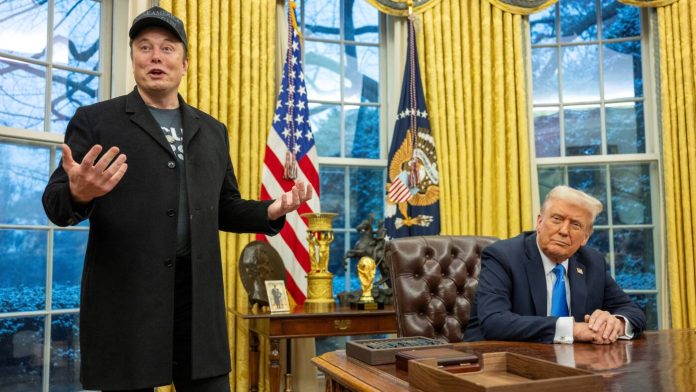
Elon Musk speaks as President Trump looks on in the Oval Office of the White House on Feb. 11.

Jim Watson/AFP via Getty Images


hide caption

toggle caption

Jim Watson/AFP via Getty Images

A new online tracker on the Department of Government Efficiency’s website puts a dollar amount on the estimated savings from the DOGE effort to slash federal government spending at $55 billion.

But an NPR analysis finds the numbers don’t add up.

The DOGE site’s posts, reminiscent of a feed on the Musk-owned social media site, X, says some savings comes from sources like “fraud detection/deletion” and “workforce reductions, programmatic changes, and regulatory savings,” and state that the full disclosure of the unit’s actions will take time.

“We are working to upload all of this data in a digestible and fully transparent manner with clear assumptions, consistent with applicable rules and regulations,” the website reads. “To get started, listed below are a subset of contract and lease cancellations.”

The doge.gov/savings page then lists a “wall of receipts,” DOGE’s first major data release that initially claimed to show more than $16 billion in savings from ending contracts. After correcting an apparent clerical error, it now shows $8.5 billion.

An NPR review of the more than 1,100 contracts in that initial release finds that DOGE’s “maximally transparent” calculations still overstate its estimated savings totals by billions of dollars.

Discrepancies paint an incomplete picture

Of the DOGE list’s initial claim of $16 billion in savings, half came from an Immigration and Customs Enforcement (ICE) listing that was entered into the Federal Procurement Data System (FPDS) in 2022 with a whopping $8 billion maximum possible value.

According to a DOGE post on X, that number was a typo that was corrected in the contract database to $8 million on Jan. 22 of this year before being terminated a week later, and DOGE “has always used the correct $8M in its calculations.”

But for much of this week, DOGE listed the outdated $8 billion for its savings claims while linking to the termination notice with the smaller ceiling amount.

Some time Tuesday evening, the DOGE link was changed to point at the original $8 billion entry, and on Wednesday morning, the site was revised once again to show $8 million in savings — but still linked to the larger, outdated claim. The site also continues to list $55 billion in total estimated savings — the $8.5 billion in alleged contract savings and another $46.5 billion with no specifically documented source.

Spokespeople for the White House and DOGE did not respond to multiple requests for clarification about the DOGE data and savings claims shared online.

Others discrepancies in DOGE’s representation of data are more technical: The ICE example is also one of many DOGE entries that is not actually a contract, but rather a different procurement method known as a blanket purchase agreement where the high maximum value acts as a sort of large line of credit for orders to be “called” against.

Since the agreement began in late 2022, ICE used it three times for work that totaled $3.5 million, for possible savings of $4.5 million – just over half of what the corrected DOGE data claimed.

Government contracting and budget experts say including those terminations in their estimates is one of many ways DOGE isn’t sharing the complete picture of government spending and saving.

What the DOGE data shows

Just over half of the contracts touted by DOGE, accounting for $6.5 billion in alleged savings, haven’t actually been terminated or closed out as of Wednesday, according to an NPR analysis of a federal government procurement database, even though the site’s “wall of receipts” listed these items.

That includes a billion dollar IT support contract with the Social Security Administration that actually added $1.8 million in obligated spending and additional funding for a Forest Service project management contract worth up to nearly $30 million.

More than a third of the listed contracts posted online would not actually save any money if canceled, according to DOGE.

In all, estimated savings from the initial DOGE list of just over 500 contracts that NPR found to be cancelled runs closer to $2 billion, with roughly half coming from the gutting of the Department of Education, the Consumer Financial Protection Bureau and the U.S. Agency for International Development.

The contracts DOGE has targeted at these agencies include ending research studies into early childhood education improvements, canceling access to financial market resources and the proposed halting of billions in international foreign aid work. To check DOGE’s claims, NPR compared the unique award ID from each hyperlink DOGE published with a list of more than 130,000 contracts that have been modified since Jan. 20, downloaded from USASpending.gov, another public data source to review government spending.

Why does this matter?

“There’s no doubt that these young people [Musk] has working for him are very intelligent coders, genius coders, but they’re limited,” retired senior contracting officer Christopher Byrne said, referring to DOGE team members who have apparently been identifying cuts across government agencies. “They don’t understand the processes, they don’t understand how things work, they don’t understand contracts, they don’t understand grants,” Byrne said.

Six other current and former federal contracting officers who spoke with NPR on the condition of anonymity for fear of retaliation say that the DOGE savings page is misleading the public with the data it includes — like overemphasizing the maximum possible value of contracts cancelled — as well as with what it leaves out, they say, like how much has already been budgeted and spent to fulfill the contract.

Jessica Riedl, a senior fellow at the center-right Manhattan Institute who studies ways to cut extraneous government spending, says DOGE is doing more harm than good to the government in how it has cut costs and shared them with the public.

“A smarter way to reform contracting would actually cost money in the short term,” Riedl said. “Because it requires audits, it requires analysis, building new systems, building new controls rather than just going through with a chainsaw and trying to cut contracts almost randomly.”

Byrne, whose contracting career spanned more than 20 years and included work with the General Services Administration, the Environmental Protection Agency and the Navy, says DOGE’s website is also missing basic information needed to track and understand federal spending, like the ID number, what type of agreement or contract method was used and whether the cancellation was for some or all of the spending. Several publicly available data sources already track and confirm changes to federal contracts, including the Federal Procurement Data System, USASpending.gov and the System for Award Management (SAM). Unlike DOGE, those sources list other relevant data like the current value of the contract, historical changes to the amount budgeted and spent for the contract and when the contracts begin and end.

DOGE’s savings page also does not include any evidence of fraud, waste or abuse in contracts, but does highlight ideological differences between the Trump administration and the previous priorities of former President Joe Biden.

As for contracts, Byrne said the discrepancy in DOGE data shows why information being entered into those systems by the government needs better validation and standardization to be more transparent.

He added that shortcomings with the current training, staffing levels and processes among contracting officers could be exacerbated by potential retirements and firings in coming months under the Trump administration’s plan to downsize the federal workforce.

“There are not the people available to do the job, to do it well,” he said, “which is going to lead to more wasteful spending.”

How much will actually be saved?

Even government contracts that have been terminated before reaching their full value could end up costing taxpayers more to settle up. Jessica Tillipman, associate dean for government procurement law studies at The George Washington University Law School, previously told NPR that the termination for convenience clause used for many of these cancellations is expensive.

“When the government terminates a contract for convenience, it’s still obligated to pay for the work completed,” she said. “This doesn’t eliminate the government’s responsibility for paying these sorts of costs.”

Riedl with the Manhattan Institute also says that the only way for the federal government to cut spending and reduce the deficit is through meaningful — and difficult — changes enacted by Congress, and not DOGE creating a “false perception” that finding “waste, fraud and abuse” is enough to get there.

More than 60% of the $6.8 trillion the federal government spent last fiscal year was mandatory spending on popular programs like Medicare, Social Security and income security programs — spending that would require major legislative reforms to substantially reduce.

NPR’s analysis found that, of its verifiable work completed so far, DOGE has cut just $2 billion in spending — less than three hundredths of a percent of last fiscal year’s federal spending.

“Think of Congress and its budget as the debt-ridden dad on the way to buy a $250,000 Ferrari on the credit card, and DOGE is the $2 off gas card he used along the way,” Riedl said. “It’s great that he saved $2 on gas, but I think his wife may be more concerned about the $250,000 car.”

Ukrainians Say They Feel Betrayed by Trump and U.S.

0

Nataliia Klymyuk, who has been volunteering for 11 years to look after a memorial to war dead in Kyiv, the Ukrainian capital, said she had never had any illusions about President Trump.

On Wednesday, she stood among a crowd of people at the memorial, on Independence Square in central Kyiv, where tens of thousands of little flags fluttered, each representing a soldier killed during Russia’s relentless invasion. The mood was especially somber.

A day earlier, Mr. Trump, from his Mar-a-Lago estate in Florida, had blamed Ukraine for the violence. “You should have never started it,” he said, referring to Ukrainian leaders who did not, in fact, start the war.

His comment stunned many Ukrainians, who saw it as a blatant betrayal.

“I don’t believe in negotiations,” said Ms. Klymyuk, 51, who plants new flags at the site daily and clears away snow. Referring to President Vladimir V. Putin of Russia and President Volodymyr Zelensky of Ukraine, she added: “Trump has always been a friend to Putin, and I don’t believe that he suddenly became our friend. He is only pursuing his own interests behind Zelensky’s back.”

Marina Ivashyna, 30, who was passing through the square, said that her father had died in the war and that her husband was missing in action. “It is tough for me — I don’t believe anything good will happen,” she said, bursting into tears. “I don’t believe in these negotiations.”

Ms. Klymyuk’s and Ms. Ivashyna’s refrain represents a growing sentiment in Ukraine as the United States and Russia have moved toward a head-spinning reset of their relationship that could disadvantage Ukraine in the war. Ukrainians are becoming disillusioned with the Trump administration, many analysts say.

In December, a large percentage of Ukrainians said they trusted Mr. Trump, who was then the president-elect. On Wednesday, expressions of disappointment and even rage were everywhere: from the front in the east to the streets of Kyiv, from social media to the halls of government buildings.

“Many people were tired of Biden’s indecisiveness and had hopes that Trump would be able to force Russia to end the war, and we can see that they are now disappointed,” said Oleh Saakyan, a political analyst and co-founder of the National Platform for Resilience and Social Cohesion, a Ukrainian think tank.

In his news conference on Tuesday, Mr. Trump also denigrated Mr. Zelensky and suggested that new elections in Ukraine should play a part in the country’s negotiations with Russia. He deepened his criticism on Wednesday, calling Mr. Zelensky a “dictator” who took money from the United States to go to war with Russia.

“Ukrainians might not like their government, but they are fanatically devoted to the value of freedom of choice,” Mr. Saakyan said. “People in Ukraine get angry when freedom of choice is taken away from them, and that’s exactly what Trump did when he started dictating to Ukrainians that they need elections.”

A 36-year-old special operations soldier fighting in eastern Ukraine, who asked to be identified only by his call sign, Cap, for security reasons, went a step further. “I can be blunt: Trump is like Putin,” he said. “He’ll never tell the truth and will make up whatever he wants.” He added that Ukraine should not rely on Mr. Trump.

“Whenever soldiers hear what Trump is saying, it gives them a nervous twitch,” he said.

Yulia Hrebnyeva, a member of the City Council in the northern Ukrainian city of Chernihiv, said she had “no understanding whatsoever” of Mr. Trump’s speech on Tuesday, with its echoes of Russian propaganda.

“We were expecting from him actions that could help us win, not that he would just sit and talk with our enemy,” she said. Early in the invasion, Ms. Hrebnyeva’s house was hit by a falling Russian fighter jet. At the time, she was hiding in the basement with her children.

For many, Mr. Trump’s news conference on Tuesday was a moment of truth. They hoped he would uphold the United States’ commitment to Ukraine’s war effort. Instead, the president blamed Ukraine for the war and made several false claims, including that Mr. Zelensky had an approval rating of just 4 percent. In fact, recent polls put his approval rating between 42 and 57 percent.

For other Ukrainians, their confidence in the United States had already buckled over the weekend when it became clear that peace talks with Russia would begin without Ukrainian participation.

“Goodbye America,” Yevhen Dykyi, a political analyst and Ukrainian veteran, wrote on Facebook. “We must accept the reality that we no longer have an ally on the other side of the Atlantic.”

Even opponents of Mr. Zelensky have been angered by Mr. Trump’s comments. Oleksandr Notevskyi, an analyst at the Center for Policy Formation and a vocal critic of the Ukrainian president, lashed out at Mr. Trump for interfering in Ukraine’s domestic politics.

As much as he hoped that another leader would soon replace Mr. Zelensky, Mr. Notevskyi said, he believed strongly that such decisions should be made only by the Ukrainian people. Foreign criticism like Mr. Trump’s, Mr. Notevskyi said on social media, was not just “an attack on Volodymyr Zelensky.”

“It’s an attack on the President of Ukraine, on our sovereign government, and on the Ukrainian state,” he wrote.

“The most important trait of Ukrainians is our ability to unite under pressure and defend our choice,” Mr. Notevskyi later said in an interview. “The vibes are the same. But this time, the target of our rage will be someone else. No one will impose anything on us.”

Ukrainians worry that they have lost the United States as an ally.

“Several factors indicate that the U.S. is no longer a key partner for Ukraine,” said Mariia Zolkina, a Ukrainian political analyst at the London School of Economics. “Even before the start of the negotiations, Trump sacrificed those positions that were fundamental for Ukraine,” including NATO membership and control of territory. Mr. Trump, she said, “gave carte blanche to the occupation.”

Ihor Lachenkov, a Ukrainian civil activist and volunteer, wrote an angry post on Facebook criticizing Mr. Trump’s assertion that Mr. Zelensky could have negotiated. “I am so sick of all this,” he said. “Of course, it’s the bad Ukrainians who just refused to surrender and give up,” he added sarcastically.

Soldiers are also monitoring Mr. Trump’s speeches. His latest comments have left many enraged.

But a soldier from the 82nd Air Assault Brigade, who asked to not be identified as he was not authorized to speak to the news media, said Mr. Trump’s statements would not deter him and his friends.

“The primary task of the 82nd Air Assault Brigade is to liberate Ukrainian territory from occupiers and defend our country,” he said. “We will continue doing that, regardless of Trump’s statements.”

Oleksandr Merezhko, a member of Ukraine’s Parliament from Mr. Zelensky’s party and chairman of the Foreign Affairs Committee, said that despite Mr. Trump’s words it was important for Ukraine to remain in dialogue with the United States. “The situation is difficult, but not hopeless,” he said. “Trump himself gives advice in such situations: Never give up!”

Oleksandra Mykolyshyn contributed reporting from Kyiv and Yurii Shyvala from Lviv, Ukraine.

What is the Impoundment Control Act, and why does Trump want to get rid of it? : Planet Money : NPR

0

A worker removes the U.S. Agency for International Development sign on their headquarters on February 07, 2025 in Washington, DC. President Donald Trump and Elon Musk’s Department of Government Efficiency (DOGE) abruptly shutdown the U.S. aid agency earlier this week leaving thousands unemployed and putting U.S. foreign diplomacy and aid programs in limbo.

Kayla Bartkowski/Getty Images


hide caption

toggle caption

Kayla Bartkowski/Getty Images


A worker removes the U.S. Agency for International Development sign on their headquarters on February 07, 2025 in Washington, DC. President Donald Trump and Elon Musk’s Department of Government Efficiency (DOGE) abruptly shutdown the U.S. aid agency earlier this week leaving thousands unemployed and putting U.S. foreign diplomacy and aid programs in limbo.

Kayla Bartkowski/Getty Images

So the president can’t spend more money than Congress has agreed and voted to spend. But can the president spend less money than Congress wants?

It all comes down to something called “impoundment” and the Impoundment Control Act of 1974, which controls when and how a president can take away money Congress has appropriated.

President Trump followed the Impoundment Control Act rules back in 2018. But now, in his second term, he’s saying he thinks that law is unconstitutional.

On this episode: the history of impoundment, from Thomas Jefferson to Richard Nixon and Bill Clinton. And what constitutional scholars and judges are saying after Trump attempted to dismantle a federal agency and freeze trillions in federal funding that goes to states for everything from new school buses to public health research.

We’ve got more about impoundment in the latest Planet Money newsletter.

Check out The Indicator’s episodes on the gutting of USAID and how American farmers are affected in USAID cuts. And, our previous episode on the big government money pipe that’s being closely watched right now.

This episode was hosted by Sarah Gonzalez. It was produced by Willa Rubin and edited by Meg Cramer. It was fact-checked by Sam Yellowhorse Kesler. Engineering by Robert Rodriguez. Alex Goldmark is Planet Money’s executive producer.

Find more Planet Money: Facebook / Instagram / TikTok / Our weekly Newsletter.

Listen free at these links: Apple Podcasts, Spotify, the NPR app or anywhere you get podcasts.

Help support Planet Money and hear our bonus episodes by subscribing to Planet Money+ in Apple Podcasts or at plus.npr.org/planetmoney.

Music: Universal Music Production, “Hi-Tech Expert,” “Black Excellence,” and “Walk The Dream.”

Trump Administration Has Fired Health Inspectors at Some Border Stations

0

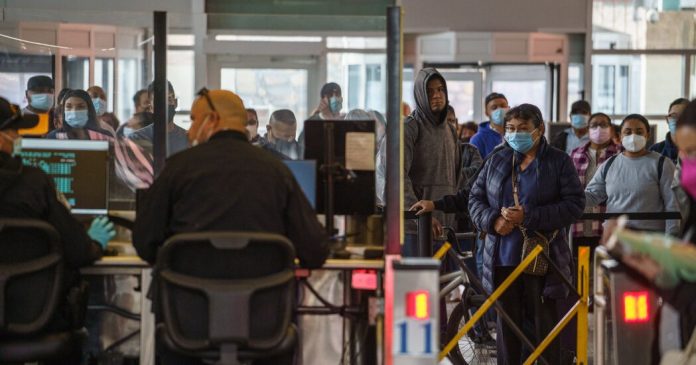
At the nation’s borders, federal workers keep the country safe in many ways: Some investigate sick passengers. Some examine animals for dangerous pathogens. And some inspect plants for infestations that could spread in this country.

Late last week, the Trump administration dispatched hundreds of those federal employees with the same message that colleagues at other agencies received: Their services were no longer needed.

The absence of these federal officers at the borders leaves Americans vulnerable to pathogens carried by plants, animals and people, experts warned.

The firings come even as the Trump administration is said to be readying plans to turn back migrants on the grounds that they might bring diseases like tuberculosis and measles into the country.

“Screening for communicable diseases at ports of entry is an important role of public health in order to prevent communicable diseases from entering our country,” said Dr. Carlos del Rio, an infectious disease physician at Emory University.

“Not having public health employees to do this job is concerning and makes us less safe,” he added.

The Centers for Disease Control and Prevention estimates that every day, nearly 30,000 planes travel in and out of the country. In 2019, more than 400 million travelers arrived via more than 300 ports of entry. About half of those people crossed the border between the United States and Mexico.

Border posts are manned by workers from multiple agencies. Employees from the C.D.C.’s Division of Global Migration Health screen people, animals and animal products for diseases, respond to reports of ill travelers and distribute medications as needed.

The Trump administration last week dismissed an unknown number of people from the C.D.C.’s 20 port health stations, leaving some entirely unattended, according to three officials with knowledge of the situation.

Calls to the port station in San Juan, P.R., on Wednesday, for example, were rerouted to the station in Miami, where a C.D.C. employee who declined to be identified said that no one would be at the San Juan post “for a very long time.”

Other port stations are in Anchorage, Atlanta, Chicago, New York, San Francisco and three cities in Texas.

C.D.C. officers can legally detain or conditionally release people and wildlife suspected of carrying any disease on a long list that includes measles, tuberculosis, pandemic influenza and viral hemorrhagic fevers such as Ebola and Marburg.

The Department of Agriculture employs entomologists, botanists and mycologists — experts in insects, plants and fungi, respectively — who inspect agricultural products for pests and pathogens. Many of those specialists were also let go on Friday.

“We’re such a critical program, it makes no sense,” said one U.S.D.A. official with knowledge of the situation, who asked not to be named for fear of retaliation.

“If we don’t work and those inspections don’t happen, things start piling up at the ports,” the official added.

Animal health experts have been particularly concerned about African swine fever and New World screwworm, two diseases that have been creeping closer to the United States and could have devastating impacts on the pork and beef industries.

On Tuesday, the U.S.D.A. said it had mistakenly fired several employees working on the country’s bird flu outbreak and was trying to hire them back, according to a report by NBC News. It’s unclear how many of the employees have returned to their positions.

Judge will soon rule on corruption charges against NYC Mayor Adams : NPR

0

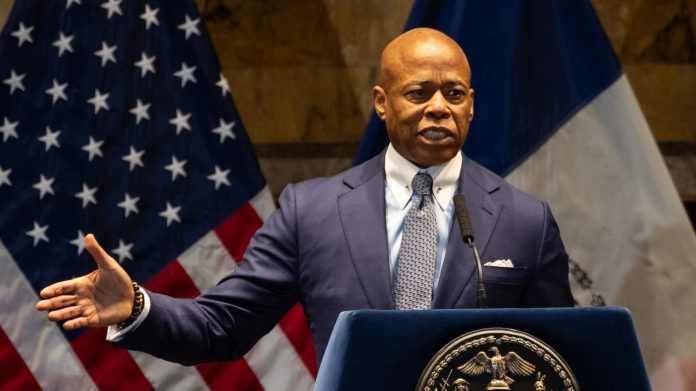
New York City Mayor Eric Adams speaks during the annual Interfaith Breakfast at the New York Public Library in New York City on Jan. 30.

Yuki Iwamura/AFP via Getty Images


hide caption

toggle caption

Yuki Iwamura/AFP via Getty Images

Attorneys for the U.S. Justice Department and Mayor Eric Adams appeared before federal Judge Dale Ho Wednesday afternoon in Manhattan, pressing their case that five federal corruption and bribery charges against Adams should be suspended.

Normally such requests are granted readily when prosecutors and defendants are in agreement, but Ho asked a lengthy series of questions about the DOJ’s motives for putting Adams’ case on hold.

“This is a very complicated situation, at least from where I sit,” Ho said. At the end of the hearing, he declined to rule from the bench but said he would issue a ruling soon.

The DOJ moved last week to request that its sweeping criminal case against Adams, launched by the Justice Department under the Biden administration, be shelved.

Top Trump administration officials have signaled they expect Adams, a Democrat, to help the White House crack down on migrants living in New York City without legal status.

In the courtroom today, the DOJ’s acting Deputy Attorney General Emil Bove asserted repeatedly that Ho possessed only limited discretion to review the request for dismissal.

Bove, who once served as attorney for President Donald Trump, also said the decision to suspend the case was motivated in large part by “national security” concerns and a desire for Adams to pursue migrants in New York City who lack legal status.

Under questioning by Ho, Bove said canceling a criminal trial would allow Adams to “get back to work unburdened and unhindered.”

The DOJ’s dismissal memo, sent on Feb.10, said bluntly that a criminal trial would interfere with Adams’ ability to carry out one of the Trump administration’s key policies:

“[T]he pending prosecution has unduly restricted Mayor Adams’ ability to devote full attention and resources to the illegal immigration and violent crime that escalated under the policies of the prior administration,” the DOJ’s memo asserted.

Critics say Adams case skewed by politics

Critics inside the DOJ suggested the decision to suspend the case came as part of an improper “quid pro quo.” At least seven Justice Department attorneys in New York City and Washington, D.C., resigned rather than go along with the deal.

NEW YORK, NEW YORK - FEBRUARY 19: Protesters awaited the arrival of New York City Mayor Eric Adams to his court hearing at Thurgood Marshall Courthouse in New York City. Judge Dale E. Ho scheduled a hearing in response to the Justice Department’s request to dismiss corruption charges against Adams. The hearing comes after four deputy mayors from Adams’ administration resigned over his cooperation with U.S. President Donald Trump on immigration, which prosecutors on his bribery case alleged was part of a deal with the Trump administration’s Department of Justice to drop the charges against him.

NEW YORK, NEW YORK – FEBRUARY 19: Protesters awaited the arrival of New York City Mayor Eric Adams to his court hearing at Thurgood Marshall Courthouse in New York City. Judge Dale E. Ho scheduled a hearing in response to the Justice Department’s request to dismiss corruption charges against Adams. The hearing comes after four deputy mayors from Adams’ administration resigned over his cooperation with U.S. President Donald Trump on immigration, which prosecutors on his bribery case alleged was part of a deal with the Trump administration’s Department of Justice to drop the charges against him.

Eduardo Munoz Alvarez/Getty Images/Getty Images North America


hide caption

toggle caption

Eduardo Munoz Alvarez/Getty Images/Getty Images North America

Answering Ho’s questions under oath, however, Adams repeatedly said there was no explicit trade-off, linking his cooperation with the Trump administration on immigration enforcement in New York City to lenient treatment by the DOJ.

Ho also noted that the DOJ is reserving the right to indict Adams again on these charges in the future. Asked whether he felt threatened or pressured in any way, Adams answered, “No, your honor.”

Ho also noted in court that three former federal prosecutors filed a legal brief urging him to reject the DOJ’s bid to suspend the case against Adams. They argued that the move reflected improper political influence over a criminal case.

“Federal prosecutors should not make criminal charging decisions based on political associations, political activities, or personal allegiances,” they wrote.

During court proceedings on Wednesday, the DOJ’s Bove dismissed that claim as “partisan noise.”

Speaking with reporters before the hearing, Adams sounded upbeat, describing the proceedings as “part of the process.” In recent days, he’s made frequent public appearances throughout the city, promising progress on infrastructure, the economy and other priorities.

While Adams’ legal fate hangs on Ho’s ruling, his political future also hangs in the balance. Four of his deputy mayors resigned this week because of Adams’ scandals and his deepening ties to Trump’s immigration policies. Adams also faces a fiercely-contested Democratic primary in June followed by the general election in November.

Meanwhile, New York’s Democratic Governor Kathy Hochul, long considered a political ally of Adams, is weighing whether to use her authority to remove him from office.

Hochul met with top political and civic leaders on Tuesday in Manhattan to discuss Adams’ political future. She hasn’t yet announced her decision.

Thursday Briefing: Trump and Zelensky Feud Over Peace Talks

0

President Trump yesterday called Ukraine’s president, Volodymyr Zelensky, a “dictator” who took money from the U.S. to go to war with Russia. In a social media post littered with falsehoods, Trump didn’t mention President Vladimir Putin, or that Russia seized some Ukrainian territory in 2014 before its full-scale invasion in 2022.

Trump also suggested that the future security of Ukraine would not be an American problem.

“This War is far more important to Europe than it is to us,” he wrote on Truth Social. “We have a big, beautiful Ocean as separation.”

The feud began after White House and Kremlin officials in Saudi Arabia began peace talks that excluded Ukraine. After that meeting on Tuesday, Trump suggested that Ukraine had started the war. Afterward, Zelensky said Trump had been “caught in a web of disinformation.”

E.U.: Leaders met yesterday for a second emergency meeting seeking to recalibrate relations with the U.S. as Trump moved closer to Russia.

Envoys from five Arab countries are set to meet in Saudi Arabia tomorrow to begin fleshing out a vision for Gaza. They’re expected to meet again at a bigger summit on March 4 in Cairo.

Egypt, Jordan, Saudi Arabia, Qatar and the United Arab Emirates hope that countries in the region will help fund and oversee Gaza’s reconstruction, while keeping its residents in place and preserving the possibility of a Palestinian state, according to diplomats and officials. But Israeli leaders oppose postwar plans that would pave the way to Palestinian sovereignty.

What’s next: Egypt will likely propose a committee of Palestinian technocrats and community leaders, all unaffiliated with Hamas, who could run Gaza after the war, according to two Arab diplomats and two Western officials.

Hostages: Israelis are waiting anxiously for the expected release tomorrow of the bodies of four captives held by Hamas.

Israel: A military prosecutor charged five reservist soldiers with abuse of a Palestinian detainee.


President Trump’s media company sued a Brazilian Supreme Court justice yesterday, accusing him of illegally censoring right-wing voices on social media. Hours earlier, the judge had received an indictment that would force him to decide whether to order the arrest of Jair Bolsonaro, the former Brazilian president.

Context: Bolsonaro was indicted on Tuesday on charges that he plotted a coup after losing the 2022 election, including by participating in plans to assassinate the justice. Bolsonaro had called on Trump to take action against the justice in an interview with The Times last month.


Cambodia’s national museum is facing a problem: About 300 stolen artifacts have been returned over the past six years, and space is getting a little cramped.

Expansion and renovations are challenges, but so is designing galleries for sacred objects. Some Cambodian visitors don’t see the pieces as cultural curiosities or works of art, but as divinities that hold their ancestors’ souls. For them, this is more of a temple than a museum.

Lives lived: Gil Won-ok, one of the last survivors of sexual slavery for Japan’s World War II troops, and who campaigned for justice​, died at 96.

Microsoft announced yesterday that it created a new state of matter in its quest to build a quantum computer — a machine that could accelerate the development of everything from batteries to medicines to A.I. It used the new matter to construct a tiny chip that could have exponentially more processing power than a superconductor.

The tech could leapfrog methods used by competitors like Google. The milestone, Microsoft says, pushes the company closer to the finish line in a technological race that could be even bigger than A.I. But some academics are skeptical. Read why here.

Trump’s Ukraine rhetoric highlights intraparty GOP rift : NPR

0

President Trump delivers remarks at his Mar-a-Lago resort in Palm Beach, Fla., on Tuesday. On Wednesday, Trump criticized Ukrainian President Volodymyr Zelenskyy as a “dictator.”

Joe Raedle/Getty Images


hide caption

toggle caption

Joe Raedle/Getty Images

Some Senate Republicans took issue Wednesday with President Trump’s escalating criticism of Ukrainian President Volodymyr Zelenskyy as a “dictator” and his false assertion that Ukraine provoked the ongoing war with Russia, now in its third year.

Trump’s “dictator” remark came in a scathing post on his TruthSocial social account, and followed comments by Zelenskyy earlier in the day that he “would like to see more truth from the Trump team.” 

The president’s comments left several lawmakers looking to dispel Russian talking points about how the war began and who bore ultimate responsibility. 

“We must remember that the instigator of this war was Russia,” said Sen. Susan Collins, R-Maine. “It was President Putin who launched an unprovoked attack on Ukraine.”

Sen. Thom Tillis, R-N.C., who just returned from an official visit to Ukraine, lauded Zelenskyy for keeping his nation together and putting up a tougher fight than Russia anticipated.

“I think we should give [Zelenskyy] a fair amount of credit for that work,” he said.

The response among Senate Republicans highlights a public intraparty rift with the president on a key White House priority, even though lawmakers have little power to change Trump’s mind about approving any more funding for Ukraine, his personal view of Zelenskyy or the increasing likelihood of a peace deal that many lawmakers worry is more likely to favor Russia’s interests.

The president holds tremendous constitutional authority to conduct foreign policy with little check on that power from Congress or anywhere else. An initial round of U.S.-Russia talks kicked off in Saudi Arabia on Tuesday — without Ukraine at the table.

Senators like Tillis expressed some concern that the president is taking a cozier approach to Russian President Vladimir Putin, someone who more conservative defense hawks traditionally view as a direct threat to U.S. interests.

“Putin’s a murderer,” Tillis said. “He’s a very bad person who needs to be stopped. He’s going to metastasize across Europe if we don’t [stop him.]”

At the same time Tillis, who is up for re-election in 2026, suggested that Trump’s negotiating tactics often work for him and said he’s willing to give him the benefit of the doubt to try to finalize a deal that protects Ukraine.

“I’ll give him latitude for now, but at the end of the day, Putin needs to be a loser and the Ukrainian people need to be the winners,” Tillis said.

Ukrainian President Volodymyr Zelenskyy arrives at the 61st Munich Security Conference on Feb. 15, in Munich, Germany. Ukrainian officials were left out of a meeting this week between U.S. and Russia negotiators about ending the war in Ukraine.

Ukrainian President Volodymyr Zelenskyy arrives at the 61st Munich Security Conference on Feb. 15, in Munich, Germany. Ukrainian officials were left out of a meeting this week between U.S. and Russia negotiators about ending the war in Ukraine.

Sean Gallup/Getty Images/Getty Images Europe


hide caption

toggle caption

Sean Gallup/Getty Images/Getty Images Europe

Sen. Kevin Cramer, R-N.D., echoed the view that Trump should be given room to negotiate, telling reporters the president is “a public negotiator and understands positioning and likes to soften his targets.”

Asked what he would tell Ukrainians following Trump’s moves, Cramer said: “Watch Donald Trump masterfully bring an end to the war in your country and don’t expect to get everything you want and don’t expect Vladimir Putin to get everything he wants, but a permanent peace which I think almost every Ukrainian wants.”

Whether or not Trump can broker an end to the war is unlikely to affect the reality that the GOP-controlled Congress has little appetite for approving any more foreign aid to help Ukraine in its fight. All in, Congress has approved about $175 billion that includes direct military assistance to Ukraine and funds to rebuild the U.S. military stockpile.

Zelensky told NBC in an interview that aired Sunday that it would be “very very difficult” for Ukraine to survive without U.S. aid. “I don’t want to think about it,” he said. “Yes, we have to think about it.”

Prior to Trump’s comments, other top Republicans were already expressing concern with the president’s posture toward Russia. During the Munich Security Conference last week, Senate Armed Services Committee Chairman Roger Wicker, R-Miss., criticized Defense Secretary Pete Hegseth’s declaration that Ukraine would not be offered NATO membership as part of any peace deal with Russia.

“There are good guys and bad guys in this war, and the Russians are the bad guys,” Wicker said during a programming interview hosted by Politico. “They invaded, contrary to almost every international law, and they should be defeated. And Ukraine is entitled to the promises that the world made to it.”

Senate Majority Leader John Thune, R-S.D., speaks to reporters at the U.S. Capitol on Wednesday. Thune spoke about the war in Ukraine, saying it was worth giving both sides "some space" to sort out their issues.

Senate Majority Leader John Thune, R-S.D., speaks to reporters at the U.S. Capitol on Wednesday. Thune spoke about the war in Ukraine, saying it was worth giving both sides “some space” to sort out their issues.

Andrew Harnik/Getty Images


hide caption

toggle caption

Andrew Harnik/Getty Images

While former Senate Majority Leader Mitch McConnell, R-Ky., was – and remains – one of the loudest defenders of U.S. aid to Ukraine in Congress, his successor made clear Wednesday he is taking a softer approach.

“I think what I’m in support of is a peaceful outcome and result in Ukraine, and I think right now the administration, the president and his team are working to achieve that,” Senate Majority Leader John Thune, R-S.D., told reporters. “And I think right now you’ve got to give them some space.”

Asked about Trump’s characterization of Zelenskyy as a dictator, Thune responded: “The president speaks for himself.”

Deirdre Walsh and Lexie Schapitl contributed reporting.