Friday, November 13, 2026
Home Blog Page 205

Bessent to Skip G20 Finance Ministers Meeting in South Africa

0

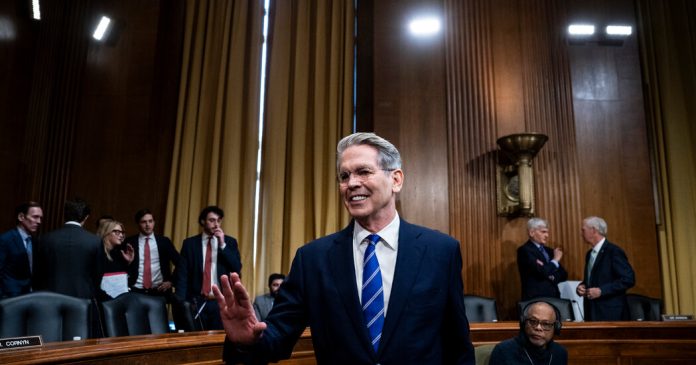
Treasury Secretary Scott Bessent will skip a meeting of finance ministers and central bankers from the Group of 20 nations in Cape Town next week, according to people familiar with his plans, deepening the rift between the United States and South Africa over policies the Trump administration believes are anti-American.

The decision to forgo such a major economic gathering is highly unusual for a Treasury secretary, particularly one who was confirmed to his post three weeks ago. It comes at a pivotal moment for the global economy, as the United States moves toward imposing tariffs on virtually all of its trading partners. President Trump is also seeking deeper economic ties with Russia, an adversary that the United States was aligned against in coordination with Western allies until he returned to office.

Mr. Bessent’s decision came after a boycott of a similar meeting this week of foreign ministers in Johannesburg by Secretary of State Marco Rubio. Mr. Rubio said he was skipping the gathering because he did not want to “waste taxpayer money or coddle anti-Americanism.”

Mr. Trump has indicated that he sees little value in multilateral meetings like the Group of 20 and prefers to hold bilateral negotiations with other nations. The theme for the meetings this year is “solidarity, equality, sustainability,” which the administration considers at odds with its views on climate change and diversity policies.

The gathering would have been Mr. Bessent’s first opportunity to meet with his global counterparts and have talks with top financial officials from Europe, China and Russia.

Mark Sobel, who served at the Treasury Department for nearly four decades, called the decision to skip the meetings a “colossal mistake.” He noted that such gatherings were an opportunity for the Trump administration to lay out its global priorities and discuss the state of the world economy and central issues such as exchange rates.

“The Trump administration and Scott Bessent are thumbing their noses at the international economic and financial system,” Mr. Sobel said. “That will not make America greater or safer.”

The G20 was created in 1999 after the Asian Financial Crisis as a forum for finance ministers and central bankers to meet and discuss international economic matters and financial stability.

The group’s meetings have been awkward in recent years because of tension between Russia and Western allies, including the United States, over the war in Ukraine. But the Trump administration has made clear that it intends to take a different approach with Russia as it looks to negotiate an end to the war.

Mr. Trump suggested this week that Ukraine might have been responsible for Russia’s invasion and on Wednesday referred to the Ukrainian president, Volodymyr Zelensky, on social media as a “Dictator without Elections.”

The decision by Mr. Bessent not to attend the meetings will come as a disappointment and a surprise to South Africa. An official from its Department of International Relations and Cooperation posted on social media this week that the Treasury secretary was expected to attend the meetings in Cape Town.

A spokeswoman for Mr. Bessent had no comment on Wednesday.

Another person familiar with the situation said that Mr. Bessent was in regular contact with his international counterparts and opted to stay in the United States next week to focus on domestic matters. A senior Treasury official will be attending the meetings in his place, the person said.

The diplomatic tension between the United States and South Africa emerged as a surprising turn of events this year.

Earlier this month, Mr. Trump ordered that all foreign assistance to South Africa be halted and said his administration would prioritize the resettling of white, “Afrikaner refugees” into the United States because of what he called actions by the country’s government that “racially disfavored landowners.”

Mr. Trump’s recent comments were in reference to a policy that President Cyril Ramaphosa of South Africa signed into law last month.

Known as the Expropriation Act, the law repeals an apartheid-era policy and allows the government in certain instances to acquire privately held land in the public interest without paying compensation. This can be done only after a justification process subject to judicial review.


Is this U.S. heading for autocracy?

0

Since he took office four weeks ago, President Trump has taken a series of actions that have upended the traditional role of government. Are they pushing the United States closer to an autocracy?

Israeli Military Prosecutor Charges Five Soldiers in Abuse of Palestinian Detainee

0

An Israeli military prosecutor charged five reservist soldiers on Wednesday with abuse of a Palestinian detainee, saying it took place last year at a military base where thousands of Gazans have been held.

The indictment accused soldiers at the Sde Teiman base in southern Israel of breaking the detainee’s ribs, puncturing his left lung and tearing his rectum. The detainee was identified only by his initials.

Avi Amiram and Lior Porat, lawyers representing one of the soldiers, said they have presented arguments that deny the charges against the reservists. Honenu, a right-wing legal organization representing two of the soldiers, criticized the charges and claimed the detainee was a militant in an elite unit in the northern Gaza Strip. The New York Times could not independently verify Honenu’s allegation about the detainee.

The indictment contains some of the most serious allegations of mistreatment at Sde Teiman since the Israeli military launched its offensive in Gaza in the aftermath of the Hamas-led October 2023 attack on Israel. The case against the soldiers has also revealed divisions in Israel about the extent to which soldiers should be held accountable for abusing Palestinian detainees accused of involvement in terrorist activity.

On the evening of July 5, 2024, soldiers beat the detainee while he screamed in pain, according to the indictment, which said his hands and legs were bound and his eyes blindfolded.

“For about 15 minutes, the defendants hit the detainee, stomped on him, and stood on his body,” the document said. “They struck him all over his body.”

Soldiers also used a Taser against him, including on his head, the prosecutor’s account said. At one point, one of the soldiers stabbed him with a “sharp object,” causing a tear in his rectal wall, it added.

Hours later, medics rushed the detainee to a health clinic at the base, where a doctor ordered him transferred to a hospital, according to the indictment.

The Israeli military said that it was committed to the rule of law and that investigators had collected “extensive” evidence to support the charges, including medical documentation and security camera footage.

In a statement, Mr. Amiram and Mr. Porat said they were certain that the charges against the soldiers would be dropped “when the facts are clarified in proceedings.”

The two charges made against the soldiers include jointly causing severe injury under aggravated circumstances and jointly abusing the detainee under aggravated circumstances.

Tal Steiner, the executive director of the Public Committee Against Torture in Israel, a human rights group, said the charges against the reservists were serious. She said while it was still too early to understand what kind of penalty they could face, Israeli military courts have acted relatively leniently in past cases in which Israeli soldiers were accused of using excessive force against Palestinians.

In 2017, Elor Azaria, a sergeant before he was demoted, was convicted of manslaughter and sentenced to 18 months in prison for killing Abdel Fattah al-Sharif, a Palestinian man in the Israeli-occupied West Bank. When Mr. Azaria shot Mr. al-Sharif dead, Mr. al-Sharif was already lying on the ground wounded; Mr. al-Sharif had been shot after stabbing another Israeli soldier. Mr. Azaria served nine months in prison and was later granted parole.

The case against the soldiers at Sde Teiman led to unrest last July, after videos surfaced of Israeli military police raiding the base to detain soldiers on suspicion of abusing the Palestinian.

Dozens of protesters gathered outside the base in solidarity with the soldiers, including at least three far-right lawmakers from Prime Minister Benjamin Netanyahu’s governing coalition. Hundreds later massed outside Beit Lid, a second base in which the soldiers had been brought for interrogation. Dozens surged inside both bases, brushing aside the guards at the gates.

At the time, Israeli military officials emphasized that no one was above the law, while right-wing protesters argued soldiers shouldn’t be punished for mistreating Palestinians accused of partaking in terrorist activities.

Many Palestinians who have been held at Sde Teiman have accused Israeli soldiers of carrying out grave acts of abuse against them. An investigation by The New York Times published last June found that by late May, roughly 4,000 Gazan detainees had spent up to three months in limbo at Sde Teiman. At least 1,200 people had been found to be civilians and returned to Gaza, without charge, apology or compensation.

The investigation found that those 1,200 Palestinian civilians had been held at Sde Teiman in demeaning conditions without the ability to plead their cases to a judge for up to 75 days. Eight former detainees, all of whom the military confirmed were held at the site and who spoke on the record, variously said they had been punched, kicked and beaten with batons, rifle butts and a hand-held metal detector while in custody.

Back then, the Israeli military denied that “systematic abuse” had taken place at Sde Teiman. When presented with individual allegations of abuse, the military said the claims were “evidently inaccurate or completely unfounded,” and might have been invented under pressure from Hamas. It did not give further details.

Gabby Sobelman contributed reporting to this article.

Trump claims expanded power over independent agencies : NPR

0

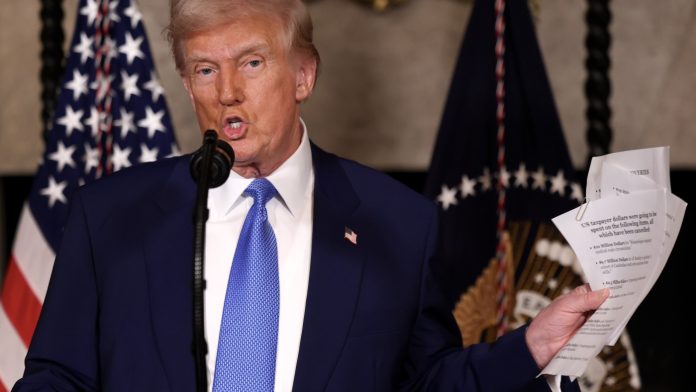
President Trump speaks during a press conference Tuesday at his Mar-a-Lago resort in Palm Beach, Fla.

Joe Raedle/Getty Images


hide caption

toggle caption

Joe Raedle/Getty Images

President Trump on Tuesday signed an executive order to give the president greater power over independent regulatory agencies — government entities Congress set up to be shielded from White House control.

Well-known independent regulatory agencies include the Consumer Product Safety Commission, which issues recalls and safety warnings; the Securities and Exchange Commission, which oversees markets; and the Federal Deposit Insurance Corporation, which insures bank deposits.

Trump’s order specifically exempts the Federal Reserve’s Board of Governors and Open Market Committee.

The Federal Reserve, which sets monetary policy, is intentionally designed to be independent from the whims of electoral politics, a separation considered central to its ability to stabilize the economy.

The order calls for the affected agencies to submit any new regulations to the White House, set up White House Liaison offices, and “regularly consult with and coordinate policies and priorities” with the White House. In claiming this new power over agencies, the order also gives the president and attorney general the sole abilities to interpret laws for the executive branch. The order stands as yet another example of Trump’s pushes to aggressively expand executive power.

Expanded presidential power

“Given Trump’s insistence on complete loyalty to him on the part of all government employees, this move is designed to extend his grip on the government to areas that previously have been nonpartisan,” said Daniel Farber, a law professor at University of California, Berkeley, who clerked for the moderate Supreme Court Justice John Paul Stevens, in an email.

Trump has already fired high-ranking officials at independent agencies including the Equal Employment Opportunity Commission and the National Labor Relations Board, and also more than a dozen inspectors general at independent agencies. Those decisions have already sparked lawsuits against the administration that claim the firings were illegal. This order could result in related legal action.

The White House has had the power to review the regulations of government agencies for more than 30 years, since President Clinton signed an executive order calling for regulatory review. However, the policy has long exempted independent regulatory agencies.

Project 2025

At the center of Trump’s new executive order is Russell Vought, director of the Office of Management and Budget. As acting director of the Consumer Financial Protection Bureau, he recently mandated that all staff “stop performing any work tasks.”

Vought advocated against the concept of independent agencies in an interview with far-right broadcaster Tucker Carlson shortly after Trump’s November election.

“There are no independent agencies. Congress may have viewed them as such, SEC or the FCC, CFPB, the whole alphabet soup, but that is not something that the Constitution understands,” he said. “So there may be different strategies with each one of them about how you dismantle them. But as an administration, the whole notion of an independent agency should be thrown out.”

The prospect of bringing independent agencies under White House control is laid out in Project 2025, the conservative Heritage Foundation’s blueprint for government that Trump tried to distance himself from during the campaign.

Project 2025 references a 1935 Supreme Court decision, Humphrey’s Executor v. US, in which the court decided that a president cannot fire the head of an independent agency. Project 2025’s chapter on the Department of Justice argues that that decision violates the separation of powers.

In Trump’s first term, his White House asked the Justice Department for an opinion on whether he could make independent agencies submit to White House regulatory review. The DOJ said yes, but Trump did not pursue that.

A sympathetic Supreme Court?

Saikrishna Prakash, a law professor at the University of Virginia who clerked for the conservative Justice Clarence Thomas, takes the view that the president has the power to fire heads of independent agencies. He also says he believes the current Supreme Court is likely to agree with Trump.

“I think the court has been saying for years that Congress can’t give for-cause protections to these agencies,” he said. “I think the handwriting’s on the wall.”

Indeed, the Supreme Court, which has a 6-3 conservative supermajority, has for years been eroding the power of regulatory agencies. Five of its six conservatives have during their careers served as White House lawyers.

The practical results of this executive order could be far-reaching, said UC-Berkeley’s Farber.

“One result will be to give the president much more control over the financial sector, especially via the SEC,” Farber said, adding that via the NLRB and FTC, Trump would also have more control over labor and trade, respectively. The ultimate result, he said could be regulatory whiplash.

“The Commission system has given these areas of the law some degree of stability, so the rules don’t completely flip after every election,” Farber said. “That would change under Trump’s order.”

As Tourists Swarm Erupting Mount Etna, Italian Authorities Warn Them Away

0

Thousands of tourists have stormed the snowy slopes of Sicily’s Mount Etna in recent weeks, congesting roads and obstructing the paths of rescue crews, the Italian authorities said, despite their efforts to keep people safely away from explosive lava flows.

Mount Etna regularly erupts, and it has drawn tourists for decades. But the latest eruption, which began on Feb. 8, has drawn so many photographers, hikers and nature aficionados that it has raised a chorus of warnings and orders from local Italian officials.

Salvo Cocina, Sicily’s regional civil protection leader, in a statement Sunday described a “constant flow” of about 1,000 people, as well as “wild parking on the edges of tight streets” that created an impasse for emergency vehicles.

“With the dark, the risk of falling and sinking into the snow increases proportionally with the increase of people,” he said.

“Etna is giving us a breathtaking spectacle: A lava flow has reached our territory,” Mayor Fabio Mancuso of Adrano warned his town near the foot of Etna a day earlier. “A lot of people are trying to get closer to admire this natural phenomenon, but it is extremely dangerous!”

He said the lava colliding with snow could cause violent explosions when the snow melts rapidly, resulting in high-pressure steam that can hurl rocks and lava a great distance. “A mortal danger for anybody near the flow!” he said in a social media post. “For this reason I have signed an order forbidding anyone from approaching the lava front.”

In Ragalna, another community on Etna’s slopes, the authorities ordered everyone to stay at least 500 meters, or nearly 550 yards, away from the lava flow.

But as the authorities issued orders, people still appeared to be uploading images and videos taken from the vicinity of the lava flows. Videos shared by the company AccuWeather showed people skiing down a snowy slope while lava smoldered and molten chunks of material tumbled down in the distance. In one clip, the silhouette of a sightseer’s body can be seen against red lava cascading not far in the background.

“Some people have independently managed to approach certain areas, but local municipalities have now imposed restrictions to prevent access to sites affected by the eruption for safety reasons,” said Giulia Campisi, a spokeswoman for a volcano tour agency, Go-Etna.

Ms. Campisi said in an email that the eruption was affecting Etna’s western flank, where fewer tourists know the trails. “To reach the lava flow in this particularly cold winter,” she said, “you must walk for a long time in deep snow.”

Go-Etna has not been taking tourists directly to the lava flows, she said, adding that it was abiding by local restrictions and safety measures. She also cited the danger that occurs when hot lava meets frigid snow.

“In some deeper spots, this can cause an immediate (and literally EXPLOSIVE) evaporation of the snow, resulting in the projection of hot stones, like bullets everywhere,” she said. “Events like these can take even experts by surprise.”

Stefano Branca, the director of the National Institute of Geophysics and Volcanology, called the activity a “typical summit eruption.” He added, “Only people who come within a few meters from the lava flow can be in danger as the heat of the lavas can cause small hydromagmatic explosions caused by the rapid melting of the snow.”

Elisabetta Povoledo contributed reporting.

Trump backs House’s approach to budget plans to implement his agenda : NPR

0

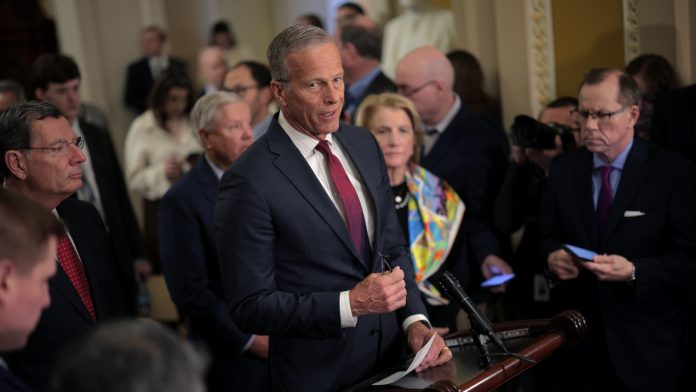
U.S. Senate Majority Leader John Thune, R-S.D., delivers remarks following the weekly policy luncheon at the U.S. Capitol on Feb. 11, 2025.

Chip Somodevilla/Getty Images


hide caption

toggle caption

Chip Somodevilla/Getty Images

President Trump is putting his thumb on the scale in a months-long debate between the House and Senate as to how to best implement his top legislative priorities, like securing the southern U.S. border and extending the tax cuts passed in his first administration.

Senate GOP leaders have pushed for a two-bill approach, first addressing funding for the military and the border along with some changes to federal energy policy, and then revisiting tax cuts later this year in a separate bill. They say it’s the most expeditious path to get dollars to the agencies that need them.

House GOP leaders say the best chance of getting legislation passed with their razor-thin majority — with various factions demanding different concessions — is to tackle Trump’s agenda in one large bill covering border funding and taxes together.

On Wednesday, Trump posted on social media that the House resolution “implements my FULL America First Agenda, EVERYTHING, not just parts of it!”

“We need both Chambers to pass the House Budget to ‘kickstart’ the Reconciliation process, and move all of our priorities to the concept of, “ONE BIG BEAUTIFUL BILL,” he added.

Trump’s statement goes further than his prior remarks, where he indicated support for the House’s approach but said he cared less about the process as long as the results got done.

As both chambers move ahead with different strategies, Trump is likely to be pulled into the process again to press lawmakers to back GOP leaders’ plans. But if the party remains unified, the budget process could hand Trump major wins for his biggest campaign promises on the border and taxes.

Senate begins debate this week 

The Senate on Tuesday evening agreed to a motion to proceed on Senate Budget Chairman Lindsey’s budget resolution by a 50-47 vote along party lines.

That resolution would authorize over $300 billion in new funding to address border security, military spending, and changes to federal energy policy. The new spending would be offset by cuts to mandatory spending, which weren’t specified.

The Senate process this week, which proceeds while the House is in recess, includes floor debate on the resolution, which is limited to 50 hours and is succeeded by what’s known as a “vote-a-rama,” where senators bring amendments that last until lawmakers essentially run out of steam.

The vote-a-rama can be long-drawn-out and is often used to force lawmakers from both parties to go on the record about something — even unrelated to the core of the bill at hand — that can then be used for political purposes down the road.

Both Republican and Democratic senators are expected to offer amendments aimed at forcing challenging votes on senators who face tough reelection bids next year. It offers Democrats a way to advance their message while they have very limited concrete power as the party in the minority.

House aims for “one big beautiful bill”

Senate Majority Leader Steve Scalise scheduled a House vote for next week on the House budget resolution, after the House Budget Committee adopted it along party lines last week.

In order to appease some conservative holdouts and get the resolution over the finish line, House GOP leaders made adjustments that would direct up to $2 trillion in spending cuts — though committees would have to work out the details. That puts some programs like Medicaid on the potential chopping block, which has already raised concerns from some Republican members.

The House bill also calls for $4.5 trillion in tax cuts over the next decade. These include renewing Trump tax cuts enacted in 2017 and then adding other provisions Trump campaigned on, like no tax on tips, overtime or Social Security.

Some Senate Republicans want to make the 2017 Trump tax cuts permanent.

While Republicans in the House and Senate disagree on the strategy of one bill versus two bills to implement Trump’s agenda, they are united in using budget reconciliation to pass the legislation with only Republican support.

Reconciliation is a budget tool that enables some legislation to pass with just a simple majority and avoid the threat of a filibuster, which requires 60 senators to overcome. It’s the same budget process that enabled congressional Democrats to pass parts of former President Joe Biden’s agenda.

But the budget resolution must ultimately be adopted by both chambers. So as the Senate advances down its own path, a showdown with the House is looming.

Once both chambers adopt the resolution, congressional committees start writing bills to achieve the budget goals laid out in the resolution. Then, the budget committee assembles those bills together into one large bill that can’t be filibustered.

Negotiations on the budget reconciliation package are expected to be more challenging in the coming months, as committees craft detailed provisions impacting government programs and tax policy. And leaders are racing to complete action to get a package that both the House and Senate can pass before the end of the year, when Trump’s 2017 tax cuts expire.

What We Know About the Secretive Migrant Mission at Guantánamo Bay

0

The Trump administration has moved more than 175 men from an immigration holding site in Texas to the U.S. military base at Guantánamo Bay. All have been described as Venezuelans who have been issued final deportation orders. But it is not known why these men in particular were sent there.

Waves of migrants, including thousands of Haitians and Cubans, have been housed at the base over the years. But it is better known as a prison for wartime detainees captured after the terrorist attacks on Sept. 11, 2001. Because of that legacy, Guantánamo Bay sometimes evokes the idea of indefinite detention without charge, a legal black hole with no way out.

Here are some of the things we have learned about the migrant mission so far.

On Jan. 29, President Trump ordered the Defense and Homeland Security Departments to prepare the base to receive up to 30,000 migrants.

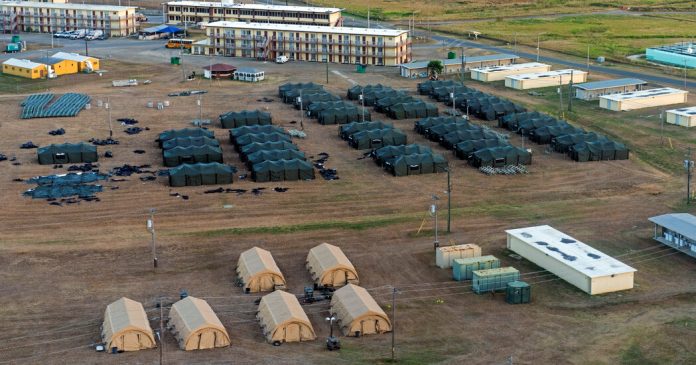
Satellite imagery shows that tents have been going up near a building that was used for migrant operations in the past.

As of Tuesday, the military said there were about 850 troops and civilians assigned to migrant operations, more than 700 of them in the U.S. military.

With support from the Coast Guard, the military has been guarding and managing the Venezuelans in two separate buildings: the 120-bed Migrant Operations Center near the tents and a 176-cell military prison on the other side of the base for men the Trump administration has profiled as potentially dangerous or more dangerous. As of Wednesday, there were about 175 held there, 127 of whom were considered “high-threat illegal aliens,” according to a Defense Department official, who was not authorized to discuss the operation and spoke on the condition of anonymity.

Until now, the Migrant Operations Center has been the exclusive domain of the Department of Homeland Security, which has hired contractors to run it. As of last week, the Immigration and Customs Enforcement division of D.H.S. had 10 officers on temporary assignment for the entire migrant mission and plans to send 50 “contract security personnel,” homeland security representatives told Congress.

To expand it to a capacity in the tens of thousands, the administration will need to add more personnel. A military blueprint for the migrant operation shows plans to house more than 3,500 U.S. forces near tent encampments for more than 11,000 migrants.

The Trump administration has generally described the men sent to the base as including violent gang members being held for deportation, but has provided no proof.

The administration has not released their names or the specific basis for their planned deportation. But an examination of court records for some of the men, whose names are known, shows they entered the country illegally, for example by crossing the Rio Grande, and were picked up by border guards.

More recently, officials have been describing them as “illegal aliens.”

That may depend on whether the Trump administration can make arrangements for the Venezuelan government or another country to receive them.

U.S. officials have described the migrant mission at Guantánamo as a temporary holding site for people with final deportation orders. Complications could include whether individuals have claims to make that they should not be sent home, for example if they made asylum requests that were not fully adjudicated.

Even as Venezuelans arrive at Guantánamo, others have been sent back to Venezuela. On Feb. 10, Venezuela sent two planes to El Paso and picked up about 190 of its citizens, who were also under deportation orders. On the same day, a U.S. military cargo plane transported 15 men to Guantánamo Bay. Those men were put in the 120-bed dormitory.

As for Guantánamo’s terrorism-related detention mission, 780 Qaeda and Taliban prisoners were sent there from 2002 to 2008. Today, only 15 remain. They are held as military prisoners under the president’s war powers authority and are awaiting trial.

Not without radically changing the law.

The law that created the military commissions system specifically limits its use to war crimes trials of foreign citizens who are members of Al Qaeda or their associates, specifically men held as detainees in the war against terrorism, an international armed conflict.

By U.S. law, the Qaeda prisoners at Guantánamo Bay cannot set foot on American soil.

The Venezuelans at Guantánamo are civilian, domestic prisoners who were taken into custody in the United States or at the southwest border, in a time of peace, and are technically in the custody of the Department of Homeland Security. They, like the war prisoners, may be able to challenge their detention in federal court.

But the migrants have not been accused of committing war crimes, and there is nothing prohibiting them from being flown back to the United States to appear in court.

For starters, there is concern about mission creep and the militarization of a civilian security challenge. There is also a question of whether it is legal, or a misappropriation of funds.

The U.S. military has traditionally provided security and support for the Department of Homeland Security in the United States but left the guarding and management of foreign citizens awaiting deportation to civilian immigration service employees and contractors. They operate under different rules, and often have the language skills and experience needed for the job.

At Guantánamo, the Army guards and Navy medics who work at the wartime prison and court were trained for a specific military police mission: housing and caring for long-held detainees from the war against terrorism. These are older men who have been at Guantánamo for 17 years or longer. Army prison guards and Navy medics are now caring for dozens of younger, Spanish-speaking men from immigration detention facilities that operate under different rules.

Also, some of the migrants are held in what could be called double military custody on the hard-to-reach base, whose access is controlled by its Navy commander.

Men who have been profiled as “high-threat illegal aliens” are held in a prison building that until recently held Qaeda suspects. That building is inside a special security zone for wartime detention operations, whose access is controlled by an Army colonel who answers to the U.S. Southern Command.

No, but it is going to be expensive. The tents and cots were already in storage at Guantánamo, in case of a humanitarian crisis in the Caribbean. But most of the provisions, including pallets of drinking water, will have to be airlifted to the base.

Prison and court functions for the war on terrorism operation have cost billions of dollars since 2002. That worked out to $13 million per prisoner per year, according to a 2019 study, including court costs.

But that operation has more fixed costs, with troops arriving on scheduled rotations on charter aircraft and housed in a barrack built for the prison guards.

Now the Pentagon has stepped up air missions to the base using C-17s and other costly Air Force cargo planes, and will need to mobilize, house and train more forces for the new mission.

Certainly, the photos of men in shackles being loaded up on cargo planes to Guantánamo Bay may be sending messages.

Foreigners may be dissuaded from crossing illegally into the United States for fear of ending up at Guantánamo. Trump supporters may also see the operation as delivering on a promise the president made in his first campaign to load up the cells at Guantánamo with “bad dudes.”

Legal challenges have begun.

USDA seeks to undo firings of bird flu officials : NPR

0

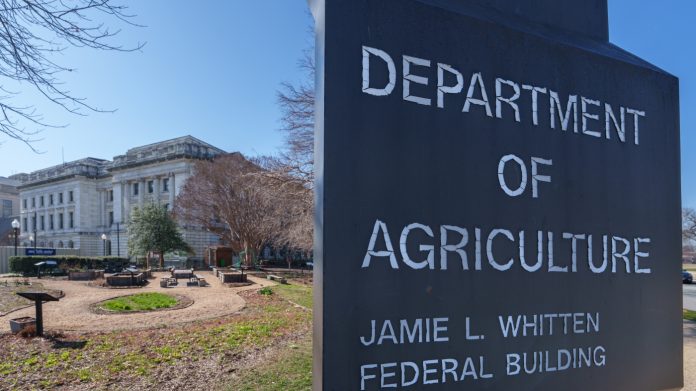
The U.S. Department of Agriculture says it is taking steps to optimize its workforce and reduce its spending — but is now trying to rescind the firing of some employees.

J. David Ake/Getty Images


hide caption

toggle caption

J. David Ake/Getty Images

The U.S. Department of Agriculture says it is trying to reverse the firing of staffers who worked on the government’s response to bird flu, amidst growing concerns about its spread.

Tens of thousands of workers across the federal government have been told they are losing their jobs, and more layoffs and firings are in the works. The USDA is among multiple health agencies that have faced mass firings.

On Friday, the USDA publicly touted what it called “the first tranche in a series of bold reforms,” including “an aggressive plan to optimize its workforce by eliminating positions that are no longer necessary,” in line with the efforts of the Department of Government Efficiency (DOGE).

Within days, however, the agency sought to reverse some of those firings — particularly those related to its handling of the highly pathogenic avian influenza (HPAI).

“Although several positions supporting HPAI were notified of their terminations over the weekend, we are working to swiftly rectify the situation and rescind those letters,” a spokesperson wrote in a statement shared with NPR. It was first reported by NBC News on Tuesday.

The agency continues to prioritize its response to bird flu, the spokesperson added.

Several job categories — including veterinarians and animal health technicians — have been “exempted from the recent personnel actions” to support those efforts. The USDA also says it is “continuing to hire the workforce necessary to ensure the safety and adequate supply of food to fulfill our statutory mission.”

The H5 bird flu is widespread in wild birds globally, causing outbreaks in poultry and U.S. dairy cows. Many Americans are now feeling the impact, with egg prices high and supply low. The outbreak has also gotten some people sick.

There have been 68 confirmed U.S. cases of bird flu since 2024, according to the Centers for Disease Control and Prevention (CDC). There has been one confirmed death, of a person in Louisiana, in January. The CDC says the “current public health risk is low.”

However, the Trump administration’s efforts to slash the federal workforce — including at numerous health agencies — and restrict public health communications have been cause for concern to many in those fields, as NPR has reported.

The first bird flu study from the CDC published under the Trump administration — released after a delay last week — suggested that some spillovers from dairy cattle into veterinarians who worked with them have gone undetected.

This isn’t the only department trying to reverse firings

Several Democratic lawmakers were quick to lay the blame for the bird flu firings on DOGE and Elon Musk, who effectively runs it.

“This is what happens when you let a bunch of inexperienced hacks tear down vital government agencies and services,” tweeted Sen. Chris Van Hollen of Maryland. “Elon Musk and the DOGE boys are playing with people’s lives and our national security, and we need to shut them down.”

Sen. Amy Klobuchar of Minnesota also amplified reports of USDA’s efforts to rehire staffers working on bird flu, writing, “They were ‘accidentally’ fired by the administration.”

Amidst mass layoffs across the entire federal government, the USDA isn’t the first federal agency that has reversed course on certain terminations.

Last week, chaos unfolded at the National Nuclear Security Administration (NNSA) — the civilian agency that oversees the U.S. nuclear weapons stockpile — where officials were given hours to fire hundreds of employees as part of broader Department of Energy layoffs on Thursday.

The process sparked confusion among employees and concern from lawmakers, given the national security implications. Some critics suggested the Trump administration had carried out the layoffs without understanding the scope of the NNSA’s work.

“The DOGE people are coming in with absolutely no knowledge of what these departments are responsible for,” Daryl Kimball, executive director of the Arms Control Association, told the Associated Press. “They don’t seem to realize that it’s actually the department of nuclear weapons more than it is the Department of Energy.”

On Friday, the NNSA director issued a memo rescinding the firings of all but some two dozen employees, according to the AP.

The story didn’t end there, however. Citing an internal NNSA email, NBC News reported that agency officials struggled over the weekend to contact some of those employees to inform them about their reinstatement, since they had lost access to their government email accounts after being fired.

When asked on Tuesday if he had any concerns about how the NNSA firings had been handled, President Trump told reporters, “No, not at all, I think we have to just do what we have to do.”

“It’s amazing what’s being found right now — it’s amazing,” Trump added. “Some, if we feel that, in some cases, they’ll fire people and then they’ll put some people back, not all of them, because a lot of people were let go.”

European Leaders Try to Recalibrate After Trump Sides With Russia on Ukraine

0

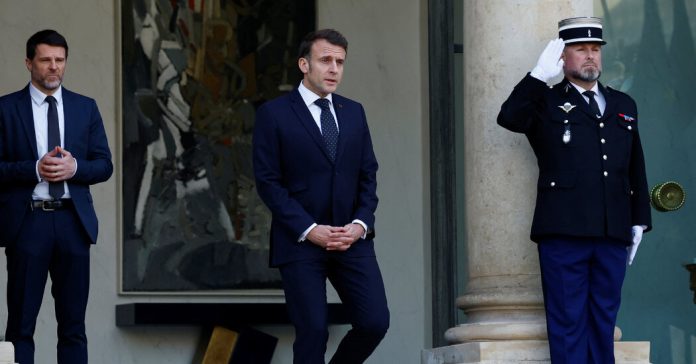
President Emmanuel Macron of France called a second emergency meeting of European allies on Wednesday seeking to recalibrate relations with the United States as President Trump upends international politics by rapidly changing American alliances.

Mr. Macron had already assembled a dozen European leaders in Paris on Monday after Mr. Trump and his new team angered and confused America’s traditional allies by suggesting that the United States would rapidly retreat from its security role in Europe and planned to proceed with peace talks with Russia — without Europe or Ukraine at the table.

Mr. Trump’s remarks late on Tuesday, when he sided fully with Russia’s narrative blaming Ukraine for the war, have now fortified the impression that the United States is prepared to abandon its role as a European ally and switch sides to embrace President Vladimir V. Putin of Russia.

It was a complete reversal of historical alliances that left many in Europe stunned and fearful.

“What’s happening is very bad. It’s a reversal of the state of the world since 1945,” Jean- Yves Le Drian, a former French foreign minister, said on French radio Wednesday morning.

“It’s our security he’s putting at risk,” he said, referring to Mr. Trump. “We must wake up.”

Fear that Mr. Trump is ready to abandon Ukraine and has accepted Russian talking points has been particularly acute in Eastern and Central Europe, where memories are long and bitter of the West’s efforts to appease Hitler in Munich in 1938 and its assent to Stalin’s demands at the Yalta Conference in 1945 for a Europe cleaved in two.

“Even Poland’s betrayal in Yalta lasted longer than Ukraine’s betrayal in Riyadh,” Jaroslaw Walesa, a Polish lawmaker and the son of Poland’s anti-Communist Solidarity trade union leader, Lech Walesa, said Wednesday on social media, referring to the American-Russian talks in Saudi Arabia on Tuesday.

Rasa Jukneviciene, a former Lithuania defense minister who is now a member of the European Parliament, said it was “hard to understand” the sudden shifts in policy by the United States, the once reliable pillar of Europe’s security for decades. She said she was “wondering what historians will write about the events of this time, say, in five decades.”

“It is already clear that the Euro-Atlantic connection will not be the same as it used to be,” she said. “The stage when European security after World War II was basically guaranteed only by the U.S.A. is over.”

Europe, she added, “is once again facing existential challenges” — akin to those in 1938 after Prime Minister Neville Chamberlain of Britain met Hitler in Munich and agreed to his annexation of parts of Czechoslovakia with a large ethnic German population.

In the power vacuum, Mr. Macron has tried to show leadership, corralling allied leaders to devise a united response.

The Élysée Palace announced that he would host a second emergency meeting on Wednesday of many European leaders who had not been included in the meeting on Monday. Among them were the interim president of Romania, Ilie Bolojan, and Prime Minister Luc Frieden of Luxembourg, who would attend in person, while leaders from 18 other countries were scheduled to attend by video. They included Ireland, Iceland, Portugal, Sweden, Finland, Norway, the Czech Republic, Estonia, Latvia, Greece, Sweden and Belgium.

The meeting comes the day after Secretary of State Marco Rubio met with Russian representatives, including Foreign Minister Sergey V. Lavrov, in Riyadh, Saudi Arabia, to discuss a peace deal for the war in Ukraine, to the fury of its president, Volodymyr Zelensky, who was not invited.

Mr. Rubio said they hammered out a three-part plan, which would start by re-establishing bilateral relations between Washington and Moscow and end by exploring new partnerships — geopolitical and business — between Russia and the United States, while addressing the parameters of an end of the war with Ukraine in between.

Mr. Rubio said he would consult with Ukraine, the American “partners in Europe and others,” but in the end, “ultimately, the Russian side will be indispensable to this effort.”

Afterward, speaking to reporters at his Mar-a-Lago estate in Florida, Mr. Trump blamed Ukraine for starting the war, despite the fact that Russia had invaded.

“You could have made a deal,” he said, denigrating Mr. Zelensky’s popularity and indicating he didn’t deserve a seat at the negotiating table.

“Well, they’ve had a seat for three years. And a long time before that,” Mr. Trump said. “This could have been settled very easily. Just a half-baked negotiator could have settled this years ago without, I think, without the loss of much land, very little land. Without the loss of any lives. And without the loss of cities that are just laying on their sides.”

Mr. Trump’s comments blaming Ukraine for the war stirred outrage in the Czech Republic, whose centrist government has been a stalwart supporter of Ukraine. “I’m afraid we’ve never been this close to Orwell’s ‘war is peace, freedom is slavery, and ignorance is strength’ before,” Interior Minister Vit Rakusan said on social media.

Mr. Le Drian called it a monstrous reversal of world alliances, as well as an “inversion of the truth.”

“The victim becomes the attacker,” he said, adding that the United States seemed to be retreating to a 19th-century view of itself, and telling an aggressive, expansionist Russia to do what it wants in Europe. “It’s the law of the strongest,” he said, adding, “Tomorrow, it could be Moldavia and after tomorrow, it could be Estonia because Putin won’t stop.”

Marko Mihkelson, chairman of the Estonian Parliament’s foreign affairs committee, also compared the Riyadh meeting with the 1938 talks in Munich. “All of this paves the way for the aggressor to achieve its new plans of conquest,” he said.

Before Mr. Rubio and Mr. Trump’s pronouncements on Tuesday, Mr. Macron said he considered the Russian threat to Europe not just in military terms, but through slyer means, including cyberattacks and manipulation of electoral processes like Romania.

“Russia constitutes an existential threat to Europeans,” Mr. Macron said on Tuesday in an interview with French regional newspapers, including Le Parisien and Ouest France.

“Do not think that the unthinkable cannot happen, including the worst,” he added.

On Monday, a dozen European leaders left a quickly organized meeting in Paris with a resounding message that Europeans and Ukrainians needed to be included in any peace talks with Russia and a commitment to increase military funding.

Many made clear that they wanted a continued alliance with the United States, which they considered indispensable to European security.

“The positive message was that we all had the same feeling that this is not about the U.S. or Europe, but it’s about the U.S. and Europe together, and that Europe understands very well that we have to step up, but that we want to still do it together with the Americans,” Prime Minister Dick Schoof of the Netherlands said.

Mr. Trump’s latest statement poured water on many of those sentiments and may now force a deeper reconsideration of the trans-Atlantic alliance by European leaders.

Mr. Macron has been speaking for months to European leaders about forming a cease-fire buffer force in Ukraine and has long called for European strategic autonomy. Still, he told the French regional news media that he did not believe European countries could defend themselves without American support.

He said that he expected European countries to increase their military budgets and would announce new programs to allow them to do that “as early as March.” Denmark said on Wednesday that it would increase its $5 billion military budget by an additional $7 billion over two years, to reach 3 percent of gross domestic product.

Already, the European Commission president, Ursula von der Leyen, announced in a speech that she would propose an “escape clause for defense investments” permitting countries to fund defense without breaching the European Union’s strict fiscal rules, which aim to keep budget deficits under 3 percent of the size of each country’s economy.

“This will allow member states to substantially increase their defense expenditure,” she said.

Europeans are also discussing joint spending on defense — including how to finance those, which could involve issuing joint debt, though that is still up for debate. They are also talking about how to ramp up the development of European defense industries.

Over the past week, Europe’s steadfast position that held the United States as the central pole of its defense guarantee seems to be changing, said Martin Quencez, the director of the Paris office of the German Marshall Fund.

The big question will be whether European nations follow through with increased military spending and maintain a united front, without fracturing off to individually negotiate with Mr. Trump, he said.

“I’ve heard Europe talk about wake-up calls so many times over the past 10 years, I remain cautious,” he said, pointing out that many European leaders, including Mr. Macron, find themselves in fragile political and economic positions in their own countries.

“I’m sure we will hear from every European leader, but let’s see what actual decisions are taken,” he said, adding: “It’s very, very difficult to tell your population, we’re going to have to make the tough choice of prioritizing European security over social issues or environmental issues. Not many governments have the political capital to spend on all this.”

Poland, the biggest and most militarily powerful country in the European Union’s formerly communist east, sought on Tuesday evening after the talks in Saudi Arabia ended to calm the panic.

That day, President Andrzej Duda was visited in Warsaw by Mr. Trump’s special envoy for Ukraine and Russia, Keith Kellogg, a retired lieutenant general. The Polish leader said Mr. Kellogg reassured him that “there are absolutely no American intentions to reduce activity here in our part of Europe, especially in the field of security, to reduce the number of American soldiers.”

The United States has thousands of soldiers in Poland and in November opened a new missile defense facility near the Baltic Sea that Russia sees as a threat to its own security. Getting Washington to shut down the Polish site and a similar one in Romania has been a longstanding demand by Mr. Putin.

Jeanna Smialek contributed reporting from Brussels.

Journalist describes Trump's movements as a 'regime change' towards authoritarianism

0

The Atlantic writer Anne Applebaum says President Trump’s dismantling of the U.S. civil service system, and his attacks on judges and his opponents, are part of a playbook on undermining democracy.