Friday, November 13, 2026
Home Blog Page 206

Zelensky Pushes Back on Trump “Disinformation”

0

new video loaded: Zelensky Pushes Back on Trump “Disinformation”

transcript

transcript

Zelensky Pushes Back on Trump “Disinformation”

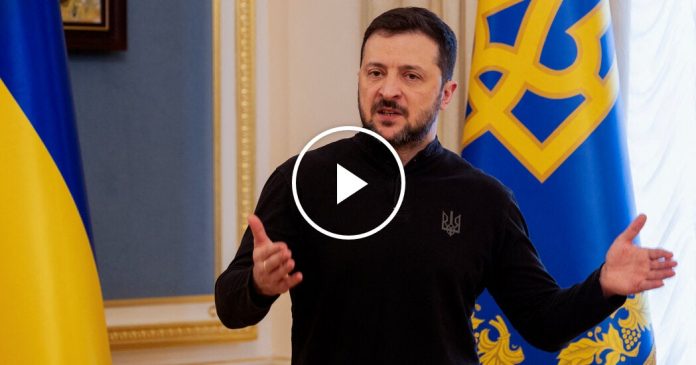
President Volodymyr Zelensky of Ukraine responded to President Trump’s comments on the war. Among other things, Mr. Trump had suggested that Ukraine had started the war, and he appeared to embrace what has been a Russian demand that Ukraine hold presidential elections.

And I think I have the power to end this war. And I think it’s going very well. But today I heard, Oh, well, we weren’t invited. Well, you’ve been there for three years. You should have ended it three years. You should have never started it. You could have made a deal. I could have made a deal for Ukraine. Will you be meeting President Putin before the end of the month? Probably.

Recent episodes in Latest Video

Whether it’s reporting on conflicts abroad and political divisions at home, or covering the latest style trends and scientific developments, Times Video journalists provide a revealing and unforgettable view of the world.

Whether it’s reporting on conflicts abroad and political divisions at home, or covering the latest style trends and scientific developments, Times Video journalists provide a revealing and unforgettable view of the world.

Migrants Deported to Panama by Trump Administration Taken to Jungle Camp

0

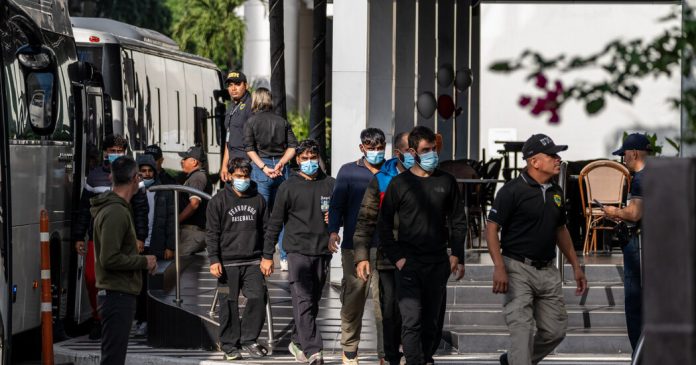
Nearly 100 migrants, recently deported by the United States to Panama where they had been locked in a hotel, were loaded onto buses Tuesday night and moved to a detention camp on the outskirts of the jungle, several of the migrants said.

It is unclear how long the group, who were deported under the Trump administration’s sweeping effort to expel unauthorized migrants, will be detained at the jungle camp.

Conditions at the site are primitive, the detainees said. Diseases, including dengue are endemic to the region, and the government has denied access to journalists and aid organizations.

“It looks like a zoo, there are fenced cages,” said one deportee, Artemis Ghasemzadeh, a 27-year-old migrant from Iran after arriving at the camp following a four-hour drive from Panama City. “They gave us a stale piece of bread. We are sitting on the floor.”

The group includes eight children, according to a person with knowledge of the situation who was not authorized to speak on the record. Lawyers have said it is illegal to detain people in Panama for more than 24 hours without a court order.

The transfer is the latest move in a weeklong saga for a group of about 300 migrants who arrived in the United States hoping to to seek asylum. The group was sent to Panama, which has agreed to aid President Trump in his plan to deport millions of undocumented migrants.

The agreement is part of a larger strategy by the Trump administration to export some of its most difficult migration challenges to other nations. The United States, for varying reasons, cannot easily deport people to countries like Afghanistan, Iran and China, but by applying intense pressure it has managed to convince Panama to take some of them.

After being sent to Panama, the deported migrants are no longer subject to United States law.

Asked for details about the transfer of migrants to the jungle camp, a spokesman for Panama’s security ministry, Aurelio Martínez, said he was unaware that migrants had been moved there.

Costa Rica is also taking some deportees, migrants originally from Central Asia and India and has said it plans to repatriate them. A flight from the United States was expected to arrive in Costa Rica on Wednesday.

Upon arrival in Panama City last week, the 300 or so migrants were taken to a downtown hotel, called the Decapolis, and barred from leaving, several of them told The New York Times in calls and text messages. A lawyer seeking to represent many of them, Jenny Soto Fernández, was blocked at least four times from visiting them in the hotel, she said.

On Tuesday morning, an article published by The Times attracted enormous attention to the migrants’ situation, and members of the Panamanian news media began surrounding the hotel.

On Tuesday night, guards at the hotel told people to pack their bags, said Ms. Ghasemzadeh, the migrant from Iran. Several buses arrived and guards led them aboard, as witnessed by a reporter working for The New York Times. Then the bus traveled out of Panama City, east and then farther east, to the province of Darién.

On the bus, at least one woman cried, according to a photograph sent by a person on the bus.

The camp where the 100 or so migrants will stay is called San Vicente, and sits at the end of a jungle, also called the Darién, which links Panama to Colombia. The camp was built years ago as a stopover point for migrants coming north from Colombia through the Darién jungle and into Panama, a harrowing part of the journey north to the United States.

Now, the Panamanian government is using it for deportees.

On Tuesday, Panama’s security minister, Frank Ábrego, told reporters that 170 of the 300 or so migrants had volunteered to be sent back to their countries of origin, journeys that would be arranged by the United Nations International Organization for Migration.

He added that the migrants were not “detained” by the Panamanian government, but rather “are under our protection.”

“What we agreed with the United States government is that they remain and are in our temporary custody for their protection,” he said.

The Panamanian government has previously said the migrants had no criminal records.

On Wednesday morning, from the Darién region, Ms. Ghasemzadeh described a sweltering encampment, overrun with cats and dogs.

Then, she sent a text message saying that the authorities were confiscating all phones. Her last words: “Please try to help us.”

Annie Correal contributed reporting from Mexico City and Alex E. Hernández from Panama City.

Zelensky Urges ‘More Truth’ After Trump Suggests Ukraine Started the War

0

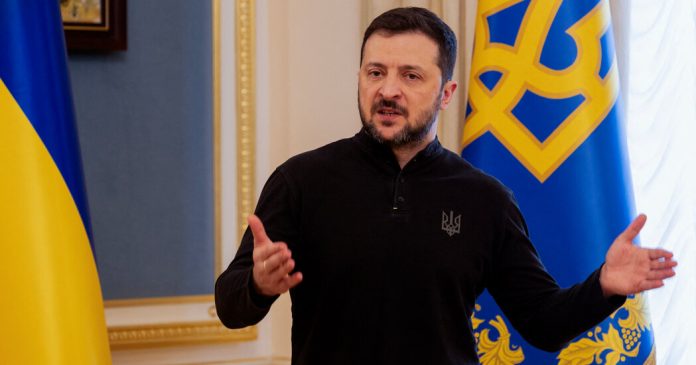
President Volodymyr Zelensky of Ukraine appealed to the Trump administration on Wednesday to respect the truth and avoid disinformation in discussing the war that began with a Russian invasion of his country, in his first response to President Trump’s suggestion that Ukraine had started the war.

“I would like to have more truth with the Trump team,” Mr. Zelensky said in some of the most pointed criticism yet of Mr. Trump and the new American administration, which on Tuesday opened peace talks with Russia that excluded Ukraine. Mr. Zelensky said that the U.S. president was “living in a disinformation space” and in a “circle of disinformation.”

Mr. Zelensky made the remarks to a group of reporters he had summoned to his presidential office in Kyiv, a building still fortified with sandbags to avoid blasts from Russian missiles.

He was responding to a flurry of accusatory statements on Tuesday, some of them false, by Mr. Trump. He said of Ukraine’s leadership and the war, “You should have never started it,” and appeared to embrace what has been a Russian demand that Ukraine hold elections before some stages of talks. Elections were suspended under martial law after Russia’s invasion in February 2022.

Mr. Trump also said that Mr. Zelensky’s approval rating was 4 percent. Mr. Zelensky said that was not true, citing polls showing far higher support. In one conducted in December by the Kyiv International Institute of Sociology, for example, 52 percent of Ukrainians said that they trusted Mr. Zelensky’s leadership.

Mr. Zelensky had until this week walked a fine line of staking out Ukrainian positions while avoiding any suggestion of an open breach with the United States, Ukraine’s most important ally in the now nearly three-year war. After the initial cease-fire talks between Russia and the United States, Mr. Zelensky on Tuesday had starkly laid out his refusal to accept terms negotiated without Ukrainian participation.

At the news conference, Mr. Zelensky was focused and spoke with intensity. He said he was not personally ruffled by the negotiations with the Trump administration. “This is not my first dialogue or fight,” he said. “I take it calmly.”

Russia, he said, is clearly pleased with the turn of diplomatic developments. “I think Putin and the Russians are very happy, because questions are discussed with them,” Mr. Zelensky said.

“Yesterday, there were signals of speaking with them as victims,” he said of the Trump officials’ tone in discussing the Russian officials, whose government prompted the largest war in Europe since World War II, which has killed or wounded about a million people on both sides over three years. “That is something new.”

Ukrainians, Mr. Zelensky said, are not likely to trust promises Russian negotiators offer in talks. “Nobody in Ukraine trusts Putin,” he said.

Mr. Zelensky also laid out efforts to coordinate from allies security guarantees intended to prevent Russia from violating a cease-fire. This has been an overriding focus of Ukrainian diplomacy going into any peace talks.

For Russia, a continuation of the war also carries costs, including by the estimate of military analysts a staggering casualty count of 1,000 soldiers or more killed or wounded daily, as well as punishing economic sanctions. Ukraine wants to trade this pressure on Russia for acceptance of a peacekeeping force or other guarantee of security to prevent the war, already the bloodiest in Europe in generations, from restarting.

Mr. Zelensky repeated that one option would be membership in NATO, a possibility that President Vladimir V. Putin of Russia has rejected and that the United States has said it does not support. The Ukrainian leader also mentioned maintaining the country’s standing army of about one million soldiers and a peacekeeping contingent from European countries, or some combination of these measures.

Mr. Putin on Wednesday praised the Trump administration officials in Riyadh, Saudi Arabia, for having fostered a “very friendly” atmosphere. Unlike past American administrations, he suggested, the Trump team did not criticize Russia’s actions.

“On the American side, there were completely different people who were open to the negotiation process without any bias, without any condemnation of what was done in the past,” Mr. Putin said, speaking to reporters while on a visit to St. Petersburg.

Mr. Putin said he looked forward to a meeting with Mr. Trump, but declined to give a date, cautioning that there was still a lot of preparatory work to be done, “including on the Ukrainian track.”

“I’ll be happy to meet with Donald. We haven’t seen each other in a while,” Mr. Putin said. “But we’re in a situation where it’s not enough to meet just to have tea or coffee and sit and talk about the future.”

Mr. Putin dismissed fears that American allies in Europe were being excluded from the U.S.-Russia talks, arguing that the two countries had bilateral issues to discuss, such as the expiration of the New START nuclear arms control treaty next year.

“Why are they being hysterical?” Mr. Putin said, apparently referring to the Europeans. “Hysteria is not appropriate here.”

Mr. Putin said that Mr. Trump told him in their phone call last week that “the United States expects that the negotiating process will take place with the participation of both Russia and Ukraine.”

“No one is excluding Ukraine from this process,” Mr. Putin said.

Over three years of war, the Ukrainian Army succeeded in repelling Russia’s military from about half of the territory it captured in the initial invasion, but the fighting then bogged down in bloody but mostly static trench warfare, with Russian forces pressing forward slowly.

Several Ukrainian soldiers in telephone interviews on Wednesday expressed worry about Mr. Trump’s misstatements about Ukraine, including Mr. Zelensky’s approval rating, but said nothing had changed in the conduct of the war.

One officer in the 82nd Air Assault Brigade, who declined to give his name for security reasons, said in a telephone interview that the Ukrainian forces would keep fighting, regardless of what Mr. Trump “says he’ll give us or won’t, what funds have been sent or haven’t, where we’ve been invited or not.”

Kremlin Message to Trump: There’s Money to Be Made in Russia

0

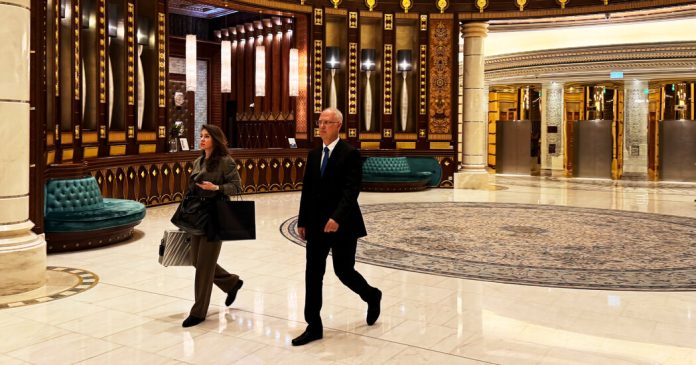
The Russian government’s top investment manager, who has Harvard and McKinsey credentials and fluent English, brought a simple printout to Tuesday’s talks with the Trump administration in Saudi Arabia.

Its message: By pulling out of Russia in outrage over the invasion of Ukraine, American companies had walked away from piles of cold, hard cash.

“Losses of U.S. companies by industry,” read the document, which Kirill Dmitriev, the head of Russia’s sovereign wealth fund, showed to a New York Times reporter. “Total losses,” one of the columns said. The sum at the bottom: $324 billion.

In appealing to President Trump, the Kremlin has zeroed in on his desire to make a profit. President Vladimir V. Putin said last month that the two leaders “have a lot to talk about” when it comes to energy and the economy. Sergey V. Lavrov, Russia’s foreign minister, said after Tuesday’s meeting that “there was great interest” in the room “in removing artificial barriers to the development of mutually beneficial economic cooperation” — an apparent reference to lifting American sanctions.

Remarkably, the Trump administration appears to be engaging with Russia’s message without demanding payment up front. After Ukraine suggested the possibility of natural resource deals to Mr. Trump, his treasury secretary pushed to have the country sign away half its mineral wealth. And Mr. Trump continues to portray American allies as freeloaders, threatening more tariffs and demanding they pay more for their own defense.

With Russia, by contrast, the administration seems to be signaling that the one thing Mr. Putin has to do to pave the way for a full reset in Moscow’s relationship with Washington is end the war in Ukraine. Many Europeans and Ukrainians fear Mr. Trump will seek a peace deal on Russia’s terms, especially after the American president suggested on Tuesday that Ukraine was to blame for the Russian invasion.

Secretary of State Marco Rubio said on Tuesday that an end to the war would be “the key that unlocks the door” for “potentially historic economic partnerships.” He echoed Mr. Lavrov in hinting that the United States could drop sanctions against Russia as part of such a deal.

“There are sanctions that were imposed as a result of this conflict,” Mr. Rubio said. “I would say to you that in order to bring an end to any conflict there has to be concessions made by all sides.”

For the Kremlin, a key emissary to Mr. Trump’s pecuniary mind-set has been Mr. Dmitriev, a youthful Putin ally and former banker who has specialized in developing Russian business ventures around the world. He has close ties to Saudi Arabia’s de facto ruler, Crown Prince Mohammed bin Salman, and he pushed the development and global distribution of Russia’s Covid-19 vaccine, Sputnik V.

In 2016, Mr. Dmitriev tried to use business contacts to build a back channel to Mr. Trump in the name of “reconciliation” between the United States and Russia, according to the report into Russian interference in that year’s election by Robert S. Mueller III, the special counsel.

In Mr. Trump’s first term, that reconciliation never came. This time around, Mr. Dmitriev has already had better luck.

Steve Witkoff, Mr. Trump’s Middle East envoy, praised Mr. Dmitriev and Prince Mohammed for their role in helping secure Russia’s release last week of Marc Vogel, an American schoolteacher imprisoned in Moscow. In Tuesday’s talks, Mr. Dmitriev was part of Russia’s delegation, using interviews with Western media outlets to promote business opportunities in Russia’s oil sector and in the Arctic.

“The economic track allows diplomacy, allows communication, allows joint wins, allows joint success,” Mr. Dmitriev said. “And we saw that President Trump is focused on having success.”

He said that U.S. oil companies had “really benefited from the Russian oil sector,” adding, “we believe at some point they will be coming back.” The document that he brought into Tuesday’s meeting with the United States showed that the industries with the greatest purported losses among American companies that left Russia were “I.T. and Media,” at $123 billion, and “Consumer and Healthcare,” at $94 billion.

While American trade with Russia before Ukraine-related sanctions began in 2014 was tiny compared with trade with China or the European Union, big energy companies made huge investments, and American consumer goods and tech companies saw Russia as a significant market.

Mr. Dmitriev said the calculation took into account not only fire sales and write-downs, but also “forgone profits.” Western companies that left Russia have officially declared more than $100 billion in losses since the start of the war, with many of their prized assets sold under onerous terms dictated by the Russian state.

Many world leaders have shifted to a business-focused message to cater to an American president whose foreign policy has little in common with his predecessors’ emphasis on democracy, human rights and the trans-Atlantic alliance. But among the governments scrambling to influence Mr. Trump’s view of the war in Ukraine, Moscow stands alone in its success in getting him to bite.

Ukrainian officials made the possibility of lucrative U.S. energy and mineral deals after the war’s end a centerpiece of a charm offensive with Mr. Trump that began last fall. Rather than take the invitation to cooperate, Mr. Trump appeared to decide that Ukraine’s natural resources should serve as payback for past American support.

In Kyiv last week, President Volodymyr Zelensky of Ukraine rejected a proposal from Treasury Secretary Scott Bessent under which the United States would take a 50 percent interest in all of Ukraine’s mineral resources.

Europeans have also tried to use talk of deals to get Mr. Trump’s attention. During the World Economic Forum in Davos in late January, NATO’s secretary general, Mark Rutte, said Europe would be willing to foot the bill for the United States to continue supplying arms to Ukraine using its defense industrial base.

Such entreaties did little to shift Mr. Trump’s view of Europe as taking advantage of American security assistance, nor did they stop him from excluding the Europeans from his administration’s talks with Russia.

Russia, on the other hand, has gotten the Trump administration’s attention — both with the prospect of business deals and with the prospect of Mr. Trump being seen as a peacemaker by ending the war in Ukraine.

“Trump doesn’t care much about long-term strategic goals,” said Boris Bondarev, a former Russian diplomat who resigned over the war in Ukraine. “Putin is trying to play on this feeling and get him interested in very quick material gains that are immediately clear to Trump.”

Nataliya Vasilyeva contributed reporting from Istanbul and Paul Sonne from Berlin.

Trump Media Group Sues Brazilian Judge Weighing Arrest of Jair Bolsonaro

0

President Trump’s media company sued a Brazilian Supreme Court justice on Wednesday, accusing him of illegally censoring right-wing voices on social media.

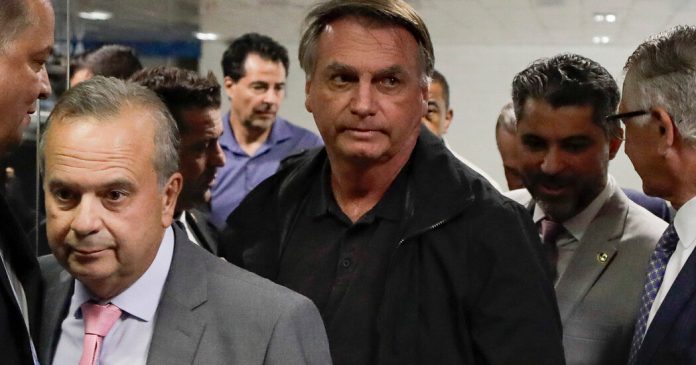
The unusual move was made all the more extraordinary by its timing: Just hours earlier, the Brazilian justice had received an indictment that would force him to decide whether to order the arrest of Jair Bolsonaro, the former Brazilian president and an ally of Mr. Trump. The justice is overseeing multiple criminal investigations into Mr. Bolsonaro.

The Trump Media & Technology Group — which is majority owned by Mr. Trump and runs his Truth Social site — sued the Brazilian justice, Alexandre de Moraes, in U.S. federal court in Tampa, Fla., on Wednesday morning. Joining as a plaintiff was Rumble, a Florida-based video platform that, like Truth Social, pitches itself as a home for free speech.

The lawsuit appeared to represent an astonishing effort by Mr. Trump to pressure a foreign judge as he weighed the fate of a fellow right-wing leader who, like him, was indicted on charges that he tried to overturn his election loss.

Mr. Bolsonaro had explicitly called on Mr. Trump to take action against Justice Moraes in an interview with The New York Times last month. At the time, it was not clear how Mr. Trump might be able to influence Brazil’s domestic politics.

The companies accused Justice Moraes of censoring political discourse in the United States and infringing upon the First Amendment by ordering Rumble to remove the accounts of prominent supporters of Mr. Bolsonaro.

The companies argued that those orders could apply to how those accounts appeared in the United States, breaking American law. Mr. Trump’s company has not been subject to Justice Moraes’s orders, but it argued in the lawsuit that it relied on Rumble’s technology and therefore could be harmed if Rumble’s operations were affected.

Justice Moraes has argued that his actions are necessary to protect Brazil from the anti-democratic acts of Mr. Bolsonaro and his supporters. His spokeswoman said that Justice Moraes did not have immediate comment.

It was unclear how or whether the lawsuit would affect the proceedings in Brazil. Justice Moraes has largely proved immune to years of intense criticism and pressure from the Brazilian right as he aggressively investigated Mr. Bolsonaro and his supporters.

As part of investigations into attacks against Brazil’s democracy, Justice Moraes has ordered arrests of Mr. Bolsonaro’s allies and the confiscation of the former president’s passport, as well as the suspension of hundreds of social media accounts belonging to his supporters. Last year, Justice Moraes faced off against Elon Musk — and won — blocking Mr. Musk’s social network, X, in Brazil until the billionaire backed down in his refusal to comply with the judge’s orders to suspend accounts.

Those actions have raised questions, even among moderate Brazilians, about whether Justice Moraes was posing his own threat to democracy.

The moves have also arguably made the judge Mr. Bolsonaro’s political archrival — and a target. In 2023, a mob of Mr. Bolsonaro’s supporters raided Brazil’s Supreme Court. Late last year, a Bolsonaro supporter tried to bomb the Supreme Court but instead killed only himself. And on Tuesday, new details emerged in the indictment of Mr. Bolsonaro showing that, according to Brazilian investigators, the former president and his allies had plotted to assassinate Justice Moraes as part of their bid to hold on to power.

Mr. Bolsonaro has denied that he tried to stage a coup or had any knowledge of a plot to kill Justice Moraes.

On Tuesday, Justice Moraes was tasked with his most consequential decision yet: whether to arrest Mr. Bolsonaro.

As the head of the federal investigation into the former president, he received the indictment and will decide how it proceeds. His first order of business will be weighing whether Mr. Bolsonaro represents a flight risk and thus should be held in jail until a trial. Justice Moraes has already used such measures against Mr. Bolsonaro’s allies, including his former running mate, who has been jailed since December.

She worked for years to get a federal job. Within a month, she was fired : NPR

0

Rose spent years trying to land her first job in the federal government. It ended up lasting just a few weeks.

Ryan Kellman/NPR


hide caption

toggle caption

Ryan Kellman/NPR

Rose’s brief career as a federal employee ended last Thursday.

“I was winding down for the day, and then all of a sudden, I got a notification ping,” she says. She reached for her government phone, which had been issued to her just a month earlier when she took a new job at the Department of Energy (DOE).

The message was from a co-worker saying that she needed to check her email right away. She opened it up and found a letter telling her she’d been terminated.

“DOE finds that your further employment would not be in the public interest,” the letter read in part. The 26-year-old was being removed from her position, “effective today.”

Rose was shocked, and she had plenty of company. Even longtime workers seemed confused.

“People who’ve been in the federal government 30, 40 years are like, ‘We have never seen this before. This is unprecedented,'” she says.

But she didn’t have much time to let her firing sink in. Her email was about to be shut off. She grabbed her personal phone.

“I had to take a picture of the attachments, because I didn’t have enough time to send them,” she says. By 11:30 p.m., she’d been locked out of her work email.

Rose agreed to discuss her experience with NPR, which is identifying her only by her middle name because she holds out hope she could work for the government again someday and because she worries she’ll be retaliated against for talking to the press.

Just days before, President Trump had signed an executive order directing federal agencies to “initiate large-scale reductions in force.” Rose is one of thousands of early-career federal workers swept up in those moves. The Department of Government Efficiency, overseen by Elon Musk, has also been pushing to slash the federal workforce.

According to media reports, around a thousand “probationary” employees were terminated at the Energy Department. Many were employees with less than two years of federal service. The DOE did not respond to NPR’s request for comment on the firings.

This photo shows a woman's hands resting on her knee, which is crossed over her other leg. She's wearing a watch and a sweater.

Rose was terminated with no notice and no severance. “Bills aren’t going to stop because I lost my job. Car payments aren’t going to stop because I lost my job. Student loans aren’t going to stop because I lost my job,” she says.

Ryan Kellman/NPR


hide caption

toggle caption

Ryan Kellman/NPR

A dream job

Rose is the daughter of immigrants and grew up on the East Coast. For her entire professional life, she had wanted to work in the government. She’d done a few internships around Washington, D.C., before taking a job as a consultant. In that role, she’d worked alongside federal workers on environmental cleanup and clean energy projects.

Working with those federal employees inspired her to pursue a job as a civil servant. But, she says, she soon learned that “getting a job in the federal government is a science in itself.”

Initially, she was rejected from several positions. Undaunted, Rose steeped herself in the language of the U.S. government. She taught herself an endless list of acronyms and bought a book on how to build a résumé that would make her more attractive to federal work.

Then late last year, she got what she thought was going to be her big break. She had interviewed at the Department of Energy for a job helping to oversee a portfolio of renewable energy projects. She says the hiring process was a monthslong ordeal, during which, she jokes, she told them everything except “what my blood type is.”

In December, she got the call from human resources telling her she’d landed the role. “I was with a friend at the time,” she says. “And I just kept saying over and over, ‘I got the job! I got the job!'”

It was going to be a turning point in her life: “It really felt like … my career is beginning, because this is the job I want,” she recalls.

Rose knew that Trump had just been elected, but the HR recruiter assured her that this wouldn’t be a problem. “They told me the precedent was in previous administrations, they have honored the people that have been hired.”

HR told her she could join as late as February, but she was so excited she asked to start the job early.

“I was like, ‘Please let me start in January!'” she recalls. “Kind of silly looking back now — I didn’t even work there for a month until I got the boot.”

A MAGA dad

Rose had to let her family know she’d been fired, including her dad — a military veteran living in Florida who is a big supporter of Trump.

Before she’d taken the job, she’d joked with him: “If I lose this job, I’m going to pack my toothbrush, put all my things in a little hobo satchel and be knocking on your door.

“Little did I know that door would be destroyed in the Florida hurricanes.”

Her father’s house was ruined by hurricanes Helene and Milton, she says. For Rose, it’s a particularly bitter irony, because her job was to try to help develop alternative energy sources.

“The work I was doing and supporting was directly related to climate change, which is why these natural disasters are on the rise,” she says.

Her dad was sympathetic when he heard about her firing. His response was “‘That really sucks, but you’ll bounce back.'”

Rose doesn’t feel particularly bouncy at the moment, but she doesn’t seem angry at her dad either. If anything, she feels closer to him.

“I remember I was sitting at a dinner with my dad recently, and he was talking about ‘It feels like we are forgotten, because as soon as the hurricane in Florida happened, then it was North Carolina, then it was the California wildfires,'” she says. “And there’s a relationship between all of this — federal employees feel forgotten. My dad who voted for Trump feels forgotten.

“Across the board, everybody feels this sense of loss and like ‘I’m not being heard,'” she says.

But she doesn’t have much time to reflect. She has to find work.

“Bills aren’t going to stop because I lost my job. Car payments aren’t going to stop because I lost my job. Student loans aren’t going to stop because I lost my job,” she says.

While she’s searching for her new gig, she says, she has thought about parking herself on the sidewalk outside the Energy Department, on the off chance they might take her back.


South Korean Officials Convicted Over Forcibly Sending North Koreans Home

0

In 2019, two North Korean fishermen confessed to murdering 16 shipmates ​before they fled to South Korea by boat​ and sought asylum.​ The then-progressive government in ​the South denied them refugee status ​or a trial there and, in an unprecedented move, sent them back to the North​.

​That decision triggered ​not only a political firestorm at the time​ but also criminal charges against four senior officials prosecuted after the current conservative government, with a more hard-line stance against North Korea, took power in Seoul in 2022.

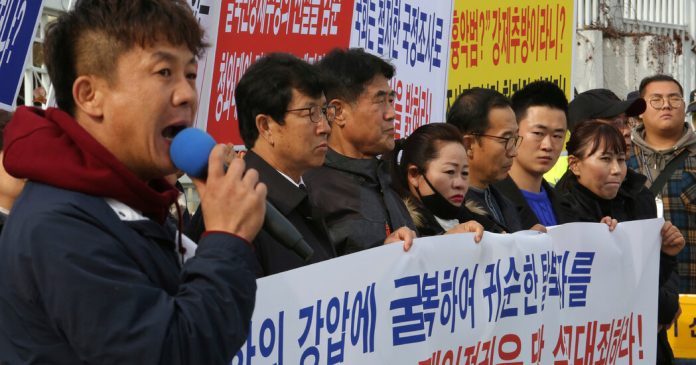
On Tuesday, a three-judge panel in the Seoul Central District Court found the four top national security aides to former President Moon Jae-in guilty of abusing their official power when they sent the fleeing North Korean fishermen back. The court announced prison sentences but decided not to impose them immediately, indicating in its verdict that it considered the criminal charges against the​ officials to be politically motivated under Mr. Moon’s successor, President Yoon Suk Yeol.

The four former officials — Mr. Moon’s national security adviser, Chung Eui-yong; his director of national intelligence, Suh Hoon; his presidential chief of staff, Noh Young-min; and his unification minister, Kim Yeon-chul — were sentenced to six to 10 months in prison. But the sentences were suspended for two years, after which they will be removed.

The criminal charges the four faced were the first of their kind in South Korea and reflect the polarization between the country’s two main political parties when it comes to dealing with its decades-old foe North Korea.​

When South Korea captured the two North Korean fishermen, then ages 22 and 23, in its waters in 2019​, they were no ordinary defectors. They confessed that they fled after killing the captain and 15 other crewmen on their boat with ​hammers, dumping​ their bodies into the sea.

South Korea had no treaty with North Korea for extraditing criminal suspects. Under its Constitution, it must treat North Koreans as its citizens and, until then, had accepted all North Korean asylum-seekers, regardless of their background. But this time, Mr. Moon’s government decided to repatriate them to the North, calling them “heinous criminals.”

The two were denied access to lawyers or a chance​ at court to appeal the government’s decision to repatriate them. ​Five days after they were captured​, they were taken​, ​blindfolded and with their hands tied, to the ​inter-Korean border​. One of them​ resisted when he saw what was happening, and had to be dragged​ by South Korean officials to be handed over to their North Korean counterparts.

Critics of Mr. Moon’s government accused it of denying the two fishermen a fair trial in the South​ and sending them to certain executions in the North in order to advance its policy of improving ties with ​the North. Mr. Moon’s government argued that there was no way for South Korea to serve justice ​for the two North Koreans through its judicia​l system because all ​key criminal evidence ​against them was in ​the North​.

Prosecutors ​initially decided not to bring charges against the aides to Mr. Moon who were involved in the decision. But things changed after Mr. Yoon took office in 2022.

Mr. Yoon​, a fierce critic of Mr. Moon’s North Korea policy, ​cited the case of the ​fishermen as a prime example of ignoring the human rights of asylum seekers for the sake of political appeasement.​ Under Mr. Yoon, the Unification Ministry, which ​had supported the repatriation, released​ video footage and photos showing the two North Koreans being led, against their will, to the borderline.

In their ruling on Tuesday, the judges said that the former officials denied the fishermen their right to a fair trial in South Korea. But they also suspected a political motive behind the charges, citing Mr. Yoon’s comments on the case and the prosecutors’ decision to reverse their earlier position not to press charges.

​In South Korea, sitting presidents have long been accused of weaponizing prosecutors to discredit their predecessors’ governments with criminal charges, creating a vicious circle of political vengeance. Mr. Yoon himself is now suspended from office and faces criminal charges tied to his ill-fated declaration of martial law in December.

The judges said South Korea should develop guidelines that could help its officials deal with cases like the two North Korean fishermen.

Without such rules, “there is no guarantee that similar confusion won’t repeat itself should the same or ​a similar case happen again,” th​e judges said.

Prosecutors have a week to appeal the ruling.

Trump team fires FDA staff reviewing drugs for pets and livestock : Shots

0

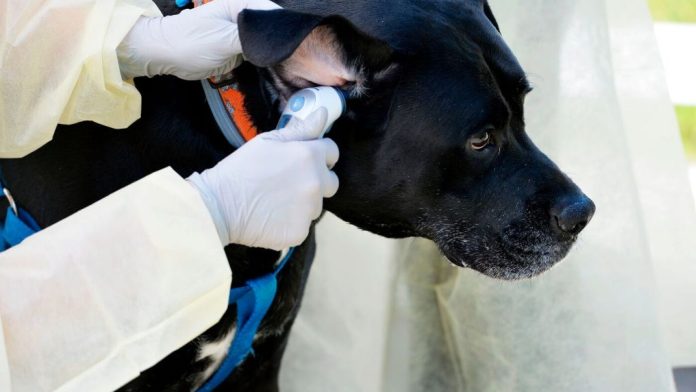
Drugs and medical devices for pets and other animals go through approval processes through the FDA. Staff handling parts of this work lost their jobs in the recent round of firings from the Trump administration.

JOSEPH PREZIOSO/AFP/Getty Images


hide caption

toggle caption

JOSEPH PREZIOSO/AFP/Getty Images

One casualty of the mass firings across federal health agencies are regulators who ensure drugs for pets and livestock are safe and effective.

The cuts hit the Center for Veterinary Medicine, an arm of the Food and Drug Administration that regulates the safety and efficacy of drugs, food and medical devices for animals.

That’s according to two staffers working at the FDA, and a third who was fired over the weekend, who spoke to NPR on condition of anonymity because they are not authorized to speak for the agency and fear retribution.

The center’s work has an impact on many different animals, including household pets, like dogs, cats and hamsters. It’s also responsible for making sure that human food from animals being treated with medications (such as antibiotics and hormones) is safe to eat, including dairy cows, egg-laying hens and other livestock.

Some of those who lost their jobs were responsible for reviewing data-heavy material from companies that manufacture veterinary drugs to determine whether those are safe and effective, the sources told NPR.

One staffer who received their termination letter over the weekend said the majority of their work had involved regularly reviewing reports on drugs that are on the market to make sure manufacturers were following quality standards and preventing contamination, among other things.

Like many other federal workers who were fired by the Trump administration, the individual was still in their probationary period — a prolonged trial of one to two years for new employees or those who have moved to new positions — which meant they had fewer worker protections.

According to one FDA employee who spoke to NPR, at least 20 reviewers had lost their jobs, but because information is spreading among employees by word-of-mouth — not through the normal chains of command — the true scope of the layoffs wasn’t entirely clear.

FDA had not responded to a request for comment at the time of publication.

Marcos Contreras, director of pharmacy at the University of California, Davis, Veterinary Teaching Hospital, says news of the cuts was concerning.

“Anything entering the [veterinary] market, just like a human drug, needs oversight and regulation to make sure that they are putting safe stuff out there,” he says.

The losses will deplete staffing in an already backlogged area of FDA, meaning those workers that are left could be forced to “rush through their work,” in order to meet deadlines, one of the current FDA staffers told NPR.

“We want to be able to trust the medications,” the person said, adding that they worry overworked reviewers could miss “critical aspects of concern that will affect safety and efficacy.”

What’s more, the cuts may not save the government money, the sources said. The majority of salaries of many of the terminated staffers are paid by user fees, which veterinary drug companies pay the FDA to hire more staff and ensure product reviews happen in a timely manner.

The cuts affect a relatively small team. And they coincide with an order to return to in-person work, which may lead to others who were hired as remote workers to resign, the other FDA staffer said.

This could have implications not only for pets like cats and dogs, but also for humans who consume animal products.

“The safety of these drugs impacts anyone who eats animal products who eats meat or milk or eggs,” the person told NPR.

Have information you want to share about the ongoing changes at federal health agencies? Reach out to these authors via encrypted communications: Will Stone @wstonereports.95 and Sydney Lupkin @sydneylupkin.36.

Israelis Gird for Release of Bodies of Captives From Gaza

0

Israelis waited anxiously on Wednesday for the expected release of the bodies of four hostages by Hamas the following day as part of the cease-fire deal in Gaza.

Israelis and Palestinians have been gripped by emotional homecomings during the truce, which began in late January. As part of the deal’s first phase, Hamas committed to returning 25 Israelis held hostage in Gaza and the remains of eight others in exchange for 1,500 Palestinian prisoners jailed by Israel.

For the past few weeks, Israelis have watched tearful parents and siblings embrace their freed loved ones, many of whom had scarcely been heard from since they were kidnapped by Hamas and its allies during the Oct. 7, 2023, assault on southern Israel.

Palestinians have greeted released prisoners, some of whom spent decades in Israeli jails for militant attacks. Many others, including women and minors, were detained indefinitely without charges.

The scenes anticipated on Thursday in Israel are likely to be much more somber.

The bodies of the Israeli hostages will be ferried by the International Committee of the Red Cross to Israeli forces. They will then be brought back to Israel for forensic testing to verify their identity and, if possible, establish the cause of death, which could take time.

Hamas has yet to formally announce the names of all the captives whose bodies will be returned. But Khalil al-Hayya, a senior Hamas leader, said on Tuesday that they would include members of the Bibas family, whose abduction shocked and horrified Israelis and others around the world.

Shiri Bibas, 32, was kidnapped alongside her two redheaded children, one of whom was not yet nine months old. In November 2023, Hamas said all three had been killed in an Israeli airstrike. Israeli officials have expressed concern for their fate but have not confirmed their deaths.

Ms. Bibas’s husband, Yarden, was abducted separately and taken, wounded, to the Gaza Strip. He was finally freed as part of the cease-fire in early February in a highly choreographed Hamas release ceremony.

Under the terms of the agreement, in exchange for the four bodies, Israel will release Gazan women and minors in Israeli detention facilities, except for those accused of participating in the Oct. 7 attacks.

Lori Chavez-DeRemer, Trump’s Labor Department pick, to face questions from senators : NPR

0

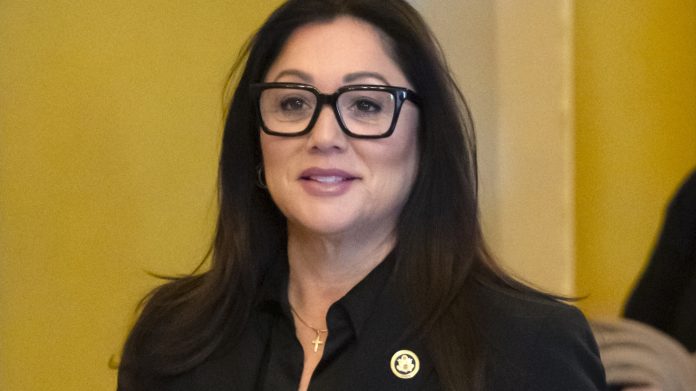
Former Rep. Lori Chavez-DeRemer, R-Ore., President Trump’s pick for secretary of labor, arrives to meet with Senate Minority Leader Chuck Schumer on Capitol Hill on Jan. 14.

Mark Schiefelbein/AP


hide caption

toggle caption

Mark Schiefelbein/AP

We’re following the confirmation hearings for the incoming Trump administration. See our full politics coverage, and follow NPR’s Trump’s Terms podcast or sign up for our Politics newsletter to stay up to date.

Who: Lori M. Chavez-DeRemer

Nominated for: secretary of labor

You might know her from: In 2022, she was elected to represent Oregon’s 5th Congressional District, flipping a blue seat to red. This election made her the first Republican woman from Oregon to serve in the U.S. House of Representatives. But she lost her bid for reelection in 2024 to Democrat Janelle Bynum, resulting in the seat flipping back to blue.

  • Before her election to Congress, Chavez-DeRemer served on the Happy Valley, Ore., city council from 2005 to 2010, where she was president beginning in 2007, according to her congressional bio. She was then elected mayor of Happy Valley in November 2010 and was reelected in 2018 for another four-year term.
  • During her time in Congress, she received support from unions for her 2024 reelection campaign. She also advocated for the Protecting the Right to Organize Act, a bill designed to facilitate the formation of labor unions by overturning state Right to Work laws, which undermine union strength.
  • Her nomination for secretary of labor has garnered praise from various unions, including Teamsters President Sean O’Brien.

What does this role do? The secretary leads the Labor Department and its agencies, including the Bureau of Labor Statistics, the Occupational Safety and Health Administration (OSHA) and the Office of Workers’ Compensation Programs. The department also enforces more than 180 federal labor policies and laws such as those pertaining to hourly and overtime pay, unemployment insurance and workers’ rights to safe working environments. It is the 11th Cabinet position in the presidential line of succession.

In his last full year in office, President Joe Biden requested that the fiscal year 2025 budget include $13.9 billion and support for 15,762 full-time employees.