Friday, November 13, 2026
Home Blog Page 207

Alarmed by Trump’s Gaza Plan, Arab Leaders Brainstorm on Their Own

0

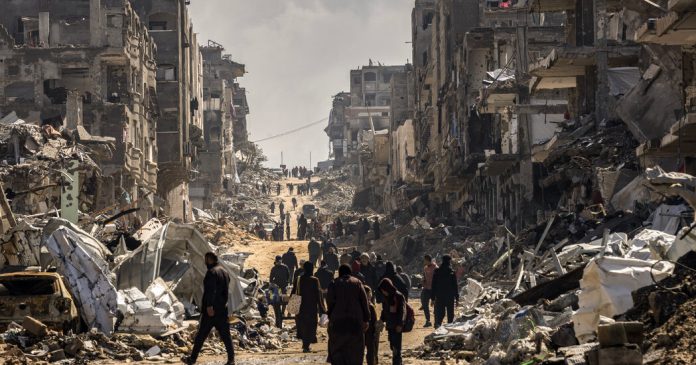
After President Trump shocked the Arab world last month by suggesting the entire population of Gaza be expelled from the territory, his aides reframed the idea as an invitation to the leaders of the Middle East: Come up with a better plan, or do it our way.

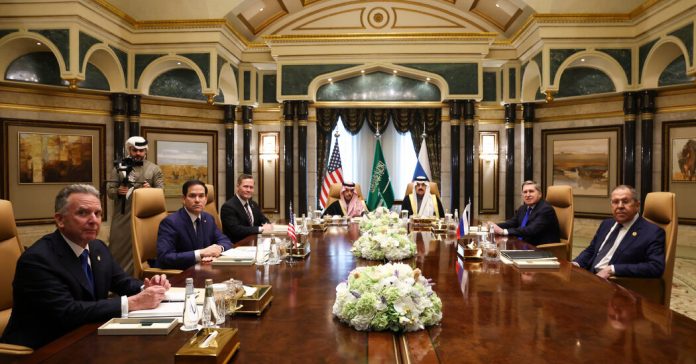
“All these countries say how much they care about the Palestinians,” Secretary of State Marco Rubio said last week. “If the Arab countries have a better plan, then that’s great,” Mr. Rubio added.

Now, the governments of several Arab states are attempting to do exactly that. Representatives of Egypt, Jordan, Saudi Arabia, Qatar and the United Arab Emirates are quietly coordinating to form an alternative vision for Gaza in which Arab countries would help fund and oversee the reconstruction of Gaza, while keeping its residents in place and preserving the possibility of a Palestinian state, according to diplomats and officials briefed on the endeavor.

Envoys from all five countries are set to flesh out the details on Friday in Saudi Arabia, and then again at a bigger summit on March 4 in Cairo. At those meetings, Egypt will likely propose forming a committee of Palestinian technocrats and community leaders, all unaffiliated with Hamas, who could run Gaza after the war, according to two Arab diplomats, a senior Western official and Senator Chris Van Hollen, Democrat of Maryland. Mr. Van Hollen said he spoke over the last week with the Egyptian, Saudi and Jordanian foreign ministers about the evolving proposal.

“A lot of the focus will be to demonstrate to Trump and others that, ‘Yes, there is a viable plan to rebuild, we will invest the resources there,’” Mr. Van Hollen said.

“Their view is that Trump’s a real estate guy, he talked about redeveloping Gaza, they want to put together a viable plan that shows Trump that you can rebuild Gaza and provide a future for two million Palestinians” without forcing them to leave the territory, Mr. Van Hollen added.

While the ideas might be presented as a fresh alternative, they are hardly new. For months, Egypt has promoted the idea of a technocratic committee and has hosted Palestinian leaders in Cairo to discuss the idea. For decades, Arab leaders have called for the establishment of a Palestinian state that includes Gaza. Even the Israeli government has privately signaled for more than a year that it is open to Arab leaders playing an oversight role in postwar Gaza.

The challenge is that the obstacles to these ideas are as old as the ideas themselves.

Israeli leaders oppose postwar plans that would pave the way to Palestinian sovereignty. But Arab leaders will only support a framework that at least nominally forges a path toward Palestinian statehood.

They also want the blessing of the Palestinian Authority, the internationally recognized body that administered Gaza until Hamas wrested control of the territory nearly two decades ago. But the authority’s president, Mahmoud Abbas, has appeared wary of a postwar governance structure that does not unequivocally give him full control of the territory — a position that puts him at odds with a technocratic committee. Hamas officials have said they would be willing to cede control over civil affairs to such a body. But they have refused to disband their military wing, an unacceptable position for both Israel and Mr. Trump, who seek Hamas’s complete disarmament.

“The biggest challenge that the Arab leaders face is to present a realistic plan that can be imposed on the Palestinian factions as well as also being acceptable to both the U.S. and Israel,” said Ibrahim Dalalsha, director of the Horizon Center, a political research group in Ramallah, West Bank. “It’s going to be a very complicated process.”

Among the uncertainties is whom the Arab leaders would entrust to secure Gaza and prevent Hamas from attacking Israel. Israeli officials also want the Israeli military to have operational freedom in Gaza for the long term, but that arrangement would be hard for the Arab leadership to publicly support.

Some hope that Egypt and the Gulf countries would provide their own troops. Last month, Egypt allowed a private Egyptian security firm to help staff a checkpoint inside Gaza — an arrangement that some diplomats and analysts viewed as a prototype for a broader operation. But it is unclear whether Arab leaders would be prepared to send a larger force to secure a wider territory. And it is unlikely that Hamas would accept that intervention.

“Whoever wants to take Israel’s place will be treated just like Israel,” Osama Hamdan, a senior Hamas official, said during a conference in Qatar last weekend.

The firmest element of the Egyptian plan centers on rebuilding Gaza while keeping Palestinians inside the enclave instead of forcing them out to Egypt and Jordan, as Mr. Trump has suggested.

President Abdel Fattah el-Sisi of Egypt outlined the proposal in broad strokes in meetings on Sunday with Ronald Lauder, the president of the World Jewish Congress, and Crown Prince Hussein of Jordan. Mr. el-Sisi discussed with the Jordanian prince “the necessity of immediately starting the reconstruction of the Gaza Strip, without displacing the Palestinians from their land,” according to a statement from Egypt’s presidency.

But the details of the plan remain unclear.

Samir Farag, a retired Egyptian military general, said in an interview that Egypt would call on an array of companies, both domestic and international, to reconstruct Gaza over the next three to five years. A first phase of increasing humanitarian aid to Gaza and clearing rubble would be followed by building hospitals, schools and other infrastructure, said Mr. Farag, who is close to Egyptian officials.

The question of who will pay for it remains unanswered.

Egypt will call on other Arab countries to contribute reconstruction funds at an upcoming conference, Mr. Farag said.

But even the timing of such summits has been the subject of confusion. Egypt originally invited Arab leaders to an “emergency” summit on Feb. 27.

Then it was delayed by a week.

Rania Khaled contributed reporting from Cairo and Ismaeel Naar from Riyadh.
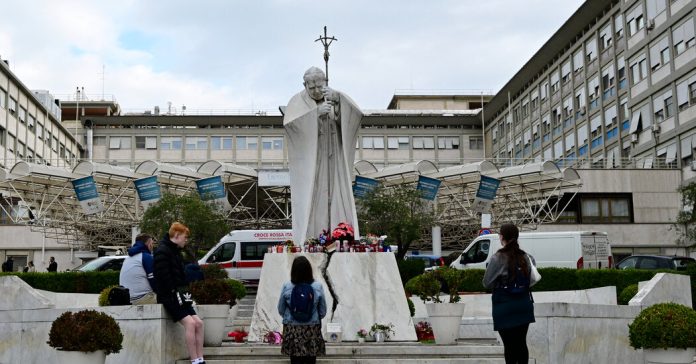
Pope Francis Has ‘Peaceful Night’ After Pneumonia Diagnosis, Vatican Says

0

Pope Francis, who has been diagnosed with pneumonia in both lungs, slept well overnight and ate breakfast on Wednesday, the Vatican said, as concerns grew about the health of the 88-year-old pontiff.

In a brief early-morning update, the Vatican said that Francis “spent a peaceful night, woke up and had breakfast.”

Francis was admitted to Policlinico A. Gemelli Hospital in Rome with bronchitis last Friday. Successive diagnostic tests found that he had developed pneumonia in both lungs.

He also has a polymicrobial infection, which means that he has a mix of microbes, like a virus or bacteria, in his lungs or another part of his respiratory tract. The infection required the use of cortisone antibiotic therapy, the Vatican said.

His overall health continued to be complex, the Vatican said on Tuesday evening, but it added that the pope was in “good spirits,” praying, reading and resting.

In recent years, Francis’ health has been cause for concern, and this is his fourth stay at Policlinico A. Gemelli Hospital. In 2021, he had colon surgery there. In 2023, he was admitted for a respiratory infection and went home after three days. He was then hospitalized again a few months later to undergo abdominal surgery for a hernia.

More than 60 years ago, Francis had an upper lobe of his right lung removed, and in recent years his breathing has seemed labored during speeches. Over the past few months, he has often asked aides to read the remarks on his behalf.

But Francis has maintained an often exhausting schedule, in particular since the Roman Catholic Church’s 2025 Jubilee — a year of faith, penance and forgiveness of sins that takes place every quarter-century — began on Christmas Eve.

All of his public engagements have been canceled through the weekend.

Bomber Given 10 Years in Prison for Attempted Murder of Japanese Premier

0

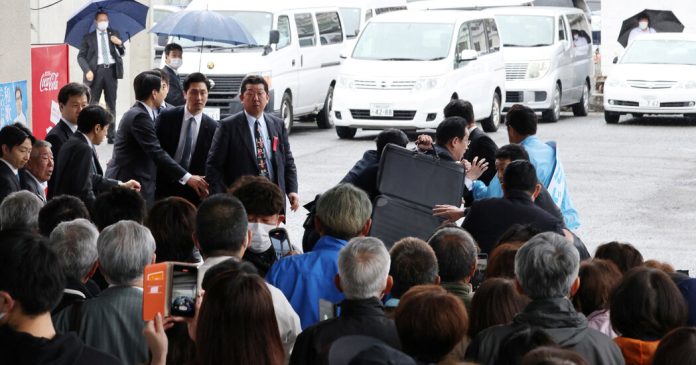
A court in western Japan sentenced a man to 10 years in prison on Wednesday after finding him guilty of attempting to murder the prime minister two years ago with a homemade bomb.

The court in the city of Wakayama found Ryuji Kimura, 25, guilty of attempted murder and four charges related to the possession of explosives. In its ruling, the court said Mr. Kimura had sought to kill the prime minister at the time, Fumio Kishida, when he threw the device inside a hall in April 2023.

Mr. Kishida was about to speak to political supporters when the attack happened. Prosecutors had sought a 15-year sentence for the attacker, who the court said acted out of a desire for public attention. Mr. Kimura had denied the attempted murder charge, saying he had not had an intent to kill.

The attack shocked Japan not only because such acts of violence are rare in the country, but also because it took place less than a year after the assassination of a previous prime minister. In July 2022, Shinzo Abe was gunned down on a street in Nara, which is near Wakayama, by a disgruntled man who had made the weapon himself.

Mr. Abe’s security detail was later faulted for allowing the gunman to get off two shots at the former prime minister, who was making a campaign speech. It was the second shot, which struck Mr. Abe in the chest, that proved fatal.

In the attack on Mr. Kishida, the premier’s security detail rushed him to safety before the bomb went off. The small explosion by the device, which appeared to be a pipe filled with gunpowder, injured two people in the hall in Wakayama, a port city south of Osaka.

After he threw the device, Mr. Kimura was wrestled to the ground by the security detail and members of the audience, who were supporters of Mr. Kishida’s party. When police searched Mr. Kimura’s backpack, they found a second handmade explosive in addition to gunpowder and a knife.

A subsequent search of Mr. Kimura’s home found another pound of gunpowder and more pipes.

In its ruling, the court said that Mr. Kimura, who was unemployed, had tried to kill the prime minister out of a desire to gain public attention. It said he planned the attack after his postings about politics on social media failed to get much response.

The court said bomb specialists had determined that the improvised device was strong enough to have killed Mr. Kishida if it had detonated close to him.

Nepal Took a Risk on a $500 Million U.S. Grant. It May Now Regret It.

0

Nepal, the small Himalayan nation bordering China, was negotiating with Beijing over a major injection of infrastructure financing when the United States stepped in with a lucrative offer.

Over five years, the American government would give the country $500 million in grants to expand its electricity grid and improve its roads — a huge sum in a country where the average annual income is about $1,400.

The U.S. challenge to China’s sway in its own region angered officials in Beijing. But Nepal, after five years of divisive debate, went ahead and accepted the offer, ratifying it in 2022 after coming up with $200 million of its own.

Now, the project has been thrown into doubt with the Trump administration’s freeze on foreign aid. Nepali leaders who had sided with the United States, backing the deal even as opponents called them U.S. puppets and traitors, are wondering if they made a terrible mistake in putting their faith in America.

“This is quite shocking,” said Rajendra Bajgain, a lawmaker from the governing Nepali Congress party, who had argued passionately for the U.S. project. “They are making it easier for our neighboring countries, especially the Chinese, who are enjoying themselves. They will come to our office and say, ‘See, this is how America acts.’”

It is not clear if China has made any direct overtures to Nepal as the United States pulls back. But Beijing has been handed openings by President Trump’s gutting of foreign aid and other moves that have alienated U.S. allies and partners. Some of them, like India, may find it harder to challenge China’s growing assertiveness in Asia without the backing of the United States, particularly its financial muscle.

The infrastructure grant to Nepal was made through the Millennium Challenge Corporation, an agency established by the U.S. Congress in 2004 during the George W. Bush administration. It has an annual budget of only about $1 billion, but it provides funding for programs around the world, including ones aimed at limiting the influence of China in Asia and Africa.

The bulk of the Nepal grant was to be used to build a nearly 200-mile transmission line that would connect its power grid with India’s, helping the country generate revenue by selling surplus electricity to its giant neighbor. The money would also help Nepal maintain about 200 miles of roads, helping to knit together a nation divided by its rough terrain.

Some small, early contracts have been awarded, and work on parts of the project, including substations, has started. But on Tuesday, after remaining in the dark for weeks, Nepal announced that it had been told by the United States that funding for the program had been suspended for at least 90 days.

The Millennium Challenge Corporation plans to apply to the State Department for waivers to keep eight large-scale programs, including the one in Nepal, on track, according to a U.S. official, who spoke on the condition of anonymity to discuss internal deliberations.

The halt to U.S. grant money could impose serious hardships on recipient nations. If they are forced to break contracts, their already significant debt could grow. In the case of Nepal, it could incur a liability if it does not abide by its agreement with India to transmit electricity, the U.S. official said.

Large hydropower projects in Nepal will also be affected if the transmission line is not completed, said Semanta Dahal, a lawyer who was part of the grant ratification process.

Nepal had to overcome China’s heavy influence to strike the agreement with the United States in 2017, during Mr. Trump’s first administration.

The mountain nation, with a long history of communist politics, has some affinities with China. The deal’s detractors warned that it would mean a surrendering of sovereignty to the United States and stoked fears that American troops would someday arrive.

China worked to amplify the doubts. “Is it a gift or Pandora’s box?” Hua Chunying, a spokeswoman for China’s Foreign Ministry, said as the debate was playing out in Nepal. “I’m afraid it will turn out like a Nepalese saying: It looks good, but you will find the meat difficult to chew.”

Supporters of the deal fought back, saying they would defend it “in the Parliament and on the streets.” They pointed out that it was a grant from a democratic country and did not have strings that often come with Chinese loans, such as having to use Chinese contractors, which have overburdened some poorer borrowers.

Nepal would soon experience this problem itself: It is on the hook for an international airport, at a significantly inflated price, without the necessary passenger numbers to repay the $200 million China lent to build it. That loan came around the same time that the Americans stepped in with their grant.

“It was risky, hard,” Gagan Thapa, a member of Parliament, said about the process of agreeing to the U.S. grant. “There were several geopolitical complexities.”

The two countries surmounted those challenges, Mr. Thapa said, “based on Nepal-U.S. relations, and for the benefit of Nepalese people.” But as Mr. Trump turns America inward, that benefit may be fleeting.

Nearly 300 deportees from U.S. held in Panama hotel : NPR

0

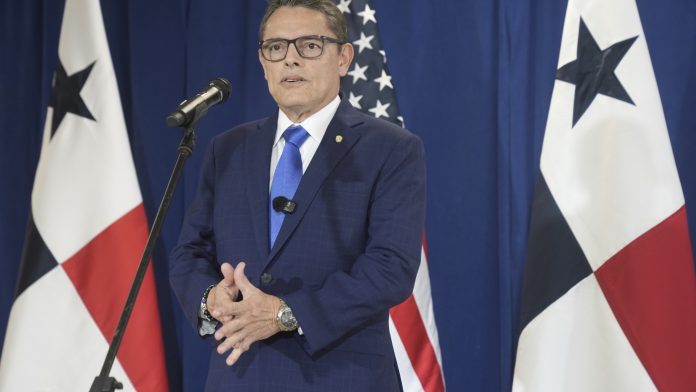
Panama’s Minister of Public Security Frank Alexis Abrego, speaks to reporters after watching people board a repatriation flight bound for Colombia at Albrook Airport in Panama City on Feb. 3.

Mark Schiefelbein/Pool AP


hide caption

toggle caption

Mark Schiefelbein/Pool AP

PANAMA CITY — Panama is detaining in a hotel nearly 300 people from various countries deported under U.S. President Donald Trump, not allowing them to leave while waiting for international authorities to organize a return to their countries.

More than 40% of the migrants, authorities say, won’t voluntarily return to their homeland. Migrants in the hotel rooms held messages to the windows reading “Help” and “We are not save (sic) in our country.”

The migrants hailed from 10 mostly Asian countries, including Iran, India, Nepal, Sri Lanka, Pakistan, Afghanistan, China and others. The U.S. has difficulty deporting directly to some of those countries so Panama is being used as a stopover. Costa Rica was expected to receive a similar flight of third-country deportees on Wednesday.

Panama’s Security Minister Frank Abrego said Tuesday the migrants are receiving medical attention and food as part of a migration agreement between Panama and the U.S.

The Panamanian government has now agreed to serve as a “bridge” or transit country for deportees, while the U.S. bears all the costs of the operation. The agreement was announced earlier this month after U.S. Secretary of State Marco Rubio’s visit.

Panamanian President José Raúl Mulino, who faces political pressure over Trump’s threats of retaking control of the Panama Canal, announced the arrival of the first of the deportation flights last Thursday.

The confinement and legal limbo the deportees face has raised alarm in the Central American country, especially as images spread of migrants peaking through the windows of their rooms on high floors of the hotel and displaying the notes pleading for help.

Abrego denied the foreigners are being detained even though they cannot leave the rooms of their hotel, which is being guarded by police.

Abrego said that 171 of the 299 deportees have agreed to return voluntarily to their respective countries with help from the International Organization for Migration and the U.N. Refugee Agency. U.N. agencies are talking with the other 128 migrants in an effort to find a destination for them in third countries. Abrego said that one deported Irish citizen has already returned to her country.

Those who do not agree to return to their countries will be temporarily held in a facility in the remote Darien province through which hundreds of thousands of migrants have crossed on their journey north in recent years, Abrego said.

The Panamanian Ombudsman’s Office was scheduled to provide more details on the deportees’ situation later Tuesday.

Jet-Skis in Rwanda. Bodies Ashore in Congo.

0

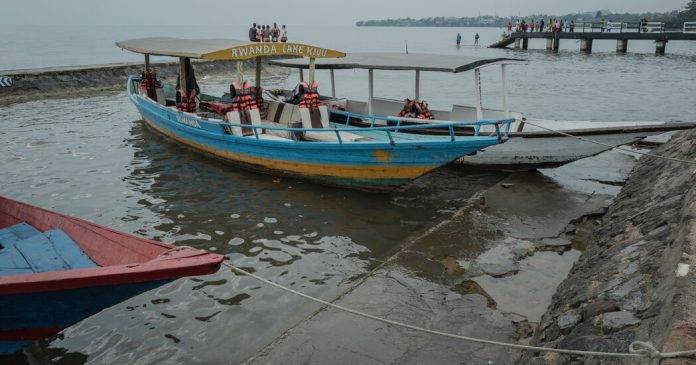
On one side of the lake, lovers glide on canoes, friends ride jet-skis and families pose for pictures in the hazy sunset. On the other side, less than two miles away, dead bodies washed ashore while ammunition and discarded weapons littered the water.

The shore of Lake Kivu in Rwanda offers leisure and relaxation. Across the border in the Democratic Republic of Congo, the same lake displayed devastation and misery after an armed group called M23 captured the lakeside city of Goma last month. Nearly 3,000 people were killed in the January offensive, according to the United Nations.

“It is peaceful here, unlike over there,” said Exauce Shalako, a 20-year-old man from Goma who was lounging on the shore of Lake Kivu in Rwanda one afternoon this month. Mr. Shalako, who said he had lost a friend in the fighting, had crossed into Rwanda for a day at the beach. “We need to unwind, to have a change of scene,” he said.

But while Rwanda appears peaceful at home, it is fueling war across the border. Thousands of Rwandan troops have invaded eastern Congo alongside fighters from M23, which is under Rwanda’s control, according to the United States and United Nations experts. Rwanda denies backing the rebels.

To cross from Goma to its sister city Gisenyi in Rwanda takes just minutes by land, but the two places feel worlds apart. In Gisenyi, a town of 50,000, restaurant owners adorn their beachfront properties with colorful decorations as the smell of roasted chicken fills the air. In Goma, a city of two million, the stench of death and the sounds of sirens wafted over the streets for days.

The neighboring countries share a painful history but have little in common these days.

Rwanda is seen as a model of development across Africa. A country nearly 90 times smaller than Congo, it sponsors top European soccer teams and is known for its high-end resorts, where affluent tourists stay during expeditions to marvel at gorillas. Being here can give an impression of political stability and affluence, but many say beneath that veneer lies widespread surveillance, repression and unequal development.

Congo, despite its dizzying natural resources, remains plagued by instability. Its eastern region is home to one of the world’s largest displacement crises, dating back to the aftermath of the Rwandan genocide 30 years ago.

“The living standards are so different,” said Théoneste Bitangimana, a Rwandan real estate agent and pastor who lives in Gisenyi and works on both sides of the border. “In Congo the rich get richer and the government doesn’t care. In Rwanda we’re constantly trying to improve the way we live.”

The Congolese have a different way of describing the wealth gap between the two nations: exploitation.

United Nations experts found that 150 tons of coltan — from which key minerals used in smartphone manufacturing are extracted — was smuggled out of Congo and into Rwanda by M23 last year.

“We’re being looted for others to get rich,” said Didier Kambale, a pastor in Goma walking on a debris-littered street this month. “Why are they coming here?” he asked about Rwandan troops. “Do Congolese wage war abroad?”

Though Rwanda’s leader has said that the war in eastern Congo is a Congolese problem, the M23 offensive on Goma brought it one step closer to Rwanda.

In its attempt to defend Goma, the Congolese army launched shells and bombs across the border in January, puncturing Rwandan homes and tearing roofs open. Sixteen people were killed and 160 injured in Rwanda. Thousands of people fleeing Goma found refuge in Rwanda.

Shattered glass and wood still littered the floors as rain fell into Mr. Bitangimana’s home this month. A shell had hit the roof of the real estate agent’s brick and cement house.

“We’re praying for the two countries, because we need to live in harmony,” he said.

In Gisenyi, children at school now talk of the war between Rwanda’s president, Paul Kagame, and his Congolese counterpart, Felix Tshisekedi.

“I don’t pick a side, it’s too complicated,” said Ariella, a 10-year-old living in Rwanda with a Congolese father and a Rwandan mother. Sitting at her home yards away from the border, Ariella said she played dead in her bed for hours one morning during the M23 offensive, fearing soldiers might “come to kill us.” The fighting paused shortly after.

Despite the two different worlds on each side of Lake Kivu’s shores, the beach in Gisenyi is also where people from Rwanda and Congo gather in peace. Mr. Shalako, the 20-year-old, said he crossed the border to tell his Rwandan friends that he was safe.

“Politicians want to make us believe that we are enemies, but we’re brothers,” he said.

In her living room, Ariella stopped her math homework to discuss the war. She said she was longing to visit her aunt who lives in Goma on her upcoming vacation, and “do all kinds of silly things over there.”

Sitting in her Spider-Man pajamas, Ariella asked a question about the presidents from both countries that left a silence in the room: “Why can’t they just make peace?”

Wednesday Briefing

0

Here’s what you need to know.

Musk and X to pay Trump $10 million to settle Jan. 6 lawsuit : NPR

0

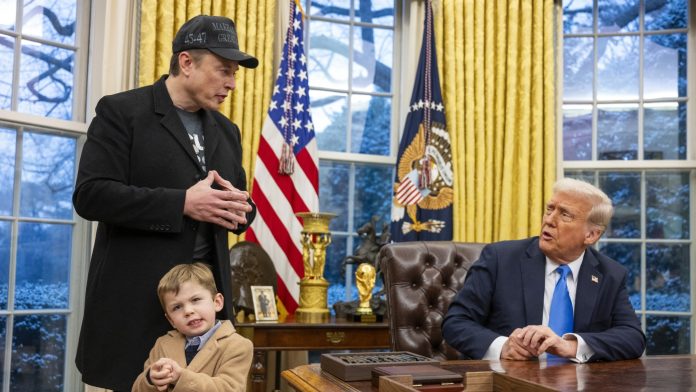
Tesla and SpaceX CEO Elon Musk with his son X Æ A-Xii and President Trump in the Oval Office on Feb. 11, 2025. Musk has been tapped by President Donald Trump to lead federal cost-cutting efforts.

Jim Watson/AFP via Getty Images


hide caption

toggle caption

Jim Watson/AFP via Getty Images

President Trump said Elon Musk paying $10 million to settle a lawsuit the president brought against the social media site Musk now owns was “a big discount.”

Speaking to Fox News host Sean Hannity in a pre-taped interview on Tuesday night, Trump said he hoped for a larger payout.

“It’s very low. I was looking to get much more money than that,” said Trump, sitting right next to Musk as he made the comments.

Musk, who had a contorted expression of bewilderment when Hannity asked the question, said in response: “I left it up to the lawyers and the team running Twitter.”

Twitter, now X, banned Trump days after the Jan. 6 riots on the Capitol, citing the possibility of further increments of violence. And Trump responded by suing the platform for alleged censorship.

Those legal arguments were losing in court. A U.S. District Judge in California tossed the case, ruling that only governments, not private companies, can violate someone’s First Amendment rights. Trump’s legal team appealed to a federal appeals court, which also appeared skeptical of Trump’s allegations.

But Trump’s lawyers kept fighting to keep the suit alive well after billionaire Elon Musk bought Twitter in 2022 and drew increasingly closer to Trump’s orbit over the next two years, culminating in Musk becoming the single biggest donor to Trump’s successful campaign last November.

Despite working together in the White House, Musk’s lawyers negotiated a $10 million to Trump to end the pending litigation. Earlier this month, Musk’s lawyers wrote in a court filing that the suit would be voluntarily dismissed. The Wall Street Journal first reported on the payout.

It’s the second tech company payment to Trump over him being booted from social media sites. Last month, Meta agreed to fork up $25 million to resolve litigation over Trump’s suspension from Meta’s Facebook and Instagram.

Trump also sued Google for banning him from YouTube, but that case is still pending.

The agreement between Musk’s X and Trump, which the president discussed on Tuesday, is striking, given Musk’s role as a top official in the White House.

Musk, who had been leading an effort known as the Department of Government Efficiency, has been given broad powers by Trump to shrink the size of the federal government by aggressively cutting costs and, in some cases, attempting to dismantle entire agencies, spurring a slew of legal challenges over the limits of executive authority.

X did not respond to NPR’s request for comment.

Shortly after Musk purchased Twitter in October 2022, he reinstated Trump’s account.

The same year, U.S. District Judge James Donato threw out Trump’s free speech case against Twitter.

“The amended complaint merely offers a grab-bag of allegations to the effect that some Democratic members of Congress wanted Mr. Trump, and ‘the views he espoused,’ to be banned from Twitter because such ‘content and views’ were ‘contrary to those legislators’ preferred points of view,'” Donato wrote in his ruling. “But the comments of a handful of elected officials are a far cry from a ‘rule of decision for which the State is responsible.’ Legislators are perfectly free to express opinions without being deemed the official voice of ‘the State.'”

Right-Wing Media Praises U.S.-Russia Talks as ‘Breath of Fresh Air’

0

News that the Trump administration had agreed with Russia to try to negotiate a peace settlement for Ukraine, without including Ukraine in the talks, was a revelation that many believed reversed years of efforts to isolate Moscow.

But prominent voices in the right-wing media world interpreted the development this week as cause for celebration.

“Every day has kind of felt like Christmas morning, hasn’t it?” Kari Lake, the former TV news anchor who is poised to run Voice of America, said during a podcast interview on Tuesday. “President Trump wants peace for every nation.”

Charlie Kirk, the co-founder of Turning Point USA and podcast host who has more than 4.6 million followers on the social media platform X, praised the discussions as “a breath of fresh air.”

And Jack Posobiec, a die-hard Trump loyalist perhaps best known for spreading the infamous “Pizzagate” conspiracy theory, invoked the title of Mr. Trump’s 1987 best-selling book. “Ladies and gentlemen,” he said on his podcast, “it’s the art of the peace deal.”

They are among a growing pool of Trump-aligned media figures who have become among the harshest critics of American strategy in addressing Russia’s war in Ukraine, deeming the Biden administration’s efforts wasteful, detrimental to national interests and, ultimately, futile. They have opposed sending more aid to Ukraine, argued against including the country in the North Atlantic Treaty Organization and suggested that it should relinquish at least some of the territory seized by Russia in the conflict.

Now that Mr. Trump is back in charge, many of those same right-wing voices have functioned as a supportive chorus, cheering the president’s unorthodox approach of directly engaging with Russian leadership and creating a media narrative that runs counter to the deep unease expressed by the foreign policy establishment.

That increasing numbers of Republicans are falling in line with this once-fringe view is a testament to Mr. Trump’s ability to bring his Republican Party to heel on nearly any issue, even one that upends its previously hawkish stance toward Russia. Secretary of State Marco Rubio, who is representing the United States at the talks with Russia in Saudi Arabia, was once a champion of Ukraine, although last year as a senator he voted against a congressional aid package that included Ukraine and that Mr. Trump opposed.

Mr. Trump campaigned on a promise to end the war in Ukraine, and over the past week he has pushed the matter to the top of his agenda. On Wednesday, he disclosed a surprise phone call with Russia’s president, Vladimir V. Putin, which Mr. Trump characterized as the beginning of peace negotiations.

A day after the call, Tucker Carlson dedicated large portions of a live interview with President Viktor Orban of Hungary — himself a darling of the American right — to the war and its potential resolution.

“Donald Trump already changed the mind-set of the whole Western world,” Mr. Orban told him.

Mr. Carlson, a former Fox News star who is now among the country’s most popular podcasters, had long promoted pro-Russian arguments on his Fox prime-time show, arguing that President Volodymyr Zelensky of Ukraine was a dictator being used by the West to undermine Russia.

A year ago, Mr. Carlson flew to Moscow to conduct a two-hour interview with Mr. Putin, the Russian president’s first one-on-one session with a representative of a Western media outlet in several years. Mr. Carlson, who expressed sympathy for Mr. Putin’s viewpoint, has made criticism of U.S. and European aid to Ukraine, as well as Ukraine’s own governance, a centerpiece of his messaging.

Throughout his political career, Mr. Trump has shown himself to be especially receptive to that kind of commentary, not only amplifying the viewpoints of his media supporters but often acting in direct response to them.

Last week, that dynamic appeared to reach new heights when Mr. Posobiec accompanied the defense secretary, Pete Hegseth, on his trip to Germany, Belgium and Poland for high-level security meetings. Mr. Posobiec occupied a front-row seat — if not an active role — in highly sensitive diplomacy.

Mr. Posobiec is not a government official and was not traveling as part of the press corps. Instead, he was invited by Pentagon officials and appeared to have seemingly unfettered access, allowing the influencer to provide running commentary on high-level conversations.

Mr. Posobiec then traveled with Treasury Secretary Scott Bessent to Ukraine, where he met with Mr. Zelensky. Mr. Posobiec referred to the trip as “the Trump peace delegation.”

Critics, including many veterans of the diplomatic corps, have been alarmed by Mr. Trump’s apparent rapprochement with Russia. The talks in Saudi Arabia were a swerve from previous American efforts to isolate Russia and impose sanctions on its political and financial leaders as punishment for the 2022 invasion of Ukraine, which led to Europe’s most destructive war in decades. Opponents also labeled the talks as a potential peril for trans-Atlantic alliances like NATO.

Brit Hume, Fox News’s chief political analyst, sounded a note of caution about the negotiations. He speculated that the direct talks between the United States and Russia were a precursor to a more inclusive round of negotiations, which he thought may ultimately bring together the parties to find a solution.

“I don’t think he is going to sell out Ukraine,” Mr. Hume said of Mr. Trump. “I think these early talks in Saudi Arabia are just about the contours of the table, in all likelihood. And obviously you can’t make peace between two countries when you’re only negotiating with one.”

When a Journey Home to Israeli-Occupied Lebanon Becomes Deadly

0

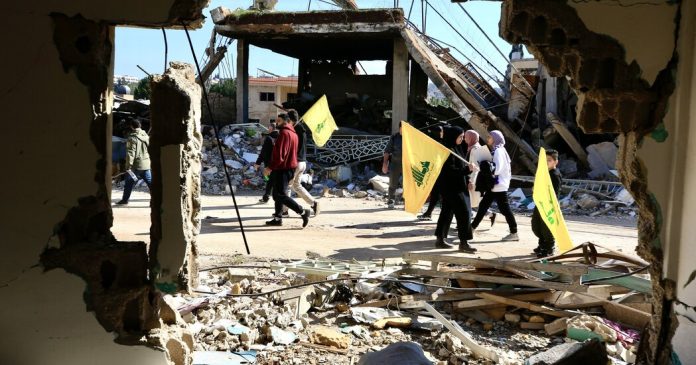
For months after the Israel-Hezbollah war that devastated southern Lebanon, the Alawieh family would visit a hillside near their ruined home to catch whatever glimpse they could of what remained.

Their olive trees were gone. So were their goats, and the lemon and fig orchards that had taken years to bear fruit. Their house was just a pile of rubble.

Israel had agreed to a Jan. 26 deadline — two months after a cease-fire took effect — to withdraw its remaining forces from southern Lebanon. That day, Mousa Alawieh set out with his three teenage children and a cousin, eager to see what was left of their home in the border town of Aitaroun.

Mr. Alawieh, 45, a metal worker, had been displaced for more than a year and struggling to make ends meet. He had hoped to salvage whatever possessions he could from the wreckage, family members said.

But he never made it home.

As he and his family were driving through their flattened town, they encountered at least two Israeli soldiers on the road who shot multiple times at the family’s car, killing Mr. Alawieh, according to video footage verified by The New York Times and accounts from his brother and brother-in-law.

Asked about the shooting of Mr. Alawieh, the Israeli military said the matter was “under review.”

Israel had delayed its withdrawal that day, but Mr. Alawieh was unaware and believed the military had begun to pull out of Aitaroun, according to Yaacoub Alawieh, his brother.

The displaced are uncertain about whether Israel will remain indefinitely in Lebanon and when they will be able to return home. Many of their towns and villages now lie in ruins, and it is also unclear who will foot the mammoth bill for reconstruction.

After Israel and Lebanon agreed to extend the Jan. 26 withdrawal deadline, Israeli forces continued to occupy large portions of southern Lebanon. A new date for the withdrawal was set for Tuesday, and Israeli forces pulled out of the remaining populated towns and villages along the border.

But the Israeli military said this week that it intended to stay at a number of strategic points inside Lebanon beyond the deadline for its complete withdrawal.

Israel once occupied southern Lebanon for 18 years, and with each delay in the pullout, fears of another prolonged occupation have grown.

The latest war began brewing after the surprise Hamas-led assault on southern Israel on Oct. 7, 2023. The Iran-backed Lebanese militant group Hezbollah began attacking Israeli positions in solidarity with Hamas, its ally.

After nearly a year of low-level clashes, Israel launched a full-scale offensive in September, assassinating many of Hezbollah’s leaders and destroying much of its weapons stockpiles. It was Lebanon’s most destructive war in decades.

Israel has issued a series of warnings to residents of southern Lebanon — including on Jan. 26 — not to return to their hometowns yet because its military forces were still deployed there. But thousands of Lebanese have defied those orders in their eagerness to go home.

Israeli forces killed at least 24 people in southern Lebanon on Jan. 26 alone, according to Lebanon’s health ministry, and more were killed in the days that came after.

Mr. Alawieh was so excited to go home that he did not even check the news that day, his brother said, so he was under the impression that Israeli troops had begun to withdraw to the outskirts of Aitaroun.

Mousa AlawiehCredit…via Alawieh family

But as his car rounded a bend in the town, at least two Israeli soldiers suddenly emerged in the road ahead, according to video footage filmed from inside the vehicle by Ali, Mr. Alawieh’s 15-year-old son.

Mr. Alawieh panicked and slammed his vehicle into reverse. The family raised their hands in the air. A gunshot rang out — one, two, then 20 — a salvo of bullets puncturing metal and glass and skin.

“Get down, Dad, get down!” shouted Ali from the back seat, his sisters screaming in fear.

“No, Dad!” shouted Ali. “Dad! Dad! Dad!”

As their father began to bleed, the Israeli soldiers ordered the children out of the car and questioned them, Mr. Alawieh’s brother said, relaying what he was told by his family members who were in the car at the time. The soldiers then told them to walk straight ahead without looking back. They left their father behind in the car, wounded but still alive.

Rukaya Alawieh, Mr. Alawieh’s 18-year-old daughter, was wounded in the shooting and it took her an hour to reach the nearest hospital to find her father help. By the time the ambulance arrived at the car, he was dead.

Like many other residents of southern Lebanon, Mr. Alawieh was affiliated with Hezbollah, according to his brother. But he was not a fighter or a full-fledged member, the brother said. Hezbollah has long operated a roster of social and humanitarian services in lieu of Lebanon’s ailing state, and Mr. Alawieh became involved in the group’s social work shortly before his death.

Many residents who have been able to return to their homes in southern Lebanon have often arrived back to find nothing left standing.

The extended Alawieh family lost 11 of their homes, said Marwan Qassem, Mr. Alawieh’s brother-in-law, who owned a house in Aitaroun and also ran a large family farm there, both now in ruins.

“When I saw the damage to the house, I asked myself, where do I begin?” he said.

During the war, Mr. Qassem and Mr. Alawieh spent months bouncing between temporary accommodations with their families, trying to escape Israel’s widening offensive.

First they fled the border region to an area where the airstrikes soon struck. Then they headed for the capital, Beirut, but that was bombed too. It was a seemingly endless loop, searching for safety, but never quite safe.

Today, his family is in limbo, still unable to return home and consumed with grief over their losses. Forced to lay their father to rest away from the family cemetery in Aitaroun, the children have struggled to process what happened, Mr. Qassem said.

Ali’s cheeky laugh has given way to reticence. And Rukaya, his elder sister who scrambled to find help after their father was shot, is traumatized.

“Sometimes she is silent,” Mr. Qassem said. “Sometimes she cries.”

Arijeta Lajka and Myra Noveck contributed reporting.