Wednesday, November 11, 2026
Home Blog Page 21

Nevada’s Asian voters who picked Trump look back on first 100 days : NPR

0

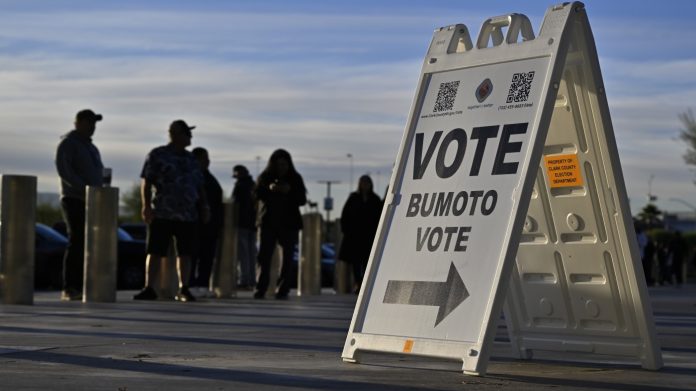
Voters line up to cast their ballots at Allegiant Stadium on Nov. 5, 2024 in Las Vegas, Nevada behind a sign reading “Vote, Bumoto, Vote” – directions in English, Tagalog and Spanish.

David Becker/Getty Images


hide caption

toggle caption

David Becker/Getty Images

Pauline Lee is the daughter of immigrants who came to the United States as teenagers, with nothing.

“When they came here they were dirt poor,” she recalled.

They worked entry-level jobs at first, before they both went on to study and build successful careers in California.

Lee is proud of her family’s immigration stories — and the fact that they came to the U.S. legally.

“Illegal immigration is, for me, one of the biggest problems, because you’re also giving these illegal immigrants a lot of our resources that should be retained for our own Americans,” she said. “That’s a real problem.”

Lee, a retired attorney, is active in Republican politics in Nevada. About six in 10 Asian Americans in the state voted for President Trump over Democratic nominee Kamala Harris in November. That’s a huge swing from four years earlier, when a little more than six in 10 Asian voters backed Joe Biden.

During his first 100 days in office, President Trump has taken steps to crack down on immigration and end diversity programs in higher education and the federal government. Those actions came on the heels of an election in which Trump expanded his support among nonwhite voters – including some groups directly affected by these policies.

Over lunch, Lee says many of her Asian American friends also appreciate Trump’s rejection of diversity initiatives commonly known as DEI.

“I’m going to say right now, I’m resentful as a parent that my kids have to do more than other kids to get into certain colleges,” Lee said.

When her now-adult children were applying to college, Lee says counselors steered them away from the Ivy League, warning they’d be up against too many other top-performing Asian students.

Las Vegas City Councilwoman Francis Allen-Palenske has heard similar frustrations.

“I think most Asian people feel as though, when colleges go through this vetting process, that the ethnicity of the students should not be released, so that there is absolute parity in that discussion – true meritocracy, if there is such a thing.” she said.

Allen-Palenske, whose mother came to the U.S. from South Korea, previously served as a Republican state lawmaker. She says the shift toward Republicans among Asian Americans in Nevada is also about economic issues.

“Gas prices, inflation, the ability to buy a home, particularly here in Southern Nevada, has changed over the last 15 years,” Allen-Palenske explained. “Las Vegas was probably one of the best places in the country to come and purchase a home for $200,000 and home ownership was very attainable 15 years ago. We can’t say that right now.”

James Zarsadiaz, a historian at the University of San Francisco, has observed economic concerns largely driving the shift.

“There’s a strong working class and lower middle class community of Asian Americans in Nevada, many of them working in hospitality, in the gaming industry,” he said. “And so I think they’re feeling the pinch more right at the grocery store, at the gas pump.”

When it comes to Trump’s economic policies, Rachel Puaina, a local teacher whose husband and four adult children are union workers, says she sees Trump standing up for the United States.

“Is this what you voted for? Yes, that’s what we voted for,” she said. “The tariffs. I’ve been wanting to do that for over 20 years.”

She acknowledges that Trump’s tariffs have led to volatility in the stock market, but she says Americans should be prepared to “suffer” for a little while and should give Trump’s policies a chance to work.

“I looked at the stock market. Yep, it’s plummeting,” Puaina said. “And I was like, Well, this is what we get for allowing them to do this to us for how many years?“

Puaina, whose parents immigrated to the U.S. from the Philippines, also supports Trump’s immigration policies, including his push to rethink birthright citizenship.

“As far as citizenship, I think we have to have more strict restrictions on it,” she said.

Schayden Gorai, a field representative in Las Vegas for the conservative group Turning Point Action, identifies as Asian American and says he believes many in the local Asian community agree with Trump.

“A lot of them are immigrants from other countries, and they did it the right way. They went through the process themselves. And I think they just want to be treated fairly,” he suggested. “There’s a right way and a wrong way to do things. They’ve done it the right way, and they think that everybody should also do it the right way and be treated equally.”

Historian James Zarsadiaz says for some Asian Americans with recent ties to immigration, those very experiences have drawn them to Trump’s rhetoric.

“They don’t see immigration as a racial issue. They see it as a fairness issue or a matter of law and order,” he said.

But for some Asian Americans here, uncertainty around Trump’s deportation policy is causing fear.

At an Asian cultural festival in Las Vegas recently, a woman named May – a naturalized citizen who was born in the Philippines – says Trump’s efforts to do away with birthright citizenship worry her.

“I’m like, will I be next…you know what I mean?” she asked.

May asked us not to use her last name because she has a family member who’s seeking citizenship and she’s hesitant to speak publicly.

“I’m just worried…just because he’s going through the right channels, he could be deported,” May said. “It’s just like a little bit of uneasiness.”

Nevada represents a more pronounced example of a larger shift. In November, Asian American voters nationwide moved toward Trump by about six points compared to 2020.

That said, it’s unclear whether Trump can maintain that support. In a poll released by the Public Religion Research Institute this week, just four in 10 Asian Americans said they approved of Trump’s job performance so far.
Bipartisan push to ban lawmakers from trading stocks gets boost from Trump : NPR

0

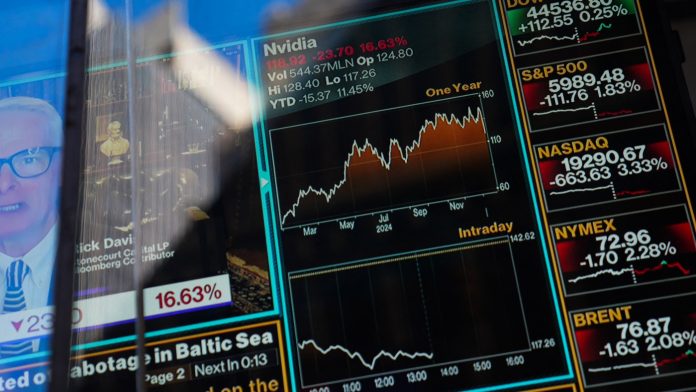
Television graphics are seen in the window of Nasdaq headquarters in Times Square, as Nasdaq fell nearly 4 percent this morning on January 27, 2025 in New York City.

BRYAN R. SMITH/AFP via Getty Images/AFP


hide caption

toggle caption

BRYAN R. SMITH/AFP via Getty Images/AFP

President Trump and House Minority Leader Hakeem Jeffries, D-N.Y., don’t agree on much. But their public support of legislation to ban members of Congress from trading individual stocks could revive prospects for a bipartisan effort that’s stalled on Capitol Hill for years.

Earlier in April around President Trump’s tariff announcement, a flurry of lawmakers’ stock trades raised questions about whether they got any advance notice.

Georgia GOP Rep. Marjorie Taylor Greene is one of the members whose trades have attracted scrutiny. According to House disclosure filings, Greene purchased between tens and hundreds of thousands of dollars in stock around the tariff announcements. She also disclosed more trades around the news that Trump was pausing many of the tariffs for 90 days. Some of the specific stocks she purchased increased in value significantly.

Greene’s office did not respond to a request for comment but she recently told the Atlanta Journal Constitution that her financial adviser handles her trades. More disclosures about lawmakers’ investment moves around the tariff are expected later this month.

Trades like those are not surprising to lawmakers advocating for the ban.

“I think that this happens all the time. I do. I do think that it makes the point,” Missouri Republican Sen. Josh Hawley told NPR. He introduced legislation to bar lawmakers from investing in individual stocks. He backed a bipartisan bill last year that made it through committee but never got a floor vote.

“The truth is, both parties, members of both parties enjoy trading stock and enjoy the profits they get off of it,” he said. “And my view is, listen, this is this is something that we ought to set aside for the good of the American people. It is a distraction at best. It is a source of potential corruption at worst.”

President Trump reinvigorated efforts to change the law last week when he told TIME magazine that he would sign a bill that ends the ability of members of Congress to buy or sell individual stocks — “absolutely.”

Hawley sees that development as “hugely helpful” and “big deal.”

“It takes away a talking point of some people say, ‘oh, it doesn’t matter if we pass it, this will never get signed.’ He said he would sign it,” Hawley said in the interview.

Bipartisan support grows

Hawley also noted that a lot of members campaigned on the issue in 2024 — and he’s going to those who talked about it to urge them to sponsor his bill. Sen. Jeff Merkley, D-Ore., led the effort in the last Congress, and Hawley says he’s talking to him and other senators from both parties about pressing for a vote on the floor.

Rhode Island Democrat Rep. Seth Magaziner, the lead sponsor on a bipartisan House proposal, points out that Jeffries —— the top House Democrat — became the first leader of either party to endorse a ban recently.

“I think we’ve gained more momentum in the last two weeks than had been achieved in the last two years.” Jeffries predecessor, former Speaker Nancy Pelosi, initially opposed proposals to change rules around congressional trading. She eventually backed the reforms, but never put a bill on the House floor. Jeffries says he hasn’t talked to other leaders about moving a bill but argues this is something he’s “long supported.”

Magaziner told NPR “we clearly have a surge of momentum and now we need to capitalize on it.”

He says he and Democrats like New York Democratic Rep. Alexandria Ocasio-Cortez are working across the aisle with Republican Reps. Chip Roy of Texas and Brian Fitzpatrick of Pennsylvania to build support and finalize details that meld different bill versions into one that could advance with significant support.

“This is going to happen at some point, like the public supports it in polling by a 90 to 10 margin. It’s one of the highest polling issues I have ever seen.” Magaziner says chatter has picked up on the House floor and it’s consistently an issue constituents raise back home at town halls.

He acknowledged the issue has been building support behind the scenes over time. But now he believes a combination of factors build political pressure for action.

Attention to trades around tariffs and Trump comments key factors as speaker says he’s “open” to a vote

Magaziner called news around Trump’s tariffs a “catalyst,” saying, “whether anybody with inside information traded off of those announcements or not, they were just a very stark example of what could be possible when it comes to insider trading in Washington.”

And he said for his GOP colleagues, “it’s all about President Trump, right? President Trump is the leader of the Republican Party. They pay a lot of attention to what he says. And the president was very clear that this is something he supports.”

He argues the ball is in the speaker’s court.

For his part, Johnson told NPR that he is not opposed to the idea and if there’s a consensus, he’ll act on it.

“It’s been talked about for quite some time. But there’s probably a reason that the bill hasn’t moved in all those years because there’s never been a consensus built around it,” he said. “But, I mean, I’m open to the conversation.”

Johnson also noted he personally does trade stocks.

Rep. Roy told NPR he’s given the speaker some time to get through the process of passing the big bill with the bulk of Trump’s tax, border and energy agenda. But on the congressional trading bill he said “we’re well past time to do it” and insisted, “We’re going to have a vote on the floor of the United States House this year.”

Hawley named his bill the “PELOSI act” — Preventing Elected Leaders from Owning Securities and Investments Act — a dig at the former speaker, who doesn’t trade personally but under the law reports regular investments from her husband, Paul, whose portfolio is among the top performing of lawmakers and their spouses.

But Hawley notes that Republican senators were investigated about their trades during the COVID-19 pandemic because of information they learned in briefings.

Those members were ultimately cleared, but Hawley says “members of Congress really do have advantages in the way that they are presented with information.” He said he doesn’t believe it necessarily means they are engaging in insider trading but says the information is “sort of served up to you on a silver platter and all of that is true, which is why we ought to ban it.”

Proposals cover lawmakers and spouses

Both the House and Senate bills would ban lawmakers, their spouses from trading individual stocks. Hawley says there’s resistance from members of both parties.

Magaziner said he believes some just don’t want to give up the ability to make money. But he adds, “there are plenty of other members who are not active stock traders but have honest questions about, well, hey, if this passes, will I still be able to save for retirement? Will I still be able to save for my kid’s college tuition? And the answer is yes.”

The proposals set out a transition period for current lawmakers to shift to either blind trusts or mutual funds. And they lay out a similar period for newly elected members to divest.

Some argue current rules that require lawmakers to disclose any trades of stocks over $1,000 within 30 days are a sufficient guardrail.

Senate Majority Leader John Thune, R-S.D., pointed to those rules when asked by NPR about his position.

“We’ll see how this how this conversation evolves. I mean, we get some members up here on both sides out both sides of the Capitol as you know, who would like more strict limitations on that. But there are some pretty good, I would say, protections in place already.”

Proponents admit their chances of moving forward mean they have to address concerns around how the rules impact people who have investments who want to run for Congress but worry about being forced to divest and take a financial loss or tax penalty.

And they say they need to iron out details about how lawmakers would divest in a new system and educate their colleagues about how it will all work.

Hawley dismissed the argument that changing ethics rules about investing would impact the kinds of people willing to run for elected office. “I would say that serving is a privilege. And if you are not willing to serve in Congress because you can’t day trade anymore, maybe this isn’t the right job for you.”

Trump orders end to federal funding for NPR and PBS : NPR

0

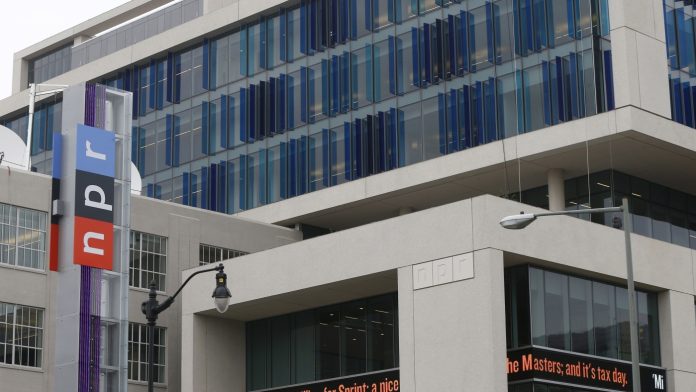
The headquarters for National Public Radio (NPR) is seen in Washington, D.C.

Charles Dharapak/AP


hide caption

toggle caption

Charles Dharapak/AP

President Trump signed an executive order Thursday directing the Corporation for Public Broadcasting’s board of directors to “cease federal funding for NPR and PBS,” the nation’s primary public broadcasters. Trump contends that news coverage by NPR and PBS contains a left-wing bias. The federal funding for NPR and PBS is appropriated by Congress.

The executive order, like many that have been signed by the president, could be challenged in court.

“Which viewpoints NPR and PBS promote does not matter,” the executive order says. “What does matter is that neither entity presents a fair, accurate or unbiased portrayal of current events to tax-paying citizens.”

On social media platforms, Trump recently blasted the two primary public broadcasting networks, posting in all caps: “REPUBLICANS MUST DEFUND AND TOTALLY DISASSOCIATE THEMSELVES FROM NPR & PBS, THE RADICAL LEFT ‘MONSTERS’ THAT SO BADLY HURT OUR COUNTRY!”

In the executive order, Trump instructs the CPB and executive branch departments and agencies to cease direct and indirect funding of NPR and PBS.

“The CPB Board shall cancel existing direct funding to the maximum extent allowed by law and shall decline to provide future funding,” the order says.

NPR’s President and CEO Katherine Maher defended coverage and addressed the need for funding in a recent interview on All Things Considered.

“I think that it’s important for public media to be able to continue to be relevant in a time where there is a lot of coverage of different issues and areas of interest,” she said.

NPR did not immediately respond to requests for comment on the executive order.

The leaders of NPR and PBS testified at a House oversight committee hearing in late March on allegations of ideological bias in public broadcasting.

Maher was assailed for her past political postings on social media and the network’s news judgment almost entirely based on tweets and stories that preceded her March 2024 arrival at the network by years.

PBS’s Paula Kerger found herself queried about a video involving a performer in drag singing a variation on a children’s song for a young audience. (Kerger testified that the video was posted on the website of PBS’s New York City member station and never aired on television.)

Federal funding for public media flows through the congressionally chartered Corporation for Public Broadcasting. Congress allocated $535 million for the CPB for the current fiscal year – an amount affirmed in a recent stop-gap bill passed by the Republican-controlled U.S. House and Senate.

The CPB’s budget is approved by Congress on a two-year cycle in large part to insulate it from political pressures; according to the Corporation for Public Broadcasting, Congress has fully funded it through Sept 30, 2027.

At the hearing in late March, heads of both networks spoke of the mission to provide nonpartisan news and programming to the American public, without charge.

NPR receives about 1% of its funding directly from the federal government, and a slightly greater amount indirectly; its 246 member institutions, operating more than 1,300 stations, receive on average 8% to 10% of their funds from CPB.

By contrast, PBS and its stations receive about 15% of their revenues from CPB’s federal funds.

Most of the funds for public media go to local stations; and most to subsidize television, which is more expensive than radio.

The networks say they have been encouraged repeatedly by the agency and Congress to develop private financial support and have worked assiduously for years with the FCC to ensure that its content falls within FCC guidelines.

PBS offers a heavy amount of educational fare; NPR relies more on news and music. Both provide locally grounded content and reach more than 99% of the population, at no cost. And in many states and communities, the stations serve as a key component of emergency and disaster response systems.

President Trump opened up a new front in his assault on public media on Monday, asserting that he was removing three of the five board members of the Corporation for Public Broadcasting. The corporation sued Trump on Tuesday morning in response, pointing to federal law and a U.S. Supreme Court ruling to contend that he does not have the power to take these actions.

Last month, the White House said it was going to send a request to Congress for a rescission of funding for NPR and PBS.

Additionally, the Federal Communications Commission has launched an investigation of NPR and PBS, saying it appears that their corporate underwriting spots violate laws banning commercial advertisements.

Disclosure: This story was reported and written by NPR Media Correspondent David Folkenflik and edited by Deputy Business Editor Emily Kopp, Managing Editor Gerry Holmes and Managing Editor Vickie Walton-James. Under NPR’s protocol for reporting on itself, no corporate official or news executive reviewed this story before it was posted publicly.

Trump shakes up team, sends national security adviser Mike Waltz to the UN : NPR

0

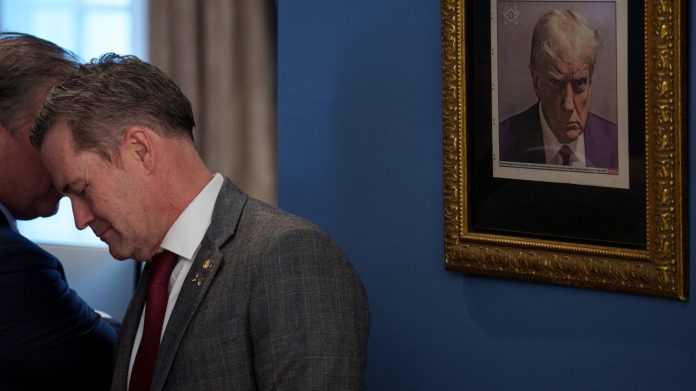
In this file photo from Feb. 14, 2025, Mike Waltz speaks with an official just outside the Oval Office where a copy of President Trump’s mugshot on the front page of the New York Post is posted.

Andrew Harnik/Getty Images


hide caption

toggle caption

Andrew Harnik/Getty Images

President Trump said on Thursday he is nominating his national security adviser Mike Waltz as his ambassador to the United Nations in the first big shake up of top aides since Trump started his second term.

Trump said on social media that he would make Marco Rubio his interim national security adviser — a role that will come on top of his existing job, Secretary of State.

It’s very unusual for one person to hold both major roles. Waltz’ new job will depend on confirmation by the U.S. Senate, where Republicans narrowly control the majority — but where some have expressed concerns after inadvertently invited a journalist into a private text chat discussing military plans for U.S. strikes on the Houthis in Yemen.

The UN spot has been vacant since Trump asked his first nominee, Rep. Elise Stefanik, R-N.Y., to instead stay in Congress to help preserve the narrow majority Republicans hold in the House of Representatives.

“I’m deeply honored to continue my service to President Trump and our great nation,” Waltz said on social media.

National security adviser Mike Waltz stands behind Vice President Vance, Secretary of State Marco Rubio and Secretary of Defense Pete Hegseth in the Oval Office on April 7, 2025.

National security adviser Mike Waltz stands behind Vice President Vance, Secretary of State Marco Rubio and Secretary of Defense Pete Hegseth in the Oval Office on April 7, 2025.

Saul Loeb/AFP


hide caption

toggle caption

Saul Loeb/AFP

Vance says it has nothing to do with the group chat

Trump had initially defended Waltz — who took responsibility for the mishap — and downplayed the incident as a “glitch.” He was complimentary of Waltz in his announcement on Thursday, and last week told The Atlantic in an interview that “Waltz is fine” when asked about his future.

“I think we learned, ‘Maybe don’t use Signal, okay?’ If you want to know the truth. I would frankly tell these people not to use Signal, although it’s been used by a lot of people,” Trump said.

Trump has not talked to reporters yet about his decision. But Vice President Vance said in an interview that the change in roles had nothing to do with the group chat incident.

“I know the president really likes Mike Waltz. He just thought that the UN ambassador position would be a better place for Mike Waltz to be,” Vance told Fox News’ Bret Baier.

“The media wants to frame this as a firing. Donald Trump has fired a lot of people. He doesn’t give them Senate-confirmed appointments afterwards,” Vance said.

National security adviser Mike Waltz and his wife, former homeland security adviser Julia Nesheiwat, take a selfie as they tour the Pituffik Space Base on March 28, 2025 in Greenland during a visit with Vice President Vance.

National security adviser Mike Waltz and his wife, former homeland security adviser Julia Nesheiwat, take a selfie as they tour the Pituffik Space Base on March 28, 2025 in Greenland during a visit with Vice President Vance.

Pool/Getty Images Europe


hide caption

toggle caption

Pool/Getty Images Europe

Trump has leaned on other officials for national security issues

During his first 100 days in office, Trump has leaned more heavily on other top aides for national security issues like the conflicts in Ukraine and Gaza, and talks with Iran, including Middle East envoy Steve Witkoff, Treasury Secretary Scott Bessent as well as Secretary of State Marco Rubio.

Waltz was the first Green Beret elected to Congress where he served three terms representing east central Florida in the House of Representatives.

Waltz, who was known as a national security hawk, had an uphill road to climb within Trump’s circle. He had long been an advocate of sanctions against Russia and never seemed to fully align with Trump’s approach to Moscow and other adversaries.

Vance denied that the change in position was a sign of philosophical divisions within Trump’s team. “I’ve already seen some folks saying that this is a war between the hawks and the anti-hawks, new conservatives vs. MAGA or the realists — that’s not what this is about at all,” Vance said.

Before taking the White House job, Waltz served as chairman of the House Armed Services subcommittee on readiness and was a member of the House Foreign Affairs Committee and the Permanent Select Committee on Intelligence.

It’s unusual for the Secretary of State to do this job at the same time

Trump’s announcement came after hours of rumors that Waltz was leaving his position — and while Rubio’s spokeswoman Tammy Bruce was briefing reporters at the State Department. “We have to admit, these last 100 days — it’s like hanging on to a freaking bullet train,” Bruce told reporters.

The last person to simultaneously be Secretary of State and national security adviser was Henry Kissinger, during the Nixon era. He did both jobs for two years.

“Some Americans in Washington and elsewhere thought the double assignment gave Kissinger too much power and persuaded President Ford to strip him of his White House title in late 1975,” presidential historian Michael Beschloss said.

In Rubio’s case, Trump has indicated this will be a temporary assignment until he picks a new national security adviser.

Trump has been known to give people he trusts multiple positions at the same time. In his first term, his budget director Mick Mulvaney was also in charge of the Consumer Financial Protection Bureau, noted Katie Dunn Tenpas, an expert on presidential personnel at the Brookings Institution.

“it’s highly unconventional, but it’s not unusual for the Trump administration. And I watched it during the first term — and I watched it with a great deal of awe because I had not seen it in prior administrations,” Tenpas said.

NPR diplomatic correspondent Michele Kelemen contributed to this report.

Waltz is out at the White House. What's next for Trump's national security adviser?

0

In the first big shake-up of his inner circle, President Trump said he’s nominating his national security adviser Mike Waltz as his UN ambassador.

HHS report critiques health care for transgender children and hides authors’ names : Shots

0

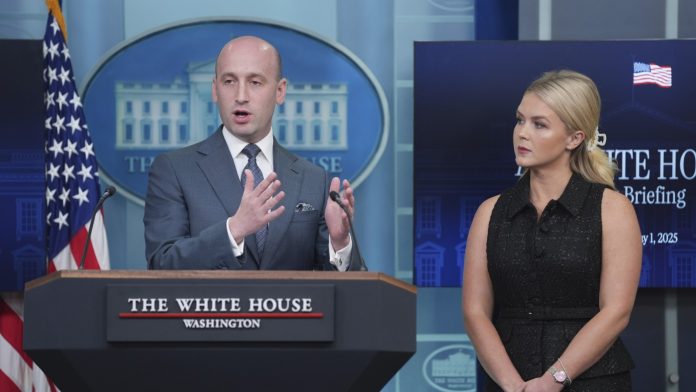
White House Deputy Chief of Staff Stephen Miller called gender-affirming care for children “barbaric” at a press conference on Thursday. Press secretary Karoline Leavitt looks on.

Evan Vucci/AP


hide caption

toggle caption

Evan Vucci/AP

On Thursday, the Department of Health and Human Services published a 400-page document entitled “Treatment for Pediatric Gender Dysphoria: Review of Evidence and Best Practices.”

The review’s authors are not being named by HHS. According to a press release, the names “are not initially being made public in order to help maintain the integrity” of a post-publication peer review process. HHS did not immediately respond to NPR’s questions about the number of authors, their professional backgrounds, and their affiliations.

The current approach for transgender youth, endorsed by all major medical associations in the U.S., is to affirm a young person’s gender identity and give their family the option of medical interventions like puberty blockers and hormone therapy.

The report describes that approach as fundamentally misguided. Its authors conclude that doctors and clinics that provide gender-affirming care have “fallen short of their duty to prioritize the health interests of young patients.”

White House Deputy Chief of Staff Stephen Miller used the term “barbaric” when describing gender-affirming medical interventions at the White House on Thursday. “They violate all sound medical ethics. They are completely unwarranted. They harm children for life irreversibly. It is child torture. It is child abuse. It is medical malpractice,” he said during a press conference on Thursday.

In a statement, Dr. Susan Kressly, president of the American Academy of Pediatrics, wrote that the organization is “deeply alarmed” by the new HHS document. “This report misrepresents the current medical consensus and fails to reflect the realities of pediatric care,” she wrote. She asserted that the report was not credible because it relied “on select perspectives and a narrow set of data.”

She added that AAP was not consulted on the report, but that its recommendations were “inaccurately” characterized throughout. (The official AAP recommendation says, in part, that transgender youth should “have access to comprehensive, gender-affirming, and developmentally appropriate health care that is provided in a safe and inclusive clinical space.”)

The report’s conclusion that gender-affirming care for youth should be curtailed is not surprising given that the report was commissioned in an executive order entitled “Protecting Children From Chemical and Surgical Mutilation.” It reads: “Across the country today, medical professionals are maiming and sterilizing a growing number of impressionable children under the radical and false claim that adults can change a child’s sex through a series of irreversible medical interventions.” This trend, it continues, “must end.”

On the campaign trail, President Trump and the Republican party spent more than $200 million on anti-trans television ads. Since taking office, Trump has moved swiftly to target schools and hospitals that affirm transgender youth, to limit the participation of trans people in sports and the military, to require that passports reflect a person’s sex at birth and to cancel millions in funding for LGBTQ+ health research. Some of these efforts have been blocked in the courts.

The HHS report describes transition-related medical care for young people as being too readily available, but more than half of U.S. states have banned it. The Supreme Court is set to rule this spring on a challenge to Tennessee’s ban on gender-affirming care for youth.

In tone and form, the HHS report mirrors the Cass Review, published in the U.K. last year and commissioned by the National Health Service. (The name “Cass” is cited 149 times in the HHS report.) Like the new HHS report, the review submitted by Dr. Hilary Cass, looks at available evidence and concludes the benefits of gender-affirming care are overstated. But Cass was also the public face of the review process, and she spent four years conducting interviews with transgender young people, parents and clinicians to prepare the report. HHS did not respond to NPR’s questions about how long its lengthy report had been in the works.

“The purpose of this piece of propaganda is to give the veneer of science,” says a physician who provides gender-affirming care in a state where it remains legal. NPR agreed not to name the doctor because they did not have permission from their employer to speak with the media, and because they fear for their safety.

The doctor added that the anonymous authors of the report and the politicians who commissioned it “have already said what they think — they don’t think being trans is real, they don’t think that trans people should be allowed to do what they want with their bodies, they think that gender is this immutable concept, and they have absolutely no curiosity about whether that might not be true for everybody.”

On social media, Kristen Waggoner, president of the Christian legal group Alliance Defending Freedom, praised the report and said that it “should lead to the closure of every gender clinic in America. Doctors who perpetrate these experiments on children should lose their medical licenses and be sued for damages.”

What to watch for when the White House releases Trump's first budget proposal

0

President Trump’s team is expected to soon preview his first budget proposal. We explain what parts matter.

State of the World from NPR : NPR

0

Donald Trump has passed one hundred days in his second term as president of the United States. We look at how he is reshaping the US relationship with the rest of the world.

US President Donald Trump arrives to deliver a speech marking his 100th day in office at Macomb County Community College Sports Expo Center in Warren, Michigan, on April 29, 2025.

JIM WATSON/AFP via Getty Images


hide caption

toggle caption

JIM WATSON/AFP via Getty Images


US President Donald Trump arrives to deliver a speech marking his 100th day in office at Macomb County Community College Sports Expo Center in Warren, Michigan, on April 29, 2025.

JIM WATSON/AFP via Getty Images

Trump sends national security adviser Mike Waltz to the UN : NPR

0

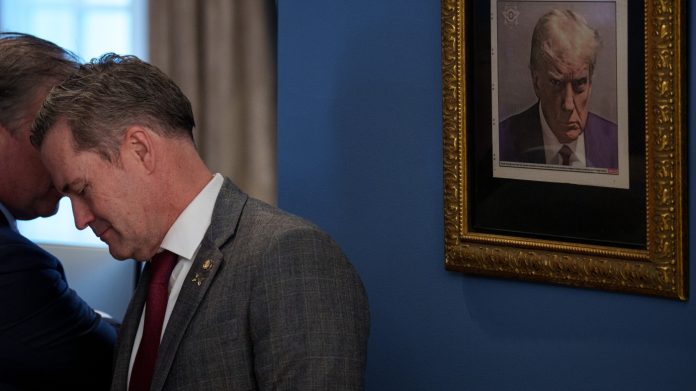
In this file photo from Feb. 14, 2025, Mike Waltz speaks with an official just outside the Oval Office where a copy of President Trump’s mugshot on the front page of the New York Post is posted.

Andrew Harnik/Getty Images


hide caption

toggle caption

Andrew Harnik/Getty Images

President Trump said on Thursday he is nominating his national security adviser Mike Waltz as his ambassador to the United Nations in the first big shake up of top aides since Trump started his second term.

Trump said on social media that he would make Marco Rubio his interim national security adviser — a role that will come on top of his existing job, Secretary of State.

Waltz will need to be confirmed by the U.S. Senate for the UN position. “I’m deeply honored to continue my service to President Trump and our great nation,” he said on social media.

The UN spot has been vacant since Trump asked his first nominee, Rep. Elise Stefanik, R-N.Y., to instead stay in Congress to help preserve the narrow majority Republicans hold in the House of Representatives.

Waltz has come under pressure since March when he inadvertently invited a journalist into a private text chat among top officials discussing military plans for U.S. strikes on the Houthis in Yemen.

Trump had initially defended Waltz — who took responsibility for the mishap — and downplayed the incident as a “glitch.” He was complimentary of Waltz in his announcement on Thursday, saying he had “worked hard to put our nation’s interests first.”

Trump told The Atlantic in an interview last week that “Waltz is fine” when asked about his future. “I think we learned, ‘Maybe don’t use Signal, okay?’ If you want to know the truth. I would frankly tell these people not to use Signal, although it’s been used by a lot of people.”

But Trump has leaned more heavily on other top aides for national security issues like the conflicts in Ukraine and Gaza, and talks with Iran, including Middle East envoy Steve Witkoff, Treasury Secretary Scott Bessent as well as Secretary of State Marco Rubio.

The announcement came after hours of rumors that Waltz was leaving his position — and while Rubio’s spokeswoman Tammy Bruce was briefing reporters at the State Department. “We have to admit, these last 100 days — it’s like hanging on to a freaking bullet train,” Bruce told reporters.

Waltz was the first Green Beret elected to Congress where he served three terms representing east central Florida in the House of Representatives.

Waltz, who was known as a national security hawk, had an uphill road to climb within Trump’s circle. He had long been an advocate of sanctions against Russia and never seemed to fully align with Trump’s approach to Moscow and other adversaries.

Before taking the White House job, Waltz served as chairman of the House Armed Services subcommittee on readiness and was a member of the House Foreign Affairs Committee and the Permanent Select Committee on Intelligence.

NPR diplomatic correspondent Michele Kelemen contributed to this report.

The House strikes a blow against California in a fight over EVs : NPR

0

Vehicles drive along the 101 Freeway in Los Angeles, Calif., during a heat wave in October 2024. California has ambitious rules requiring automakers to phase out gas-powered vehicles (except for plug-in hybrids), to combat air pollution and climate change. The Trump administration has vowed to overturn California’s stringent standards.

Apu Gomes/Getty Images


hide caption

toggle caption

Apu Gomes/Getty Images

The U.S. House of Representatives has voted to undo three federal waivers that let California set strict vehicle pollution standards. On Wednesday, the House voted against two waivers involving heavy trucking, and on Thursday, it voted to reverse a state rule that would require all new vehicles in the state to be zero-emission by 2035.

Two nonpartisan government entities have advised Congress that it can’t actually reverse those waivers through the mechanism it’s using. The Senate now needs to decide whether to follow that guidance — or follow the House.

California’s standards have been described by supporters as ambitious, and by critics as unrealistic. Beginning with model year 2026, the state requires 35% of new cars sold by any given automaker to be zero-emission. Currently, about 25% of new cars sold in California are electric; the national average is closer to 10%.

These rules are not something automakers can brush off or overlook. California is a huge state and a major auto market. Other states can’t set their own standards, but they can opt to follow California’s, and about a dozen have adopted its zero-emission rule. The result is that more than 30% of the U.S. auto market is governed by California’s policies.

“California’s waiver has a massive impact,” Stephanie Brinley, the associate director of AutoIntelligence at S&P Global Mobility, wrote in a report in January 2025.

The Alliance for Automotive Innovation, a trade group representing automakers, had pushed hard for Congress to step in and overrule California because they argue that consumer demand for EVs is not strong enough to support California’s targets. John Bozzella, the trade group’s president, has warned that meeting the requirements would “take a miracle” and said in a statement Wednesday that “thousands of American auto jobs and millions of units of U.S. auto production are at stake.”

Environmental groups such as the Union of Concerned Scientists argue that flexibilities built into the rules make them more achievable than they seem. And they say stricter regulations are important for protecting public health and the climate.

“This vote is an unprecedented and reckless attack on states’ legal authority to address the vehicle pollution causing asthma, lung disease and heart conditions,” Kathy Harris, Director of Clean Vehicles at the Natural Resources Defense Council, wrote in a statement.

Here’s how we got here, and what’s next.

What is a “California waiver”? 

Picture Los Angeles in the 1940s and ’50s. Beautiful beaches, palm trees and picturesque homes — that were impossible to see behind a thick haze. That choking smog was fueled by air pollution from cars and industry, which became trapped mid-air by mountains and wind patterns.

Facing this unusually severe problem, the state began regulating air pollution well before the federal government did. As a result, California has a unique privilege: It, alone among U.S. states, can impose its own emissions standards that are stricter than the nation’s.

Each time California wants to add a new, stricter rule, it has to obtain a waiver from the EPA. It’s done that more than 75 times.

Today, the House voted to rescind the waiver that let California issue its zero-emission rule for passenger cars, along with two more that allow California to set rules for heavy trucks. One rule would require more heavy trucks to be electric, while the other would require new diesel vehicles to become cleaner.

Those three California rules aren’t just about reducing smog. Cars and trucks are a major source of the carbon dioxide emissions that are warming the planet. Increasingly, California has become a global leader in reducing the carbon emissions that fuel climate change, and zero-emission vehicles are a key part of those climate policies.

California’s climate-minded vehicle regulations, far more aggressive than the federal standards and explicitly designed to fight climate change, have long outraged President Trump and his allies. Trump has dismissed climate concerns and prioritized the domestic fossil fuel industry, and opposes regulations that he describes as limiting consumer choice.

The Trump administration is working to eliminate a number of the Biden administration’s pro-EV policies, from freezing EV charger funding to reconsidering federal vehicle standards.

But even if the administration eases federal standards, California’s tougher rules still push the auto industry to move aggressively toward EVs. That’s why reversing these waivers is a key part of the Trump administration’s broader deregulation plan.

Wait, didn’t this happen before? 

Yes. During the first Trump presidency, the federal government revoked a waiver that allowed California to set its own vehicle standards. That had never been done before, and triggered years of litigation.

It also split the auto industry. Some companies that had already made costly investments based on existing rules, and that were looking for some consistency among flip-flopping policies, sided with California. They agreed to follow the state’s rules regardless of whether they were legally required to. Others sided with the Trump administration. The whole situation was messy, chaotic and, ultimately, temporary.

When Biden took office, the waiver was reinstated. Over the next few years California made its rules even stricter, requiring a new waiver to be granted — the one on passenger vehicles that the House just voted to nix.

What’s different this time? 

The new Trump administration is now trying a different tactic to eliminate these waivers.

The EPA grants them. In the first Trump term, it was also the EPA that revoked the passenger vehicle waiver. As soon as Biden was in office, the EPA just issued the waiver again. That flip-flopping could, hypothetically, continue with each new administration, unless something changes.

This time, Congress is attempting to use the Congressional Review Act to reverse the EPA’s decision to grant these waivers in the first place. It’s a little bit like pressing an “undo” button, wiping the waivers out of existence.

It’s only an option within a narrow window of time — and it only works if the president’s party controls Congress. (Trump used this tool heavily in his first administration.) Significantly, rules that are reversed under the CRA may not be reissued in “substantially the same form” unless Congress passes a new law authorizing that specific rule.

The Congressional Review Act also states that actions taken under it are not subject to judicial review, meaning that courts can’t overturn Congress’ decision. But if the California waiver is in fact revoked under the CRA, expect legal challenges anyway.

“It’s guaranteed,” says Christopher “Smitty” Smith, an environmental lawyer in California. “And that’s something I’m willing to state: It’s guaranteed to result in litigation.”

What’s next? 

Now, the Senate has a decision to make.

The Government Accountability Office, a federal agency, believes the waiver is not actually eligible for this kind of reversal. So does the Senate parliamentarian, a sort of referee over what Congress can and can’t do according to its own rules. Three Democratic senators say the parliamentarian “reaffirmed” in early April that the waiver is not subject to the Congressional Review Act.

The parliamentarian is not elected, and while her rulings hold significant weight in the Senate, they are not binding.

But overruling the parliamentarian violates long-held Senate norms — the same norms that keep the filibuster in place.

Reports indicate that some Republican senators have been weighing whether eliminating the California rules justifies breaking that norm.

Lobbying on this issue has been intense, with traditional automakers and the oil industry pushing hard for Congress to eliminate the rules, and public health groups like the American Lung Association joining environmental and EV groups to defend California’s policies.