Friday, November 13, 2026
Home Blog Page 210

As Deadline for Withdrawal Lapses, Israel Says It Will Stay in Southern Lebanon

0

Israeli forces pulled out of the remaining towns and villages they still occupied in southern Lebanon on Tuesday, according to the United Nations, but held onto strategic positions along the border as a deadline elapsed for their full withdrawal.

The ongoing Israeli presence on Lebanese territory risked undermining a fragile truce with Hezbollah and raised fears of a prolonged Israeli occupation.

A cease-fire in November ended the deadliest war between the two sides in decades. Both the Israeli military and Hezbollah, the Iran-backed Lebanese armed group, were then supposed to cede control of southern Lebanon to the Lebanese military by the end of January — a deadline that was then extended until Tuesday.

But Israel announced on Monday that its forces would remain temporarily in five “strategic” vantage points just across the border in Lebanese territory until the Lebanese military fully implemented its end of the agreement, according to an Israeli military spokesman, Lt. Col. Nadav Shoshani. He declined to say how long the Israeli troops would stay there.

For months, thousands of displaced Lebanese have been unable to return to areas occupied by Israel amid repeated warnings by the Israeli military to stay away.

The United Nations, which has long maintained a peacekeeping force in south Lebanon, said on Tuesday that Israel had pulled out of population centers in the south. But the organization said the continued Israeli presence in the country violated a U.N. resolution which ended the 2006 Israel-Hezbollah war and formed the basis of the recent cease-fire between the two sides.

The delay was “not what we hoped would happen,” the U.N. Lebanon envoy and the U.N. peacekeeping force in south Lebanon said in a joint statement.

Displaced residents flocked south on Tuesday despite the continued Israeli presence, some arriving home to find their towns and villages almost unrecognizable. At least two people were injured by Israeli gunfire, according to Lebanon’s state-run news agency.

“Our memories are destroyed, and our homes,” said Yara Awada, 24, who entered the southern border town of Houla on Tuesday for the first time in more than a year.

Most of Ms. Awada’s neighborhood is now in ruins, with her family home toppled to the ground. Her grandfather had built the house with his bare hands more than 100 years ago, she said.

“This house meant a lot to my family. Ten children grew up in this house with their cousins and relatives. Then suddenly, within seconds, everything was gone,” Ms. Awada said. “It hurts our heart to see our village like this. But we still have hope and we are going to rebuild our village better than it was.”

Under the terms of the truce that halted the latest war, Hezbollah must also pull out from southern Lebanon and the Lebanese military is supposed to deploy there in force. Israeli officials have repeatedly accused both Hezbollah and the Lebanese army of not upholding their end of the bargain.

Although a U.S.-led monitoring committee overseeing the implementation of the truce has praised the Lebanese military’s deployment, it has not released public data on the extent to which Hezbollah has withdrawn its weapons and fighters from the region.

Last month, Israeli forces killed more than two dozen people as they attempted to enter southern border towns, according to Lebanese officials. The Israeli military said it had fired “warning shots in order to eliminate threats.”

Hezbollah’s new leader, Naim Qassem, vehemently opposed Israel’s intention to remain in parts of southern Lebanon. But in a speech on Sunday, he stopped short of threatening to resume attacks.

“Israel must withdraw completely on Feb. 18,” Mr. Qassem said. “This is the agreement,” he added. “Everyone knows how an occupation is dealt with.”

Despite their objections, Hezbollah and the Lebanese government have no real ability to compel Israel to withdraw. Lebanon’s leaders have sought to rally their Arab neighbors and appeal to the United States in bids to pressure Israel.

But experts say that Hezbollah, battered by 14 months of conflict with Israel, is unlikely to risk resurrecting the conflict in the near term.

However, if Israel does remain indefinitely inside Lebanon, this could strengthen Hezbollah, regional experts said.

“If Israel stays in those five points, that is absolutely a gift to Hezbollah,” Paul Salem, the vice president for international engagement at the Middle East Institute in Washington, said. “It enables them to say the occupation cannot be ended by diplomacy, and hence that Lebanon continues to need armed resistance.”

Lebanon’s new president, Joseph Aoun, has pledged to bring all arms under the state’s control, a challenge to Hezbollah, which has long wielded inordinate influence over the country. But it is unclear how or whether Mr. Aoun can accomplish this.

The Lebanese military warned civilians on Tuesday not to approach southern towns until the military had deployed there.

The Lebanese military has accused Israel of adopting a scorched-earth policy in recent weeks, including demolishing and setting fire to homes as it has pulled out of towns and villages. The Israeli military did not immediately respond to a request for comment on that claim.

Dayana Iwaza, Patrick Kingsley and Johnatan Reiss contributed reporting.

Up First from NPR : NPR

0

American and Russian officials meet in Saudi Arabia for talks on negotiating an end to the war in Ukraine. The Trump administration has started making broad cuts to federal health agencies. Days after the Justice Department moved to drop corruption charges against New York City Mayor Eric Adams, four of his top aides and deputy mayors announced their resignations.
Want more comprehensive analysis of the most important news of the day, plus a little fun? Subscribe to the Up First newsletter.

Today’s episode of Up First was edited by Ryland Barton, Jane Greenhalgh, Denice Rios, Reena Advani and Janaya Williams. It was produced by Ziad Buchh, Nia Dumas and Christopher Thomas. We get engineering support from Arthur Laurent and our technical director is Carleigh Strange. Our Executive Producer is Kelley Dickens.

Europe, Dazed by Trump, Confronts Hard Choices in Ukraine

0

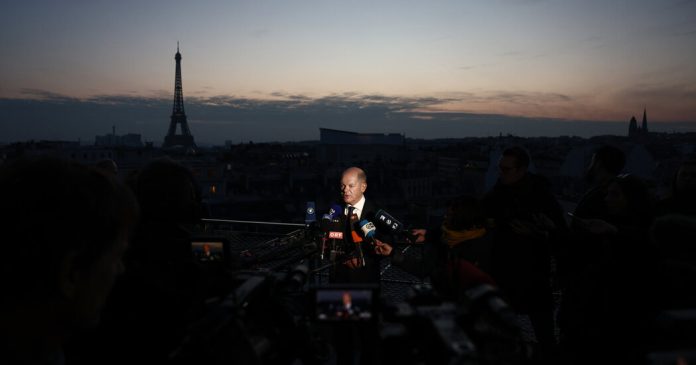
For years, European leaders have fretted about reducing their dependence on a wayward United States. On Monday, at a hastily arranged meeting in Paris, the hand-wringing gave way to harried acceptance of a new world in which Europe’s most powerful ally has begun acting more like an adversary.

President Trump’s plan to negotiate a peace settlement in Ukraine with President Vladimir V. Putin of Russia, with neither the Ukrainians nor Europeans invited to take part, has forced dazed leaders in capitals like Berlin, London and Paris to confront a series of hard choices, painful trade-offs and costly new burdens.

Already on the table is the possibility that Britain, France, Germany, and other countries will deploy tens of thousands of troops to Ukraine as peacekeepers. European governments are affirming the need for major increases in their military budgets — if not to the 5 percent of gross domestic product demanded by Mr. Trump, then to levels not seen since the Cold War days of the early 1980s.

“Everybody’s hyped up at the moment, understandably,” said Lawrence Freedman, emeritus professor of war studies at King’s College London. “What is clear is that whatever happens, Europe will have to step up.”

That could put its leaders in a difficult spot. While public support for Ukraine remains strong across Europe, committing troops to potentially dangerous duty on Ukrainian soil could quickly become a domestic political liability. Estimates on the size of a peacekeeping force vary widely, but under any scenario, it would be an extremely expensive undertaking at a time of straitened budgets.

President Emmanuel Macron of France, who first floated the idea of a peacekeeping force last year — to widespread skepticism in Europe — has been weakened since his decision to call parliamentary elections last summer backfired and left him with a fragile government.

Germany may not have a new coalition government for weeks after its election on Feb. 23. On Monday, its chancellor, Olaf Scholz, dismissed talk of peacekeepers as “completely premature” and “highly inappropriate” while fighting was still raging.

Prime Minister Keir Starmer of Britain, who does not have to face voters for four years, said that Britain was open to “putting our troops on the ground if necessary.” But former military officials said that after years of budget cuts, the British military was not equipped to lead a large-scale, long-term mission in Ukraine.

“Frankly, we haven’t got the numbers, and we haven’t got the equipment,” Richard Dannatt, a former head of the British Army, told the BBC. He estimated that Britain would have to supply up to 40,000 troops to a 100,000-strong force.

For some Europeans, it is too soon to talk about a post-American era on the continent. Mr. Scholz and Poland’s prime minister, Donald Tusk, warned leaders not to sunder the trans-Atlantic alliance, whatever the current tensions.

As a practical matter, a peacekeeping force would be difficult without logistical support from the United States. American security assurances, analysts said, were crucial to making it politically acceptable in European capitals, where some leaders will have to win approval from their parliaments. Mr. Starmer spoke of an “American backstop,” saying that was “the only way to effectively deter Russia from attacking Ukraine again.”

Professor Freedman said he believed that senior Trump administration officials like Secretary of State Marco Rubio and the national security adviser, Michael Waltz, understood those realities and were not bent on pulling America’s security umbrella from Europe. But he said that Mr. Trump’s goals were harder to decipher; his drive for untrammeled power at home has been deeply alarming to Europeans.

“In the past, you assumed that this was a serious, competent country,” Professor Freedman said. “It’s unnerving to think that might not be the case. There is a sense that the guardrails just aren’t there.”

At the Munich Security Conference this past weekend, the anxiety boiled over when Christoph Heusgen, who chairs the gathering, broke down in tears during his closing speech. It was a jarring display of emotion from a seasoned German diplomat, but Mr. Heusgen could be seen as merely channeling the feelings of his fellow Europeans.

His anguish was not prompted by the surprise news of Mr. Trump’s phone call with Mr. Putin nor by Defense Secretary Pete Hegseth’s warning that it was unrealistic for Ukraine to join NATO. Rather, it was in response to Vice President JD Vance’s blistering speech at the conference, in which he urged Europeans to stop shunning far-right parties and accused them of suppressing free speech.

“We have to fear that our common value base is not that common anymore,” Mr. Heusgen said.

Many Germans viewed Mr. Vance’s comments as brazen election interference. The vice president, who skipped a meeting with Mr. Scholz, did find time to meet with the co-leader of the far-right Alternative for Germany party, or AfD, Alice Weidel. Germany’s mainstream parties have refused to enter coalitions with the AfD, which German intelligence agencies classify as an extremist organization.

Mr. Trump, meantime, has threatened to hit the European Union with sweeping tariffs. That could damage the bloc’s economies, which would make it even harder to lift spending on defense. NATO’s secretary general, Mark Rutte, has called on the alliance’s members to increase their spending to “considerably more than 3 percent” of gross domestic product (the United States spends 3.4 percent).

In 2023, Germany spent 1.5 percent of its gross domestic product on defense, while France spent 2.1 percent and Britain 2.3 percent.

Beyond the political and economic provocations, European leaders are struggling to make sense of the Trump administration’s strategy for Ukraine. Mr. Hegseth’s remarks signaled a reduction in American support for Ukraine’s war goals — something that European leaders regret but privately acknowledge they share.

Yet Treasury Secretary Scott Bessent, on a visit to the Ukrainian capital, Kyiv, last week, suggested that the United States could supply a “long-term security shield” for Ukraine, provided it obtained access to the country’s valuable minerals. Mr. Trump’s announcement of negotiations between him and Mr. Putin blindsided European leaders and President Volodymyr Zelensky of Ukraine.

“A contradiction runs through the United States’ approach,” Nigel Gould-Davies, senior fellow for Russia and Eurasia at the International Institute for Strategic Studies, a research group in London, wrote in an online essay. “It has signaled that the U.S. alone will negotiate an end to the war but also that Europe alone must pay for and enforce an outcome it has not played a role in deciding.”

This assumes that Mr. Trump can strike a deal with Mr. Putin. Analysts note that the United States has already granted Russia two major concessions — ruling out Ukrainian membership in NATO and suggesting that it is unrealistic for Ukraine to reclaim all its territory — without receiving anything in return.

Some liken Mr. Trump’s approach to his nuclear diplomacy with North Korea’s leader, Kim Jong-un, during his first term. Meeting Mr. Kim in Singapore, Mr. Trump gave him a valuable concession — no more military drills between the United States and South Korea — without getting a reciprocal gesture. The negotiations petered out, and North Korea has yet to give up its nuclear arsenal.

In this case, analysts said, the odds against a quick breakthrough might spare European leaders from having to commit troops, at least for now.

“Unless the position on the ground improves greatly to Ukraine’s advantage, it’s hard to imagine Russia signing up to a deal that allows large numbers of NATO troops — including British ones — on its border,” said Malcolm Chalmers, deputy director general of the Royal United Services Institute, a research group in London.

Professor Freedman said that Mr. Trump would have to persuade Mr. Putin to agree to terms that are acceptable to Mr. Zelensky — an exceedingly long shot.

“We’re a long way from the circumstances where it makes sense,” he said of a peacekeeping force. “I can’t get past the incompatibility between what Trump can offer and what the Russians want.”

Can Trump ignore Congress’ spending laws? The debate over ‘impoundment’ : Planet Money : NPR

0

Douglas Rissing/iStock/Getty Images Plus

This first appeared in the Planet Money newsletter. You can sign up here.

A constitutional conflict is brewing over Congress’ power of the purse and whether the president can refuse to spend what Congress has directed him to spend.

Since taking office, the Trump administration — along with Elon Musk’s Department of Government Efficiency (DOGE) — has been seeking to cut federal spending, reduce workforce levels and dismantle programs and bureaucracies without going through the legislative process. They’re instead claiming that the president has the power to unilaterally override the existing spending plans set by Congress.

The Trump administration’s broad assertion of executive power to slash spending is not completely out of the blue. Before taking office, President Trump’s Office of Management and Budget (OMB) director — Project 2025 architect Russell Vought — and OMB general counsel Mark Paoletta were both very vocal that the president can and should take unilateral actions to cut spending. And in a Wall Street Journal opinion piece published in November, Musk and then DOGE co-leader Vivek Ramaswamy announced that DOGE “will focus particularly on driving change through executive action based on existing legislation rather than by passing new laws.”

Even more telling, in 2023, when he was running for reelection, Donald Trump released a campaign video in which he outlined his view that the president should have a special power to slash spending known as “impoundment,” or the power to refuse to spend money appropriated by Congress.

“For 200 years under our system of government, it was undisputed that the president had the constitutional power to stop unnecessary spending through what is known as impoundment,” Trump said. “Very simply, this meant that if Congress provided more funding than was needed to run the government, the president could refuse to waste the extra funds.” Giving the president the power of impoundment, he said, would help him balance the budget, “drain the swamp” and “obliterate the deep state.”

In Trump’s telling, presidents were allowed to freely wield impoundment power until 1974. That’s when the government, during the Watergate era, enacted the Impoundment Control Act, which restricts presidents from unilaterally impounding funds.

“This disaster of a law is clearly unconstitutional — a blatant violation of the separation of powers,” Trump said.

However, a long line of legal scholars, officials and judges from both major political parties — including Brett Kavanaugh, who was appointed by Trump to the Supreme Court — has rejected the idea that the president has a constitutional power to ignore spending laws. They say that the Constitution clearly gives Congress the power of the purse and that this includes the power to tell the executive branch how much — and how little — to spend on things (when those spending directives have passed both houses of Congress and been signed into law by a president, or when, in the face of a presidential veto, Congress passes the spending law with a supermajority in both chambers).

Today in the Planet Money newsletter, what is presidential impoundment power? Is it really constitutional? Or are we witnessing an unconstitutional power grab? We dive into the debate.

Trumpworld’s case for presidential impoundment

First up, let’s look at Trumpworld’s case that impoundment is an inherent power of the president that was unconstitutionally taken away.

Paoletta and his colleagues have made the most comprehensive case for this. Paoletta was the top lawyer at the OMB during Trump’s first term and is now serving his second stint in that same position. So he’s not just some random academic.

Last year, Paoletta and his colleagues wrote some legal memos outlining their case for a presidential impoundment power (and also the case for why the Impoundment Control Act, which restricts the president from exercising this power unilaterally, is unconstitutional).

In their first memo, they dive into American history. “Since the Founding, Congress’s power of the purse has been understood to establish a ceiling on Executive spending, not a floor,” they write. “Until the Presidency of Richard Nixon, it was overwhelmingly understood that the power of the purse restricted only the President’s ability to spend more than an appropriation — it was not understood to prohibit the President from spending less than an appropriation.”

Paoletta and his colleagues claim that tons of presidents used impoundment power before the Nixon-era restrictions — and that everybody was fine with that. For example, they write that President Thomas Jefferson “refused to spend a congressional appropriation of $50,000 for 15 gunboats for use on the Mississippi.” Congress had passed a law funding these gunboats, but Jefferson ended up being like, “Nah, it’s cool. Don’t need it.” And Congress was like, “OK, no worries.”

President Ulysses S. Grant, Paoletta and his colleagues write, impounded some infrastructure funds for rivers and harbors. Grant objected to some of the spending because he viewed it as wasteful and not serving the national interest.

President Woodrow Wilson, they write, “declined to expend funds appropriated by Congress for holding a peace conference with the great powers aiming to end the First World War.”

President Franklin D. Roosevelt, they write, “engaged in widespread and much-publicized impoundments in the Great Depression and World War II.”

And on and on and on.

However, in the early 1970s, President Richard Nixon went hog wild impounding billions and billions of dollars’ worth of federal funding for a whole variety of social programs, and it angered many lawmakers in Congress. Nixon, at the time, was trying to lower inflation and rein in spending. After Nixon became embattled in the Watergate scandal, Congress began reasserting its power, including over spending.

In 1974, Congress passed and Nixon signed the Impoundment Control Act, which restricted the president’s use of impoundments, offering presidents pathways to work with Congress if they want to impound funds. Nixon, who would be forced to resign less than a month later, put on a happy face when he signed the law, saying it provided the government with crucial tools to lower spending and fight inflation.

However, Paoletta and his colleagues argue, “The Impoundment Control Act is an unconstitutional usurpation of the President’s longstanding executive impoundment power.”

The constitutional case against presidential impoundment

For many, many legal scholars and jurists, the Constitution indisputably gives Congress the power of the purse — and that includes the power to set a floor on how much the executive branch should spend on things. And we’re not just talking Democrats here.

William Rehnquist, for example, was clear on his read of the Constitution. Before he was appointed a Supreme Court justice by Nixon — and before he was promoted to chief justice by President Ronald Reagan — Rehnquist served as an assistant attorney general in the Nixon administration. In that position, Rehnquist wrote an Office of Legal Counsel memo in 1969 in which he said the “existence of such a broad power” — that is, a presidential impoundment power — “is supported by neither reason nor precedent.” He continued, “It is in our view extremely difficult to formulate a constitutional theory to justify a refusal by the President to comply with a congressional directive to spend.”

Kavanaugh, whom Trump appointed to the Supreme Court, expressed a similar sentiment. In a 2013 opinion, when he was serving on a federal appellate court, Kavanaugh wrote, “the President does not have unilateral authority to refuse to spend.”

David Super, a professor of law and economics at Georgetown Law, told NPR in an interview that this whole supposed debate gets settled by one important clause in the U.S. Constitution: The president, it says, “shall take Care that the Laws be faithfully executed.”

When appropriations are enacted into law, Super says, the Constitution clearly instructs the president to execute them. “So if Congress has provided a million dollars for an activity, the president isn’t faithfully executing that law if he fails to spend it.”

Super says the Supreme Court has already been clear on this matter. In 1975, the Supreme Court, in Train v. City of New York, ruled on Nixon’s unilateral impoundment of funds. Nixon had instructed the government not to spend the full amount of money appropriated by Congress to clean up public water systems in New York City under the Federal Water Pollution Control Act. The court ruled unanimously that Nixon couldn’t do this — that the president “did not have the authority to refrain from spending the money,” Super says. “ The Supreme Court said, ‘That’s not taking care that the laws be faithfully executed. You have to spend that money that Congress has provided.'”

In one of their memos on this issue, Paoletta and his co-authors stress that the Supreme Court, in Train, did not provide the final word on presidential impoundment power. The opinion, they claim, is “confined to the particular statutory scheme at issue and does not address the President’s constitutional impoundment power.”

Super says it’s true that the Department of Justice, representing Nixon, did not make the argument in Train that the president has an inherent impoundment power, so the Supreme Court didn’t specifically address that issue. But, Super says, “that’s because it’s an absurd argument.” Nixon’s Justice Department, he says, didn’t even try to argue that the president has an inherent power to override the spending directives of Congress.

Super also points to another Supreme Court case: Clinton v. City of New York. In 1996, Congress passed and President Bill Clinton signed the Line Item Veto Act. The law sought to give the president a special power to veto specific funding provisions in budget bills after he signed bills into law. This is analytically similar to impoundment: The line-item veto gave the president the unilateral power to cancel specific appropriations — to spend less than Congress instructed the president to.

“And the Supreme Court said, ‘No, that’s unconstitutional,'” Super says. “That’s giving the president the ability to amend the law, and he has no such power. The court held that even with Congress’ approval. The president cannot refuse to spend money in this way.”

A rejection of Trump’s interpretation of presidential history

But what about the 200 years before the Impoundment Control Act, when presidents apparently did impound funds? Trump and his legal team have made a big deal out of this. Why were presidents allowed to impound funds if it wasn’t in their constitutional powers?

Super says he has read Paoletta and his colleagues’ memo that digs into American history, and he says they get the history wrong.

For example, the famous instance of Jefferson refusing to spend money appropriated by Congress for gunboats. Look at how the statute is worded, Super says, and you will see that Congress allowed Jefferson to do this. The law authorized the president to fund the construction of “a number not exceeding fifteen gun boats” and to use them “for such purposes as is his opinion the public service may require” — with “a sum not exceeding fifty thousand dollars.” In other words, in this law, Congress explicitly set a ceiling — but not a floor — on how much Jefferson could spend on gunboats.

“Jefferson was not refusing to take care that the law be faithfully executed, because the law gave him that discretion,” Super says.  ”Congress can pass laws giving the president this discretion. But if Congress passes a law requiring the money to go out, then that’s one of the laws the president is obliged to follow.”

Zachary Price, a professor of law at UC Law San Francisco, has a similar read of this history. More generally, he says, in the 200 years before the Impoundment Control Act, there was a casual understanding between Congress and the president that, if the president could save money accomplishing a particular goal outlined by Congress, that was OK.

However, when Nixon started directly defying the policy goals of Congress and impounding billions of dollars’ worth of funds, that became a much different matter. And that’s when Congress decided to assert its authority over the power of the purse and said no more unilateral fund slashing.

The Impoundment Control Act doesn’t prohibit the president from impounding funds. Instead, it offers the president legal pathways to both pause and slash spending. However, both pathways require oversight and participation from Congress.

Super stresses that he believes the Impoundment Control Act is constitutional. And, ironically, he suggests, if the Supreme Court or Congress did knock it down, it would restrict the president’s ability to impound funds because he would no longer have legal pathways to do it anymore.

If the Impoundment Control Act were gone, Super says, “then we would just have what the Supreme Court said in Train v. New York, which is that the money must be spent. Period. Full stop.”

Super says he’s alarmed by the Trump administration’s actions that ignore congressional directives and by other actions that he thinks undermine the Constitution’s system of checks and balances.

But, he admits, there has been a silver lining. He says he’s teaching a class on legislation this semester, and, coincidentally, he had the Impoundment Control Act on the syllabus for the day after the Trump administration issued a memo freezing a bunch of federal funding. “So I emailed it out to my students the night before and said, ‘Add this to the readings.'”

“ As a teacher, I couldn’t be more grateful for their timing with this,” Super says. “As a lawyer and a citizen, I’m troubled by it.”


Korean Victim of WWII Sex Slavery Who Fought for Japan’s Apology Dies

0

Gil Won-ok, one of the last survivors of sexual slavery in brothels for Japan’s World War II troops, who campaigned to bring international attention to the suffering of thousands of women like her​, died this week at her home. She was 96.

Ms. Gil’s death at her home in Incheon, west of Seoul, on Sunday was confirmed by the South Korean government. The cause of her death was not revealed. ​Officials said that in her last years, Ms. Gil had suffered Alzheimer’s and a host of other ailments ​often associated with old age.

To her final days, Ms. Gil had fiercely criticized Japan, accusing the government of ​refusing to take legal responsibility for sexual slavery and offer compensation to the victims, euphemistically known as “comfort women.” She died with her tireless demand unmet,​ but she had said that the campaign for justice ​would continue after her death.

Despite the stigma, around 240 South Korean women came forward to report their painful past as comfort women since their government began accepting registration in the early 1990s. Now, only seven of them — with an average age of 95 — are still alive.

“They are wrong if they think it will be over when the last of us die,” Ms. Gil said in 2013. “There will be our descendants continuing to campaign as long as it takes to get the apology we deserve. It will not be over with our death.”

In South Korea, the women forced into sexual slavery have been widely accepted as a deeply emotional symbol of Korea’s suffering under colonial rule by Japan from 1910 to 1945, and its need for historical justice.​ A parade of politicians and senior government officials attended the funeral service held for Ms. Gil on Tuesday or sent wreaths and issued statements in her honor.

“​Through her life, we have seen what human dignity is,” Woo Won-shik, the speaker of the National Assembly, said in a social media post after visiting a mourning station on Monday.

Ms. Gil was born in 1928 in Hoichon, in what is now the northwest of North Korea. Japan then ruled Korea as a colony,​ and Korea had not yet been divided into North and South.

​She was living in Pyongyang ​and was barely 13 when she was recruited for Japanese soldiers in northeast China. After one year, she was sent home with sexually transmitted diseases. After returning to China in 1942 to find work to support her poor family, she was again forced to work in a military brothel ​for Japanese troops.

After the war ended with Japan’s defeat, Ms. Gil returned to Korea.

Like many former comfort women, she never married and long kept her past a secret.​ She later adopted a son and made a living as a street-food vendor.

​In 1991, as South Korea was emerging from military rule, some of the women who were enslaved by Japan broke decades of silence to talk about what they had gone through during World War II. Historians estimate that up to 200,000 women, mostly from Korea, were mobilized to work in the front line brothels, where they were raped by several Japanese soldiers every day.

Ms. Gil decided to come forward after watching former comfort women protest​ in front of the Japanese Embassy in Seoul on TV in 1998. Since then, she attended weekly protest rallies there and traveled around the world, testifying at international conferences and collecting signatures supporting​ the women’s demand that Japan atone and apologize for its colonial past.

The controversy surrounding comfort women remains the most emotionally charged historical dispute that divides South Korea and Japan, the United States’ two most important allies in East Asia.

Tokyo insists that it has apologized enough and that all claims arising from its colonial rule were settled under a treaty re-establishing diplomatic ties between the two nations in 1965. But the women say that their​ grievances were not properly addressed in the treaty.

Until South Korea rallied behind the women in the 1990s, female victims of sexual violence were left to live in shame and silence rather than seek redress. When young reporters asked her about her past, Ms. Gil often ​called her experience “the worst humiliation a woman could possibly suffer.”

​She said her love of singing helped sustain her.

“When I was lonely and felt empty at heart, I always sang songs to myself,” Ms. Gil said in 2017, when she released an album.

The Rev. Jeong Seok-won, who led Ms. Gil’s funeral service, said her life ​in South Korea was akin to that of a rape victim who had to constantly move to different places to avoid being shamed.

“But she decided to expose her own pain so that it will not be repeated,” he said, according to the national news agency Yonhap. “She overcame her painful past to lead a great life.”

Trump’s allies find signs of respite from scrutiny at the Justice Department : NPR

0

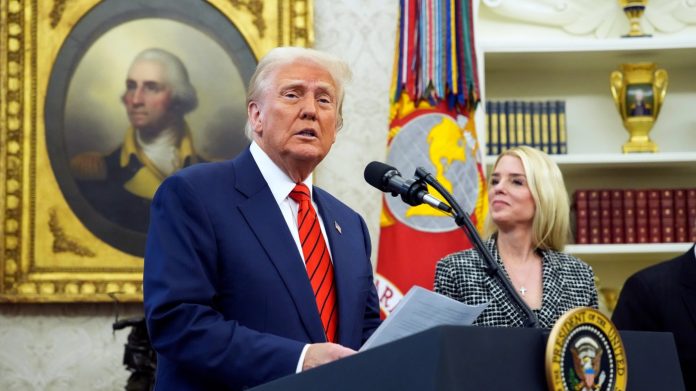
President Trump speaks alongside Attorney General Pam Bondi during her swearing in ceremony at the White House on Feb. 5.

Andrew Harnik/Getty Images


hide caption

toggle caption

Andrew Harnik/Getty Images

Justice Department veterans are noticing a pattern a month after President Trump took office: They say the department seems to be cutting breaks to people who seem loyal to the president.

In recent weeks, the department dropped a case against former Nebraska Republican Congressman Jeff Fortenberry. Prosecutors in Nashville withdrew from an investigation against Republican Congressman Andy Ogles, who introduced a bill that would clear the way for Trump to serve a third term in office. And last Friday, the Justice Department moved to dismiss the case against New York Mayor Eric Adams. Adams is a Democrat, but has said he’s open to cooperating with Trump’s immigration policies, including on deportations.

Stephen Saltzburg, a Justice Department veteran from the Reagan and Bush 41 eras, says the word “alarm” is an understatement about what’s happening at the department: Prosecutors seem to be backing away from cases against people with ties to President Trump.

“They’re patterns that we haven’t really seen in the past actions of the Department of Justice,” he said. “And none of the patterns inspire a lot of confidence that the department is being even-handed in its approach to cases.”

Saltzburg says this started on inauguration day with Trump’s clemency for more than 1,500 people who took part in the Capitol riot. He says it looks like Trump wanted to cut those people a break because they were acting on his behalf.

Politicization at the Justice Department?

Trump himself was charged by the Justice Department in connection with that case. He was also charged by the department in another case, related to the handling of classified documents. Prosecutors dropped both sets of charges after Trump won the November election. Since then, prosecutors abandoned their obstruction case against two of his aides at the Mar a Lago resort who allegedly helped him hide the classified documents from the FBI.

Trump has said he viewed the department’s actions as politically motivated. That, he said, gave him an appreciation for the plight of other politicians accused of wrongdoing.

But some of the department’s actions have had stark consequences. The fallout from the Adams case is continuing: Seven prosecutors quit rather than move to drop the case; they said it looked like an unlawful quid pro quo. Adams and his lawyer flatly denied that. (Separately, four of his top aides and deputy mayors announced Monday they’re resigning.)

Peter Zeidenberg, who used to prosecute public corruption cases, says senior leaders at Justice didn’t seem to hide they were acting for political reasons to secure Adams’ cooperation with immigration agents.

“The politicization of the Justice Department seems like it’s complete,” he said.

Last month, federal prosecutors in Texas dismissed charges against a doctor accused of unlawfully sharing health records from a children’s hospital there. Prosecutors did not provide a reason for the dismissal, according to Houston Public Media.

“The United States finally agreed to drop the case against Dr. Haim, and the Court granted dismissal with prejudice, which means the federal government can never again come after him for blowing the whistle on the secret pediatric transgender program at Texas Children’s Hospital,” said his lawyer Marcella Burke. “This dismissal represents a repudiation of the weaponization of federal law enforcement and the first step in accountability for the prosecutorial misdeeds witnessed in this case.”

Justice Department sources speaking on condition of anonymity for fear of reprisal at work say the fear is the department will on one hand move to help Trump’s friends get out of trouble and on the other use its vast powers of investigation and prosecution against people who have criticized the president.

But Chad Mizelle, chief of staff to Attorney General Pam Bondi, said this Justice Department wants to focus on its core function of prosecuting dangerous criminals, not pursuing “politically motivated witch hunts.”

Bondi herself has said she wants to go after the weaponization of the justice system, issuing a memo on her first day at work to create a working group to do just that. To start, she seems to be focused on people who helped bring cases against Trump.

Harvard law professor Jack Goldsmith wrote this week this all seems to be “doublespeak,” part of a playbook to “weaponize DOJ law enforcement like never before” against Trump’s perceived enemies.

A Passenger Jet Flips and Burns, but Tragedy Is Averted This Time

0

Delta Flight 4819’s landing seemed routine — until it wasn’t.

For the 80 people on board, the world lurched immediately after the wheels hit the ground at Toronto Pearson International Airport on Monday afternoon. The plane sparked and burst into flames as it skidded along the runway, then it rolled onto its back, its right wing shearing off.

In the blink of an eye, passengers found themselves hanging upside down, still strapped into their seats as jet fuel began running down the windows, said Pete Carlson, one of those on the flight.

“The absolute initial feeling is just, ‘Need to get out of this,’” Mr. Carlson told CBC, the Canadian national broadcaster.

But after a horrific string of fatal aviation accidents over the past two months, this crash proved different. Flight attendants and passengers were able to help each other out of the emergency exits and onto the snow. At least 18 people were injured, including one adult and one child in critical but non-life threatening condition, but everyone was expected to survive. By late Monday, some of the injured passengers had been released from the hospital, Delta said.

The jet, a Bombardier CRJ900 operated by a Delta subsidiary, Endeavor Air, was landing at 2:15 p.m. Eastern time after a seemingly normal flight along the busy route between Minneapolis and Toronto.

“The second that the wheels hit the ground, then everything happened,” said Pete Koukov, a professional skier from Colorado, in an interview on Monday night. “The next thing I know, we’re sideways.”

The plane skidded on its right side, said Mr. Koukov, who was sitting at a window seat on the other side of the plane. He saw sparks and flames as the plane hit the ground.

When the plane came to a stop belly-up, he unbuckled and lowered himself down to the ceiling of the aircraft, which was now its floor, Mr. Koukov said. “People were panicking.”

A video taken by Mr. Koukov shows a flight attendant helping passengers climb out of the plane, urging them to hurry and to leave their belongings behind.

Other videos from the scene showed flames and black smoke billowing from the plane as firefighters hosed it down. Photos taken after the crash showed most of the right wing of the jet shorn off, and the left wing damaged with the left landing gear still attached to the plane.

In the aftermath of the crash, an air traffic controller told a medical helicopter pilot who offered to help: “There are people outside walking around the aircraft there.”

“Yeah, we’ve got it. The aircraft is upside down and burning,” the helicopter pilot responded, according to LiveATC audio.

The Transportation Safety Board of Canada will lead the investigation into the crash, officials have said, and the National Transportation Safety Board has said it was leading a team of American investigators to assist the Canadian authorities.

The crash is likely to create aviation chaos for days to come. Toronto Pearson, Canada’s largest and busiest airport, was already juggling a slew of delays and cancellations caused by a series of winter storms. Although its operations resumed on Monday afternoon, two of its five runways remain closed.

Few details have been released about the crash so far. At two short news conferences, Canadian officials gave brief statements but would not take questions.

But the government’s weather service said that gusts of up to 38 miles an hour were coming from the west as it was landing. There was also drifting snow in the Toronto area, which was struck by two snowstorms in the past few days.

The jet’s pilots had told passengers during the flight that there were windy conditions, said Mr. Carlson, the paramedic who was on the flight. But he and others were still unprepared for the jolt when it came. “It was cement and metal,” he said.

Mr. Carlson, who had a scrape visible on his head, said he saw a woman who had ended up under a seat and a mother and a boy who were sitting on the ceiling of the aircraft. He had no idea what state any of them were in, he said. “My fatherly instinct and background as a paramedic kind of kicked in,” he said, making him focus on ensuring that they all got off the plane.

Even in those panicky moments, there was a palpable camaraderie as they escaped the plane, he said. “Everyone on that plane suddenly became very close in terms of how to help one another, how to console one another,” he said. “That was powerful.”

Jet fuel was running down the airplane’s windows, Mr. Carlson said. And after leaving the plane, he and others tried to move as far from it as possible once he noticed that a wing was missing and heard sounds of an explosion.

Emerging from the upside-down plane, onto the tarmac and into the blowing snow on Monday, Mr. Carlson said, “it felt like I was stepping onto the tundra.”

“I didn’t care how cold it was,” he said. “I didn’t care how far I had to walk, how long I had to stand. All of us wanted to just be out of the aircraft.”

Remy Tumin, Norimitsu Onishi, Tiffany May and Niraj Chokshi contributed reporting.

Pete Marocco Returns to Battle in Trump’s War on Foreign Aid

0

Pete Marocco has spent much of this month hunkered in an office suite on the seventh floor of the State Department overseeing the dismantling of the architecture for how the United States delivers foreign aid.

But he did have time to greet a foreign guest who had been making the rounds in Washington during the Trump administration’s early days: an official in the government of Viktor Orban, Hungary’s autocratic leader.

During the meeting, according to statements released by the Hungarian official, Tristan Azbej, Mr. Marocco pledged to halt all aid programs that “intervened” in Hungary’s internal affairs.

The next day, Mr. Orban took to state radio to announce that media outlets, pro-democracy groups and other organizations that have received money from the U.S. Agency for International Development would be considered “illegal agents.” He praised the Trump administration’s efforts to shutter the aid agency as a “cleansing wind.”

It was a little noticed moment of symbiosis between the governments of President Trump and Mr. Orban, which has spent years trying to suffocate political opposition and independent news media in Hungary. The country remains a NATO member, even as Mr. Orban has assiduously cultivated closer ties to President Vladimir V. Putin of Russia.

But it is also a glimpse of how Mr. Marocco — the State Department official who took over the remains of U.S.A.I.D. and is now charged with reorienting a foreign aid mission to serve Mr. Trump’s agenda — sees his job.

Gutting aid programs can be a weapon to punish some countries, especially those that are poor. It can also be a gift for others where Mr. Trump is seeking a friendlier relationship.

Mr. Marocco is now directing the battle rhythm of the most high-profile fight the Trump administration has chosen to wage in its effort to shrink the federal work force and end what it portrays as left-wing policies. In doing so, he is all but shutting down an agency that presidents have seen for decades as an essential tool to advance U.S. interests by distributing aid abroad.

Whether this fight runs afoul of the law — and the Constitution — is a question at the center of numerous legal challenges to the Trump administration’s efforts. The foreign aid money that Mr. Trump ordered frozen during his first week in office had already been appropriated by Congress, and several lawsuits are making their way through the courts challenging his directives.

Before his new job, Mr. Marocco worked as a conservative political activist in the Dallas area and used appearances on podcasts and other media to advance the false claim that Mr. Trump had won the 2020 election.

The State Department did not make Mr. Marocco available for an interview. This article is based on interviews with more than a dozen current and former government officials who have worked with him.

Secretary of State Marco Rubio told members of Congress that he had given Mr. Marocco, a former Marine known for a hot temper and for demanding total loyalty from his staff, the job of reviewing all facets of foreign aid to “maximize efficiency and align operations with the national interest.”

For his part, Mr. Marocco has described U.S.A.I.D. as something of a rogue organization at odds with Mr. Trump’s agenda.

In an affidavit filed on Feb. 10 as part of a lawsuit brought by the American Foreign Service Association to halt the dismantling of the agency, Mr. Marocco said he had “grave concern about whether U.S.A.I.D. was faithfully following the president’s and secretary’s directives.” He said the freeze in American aid, what he called “pencils down,” was necessary “to gain control of an organization” that included employees who were insubordinate.

Last week, a federal judge ordered the Trump administration to unfreeze foreign aid, saying the blanket halt was based on dubious logic. He gave the administration until Tuesday to show it was complying with the order.

Mr. Marocco has told State Department officials that his job is a balancing act and that he understands the mandate of a team led by the billionaire Elon Musk to eliminate nearly all foreign aid. In social media posts, Mr. Musk has called U.S.A.I.D. a “criminal organization” and said it was “time for it to die.”

According to one former American official, Mr. Marocco accompanied Mr. Musk’s team when it first entered the agency’s headquarters on Jan. 27, after Mr. Marocco had been appointed overseer of foreign aid at the State Department but a week before he was officially appointed to his U.S.A.I.D. job.

On the other hand, Mr. Marocco has said that Mr. Rubio wants foreign aid to be more efficient, not eliminated, and that influential members of Congress have similar views. Mr. Rubio, he has told colleagues, provides him “top cover.”

Officials at U.S.A.I.D., who spoke on the condition of anonymity because the staff had been ordered not to publicly discuss the changes at the agency, have indicated that Mr. Marocco has been a driving force behind many of the steps to dismantle it since he was appointed on Feb. 3.

The following day, Mr. Marocco informed 1,400 U.S.-based staff members that they had been put on indefinite administrative leave, according to two people with knowledge of the order and a copy of the note viewed by The New York Times. Hours later, U.S.A.I.D. foreign service officers were told they would have to return to the United States within 30 days.

Those orders are now on hold until Friday, after a federal judge issued a temporary restraining order as part of the lawsuit to overturn the Trump administration’s cuts to the agency.

Mr. Marocco bounced around the government during the first Trump administration, with brief stints at the Commerce Department, the State Department, the Pentagon and U.S.A.I.D. One former Defense Department official who worked with him said that Mr. Marocco was deeply suspicious of anyone who raised questions about his policy initiatives, even Defense Department lawyers, whom he saw as insubordinate “deep state” bureaucrats.

In 2020, he spent several months at U.S.A.I.D., running a bureau that oversaw the agency’s Office of Transition Initiatives, which had a $225 million budget to mitigate conflict in select countries. U.S.A.I.D. employees who worked with Mr. Marocco said that job turned out to be a kind of dry run for his current role.

The Office of Transition Initiatives, unlike much of the rest of U.S.A.I.D., was supposed to move swiftly to deliver grants to countries vital to American interests. But when Mr. Marocco arrived at U.S.A.I.D. in the summer of 2020, according to five former employees, he ground to a halt the office’s operations by ordering an immediate review of most of its programs.

He insisted on personally approving expenditures above $10,000, and that he at least be notified about expenditures below that threshold. He started targeting staff members who he believed had espoused anti-Trump sentiments on their social media profiles or elsewhere. When managers resisted firing people he had identified as potentially disloyal, they also became targets.

In the process of trying to reshape the agency, Mr. Marocco clashed not just with career U.S.A.I.D. employees but also with the Trump administration’s political appointees.

In September 2020, U.S.A.I.D. employees wrote a 13-page memo in the agency’s “dissent channel” detailing a number of Mr. Marocco’s actions that they said had led to the office becoming “less flexible, less rapid, less trusted, less efficient” and “plummeting” morale.

“Intervention is urgently needed,” the cable concluded. Mr. Marocco left the agency shortly afterward.

Given how his previous tour at the agency had ended, some employees said they saw some of Mr. Marocco’s actions in recent weeks as retribution.

“In the past, what he was doing seemed designed to gum up the works, to slow everything down,” said Joseph Curtin, who worked at the Office of Transition Initiatives in 2020 and now works in a different bureau of U.S.A.I.D. “Now he wants to destroy everything.”

Mr. Curtin was publicly critical of Mr. Marocco and other appointees at the agency in 2020, which resulted in him being put on “Mr. Marocco’s list,” he said a colleague told him.

Another appointee whom Mr. Curtin criticized was Merritt Corrigan, who ended up leaving the agency in August 2020 amid criticism for her past statements, including that the United States was in the grip of a “homo-empire” pushing a “tyrannical L.G.B.T. agenda.”

Ms. Corrigan and Mr. Marocco are now married. She held a previous job at the Hungarian Embassy in Washington and has described Mr. Orban as “the shining champion of Western civilization.”

A group of investigators identified the couple as being outside the Capitol on Jan. 6, 2021. The group, which calls itself Sedition Hunters, has pored over videos and photographs of the mob and has aided the F.B.I. in its investigation into the attack. Neither Mr. Marocco nor Ms. Corrigan was charged, and neither has confirmed being at the Capitol that day.

When asked by a Dallas-based news outlet last year about his role in the attack, Mr. Marocco did not address whether he or his wife were part of the mob. Instead, he called the accusations “petty smear tactics and desperate personal attacks.”

But in a podcast interview in 2022, he made clear that he believed the results of the 2020 election were suspicious. Mr. Marocco said he had volunteered after the election for an effort to scrutinize and challenge the results in Pennsylvania, where he claimed to have seen “firsthand” evidence of fraud.

In particular, he cited the fact that in some counties, Joseph R. Biden Jr. had claimed a large share of registered Republican and independent votes, calling the idea “laughable on its face.”

“The decisions that were being made, and this characterization that there was no evidence of fraud, is absolutely untrue,” he said. “There’s evidence everywhere.”

Eric Schmitt, Edward Wong and Michael Crowley contributed reporting.

Thousands of people protest in Washington, D.C., and across the U.S. on Presidents Day : NPR

0

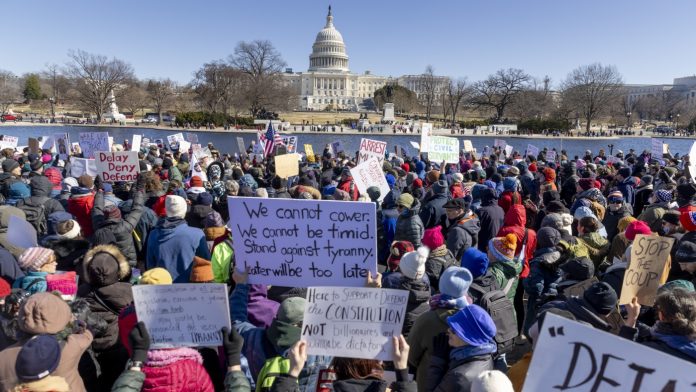
Thousands of people demonstrated at the Presidents Day protest against President Donald Trump and Elon Musk at the U.S. Capitol on Monday in Washington, D.C.

Tyrone Turner/WAMU/NPR


hide caption

toggle caption

Tyrone Turner/WAMU/NPR

On Presidents Day, demonstrators across the U.S. descended upon state capitol buildings and other locations to protest actions by President Donald Trump and billionaire Elon Musk, who is implementing significant changes to the federal government.

In Washington, D.C., the nation’s capital, thousands of people gathered at the Capitol Reflecting Pool chanting “Where is Congress?” and urging members of Congress to “do your job!” despite nearly 40-degree temperatures and 20-mile-per-hour wind gusts.

Potus Black, an organizer of the D.C. chapter of the 50501 Movement, which spearheaded the rallies, called on the sea of protesters to stand united to “uphold the Constitution.”

“To oppose tyranny is to stand behind democracy and remind our elected officials that we, the people, are who they’re elected to serve, not themselves,” Black said. “The events over the past month have been built to exhaust us, to break our wills. But we are the American people. We will not break.”

The nationwide protests were part of the 50501 Movement, which stands for “50 protests. 50 states. 1 movement.” These protests were a response to what organizers describe as “the anti-democratic and illegal actions of the Trump administration.” Monday’s demonstrations marked the group’s second nationwide campaign, following a series of executive orders signed by Trump. Both Musk and Trump have faced criticism for mass firings across several federal agencies.

Calls for Congress to take action

Thousands of people demonstrated at the Presidents’ Day protest against Donald Trump and Elon Musk at the U.S. Capitol on Monday Feb. 17, 2025 in Washington D.C.

Thousands of people demonstrated at the Presidents’ Day protest against Donald Trump and Elon Musk.

Tyrone Turner/WAMU/NPR


hide caption

toggle caption

Tyrone Turner/WAMU/NPR

Several attendees spoke with NPR, expressing their anger over Musk and Trump’s actions and their fears about future executive orders. Their concerns ranged from Musk’s team at the Department of Government Efficiency (DOGE), gaining access to Americans’ personal data through the IRS and other federal agency records, to the firing of national park rangers.

Suzanne, a resident of Maryland, who requested that her last name be withheld because she fears retaliation against her family. She told NPR she attended the rally in support of her husband, a federal employee with a financial regulatory agency. She mentioned their worries about him potentially being laid off among thousands of others.

“It’s put us in a pretty tenuous financial situation. Currently, his paychecks are going through, but we’re looking to Plan B as an alternative on how to support our family, our children,” she said. “But it has really motivated him and his co-workers to stand united, to stand as a solid, solidified workers force.”

Anita Gilmore of Maryland expressed her concerns about her son’s federal healthcare coverage, which he relies on for medical treatment. She feels anxious about what actions Department of Health and Human Services Secretary Robert F. Kennedy Jr. may take.

“My son is on Medicaid because he has a life-threatening disease that if I wasn’t there to take care of him, he would be one of these DC [homeless] guys on the street,” Gilmore says.

Many protesters, including Katie Temple, are frustrated by Congress and say lawmakers are not doing enough to hold the executive branch accountable.

“I want Congress to grow a spine, as they’ve been saying,” Temple, a Democrat, said while holding a sign that read “Was the price of your eggs worth our Democracy?”‘

“I feel like, especially the Democrats, are not standing up. We need them to act,” she said.

Following the protests, Black told NPR that more demonstrations were planned and that the 50501 Movement was only getting started.

“We know that this one protest is not going to be enough to make the changes that we expect,” Black said. “We will be continuing to let the American people’s voice be heard.”

Protests sweep the nation from California to Tennessee to Massachusetts

People gather in protest against U.S. President Donald Trump during the "Not My President's Day" demonstration at the Texas State Capitol on Feb. 17, 2025 in Austin, Texas.

People gather in protest against U.S. President Donald Trump during the “Not My President’s Day” demonstration at the Texas State Capitol on Feb. 17, 2025 in Austin, Texas.

Brandon Bell/Getty Images


hide caption

toggle caption

Brandon Bell/Getty Images

Protesters flooded statehouses, federal courts and other public spaces across the U.S., denouncing the Trump administration, executive overreach and mass deportations.

Organizers of the 50501 Movement provided details for protests in more than half of the states in the U.S. from California to Colorado to Tennessee, and Massachusetts, just to name a few.

In the Northeast, despite freezing temperatures and fierce winds, hundreds of people gathered at Boston Common bundled in winter coats and beanies, according to social media. Similar protests broke out in Hartford, New York City and Trenton.

Further south in Knoxville, protesters turned out early for the afternoon “Not My Billionaires” rally near a federal courthouse, waving signs that read “Musk wasn’t on the ballot” and “no felons, no Elons” according to social media. Demonstrations also took place in Nashville, Atlanta and Miami.

In Iowa, dozens of protesters rallied inside the statehouse walls, chanting “President Musk must go!” to condemn Musk’s involvement with the federal government, particularly his role heading DOGE, Iowa Local 5 News reported.

On the West Coast, in Palo Alto, protesters took their efforts a step further by rallying near Tesla dealerships, where Musk serves as CEO, NBC Bay Area reported.

Colorado Public Radio estimates that more than 1,000 people took to the streets of Denver, braving the snow and holding signs that addressed a range of issues including women’s reproductive rights, LGBTQ rights and immigration.

What We Know About the Delta Plane Crash in Toronto

0

There were strong winds coming from the west at about 29 miles per hour, with gusts of up to 38 miles per hour, around 2:15 p.m., the time of the crash, according to the authorities. There was also drifting snow in Toronto, which was struck by two snowstorms in the past few days.

The weather advisories for Toronto Pearson International Airport at the time of the crash “indicated a gusting crosswind and blowing snow,” according to Flightradar24, an aviation tracking website.

The cause of the crash will be investigated by the Transportation Safety Board of Canada, which will be assisted by a team of American investigators from the Federal Aviation Administration.

The flight had a crew of four, according to Delta, and the rest were passengers. Of those, 22 were Canadians.

Some of the injured were taken to hospitals but most passengers were taken to a Sheraton Gateway Hotel, near the airport’s terminals.

They left around 7 p.m. local time, picked up by taxis and family members, a hotel staff member said, declining to provide more details.

Operations at the airport resumed at 5 p.m. local time although two of the five runways remain closed.

The model CRJ900 aircraft was operated by Endeavor Air, a Delta subsidiary that typically operates smaller planes for the airline.

It was about 16 years old, according to F.A.A. records. With regular maintenance, such passenger jets are often operated for two to three decades, or more.

More than 380 CRJ900s are used by airlines around the world, according to Cirium, an aviation data company. The aircraft, which has been in operation for more than two decades, has a solid safety record, according to Cirium data.

Vjosa Isai and Qasim Nauman contributed reporting.