Friday, November 13, 2026
Home Blog Page 215

Volunteers Search for ISIS Kidnap Victims

0

No international body is searching for hundreds of Yazidi women and girls still held captive by the Islamist terrorists. Instead, their fates depend on a ragtag army of activists, relatives and armchair detectives.


The investigator’s eyes dart between the two photographs. In one, a young girl, maybe 10, is wearing a colorful shirt, her hair loose. In the other, a woman, her face weathered to an indeterminate age and framed by a black hijab, stares into the camera.

The first picture is among hundreds of images of young girls sent in by families desperate to find loved ones who were kidnapped years ago, when militants from the Islamic State first roared to power in Iraq and Syria. The pictures of older women come in from a variety of sources.

The woman examining the photographs has become skilled at finding the telling detail that might help confirm an identity — and lead to someone’s freedom. But she is not a professional investigator. Her name is Pari Ibrahim, and by day she is the executive director of a nonprofit in suburban Maryland.

At night, by the glow of a laptop screen, that she scours the photos, hoping to locate women taken captive as long as a decade ago.

“Sometimes, late at night, I’m working to see if this girl is someone who can be identified,” said Ms. Ibrahim, as she compared the two photographs, searching the faces for any hint — the bow of the lips, perhaps, or a telltale mole — that she might be looking at the same person.

“Ten years brings a lot of change into someone’s face and appearance,” she said. “It’s not easy.”

The missing people are all members of a religious minority, the Yazidi, who were a particular focus of the brutal campaign of terror that ISIS, also known as the Islamic State, launched in 2014. In the years that followed, according to a United Nations commission, the militants murdered, enslaved, raped and tortured at will. Some 3,100 Yazidis were killed and 6,800 kidnapped in August 2014 alone, one study estimates.

Now, more than half a decade since the Islamic State’s self-proclaimed caliphate in Syria and Iraq fell, nearly 2,600 Yazidis remain unaccounted for, according to Ms. Ibrahim’s nonprofit, the Free Yezidi Foundation; in 2022, the United Nations Refugee Agency put the number around 3,000. The foundation, which uses an alternative spelling for the ethnoreligious group, provides support services to members of the Yazidi diaspora.

Many are presumed dead, but Ms Ibrahim is hopeful that as many as 1,000 are still in captivity, held by their kidnappers or transferred to fighters’ extended families throughout the Middle East.

Although the United Nations has called treatment of the Yazidis genocide, the U.N. agency mandated to collect evidence of ISIS atrocities ceased operating last year. There is no official entity dedicated to finding the women — and their children.

That task has been taken up by a sprawling network of activists, survivors, family members, informants and amateur detectives like Ms. Ibrahim, a Yazidi whose family left Iraq in the early 1990s. The New York Times interviewed people based in Maryland, Germany, Australia, Iraq and Syria.

They described a modern-day Underground Railroad, on which journeys often begin with snippets of information and photographs shared via messaging apps. Sometimes that information is conveyed to families of the missing, some of whom hire informants and human smugglers to reunite them with their loved ones. Other times it is shared with the local authorities.

One member of the unofficial network, Abduallah Abbas Khalaf, helped free his niece from the Islamic State in 2014 using connections he made working as a beekeeper and honey vendor in Aleppo, Syria. Mr. Khalaf, who is Yazidi and is based in Iraq, says he went on to help free other captives through a variety of methods, including impersonating militants online.

“We used to log into ISIS telegram channels and we used to pretend that we were ISIS members,” he said. To appear more convincing, he said, he would sometimes inquire about weapons and equipment.

“They would welcome us,” Mr. Khalaf said, “and after a period of time, they would post pictures of girls or boys for selling.” As he pretended to be negotiating the price, he said, he would really be trying to coax out the whereabouts of the captives.

Mr. Khalaf shared screenshots from what appeared to be ISIS messaging channels on which women and children were being trafficked. The images showed forum users haggling over sex slaves. The Times was not able to independently verify the source of the images because many of the channels have since been made private or deleted.

At the height of the Islamic’s State’s reign in the portions of Syria and Iraq that it conquered, the enslavement and sale of women was conducted openly. Later, it became more discreet, experts said. Women and girls have been bought and sold online, and then transferred across national borders quietly, making the work of those who would rescue them all the more difficult.

“While the public Yazidi slave markets of the Islamic State caliphate period no longer exist,” said Devorah Margolin, a senior fellow at the Washington Institute for Near East Policy, “some women remain enslaved by Islamic State affiliates and continued to be sold by supporters of the group even after the fall of its caliphate.”

According to investigators, experts and news reports, captives have been found in homes connected to ISIS members as far away as Turkey and the Gaza Strip. Other Yazidis have ended up alongside their captors in overcrowded and dangerous desert camps.

About 3,600 Yazidis have managed to get back to their families, according to Nadia’s Initiative, another nonprofit group that works with the Yazidi.

One of them, Sherine Hakrash, said she had been held captive in Syria with her two daughters until she was sold to a Saudi man. Speaking haltingly and at times in tears by telephone from her new home in Australia, Ms. Hakrash said it was too painful to talk about what the girls looked like when she last saw them, in 2018.

“I don’t know anything about them,” she said. “If they are alive. If they need me. How their situation is.”

The upheavals in the Middle East over the past year and a half have further complicated efforts to locate and rescue missing people. In Iraq, for example, the government recently directed a team of international experts investigating ISIS crimes to wind down their work.

In Syria, the ouster of President Bashar al-Assad has led both to hope and fear among Yazidis. They want to take the opportunity to search for the missing, but worry that instability may pave the way for an ISIS resurgence.

As their caliphate fell in 2019, ISIS fighters fled across the region, some taking their captives with them. In many cases women were forced to marry their kidnappers, integrating them into expansive clans that could then traffic them around the world.

In December in Germany, federal prosecutors accused two people they said were Iraqi members of ISIS of sexually abusing two young Yazidi girls they kept as slaves. The girls had been held captive by the couple when they were 5 and 12. In Gaza, a woman kidnapped by ISIS at age 11 and, American officials say, later sold and forced to marry a Hamas fighter, was rescued in October after her captor died.

Captivity for some Yazidis grew still worse after their captors were themselves detained.

Some ended up in Al Hol, a sprawling nightmare of a detention camp in the desert of eastern Syria. Captive Yazidi women there are forced to live alongside ISIS members and their families. The camp, in which thousands of people are held, is dangerous — murders are common and there have been reports of beheadings.

For the network of rescuers, Al Hol presents a special challenge. Captives there are reluctant to identify themselves as Yazidis for fear that the ISIS members in their midst, some of whom have organized themselves into a religious police force, will target them. Others may have been taken captive when they were too young to know their heritage.

“The way they were enslaved outside Al Hol camp, they are enslaved inside — the torture, everything,” said the camp’s director, Jihan Hanan, who has worked with Yazidi investigators to help extricate captives in the camp.

One member of the informal rescue network, Barjas Khidhir Sabri, is a Yazidi from Sinjar Province in Iraq who currently lives in an Iraqi camp for internally displaced people. It is about 100 miles from Al Hol.

From his tent, using little more than his wits and a smartphone, Mr. Sabri has developed his own web of informants, which include men he says are ISIS members living at Al Hol.

“I don’t trust them and they don’t trust me,” Mr. Sabri said of the ISIS members. “I have to work with them. I have no regrets because any possible way we can save women and girls, it is worthwhile.”

Ms. Ibrahim said the Free Yezidi Foundation did not deal with ISIS members under any circumstances. But for many families, desperation overshadows the disgust of dealing with — and even paying — those who belong to the terrorist group, Mr. Sabri said.

When a woman in the camp is identified as a possible Yazidi captive, Ms. Hanan works with security guards to arrange a discreet interview.

Ms. Hanan said she had seen seven Yazidi girls and women liberated from Al Hol in at least the past two years.

But it is not always simple.

Some Yazidi women who have given birth to their captors’ babies fear their children may not be accepted by the Yazidi community. Some who have been raped fear returning home only to be shunned. Still others who were captured as young children know nothing but their captors’ families and may not even realize that they are Yazidi.

“We have to make sure the woman is able to make a choice in a safe space,” said Ms. Ibrahim, the nonprofit director.

Marwa Nawaf Abas, embraced the opportunity for freedom.

“I was held captive as a sex slave for three months of torture and sold on to several ISIS terrorists,” Ms. Abas, who was 21 when she was rescued, said in an interview.

After escaping from her captors in Raqqa, Syria, in 2014, Ms. Abas was offered temporary protection by a local family. She contacted her uncle, and her family paid smugglers to take her from the ISIS-controlled area to a Kurdish-controlled one.

Ms. Abas moved to Germany, and works at a hair transplant center.

“I am very happy now in Germany,” she said.

Falih Hassan contributed reporting from Baghdad.

Protests are set to take place on Presidents Day. Here is why : NPR

0

Crowds gather in front of the California Capitol Building during the “50 States 50 Protests 1 Day” protest against Project 2025 and the policies of President Donald Trump in Sacramento, Calif. on Feb. 5.

Fred Greaves/AFP via Getty Images


hide caption

toggle caption

Fred Greaves/AFP via Getty Images

Protests are set to take place in several major cities across the U.S. on Monday, the Presidents Day holiday, according to activists.

These demonstrations are being organized by the 50501 Movement, which stands for “50 protests. 50 states. 1 movement.” The protests are a response to what organizers describe as “the anti-democratic and illegal actions of the Trump administration.” This marks the second nationwide protest by the group, following an event held on Feb. 5.

The protests follow a series of executive orders signed by President Trump, including actions led by billionaire Elon Musk, which have been criticized for their aims to diminish the role of the federal government.

Organizers like Sydney Wilson — a local organizer in Pittsburgh and national press liaison for 50501— tell NPR that holding the protests on a day dedicated to celebrating U.S. presidents is an ideal moment.

“We are going out and protesting because we are concerned by our current president’s actions,” Wilson says. “We figured it was a nice little punch.”

Here’s what you should know about the 50501 Movement and the protests on Presidents Day.

It started on Reddit

The idea for a day of protest in each state originated on Reddit by a user named Evolved_Fungi in late January. The concept quickly gained traction on various social media platforms, according to organizers.

The first nationwide protest by 50501 occurred on Feb. 5. And while it did not attract the hundreds of thousands of protesters seen on Jan. 21, 2017 — the day after Trump’s first inauguration — hundreds of people participated across cities and at state capitals, including in Connecticut, Colorado and Hawaii. The organization estimates there were nearly 80 protests across 88 cities.

During those protests, participants called for Trump’s impeachment and removal from office, demanded an investigation into Elon Musk — who is leading the Department of Government Efficiency — and sought the reinstatement of Diversity, Equity and Inclusion (DEI) initiatives that have been rescinded through executive orders.

For the next wave of protests, set to take place on Monday at state Capitols again and in Washington, D.C., Wilson says they expect a similar turnout, if not larger than the previous one. Their demands remain unchanged.

“We are still very much calling for the removal of Elon Musk. We find it very concerning that there is a non-government official that has the access that he does,” Wilson says. “And we would like to see the strengthening of anti-discrimination legislation.”

The group is also advocating for an investigation into Trump’s presidential appointees, especially those connected to Project 2025, such as Russell Vought, the architect of the conservative agenda.

Wilson says the 50501 Movement plans to hold more protests in the future.

Who is supporting 50501?

People protest against President Donald Trump and Elon Musk outside the Michigan Capitol in Lansing, Mich., on Feb.5, 2025.

People protest against President Donald Trump and Elon Musk outside the Michigan Capitol in Lansing, Mich., on Feb.5.

Jeff Kowalsky/AFP via Getty Images


hide caption

toggle caption

Jeff Kowalsky/AFP via Getty Images

The protests are being coordinated with Political Revolution, a group founded in 2016 after Vermont Sen. Bernie Sanders’ — an independent who caucuses with Democrats — presidential campaign. The group consists of volunteers and leaders who “have been on the front lines of justice, marching in support of Black Lives Matter, women’s rights, LGBTQ+ advocacy, and disability rights,” the organization says.

The group says it is not affiliated with any political party, and they describe Monday’s protest as a “call to action.”

“The current administration has clarified that it cares more about profit than people. We as a collective refuse to stand by as they continue to undermine the dignity of our communities,” the group said in a statement. “We are not just numbers or consumers. We are the People. We reject fascism. We reject the oligarchy. We reject the idea that any person’s worth is less than another’s.”

The protests and the 50501 movement have garnered substantial support across social media platforms, boasting more than 102,000 members on their Reddit page and more than 600,000 on Discord.

Additionally, Smart Girls, an organization founded by comedian and actress Amy Poehler and producer Meredith Walker, has promoted the upcoming protests.

Local and state Democratic lawmakers have also supported the protests. During the Feb. 5 protests, several Michigan state House Democrats joined demonstrators at the state Capitol.

NPR’s Liz Baker contributed to this report.

Gold Mine Collapse in Mali Kills at Least 43

0

At least 43 people, mostly women, were killed after an informal gold mine collapsed in western Mali on Saturday, the head of an industry union said.

The accident took place near the town of Kéniéba in Mali’s gold-rich Kayes region, Taoule Camara, the secretary general of the national union of gold counters and refineries, told Reuters. The women had climbed down into open-pit areas left by industrial miners to look for scraps of gold when the earth collapsed around them, he said.

A mines ministry representative confirmed the accident had taken place between the towns of Kenieba and Dabia, but declined to give further details, as ministry teams at the scene had not yet shared their report.

Informal mining, also known as artisanal mining, is a common activity across much of West Africa and has become more lucrative in recent years because of a growing demand for metals and rising prices. Deadly accidents are frequent, as such miners often use unregulated methods and work in unsafe conditions.

Thirteen artisanal miners, including women and three children, died in southwest Mali in late January, after a tunnel in which they were digging for gold flooded.

Politics chat: State governors push back, Vance makes first international appearance

0

As the Trump administration pushes the boundaries of executive authority, some state governors are pushing back.

M23 Rebels in Congo Say They Have Entered Bukavu

0

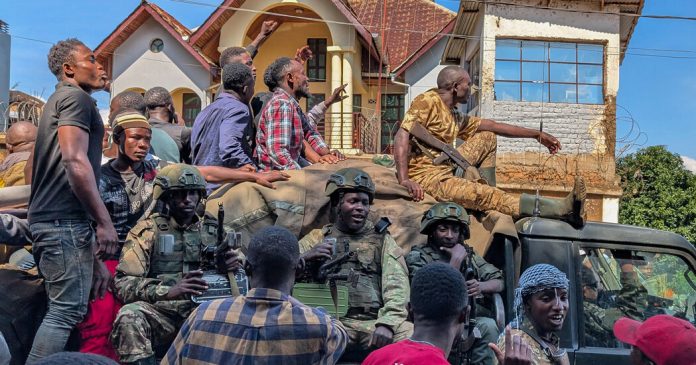
Rebels in the Democratic Republic of Congo on Sunday entered the vital trading hub of Bukavu in the east of the country, according to the fighters and videos circulated by local residents. If confirmed, Bukavu would be the latest city to fall in a sweeping offensive that has revealed the weakness of the crumbling Congolese army.

The M23 rebels — who are supported and directed by Rwanda, Congo’s much smaller neighbor — appeared to meet no resistance, residents said, as they marched into Bukavu, a provincial capital that is a major center for gold trading and smuggling.

“We’re there, we’re there in Bukavu,” said Willy Ngoma, a M23 spokesman reached by telephone.

On Sunday, the rebels addressed a crowd of people in Bukavu’s main square after they entered the city in long, silent columns, according to three eyewitnesses and videos shared on social media and verified by the Times. The eyewitnesses requested anonymity for fear of retribution from the armed group.

Days earlier, Congolese soldiers had fled the city in similar columns. The Congolese government has not spoken publicly about the situation in the city Sunday, and the capture of Bukavu has not been independently confirmed.

The apparent fall of Bukavu would stand in sharp contrast to the protracted battle for the key city of Goma last month, in which nearly 3,000 people were killed, according to the United Nations.

With the capture of Bukavu, a city of more than a million people that sits on the edge of a crystalline lake, the M23 rebels would now control the two largest trading hubs in Congo’s mineral-rich east.

Experts say Bukavu’s capture threatens to draw more neighboring countries into the conflict. The city sits 20 miles away from the border with Burundi, whose troops have been fighting alongside the Congolese army.

“It will increase the risk of regional war, especially with Burundi,” Fred Bauma, the executive director of Ebuteli, a research group specializing on Congo, said about Bukavu’s fall.

Now, M23 is also now more directly connected to its powerful backer, Rwanda. Bukavu and Goma, on the southern and northern edges of the sprawling Lake Kivu, both sit on the border with Rwanda, whose exports of minerals smuggled out of Congo have spiked in recent years, according to U.N. experts.

President Paul Kagame of Rwanda has acknowledged that Rwandan soldiers are present in eastern Congo but has denied backing M23.

The leaders of M23 have now vowed to march on Kinshasa, Congo’s capital and one of Africa’s largest cities. The Congolese government has refused to sit down with M23 leaders or Rwanda, and its military response on the ground has been limited.

M23 is the most powerful of the dozens of armed groups that have destabilized eastern Congo over nearly three decades. Since capturing Goma, the rebels have vowed to restore order and security — attempting to present the group as an administrative power qualified enough to govern large swathes of one of Africa’s richest mining regions.

“It is important that we can work hand in hand for our country’s development,” Bernard Byamungu, a high-ranking M23 official, told Bukavu’s residents on Sunday, according to a video verified by the Times. “No development without work, but let’s not forget that peace remains fundamental for a stable nation.”

Mr. Byamungu then ordered residents to go back home so that M23 could finish securing the city.

The group’s calls for peace have been at odds with M23’s bloody tactics on the ground. M23 has repeatedly violated cease-fires, including some that it had unilaterally declared. Mr. Byamungu, according to the United Nations, planned and directed the killings of civilians and the extrajudicial executions of soldiers.

Unlike Goma, the apparent capture of Bukavu was hardly a surprise: Schools there closed earlier this month and countless people fled in recent weeks in anticipation of the M23 offensive.

The M23 rebels entered Bukavu on Sunday days after they said they had captured a nearby airport that the Congolese army had used as a key rear base to try to contain the group’s advance in the province of South Kivu.

The latest M23 offensive, which began in early January, has further destabilized eastern Congo, a mineral-rich region scarred by nearly three decades of conflict over access to land and gold, tin and cobalt, among other minerals.

More than 500,000 people were displaced last month, according to the United Nations. The number of rapes against children carried out by armed groups, already rampant in the region, has soared in recent weeks, according to UNICEF.

Ruth Maclean contributed reporting from Dakar, Senegal.

Trump Team Leaves Behind an Alliance in Crisis

0

Many critical issues were left uncertain — including the fate of Ukraine — at the end of Europe’s first encounter with an angry and impatient Trump administration. But one thing was clear: An epochal breach appears to be opening in the Western alliance.

After three years of war that forged a new unity within NATO, the Trump administration has made clear it is planning to focus its attention elsewhere: in Asia, Latin America, the Arctic and anywhere President Trump believes the United States can obtain critical mineral rights.

European officials who emerged from a meeting with Defense Secretary Pete Hegseth said they now expect that tens of thousands of American troops will be pulled out of Europe — the only question is how many, and how fast.

And they fear that in one-on-one negotiations with President Vladimir V. Putin of Russia, Mr. Trump is on his way to agreeing to terms that could ultimately put Moscow in a position to own a fifth of Ukraine and to prepare to take the rest in a few years’ time. Mr. Putin’s ultimate goal, they believe, is to break up the NATO alliance.

Those fears spilled out on the stage of the Munich Security Conference on Saturday morning, when President Volodymyr Zelensky declared that “Ukraine will never accept deals made behind our backs.” He then called optimistically for the creation of an “army of Europe,” one that includes his now battle-hardened Ukrainian forces. He was advocating, in essence, a military alternative to NATO, a force that would make its own decisions without the influence — or the military control — of the United States.

Mr. Zelensky predicted that Mr. Putin would soon seek to manipulate Mr. Trump, speculating that the Russian leader would invite the new American president to the celebration of the 80th anniversary of the defeat of Nazi Germany. “Putin will try to get the U.S. president standing on Red Square on May 9 this year,” he told a jammed hall of European diplomats and defense and intelligence officials, “not as a respected leader but as a prop in his own performance.”

Behind closed doors, Mr. Zelensky had a different kind of confrontation with the Trump administration officials this past week: After meetings with Treasury Secretary Scott Bessent in Kyiv, Ukraine’s capital, he rejected an extraordinary proposal that the United States be granted a 50 percent interest in all of Ukraine’s mineral resources, including graphite, lithium and uranium, as compensation for past and future support of the war, according to two European officials.

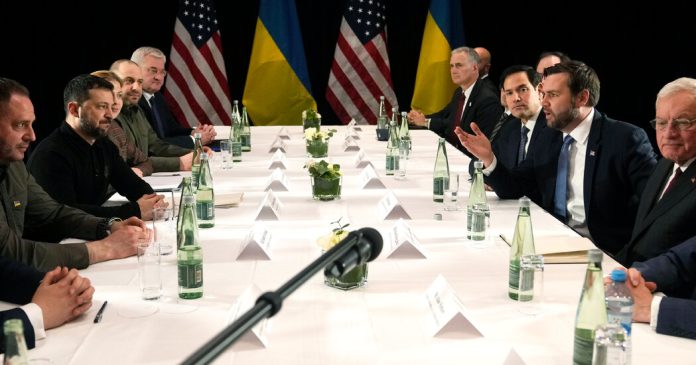
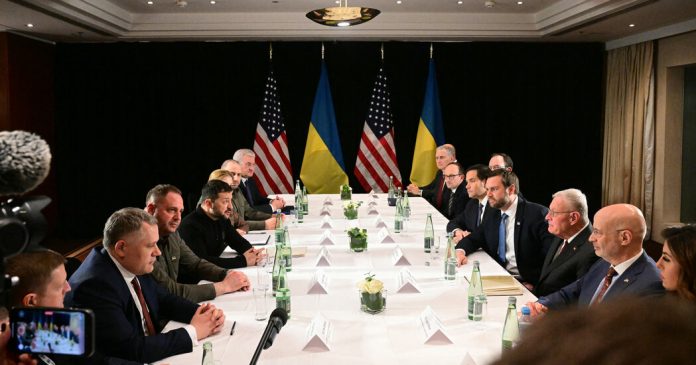
Mr. Zelensky himself referred to the tense negotiation in Munich, after he met Mr. Vance, complaining that the administration’s proposal included no security guarantees for the country should Russia attempt another invasion. “We can consider how to distribute profits when security guarantees are clear,” he said.

The security guarantee is key because Ukrainians believe the United States and Britain failed to live up to obligations to protect the country under an agreement signed at the end of the Cold War, when Ukraine gave up the Russian nuclear weapons on its territory. But European diplomats complained that the negotiation reeked of colonialism, an era of exploitation when Western countries held up smaller nations for commodities, in return for protection.

Listening to the open debate at the Munich Security Conference over the past three days, and the more blunt conversations over dinners and in hallways, was to witness a relationship in crisis and confusion.

It was only last July that the NATO allies gathered in Washington for the 75th anniversary of the world’s largest and most successful military alliance. While officials knew that the re-election of Donald J. Trump would strain the system, they have been stunned by both the ferocity and the velocity of the effort.

“Compare the speeches that General Mattis and Mike Pence gave here in their first appearances in 2017,” said Senator Jeanne Shaheen, Democrat of New Hampshire, referring to Mr. Trump’s first defense secretary and vice president. “They were full of reassurance and discussion of what allies can do together. Then listen to Pete Hegseth and JD Vance this week,” she said. “It feels that it’s their goal to create division.”

In fact, when Keith Kellogg, Mr. Trump’s special envoy for Ukraine, spoke in Munich on Saturday, he made clear that Europe would not be at the negotiating table. He envisioned a negotiation between Russia and Ukraine in which the United States plays “mediator.”

It is the uncertainty of how that negotiation will play out — and whether Europeans can count on the United States to come to their defense should Russia try to pick off a smaller NATO nation next — that is driving European anxiety. But it is also clear that the Trump administration has no clear plan for Ukraine, at least not yet.

“For those in search of Trump’s strategy on Ukraine: Relax,” said Douglas Lute, who served both Democratic and Republican presidents in senior national security positions. “There is no strategy.”

Still, President Emmanuel Macron of France has asked European leaders to come to Paris on Monday to discuss the challenges presented by the new Trump administration, said Radoslaw Sikorski, the foreign minister of Poland.

It is not clear who will attend, but Prime Minister Keir Starmer of Britain is expected to go, saying on Saturday that this was a “once-in-a-generation moment for our national security” and that it was clear that Europe must take a greater role in NATO, which has been the consensus since Russia invaded Ukraine three years ago.

The Western alliance has gone through many crises before, including in the 1950s, when President Dwight D. Eisenhower was elected with a promise to lower the price of waging the Cold War and pulled back on American troops in Europe, replacing them with nuclear weapons to keep the Soviet Union at bay. Some predict a similar move by Mr. Trump in coming months — sharply reducing manpower, but keeping an arsenal of nuclear weapons on the continent.

To many in Munich, the past few weeks have already alienated Europeans and destroyed much of the unity created over the past three years in providing arms, aid and intelligence to Ukraine.

It is hard to know how lasting the breach will be, but for some like Norbert Röttgen, a member of Germany’s Parliament for the Christian Democratic Union, the party expected to run the next government after elections next week, it is time for Europeans to recognize the world has changed.

“This is a new reality, a break with traditional European American policy that security in Europe is a genuine U.S. national interest,” he said. “But this administration does not consider it a primary U.S. interest, and this is a fundamental shift.”

He pointed in particular to Mr. Vance’s speech on Friday. There was no talk of common bonds, or a plan for Ukraine, or the goals of a peace negotiation. Instead, Mr. Vance delivered a blistering attack on European democracy for restricting the power of the far right. Mr. Vance then met with the leader of the far-right German political party that Elon Musk has backed and which is running second in the opinion polls.

“The spirit of the Vance speech was hostility,” Mr. Röttgen said.

The speed of the embrace of Mr. Putin also shocked those in Munich. In the Biden years, the strategy was to isolate the Russian leader. Mr. Trump broke with that approach when he engaged in a 90-minute phone call with Mr. Putin, without prior consultation with his allies.

Mr. Vance added to the suspicions. The parties he embraced during his visit here are the same far-right parties that Mr. Putin embraces, and that buy into his narrative of an aggressive NATO infringing on a broader Russian sphere of influence. Among those who embraced that view was Tulsi Gabbard, the new director of national intelligence.

Europeans are now afraid that they may find themselves as pawns in a negotiation conducted without their active participation, even if their own borders are in question and they are expected to take up the largest burden of defending them. That is reminiscent of a Europe and a world of a previous age, of regional empires and the rule of the strong with little concern for the rest.

Kaja Kallas, the E.U. foreign policy chief and former prime minister of Estonia, said in an interview that she remained worried about “appeasement” of Mr. Putin by Mr. Trump over Ukraine, which she defined as “giving the aggressor what he wants” even before negotiations begin. “That’s why we shouldn’t give Putin what he wants because that will only invite more aggression,” she said.

Trump officials had sent mixed signals, she said. “When we meet these people inside the rooms, we are discussing that we are great allies,” Ms. Kallas said. But then, “we see also the public statements, which are a bit confusing.”

Given the war in Europe, she said, the stakes are high. “It’s not only the question of the sovereignty of Ukraine, or the freedom of Europe,” she said. “It’s actually a question of trans-Atlantic but also global security.”

As for American troops, which were increased in Europe after the Russian invasion of Ukraine, she said that there were no detailed discussions about removing them, but that there was a clear trend that worried her. The United States is “turning inward,” she said.

The head of the Munich conference, Christoph Heusgen, had told German radio on Friday that “I suspect that today the American vice president will announce that a large part of the American troops will be withdrawn from Europe.” That of course did not happen.

But Boris Pistorius, the defense minister of Germany, said troop withdrawals were discussed with Mr. Hegseth in Brussels. “We would have to compensate for what the Americans are doing less of in Europe,” Mr. Pistorius said. “But that can’t happen overnight.”

Mr. Pistorius said he had proposed a “road map” to Mr. Hegseth that included “a change in burden sharing, in such a way that it is orchestrated” and “no dangerous capability gaps arise over time.” Mr. Hegseth “sees it the same way,” Mr. Pistorius said to Agence France-Presse.

“To believe that we could compensate within a year for what the Americans are doing less of in a few months, that’s illusory, it won’t work,” Mr. Pistorius said.

Other NATO defense and foreign ministers have said that personnel was less of a problem than the kind of arms and equipment only the United States has in Europe in large numbers, from attack helicopters to satellite intelligence. To replace all of that, even if ordered tomorrow, would take close to a decade, one minister said.

As for Ukraine, Ms. Kallas said, there was not yet a real plan from Washington, and no plan could be imposed by Washington because for any plan to function, “you need the Europeans and you need the Ukrainians.”

And if the Ukrainians do not accept a deal and decide to continue to resist, “then Europe will support them.”

António Costa, the president of the European Council, said in an interview that it was important “to keep calm” and “prepare for all scenarios, but not to react to each declaration, each tweet, each speech, but to come prepared and wait and see.”

More important, Mr. Costa said, was Europe’s lasting support for Ukraine. “There can be no lasting peace without Ukraine and without the European Union,” he said. “Only Ukraine can decide when to negotiate. And we will be with Ukraine.”

Europe must pay attention to the realities, not the rhetoric, he said. “We are prepared on tariffs, on security, on defense, on Ukraine,” he said.

Fight for America! is a new game that re-enacts the storming of the Capitol : NPR

0

Fight for America! is a new art installation about democracy that invites audiences to play a war game — battling over the U.S. Capitol on Jan. 6, 2021.

J. Elon Goodman/the american vicarious


hide caption

toggle caption

J. Elon Goodman/the american vicarious

When we arrive on a cold night in January, we’re told we’re on the Red Team — that is, the team that will try to take over the U.S. Capitol and find Vice President Mike Pence.

Others are on the Blue Team, playing the police officers who are trying to defend the Capitol from attack.

A man dressed as Uncle Sam takes the stage.

“Welcome to the Fight for America!” he says.

About 20 of us are here in Brooklyn to play a large-scale war game — think Risk — but we’re also each assigned a character, which is a bit like Dungeons & Dragons. We’re told it’s Jan. 6, 2021. We’re given rows and rows of hand-painted mini-figures, a bowl of dice, and a measuring stick showing how far we can move each roll. We all stand up as we strategize because the board — green lawn and marble steps — surrounds a detailed plastic replica of the Capitol that’s almost 14 feet long.

The idea, the creators say, is a bipartisan experience that teaches something about American democracy. But what?

‘I thought it was a joke’

Fight for America! has been in development for over a year from the american vicarious, an artistic not-for-profit that calls itself a “generator of creative content” that reflects on America and Americans. The game was designed by Alessio Cavatore, who’s known for tabletop games such as Warhammer and The Lord of the Rings.

Although artistic projects are outside his comfort zone, Cavatore agreed to design the game because he liked the intent: to encourage dialogue. “Making the red and the blue engage in an activity and speak to one another instead of demonizing the other as bad” is important, he says in a conversation over Zoom. “Let’s play a game and then let’s have a chat. Let’s talk about things. We may not change minds, but at least we’re getting an understanding from the other side.”

Cavatore is based in England — he’s not at this workshop, which is one of the final, large-scale test runs before Fight for America officially opens in London in the spring.

This Brooklyn test run is not necessarily meant to be a blue and red conversation — we’re playing in a neighborhood that tends to go for Democrats; 92% voted for Harris in November. But Brooklyn liberals are not the final audience, the creators say.

The board — a green lawn and marble steps — surrounds a detailed, nearly 14-foot, plastic replica of the Capitol.

The board — a green lawn and marble steps — surrounds a detailed, nearly 14-foot, plastic replica of the Capitol.

J. Elon Goodman/the american vicarious


hide caption

toggle caption

J. Elon Goodman/the american vicarious

“Our ultimate objective is to take it across the [United States] and engage people in game play, to have a conversation about the state of our democracy,” said the american vicarious artistic director Christopher McElroen, who worked with Cavatore to create the game. “The beautiful thing about playing a game is it requires participation … and that’s what democracy is. Democracy requires participation.”

Yet, participating in this particular game seemed absurd to some, at first. That was Korey Dowell’s response when someone who worked on the game invited him to play.

“I thought it was a joke. I don’t want to play Jan. 6, the home game. What is this, this is nonsense!” Dowell recalls thinking. He’s been assigned to the Blue Team. “But then [the creators] explained to me it was an art installation, and I live close, so I said, ‘Let me come and do it.’ “

‘Maybe a historic first’

He’s not wrong that it’s an outlier. Most war games with dice and mini-figures are about historical wars, not about current events. You don’t often play a character. And they tend to be a couple of people around a table, not a couple dozen playing all at once.

I invited Naomi Clark to come play, and we’re both assigned to the Red Team. She’s a game designer and professor at New York University, where she heads the NYU Game Center.

“I’m not sure if there has been a game exactly like this before. This is a really interesting and unusual event, maybe a historic first of some kind,” Clark says.

She points out that tabletop war games started off as training exercises for the Prussian army — they were simulations for battle. Later, they turned into hobbyist re-enactments and eventually, family games like Risk.

“Part of the interesting thing about games is you can imagine all of these what-if situations … it’s a different way of studying or looking at history,” Clark says. This means that although a game about Jan. 6 might at first seem bonkers, it actually makes sense.

“Games are traditionally about fun, right? By which I mean they produce pleasure,” she says. “But they don’t only have to produce pleasure any more than a song or a play only produces pleasure. They can also make us think or they can pose questions.”

Happy chaos

Fight For America! is more than a game — it’s a social event. There’s an edge of happy chaos, with beer and snacks pushed around on a cart, many people talking and rolling their dice at once, and regular interruptions by actor Dana Watkins, who plays the game master dressed as Uncle Sam, as well as characters in sketches that appear on the video monitors, everyone from a conservative broadcaster to Nancy Pelosi to the Red Team leader.

Dana Watkins dressed as Uncle Sam for Fight for America!

Dana Watkins dressed as Uncle Sam for Fight for America!

J. Elon Goodman/the american vicarious


hide caption

toggle caption

J. Elon Goodman/the american vicarious

“Together, we resist tyranny. Together, we stop the steal. Together, we reclaim America,” he tells the Red Team. Our mission, he says, is “to find Mike Pence.”

Each player has a character card depicting a real person who was at the Capitol on Jan. 6. Dowell says he is Harry Dunn, an officer with the Capitol Police. Clark is playing as Elmer Stewart Rhodes III, a founder of the Oath Keepers. I’m Joseph Biggs, who, at the time, was a leader of the Proud Boys. We are given name tags — mine says “Joe.”

Every time I roll the dice, I think: What would Joe do?

Clark’s plan is simple: “Just pure aggression. I think it’s the Oath Keepers’ strategy. Just push for it on all fronts. I guess we’ve got to get Mike Pence. I don’t know what we’re going to do when we find him, but something.”

Winning is everything

We retreat, we attack. Every now and then, one of the game masters will hand someone a card that will give them an advantage, like tear gas. Or a tweet will come on the screen, and suddenly, one of the teams will get a morale boost — or extra troop reinforcements.

As the game continues, it’s stopped being about how you might feel about the storming of the Capitol and more … how do we win?

Game creator McElroen says … yeah, that’s the idea.

“The framing device is absolutely political, but it’s a game, and that is metaphorically what America is at this point. It has become a game where winning is the only objective, regardless of the toll it exacts,” he says.

The blue team is flailing

Over an hour in, it’s clear the Red Team has the advantage. Wave after wave of mini-figures in MAGA hats, one holding a baseball bat and one a sword, are approaching the Capitol steps.

“Hold the line!” someone shouts on the Blue Team.

Law enforcement officers at the Capitol in Fight for America!

Law enforcement officers at the Capitol in Fight for America!

J. Elon Goodman/the american vicarious


hide caption

toggle caption

J. Elon Goodman/the american vicarious

“They are throwing bike racks!” Uncle Sam warns.

Uncle Sam reminds the Red Team that their goal is to get into the Capitol — and hang Mike Pence. He starts chanting, and the Red team takes it up: “Hang Mike Pence!”

It is a shocking thing to hear in this deep blue part of Brooklyn.

And the Blue Team itself is starting to feel discouraged.

“We were advised to fall back,” says player Julia White. “We’ve lost quite a few men. It’s extremely stressful.”

The Red Team, on the other hand, feels great.

“Our men are at the door of the Capitol at this point,” Clark says. “It doesn’t seem like Blue has a good chance.”

The End Game

There is a siren — the U.S. Capitol has been breached by the Red Team.

We’re corralled over to a second game board, where we search for Mike Pence. And, unlike on Jan. 6, 2021, the Red Team finds him.

“Hang Mike Pence,” some of the team cheers again, led by Uncle Sam.

Then there’s a twist.

“Team Red will now vote!” Uncle Sam says. “Vote to protect the Vice President … or vote to hang him.” There’s uncomfortable laughter. Are we voting as our characters? Or as ourselves?

Protect the Vice President, or hang him? Players get to choose in Fight for America!

Protect the Vice President, or hang him? Players get to choose in Fight for America!

J. Elon Goodman/the american vicarious


hide caption

toggle caption

J. Elon Goodman/the american vicarious

We look at each other. For a minute, I’m not sure which way it’s going to go. There’s a lot of shuffling around.

We vote no.

Clark explains her vote this way: “I just don’t think they would have done it … I could be wrong, of course.” She adds, “In that moment, I just sort of think, well, what do I really want this story to be? And I don’t really want this story to be that these people are so evil, so unredeemable, that they would actually hang someone.”

After the vote, there is pandemonium for a minute — a confetti cannon goes off, there’s music, the Red Team cheers — and then everyone falls silent to watch the video monitors, which are suddenly playing tape from Jan. 6, 2021. Our “characters” are real people, and there they are on screen. Storming the Capitol. Defending it. Clark says: it’s sobering. A gut punch. And, she says, that makes Fight for America! a particular type of game.

“Some people call this complicity gaming. Where you take the role of somebody you wouldn’t sympathize with in real life and you see it from their point of view,” she says. “And then you watch it in real life and you’re like, ‘Oh, I just did that.’ “

Which is a discouraging way to feel about human nature. But Dowell, on the Blue team, says that after playing the game, he sees a different way to think about Jan. 6.

“I think what the Red Side showed was that community is important. Like, that’s what that is. That’s the most tragic part is that they’re actually a community, and they came together to fight. So we need the community on the other side. And maybe at some point, we’ll all be [a] community again together?”

It’s a question, not a statement.

But then he says, “I still have hope.”

Audio and digital edited by Ciera Crawford. Audio mixed by Chloee Weiner. Web page produced by Beth Novey.

Trump’s Ambition to Redraw the World Map Ignores Those Affected Most

0

Western allies of the United States gathered in Munich this past week, anxious, adrift and despairing in the face of President Trump’s brute display of muscle-flexing on the global stage. But it was people not at the table at the Munich Security Conference who have become most marginalized in Mr. Trump’s world.

Palestinians and Afghans, Greenlanders and Panamanians — these are the true pawns in the president’s geopolitical chess game. Their priorities, preferences and aspirations seem almost beside the point in Mr. Trump’s ambition to redraw the map of the world along “America First” lines.

Even Ukrainians now appear at risk of a peace settlement being negotiated over their heads, as Mr. Trump and President Vladimir V. Putin of Russia embark on talks to end a war that has left tens of thousands of Ukrainians dead, much of the country in ruins, and nearly a fifth of its territory in Russian hands.

“Strong-arming has been part of American foreign policy throughout our history,” said Charles A. Kupchan, a professor of international affairs at Georgetown University. “But there was usually an effort to legitimize American power through some form of dialogue. That’s absent from Trump’s foreign policy.”

In his propensity to make deals that take little heed of those most directly affected by them, Mr. Trump’s foreign policy echoes that of a bygone era, when imperial powers waged a great game for influence, with scarcely a pretense that their conquests were rooted in the desires of local populations.

Mr. Trump’s expansionist instincts have been likened to those of William McKinley, the 25th American president, whose victory in the Spanish-American War of 1898 brought the Philippines, Guam and Puerto Rico under the control of an up-and-coming United States. He annexed Hawaii, as well.

But Mr. Trump is also in the tradition of Mark Sykes and François Georges-Picot, the British and French diplomats who conducted the secret negotiations that carved up the Levantine remnants of the Ottoman Empire during World War I. The Sykes-Picot Agreement drew the borders of the modern Middle East, with little regard for the ethnic and religious communities that their lines crossed.

Historians trace the resentments that erupted into conflict in the Middle East to the arbitrary nature of Europe’s partitioning of the region. Some question whether Mr. Trump’s cavalier approach to the interests of the Palestinians or Panamanians could stoke new tensions and ignite future conflicts.

“As Oct. 7 showed, you ignore locals at your peril,” said Richard N. Haass, a former president of the Council on Foreign Relations, referring to the deadly attack on Israel by Hamas fighters from Gaza. That triggered the war that Mr. Trump proposes to end by dispersing Gaza’s 2.1 million Palestinians to Jordan and Egypt, and then taking over the enclave to redevelop it as an Arab Riviera.

“Ultimately, what happens in Ukraine or Gaza or Panama will be heavily influenced by the people who live in those places,” Mr. Haass continued. “The ability of the U.S., Russia or China to control these things is not automatic.”

Mr. Haass said it was too soon to conclude that Mr. Trump intended to cut the Ukrainians out of a negotiation with Russia. The president himself insisted Ukraine would be part of the process, as would other countries. He called President Volodymyr Zelensky of Ukraine after speaking to Mr. Putin.

But Mr. Trump’s announcement of “immediate” peace negotiations with Russia — blindsiding Mr. Zelensky as well as European leaders — bore the hallmarks of a blitzkrieg approach to geopolitics in the early days of his second term. His proposal to empty Gaza appeared to catch off guard even Prime Minister Benjamin Netanyahu of Israel, who was visiting him in Washington.

Analysts said Mr. Trump’s lightning speed was designed to knock potential critics of his deals off-balance and short-circuit the kind of lobbying or scrutiny that could delay or dilute them. Some said Mr. Trump learned from his first term, when his secretary of state at the time, Mike Pompeo, oversaw a more traditional negotiation with the leaders of the Taliban to end the war in Afghanistan.

While the Trump administration left Afghanistan’s pro-Western government and America’s NATO allies out of the process, the prolonged, public nature of the talks brought demonstrators, including women’s groups, into the streets of Doha, the capital of Qatar, where the two sides were meeting.

Critics say the 2020 deal opened the door to the Taliban’s calamitous takeover of Afghanistan 17 months later, though allies of Mr. Trump blame that on what they say was President Joseph R. Biden Jr.’s botched withdrawal of American troops.

“Trump learned that the establishment and the media can put enormous pressure on a deal,” said Vali R. Nasr, a professor of international affairs at the Johns Hopkins School of Advanced International Studies. “His approach now is to present the world with a fait accompli, with no room to influence things.”

“Deals that are this opaque and that are done this quickly are more vulnerable to grave errors because they are not subject to scrutiny,” said Mr. Nasr, who worked on Afghan policy during the Obama administration.

Mr. Trump is not the only president to try to make deals privately. President Barack Obama famously negotiated a rapprochement with Cuba — later reversed by Mr. Trump — under a veil of secrecy. Mr. Obama authorized American diplomats to open a secret back channel to Iranian officials, which cleared the way for a nuclear agreement that Mr. Trump also later abrogated.

Mr. Trump often appears more comfortable dealing with adversaries than allies. That could open the door, Mr. Haass said, to a new round of diplomacy with Iran. Mr. Haass, who has long argued that the United States needed to redefine its objectives on Ukraine, said there was also potential for Mr. Trump to make progress with Mr. Putin in winding down the war.

The trouble is likely to come in Mr. Trump’s efforts to pressure allies. Neither King Abdullah II of Jordan nor President Abdel Fattah el-Sisi of Egypt have yielded to his proposal that they take Palestinian refugees from Gaza. Panama has rejected his demand that the United States seize the Panama Canal.

Denmark has rebuffed Mr. Trump’s proposal to acquire Greenland, its semiautonomous territory. So has Greenland itself, though the prime minister, Múte Egede, said it would be open to working with the United States on defense and natural resources. In this, Mr. Egede might have a clearer insight into Mr. Trump’s motives than many leaders.

The president’s foreign policy, analysts said, is so rooted in commercial calculations that local people barely enter the equation. Greenland lies along valuable Arctic shipping lanes and, like Ukraine, has rich mineral deposits. Panama has its canal. Gaza has a scenic Mediterranean coastline.

“What’s different about Trump is that it’s 100 percent materialist,” said Professor Kupchan, who worked on European affairs in the Obama administration. “There’s not an iota of ideology in any of this.”

When McKinley started the Spanish-American War, Professor Kupchan said, he did so ostensibly to liberate the Cubans from Spanish colonial rule. Even the conquest of the Philippines, he said, was done under the cloak of a “civilizing mission.”

“This is devoid of any civilizing mission,” he said. “This kind of bald transactional approach, unadorned by any ideology, is new.”

Rubio Visits Israel as Trump Pushes Plan to Expel Palestinians From Gaza

0

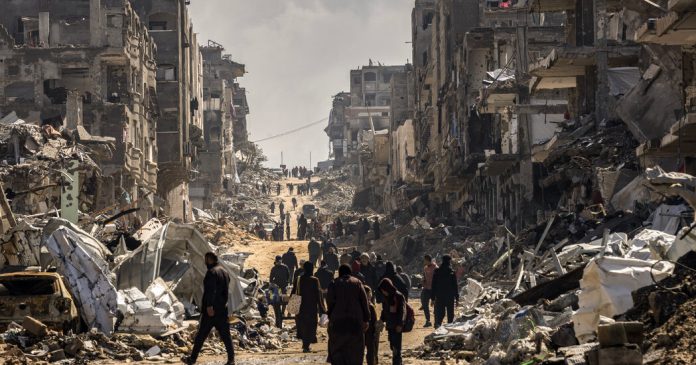
Secretary of State Marco Rubio was meeting in Jerusalem on Sunday with Prime Minister Benjamin Netanyahu of Israel as political chaos rippled across the Middle East over President Trump’s insistent proposals to seize the devastated Gaza Strip and force out its Palestinian residents.

The trip is Mr. Rubio’s first to the region as secretary of state, and comes as Israel and Hamas are meant to be negotiating to turn a tenuous cease-fire in Gaza into a permanent end to their war.

But Mr. Trump’s improbable vision for transforming Gaza into an American-owned “Riviera of the Middle East” has overshadowed that high-stakes discussion, and Mr. Rubio is sure to be pressed for more clarity about the plan during his visits to Israel, Saudi Arabia and the United Arab Emirates.

It is unclear whether Mr. Rubio will have any details to offer, however, and not only because Mr. Trump’s plan is as vague as it is contentious — it is unclear whether Mr. Rubio himself takes the president literally.

Mr. Rubio, a former Florida senator with a far more conventional worldview and style than the president, has more than once suggested that Mr. Trump’s idea is mainly a negotiating tactic meant to provoke Arab leaders into taking more responsibility for the Palestinians.

Mr. Trump surprised the world with his Gaza plan during a Feb. 4 news conference in Washington with Prime Minister Benjamin Netanyahu, who has since called it “a revolutionary, creative approach” that should be studied. Mr. Netanyahu has not explicitly endorsed the idea, which some Israeli officials consider impractical.

After Arab officials in the region immediately denounced it, Mr. Rubio suggested to reporters that Mr. Trump was merely trying to “get a reaction” and “stir” other nations into providing more assistance for postwar Gaza.

Since then, however, Mr. Trump has doubled down, telling reporters in the Oval Office on two other occasions and in a Fox News interview that he intends to move forward with the plan. On Friday, Mahmoud Abbas, who governs the West Bank as the president of the Palestinian Authority, said the Palestinian people “must remain” on their land.

The forced expulsion of Palestinians would be ethnic cleansing and a war crime, international law scholars say. More than 47,000 Palestinians have been killed by Israeli military retaliation in Gaza for a Hamas-led assault in October 2023 that killed 1,200 people. Most of the dead on both sides have been civilians.

Mr. Trump has said Jordan and Egypt should allow the Palestinian residents of Gaza to move to their countries. The idea has long been promoted by the Israeli right but flatly rejected by Arab and Palestinian leaders as well as past U.S. presidents of both parties. King Abdullah II of Jordan publicly rejected Mr. Trump’s proposal after a Wednesday meeting at the White House that was also attended by Mr. Rubio.

In a radio interview on Thursday, Mr. Rubio again spoke of Mr. Trump’s idea less as a concrete objective and more as kind of diplomatic stink bomb aimed at Arab nations.

“All these countries say how much they care about the Palestinians, but none of them want to take any Palestinians. None of them have a history of doing anything for Gaza in that matter,” Mr. Rubio said. “So the president says, all right, then this is what we’re going to do. We’ll take it on. We’ll have to move people around.”

“It’s the only plan out there right now,” he added. “Now, if someone has a better plan — and we hope they do — if the Arab countries have a better plan, then that’s great.”

Mr. Rubio suggested that any Arab proposal should address the mammoth task of reconstructing Gaza and deploying a multinational security force to fight remnants of Hamas.

“I can tell you that any plan that leaves Hamas there is going to be a problem, because Israel is not going to tolerate it.” he said.

Mr. Rubio made no mention of months of work by the Biden administration, led by former Secretary of State Antony J. Blinken, to devise just such a plan. By the end of last year, Biden administration officials said they were getting close to a complex agreement that would bring Arab security forces and reconstruction funds to Gaza along with greater accountability to the Palestinian Authority, which President Joe Biden said should play a leading role in a postwar Gaza.

But any such plan is only possible once the war in Gaza comes to an end, and progress toward that depends on extending a cease-fire agreement that is set to end in March and that revolves around hostage-prisoner exchanges.

Mr. Rubio arrived in Israel on Saturday — the same day that Hamas released three Israeli hostages, including a dual American citizen, in exchange for 369 Palestinian prisoners.

The Israeli and American governments had been pressuring Hamas for days to release the hostages in hopes of sustaining the cease-fire first reached with the prodding of Biden and Trump aides in mid-January. Mr. Trump warned last Monday that Israel could cancel the agreement and that “all hell is going to break out” if Hamas did not release all remaining hostages by noon on Saturday.

Mr. Rubio is on his second trip as secretary of state. He landed in Israel on Saturday night after spending a couple of days at the Munich Security Conference, and plans to fly to Saudi Arabia and the United Arab Emirates after meetings in Jerusalem. Mr. Rubio had planned to stop in Qatar earlier, but that was not on the announced schedule.

In Saudi Arabia, Mr. Rubio and two other top Trump aides plan to meet with Russian officials to discuss ending the war in Ukraine.

Mr. Rubio’s travels have attracted little public reaction in Israel, amid uncertainty about the secretary’s influence in comparison to Steve Witkoff, the president’s Mideast envoy, and other advisers to Mr. Trump.

More broadly, Israeli government officials have warmly welcomed the Trump administration’s support for Israel. Mr. Netanyahu issued a statement on Tuesday that hailed “the president’s revolutionary vision for the future of Gaza.” He also credited Mr. Trump on Saturday with helping to ensure that the cease-fire remained intact through the weekend.

Still, it is unclear whether Mr. Netanyahu sees Mr. Trump’s plan to expel Gaza’s residents as a viable postwar strategy, even if the idea has been praised by Mr. Netanyahu’s far-right allies.

Mr. Netanyahu himself has avoided direct commentary on the premise of a U.S.-led building project in Gaza. Instead, the Israeli leadership seems more focused on a short-term goal — securing U.S. support for resuming the war if the cease-fire breaks down. Mr. Netanyahu has repeatedly said the war cannot end before Hamas is defeated, but it will be harder to renew the fighting without Mr. Trump’s blessing.

Isabel Kershner contributed reporting.

Knife Attack in Austria Kills One and Injures Four

0

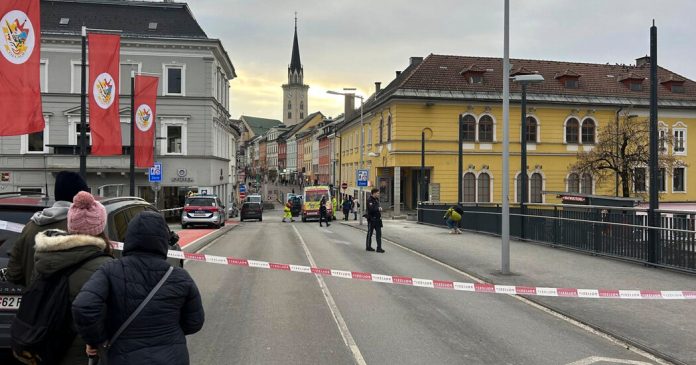
A teenager died and several other people were injured in Villach, Austria, on Saturday after a man attacked them with a knife, officials said. A suspect has been detained in connection with the attack; it is not clear whether he knew the victims.

The attack happened around 4 p.m. local time, killing a 14-year-old and injuring four other people, according to the mayor of Villach, a city in the south near the Italian and Slovenian borders. The police told The Associated Press that two people were seriously injured.

The suspect is a 23-year-old Syrian man with legal residence in Austria, local police officials said in an interview with Austria’s public broadcaster ORF. It is not known if he lived in Villach. The motive is also unknown, but police are investigating the suspect’s background, said Rainer Dionisio, a spokesman for the police department in Carinthia, the province where Villach is located.

Peter Kaiser, Carinthia’s governor, called for the “harshest consequences” for the attacker, saying the perpetrator “must be put on trial, imprisoned, and deported” in a post on X. The city’s mayor, Günther Albel, wrote on Meta: “To all those who sow hatred and violence, I say: You will not win.”

Several similar attacks in neighboring Germany in recent months, including a car attack in Munich last week, have pushed migration to the forefront of that country’s national election campaign.

Millions of Syrians have sought refuge in Europe after a popular uprising against the nation’s autocratic longtime leader, Bashar al-Assad, that began in 2011 turned into a civil war. The large migration has strained social safety nets in Europe and stirred concern about assimilation, which has at times taken openly xenophobic form and provided an opening for right-wing, nationalist political movements.

The collapse of the Assad regime in December prompted several European countries to pause legal proceedings on asylum status for Syrians. Austria has said it would plan to deport Syrians whose claims for asylum failed.

Violence is relatively uncommon in Austria, which was ranked as the fifth-safest country in the world as of 2023, according to the Global Peace Index.