Friday, November 13, 2026
Home Blog Page 218

What is a probationary employee? Trump cuts target new federal workers : NPR

0

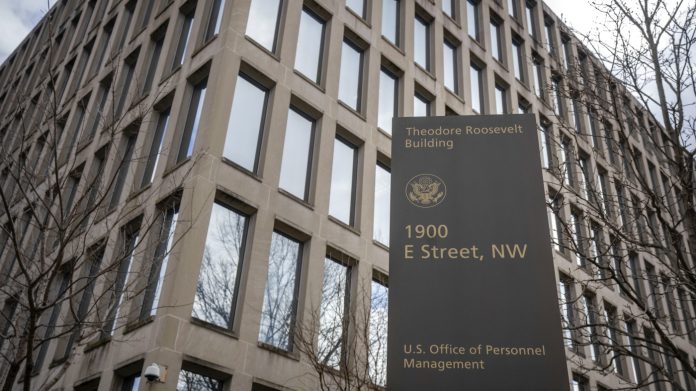
The Theodore Roosevelt Building, location of the U.S. Office of Personnel Management, is pictured on Feb. 13, 2024, in Washington, D.C.

Mark Schiefelbein/AP


hide caption

toggle caption

Mark Schiefelbein/AP

The Trump administration is targeting the federal workforce with sweeping cuts. Recently hired federal employees who are still on probationary status are some of the first positions on the chopping block.

The probationary firings have hit several agencies, including Veterans Affairs, the Department of Energy, the Small Business Administration and the Office of Personnel Management (OPM). The cuts are part of a Trump administration plan to slash government spending, overseen by DOGE, the governmental efficiency unit headed by Elon Musk. Compensation for federal employees comprised about 3% of the 2024 fiscal year federal budget, according to government data.

The scope of the terminations is not yet clear. But hundreds of thousands of probationary employees could be affected.

What is a probationary employee?

A probationary employee is a newly hired worker who is put on a “probationary” period — typically for one or two years, though it can be longer at some agencies — before they may be hired into full-time status. It’s like a trial period during which the worker and their performance is under heightened scrutiny until they become a permanent employee.

“The probationary period is a continuation of the job application process, not an entitlement for permanent employment,” said OPM spokesperson McLaurine Pinover.

Hundreds of thousands of workers across federal agencies hold the status. According to government data, around 220,000 federal employees had served under one year as of March 2024. Another 288,000 employees had between one and two years of service at that time.

Are all federal employees probationary to start?

Typically, yes.

Josh Jewett, an employment and labor attorney who represents people in the federal workforce, says he’s never seen anything otherwise.

What rights do probational employees have?

Unlike non-probationary employees, they have few employee rights. They may be let go without any prior notice or severance. In most cases, they don’t have the right to appeal their termination.

Probationary employees are entitled to a written letter or termination notice stating the reason for the firing, according to Suzanne Summerlin, a labor attorney in Washington, D.C.

However, if a probationary employee was fired on the basis of a protected characteristic or activity, there are legal avenues to challenge their dismissal as unlawful, according to Jewett. For example, they cannot be fired due to discrimination based on their race, gender and disability. Whistleblowers — who report fraud, abuse and other wrongdoings — are protected from being retaliated against.

If reinstated after a successful legal challenge, the probationary employee would be entitled to back pay, Jewett said.

What happens next?

The American Federation of Government Employees, which represents more than 800,000 civil servants, including federal workers subject to the cuts, said it would challenge the layoffs of probationary workers.

“AFGE will fight these firings every step of the way,” AFGE National President Everett Kelley said in a statement. “We will stand with every impacted employee, pursue every legal challenge available, and hold this administration accountable for its reckless actions.”

Love Letters – The New York Times

0

A friend told me he recently removed the email app from his phone. “I used to love in the old days, coming home and checking email — there would be new messages!” he rhapsodized. I felt the pang. Not only would there be new messages, but often, in those early days of email, they were actual electronic letters from friends, replete with emotional life updates and unspooling narratives. Before texting, email was an efficient way to communicate, and the way we communicated was in sentences, paragraphs, fully developed thoughts. We hadn’t yet glimpsed the future where “k” or a thumbs-up emoji was considered communication.

I’m always excited when people tell me they’ve deleted an app: another tiny reduction in the amount of time those in my orbit will be spending on their phones. Infinitesimal, perhaps, but moving in the right direction. We’re tinkering with these devices that own our attention, we’re taking back a little bit of control.

But I’m particularly interested in modifications that can bring back some of the magic of pre-smartphone communication, when letter writing wasn’t quaint and voice mails were miracles. I’ve written about my nostalgia for phone booths, recommending we borrow some of the parameters they provided and bring them into this century (say, containing our private conversations to private spaces).

Even if we’re nostalgic for the olden days, it’s hard to reinstitute the old habits. Deleting email from your phone may release you from the compulsion to check it all the time, but that doesn’t mean you’re going to come home to an inbox full of satisfying missives from your friends. Chances are, they’ve been texting you all day, and your inbox is actually full of spam and bills.

In an attempt to reduce my phone’s grip on my life, I once suggested to a friend that each time we wanted to send a text to each other, we send a postcard instead. I think we tried this for a week before admitting that it was an inefficient way to chat. I was aware of the art-project nature of the proposition from the outset and didn’t figure our experiment would replace texting, but I hoped that the postcards would be so delightful we’d at least keep a parallel stream of slow communication going. It didn’t happen.

A few weeks ago, I placed a phone call to a friend without warning, someone I’d never spoken on the phone with before. It felt a little reckless, a little rude, which made me want to do it even more, because it seems ridiculous that calling someone should be in any way controversial. It should feel wonderful that someone wants to hear your voice, that they were thinking of you and wanted to connect.

While I have a few people that I speak to on the phone regularly, most people I consulted view an unbidden phone call as hostile. They assume there’s an emergency if they get a call from someone with whom they don’t have a regular phone relationship.

My recent surprise phone call was awkward, as I suspected it might be. People used to have the bandwidth to receive phone calls from anyone at any time, even without caller ID. That skill set has vanished, replaced perhaps by the ability to process multiple group texts blowing up at once. Now, even if it’s someone you are happy to hear from, a surprise call feels a little like someone popping by unannounced in the middle of the night.

There are lots of ideas for how to break phone addiction, but not as many for how to regain the romance of what I’m coming to think of as the slow-comms era, the second half of the 20th century when the phone and the mail were our main means of long-distance communication. The ache at the sight of an empty mailbox was, in my memory, more than balanced out by the ecstasy at the letter that finally arrived.

It isn’t just the sane cadence of correspondence that we’re missing now, though; it’s the care and attention we gave to it. We sat down and wrote letters and emails. We may have been cooking dinner or folding laundry while we talked on the phone, but we were literally on the hook for the length of the call. Our communication required presence and continued focus on the other person.

We can certainly re-establish this kind of concentration with some people — I have a close friend who detests texting, and he’d be thrilled if I dispensed with it in favor of phone calls — but it’s just too efficient to abandon altogether. A more conceivable option is to try to bring the kind of steady presence and full attention I miss to in-person conversations.

If the bulk of our remote communication is destined to be mediated by technology, then let’s see how irrelevant we can make our phones when we’re actually together. Turn off alerts, turn off the damn things altogether, and practice really being there. We think we’re naturals at eye contact, at listening before formulating a response, at sitting together in silence. But like phone-call readiness and entertaining voice mail delivery, those skills atrophy too.

Film and TV

  • The lead prosecutor on Adams’s investigation wrote in his resignation letter to Bove: “I expect you will eventually find someone who is enough of a fool, or enough of a coward, to file your motion. But it was never going to be me.”

  • Prominent New York Democrats, including the lieutenant governor and Representative Alexandria Ocasio-Cortez, called on Adams to resign. They accused him of adopting President Trump’s policies to escape legal trouble.

Trump Administration

Other Big Stories

📺 “The White Lotus”: Another beautiful location. Another collection of wealthy guests and weary employees. Another mysterious crime. Season 3 of this dark comedy from the writer-director Mike White, which begins Sunday on HBO and Max, takes place at a wellness resort on a gem of an island in the Gulf of Thailand. There will be guns, monkeys and beautiful sunsets. This season’s cast includes Walton Goggins, Parker Posey and Lisa of the K-pop group Blackpink.

If you adore the nubby chewiness of oatmeal raisin cookies but don’t think that anything qualifies as dessert if it doesn’t have chocolate, Genevieve Ko has the treat for you: oatmeal cookies with chocolate chips. Made with just enough batter to bind the oats, they’re a perfect showcase for the real star of the show, that generous handful of chocolate chips. Bake these over the weekend so you can nibble them all week long — stashed into lunchboxes, savored as a midafternoon snack, or for dessert, naturally, with a big glass of milk.

No. 1 Auburn vs. No. 2 Alabama, men’s college basketball: Before today, the football-obsessed Southeastern Conference had never had a top-two matchup in basketball. How exciting, then, that the conference’s first is this showdown between in-state rivals. Auburn and Alabama have the two best offenses in the country, The Athletic’s Brendan Marks writes, which means this game isn’t just historic — it should also be really exciting. Today at 4 p.m. Eastern on ESPN

Week in politics: Trump, Putin discuss the war, House and Senate Republicans divided

0

We look at President Trump’s relationship with Russian President Vladimir Putin and why House and Senate Republicans are charting different paths to passing Trump’s budget.

Even in Death, Navalny Is Seen by the Kremlin as an Enduring Threat

0

Six months after the opposition leader Aleksei A. Navalny died in a Russian prison above the Arctic Circle, Konstantin A. Kotov woke up to find his Moscow apartment under siege.

After breaking down the door, Russian officers set about confiscating everything to do with Mr. Navalny, down to a campaign button from the activist’s 2018 presidential run and a book written by his brother. Then, they arrested Mr. Kotov and took him away.

His alleged crime: donating approximately $30 three years earlier to Mr. Navalny’s Anti-Corruption Fund, which the Kremlin considers an extremist group.

The death one year ago of Mr. Navalny, who once led tens of thousands of Russians against the Kremlin on the streets of Moscow, dealt a serious blow to Russia’s already beleaguered opposition. Much of that movement has fled abroad amid a crackdown on dissent that began before President Vladimir V. Putin’s invasion of Ukraine in 2022, but escalated with the war.

Even with Mr. Navalny dead and his movement in tatters, the authorities have been going after people with links to him and his organization inside Russia. Some see the continued prosecutions as a repressive Russian machine operating on autopilot. Others see a Moscow that views the opposition figure’s legacy as an enduring threat.

“They seem to be doing it more out of habit, rather than as a new campaign,” said Sergei S. Smirnov, the editor in chief of the exiled media outlet Mediazona.

But there are also senior officers in the F.S.B., Russia’s domestic intelligence service, who see themselves as strangling a political underground that presents the same risk to the Kremlin that the Bolsheviks posed before Russia’s monarchy was toppled in 1917, said Andrei Soldatov, a Russian author and expert on the security establishment.

“The comparison to the Bolsheviks and the Russian Revolution is embedded in those people’s heads,” Mr. Soldatov said by phone from London. “Czarist Russia crumbled because of a big war and a major political party operating underground.”

The authorities have focused on a wide range of targets.

Last year, they went after journalists who remained in Russia and continued to cover Mr. Navalny’s ordeal, accusing them of cooperating with his organization.

Antonina Favorskaya, a reporter for the Sota Vision media outlet, was arrested last March on charges of “participating in an extremist organization.” She was accused of filming footage later used by Mr. Navalny’s associates on their media platforms.

A rare reporter to attend court hearings for Mr. Navalny shortly before his death, Ms. Favorskaya shot the last known video of him addressing the court via a video link from his Arctic prison colony the day before he died.

Russian authorities later arrested three more journalists and put them all on trial together. Artyom Kriger, one of the defendants, said he and others stood accused of filming interviews on the street in Russia for Mr. Navalny’s YouTube channel.

There has yet to be a verdict.

Moscow also pursued charges against Mr. Navalny’s lawyers.

A court some 80 miles east of Moscow last month sentenced three lawyers for Mr. Navalny to as much as five and a half years in prison for passing correspondence from the incarcerated politician to his allies. The court ruled that it was tantamount to “participating” in Mr. Navalny’s illegal movement.

Mr. Navalny’s lawyers insisted they were being tried for routine legal work that includes passing on communications on behalf of imprisoned clients.

Cases seeking to punish ordinary Russians for making donations to Mr. Navalny’s team, some of them as paltry as $3, have also cropped up in courts.

Russian authorities have prosecuted at least 15 people on charges of funding an extremist organization for sending donations to Mr. Navalny’s Anti-Corruption Fund. In the past few months, local media reported such charges against a physician from Biysk, an IT engineer from a St. Petersburg suburb and a political activist from Ufa.

“These are simply people who maybe just transferred 500 rubles a long time ago to the Anti-Corruption Fund,” Mr. Kotov, a wiry 39-year-old activist who works for a human rights organization, said, referring to a sum that is a little over $5.

By the time a donation case was opened against him, Mr. Kotov had long been on the radar of Russian authorities for rallying against Kremlin abuses.

In 2019, he was one of the first people to be arrested under a new Russian law restricting freedom of assembly at “unsanctioned protests.” (The law laid the groundwork for a near total protest ban that later helped pacify wartime Russia.)

He spent 18 months in prison, most of it at a harsh facility in Russia’s Vladimir region, about 60 miles east of Moscow.

Shortly after Mr. Kotov’s release, Mr. Navalny returned to Russia, having recovered abroad in Germany from a near-fatal poisoning. Within weeks, Mr. Navalny would end up in the same prison where Mr. Kotov had been jailed.

That year, a Russian court outlawed and liquidated Mr. Navalny’s Anti-Corruption Fund, labeling it extremist. The ruling criminalized fund-raising from ordinary Russians that for years had kept the group afloat.

Mr. Navalny’s top aides took to YouTube and made an urgent plea for donations to keep the organization alive, saying they had worked out a secure system for supporters to transfer funds to a bank account outside Russia.

Mr. Kotov saw how Mr. Navalny had landed in the same prison where he had suffered, and felt a personal connection. He signed up to give a 500 ruble donation per month, believing the new platform was secure.

“It was my gesture to show that I didn’t agree with the liquidation of the Anti-Corruption Fund and that I supported Aleksei Navalny, who was in prison,” Mr. Kotov said. “I wanted his activities to continue.”

Half a year later, in January 2022, Mr. Kotov got nervous and stopped the donations. But by then, it was too late. Some of the transactions had revealed the Anti-Corruption Fund’s foreign bank information to Russian authorities by including a reference to the group’s name in the transfer data. The donations had not been secure.

The following month, Mr. Putin invaded Ukraine, prompting Mr. Kotov to go out in the streets of Moscow and protest the war. He was quickly arrested and spent the next month in jail. Two and a half years later, the authorities came to his apartment and arrested him for the six 500 ruble donations he made to the Mr. Navalny’s fund. He pleaded guilty.

A court released him under house arrest. At first, he thought he would stay in Russia. Other donors charged with the same crime had gotten away with fines.

But then, in December, a court in Moscow found Ivan S. Tishchenko, a 46-year-old heart surgeon, guilty for sending 3,500 rubles in donations to Mr. Navalny’s foundation. His sentence: four years in prison.

Dr. Tishchenko had subscribed to recurring donations to the Anti-Corruption Fund well before Russian authorities outlawed it as extremist in 2021.

Dr. Tishchenko’s lawyer, Natalya Tikhonova, described the verdict as “too harsh for a person who saved thousands of lives and definitely never intended to cause any harm to Russia’s constitutional order.”

Mr. Kotov, wary of a return to Russian prison, fled to Lithuania this year.

In an interview from there, Mr. Kotov described how Mr. Navalny had represented hope “that Putin isn’t immortal, that at some point this regime will come to an end.”

“Aleksei Navalny was the symbol of a beautiful Russia of the future, a happy Russia of the future,” he said. “When that symbol was gone, I started to feel much worse.”

“But we’re still living,” he added. “We can’t give up.”

U.S. judge pauses Trump order against gender-affirming care for youth : NPR

0

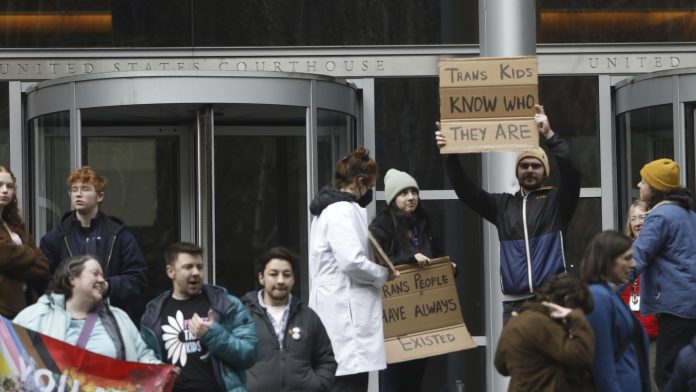
People celebrate outside a Seattle federal courthouse after a second federal judge paused President Trump’s order against gender-affirming care for youth on Friday.

Manuel Valdes/AP


hide caption

toggle caption

Manuel Valdes/AP

SEATTLE — A second federal judge on Friday paused President Donald Trump’s executive order halting federal support for gender-affirming care for transgender youth under 19.

U.S. District Court Judge Lauren King granted a temporary restraining order after the Democratic attorneys general of Washington state, Oregon and Minnesota sued the Trump administration last week. Three doctors joined as plaintiffs in the suit, which was filed in the Western District of Washington.

The decision came one day after a federal judge in Baltimore temporarily blocked the executive order in response to a separate lawsuit filed on behalf of families with transgender or nonbinary children. Judge Brendan Hurson’s temporary restraining order will last 14 days but could be extended, and essentially puts Trump’s directive on hold while the case proceeds. Hurston and King were both appointed by former President Joe Biden.

Trump signed an executive order last month halting federal funding for institutions that provide the care and directing federally run insurance programs, including Medicaid and TRICARE for military families, to exclude coverage for it. The order also calls on the Department of Justice to pursue litigation and legislation to oppose it.

Medicaid programs in some states cover gender-affirming care. Trump’s order suggests that the practice could end, and targets hospitals and universities that receive federal money and provide the care.

In the complaint filed in Seattle, the three Democratic attorneys general argue that the executive order violates equal rights protections, the separation of powers and states’ powers to regulate what is not specifically delegated to the federal government.

The Trump administration disputed those claims in court filings. “The President’s authority to direct subordinate agencies to implement his agenda, subject to those agencies’ own statutory authorities, is well established,” Justice Department attorneys wrote.

A large crowd of people went to the federal courthouse to watch Friday’s hearing. Outside, some carried signs with phrases including “Protect Trans Kids” or Pride flags with the words, “You are loved.”

“We had over 100 declarants submit their personal stories about the impact of this illegal and unconstitutional and hateful order, and their bravery allowed for justice to be done today,” Washington Attorney General Nick Brown said after the ruling.

The temporary restraining order is just the first step in a long fight, Brown said, adding that he hopes the order reassures health care providers in the state that they can continue to provide gender-affirming care to their patients.

“The word I would use is relief, right?” third-year medical student Natalie Koconis said when asked for a response to the judge’s ruling. One of a group of medical students and doctors in white coats who held signs outside the courthouse, Koconis said Trump’s executive order “is something that has already had material impacts on our ability” to treat transgender youth. “All we want is just everybody to get the care that they need and deserve.”

In addition to the orders on health care access and defining the sexes as unchangeable, Trump has also signed orders that open the door to banning transgender people from military service; set up new rules about how schools can teach about gender; and intend to ban transgender athletes from participating in girls and women’s sports.

Legal challenges have already been filed on the military order, the plan to move transgender women in federal prisons to men’s facilities and the recognition only of people’s sex as assigned at birth, which led to the halting of allowing gender markers to be changed on passports.

Other lawsuits are likely to be filed, just as there have been challenges to a variety of Trump’s policies.

As transgender people have gained visibility and acceptance in some ways, there’s been vehement pushback. At least 26 states have passed laws to restrict or ban gender-affirming care for minors. The U.S. Supreme Court heard arguments last year but has not yet ruled on whether Tennessee’s ban on the care is constitutional.

German Chancellor Rebukes Vance for Supporting Party That Downplays Nazis

0

Chancellor Olaf Scholz of Germany on Saturday accused Vice President JD Vance of unacceptably interfering in his country’s imminent elections on behalf of a party that has played down the atrocities committed by the Nazis 80 years ago.

A day after Mr. Vance stunned the Munich Security Conference by telling German leaders to drop their so-called firewall and allow the hard-right Alternative for Germany, or AfD, to enter their federal government, Mr. Scholz accused Mr. Vance of effectively violating a commitment to never again allow Germany to be led by fascists who could repeat the horrors of the Holocaust.

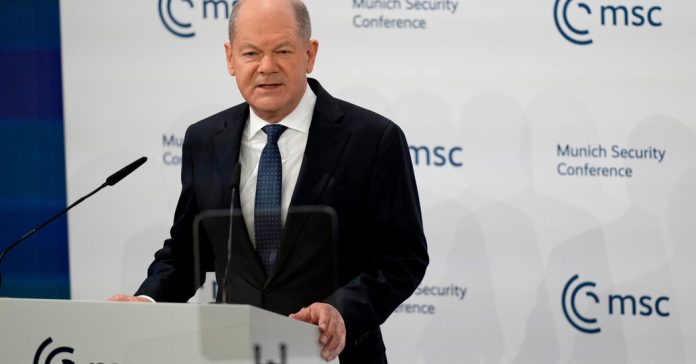
“A commitment to ‘never again’ is not reconcilable with support for the AfD,” Mr. Scholz said at the conference on Saturday morning, in an address opening the gathering’s second day.

Mr. Scholz said the AfD had trivialized Nazi atrocities like the concentration camp at Dachau, which Mr. Vance visited on Friday. The chancellor said Germany “would not accept” suggestions from outsiders about how to run its democracy — or directives to work with such a party.

“That is not done, certainly not among friends and allies,” Mr. Scholz said. “Where our democracy goes from here is for us to decide.”

Attendees at Mr. Vance’s speech had been expecting to hear details of the Trump administration’s plans for Ukraine peace talks and NATO defense policies. On Saturday, President Volodymyr Zelensky of Ukraine himself put the focus on the Ukraine war in his remarks, starkly laying out the threat from Russia’s battle-hardened military and making an impassioned appeal for Europeans to take their security into their own hands, including by forming an “Army of Europe” that would supplement U.S. power on the Continent.

His speech drew standing ovations, in contrast to Mr. Vance’s speech the day before.

Saturday’s sessions of the security conference were dominated by reactions, predominantly negative, to Mr. Vance’s speech.

Mr. Scholz was joined in his criticism by Friedrich Merz, his rival as the chancellor candidate for the conservative Christian Democrats, who polls suggest is the favorite to be Germany’s next leader.

Mr. Vance spent much of his speech on Friday scolding Europeans for what he suggested were Soviet-style restrictions on free speech across the continent. On Saturday, Mr. Merz defended Germany’s laws that prohibit particular forms of speech, including hate speech and banned Nazi slogans, including on social media.

He also suggested that Mr. Trump’s administration was suppressing speech in the United States, after it moved on Friday to kick The Associated Press out of reporting pools and off Mr. Trump’s plane because the news agency refuses to go along with Mr. Trump’s directive to change the name of the Gulf of Mexico to the Gulf of America.

“We stick to the rules which are given by our democratic institutions,” Mr. Merz said. “Free speech remains free speech and remains part of our open, democratic society. And fake news, hate speech and offenses remain subject to legal restraints and controlled by independent courts.”

“I think I should say,” he added, “that in front of the events which took place in D.C. yesterday — we would never kick out the news agency, out of the press room of our chancellor.”

The comments were the latest in a series of critiques of Mr. Vance’s speech from German politicians before the election next Sunday. Mr. Scholz’s Social Democrats are running third or fourth in most polls. The AfD is running second, and its chancellor candidate, Alice Weidel, met Mr. Vance on Friday in Munich.

No party in the German Parliament will join with the AfD to form a government. Parts of the AfD have been classified as extremist by German intelligence. Some of its members have been convicted of violating German law against the use of Nazi slogans. Others have been arrested for trying to overthrow the federal government.

That collective shunning of the AfD and other extremist parties is known as the firewall. Mr. Vance took aim at it on Friday, saying the AfD and other hard-right parties across Europe represented legitimate voter concerns about high levels of migration into European countries from the Middle East and elsewhere.

“There is no room for firewalls,” Mr. Vance said.

The vice president also called restrictions on free speech a greater threat to Europe than military aggression from Russia or China.

Mr. Scholz chided Mr. Vance for that focus in a question-and-answer session after his speech. He was asked by Zanny Minton Beddoes, the editor in chief of The Economist, if Mr. Vance had made any points in his speech worth reflecting on.

“You mean all these very relevant discussions about Ukraine and security in Europe?” Mr. Scholz said, drawing laughter from the audience.

Then he addressed Mr. Vance’s critique of European speech restrictions directly.

“We should be very clear that free speech in Europe means that you are not attacking others in ways that are against legislation and laws we have in our country,” Mr. Scholz said. “And that’s the case. There is no difference between the digital world and the analog world to say it like this. And we have to be very clear that hate and all this, which is so bad for our societies, should be not the reality of public debate.”

Mr. Zelensky, in his remarks, focused on the question of European defense. He reiterated his position that the United States would be pivotal in securing any cease-fire in Ukraine but that it would need Europe to also step up. He pointed to what he said were intelligence warnings of Russian plans to conduct military exercises in Belarus next summer. He noted that Russia had invaded Ukraine after deploying troops to Belarus under the guise of exercises.

“Europe just needs to come together and start acting in a way that no one can say ‘No’ to Europe, boss it around, or treat it like a pushover,” Mr. Zelensky said.

In a conversation with the CNN anchor Christiane Amanpour after his speech, Mr. Zelensky also said that Ukraine needed to be at the table at any cease-fire talks, and he asked to meet with President Trump before any meeting that Mr. Trump has with President Vladimir V. Putin of Russia.

“It’s up to them, they can discuss anything they want, but not Ukraine without Ukraine,” he said.

Courts block Trump’s DOGE actions — chaos, panic not proving to be best legal strategy : NPR

0

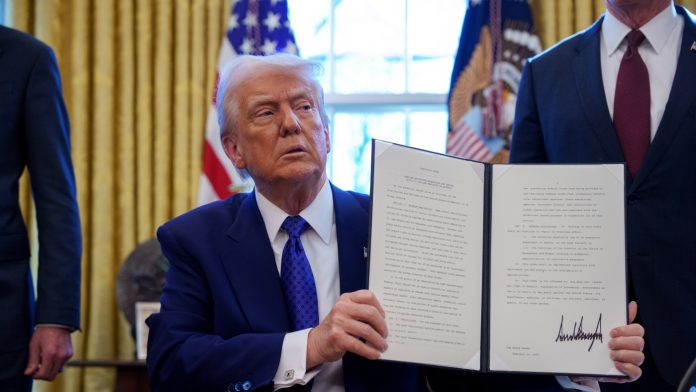
President Donald Trump signs an executive order withholding federal funding from schools and universities that impose a COVID-19 vaccine mandate in the Oval Office on Feb. 14, 2025. Many of Trump’s executive actions are facing legal challenges in the courts.

Andrew Harnik/Getty Images


hide caption

toggle caption

Andrew Harnik/Getty Images

The Trump administration and its Department of Government Efficiency team continue to crash into more federal agencies– shutting down ongoing work and firing thousands of federal employees.

It is a historic power grab by the president. But the chaotic approach also may be undermining his chances of getting the courts to go along with the effort as lawsuits pile up along with court orders blocking the DOGE team.

“I hope that the court system is going to allow us to do what we have to do,” Trump said this week in a lengthy Oval Office meeting with reporters. “We got elected to, among other things, find all of this fraud, abuse, all of this, this horrible stuff going on.”

The examples of “fraud” Trump has so far offered up actually appear to be programs he just doesn’t like, such as diversity initiatives.

There is serious concern from legal experts, conservatives and liberals alike about the administration’s sweeping and abrupt moves– freezing broad swaths of federal money approved by Congress, gaining access to sensitive Treasury payment systems, and trying to shut down entire agencies overnight.

“ From the chaos in and around the administration, to the chaos in the courts who are trying to grapple with it, and for all of us who are watching it happen,” said Adam White with the conservative American Enterprise Institute, “we can all agree this is no way to run a country.”

White said these actions don’t appear to be carefully thought out and explained and that makes judges more likely to be confused and skeptical. Other experts on executive power agree.

“Every other presidential administration in modern American history spends a fair bit of time explaining in legal language and in legal arguments, why what they’re doing is actually legal,” said Deborah Pearlstein, a constitutional scholar at Princeton University who served in the Clinton White House.

“Even if it appears like a huge power grab and almost certainly beyond the scope of the president’s power, they have some argument,” she said.

But she said so far that is basically not happening in the second Trump Administration. And for that reason, it doesn’t seem to be rolling out this DOGE restructuring effort in a way that would be in its own best interest – legally speaking.

Pearlstein said the conservative Supreme Court might be sympathetic to some of the ways the president appears to want to expand his powers.

But she says you learn quickly in the White House not to do anything without having some really good lawyers in the room to make sure you are going about it in the right way. She says Trump and billionaire Elon Musk, who’s heading the DOGE effort, appear to be figuring they can just do whatever they want and let the lawyers figure it out later.

“That seems to me pretty likely with some of the DOGE stuff to be what’s going on,” Pearlstein said. “And in part for that reason, a lot of that stuff is going to get struck down by the courts pretty quickly.”

And that is already starting to happen.

On Thursday, two different federal judges temporarily blocked the Trump administration’s attempt to shutter USAID. One ordered it to lift a funding freeze on foreign aid, while another barred the administration from placing thousands of USAID workers on leave.

Meanwhile a federal judge in Manhattan said Friday she will continue to block DOGE’s access to sensitive Treasury Department records and systems. Also on Friday, a judge in D.C. issued an order temporarily blocking layoffs at the Consumer Financial Protection Bureau, another agency Musk has said he wants to dismantle.

The Trump administration did get a win in the courts this week when a federal judge in Massachusetts allowed its “Fork in the Road” resignation offer to proceed, ruling labor unions that brought a lawsuit lacked standing.

For his part White with AEI said while he’s not a fan of the administration’s chaotic moves, “the only question is whether this is just an exceptional flurry of new policymaking energy in the first weeks of the administration?”

He said he hopes and expects that will be the case and that after a few weeks things will clarify and slow down.

But he also wondered, “if this is going to be the style of governance for four entire years… we’ll see.”

Certainly this is not the first administration that announced big plans to eliminate waste fraud and abuse in government.

“Under President Reagan there was something called the Grace Commission,” said Linda Bilmes, a government efficiency expert with the Harvard Kennedy School.

“He charged the commission to work like bloodhounds– don’t leave any stone unturned in your search to root out inefficiency,” she said.

But she says both Reagan and President Clinton worked within the system. Clinton and his Vice President Al Gore received input from civil servants to find cost savings. Reagan worked with Congress to pass lasting legislation.

Bilmes said so far what she’s seeing now is more of a clumsy attack on the system.

“Not only is this effort not accomplishing the task of weeding out inefficiency, but… It’s like cutting off your arm to lose weight,” she said

In other words it might seem like it works for a minute, but it creates a lot more problems than it solves.

Some political analysts note that the DOGE attack on Washington optics may be playing well to Trump’s base and could be seen as a short-term political win.

But even so, why the administration is taking this approach, when Republicans control both the Senate and the House, have a starkly conservative Supreme Court and could be passing legislation, that’s an ongoing mystery for many political and legal experts.

Relief in Israel as Newly Released Hostages Appear to Be in Better Shape

0

On this sun-drenched morning there appeared to be fewer people gathered in Hostages Square than on previous release days. Naama Moses, a volunteer selling merchandise to support the Hostages and Missing Families Forum, which represents relatives of the captives, ascribed this to the pain that many felt when they saw the three men who were freed last week.

“Perhaps containing your disappointment would be easier at home in front of the telly, on your own,” Ms. Moses said.

Dr. Hagai Levine, the head of the medical team for the hostage families group, said that while the men released Saturday were talking and walking on their own, it was evident from the video of their release that they needed medical care. “Now they will have to be examined very carefully,” he said.

Dr. Levine said those released recently had shared “dreadful testimonies” about the status of hostages who remain in Gaza. “Being in captivity for nearly 500 days means severe damage to their health,” he said. “They don’t have time, they may not survive the next weeks.”

The specter of the cease-fire negotiations breaking down alarmed families whose loved ones were not set to be released during the cease-fire agreement’s current phase, which ends early next month.

“There’s concern,” said Mr. Zexer, whose family hosted the Israeli American hostage Edan Alexander during his military service in Israel. “We are living in a reality show that even the devil couldn’t have conceived.”

Describing the tension and uncertainty between each week’s release, Mr. Zexer said that “the hostages are paying the price.”

Viki Cohen, the mother of an Israeli soldier still held captive in Gaza, said in an interview that the joy of seeing three more hostages released was tempered by anguish and uncertainty.

“We are on a crazy roller coaster,” said Ms. Cohen, who recently received evidence that her son Nimrod was still alive. He is not among the hostages expected to be released in the first phase of the cease-fire. “We are doing everything in our power for him to return,” she said.

Even after the Red Cross drove away with the newly released men, heading toward Israel, the crowd at Hostages Square remained, hoisting pictures of people still in captivity in a subdued celebration of solidarity.

“It’s overwhelming to be here, the warmth and the love,” said Jennifer Brandeis, who was visiting Tel Aviv from Virginia. “Being together — it’s everything to me.”

Trump’s efforts with DOGE cuts test Watergate-era reforms : NPR

0

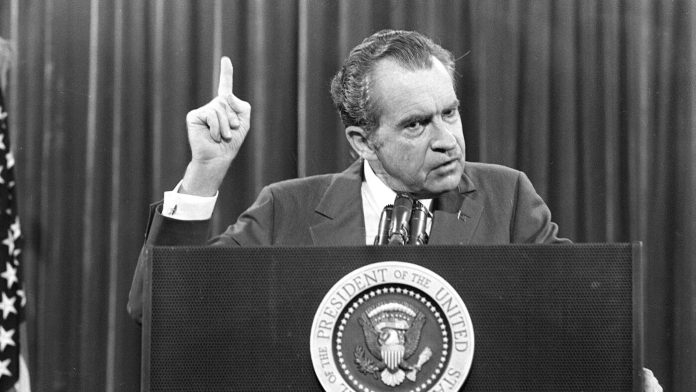
In this Nov. 17, 1973 file photo, President Richard Nixon speaks near Orlando, Fla. to the Associated Press Managing Editors annual meeting. Nixon told the APME “I am not a crook.”

File/AP


hide caption

toggle caption

File/AP

President Trump is firing government watchdogs, trying to shutter entire agencies and pausing spending on things that don’t fit with his agenda. These efforts to reshape the government at a rapid clip have put him on a collision course with laws passed after the Watergate scandal.

For a generation, the narrative was that Watergate ushered in greater congressional oversight and a taming of presidential power. But over the years, those limits spurred a movement on the political right to restore power in the executive branch, said Bruce Schulman, a history professor at Boston University.

Trump, in his second term, is pushing new boundaries. “What we are seeing now is a final campaign, a frontal attack of the last vestiges of that particular post-Nixon historical moment,” said Schulman.

President Richard Nixon at the White House with his family after his resignation on Aug. 9, 1974.

President Richard Nixon at the White House with his family after his resignation on Aug. 9, 1974.

Keystone/Getty Images/Hulton Archive


hide caption

toggle caption

Keystone/Getty Images/Hulton Archive

What happened after Nixon

President Richard Nixon weaponized the FBI and CIA against his political enemies, resisted the will of Congress on federal spending and obstructed investigations into his alleged wrongdoing. Ultimately, he resigned as an impeachment effort was gaining steam.

“Nixon’s removal from office in 1974 initiated a widespread and bipartisan effort to limit presidential power, to clean up corruption, to make the government more transparent,” Schulman said.

Democratic Senator Walter Mondale was part of a bipartisan push to curb what he described as “the imperial presidency” in a 1974 interview with NPR.

“If we can — before this is over — establish the principle that any president including this one is under the law and must respond to the Constitution and the courts and to the Congress and the American people, we will have saved ourselves from a very dangerous trend,” Mondale said in the interview.

Watergate created an appetite for change

After Nixon’s resignation, a new class of lawmakers swept into Congress with a mandate for reform. They worked on a wide-ranging list of new checks on the executive branch. The laws sought to rein in presidential use of national emergencies and war powers.

There were new protections to prevent the federal civil service from being politicized and a new 10-year term for the FBI director to limit political interference.

The laws placed inspectors general in federal agencies, and created the Office of Government Ethics and the Office of Special Counsel — watchdogs to keep an eye on the executive branch.

“These are a bunch of laws that are meant to serve as notice of congressional intent, to stand up to presidential overreach,” said Andrew Rudalevige, a professor of government at Bowdoin College.

President Trump signs an executive action on tariffs in the Oval Office on Feb. 13, 2025.

President Trump signs an executive action on tariffs in the Oval Office on Feb. 13, 2025.

Andrew Caballero-Reynolds/AFP


hide caption

toggle caption

Andrew Caballero-Reynolds/AFP

What Trump has been unwinding

Since taking office, Trump has fired more than a dozen inspectors general. He also blew past a 2022 law requiring that there be cause for any such firings and provide advance notice to congress.

“As the statute is written … what President Trump did, violates the law,” said Stanford law professor Anne Joseph O’Connell. “Now, whether this conservative Supreme Court would uphold that law is uncertain.”

The White House is arguing that because these watchdogs work in the executive branch, President Trump has the authority to fire them no matter what the laws written by Congress say.

“Those are plausible legal arguments,” said Blake Emerson at UCLA Law. “They were not plausible legal arguments 20 years ago — but they are now.”

Federal judges have put a hold on many of the Trump administration’s recent actions and orders at least temporarily. Some of these cases may end up with the Supreme Court. 

The White House said it will appeal the court injunctions blocking their efforts, while also questioning the motives of the judges making those preliminary rulings.

“The real constitutional crisis is taking place in our judicial branch where district court judges in liberal districts across the country are using their power to unilaterally block the president’s basic executive authority,” White House press secretary Karoline Leavitt told reporters.

Vice President Vance suggested on social media that judges don’t have the authority to challenge President Trump’s “legitimate power.”

UCLA’s Emerson said the conservative supermajority on the Supreme Court has started to hem in Congress’ ability to oversee the executive branch.

“The post-Nixon reforms are under challenge, and may fall by the wayside,” said Emerson.

President Trump steps off of Air Force One at Palm Beach International Airport in West Palm Beach, Fla., on Feb. 14, 2025.

President Trump steps off of Air Force One at Palm Beach International Airport in West Palm Beach, Fla., on Feb. 14, 2025.

Roberto Schmidt/AFP


hide caption

toggle caption

Roberto Schmidt/AFP

The power of the purse

Another law under pressure is the Impoundment Control Act of 1974, a response to Nixon’s refusal to spend funds as directed by Congress. The law underscored that the Constitution gives Congress the power of the purse.

Trump officials have said the Impoundment Control Act is unconstitutional and are trying to move ahead with slashing spending on programs and agencies that don’t line up with the president’s policy priorities.

Some conservatives have said the Trump administration is stretching presidential power too far.

“I’d like to see a lot of agencies eliminated,” said Gene Healy, senior vice president for policy at the Cato Institute, a libertarian think-tank. “I don’t think an effort to do that is going to get very far without Congress.”

Congressional Republicans are standing by Trump

Healy said the post-Watergate era was really the last “serious sustained effort” by Congress to put the presidency back within its constitutional limits.

And other presidents have also tried new and different ways to exert their power, from George W. Bush’s wide-ranging actions after the Sept. 11 attacks, to Barack Obama’s actions protecting undocumented “Dreamers” brought to the United States as children, to Joe Biden’s push to erase billions of dollars in student loan debt.

“It didn’t start with Trump 1.0 and it didn’t stop during the Biden administration,” Healy said.

Today, a Republican-controlled Congress is showing much more deference to the White House as Trump tests the limits of his authority. Some congressional Republicans have introduced bills to give the president’s executive orders the force of law, while others have shrugged off questions about whether Trump has overstepped. 

“The phrase I’ve been using for 20 years is, you can’t have an imperial president without an invisible Congress — and that’s certainly true today,” said Bowdoin College’s Rudalevige.

NPR’s Lexie Schapitl contributed to this story.

Hamas Releases 3 More Israeli Hostages: Live Updates

0

Hamas freed three more Israeli hostages on Saturday in a ceremony marked by some of the same provocative theatrics used by the Palestinian militants in previous releases.

It was the sixth round of a tense series of hostage-for-prisoner exchanges that are part of a 42-day cease-fire deal between Israel and Hamas, which went into effect last month. Overall, Hamas agreed to release 33 of the nearly 100 people who were captured on Oct. 7, 2023. In exchange, Israel agreed to free more than 1,000 Palestinians held in its jails and partially withdraw from Gaza.

Here’s a closer look at the three civilian male hostages, including an Israeli American, who were released on Saturday:

Sagui Dekel-Chen

Credit…Saher Alghorra for The New York Times

Mr. Dekel-Chen, an Israeli American who had played for Israel’s national basketball team, was 35 when he was taken from Nir Oz, a kibbutz in southern Israel close to the Gaza border where militants abducted more than 70 people in the Hamas-led attack on Oct. 7, 2023.

He is a father of three; his youngest child was born during his captivity. Mr. Dekel-Chen worked as national coordinator for the British branch of the Jewish National Fund and with his wife, converted buses for new uses, such as for mobile classrooms.

Mr. Dekel-Chen’s family was active in advocating a cease-fire deal. His father, Jonathan Dekel-Chen, a history professor at Hebrew University in Jerusalem, wrote an opinion piece for The New York Times critical of the Israeli government for not bringing home the hostages.

In August, the professor told The Times that he and other members of the Nir Oz kibbutz would not participate in an official government ceremony then being planned to commemorate the Oct. 7 attack. He said they were “appalled by the idea of this government creating a ceremony that would distract from their culpability.”

Mr. Dekel-Chen’s mother, Neomit Dekel-Chen, and some neighbors were also captured in the Oct. 7 attack. She escaped from an electric cart that was heading toward Gaza when an Israeli military helicopter shot at the militants, according to an account she gave to Israeli news media.

Iair Horn

Credit…Saher Alghorra for The New York Times

Mr. Horn was 45 when he was abducted from Nir Oz along with one of his two brothers, Eitan, who was visiting for the weekend. Iair Horn worked in construction and his brother worked as a teacher.

Iair Horn was born in Israel and raised in Argentina. He returned to Israel as an adult along with his parents and siblings, according to their mother, Ruth Strom. They are part of a large Argentine community on the kibbutz, including other families awaiting the return of hostages.

Eitan Horn has not been slated for release in the first phase of the cease-fire deal, and Ms. Strom has said she was anxious that Iair would have to leave his brother behind.

Their father, Itzik Horn, said in December 2023, after the Israeli military mistakenly shot and killed three hostages who had fled their captors in Gaza, that Israel must reach a deal even if it means freeing prisoners designated as terrorists.

“The most important thing isn’t to defeat Hamas,” he said in an interview. “The only victory here is to bring back all the hostages.”

Sasha Troufanov

Credit…Saher Alghorra for The New York Times

Mr. Troufanov, a Russian Israeli dual citizen who was 27 when he was captured, was visiting family in Nir Oz on Oct. 7. His father was killed, and his mother, grandmother and girlfriend were taken hostage but released during an earlier cease-fire, in November 2023.

Mr. Troufanov, who lived with his girlfriend in a Tel Aviv suburb and worked at a company owned by Amazon, was seen in a video released by Palestinian Islamic Jihad — the second most powerful militant group in Gaza after Hamas — in November of last year. He appeared weary, with an untrimmed beard and bags under his eyes, and spoke of a lack of food and water.

In October, Mousa Abu Marzouk, a senior Hamas official, told Russia Today that he had spoken to Islamic Jihad about Mr. Troufanov, and that Hamas would give priority to him in any exchange of hostages and Palestinian prisoners “in honor” of President Vladimir V. Putin of Russia.