Friday, November 13, 2026
Home Blog Page 219

A Quick, Quiet Trip to Belarus Signals a Turn in U.S. Policy

0

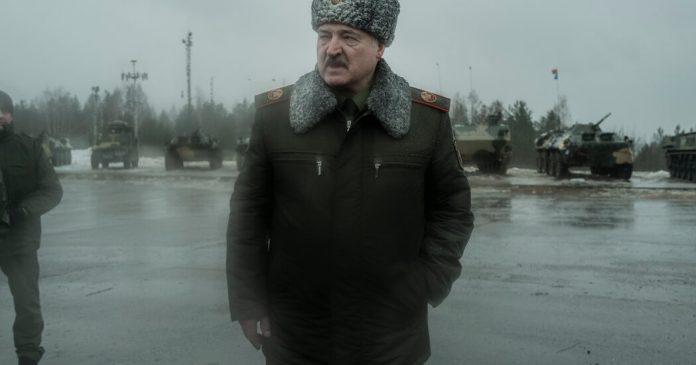
The senior American diplomat slipped quietly into Belarus, a police state run by a strongman reviled for decades in the West, traveling by car across the border for meetings with President Aleksandr G. Lukashenko and the head of his KGB security apparatus.

It was Mr. Lukashenko’s first meeting with a senior State Department official in five years, and the start of what could be a highly consequential thawing of frozen relations between the United States and Russia’s closest ally.

The below-the-radar American visit to Minsk, the Belarusian capital, on Wednesday came just a day after President Trump had a long telephone call with President Vladimir V. Putin of Russia. Both events signaled Washington’s departure from a yearslong policy of trying to isolate leaders out of favor in the West because of their repressive policies and the war in Ukraine.

After talks with Mr. Lukashenko, Christopher W. Smith, a deputy assistant secretary of state, and two other American officials drove to a village near the border with Lithuania. There, courtesy of the Belarusian KGB, three people who had been jailed — an American and two Belarusian political prisoners — were waiting to be picked up.

As darkness fell, the Americans and the freed prisoners drove back across the border to Vilnius, the Lithuanian capital. Speaking outside the U.S. Embassy there on Wednesday evening, Mr. Smith hailed the successful completion of what he called “a special operation,” describing the prisoners’ release as a “huge win and a response to President Trump’s peace through strength agenda.”

The next step, Mr. Smith told a gathering of Western diplomats on Thursday in Vilnius, according to people who attended, is a possible grand bargain under which Mr. Lukashenko would release a slew of political prisoners, including prominent ones. In return, the United States would relax sanctions on Belarusian banks and exports of potash, a key ingredient in fertilizer, of which Belarus is a major producer.

The people who relayed Mr. Smith’s account of his talks in Minsk spoke on the condition of anonymity to discuss a confidential meeting. Mr. Smith himself has not publicly disclosed whom he met with or what was discussed, and the State Department did not respond to questions about those details.

Belarus, which usually gloats over any sign that it is breaking out of its isolation, has also been mostly silent, though an anchor on state television, Igor Tur, introduced a note of mystery, suggesting that Mr. Smith was not the real leader of the American delegation and that a more senior official also took part.

Franak Viacorka, the chief of staff to the exiled opposition leader Svetlana Tikhanovskaya, who has long called for toughening of sanctions, said: “We are very grateful to President Trump that he managed to move things forward.” But, he added, sanctions should be eased only when “Lukashenko stops repression and new arrests” and “releases all political prisoners, including top figures.”

Viasna, a human rights group that keeps a tally of political prisoners in Belarus, put their number this week at 1,226. Mr. Lukashenko has in recent months released more than 200 of them, including two Americans set free since Mr. Trump took office, but opposition activists say that even more people have been arrested during the same period.

Tatyana Khomich, a sister of one of Belarus’s most prominent political prisoners, Maria Kolesnikova, welcomed the American outreach to Mr. Lukashenko. “The past pressure strategy has failed to release political prisoners, halt repression or change the regime’s behavior,” she said.

Mr. Smith also steered Belarus policy during the Biden administration, and started tentative discussions last year with U.S. allies about easing sanctions, but until this week he had never traveled to Minsk to meet Mr. Lukashenko.

That “direct diplomatic approach could yield concrete results, including the release of individual prisoners or even a broader amnesty,” Ms. Khomich said, while loosening Belarus’s dependence on Russia and “preserving some leverage for the U.S. and E.U.”

An American-led drive to isolate and bankrupt Mr. Lukashenko under the Biden administration produced a raft of Western penalties. The sanctions on potash cut an important economic lifeline for the Belarusian ruler but handed a windfall to Russia, another big producer, as global prices spiked. Some Belarusian potash continued to reach global markets via Russia, instead of by the previous, cheaper route through Lithuania.

Artyom Shraibman, a political analyst who fled Belarus after a brutal crackdown on protests in 2020, said Western sanctions had little impact because of Russia’s expansive support for Mr. Lukashenko. But a release of prisoners in return for relaxing sanctions, he said, would “mean they have finally been used with some effect.”

“This would be definitely a positive development for the prisoners themselves, their families — and potentially for solving broader issues of the relationship” between Belarus and the West, said Mr. Schraibman, a nonresident scholar at the Carnegie Russia Eurasia Center.

How to deal with Mr. Lukashenko has vexed Western policymakers for decades. A master at maneuvering between East and West, and silencing his critics at home, he took power in 1994 and has won seven increasingly dubious elections in a row, most recently in January, when he claimed 87 percent of the vote, his biggest landslide yet.

In 2005, the U.S. secretary of state at the time, Condoleezza Rice, denounced Belarus as the “last true remaining dictatorship in the heart of Europe” — though that was before Mr. Putin consolidated his autocratic control of Russia.

Dispirited by the longevity of Mr. Lukashenko, now 70, his exiled opponents, like Mr. Putin’s, have often sought solace in rumors that he was seriously ill. But Mr. Smith, briefing Western diplomats in Vilnius, reported that Mr. Lukashenko showed no sign of ill health and seemed confident and in full control, several of those who attended said.

Beginning a decade ago, efforts to isolate Mr. Lukashenko gave way for a time to engagement, amid signs that Belarus wanted to avoid becoming too dependent on Moscow, the country’s increasingly overbearing neighbor.

While heavily reliant on Russia for deliveries of cheap oil, which he needed to keep his faltering economy afloat, Mr. Lukashenko resisted pressure from Mr. Putin to fully implement a 1990s agreement to form a “union state” that he feared would reduce Belarus to a province of Russia.

Mr. Lukashenko appealed to Mr. Putin, who rushed in security advisers to help restore control. Vicious repression followed, with mass arrests and torture of detainees.

Less than a year and a half later, Mr. Lukashenko allowed Russia to use his country as a staging ground for its full-scale invasion of Ukraine, with an abortive thrust south from Belarus toward Kyiv.

Mr. Smith, according to diplomats who attended his briefing, said the primary U.S. goal was to secure freedom for more political prisoners. He said he had asked Mr. Lukashenko whether he was ready to scale back repression and was assured that he was. Another important aim, Mr. Smith told the diplomats, is to give Mr. Lukashenko some breathing room outside Russia’s orbit of influence.

Piotr Krawczyk, a former head of Poland’s foreign intelligence service who worked with the first Trump administration on loosening Russia’s grip on Belarus, said Belarus was “part of a wider American approach toward Russia.”

The United States is “confronting Russia in Ukraine, in Africa, in the oil and gas sector, and in several other strategic areas,” he said. “Negotiating with Belarus creates additional leverage for the U.S. to signal to Russia that they should be more attentive to American arguments.”

Mr. Shraibman, the exiled analyst, said a big question now was how the Kremlin would react to any rapprochement between Belarus and the West. Many Russian officials “would likely panic at the prospect,” he said, but “there is no quick or easy way for Belarus to distance itself from Russia given Moscow’s economic dominance over the country.”

He added that it was unlikely that President Trump “has any particular interest in, understanding of or a plan for Belarus.” Even so, he said, the “Trump factor certainly creates some momentum, as everyone, including Lukashenko, tries to impress the U.S. president and compete for his attention.”

Rafter Says Video Shows Him Being ‘Swallowed’ by Whale

0

A humpback whale reportedly snatched and spat out Adrián Simancas, who had been packrafting with his father in the waters off Patagonia.

Tensions Build in Syria Between New Leaders and Kurdish-Led Militia

0

A showdown is gathering pace in Syria as the country’s new leaders demand that a powerful Kurdish-led militia backed by the United States disarm and integrate into a unified national military force.

The tensions are centered around preparations to establish a caretaker government to replace the dictatorship that fell in early December. The new leaders want the Kurdish-led militia, the Syrian Democratic Forces, to commit to giving up its weapons as a condition to be included in a national dialogue. The dialogue is supposed to lead to the formation of an administration that will govern until elections can be organized.

The dialogue over Syria’s political future will be held during a conference, but no date has been set for it yet. Hassan al-Daghim, head of the government-appointed committee tasked with planning the dialogue, said on Thursday that armed groups would not be included “unless they lay down their arms and integrate” under the Ministry of Defense. “This is a fundamental issue,” he added.

That stance has raised the prospect that the Kurdish-led administration linked to the Syrian Democratic Forces and effectively controls an autonomous region in northeastern Syria could be excluded from the national dialogue and any caretaker national government.

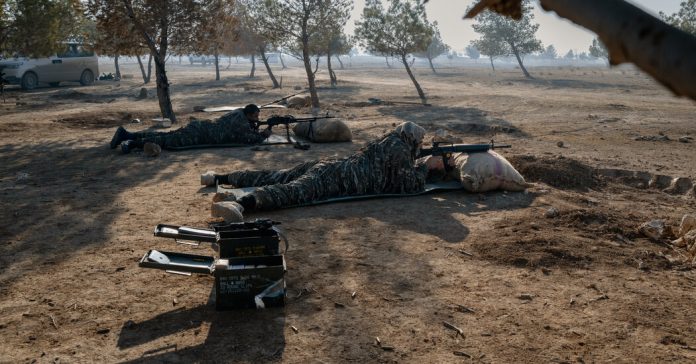
The Syrian Democratic Forces have consistently refused to lay down their arms since the dictator Bashar al-Assad was ousted. The militia, which is mostly made up of members of the Kurdish ethnic minority, was the main U.S. partner in the fight in Syria against the terrorist group Islamic State, which was largely defeated in 2019 after it had taken over parts of the country.

The lingering threat of the Islamic State in Syria has remained a key concern internationally, particularly among Western countries.

At a conference in Paris on Thursday to help coordinate global support for state-building in Syria, President Emmanuel Macron of France urged the interim authorities to reach a détente with the Kurdish forces, whom he referred to as “precious allies” who must be integrated into the new political system.

In the years since helping to push back ISIS, the Kurdish-led militia has consolidated control over towns in northeastern Syria and has often clashed with Turkish-backed forces there amid the maelstrom of political and ethnic divisions in the country.

Turkey, a close ally of the rebel group that led the overthrow of Mr. al-Assad and formed the interim government, has for years sought to curb the power of the Syrian Democratic Forces, maintaining that the militia is linked to Kurdish separatist insurgents inside Turkey.

Since rebels seized control of the Syrian capital, Damascus, in December, fighting between Turkish-backed forces and the Kurdish-led Syrian Democratic Forces has continued to flare in the northeast.

The interim government’s forces are overstretched, experts say, and have still not secured control over the entire country, including the Kurdish-administered region there.

Manbij, a city near Syria’s border with Turkey, has been a focal point of the fighting between Turkish-backed and Kurdish-led forces. The Turkish-backed forces wrested control of the city from Kurdish-led militia in December.

Negotiating an end to the skirmishes has become among the most pressing challenges for Syria’s new leaders.

The rebel coalition that toppled Mr. al-Assad’s government appointed its chief, Ahmad al-Shara, as temporary president and set up an interim government led by officials from a regional administration it had previously run in the northern province of Idlib.

In doing so, the rebel coalition became Syria’s de facto governing party. Still, Mr. al-Shara has pledged to create an inclusive political process, draw up a new constitution and establish a caretaker administration that will govern the country until elections, which he said might take years to set up.

On Thursday, Mr. al-Shara inaugurated the seven-member committee that will plan the national dialogue over a new caretaker government. The committee has been tasked with choosing participants for the conference based on expertise and public influence, and reflecting Syria’s diversity, though there will be no set quotas for the participation of any group.

Mr. al-Daghim, the committee’s head, underlined that point at a news conference on Thursday.

“No one will be invited based on religion, institutional ties or party affiliation,” he pledged.

Still, most members of the steering committee have strong links to Mr. al-Shara and his rebel coalition, stoking concerns about his promises of inclusivity in the political process.

In recent weeks, many other militias have agreed to dissolve their forces but, in negotiations with the interim government, the Kurdish-led forces have pushed to be merged into the army as a single military bloc that can continue to patrol northeast Syria. They have also pushed for guarantees that Kurdish will be made the official language of Syria’s northeast and that their leaders will continue to administer northeast Syria.

The tensions between the Kurdish forces and the leadership in Damascus come amid uncertainty over Washington’s role in the region. American support for the Kurdish militia has been crucial to keeping threats from the Islamic State in Syria at bay.

But President Trump has not made any commitments to continue supporting the group since his inauguration last month.

Underlining the shifting situation, a freeze on U.S. international aid funding in January threatened chaos at a Syrian camp housing thousands of ISIS fighters and family members. The freeze led to a group depending on the American support to provide services and security at the camp to briefly stop its work.

At the conference in Paris on Thursday, Mr. Macron urged Syria’s interim government to reach an agreement with the Kurdish forces.

“Syria must very clearly continue to fight against all the terrorist organizations that are spreading chaos,” Mr. Macron said, adding that cooperation with Kurdish-led forces would be critical to doing so.

Addressing Syria’s new leaders, he said their responsibility toward the Kurdish fighters was “to integrate them and also to allow these forces to join in.”

Alissa J. Rubin contributed reporting.

Texas County Declares an Emergency Over Toxic Fertilizer

0

A Texas county is taking steps to declare a state of emergency and seek federal assistance over farmland contaminated with harmful “forever chemicals,” as concerns grow over the safety of fertilizer made from sewage.

Johnson County, south of Fort Worth, has been roiled since county investigators found high levels of chemicals called PFAS, or per- and polyfluoroalkyl substances, at two cattle ranches in the county in 2023.

The county says the PFAS, also known as forever chemicals because they don’t break down in the environment, came from contaminated fertilizer used on a neighboring farm. That fertilizer was made out of treated sewage from Fort Worth’s wastewater treatment plant. A New York Times investigation into the use of contaminated sewage sludge as fertilizer focused in part on the experience of ranchers in Johnson County.

PFAS, which is used in everyday items like nonstick cookware and stain-resistant carpets, has been found to increase the risk of certain types of cancer, and can cause birth defects, developmental delays in children, and other health harms.

County commissioners passed a resolution this week calling on Texas governor Greg Abbott to join the declaration, and seek federal disaster assistance.

“This is uncharted territory,” said Larry Woolley, one of the county’s four commissioners, in an interview. The funds, he said, would be put toward testing and monitoring of drinking water, cleanup, as well as euthanization of cattle contaminated from the soil, crops and water.

Johnson county is also pressing the state of Texas to block the use of sewage sludge to fertilize local farmland. “Ultimately, our goal is to stop the flow of contaminants into the county,” said Christopher Boedeker, a county Judge.

For decades, farmers nationwide have been encouraged by the federal government to use treated sewage sludge as fertilizer for its rich nutrients, and to reduce the amount of sludge that must be buried in landfills or incinerated. Spreading sewage on farmland also cuts down on the use of fertilizers made from fossil fuels.

But a growing body of research shows that the black sludge, made from the sewage that flows from homes and factories, can contain heavy concentrations of PFAS as well as other harmful contaminants.

Last month, under the Biden administration, the Environmental Protection Agency for the first time warned that PFAS-tainted sewage sludge used as fertilizer can contaminate the soil, groundwater, crops and livestock, posing human health risks.

The Biden administration also set drinking-water standards for certain kinds of PFAS and designated two of the chemicals as hazardous substances that must be cleaned up under the nation’s Superfund law. The future of those measures is uncertain under the Trump administration. The E.P.A. says there is no safe level of exposure to those two PFAS.

There has been little testing on farms. Maine is the only state that has started to systematically test farmland for PFAS, and has shuttered dozens of dairy farms found with contamination.

Johnson County is the first to directly seek federal assistance. It remained unclear, however, exactly how the county could tap federal funds, particularly amid the Trump administration’s freeze on federal spending.

President Biden’s Bipartisan Infrastructure Law had provided $2 billion in funding to address PFAS and other contaminants in drinking water. It is the future of funds like these, which must be requested at the state level, that remain uncertain in the new administration.

The Federal Emergency Management Agency also has funds available for well testing, which must be requested by states, though that money is typically distributed after natural disasters. President Trump has also targeted FEMA funding, saying he wants states to handle disasters without the federal agency’s help. The Department of Agriculture also offers assistance to farmers affected by PFAS contamination, but that program is currently limited to dairy farmers.

That leaves Johnson County in a bind.

While President Trump has been hostile to regulations, he also spoke on the campaign trail of “getting dangerous chemicals out of our environment.” And concerns about PFAS contamination have reached some deeply red states and counties, like Johnson County, which voted overwhelmingly for Mr. Trump.

The E.P.A. and FEMA did not provide comment.

In December, Texas attorney general Ken Paxton sued the largest PFAS makers, saying they knew about the dangers of these chemicals, but continued to market their use. The G.O.P.-controlled Texas state legislature is considering bills that set limits on PFAS in sludge fertilizer and require producers to test for the chemicals.

The state of Texas has not indicated whether they will back Johnson County’s declaration and support its request for federal assistance. The governor’s office did not respond to requests for comment.

Ricky Richter, a spokesman at the state’s environmental regulator, the Texas Commission of Environmental Quality, said the agency’s own analysis of PFAS levels discovered by Johnson County investigators did not suggest any harm to human health or the environment.

The agency did not immediately provide details of its analysis.

Johnson county officials said they stood behind their findings. The ranchers are suing the fertilizer provider, alleging that the contamination on their land was slowly sickening and killing their livestock. They are still caring for the surviving cattle, but are no longer sending them to market.

Barbie Hsu, Taiwanese Actress and Star of ‘Meteor Garden,’ Dies at 48

0

Barbie Hsu, a Taiwanese actress, television host and pop star who catapulted to Pan-Asian popularity in 2001 as the star of the Cinderella-style teenage drama “Meteor Garden,” died on Feb. 2 in Tokyo. She was 48.

Her death was announced to TVBS News in Taiwan by her sister Dee Hsu, who said the cause was complications of the flu. The family had been vacationing in Japan.

In “Meteor Garden,” an adaptation of the Japanese manga “Boys Over Flowers,” Ms. Hsu played Dong Shan Cai, a naïve yet headstrong student from a poor family who is terrorized by a group of four handsome boys who call themselves F4 after she enrolls in the elite private school they attend. She reluctantly enters high society when F4’s leader, Dao Ming Si (played by Jerry Yan), falls for her.

With her expressive eyes and elfin features, Ms. Hsu was a natural for the role, and she exploded in popularity across swaths of Asia, where she was known by the nickname Big S.

Fans were particularly drawn to her character’s relatable and resilient nature. “I am like a blade of grass,” she said in one episode. “No matter how many times you cut me down, I will grow back and live again.”

The four male stars used the series’ influence to promote their boy band, also called F4 — for “Flower Four” — making “Meteor Garden” an early example of the genre known as idol drama, formulaic but addictive love stories featuring pop stars. Ms. Hsu’s character became the genre’s classic protagonist.

As Mei Ting Li, a professor of media studies at the Chinese University of Hong Kong who specializes in fandom and popular culture, wrote in an email, the show “became the archetype of Chinese-language TV drama that allowed the cross-media celebrity business.”

The series’ popularity led to later shows adapted from the same source material, including a 2018 Chinese drama of the same name and the hugely successful “Boys Over Flowers” (2009).

Its popularity spread as far as the Philippines, where it became one of the country’s highest-rated shows, inspiring a quasi-religious fervor among young people that became known as “Meteor fever.” Filipino men adopted the floppy hair and dress of their favorite characters, and the stars were mobbed when they visited the country.

During one visit, in 2003, the media conglomerate ABS-CBN, which aired “Meteor Garden,” used decoy actors in wigs to distract the paparazzi, and some 100 policemen were deployed to manage unruly crowds.

Hsi-yuan Hsu was born on Oct. 6, 1976, in Taipei, Taiwan, to Huang Chun-Mei and Hsu Chien. The household was tumultuous: Her mother separated from her father over his gambling. Barbie’s mother supported her and her two sisters by working as a real estate broker.

In 1994, Ms. Hsu and her younger sister, Dee, enrolled in the Hwa Kang Arts School in Taipei, where they befriended a group of classmates nicknamed the Seven Fairies, including the actresses and singers Mavis Fan, Pace Wu and Aya Liu.

While at Hwa Kang, the Hsu sisters began performing as a pop duo known as S.O.S., or Sisters of Shu; their 1995 bubblegum pop song “Ten Minutes of Love” became a breakout hit. They later changed their name to A.S.O.S., for All Sisters of Shu, and co-hosted variety shows like “Guess,” from 1996 to 2000, and “100% Entertainment,” from 1998 to 2005.

Ms. Hsu leveraged her “Meteor Garden” fame to promote two best-selling beauty guides, published in 2004 and 2007, that encouraged readers to try red wine facials to prevent aging and Rogaine to thicken their eyebrows.

In 2008, she branched out into Chinese-language cinema by playing a woman kidnapped by a gang of Interpol agents in “Connected,” a remake of the 2004 Hollywood thriller “Cellular.” In 2010, she played a sadistic young woman who murdered her fiancé and his parents on her wedding night in the martial arts film “Reign of Assassins,” starring Michelle Yeoh.

Ms. Hsu withdrew from acting in 2011, but her tumultuous relationship with the Chinese businessman Wang Xiaofei, whom she married in 2010, kept her in the spotlight; they divorced in 2021. Her survivors include a son, Hsi-Lin, and a daughter, Hsi-Yueh, as well as her second husband, Koo Jun-yup, a South Korean singer known as DJ Koo, whom she married in 2022.

Ms. Hsu experienced a host of health issues, including heart disease and epilepsy, as well as a near-fatal seizure during the birth of her son. Her death sent ripples of grief across Asia and trended on Weibo, the Chinese social media platform. The South China Morning Post reported that many of her bereaved fans turned to the Chinese artificial intelligence start-up DeepSeek to construct farewell letters mimicking her writing style.

Many of these letters noted her signature phrase: “Live beautifully.”

Hamas Names Hostages Set for Release on Saturday

0

At least 60,000 prefabricated housing units and 200,000 tents should be delivered to Gaza during the first phase of the deal, in addition to equipment for rubble clearance, according to a copy of the agreement’s text seen by The New York Times.

As of Friday, it remained unclear whether Israel had recommitted to allowing the supplies to enter Gaza. Omer Dostri, spokesman for Prime Minister Benjamin Netanyahu of Israel, said on Thursday that Israel was not allowing in prefabricated housing or heavy construction equipment, without explaining the rationale. He did not say whether that might change.

But even as the deal appears back on track for the near future, the wrangling has prompted further pessimism over whether the cease-fire will last. The first phase is set to expire in early March, and Israel and Hamas have yet to agree on terms to extend the agreement.

They were supposed to begin indirect talks over the second phase last week, including negotiating an end to the war, the release of the remaining living hostages and the withdrawal of Israeli forces from Gaza.

But on Thursday, Mr. Dostri said that Israel was “not currently conducting negotiations over the second phase of the deal.” Mr. Netanyahu has faced pressure from members of his right-wing governing coalition to resume the fight against Hamas after the six weeks are up.

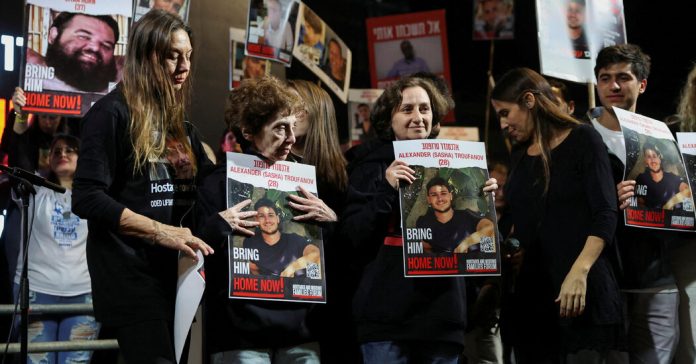
The three Israeli captives have been held incommunicado since Oct. 7, 2023, when Hamas launched its surprise attack on Israel in which 1,200 people were killed and 250 taken hostage. All three were abducted from Nir Oz, an Israeli border community devastated by the assault; roughly a quarter of its 400 residents were either killed or abducted.

For Iair Horn’s family, his release will most likely be bittersweet. His brother, Eitan Horn, has not been included on the list of 33 Israeli hostages to be freed, meaning his freedom has been delayed to the nebulous “second phase.”

Iair Horn was a longtime member of Nir Oz who managed the local pub. Eitan was visiting his brother for a holiday weekend when the Hamas attack began, according to their father, Itzik Horn, who added that he had lost contact with them soon afterward.

“Let them free all the Palestinian prisoners we have here, all the terrorists — what do I care,” Mr. Horn said in an interview with The New York Times in December 2023. “The most important thing isn’t to defeat Hamas. The only victory here is to bring back all the hostages.”

Mr. Dekel-Chen, a father of three young daughters, was taken as he worked in Nir Oz’s machine workshop on the morning of the assault. He has never met his third daughter, who was born two months after his abduction, according to the Hostages and Missing Families Forum, an advocacy group.

His father, Jonathan Dekel-Chen, has campaigned tirelessly for his release, including trips to the White House to meet with U.S. officials. He has criticized the Israeli government, which he has argued did not do enough to free the captives earlier.

Mr. Troufanov, an engineer for an Amazon subsidiary, was abducted by a smaller militant group, Palestinian Islamic Jihad, which also confirmed on Friday that he would be released. His father was killed during the Hamas-led attack and his mother, grandmother and girlfriend were all taken hostage as well. They were released along with more than 100 other hostages during a weeklong truce in November 2023.

In November, Palestinian Islamic Jihad published a hostage video featuring Mr. Troufanov, in which he appeared weary, with an untrimmed beard and bags under his eyes. He mentioned a lack of food and water.

Widespread concern among U.S. allies in Munich about Ukraine policy, foreign aid : NPR

0

NPR’s Mary Louise Kelly speaks with Sen. Chris Coons, D-Del., about what he’s hearing from
and discussing with U.S. allies during the Munich Security Conference.


MARY LOUISE KELLY, HOST:

What a difference a year makes. Once again, world leaders and other top officials are gathering in Munich, Germany, for the annual security conference there. Once again, the wars in Ukraine and Gaza are expected to dominate the conversation. But this year, of course, Donald Trump is back in the White House in Washington, and he has sent his vice president, JD Vance, to lead the U.S. delegation to Munich. Well, let’s go to Munich now and hear from another American there, who happens to be Delaware Democrat, Senator Chris Coons. Senator, welcome back to ALL THINGS CONSIDERED.

CHRIS COONS: Thanks, Mary Louise. It’s great to be on with you.

KELLY: Give me a little taste of the scene, because this is not your first rodeo in Munich.

COONS: (Laughter) No.

KELLY: Does it feel different from past years, with the Trump team there?

COONS: Strikingly, but it feels a lot like 2017, when our European allies, folks from around the world who gather at this annual conference, were genuinely surprised at Trump’s election and trying to figure out what his policies and positions would be. This time, they know a little bit more what to expect. But in just his first three weeks, President Trump has outperformed those expectations by threatening to make Greenland part of the United States, to retake the Panama Canal, to make Canada the 51st state. Many of the foreign leaders we’re meeting with are asking for help discerning which of these are serious and which of these are negotiating tactics.

KELLY: Well, and I’m curious what you are telling them. And let me focus us on Ukraine. We have been hearing all this week from U.S. allies who are alarmed by Trump’s plans for ending the war in Ukraine. What are they telling you?

COONS: Well, there’s been some real sharp differences between what different senior members of the Trump team have said this week. Pete Hegseth, the new secretary of defense, said that Ukraine can’t expect to regain its sovereign territory that Russia has invaded and occupied and that NATO membership is off the table, just to paraphrase. And then my understanding is Vice President Vance said sharply different things – that not only is everything on the table, but there’s a chance we might even commit U.S. troops to help Ukraine defend its sovereignty.

KELLY: Senator, as you speak with U.S. allies, NATO allies there, are you hearing any optimism that maybe they are confused by what is coming out of Washington right now? – maybe they don’t like President Trump’s tactics, but that at least the U.S. is engaged on Ukraine, that there’s some movement?

COONS: Look, I think there was widespread concern that President Trump might simply abandon Ukraine. And I’ve heard from a number of the foreign ministers and military leaders we’ve talked to that they’re at least encouraged that there seems to be a willingness to engage with NATO on all of us increasing our investment in collective security and to engage with Ukraine in a way that sees value in the fight for freedom in Ukraine.

KELLY: Let me turn you to the Middle East. This is a conference, again, taking place in Germany, but it’s all things national security and foreign policy on the table. What reaction are you hearing? What questions are you getting about President Trump’s proposal for the United States to take over Gaza?

COONS: A lot of puzzlement, bewilderment or grave concern. Many in the region had expected Trump to come in with a bold proposal to lay out a plan for stabilizing and rebuilding Gaza. Instead, he shoved all that aside and made this, you know, Gaza Riviera proposal to relocate nearly 2 million Palestinians against their will and redevelop Gaza. It’s not going over well. The leaders of Jordan and Egypt have publicly said that that’s completely unacceptable, as has the crown prince of Saudi Arabia.

KELLY: I wonder, are you getting questions about the U.S. as a reliable ally? And I’m thinking in part, JD Vance…

COONS: Absolutely.

KELLY: …I said, he’s there leading the U.S. delegation. Is there confidence that he speaks for Trump on foreign policy matters or that anyone really speaks for Trump? Like, does anyone, including Trump, know what Trump will do next?

COONS: Well, that’s part of the challenge and part of why having a bipartisan delegation of a dozen senators who’ve worked together for many years is somewhat reassuring and stabilizing. But there’s one other thing that’s happened that’s being widely discussed here, and it’s the shutdown of U.S. foreign aid. Lots of our partners in that work are European, and they are very puzzled, alarmed and, in some cases, genuinely upset at what seems to be not just a pause to reflect on our policy, but a shutdown of U.S. foreign aid with huge humanitarian consequences.

KELLY: Before I let you go, Senator, anyone there in Munich confused you yet with German Chancellor Olaf Scholz?

COONS: (Laughter) I literally just spoke to the foreign minister, Annalena Baerbock, and she made a joke that this may be the last year that when I walk in, the press says, oh, welcome, Chancellor. Guten abend, Chancellor. So we will see.

KELLY: For those who don’t know what we’re talking about, the German press, I gather, has had quite a bit of fun writing that you’re basically their chancellor’s doppelganger. And you two do look….

COONS: I am the doppelganger, yes.

KELLY: …A lot alike, if I may say.

COONS: (Laughter) Yes.

KELLY: That is – we thank Senator Chris Coons – not the Chancellor of Germany – Senator Chris Coons, Democrat from Delaware, on the line from the Munich Security Conference. Thanks very much.

COONS: Thank you.

Copyright © 2025 NPR. All rights reserved. Visit our website terms of use and permissions pages at www.npr.org for further information.

NPR transcripts are created on a rush deadline by an NPR contractor. This text may not be in its final form and may be updated or revised in the future. Accuracy and availability may vary. The authoritative record of NPR’s programming is the audio record.

Tropical Cyclone Zelia Hits North Western Australia

0

new video loaded: Tropical Cyclone Zelia Hits North Western Australia

transcript

transcript

Tropical Cyclone Zelia Hits North Western Australia

Zelia made landfall 34 miles northeast of Port Hedland, packing winds equivalent to a Category 4 Atlantic hurricane. Residents were told to stay indoors to shelter from heavy rain and destructive winds.

“Port Hedland is not expected to be impacted by the very destructive eyewall winds, but damaging to destructive wind gusts are still likely this afternoon and into the evening on the Eastern side of the tropical cyclone track. A dangerous storm surge is possible, which could cause flash flooding of coastal areas.” “Holy crap.” “We’re ready to deal with the aftermath of the cyclone, which will pack 290 k.m.h.-winds and dump more than 500 millimeters of rain through the Pilbara. It is critical that impacted communities don’t get complacent because the hazards won’t ease once the cyclone has passed.”

Recent episodes in Extreme Weather

Consider This from NPR : NPR

0

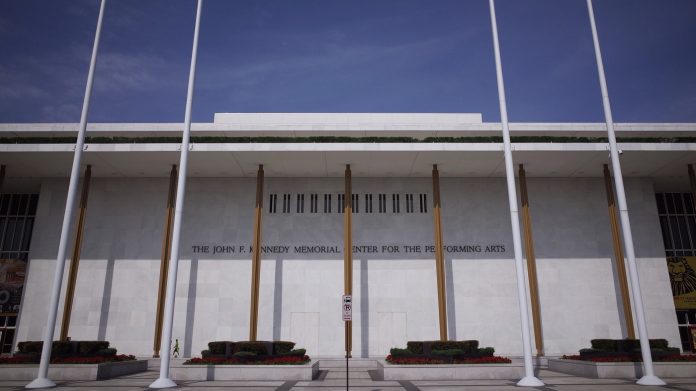
The John F. Kennedy Center for the Performing Arts, in Washington, D.C.

Mandel Ngan/AFP/Getty Images


hide caption

toggle caption

Mandel Ngan/AFP/Getty Images


The John F. Kennedy Center for the Performing Arts, in Washington, D.C.

Mandel Ngan/AFP/Getty Images

President Donald Trump is now chairman of The Kennedy Center for the Performing Arts in Washington, D.C. Trump replaced 18 members of the board with allies who then elected him into the position.

There is no precedent for this move – most presidents have been hands-off with the cultural center since it opened in 1971 – including President Trump himself during his first term.

Already, artists affiliated with the center have departed and performers are canceling shows.

For a decade, Deborah Rutter served as President of the Kennedy Center. This week, she was ousted from that position. In her first interview since then, she speaks with NPR’s Mary Louise Kelly about the abrupt end to her tenure.

For sponsor-free episodes of Consider This, sign up for Consider This+ via Apple Podcasts or at plus.npr.org.

Email us at [email protected].

This episode was produced by Elena Burnett and Mia Venkat.

It was edited by Ashley Brown, Jeanette Woods and Nadia Lancy.

Our executive producer is Sami Yenigun.

Cuts to U.S.-Backed Rights Groups Seen as a Win for China

0

The nonprofit groups track the imprisonment of Chinese political dissidents and the expansion of state censorship. They speak out for persecuted minority groups like the Uyghurs and Tibetans. And they help sustain attention on Beijing’s crackdown of freedoms in Hong Kong.

The future of their work is now in question as Elon Musk’s government efficiency operation takes aim at an important backer of such groups: the National Endowment for Democracy, or N.E.D., an American nonprofit largely funded by the United States.

Several China-focused nonprofits told The New York Times that the endowment had informed them this past week that their funding had been suspended indefinitely. Money distributed to the endowment was no longer being delivered after members of Mr. Musk’s so-called Department of Government Efficiency gained access to the Treasury Department’s payment system.

The stoppage of N.E.D. funds affects groups all over the world, but activists say the impact on groups focused on China will be especially severe. Such work has become more crucial — and risky — as Xi Jinping, the most powerful Chinese leader in decades, has waged a far-reaching crackdown on civil society and tightened control on information.

Across China, scores of activists, lawyers, journalists and intellectuals have been harassed, detained or jailed since Mr. Xi came to power in 2012. In the far-western region of Xinjiang, officials have detained and imprisoned an estimated hundreds of thousands of Uyghurs and members of other Muslim ethnic minorities.

It is unclear how many organizations have been affected by the cuts to the endowment’s funding. The Treasury Department and the endowment, which was allocated $315 million by Congress this year, did not respond to requests for comment. The Department of Government Efficiency could not be reached for comment.

The National Endowment for Democracy was established by Congress during the Reagan administration to bolster democracy worldwide. It has long attracted the ire of Beijing, which has accused the group of committing “evil deeds” by instigating protests and “colluding with anti-China destabilizing forces” in Taiwan, Hong Kong, Xinjiang and Tibet.

Among the endowment’s grantees is China Digital Times, a United States-based website that monitors Chinese internet controls and censorship. It recently exposed a Chinese state-sponsored disinformation campaign targeting Canada’s former finance minister Chrystia Freeland, who is running to succeed Prime Minister Justin Trudeau.

The website’s founder, Xiao Qiang, said his operations were “severely disrupted” by the funding suspension, resulting in pay cuts and work-hour reductions for staff.

“We are facing significant financial challenges that threaten our ability to continue our work,” said Mr. Xiao, whose website has been financially supported by the endowment since the site was established in 2013.

A representative of the World Uyghur Congress, a group of exiled Uyghurs, which has also seen its N.E.D. funding frozen, said the cuts came at a difficult time for their advocacy work. The group said that the plight of Muslim Uyghurs in China had been overshadowed by other global crises, like the wars in Ukraine and Gaza. And its advocacy efforts have been complicated by Beijing’s growing ability to silence its critics abroad by targeting their family members still in the country and pressuring governments to repatriate asylum seekers.

The funding was especially important, the group said, because private donors like companies or entrepreneurs with overseas business interests were more vulnerable to Chinese retribution.

Some activists had hoped that the Trump administration’s appointment of politicians with hawkish views on China was a sign that they would retain support from the United States. They lamented how abruptly the funds were cut.

“We in the China community were initially hopeful and optimistic about this administration because of appointments like Marco Rubio,” Zumretay Arkin, the vice president of the World Uyghur Congress, said about the secretary of state, who has long been critical of Beijing’s human rights record.

“We are shocked by how rapidly things have changed in not even a month,” she continued.

Li Qiang, the founder of the New York-based China Labor Watch, which seeks to end the forced labor and trafficking of Chinese workers, said he was told on Wednesday that N.E.D. funds to his group would be halted for the first time in the 23 years he has been a grantee of the organization.

He said the sweeping way in which Mr. Musk had mobilized people online to attack groups like the National Endowment for Democracy reminded him of political crackdowns in China aimed at consolidating control under a top leader.

“History has proven that this approach ultimately led to chaos in China, resulting in the deaths of thousands of innocent people,” Mr. Li said.

Chinese nationalist voices, on the other hand, applauded President Trump’s and Mr. Musk’s moves to cripple the endowment. China has accused it of fomenting all kinds of dissent against Beijing, including the 2019 antigovernment protests in Hong Kong. Beijing said the endowment’s support for rights groups there was an attempt at destabilizing the city and weakening Beijing’s control over it. (Hong Kong activists have rejected the accusation of foreign meddling as an attempt at belittling their grievances.)

“I’m undoubtedly happy about it, and, hopefully, this cutoff will be long-term instead of temporary,” said Hu Xijin, a retired editor in chief of The Global Times, a Communist Party tabloid, in an interview.

Wang Yiwei, the director of the Institute of International Affairs at Renmin University in Beijing, said the dismantling of U.S. foreign aid pointed to a retreat by the United States from the global stage. He said the endowment’s work was America’s way of interfering in the internal affairs of other countries and a waste of taxpayers’ money.

“China welcomes this, of course, and so do other countries,” he said.