


Love connection? Probably not. This Valentine’s Day, one Wisconsin lawmaker is trying to bring colleagues together on politics, no matter the party.
Map: 6.0-Magnitude Earthquake Strikes Ethiopia
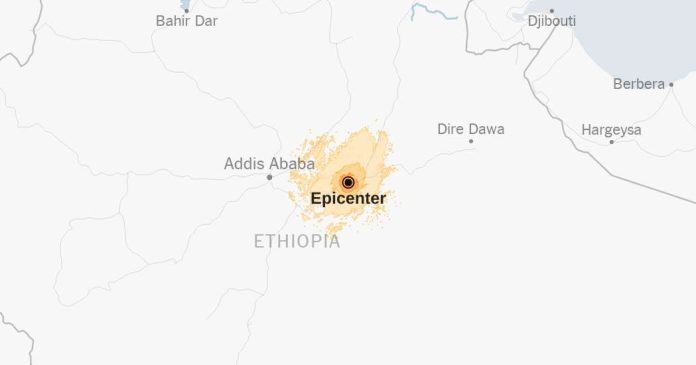
Note: Map shows the area with a shake intensity of 4 or greater, which U.S.G.S. defines as “light,” though the earthquake may be felt outside the areas shown. The New York Times
A strong, 6.0-magnitude earthquake struck in Ethiopia on Friday, according to the United States Geological Survey.
The temblor happened at 11:28 p.m. East Africa time about 4 miles northeast of Metahāra, Ethiopia, data from the agency shows.
As seismologists review available data, they may revise the earthquake’s reported magnitude. Additional information collected about the earthquake may also prompt U.S.G.S. scientists to update the shake-severity map.
Aftershocks in the region
An aftershock is usually a smaller earthquake that follows a larger one in the same general area. Aftershocks are typically minor adjustments along the portion of a fault that slipped at the time of the initial earthquake.
Quakes and aftershocks within 100 miles
Source: United States Geological Survey | Notes: Shaking categories are based on the Modified Mercalli Intensity scale. When aftershock data is available, the corresponding maps and charts include earthquakes within 100 miles and seven days of the initial quake. All times above are East Africa time. Shake data is as of Friday, Feb. 14 at 3:49 p.m. Eastern. Aftershocks data is as of Friday, Feb. 14 at 3:58 p.m. Eastern.
Will the Eagles visit the White House after Super Bowl win? : NPR

The Philadelphia Eagles celebrate with the Vince Lombardi Trophy after beating the Kansas City Chiefs 40-22 to win Super Bowl LIX at Caesars Superdome in New Orleans.
Chris Graythen/Getty Images
hide caption
toggle caption
Chris Graythen/Getty Images
The Philadelphia Eagles secured the coveted Super Bowl victory this week over the Kansas City Chiefs. But will the winning team make the customary visit to the White House to celebrate with President Trump? If history is any indication, probably not.
Not only did President Trump attend the game to root for Kansas City — lavishing praise on team quarterback Patrick Mahomes — but Trump and the Philadelphia team share a tense past.
The last time the Eagles scored a Super Bowl win was in 2018, during Trump’s first presidency. That year, across professional sport organizations, teams were embroiled in controversy over athletes choosing to kneel during the National Anthem in protest of systemic racism in America.

Trump was one of the most vocal critics against the protests, calling for athletes who did not stand during the anthem to be fired.
Because of his stance, a majority of the 2018 Eagles team planned to boycott the trip to 1600 Pennsylvania Ave.
Rather than face being publicly snubbed, Trump disinvited the team altogether.
“The Philadelphia Eagles Football Team was invited to the White House,” Trump wrote on X at the time. “Unfortunately, only a small number of players decided to come, and we canceled the event.”
The optics of a White House visit — or lack thereof — by either team, would paint a picture of the current dynamics of American politics.
The Super Bowl visit dates back to President Jimmy Carter’s administration and for decades had been viewed as a nonpartisan celebration of America’s favorite sport.

But the dynamics have changed in recent years. While it’s not unusual for a president to talk sports, Trump has bucked convention, publicly castigating players with whom he disagrees, while also adulating those whom he views as politically aligned with him.
Even Trump’s decision to travel to the New Orleans showdown showed the shift from conformity. He is the first sitting president to ever attend the big game.
And issues like NFL athletes kneeling during the National Anthem and Trump’s public response have highlighted how deeply partisanship has infiltrated even the most unifying of American pastimes.
The racial politics of a visit are also on display. In a league where an overwhelming majority of players are Black or minority, Trump’s comments have often been perceived as racist, creating static even between the players and league leadership.
Representatives for the Eagles did not respond to requests for comment on whether the team had been invited to the White House or whether they would accept such an invitation.
Vance Tells Europeans to Stop Shunning Parties Deemed Extreme
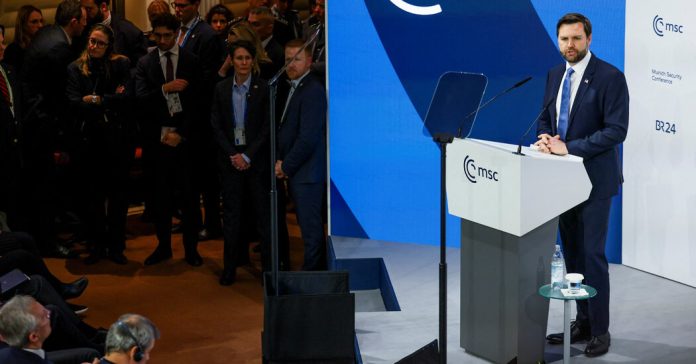
Vice President JD Vance told European leaders on Friday that their biggest security threat was not military aggression from Russia or China, or election meddling from Moscow. Rather, he said, it was what he called “the enemy within” — their own suppression of abortion protests and other forms of free speech and the sidelining of parties considered extremist.
The address stunned and silenced hundreds of attendees at the Munich Security Conference, a forum where top-level politicians, diplomats and analysts had gathered expecting to hear the Trump administration’s plans for ending the war in Ukraine and Europe’s defense against a rising Russian threat in the future.
Instead, the vice president offered what may be a preview of a new kind of trans-Atlantic relationship under Mr. Trump — one not built on postwar bonds of stability between allied governments, but rather on ties between once-fringe political parties that share a common approach to migration, identity and internet speech.
Mr. Vance singled out his German hosts, who will elect a new chancellor next weekend, and told them to drop their objections to working with a party that has often reveled in banned Nazi slogans and has been shunned from government as a result.
It was an extraordinary intervention in the domestic politics of a democratic American ally, and it brought some gasps in the hall.
He did not mention the party, the Alternative for Germany or AfD, by name but made a direct reference to the longstanding agreement by mainstream German politicians to freeze out the group, parts of which have been formally classified as extremist by German intelligence.
“There is no room for firewalls,” Mr. Vance said near the end of his speech.
The AfD has surged to second in the polls with its call to crack down on immigration, and its members have a history of use of Nazi language and antisemitic and racist comments, along with plots to overthrow the federal government.
Mr. Vance did not note that baggage, nor did he mention any extremist elements of anti-immigration political parties. Without naming any parties specifically, he cast the AfD and its counterparts across Europe as legitimate vessels of voter anger over the millions of refugees who have entered the European Union from the Middle East, Africa and elsewhere over the last decade.
He also met on Friday with Alice Weidel, the chancellor candidate for the AfD, as well as other German leaders.
Those German leaders, across most party lines, bridled at the speech. They immediately rejected Mr. Vance’s suggestion that they should drop their firewall against the AfD, pointing to past comments by AfD members in support of the National Socialists, or Nazis.
“This is our business,” said Thomas Silberhorn, a member of Parliament for the Christian Social Union, the Bavarian sister party of the Christian Democrats. “My message to the U.S. administration is: German extremists who explicitly refer to National Socialism — part of the AfD — are clearly anti the U.S. that liberated us from National Socialism.”
Boris Pistorius, the German defense minister and a member of the governing Social Democrats, deviated from his planned speech on Friday afternoon to rebuke Mr. Vance.
“If I understood him correctly he is comparing parts of Europe with authoritarian regimes. This is not acceptable,” Mr. Pistorius said, drawing sustained applause. “This is not the Europe, not the democracy, where I live.”
Germany has been the most successful major European power at shutting its hard-right party out of power, along with France, where a group of rival parties engaged in strategic voting last summer to deny the hard-right National Rally a parliamentary majority.
Other firewalls have fallen around Europe, including in the Netherlands, Hungary and Italy. In Austria, the hard-right Freedom Party has been part of federal coalitions and appeared set to lead its next government, before negotiations with a center-right party collapsed this week.
Mr. Vance is now the second figure in the Trump administration who has tried to chip away at the efforts to isolate the far right ahead of the German elections next Sunday, by attempting to destigmatize the AfD.
The billionaire Elon Musk, a top adviser to Mr. Trump, endorsed the AfD late last year in a post on social media. He has publicly interviewed its chancellor candidate, Alice Weidel.
In an address to party members this month, Mr. Musk said Germany has “too much focus on past guilt.” That was a clear reference to Hitler’s long shadow, which continues to dominate mainstream German politics, including in tight legal restrictions against Nazi language.
In his speech, Mr. Vance seemed to lump those restrictions into a long list of what he called European deviations from democratic values and attacks on free speech.
Those failures, Mr. Vance said, included efforts to restrict misinformation and other content on social media, and laws against abortion protests that he said unfairly silenced Christians.
Particularly since the start of the war in Ukraine, European intelligence agencies have raised alarms about what they consider to be a systematic effort by Russia at mass disinformation and propaganda, often by using fake social media accounts to sow division and doubt about democratic systems.
Mr. Vance ridiculed and diminished that threat.
“It looks more and more like old entrenched interests hiding behind ugly Soviet era words like misinformation and disinformation, who simply don’t like the idea that somebody with an alternative viewpoint might express a different opinion, or, God forbid, vote a different way, or, even worse, win an election,” he told a largely stony audience.
He poured scorn on the decision in “remote Romania,” as he called it, to cancel a presidential election because of clear evidence of Russian manipulation of the political campaign.
“If your democracy can be destroyed with a few hundred thousand dollars of digital advertising from a foreign country, then it wasn’t very strong to begin with,” he said.
Such statements came as something of a shock for attendees who had hoped to learn more about the administration’s plans for peace negotiations with Russia. Mr. Vance barely mentioned Ukraine and only referred to the conflict in passing.
“While the Trump administration is very concerned with European security and believes that we can come to a reasonable settlement between Russia and Ukraine, and we also believe that it’s important in the coming years for Europe to step up in a big way to provide for its own defense, Mr. Vance said. “The threat that I worry the most about vis-à-vis Europe is not Russia, it’s not China, it’s not any other external actor.”
He added, “What I worry about is the threat from within, the retreat of Europe from some of its most fundamental values, values shared with the United States.”
Mr. Vance also decried the mass migration into Germany and other nations in 2015, which included many asylum seekers fleeing wars in Afghanistan and Syria. He tied the migration to terrorist crimes, including a car attack in Munich on Thursday by an Afghan asylum seeker, which injured 30 people.
“Over the span of a decade, we saw the horrors wrought by these decisions yesterday in this very city,” he said.
Even before Mr. Vance spoke, experts at the security conference were warning European leaders that they could be in for a fast and painful reordering of the continent’s relationship with the United States.
Mr. Trump’s push to negotiate directly with Russia’s president over Ukraine — potentially sidelining European leaders — and his transactional approach to trade policy and military spending dominated a breakfast panel discussion, hosted by the American Council on Germany and the global accounting firm KPMG.
One panelist, Jana Puglierin, a senior policy fellow at the European Council on Foreign Relations in Berlin, said that it was possible Mr. Trump would build a new Euro-American alliance between parties that share core values of immigration opposition, unregulated social media speech and “anti-woke” attitudes.
“We have an American government that has different values,” she said, “and a different vision of what the West should be.”
The council released new polling this week that suggests that value shift has already resonated in Europe. It found that majorities of Europeans now view America as a “necessary partner” and not an “ally” under Mr. Trump. It also found that Mr. Trump’s return to the White House was most celebrated in Europe among members of several hard-right parties.
There is one, perhaps paradoxical, exception to that trend. The poll found that members of the AfD were more likely to say Mr. Trump’s election would be bad for Germany than to say it would be good.
Trump administration orders CDC layoffs : Shots
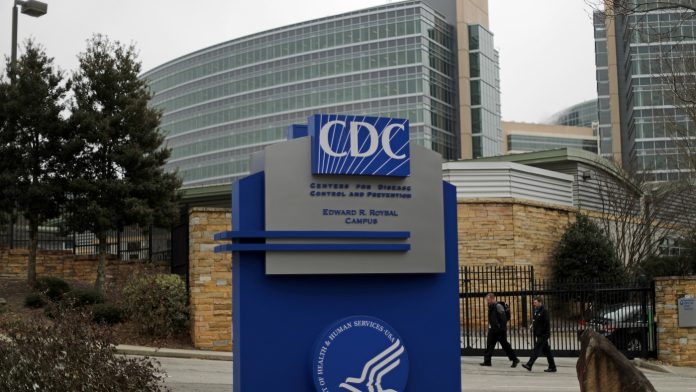
Layoffs started Friday at the Centers for Disease Control and Prevention.
David Goldman/AP
hide caption
toggle caption
David Goldman/AP
The Trump administration is slashing about 1,300 employees, or 10%, of the workforce at the Centers for Disease Control and Prevention, according to two agency employees who requested anonymity because they weren’t authorized to speak for the agency. Staff were notified Friday of the cuts.
The layoffs are targeted at probationary employees — a broad category that includes recent hires and long-time staffers who were recently moved to a new position in the CDC.
“This is absolutely tragic,” said one current CDC employee. “If we lose these people we lose important capacity and in a very real sense we lose our CDC future.”

Another current CDC staffer told NPR the cuts were coming at the direction of the Department of Health and Human Services — now under the leadership of Robert F. Kennedy Jr., who was confirmed as secretary on Thursday.
In response to a request for comment on the cuts, Andrew Nixon, director of communications at HHS, wrote in an email to NPR: “HHS is following the Administration’s guidance and taking action to support the President’s broader efforts to restructure and streamline the federal government. This is to ensure that HHS better serves the American people at the highest and most efficient standard.”
Dr. Georges Benjamin, executive director of the American Public Health Association, says these cuts “are very destructive to the core infrastructure of public health.”
“This happens when you do indiscriminate, poorly thought-out layoffs,” he says.
The cuts also hit the Epidemic Intelligence Service officer corps, where all those in the first year of their service were laid off, one of the CDC employees said. Members of the service, whom the CDC calls “disease detectives,” are often dispatched to investigate disease outbreaks and public health threats in the U.S. and overseas.

Friday’s layoffs are the latest in a series that started this week at CDC. Earlier this week, contractors in various divisions of the agency were let go, and around 400 employees accepted the “Fork in the Road” offer, according to a former CDC staffer with knowledge of the situation.
Have information you want to share about the ongoing changes across the federal government? Reach out to these authors via encrypted communications: Will Stone @wstonereports.95 and Pien Huang @pienhuang.88
Edited by Carmel Wroth and Scott Hensley.
Sexual Violence Against Children Soars in Congo, U.N. Group Says

Sexual violence against children in the eastern Democratic Republic of Congo has soared in recent weeks, the United Nations Children’s Fund said on Thursday, as disputes over land and mineral resources fuel fighting in the country.
The organization, known as UNICEF, reported that health care facilities in the city of Goma and the surrounding areas had documented 170 cases of children having been raped in a single week, between Jan. 27 and Feb. 2.
The health facilities reported 572 cases of rape that week, compared to an average of 95 cases in the prior weeks, said Lianne Gutcher, UNICEF’s communication chief for Congo. She added that the violence was being perpetrated by “armed men” belonging to all parties in the conflict.
The aid group Save the Children reported similar trends of children being victimized across eastern Congo. The New York Times could not independently verify the numbers provided by UNICEF.
Rebels, said to be backed by Rwanda, have been seizing huge tracts of the Democratic Republic of Congo at lightning speed. In a month, they have routed Congo’s underequipped army several times and caused more than half a million people to flee. In late January, the rebels captured Goma, a Congolese city of three million people along the Rwandan border.
Rwanda’s president has given various answers to questions about whether his country is arming the rebels or if his troops are in Congo. He has often denied it, sometimes appeared to acknowledge it, and recently said that he did not know whether his country’s troops were there.
The rebels, known as M23, say they are protecting ethnic Tutsis, the minority group massacred in a 1994 genocide, some of whom also live in Congo. Experts, however, say the group is after Congo’s rare minerals.
“In North and South Kivu provinces, we are receiving horrific reports of grave violations against children by parties to the conflict, including rape and other forms of sexual violence at levels surpassing anything we have seen in recent years,” UNICEF’s executive director, Catherine Russell, said in a statement.
She added that medical workers were running out of drugs used to reduce the risk of HIV infection after an assault.
President Trump’s pause on aid, and the gutting of the U.S. government’s primary foreign assistance agency, U.S.A.I.D., has left the health of millions of people around the world at risk.
Save the Children said it had evidence that 18 girls were sexually violated in South Kivu Province, and that a 16-year-old girl was killed resisting armed men.
“One mother recounted to our staff how her six daughters, the youngest just 12 years old, were systematically raped by armed men while searching for food,” she said.
The rebel group’s leaders have vowed to bring order and security to the areas it controls.
Elian Peltier and Ruth Maclean contributed reporting.
Elon Musk’s DOGE team is expected to cut costs at the Pentagon soon : NPR

The Pentagon is pictured in December 2024.
Daniel Slim/AFP via Getty Images
hide caption
toggle caption
Daniel Slim/AFP via Getty Images
Members of Elon Musk’s government efficiency team are poised to arrive at the Defense Department in the coming days. Officials tell NPR that DOGE has a target of cutting 8% from next year’s budget. The officials were not authorized to speak publicly and provided details on condition of anonymity.
Targets will likely include the workforce, which Defense Secretary Pete Hegseth already said has grown too much. The unit called the Department of Government Efficiency has been rapidly moving throughout the federal workforce, restructuring and cutting personnel across multiple agencies.

The Pentagon employs 3 million troops and civilians, with a budget well over $800 billion.
“We won World War II with seven four-star generals,” Hegseth said during his confirmation hearing. “Today we have 44. … There is an inverse relationship between the size of staffs and victory on the battlefield. We do not need more bureaucracy at the top. We need more warfighters empowered at the bottom. So, it is going to be my job … to identify those places where fat can be cut, so it can go toward lethality.”

Dov Zakheim, who served as Pentagon comptroller during the administration of George W. Bush, agreed that there has been a steep increase in personnel over the last two decades, since the wars in Iraq and Afghanistan, but he also urged caution.
“We have nowhere near the same level of military operation,” Zakheim told NPR. “Bottom line, there certainly can be budget cuts. The issue is how the cuts are made. Too often ‘cut drills’ involve cutting the most promising new developments while protecting legacy systems.”
It appears, however, some legacy systems could be on the chopping block, like F-35 aircraft and armored vehicles. Trump officials are expected to push for more cutting-edge technology that could include drones, hypersonic missiles and cyber equipment. There is also expected to be an increase in shipbuilding to keep pace with China.
Man Is Briefly ‘Swallowed’ by Whale in Chile

Paddling through choppy waters under cloudy skies, Adrián Simancas and his father were packrafting only a few yards away from each other when something huge lunged, mouth open, from the waves below.
A humpback whale appeared to gulp Mr. Simancas down, then rolled over into the waters of Chilean Patagonia.
Moments later, Mr. Simancas bobbed back up to the surface, followed by his kayak-sized vessel. The dark curve of the whale’s back briefly emerged behind them, then the animal dived out of sight.
Mr. Simancas’s father caught the whole thing on video.
“I felt something hit me from behind — all this happened in a second — something dark blue or white enveloped me, and a slimy texture brushed my face,” Mr. Simancas said in an interview on Thursday night. “Then it closed completely and I started to sink, and I just closed my eyes, expecting an impact. But instead I felt as if I was surrounded by water. I realized that I was in something’s mouth and I had been eaten.”
After a second or so, he said, “I began to feel the life jacket pulling me up and then suddenly I was out again.”
Mr. Simancas, 23, and his father, Dell, had been packrafting — they emphasized that they were using portable, inflatable craft and not kayaks — near the San Isidro Lighthouse and Bahía El Águila, a campground in Patagonia.
Dell Simancas, 49, said that he and his son, a computer engineering student, did many outdoor activities together, and that they had planned their trip months in advance. The pair, who live in Chile, finally set out on their four-day trek and rafting trip last weekend, heading out through the Strait of Magellan for an island near Cape Froward.
“I turned the camera on to record the waves, and I heard a very loud sound behind me like a big wave breaking,” Dell Simancas recalled. “I turned around and couldn’t see Adrián or the boat anywhere. Suddenly I saw him emerge from the water along with what looked like an animal.”
He said that he felt a pang of fear as soon as his son vanished — and that his experience as an anaesthetist helped him keep his composure in the moments that followed. “Stay calm, stay calm,” he can be heard saying after his son reappeared at the surface.
“At the time, I didn’t know it was a whale,” Adrián Simancas said. “I was able to stay calm thanks to my dad’s advice.”
Such encounters between whales and humans are extraordinarily rare, scientists say, and although Mr. Simancas told The Associated Press he had been “swallowed,” humpbacks are filter feeders that eat small fish and krill. They are incapable of swallowing anything as large as a person.
“What I see in the video suggests to me that the kayaker was just in the way of a surface-feeding whale,” said Jooke Robbins, director of the Humpback Whale Studies Program at the Center for Coastal Studies, in Massachusetts. “My guess is that the whale was just as surprised” as the rafter, she added.
Despite the improbability of Mr. Simancas’s experience, he is not the first person to have landed in or near a humpback’s mouth in recent years. In 2021, a lobsterman diving off the coast of Massachusetts was briefly caught in a humpback’s mouth, then was released, bruised, to the surface.
Last year, a 30-foot-long juvenile humpback capsized a 23-foot motorboat off the coast of New Hampshire, sending two men into the water. And in 2020, a breaching humpback off the Central Coast of California lifted a kayak about six feet into the air, along with the two women inside it.
From the short video from Chile, “it is difficult to tell what happened,” said Dianna Schulte, a co-founder and director of research at the Blue Ocean Society for Marine Conservation in Portsmouth, N.H.
“Humpbacks often feed in the manner seen in the video, by charging to the surface with their mouth open to capture concentrated prey,” she wrote in an email. “It likely did not know the kayaker was above it, especially given the cloudy conditions and the assumed concentration of the prey.”
She added that humpbacks, which lack biosonar or echolocation, rely primarily on their hearing, and small, motorless vessels like kayaks make very little sound, “which again leads to the point that the whale did not know it was there.”
Ms. Schulte said that with cameras more prevalent, it was hard to say whether such whale encounters were taking place more frequently or simply garnering more attention. In her view, she said, “these interactions are occurring more frequently as whales seem to be shifting their feeding habitats closer to shore in some areas, where whale/human interactions are more likely to occur.”
Adrián Simancas, who had never seen a whale before last weekend, said he harbored no resentments. “If it happens again, I hope it isn’t quite so close up,” he said.
ICE officers granted access to unaccompanied minors database : NPR
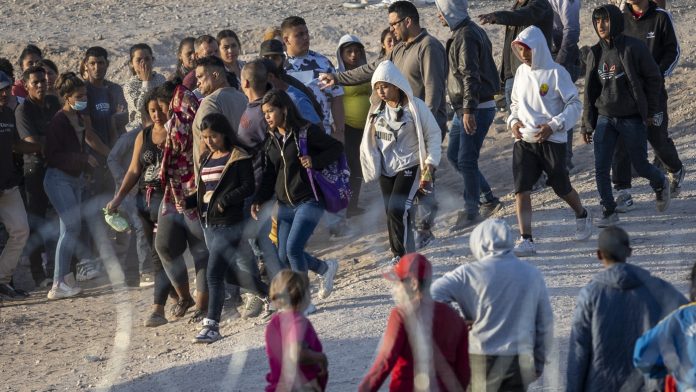
Unaccompanied minors walk towards U.S. Border Patrol vehicles after crossing over from Mexico on May 09, 2023, in El Paso, Texas.
John Moore/Getty Images
hide caption
toggle caption
John Moore/Getty Images
Multiple Immigration and Customs Enforcement officers have been granted access to information in a database on unaccompanied children who crossed the border into the United States — in line with the first Trump administration’s policies, which were revoked by the president’s successor.
In an email to staff obtained by NPR, the acting director of the Office of Refugee Resettlement said upcoming changes were necessary “to build a culture of child safety and accountability.” But advocates say they fear the administration will use it for immigration enforcement against some of the families illegally in the country that take in the children.
NPR learned of the access to the database, which is maintained by the ORR, from a staff member who spoke on condition of anonymity because of fear of retaliation. ICE officers were granted access under the direction of ORR’s interim leadership. Unlike many other immigration-related agencies, ORR is part of the Department of Health and Human Services, not the Department of Homeland Security. It comes after Mellissa Harper, an ICE official from New Orleans, was assigned last month to a short-term federal assignment as ORR’s acting director.
The Biden administration revoked efforts during President Trump’s first term to put in place an agreement that allowed ORR and DHS to share biometric and immigration-status information about the children, their sponsors and adults in their homes.
ICE and HHS did not immediately respond to a request for comment.
In the email to employees, Harper said that “both practice and culture within the sponsor evaluation process” needs to change.
“The mindset that fraud is justifiable or necessary is intolerable,” Harper said in the email. “I ask each of you to critically examine your role in the UAC [unaccompanied child] process and take responsibility in creating a culture of enhanced accountability and safety measures.”
Tom Homan, Trump’s border czar, first floated the idea to the Washington Post. He said the goal was not to use the data for enforcement, but did not rule that out in the future.
According to the most recent HHS statistics, as of Jan. 29, there were 4,096 unaccompanied children in the agency’s care; the average length of time an unaccompanied child remained in ORR’s care was 36 days, according to the agency.
During Trump’s first term, the agreement among ORR, ICE and Customs and Border Protection allowed for details such as arrests, deaths and crimes to be reported to immigration enforcement. Other information such as the citizenship status, biometric information of all adults living in the household could also be shared. The agreement was signed by several officials including Homan.
At the time, immigrant rights advocates objected to the data sharing, arguing it would impede ORR’s ability to place children with appropriate caregivers or be reunified with their family members.
According to the Congressional Research Service, a nonpartisan research institute operating within the Library of Congress, “from July through November 2018, ICE reportedly arrested 170 potential sponsors — 109 of whom had no previous criminal histories — and placed them in deportation proceedings.” Some of the data collection requirements were later pulled back, the report notes.
Homan told the Washington Post at the start of the administration he wanted access to the data to verify the safety of children under ORR care. Homan has claimed that more than 300,000 children had been given to unvetted sponsors — a claim previously made by then vice presidential candidate JD Vance and Congressional Republicans. Advocates and Democrats say there’s no evidence the claim is true. The figure comes from a DHS report that said nearly 300,000 unaccompanied migrant children had not received their notice to come to court and 32,000 had missed a court hearing between October 2018 and September 2023.
While the report did not explain the reasons for these incidents, immigration rights advocates argue there are several reasons, including that removal proceedings may not have begun or court papers were sent to wrong addresses.
Still, a New York Times investigation in 2023 found that unaccompanied migrant children are particularly vulnerable to working full time in violation of labor laws.
Selena Simmons-Duffin contributed to this report
Video Shows Explosion at Chernobyl Nuclear Power Plant

Ukraine said that a Russian drone had hit a shelter constructed to prevent radiation leaks at the site’s Reactor No. 4. The Kremlin denied the accusation.