Friday, November 13, 2026
Home Blog Page 230

What happens if Trump starts ignoring court rulings? We break it down : NPR

0

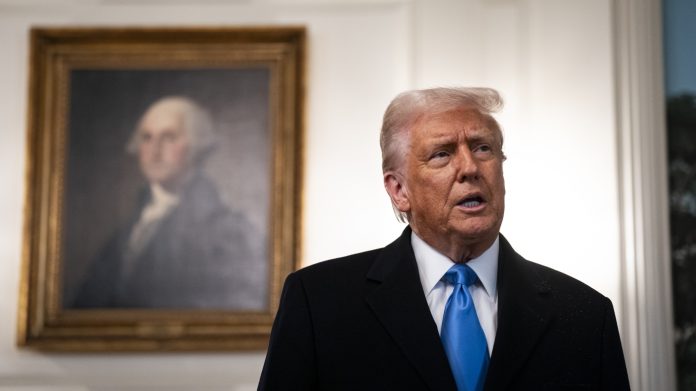
A court found that President Trump’s administration had not complied with an earlier court order. Experts worry about the potential of a constitutional crisis.

Al Drago/Getty Images


hide caption

toggle caption

Al Drago/Getty Images

In less than a month in office, President Trump has signed dozens of executive orders that are now facing pushback in the courts.

Many are wondering: What happens if he simply ignores them?

Law professors who spoke to NPR saw warning signs of a constitutional crisis based on a recent court order and comments from the vice president over the weekend.

On Monday, a federal judge in Rhode Island found the White House had defied an earlier court order to unfreeze federal grant and program funds. U.S. District Judge John McConnell Jr. ordered the administration to immediately end any federal funding pause.

That court order came a day after Vice President JD Vance suggested that judges don’t have the ability to challenge President Trump’s “legitimate power.”

Vance wrote on X, “If a judge tried to tell a general how to conduct a military operation, that would be illegal. If a judge tried to command the attorney general in how to use her discretion as a prosecutor, that’s also illegal. Judges aren’t allowed to control the executive’s legitimate power.”

It’s unclear what specific judge or court order Vance was referring to.

Federal judges like McConnell have the power to levy fines and find parties in contempt for not following his orders. But that’s generally considered toothless enforcement, according to experts.

Trump has been openly critical of the courts, over the weekend calling a judge’s order against Elon Musk’s Department of Government Efficiency team “a disgrace.“

But on Tuesday, Trump said he would comply with court rulings against DOGE. “I always abide by the courts. Always abide by them, and we’ll appeal,” he said.

Law experts say it hasn’t reached a full-blown crisis quite yet

Kristin Hickman, a professor of administrative law at the University of Minnesota Law School, urges caution on talk of a constitutional crisis.

The Trump administration is still entrenched in legal fights in the lower courts and, so far, has not defied any orders from the U.S. Supreme Court, the nation’s highest court, she noted.

“We’re not there yet and we have no guarantee we’re ever going to get there. It is not healthy for our body politic for us to overreact and roll around a lot of overheated rhetoric,” she said.

Blake Emerson, a professor of law and political science at UCLA, perceives a tangible threat from Vance’s social media post that seems to indicate the U.S. is threatening to enter a new dangerous stage.

“We’re now seeing a leap to a new level, potentially, where the president claims authority to act outside the bounds of the law established by Congress,” he said. “And if that comes to pass, we really will be in a different form of constitutional government, or maybe one that really shouldn’t be described as constitutional in the true sense. And here, I do think risks about tyranny or dictatorship become quite real.”

Speaking to All Things Considered on Tuesday, University of Virginia law professor Amanda Frost said she was “deeply concerned, as I think every American should be, about the way in which executive power is being abused, misused and overstepping the bounds of the authority,” referencing actions such as the Trump executive order to end birthright citizenship.

“But I will say that as of today, at this moment, the executive branch has not taken the position that it can violate court orders or that it does not need to comply with court orders,” she said.

How the system is supposed to work

One of the central roles of the federal courts in the U.S. is to review the executive branch’s implementation of federal law or its failure to implement federal law, said Emerson.

“There are statutes that give the courts the power to do that,” he said.

Traditionally, executive branch employees, officials and lawyers have understood they must comply, not just with explicit court orders, but with existing legal roles to comply with the rule of law. But that’s mostly relying on good faith and tradition, Emerson said.

Within this system, there are avenues for the Trump administration to challenge court decisions. The White House can, and has in prior administrations, appealed to appellate courts and the Supreme Court over lower court decisions it disagrees with.

That phase of the litigation hasn’t been reached for Trump’s cases, Emerson said. But the Trump administration’s reaction to court orders so far, including Vance’s statement, suggest that there’s at least some discussion within the Oval Office over the extent the administration plans to challenge judicial authority, he said.

What courts have at their disposal

Courts have tools to force compliance — whether that be through fines or sanctions, finding someone in contempt or even jail time.

But some experts, like retired federal judge Nancy Gertner, who spoke to Morning Edition, view these options as representing empty threats.

“It’s not clear that fines are going to make a particle of difference. There’s even the possibility of imprisoning someone until the order is followed,” she said.

The Supreme Court is seen in Washington, D.C. Law experts say the Trump administration has so far not defied orders from the high court.

The Supreme Court is seen in Washington, D.C. Law experts say the Trump administration has so far not defied orders from the high court.

Mandel Ngan/AFP via Getty Images


hide caption

toggle caption

Mandel Ngan/AFP via Getty Images

It would fall to the U.S. Marshals Service — which is part of the Department of Justice — to enforce a judge’s order. But “if Trump wanted to fully not comply, he could direct the Department of Justice not to comply. At that point, you have a full-on constitutional crisis,” Gertner said.

A 2018 Harvard Law Review article on judicial contempt powers by Yale University professor Nicholas R. Parrillo found there were several cases of federal judges who tried to levy fines and imprisonment when the executive branch was found noncompliant with court orders. But he concluded that higher courts “have exhibited a virtually complete unwillingness to allow sanctions, at times swooping down at the eleventh hour to rescue an agency from incurring a budget-straining fine or its top official from being thrown in jail.”

However, Parrillo wrote, “even though contempt findings are practically devoid of sanctions, they have a shaming effect that gives them substantial if imperfect deterrent power.”

A look back in history

Hickman, with the University of Minnesota Law School, believes courts don’t typically pursue fines or sanctions, saying that “usually it is enough to threaten them and people tend to comply.”

Still, there have been times presidents have ignored Supreme Court decisions, rendering them essentially unenforceable.

In 1832, the Supreme Court overturned the conviction of a missionary living with the Cherokee Nation for refusing to take an oath to obey the laws of Georgia. Chief Justice John Marshall found that the Cherokee Nation constituted an independent political community and didn’t have to follow Georgia’s laws. President Andrew Jackson ignored that ruling on the Cherokee’s independence and launched the forced migration of the Cherokee Nation known as the Trail of Tears.

Almost 30 years later, President Abraham Lincoln authorized the suspension of the writ of habeas corpus during the Civil War. Chief Justice Roger Taney declared that in doing this, Lincoln had exercised a power that belonged only to Congress. Lincoln disagreed. It was essentially resolved about two years later when Congress authorized the president to suspend habeas corpus.

Courts ultimately have few ways to punish a president for ignoring their rulings, but Congress still exists to intervene, Hickman said.

“Congress, ultimately, is the arm of our government that enacts statutes. And if the president is claiming authority under a statute to do X and Congress disagrees, Congress can amend the statute and say, you don’t have the power,” she said.

However, Republicans, faithful to Trump, control both the House and Senate, so opposition is unlikely.

How Venezuela Helps Feed the Violence in Colombia

0

In a remote corner of northeast Colombia, where dirt roads lead to lush hills lined with banana trees, farmers and their families have become the victims of a spate of violence unlike anything the country has seen in a generation.

As two rebel groups battle for territory, more than 54,000 people have fled their homes, and an estimated 80 people died in a matter of days, with the death toll expected to climb.

At the root of this conflict are decades-old battles over land and drug money, and the failure of past deals to lead to lasting peace. But analysts, diplomats and even Colombia’s president, Gustavo Petro, point to another, newer factor helping foment the chaos in Colombia: neighboring Venezuela.

Over the past decade, as Venezuela has descended into autocracy, its government has also drawn closer to the principal aggressor in the current conflict next door, a longstanding rebel group called the National Liberation Army, or ELN.

Born as a Marxist group in Santander, Colombia, in the 1960s, the ELN has increasingly used Venezuela as a place of refuge, moving deeper into the country, enriching itself through drug trafficking and other illicit activities, tripling in size to roughly 6,000 fighters and strengthening relationships with Venezuelan officials.

In return, the Colombian authorities say, the country’s autocratic president, Nicolás Maduro, who has become more isolated on the global stage, has benefited from having a powerful armed group as a buffer against domestic and foreign threats, including the possibility of a coup.

For years, the disintegration of Venezuela’s democracy has put a strain on neighboring Colombia, sending some three million refugees fleeing into the nation of just 50 million.

Now, some say, Mr. Maduro’s Venezuela is being used as a base to unleash something far more destabilizing: a new wave of destruction in Colombia.

Mr. Petro went as far as accusing the ELN of becoming a “foreign force,” that had invaded Colombia. “This is a problem of national sovereignty,” he said, “not just an internal conflict, which we’ve had since long ago.”

Venezuela’s defense minister, Vladimir Padrino López, in a statement in late January, said it was “essential to state with crystal clarity that Venezuela does not serve, nor will it ever serve, as a platform for armed groups outside the law, whatever their nature, ideology or nationality.”

Why the ELN decided to attack now is unclear, but the relationship between Mr. Petro and Mr. Maduro, once friendly, has soured significantly over the last few months.

Mr. Petro is Colombia’s first leftist president, a former guerrilla himself and seemingly a natural ally of Mr. Maduro, who calls himself a socialist. Two years ago, they held a high-profile meeting in Caracas, where the two promised to work together on issues of mutual interest.

That included the security of their 1,300-mile shared border.

Then in July, Mr. Maduro declared himself the winner of a tainted presidential election, refusing to produce tallies to back up this claim and imprisoning roughly 2,000 people amid a wave of protest.

The United Nations and other independent monitors questioned the result. The United States recognized the opposition candidate as the winner.

Soon, Mr. Petro, one of few leaders to still be somewhat amicable with Mr. Maduro, took a more critical tone, publicly urging him to publish election results and release political prisoners. Mr. Maduro responded by ordering a “punch in the face” to anyone who meddled in Venezuela’s affairs.

When Mr. Maduro was sworn in for a third term on Jan. 10, Mr. Petro refused to attend the ceremony or to recognize the Venezuelan as president.

Five days later, the ELN sent fighters from a more southern point in Colombia into northern Colombia, to a strategically important region called Catatumbo, saying on X that it sought to oust a rival armed group called the 33rd Front.

The two groups had long divided control of the region, home to vast fields of coca, the base product in cocaine. Now, a fragile power-sharing accord had broken.

The violence has crushed Mr. Petro’s chances at accomplishing one of his most important policy goals: a peace deal with the ELN, a key part of an ambitious campaign promise — “total peace,” he called it — that he made to end all conflict in Colombia.

The country has suffered decades of internal violence that has claimed hundreds of thousands of lives.

“‘Total peace’ was already in a bad spot,” said Kyle Johnson, co-founder of Foundation Conflict Responses, a nonprofit research group in Bogotá. “With this outbreak of violence it feels politically like the final nail in the coffin.”

Today, tens of thousands of civilians are trapped in the middle of the violence. Some families in Catatumbo have sought refuge in the forest, surviving on whatever they managed to carry with them.

Others have streamed into Tibú, a small Colombian town on the Venezuelan border, sleeping in a school that has become a shelter. Still others have crowded into a coliseum in Cúcuta, the region’s main city, lining up each morning for food and assistance.

On a recent day at the school in Tibú, classrooms had become bedrooms, and children played while a young woman, overcome with emotion, cried and wheezed until she fainted on a patio floor.

“Sow what you dream,” read a mural on one wall. Military helicopters buzzed overhead.

Venezuela’s powerful interior minister, Diosdado Cabello, had just paid a visit to the border, while a new wave of Colombian troops were moving in to fight the ELN.

As the sun set, Luz, 45, and her husband Francisco, 40, sat in the doorway of one of the classrooms, describing the home they had abandoned: dirt floor, wood construction, a small patio, a barrel for collecting rainwater.

Just days before, as armed men had stormed the region, a man had arrived at the school where Francisco worked and told him that he had five minutes to leave.

The couple and their two sons ran.

The Times is publishing only their first names, out of concern for their safety.

That night in Tibú, Luz was struggling to understand how they had gotten there.

“All of us civilians are saying: What are they fighting for?” she said. “What are they looking for? What is the reason for this?”

At his office in Cúcuta, Gen. Mario Contreras, the regional commander for the Colombian Army, said the violence had begun with the killing of a single family, which angered the ELN. The following day, he said, the ELN entered town centers — “because they know people are defenseless there” — armed with pistols and dressed as civilians, looking for suspected collaborators of the 33rd Front.

A generation ago, the ELN was so weak it was near extinction, battered by the Colombian state and paramilitaries. In a recent academic paper, two researchers, Jorge Mantilla and Andreas Feldmann, argued that “the support of neighboring Venezuela” has been the most important factor in the rebels’ “improbable resurgence.”

Bram Ebus, a consultant for the International Crisis Group, said that the Venezuelan government had in recent years even used the ELN as “an extension” of its security forces. “We know that there is a tacit alliance on the federal level in Venezuela,” he said.

The Colombian military says ELN fighters passed through Venezuela to get to the scene of their first attacks. In a message on X, signed by the Central Command of the ELN, the group called this “fake news” invented by the Colombian government to justify a possible invasion of Venezuela.

The group has focused its anger on the Colombian government, which it accused of uniting with the 33rd Front to “annihilate” the ELN.

The 33rd Front is a faction of the Revolutionary Armed Forces of Colombia, or FARC, who remain in arms despite a 2016 peace deal signed by the FARC and the Colombian government.

In late January, Colombia’s defense minister traveled to Venezuela to meet with his Venezuelan counterpart and said afterward that the two had discussed “cooperation” in capturing ELN leaders and containing the group.

As the violence unfolded in recent days, something remarkable started happening at the River Tarra, a muddy strip dividing Colombia and Venezuela. For years, Venezuelans had poured across it, seeking sanctuary in Colombia. Now, the flow was going in reverse.

At one crossing, a makeshift ferry carrying roughly nearly 3,000 people into Venezuela in the first three days of the fighting.

Jackline, 42, was one of them. Wearing a red skirt adorned with buttons and a blue blouse — more suitable for church than an escape — she was with her son, 7, and daughter, 17.

Jackline had been displaced once before by violence, she said. And though she is Colombian, she was now considering staying in Venezuela for good.

“It’s really nice there,” she said. “There is no war.”

Genevieve Glatsky contributed reporting from Bogotá.

Musk hopes to eradicate CFPB that would oversee regulating X : NPR

0

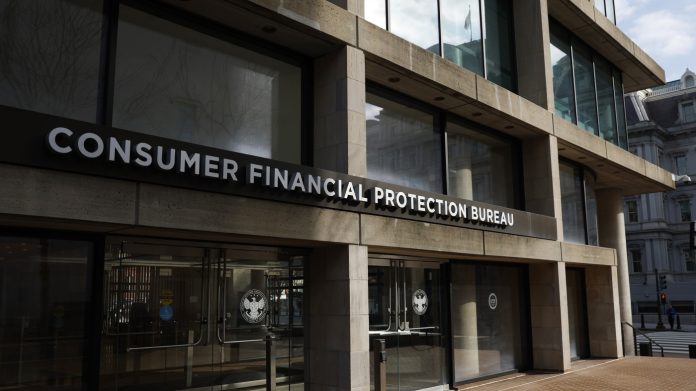
The exterior of the Consumer Financial Protection Bureau headquarters in Washington, D.C. Employees of the CFPB were notified that the headquarters would be closed and that employees were to work from home.

Anna Moneymaker/Getty Images


hide caption

toggle caption

Anna Moneymaker/Getty Images

Elon Musk made a big leap late last month toward his long-shot goal of turning X into an “everything app,” a service that could encompass a broad range of services, including the ability to transfer money, similar to Venmo or PayPal.

X, formerly Twitter, announced it had struck a deal with Visa to soon offer a mobile payments service, cementing the card giant as the first major partner in a feature called “X Money Account.”

This service would be directly regulated by the Consumer Financial Protection Bureau under expanded oversight powers it had finalized late last year allowing the agency to police things like privacy issues, fraud and how disputed transactions are handled at mobile payment apps like Apple Pay, Google Wallet, PayPal, Cash App — and X’s money service.

Now, the CFPB is in Musk’s crosshairs as the latest target of a group of young operatives tasked with President Trump’s marching orders to cut federal government spending at the same time the agency was poised to oversee his grand plan of morphing X into a financial services juggernaut.

“The fact that Musk is now engaged in payment businesses that would be regulated by the CFPB at the same time he’s trying to tear down the CFPB puts in sharp relief the conflicts of interests here and how much this disserves the general public,” said Richard Cordray, who led the CFPB under President Barack Obama. “The whole situation is rife with conflicts of interest.”

The White House and Musk did not return requests for comment.

The CFPB has long faced opposition from Republicans and industries, including Wall Street and Silicon Valley.

Weeks after the bureau announced finalized rules for becoming a watchdog on digital wallets, TechNet and NetChoice, two groups backed by Big Tech, sued the CFPB, arguing that the agency does not have “free rein in choosing which nonbank entities to supervise.”

During Trump’s first term, the scope of the agency’s work was significantly narrowed. But now, under acting Director Russ Vought, nearly all of the bureau’s work has been ordered to be stopped, with Vought saying he will not be asking for any more funding for the agency.

“CFPB RIP,” Musk wrote on X last week with an emoji of a gravestone.

New questions about Musk’s potential conflicts of interest

Since Musk’s role leading the Department of Government Accountability, or DOGE, became clear, his critics have been quick to point out just how entangled some of his six companies, including Tesla and SpaceX, are with the federal government.

Through contracts, tax breaks, loans and other ways, the federal government has supported Musk’s business empire to the tune of billions of dollars, while at least 11 federal agencies have more than 30 investigations into Musk’s companies, according to a count by The New York Times. The newspaper reported on Tuesday that Musk’s push to whittle down, or completely dismantle, agencies has “thrown into question the progress and outcomes of many of those pending investigations.”

As a special government employee, Musk is required by law to recuse himself from any matters that could have an impact on his financial interests. President Trump has vowed to remove Musk from any government business that intersects with one of his companies.

“If we thought that, we would not let him to do that segment, or look in that area, if we thought there was a lack of transparency or conflict of interest,” Trump said from the Oval Office on Tuesday alongside Musk. “We watch that.”

A crowd holding signs, including one that reads "Hands off our CFPB," joins Sen. Elizabeth Warren in front of the Consumer Financial Protection Bureau.

Sen. Elizabeth Warren, D-Mass., speaks as congressional Democrats and CFPB workers hold a rally to protest the closing of the Consumer Financial Protection Bureau and a work-from-home order outside its headquarters on Monday in Washington, D.C.

Jemal Countess/Getty Images


hide caption

toggle caption

Jemal Countess/Getty Images

In the same appearance, Musk told reporters in the White House that DOGE is operating transparently, pointing to the unit’s account on X, which posts regularly celebrating the canceling of various federal contracts.

“Transparency is what builds trust,” Musk said. “And you can see, am I doing something that is benefiting one of my companies or not? It’s totally obvious.”

But if there is a problem, the public may never know.

The White House confirmed to NPR that Musk’s financial disclosures will remain confidential, a level of secrecy that is permitted under law. Trump officials added that Musk received an ethics training this week to ensure Musk’s work with DOGE does not create ethical conflicts.

In taking a hatchet to the CFPB, Musk is not only potentially clearing regulatory oversight of new money services on X, but delivering a win to other Silicon Valley giants, which have for years been fighting against the bureau, according to lawmakers and advocacy groups that rail against Big Tech.

At a protest outside the CFPB headquarters on Monday, Sen. Elizabeth Warren, D-Mass., who helped conceive of the agency, told rallygoers that Musk wants to wipe out the agency as a way of boosting his own bottom line.

“This is like a bank robber trying to fire the cops,” Warren said. “And turn off the alarms just before he strolls into the lobby.”

Have information you want to share about the ongoing changes at CFPB or across the federal government? Bobby Allyn is available via the encrypted messaging app Signal at ballyn.77 

Treasury Secretary Expected to Visit Kyiv

0

The first senior Trump administration official was expected to visit Ukraine, a day after Russia released an American prisoner in a development that President Trump called a positive signal for cease-fire talks.

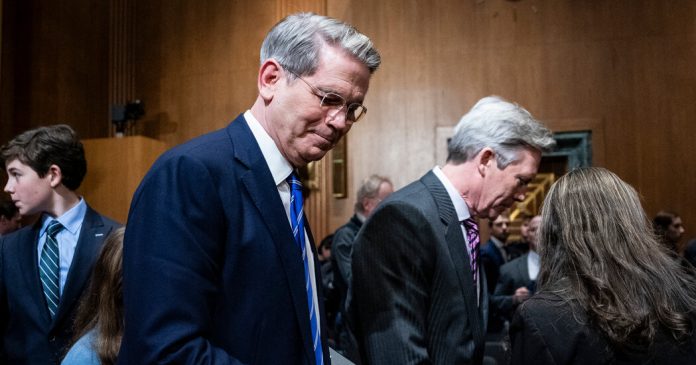
Treasury Secretary Scott Bessent’s trip comes amid anxiety in Kyiv and among American allies about whether U.S. support for the Ukrainian war effort will be maintained now that Mr. Trump has returned to the White House.

The Trump administration has already sought an arrangement for the United States to secure rights to Ukrainian natural resources, including rare earth minerals, as a guarantee for further U.S. assistance.

Mr. Trump said in a post on Truth Social on Tuesday that he was sending Mr. Bessent to Ukraine because “this war must and will end soon — too much death and destruction.”

Mr. Trump, who has made American spending in a variety of areas a focus of the early days of his new administration, also wrote that the visit would touch on American assistance to Ukraine. The United States, he wrote, had spent billions of dollars “with too little to show” for it.

President Volodymyr Zelensky of Ukraine said he welcomed the visit by Mr. Bessent. “We are already prepared for meetings with representatives of the United States — negotiations will begin soon,” Mr. Zelensky in his evening address to Ukrainians on Tuesday.

Mr. Trump’s focus on securing the mining rights was reflected in the choice of Mr. Bessent to make the first high-level visit, rather than a senior security or military official to discuss the war.

Hours after Mr. Trump announced the visit, Russia launched a missile attack on Ukraine that included a volley of ballistic missiles fired at Kyiv, the capital.

The missile strike, which took place shortly before 5 a.m., killed one person and wounded four others, including a 9-year-old girl, according to the Kyiv city administration. It was unclear if Mr. Bessent was in Kyiv at the time.

Falling debris from interceptions by air defense missiles over Kyiv scattered debris that caused fires in buildings in four districts, and explosions echoed through the capital for several minutes.

The missile volley in Ukraine came also hours after Russia released an American prisoner, Marc Fogel, in what Mr. Trump said he hoped would be an initial step toward negotiating an end the war in Ukraine.

Mr. Zelensky, in a post on X, also voiced support for ending the war. “This Russian terror against Ukraine will not stop on its own,” he wrote. “Right now, we need the unity and support of all our partners in the fight for a just end to this war.”

Overall, Russia fired six ballistic missiles and 123 exploding drones at Ukraine overnight, after a period of nearly a month in which Russia has largely refrained from using ballistic missiles. Fighting also continued along the front line in eastern Ukraine, where Russian forces continued assaults.

The Ukrainian military reported that 149 aerial bombs were dropped from airplanes and more than 2,000 short-range drone strikes were fired at frontline positions.

In another missile attack on Ukraine, on Tuesday, Russia struck the country’s main natural gas producing region, Poltava, continuing attacks on the country’s energy infrastructure.

Beyond Ukraine, the Polish military reported on Tuesday that a Russian military plane briefly entered its airspace, although the military said that it was in contact with its Russian counterparts. The error was attributed to a problem with the plane’s navigation system.

Trump funding freeze threatens climate projects : NPR

0

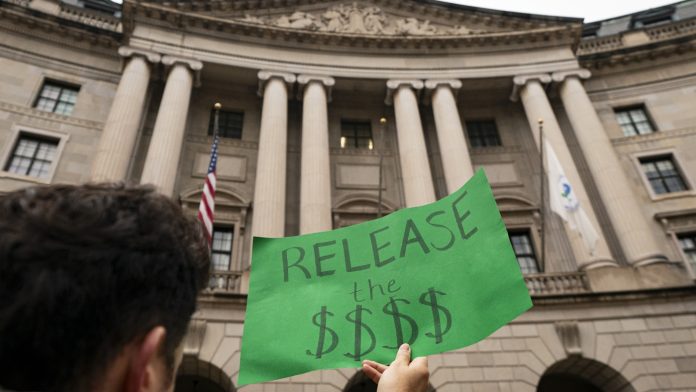
A demonstrator shows opposition during a demonstration at the Environmental Protection Agency on Feb. 6 in Washington, DC.

Al Drago/Getty Images/Getty Images North America


hide caption

toggle caption

Al Drago/Getty Images/Getty Images North America

Removing lead paint and pipes. Cleaning up contaminated land. Monitoring pollution. Making houses more energy efficient. Installing solar panels in low-income neighborhoods. Those are some of the projects across the country that were cut off from federal funding when the Trump administration paused spending approved earlier by Congress.

The sweeping move is part of President Trump’s plan to roll back environmental and climate change initiatives that started under former President Biden.

Federal judges intervened, issuing temporary restraining orders that prohibited the Trump administration from carrying out the funding freeze. But grant recipients, contractors and activists say promised government money has been held back even after the courts stepped in, throwing into doubt the government’s standing as a reliable partner in protecting human health and the environment.

“Undermining the trust in the federal government may actually be the real point of this,” says Zara Ahmed, vice president of policy and advisory operations at Carbon Direct, which helps companies, governments and other organizations cut their carbon emissions.

“Fast forward to the future, and imagine that you were trying to build a new project, and you were thinking about getting an award from the federal government. How would you think about that now?” Ahmed says. “I think people are going to be a lot more reluctant to do business with the federal government for fear of making investments, uprooting their lives, only to have the rug pulled out from under them.”

A worker installs no-cost solar panels on the roof of a low-income household in 2023 in Pomona, Calif.

A worker installs no-cost solar panels on the roof of a low-income household in 2023 in Pomona, Calif.

Mario Tama/Getty Images/Getty Images North America


hide caption

toggle caption

Mario Tama/Getty Images/Getty Images North America

‘We wouldn’t be able to move forward without it’

Trump has vowed to shrink the federal bureaucracy and slash government spending. One focus is initiatives to cut climate pollution and protect communities from the impacts of rising temperatures, like more extreme storms and heat waves. A Trump administration official did not respond to a request for comment.

The funding freeze is being felt across the U.S.

A Missouri school district couldn’t pay for almost two dozen electric school buses it ordered to replace a fleet of diesel buses. In Springfield, Mass., officials didn’t know if the city would get money it was promised to weatherize homes, remove lead paint and repair roads. Oklahoma regulators warned $100 million in grant funding to plug abandoned oil and gas wells was in jeopardy. A North Carolina official said the state risks losing out on more than $100 million in conservation projects that could protect communities from floods and wildfires. And in Kersey, Colo., officials had to hope the government would unfreeze money to remove an old grain elevator covered in asbestos, a cancer-causing substance that’s linked to the deaths of tens of thousands of Americans every year.

“We wouldn’t be able to move forward without it,” Susie Thielbert, a grant analyst for Kersey, told Colorado Public Radio about the grain-elevator project. “We are a very small community.”

Without federal support, American communities — especially those in low-income areas that investors often avoid — will struggle to deal with a challenge as pervasive as climate change, market analysts and environmental advocates say.

“You can try to ignore climate realities, but we’re feeling them,” says Alys Campaigne, climate initiative leader at the Southern Environmental Law Center. “So to back out of any kind of leadership role and to defund programs that were specifically designed to address these needs just shifts the risk and the cost back onto communities and individuals.”

Court fights deepen anxiety about climate action and U.S. governance

The fight over climate funding looks far from over.

On the day Trump took office, he signed an executive order instructing federal agencies to pause grant payments under the Inflation Reduction Act and the Infrastructure Investment and Jobs Act. Those laws authorize huge federal investments aimed at protecting the environment and spurring investment in clean energy and new infrastructure.

Days later, the Office of Management and Budget (OMB) released a memo directing agencies to temporarily halt funding related to “the green new deal,” as well as diversity, equity and inclusion programs, and foreign aid. OMB said such investments are “a waste of taxpayer dollars.” (There is no ‘Green New Deal’ within the government.)

Nonprofits and attorneys general from 22 states and the District of Columbia filed separate lawsuits in federal court challenging the administration’s actions. In both cases, judges issued temporary orders directing the Trump administration to halt its funding freeze.

The government’s handling of the issue since then has only deepened anxiety among groups that were awarded grant funding. OMB rescinded its memo, and lawyers for the government said in a court filing that agencies were told to release funds that had been held back. However, in a message posted on the social media site X, White House spokeswoman Karoline Leavitt said the administration had not canceled the funding freeze itself.

“The President’s [executive orders] on federal funding remain in full force and effect, and will be rigorously implemented,” Leavitt wrote.

On Monday, U.S. District Judge John McConnell, Jr. said the Trump administration has continued to improperly freeze some federal funding. McConnell ordered the administration to immediately restore funds it withheld, including from the Inflation Reduction Act and the Infrastructure Investment and Jobs Act, saying the freeze is “likely unconstitutional and has caused and continues to cause irreparable harm to a vast portion of this country.”

President Trump signs executive orders in the Oval Office of the White House on January 20.

President Trump signs executive orders in the Oval Office of the White House on Jan.20.

JIM WATSON/AFP via Getty Images/AFP


hide caption

toggle caption

JIM WATSON/AFP via Getty Images/AFP

Advocates say federal government has a crucial role funding environmental projects

One group that’s been waiting on funding is Collaborative Earth. The organization is helping Native American tribes in Oklahoma develop more sustainable grazing practices and small farmers in the southeast reforest waterways to prevent flooding and store carbon pollution.

“It’s strange that the payment of an invoice could make you wonder about the future of a democracy, but that’s exactly what it feels like,” says Aaron Hirsh, organization lead at Collaborative Earth.

Unless payments restart, Hirsh says his group is weeks away from having to lay people off — and potentially having to shut down entirely.

“I don’t know when we’re going to get started again on finding these kinds of solutions that can benefit local communities as well as ecosystems,” Hirsh says. “This is the sort of funding that can support that kind of innovation. That’s what it was supposed to do. And without it, I don’t think we find those solutions.”

Like a lot of organizations, Collaborative Earth doesn’t receive grant funding in big upfront payments. Instead, it’s compensated by the government for past expenses, like paying workers and buying equipment. In other cases, organizations can withdraw federal funding to cover about a week’s worth of expenses. Unless groups have large cash reserves, even a brief interruption in government funding can cause problems.

“When these projects get frozen and you let all that staff go, you lose momentum, and you might lose the project permanently, because the people can’t afford to sit and wait,” says Campaigne of the Southern Environmental Law Center. “You’re between a rock and a hard place of trying to stay committed to the work that you are dedicated to and feeding your family.”

Funding uncertainty threatens to derail projects

The outlook isn’t much better for groups whose funding has been restored.

“There’s a lot of uncertainty,” says Debra Hernandez, who runs an environmental nonprofit in South Carolina, “about whether folks should continue work.”

Hernandez’s group, the Southeast Coastal Ocean Observing Regional Association, gets federal funding, mainly through the National Oceanic and Atmospheric Administration, to collect environmental data for the public, including information for hurricane models. When OMB froze funding, Hernandez says her group was temporarily locked out of government accounts it uses to withdraw grant money.

“I was in the process of hiring new people, which I put on indefinite hold,” Hernandez says.

In other cases, groups received conflicting information about their grant funding from federal agencies, making it hard for them to budget for the future.

Adding to the challenge, the uncertainty created by the Trump administration could dissuade consultants and subcontractors from working on projects that are backed by the federal government, says Michelle Roos, executive director of the Environmental Protection Network, a group of former staffers and political appointees at the Environmental Protection Agency.

“They’re going to have a hard time finding people that want to do business with them if they think that, ‘Well, at any point, this project may lose its funding,'” Roos says.

Former President Biden shakes hands with Republican Sen. Mitch McConnell during an event related to the Bipartisan Infrastructure Law in Covington, Kentucky, in 2023.

Former President Joe Biden shakes hands with Republican Sen. Mitch McConnell during an event related to the Bipartisan Infrastructure Law in Covington, Ky., in 2023.

JIM WATSON/AFP via Getty Images/AFP


hide caption

toggle caption

JIM WATSON/AFP via Getty Images/AFP

Republican states could be hit hard

Fallout from the Trump administration’s funding freeze is likely to hit especially hard in Republican-led states, which have been big beneficiaries of climate investments the government made through the Inflation Reduction Act.

“Our state is really going to take a big hit if these funds are pulled away,” says Autumn Crowe, deputy director of the West Virginia Rivers Coalition, a conservation group.

Parts of West Virginia “have been left behind” for decades, Crowe says, but money had started flowing in from the Biden-era laws that Trump’s now targeting.

“Their infrastructure is failing,” Crowe says. “And without the federal government coming in to help support them, they’re not going to be able to come up with that money on their own.”

Similar concerns are rippling through the region, says Dana Kuhnline, senior program director at ReImagine Appalachia, an advocacy group.

“I think what sometimes gets lost in the story about Appalachia is that there is actually a tremendous amount of local energy and innovation, because people love the place, and they stay here because they love it,” Kuhnline says. “And so you have a lot of folks with the Inflation Reduction Act and the Bipartisan Infrastructure Law funding who really had that first chance in a generation to start to kind of really do some big, big things.”

Now, Kuhnline says, people will probably be wary of taking federal aid that looked like a lifeline just weeks ago.

“They tried to dream big and do a big economic improvement for their local community,” she says, “and ended up in this really impossible situation.”

San Diego fails to pass measure protecting girls from trans athletes despite pleas from parents

0

A middle school in San Diego has been thrust into local controversy because of a transgender student using the girls’ locker room. 

The San Diego County Board of Supervisors on Tuesday voted against a measure to carry out the Protection of Women and Girls in Sports Act, which would prevent trans athletes from competing in girls’ sports or entering girls’ locker rooms. 

Vice Chair of the San Diego County Board of Supervisors Jim Desmond brought forth the proposal at a San Diego Board of Supervisors meeting on Tuesday. However, the measure did not get any votes from other supervisors outside of Desmond. 

“People came into the meeting with their minds already made up on the issue,” Desmond told Fox News Digital. 

“The rest were mothers who just didn’t think it was fair or safe for males to be playing in girls’ or women’s safe. So the room was probably 60-40 in favor of letting them play, but I think that’s just the turnout of who was able to take the day off and come down here. I think the vast majority of the people in San Diego County agree that males should not be playing in women’s and girls’ sports.”

CLICK HERE FOR MORE SPORTS COVERAGE ON FOXNEWS.COM

Tuesday’s meeting featured several arguments from concerned parents who expressed their concern over their daughters being forced to share locker rooms with biological males. 

The middle school where this controversy is taking place, San Elijo Middle School, provided a statement to Fox News Digital, crediting its enabling of the transgender student to access the girls’ locker room to the school’s obligation of following state law. 

“Public school districts in California are governed by, and must act in accordance with, California state law and the California Education Code,” San Elijo Middle School’s statement reads. 

“As a California public school district, we will continue to follow state law and guidance from the California Department of Education to ensure that all students are treated with dignity, respect, and fairness. Our district remains committed to upholding policies that support all students, in accordance with state protections and anti-discrimination laws.”

President Donald Trump signed the “No Men in Women’s Sports” executive order last Wednesday, which cuts federal funding for any educational institution that allows biological males to compete with girls and women. 

However, multiple states, including California, have insisted they will not comply with Trump’s order. According to USA Facts, California public schools receive about $16.8 billion per year, which is 13.9% or one in every seven dollars of public school funding, which is well above the national average. 

The California Interscholastic Federation (CIF) said it will continue to follow the state’s law that allows athletes to participate as whichever gender they identify as, a spokesperson told Fox News Digital. 

“The CIF provides students with the opportunity to belong, connect, and compete in education-based experiences in compliance with California law [Education Code section 221.5. (f)] which permits students to participate in school programs and activities, including athletic teams and competitions, consistent with the student’s gender identity, irrespective of the gender listed on the student’s records,” a CIF statement said. 

Desmond said that many of his local constituents reached out to him expressing concern and disbelief about the state’s handling of the situation. 

“They think it’s crazy, and I’ve heard questions of ‘is it even legal?’” Desmond said. 

For Desmond, as a Republican, he sees the Democrat refusal to comply with Trump’s order as an issue that will continue to harm support for the party in his state. 

“These people didn’t get the message in the last election and they’re just digging the hole deeper. They’re doubling down, digging their heels in the ground, ‘yes we’re right,'” Desmond said, adding that he thinks and hopes the trans athlete debate will strengthen Republican support in California. 

TEEN GIRLS OPEN UP ON TRANS ATHLETE SCANDAL THAT TURNED THEIR HIGH SCHOOL INTO A CULTURE WAR BATTLEGROUND 

“I think it’s empowering us with the new administration to stand up and do what’s right. And that’s all we’re trying to do, we’re not trying to discriminate against anybody. If you want to be trans, if you want to identify as another [gender], fine, go for it, you have that right, but where do your rights end and somebody else’s begin? You can’t have one boy cause 30 girls to have to leave and go change some place else, that’s not right, we need a better system.” 

The decision by California not to comply with Trump’s order has recently prompted backlash and even protests and threats of lawsuits by the state’s residents. 

On Friday, residents gathered in Long Beach, California, to protest outside a CIF federated board meeting. The protesters then spoke at the board meeting, pleading with the CIF officials to follow the president’s order and threatening civil lawsuits against the CIF and state. 

Currently, there is one lawsuit against the CIF and the state’s attorney general, Rob Bonta, over a situation at Martin Luther King High School involving a trans athlete on the girls’ cross-country team.

A recent school board meeting by the Riverside Unified School District on Dec. 19 featured a parade of parents berating the board for allowing a trans athlete on the Martin Luther King girls’ cross-country team. A lawsuit filed by two girls on the team alleges that their T-shirts in protest of that player were compared to swastikas simply because they said “Save Girls Sports.” 

The father of a girl who lost her varsity spot to the trans athlete previously told Fox News Digital that his daughter and other girls at the school were told “transgenders have more rights than cisgender[s]” by school administrators when they protested the athlete’s participation.

CLICK HERE TO GET THE FOX NEWS APP

That is just one controversy in the state that has erupted over the last year from its laws that enable trans inclusion in girls’ sports. 

Stone Ridge Christian High School’s girls’ volleyball team was scheduled to face San Francisco Waldorf in the Northern California Division 6 tournament but forfeited in an announcement just before the match over the presence of a trans athlete on the team.

A transgender volleyball player was booed and harassed at an Oct. 12 match between Notre Dame Belmont in Belmont, California, against Half Moon Bay High School, according to ABC 7. Half Moon Bay rostered the transgender athlete.

California State Assembly member Kate Sanchez announced on Jan. 7 that she is introducing a bill to ban trans athletes from competing in girls’ and women’s sports.

Sanchez will propose the Protect Girls’ Sports Act to the state legislature. Currently, 25 states have similar laws in effect.

Follow Fox News Digital’s sports coverage on X, and subscribe to the Fox News Sports Huddle newsletter.

The Fiercest Fighting of the Ukraine War May Be in Russia

0

A Russian special forces commander served on four battlefronts across eastern Ukraine after joining Russia’s invasion nearly three years ago. He said the most ferocious fighting he has seen is now unfolding back home, as the Russian Army he serves struggles to liberate a sliver of national territory from Ukrainian forces.

The protracted battle for the occupied Russian town of Sudzha and the surrounding countryside has unexpectedly emerged as one of the focal points of a war fought over the fate of the Ukrainian state. Both sides have committed a significant share of their limited reserves to control Sudzha, a once sleepy county seat in the Kursk region, near the two countries’ border.

“These are the most brutal battles — I haven’t seen anything like this during the entire special military operation,” the commander, who leads about 200 men fighting in Kursk, said in an interview near the front line late last year, using the Kremlin’s euphemism for the war. He requested that he be identified only by his call sign,Hades, according to military protocol.

Both sides see Kursk as must-have territory, an important element in the expected peace talks promised by President Trump. Military analysts say the Ukrainian forces have since poured some of their best reserves into Kursk, hoping to use its conquest as a bargaining chip in negotiations.

For President Vladimir V. Putin of Russia, the Ukrainian incursion — the first invasion of Russian territory since World War II — has been an ongoing embarrassment. He is determined to push Ukraine out so he does not have to make any concession to get the territory back, and Moscow has deployed tens of thousands of soldiers, including conscripts and North Korean allies, to repel the invaders, according to U.S. officials.

Ukrainians “wanted to conduct the talks from a position of strength,” Lt. Gen. Apti Alaudinov, the commander of the Akhmat special forces unit from Russia’s Chechnya region, said in an interview in the Kursk region in December. “When the time comes for the talks, it is not clear if they can still say that they are here.”

With the stakes so high, Russian soldiers fighting in Kursk believe the fighting is about to become even bloodier.

“We are expecting Bakhmut 2.0,” said Hades, the Russian commander serving in Akhmat, which is made up in large part from the remnants of Wagner paramilitaries.

Bakhmut is a Ukrainian town whose ruins Wagner captured in 2023 after a nine-month assault at the cost of tens of thousands of casualties. The standoff was emblematic of Ukraine’s stand-and-fight strategy even in the face of Russia’s superior manpower and firepower.

Another Russian commander, who insisted on anonymity for security reasons, said the cost of a showdown would be staggering. The bloodshed, the casualties, it’s “unimaginable,” he said.

A photographer working for The New York Times was given access to Kursk late last year and was allowed to interview and photograph Russian soldiers at a hospital and near the front line, as well as civilians, some who had fled their villages and others who stayed behind.

Some of the interviewed soldiers were Wagner veterans who joined Akhmat after the failed mutiny of the mercenaries’ leader, Yevgeny V. Prigozhin. They said the Chechnya-based special forces unit most closely resembled the loose structure of their former paramilitary force.

Other interviewed soldiers were recent volunteers who joined to take advantage of rising sign-up bonuses. They said an opportunity to fight inside their own country provided an additional incentive to join a war whose broader goals or causes they struggled to articulate.

“This is our land, these are our people and our values,” Aleksandr, a Russian contract soldier who was injured by a mortar fighting in Kursk, said in an interview at a medical center. “We must fight for them.”

Since the Ukrainian invasion began six months ago, both sides have taken heavy losses in Kursk’s exposed, flat terrain punctuated by small villages, although the armies closely guard their casualty rates. Russia, in glacial advances, has been able to recover about 60 percent of about 500 square miles initially captured by Ukraine.

Between the two armies are an estimated 2,000 to 3,000 Russian civilians, who were trapped by the speed of the initial Ukrainian advance and the Russian government’s failure to mount an evacuation.

The two sides have blamed each other for failing to provide conditions for the remaining residents to leave, forcing those civilians to endure the Russian winter with dwindling food supplies and without running water, heating or electricity. As the Russian forces close in, they are being subjected to escalating bombardment.

The analysts and relatives of Sudzha residents fear that the Russian military’s reliance on heavy bombing and Ukraine’s determination to defend the town threaten a humanitarian catastrophe at a level not seen in Russia since the civil war in Chechnya in the 1990s. By late January, Russian forces stood just a few miles from the town center.

In Ukraine, the Russian invasion has caused civilian suffering on a much larger scale, with strikes on residential buildings, hospitals, churches and an array of energy facilities.

Pasi Paroinen, a military analyst at Finland-based research company Black Bird Group, said the Russian assault on Sudzha would be costly for both soldiers and civilians, because Ukraine had deployed in Kursk its strongest force.

Lyubov, a mother of four, is part of a group of Kursk residents who for months have been publicly calling for a humanitarian corridor to evacuate relatives trapped in Sudzha. She said she feared that the impeding assault on the town would leave her parents and others there with little chance of survival.

“By the time Russian troops enter the settlements, only ruins and ashes remain of the houses,” she said in an interview, adding: “This is an awful rescue system.”

The apocalyptic scenes described by civilians who have escaped Sudzha’s surrounding villages foreshadow the intensity of the impending battle for the town.

In interviews, these civilians provided mixed accounts of Ukrainian occupation.

Zoya, 64, described the initial friendliness of Ukrainian soldiers who occupied her village, Pogrebki, on Aug. 12. She said the first soldiers who came to her house gave her husband a pack of cigarettes and offered their help.

“They were really nice lads,” she said.

(Zola and other civilians who were interviewed are being identified by their first names only to protect them against Russian censorship laws).

That camaraderie waned as the fighting intensified, according to those who fled. The Ukrainian soldiers began to see Russian civilians as a hindrance — or worse, as potential informers who could give away their positions.

Zoya and her husband ran out of food and subsisted on occasional frozen potatoes that they dug out from their garden. During one of those sorties, a drone exploded near her husband. He died in her arms minutes later, she said.

Zoya spent most of her time sheltering from constant bombing in her basement, a stretch of darkness that made her hallucinate and temporarily lose her sense of sight and time. Hunger eventually drove her to attempt an escape.

“There was nowhere left to live — it was so scary there, everything was destroyed,” she said in an interview.

She said she walked five miles through fields littered with destroyed Russian tanks and dead soldiers before reaching the Russian positions in November.

Another woman named Natalia, 69, who uses a wheelchair, recounted a similar experience.

She said Ukrainian soldiers initially brought her bread, water and insulin for her diabetes after occupying her village of Novoivanovka. The soldiers stopped occasionally to chat over a cup of tea.

The treatment worsened as the fighting drew closer.

She said in an interview that her husband had died after being summarily shot by a Ukrainian soldier. Her account could not be independently verified and Ukraine has repeatedly said that it adheres to humanitarian laws in Kursk.

By November, Natalia was sheltering in a basement in no man’s land. One day, she said, a Russian reconnaissance group reached her house and told her that her only chance of survival was escape.

“They said, ‘Please leave, however you can — otherwise you will die,’” said Natalia.

She said other surviving residents helped to carry her to another village, where their group was eventually rescued by Russian troops.

Sudzha residents now fear similar hardships are coming to their trapped relatives.

Earlier in February, a missile hit Sudzha’s boarding school, which sheltered about 100 people displaced from the outlying villages. Both sides have blamed each other for the strike. Ukraine has released evidence that appears to show that Russia was responsible.

The attack killed at least four people; Ukrainian soldiers evacuated survivors to Ukraine.

“We don’t know where the rocket came from,” said Yulia, a Russian woman whose parents survived the strike. She said that Ukrainian soldiers “came and helped dig people from the rubble, and saved our people.”

A Russian man named Sergei said that video messages from family in the town had sometimes reached him following its occupation. Over the months, he said, he watched their hair grow white, their bodies grow thin and the sounds of explosions grow louder.

“I’m sorry that I am crying,” said his sister in a video that was viewed by The Times, congratulating Sergei on his birthday. “I wish I could’ve done it in person, at least by telephone. You have always complained that I call too little.”

“Mother can’t congratulate you, because she struggles to come up the stairs. She is almost always in the basement,” the sister added. “She joins my congratulations.”

Eventually, the videos became too painful to watch, said Sergei, leading him to switch to passing occasional texts.

Constant Méheut and Yurii Shyvala contributed reporting from Kyiv and Milana Mazaeva from Tbilisi, Georgia.

Republicans split on best path to advance Trump’s agenda in Congress : NPR

0

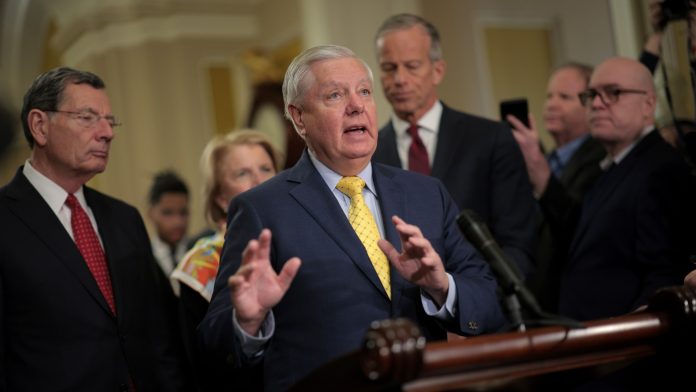
Senate Budget Committee Chairman Lindsey Graham, R-S.C., told reporters in the Capitol on Tuesday that he is moving forward with a budget proposal that would allow Republicans to pass much of President Trump’s agenda without the threat of a filibuster.

Chip Somodevilla/Getty Images


hide caption

toggle caption

Chip Somodevilla/Getty Images

House and Senate Republicans are charting competing courses to implement President Trump’s top agenda items, including boosting funds for security along the U.S. southern border and extending tax cuts.

The Senate budget committee is expected to begin marking up a budget resolution Wednesday that begins the process of reconciliation to provide $175 billion to secure the southern border and $150 billion in new military spending.

“It would be enough money for four years to implement President Trump’s border agenda, immigration agenda on the security side,” budget Chairman Lindsey Graham told reporters in the Capitol on Tuesday.

Graham spoke after a closed-door briefing with other GOP senators, OMB Director Russ Vought and border czar Tom Homan. He said the pair begged for additional funding and said Immigration and Customs Enforcement (ICE) is running out of money.

“After that briefing, if the Republican Party cannot provide the money to the Trump administration to do all the things they need to do to make us safe, we have nobody to blame but ourselves,” Graham said. “Because we have the ability through reconciliation to do this, and I just want to do it sooner rather than later.”

One or two bills, that is the question 

Senate Republicans want to proceed with a two-bill approach in order to act more expeditiously on the president’s priorities at the border, and then return later this year to address extending tax cuts. GOP senators have expressed concern that combining those items into one bill risks making it too complicated and unwieldy to pass quickly.

“To my friends in the House – we’re moving because we have to,” Graham, R-S.C., said. “I wish you the best. I want one big beautiful bill, but I cannot and will not go back to South Carolina and justify not supporting the president’s immigration plan.”

Across the Capitol, House Republican leaders have been pushing a one-bill approach that encompasses top administration priorities like immigration, energy, defense and taxes.

The House has different considerations than the Senate. GOP members say putting the tax component into a separate bill down the road could jeopardize it altogether.

House Republicans have a razor thin majority and it’s difficult enough to satisfy the various factions within the conference to get on board with one bill, let alone two.

“It’s a nonstarter,” said House Speaker Mike Johnson, R-La., of the potential to go with the Senate’s budget resolution. Johnson also indicated addressing the debt ceiling, something Trump has requested, will be part of the House plan.

But Johnson’s conference isn’t yet aligned with how to go about the one-bill approach. The speaker’s plan has already been undermined earlier this week when the hardline House Freedom Caucus released its own budget resolution, representing the first of a two-step reconciliation plan.

“Given the current delay in the House on moving a comprehensive reconciliation bill, moving a smaller targeted bill now makes the most sense to deliver a win for the President and the American people,” Chairman Andy Harris, R-Md., said in a statement.

Trump has previously expressed support for the one-bill path but has also said he cares less about the process and more that it gets done.

Budget resolution key to unlocking reconciliation

Both chambers are working toward a budget tool called reconciliation in order to achieve their policy goals.

Reconciliation is a process that allows some types of legislation to pass with a simple majority and avoid the threat of a filibuster, which requires 60 senators to overcome. It’s the same mechanism that congressional Democrats used to pass parts of former President Joe Biden’s legislative agenda.

Republicans have 53 seats in the Senate and can’t expect any support from Democrats to get them over the 60-vote threshold, so they turn to reconciliation.

The first step of that process is a budget resolution, which directs various committees to develop legislation that achieves certain budgetary goals. The committees write those bills to achieve specific targets and then the budget committee assembles those bills together into one large bill that can’t be filibustered.

Graham pointed out Tuesday that committees will also be directed to find offsets to pay for other priorities like defense.

Pope blasts Trump admin over mass deportation plan, directs ire at Vance’s religious defense for policies

0

Pope Francis on Tuesday issued a major rebuke of the Trump administration’s plans for the mass deportations of migrants, stressing that the forceful removal of people simply for their immigration status deprives them of their inherent dignity and “will end badly.”

Francis wrote a letter to U.S. bishops in which he appeared to criticize Vice President JD Vance’s religious argument in defense of the deportation policies.

U.S. border czar Tom Homan responded to the pope, saying that the Vatican is a city-state surrounded by walls and that Francis should leave immigration enforcement to him. Homan, a Catholic, also said Francis should focus on fixing the Catholic Church rather than U.S. immigration policies.

“He wants to attack us for securing our border. He’s got a wall around the Vatican, does he not?” Homan told reporters. “So he’s got a wall around that protects his people and himself, but we can’t have a wall around the United States.”

DOZENS OF RELIGIOUS GROUPS SUE TO STOP TRUMP ADMIN FROM ARRESTING MIGRANTS IN PLACES OF WORSHIP

Pope Francis presides over a mass for the jubilee of the armed forces in St. Peter’s Square at The Vatican, Sunday Feb. 9, 2025. (AP)

As the first Latin American pope, Francis has long held the position of caring for migrants, pointing to the biblical command to “welcome the stranger” in calling on countries to welcome, protect, promote and integrate people fleeing conflicts, poverty and climate disasters.

Francis and President Donald Trump have long butted heads over the issue of immigration, including prior to Trump’s first term, when Francis said in 2016 that anyone who builds a wall to keep migrants out was “not a Christian.”

In his letter, Francis acknowledged that governments have the right to defend their countries and keep their communities safe from criminals, but said the deportation of people who fled their countries due to various difficult circumstances damages their dignity.

“That said, the act of deporting people who in many cases have left their own land for reasons of extreme poverty, insecurity, exploitation, persecution or serious deterioration of the environment, damages the dignity of many men and women, and of entire families, and places them in a state of particular vulnerability and defenselessness,” he wrote.

Pointing to the Book of Exodus in the Bible and Jesus Christ’s experience, Francis emphasized the right of people to seek shelter and safety in other lands and said the Trump administration’s deportation plan was a “major crisis.”

Anyone educated in Christianity, he said, “cannot fail to make a critical judgment and express its disagreement with any measure that tacitly or explicitly identifies the illegal status of some migrants with criminality.”

“What is built on the basis of force, and not on the truth about the equal dignity of every human being, begins badly and will end badly,” he continued.

POPE FRANCIS CALLS TRUMP’S DEPORTATION PLAN A ‘DISGRACE’

Pope Francis sitting

Pope Francis at his weekly audience in the Vatican on Feb. 28, 2024.  (AP Photo/Andrew Medichini)

The president of the U.S. Conference of Catholic Bishops, Archbishop Timothy Broglio, thanked the pope for his letter.

“With you, we pray that the U.S. government keep its prior commitments to help those in desperate need,” Broglio wrote. “Boldly I ask for your continued prayers so that we may find the courage as a nation to build a more humane system of immigration, one that protects our communities while safeguarding the dignity of all.”

White House press secretary Karoline Leavitt said last week that more than 8,000 people had been arrested since Trump took office Jan. 20 as part of the president’s plan to detain and deport immigrants in the country illegally, although hundreds of those arrested have since been released back into the U.S. Others have been deported, are being held in federal prisons or are being held at the Guantánamo Bay Cuba, detention camp.

Vance, a Catholic convert, has defended the administration’s deportation plans by citing a concept from medieval Catholic theology known in Latin as “ordo amoris,” which he has said describes a hierarchy of care: prioritizing the family first, then the neighbor, community, fellow citizens and lastly those from other regions.

But Francis sought to fact-check Vance’s understanding of the concept.

“Christian love is not a concentric expansion of interests that little by little extend to other persons and groups,” Francis wrote in his letter. “The true ordo amoris that must be promoted is that which we discover by meditating constantly on the parable of the ‘Good Samaritan,’ that is, by meditating on the love that builds a fraternity open to all, without exception.”

J.D. Vance walks into the Senate Chamber on Capitol Hill

J.D. Vance walks into the Senate Chamber on Capitol Hill on April 23, 2024, in Washington, D.C.  (Andrew Harnik/Getty Images)

As Homan referenced, the Vatican is a walled-in, 108-acre city-state inside Rome, and it recently increased sanctions for anyone who enters illegally. The law, approved in December, calls for people to face up to four years in prison and a fine of up to 25,000 euros, or $25,873, if they enter with “violence, threat or deception,” including by evading security checkpoints.

The U.S. bishops conference had already released a statement condemning Trump’s immigration policies after his first executive orders.

CLICK HERE TO GET THE FOX NEWS APP

Anyone “focused on the treatment of immigrants and refugees, foreign aid, expansion of the death penalty, and the environment, are deeply troubling and will have negative consequences, many of which will harm the most vulnerable among us,” the statement said.

Cardinal Blase Cupich of Chicago praised Francis’ letter, telling Vatican Media that it showed the pope viewed “the protection and advocacy for the dignity of migrants as the preeminent urgency at this moment.”

The Associated Press contributed to this report.

Myanmar Refugees’ Dreams of Living in America Dashed by Trump Orders

0

The family of four refugees filled seven suitcases for their new life in America. They packed blankets, tin plates, one blade for clearing the land in their future home and one for chopping meat. They left behind what they were not supposed to bring: slingshots, fish paste, traditional medicines from their native Myanmar.

But the family never made it to Ohio. Last month, their flights were abruptly canceled. Now with President Trump’s order to pause refugee resettlement, even for thousands of those who have gone through the yearslong approval process, they say they have lost hope in ever becoming Americans.

“I don’t have an opinion about American politics,” said Saw Steel Wah Doh, a 35-year-old lab technician, who is now back in a refugee camp in Thailand with his wife and two children. “I want to become American, work hard, love democracy.”

The Trump administration’s refugee suspension and foreign aid freeze are upending efforts to address one of the world’s most dire humanitarian crises. Not too long ago, Myanmar was an icon of democratic reform lauded by the West. Today, four years after the military toppled an elected government, it is an international pariah largely unchecked as it bombs its own civilians.

On Wednesday, nongovernmental organizations that promote democracy and provide lifesaving treatment for refugees and people displaced by conflict in Myanmar said they were told that grants from the National Endowment for Democracy had been suspended, effective immediately.

The N.E.D. was set up by Congress during the Reagan era to strengthen democracy worldwide. Three representatives of Myanmar-related aid groups said they were told that the N.E.D. has not been able to draw funds from the U.S. Treasury to pay for grants that had already been approved.

The N.E.D. stoppage comes two weeks after President Trump’s order to freeze most foreign aid, including funds disbursed by the United States Agency for International Development. Myanmar-related programs received about $150 million in pledges from U.S.A.I.D., according to local monitors. The aid money was to be used for benefits including H.I.V. treatment and support for exiled media reporting on Myanmar’s civil war.

In 2024, Myanmar was the second-most-dangerous and violent place on earth, according to a global conflict monitor. More than 3 million people are now displaced; thousands have been killed.

The United States has long offered a legal path to immigration for refugees fleeing persecution, war or other threats to their lives. Mr. Trump’s directive has shut the door to Afghan translators who risked their lives for American soldiers and to those fleeing religious persecution. It has also dashed the dreams of people from Myanmar, some of whom escaped persecution decades ago.

In Bangladesh, a sprawling tent settlement for Rohingya Muslims expelled from Myanmar constitutes the world’s largest refugee camp. Mohammad Islam was supposed to be resettled in the United States on Feb. 13, along with his family. That dream has withered.

Mr. Islam, 43, has been a refugee since he was 7, but he speaks fluent English and serves as a teacher in the camps.

“I have never been in a classroom, I only studied in tent shelters,” he said. “I want my children to learn in a real school, with walls and desks, in the United States.”

The 2021 coup, which put Myanmar’s generals back in charge, drew bipartisan condemnation in Washington. During Mr. Trump’s first term as president, his administration formally labeled the Myanmar military’s campaign of violence against the Rohingya a genocide. He also honored religious minorities from Myanmar at the White House.

But American support for those fighting Myanmar’s junta has never approached the monetary commitment made to Ukraine, Israel or other top aid recipients. In Myanmar’s jungles, university students, young professionals and even poets who have taken up arms to oust the generals have expressed frustration at how little international attention their plight garners.

In late 2022, President Biden signed into law the BURMA Act, which aims to punish those abusing human rights in the country and to provide assistance to those opposing the junta. (Burma is Myanmar’s former name.).

Last month, Mr. Trump singled out for elimination a $45 million scholarship program that helps Myanmar students fleeing civil war and hoping to study conflict resolution and peace building. Supported by U.S.A.I.D., the educational fund is called the Development and Inclusive Scholarship Program.

“We also blocked $45 million from diversity scholarships in Burma,” Mr. Trump said, adding, “you can imagine where that money went.”

In a post on X, the so-called Department of Government Efficiency labeled the program a “DEI scholarship” and said it had been canceled. Mr. Trump has said federal funds should not be used to support diversity, equity and inclusion.

“It feels like they just shut it down because they could,” said Ko Hlwan Paing Thiha, a scholarship recipient. He has been studying for a master’s in public policy in Thailand.

While opposition militias have pushed the Myanmar military from vast swathes of territory, the junta’s forces have exacted revenge on civilians through a brutal aerial campaign and the scattering of land mines in thousands of villages. The military has enforced conscription and is kidnapping young men from the streets to fill its ranks.

For the hundreds of Myanmar refugees already cleared to go to the United States, the prospect of an indefinite immigration halt is yet another hardship in lives beset by conflict, poverty and insecurity. Saw Htun Htun said his wife and two daughters are already resettled in Vermont. He is supposed to fly to the United States in late February but said he has little hope the trip will go forward.

“My heart is weak, and I am scared that I will never see my family again,” he said. “Please pray for me to go to the U.S.”

Thinking he was on his way to America, Mr. Steel Wah Doh quit his laboratory job at his refugee camp in Thailand. His father, who also hopes to be resettled in the United States, cannot get the medical checkups he needs for his immigration paperwork because camp clinics have been shut by Mr. Trump’s funding freeze.

Lifesaving American aid is supposed to be exempted from the spending ban, but health facilities remain closed. Two nonprofit representatives said they have been told that they will need to fund programs themselves before receiving reimbursements from American aid agencies. What constitutes lifesaving aid has not been made clear to them, they said.

In the Rohingya refugee camps, health clinics, learning centers and sanitation programs funded by the United States have also shut down. In one of the most densely packed places on earth, sewers are overflowing, posing the threat of disease, residents say.

Suffering from heart and kidney disease, Gul Bahar has walked through the muck to an American-funded clinic several times over the past two weeks, only to be turned away.

“I have no hope,” she said.

In Lakewood, Ohio, Mr. Steel Wah Doh’s cousin, Lay Htoo, 19, said he felt terrible for his relatives who didn’t show up as expected.

Mr. Htoo was nearly 8 when he and his family moved to the United States. He spoke no English.

His father is now a mechanic at a factory that makes gambling materials. Mr. Htoo is studying health at a community college, the first in his family to access higher education.

Now an American citizen, Mr. Htoo said he did not vote in last year’s elections. Some of the other Myanmar refugees in town, including family friends, he said, support Mr. Trump because they consider him to be a talented businessman.

“To be honest, living in those refugee camps, I remember it, and it’s not even 100 percent living,” Mr. Htoo said. “If I were still stuck there and I knew that other people voted for a guy who overturned my opportunity for a new life, I’d be extremely livid.”

Saiful Arakani contributed reporting from Teknaf, Bangladesh.