Thursday, November 12, 2026
Home Blog Page 27

U.S. complaints valid, expects more spending by allies : NPR

0

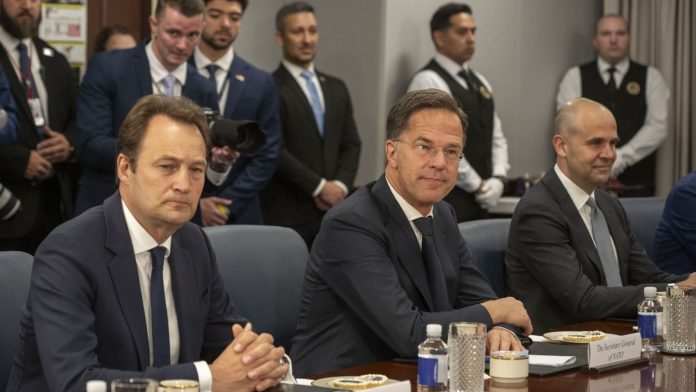
NATO Secretary General Mark Rutte attends a meeting with U.S. Defense Secretary Pete Hegseth (not pictured) at the Pentagon in Washington, D.C., U.S., April 24, 2025.

AP Photo/Kevin Wolf


hide caption

toggle caption

AP Photo/Kevin Wolf

For decades, the U.S. has played a leading security role both in Europe and for Europe. But President Trump has called that role into question and dialed back America’s involvement in many international conflicts.

Trump is particularly aggravated with the North Atlantic Treaty Organization, or NATO — the world’s biggest military alliance, which comprises 32 countries in Europe and North America.

The president has expressed frustration that Europe has not contributed enough monetarily to its own defense.

Speaking with Morning Edition on Friday while visiting Washington for meetings with Trump and other top officials, NATO Secretary General Mark Rutte said he agreed with the president’s assessment of Europe and Canada’s financial contributions to NATO.

“Rightly, the U.S. has complained. Particularly, President Trump has been very clear on this — that he expects Europeans and Canada to pay more, to step up in terms of their overall defense spending, and that is going to happen,” Rutte said.

NPR’s Michel Martin spoke to Rutte about how his talks with U.S. officials were going and NATO’s upcoming Hague summit.

This interview has been lightly edited for length and clarity. 

Interview highlights

Michel Martin: How are your meetings going so far?

NATO Secretary General Mark Rutte: We discussed Ukraine first. I think we can all be very happy for the fact that President Trump broke the deadlock and started the talks. Obviously, it is the U.S. — and its leadership and Trump’s leadership — which we need to hear to bring this to a good end, including help from the Secretaries [Pete] Hegseth, [Marco] Rubio and Security Adviser [Michael] Waltz. We discussed the state of play on that. I think they are really making progress and the ball is now clearly in Russia’s court. So, they need to now make a proposal, or at least react to what is on the table. We also discussed the upcoming NATO summit, which I believe we have every reason to think will be very successful. So much more defense spending, particularly on the European and Canadian side, which is necessary, but also ramping up defense industrial production.

Martin: As you just mentioned, in a couple of months, you’re going to chair a summit of NATO nations in the Netherlands. You said you believe it will be successful. What does success look like?

Rutte: For two reasons I think it’ll be successful. First of all, I believe who will decide that the European side of NATO and the Canadian side of NATO will ramp up spending, which is crucial because of the Russian threat, and because of the Chinese buildup of its military. Also, it is fair to spend more on that side of NATO because it equalizes with what the U.S. is spending. Rightly, the U.S. has complained. Particularly, President Trump has been very clear on this, that he expects Europeans and Canada to pay more, to step up in terms of their overall defense spending, and that is going to happen. Then there is an issue around the whole of NATO, including the U.S., that we do not produce enough in terms of defense industrial products, ammunition, Navy ships, tanks, fighter jets, long range missiles, air defenses and what have you. We will take decisions in June to make sure that we will stay ahead of the Russians and the Chinese. That is important, too, to keep ourselves safe.

Martin: Turning to some specific conflicts, there are European leaders, both publicly and privately, that have expressed some shock at what seems to be an American tilt toward Russia in these negotiations over the war in Ukraine. They seem to be pressing Ukraine to make concessions, even as the U.S. in the current administration doesn’t seem to be pressing Russia as hard. Is that your view as well?

Rutte: It is not, no. I think the U.S. and President Trump’s team and he himself really tried to, in an even-handed way, bring this whole process forward. That will mean compromises on all sides. What we have seen last [in] the attack on Kiev, a residential area, people just going about their lives, [was] 12 people killed because of an indiscriminate attack by the Russians. Also, I was in Odessa the other week with President Zelenskyy and I’ve seen the devastation there when attacks take place and these missiles come in this beautiful, beautiful city. This is not a sign of strength by the Russians. If they really are winning this, they would not do this.

Martin: Ukraine’s desire to seek NATO’s membership is a part of these discussions. Is that officially off the table now, to your understanding, or is that still part of the discussion?

Rutte: No, there is a clear statement by NATO that there is an irreversible path for Ukraine into NATO, but we always knew that there are very different views among allies. NATO is very much involved in building up the Ukrainian armed forces and helping with making sure that all the support for Ukraine military support for Ukraine is well coordinated. When it comes to full NATO membership, we never promised Ukraine that will be part of a peace deal.

Martin: Defense Secretary Hagel back in February warned that the U.S. is increasingly focused on Asia and its own borders for security. Did you walk away from this meeting feeling confident that the United States is still committed to NATO even if it reorders its priorities?

Rutte: 100% on both issues: the membership of NATO, and a total commitment to Article 5. Four weeks ago I was also visiting President Trump in the White House and he was very clear on this. Obviously, the U.S. has to take care of more issues than only Europe and the Euro-Atlantic. There’s also the Middle East. There’s also the Pacific. So, whilst the Europeans are stepping up, spending more, making sure that we can deliver more of the overall capabilities we need to deliver as NATO as a whole, it’s only logical for the U.S. to pivot more towards Asia. I’m absolutely convinced we will do this in a step by step approach, but it’s only logical. Everybody understands that.

Edited for radio by Olivia Hampton and for digital by Treye Green.
Trump needs unity among Republicans to pass his budget bill. Can he get it? : NPR

0

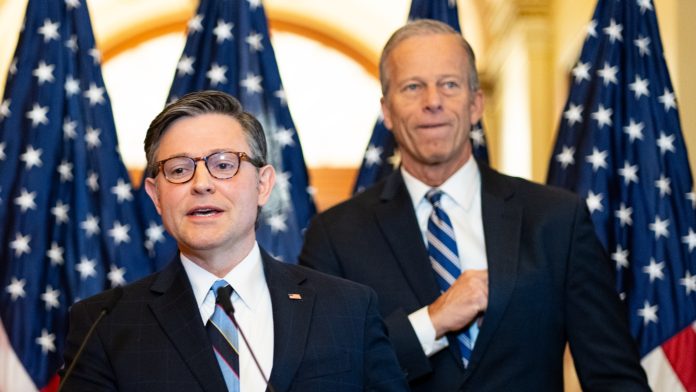
Speaker of the House Mike Johnson, R-La., left, and Senate Majority Leader John Thune, R-S.D., hold a news conference on passing the budget resolution in the U.S. Capitol on April 10, 2025. (Bill Clark/CQ-Roll Call, Inc via Getty Images)

Bill Clark/CQ-Roll Call, Inc via Getty Imag/CQ-Roll Call, Inc.


hide caption

toggle caption

Bill Clark/CQ-Roll Call, Inc via Getty Imag/CQ-Roll Call, Inc.

Congress returns to D.C. with plans to begin the detailed process of turning President Trump’s domestic policy agenda into a multi-trillion dollar policy bill that is expected to touch everything from tax cuts and Pentagon funding increases to expanded border security spending — along with corresponding cuts to help balance the cost.

Republicans may control both the House and the Senate but they are already fighting an uphill battle to find consensus on major elements of the plan. Intra-party factions remain at odds with the fundamental budget framework that directs committees to start their work. The House barely approved that bill before a two-week holiday recess and they plan to begin the next steps this week.

Republicans are using a budget tool called reconciliation, a process that enables Congress to bypass the 60-vote threshold normally required to advance a bill in the Senate. At this stage, committees are working to meet the instructions set out for them to change revenue, deficits, spending, or the debt limit by specific amounts. Eventually, the budget committee will assemble all the drafted legislation from committees into one large legislative package that both chambers will vote on.

But getting to that point is going to be a thorny endeavor that will test the GOP’s ability to overcome internal divide under tight margins in both chambers.

“They have a very slim majority,” said Josh Chafetz, law professor at Georgetown University. “Can they actually keep the entire conference together in both chambers? We haven’t really seen many tests of that yet because there’s been so little legislative activity.”

House Speaker Mike Johnson, R-La., set a goal of getting the legislation to Trump’s desk by Memorial Day, an ambitious timeline that may well fall by the wayside.

Differences on size of spending and cuts

Republicans are aiming to craft a legislative package that would extend the 2017 Tax Cuts and Jobs Act while authorizing additional cuts, raise the debt ceiling and boost defense spending and funds to increase security along the U.S.-Mexico border.

But there are major differences among Republicans, including over the targets themselves. House committees are instructed to cut at least $1.5 trillion in spending; the Senate has just $4 billion as a floor for spending cuts.

Sarah Binder, a politics professor at George Washington University, said deficits have grown in the years since the Trump tax package was first passed, putting more pressure on fiscal hawks who worry about spending but may also want to back lower taxes.  

“Conservatives want to do rather large spending cuts,” she said. “There’s more disagreement than one might’ve expected for something (normally) as unifying as tax cuts for the Republican party.”

In order to get the budget blueprint to pass the House, Senate GOP leaders publicly committed to finding larger spending cuts than what was included in the resolution itself. But bridging that divide will not come easily.

“Republicans have always had this challenge where they talk about deficit reduction in the abstract, but that becomes very difficult when it’s time to specify what they would cut to fix the budget,” said Jessica Riedl, a senior fellow at the Manhattan Institute who previously worked as chief economist to Sen. Rob Portman, R-Ohio.

“Now they have to roll up their sleeves and figure out how to dramatically cut Medicaid, student loans, and food aid programs that are popular not only in Democratic districts, but in a lot of Republican districts as well,” Riedl said.

Medicaid fight will be front and center 

A major point of contention is cuts to Medicaid, the federal-state health insurance program for people with disabilities and low-income adults. The House instructed the Energy and Commerce Committee, which has jurisdiction over the program, to find $880 billion in savings over the next 10 years.

A report last month from the nonpartisan Congressional Budget Office found that the provisions in the House plan could only be reached by massive cuts to Medicaid.

But there is vehement opposition from some Republicans about significant cuts to the program, including Missouri Sen. Josh Hawley, who has vowed to not support any measure that would lead to cuts in Medicaid benefits.

A dozen House Republicans recently wrote a letter to the chairman of the Energy and Commerce Committee along with House leadership, warning they won’t support a bill that includes “any reduction in Medicaid coverage for vulnerable populations.”

“Balancing the federal budget must not come at the expense of those who depend on these benefits for their health and economic security,” their letter read.

For his part, Speaker Johnson has pledged to “protect the benefits that everyone is legally entitled to” and that they’ll look to “waste, fraud, and abuse” for savings, something experts say won’t be enough to meet that $880 billion target.

“This is going to tie Republican lawmakers in knots,” Riedl said. “When you make certain promises that major spending programs will not be cut, and it turns out that such promises are mathematically impossible within the savings framework you’ve promised, that’s when lawmakers panic and try to figure out what promises they can afford to break and which ones they cannot.”

The tension between lawmakers who say they won’t vote for massive cuts to a popular program and lawmakers who only voted to advance the budget resolution because of promises of deficit reduction is only going to increase.

“The problem for Republicans right now is they’re going to have to deal with doing the largest Medicaid cuts of all time or breaking the promise to the people who only went forward because they thought they were going to get the largest Medicaid cuts,” said Bobby Kogan, a former Senate Budget Committee staffer who is now senior director of federal budget policy at the Center for American Progress, a progressive research group.

Time pressures are adding further complications. Republicans also want to use the bill to increase the debt limit. Independent analysts expect the federal government could hit the borrowing limit sometime this summer.

In addition, the reconciliation process sets a deadline of Sept. 30 to pass the bill or lose all of the benefits of the budget process.

“This legislative schedule is going to really tighten how much time they have left because they’re going into the summer season,” she said. “Otherwise, the budget resolution in the Senate loses its privilege if it’s expired.”

All about the math 

You may be hearing “current policy baseline” thrown around a lot in the next month.

Simply put — it’s a way to make the nearly $4 trillion in tax cut extensions look like it costs nothing.

The approach, pushed by some Senate Republicans, would essentially count the 2017 tax cuts, which expire this year, as ongoing policy that doesn’t cost anything to extend.

“The equivalent would be — what if Democrats did a one year of Medicare for All, completely unpaid for, and then they come back next year and say, OK, it’s free to continue,” said Kogan. “That’s what Republicans are doing.”

Advocates for the approach say it helps enable more permanent policy while not getting in the way of congressional efforts to cut spending. Opponents call it a budget gimmick that will add trillions to deficit increases.

Maya MacGuineas, president of the nonpartisan Committee for a Responsible Federal Budget, is among the experts who say changing the rules for assessing spending in this way could have permanent consequences.

“This ad-hoc, inconsistent, manipulative, and disingenuous approach to budgeting is enough to make your head explode, and it is going to make the debt explode,” MacGuineas said in a statement. “Congress isn’t even pretending to do honest budgeting at this point.”

The strategy also won’t fly with deficit hawks, who begrudgingly advanced the budget resolution because of assurances they would get sufficient cuts in the end.

And this is where the Trump factor could come into play.

A big difference between Trump’s first presidency and second is the level of his involvement during Hill negotiations. He privately calls members directly to whip support for his priorities and publicly threatens to primary lawmakers who don’t fall in line.

“It’s all well and good to have a red line,” Kogan said. “But one question that members are going to have to figure out is what do you think of your red line when Donald Trump calls you up and says, vote for this or you’re dead to me?”

The next AOC? Young Democrats are aiming to topple incumbents inside their own party

0

Frustrated with their party’s response to President Trump, young Democrats are challenging incumbents in safe blue districts ahead of next year’s midterm elections.

Politics chat: Trump meets Zelenskyy, China denies being in negotiations with U.S.

0

The Trump administration is in active negotiations for a ceasefire between Russia and Ukraine but does not seem to be in talks with China over trade.

How Trump’s federal job cuts put Black employees at risk : NPR

0

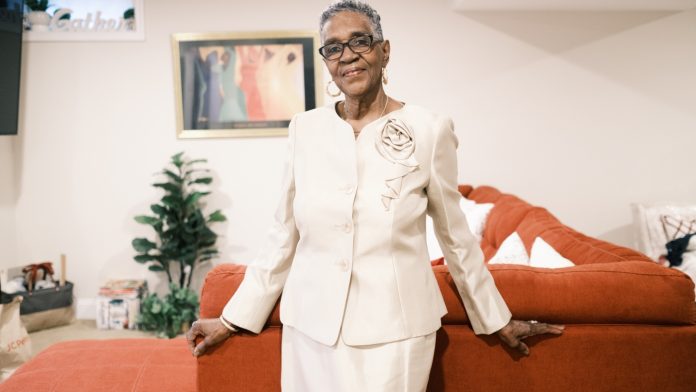
Shirley Hopkins helped recruit countless Black students in Washington, D.C., for the National Institutes of Health’s internship and youth employment programs before retiring to Clinton, Md. Her career in the federal government reflects a generation of Black workers who found stability, purpose and opportunity in public service.

Kyna Uwaeme for NPR


hide caption

toggle caption

Kyna Uwaeme for NPR

Shirley Hopkins built careers for herself and countless other Black workers through a federal government job.

While working in the National Institutes of Health’s human resources office, she became known as the “recruitment lady.” It wasn’t spelled out in her job description, but she made it her personal mission to encourage more Black students in the Washington, D.C., area to apply for the federal agency’s internship and youth employment programs.

“When I was young, I was not able to find employment,” Hopkins says. “I was not going to have it the way it was when I was coming up. I was going to let them be a part of something and let them get a job and work and be responsible.”

The 81-year-old retiree, now living in Prince George’s County, Md., one of the wealthiest majority-Black counties in the country, remembers how proud her mother was when she secured her first federal job — caring for young cancer patients in NIH clinical trials as a nurse’s aide.

A plaque commemorating Shirley Hopkins' service at the National Institutes of Health

Hopkins holds a plaque commemorating her service at the NIH.

Kyna Uwaeme for NPR


hide caption

toggle caption

Kyna Uwaeme for NPR

“She didn’t say it, but it was like, ‘You made it. You moved on up,’ ” Hopkins says about her mother, who earned money doing hairdressing inside her D.C. home and domestic work at other people’s houses. “Some of the people she used to work for, they worked for the federal government, and she knew how important it was.”

Working for the U.S. government also came with the kinds of benefits and job stability that have attracted many Black federal employees for generations.

Now, the Trump administration’s slashing of government jobs, ongoing hiring freeze and attack on diversity, equity and inclusion programs are upending what has been a longstanding path into the middle class for many Black workers, including some Hopkins helped recruit.

The exact numbers and demographics of the workers affected by the ongoing federal job cuts are hard to come by. But the government’s latest public data from September 2024 shows Black people make up 18.5% of the federal civilian workforce, while their share of the general U.S. population, according to the 2020 census, stands at 14.8%. At some agencies, including the Departments of Education, Treasury and Housing and Urban Development, Black employees make up about a third or more of the staff.

“You’re talking about a disproportionate number of Black people who are going to be profoundly affected by these broad brush strokes,” says Frederick Gooding Jr., an associate history professor at Texas Christian University, who wrote American Dream Deferred: Black Federal Workers in Washington, D.C., 1941-1981.

The path from a post-World War II boom in federal jobs to today’s uncertainty 

“It’s very difficult to tell the story of the Black middle class without the federal government’s role in employing Black individuals,” Gooding explains. A major turning point was World War II, when Gooding says “Black Americans for the first time had doors open to them that really weren’t open before” under Jim Crow segregation.

“With World War II breaking out and there simply being a supply need for more bodies, many Black Americans took advantage of the meritorious avenues” for employment, Gooding says. “The federal government in many ways became a leader modeling for the private sector what a true, equitable environment would look like. It didn’t matter what you looked like. It mattered how fast you could type, then you would get the job.”

Calvin Stevens, who worked at the General Services Administration for more than 30 years, says, “Federal employment allowed me to move into the middle class.”

Calvin Stevens, who worked at the General Services Administration for more than 30 years, says, “Federal employment allowed me to move into the middle class.”

Eleanor Stevens


hide caption

toggle caption

Eleanor Stevens

Decades later, the federal job for Calvin Stevens was at the General Services Administration, where he built a career spanning more than 30 years that began with inspecting furniture, hand tools and office supplies at a GSA warehouse in Atlanta.

“I was really, truly blessed,” says the 78-year-old Air Force veteran. “Federal employment allowed me to move into the middle class. Before this year, these jobs were stable as long as you did your job and performed well.”

Stevens says that his federal salary and benefits allowed him and his wife to live a comfortable life and send their three children to college. “We didn’t buy extravagant stuff, but we did take the kids on vacations,” adds Stevens, who owns his home in Decatur, Ga.

But the most fulfilling part about civil service for him, he says, is that it allowed him “to reach back and help somebody else because I didn’t have to worry about where my next dollar was going to come from because I was fully employed.”

David Groves, a retired Equal Employment Opportunity officer for the Department of Veterans Affairs, serves as the national president of Blacks In Government, an advocacy organization created by Black federal employees.

David Groves, a retired Equal Employment Opportunity officer for the Department of Veterans Affairs, serves as the national president of Blacks In Government, an advocacy organization created by Black federal employees.

Trek Powell


hide caption

toggle caption

Trek Powell

Stevens says he took every opportunity the agency offered to advance his career, like fellowships paid for by his employer. And it paid off. Stevens was promoted several times before he retired in 2009 as a GS-14, one of the top levels of supervisory positions in the federal government.

It’s one example of long-term career growth that some Black workers have found in the federal sector. Working for a federal agency has offered “clear and structured paths for promotion and professional development” that can be difficult to find at a private employer, says David Groves, a retired Equal Employment Opportunity officer for the Department of Veterans Affairs, who is the president of Blacks In Government, an advocacy organization created by Black federal employees in 1975.

Still, for Black federal employees, trying to advance through the ranks of the civil service can be a bumpy road. Stevens says he endured challenges along the way, including “prejudice and biases.”

As Trump officials continue their push at federal agencies to dismantle DEI programs, which the administration has called “illegal” and “immoral,” Gooding is concerned Black workers who remain in the federal government will be left in a “very vulnerable position.”

“If there’s one employer in our country that should feel obligated to uphold these ideas of truth, justice, equity and opportunity, it would be the federal government,” Gooding adds. “It really just opens up the door for the private sector not to adhere to the laws that we’ve agreed to in the first place.”

Federal job cuts bring shifting winds for Black families and communities

Kevin Abernathy joined the U.S. Postal Service as a letter carrier in 1994. "I went there because of the stability, and that's why I'm still here," he says.

Kevin Abernathy joined the U.S. Postal Service as a letter carrier in 1994. “I went there because of the stability, and that’s why I’m still here,” he says.

Kyna Uwaeme for NPR


hide caption

toggle caption

Kyna Uwaeme for NPR

Until recently, the instability of many federal jobs today would have been unthinkable for Kevin Abernathy, a nephew of Hopkins, the retired NIH staffer, who was pushed by his aunt to apply for his first summer job with the federal government as a teenager.

For years, Abernathy’s career advice to his own four children was consistent: If you don’t make millions of dollars catching a football or shooting a basketball, then the government is where you want to be.

Back in 1994, months after the birth of his first son, Abernathy abandoned his dreams of becoming a comedic actor to start work as a letter carrier with the U.S. Postal Service.

“I went there because of the stability, and that’s why I’m still here,” says Abernathy, who now delivers on what he calls a “retirement route” in Potomac, Md., and serves as a union steward for the National Association of Letter Carriers Branch 3825.

Abernathy checks a cluster mailbox in Potomac, Md., where he is assigned to what he calls a “retirement route.”

Abernathy checks a cluster mailbox in Potomac, Md., where he is assigned to what he calls a “retirement route.”

Kyna Uwaeme for NPR


hide caption

toggle caption

Kyna Uwaeme for NPR

To find his own stability, Abernathy’s eldest son, however, recently took a turn toward a different career path. Now an adult with his own baby, and facing Trump’s calls to shrink the federal workforce, he decided in January to leave a government job to join the private sector. “Things are a little shaky. We don’t know what’s going to be happening,” Abernathy says.

With more firings expected at many federal agencies in the weeks ahead, federal jobs may start to look less attractive to more Black workers. And that could end up hurting their chances of securing positions in the private sector in the long run, says Marcus Casey, an associate economics professor, who researches social mobility at the University of Illinois Chicago.

“A lot of college-educated, Black, white-collar workers often go through the federal service first to gain experience, skills that they can add to their resume and take to the private sector,” Casey explains. “If that gets shut off, that might lead to a decrease in the pathways to the private sector. Any time you’re shutting off a potential pathway, especially for a group that’s historically had more difficulties in moving directly into the private sector, that stands to be important.”

Abernathy sorts through letters and magazines on his delivery route. The Trump administration’s slashing of the U.S. government has helped push his eldest to leave a federal job to join the private sector.

Abernathy sorts through letters and magazines on his delivery route. The Trump administration’s slashing of the U.S. government has helped push his eldest son to leave a federal job to join the private sector.

Kyna Uwaeme for NPR


hide caption

toggle caption

Kyna Uwaeme for NPR

Other ripple effects of the federal job cuts may appear in the D.C. suburbs in Maryland that U.S. government work has helped turn into the country’s two wealthiest majority-Black counties, says Kris Marsh, a sociologist and demographer at the University of Maryland and author of The Love Jones Cohort: Single and Living Alone in the Black Middle Class.

“The Black families in Prince George’s County and Charles County will look very different. I don’t want to be all doom and gloom, but it’s probably not going to look as impressive as it looks now, if that’s the word we want to use,” Marsh says. “There’s a lot of research that talks about the fragility of the Black middle class, how the Black middle class in some ways might be one or two paychecks away from poverty, not because they don’t save, but because of structural forces.”

Trump officials’ shrinking of the federal workforce has left Marsh wondering how aware the administration is that it is likely to shrink the Black middle class living in and around the nation’s capital. “Is that by design or is that just like a happenstance of what’s happening right now?” Marsh asks.

The White House’s press office did not respond to NPR’s request for comment.

For a Black employee placed on administrative leave and waiting for a potential firing at the Department of Health and Human Services, another question is, what else can this administration do to slash the federal government?

“It feels like my whole world is just knocked off its axis by no fault of mine,” says the HHS staffer, who NPR has agreed not to name because she fears retaliation at work.

Worried about how she would make her mortgage and car payments without federal employment going forward, the first-generation college graduate says that, “as a Black woman in America, the ‘American dream’ always felt like a facade, just knowing how America has historically perceived Black and brown people, people who aren’t white and on the top of the food chain.”

But with a HHS job that allowed her to make a six-figure salary and send her child to private school, she says it started to feel like she was living an American dream.

“And now it feels like it’s being taken away,” she adds.

Have information you want to share about changes in the federal government? Reach out to Hansi Lo Wang (hansi.01) or Marisa Peñaloza (marisa.85) on the encrypted messaging app Signal. Please use a nonwork device.

First Black Secretary of Labor Alexis Herman dies at 77 : NPR

0

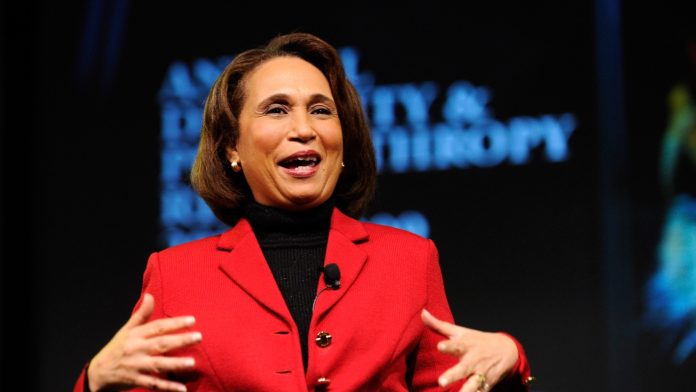
Alexis Herman was tapped by former President Bill Clinton to serve as secretary of labor. Upon her confirmation in 1997, she became the first Black secretary of labor in American history. She is shown here in Las Vegas in 2010.

Ethan Miller/Getty Images


hide caption

toggle caption

Ethan Miller/Getty Images

The first Black leader of the U.S. Department of Labor, former Secretary Alexis Herman, has died at the age of 77.

Former President Bill Clinton nominated Herman to the role, which she held from 1997 to 2001, following a career in social work, civil rights and Democratic politics.

“Hillary and I are deeply saddened by the loss of Alexis Herman, our friend of nearly fifty years,” former President Clinton said in a statement. “Our hearts and prayers are with her family and all who loved and admired her.”

Current Secretary of Labor Lori Chavez-DeRemer said in a statement that Herman “was a trailblazer who dedicated her life to strengthening America’s workforce and creating better lives for hardworking families.”

Herman was born in Mobile, Ala., in 1947, at a time when Jim Crow laws imposed racial segregation and discrimination across the American South.

“The struggle for civil rights was a daily part of our lives,” Herman later testified to Congress.

Herman graduated from Xavier University of Louisiana, a Catholic and historically Black university in New Orleans. She later worked on school desegregation efforts in her hometown of Mobile. In 1977, when Herman was 29 years old, then-President Jimmy Carter selected her to lead the Women’s Bureau at the Department of Labor.

In a 1977 interview with NPR, Herman described the bureau’s mission to serve women in the workplace.

“That means help women to get jobs,” Herman said. “That means to help women find out about opportunities for jobs. That means informing women of their rights if they’re being discriminated against.”

Herman went on to work on the 1988 presidential campaign of civil rights leader Jesse Jackson, and in 1992, she became the first Black woman to hold the position of CEO of the Democratic National Convention before joining the Clinton administration.

“I believe that our lives are a gift from God. And what we do with our lives is a gift to God,” Herman said after receiving an award from the National Political Congress of Black Women in 1996. “I have been very blessed to have been used as an instrument for change in our ongoing collective struggle, for us as Black women, to say that we, too, ‘sing America.'”

At her confirmation hearing for secretary of labor, Herman received strong bipartisan support, including from staunch conservatives like former Republican Sens. Jeff Sessions and Richard Shelby.

“I want workers to get and keep good jobs,” Herman said at the hearing. “I want working families to enjoy a rising standard of living. And I want workers and their families to have dignity and security throughout their lives.”

“I want workers to get and keep good jobs,” Herman said at her confirmation hearing to serve as Secretary of Labor. “I want working families to enjoy a rising standard of living. And I want workers and their families to have dignity and security throughout their lives.”

“I want workers to get and keep good jobs,” Herman said at her confirmation hearing to serve as Secretary of Labor. “I want working families to enjoy a rising standard of living. And I want workers and their families to have dignity and security throughout their lives.”

Luke Frazza/AFP


hide caption

toggle caption

Luke Frazza/AFP

After news broke of Herman’s death, civil rights groups, unions and Democratic leaders issued statements praising her decades of work.

“Her legacy of service and trailblazing leadership will continue to inspire generations,” said the NAACP.

“We join the entire labor movement in mourning the loss of Alexis Herman,” said the AFL-CIO in a statement. “Secretary Herman was a trailblazer and relentless advocate for working people.”

“I’m deeply saddened by the passing of a giant and cherished friend,” said Susan Rice, the former U.S. Ambassador to the United Nations. “She was a powerful yet graceful leader, a visionary, a sister to sisters and one of the kindest people I’ve known.”

Throughout her career, Herman championed efforts to increase diversity in government and the workplace, and encouraged young people to get involved in politics.

“I fought for civil rights, I fought for voting rights, I fought for women’s rights in the ’70s,” Herman said in a commencement address at Agnes Scott College in Georgia in 2016. “But now it’s your turn.”

Journalist and Nobel Peace Prize Laureate weighs in on Trump and press freedoms

0

NPR’s Scott Detrow speaks with journalist Maria Ressa, winner of the Nobel Peace Prize, about the Trump administration and press freedoms.

U.S. judge says a 2-year-old girl was deported to Honduras : NPR

0

Demonstrators gather to protest on Thursday against the deportation of immigrants to El Salvador outside the Permanent Mission of El Salvador to the United Nations in New York City.

Michael M. Santiago/Getty Images


hide caption

toggle caption

Michael M. Santiago/Getty Images

A Trump-nominated federal judge in Louisiana said that a 2-year-old American citizen appears to have been deported “with no meaningful process.” This comes as the Trump administration has faced growing criticisms for its hurried proceedings to remove as many noncitizens from the country as quickly as possible.

U.S. District Judge Terry Doughty wrote that the toddler, identified as VML, had been sent to Honduras on Friday, alongside her mother and sister, even as the court had sought to clarify the girl’s status. He set a hearing on the case for May 16 “in the interest of dispelling our strong suspicion that the Government just deported a U.S. citizen with no meaningful process.”

On Friday afternoon, Doughty had called counsel for the federal government to try to speak with VML’s mother and better understand the child’s situation, but VML and her family were already “above the Gulf of America,” the judge wrote, using President Trump’s preferred term for the Gulf of Mexico.

“The Government contends that this is all okay because the mother wishes that the child be deported with her,” Doughty wrote. “But the Court doesn’t know that.”

According to a lawsuit filed on VML’s behalf, she and her family were taken into U.S. Immigration and Customs Enforcement (ICE) custody on Tuesday while attending a routine check-in with the mother’s Intensive Supervision Appearance Program (ISAP).

ISAP is an alternative to detention for noncitizens who are in the country unlawfully.

It is not immediately clear what was flagged during that meeting to trigger deportation proceedings for VML’s mother and sister. But according to a court petition, her father, who had dropped the trio off at the meeting, was informed about an hour after the start of the meeting that his partner and two daughters had been taken into custody.

The suit alleges that ICE agents repeatedly refused to give VML’s father her location and denied him the opportunity to speak for more than a minute to VML’s mother.

“V.M.L.’s father received a call from an ICE officer, who spoke to him for about a minute,” the filing said.

“The officer said that V.M.L.’s mother was there, and that they did not have much time to speak to each other and that they were going to deport his partner and daughters. V.M.L.’s father was able to speak with his partner for only about or less than a minute. He heard his daughters crying and his partner crying,” the filing said.

According to the suit, at one point as VML’s father tried to secure her release, New Orleans ICE Field Office Director Mellissa Harper began interrogating the family’s attorney about the father’s immigration status and attempted to lure him into custody as well.

In an emailed statement to NPR, the Department of Homeland Security (DHS), which oversees ICE, defended its decision.

“The parents made the decision to take the child with them to Honduras. It is common that parents want to be removed with their children,” said Tricia McLaughlin, DHS’ assistant secretary for public affairs.

The agency did not respond to further request for comment as to why McLaughlin implied that both parents had supported VML’s deportation to Honduras when her father ostensibly remains in the United States.

VML is just the latest to be ensnared in the messy legal process as the Trump administration has rushed to remove as many undocumented immigrants as it can.

Last month, a Maryland man, Kilmar Abrego Garcia, was illegally deported to El Salvador and sent to the notorious CECOT megaprison “due to an “administrative error.”

Meet Steve Witkoff, Trump’s negotiator with Iran, Russia and the Middle East : NPR

0

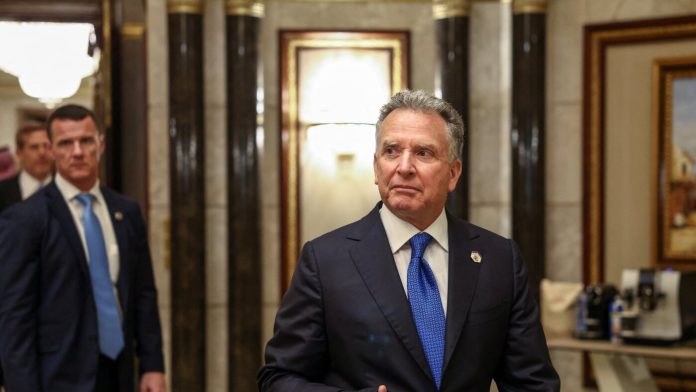
Steve Witkoff walks to an interview after meeting with Russian officials in Riyadh, Saudi Arabia, on Feb. 18, 2025.

Evelyn Hockstein/Pool/AFP


hide caption

toggle caption

Evelyn Hockstein/Pool/AFP

President Trump’s envoy Steve Witkoff is in Oman on Saturday for nuclear talks with Iran‘s foreign minister, a day after talks in Moscow to try to broker a deal with Russian President Vladimir Putin to end the war in Ukraine.

Witkoff — whose background is in New York real estate — has also been the lead player in trying to reach a ceasefire in Gaza.

Managing talks about the three conflicts would be a massive portfolio for the most veteran of diplomats. But this is Witkoff’s first foray into international diplomacy — and that has worried policy experts in the field.

“My concern is and I think the concern of lots of others is that the president and Mr. Witkoff see Iran nuclear negotiations or a ceasefire agreement in Gaza as very similar to a negotiating real estate deal. And they’re very, very different,” said Steven Cook, a senior fellow for the Middle East at the Council on Foreign Relations.

Trump and Witkoff have a long friendship

Witkoff and the president have been friends for almost 40 years. Trump calls Witkoff “a special guy” and “my pal.” Their friendship dates back to a chance encounter at a New York Deli at 3 a.m.

Trump had no cash on him. “I ordered him a ham and swiss,” Witkoff said, according to a report in Courthouse News about his testimony in Trump’s defense during one of Trump’s trials last year.

President Trump gestures to Steve Witkoff while signing an executive order to create a U.S. sovereign wealth fund on Feb. 3, 2025.

President Trump gestures to Steve Witkoff while signing an executive order to create a U.S. sovereign wealth fund on Feb. 3, 2025.

Jim Watson/AFP


hide caption

toggle caption

Jim Watson/AFP

Witkoff said in an interview with Tucker Carlson that he learned the real estate business from Trump.

“I wanted to be him,” Witkoff said. “Everybody wanted to be him. He’d come to 101 Park Avenue, where I was a lawyer. He had this swashbuckling style. I used to see him come in and I used to say, ‘God, I want to be him.'”

Witkoff has described how Trump was there for him when one of his sons died from an opioid overdose in 2011.

“I have seen his humanity in the quiet moments away from the spotlight in hospital rooms he didn’t have to be in — where his presence brought real solace in a dark hour for my family,” Witkoff said at the Republican National Convention.

During the campaign, Witkoff helped with fundraising. Trump also turned to Witkoff to handle sensitive matters like trying to repair ties with Georgia Gov. Brian Kemp and presidential challenger Nikki Haley.

“His best friend, Steve Witkoff, came to our house in South Carolina, spoke to me and my husband, and basically wanted a truce between me and Donald Trump,” Haley said on her podcast. She told Witkoff that Trump had her support.

Picking Witkoff for a role his son-in-law used to fill

Once in office, Trump picked his old friend as his envoy to the Middle East. It was the same position that Trump — in his first term — had given to another person whose loyalty was unquestioned: his son-in-law, Jared Kushner.

Kushner, who now runs an investment firm, had also come from the real estate world and handled many tough files for Trump, including Middle East peace, trade talks with Mexico and Canada, immigration reform, and parts of the administration’s response to the COVID pandemic.

In President Trump's first term, his son-in-law Jared Kushner held the role now filled by Steve Witkoff. Kushner and Witkoff appeared together on Feb. 20 at a Miami conference organized by the non-profit arm of Saudi Arabia's main sovereign wealth fund called the Future Investment Initiative (FII) Institute.

In President Trump’s first term, his son-in-law Jared Kushner held the role now filled by Steve Witkoff. Kushner and Witkoff appeared together on Feb. 20 at a Miami conference organized by the non-profit arm of Saudi Arabia’s main sovereign wealth fund called the Future Investment Initiative (FII) Institute.

Joe Raedle/Getty Images


hide caption

toggle caption

Joe Raedle/Getty Images

A lot of experts scoffed at Kushner’s lack of experience when he started his White House role, and some are raising the same questions about Witkoff.

Aaron David Miller, a former State department negotiator in both Democratic and Republican administrations, has been part of numerous Arab-Israel talks. He acknowledges the challenges and says they lost more than they won.

He said the three conflicts Witkoff is tasked with are “galactic challenges” where the complexities and differences between those involved are “as wide as the Grand Canyon.”

“I mean, you can’t do this stuff on the back of a cocktail napkin,” said Miller who is now at the Carnegie Endowment for International Peace.

“I think it’s very hard to task one individual — as talented as he may be — and make him the envoy for everything,” Miller said.

How Witkoff describes his approach to negotiations

The White House says Witkoff is a trusted friend of the president who left behind a massive business enterprise to serve the country. He doesn’t take a salary and pays for his own travel.

“His results speak for themselves, including the release of Marc Fogel from Russia and hostages trapped in Gaza,” said spokeswoman Anna Kelly. “The president is incredibly proud of all Mr. Witkoff has accomplished to help restore peace through strength, and he will continue to leverage Mr. Witkoff’s talents to advance his America First foreign policy vision.”

Witkoff fueled some criticism recently after appearing on Tucker Carlson’s podcast when he described Russian President Vladimir Putin as “not a bad guy.”

French President Emmanuel Macron shakes hands with Secretary of State Marco Rubio as Steve Witkoff looks on before a meeting about the war in Ukraine on April 17, 2025 in Paris.

French President Emmanuel Macron shakes hands with Secretary of State Marco Rubio as Steve Witkoff looks on before a meeting about the war in Ukraine on April 17, 2025 in Paris.

Ludovic Marin/Pool/AFP


hide caption

toggle caption

Ludovic Marin/Pool/AFP

In the interview, Witkoff explained his approach to negotiations. “There’s no doubt I’m always trying to put myself in the shoes of the other person because a good deal has to work fair for everybody,” he said.

Don Peebles said he has seen that attitude first-hand during adversarial talks with Witkoff. “If I were going to summarize his approach is to find what the other person, other side, wants — and to try to give it to him,” said Peebles, a real estate developer who fundraised for former President Barack Obama.

Peebles said he thinks Witkoff probably has more high stakes negotiating experience than most diplomats.

He remembers being forced to deal with Witkoff on a big real estate transaction in New York. Peebles considered walking away. He felt like he had a gun to his head, but never by Witkoff.

Witkoff defused the situation, promising not to be disruptive and explained how they would both be better off as partners, Peebles recalled.

“He took a very adversarial situation from my perspective and not only got the deal done, but we’ve been friends ever since.”

Photos : NPR

0

Ukraine’s President Volodymyr Zelenskyy (right) and President Trump talk as they attend the funeral of Pope Francis at the Vatican on Saturday.

Ukrainian Presidential Press Office/AP


hide caption

toggle caption

Ukrainian Presidential Press Office/AP

VATICAN CITY — President Trump met with Ukraine’s President Volodymyr Zelenskyy at the Vatican Saturday morning, right before attending Pope Francis’ funeral. 

Trump has been working to broker peace talks to try to end Russia’s war in Ukraine. His last meeting with Zelenskyy in February abruptly ended after they argued in front of television cameras and Trump criticized Zelenskyy for being ungrateful for U.S. aid. The leaders later spoke by phone in March.

Photos released by the Ukrainian government on Saturday showed the leaders in a private one-on-one discussion, as well as speaking with French President Emmanuel Macron and British Prime Minister Keir Starmer, who have been leading European efforts on a peace agreement.

Ukraine's President Volodymyr Zelenskyy, right, and President  Trump, talk as they attend the funeral of Pope Francis in Vatican.

Ukraine’s President Volodymyr Zelenskyy, right, and President Trump, talk as they attend the funeral of Pope Francis in Vatican.

Ukrainian Presidential Press Office/AP


hide caption

toggle caption

Ukrainian Presidential Press Office/AP

White House communications director Steven Cheung told reporters that Trump and Zelenskyy “had a very productive discussion” and said more details about the meeting would follow.

Trump and Zelenskyy’s meeting comes a day after U.S. envoy Steve Witkoff met with Russian President Vladimir Putin in Moscow. Trump aide Keith Kellogg also met this week with Ukrainian and European officials in London.

Late Friday, Trump expressed optimism on social media, saying most major issues had been agreed to and that “the two sides should now meet, at very high levels” to finish a deal.

Trump officials have presented Ukraine and Russia with options for a peace deal. They have not been made public, but Zelenskyy has said one of the ideas — ceding Crimea to Russia — was “against our constitution.”

Trump had expressed frustration with Zelenskyy for those comments, saying that Crimea had been effectively lost long ago and should not be the deal-breaker. He also said he was “not happy” about Russian strikes on Kyiv this week.

Ukraine's President Volodymyr Zelenskyy, right, President  Trump, second right, French President Emmanuel Macron, left, and British Prime Minister Keir Starmer talk as they attend the funeral of Pope Francis.

Ukraine’s President Volodymyr Zelenskyy, right, President Trump, second right, French President Emmanuel Macron, left, and British Prime Minister Keir Starmer talk as they attend the funeral of Pope Francis.

Ukrainian Presidential Press Office/AP


hide caption

toggle caption

Ukrainian Presidential Press Office/AP

Ukraine's President Volodymyr Zelenskyy, left, and President Trump, talk

In this photo provided by the Ukrainian Presidential Press Office, Ukraine’s President Volodymyr Zelenskyy, left, and President Trump, talk as they attend the funeral of Pope Francis in Vatican, Saturday, April 26, 2025.

Ukrainian Presidential Press Office/AP


hide caption

toggle caption

Ukrainian Presidential Press Office/AP