

Nearly 100 days into his new term, President Trump has set an aggressive agenda, spending his political capital and losing some of the public approval he began with.
Trump meets Zelenskyy during visit to Pope Francis funeral

The White House says they’ll release more details of the meeting, which they called “a very productive discussion.”
(Image credit: Ukrainian Presidential Press Office)

3 judges ruled Trump overstepped with school DEI crackdowns : NPR

President Trump and his education secretary, Linda McMahon, have said repeatedly that they want to send education “back to the states.” But in recent lawsuits, the administration is accused of doing the opposite: wielding the power of the federal government to tell schools what they can and cannot teach.
Alex Brandon/AP
hide caption
toggle caption
Alex Brandon/AP
Three federal judges, in Maryland, New Hampshire and Washington, D.C., ruled Thursday that the Trump administration had overstepped when it ordered the nation’s schools to stop all diversity, equity and inclusion (DEI) programs as well as classroom teaching the administration might consider discriminatory. For the moment, this means the U.S. Department of Education cannot make good on its threat to punish noncompliant districts by withholding vital federal funding, including dollars that help K-12 schools serve low-income students and children with disabilities.

U.S. District Judge Landya B. McCafferty, an Obama appointee in New Hampshire, began her opinion by noting the importance of safeguarding academic freedom in the U.S. and of exposing students to a multitude of viewpoints.
“In this case, the court reviews action by the executive branch that threatens to erode these foundational principles,” McCafferty wrote.
U.S. District Judge Stephanie A. Gallagher, a Trump appointee in Maryland, wrote, “This Court is constitutionally required to closely scrutinize whether the government went about creating and implementing [policies] in the manner the law requires.”
“The government did not,” she found.
Gallagher issued a temporary stay preventing the Trump administration from enforcing its threat against schools, while McCafferty blocked enforcement in any school that employs a teacher from one of the groups that brought the New Hampshire suit, including the National Education Association, the nation’s largest teachers union.
The Education Department did not respond to an NPR request for comment.
The three opinions, in three separate cases, raise similar concerns – and suggest the Trump administration has work to do to convince the courts its anti-DEI efforts are legal.
The administration “does not even define what a ‘DEI program’ is”
McCafferty, in New Hampshire, faulted the Trump administration for its vagueness.
In her decision, McCafferty criticized a Feb. 14 “Dear Colleague” letter from the U.S. Education Department. The letter argues that schools, in the name of DEI, “have toxically indoctrinated students with the false premise that the United States is built upon ‘systemic and structural racism’ and advanced discriminatory policies.”

But, McCafferty wrote, “The Letter does not even define what a ‘DEI program’ is.”
This vagueness was a common theme among the rulings.
“Although the challenged documents place a particular emphasis on ‘certain DEI practices,’ they fail to provide an actionable definition of what constitutes ‘DEI’ or a ‘DEI’ practice,” wrote U.S. District Judge Dabney L. Friedrich in Washington, D.C. Friedrich is also a Trump appointee.
In that case, brought by the NAACP, Friedrich agreed to a preliminary injunction.
In Maryland, Gallagher criticized the administration for filling its “Dear Colleague” letter with broad claims about harmful, discriminatory teaching, but neglecting to include “any factual citations or references to any facts supporting its assertions.”
On Feb. 27, that “Dear Colleague” letter was followed by the creation of a department portal through which parents were encouraged to report teaching or policies they consider discriminatory. The official release announcing the portal quotes Tiffany Justice, co-founder of the conservative-leaning Moms for Liberty: “Parents, now is the time that you share the receipts of the betrayal that has happened in our public schools.”
And then on April 3, the Education Department went further: requiring K-12 school districts to certify, in writing, that they are in compliance with the department’s expanded interpretation of federal anti-discrimination law, or risk losing their federal funding.
Districts are already required to certify their compliance with existing federal law, something Gallagher noted in her ruling.
The administration argues its interpretation is not new – that many DEI policies violate Title VI of the Civil Rights Act of 1964 and that the government’s recent anti-DEI efforts are allowable because they’re simply enforcing pre-existing federal law.
Gallagher, in Maryland, found that argument “unpersuasive.”
“If the [‘Dear Colleague’ letter] said nothing new,” Gallagher wrote, “then why does it link to a new reporting portal specifically looking for instances of ‘divisive ideologies’ and ‘indoctrination,’ when there has always been a portal for anyone to report race discrimination or racially hostile environments?”
The lack of clarity “will sow fear and doubt among teachers”
Tying a consequence so severe – the loss of federal funding – to a new and ill-defined set of policies and behaviors could have a chilling effect on schools, McCafferty warned.
As an example, she imagined “an elementary school teacher could seek to establish a class culture of equitable and inclusive treatment by asking her students to sign a collective pledge to follow the ‘Golden Rule’ for the entire school year. It is more than arguable that such a practice would come within the ocean-wide definition of DEI set forth above.”
Or, how should the nation’s history teachers approach America’s fraught racial past, given the department’s contention that talk of “systemic and structural racism” has “toxically indoctrinated” students?
McCafferty noted the story of one NEA-member middle school history teacher in New Hampshire:
“Discussing the … enactment of the Civil Rights Act of 1866 and the Fourteenth and Fifteenth Amendments, the Jim Crow south, the founding of the KKK, and the Tulsa Race Massacre—necessarily entails discussions of race and how race and perceptions toward different racial groups has shaped American history,” McCafferty wrote. But “this teacher now fears being accused of engaging in discrimination for doing no more than teaching historical facts.”

The threat to schools’ federal funding, coupled with the DEI portal for parents to report teachers they believe have crossed the line, “raise the specter of a public ‘witch hunt’ that will sow fear and doubt among teachers,” McCafferty warned.
Can the executive branch influence school curriculum?
Trump and his education secretary, Linda McMahon, have said repeatedly that they want to eliminate the U.S. Department of Education and send education “back to the states.” But, in these lawsuits, the administration is accused of doing the opposite: wielding the power of the federal government to tell schools what they can and cannot teach.

Two of Thursday’s rulings note that federal law expressly prohibits the U.S. Department of Education from exercising “any direction, supervision, or control over the curriculum, program of instruction, administration, or personnel of any educational institution, school, or school system.”
The department has argued its efforts are legal because they are enforcing federal anti-discrimination law, but McCafferty found that argument “insufficient.”
“While it may be true that a line must be drawn somewhere between the Department’s lawful prerogative to enforce anti-discrimination law and its prohibition from controlling curriculum, the Letter and its associated documents do not toe that line.”
As for whether the letter exceeds the Education Department’s legal authority, Gallagher wrote, the Trump administration insists it “merely informs schools that they must not discriminate among students when implementing their curricula and must avoid stereotyping and stigmatizing based on race.”
Gallagher’s skeptical response: “This Court must concern itself with what the Letter actually says, not what the government says the Letter says.”
As such, “by declaring broad categories of classroom speech discriminatory,” Gallagher wrote, “in the context of a Letter threatening enforcement actions for discriminatory practices, DOE is exercising ‘direction, supervision, or control’ over ‘the curriculum, program of instruction, administration, or personnel of [schools.]'”
In short, the Education Department appears to be doing precisely what federal law says it cannot.
“The government cannot proclaim entire categories of classroom content discriminatory to side-step the bounds of its statutory authority,” Gallagher ruled.
The Trump administration is likely to challenge all three rulings.
Worker cuts at Social Security are roiling the agency : NPR

A Social Security Administration office is seen on March 6 in Nashville, Tenn.
George Walker IV/AP
hide caption
toggle caption
George Walker IV/AP
Jessica LaPointe has worked at a Social Security field office in Madison, Wis., for the past 16 years. And she says right now, the work is harder than ever.
LaPointe says disruptions prompted by the Trump administration’s efforts to make deep cuts in the federal government workforce have left many remaining Social Security employees “burned out … and overwhelmed.”
Field offices are the public-facing branch of a sprawling agency that provides retirement and anti-poverty benefits to 73 million Americans.
“We really feel the brunt of the public that we serve and the chaos and confusion surrounding Social Security and its impact on them,” said LaPointe, who’s president of a local chapter of the American Federation of Government Employees (AFGE), which represents 25,000 field office workers.
The Social Security Administration (SSA) has laid out plans to slash about 12% of its overall workforce, or 7,000 jobs.
Rich Couture, a spokesman for AFGE SSA’s General Committee, says more than 2,500 employees at the agency have taken an offered buyout, and that many of the workers who have left were in critical roles — including those local field offices.
“That’s the primary point of contact, other than the 1-800 number, that the American people have with Social Security,” he said. “They take care of enumeration issues with respect to Social Security cards, handle retirement, disability survivor claims, interviews and processing, among other workloads.”
Couture says the agency has lost about 2,000 employees specifically from the field offices through the federal government’s buyout program.
These losses have disproportionately affected certain local offices. Couture told NPR that there are about 40 field offices that have lost at least 25% of their staff so far, and others, such as offices in Nevada, Mo., and Alexandria, Minn., have lost half or more of their workers, according to agency data.

“The impact on those offices in particular is going to be significant, where you are going to see waiting times for visitors, including those who have appointments, go up exponentially,” Couture said.
The office in the city of Wisconsin Rapids has lost more than 58% of its staff. LaPointe, whose field office is 100 miles south, says massive losses in one office often affect nearby sites.
“That office then takes the work and moves it to the surrounding offices, the surrounding areas and then throughout the region and even then nationwide to get help,” LaPointe said. “So every office is overburdened, short-staffed with public demand.”
Trump promised no cuts to benefits, but advocates say service cuts affect benefits
The Trump administration has routinely pledged not to cut Social Security benefits, while simultaneously cutting waste and fraud from the program.
“President Trump has promised to protect Americans’ hard-earned Social Security benefits so that all eligible individuals can access them,” Lee Dudek, the acting commissioner of Social Security, said in a statement recently.
But SSA workers and advocates for older and disabled Americans say these staff cuts — as well as controversial agency moves under Dudek’s leadership — amount to a cut to services.
“The cut to the program is the deterioration of staff,” LaPointe said. “That is the backdoor cut to the program because benefits delayed are benefits denied.”
According to the agency’s own performance data, there has been a significant increase in wait times for phone services since President Trump was elected.

Last year the average wait time for phone services was about an hour. So far this year, it’s more than an hour and a half. At the same time, the number of people calling in to the agency has skyrocketed. In November of last year, roughly 6.5 million calls were received by the SSA that month. Last month, the agency received 10.4 million calls.
Much of the increase in call volume, LaPointe said, is due to “confusion and fear” created by the administration. Some of that concern, she said, was a result of recently announced anti-fraud measures, as well as stories of some beneficiaries being erroneously classified as dead. She said she also saw an uptick in calls after Commerce Secretary Howard Lutnick suggested that only a “fraudster” would complain if they missed a Social Security check.
“People started to come in just to verify their identity [and] that they’re alive,” LaPointe said, “that they’re associated with their account [and] to let us know they do need their money.”
Reassignments and retirements
It’s expected many of the lost field office employees will be replaced by staff who were working at the agency’s headquarters or one of the regional offices. One of the Trump administration’s plans is to cut down the number of regional offices — which provide IT and human resources to the field offices — from 10 to four, and then retrain some workers who “volunteered” to be reassigned to public-facing roles.
“SSA offered all employees the opportunity to volunteer to be reassigned from a non-mission critical position to a local field office, teleservice center, processing center, payment center, workload support unit, or hearing office,” the agency says. More than 2,000 employees have volunteered for a reassignment.
Couture said the union, however, has not heard any “well-developed plan for ensuring that there was orderly knowledge transfer” as people are placed in those roles.
Laura Haltzel was the former associate commissioner for the SSA’s Office of Research, Evaluation and Statistics in the agency’s Maryland headquarters. Rather than volunteer for reassignment and face more uncertainty, she decided to take an offer of early retirement.
Haltzel said there are problems with the expectation that workers in roles like hers would be able to quickly jump in and replace the thousands of frontline workers that have left. She called the plan a “sort of mythical idea.”

“We’ve lost an extreme amount of expertise and knowledge that we simply are not going to get back,” she said. “Let’s say somebody in my team, who is a statistician, [you] suddenly turn them into a claims processor. It takes two years of training for someone to become proficient at taking a Social Security claim because of the complexity of the law. That is not something that you can simply plug somebody into overnight and keep up at the same pace as it had been operating previously.”
And to meet the overall staffing goal, agency officials are urging more workers in “non-critical roles” at headquarters to consider the deferred resignation program.
But Haltzel said it’s an open question whether many of these workers will want to leave, despite the pressure.
“People are taking reassignments out of fear that they will have no jobs because the entire economy in the D.C. area now is affected by a loss of employment across the federal landscape,” she said. “And for all of these individuals to find new jobs in the private sector, that’s simply not a reality, particularly from the Social Security Administration, for which there is no private equivalent.”
A spokesperson for Social Security told NPR in a statement that the agency “has implemented its workforce optimization plan that focuses on reducing employees in non-mission-critical positions and bolstering staff in mission-critical roles” and that officials will “continue to monitor progress” of the staff reductions as they continue throughout the fiscal year.
Haltzel said she’s deeply concerned about the loss of expertise that has left the SSA in recent weeks. She said her former team, which analyzed whether the agency was doing a good job serving beneficiaries, has been cut by more than half.
“I hope that we’re able to sustain a basic minimum of knowledge in order to maintain the functioning of the agency,” Haltzel said. “But frankly, given that they have no control over who takes the reassignments and who simply retires and leaves, they could lose individuals where we are one person deep in knowledge. And once that knowledge is gone, it is gone. These people will not come back.”
New senior staff announced as White House looks to ‘right the ship’ at the Pentagon : NPR

Secretary of Defense Pete Hegseth attends an Oval Office meeting with President Trump and Norway’s Prime Minister Jonas Gahr Store at the Oval Office on April 24.
Chip Somodevilla/Getty Images
hide caption
toggle caption
Chip Somodevilla/Getty Images
Normally the names of senior staff at the Pentagon don’t make the news, but the precarious position of Defense Secretary Pete Hegseth means that every move is drawing scrutiny. NPR reported this week that the White House is looking for possible replacements with Hegseth under fire for putting sensitive military attack plans into at least two insecure group chats.
In-fighting over alleged leaks from the secretary’s office have now resulted in five senior advisers resigning or being fired. On Friday the Pentagon announced four new senior advisers had been promoted; they include Col. Ricky Buria, a former junior military assistant; Justin Fulcher, a member of the DOGE team embedded at the Pentagon, and Patrick Weaver, formerly a Department of Defense “special assistant.”

Sean Parnell, who had been the Pentagon’s chief spokesman, has been promoted to assistant to the secretary of defense and senior adviser.
In a statement announcing the changes, Pentagon acting press secretary Kingsley Wilson said that “regular workforce adjustments are a feature of any highly efficient organization.” But there is nothing about the latest moves that are “regular workforce adjustments.” Three top staffers were removed, with Hegseth saying they were leaking information, though all three deny it. And a fourth staffer — his chief of staff Joe Kasper, who Hegseth said would be taking another job — instead decided to leave the Pentagon altogether and return to the private sector.
A former Trump official who requested anonymity to describe internal administration deliberations said the White House has been reaching out, searching for possible advisers to serve in Hegseth’s office in an effort to “right the ship.” But the official was doubtful there were many who would want to take the job at a Pentagon that is in such disarray. NPR reached out to the White House for comment but did not hear back.
Those who have been named to the new positions have little experience in government.
Parnell, a Pittsburgh native, served in the military for six years, ran unsuccessfully for the U.S. House in 2020, and the next year launched a short-lived campaign for the U.S. Senate. Fulcher, who Forbes magazine featured in its 30 under 30 list in 2017, came into the Pentagon as part of tech billionaire Elon Musk’s DOGE team. Forbes later featured him again in an article questioning his credentials as an entrepreneur. Weaver graduated from college in 2017, and served in the first Trump administration at the Department of Homeland Security.
Wilson, 26, had been deputy press secretary and will now be acting press secretary. Just last month, she was criticized by members of Congress and Jewish groups for online posts and past public commentary she made before joining the Trump administration.

Those who have served as press secretary generally have long experience, either on Capitol Hill, the military, journalism or private industry.
Kenneth Bacon, Defense Secretary William Cohen’s spokesman, had been a veteran who worked on Capitol Hill, and then for The Wall Street Journal. Victoria Clarke served as spokesperson for Pentagon chief Donald Rumsfeld and had worked on Capitol Hill for Sen. John McCain and then in the Reagan and Bush White Houses.
More recently, under Defense Secretary Lloyd Austin, the top spokesman was retired Rear Adm. John Kirby, who later went on to be the State Department spokesman.
Similarly, those who hold the title Pentagon chief of staff also have long experience.
Robert Rangel was a chief of staff to Defense Secretary Robert Gates, and before that, he held the post under Rumsfeld, who recruited him from the House Armed Services Committee. Rangel served as staff director for the committee.
In particular the absence of a chief of staff could stymie progress at the Pentagon. That role usually directs the massive traffic of demands on the secretary of defense, who is in charge of about 3 million staff, including troops deployed all over the world. Turmoil in that office means things like requests from Congress and even decisions about appointments have been stacking up.
Democrats and at least one Republican in Congress say Hegseth should be replaced.
Hegseth has not appeared in the Pentagon briefing room since he came to the Defense department. His press secretary has been there once for a briefing. Instead, both Hegseth and his press secretary often communicate through short videos.
Justice Department revokes Biden-era protections for reporters in leak investigations : NPR

Attorney General Pam Bondi looks on as President Trump delivers remarks during a cabinet meeting at the White House on March 24.
Win McNamee/Getty Images
hide caption
toggle caption
Win McNamee/Getty Images
The Justice Department on Friday rescinded a Biden-era policy that provided protections to journalists in leak investigations, paving the way for authorities to once again use subpoenas and compel testimony from reporters in probes targeting leakers.
“Federal government employees intentionally leaking sensitive information to the media undermines the ability of the Department of Justice to uphold the rule of law, protect civil rights, and keep America safe. This conduct is illegal and wrong, and it must stop,” Attorney General Pam Bondi said in an internal memo issued on Friday and obtained by NPR.
She said the DOJ’s policy allows for subpoenas, court orders and search warrants to get information and testimony from journalists. Such actions must be approved by DOJ leadership and journalists must get advance notice of them. The actions also must be as narrow as possible to avoid interfering with news gathering or “potentially protected materials,” the memo states.
During the Biden administration, the Justice Department said it would no longer secretly seize the records of reporters to identify their sources when investigating leaks, except under limited, specified circumstances.
Bondi’s memo marks a sharp break with that policy and returns to a more aggressive approach to leak investigations used during President Trump’s first term in office, as well as during the presidency of Barack Obama.
In the memo, the attorney general specifically cited instances of leaks under the Trump administration, including sharing classified info about intelligence assessments on the Venezuelan gang Tren de Aragua and news of Dan Caldwell, an adviser to Defense Secretary Pete Hegseth, being put on leave.
Bondi said press independence is important and the DOJ would defend it, “despite the lack of independence of certain members of the legacy news media.” She wrote that the department would try to limit forcing journalists to share information by seeking “enhanced approval” and “advance-notice procedures.”
“The Attorney General must also approve efforts to question or arrest members of thew [sic] news media,” she wrote.
Bruce Brown, president of the Reporters Committee for Freedom of the Press, said that protections for journalists not only serve reporters, but the American public more broadly.
“Some of the most consequential reporting in U.S. history — from Watergate to warrantless wiretapping after 9/11 — was and continues to be made possible because reporters have been able to protect the identities of confidential sources and uncover and report stories that matter to people across the political spectrum,” Brown said in a statement.
Consider This from NPR : NPR
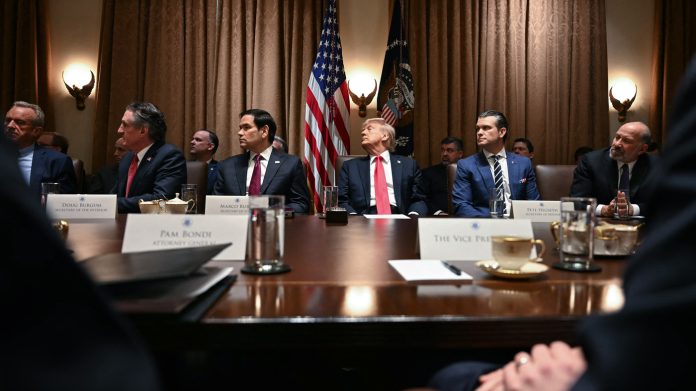
President Donald Trump cranes his head to listen during a cabinet meeting at the White House in February. Also pictured, L-R, are Secretary of Health and Human Services Robert F. Kennedy Jr., Secretary of the Interior Doug Burgum, Secretary of State Marco Rubio, Secretary of Defense Pete Hegseth and Secretary of Commerce Howard Lutnick.
Jim Watson/AFP via Getty Images
hide caption
toggle caption
Jim Watson/AFP via Getty Images

President Donald Trump cranes his head to listen during a cabinet meeting at the White House in February. Also pictured, L-R, are Secretary of Health and Human Services Robert F. Kennedy Jr., Secretary of the Interior Doug Burgum, Secretary of State Marco Rubio, Secretary of Defense Pete Hegseth and Secretary of Commerce Howard Lutnick.
Jim Watson/AFP via Getty Images
Whether a “chainsaw,” per Elon Musk, or “scalpel,” as President Trump has said — the Trump administration is making deep cuts to the federal government within its first 100 days.
And Trump has appointed personal allies with little experience in government to key cabinet positions.
For the civil servants working to enact the missions of these government agencies, that’s often meant chaos and dysfunction.
NPR correspondents Tom Bowman, Michele Kelemen and Selena Simmons-Duffin recap what they are hearing from federal workers at the Departments of Defense, State, and Health and Human Services.
For sponsor-free episodes of Consider This, sign up for Consider This+ via Apple Podcasts or at plus.npr.org.
Email us at [email protected].
This episode was produced by Alejandra Marquez Janse and Connor Donevan, with reporting from Yuki Noguchi. It was edited by Patrick Jarenwattananon. Our executive producer is Sami Yenigun.
Meet the man Trump trusts for some of his toughest international talks

President Trump is looking to Steve Witkoff, a old friend, for help negotiating the thorniest foreign policy issues in Ukraine, Gaza and Iran.
Takeaways from the week — and how they've affected President Trump's polling numbers
This week, President Trump seemed to take a softer tone when asked about the trade war with China. Here are four takeaways from week 14 in our continued look at Trump’s first 100 days in office.
NATO Secretary General speaks with NPR ahead of U.S. meetings
NPR’s Michel Martin speaks with NATO Secretary General Mark Rutte about U.S. involvement in major international conflicts under the Trump administration.