Thursday, November 12, 2026
Home Blog Page 29

Mangione’s case marks a shift on the death penalty in the U.S. : NPR

0

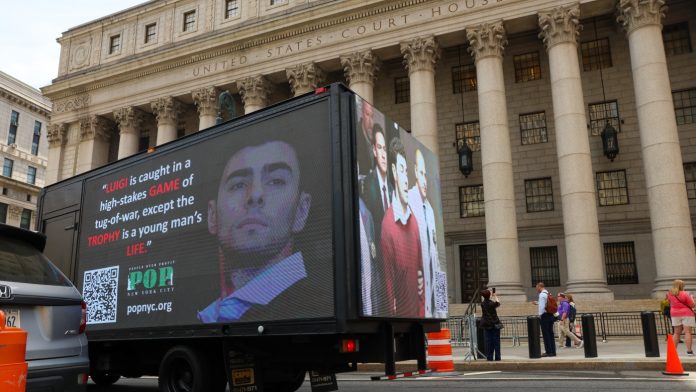
A truck displays pictures of Luigi Mangione on April 25, 2025 in New York City, as he was set to appear for the arraignment on charges that he murdered the CEO of UnitedHealthcare last year.

Spencer Platt/Getty Images


hide caption

toggle caption

Spencer Platt/Getty Images

Luigi Mangione, 26, appeared in federal court on Friday for the first time after his indictment on federal charges of killing the former CEO of UnitedHealthcare, Brian Thompson.

Federal prosecutors formally filed notice with the court Thursday that they plan to seek the death penalty. Mangione pleaded not guilty on Friday.

What’s unusual in his case is that U.S. Attorney General Pam Bondi announced earlier this month she was already directing federal prosecutors to seek Mangione’s execution.

It’s the first death penalty case the Department of Justice is tying to President Trump’s Day One executive order restoring the executions of people on federal death row, and committing to pursue the death penalty for all severe crimes that demand its use.

The Trump administration’s pursuit of the death penalty for Mangione marks a new development in the shifting politics of capital punishment in the United States, which has seesawed for more than half a century.

“Luigi Mangione’s murder of Brian Thompson — an innocent man and father of two young children — was a premeditated, cold-blooded assassination that shocked America. After careful consideration, I have directed federal prosecutors to seek the death penalty in this case as we carry out President Trump’s agenda to stop violent crime and Make America Safe Again,” Bondi said in an statement.

Mangione’s attorneys asked a federal court to prevent federal prosecutors from seeking the death penalty. In court records filed April 11, the lawyers argued Bondi’s directive prior to his indictment and her public statements were political and broke established Justice Department protocol on the death penalty.

“Because the Attorney General has chosen to proceed in this way, Mr. Mangione’s Due Process rights have already been violated and the manner in which the Government has acted has prejudiced the grand jury pool and has corrupted the grand jury process,” the attorneys wrote in the filing.

They’re asking the court to bar Bondi from making future public statements that could infringe upon Mangione’s right to a fair trial.

Robin Maher, the executive director of the Death Penalty Information Center, agreed that Bondi’s announcement — weeks before Mangione’s indictment on April 17 — was rare.

The reference to carrying out Trump’s agenda, “in combination with the unusual timing in this case, suggests that the death penalty is being used here to achieve some sort of political purpose,” Maher said in an interview.

The nonprofit organization doesn’t take a position on the death penalty, but is critical of how the punishment is applied in certain cases.

Federal prosecutors in New York haven’t responded to a request for comment on the perception of politics in the Mangione case.

In court filings in response to Mangione’s lawyers’ claims of potential grand jury bias, prosecutors said the federal court has limited authority to intervene with grand jury proceedings. Prosecutors for their part also argued that it was premature, before his indictment, for Mangione to challenge the death penalty in his case.

Whipsaw of death penalty politics

Maher said over the last half-century, the political leanings of the Supreme Court, Congress and the presidency contributed to dramatically different approaches to the federal death penalty.

The U.S. Supreme Court in 1972 in a landmark case declared the death penalty unconstitutional. The Court decided states and the federal government were imposing capital punishment in an arbitrary and inconsistent manner that was racially and otherwise discriminatory. The justices ruled that the lack of standards in implementation amounted to cruel and unusual punishment.

Then the pendulum swung again, and the federal Anti-Drug Abuse Act in 1988 expanded the federal death penalty for drug-related murders as part of a larger crackdown in President Ronald Reagan’s war on drugs.

Building on that, Congress enacted the Federal Death Penalty Act of 1994, or Title VI of the Violent Crime Control and Law Enforcement Act. It expanded the number of federal offenses eligible for the death penalty.

In 2001, Timothy McVeigh, the Oklahoma City bomber, became the first federal death row inmate executed in almost 40 years.

That act is still the law of the land. But different presidents have chosen to give it varying weight.

Maher said over the next two decades, “the federal death penalty was being heavily criticized and scrutinized because of a lot of concerns about the racially biased way that it was used.”

Polling from Gallup, which has been tracking the issue since the 1940s, shows that 53% of Americans favor the death penalty for those convicted of murder as of October 2024. That ties for the lowest percentage of public support since the landmark 1972 Supreme Court decision.

The first Trump administration executed 13 death row inmates in 2020 and 2021 — compared to the executions of three people on federal death row during the first term of President George W. Bush. There were no federal executions during Bush’s second term or during the Obama administration.

President Joe Biden imposed a moratorium on federal death row executions. In the weeks leading up to Trump’s second term, Biden commuted the death sentences of 37 people on federal death row.

The three remaining federal death row prisoners whose sentences Biden didn’t commute are all challenging their cases.

Push for more state executions

Trump’s executive order may also affect the executions of state death row inmates.

Trump directed the Justice Department to encourage state attorneys general and local prosecutors to bring state capital charges for all capital crimes. The administration also pledged to help states where the death penalty is legal, like South Carolina, secure a sufficient supply of drugs to carry out lethal injections.

David Pascoe, solicitor of the First Judicial Circuit in the state’s Lowcountry, welcomes the support from the federal government.

“In South Carolina, we went over a decade without even having any executions because we just didn’t have the drug to administer for the execution,” he said in an interview.

South Carolina and other states had in the past had difficulty obtaining some drugs for lethal injections, including sodium thiopental and pancuronium bromide, due to shortages.

Some death penalty opponents also criticized pentobarbital as a single-dose lethal injection for being inhumane and causing unnecessary pain and suffering.

Pascoe pushed for a state law that gives death row prisoners the option of execution by firing squad to address concerns of botched lethal injections and in case of drug shortages. The state legislature passed the law in 2021. The state also allows execution by electrocution.

South Carolina has executed three people in 2025. Pascoe prosecuted the most recent case, that of Mikal Mahdi. Mahdi was executed by firing squad for killing police Capt. James Myers during a week-long crime spree in 2004. He was also sentenced to life in prison in North Carolina for the killing of convenience store clerk Christopher Boggs.

Pascoe says it’s difficult to say whether the Trump administration encouraging more state death penalty prosecutions will mean prosecutors in his state will actually pursue more such convictions.

“But it’s going to be very appreciated in facilitating us to reach justice in our cases, I know that,” Pascoe said.

Some fired federal employees now face health insurance chaos : NPR

0

Danielle Waterfield was fired, rehired and fired again from her job at CHIPS for America, part of the Department of Commerce. Now, she fears her health insurance was cut off weeks ago, even though she was told otherwise.

Andrea Hsu/NPR


hide caption

toggle caption

Andrea Hsu/NPR

Danielle Waterfield was already dealing with the shock and disappointment of being fired from a job she loved.

An attorney recruited to the Commerce Department’s CHIPS for America program in 2023, Waterfield had felt she was part of something monumental, something that would move the country forward: rebuilding America’s semiconductor industry.

Instead, nearly two months after being fired in the Trump administration’s purge of newer – or “probationary” – federal employees, Waterfield is enmeshed in a bureaucratic mess over her health care coverage. It’s a mess that’s left her fearing her entire family may now be uninsured.

“I’ve been in the private sector. I’ve gone through layoffs,” says Waterfield. “I’ve never before experienced this, and never for the life of me thought the federal government would treat people like that.”

Good health benefits a perk of federal jobs

Solid benefits have long been seen as a perk of federal jobs, a tradeoff for lower pay. As a result, many federal employees carry their families on their health insurance plans.

But now, the administration’s “break first, ask questions later” approach to remaking the federal bureaucracy has brought a level of chaos to the government that workers like Waterfield have never seen anywhere, even in the private sector.

President Trump delivers remarks on reciprocal tariffs as Secretary of Commerce Howard Lutnick holds a chart during an event in the Rose Garden entitled "Make America Wealthy Again" at the White House in Washington, D.C., on April 2, 2025.

President Trump delivers remarks on reciprocal tariffs as Secretary of Commerce Howard Lutnick holds a chart during an event in the Rose Garden entitled “Make America Wealthy Again” at the White House in Washington, D.C., on April 2, 2025.

Brendan Smialowski/AFP via Getty Images


hide caption

toggle caption

Brendan Smialowski/AFP via Getty Images

Firings have been carried out with such haste that human resource departments have struggled to answer a basic question from those affected: Do we have health insurance?

Fired employees desperate for information have instead been given responses that are confusing, conflicting and at times, flat out wrong. Moreover, much of that information has come too late. Some fear they’ve racked up medical bills that will not be reimbursed, while others are avoiding medical care until they can get new insurance.

The Commerce Department did not respond to NPR’s multiple requests for comment about the fired employees’ health care coverage. The U.S. Office of Personnel Management, which handles many human resource functions for the federal government, only provided general information about federal benefits but did not address specific questions.

How Waterfield and possibly hundreds of others recently fired from the Commerce Department ended up in this situation takes some explaining. The information vacuum that employees have encountered amid a legal battle over their firings has certainly compounded the chaos.

March 3: The original termination 

In court filings, the Commerce Department confirmed it fired close to 800 probationary employees between President Trump’s inauguration on January 20 and March 3.

Waterfield’s termination letter came March 3. Immediately, she realized she needed to figure out health insurance for her family. Her husband and two children were on her health plan.

The Commerce Department sent her a memo explaining the federal government’s benefits policy for separated employees: The government would provide a 31-day extension of her health insurance following her last pay period. She would owe no additional premiums. After that, she would have 60 days to opt into federal employees’ equivalent of COBRA to continue her health benefits.

Instead, Waterfield started looking into how to switch the family to the plan her husband’s employer offered, an option she was grateful to have. But she couldn’t do that until she could prove a “qualifying life event” – in her case, a loss of health insurance due to being fired.

And then, ten days later came a new twist.

March 17: Reinstatement

Ten days after Waterfield was terminated, a federal judge in Maryland found that her firing and that of more than 24,000 other probationary employees targeted by the Trump administration were probably illegal. He ordered them temporarily reinstated, restoring the status quo.

To comply with the judge’s order, the Commerce Department reinstated nearly all of the fired employees on March 17, putting them on paid administrative leave.

Waterfield assumed a return to the status quo would mean her benefits would be restored. She was still paying her insurance premium through her paycheck, but she wanted confirmation. She asked Human Resources but heard nothing back. She sent her reinstatement letter to Blue Cross Blue Shield and felt reassured when she got a response informing her she’d have no break in coverage.

“Within a week, I had new insurance cards sent to my entire family,” she says.

Knowing that the Trump administration was appealing the judge’s order and that she could be fired again at any moment, she took swift action to ensure her family’s wellbeing. She moved up a bunch of medical appointments, including a routine checkup for her teenager, a diabetes appointment for her husband, and her own physical therapy to address a spinal issue.

“Doctors have been very, very supportive,” she says. “They rescheduled things and got us in.”

April 10: Terminated again

Then on April 10 came the notification Waterfield had dreaded. A day earlier, a panel of judges at the 4th Circuit Court of Appeals had found fault with the lower court’s reinstatement order, and voided it.

Now, the Commerce Department was firing her once again, retroactive to her original termination date. This time, there was no accompanying memo about benefits. Again, questions to Human Resources went unanswered.

Waterfield logged on to her insurance portal and saw no change in status. Her paystubs still showed that her health care premium was being taken out of her paycheck. She kept the family’s doctors appointments until this week, when her group chats lit up with frantic text messages.

A couple of her colleagues had just heard from their insurers that their coverage did indeed end on April 8, consistent with what the Commerce Department had told them before the whole legal saga began. As a result, claims for expenses incurred after that would not be paid.

Protesters gather on the National Mall for the "Hands-Off" protest against the Trump administration on Saturday, April 5, 2025.

Protesters gather on the National Mall for the “Hands-Off” protest against the Trump administration on Saturday, April 5, 2025.

Dominic Gwinn/AFP via Getty


hide caption

toggle caption

Dominic Gwinn/AFP via Getty

“I’m afraid to call my insurance company”

NPR has since learned that fired employees at another agency within the Commerce Department, the National Oceanic and Atmospheric Administration, received a memo from the government on April 17 confirming the April 8 insurance cutoff – a full week after they were re-fired. That’s despite the fact that some of those employees had received verbal and even written assurances from supervisors that their coverage would continue uninterrupted. Now they don’t know what to believe.

“I’m afraid to call my insurance company,” says Waterfield.

Her colleague Keri Murphy, an administrative officer at CHIPS for America, is even more terrified. She had surgery on her foot on April 17. That morning, she called Blue Cross Blue Shield to make sure she had coverage and was told she did.

“Blue Cross was showing me as active,” she says. “I paid my specialist co-pay of $50.”

That confirmation, along with the fact that her latest paystub showed she had paid her health care premium, led Murphy to assume she’d have health coverage for another 31 days past her April 10 re-termination date.

Now, she’s trying to figure out what she’ll do if she’s saddled with the entire cost of her foot surgery. Her only choice may be to opt into continuing coverage for one month. But she estimates that could cost her around $2800, money her family doesn’t have given she just lost her job.

She’s now worried she may have to cancel her follow-up appointment next week, when her doctor is supposed to remove the bandages and have a look.

“This has been such a life-changing, devastating series of events that I don’t know how much more bad news I can take,” she says.

Tammy Flanagan, who formerly worked in human resources at the FBI and now runs her own consultancy, says these federal workers have done exactly what she would have advised them to do in this situation – call their insurers.

Beyond that, she’s not sure what to tell them.

“Where have government employees ever been fired and then rehired and fired again? It’s unknown territory,” she says.

Hoping for no emergencies

Jennifer Raulin (left) and a colleague work in the field on a government-supported project related to marsh restoration. Raulin had just started a federal job in coastal management with the National Oceanic and Atmospheric Administration in January before being fired in February.

Jennifer Raulin (left) and a colleague work in the field on a government-supported project related to marsh restoration. Raulin had just started a federal job in coastal management with the National Oceanic and Atmospheric Administration in January before being fired in February.

C. Weilminster


hide caption

toggle caption

C. Weilminster

Jennifer Raulin, who had just started a job at NOAA in January before being fired in February, rehired in March and fired again in April, had not wanted to complain publicly about the ordeal she’s been through – until now.

“We have been kind of living in purgatory for the past couple of months, but this whole health care thing has really taken a darker turn,” she says. “This to me crossed a line… because my kids are now involved.”

One of her children just turned 11, but she isn’t taking him in for his annual checkup and the shots that he’s due to get, including the HPV, Tdap and meningitis vaccines, until she has health care coverage again.

In the meantime, she’s also hoping for no emergencies.

“Both of my children play baseball, and so now every time they have a game, I hold my breath and hope that they don’t get hurt,” she says.

She, too, feels fortunate her husband’s employer offers a family insurance plan. But they haven’t been able to make the switch because the government hasn’t sent Raulin her termination paperwork proving a qualifying life event.

Until then, if someone in the family ends up in the emergency room, she’ll have to opt into continuing coverage, despite it being cost-prohibitive, she says. NOAA employees have been told they have until June 7 to do so.

Not optimistic about another reinstatement

Although multiple legal challenges to the probationary employees’ firings are still playing out in court, Raulin and others are not optimistic this health care situation will be sorted out by another ruling – or that they’ll get their jobs back.

“Trying to follow all these cases and the appeal process is almost like a full-time job, on top of trying to find another full-time job,” says Raulin.

While Waterfield looks for new employment, she is doing what she can to help other federal workers navigate the murky situation, including signing up with her local bar association to provide pro-bono legal counsel – and support.

“Even if it’s just a sense of giving an open ear, letting them know they’re not alone, that their feeling that this isn’t fair is shared by others,” says Waterfield. “Letting people know that I feel it with them.”

What is pronatalism, and what role do Musk and Vance have with it? : NPR

0

Pronatalists believe that modern culture has failed to adequately prioritize the value of nuclear families and making lots of babies. They see powerful potential allies in Elon Musk and JD Vance.

Jess Suttner for NPR


hide caption

toggle caption

Jess Suttner for NPR

“Humanity is dying,” billionaire Elon Musk told Fox News anchor Bret Baier recently when asked what keeps him up at night. “The birth rate is very low in almost every country. And so unless that changes, civilization will disappear.” Through interviews, social media posts, funding for population research and his own example as the parent of at least 14 children, Musk has become one of the most visible beacons of anxiety about falling birth rates.

While discussions about the economic challenges of falling birth rates exist across the political spectrum, the right has increasingly taken up the cause under the banner of “pronatalism” to promote higher birth rates. The Trump White House is reportedly soliciting suggestions to boost births from married couples, even as it continues drastic reductions to social services and public health funding.

In recent years, a revitalized pronatalist movement has brought together parts of the religious right, tech types and dedicated “new right” anti-feminists. These camps have some disagreements over government policy, technologies like in vitro fertilization, genetic engineering and the rehabilitation of eugenics. But most are united in the belief that modern culture has failed to adequately prioritize the value of nuclear families and making lots of babies.

Last month in Austin, Texas, many proponents of pronatalism met up at the second Natal Conference, known informally as Natal Con, where the mood was exuberant. Many there see this moment as a chance to advance their agenda through perceived allies in the Trump administration, including Musk and Vice President Vance.

The “techno-puritans”

Simone Collins holds her 1-year-old daughter. Collins is wearing round, black-framed glasses and a white bonnet.

Simone Collins holds her 1-year-old daughter, Industry Americus Collins. Simone and her husband, Malcolm Collins, have become prominent faces in pronatalism.

Lisa Hagen/NPR


hide caption

toggle caption

Lisa Hagen/NPR

Outside the Trump administration, Simone Collins has purposefully made herself into one of the more visible faces of pronatalism.

“My whole entire, like, Etsy getup right now — it’s intentionally cringe,” Collins told NPR between other press interviews at Natal Con. She describes her signature look as “techno-puritan.”

“There should obviously be more cybernetics in my outfit. But we are combining, like, chunky hipster glasses and a lot of modern equipment with a bonnet and linen clothing and weird puritan stuff,” said Collins, who had her 1-year-old daughter, Industry Americus Collins, strapped to her back.

Collins and her husband, Malcolm Collins, have courted press coverage by being “intentionally cringe.” It has worked: Over the last few years, they’ve been profiled by many news outlets, including The Telegraph, The Washington Post and The Guardian. The couple tells journalists they’ve curated their family’s image based on data. They chose their kids’ names (Industry Americus, Titan Invictus, Octavian George, Torsten Savage) in hopes of launching them toward impressive careers. Simone, rather than Malcolm, ran (unsuccessfully) for state office in Pennsylvania because they felt a woman would be more electable.

Techno-puritan isn’t just a fashion choice for the Collinses. It’s a religion they’ve invented in part to maximize fertility, mental health and social good. Malcolm once slapped their 2-year-old son in front of a reporter, likening it to the behavior of tigers in the wild.

“We constantly court controversy in order to get our message out because we know that’s what gets clicks,” Simone told NPR.

“The number one goal we have is to make everyone universally aware of demographic collapse as a catastrophic issue,” she said. “Our big focus is primarily on just signaling that this is a culture that values family and kids and, secondarily, taking a regulatory foot off the neck of parents.”

The Collinses are seen by fellow pronatalists as members of the movement’s “tech” camp. The couple uses and advocates for in vitro fertilization and claims the embryos of their four children were screened for illnesses, mental health issues and potential intelligence. At a penthouse cocktail party in Austin the night before Natal Con began, the Collinses invited journalists to mingle with founders of gene editing and genetic engineering companies.

The couple’s network also includes right-wing tech elites and Silicon Valley venture capitalists. Simone worked for PayPal co-founder Peter Thiel, and Malcolm’s brother works for Musk’s ad hoc Department of Government Efficiency (DOGE) team.

This illustration shows a woman pushing a baby in a stroller in the foreground as she looks back at another woman pushing a wagon with at least five young children.

The right has increasingly taken up the issue of falling birth rates under the banner of “pronatalism.”

Jess Suttner for NPR


hide caption

toggle caption

Jess Suttner for NPR

“Generally, women should not have careers” 

Another pronatalist camp includes the more religiously motivated and believers in strict gender norms. In the movement, they’re referred to as the “trads,” as in “traditional.”

The first Natal Con, in 2023, included a presentation by far-right businessman Charles Haywood on the importance of men-only spaces. Haywood, who founded a shampoo company and aspires to be a self-described “warlord,” told the audience that workplaces should revert to privileging men with families and being segregated by sex. “And generally, women should not have careers. They should be socially stigmatized if they have careers,” Haywood said at Natal Con that year. He sponsored this year’s conference but didn’t speak.

He blames birth rate declines on feminism and democratic changes overturning what he sees as natural hierarchies of gender and race.

“The Civil Rights Act of 1964 and its progeny are probably the single most destructive set of laws in American history, and all should be wiped forever from the history of this nation,” Haywood said in 2023, drawing applause from the Natal Con crowd.

Malcolm and Simone Collins sit on a sofa in December 2024. Simone, seated on the right, has one child in her lap and another strapped to her back. Malcolm is holding one child, and their fourth child in on the floor in front of them, looking at a book open on a coffee table.

Malcolm and Simone Collins with their four children in December 2024.

Rachel Wisniewski


hide caption

toggle caption

Rachel Wisniewski

Where “tech” and “trad” overlap 

Simone Collins, an entrepreneurial woman with a master’s degree from the University of Cambridge, told NPR she thinks Haywood’s stances are “so dumb.” But in addition to their commitment to spaces like Natal Con, the two share a contempt for contemporary culture.

In interviews, the Collinses frame their arguments as concerns about preserving diversity or LGBTQ+ communities. If tolerant progressives don’t reproduce, they’ve argued, authoritarian solutions will assert themselves. Simone often refers to her upbringing in the San Francisco Bay Area by hippie parents as a symbol of her former left-wing bona fides. In an initial interview with NPR last year, Malcolm referred to himself as a “major thinker on the left.”

On their podcast, however, the Collinses say reversing demographic collapse is not possible without addressing “wokeness” or “progressiveness,” which Malcolm refers to as “the urban monoculture and its goal of cultural genocide.” This “monoculture” survives only by creating popular culture or, as Malcolm has said, “by parasitizing children from nearby demographically healthy cultural groups.”

A complex global trend

Many demographers frame the issue of birth rate declines differently than pronatalists do, including Karen Benjamin Guzzo, a University of North Carolina sociologist who runs the Carolina Population Center.

The United States, she explained, is actually a couple of decades late to a global declining fertility trend. Birth rates have already dropped in Italy, Japan, India, parts of Brazil and many countries in sub-Saharan Africa.

“Up until the Great Recession, we were sort of humming along, you know, right around two kids per [woman],” said Guzzo. Birth rates then began to fall, partly because the U.S. succeeded in reducing teen and unintended births.

Many national governments facing birth rate declines have launched policies to try to raise fertility, with mixed results. None has succeeded in sustainably raising birth rates above “replacement rate” without also drastically increasing maternal mortality and the number of orphaned children, as was the case with Romania’s total ban on contraception and abortion beginning in the 1960s.

In and outside pronatalist circles, Guzzo said, there has been a lingering notion that wealthy women have fewer children than their poor and working-class counterparts. But recent research shows that this tendency has actually started to reverse in many countries, including the United States.

“In the 1980s and ’90s, college-educated women were less likely to have kids than other groups. That is not really the case anymore. They just have them later,” said Guzzo.

Guzzo said surveys show roughly 80% of people want kids, but for many people, the right moment doesn’t materialize.

In her research on Americans, she said, she has seen that “one of the biggest things people think about when they think about having kids is ‘how does the future look?'” Respondents want stable housing, job security, health care, education and a good partner and worry about larger forces like politics and climate change.

These worries lead people to make a series of decisions to delay having children, with hopes of having them in the future. Guzzo said this pattern continues because “we aren’t giving people the societal supports to meet their visions of [being] a good parent.”

For her, that support could look like more government funding for health care, affordable housing, education and child care and addressing student loan debt and climate change.

Some pronatalists agree and point to evidence that generous government policies raise birth rates. Still, they haven’t always put their full support behind enacting those policies. As a U.S. senator, Vance suggested more than doubling the child tax credit to $5,000 a child, weeks after he skipped a vote on a bill to expand the benefit. Musk’s DOGE has targeted funding for the Department of Health and Human Services and laid off employees who administer Head Start child care.

But many more pronatalists, including Natal Con’s organizer, Kevin Dolan, see their biggest allies as those in the White House right now.

This illustration shows a very pregnant woman lying on her back with a petri dish balancing on her stomach as small Lilliputian-type men stand around and on her. One man holds a syringe, one looks at a clipboard and the other is dressed in scrubs and is standing next to two tubes of blood.

Some pronatalists are members of the movement’s “tech” camp, using and advocating for in vitro fertilization, including screening embryos for illnesses, mental health issues and potential intelligence.

Jess Suttner for NPR


hide caption

toggle caption

Jess Suttner for NPR

“Breeding” excellence

“The topic of demographic decline clearly matters to Elon Musk, JD Vance and many others in the Trump administration, which means that the great ideas developed here can get a hearing that would not have been possible last year,” said Dolan in his welcome speech at this year’s Natal Con.

Dolan left his data science job in 2021 after his anonymous Twitter and Substack accounts were exposed. Among other things, he’d used them to promote author Charles Murray, who has advanced discredited arguments that social inequalities exist because of supposed genetic differences between races rather than historical disadvantages and structural racism.

After his identity was revealed, Dolan continued sharing his thoughts about how society should be ordered on his podcast. For example, he described love between men and women as a “relationship between superior and inferior.”

In this photo, Kevin Dolan stands behind a wooden lectern as he speaks to Natal Con attendees.

Natal Con’s organizer, Kevin Dolan, speaks to attendees in Austin, Texas. He said on his podcast that modern culture and government policies have created a “badly dysfunctional” “breeding system” in which excellence is devalued.

Lisa Hagen/NPR


hide caption

toggle caption

Lisa Hagen/NPR

“We’re expected to lie about the existence of these hierarchies all of the time. And if our goal is to rehabilitate hierarchies of nature, then the best place to start is the most fundamental natural hierarchies which are found in the family,” he said. “And that brings us back to where we started with selective breeding.”

Dolan was reviewing what he called “a fantastic book” by Costin Alamariu, an influential hard-right writer who has written: “I believe in Fascism or ‘something worse.'” Figures on the right have noted that Alamariu, who goes by the pseudonym Bronze Age Pervert, is a favorite among junior Trump staffers.

“The idea is essentially that our society has become excessively effeminate, weak, compassionate,” said Matthew McManus, a lecturer at the University of Michigan, “and what they want to do is breed or elevate an aristocratic class that’s going to be masculine, violent, not necessarily motivated by, let’s call it empathy.” Recently, Elon Musk echoed the sentiment on Joe Rogan’s podcast, saying “the fundamental weakness of Western civilization is empathy.”

McManus is an expert on the modern, hard-right thinkers whose ideas Dolan promotes. In these intellectual circles, McManus said, establishing a “masculine” culture means rooting out feminism and multicultural democracy.

“Women are to be subordinated to men. [They] largely are going to be responsible for managing the household, although with no real particular authority. And of course, they’re going to have an awful lot of children,” said McManus.

On his podcast, Dolan has said modern culture and government policies have created a “badly dysfunctional” “breeding system” in which excellence is devalued. Part of the vision for Natal Con, as Dolan describes it on his podcast, is for it to be a hub for like-minded people to breed a sustainable “aristocratic class” to resist those cultural forces.

A small group of student protesters gathers under a statue of a large star outside Natal Con. A couple of signs read "Natalism is Nazism" and "No Nazis in Austin!"

A small group of student protesters from the adjoining University of Texas at Austin gathers outside Natal Con.

Lisa Hagen/NPR


hide caption

toggle caption

Lisa Hagen/NPR

A nonpartisan conference? 

On the opening night of this year’s conference, Natal Con attendees bound for the introductory dinner were greeted by a small group of student protesters from the adjoining University of Texas at Austin.

“Eugenicists! Off our campus! Racists! Off our campus! White supremacists! Off our campus! Neo-Nazis! Off our campus!” they chanted into a megaphone, as conference attendees entered the Bullock Texas State History Museum. It was a perplexing experience for speaker Bryan Caplan, a George Mason University economics professor and bestselling author.

“To go and start calling a whole crowd of people Nazis seemed a rather odd thing to do,” he told NPR.

In addition to doubling the number of attendees to 200 since the inaugural conference in 2023, Dolan had succeeded in widening the range of speakers beyond the original lineup of hard-right influencers and promoters of scientific racism. Caplan was among the increased number of credentialed professors who accepted invitations to speak this year.

Dolan has said Natal Con is nonpartisan, and he told NPR that his goal is to find a solution to birth rate declines that works for everyone.

“I think it’s a tragedy that [liberal] people are not raising children with their cultural obsessions and interests and skills and talents,” Dolan said in an interview.

But he also invited pseudonymous writer Peachy Keenan. She also spoke at the first conference, where she said: “We don’t really want to market natalism to the progressive feminists. The people maxing out their fertility should be people, ideally, who won’t raise their children to be gender-neutral furries who want to join antifa one day.”

Keenan is one of multiple Natal Con speakers published by Passage Publishing, commonly referred to as Passage Press, which sells books arguing Black people are inherently more criminal and less intelligent than white people. Passage Publishing’s founder, Jonathan Keeperman, both spoke at and sponsored this year’s Natal Con.

Dolan also featured speakers such as Jack Posobiec, a hard-right political operative who first gained notoriety after spreading the Pizzagate conspiracy theory during the first Trump term. Posobiec is close to the Trump administration and has used antisemitic memes on social media.

Jack Posobiec stands behind a lectern equipped with a microphone as he speaks at the Conservative Political Action Conference in February.

Jack Posobiec speaks at the Conservative Political Action Conference in February.

Dominic Gwinn/Middle East Images/AFP via Getty Images


hide caption

toggle caption

Dominic Gwinn/Middle East Images/AFP via Getty Images

Speaking at the conference’s welcome dinner this year, Posobiec referenced detractors of the pronatalist movement. “To the enemies of civilization, and call them whatever you want — the woke, the globalists, the nihilists — they don’t just want to rewrite our history. They actually want to erase our future. They want to erase us, all of us, everyone in this room.”

His speech at Natal Con focused on the defense of “Western civilization.” In the past, Posobiec marched in and promoted demonstrations in Poland that included antisemitic, neo-fascist groups chanting support for “white Poland.” Asked for comment, Posobiec has previously told NPR to “enjoy being defunded.”

Asked whether his curation of Natal Con speakers contradicts his professed nonpartisan goals, Dolan told NPR that he’d love to include more speakers from across the political spectrum. However, he said he thinks progressive people who are “frightened” by “dangerous” ideas “just may not be a fit for what we’re trying to do right now.”

“I would say this needs to be a very high openness, very exploratory, very intellectually curious environment,” said Dolan. “It’s been my experience that if you are unwilling to include people who have been labeled [racists], that is functionally a choice to exclude an incredible percentage of people who are thoughtful and interesting and have something new to say.”

“Race suicide”

Not all the ideas that Natal Con speakers are interested in are new.

Around the early 1900s, another period of historically low birth rates, the eugenicist concept of “race suicide” was amplified by President Theodore Roosevelt.

It was “the idea that white, middle-class women were too busy going to college or getting ahead professionally — they were not having babies,” explained Alexandra Stern, a University of California, Los Angeles history and English professor who has written books on the American history of eugenics and the contemporary far right.

In this black-and-white photo from circa 1906, President Theodore Roosevelt sits at his desk, reading some papers.

President Theodore Roosevelt at his desk circa 1906. In the early 1900s, he amplified the eugenicist concept of “race suicide” during another period of low birth rates.

Harris & Ewing/Library of Congress


hide caption

toggle caption

Harris & Ewing/Library of Congress

Race suicide included fears that some people, like the poor, or new waves of Italian, Polish and Jewish immigrants, had too many babies, which led to widespread programs of sterilizing supposedly “unfit” groups in the United States. These and other American policies, like anti-miscegenation laws, went on to influence some of the “racial hygiene” programs of the Nazi party.

Today’s pronatalists, Stern said, are largely aware of this history and often try to disassociate themselves from it.

“So by a very superficial gloss, [today’s pronatalist movements] could appear to be, let’s say, almost a libertarian approach to babymaking,” she said. “But if you look at the underlying, driving ideologies, à la Charles Murray and others who have written about who should be having babies and who should not be having babies, it often comes down to ideologies of genetic determinism and who is more fit or less fit.”

Stern said it’s just as important to think of pronatalists’ ideas within the context of what else is happening today, such as rising maternal mortality after the Supreme Court overturned a constitutional right to abortion or the nation’s top health official claiming, inaccurately, that autistic people lead unfulfilling lives. President Trump has signed multiple executive orders targeting transgender people and funding for schools with trans-inclusive policies.

Stern also pointed to attacks on diversity, equity and inclusion (DEI) efforts and their ramifications for disabled people, women and people of color.

“The logic behind [targeting DEI] is that diversity and difference has been prized over excellence and human optimization and we have to get back to judging people by their merit and not try to pull everyone up to the same level because some people just naturally, biologically or God-given are not going to be at that level,” said Stern.

Birth rate declines have also been prominent tropes for white supremacist mass shooters, including the shooter who killed 51 Muslim people and wounded 40 others at two mosques in New Zealand in 2019.

In a document titled “The Great Replacement,” the shooter wrote, “If there is one thing I want you to remember from these writings, its [sic] that the birthrates must change.”

The “great replacement” is a racist concept, promoted by at least one Natal Con speaker, that populations in majority-white nations are deliberately being “replaced” by nonwhite immigrants. Fears about the birth rates of white women are often a key component of the theory in extremist literature.

“In their eyes, this is the path to what they term white extinction,” said Michael Feola, a political theorist at Lafayette College and the author of The Rage of Replacement: Far Right Politics and Demographic Fear.

Feola said it’s also no surprise that proponents of scientific racism are helping fund events like Natal Con. There has been a deliberate investment by tech elites to rehabilitate these ideas.

“We’re seeing a far more publicly sanitized set of big arguments being presented at the forefront and different sorts of speakers coming to the forefront as public faces of the movement,” said Feola.

NPR asked Simone Collins to comment on whether her activism helps give cover for the more extreme elements of pronatalism. Her response was that white nationalism is “obviously evil” and “dumb.” But, then, she also reframed some of their ideas.

“They’re just trying to point out that ‘Oh, wait. Different genetic groups have different general traits,'” said Collins.

She and her husband also have traded multiple podcast appearances with a promoter of racial pseudoscience and promoted his book. Malcolm Collins later apologized for recommending the book, but the couple’s episodes with the author remain up.

NPR’s Audrey Nguyen produced this story.

5 takeaways from the week — from a softer approach on trade to Hegseth in hot water : NPR

0

During impromptu remarks to reporters outside the White House on April 23, President Trump said the U.S. will “have a fair deal with China.” 

Samuel Corum/Sipa/Bloomberg via Getty Images


hide caption

toggle caption

Samuel Corum/Sipa/Bloomberg via Getty Images

We’ll be recapping what you need to know every Friday morning for the first 100 days of the Trump administration. Get more updates and analysis in the NPR Politics newsletter.

After weeks of volatility because of Trump’s trade war, the stock markets this week responded positively to Trump softening his tone toward China and Federal Reserve Chair Jerome Powell; Defense Secretary Pete Hegseth, meanwhile, has been wading in hot water; Trump looks to live up to the dealmaker reputation he has sought to project, trying for a nuclear deal with Iran, while also growing irritated with the inability to get a peace plan agreed to between Russia and Ukraine; and he continues to mix politics and money.

Here are five takeaways from week 14 in our continued look at Trump’s first 100 days in office:

1. A softening toward China and Powell. 

Trump doesn’t need to focus on public opinion because he’s constitutionally barred from running for a third term — even though several polls this week showed his approval ratings on the decline and vulnerable congressional Republicans might wish he took their findings to heart.

But one thing he has always reacted to is investors. The stock market was on track for its worst performance at the beginning of a presidency since the Great Depression. But then Trump ditched the hot rhetoric toward China and the Fed chair. He said 145% tariffs remain in place toward China but that the White House and China are in talks to find a different, reasonable number. On Monday, Trump on social media called Powell a “major loser.”

But a day later, he said he had “no intention” of firing Powell. As a result, the markets are up. But it has been a bumpy ride since the beginning of the month — and the uncertainty hasn’t been cleared up, not just for Wall Street, but small businesses and farmers, who operate on very slim margins.

2. Hegseth in hot water.

The number of stories in the past week about problems in Hegseth’s Defense Department has been extraordinary. Here’s a look at some:

  • The New York Times reports on Sunday that Defense Secretary Pete Hegseth shared details of the U.S. strikes on Yemen in a message group with his wife, brother and personal lawyer.
  • A former Pentagon spokesman, John Ullyot — someone who was close with Hegseth and worked in the first Trump administration, too — writes an op-ed the same day in Politico describing “a month of total chaos” and predicts Trump will fire Hegseth. 
  • The next day, at the White House Easter Egg Roll, Hegseth blasts the media for using “anonymous sources” from “disgruntled, former employees” in its reporting about him. 
  • NPR and others report on Tuesday that Hegseth was cutting and pasting information from a secure channel sent by the head of U.S. Central Command, Erik Kurilla, to the Signal chat groups.

Few Republicans have been critical or have been willing to speak out. Sen. Lisa Murkowski of Alaska said she fears “retaliation.” Rep. Don Bacon, R-Neb., did raise concerns, saying if he were president he wouldn’t “tolerate” Hegseth’s behavior. “He’s acting like he’s above the law,” he said, “and that shows an amateur person.”

But Murkowski and Bacon are unique figures. Murkowski has a famous last name in her state and has been tested before, winning a statewide write-in campaign after conservatives tried to oust her. Bacon is one of the few Republicans in a district that Democrat Kamala Harris won. There has been a decreasing number of swing districts, only a few dozen now.

So for most other Republicans, there’s no incentive for them to speak out because of the power Trump has with the base and risk of a primary challenge.

That insulates Hegseth to an extent because often divisions within a president’s party are leading indicators for a Cabinet member’s ouster. At the end of the day, few people last in Cabinet positions for the entirety of a president’s term, but dismissing one this early would be highly unusual. Only 13 Cabinet members in history have served less than 100 days. Trump’s is coming up on Wednesday.

The White House said it is firmly behind Hegseth, contending that the “entire” Pentagon is resisting him. NPR reported that the White House is, however, looking at potential replacements if the president changes his mind — or things get even worse.

3. Trump really wants to make international deals, but so far, they’ve been elusive.

The man, who wrote The Art of the Deal and considers himself the dealmaker of all dealmakers, really wants them made to end the Russia-Ukraine war and with Iran over its nuclear program.

But it hasn’t proved to be so easy.

Trump has promised to quickly put an end to the war in Ukraine — 24 hours, in fact. But, this week, Trump lashed out at Ukraine’s president — again — saying he was harder to deal with than Russia and accused him of derailing negotiations. The U.S. wants Ukraine to officially cede Crimea and to pledge never to join NATO. Trump was critical of Russia’s Vladimir Putin on social media for continuing to bombard Ukraine, but there have been no concessions the Trump administration has publicly asked of Russia.

Vice President Vance and Secretary of State Marco Rubio have threatened that the U.S. would walk away from the table if a deal isn’t reached.

Asked whether the U.S. would, indeed, walk away, Trump said to ask the question again in “two weeks.”

As for an Iran deal, Trump said Thursday it was “well on its way.” Trump pulled the U.S. out of the Iran deal struck under President Obama, which he called at the time “the worst deal ever.” But it’s not clear if that’s the case, and it’s easy to forget that Trump promised to forge one with Iran during his first term — one that looked similar to the original Obama deal.

4. The commodification of politics.

Unlike any past president, Trump is mixing money and the White House. He sold lots of tchotchkes during the campaign, from boots to Bibles, gold sneakers, victory medallions, NFTs and more.

That’s continued into his presidency. He had billionaire CEOs on the dais at his inauguration. He raised a record amount of money for the inauguration, more than $200 million. There’s a “Trump Store” website, where people can also buy any number of Trump-branded products, from hats, including one for Trump 2028, to luggage tags to golf apparel, even candles.

This week, he held the White House Easter Egg Roll, which, for the first time, included corporate sponsors other than the American Egg Board, which has traditionally backed the event. He was also promoting his crypto meme coin with a contest for the top 220 holders of it to win a dinner with the president next month. The top 25 would get “VIP access.” His meme coin’s value jumped after the contest announcement.

It’s just the latest example of Trump doing something that is far outside the norm for president. — and raises all kinds of questions about conflicts of interest and ethics.

Here’s a day-by-day look at what happened in the past week:

Friday, April 18:

  • The State Department has changed what it defines as human rights. Despite decades of bipartisan agreement on American values, the State Department removed, according to  NPR reporting, “longstanding critiques of abuses such as harsh prison conditions, government corruption and restrictions on participation in the political process.”
  • Secretary of State Rubio says the U.S. could pause its Russia-Ukraine peace deal efforts. “So we need to determine very quickly now, and I’m talking about a matter of days, whether or not this is doable in the next few weeks,” Rubio said after talks Thursday with European and Ukrainian officials. “If it is, we’re in. If it’s not, then we have other priorities to focus on.”
  • The U.S. strikes a Houthi oil port overnight, killing more than 70 people.
  • Alaska Republican Sen. Lisa Murkowski says she fears retribution from the Trump administration for speaking out. “We are all afraid,” Murkowski said, taking a long pause. “It’s quite a statement. But we are in a time and a place where I certainly have not been here before. And I’ll tell ya, I’m oftentimes very anxious myself about using my voice, because retaliation is real. And that’s not right.”

Saturday:

  • The White House is soliciting corporate sponsorship for the White House Easter Egg Roll for the first time.  
  • There were more anti-Trump protests across the country. 
  • The Washington Post reports that cuts at Health and Human Services are impacting “programs that help people compare IVF clinics, monitor safety in fertility and make sense of health data. … in a move some maternal health experts predict will have an enduring effect on women and children.”
  • Is the country in a constitutional crisis? NPR’s Nina Totenberg writes, “Think of the country right now as the pot on a stove. A week ago, one might have said that the flame controlling the temperature was on medium. But in the days since then, the pot has been inching closer to high, and a full-on clash between the Supreme Court and the president.”
Pope Francis meets with Vice President Vance and delegation during an audience at Casa Santa Marta on April 20 in Vatican City, Vatican.

Pope Francis meets with Vice President Vance and delegation during an audience at Casa Santa Marta on April 20 in Vatican City, Vatican.

Vatican Media/Vatican Pool/Getty Images


hide caption

toggle caption

Vatican Media/Vatican Pool/Getty Images

Sunday:

  • The Wall Street Journal reports the U.S. is waiting on Ukraine for its response to a peace plan with Russia. It includes Ukraine’s recognition of the annexation of Crimea and that Ukraine will never join NATO. 
  • Reuters reports that Ukraine reported almost 3,000 violations during Russia’s own Easter “ceasefire.”
  • El Salvador’s president, Nayib Bukele, proposes sending imprisoned U.S.-deported Venezuelans to Venezuela for a prisoner swap.
  • The New York Times reports that Defense Secretary Pete Hegseth shared details of the U.S. strikes on Yemen in a message group with his wife, brother and personal lawyer. 
  • John Ullyot, a former Pentagon spokesman writes an opinion piece in Politico – with his name on it – describing “a month of total chaos” and predicts Trump will fire Defense Secretary Pete Hegseth. 
  • Trump shattered a record, raising $239 million for his inauguration. 
  • Vice President Vance met with Pope Francis. Francis has been critical of the Trump administration’s immigration policies. 
  • The New York Times reports on a draft proposal that would drastically reduce the size of the State Department. It would eliminate almost all U.S. footprint on the African continent, shutting down embassies and consulates, as well as offices related to climate change, human rights and democracy at State Department headquarters in D.C.
  • Four more House Democrats travel to El Salvador to call attention to the deportation and imprisonment of Kilmer Abrego Garcia — Reps. Yassamin Ansari, D-Ariz., Maxine Dexter, D-Ore., Maxwell Frost, D-Fla. and Robert Garcia, D-Calif. 
President Donald Trump, first lady Melania Trump and the Easter Bunny greet guests during the White House Egg Roll on the South Lawn of the White House on April 21.

President Donald Trump, first lady Melania Trump and the Easter Bunny greet guests during the White House Egg Roll on the South Lawn of the White House on April 21.

Anna Moneymaker/Getty Images


hide caption

toggle caption

Anna Moneymaker/Getty Images

Monday:

  • Pope Francis dies. 
  • Vice President Vance and his wife, Usha, are in India. Vance and India’s prime minister, Modi, say they’re making “significant” progress” in trade talks.
  • Thousands attend the White House Easter Egg Roll event. 
  • Harvard sues the Trump administration.
  • Trump says in a social media post that due process for all immigrants in the U.S. without permanent legal status is not possible. “We cannot give everyone a trial, because to do so would take, without exaggeration, 200 years,” he says.
  • NPR reports the White House is looking at potential replacements for Hegseth. The White House says Trump still backs Hegseth and that the “entire Pentagon” is resisting him. 
  • At the White House Easter Egg Roll, Hegseth blasts the media. “This is what the media does,” he says. “They take anonymous sources from disgruntled, former employees and then they try to slash and burn people and ruin their reputations. Not gonna work with me. Because we’re changing the Defense Department, putting the Pentagon back in the hands of warfighters and anonymous smears from disgruntled former employees on old news doesn’t matter.” The former Pentagon spokesman, who wrote his opinion piece in Politico was not anonymous, and he had previously been close to Hegseth.
  • The Education Department says it will resume collections of student loans of those who have defaulted. 
  • The U.S. imposes a 3,521% tariff on solar panels from Southeast Asia, Bloomberg reports. 
  • The stock market is off to the worst start for any presidency since 1928. 
  • Colorado is fighting Trump administration pressure to help a county election clerk convicted of allowing Trump supporters to access election equipment after his 2020 defeat.
  • Detained pro-Palestinian Columbia activist Mahmoud Khalil was denied release for the birth of his first child. 
  • Israeli airstrikes kill 17 in Gaza and destroy heavy equipment, like bulldozers provided by mediators, to clear rubble. 
  • Six, plain-clothes private security officers were charged with misdemeanors, including battery, for the forcible removal of a woman from a Republican Party meeting in Idaho.
  • Another female commander was suspended, this time because her base failed to post photos of President Trump and Vice President Vance, per Fox News. 
  • The New York Times reports that the White House is looking at ways to try and persuade women to have more children.
  • Trump calls Fed Chair Powell a “major loser” on social media. 
  • Trump announces that he will give the commencement addresses at West Point and the University of Alabama. 
  • Trump met with CEOs, who warned about potential costs of tariffs, bare shelves by summer and shortages of key products, Axios reports.
  • Army recruitment is up, according to Military.com. 
  • Venezuela’s Maduro rejects El Salvador’s proposal for a prisoner swap that would have included detainees in El Salvador, who had been deported from the U.S.
Secretary of Health and Human Services Robert F. Kennedy Jr. speaks at a press conference with Director of the National Institutes of Health Jayanta Bhattacharya on the FDA's intent to phase out the use of petroleum-based synthetic dyes in the nation's food supply, at the Department of Health and Human Services on April 22.

Secretary of Health and Human Services Robert F. Kennedy Jr. speaks at a press conference with Director of the National Institutes of Health Jayanta Bhattacharya on the FDA’s intent to phase out the use of petroleum-based synthetic dyes in the nation’s food supply, at the Department of Health and Human Services on April 22.

Oliver Contreras/AFP via Getty Images


hide caption

toggle caption

Oliver Contreras/AFP via Getty Images

Tuesday:

  • The AP reports on the infighting that’s starting to emerge out of the Trump administration’s second term. 
  • NPR and others report that Hegseth was cutting and pasting information from a secure channel sent by the head of U.S. Central Command, Erik Kurilla, to Signal chat groups.
  • Trump attends a dinner hosted by Treasury Secretary Scott Bessent honoring the Amir of Qatar.
  • Rep. Don Bacon, R-Neb., raises concerns about Hegseth, saying if he were president he wouldn’t “tolerate” Hegseth’s behavior. “He’s acting like he’s above the law,” Bacon tells Politico, “and that shows an amateur person.”
  • The Washington Post reports on a major proposed reorganization of the State Department that includes the elimination of 132 offices and 700 jobs, many of which focus on global human rights. It also would create a Bureau of Emerging Threats to focus on cybersecurity and AI.
  • The Environmental Protection Agency has let 450 employees know they will be reassigned or fired. They had worked on environmental justice or diversity, equity and inclusion initiatives, The Washington Post reports. 
  • Health and Human Services Secretary Robert F. Kennedy announces his intention to phase out petroleum-based food dyes. 
  • Bessent tells investors that trade war with China is unsustainable and that he expects a de-escalation soon. 
  • White House Press Secretary Karoline Leavitt says the president has the right to express his view that interest rates should be lowered. 
  • Rubio is no longer going to a planned meeting with Ukraine’s Zelenskyy in London.
  • Trump says he has no intention of firing Fed Chair Powell. 
  • Trump reiterates that due process is not possible for all immigrants. “We’re getting them out,” Trump says, “and a judge can’t say, ‘No, you have to have a trial.’ The trial is going to take two years. We’re going to have a very dangerous country if we’re not allowed to do what we’re entitled to do.”
  • With Tesla profits plunging 71%, Elon Musk says he’ll spend less time on DOGE. 
  • The International Monetary Fund warns of Trump’s tariffs and its potential effect on the U.S. economy.
  • A survey of some 500 political scientists shows they believe the U.S. is lurching toward authoritarianism. 
  • CBS News reports on a “registry to track Americans with autism” and compiling data from their medical records and commercially available databases at the direction of Health and Human Services Secretary Robert F. Kennedy.
Secretary of Defense Pete Hegseth attends the White House Easter Egg Roll on the South Lawn of the White House on April 21.

Secretary of Defense Pete Hegseth attends the White House Easter Egg Roll on the South Lawn of the White House on April 21.

Chip Somodevilla/Getty Images


hide caption

toggle caption

Chip Somodevilla/Getty Images

Wednesday:

  • Politico looks at the rivalries inside the Pentagon among those surrounding Hegseth, including a controversial departing chief of staff.
  • Trump tells reporters he’s putting up two American flag poles on the White House grounds that will be 100 feet high and “paid for by Trump.”
  • Democrats send a letter to the Social Security inspector general wanting an investigation into Elon Musk’s Department of Government Efficiency’s restructuring and cuts at the agency, The Washington Post reports.
  • A Harvard Youth Poll finds that just 15% of 18-29-year-olds think the country is heading the right direction; just 25% say the country is better off under Trump than Biden. Trump gets a 31% approval rating. But Democrats fare even worse. More young voters now approve of the job Republicans are doing in Congress (29%) than Democrats (23%). Since 2019, the percentage approving of the job congressional Democrats are doing dropped 19 points.
  • Secretary of State Marco Rubio says of a potential deal with Iran: “If Iran wants a civil nuclear program, they can have one.”
  • The Trump administration is shutting down the women’s health initiative, a major long-term study of women’s health. It was started because much of the research that had been conducted for decades was focused on men’s health. 
  • Trump slams Ukrainian President Volodymyr Zelenskyy for rejecting a U.S. peace proposal with Russia. Vice President Vance says the U.S. will walk away if it can’t get a deal soon. Trump also accuses Zelenskyy of derailing negotiations. 
  • Trump signs executive orders on education and says too many schools are focused on “diversity” instead of “discipline.” 
  • The U.S. is sending signals that it’s ready to negotiate with China. “China isn’t doing any business” in the U.S., Trump contends and says he didn’t bring down the 145% tariff. But he adds that there will hopefully be a deal and a fair number agreed to soon, but if there isn’t, “that’s OK.”
  • Treasury Secretary Bessent takes a softer tone toward China in a speech, saying the U.S. wants to help China rebalance trade rather than be reliant on exports. 
  • Trump also softens his tone toward Fed Chair Powell. He was critical of rates being too high, but without fiery rhetoric.
  • CNN reports that Jennifer Hegseth, Pete Hegseth’s wife, put in papers for a security clearance despite not having a job in the Pentagon. 
  • Trump says there’s a deal with Russia but not with Ukraine. “I thought it would be easier to deal with Zelenskyy,” Trump says, “but so far, it’s been harder, but that’s OK.” He adds that because oil prices are down, Russia might want a deal. 
  • CBS News reports that Hegseth had a makeup studio installed at the Pentagon. 
  • Vice President Vance says that the U.S. issued a “very explicit proposal” to Ukraine and Russia, that the U.S. has been “trying to understand both sides’ perspective” and that it’s “time to say yes.” If not, the U.S. will walk away from the process, he says.
  • Politico reports that the White House is debating lifting sanctions on Russian energy assets and a key oil pipeline with Trump Special Envoy Steve Witkoff advocating for the idea and Secretary of State Marco Rubio against it. Rubio, however, says that it is “unequivocally false” and that there have been no discussions of lifting those sanctions.
Secretary of State Marco Rubio listens as President Trump delivers remarks during a bilateral lunch with Norway's Prime Minister Jonas Gahr Store in the Cabinet Room at the White House on April 24. The leaders are expected to discuss security, trade, NATO and the war in Ukraine.

Secretary of State Marco Rubio listens as President Trump delivers remarks during a bilateral lunch with Norway’s Prime Minister Jonas Gahr Store in the Cabinet Room at the White House on April 24. The leaders are expected to discuss security, trade, NATO and the war in Ukraine.

Chip Somodevilla/Getty Images


hide caption

toggle caption

Chip Somodevilla/Getty Images

Thursday:

  • Several polls find Trump’s approval ratings in decline, including Fox News, Reuters/Ipsos, the Pew Research Center and AP/NORC
  • A YouGov/Economist finds by a 50%-28% margin say Kilmar Abrego Garcia should be returned to the United States. 
  • The Wall Street Journal editorial page criticizes Trump’s proposed Ukraine deal: “Mr. Trump’s current offer looks more like an ultimatum than grounds for a durable piece.” It adds that Trump “has applied pressure only on Ukraine.” And: “[T]he current ‘final’ settlement offer looks like it would set up Mr. Putin to win the war now or later. The world’s rogues will notice, and Mr. Trump’s headaches will have only begun.”
  • Later in the day, in an Oval Office meeting that included Norway’s prime minister, Trump says he will solve the Russia-Ukraine war “in two weeks.” He also says he invited Norway to the White House because he likes the country, the government, and, “I like your king. He’s very well respected.”
  • Trump also disputes the idea that he isn’t pressuring Russia. “You have no idea what pressure we’re putting on Russia,” he says in the Oval Office. Asked what concessions he’s asking for from Russia, he says: “Stopping the war, stopping taking the whole country. Pretty big concession.”
  • Trump on Truth Social says, “Vladimir, STOP!” and that he is not happy with the continued Russian bombings on Ukraine. 
  • Asked if he deserves a Nobel Peace Prize if he gets a Russia-Ukraine peace deal, he said, “Maybe for the Abraham Accords.”
  • Trump also calls an Iran deal “well on its way.”
  • Trump contends “I did” get prices down. He pointed to oil and also groceries, specifically eggs.
  • Politico reports that Trump will host a dinner with “top owners” of Trump’s crypto meme coin May 22. The invitation describes it as “The most EXCLUSIVE INVITATION in the World. Only for the TOP 220$TRUMP Meme Coin Holders.” Politico notes: “The top 25 will meet the president at a private VIP reception and ‘Special VIP’ tour.” CNBC reports that after Trump’s invite went out, his meme coin went up 50%. The coin had lost 70% of its value since its peak in January.
  • The controversial former Hegseth chief of staff will no longer transition to another position inside the Defense Department, but be a special adviser.
  • Trump issues executive orders. One targets ActBlue, a platform for people to contribute to Democratic causes and campaigns. Another “strengthens probationary periods” for federal workers.
  • China says there have been no talks or negotiations to end the trade war, despite Trump’s contentions that there have been.

Trump signs executive order aimed at opening deep sea for mining : NPR

0

Nodules containing valuable metals can be found scattered across the seabed in some parts of the ocean. Here, manganese nodules found off the Southeastern U.S. in 2019.

NOAA Office of Ocean Exploration and Research


hide caption

toggle caption

NOAA Office of Ocean Exploration and Research

President Trump signed an executive order Thursday aimed at making it easier for companies to mine the deep seafloor, saying it would create “a robust domestic supply for critical minerals.”

There is currently no commercial-scale deep-sea mining anywhere in the world. But companies have long eyed the ocean floor as a potential source of metals like nickel, cobalt, manganese and copper, which are used in batteries for electric vehicles and other technologies.

These metals can be found in potato-sized nodules lying on the ocean floor. Many of the nodules are in the middle of the Pacific ocean, beyond the legal territory of individual countries.

Thursday’s order might circumvent ongoing international negotiations to regulate deep-sea mining.

Those regions have traditionally been overseen by an international organization, the International Seabed Authority (ISA). The ISA has hosted talks for years to try to hammer out a rulebook to govern a potential seabed mining industry. The U.S. did not ratify the treaty that governs the seabed, and is not a voting member of the ISA, though in the past under previous administrations it has respected the ISA process.

In his executive order, Trump instructed federal agencies to expedite the process for reviewing and issuing permits for mining on the seafloor in both U.S. and international territory. It will use a U.S. law from 1980, the “Deep Seabed Hard Mineral Resources Act.”

Scientists and environmental groups condemned the order, arguing that opening the deep seabed for mining could disrupt important marine ecosystems, and damage the fishing industry.

“This is being planned on some of the least resilient ecosystems on the planet,” says Douglas McCauley, professor of ocean science at the University of California Santa Barbara. “It would have catastrophic biological consequences.”

Underwater mining can create plumes of sediment that could suffocate marine life, and degrade the food webs that fish depend on, McCauley says.

There are also important questions about whether we actually need to be mining the seabed to get enough of these minerals for technologies like batteries, says Micah Ziegler, assistant professor of energy and chemical systems at Georgia Institute of Technology.

While a couple of years ago researchers were concerned about the limitations of land-based mining for metals like cobalt and nickel, a variety of alternative battery chemistries have been developed that might reduce the need for those elements, Ziegler says.

“People said we were going to be cobalt-limited and then we found a bunch of alternative chemistries that use less [or no] cobalt,” Ziegler says. “The technologies are changing so rapidly and alternatives are being explored.”

At least one company has expressed interest in applying for a permit to mine the seafloor through the U.S. The Metals Company, a Canadian mining company, said this spring it would seek a permit from the Trump administration. Shares of the company were up 44% by the end of the day Thursday.

GOP strategist on political fallout from Trump’s legal challenges : NPR

0

U.S. President Donald Trump waves as he arrives at the North Portico of the White House, on April 20, 2025 in Washington, D.C. Trump traveled to Trump National Golf Club in Sterling, Virginia, on Easter.

Al Drago/Getty Images


hide caption

toggle caption

Al Drago/Getty Images

The Trump administration is facing legal challenges to two of its signature policy priorities: tariffs and immigration. On Wednesday, a dozen states sued the administration in the U.S. Court of International Trade, calling its tariff policy unlawful and economically disruptive.

Separately, on April 16, U.S. District Judge James Boasberg said there is probable cause to hold the administration in contempt for continuing deportations under the Alien Enemies Act, in violation of a court order.

Republican strategist Alex Conant — who previously worked on Marco Rubio’s 2016 presidential campaign — told Morning Edition that if the president doesn’t follow court rulings, it could lead to serious political problems.

“Well, I think if the courts, especially the Supreme Court, rules that the president can’t do something, he really does need to abide by that or face serious political backlash from Republicans, including Republicans in Congress,” Conant said.

Most Americans say the administration needs to obey federal court rulings, according to a recent Pew survey.

Conant spoke with NPR’s host Michel Martin about how challenges to the administration are playing politically.

Here are the main takeaways from the conversation:

On public opposition to tariffs:

“If Americans are going to [pay for tariffs], they have to have a clear understanding of why,” Conant said. “The reasons for the tariffs that we’ve heard from the White House are very varied. We’ve heard it’s for deficit reduction. We’ve heard it’s to bring manufacturing jobs back. We’ve heard it’s to put leverage on other countries. All these things cannot be true at the same time.”

On the political value of Trump’s economic policy: 

“We’ve seen his poll numbers start to dip on the economy. Throughout his political career, his standing on the economy has been his bedrock,” Conant said. “If we see that begin to erode, he’s in real political danger.”

On immigration and political advantage:

“The administration feels like they’re on much stronger ground politically here,” Conant said, noting that Republicans and independents largely support Trump’s immigration policy, unlike tariffs. “This is clearly the issue that they want to be talking about.”

On higher education:

“There’s a lot of unease, including amongst Republicans with the federal government trying to put private institutions into some sort of federal receivership, dictating how private institutions should act, what they should teach,” Conant said. “We won’t always have a Republican president, and I don’t think we want Democrats doing the same thing in the future.”

Judge pauses parts of Trump’s executive order on voting : NPR

0

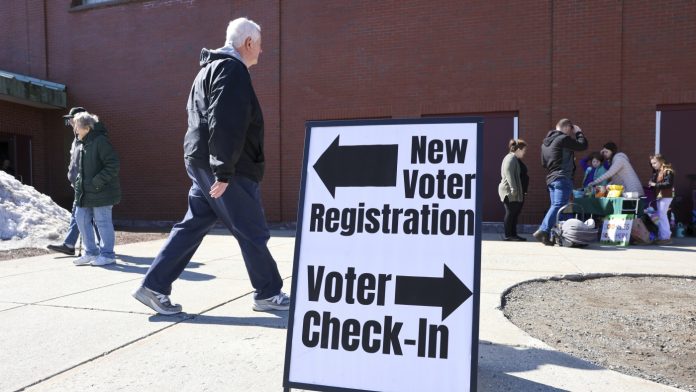
A sign for new voter registration is seen outside a polling location in Derry, N.H., on March 11.

Reba Saldanha/AP


hide caption

toggle caption

Reba Saldanha/AP

A federal judge in Washington, D.C., has paused a key section of President Trump’s executive order that makes sweeping changes to voting and elections.

Critics of Trump’s March 25 executive order say it could disenfranchise millions of would-be voters, and exceeds presidential authority.

The executive order instructs the independent Election Assistance Commission (EAC) to change the national mail voter registration form to require that applicants show a document proving U.S. citizenship before they can be registered to vote.

But a court order issued Thursday puts that instruction on hold.

“Our Constitution entrusts Congress and the States—not the President—with the authority to regulate federal elections,” wrote Judge Colleen Kollar-Kotelly in a 120-page opinion, while noting that Congress is currently debating legislation — the SAVE Act — that would require showing proof of citizenship to register to vote in federal elections.

Earlier this month, the GOP-led House of Representatives, mostly along party lines, passed the SAVE Act. The bill faces an uphill battle in the Senate, where Democrats have vowed to block it through a filibuster.

Trump’s executive order essentially seeks to implement much of the SAVE Act by executive decree — a move the judge rejected.

“[N]o statutory delegation of authority to the Executive Branch permits the President to short-circuit Congress’s deliberative process by executive order,” wrote Kollar-Kotelly, who was appointed to the federal district court in Washington, D.C., by former President Bill Clinton.

Kollar-Kotelly’s order is, for now, a legal victory for voter registration groups and Democrats that are challenging Trump’s far-reaching executive order in three lawsuits that have been consolidated.

“The court’s decision today provides crucial protections for eligible voters, and the organizations that help them register to vote, while the fight continues against this illegal executive order,” reads a joint statement from lawyers from the American Civil Liberties Union, Asian Americans Advancing Justice, Brennan Center for Justice, the Legal Defense Fund and Latino Justice PRLDEF, which are representing several voter registration groups challenging the order. “Millions of U.S. citizens lack easy access to a passport or other documents proving citizenship, and that shouldn’t interfere with their ability to register to vote.”

In a statement, White House spokesperson Harrison Fields said, “President Trump will keep fighting for election integrity, despite Democrat objections that reveal their disdain for commonsense safeguards like verifying citizenship. Free and fair elections are the bedrock of our Constitutional Republic, and we’re confident in securing an ultimate victory in the courtroom.”

The judge’s decision also pauses a second provision of Trump’s executive order that requires certain government agencies to verify U.S. citizenship before giving voter registration forms to enrollees of public assistance programs. Kollar-Kotelly said this provision is in conflict with the 1993 National Voter Registration Act, which mandates those agencies give out voter registration forms, unless an applicant opts out.

Other portions of the executive order are still being litigated, including a provision that withholds federal funds from states that count mail and absentee ballots that are postmarked by Election Day but are received by election officials afterwards.

Though Democratic plaintiffs had asked to pause that and other sections of the executive order, Kollar-Kotelly said those requests were premature or should be brought by states.

Another legal challenge to Trump’s order brought by 19 Democratic state attorneys general in federal court in Massachusetts is proceeding separately, though the government has asked for that case to be moved to Washington, D.C., to be consolidated with the one before Kollar-Kotelly. Washington and Oregon, which rely heavily on mail voting, have filed a separate lawsuit.

The plaintiffs in the D.C. lawsuit argue that the president cannot direct the EAC what to do. The commission, which is an independent entity, has four members, and can only have two members from the same political party. It cannot take action without approval from three members, to ensure a bipartisan approach.

Following Trump’s executive order, the commission’s executive director sent an April 11 letter to state election officials soliciting feedback about “how states would propose to implement” the provision in question, “if required.” The EAC was set to discuss the order at its meeting Thursday.

Trump’s order says it’s needed to enforce election protections, and the government argued in court that plaintiffs did not have standing to challenge the order.

The various plaintiffs challenging Trump’s executive order argue requiring documentary proof of citizenship to register to vote would create barriers for millions of eligible voters. Trump’s executive order lists only a limited number of documents that can be used to prove citizenship, and it remains unclear if a birth certificate would be accepted. Passports are the most common option named in the order, but only about half of American citizens have one.

The current version of the national voter registration form asks applicants to attest, under penalty of perjury, that they are U.S. citizens and eligible to vote. Noncitizens who attempt to vote illegally face deportation and jail time.

While noncitizens do sometimes wind up on voter rolls, state audits have found instances of noncitizens voting to be exceedingly rare.

Trump, however, pushed a baseless narrative during the 2024 election that large numbers of noncitizens were poised to vote and swing the election for Democrats. No evidence of such a plot has surfaced, but Trump and Republicans have continued to cite the narrative to justify more restrictive voting requirements.

As the March 25 executive order continues to be litigated, state and local election officials say they are waiting for clear answers before beginning to implement changes.

“My job is to wait for guidance and instructions on how to go about implementing any regulations that come down,” said Tim Tsujii, who oversees elections in North Carolina’s Forsyth County. “I’m in a holding pattern right now.”

Miles Parks contributed reporting.

State of the World from NPR : NPR

0

The sometimes cold and often frozen relationship between Russia and the U.S. has gotten a lot warmer since President Trump took office. And even though the American drive to broker a peace deal between Russia and Ukraine may be faltering, the desire to do big business deals with the Kremlin has not. We go to Moscow to look at how the relationship between the two countries has changed, from the Russian perspective.

CORRECTION: A previous version of the audio in this story misidentified Pete Hegseth as the secretary of state. He is the secretary of defense.

Outside the U.S. Embassy in Moscow in April 2025. Pro-war signs in the Russian tricolor read “We’re Together” and promise inevitable victory in Ukraine. A key symbol is the letter Z — the Kremlin’s chosen symbol in support of the war.

Charles Maynes/NPR


hide caption

toggle caption

Charles Maynes/NPR


Outside the U.S. Embassy in Moscow in April 2025. Pro-war signs in the Russian tricolor read “We’re Together” and promise inevitable victory in Ukraine. A key symbol is the letter Z — the Kremlin’s chosen symbol in support of the war.

Charles Maynes/NPR

Consider This from NPR : NPR

0

A view from the Lincoln Memorial toward the Washington Monument at the end of the March on Washington for Jobs and Freedom, where Martin Luther King Jr gave his “I Have a Dream” speech in August 1963.

Fotosearch/Getty Images


hide caption

toggle caption

Fotosearch/Getty Images


A view from the Lincoln Memorial toward the Washington Monument at the end of the March on Washington for Jobs and Freedom, where Martin Luther King Jr gave his “I Have a Dream” speech in August 1963.

Fotosearch/Getty Images

When you think of a successful protest movement, most Americans probably think of the American Civil Rights movement, and the March on Washington in 1963.

Martin Luther King, Jr. standing behind a podium on the steps of the Lincoln memorial delivered his most famous speech and a line that would come to define the goals of the Civil Rights Movement.

President Lyndon Johnson signed the Civil Rights Act just nine months after the March. A year after that Johnson signed the National Voting Rights Act of 1965.

The quest for equality continues. In the decades since that bright summer day in August 1963, many other Americans have tried to use the model of protest to achieve their political goals.

But do protests work?

For sponsor-free episodes of Consider This, sign up for Consider This+ via Apple Podcasts or at plus.npr.org.

Email us at [email protected].

This episode was produced by Megan Lim

It was edited by Courtney Dorning.

Our executive producer is Sami Yenigun.

How three key cabinet departments are functioning amid layoffs and cuts

0

NPR correspondents recap how funding cuts, layoffs and leadership and policy changes in the second Trump administration are affecting the Departments of Defense, State and Health and Human Services.