

We look back at the relationship between Elon Musk and President Trump as Musk signals he’s easing off his White House role.
‘the party needs to listen more’; ‘There’s a lot to be proud of’ : NPR
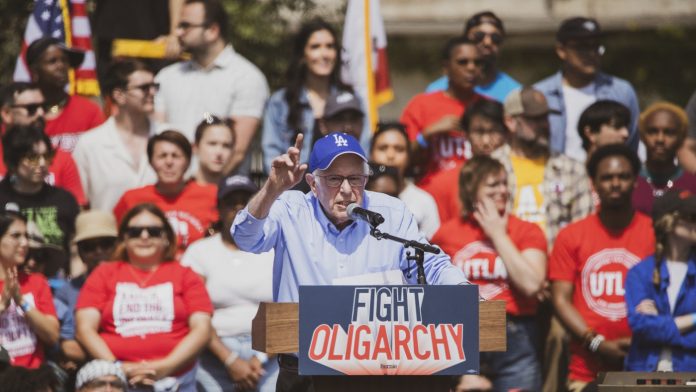
Sen. Bernie Sanders Speaks To A Crowd Of 36,000 At The Fighting Oligarchy Rally At Gloria Molina Grand Park In Downtown Los Angeles On April 12, 2025.
Sam Ghazi//AFP via Getty
hide caption
toggle caption
Sam Ghazi//AFP via Getty
Sen. Bernie Sanders (I-Vt.), who caucuses with Democrats, has been touring the country with Rep. Alexandria Ocasio-Cortez (D-N.Y.) to push back against the Trump administration.
In an interview with Here & Now’s Robin Young, he said Democrats need to put up candidates who can channel the anger of voters who are worried about recent moves by President Trump.
“I think support for this right-wing agenda, which is not only about authoritarianism and oligarchy, it is about a proposal which will give over, if passed, over $1 trillion in tax breaks to the top 1% and allow for massive cuts to Medicaid, nutrition, housing and other programs,” Sanders said. “If you poll that, I would guess that 80-90% of the American people think that that is totally insane. So I think in fact in many ways the Trump administration is now on the defensive with their tariff policies, which are going to raise prices. Now what we need are candidates and a political movement which stands clearly with the working class of this country.”
The following excerpt has been edited for length and clarity.
On concerns from Democrats that the party has moved too far to the left and needs to listen more
Sen. Bernie Sanders: Well, of course the party needs to listen more. There’s a lot to be proud of. They have led the way in the right for women to control their own body, something which is under attack right now, led the way for gay rights, led the way to fight against bigotry in general civil rights, but I’ll tell you what Democrats should not be proud of: And that is in the richest country in the history of the world, 60% of the American people living paycheck to paycheck.
In America today, one guy, Elon Musk, owns more wealth than the bottom 53% of American households. We’re the only major country on Earth that doesn’t guarantee health care to all people despite spending twice as much as most countries. Sixty thousand people a year die because they don’t get to a doctor on time. In other words, what the Democratic Party has not done is paid attention to the working class, and they paid a political price for that.

U.S. Sen. Bernie Sanders (I-Vt) And Rep. Alexandria Ocasio-Cortez (D-Ny) Hold Hands During A Stop On Their ‘Fighting Oligarchy’ Tour At Grand Park On April 12, 2025 In Los Angeles, California. An Estimated 36,000 People Attended The Rally Which Also Saw Neil Young And Joan Baez Perform.
Sam Ghazi/AFP via Getty
hide caption
toggle caption
Sam Ghazi/AFP via Getty
More interview highlights
For more highlights from Sanders’ interview, including thoughts on why Republicans haven’t paid a political price for policies favoring the wealthy and how to get disaffected voters to listen to the Democratic Party and to listen, click through to Here & Now‘s site.
Michael Scotto produced this piece for digital along with Grace Griffin. Mark Navin edited the broadcast segment.
NIH autism study will pull from private medical records : NPR
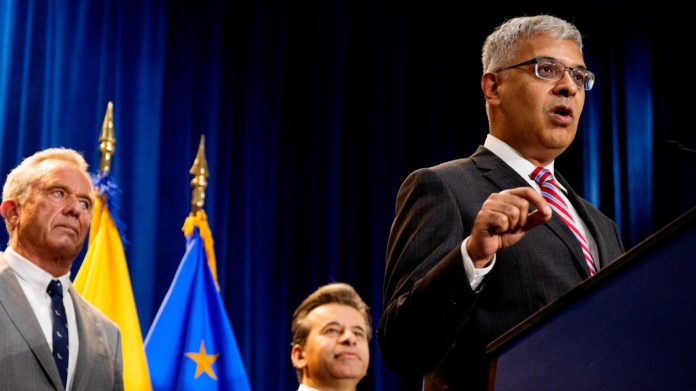
NIH Director Jay Bhattacharya (right), accompanied by HHS Secretary Robert F. Kennedy Jr. (left) and FDA Commissioner Marty Makary (center), speaks during a news conference Tuesday at the Health and Human Services Department on in Washington, D.C.
Andrew Harnik/Getty Images
hide caption
toggle caption
Andrew Harnik/Getty Images
The National Institutes of Health will begin collecting Americans’ private health records as part of Health and Human Services Secretary Robert F. Kennedy Jr.’s controversial plan to discover a cause and a cure for autism. NIH Director Jay Bhattacharya told a panel of experts about the plan this week.

The NIH plans to gather information from a wide range of private sources, including pharmacy chains, hospitals and wearable devices with health sensors, like smartwatches.
“The idea of the platform is that the existing data resources are often fragmented and difficult to obtain. The NIH itself will often pay multiple times for the same data resource,” Bhattacharya told the panel, according to The Guardian. “Even data resources that are within the federal government are difficult to obtain.”
The NIH did not return a request for comment.
Kennedy has made autism research a central pillar of his role as America’s official health advocate. He has made a number of conspiratorial, anti-science claims, including that childhood vaccinations could cause autism, despite overwhelming evidence to the contrary.
Earlier this month, he called autism an “epidemic” and vowed to find an “environmental toxin” responsible for the disorder by September.
“Overall autism is increasing in prevalence at an alarming rate,” Kennedy told reporters at the time. “We’re going to get back to it with an answer to the American people very, very quickly.”
He further described autism as “a preventable disease.”
While the Centers for Disease Control and Prevention did report that autism prevalence in the United States has increased from 1 in 36 children five years ago, to 1 in 31 children in 2022, experts say this is largely due to more comprehensive screening across a broader population.
As for identifying a root cause of the disorder, some experts have also warned that there is likely no single factor determining an autism diagnosis.
“We may have hundreds, if not thousands, of different neurogenetic factors that in combination with complicated environmental interactions influence presentations of autism,” Zachary Warren, a pediatric psychiatrist and autism researcher at Vanderbilt University, told NPR at the time of Kennedy’s remarks.
Bhattacharya, the NIH director, also has a controversial background in the medical community, questioning early on the lethality of COVID-19 and being a vocal opponent to lockdown mandates.
This week, he reportedly backed away from the September deadline, telling reporters that a year is more likely.
“I would like to have a timeline within a year, where they start to put out the preliminary results or the results. We’ll see. It’s hard to predict how long scientists – you know, nature has its say in how long the results take,” Bhattacharya said, according to CBS.
Already, news of the autism study has triggered backlash from disability and privacy advocates.

New York State assemblyman Angelo Santabarbara, a Democrat, wrote in a statement posted to X that the move was disrespectful to those with autism.
“This idea is dangerous, unethical, and a serious threat to privacy. People with autism deserve dignity and respect—not surveillance by their own government,” he wrote. “I stand with advocates across the country in strongly opposing this proposal.”
Sen. Dick Durbin, a top Senate Democrat, says he will not seek reelection : NPR
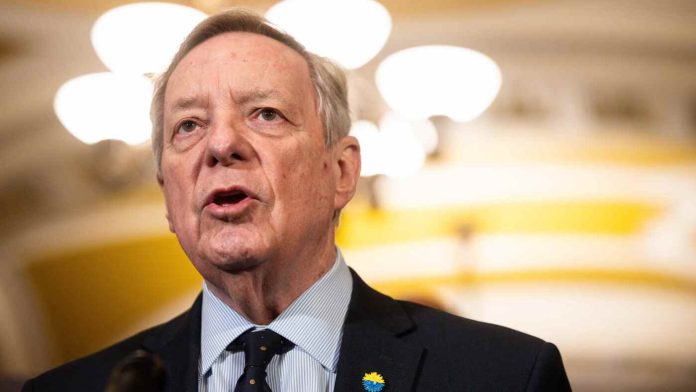
Sen. Richard Durbin, D-Ill., speaks during a news conference at the U.S. Capitol on March 4.
Tierney L. Cross/Getty Images
hide caption
toggle caption
Tierney L. Cross/Getty Images
Illinois Sen. Dick Durbin, one of the highest ranking Democrats on Capitol Hill, will not seek reelection next year, capping a more than four decade-long tenure in Congress.
“The decision of whether to run for re-election has not been easy. I truly love the job of being a United States Senator. But in my heart, I know it’s time to pass the torch,” Durbin said in a video released on Wednesday. “So, I am announcing today that I will not be seeking re-election at the end of my term.”
Durbin, 80, who had previously said he was undecided on whether he would run for a sixth term in the Senate but Democrats privately speculated for months that he would step aside.
His retirement creates a valuable opening within Democratic leadership. The longtime Illinois lawmaker has served as the Senate Democratic whip — the second-ranking post in the caucus — for the last 20 years.
Democrats under pressure to identify future leaders
Durbin’s announcement comes at a critical moment for the party, as Democratic lawmakers stand divided over how best to mount an effective opposition strategy against President Trump’s agenda while stuck in the minority in both the House and the Senate.
Congressional Democrats continue to face intense pressure from their base to be more aggressive in pushing back against Trump and the GOP.

That pressure has intensified following the decision by Senate Minority Leader Chuck Schumer, D-N.Y., to advance a Republican-backed spending bill in March in order to avoid a potential government shutdown. Nine Democrats joined Schumer in voting to advance that GOP measure — including Durbin. While Schumer has faced blowback for that vote, he has said he will not step down.
Schumer praised Durbin for his decades of work in the Senate in a statement following the announcement.
“His deep commitment to justice, his tireless advocacy for Americans in need, and his wisdom in leadership have left an indelible mark on this institution, the United States, and his beloved Illinois,” Schumer wrote. “The Senate—and the country—are better because of his service.”

Durbin’s departure is expected to further fuel calls from within the Democratic Party for new, younger leadership to guide the party. Sens. Brian Schatz of Hawaii and Amy Klobuchar of Minnesota are among the possible contenders to succeed Durbin in Senate leadership.
“I’m lucky to call Senator Durbin a mentor and friend. I know he will be running through the tape, fighting for Illinois and our nation, as always,” Schatz wrote in a statement. “His work and legacy will continue to shape the U.S. Senate and our country for years to come.”
Democrats expect to retain the Senate seat in Illinois
Democrats are widely expected to retain Durbin’s seat in the midterm elections next year, however, several other Democratic-held Senate seats are expected to be competitive.

Durbin is now the fourth Senate Democrat to announce they will not seek reelection in 2026, joining Sen. Jeanne Shaheen of New Hampshire, Sen. Tina Smith of Minnesota and Sen. Gary Peters of Michigan. Republicans control a 53-47 majority in the Senate, leaving Democrats with a difficult path back to the majority. On the GOP side, Kentucky Sen. Mitch McConnell, one of the longest-serving Senators in U.S. history, has also said he won’t run for reelection next year.
In addition to his leadership role with Senate Democrats, Durbin also chaired the Senate Judiciary Committee from 2021 until 2025. As chairman, he presided over confirmation hearings for Justice Ketanji Brown Jackson after she was nominated by former President Joe Biden to serve as the first Black woman on the Supreme Court.
Before coming to the Senate in 1997, Durbin served seven terms in the House of Representatives.
How to prepare for collection of defaulted student loans : NPR

The Department of Education says it will resume collections on defaulted student loans on May 5, affecting some 5 million borrowers nationwide.
mohd izzuan/Getty Images
hide caption
toggle caption
mohd izzuan/Getty Images
The Trump administration says it will soon resume collections on defaulted student loans for the first time in five years, raising questions and anxieties for millions of borrowers across the country.
The Department of Education announced Monday that its office of Federal Student Aid will resume collections on May 5, meaning it can start taking funds out of borrowers’ tax refunds, Social Security benefits and — eventually — wages.
“Together, these actions will move the federal student loan portfolio back into repayment, which benefits borrowers and taxpayers alike,” Education Secretary Linda McMahon said.

The change will affect 5.3 million borrowers who went into default before the pandemic, according to the Education Department. Technically, a borrower is considered in default when they fail to make a loan payment for at least 270 days.
Even more borrowers are delinquent on their payments and may be headed toward default. According to data provided to NPR by the department, 2.9 million borrowers are 61-90 days late on their loan payments. Another 4 million are in “late-stage delinquency,” have been reported to the credit bureaus and are quickly approaching default, according to the Department.
“Most borrowers … they’re not in danger of delinquency today, but in five months, they could be,” says Scott Buchanan, executive director of nonprofit trade group Student Loan Servicing Alliance. “And so taking action today is pretty important.”
In a press release on Monday, the Education Department said it will send notices of wage garnishment — seizing up to 15% of a borrower’s disposable income — “later this summer.” In the meantime, it is urging borrowers in default to start making monthly payments or enroll in an income-driven repayment plan.

“It’s totally reasonable that people would be scared and confused and overwhelmed by the prospect of paying hundreds or thousands of dollars a month that they don’t have,” says Mike Pierce, executive director of the Student Borrower Protection Center.
Many families are already struggling to get by in today’s turbulent economy, especially with tariffs making many goods more expensive. On top of that, he says, families with student debt could soon start seeing some of their paycheck or Social Security disappear.
NPR spoke to experts about borrowers’ options and the consequences they could face as collections resume. Here’s what to know.
Why are collections restarting?
Nearly 8 million federal student loan borrowers were in default when the pandemic — and accompanying economic downturn — started. The first Trump administration announced in March 2020 that it would pause collections on defaulted student loans for at least 60 days.
“By the middle of 2020, no one is having their credit damaged. No one is having their paychecks seized. No one is having their public benefits ceased,” Pierce adds. “And that’s where things have been now for about five years.”
The Biden administration — which tried with mixed success to forgive federal student loan debt — repeatedly extended the pause on federal student loan payments until October 2023. But even once payments resumed, collections did not — until now.

Betsy Mayotte, president of the Institute of Student Loan Advisors (TISLA), says the return of loan collection was inevitable and that the Trump administration isn’t creating new policy — just restoring old policy.
“They were always going to start collecting these defaulted loans again — it was just a matter of when the switch was going to get flipped,” she says. “The Department of Education has a requirement to collect on these debts; they’re owed to the U.S. taxpayer.”
Mayotte says her nonprofit is now hearing from many panicked borrowers who have been lulled into a false sense of security — they mistakenly thought their loans had been forgiven, or that a statute of limitations had expired.
“Now, [a] statute of limitations does apply to other consumer debts,” she said. “But there is no statute of limitations for federal student loans.”
The Trump administration, which is vocally opposed to broad-based student loan forgiveness, says it is taking this step to relieve the burden on American taxpayers.
“Student and parent borrowers — not taxpayers — must repay their student loans,” the Department of Education said. “There will not be any mass loan forgiveness.”
How can I tell if I’m impacted?
The Department of Education says it will reach out to all borrowers in default before May 5, through emails and social media posts, “reminding them of their obligations and providing resources and support to assist them in selecting the best repayment plan.”
People can also check their status by logging into StudentAid.gov, the Department of Education’s website.
The online dashboard shows how much debt they owe and to whom, their monthly payment amount and — if they’re in default — a warning message that says so. It’s also where they can make sure their email and physical addresses are up to date.
Student loan servicers, like MOHELA and Aidvantage, can also provide clues.
“If you’re getting bills from a student loan servicer, that means you’re not in default, and you’re not going to face forced collections over the summer,” Pierce says.
Loan servicers will also send multiple notices — by email, snail mail or phone — to borrowers who are delinquent and increasingly at risk of going into default, Buchanan says.
“Don’t ignore the notices, don’t ignore the phone calls,” he says. “We probably have a solution that can meet you where you are. It will certainly be better than going into delinquency and default.”
What are my options if I’m in default?
There are three primary ways people can get out of default. The quickest, but hardest, is to repay the loans in full.
“If people could pay the loan in full, they probably wouldn’t be in default,” Mayotte says. “So that’s not really an option for most borrowers in this situation.”
The two other methods are loan consolidation and rehabilitation.

Loan consolidation is the faster of the two, says Mayotte. It involves paying off your defaulted loans with new repayment terms. While it does not remove the fact that you were once in default from your credit report, it does make you eligible for lower payment options.
For loan rehabilitation, a borrower must make multiple — typically nine — consecutive on-time payments of an amount that is usually based on their income. Once those are paid, the loan is taken out of default and the default line is removed from the person’s credit report.
To make matters more complicated, some 8 million borrowers are still waiting to find out if their repayment plan is even legal. The Biden administration’s plan known as SAVE, which bases a person’s monthly student loan payments on how much money they make, is currently tied up in the courts.
“That’s all happening at the same time as Secretary McMahon is trying to restart the debt collection machine,” Pierce says. “So we’re worried that borrowers are not going to have a full set of options that help them afford their payments and are going to have no choice but to sit still and watch their Social Security be seized, watch their wages get garnished.”
What resources are available?
The announcement comes at a dizzying time for the Department of Education, which is being cut in half amidst the Trump administration’s mass layoffs across the federal workforce. The Trump administration has said the student loan program will move to the Small Business Administration, which plans to cut its workforce by more than 40%.
All the disruption and downsizing will likely make it even harder for borrowers to navigate their loans.
“The layoffs affected a lot of what I call ‘the helpers,’ ” Mayotte says. “And with everything else going on, the loan servicers are also really overwhelmed. So it’s very common for there to be long hold times when borrowers reach out to their usual resources.”

She says there are plenty of alternatives, like advocates and even ombudsmen in certain states, as well as information from nonprofits and other reliable sources online.
Buchanan encourages borrowers to use the loan calculator on the federal student aid website to get a rough estimate of what their monthly payment and interest choices would look like under different repayment plans, to choose the one that is best for them. Then, he says, they can go to their loan servicer’s online portal and do the actual math.
He wants people to know there are ways to lower their monthly payments — like economic hardship deferments — especially if they just lost a job or are in extreme financial distress. Plus, he says, people can change repayment options as their circumstances change.
“I think the most important thing for people to realize … is that the federal student loan program is probably one of the most flexible programs that exists when you borrow money,” he says. “So take advantage of it. It’s part of the government program. It’s part of the benefit.”
NPR’s Cory Turner contributed reporting.
Trump administration faces a free-speech lawsuit over frozen climate, environmental funds : NPR
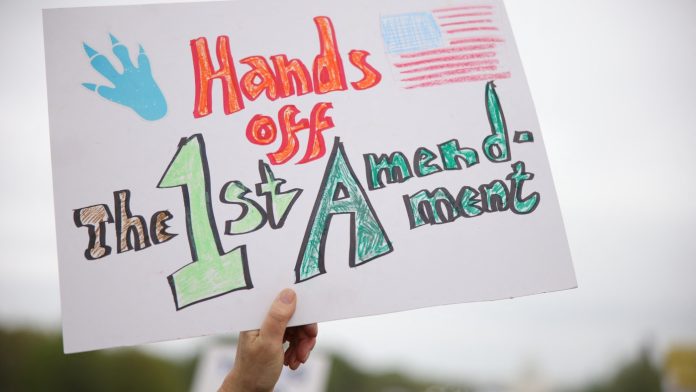
People gathered to protest the Trump administration during the ‘Hands Off’ protest on the National Mall in Washington, D.C. on April 5, 2025.
BRYAN DOZIER/Middle East Images/AFP via Getty/AFP
hide caption
toggle caption
BRYAN DOZIER/Middle East Images/AFP via Getty/AFP
Scott Vlaun has been working with his school district in western Maine to cut back how much energy it uses and helping his town come up with a plan to deal with climate threats from things like rising temperatures and worsening floods. It’s a conservative part of the state where incomes are well below the national average. So, Vlaun says it was a big deal when his nonprofit got federal funding under the Biden administration to assist in lowering people’s energy bills and preparing communities for more extreme weather.
“A lot of the work we do is about building resilience,” says Vlaun, executive director of the Center for an Ecology-Based Economy in Norway, Maine, a town of about 5,000 that was once known as the Snowshoe Capital of the World. “But we’re also trying to build energy equity, so that the working poor here can afford their electricity.”
Then President Trump took office, and the aid disappeared.
At the end of March, the Environmental Protection Agency told Vlaun that a grant to his organization had been terminated. “The objectives of the award are no longer consistent with EPA funding priorities,” the agency said in a letter that was shared with NPR.
It’s one of scores of funding agreements Congress earlier approved for climate and environmental initiatives that have been frozen or cancelled by the Trump administration. Environmental justice projects like Vlaun’s, which are aimed at helping low-income and disadvantaged communities, have been hit especially hard.
Federal judges have intervened, ordering the Trump administration to release promised funds. A lot of the legal arguments so far have revolved around whether the administration violated federal regulations and the Constitution’s separation of powers when it withheld money that Congress appropriated.
But a lawsuit filed recently in federal court in South Carolina goes further. A group of nonprofits and municipalities alleges the Trump administration violated their free-speech rights by targeting them over language in their grant documents, including words like “equity” and “socioeconomic,” and trying to force them to use different language. They’re not alone: Harvard University filed suit Monday arguing that a federal funding freeze threatens its First Amendment rights.
“You can’t use government funding to coerce speech,” says Kym Meyer, litigation director at the Southern Environmental Law Center, which represents nonprofits in the South Carolina lawsuit.
Vlaun says he’s talked to some national organizations about potentially joining litigation against the Trump administration. His nonprofit is trying to push ahead with its work in Maine at the same time it looks for ways to make up an $85,000 budget deficit that was created when the EPA grant disappeared.
“We’re working to support the most vulnerable people in our communities,” Vlaun says. “And when you use words like equity, energy equity or something, all of a sudden you’re on a blacklist. That just seems bizarre to me.”
The EPA said in a statement that it doesn’t comment on pending litigation. The agency has previously said it is “reviewing its grant funding to ensure it is appropriate use of taxpayer dollars and to understand how those programs align with Administration priorities.”
The departments of Agriculture, Energy and Transportation, which are also named as defendants in the South Carolina lawsuit, didn’t respond to a message seeking comment.

The Trump administration is targeting environmental justice programs aimed at helping poor communities like Louisiana’s Cancer Alley that have been disproportionately exposed to pollution. In Reserve, La., the Fifth Ward Elementary School and residential neighborhoods sit near a plant that makes synthetic rubber, emitting chloroprene, which the Environmental Protection Agency lists as a likely carcinogen.
Gerald Herbert/AP/AP
hide caption
toggle caption
Gerald Herbert/AP/AP
‘People got their hopes up, and then it went away.’
Trump has vowed to shrink the federal bureaucracy and slash government spending. One focus is initiatives to deal with climate change and environmental threats. As federal funding ground to a halt in recent months, projects ranging from removing lead paint and pipes to cleaning up contaminated land and monitoring pollution were jeopardized.
Grant recipients and activists say the sweeping move to withhold funding threatens the government’s reputation as a reliable partner, whether it’s to protect human health and the environment or to build big infrastructure projects.
“The market despises uncertainty,” says Beth Bafford, chief executive of Climate United, an investment fund that’s suing to stop the EPA from revoking grant funding the agency awarded under the Biden administration. “And so, the instability and uncertainty is not only going to impact what we can do today, but it’s certainly going to impact the types of investments our country can make, what we can build, over the next 10 years, 20 years, 30 years.”
As part of its rollback of Biden-era initiatives, the Trump administration is targeting programs aimed at helping poor communities like Louisiana’s Cancer Alley that have been disproportionately exposed to pollution from things like refineries and chemical plants.
On his first day in office, Trump revoked an executive order issued by former President Biden that directed agencies to consider the effects of federal policies and programs on “communities with environmental justice concerns.” Weeks later, the Office of the Attorney General said that to ensure the “even-handed administration of justice,” it was rescinding a 2022 memo that prioritized the enforcement of environmental laws in “overburdened and underserved communities.” And in March, the EPA said it was eliminating part of the agency that focused on environmental justice, which Administrator Lee Zeldin called “an excuse to fund left-wing activists.”
The effort to purge environmental justice programs has extended to grant funding that Congress authorized through the Inflation Reduction Act and the Infrastructure Investment and Jobs Act, which were signed by former President Biden.
The Sierra Club obtained a list of EPA grants marked as terminated as of early March. Many on the list, which was shared with NPR, were for environmental justice projects, including one grant that supported initiatives such as flood mitigation in southwest Virginia, a deep red part of the commonwealth where communities have been shaped by the coal industry’s booms and busts.
“The projects that we were doing are deeply rooted in community support,” says Emma Kelly, a new economy program coordinator at Appalachian Voices. She adds, “People got their hopes up, and then it went away.”

President Donald Trump signing executive orders in the Oval Office of the White House in Washington, DC, on January 20, 2025.
JIM WATSON/POOL/AFP via Getty Images/AFP
hide caption
toggle caption
JIM WATSON/POOL/AFP via Getty Images/AFP
EPA flagged a ‘list of words to avoid’ in grant documents
In South Carolina, a nonprofit called The Sustainability Institute received an EPA grant to build new energy-efficient homes, and to repair, weatherize and upgrade existing houses in a historically black community split decades ago by the construction of a highway. After Trump was elected, the grant was repeatedly frozen and unfrozen, throwing the project into disarray.
In late March, an EPA employee emailed the head of The Sustainability Institute about the project, according to a court filing in the federal lawsuit in South Carolina. Attached to the email was a document the EPA employee referred to as a “list of words to avoid,” and another the employee called a “Sanitized Workplan.”
Included in the court filing is a list of words such as “cultural differences,” “discrimination” and “marginalized.” The filing also includes a description of the project in which certain words and phrases are highlighted, such as “disadvantaged,” “predominantly Black neighborhood,” and “sea level rise.” A third document titled “Decision Tree” appears to direct government employees to flag grant documents containing keywords that may conflict with Trump’s executive orders.
Discussions that The Sustainability Institute has had with the EPA about its grant funding demonstrate that the government has tried to pressure the nonprofit into using language that’s acceptable to the administration, says Meyer of the Southern Environmental Law Center, which represents The Sustainability Institute in the federal lawsuit.
“The administration might try to pretend like, oh, well, we just have different priorities, and that’s why we’re moving the money around. But the facts show that that’s not true,” Meyer says. “Because what they’re saying to this group is, ‘Oh, it’s probably fine for you to spend this money on this affordable housing in Charleston as planned, but we want you to talk about it differently.’ And that isn’t something that the government can do.”
Meyer adds: “Congress has said this [funding] is for environmental justice work in disadvantaged communities. It doesn’t matter if that’s a priority for the Trump administration. That’s how this money has to be spent.”
The power the executive branch can wield over federal spending is being debated in a number of lawsuits. In two separate orders last week, federal judges in Rhode Island and the District of Columbia said agencies do have some power to terminate individual grants, but that they still have to comply with the law and applicable regulations. In the case of the Trump administration’s broad funding freeze, the judges said federal agencies appear to have acted arbitrarily and capriciously.
In the South Carolina lawsuit, lawyers for the nonprofits and municipalities suing the Trump administration filed with the court a copy of a March email in which an employee of the EPA’s Office of General Counsel acknowledged that the decision to cancel environmental justice grants was made with the knowledge that some of the grants didn’t contain terms and conditions “about termination for agency priorities.”
“The courts want to be crystal clear: elections have consequences and the President is entitled to enact his agenda,” Judge Mary McElroy of the federal court for the District of Rhode Island, whom Trump appointed during his first term, wrote in an April 15 order directing the administration to unfreeze grant funding while a lawsuit filed by a group of nonprofits plays out. However, McElroy said federal agencies don’t have “unlimited authority to further a President’s agenda, nor do they have unfettered power to hamstring in perpetuity” laws that Congress passed during the previous administration.
In New Haven, Conn., another plaintiff in the South Carolina lawsuit, the EPA cancelled an environmental justice grant that would have helped city residents swap out old oil-burning heating systems for more efficient heat pumps.
“There’s really no potential here for waste, fraud and abuse, and I struggle to see, in any sense, how helping struggling residents transition to cleaner, lower-cost heating systems conflicts with merit and fairness,” Steven Winter, New Haven’s executive director of climate and sustainability, says, citing rationales the EPA provided in the termination letter.
“We went into this project with a lens of focusing on neighborhoods with the highest rates of air pollution and associated health issues,” Winter says, and on “residents who are struggling the most with their utility bills.”
At stake in lawsuits like the one in South Carolina is the concept of “viewpoint neutrality,” which is a “bedrock principle underlying our First Amendment,” says Nadine Strossen, a senior fellow at the Foundation for Individual Rights and Expression who is not involved in the lawsuit.
“Even though you do not have a right to receive federal funding,” Strossen says, the government can’t “deny the funding or remove the funding because of disagreement with the viewpoint or the ideas or the perspectives of the grantee.”
Harvard raised a similar argument in a lawsuit it filed to stop the Trump administration from freezing billions in grants and contracts after the school rejected the government’s demands that it change hiring, admissions and other policies.
“The freeze and the looming threat of additional funding cuts will chill Harvard’s exercise of its First Amendment rights,” the university said in a federal lawsuit in Massachusetts. Harvard said it won’t be able to decide academic matters “without fear that those decisions will run afoul of government censors’ views on acceptable levels of ideological or viewpoint diversity on campus.”
White House spokeswoman Karoline Leavitt said at a press briefing on Tuesday that Harvard lost federal funding because it broke the law. In a letter to the university on April 11, the Trump administration said Harvard “failed to live up to both the intellectual and civil rights conditions that justify federal investment.”

Environmental Protection Agency employees take part in a march in Philadelphia in March against actions taken by the Trump administration.
Matt Rourke/AP/AP
hide caption
toggle caption
Matt Rourke/AP/AP
First Amendment scholars see evidence the government is trying to punish groups for their views
Genevieve Lakier, a professor at the University of Chicago Law School, says it seems the Trump administration is trying to “purify” the federal government ideologically, in part by defunding initiatives that reflect views and beliefs that are at odds with the administration’s.
“I think that that effort, because it is viewpoint-based, is inconsistent with large parts of the spirit of the First Amendment,” Lakier says. She adds, however, that it could be tricky to prove the administration is violating people’s free-speech rights by targeting things like climate and environmental grants.
For example, Lakier says the government could try to argue that grant-funded projects involving activities like replacing heating systems in low-income housing don’t have anything to do with free speech.
But Lakier says the chart cited in the South Carolina lawsuit that appears to direct government employees to flag grant documents that contain certain language is “good evidence that there’s a viewpoint-based motive, that they’re punishing these organizations because of their viewpoints.”
Previously, Lakier and Strossen both argued in support of the National Rifle Association when the group claimed its free-speech rights had been violated by a New York state official who allegedly pressured banks and insurance companies to blacklist the NRA following a deadly shooting in Parkland, Florida, in 2018.
“No matter who you are and no matter what your most important beliefs are, there will be a time and a government official and perhaps a majority of people in your community who will strongly disapprove of your viewpoint,” Strossen says. “And you will be so grateful that the viewpoint neutrality principle will prevent that government official from directly or indirectly silencing, punishing or chilling your cherished expression of your favored beliefs.”
In Maine, Vlaun says actions the Trump administration has taken over the past few months have sent a chill through climate activists. Some are afraid they’ll face retaliation if they speak out, he says.
“You wonder where it’s all going to stop,” Vlaun says. “I mean, to talk about environmental justice and to talk about, you know, people that are vulnerable to climate change and trying to help them and being vilified for that, it’s just kind of — I don’t know, I can’t think about it too much, because it just, it kind of makes you crazy.”
Trump is proving more liability than asset for right-wing politicians abroad : NPR
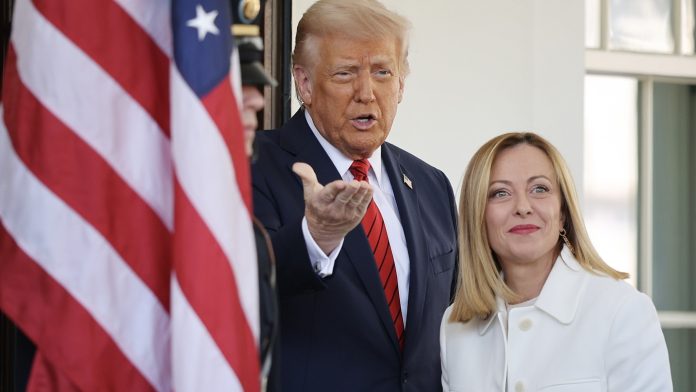
President Trump greets Italian Prime Minister Giorgia Meloni outside the West Wing of the White House on April 17. Meloni has been called a “Trump whisperer” who could bridge the gap between the U.S. president and European leaders.
Win McNamee/Getty Images
hide caption
toggle caption
Win McNamee/Getty Images
Donald Trump’s initial ascent to the presidency inspired right-wing populist politicians around the world, many of whom sought to emulate his anti-establishment and anti-immigrant messaging. But in his second term, Trump’s aggressive trade policies and confrontational stance toward America’s allies are threatening to turn that populist wave into a dangerous undertow.
Now the “Trump bump” that populist candidates had anticipated is turning into a “Trump slump.” In some countries, including those facing national elections soon, political leaders who’ve advocated a homegrown style of MAGA are suddenly scrambling to distance themselves from the U.S. president.
“Many worried that Trump’s electoral victory would create a tidal wave in support of extreme right populist parties across the world while encouraging them to intensify their extremism,” says Vivien Schmidt, a professor emerita at Boston University and a visiting fellow at the European University Institute in Florence, Italy.
But Trump’s tariffs — which have a baseline of 10% along with steeper rates targeting certain countries and industries — have been a particular flashpoint. The tariffs “have put populist leaders on the back foot, and may ironically very well push them to greater moderation,” Schmidt says.

Canada’s Conservative Party leader Pierre Poilievre speaks during a campaign event on April 14 in Montreal. A Trump backlash is a major cause of the Conservatives’ stalled momentum and a resurgence for the Liberals, observers say.
Andrej Ivanov/Getty Images
hide caption
toggle caption
Andrej Ivanov/Getty Images
Take Pierre Poilievre, the leader of Canada’s Conservative Party, who has embraced anti-establishment and anti-“woke” rhetoric and has even been labeled “Canada’s Trump” by some observers. In the lead-up to the country’s elections next Monday, Poilievre’s Conservatives initially surged, holding a commanding 45% to 22% lead in January over the governing Liberals of former Prime Minister Justin Trudeau, who stepped down last month. The exit of Trudeau, who had long been on thin ice with voters, was clearly a factor, but a Trump backlash is a major cause of the Conservatives’ stalled momentum and a resurgence for the Liberals, observers say.
The dominant issue in Canada is Trump’s “looming influence in reshaping our politics,” says Semra Sevi, an assistant professor in the political science department at the University of Toronto. “The electorate is looking for serious leaders with credible plans” who can confront, not accommodate, the U.S. president, she says.

Poilievre has largely abandoned his “Canada First” slogan, with its parallels to Trump’s “America First.” As the U.S. president ramped up provocative talk about annexing Canada in the early weeks of his term, Poilievre pushed back, declaring, “Canada will never be the 51st state.”
Jennifer McCoy, a professor of political science at Georgia State University in Atlanta, has studied populist movements across the globe. “Calling Canada’s prime minister ‘governor’ and suggesting it become the 51st state … has backfired,” for Trump, she says. “Canadians are insulted and moving away from conservative populism as a result.”
If the election had been held last year, Poilievre’s Trump-style of politics would have helped, she says. But the Conservatives are now finding it difficult to shake off their association with Trump. The Canadian populist “needed to pivot and he needed to do that hard and early on and he misread the moment,” Sevi says.
Until recently, Australia’s conservative opposition had “the wind at its back”

Opposition leader Peter Dutton speaks on April 11 in Perth, Australia. The Australian federal election is scheduled to be held on May 3. Dutton’s conservative Coalition is on the back foot after leading earlier this year.
Matt Jelonek/Getty Images
hide caption
toggle caption
Matt Jelonek/Getty Images
The story is similar in Australia, where voters head to the polls on May 3. Opposition leader Peter Dutton, a right-wing populist who once described Trump as “a big thinker,” and has called for cutting off funding for schools which he deems to have a “woke” agenda, is challenging Prime Minister Anthony Albanese. Dutton’s Liberal Party and its National Party partner, known as the Coalition, were ahead in the polls earlier this year but have since lost ground.
“The Coalition initially had the wind at its back … now they’re in survival mode,” says Ryan Neelam, director of the public opinion and foreign policy program at the Sydney-based Lowy Institute.
That slide closely tracks the first months of the second Trump presidency, which has also been accompanied by a sharp drop in Australian trust toward the U.S. According to a new Lowy poll, the number of Australians who believe the U.S. can be trusted to act responsibly on the world stage has plunged over the past year, from 56% to 36%.

Neelam says that is a record low since the institute began asking the question in 2006. It’s part of what he describes as “a categorical rejection of Donald Trump’s policies” among Australians.
“Tariffs hit a nerve … splashed across the media, [it] became a political issue,” he says, adding that 81% of Australians surveyed disapprove of the tariffs. Three-quarters of Australians also disapprove of Trump negotiating with Russian President Vladimir Putin over Ukraine.
Dutton has attempted to distance himself from aspects of Trump’s agenda, especially on trade. He criticized the U.S. tariffs, saying Trump’s self-declared “Liberation Day,” when reciprocal tariffs went into effect, was “a bad day for our country.”
But in one remark at a campaign rally earlier this month, Sen. Jacinta Nampijinpa Price — the shadow minister for government efficiency, who has pledged to implement an Elon Musk-style overhaul of federal spending — introduced Dutton by declaring that the Coalition would “make Australia great again.” The remark prompted National Party leader David Littleproud to enter damage-control mode, dismissing the comment as a “slip of the tongue.” Adding fuel to the controversy, Price and her husband also shared a photo on social media of the couple wearing “Make America Great Again” hats.
Canada and Australia aren’t the only places where association with Trump’s brand of politics is dragging down right-wing populists, straining ties that in recent years have seen them “increasingly [build] up a network to learn from each other — borrow lessons, rhetoric and policies,” according to McCoy.
Parliamentary systems present obstacles for populists
As Trump’s appeal fades in many countries, his ties with like-minded foreign leaders appear increasingly fragile. Part of the reason, says Boston University’s Schmidt, is structural: “Most of these leaders operate within parliamentary systems,” she explains. “That means navigating coalition partners — you don’t have the same unilateral power a U.S. president does.”

In 2018, Trump’s then-senior strategist Steve Bannon visited various populist movement leaders in Europe, including Marine Le Pen, the leader of France’s far-right National Front party at the time, where the two suggested it was the beginning of closer ties. Le Pen, who later rebranded the party as the National Rally, once embraced Trump as a political role model. But now she seems to view him more as a liability amid polling suggesting Trump is a drag on her political fortunes.

France’s far-right party president Marine Le Pen (right), applauds former presidential adviser Steve Bannon after his speech during the party’s annual congress, on March 10, 2018, at the Grand Palais in Lille, France.
Philippe Huguen/AFP via Getty Images
hide caption
toggle caption
Philippe Huguen/AFP via Getty Images
That said, Le Pen, who was forced to step down as her party’s leader, may have bigger problems than her association with Trump: She was convicted last month of embezzling European Union funds and barred from holding public office — an obstacle that could derail her 2027 presidential ambitions.
In Germany, the performance of the avowedly anti-immigrant AfD party at the polls in February has been a notable exception, when it surged to become the second-biggest party in Germany’s Bundestag. Ahead of the elections, Vice President Vance met with the party’s leader and endorsed it as a political ally. Yet public sentiment toward Trump remains overwhelmingly negative, according to a poll from early March, with only one-in-seven Germans viewing him favorably.
Meanwhile, other right-wing leaders, such as Hungary’s Viktor Orban, whom Trump has repeatedly praised in the past, seem to remain firmly ensconced, likely more because of his increasingly authoritarian control over democratic institutions than genuine appeal to voters.
Italy’s “Trump whisperer” might be able to split the political difference

President Trump meets with Italian Prime Minister Giorgia Meloni in the Oval Office at the White House on April 17.
Win McNamee/Getty Images
hide caption
toggle caption
Win McNamee/Getty Images
Italian Prime Minister Giorgia Meloni, who visited the White House in recent days to meet with Trump, may represent a way forward for right-wing populists wanting to balance their political survival while steering a middle road, observers say. She’s been seen as a “Trump whisperer” who could bridge the gap between the U.S. president and other European leaders, some of whom Trump has openly derided. Trump has praised the right-wing Meloni, calling her “a fantastic person and leader.”
But she has made a point of demarcating her positions carefully. The two leaders appear to see eye-to-eye on immigration and cultural conservatism, but on the war in Ukraine, unlike Trump, Meloni has been careful to unequivocally label Putin the aggressor. She said U.S. tariffs are “wrong” but offered to help make a deal between the White House and the EU to lift them.
“Meloni is a very clever politician,” says Schmidt. “What she’s doing on the economy and Ukraine is very mainstream, center-right.”
Georgia State University’s McCoy agrees that Meloni’s stance splits the difference between Trump and a more mainstream European view. “Meloni is a very anti-immigrant conservative on cultural issues — but also pro-EU and pro-Ukraine,” she says. “It’s a very interesting mix.”
The next AOC? Young Democrats aim to topple incumbents inside their own party : NPR

From left, Saikat Chakrabarti, Kat Abughazaleh and Elijah Manley are among a crop of young Democrats challenging longtime incumbents in solidly blue districts across the country ahead of next year’s midterm elections.
Saikat Chakrabarti, Kat Abughazaleh, Elijah Manley/Compiled by NPR
hide caption
toggle caption
Saikat Chakrabarti, Kat Abughazaleh, Elijah Manley/Compiled by NPR
Elijah Manley was still a teenager when his frustration with President Trump pushed him to get involved in politics. Today, he’s finally old enough to run for Congress. Upset with how his own Democratic Party is responding to Trump, he’s decided to do just that.
Manley is a 26-year-old substitute history teacher based in Fort Lauderdale, Florida. He’s never held elected office but has spent years organizing with local and national progressive groups.
He says he’s grown tired of watching Democrats, in his view, fail to be aggressive enough in their response to Trump. So in February, Manley launched a primary challenge against incumbent Democrat Sheila Cherfilus-McCormick for Florida’s 20th District.
“We’re stuck in this era right now,” he said. “What’s going to fix that is thinking bigger and being bolder and we’re not seeing that in the Democratic Party.”
With his leap into the race, Manley joins a growing group of at least five Gen Z and millennials under 40 who have recently launched bids to unseat incumbent House Democrats in solidly blue districts around the country. In California, that includes a primary challenge to former House Speaker Nancy Pelosi from a one-time aide to Alexandria Ocasio-Cortez, while in Illinois, a content creator is running for a seat held by a 13-term incumbent Democrat.
For many of these young candidates, their campaigns are centered around a shared dissatisfaction with how sitting lawmakers have fought back against Trump’s second term agenda. They hope to bring a new generation of leadership to Washington – even if they face long odds.
Democratic leaders are divided on whether to support this effort, as some worry it could strain resources for competitive races and lead to infighting within the party. However, others argue supporting primary challengers may be necessary if the party wants to move forward and learn from its 2024 election loss.
‘If we don’t even put up a fight, what are we doing?’
Manley has run for office before, with unsuccessful bids for state and local office, starting at 19 years old. But shortly before Trump took office in January, he made up his mind about his next step.
“[Democrats] didn’t have a message, didn’t have a strategy of what we’re going to do to fight back,” he said.
It’s a theme he returns to when he talks about his frustration with Democrats. One example he points to is the decision last month by Senate Minority Leader Chuck Schumer, D-N.Y., to help advance a GOP spending bill in order to avoid a government shutdown.

“Why is it that the Republicans, when they’re in the minority, they’re always able to block, obstruct … But when we’re in the minority, we somehow just don’t know how to do anything,” he said.
“We’re not going to win every battle,” he added. “But if we don’t even put up a fight, what are we doing?”

After growing up facing poverty and homelessness, Elijah Manley says he would add a needed perspective in Congress. “I want us to focus on bettering people’s quality of life and making sure that no child experiences homelessness and has to shower at the beach before they go to school,” he said. Above, Manley joins with McDonald’s workers and labor activists to protest against the restaurant chain on May 19, 2021 in Fort Lauderdale, Fla.
Joe Raedle/Getty Images
hide caption
toggle caption
Joe Raedle/Getty Images
Manley has sought to draw a contrast between himself and Cherfilus-McCormick in his still nascent campaign.
He says Cherfilus-McCormick, who came into office in 2022, has been an absent representative for his community and a “distraction.” She’s been embattled in legal controversy surrounding her family’s company, which is being sued by the state for allegedly overcharging it by nearly $6 million for work done during the pandemic. She was also the subject of a recent congressional ethics investigation that found she may have violated campaign finance law.
In a statement, Cherfilus-McCormick defended her time in office.
“My constituents know that I have been fighting for them like a mama bear fights for her cubs. And that is why I have strong support in my district,” she said. “There is a real fight going on right now for the American people and I am on the frontline fighting,” she added. “While he sits on the sidelines criticizing. I am in the ring throwing punches that are landing.”
Still, Manley’s message appears to be resonating. Since announcing in February, Manley’s campaign has outraised Cherfilus-McCormick 18 fold.
The long odds of toppling an incumbent
Challenging an incumbent can sometimes seem like a fool’s errand. In last year’s election, 96% of incumbents in the House won their race for reelection.
But if there is one case study that young challengers like to point to, it’s Ocasio-Cortez, who at 28 years old successfully challenged Democratic Rep. Joe Crowley in the New York primary and pulled off a historic upset.

Saikat Chakrabarti helped manage that campaign. Now, Chakrabarti, 39, is staging a primary challenge of his own, vying to unseat former Speaker of the House Nancy Pelosi in San Francisco.
It’s a matchup he knows is different than Ocasio-Cortez’s primary bid in 2018. Pelosi is arguably the most well known Democrat in the House and has served for nearly four decades in Washington. But when he thinks back to what helped get Ocasio-Cortez over the finish line, part of it was that Democrats underestimated the moment.

As a congressional candidate, Saikat Chakrabarti has a unique resume. Before his time in progressive politics, he worked in tech as a founding engineer for the payments platform, Stripe. Key to his platform is economic inequality and improving access to affordable healthcare, housing and education. Above, Ocasio-Cortez and Chakrabarti on June 27, 2018, in New York.
Bebeto Matthews/AP
hide caption
toggle caption
Bebeto Matthews/AP
“There was a lot of anger at establishment Democrats for losing the election to Donald Trump and there was a lot of hunger for trying to figure out what comes next,” he said. “I’d say that feeling that existed in 2018, right now, it’s a supercharged version of that.”
That may be true, says Amanda Litman, the founder of the group Run for Something, which helps first-time Democratic candidates run for state and local office. But she cautions that running as an incumbent comes with important built-in advantages.
“For every AOC, there were dozens more who didn’t, who couldn’t, take out the incumbent,” she said, explaining that sitting lawmakers typically have a leg up, from large fundraising networks to a bully pulpit.
That said, Litman is excited by the expanding group of young primary challengers and argued that regardless of the results, these primary campaigns improve the party, particularly by keeping incumbent Democrats on their game. Plus, given how poorly voters currently feel about the Democratic party, she said some primary challengers could have a chance.
“I think that there is such a frustration with the way things have been done and a sense that – especially in some of these safe blue districts – if you are in a safe blue district, why not be fighting out front?” she said. “Why not be leading in every possible way if you’re not faced by political threat?”
A new perspective for Congress
Kat Abughazaleh in Chicago is aware that voters may be unsure about her.
“I understand people being skeptical of me and frankly I would hope they would be,” Abughazaleh said. “I think that Democrats should have to earn your vote.”
At 26, she is running for Illinois’ 9th congressional district, held by Jan Schakowsky — who has yet to announce whether she will seek another term.
With a background as a researcher studying far-right politics and conservative media, Abughazaleh had already built up a sizeable platform online when she decided to run for office, with more than half a million followers across TikTok, X, Instagram and YouTube.
Unlike Schakowsky, Abughazaleh does not have deep roots in Chicago. Instead, she moved to the city last summer and currently does not live in the district she wants to represent. Abughazaleh has acknowledged that’s brought criticism.
She moved to Chicago on short notice and is now looking to find a home inside the district, according to her campaign manager, Sam Weinberg.
Though it remains unclear if she can muster up enough local support to be successful next year, Abughazaleh’s campaign has generated buzz online and outraised Schakowsky in early fundraising.
Abughazaleh said her bid is less about bringing a new generation to Congress – even though she’s running for a seat Schakowsky has held since 1999, the year Abughazaleh was born. Instead, she said it’s about being a candidate who can better “understand the reality” many voters are facing.
“The average age of Congress is 20 years older than the average American. Most of our lawmakers didn’t have to deal with school shooter drills growing up,” said Abughazaleh. “They don’t have to worry about out-of-pocket costs at the pharmacy. Most of them have owned a home and don’t have to worry about if their landlords are going to jack up the rent.”
In a statement, Schakowsky said she will decide on her plans soon.
“I have always encouraged more participation in the democratic process, and I welcome new faces getting involved as we stand up against the Trump Administration,” she said. “If I do indeed decide to retire, there are dozens of talented leaders, advocates, and organizers in the 9th Congressional District who know our community and who are ready to lead the charge.”
Friction inside the party
Some young candidates will soon be getting a financial boost from David Hogg, a vice chair at the Democratic National Committee and founder of the group Leaders We Deserve, which is focused on electing younger Democrats to state and federal office. Last week, he announced that part of the group’s $20 million midterm effort would include backing candidates challenging incumbent House Democrats.
“Here’s the reality. Our base is pissed off,” the 25-year old gun violence activist said in a recent post on Instagram. “We need to show them that we are fighting hard for them and that if somebody is not fighting hard enough for them, that there is a young person willing to replace them.”

David Hogg speaks during a news conference to call for gun reform on Feb. 20, 2023, in Lansing, Mich. Hogg has announced a $20 million midterm effort that he says will include backing candidates challenging incumbent House Democrats.
Al Goldis/AP
hide caption
toggle caption
Al Goldis/AP
The decision sparked criticism from some within the party, who say the focus needs to be on regaining a majority in the House and protecting vulnerable districts rather than weighing in on Democratic primaries.
One top Democrat, House Minority Leader Hakeem Jeffries, has already said he plans to stand by incumbents in his caucus.
“I’m gonna really focus on trying to defeat Republican incumbents so we can take back control of the House of Representatives and begin the process of ending this national nightmare that’s being visited upon us by far-right extremism,” he told told ABC News when asked about Hogg’s effort.

In a statement, Democratic National Committee chair Ken Martin drew a line in the sand.
“David Hogg is a passionate advocate and we are grateful for his service to the Democratic Party, whether it be in his role as a DNC Vice Chair or in an outside capacity,” he said. “In order to ensure we are as effective as possible at electing Democrats to office, it is the DNC’s longstanding position that primary voters – not the national party – determine their Democratic candidates for the general election.”
Hogg maintains his work is crucial for Democrats, especially if the party wants to win back voters they lost significant ground with in the 2024 election, including young voters. New polling also indicates the youngest cohort of eligible voters, those 18–21, may be swinging more significantly towards the GOP.
“We have to show that our party is changing and we are here to meet the moment for our young people … they feel like there is no future for them,” he said in an interview. “But what we have to do is show how we’re actually fighting for them.”
The next AOC? Young Democrats are aiming to topple incumbents inside their own party : NPR

For members of Congress, running for reelection is often a painless process. But that’s not stopping younger Democratic candidates from challenging longtime incumbents in safe blue districts ahead of next year’s midterm elections.
Why now is the time to find power in “otherness” : Code Switch : NPR

Hopper Stone/Harvard University Press

Hopper Stone/Harvard University Press
Viet Thanh Nguyen came to the U.S. as a refugee from Vietnam when he was four years old. Growing up in San Jose, California, Nguyen remembers the moment he understood he was Asian-American. In his latest book, To Save and To Destroy: Writing as an Other, Nguyen examines the power in finding solidarity with other Others, especially in today’s America.