Thursday, November 12, 2026
Home Blog Page 32

Why Hegseth’s second Signal chat may be worse than the first : NPR

0

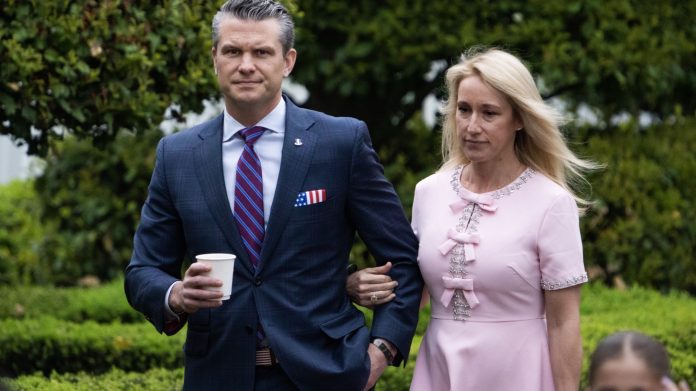
Defense Secretary Pete Hegseth and his wife, Jennifer, attend the White House Easter Egg Roll on April 21.

Tom Williams/CQ-Roll Call, Inc via Getty Images


hide caption

toggle caption

Tom Williams/CQ-Roll Call, Inc via Getty Images

Embattled Secretary of Defense Pete Hegseth pushed back Tuesday on the latest revelations that he shared military attack plans on his private phone with his wife, brother and personal lawyer.

“If you remember… I said no one is texting war plans,” Hegseth said on Fox and Friends. “What was shared over Signal then [during the first leak, which surfaced last month] and now was informal, unclassified coordinations for media coordination [and] other things.”

But the details he shared, two hours before airstrikes hit in Yemen, almost certainly were classified, according to retired Marine Lt. Col. Mick Wagoner, who was a military lawyer for 17 years and deployed to four war zones.

“A launch of an attack there is just no-way, no-how, that an American military operation starting off is going to not be classified for Lord’s sake,” he said.

And Hegseth’s defense also tacitly confirms that he shared those details with people, like his wife, he knew were not authorized to have the information.

According to a U.S. official not authorized to speak publicly, after CENTCOM commander General Erik Kurilla sent Hegseth details over secure communications about impending military operations on March 15th, Hegseth shared that information, verbatim, with two separate chat groups on Signal. One was made up of top Trump administration officials — and inadvertently included journalist Jeffrey Goldberg. But the other chat group included people with no clear reason for receiving the sensitive information.

“The last time he was wrongly using an insecure communications device, and he mistakenly thought he was speaking only to security clearance holders,” said Kevin Carroll, who served 30 years in the Army, then in the CIA and then the Department of Homeland Security in the first Trump administration. Security breaches like what happened in the Signal group chat are called “spillage” by the military, but this is more, says Carroll.

“Here he’s knowingly using an insecure communication device and he’s knowingly giving classified information to people who are not security clearance holders so it’s really more than a spill,” Carroll said. “It really gets more to the sort of willfulness that is typically prosecuted by the Department of Justice.”

Element of surprise

Even the man President Trump picked as his top military official, Chairman of the Joint Chiefs Dan Caine, seemed to struggle with Hegseth’s use of the first Signal group at his confirmation hearing.

“We all can agree that we need to always protect the element of surprise,” Caine said when asked repeatedly about leaking attack plans in advance.

When asked directly what he would have done if he found himself on an unclassified platform where tactical information was being discussed, he said, “I would weigh in and stop it if I was a part of it, but in this case I wasn’t.”

Military officers who have sent battlefield assessments that were several years old have lost their jobs for passing the information over an unsecured channel, Carroll, the Army lawyer who served in the first Trump administration, said. He defended a junior Marine Corps officer in court who sent urgent, potentially lifesaving information to fellow officers in Afghanistan from a nonclassified email server and was relieved of duty.

Carroll says, for troops, seeing leadership share attack plans in advance on Signal but so far suffer no consequences is toxic to morale. But that double standard is so common, he adds, that there’s a phrase for it in the military: “different spanks for different ranks.”

Carroll points out examples from both political parties where senior officials’ mishandling of classified information went mostly unpunished: Hillary Clinton, Sandy Berger, President Joe Biden; Richard Armitage, former Vice President Mike Pence, and of course Trump.

But several current and former military prosecutors and defense attorneys agreed there is no precedent for a secretary of defense willfully divulging operational plans against a hostile military force in real time.

The repercussions for Hegseth remain unclear. Democrats and at least one Republican lawmaker have called for his resignation in the wake of the news. NPR has previously reported that the White House has begun the process of looking for a new leader at the Pentagon to replace Pete Hegseth, though Trump has said publicly that he stands by his secretary of defense, and the White House has strenuously denied those reports.

Both Trump and Hegseth have blamed “disgruntled former staff” for revealing the existence of the second Signal chat group. They appear to be referring to four senior advisers who left the Pentagon abruptly last week. Former Defense Department spokesperson John Ullyot resigned and then published an opinion piece calling the past month at the Pentagon a “full-blown meltdown” of infighting.

Three other Pentagon advisers — Colin Carroll, Dan Caldwell, and Darin Selnick — were escorted out of the Pentagon and accused of leaking information to the press. They put out a joint statement on X saying they have not even been told what they’re accused of leaking. Caldwell and Selnik are longtime associates of Hegseth’s who worked with him at Concerned Veterans for America, a right-leaning policy group.

In response to charges that the three men leaked information to the media, Selnick told NPR, “We are discussing next steps.”
Judge blocks Trump administration plans to dismantle Voice of America : NPR

0

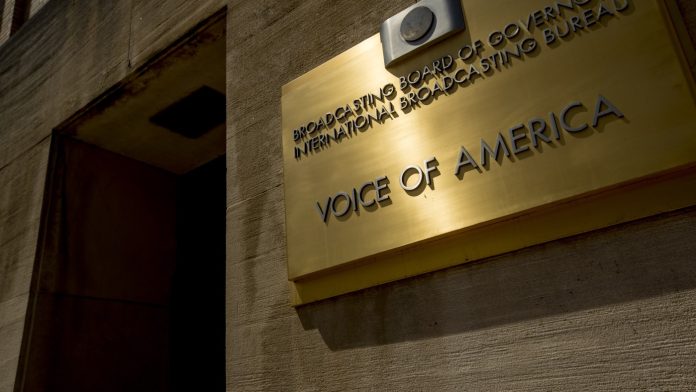
The Voice of America building, June 15, 2020, in Washington.

Andrew Harnik/AP


hide caption

toggle caption

Andrew Harnik/AP

A federal judge has blocked the Trump administration from dismantling Voice of America, the government funded broadcaster, at least temporarily. It’s a dramatic turn in a series of legal cases revolving around the limits of executive power and the strength of the Constitution’s protection of free speech.

Judge Royce C. Lamberth on Tuesday ordered the Trump administration to return Voice of America employees and contractors to their status before a March 14 executive order suspended their work. The order also covers the federally funded nonprofit news outlets Radio Free Asia, and Middle East Broadcasting Networks. It is a preliminary injunction that takes effect while the case plays out in court.

Lamberth wrote that the administration’s decision to dismantle the agency was “arbitrary and capricious.”

“Not only is there an absence of ‘reasoned analysis’ from the defendants; there is an absence of any analysis whatsoever,” he wrote.

He also said the Trump administration was “likely in direct violation of numerous federal laws.”

The Trump administration’s legal team had argued that it was not violating VOA journalists’ First Amendment rights because it has stopped all journalism rather than singling out any individual for their viewpoint. Lamberth said he found that argument “troubling.” A request for comment from the Trump administration was not immediately returned.

Unions, journalist organizations and democracy advocates hailed the decision. Patsy Widakuswara, the VOA’s White House Bureau Chief, and lead plaintiff in the case, said she was grateful for the ruling, but noted that the government was likely to appeal.

“This is not just about our jobs and journalistic freedom — it’s for our own national security,” she said. “Because every day that VOA is not broadcasting, is a day we cede the global information space and allow adversaries to fill it with disinformation and anti-American propaganda.”

Radio Free Asia President and CEO Bay Fang also struck a cautionary tone and called on the Trump administration to release its funding.

“While we want to resume our operations as they were before, for that to happen we need to receive timely disbursement of our funding on a consistent basis,” Fang said in a statement. “Until then RFA unfortunately remains in the same position as last month when we began to furlough our journalists and staff.”

Furloughed journalists, padlocked offices

More than a thousand employees and contractors from Voice of America (VOA) and the Office for Cuba Broadcasting were suspended from work on March 15, following a late-night order from the White House to dismantle the federal agency which funds them, U.S. Agency for Global Media (USAGM). The White House cited the move as part of a broader effort to cut government waste on “frivolous expenditures that fail to align with American values or address the needs of the American people.”

Since that executive order, VOA offices in Washington have been padlocked shut, its employees put on paid leave but cut off from their work emails, and contractors terminated. It was the first time broadcasts from the 83-year old institution were halted since it was founded during World War II to combat propaganda from the Nazi regime.

Employees of VOA sued the Trump administration and its advisor Kari Lake, who effectively oversees USAGM. In a court hearing Thursday, the government argued President Trump had not shut down VOA but instead had only temporarily “paused” its operations, allowing it to sidestep normal administrative procedures while considering what to do with parent agency USAGM.

“That’s a little hard to swallow,” Judge Lamberth said in response, adding it was a waste of “1,300 employees while the president tries to make up his mind.”

The targeted networks deliver information to countries around the world that lack a robust or free press. The networks are intended to promote American democratic values by broadcasting news that models independent journalism, incorporates political debate and dissent even inside the U.S.

Lawyers representing the media organizations argued the attempt to close the broadcasters was not about reducing federal bloat but was, in fact, a “censorious” initiative.

Two news outlets left out of reprieve

Other government-funded international broadcasters are fighting their own legal battles against the Trump administration and Lake. The preliminary injunction Lamberth issued on Tuesday does not cover Radio Free Europe/Radio Liberty and Open Technology Fund. The judge cited their current funding status in his memo.

Yet in late March, he temporarily barred the Trump administration from shuttering RFE/RL. The news outlet says it received its congressionally-allocated funds through the first half of March after Lamberth ruled USAGM could not unilaterally terminate its grant.

However, RFE/RL has still had to furlough staff and is asking the court to force USAGM to pay out the money it needs for the rest of the fiscal year. (Unlike Voice of America, which is owned by the government, RFE/RL is a nonprofit wholly dependent on federal grants.)

Lamberth refused to do so on Tuesday, saying it would be premature because RFE/RL and USAGM are negotiating the terms of the grant. He noted, however, that if those talks break down or the Trump administration indefinitely withholds funds that Congress has appropriated, bringing the news outlet to the brink of collapse, he would have good cause to act.

David Folkenflik contributed to this story.

Trump says he has ‘no intention’ to fire Fed Chair Powell : NPR

0

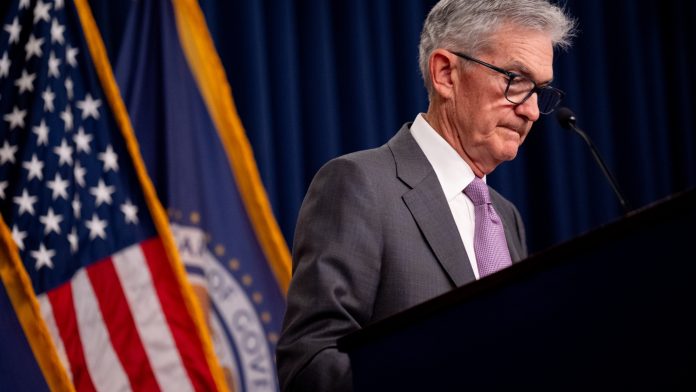
Trump said he does not intend to fire Powell after he has attacked the Federal Reserve Chair for not lowering interest rates.

Andrew Harnik/Getty Images North America


hide caption

toggle caption

Andrew Harnik/Getty Images North America

President Trump said Tuesday he had “no intention” of firing Federal Reserve Chair Jerome Powell, ending days of speculation about the independence of the central bank that had roiled the financial markets.

“I have no intention of firing him,” Trump said from the Oval Office, though he maintained, “this is a perfect time to lower interest rates.”

Since last week, Trump has used his social media platform to criticize Powell for, in his view, not lowering interest rates quickly enough — and at one point mused Powell’s “termination cannot come fast enough.”

The attacks had roiled markets at a time when investors were already on edge about the economic impact of President Trump’s sweeping tariffs. 

The Fed has been cautious about lowering rates, in part because of the impact of Trump’s tariffs, which would make imported goods more expensive.

However, Trump has framed tariffs against U.S. trading partners as a win for the country — and good for American workers and the domestic manufacturing sector.

“We are taking in a lot of money from tariffs,” Trump said in his remarks Tuesday.

A difficult relationship

President Trump and Powell have had a difficult relationship even though Trump nominated the current Fed chair for that post during his first term in the White House.

Trump has frequently criticized the central bank for not keeping interest rates lower, and also expressed a wish to have a say on monetary policy.

However, the Fed is designed to operate independently of that kind of political pressure so that it can make the unpopular decisions necessary to fight inflation.

Powell has tried to avoid antagonizing the president, but he’s also been adamant that he intends to serve out the remainder of his term, which runs through May of next year.

Powell insists the president does not have the authority to fire him, except for “cause,” meaning some kind of bad behavior. Current Supreme Court precedent supports that view.

But the White House has signaled a willingness to test that standard, firing board members of other independent agencies, raising concerns that Trump would try to fire Powell.

Inside Harvard’s lawsuit against the Trump administration : NPR

0

People cross Harvard Yard at Harvard University on April 17, in Cambridge, Mass.

Sophie Park/Getty Images


hide caption

toggle caption

Sophie Park/Getty Images

In an escalation of the back-and-forth between Harvard University and the Trump administration, the school has filed a lawsuit against the federal government. In it, Harvard argues the government’s actions, including freezing more than $2.2 billion in federal funding, violate the First Amendment and don’t follow legal procedures.

“The consequences of the government’s overreach will be severe and long-lasting,” reads a letter by Alan M. Garber, Harvard’s president, announcing the lawsuit. He goes on to detail the type of research the government has “put in jeopardy,” including efforts studying child cancer survivors, predicting the spread of infectious disease outbreaks and easing the pain of wounded soldiers.

“Defendants’ actions threaten Harvard’s academic independence and place at risk critical lifesaving and pathbreaking research that occurs on its campus,” the lawsuit reads.

The Trump administration accuses Harvard of failing to protect Jewish students. After Harvard refused to comply with a list of demands from the administration, the Joint Task Force to Combat Anti-Semitism announced it was freezing funds.

“The gravy train of federal assistance to institutions like Harvard, which enrich their grossly overpaid bureaucrats with tax dollars from struggling American families is coming to an end,” Harrison Fields, a White House spokesperson, said in a statement. “Taxpayer funds are a privilege, and Harvard fails to meet the basic conditions required to access that privilege.”

But Harvard’s lawsuit questions how freezing research funds will further the administration’s goal of eliminating antisemitism on campus.

On Tuesday, nearly 200 higher education leaders released a joint statement speaking out “against the unprecedented government overreach and political interference now endangering American higher education.” The letter was organized by the American Association of Colleges and Universities and signed by presidents and administrators at colleges across the U.S., including at large public research universities and small private colleges.

The impact of the federal funding freeze at Harvard

Dr. Donald Ingber leads scientific and engineering teams at a Harvard University lab, building small devices that replicate the functions and responses of living organs. He told NPR’s Ailsa Chang his team uses those devices to “study how the human lung, intestine, bone marrow and lymph node respond to radiation,” and also “to identify drugs that can mitigate the effects of radiation.”

But last week, Ingber’s lab at Harvard, the Wyss Institute, received a stop work order on three federal contracts it was working on, worth more than $20 million.

“The experiments have to stop,” Ingber said. “We basically have to bring it to a halt unless we can find other funding. We’re in the damage assessment phase.”

Ingber’s research could be helpful for people undergoing cancer treatments and even astronauts who encounter radiation during space travel.

“You’re never going to get to Mars … unless you figure out how to protect astronauts against radiation toxicity,” Ingber said. “But it also would be there to protect against nuclear reactor disasters… We’re at a time where the government wants to build nuclear plants all over the country.”

His focus now is on salvaging research and data that, in some cases, took months to collect. He’s also looking for alternative funding so he doesn’t have to fire his staff, “all young people who are passionate, working day and night,” he said.

The order to stop work in Ingber’s lab came on the same day the Trump administration froze more than $2.2 billion multi-year grants and contracts after the university rejected demands that it change hiring, admissions and other policies in response to allegations of antisemitism.

“I honestly don’t understand why they targeted us,” said Ingber, “because this work is totally unrelated to anything that you can imagine related to wokeness or antisemitism.”

The Wyss Institute is part of Harvard, but it’s also a separate nonprofit organization, with all of its direct costs and indirect costs going 100% to research and technology development, according to Ingber.

What is Harvard’s argument?

That confusion over the connection between antisemitism and the research being shut down is one element in the university’s legal case against the federal government.

“The Government has not—and cannot—identify any rational connection between antisemitism concerns and the medical, scientific, technological, and other research it has frozen that aims to save American lives, foster American success, preserve American security, and maintain America’s position as a global leader in innovation,” Harvard’s complaint says.

The lawsuit was filed in U.S. District Court in Massachusetts and aims to block the Trump administration from withholding federal funding “as leverage to gain control of academic decisionmaking at Harvard.”

The suit also makes the argument that the government is violating the First Amendment, which they argue, “does not permit the Government to ‘interfere with private actors’ speech to advance its own vision of ideological balance.’ “

In addition, the suit claims the government did not follow procedures, established by Congress, for “revoking federal funding based on discrimination concerns.”

Since the funding freeze early last week, President Trump has also threatened to revoke the university’s tax-exempt status, a move that would be rare, though not unprecedented.

‘60 Minutes’ chief Bill Owens resigns as Trump lawsuit looms over CBS : NPR

0

“60 Minutes” executive producer Bill Owens, left, shown with executive editor Tanya Simon in 2019. Owens resigned Tuesday, saying corporate leaders were no longer letting him “make independent decisions based on what was right for 60 Minutes, right for the audience.”

Evan Agostini/Invision/AP/Invision


hide caption

toggle caption

Evan Agostini/Invision/AP/Invision

The longtime head of CBS’ 60 Minutes resigned Tuesday, as the network’s parent company contemplates a settlement with President Trump over his lawsuit focusing on an interview the show did with then-Vice President Kamala Harris last fall.

In an emotionally charged meeting Tuesday afternoon, and again in a note to staff released publicly shortly after, the show’s executive producer, Bill Owens said he was departing after 37 years with CBS News following months of heavy-handed treatment of the show by corporate leaders.

Owens, only the third leader of the show in its more than half-century history, did not explicitly cite Trump. But the president’s open rancor toward 60 Minutes looms over all. Corporate parent Paramount and its controlling owner, Shari Redstone, are seeking the approval of federal regulators to sell it to the son of Oracle founder Larry Ellison. The billionaire software mogul is a friend of Trump who visited the president at the White House earlier this year.

“Over the past months, it has also become clear that I would not be allowed to run the show as I have always run it. To make independent decisions based on what was right for 60 Minutes, right for the audience,” Owens wrote. “So, having defended this show- and what we stand for – from every angle, over time with everything I could, I am stepping aside so the show can move forward.”

At the meeting, according to two attendees, Owens said he had “lost independence from corporate.” (The two people required anonymity to speak publicly due to the fraught professional environment at the show and the network.)

60 Minutes correspondent Scott Pelley, a longtime collaborator and friend of Owens, told colleagues, “This isn’t something Bill is doing of his own volition: There was no choice in any of this,” according to one of the attendees.

Last fall, before regaining office, Trump sued CBS’ parent company Paramount in his personal capacity. Trump pointed to the fact that the network aired two different versions of an answer Harris gave about Israel and Gaza – one on Face the Nation and the other on 60 Minutes. He demanded the network release the transcript of the raw interview, which it ultimately did this year once Trump was in office and his chief broadcasting regulator sought it. Trump was later joined by a Congressional ally in his lawsuit and doubled his demand to $20 billion.

Legal observers spanning the ideological spectrum say Trump does not have a good case. His lawsuit spuriously alleges election interference by CBS over the kind of discretionary editorial choices that routinely confront broadcast journalists, they say.

Owens has repeatedly told colleagues he would refuse to apologize to Trump. The chief executive of CBS News and Stations, Wendy McMahon, also has opposed settling.

According to an attendee of Tuesday’s meeting, McMahon appeared tearful and told the people assembled that she had been supportive of everything that Owens had done.

Redstone had been outspoken about the massacre of Israeli civilians by Hamas in October 2023. She was rankled by some CBS coverage of Gaza, including a CBS Mornings segment last fall and a 60 Minutes story in January.

In her own note announcing Owens’ departure, CBS News chief McMahon wrote, “working with Bill has been one of the great privileges of my career. Standing behind what he stood for was an easy decision for me, and I never took for granted that he did the same for me.”She said CBS News already had begun conversations with correspondents and senior leaders about the next steps for the show. Owens’ deputy Tanya Simon, a longtime 60 MInutes producer whose father was a correspondent for the show, will run the program for now; the network says it will be led permanently by someone who comes from within its ranks.

Corporate sale pending before Trump administration

Paramount’s controlling owner, Shari Redstone, has billions of dollars at stake as she seeks to close a sale of the company to Skydance Media. (Skydance Media CEO David Ellison is the son of Oracle co-founder Larry Ellison, whose billions are underwriting the deal for Paramount and CBS. Trump has called Larry Ellison a friend.)

The deal is under formal review by the Federal Communications Commission, led by Trump’s pick as chairman, Brendan Carr. The FCC is reviewing the acquisition because it entails the transfer of Paramount’s licenses to use the public airwaves for its 27 local television stations.

Lawsuit equates interview with “voter interference”

In Trump’s lawsuit, filed before a Trump-appointed federal judge in Texas, Trump’s lawyers argued that CBS engaged in “unlawful acts of election and voter interference through malicious, deceptive and substantial news distortion.”

“Am I supposed to take that seriously?” asks Carl Tobias, a law professor at the University of Richmond who specializes in First Amendment issues. “I do not understand how suits that are arguably frivolous or meritless — that have very little substance and wouldn’t amount to large judgments if you went to trial — are then settled for millions of dollars.”

“It’s laughable and it’s an affront to the First Amendment,” Heidi Kitrosser, a law professor at Northwestern University who focuses on issues involving free speech and presidential powers, says of Trump’s case. “His concern first and foremost is to intimidate the press.”

FCC Chairman Carr gave ballast to Trump’s suit by requesting CBS share raw footage and full transcripts of the 60 Minutes Harris interview, which was one of Trump’s demands. Carr did so after reviving a complaint against CBS that had been filed by a conservative public interest group. Carr’s Democratic predecessor had dismissed the complaint in her final days in office.

CBS had previously refused to release the raw materials, citing the importance of maintaining journalistic independence from governmental interference.

Shortly after Carr’s request, CBS announced it was legally required to comply, though the network had challenged the agency’s requests and demands in the past. (One such appeal, over a complaint filed by the late former President Jimmy Carter, reached the U.S. Supreme Court in 1981.)

After receiving the unedited material, the FCC publicly posted links to it. CBS swiftly followed suit. The network also published a statement that said the material showed there had been no bias in how it presented the Harris interview.

A plea to stay the course

Carr told Fox News that day that an investigation was warranted under “news distortion” concerns because CBS played different answers on two different programs in response to the same question.

“The [federal] policy says you can’t, you know, swap answers out to make it look like somebody said something entirely different,” Carr said. “Clearly, the words of the answers were very different.”

The transcripts and videos appear to show that CBS editors pulled from slightly different points in the same response, with Harris speaking vaguely as she attempted to sidestep controversy over the incendiary issue of Israel and Hamas.

After the transcript’s release, Trump denounced CBS. “CBS should lose its license, and the cheaters at 60 Minutes should all be thrown out, and this disreputable ‘NEWS’ show should be immediately terminated,” Trump posted online. (CBS as a network doesn’t hold a license; the local stations on which it is broadcast do.)

On April 13, Trump doubled down, accusing 60 Minutes of treating him unfairly and saying he was “honored” to be suing the show, CBS and Paramount.

“They did not one, but TWO, major stories on ‘TRUMP,’ one having to do with Ukraine, which I say is a War that would never have happened if the 2020 Election had not been RIGGED, in other words, if I were President and, the other story was having to do with Greenland, casting our Country, as led by me, falsely, inaccurately, and fraudulently,” Trump posted to Truth Social.

In his parting note, Owens urged the 60 Minutes staff to stay the course.

“60 Minutes will continue to cover the new administration, as we will report on future administrations. We will report from War zones, investigate injustices and educate our audience. In short, 60 Minutes will do what it has done for 57 years,” he said.

Trump fires more immigration judges even as he aims to increase deportations : NPR

0

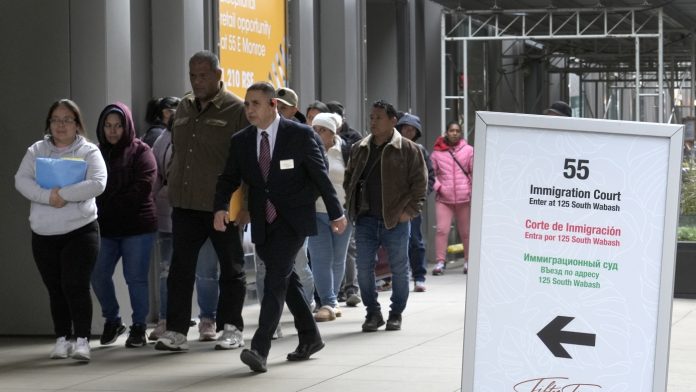
After waiting in a queue, people are led into a downtown Chicago building where an immigration court presides, Nov. 12, 2024.

Charles Rex Arbogast/AP


hide caption

toggle caption

Charles Rex Arbogast/AP

Another round of firings hit immigration courts in Massachusetts, California and Louisiana, as the Trump administration continues its twin efforts of downsizing the government and increasing immigration-related arrests.

At least eight immigration judges received notices that they would be put on leave and their employment would be terminated on April 22, according to two people familiar with the firings and to the International Federation of Professional and Technical Engineers union, which represents immigration judges. The two people spoke on condition of anonymity for fear of reprisals.

The judges who received the notices weren’t given a reason for the terminations. They were at the end of their two-year probationary period with the Executive Office for Immigration Review, or EOIR, which is part of the Justice Department. EOIR declined to comment on personnel matters.

The administration has moved to fire probationary workers at a score of other federal agencies. But getting rid of judges adds to criticism of the Trump administration for not giving migrants or noncitizens enough due process before they’re deported. Trump’s own comments this week prompted similar concerns.

“We cannot give everyone a trial, because to do so would take, without exaggeration, 200 years,” Trump posted on social media on Monday. “We would need hundreds of thousands of trials for the hundreds of thousands of Illegals we are sending out of the Country. Such a thing is not possible to do.”

There are about 700 immigration judges across the country’s 71 immigration courts and adjudication centers. These judges are the only ones who can revoke someone’s green card and issue a final order of removal for those who have been in the country for more than two years and are in the deportation process.

The latest firings comes as dozens of courts around the country are already facing vacancies after the Trump administration laid off or received resignations from over 100 court staff, including over two dozen judges. Earlier this month, EOIR posted several openings for immigration judge positions across the country, including in courts where judges were fired.

Matt Biggs, president of the union representing judges, said firing judges adds to the courts’ backlog of millions of cases.

“This is pure hypocrisy. We shouldn’t be firing judges, we should be hiring them,” he said.

Thirteen judges already fired since Trump started his second term filed a class appeal earlier this month, asserting that they had been wrongfully terminated.

“These immigration judges were appointed to serve the American people and uphold the rule of law—and they were fired by President Trump in violation of long-standing civil service protections,” Skye Perryman, president and CEO of Democracy Forward, said in a statement at the time of the filing.

Immigration law experts warn that the system is already backed up. Judges review on average 500 to 600 cases a year. Still, there were almost 4 million pending cases in the last quarter of 2024, including nearly 1.5 million asylum cases. In fiscal year 2024, immigration courts issued only 666,177 initial case decisions.

With judges leaving, voluntarily or not, the administration is also putting pressure to speed up the pace of case reviews in order to reduce the backlog.

In an April 11 memo sent to staff at the EOIR, acting Director Sirce Owen criticized judges for not “efficiently managing their dockets,” and encouraged them to drop “legally deficient asylum cases without a hearing.”

The directive could result in immigration judges determining someone is not eligible for asylum without a hearing, based solely on what is filed on a lengthy and complex asylum request form.

Biggs argues that the firings of judges make reaching the goals of increasing deportations harder to reach.

“He may be right — at the rate that his administration is firing judges, rather than a few years, it may take a couple hundred years to complete the pending cases,” Biggs said about Trump’s comments.

Harvard professor offers a grim assessment of American democracy under Trump

0

Steven Levitsky studies how healthy democracies can slip into authoritarianism. He says the Trump administration has already done grave damage: “We are no longer living in a democratic regime.”

The horse-racing industry needs workers on visas. Employers hope to still get them. : NPR

0

Workers walk and prepare race horses at the paddock before a race at Laurel Park in Laurel, Md., on April 5, 2025.

Rosem Morton for NPR


hide caption

toggle caption

Rosem Morton for NPR

For her entire life, Diana Pinones’ parents took care of racehorses.

Her mom, now retired, would walk the horses each morning. Her dad still grooms them, which can mean feeding, brushing and dressing the horses in preparation for race day.

Originally from Michoacán, Mexico, the Pinones became U.S. citizens and have turned horse-racing into a family affair, as have many others in the industry.

Pinones herself is now a staple at the Laurel Park race tracks in Maryland. On a recent Saturday, she was greeted with dozens of shouted “Good morning”s from workers on trucks driving by, or on horses walking past.

The success of this racetrack, like many others, relies on hundreds of immigrant workers on temporary H-2B visas — many of whom Pinones has gotten to know over the last decade as part of her work with the Maryland Thoroughbred Horsemen’s Association.

Diana Pinones, 40, poses for a portrait at Laurel Park in Laurel, Md., on April 5, 2025. Pinones works at various capacities with many of the immigrant workers at Laurel Park.

Diana Pinones, 40, poses for a portrait at Laurel Park in Laurel, Md., on April 5, 2025. Pinones works at various capacities with many of the immigrant workers at Laurel Park.

Rosem Morton for NPR


hide caption

toggle caption

Rosem Morton for NPR

“Everyone is an immigrant. We rely 100% on immigrants, from the hot walker to the groom to the jockey,” Pinones said, talking about the people who prep, ride and cool down the horses after they run at breakneck speed. “Everyone comes from another country to work in the industry.”

Horse racing generated some $36 billion in 2023, the latest figures available, according to the American Horse Council. The industry heavily relies on workers with H-2B visas to get a horse on the track, because owners and trainers say they’re unable to find enough U.S.-born workers. (Jockeys can qualify for a special visa for athletes.)

Still, a large portion of the workforce is estimated to be without legal status, according to industry groups.

Two widely-sought worker visa programs have already reached their annual caps, the U.S. Citizenship and Immigration Services announced in March.

Visas no longer available for 2025 include the H-1B visa, which goes to those with bachelor degrees or higher, and the H-2B visa, for non-agriculture seasonal labor such as in hospitality, landscaping, or working with animals.

In some states, like New York, horse racing is one of the biggest recipients of H-2B visas. The workers who have been granted 2025 visas will start work in the fall, which means the trainers at Laurel Park are staffed for this year. But Pinones and others at the track are closely watching changes with visa programs as they brace for what their staffing needs are next season.

Jockeys and their race horses race at Laurel Park in Laurel, Md., on April 5, 2025.

Jockeys and their race horses race at Laurel Park in Laurel, Md., on April 5, 2025.

Rosem Morton for NPR


hide caption

toggle caption

Rosem Morton for NPR

Demand for foreign labor continues amid crackdowns

Labor experts say that the demand for visas shows a pressing need for immigrant workers. But as the Trump administration promises a general crackdown on both illegal and legal migration, some fear that their industries could be targets of enforcement, including worksite raids and changes in visa programs.

James O’Neill, director of legislative affairs at the American Business Immigration Coalition, describes the H-visas as programs of “last resort.”

“It’s more expensive to use those visa programs than it is to hire domestically,” O’Neill said. “You actually have to prove that you cannot find somebody domestically to do that job in order to qualify for one of those visas.”

He said that even with an incoming administration, and changing political climate, the trend of reaching the caps on H-1B and H-2B is not surprising.

“The caps have been hit every year for the past several years,” O’Neill said. “The fact that all of the visas were used up is an indication of how desperately needed that workforce is.”

Lynden Melmed, a former chief counsel of U.S. Citizenship and Immigration Services under former President George W. Bush, said employers can see the administration wants to limit both legal and illegal migration.

So employers “are certainly looking at those visa categories as a way to say, we need to secure a consistent workforce because we’re not really sure how these immigration enforcement trends are going to affect current employees and future employees,” said Melmed, now a partner at BAL, an immigration law firm.

The majority of H-1B visa holders come from India, followed by China. Mexico was the top country for H-2B visas in 2024, followed by Jamaica, Guatemala, El Salvador and Honduras.

LAUREL, MD - April 5, 2025: A kitchen and recreation room for immigrant workers at Laurel Park is seen at Laurel Park in Laurel, Maryland on April 5, 2025. Photo by: Rosem Morton for NPR.

A kitchen and recreation room for immigrant workers at Laurel Park is seen at Laurel Park in Laurel, Maryland on April 5, 2025.

Rosem Morton for NPR


hide caption

toggle caption

Rosem Morton for NPR

The annual cap for H-2Bs is 66,000 this year. Employers worry that Trump will lower the caps next year — or freeze the programs entirely, as he did for the H-1B visa program during his first administration.

The politics of the program can be fraught. The H worker visas have received criticism from both Democrats and Republicans over the potential for abuse from employers and workers, and for limiting pathways to get more permanent status.

“I just want to make sure they’re okay”

Back in Laurel Park, tucked in the back of the sandy racetrack, sky-blue housing units can be seen: housing for hundreds of workers under visas.

Pinones explains that each trainer may have one worker for every five horses. And trainers may have dozens of horses, she said. Many live nearby, and Pinones is responsible for helping with their everyday needs, including work related to their immigration processes.

“This is a 24/7 job. It’s people who need you on a day that you’re off because they don’t understand paperwork that came in the mail and they needed to translate,” Pinones said, noting that she helps the workers even apply for green cards.

“I take my job very seriously, especially right now with everything that’s going on,” Pinones said. “They’re really young, 18, they just came here and I just want to make sure they’re okay because this is brand new for them. They had never been to the United States.”

LAUREL, MD - April 5, 2025: Ferris Allen III, watches jockeys and their race horses race at Laurel Park in Laurel, Maryland on April 5, 2025. One of the horses he manages is competing in the race. Photo by: Rosem Morton for NPR.

Ferris Allen III, watches jockeys and their race horses race at Laurel Park in Laurel, Maryland on April 5, 2025. One of the horses he manages is competing in the race.

Rosem Morton for NPR


hide caption

toggle caption

Rosem Morton for NPR

Ferris Allen has been a racehorse trainer for 27 years. He needs about 14 employees to take care of his horses, and the cost for the visas and green cards add up to thousands of dollars. It’s a process that he describes as “daunting” but worth it for a workforce he is proud of.

“We have a couple of Mexican families that we work with, multiple family members,” Allen said. “Those workers are essential to our business.”

Like most who utilize H-2B visas, Allen said it is a challenge to find a dedicated domestic workforce.

“[Immigrant laborers] love their work and they’re proud of their work. And finding that on Main Street, it’s just unlikely to happen,” Allen said. “They’re so good and kind and easy with their horses. I mean, these animals are not play toys there. They can be very rambunctious and very dangerous.”

Experts say that although there is stability for now, there are concerns about what might lie ahead for the H visa programs in the future.

“Generation after generation, they have been doing this job,” Pinones said. “But without the visas, we cannot continue to do this.”

Spectators watch jockeys and their race horses race at Laurel Park in Laurel, Maryland on April 5, 2025. One of the horses Allen manages is competing in the race.

Spectators watch jockeys and their race horses race at Laurel Park in Laurel, Maryland on April 5, 2025. One of the horses Allen manages is competing in the race.

Rosem Morton for NPR


hide caption

toggle caption

Rosem Morton for NPR

Senate Democrats press Hegseth on transgender troop ban : NPR

0

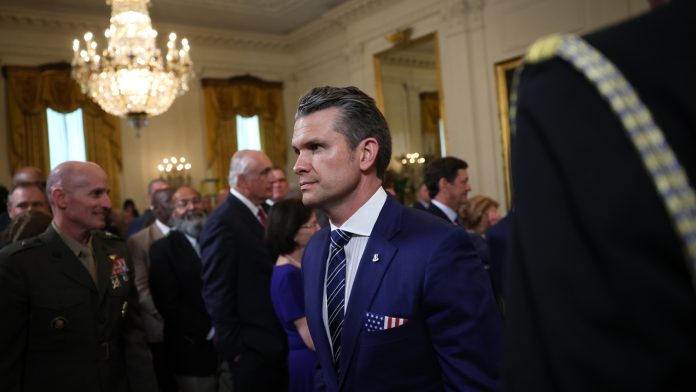
Secretary of Defense Pete Hegseth departs a presentation ceremony for the Commander-in-Chief Trophy to the U.S. Naval Academy Midshipmen football team in the East Room of the White House on April 15.

Win McNamee/Getty Images


hide caption

toggle caption

Win McNamee/Getty Images

More than a dozen Senate Democrats have signed onto a letter demanding a status update from Secretary of Defense Pete Hegseth over the military’s treatment of transgender servicemembers.

The letter, drafted by Sen. Tammy Duckworth, D-Ill., and first obtained by NPR, calls for Hegseth to explain to lawmakers how the Pentagon is complying with two separate federal court rulings blocking President Trump’s executive order attempting to ban transgender troops from military service.

Duckworth, an Iraq war veteran and Purple Heart recipient, uses the letter to denounce the executive order, writing that any effort to deny military service “based on ideological grounds is inherently un-American and jeopardizes our national security.”

“This administration’s animus towards transgender heroes,” she writes, “prioritizes a manufactured culture war over military excellence and readiness and is a purge of brave servicemembers who protect our freedoms.”

The letter is the first targeted effort by Democratic senators to press Hegseth on the administration’s policy toward transgender servicemembers. In it, Duckworth requests a response by Friday, but it is unclear whether the defense secretary will provide additional information.

In a series of questions addressed to Hegseth, Duckworth inquires as to whether any transgender servicemembers had been prematurely dismissed due to the executive order and what steps the Department of Defense has taken to bring them back. She also asks what actions the agency has taken to ensure transgender servicemembers “can continue to serve without facing stigma or backlash resulting from the Trump administration’s targeted attacks against them.”

The Soldiers Creed is displayed behind Sen. Tammy Duckworth, D-Ill., as she questions Pete Hegseth during a Senate Armed Services confirmation hearing on Capitol Hill on Jan. 14.

The Soldiers Creed is displayed behind Sen. Tammy Duckworth, D-Ill., as she questions Pete Hegseth during a Senate Armed Services confirmation hearing on Capitol Hill on Jan. 14.

Andrew Harnik/Getty Images


hide caption

toggle caption

Andrew Harnik/Getty Images

In addition to the president’s attempted ban on transgender people serving in the military, Trump has signed an executive order meant to restrict transgender athletes from playing in women’s sports. He’s also taken steps to end gender-affirming medical care for children and teenagers.

Duckworth’s letter comes as the Trump administration is facing heightened scrutiny over its compliance with the courts more broadly. Ongoing clashes between the White House and the federal courts over the president’s deportation agenda have sparked fears among legal experts about the potential for a constitutional crisis.

The administration has appealed both preliminary injunctions on Trump’s order seeking to ban transgender servicemembers. Last week, a Ninth Circuit panel denied a request by the administration for a stay in one of the cases, Shilling v. Trump, which was filed on behalf of seven transgender troops actively serving as well as an individual hoping to enlist.

The other case, Talbott v. Trump, was brought on behalf of six transgender servicemembers and two prospective servicemembers.

There are roughly 1.3 million active duty service members in the U.S., however an estimated 4,240 active duty service members have gender dysphoria, the Department of Defense has previously told NPR. Though this estimate places transgender troops at less than 1% of current forces, previous research puts the number higher. In 2018, a report by the Palm Center, which studies LGBTQ+ inclusion in the military, found that there were 14,700 transgender troops and 8,980 were active duty servicemembers.

In her letter, Duckworth noted that the army has struggled in recent years to retain servicemembers, highlighting that one quarter of recruited soldiers since 2022 have been unable to complete their initial military contracts, according to a recent analysis of Army data from Military.com.

“Our Nation cannot afford to expel several thousand troops serving honorably on a baseless, hateful whim,” she said.

Pete Hegseth may be replaced; Pope Francis’ legacy : NPR

0

Good morning. You’re reading the Up First newsletter. Subscribe here to get it delivered to your inbox, and listen to the Up First podcast for all the news you need to start your day.

Today’s top stories

A U.S. official has informed NPR that the search for a new leader to replace Defense Secretary Pete Hegseth is underway. The decision comes as Hegseth is again mired in controversy over sharing military operational details in a Signal group chat, on his private cellphone with his wife, brother and personal lawyer. Hegseth shared information in this chat about airstrikes on Houthi targets at the same time in March that he shared similar details in another Signal chat with top officials and a journalist who was mistakenly added.

Secretary of Defense Pete Hegseth speaks to reporters during the White House Easter Egg Roll on the South Lawn of the White House on April 21, the day after The New York Times reported that he shared information last month to a second private Signal group chat about upcoming strikes in Yemen.

Chip Somodevilla/Getty Images


hide caption

toggle caption

Chip Somodevilla/Getty Images

  • 🎧 The White House initially called the story about replacing Hegseth fake news. Publicly, President Trump stood firmly by him yesterday, NPR’s Quil Lawrence tells Up First. Military and veteran sources are outraged to know about the second Signal chat because they say it put lives at risk. Former Defense Department spokesperson John Ullyot resigned last week and published an opinion piece saying the past month at the Pentagon has been a full-blown meltdown of infighting that’s hurting Trump. Three other Pentagon advisers were escorted out of the Pentagon and accused of leaking information to the press.

Pope Francis died of “a stroke, followed by a coma and irreversible cardiocirculatory collapse,” according to The Vatican’s Dr. Andrea Arcangeli. Tributes have poured in from around the world remembering the first pope from Latin America as a leader who advocated for the poor.

  • 🎧 NPR’s Ruth Sherlock, who is in Rome, says there are real emotions and a sense of loss. Francis advocated for migrants and the environment, and was seen as friendlier to LGBTQ+ faithful. However, he has also been accused of not making substantial enough changes in the church. The pope’s body will be moved to St. Peter’s Basilica, where people can view him beginning tomorrow. His funeral will take place on Saturday. Politicians from around the world, including Trump, are expected to attend.
  • ➡️ Look back at defining moments in Pope Francis’ papacy through photos.
  • ➡️ The Vatican has an intricate set of rules that govern the papal transition. The public doesn’t get to watch this process unfold often. Here’s what to expect in the days and weeks to come.

Today, the U.S. Supreme Court tackles two bedrock values in public schools. On one side is the tradition of local school boards determining class curriculum for everyone. The other side argues that public schools should accommodate religious objections to some materials by allowing parents to opt their children out of some classes. At the center of the case is the Montgomery County, Md., school system — the most religiously diverse county in the U.S. The school board approved five storybooks with LGBTQ+ characters for use in elementary schools. But some parents believed exposure to these materials conflicted with their religious beliefs.

  • 🎧 The school board in the case said they initially allowed opt-outs, but it became a logistical nightmare to take children out of a classroom when a single storybook that features same-sex parents or gay and lesbian kids could come up at any time. NPR’s Nina Totenberg says the justices may side with the objectors who want to opt out.

Living better

Dr. Olena Weaver, wearing a white coat and glasses, looks at two sets of mammogram images on a computer screen. The one on the left has a lot of silvery structures; the other is mostly dark gray with just a few bright spots.

Dr. Olena Weaver of MD Anderson Cancer Center in Houston looks at mammogram imagery. The regular mammogram on the left shows a woman with dense breast tissue; on the right is a contrast-enhanced mammogram.

Brett Coomer/Houston Chronicle via Getty Images


hide caption

toggle caption

Brett Coomer/Houston Chronicle via Getty Images

Living Better is a special series about what it takes to stay healthy in America.

Approximately 40% of women have breast tissue that ranges from dense to extremely dense, which increases their risk of developing cancer. Dense breast tissue can also make it more challenging to detect cancer using both traditional 2D and even newer 3D mammograms. As of September 2024, federal regulations require all mammogram reports include information about breast density. Follow-up imaging, such as an MRI, may be beneficial for women who fall into the dense breast categories. But that’s not always the case.

  • ➡️ The harms behind additional screening could include subsequent testing, such as biopsies, and exposure to more radiation if follow-up X-rays are ordered.
  • ➡️ Cost can also be a significant barrier. Out-of-pocket pricing for an MRI can be about $1,000.
  • ➡️ There are questionnaires and online tools to help women gauge their personal cancer risks. Deciding whether to do follow-up tests is not simple and can vary based on family history, genetics and lifestyle.
  • ➡️ Mammograms detect, on average, five cancers out of 1,000 patient scans. Dr. Wendie Berg, a radiology professor at the University of Pittsburgh, says screening MRIs found another 15 cancers per thousand, even after a mammogram and ultrasound.

Picture show

WASHINGTON, DC - APRIL 21: Children and their parents participate in the White House Egg Roll on the South Lawn on April 21, 2025 in Washington, DC. The White House is expecting thousands of children and adults to participate in the annual tradition of rolling colored eggs down the White House lawn, which was started by President Rutherford B. Hayes in 1878. (Photo by Chip Somodevilla/Getty Images)

WASHINGTON, DC – APRIL 21: Children and their parents participate in the White House Egg Roll on the South Lawn on April 21, 2025 in Washington, DC. The White House is expecting thousands of children and adults to participate in the annual tradition of rolling colored eggs down the White House lawn, which was started by President Rutherford B. Hayes in 1878. (Photo by Chip Somodevilla/Getty Images)

Chip Somodevilla/Getty Images/Getty Images North America


hide caption

toggle caption

Chip Somodevilla/Getty Images/Getty Images North America

Trump and first lady Melania Trump welcomed thousands of people to the South Lawn of the White House yesterday for the annual Easter egg roll. The tradition dates back to Rutherford B. Hayes’ presidency. It has been a mainstay of Pennsylvania Avenue since 1878, save for war and food shortages. For the first time, Monday’s egg roll solicited corporate sponsors. The White House stated that the money raised will go to the White House Historical Association, a nonprofit.

  • 📷 Take a look at the many children who took part in the egg roll.

3 things to know before you go

Linda McMahon, during a cabinet meeting at the White House in Washington, D.C.. The U.S. Department of Education says it will begin resuming collections of defaulted student loans on May 5.

Linda McMahon, during a cabinet meeting at the White House in Washington, D.C.. The U.S. Department of Education says it will begin resuming collections of defaulted student loans on May 5.

Al Drago/ABACA via Reuters


hide caption

toggle caption

Al Drago/ABACA via Reuters

  1. The U.S. Department of Education says it will resume the collection of defaulted student loans on May 5 after a five-year hiatus.
  2. In celebration of Mother’s Day, NPR wants to hear about the most memorable gift you’ve ever received or given for the holiday.
  3. More than half of 1,260 Americans surveyed by the language learning site Preply say they watch shows with subtitles because the soundtracks are too hard to understand.

This newsletter was edited by Suzanne Nuyen.