Thursday, November 12, 2026
Home Blog Page 329

Violence Reported as Deadline Passes for Troop Withdrawal in Lebanon

0

At least one person was killed and 17 injured by Israeli forces in southern Lebanon on Sunday, Lebanese officials said, as the 60-day deadline for both Hezbollah and Israel to withdraw from the south expired and thousands of Lebanese displaced by the war poured into roads leading south back to their homes.

The agreement, which was signed in November, stipulated that both Hezbollah and Israel withdraw their forces from southern Lebanon, while the Lebanese Army and U.N. peacekeepers would be deployed to secure the area. If the truce held, negotiators hoped the agreement would become permanent, returning a measure of calm to a turbulent region and bringing a close to Lebanon’s deadliest war in decades.

But as the deadline passed on Sunday, a very different scenario was taking shape.

Israeli forces remained in parts of southern Lebanon, stoking fears among Lebanese of a sustained Israeli occupation and renewed hostilities between Israel and Hezbollah. And Israeli officials were warning Lebanese not to return to their homes in many towns and villages in southern Lebanon.

“In the near future, we will continue to inform you about the places to which you can return,” Avichai Adraee, the Arabic spokesman of the Israeli military, posted on social media Sunday morning. “Until further notice, all previously published instructions remain in effect.”

Lebanon’s Health Ministry said that the 17 people injured on Sunday morning had been trying to enter their two villages, Kfar Kila and Houla, along the border when they encountered Israeli attacks. Residents of both towns had called for their neighbors to gather early Sunday morning and head to their homes in a convoy, despite the warnings from Israel.

The Israeli military did not immediately respond to a request for comment.

The situation poses a critical test for Lebanon’s new leaders, President Joseph Aoun and Prime Minister-designate Nawaf Salam, as they seek to wrestle back political control from Hezbollah, the country’s dominant political and military force.

Any prolonged Israeli occupation of southern Lebanon could breathe new life into Hezbollah, a group that was founded to liberate Lebanon from Israeli occupation and that has portrayed itself as the only force capable of protecting Lebanon’s borders, experts say.

It also threatens to derail the current political momentum in Lebanon, where for the first time in decades there is a serious push to consolidate all military power within the state, and do away with Hezbollah’s justification for its vast arsenal.

The focus in Lebanon now is toward “disarming Hezbollah and transitioning from the era in which Hezbollah was seen as having the right to acquire weapons,” said Mohanad Hage Ali, deputy director for research at the Carnegie Middle East Center in Beirut. Any prolonged Israeli occupation “would put the breaks on that momentum, which is happening organically,” he added.

Israeli officials have cited concerns that Hezbollah remains active in southern Lebanon and doubts about the Lebanese Army’s ability to stymie the group. Hezbollah officials did not respond to these accusations but said they were “committed” to upholding the terms of the truce.

On Saturday, Lebanese Army officials said they were prepared to complete their deployment in the south but had been delayed “as a result of the procrastination in the withdrawal by the Israeli enemy,” according to a Lebanese Army statement.

The 60-day truce took effect more than a year after Hezbollah began firing rockets toward Israeli positions in solidarity with its ally Hamas, the Palestinian militant group in Gaza that led the Oct. 7, 2023, attack on Israel. Israel retaliated by assassinating Hezbollah’s leadership, leveling towns and villages along the border and invading southern Lebanon.

Even before Sunday’s deadline, thousands of Lebanese who were displaced by the war from homes along the southern border were preparing to return home. On Saturday, the main highway leading from the capital, Beirut, to southern Lebanon was packed with cars even as people received automated phone calls from the Israeli military on Saturday warning them not to return home.

“You are forbidden to go back to your home until further notice,” the automated voice said. “Anyone driving south is putting their life at risk.”

Israeli forces appeared to be continuing efforts that persisted during the 60-day truce to bulldoze and block roads between some villages in southern Lebanon, according to local media. Israel currently occupies roughly 70 percent of the areas that it captured after invading Lebanon last fall, according to the United Nations peacekeeping force in southern Lebanon.

The Lebanese Army also warned about the dangers of unexploded ordnance in some villages and towns. Still, few Lebanese appeared dissuaded from returning home.

“The people of the land will force their way in,” said Abed al Karim Hasan, a banana farmer in Maaliye, a village in southern Lebanon, whose home was destroyed during the war. “If I had a house there, I would go there first thing tomorrow.”

Hezbollah has not said how it plans to respond to Israel’s continued occupation of Lebanese soil. On Friday, Hezbollah officials warned in a statement that if Israeli forces remained in Lebanon beyond Sunday, it would amount to “an attack on Lebanese sovereignty and the beginning of a new chapter of occupation.”

Some Hezbollah lawmakers have vowed retaliation. But other officials from Hezbollah — which has been militarily and politically battered in recent months — instead shifted responsibility for responding to Israel to the Lebanese government. The group’s statement on Friday said that it was up to the state “to reclaim the land and wrest it from the grip of the occupation.”

That shifting of responsibility is a tried-and-true tactic for Hezbollah, which just a few months ago had called on the state to provide for thousands of Lebanese displaced by a war it had pulled the country into. Still, the political posturing from a group whose founding principle is resisting Israeli occupation reflects Hezbollah’s current weakened state.

After 14 months of fighting, the Shiite Muslim group’s military ranks are battered, and its loyal support base is weary after months of displacement and destruction. Its patron Iran has also been weakened by Israel, casting doubt over Iran’s ability to provide millions of dollars for rebuilding the homes of Hezbollah supporters in Lebanon, as it did after Hezbollah’s monthlong war with Israel in 2006.

And in neighboring Syria, rebels toppled an Iran ally, the dictator Bashar al-Assad, cutting off Hezbollah’s land bridge for receiving weapons and cash from Iran.

These blows have loosened Hezbollah’s once iron grasp on political power in Lebanon, shifting the country’s political sands for the first time in decades. Earlier this month, Lebanese lawmakers elected a new president, Mr. Aoun, after years of political gridlock that many analysts had attributed to Hezbollah. Days later, lawmakers named Mr. Salam, a prominent diplomat whom Hezbollah had long opposed, as prime minister.

In a country where no major political decision had been made without Hezbollah’s blessing for years, those developments underscored just how much ground the group has lost.

But Middle East experts have warned against writing off Hezbollah’s political weight just yet. And if Israel continues to occupy Lebanon, it could revitalize the group’s mostly Shiite Muslim support base as it looks for a patron and protector against Israeli forces.

“I believe neither parties have an interest in resuming the war,” said Sami Nader, the director of the Institute of Political Science at Saint Joseph University of Beirut. “But as long as Israel is occupying Lebanon, it’s reviving the narrative of Hezbollah.”

Sara Chaito contributed reporting.
Trump’s Q&A on Air Force One goes from the plane’s color to TikTok and Canada : NPR

0

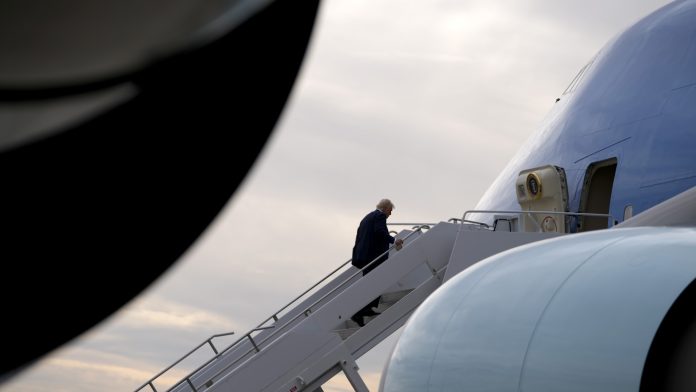
President Donald Trump boards Air Force One en route to Florida at Harry Reid International Airport in Las Vegas, on Saturday.

Mark Schiefelbein/AP


hide caption

toggle caption

Mark Schiefelbein/AP

ABOARD AIR FORCE ONE — President Donald Trump hasn’t been shy about sharing his thoughts since taking office, and he added a 20-minute Q&A with reporters aboard Air Force One to the mix Saturday night. He held forth on everything from the color of the presidential plane to the fate of TikTok, Greenland and Canada.

Trump popped in to the plane’s press cabin while flying from Las Vegas to Florida, where he was staying at his Doral golf club through Monday evening, though he insisted he’d be too busy to hit the links.

The new president scoffed at reporters getting “a bit more access” than under his predecessor, Joe Biden, and joked it was “like 5,000%” different — meaning he was willing to answer a lot more questions. Trump called Air Force One a “special plane” but observed that it hasn’t changed much from his last term. And, yes, he still wants to change the plane’s exterior colors.

“We want power blue, not baby blue,” Trump said. “Everything has its time and place. We’ll be changing the colors.”

President Donald Trump speaks to reporters aboard Air Force One as he travels from Las Vegas to Miami, on Saturday.

President Donald Trump speaks to reporters aboard Air Force One as he travels from Las Vegas to Miami, on Saturday.

Mark Schiefelbein/AP


hide caption

toggle caption

Mark Schiefelbein/AP

Here are some highlights from the conversation:

Trump says he’s talking with potential investors about the future of TikTok

Trump said he’s considering several possible investors who are looking to purchase TikTok, which faces the prospect of a U.S. ban if it isn’t sold by its Chinese parent company.

“Numerous people are talking to me,” he said. “Very substantial people.” He said he expects to decide what happens next “probably over the next 30 days.”

The president said he’d not been in contact with Oracle about buying TikTok, despite reports that he had, and that he’d not spoken to Oracle’s billionaire co-founder Larry Ellison, whom he called a friend. He noted Ellison lives “right down the road” from his Mar-a-Lago club in Florida.

But he said there are many other potential buyers.

“We have a lot of interest in it, and the United States will be a big beneficiary,” Trump said of a potential sale. “I’d only do it if the United States benefits.”

He added that, “I have a warm spot in my heart for TikTok” because he felt like it improved his standing with young voters in November’s presidential election.

Trump really wants federal workers back in the office

Asked about the series of executive orders he’s signed since taking office that have placed new rules on the federal workforce, Trump said he was opposed to work-from-home concessions that became more common during the coronavirus pandemic.

“You have to go to your office and you have to work,” he said. “Otherwise, you’re not going to have a job.”

Trump also said he’s not worried about existing federal employees leaving and the talent pool to find replacements being diminished: “We have very deep talent. We also have a lot of excess people.”

“This was a gimmick for Democrats, to a certain extent,” he said of existing federal worker rolls, which he suggested were too large.

Trump says he still wants Greenland, and Canada ‘should be a state’

Trump reiterated his desire to somehow purchase Greenland from Denmark, despite that country insisting it’s not for sale.

“I do believe Greenland, we’ll get because it really has to do with freedom of the world,” he said. “It has nothing to do with the United States, other than we’re the one that can provide the freedom.”

The president also made some of his most extensive comments about his recent suggestions that Canada could become part of the U.S.

“I love Canada,” he said. “I have so many friends up in Canada. And they like us, and they like me. But Canada’s been taking advantage of the United States for years, and we’re not going to let that happen.”

He suggested that the U.S. is losing hundreds of millions annually to Canada in trade deficits while Canada does “almost 90% of their business with the United States.”

“I don’t want to spend hundreds of millions of dollars on supporting the country unless that country is a state. And, if it’s a state, the people of Canada will pay a much lower tax.”

He said Canadians would also “have no military problems, they’d be much more secure in every way, and I think it’s a great thing for Canada.”

“I view it as, honestly, a country that should be a state,” he said. “Then, they’ll get much better treatment, much better care and much lower taxes and they’ll be much more secure.”

Connecticut to award $5.9 million to family of disabled man wrongfully imprisoned for 1992 murder conviction

0

Connecticut is set to pay nearly $5.9 million to the family of a disabled man who was wrongly imprisoned for more than two decades before he was freed in 2015 when his 1992 conviction in the murder and rape of an 88-year-old grandmother was overturned.

Richard Lapointe, who died at age 74 in 2020, had Dandy-Walker syndrome, a rare congenital brain malformation that his lawyers say was a factor in his false confession. Lapointe was never declared innocent, but his lawyers and the state attorney general’s office eventually agreed to settle after years of legal battles.

The state claims commissioner’s office on Jan. 2 set the money to be awarded to the family, although it still needs to be approved by the legislature. The claims commissioner’s office determines whether people can file lawsuits against the state or receive money under the state’s wrongful incarceration law.

Claims Commissioner Robert Shea Jr. said his office agreed that the award is “reasonable and appropriate.”

CONNECTICUT LAWYER INTRODUCES BILL THAT WOULD LEGALIZE SPORTS BETTING ON FLIGHTS TO, FROM STATE

In this April 10, 2015, photo, Richard Lapointe, center, raises his arms with Kate Germond, left, and Paul Casteleiro, both of Centurion Ministries, after he was granted bail and released at the Connecticut Supreme Court in Hartford, Connecticut. (AP)

Lapointe’s attorney, Paul Casteleiro, said the award is “a recognition by the state of the wrong it committed in prosecuting and imprisoning an innocent man. Sadly, Richard did not live long enough to witness his final vindication.”

“The award is by no means adequate compensation for what was done to Richard Lapointe,” Casteleiro said Friday, adding that the state destroyed his client’s life “for a crime he did not commit.”

The attorney general’s office said in a statement Friday that it “negotiated a resolution of this claim in the interests of all parties. This reflects that process.”

In 1987, Lapointe’s wife’s grandmother, Bernice Martin, was found stabbed, raped and strangled in her burning apartment in Manchester, Connecticut.

Lapointe was convicted in Martin’s murder in 1992 and sentenced to life in prison without the possibility of release. Key evidence in the case included Lapointe’s confessions during a nearly 10-hour interrogation by Manchester police.

His lawyers argued his mental disability attributed to him giving false confessions and that the confession was coerced without his lawyers present.

Jail

Lapointe was convicted of murder in 1992 and sentenced to life in prison without the possibility of release. (iStock)

The state Supreme Court ruled 4-2 in a 2015 decision that Lapointe was deprived of a fair trial since prosecutors did not disclose notes by a police officer that may have supported an alibi defense. Later that year, prosecutors said new DNA testing did not implicate Lapointe and all the charges were dropped.

Nobody else has been charged in Martin’s killing.

Lapointe was released from custody a short time later and exited the Hartford courthouse wearing a black T-shirt that read “I didn’t do it” as he threw his hands into the air in triumph.

“Of course I didn’t do it,” Lapointe said at the time. “That wasn’t me. I wouldn’t do nothing like that to nobody. I wouldn’t even kill my worst enemy.”

Casteleiro said the case against Lapointe destroyed his family, who shunned him.

BIDEN CLEMENCY FOR ‘NON-VIOLENT’ INMATES INCLUDES CONNECTICUT CHILD KILLER

Jail cell

The state Supreme Court ruled 4-2 in a 2015 decision that Lapointe was deprived of a fair trial. (iStock)

CLICK HERE TO GET THE FOX NEWS APP

Before Martin’s death, Lapointe and his wife, who has cerebral palsy, “were making a life together. They were doing okay,” Casteleiro said. But after his arrest, his wife divorced him, and he lost all contact with his son, who was young at the time.

After his release from prison, Lapointe began suffering from dementia, was placed in a nursing home in East Hartford and died after a battle with COVID-19, according to his lawyers.

Lapointe has been supported by several advocates, including the groups Friends of Richard Lapointe and Centurion, an organization Casteleiro works for that helps the wrongly convicted.

The Associated Press contributed to this report.

Australia Day Protesters Vandalize Melbourne and Sydney Statues

0

Some Australians were in no mood to celebrate the country’s national day on Sunday because they had long seen it as a reminder of colonial oppression. A few protesters took that antipathy a step further — by vandalizing statues to British settlers and an English king.

The damage done in Sydney, Melbourne and Canberra was a fresh sign that Australia Day, which commemorates when a British fleet sailed into Sydney Harbor to start a penal colony in the late 18th century, remains divisive.

Even as some Australians mark the holiday with barbecues and pool parties, critics note that it set in motion centuries of oppression of Indigenous people. Some prefer to call it Invasion Day or Survival Day, and they make their displeasure clear through protests or other actions.

In Sydney this week, a statue of Captain James Cook, who claimed part of the Australian continent for the British crown in 1770, was drenched in red paint. Its hand and nose were severed, too. The statue had been restored after facing a similar attack last year.

In Melbourne, a monument to John Batman, an explorer who settled the city on lands occupied by Aboriginal people, was toppled and destroyed early Saturday. Protesters in Melbourne also spray-painted the words “land back” on a memorial for Australian soldiers who died fighting in World War I.

And on Sunday in Canberra, the capital, there was graffiti on a statue of King George V. “The colony is falling,” someone had written on its base in red paint.

Australian officials condemned the vandalism.

“We should find it in our hears and in our minds to respect differences of views but not let it turn ugly,” said Jacinta Allan, the state premier of Victoria, according to a report by the television station 9News.

Representatives for the police in the states of Victoria and New South Wales said on Sunday afternoon that there had been no arrests or charges in connection with the vandalism in Sydney and Melbourne. The police in Canberra did not immediately respond to an inquiry.

People have protested Australia Day for decades. Recent protests were bolstered by the global Black Lives Matter movement, in which people in the United States, Britain and elsewhere toppled statues they saw as symbols of racism and oppression.

Last year in Melbourne, a Captain Cook statue was sawed off at the ankles, and a monument to King George V was beheaded.

Many Australian officials are keenly aware of their country’s racist colonial past, and they’re not afraid to say so publicly. In one example, the City of Melbourne’s website has a section on “truth-telling” that talks about developing “a shared understanding of the impacts of colonization and dispossession on Aboriginal peoples.”

But merely acknowledging historical wrongs is not enough for some Indigenous activists. That was clear when King Charles III visited Australia last year.

“You are not our king,” a voice rang out shortly after Charles, who retains the ceremonial title of head of state in the former British colony, finished addressing Parliament. “Give us our land back. Give us what you stole from us.”

The voice belonged to Lidia Thorpe, an Indigenous senator and activist for Aboriginal rights. As security guards hustled her out of the chamber, she accused British colonizers of genocide and demanded that Britain enter into a treaty with Australia’s Indigenous population.

The king watched impassively from the stage.

Trump wants Jordan and Egypt to accept more refugees to ‘just clean out’ Gaza : NPR

0

President Donald Trump speaks to reporters aboard Air Force One as he travels from Las Vegas to Miami, on Saturday.

Mark Schiefelbein/AP


hide caption

toggle caption

Mark Schiefelbein/AP

ABOARD AIR FORCE ONE — President Donald Trump said Saturday he’d like to see Jordan, Egypt and other Arab nations increase the number of Palestinian refugees they are accepting from the Gaza Strip — potentially moving out enough of the population to “just clean out” the war-torn area to create a virtual clean slate.

During a 20-minute question-and-answer session with reporters aboard Air Force One on Saturday, Trump also said he’s ended his predecessor’s hold on sending 2,000-pound bombs to Israel. That lifts a pressure point that had been meant to reduce civilian casualties during Israel’s war with Hamas in Gaza that is now halted by a tenuous ceasefire.

“We released them today,” Trump said of the bombs. “They’ve been waiting for them for a long time.” Asked why he lifted the ban on those bombs, Trump responded, “Because they bought them.”

Trump has built his political career around being unapologetically pro-Israel. On his larger vision for Gaza, Trump said he had call earlier in the day with King Abdullah II of Jordan and would speak Sunday with President Abdel Fattah el-Sissi of Egypt.

“I’d like Egypt to take people,” Trump said. “You’re talking about probably a million and a half people, and we just clean out that whole thing and say, ‘You know, it’s over.'”

Trump said he complimented Jordan for having successfully accepted Palestinian refugees and that he told the king, “I’d love for you to take on more, cause I’m looking at the whole Gaza Strip right now, and it’s a mess. It’s a real mess.”

Such a drastic displacement of people would openly contradict Palestinian identity and deep connection to Gaza. Still, Trump said the part of the world that encompasses Gaza, has “had many, many conflicts” over centuries. He said resettling “could be temporary or long term.”

“Something has to happen,” Trump said. “But it’s literally a demolition site right now. Almost everything’s demolished, and people are dying there.” He added: “So, I’d rather get involved with some of the Arab nations, and build housing in a different location, where they can maybe live in peace for a change.”

There was no immediate comment from Israeli Prime Minister Benjamin Netanyahu’s office.

Trump has offered non-traditional views on the future of Gaza in the past. He suggested after he was inaugurated on Monday that Gaza has “really got to be rebuilt in a different way.”

The new president added then, “Gaza is interesting. It’s a phenomenal location, on the sea. The best weather, you know, everything is good. It’s like, some beautiful things could be done with it, but it’s very interesting.”

His resuming delivery of large bombs, meanwhile, is a break with then-President Joe Biden, who halted their delivery in May as part of an effort to keep Israel from launching an all-out assault on the southern Gaza city of Rafah. A month later, Israel did take control of the city, but after the vast majority of the 1 million civilians that had been living or sheltering in Rafah had fled.

“Civilians have been killed in Gaza as a consequence of those bombs and other ways in which they go after population centers,” Biden told CNN in May when he held up the weapons. “I made it clear that if they go into Rafah … I’m not supplying the weapons that have been used historically to deal with Rafah, to deal with the cities, that deal with that problem.”

The Biden pause had also held up 1,700 500-pound bombs that had been packaged in the same shipment to Israel, but weeks later those bombs were delivered.

Trump’s action comes as he has celebrated the first phase of a ceasefire between Hamas and Israel that has paused the fighting and seen the release of some hostages held by Hamas in Gaza in return for hundreds of Palestinian prisoners held by Israel. Negotiations have yet to begin in earnest on the more difficult second phase of the deal that would eventually see the release of all hostages held by Hamas and an enduring halt to the fighting.

The Israeli government has threatened to resume its war against Hamas — which launched a massive assault against Israel on Oct. 7, 2023 — if the remaining hostages are not released.

Lizzo celebrates reaching weight-loss goal: ‘I haven’t seen this number since 2014!’

0

Lizzo marked a milestone in her body transformation journey as she revealed that she had reached her weight-loss goal.

On Saturday, the 36-year-old singer shared a health update on Instagram as she showed off her slimmed-down figure.

“I did it,” Lizzo, born Melissa Viviane Jefferson, wrote in the caption of her post. “Today when I stepped on my scale, I reached my weight release goal.”

Lizzo celebrated meeting her “weight release” goal. (Lizzo Instagram/Getty)

She continued, “I haven’t seen this number since 2014! Let this be a reminder you can do anything you put your mind to.” 

LIZZO SLAMS ‘OZEMPIC’ ALLEGATIONS AFTER WEIGHT LOSS TRANSFORMATION

“Time for new goals!”

Lizzo’s post featured a mirror selfie in which the four-time Grammy Award winner was seen posing in a matching maroon-colored sports bra and leggings set. 

closeup of lizzo after weight loss

The singer has documented her body transformation journey on Instagram. (Lizzo Instagram)

The “Good As Hell” hitmaker added a graphic to the image that read, “Congratulations! You’ve met your weight goals,” along with an illustration of a target.

Lizzo also displayed her arms and midsection in a close-up photo with a graphic that listed her weight-loss stats. Since January 23, 2024, Lizzo had reduced her body max index by 10.5 and her body fat had decreased by 16 percent.

“Let this be a reminder that you can do anything—anything you set your mind to.”

— Lizzo

The graphic also stated that Lizzo had hit her weight goal, but she didn’t share her current weight.

APP USERS CLICK HERE TO VIEW POST 

Lizzo also shared the news on her TikTok page as she posted a video in which she candidly addressed her personal goals.

“I am actually on an intentional weight loss journey right now,” she said in the first part of the clip. “Even at the end of my weight loss journey, I’m not going to be considered thin by any means. I will still be considered morbidly obese on the BMI and little bros on the internet are still going to call me ‘big backed.’ 

“But I will be happy,” she emphasized.

The video then cuts to a clip in which a beaming Lizzo exclaims, “And I am happy!”

“I stepped on the scale and I met my weight release goal,” she continued. Lizzo, who was wearing a black workout bodysuit, then began dancing and singing the lyrics to Kelly Rowland’s hit song “Like This.”

“Let this be a reminder that you can do anything—anything you set your mind to,” Lizzo added. “Now, I guess it’s time to set new goals.”

Lizzo has documented her weight-loss journey on Instagram and her latest update comes months after she slammed rumors that Ozempic was behind her dramatic results.

LIKE WHAT YOU’RE READING? CLICK HERE FOR MORE ENTERTAINMENT NEWS

In a September Instagram post, the rapper shut down speculation that she was taking the Type 2 diabetes medication, which is prescribed off-label for weight loss, attributing her body transformation to diet and fitness.

“When you finally get Ozempic allegations after 5 months of weight training and calorie deficit,” Lizzo wrote on a video post.

lizzo performing in 2014

Lizzo is pictured performing in 2014. ( Gary Wolstenholme/Redferns via Getty Images)

In October, Lizzo donned an Ozempic-themed Halloween costume as she poked fun at an episode of “South Park” that parodied her in May 2023.

At the time, she took to Instagram to share several posts featuring photos and videos of herself dressed up in a red and white package of a fictitious weight-loss drug named Lizzo with a yellow measuring tape cinched around her waist. 

“LizzOzempic dump,” the singer captioned one post.

CLICK HERE TO SIGN UP FOR THE ENTERTAINMENT NEWSLETTER

Lizzo performs in a cut-out sparkly blue outfit

The singer has said she was taking a “methodical” approach to weight loss. (Tim Mosenfelder)

In an April 2023 interview with The New York Times, Lizzo opened up about her body image.

“I’m not going to lie and say I love my body every day,” she told the outlet. “The bottom line is, the way you feel about your body changes every single day.”

CLICK HERE TO GET THE FOX NEWS APP

“There are some days I adore my body and others when I don’t feel completely positive.”

Lizzo went on to explain that she was dieting and said her approach was to gradually shed pounds.

“I’ve been methodical, losing weight very slowly,” she said.

India, a Big Source of Illegal Migration, Hopes to Navigate the Trump Storm

0

The family arrived at the ornately carved temple in western India bearing a special sweet of dried milk and clarified butter. It was a desperate offering for their son’s safety: He had just crossed into the United States, only days before President Trump took office promising a fierce crackdown on illegal immigration.

In their village in Gujarat, the home state of Prime Minister Narendra Modi, the markers of migration are everywhere. Plaques on buildings trumpet donations from Indians in America. Houses sit locked and empty, their owners now in the United States — many legally, many not.

Mr. Trump’s threats of mass deportations of illegal immigrants have raised the loudest alarms in countries closer to the United States, like in Mexico and Central America. But the fear and uncertainty — and the potential for political repercussions — are also rippling through India.

India is one of the top sources of illegal immigration to the United States, according to the Pew Research Center. As of 2022, more than 700,000 undocumented Indians were living in the United States, the center estimates, making them the third-largest group, behind Mexicans and Hondurans.

Some Indians arrive legally and overstay their visas. Others cross the borders without authorization: In 2023 alone, about 90,000 Indians were arrested as they tried to enter the United States illegally, according to U.S. government data.

India’s government, which has expanded defense, technology and trade ties with the United States, has expressed confidence that it is better positioned than most to weather the global reckoning with another “America First” administration. Mr. Modi has a bond with Mr. Trump, calling him “my dear friend” as he congratulated him on taking office for a second time.

Nevertheless, there are signs that India is trying to keep Mr. Trump on its good side by cooperating with his clampdown on illegal migration.

Indian news outlets reported this past week that the government had been working with the new administration to take back 18,000 Indian illegal immigrants who are under so-called final removal orders.

According to those reports, India’s goal is to protect its legal pathways for immigration to the United States, like skilled-worker visas, and avoid the punitive tariffs Mr. Trump has threatened to impose over illegal migration. Helping his administration could also spare India the embarrassment of being caught up in the publicity of Mr. Trump’s crackdown.

Indian officials would not confirm the specifics of the news reports to The New York Times. But they noted that deportations from the United States to India were not new — more than 1,000 Indians were sent back last year — and said that they were working with the Trump administration.

“Our position is that we are against illegal migration,” said Randhir Jaiswal, the spokesman for India’s Foreign Ministry. “We have been engaging with U.S. authorities on curbing illegal immigration, with the view of creating more avenues for legal migration from India to the U.S.”

Those legal routes — namely, H-1B visas for skilled workers and visas for students — have been a subject of heated debate among Mr. Trump’s supporters. Elon Musk and other tech moguls say the H-1B visas are needed to recruit the best talent to the United States. More nationalist voices say the jobs filled by those visa holders should go to Americans.

The State Department said the Trump administration was working with India to “address concerns related to irregular migration.” The new secretary of state, Marco Rubio, held his first bilateral meeting on Tuesday with India’s foreign minister, S. Jaishankar — an indication of the growing importance of the U.S.-India relationship.

The intensified focus on migration is politically sensitive in India.

Mr. Modi, the country’s most powerful leader in decades, has cast himself as a driving force behind economic growth that he says will eventually make India a developed nation. But his own home state, Gujarat, once hailed as an economic miracle under his leadership, is one of India’s largest sources of illegal migration to the United States, according to police officials.

Though Washington is looking to India as an alternative to China in global industrial dominance, its uneven economy — by some measures, one of the most unequal in the world — still impels large numbers of Indians to take enormous risks to make it to the United States.

In the Mehsana district of Gujarat, almost every family has a member in the United States, legally or illegally. Some return only for annual visits to see aunts and uncles. Mehsana is frequently in the news, with reports of its migrants dying while trying to climb a border wall into the United States, reach its shores by boat or make their way over the frozen northern border during winter.

Migration to the United States has traditionally been a status symbol among Gujaratis. Families who have no members in the United States have trouble matching their children in marriages, said Jagdish, 55, a worker at the local college in the village of Jasalpur whose son and daughter-in-law are in the United States illegally.

Jagdish, who asked that his last name not be used, said his son had spent five months in Mexico waiting to cross the border five years ago. Upon entering the United States, he was jailed for three months before being released. He now works at a cafe there, and his wife joined him last year.

It cost the family more than $70,000 to get them to the United States — a mix of “hard-earned money, my life’s savings” and loans, Jagdish said.

“I don’t buy new clothes, I have cut down on fruits and milk,” he said. “I need to repay the loans.”

Outside the village temple, a husband and wife who run a Subway franchise in the United States, where they have lived for two decades, were on their once-a-year visit. The husband, Rajanikant Patel, tried to offer some reassurance about Mr. Trump, couched in the “no one knows” air that characterizes much talk about the new administration.

“Trump will do what he has to do,” Mr. Patel said. “But Trump needs people to work there. We are laborers there. It’s such a huge country. Who will work and manage there?”

Indians began moving to the United States in large numbers in the 1960s, when India was among the world’s poorest nations and American immigration policy was easing.

The pull is strong even today, with India now the world’s fifth-largest economy. Given its immense inequality, economic growth has not necessarily translated into better services or higher standards of living for most.

“The quality of life here and there cannot be compared,” said Mr. Patel’s wife, Nila Ben.

Immigration consultants said they had seen a decline in visitors as word spread that it was becoming harder to enter the United States, a tightening that began during the Biden administration and that Mr. Trump is moving to drastically increase.

Varun Sharma, the director of an immigration consultancy, said about half of his potential clients inquired about illegal routes into the United States. He politely turns them down, he said.

Many undocumented immigrants now come from the new middle class. In some cases, Indians who arrive on student visas stay past the expiration date. In other cases, migrants first fly to a third country on a visitor’s visa, then slowly make their way to the United States by land or sea.

Vishnu Bhai Patel, a lemon trader from a nearby village, said he hoped that Mr. Trump “shows some leniency for divided families like mine — half of the family is here and half there.” He said he hoped that his daughter, who is studying engineering in the United States, could stay on after graduating and then invite him to come legally, too.

“My dream is for her to never come back,” he said.

Mujib Mashal contributed reporting from New Delhi.

Coast Guard intercepts boat carrying illegal migrants as expulsion flight operations begin

0

The U.S. Coast Guard (USCG) is conducting several “alien expulsion flight operations” between California and Texas, which included intercepting a boat carrying illegal migrants that was sinking in U.S. waters.

The USCG is coordinating with multiple Coast Guard units in support of the operations in coordination with U.S. Customs and Border Protection (CBP).

On Saturday, USCG Southern California shared a photo on X showing crew aboard the cutter Active intercepting a vessel carrying nine illegal migrants bound for San Diego.

Illegal migrants are detained by USCG Southern California. ( USCG Southern California via X)

COAST GUARD COMMANDANT TERMINATED OVER BORDER LAPSES, RECRUITMENT, DEI FOCUS: OFFICIAL

“The migrant vessel began to sink shortly after the Active crew stopped the voyage,” the post read. “All persons aboard the sinking vessel were safely removed and transferred to CBP.”

Led by the Eleventh Coast Guard District in California, the service is surging assets and personnel from around the nation to support the Department of Homeland Security-led operation, according to a statement from the USCG.

U.S. Coast Guard

Illegal migrants detained by the Coast Guard. (USCG)

6 SUSPECTS ALLEGEDLY INVOLVED IN DEADLY HUMAN SMUGGLING INCIDENTS OVER THE PAST WEEK, COAST GUARD SAYS

The USCG flight operations transport illegal immigrants to designated locations in Texas and California, where the Department of Defense then transports the migrants out of the U.S., according to the statement.

“In accordance with the President’s Executive Orders, the Coast Guard continues to surge assets and leverage its unique capabilities to protect America’s borders, territorial integrity, and sovereignty,” said Adm. Kevin Lunday, the Coast Guard’s acting commandant. 

U.S. Coast Guard

The U.S. Coast Guard is conducting flight operations to transport illegal immigrants to designated locations in Texas and California, where the Department of Defense then transports the migrants out of the U.S. (USCG)

Lunday said Saturday’s operation highlights the Coast Guard’s coordinated efforts.

“[The] operation exemplifies our coordination with our Department of Homeland Security and Department of Defense teammates, through which we are detecting, deterring, and interdicting aliens, drug smuggling, and other terrorist or hostile activity before it reaches our border,” he said.

Fagan

U.S. Coast Guard Commandant Adm. Linda Fagan speaks during a Senate Homeland Security and Governmental Affairs Subcommittee on Investigations hearing on Capitol Hill, June 11, 2024, in Washington, D.C. (Getty Images)

Fox News Digital first reported on Tuesday that President Donald Trump fired the commandant of the USCG, Adm. Linda Lee Fagan, over concerns about the border, recruitment and an “erosion of trust.”

CLICK HERE TO GET THE FOX NEWS APP

Officials claimed Fagan failed to address border security threats, provided insufficient leadership in recruitment and retention, had an excessive focus on diversity, equity and inclusion initiatives, and covered up Operation Fouled Anchor – which was the Coast Guard’s internal investigation into sexual assault cases at the Coast Guard Academy.

Fox News Digital’s Landon Mion contributed to this story.

Gaza at Last Welcomes More Aid. It Needs a Deluge.

0

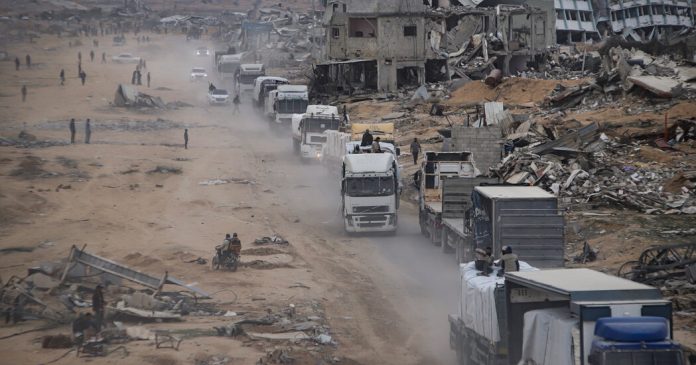
Outside a warehouse in southern Gaza one day this week, a small crowd of men and boys waited their turn for a bit of the humanitarian aid that Gaza — sick, starving, freezing Gaza — has desperately needed. They walked away with sacks of flour and cardboard boxes of food, many dragging their precious cargo behind them in two-wheeled shopping carts.

It was an orderly sight that had become rare in the territory since the war began more than 15 months ago. Israeli restrictions on aid, a security collapse that allowed widespread looting of aid trucks and other obstacles had combined to limit the food, water, tents, medicine and fuel that reached civilians amid an Israeli siege on the strip.

In the week since a cease-fire agreement stopped the fighting in Gaza, Palestinians in Gaza and aid officials say that more food deliveries and other much-needed items are streaming in. The question now is how to maintain the level of aid they say Gaza needs, despite many logistical challenges and uncertainties over how long the truce will hold.

The United Nations moved as much food into Gaza in three days this week as it did in the entire month of October, the interim head of the U.N. humanitarian office for Gaza, Jonathan Whittall, said in a briefing on Thursday.

Other U.N. agencies and aid groups were distributing medical supplies and fuel to power hospitals and water wells, among other types of assistance, and helping to repair critical infrastructure. Tents were set to enter soon, and bakeries were expected to start supplying bread by Friday, according to the United Nations.

Since the start of the cease-fire, civilian police officers belonging to the Hamas government have re-emerged, which appears to have restored some security and order to the enclave. The show of Hamas control, however, may complicate prospects for a durable peace in Gaza.

COGAT, the Israeli government agency that oversees policy in Gaza and the West Bank, did not respond to a request for comment, but it said in a post on social media on Friday that 4,200 aid trucks had entered the Gaza Strip over the past week after being inspected.

Throughout the war, Israel said that it was not limiting aid into Gaza and blamed humanitarian agencies for failing to distribute the supplies it admitted into the enclave after screening.

In all, anywhere between about 600 and 900 truckloads of aid have arrived in Gaza each day since the cease-fire took effect on Jan. 19, dwarfing the few dozen trucks that had been entering daily in recent months.

By Tuesday, Kholoud al-Shanna, 43, and her family had received a bag of flour from the World Food Program, the first in two months.

It was welcome. But “we’re still missing the basics,” Ms. al-Shanna said. “My kids haven’t had fresh vegetables in so long that they’ve almost forgotten what they taste like. How are we supposed to survive on just flour?”

Improvements were coming on that front, too. Before the war, Gaza was supplied with a mix of donated aid and goods for sale. Small amounts of imported fresh produce, meat and other food continued to be sold in markets until Israel banned most commercial items late last year, arguing that Hamas was profiting off the trade. Some commercial goods have entered Gaza this week, according to aid workers, bringing fresh vegetables and even chocolate bars to markets at lower prices than shoppers have seen in many months.

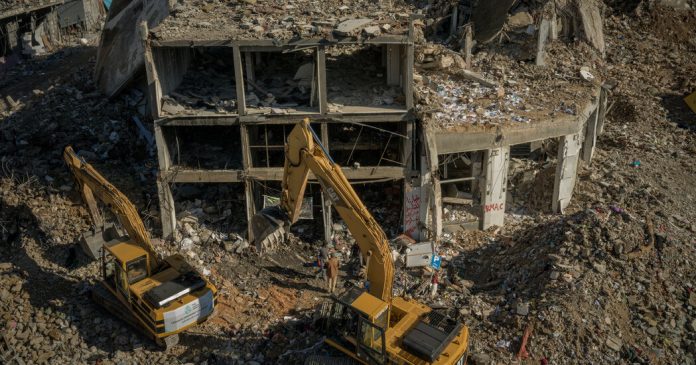
Distributing the aid once it enters Gaza remains a work in progress. Many roads are in ruins after 15 months of war, though Gaza municipalities are starting to clear debris. Unexploded ordnance still litters the enclave, making distribution and repairs dangerous.

About 500 trucks carrying a mix of aid and commercial goods entered Gaza each day before the war. The cease-fire agreement envisions 600 trucks entering each day, which aid officials say they will be hard-pressed to sustain on their own.

“It cannot be delivered just by the United Nations, no way,” Philippe Lazzarini, the head of the United Nations Relief and Works Agency, or UNRWA, the primary lifeline for Palestinian refugees, said days before the cease-fire took effect.

UNRWA’s precarious situation is another potential hindrance: While U.N. officials say the agency is crucial to the aid effort because it forms the backbone of supply chains and services in Gaza, Israel has moved to ban the agency over accusations that it shielded Hamas militants. Aid officials say there is nothing comparable to take its place.

The biggest challenge of all is the sheer scale of the emergency. Though aid may be rolling in now, aid officials said, Gaza has been so lacking in assistance that it will take a deluge of supplies just to stabilize the population and prevent more deaths, to say nothing of eventual reconstruction.

Gaza will also need educational and psychological services and other support to begin to recover, officials say.

The number of trucks recently entering Gaza “is still a drop in the ocean compared to the amount of aid needed to catch up on what has been a massive dearth over the last year and a half,” said Bob Kitchen, the vice president for emergencies at the International Rescue Committee.

Some obstacles are gradually yielding. Israel’s evident willingness to usher in a surge of aid has resolved what aid officials and governments that donated assistance say was the biggest hurdle to getting Gaza what it needed. Saying its goal was to keep Hamas from resupplying through aid shipments, Israel had imposed stringent inspections on the assistance entering Gaza and restricted its movement once inside Gaza, frequently delaying or outright stopping delivery.

Aid workers no longer need to ask permission from the Israeli military to move around Gaza, except from south to north, speeding up the process. Before the cease-fire, many trucks designated to ferry aid to warehouses around the strip sat paralyzed for lack of fuel; now fuel is entering.

Israel still prohibits agencies from bringing in a long list of items that aid officials say are vital to the emergency response but that Israel deems “dual use,” meaning they could also be used by Hamas for military purposes. That has included everything from scissors to tent materials.

Some of those restrictions have been lifted, however, aid officials say, and talks are continuing about lifting more.

Another problem plaguing aid distribution in Gaza for months was looting, which diverted much of the aid meant for civilians.

The situation in Gaza deteriorated after the Israeli military invaded Rafah, in southern Gaza, in May, seeking to oust Hamas from what Israel said was one of its final strongholds. Hamas’s security forces fled, and organized gangs — with no one stopping them — began intercepting aid trucks after they crossed into Gaza.

International aid workers accused Israel of ignoring the problem and allowing looters to act with impunity. The United Nations does not allow Israeli soldiers to protect aid convoys, fearing that would compromise its neutrality, and its officials called on Israel to allow the Gaza police, which are under Hamas’s authority, to secure their convoys.

Israel, which has sought to destroy Hamas in Gaza, accused it of stealing aid and said the police were part of its apparatus. In the end, security broke down so badly that many aid groups kept their deliveries sitting at Gaza’s borders rather than risk the dangerous drive into Gaza.

But fears that organized looting would continue after the cease-fire have eased. Policemen are once again patrolling much of Gaza. While some people are still pulling boxes from trucks — scenes described by aid officials and witnessed by a New York Times reporter — it is now on a far smaller scale.

Palestinians in Gaza say that as aid becomes more widely available, people will have less incentive to loot.

“I’ve noticed a clear improvement — more people are getting food parcels today,” said Rami Abu Sharkh, 44, an accountant from Gaza City who had been displaced to southern Gaza. “I hope it continues until theft is eliminated completely.”

Farnaz Fassihi contributed reporting from New York.

Mark Wahlberg’s wife ‘dove under the covers’ when she saw actor’s shaved head for bald role in ‘Flight Risk’

0

Mark Wahlberg shared his wife Rhea Durham’s stunned reaction after the actor shaved his head to play his balding character in the new movie “Flight Risk.”

During a recent interview with “Extra,” the 53-year-old actor explained that he opted to go partially hairless rather than wear a bald cap for his role in the Mel Gibson-directed action thriller. 

“I don’t want to sit there and wait two hours in the chair putting on a bald cap and then gluing pieces of hair on and then having to get touch-ups,” Wahlberg said. “Like, shave it, be done with it, you know, trim it in the morning because the stubble grows through, so just shave it down and then be able to be free all day.”

Mark Wahlberg recalled his wife Rhea Durham’s reaction to his bald look for his role in “Flight Risk.” (Lionsgate YouTube/Getty)

Though Wahlberg was satisfied with his decision, he recalled that Durham, 46, was shocked when she first saw his new appearance.

MARK WAHLBERG ADMITS HE ALWAYS FALLS ASLEEP DURING A CERTAIN BEDTIME ROUTINE WITH WIFE

“She dove under the covers, bro,” Wahlberg said with a laugh.

“She was like ‘Aaah, get out of here,’ but then she got used to it,” he added. “She thought it was cool after a while.”

mark wahlberg in plane in flight risk

The actor opted to shave his head rather than wearing a bald cap. (Lionsgate YouTube)

Wahlberg and Durham, who tied the knot in 2009, share daughters Ella, 21, and Grace, 15, and sons Michael, 18 and Brendan, 16.

“The most priceless thing was seeing my wife’s face when I took my hat off after getting the hair cut for work that day.”

— Mark Wahlberg 

In June, Wahlberg revealed his shaved head for the first time in a photo that he shared on Instagram. 

“No bald cap for me,” he captioned an image of himself with his hairstylist. “We go all in.”

APP USERS CLICK HERE TO VIEW POST 

During a June interview with People magazine, Wahlberg detailed how he achieved his character’s look.

“I shaved the middle and left the horseshoe around the sides,” he told the outlet. “They would shave the top as close to the scalp as possible every day, obviously, because we didn’t have any stubble or anything. So I just hid it with a hat.”

LIKE WHAT YOU’RE READING? CLICK HERE FOR MORE ENTERTAINMENT NEWS

“But the most priceless thing was seeing my wife’s face when I took my hat off after getting the hair cut for work that day,” Wahlberg said at the time.

mark wahlberg in flight risk

“Flight Risk” was directed and produced by Mel Gibson. (Lionsgate)

While speaking with “Extra,” Wahlberg remembered that he became so comfortable with the hair cut that he sometimes “forgot about it.”

CLICK HERE TO SIGN UP FOR THE ENTERTAINMENT NEWSLETTER

“I was at a UFC event and I showed up on the Jumbotron and I had a hat on,” the two-time Oscar nominee said. “I was just about to pull my hat off to just salute everybody out of respect and I realized that I had it on.”

“And then my son tried to rip it off,” Wahlberg recalled. “I was like, ‘Dude, you can’t show the hair right now because I don’t want to blow it for the movie.'”

flight risk poster

The action thriller premiered in theaters on Jan. 24. (Lionsgate )

“I wanted the first time for people to see it in the context of the film, whether it was [in] the trailer or the film itself.”

Along with Wahlberg, “Flight Risk” also stars Michelle Dockery and Topher Grace. A plot synopsis for the movie reads, “A U.S. marshal boards a small plane to transfer a government witness to New York. As they cross the Alaskan wilderness, tensions start to rise as not everyone on the flight is who they appear to be.”

“Flight Risk” was released in theaters on Jan. 24.

CLICK HERE TO GET THE FOX NEWS APP