


Maine’s Democratic Gov. Janet Mills says her state’s not backing down against possible cuts in school and other funding threatened by the Trump administration over the state’s policy on transgender athletes in sports.
CPFB starts to lay off staff as the agency adjusts its focus : NPR
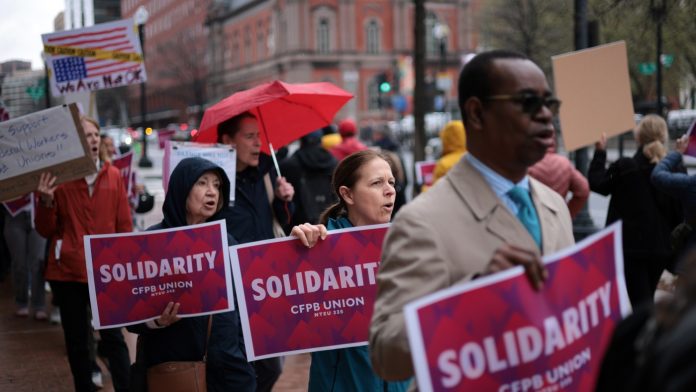
Some employees of the Consumer Financial Protection Bureau were fired in the wake of a court ruling that cleared the way for layoffs. Here, CFPB union members and supporters rally outside CFPB’s headquarters last month in Washington, D.C.
Alex Wong/Getty Images/Getty Images North America
hide caption
toggle caption
Alex Wong/Getty Images/Getty Images North America
Employees at the Consumer Financial Protection Bureau have begun receiving layoff notices, the latest attempt by the Trump Administration to shrink the bureau and reduce the scope of its work.
“This RIF action is necessary to restructure the Bureau’s operations to better reflect the agency’s priorities and mission,” read one of the notices seen by NPR, referring to reduction-in-force actions.
————————————————————————————————————————————————
Laurel Wamsley is covering what’s happening at CFPB. If you have a tip, you can contact her securely on Signal at laurel.96.
————————————————————————————————————————————————
Staff members began receiving the reduction-in-force notices on Thursday afternoon. It was not immediately clear how many of the agency’s employees were receiving the notices.
The reduction in force notices come after a recent court ruling by a federal appeals panel cleared the way for the layoffs. The three-judge panel said the bureau’s leaders can send a reduction in force notice to employees they have determined to be unnecessary to carry out CFPB’s statutory duties.
The panel otherwise left intact a separate federal judge’s injunction that prevents the agency from being dismantled — including that its data cannot be deleted or destroyed, and that employees must be given workspace or the tools to work remotely.
The CFPB did not respond to NPR’s questions about whether the layoffs had begun.
New direction for the CFPB
The layoffs come after the agency’s chief legal counsel sent a memo to CFPB employees on Wednesday evening that sets a new direction for the bureau.


In the memo, which was viewed by NPR, chief legal officer Mark Paoletta said that the Bureau would lean on states to carry out more enforcement and supervision activities, arguing that doing so would allow the agency to “to focus on tangible harms to consumers.”
Paoletta also said the bureau would shift its focus back to banks and depository institutions such as credit unions and commercial banks.
He added the bureau would “deprioritize” a number of areas it has regulated in recent years, including medical debt, peer-to-peer platforms, and digital payments.
The last item is notable as Elon Musk, who has tweeted “CFPB RIP”, is building a digital payments platform –- a platform that would ostensibly be under CFPB’s oversight. In February, Musk’s Department of Government Efficiency (DOGE) team entered the bureau’s Washington headquarters and took control of key systems.
The CFPB, which was founded in the wake of the 2008 financial crisis, has become a target of the Trump administration as well as some in Silicon Valley and on Wall Street, who say it overreaches in its regulation.
Consumer organizations criticized the bureau’s reorientation as described in Paoletta’s memo, saying it marked a significant retrenchment in its mission.
“The CFPB cannot simply shirk the consumer protection responsibilities Congress gave it and expect states to enforce federal law,” said Lauren Saunders, associate director of the National Consumer Law Center.
Consider This from NPR : NPR

Bridge cranes load containers to a cargo ship at the Qingdao Free Trade Zone in Qingdao, Shandong province, China on April 15, 2025.
CFOTO/Future Publishing/Getty Images
hide caption
toggle caption
CFOTO/Future Publishing/Getty Images

Bridge cranes load containers to a cargo ship at the Qingdao Free Trade Zone in Qingdao, Shandong province, China on April 15, 2025.
CFOTO/Future Publishing/Getty Images
When it comes to the cost of raising a child from infancy to the age of 17 in the United States – it’s hard to settle on a precise figure.
There’s one thing we do know – it’s going to be expensive.
By some estimates, raising a kid, who was born in 2015, could cost a middle class family close to $320,000 over 17 years.
That money goes to childcare, healthcare, food, clothes, education, transportation, activities, toys, and a lot more. All of those things will be affected – one way or another – by the Trump administration’s tariff policy.
And the companies that sell products geared at those raising kids – they’re going to feel the pinch as well. One CEO argues it could even mean certain products will become unavailable.
Being a parent in the U.S. is already expensive. Slapping tariffs on the products kids use could make it more so.
For sponsor-free episodes of Consider This, sign up for Consider This+ via Apple Podcasts or at plus.npr.org.
Email us at [email protected].
This episode was produced by Brianna Scott, with audio engineering by Tiffany Vera Castro, Ted Mebane and Simon-Laslo Janssen. It was edited by Courtney Dorning. Our executive producer is Sami Yenigun.
HUD is selling its headquarters as Trump shrinks its staff : NPR
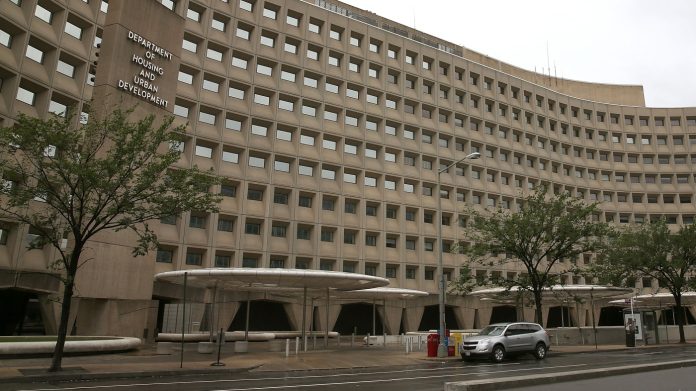
The U.S. Department of Housing and Urban Development says its current staff use only half the available office space and that relocating will “reduce the burden on the American taxpayer.”
Mark Wilson/Getty Images
hide caption
toggle caption
Mark Wilson/Getty Images
WASHINGTON — The U.S. Department of Housing and Urban Development is looking for a smaller, cheaper building for its headquarters. It’s part of a larger Trump administration push to shrink not only the number of federal employees, but also the office spaces where they work.
In announcing the plan, the agency said its 1968 building in Washington, D.C., currently faces over $500 million in deferred “maintenance and modernization.” It said current staff occupy only half the space and that relocating will “reduce the burden on the American taxpayer.”
Have information you want to share about ongoing changes at HUD? NPR’s Jennifer Ludden can be contacted through encrypted communications on Signal at jenniferludden.20.
HUD Secretary Scott Turner has also called the massive, curved Brutalist structure “the ugliest building in D.C.“
“HUD’s focus is on creating a workplace that reflects the values of efficiency, accountability, and purpose,” Turner said in a statement. “We’re committed to rightsizing government operations … to deliver results for the American people.”
The agency did not say how much it’s asking for the building.


DOGE, the cost-cutting team overseen by billionaire Elon Musk, has targeted cutting HUD staff by half, according to an internal document seen by NPR.
HUD headquarters, formally called the Robert C. Weaver Federal Building, is now up for sale, although that could be complicated by its listing in the National Register of Historic Places. The agency said a timeline and final location are not yet set, but that “the Washington, D.C. metropolitan area remains a top priority.”
HUD headquarters is near a busy metro stop in downtown D.C. But this week, President Trump gave federal agencies more flexibility to locate outside of city centers. He revoked two previous orders, by Presidents Jimmy Carter and Bill Clinton, that had encouraged agencies to locate in business districts and historic properties.
Trump’s order said those past measures “prevented agencies from relocating to lower-cost facilities,” and that agencies “must be where the people are.”
Court denies White House appeal of ‘shocking’ Abrego Garcia deportation case : NPR
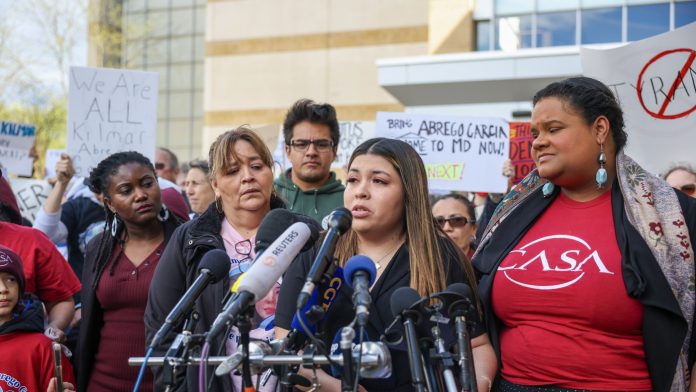
Jennifer Vasquez Sura, the wife of Kilmar Abrego Garcia, who was mistakenly deported to El Salvador, speaks to the media before she enters federal court on April 15, 2025 in Greenbelt, Md.
Tasos Katopodis/Getty Images
hide caption
toggle caption
Tasos Katopodis/Getty Images
A federal court on Thursday denied the Trump administration’s effort to appeal an order mandating that government officials be deposed about the accidental deportation of Kilmar Abrego Garcia to El Salvador.
“It is difficult in some cases to get to the very heart of the matter. But in this case, it is not hard at all,” a three-judge panel on the U.S. Court of Appeals for the Fourth Circuit wrote. “The government is asserting a right to stash away residents of this country in foreign prisons without the semblance of due process that is the foundation of our constitutional order.”
Kilmar Abrego Garcia was sent to El Salvador due to an administrative error and is being held at a notorious mega-prison, according to the Trump administration. His lawyers have sued the government to return him to the United States.
The Fourth Circuit ruling against the Trump administration came just one day after the government filed an appeal of a lower court order, a remarkably short time for a court to reach a ruling. It comes as Abrego Garcia’s case has become another test of how far the White House is seeking to push the bounds of law through its immigration policy.

The government’s unwillingness to bring Abrego Garcia back “should be shocking not only to judges, but to the intuitive sense of liberty that Americans far removed from courthouses still hold dear,” the judges wrote.
Maryland Judge Paula Xinis had ordered the government to facilitate Abrego Garcia’s release and return, an order unanimously upheld by the U.S. Supreme Court.
At a hearing earlier this week, Judge Xinis said that the Justice Department lawyers, which are representing the government, have provided little information of value about their efforts to bring him back.
She ordered the government to go through expedited discovery, during which Abrego Garcia’s lawyers can question officials and request documentation about what they are doing — or not — to bring Abrego Garcia back.
The Trump administration appealed Xinis’s order. In the appeal, the DOJ argued that the Maryland court is inserting “itself into the foreign policy of the United States and has tried to dictate it from the bench,” and said the depositions of government officials are “untenable.”

But the appellate court slapped down that notion. They said that if the government conceded that Abrego Garcia was mistakenly deported, “Why then should it not make what was wrong, right?”
“It is, as we have noted, all too possible to see in this case an incipient crisis, but it may present an opportunity as well,” the judges wrote. “We yet cling to the hope that it is not naïve to believe our good brethren in the Executive Branch perceive the rule of law as vital to the American ethos. This case presents their unique chance to vindicate that value and to summon the best that is within us while there is still time.”
The DOJ could appeal the Fourth Circuit’s decision to the Supreme Court.
Meanwhile, agency officials at the Homeland Security and State departments must abide by Xinis’s order, which requires them to be questioned under oath about the steps taken and challenges faced in order to facilitate Abrego Garcia’s return. Xinis said this would clarify what, if anything, has been done and if the government is acting in good faith.
U.S. Census Bureau data faces danger of brain drain : NPR

Staff departures and survey cuts at the U.S. Census Bureau, headquartered in Suitland, Md., are raising questions about whether the federal agency can continue producing reliable statistics for the country.
Michael Zamora/NPR
hide caption
toggle caption
Michael Zamora/NPR
As federal agencies brace for the Trump administration’s next round of slashing the U.S. government, recent staff departures are already raising concerns about whether the Census Bureau can continue producing reliable statistics for the country.
Like most other agencies, the bureau is under pressure from Trump officials to further shrink their workforce while keeping in place a hiring freeze. According to emails shared with NPR, agency staffers are facing a Thursday deadline for applications for early retirement and voluntary separation offers that may be followed by mass firings.
But current and former employees warn that the bureau — which for years has been dealing with the restrictions of short-term funding and staffing challenges — is under unique strain.
The federal government’s largest statistical agency is well into preparations for the 2030 national head count of U.S. residents, which is set to be used to determine how federal funding is allocated to local communities and how presidents, members of Congress and other levels of government are elected. The bureau also carries out the surveys that produce the monthly jobs report and other key data sets.


Outside the bureau, census advocates are concerned that reports of the DOGE team of Elon Musk, President Trump’s billionaire adviser, accessing sensitive data at other federal agencies, as well as a new agreement that gives immigration authorities access to tax information about some immigrants without legal status, could discourage more households from sharing their personal information for the bureau’s surveys.
“I think the public needs to question whether the agency is going to be able to produce the information that it needs to on time with the same quality that we’ve grown accustomed to,” says Amy O’Hara, a former bureau official who is now the executive director of the Federal Statistical Research Data Center at Georgetown University.
How Census Bureau staff departures could hurt U.S. statistics
Since the start of the second Trump administration, at least five division or office chiefs — including two who were part of 2030 census preparations — have left the bureau, which lists 43 chief positions on its public staff roster.
Other executive-level turnover among career civil servants is creating vacancies on the bureau’s Data Stewardship Executive Policy Committee, a key internal decision-making body focused on protecting the confidentiality of the information collected from survey participants.
Those committee vacancies are “going to be to everyone’s detriment in terms of the functioning of the agency and just getting work done,” O’Hara says.
Recent departures at lower ranks of the bureau are even more troubling, O’Hara adds, because “if you have all of these different layers out the door, you’re going to have a great decrease in productivity, which is, I guess, the opposite of what this [downsizing by the Trump administration] is intended to do.”
The bureau’s public information office has not responded to NPR’s requests for comment.
According to emails shared with NPR, the early retirement and voluntary separation offers are supposed to “avoid or lessen” the impact of mass layoffs. Current employees are also grappling with the Trump administration attempting to end the bureau’s telework and remote-work agreements for unionized workers, according to other emails obtained by NPR.
These moves by Trump officials come as the bureau continues to face long-standing staffing challenges at its regional offices around the country. A report last month by the agency’s internal watchdog, the Commerce Department inspector general’s office, found the bureau has not been recruiting and retaining enough interviewers in recent years for three key surveys, including the Current Population Survey that produces the monthly job report, and lacks a plan for building up a field representative staff.
“It’s a challenge being efficient because it feels like we’re spending time in our meetings just discussing, ‘What can we do to keep things afloat?’ ” says a current employee at the bureau who NPR has agreed not to name because they fear retaliation at work. “That’s valuable time that could be spent on doing the real work that supports America’s data.”
Many employees fear the ongoing brain drain at the bureau would be hard to reverse even if Trump lifts the hiring freeze and allows the bureau to find permanent replacements for departed staffers.
“Expertise doesn’t grow on trees,” the bureau employee says. “These people who have been here for a long time understand nuances. They know how to assess risks. They know how to address problems before they happen.”


It’s also not clear if all of the vacancies would be filled with career civil servants as the administration continues pushing to reclassify positions so that it can put in place more political appointees.
Amid staffing disruptions, the bureau has been making unexpected changes to its ongoing surveys and 2030 census planning.
This week, less than two months after asking for public comment on its plans, the bureau announced the cancellation of a 2026 survey that classifies local governments after it said it determined there are “reliable” alternative ways of getting that information.
With no public explanation, the bureau also delayed the March data collection for the Household Trends and Outlook Pulse Survey until May and postponed May’s collection until a to-be-determined date. And the agency has postponed the planned release dates for 17 reports on 2020 census operational assessments, evaluations and experiments that are supposed to inform preparations for the 2030 count.
How other agencies’ data-sharing for law enforcement could dampen public trust in the bureau
While not directly related to the bureau’s work, the Internal Revenue Service’s data-sharing agreement with Immigration and Customs Enforcement, as well as reports of DOGE team members accessing sensitive data at other federal agencies, could have long-term implications for the 2030 count, some census advocates warn.
Under federal law, the bureau cannot use census responses “for any purpose other than the statistical purposes for which it is supplied.”
But Jae June Lee, a fellow focused on census data quality at the National Conference on Citizenship, a civic engagement organization, says the bureau “doesn’t operate in a vacuum” and its survey work is taking place in a climate of mistrust in how the federal government handles data.
“It’s going to be hard to ask people to disaggregate agencies in their mind. They’re going to perceive the government as a whole,” Lee says.
With participation in surveys long on the decline, the bureau’s researchers have been working on ways to rely more on existing administrative records from government programs to help fill in gaps of information. But Lee says they may not ultimately help the bureau overcome growing reluctance in interacting with the U.S. government, especially among immigrants, people of color and other historically undercounted groups.
“The basic idea is that if surveys fail, we can fall back on the data that people already give us. But I think that overlooks something really basic,” Lee adds. “People participate in those public programs and services as well, and if people no longer trust those programs and services — whether it’s the tax system, Medicaid or Medicare — they’re not going to participate in those programs or they’re going to provide less accurate information.”
As for the information the bureau already has on hand, a recent contract cut has added another complication.
According to emails shared with NPR, the online training systems the bureau has relied on for its mandatory data stewardship training are set to no longer be available to the agency.
Have information you want to share about changes at the Census Bureau or across the federal government? Hansi Lo Wang is available via the encrypted messaging app Signal (hansi.01).
Edited by Benjamin Swasey
Elon Musk’s favorite news influencer is capitalizing on his clout : NPR

Elon Musk spends much of his time reposting and replying to social media posts on X, often with single word comments like “wow,” “truth” or “interesting.”
Musk’s clout as the owner of X and its most influential user means that the posts he interacts with tend to gain widespread attention, often reaching at least a million views.

One account stands out — run by Australian crypto entrepreneur Mario Nawfal. NPR’s review of Musk’s X timeline shows that Musk interacted with Nawfal’s account over 1,200 times between August 2024 and early April 2025.
Although it’s a small fraction of all of Musk’s activities on X, the two interact on a near-daily basis, far outstripping other popular accounts Musk reposts and replies to.
Powerful people, including foreign leaders, seem to be taking note. Since Jan. 20, when Musk become an advisor to President Trump, Nawfal has posted long interviews on YouTube with five prime ministers and presidents, as well as the Russian foreign minister.
“A range of political actors clearly see Nawfal not only as a useful amplifier, but also as a direct bridge to Elon Musk and the White House,” said Emerson Brooking, a researcher at the Atlantic Council’s Digital Forensic Research Lab. “If Nawfal is sharing a story, there’s a good chance that U.S. policymakers are reading it — and acting on it.”
Nawfal says he wants to use his access to world leaders to bridge divides. “There’s just so many more similarities between Moscow and New York or between Beijing and London,” he told NPR in an interview. Nawfal also said he hopes the exposure will bring more deals to his company.
Sometimes, Nawfal’s posts jump via Musk into President Trump’s feed. In February, Nawfal repeated a false claim in a week-old post accusing the news outlet Reuters of engaging in “large scale social deception”. The post refers to a Defense Department contract involving a different company that shares a parent with Reuters — not the news agency. Musk reposted it within minutes and then President Trump repeated the false claim the next day.

“Nawfal is the prime example of news brokering,” said Mert Can Bayar, a postdoctoral researcher at University of Washington. Bayar has studied the rise of a new generation of news-focused influencers on X since Musk bought the platform in 2022, who are taking both content and limelight from newsrooms during major breaking news events.
X and Musk did not respond to requests for comment for this story.
Rising in times of crisis
Before becoming a news influencer on X, Nawfal launched a crypto incubator, which he still runs, and hosted shows focused on the ups and downs of the crypto world.
Nawfal and Musk appear to have first crossed paths publicly in November 2022, when Musk joined an X live audio talk — called an X Space — Nawfal was hosting about the collapse of cryptocurrency exchange FTX. With Musk’s appearance and Nawfal’s heavy promotion, Nawfal’s follower count swelled by tens of thousands.
Nawfal said he first noticed the power of talking about news on X when he hosted an audio talk about a missile explosion in Poland near the Ukrainian border at the end of 2022. “Suddenly a lot of non-crypto people came in and started listening. And that’s when I realized that, hey, this has a lot more potential beyond just crypto,” he said.

Nawfal said he now has a team that writes over 100 posts on X a day and works around the clock.
When Nawfal posted about Wagner leader Yevgeny Prigozhin’s coup attempt against Russian President Vladimir Putin in the summer of 2023, Musk posted: “Best coverage of the situation I’ve seen so far is from Mario” and promoted Nawfal’s X Space on the topic. Nawfal’s following grew by over 300,000 in one day — an over 50% increase in his follower count at the time.

In the aftermath of Hamas’s attack on Israel in Oct. 7, 2023, the six news organizations who gained the most traffic on X still had fewer combined views than Nawfal alone, and Nawfal wasn’t even the top influencer at the time, said Bayar, the UW researcher.
“It’s a paradise for [the news brokers] because they don’t do any screening,” Bayar said. “So they can tweet a lot of things in 10 minutes.”
Nawfal said it’s not his team’s job to vet posts for accuracy. “Do we know if there’s real tunnels under a certain hospital? Do we know if the soldiers are in the hospital? How the hell can I know? It’s impossible to know. Even if I had a reporter on the ground, they probably wouldn’t be able to find out the truth,” he told NPR. “So the way we’d be able to decide the truth is like, let’s see what both sides are saying.”
Israel has mostly barred reporters from Gaza since its war there.
‘Taking a stance’ on U.S. politics
As the U.S. presidential election heated up in 2024, Nawfal interviewed prominent conservatives, including people who have gone on to join the current Trump administration, such as Federal Communications Commission chair Brendan Carr in August, Director of National Intelligence Tulsi Gabbard and Health and Human Services Secretary Robert F Kennedy Jr in September. Many of them, like Musk, allege that conservative voices have been unfairly censored by social media companies and other institutions.
“I used to be balanced on everything, and now I’ve taken a few stances,” Nawfal said. “Free speech is one. I’ve become more critical of the last administration and more supportive of the Trump administration.”
After Musk took on a prominent role as a White House advisor to President Trump, he kept interacting with Nawfal on X.
About half of Nawfal’s posts that Musk’s interacted with in the period NPR examined were about Musk himself, his companies and his work at the White House. The rest repackaged news articles, news-focused X posts and sometimes offered commentary.
Nawfal’s X account often cites news organizations as sources, including Vox, Politico, Fortune, Fox News, The Guardian, the BBC and public radio stations. The account doesn’t link to the underlying news stories, but does tag X accounts that aren’t news organizations listed as sources.
X’s algorithm downranks posts with links, meaning users are less likely to see them in their feeds, Bayar said. “Which is a problem for information literacy, digital media literacy, fact checking and information credibility.”
Sometimes Nawfal’s writeup carries a different framing than the stories it appears to source from. A post that pointed at CNN and NPR as sources claimed that some federal workers “don’t want to work without remote perks and desk naps.” But a review of the organizations’ coverage about Trump’s return-to-office order from the two outlets did not mention remote perks or naps.

“The style of our news has kind of shifted from being very bland to … becoming more tongue in cheek and kind of making it more humorous,” Nawfal said. “It’s been improving retention.” NPR was not able to independently verify Nawfal’s claims about performance.
Nawfal said he could not recall the specific post about federal workers when NPR asked about it, but said the nap reference was “pretty obvious to be humorous” and was “harmless”.
International leaders
In an interview with NPR, Nawfal did not recall interviewing any sitting heads of states before Musk took up his role at the White House —- although he did recall speaking with two former ones.
Nawfal credits his access to world leaders to his influence on X, but also to the way he approaches his interviews.
“Media outlets just don’t represent them the same way. Like, any media outlet would not represent President Xi Jinping the same way they would represent the leader of NATO, or the leader of France.”
Nawfal said that he’s been “very, very objective” when it comes to geopolitics.
In his long interviews with world leaders, including the presidents of Kosovo, Serbia, Rwanda, Belarus and prime minister of Slovakia, Nawfal tends to not interrupt or push back against his guests’ claims. Many repeated common Kremlin talking points in their appearances.
Belarusian President Alexander Lukashenko repeated claims that justified Russia’s invasion of Ukraine, while Russian foreign minister Sergey Lavrov questioned whether a massacre in Ukraine committed by Russian forces had actually occurred.

Nawfal does not only talk to pro-Russia figures. President Vjosa Osmani of Kosovo brought up Russia’s history of breaking peace agreements and expounded on how NATO and USAID has helped her country.
Nawfal told NPR he has an upcoming series focusing on Ukraine’s perspective about the war. “I visited some of the destroyed homes, [and] also got on a film tour of the Bucha massacre,” he said. Nawfal said at the time of interview with NPR that a trailer for the series would come out “in a few days”.
He also recognizes that when he doesn’t point out inaccuracies, his audience might take the content as fact. “One thing that journalists do in the world that’s really important is they push back when it’s necessary. It’s an art that I’m for sure still trying to perfect,” he said.
Nawfal promotes the long interviews by making short clips and posting them with quotes onto X and YouTube. One follow-up clip to an interview with Serbian president Aleksandar Vučić was titled “Vucic Reveals Truth About Anti-Protestor Sonic Weapons”. A clip about the interview with Belarus’s leader was titled “Lukashenko Reveals Truth About Ukraine Mineral Deal”.
Guests other than heads of states have also received the “truth” designation — Aleskandr Dugin, an extreme Russian nationalist who advocates for Russia’s expansion; and influencer brothers Andrew and Tristan Tate, who are facing charges in Romania over accusations of human trafficking and forming a criminal gang to sexually exploit women.

“[It’s] not our place to say what is the truth and what is not the truth,” Nawfal told NPR when asked about the video titles, promising to “have it fixed”.
He said he noticed it, too, when someone in his team wrote the title. “When I had the discussion with him, he was like, people click on it when it says ‘the truth’.”
The names of the videos were unchanged at the time of this story’s publication. The embassies of Kosovo, Serbia, Rwanda, Belarus and Slovakia did not respond to NPR’s request for comment about how their leaders’ interviews with Nawfal came about.
‘Loyalty’ to X and Musk
While Nawfal’s X account boasts 2.2 million followers and his bio claims he has the “Largest Show on X,” Nawfal’s interviews with world leaders only get thousands of views on YouTube. He said that although he has a team running his YouTube account, he wants to be very “X exclusive”.
“I kind of have that loyalty because of the support that has given me and also my dedication to free speech,” Nawfal said.
Nawfal’s content often seems to respond to Musk’s interests.
In February, Musk posted: “Anyone want to create a hard-hitting show on X called 69 Minutes? I will actually fund it!” One month later, Nawfal put together a pilot for a show that discussed current affairs. In another nod to Musk’s sense of humor, it aired on a Sunday at 4:20pm.
“I think he reposts the content he agrees with and I just try to bring as much value to the platform as possible,” Nawfal said about Musk. “There’s this public communication, there’s nothing more to it.”
Nawfal later followed up to say he had no comments about his communications with Musk.
Nawfal said that he’s not asking Musk to fund “69 Minutes,” despite Musk’s offer to do so. Nor does he take sponsorship for his “political shows, he said.” “When you’re financially well off, you’re in a better place not to be influenced.”
But Nawfal said he’s not diverting resources from his incubator to make X content for free, either. “I understand when I interview presidents, prime ministers, it brings a lot of eyes to my channel,” he said. “That’s top of the funnel — and then later you could and that audience could later listen to your financial show, your AI show.”
Those shows have helped bring deals to his business, Nawfal said, although he “cannot discuss numbers as it’s a bit difficult, since the shows and media arm is part of broader incubation services we offer.”
Potential clients interested in collaborating with Nawfal’s media platforms can choose from a range of options, including guest appearance, sponsorship and content collaboration. Nawfal said that they “only accept sponsorships for the crypto and AI shows.”
The website for Nawfal’s International Blockchain Consulting Group lists media as one of its offerings.
“Harness the influence of the largest platform on X(Twitter) and other strategic assets we’ve acquired to position ourselves as the foremost entity with the widest reach in Web3,” the site promises.
In late February, Nawfal posted an interview he gave on a Polish TV station. The thumbnail of the video said, in bold all caps: “Elon Musk saved the world”.
Texas may ban THC products just a few years after legalization started a big business : NPR
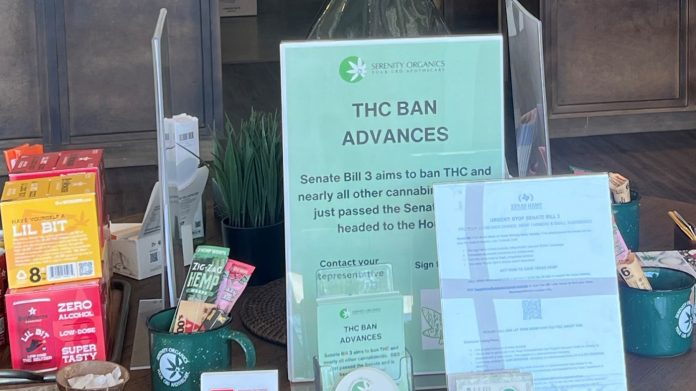
At a store selling hemp products outside of Houston, Texas, a sign notifies customers that the state Legislature might be passing a ban on most consumables containing THC.
Andrew Schneider/Houston Public Media
hide caption
toggle caption
Andrew Schneider/Houston Public Media
HOUSTON — Just six years after Texas legalized hemp products, the state may be about to ban most of them again as key lawmakers say the sales have led to abuses and safety issues.
The Texas Senate passed a bill last month that would ban nearly all consumable hemp products with THC, the main intoxicating element in cannabis, and it’s now under consideration in the state House.
“This is a poison in our public and we, as the Legislature, our number one responsibility is life and death issues,” said Republican Lt. Gov. Dan Patrick, who’s leading the effort to ban consumable hemp products.
The 2018 farm bill passed by the U.S. Congress allowed states to roll back restrictions on hemp. When the Texas Legislature did so a few months later, it laid the groundwork — some say inadvertently — for a multibillion-dollar industry for consumable hemp products like gummies, vapes, chips, and drinks. Patrick said the products are being marketed to children and young adults and fueling a public health crisis.
Texas still has stricter laws than most states
The Senate bill passed last month in a 26-to-5 vote but some opponents said the industry just needs more regulation, not a ban. Democratic state Sen. José Menéndez of San Antonio was one of those who voted no, siding for sales that are more regulated. There’s currently no age requirement for purchasing consumables.
“I’m one of those who believe it should be extremely regulated, more than 1,000 feet away from schools or churches. Do it like we do liquor stores and that sort of thing, where it’s very hard to get, that only people who are consenting adults can use this,” Menéndez said.
Texas still has relatively strict laws on cannabis. It has not legalized marijuana as about half the states have — except for limited medical uses. A new ban would mark a turnaround in what’s become a major market.

Melanne Carpenter and her husband run a store that sells hemp consumables in a suburb of Houston, Tx.
Andrew Schneider/Houston Public Media
hide caption
toggle caption
Andrew Schneider/Houston Public Media
Lawmakers who backed the move to legalize hemp years ago say it was intended to create an industry for non-consumable hemp products, such as rope, but that the law has been used to build a consumable hemp industry with sales at thousands of stores and gas stations.
Medical studies link a variety of potential health problems to some strains of THC, including respiratory problems, seizures, schizophrenia, and psychosis.
A lot of business could be at stake
By Patrick’s estimate, the market for such consumables in Texas has grown to $8 billion annually. A recent report by Whitney Economics, a consulting firm in the cannabis industry, puts the figure at a more modest $5.5 billion in sales, generating $268 million in tax revenues. For the supporters of the ban, that revenue is beside the point.
“Profit over people is never an excuse to ignore the people,” said Republican state Sen. Charles Perry of Lubbock, the author of the Senate ban. “The taxes we collect does not cover the behavioral health issues that’s created [by] an addiction that the state budgets of the day have to cover.”
At a recent hearing before a Texas House committee, Houston resident Alexandra Hess of Houston spoke in favor of the ban and opposed a version that would exempt beverages with THC. She told the story of her brother, Joshua Jimenez, who died in 2021.
“After consuming intoxicating levels of THC products, my brother suffered repeated psychotic breaks and spiraled into a mental health crisis that no one was equipped to handle,” Hess said. “I wish Joshua was here to tell you his story first hand. Unfortunately, he did not survive his last psychotic break.” The family has said Jimenez called them, saying he might walk in front of a train, and then was killed by a train.

Houston resident Alexandra Hess speaks to a committee in the Texas Legislature about her late brother’s mental health crisis and use of THC.
Andrew Schneider/Screenshot by Houston Public Media
hide caption
toggle caption
Andrew Schneider/Screenshot by Houston Public Media
Backers of THC products include some recovering veterans
Others at the hearing opposed the ban, saying legal hemp products were crucial to their survival. Some of those were veterans.
“After being injured in service, I found overwhelming pain and was prescribed heavy opioids,” said Terence Jones of Victoria, Texas., who lost both legs and part of an arm to an antipersonnel mine in Afghanistan. “Like too many veterans, I became dependent. In 2015, I made the decision to quit pharmaceutical drugs and begin using hemp and THC products to manage my pain and PTSD. The decision changed and saved my life.”
Supporters of a ban on THC products, including Patrick, say they favor expanding the state’s narrow exemption for medical cannabis. But Jones and others who testified against the measures said a ban would put their Texas suppliers out of business.
Melanne Carpenter is one such supplier. She’s operated her dispensary, Serenity Organics, in Missouri City, southwest of Houston, for about five years.
“My customers are 40-to-60-years old, so I would say probably 75-80% is medicinal — pain, anxiety, sleep,” Carpenter said.
Carpenter opposes sales of such products to anyone under 21. But she said the solution is regulation, not prohibition. “I’d be forced to shut down,” Carpenter said.
She said a ban won’t stop Texans from buying the products from places outside Texas.
“The $8 billion is still there,” Carpenter said. “It’s just who’s going to get it, the cartels in Mexico or other states. I mean, that’s what’s going to happen. But we’re not going to see cannabis consumption going down.”
Andrew Schneider reports on politics and government for Houston Public Media
Tariffs make sour grapes for American winemakers : Planet Money : NPR

A worker pushes a wine barrel into a storage facility at Hunnicutt winery in St. Helena, Calif., on Sept. 30, 2021.
Justin Sullivan/Getty Images
hide caption
toggle caption
Justin Sullivan/Getty Images
You might expect American winemakers to be popping bottles of California sparkling wine these days. With President Trump’s tariffs on the European Union, U.S.-made wine now has a greater price advantage over Italian prosecco and French Champagne.
This is a classic case that protectionists make for tariffs: They help domestic producers.
But the American winemakers we spoke with are more sour than bubbly about Trump’s tariffs.
“To me, it’s awful. There’s no upside,” said Adolfo Hernandez, owner and winemaker at Monroy Wines in Sonoma County, Calif.
So, why aren’t tariffs a big win for American winemakers? We spoke to a bunch of them around the United States, and what they told us challenges the assumption that tariffs will help domestic industries.
How tariffs damage the wine supply chain
American winemakers’ primary fear is this: The costs of all the things they need to make wine — in econspeak, the intermediate goods — will go up.
Many of the things that winemakers regularly buy often come from abroad. Three notable examples: glass bottles, corks and barrels (which are used to age wine and refine its flavor).
Portugal exports almost 60% of the world’s cork, followed by Spain, which makes almost 20%, according to a cork business industry report. The bulk of the world’s supply comes from cork oak trees in southwestern Europe and northwestern Africa.
And, sure, winemakers could pivot and seal their wine bottles with screw-off tops. But those are often made of aluminum, some of which will also be subject to Trump’s tariffs. Plus, cork allows in oxygen, which is needed for some wines.
Barrels pose another problem. For winemakers, a gold standard is French oak barrels; these can run about $1,000 each or more, depending on size.
“Not having French oak will drastically change the flavor profile of many wines,” said Hernandez, of Monroy Wines. In fact, American oak barrels have such a different flavor profile that they’re often used for bourbon. With tariffs on oak barrels (alongside other products from the EU), “they could be really, really unaffordable for a lot of small producers,” Hernandez said. And even if winemakers did switch to using American oak, the process could take years.
Then there are the bottles. Many glass bottles are made in China; Chinese imports are now going to be subject to a 145% tariff.
“We get our bottles from China, and they’re gonna be increased in terms of tariffs,” said Ken Freeman of Freeman Vineyard & Winery in Sonoma County. “Our costs are gonna go up.”
Others get their glass bottles from Mexico. Like other goods from Mexico, these could be subject to a 25% tariff. Depending on how that tariff plays out, “that is going to have a huge impact on us,” said Scott Donnini, owner of Auburn Road Vineyards in New Jersey and vice chair of the Garden State Wine Growers Association.
For Madson Wines in the Santa Cruz Mountains, the prices of barrels, bottles and corks made up roughly 30% of its total costs before the tariffs, founder Cole Thomas said.
“The wine industry operates on small margins already,” said Thomas. If those prices go up, “we will have to increase the price of our wine to reflect that, which is frankly not something we would like to do.”
OK, but can’t winemakers just raise their prices?
In theory, the tariffs will make imported wine even more expensive, leaving room for domestic wineries to raise their prices and stay competitive.
But that doesn’t mean more people will drink domestic wine, because the substitute for more expensive wine isn’t just cheaper wine. It’s also beer, cider, hard seltzer, THC or not drinking at all. Americans have been drinking less alcohol in recent years — especially younger Americans. Wine consumption in the U.S. and globally shrank last year, according to a report from Silicon Valley Bank.
American winemakers are already worried that if they raise their prices too much, consumers will say, meh, and forgo a bottle of cabernet sauvignon — especially if the economy enters a recession.
“There does come a point where you price yourself out of the market,” said Jordan Harris of Heron Hill Winery in New York state. “So we would be cautious on raising our prices, but certainly, I mean, if we can’t produce within the price range that we are in, then we would have to raise our prices. There wouldn’t really be a choice.”
A chilling effect for distributors
In addition to supply chain challenges, American winemakers are also worried about the final step in a wine bottle’s journey: distributors.
Many American wineries — both large and small — rely on distributors to get their products into customers’ glasses.
A federal regulation that is almost a century old creates what the alcohol industry calls the “three-tier system” (the three tiers being the alcohol makers, the sellers and the drinkers). This system dates back to the end of Prohibition. And it means that the people making alcohol have been prohibited from selling directly to consumers across state lines; the alcohol needs to go through a middleman — a distributor.
“It’s a way of, perhaps for historical reasons, of creating an extra check in the system, such that alcohol is managed properly, because there’s lots of problems associated with alcohol,” said Bradley Rickard, a professor of applied economics and management at Cornell University and a co-editor of the Journal of Wine Economics.
While states are increasingly allowing winemakers to sell directly to consumers, in practice lots of wineries of all sizes rely on distributors to sell their wine to wine stores, bars and restaurants across state lines.
That’s especially the case for the biggest wine sellers in the United States. “Like for mass wines where you have thousands of cases of, you cannot ship them straight,” said Karl Storchmann, an economics professor at New York University and a co-editor at the Journal of Wine Economics. “You have to be in stores and so forth.”
The point is: American winemakers largely rely on distributors to sell their wine around the country. But those distributors aren’t just selling wine from the United States. Many rely on importing and selling wine from other countries, especially from Europe. Last year, Americans imported nearly $6 billion of wine from the EU, especially from France, Italy and Spain.
American winemakers fear that tariffs will strain those same distributors that they rely on.
This fear was even greater last month, when Trump threatened a 200% tariff on European wine imports. Trump did not end up imposing that tariff.
Instead, on April 2, he proposed a 20% tariff on European imports. Last week, he announced a 90-day reprieve and lowered EU tariffs to 10% for the time being. They could still go back up to 20% after the 90-day period. In the meantime, U.S. winemakers are concerned that the ultimate tariff numbers, as well as the uncertainty, could threaten their distributors and, in turn, hurt their own ability in the short term to distribute wine.
Theoretically, those businesses could of course sell American wines instead. Billy Weiss, owner of North Berkeley Imports, has been getting cold-emailed by American winemakers, asking him whether he’s looking for new American clients. “I emailed one of them back. I was like, that’s really good timing — I like the initiative,” he said.
While it’s possible he could reorient his business around supporting domestic winemakers, “we need 50 to 60 domestic producers to help make up the loss for what’s going on with the European turf. So it’s a daunting task,” and it would take time, Weiss added.
Lingering uncertainty
Will American winemakers win with tariffs? The ones we spoke with don’t seem to think so.
A California wine advocacy group, the Wine Institute, said in a statement, “These tariffs will only hurt the broader wine sector including farmers, vintners, distributors, retailers and the millions of people working across the extended wine supply chain.”
It’s possible, of course, that things will play out differently — that tariffs will wind up helping some American winemakers sell more bottles. It’s also possible that American winemakers will sell more bottles, but at a cost to their own margins.
Canada, the U.K. and China have imported the most U.S. wine in recent years. But China now has an additional 125% tariff on American goods. And there have been reports of Canadians taking American alcohol off store shelves.
If the market in the U.S. floods, that would make it “very hard to increase prices on wines that were made here,” said Storchmann, the economics professor. “ Is it good for consumers? Probably for consumers of U.S. wine, which is a specific style of wine. Is that a good thing for wine producers? No.”
In any case, the dizzying uncertainty over the past month has already been disruptive.
When Trump first threatened a 200% tariff on European wine imports in March, distributor Kate Laughlin, CEO of Martine’s Wines, paused new wine purchases; importing seemed too cost prohibitive for European winemakers and American consumers.
Laughlin resumed placing orders after April 2, once she saw the 200% tariff wasn’t taking effect. Still, she remains cautious.
“Depending on how the next few weeks go, we anticipate the tariff scenario for us could even get worse before it gets better,” Laughlin said. “Each decision right now still feels like a bit of a high-stakes gamble. The scenario remains very difficult to navigate, demoralizing, and anxiety remains high.”
Endangered species’ habitat could be at risk under Trump proposal : NPR

Northern spotted owls, like the one pictured here, are one of many species whose habitat was historically protected by the Endangered Species Act.
Tom Szczerbowski/Getty Images North America
hide caption
toggle caption
Tom Szczerbowski/Getty Images North America
The Trump administration is proposing to significantly limit the Endangered Species Act’s power to preserve crucial habitats by changing the definition of one word: harm.
On Wednesday, the administration proposed a rule change that would essentially prohibit only actions that directly hurt or kill actual animals, not the habitats they rely on. If finalized, the change could make it easier to log, mine and build on lands that endangered species need to thrive.
“Habitat loss is the biggest single cause of extinction and endangered species — it makes sense to address it,” said Brett Hartl, government affairs director at the Center for Biological Diversity. He called efforts to deny that cause “callous and reckless.”

“Any conservation gains species were making will be reversed — we’re going to see losses again,” he said.
Under the Endangered Species Act, it’s illegal to “take” an endangered species. By law, “take” is defined to mean actions that harass, harm, or kill species. For decades, federal agencies have interpreted “harm” broadly, to include actions that modify or degrade habitats in ways that impair endangered species’ ability to feed, breed or find shelter.
That interpretation has been a crucial part of how the Endangered Species Act has protected over 1,700 species since its passage in 1973, said Hartl. It’s helped preserve spawning grounds for Atlantic Sturgeon, allowing them to mate and sustain the population. It’s protected old-growth forests in the Pacific Northwest that house northern spotted owls and red-cockaded woodpecker, saving them from extinction.
In the 1990s, timber companies that wanted to harvest those old-growth forests challenged the government’s broad interpretation of harm. The Supreme Court ultimately upheld that interpretation in a 6-3 decision.

In a dissenting opinion, Justice Antonin Scalia disagreed with that interpretation. He argued that in the context of wild animals, “take” should be interpreted more literally, as an affirmative act directed against a particular animal, not an act that indirectly causes injury to a population.
The Trump administration cites Scalia’s argument in its proposal, saying it’s “undertaking this change to adhere to the single, best meaning of the ESA.”
Conservation experts argue it makes no sense to adopt such a narrow definition of harm. “If you’re a prairie chicken in the southwest, and there’s an oil and gas developer and they want to destroy your prime breeding display grounds, the bird can’t mate,” said Hartl.
“You’re not actually harming any of them directly,” he said, but the end result is essentially the same.
The public has 30 days to comment on the proposed rule change. The move will also likely be challenged in court.