Thursday, November 12, 2026
Home Blog Page 37

Italy’s Meloni will test her mettle as EU-U.S. bridge when she meets with Trump : NPR

0

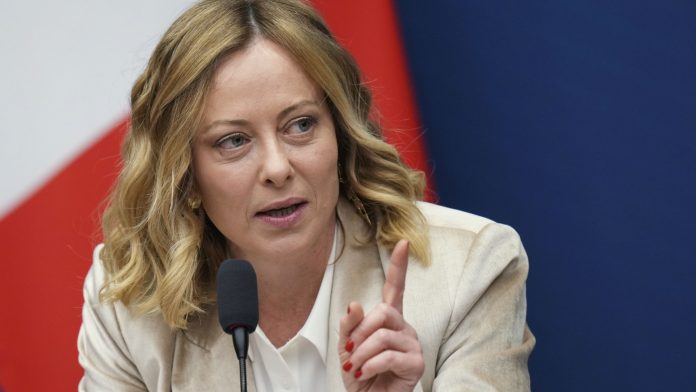
Italian Premier Giorgia Meloni holds a year-end press conference in Rome in January.

Alessandra Tarantino/AP


hide caption

toggle caption

Alessandra Tarantino/AP

MILAN — Italian Premier Giorgia Meloni will test her mettle as a bridge between the EU and the United States when she meets with U.S. President Donald Trump in the White House on Thursday, the first European leader to have a face-to-face with Trump since he announced, and then suspended, 20% tariffs on European exports.

Meloni secured the meeting at a critical juncture in the trade war as Italy’s leader, but she also has, in a sense, been “knighted” to represent the European Union. She has been in close contact with EU Commission President Ursula von der Leyen ahead of the trip, and “the outreach is … closely coordinated,” a commission spokeswoman said this week.

“We know we are in a difficult moment,” Meloni said this week in Rome. “Most certainly, I am well aware of what I represent, and what I am defending.”

The European Union is defending what it calls “the most important commercial relationship in the world,” with annual trade reaching 1.6 trillion euros ($1.8 trillion).

Trade negotiations fall under the European Commission’s authority, which is pushing for a zero-for-zero tariff deal with the U.S. However, Trump administration officials in talks with the EU have yet to publicly show signs of relenting on Trump’s insistence that a baseline 10% tariff be charged on all foreign imports. He paused for 90 days a retaliatory increase to 20%.

The pause has raised some hopes for negotiations, and Meloni’s margins for progress are more in gaining clarity on Trump’s goals rather than outright concessions, experts say.

“It is a very delicate mission,” said Fabian Zuleeg, chief economist at the European Policy Center think tank in Brussels. “There is the whole trade agenda, and while she’s not officially negotiating, we know that Trump likes to have this kind of informal exchange, which in a sense is a negotiation. So it’s a lot on her plate.”

As the leader of a far-right party, Meloni is ideologically aligned with Trump on issues including curbing migration, promoting traditional values and skepticism toward multilateral institutions. But stark differences have emerged in Meloni’s unwavering support for Ukraine.

After being the only European leader to attend the Jan. 20 inauguration, Meloni has responded with studied restraint as abrupt shifts in U.S. policy under Trump have frayed the trans-Atlantic alliance. She has denounced the tariffs as “wrong” and warned that “dividing the West would be disastrous for everyone,” after Trump’s heated White House exchange with Ukraine’s president.

“She has been very cautious,” said Wolfango Piccoli, an analyst at the London-based Teneo consultancy. “It is what we need when we have a counterpart that is changing every day.”

Italy maintains a 40 billion euro trade surplus with the United States, its largest with any country, fueled by Americans’ appetite for Italian sparkling wine, foodstuffs like Parmigiano Reggiano hard cheese and Parma ham, and Italian luxury fashion. These are all sectors critical to the Italian economy, and mostly supported by small- and medium-sized producers who are core center-right voters.

“All in all, I think she will focus on the very strong economic and trade relations that Italy has with the United States, not just in terms of exports, but also services and energy,” said Antonio Villafranca, vice president of the ISPI think tank in Milan. “For example, Italy could even consider importing more gas from the U.S.”

The meeting comes against the backdrop of growing concerns over global uncertainty generated by the escalating tariff wars. Italy’s growth forecast for this year has already been slashed from 1% to 0.5% as a result.

Meloni is also expected to address Trump’s demand for NATO partners to increase military spending to 2% of gross domestic product. Italy’s spending, at 1.49% of GDP, is among the lowest in Europe.

Experts cautioned, however, against raising expectations over any concrete progress.

“The best strategy has been to be very circumspect: Get there, get the meeting, get the photo opportunity,” Piccoli said. “If she is able to come back, and give a sense of how Washington wants to frame future relations on trade, defense and Ukraine policy, that would be a huge win.”
Consider This from NPR : NPR

0

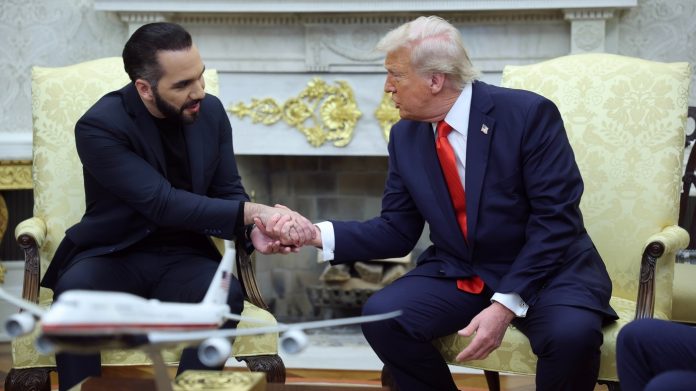
President Donald Trump meets with President Nayib Bukele of El Salvador in the Oval Office of the White House this week.

Win McNamee/Getty Images


hide caption

toggle caption

Win McNamee/Getty Images


President Donald Trump meets with President Nayib Bukele of El Salvador in the Oval Office of the White House this week.

Win McNamee/Getty Images

The Trump administration’s move to send immigrants to a maximum security prison in El Salvador is the subject of multiple on-going fights in court.

But in an Oval Office meeting with the Salvadoran president this week, President Trump was already looking ahead.

“We also have homegrown criminals that push people into subways, that hit elderly ladies on the back of the head with a baseball bat when they’re not looking, that are absolute monsters. I’d like to include them in the group of people to get them out of the country,” Trump said.

Trump later clarified that by “homegrown criminals” he meant U.S. citizens.

No president has tried to do exactly what Trump is proposing.

In this episode, we hear from someone who argues it’s wildly unconstitutional.

For sponsor-free episodes of Consider This, sign up for Consider This+ via Apple Podcasts or at plus.npr.org.

Email us at [email protected].

This episode was produced by Connor Donevan.

It was edited by Courtney Dorning.

Our executive producer is Sami Yenigun.

NPR’s CEO on the proposal to cut federal funding for public media : NPR

0

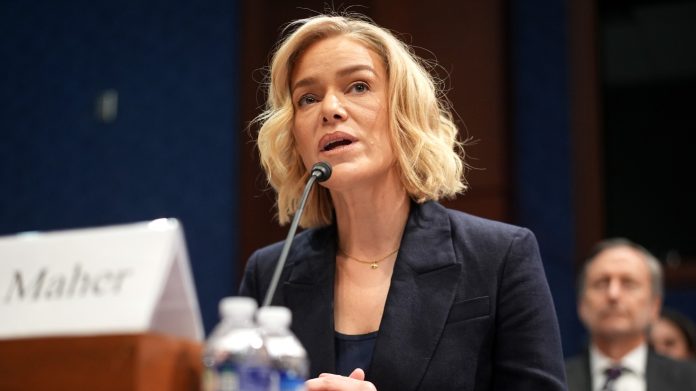
President and CEO of National Public Radio Katherine Maher testified during a House Oversight and Government Reform Committee hearing at the U.S. Capitol on March 26, 2025 in Washington, DC.

Andrew Harnik/Getty Images North America


hide caption

toggle caption

Andrew Harnik/Getty Images North America

The Trump administration has drafted a memo to Congress outlining its intent to eliminate nearly all federal funding for public media – which includes NPR and PBS – according to a White House official who spoke to NPR on condition of anonymity. In the memo, the administration accused both networks of spreading “radical, woke propaganda, disguised as ‘news.'”

The administration plans to send the memo to Congress when it reconvenes from recess on April 28, which will open a 45-day window in which the House and Senate can either approve the rescission or allow the money to be restored.

This comes in the wake of a House Oversight and Government Reform subcommittee hearing in late March, which called PBS CEO Paula Kerger and NPR CEO Katherine Maher to testify on what Republican lawmakers say is biased and woke programming. Both public broadcasting heads emphasized their mission to provide free, nonpartisan news and programming across America.

NPR has not been formally notified by the White House about the rescission, which would include all the funds for fiscal years 2026 and 2027, totaling $1.1 billion. According to Maher, that includes public media as a whole, including public television; public radio would receive $250 million.

Maher spoke with All Things Considered host Mary Louise Kelly to talk about the memo. NPR’s policy is to cover itself as we would any other organization. NPR newsroom or corporate executives, including CEO Katherine Maher, had no input on the questions for this interview.

NPR has asked the White House to comment on their goal with pulling back funding. The White House has not responded.

This interview has been lightly edited for clarity and length.

Mary Louise Kelly: To the central question: what would be the effect on NPR of losing government funding?

Katherine Maher: The biggest effect would be on the NPR network, which are the 246 stations around the country that [our audience is] probably listening to us on, right now. Those are our member stations, and they receive about 100 million of the 121,122 million that goes to public radio every single year. So the big impact would be on rural stations, stations in geographies that are quite large or complex in order to be able to receive broadcast or infrastructure, costs are very high. You could see some of those stations really having to cut back services or potentially going away altogether.

Kelly: So we’re throwing around a lot of big numbers here. But basically, just to stick with this point, because I think a lot of people may not understand: NPR – the network you and I work for – gets around one percent of our annual budget directly from the federal government. You’re making the point that a lot of our member stations would be hit considerably harder.

Maher: That’s correct. So we receive about one percent of our budget. It goes to support things like body armor for journalists covering conflict overseas, extra support for our presidential national elections, all the sorts of things that we want to invest in to ensure that we’re able to report on issues that matter to the public. But generally speaking, most of our operating budget comes from our membership fees, and that’s what allow our members to be able to receive programming. It comes from underwriting support. It comes from private donations, individual audience member donations. And that same thing is true for member stations, except federal funding makes a much bigger percentage of their total budget.

Kelly: If all government funding goes away. Would we survive?

Maher: I think the question is “Would we be able to thrive as a national network?” That is what I am focused on is we get so much value as public media by being part of a 50-state network that covers 99.7 percent of the American population. If federal funding goes away, that network is absolutely at risk, the quality of service, the ability to cover everyone, people who live in what would otherwise be news deserts. And as a result, there’s no question that NPR would not be able to pull from that richness of our national coverage if those local newsrooms –

Kelly: So it would be local newsrooms that would be going away. And often in places where local newspapers have already been decimated.

Maher: That’s exactly right.

Kelly: Make the case. Why should any tax dollars support public broadcasting when there are plenty of other news organizations around, when anyone, frankly, these days can produce programming on their iPhone?

Maher: Oh, absolutely. And I think that it’s important for public media to be able to continue to be relevant in a time where there is a lot of coverage of different issues and areas of interest. And at the same time, I think it’s very easy to say that there’s universal coverage because there’s so much content being produced. But the reality is there are many places in this country that do not have that kind of access to either cell phone service or high speed broadband, where radio may be the only way to reach communities with regular access to news. Public media also supports local news coverage in places we’ve already mentioned. About 20 percent of Americans live in an area without any other local news coverage other than their local public radio station. This is tremendously important as a public service and just because not every single person uses it every day – you know, I don’t drive on our interstates every day, and yet when I need it, it’s there. The same is true of public media.

Kelly: Just to put the question to you quite bluntly, to quote the words of Marjorie Taylor Greene, the Georgia congresswoman who was running the subcommittee hearing where I know you were just summoned to testify last month, she said, “look, you can hate us on your own dime.” To which you say, what.

Maher: We don’t hate anyone in public media. We report on the news, and we encourage that we are reaching out to people from all different backgrounds, political persuasions, belief sets. And we want to be able to hear the voices of the American public reflected on public media in the same way.

Kelly: Just to put one more challenge question to you, because this is a question I get and I want to let you respond to it. Does public funding hold NPR back? And to explain that question, I mean, we are editorially independent. We’re speaking, you and I, right now in the newsroom. I know that. But if one of the goals is to avoid even the appearance of government influence, why not walk away from this money?

Maher: I actually think public funding ensures that we hold tight to a mission that means reflecting all Americans. Most commercial outlets are able to target certain audiences that they want to reach, we have an actual obligation in our mission and in our funding model to try to serve everyone across the country. Now, we won’t always be able to serve everyone, every belief set, every need, every interest, but we need to serve as broad an audience as possible. That’s the point of public broadcasting, is to be able to put the public in conversation with one another and to operate off a shared set of conversations about what’s going on in the world.

Disclosure: This story was adapted for the web by Mallory Yu. It was edited by Managing Editors Gerry Holmes and Vickie Walton-James. Under NPR’s protocol for reporting on itself, no NPR corporate official or news executive reviewed this story before it was posted publicly.

DOGE visits NLRB after whistleblower report about data access : NPR

0

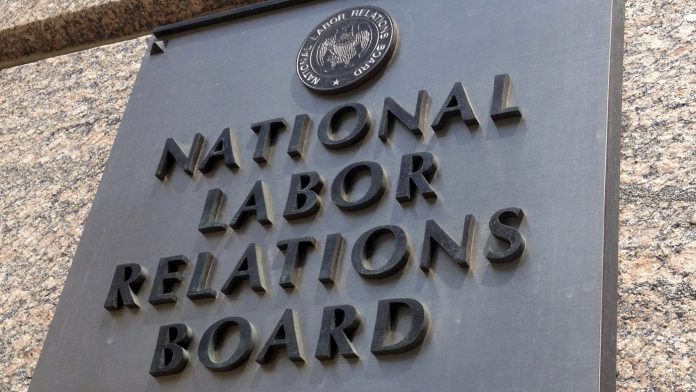
A 2013 file photo of the National Labor Relations Board headquarters in Washington, D.C.

Jon Elswick/Associated Press


hide caption

toggle caption

Jon Elswick/Associated Press

The ad hoc Department of Government Efficiency team is assigning two staffers to work at the independent agency where a whistleblower alleged Tuesday DOGE may have already removed sensitive labor data from its systems.

Just one day after NPR reported on the disclosure filed by whistleblower Daniel Berulis, DOGE representatives visited the National Labor Relations Board office in Washington, D.C. for a meeting, according to an email obtained by NPR.

The email, sent to staff on behalf of NLRB chairman Marvin E. Kaplan and acting general counsel William Cowen and shared with NPR by two NLRB employees at regional offices who are not authorized to speak publicly, said two DOGE representatives would be detailed to the agency from the General Services Administration “part-time for several months” and would largely work remotely.

“The representatives have requested information about agency operations but asked us to remove any personally identifiable information from documents we provide,” the email reads. “Consistent with the President’s Executive Order and applicable laws, the Agency will comply with DOGE’s requests for access and information.”

It’s unclear why DOGE would need access to agency files that contain personally identifiable information to complete its mission of improving efficiency, outside of employment records for potential reductions in force. The agency publishes publicly available annual performance and accountability reports and budget justifications that former NLRB members told NPR would likely be sufficient in looking for ways to cut costs.

The NLRB employees in the regional offices who shared the email told NPR that the atmosphere at work is chaotic. “There is panic among the employees,” said one of the employees. “My office has been in turmoil since this afternoon’s email … people are concerned about the data.”

“DOGE coming into the building with access to systems prior to an investigation is a major red flag — what are they doing now? Someone needs to step in, isolate the systems, and conduct an investigation,” said Andrew Bakaj of the nonprofit Whistleblower Aid, who is Berulis’s attorney.

Tim Bearese, the NLRB’s acting press secretary, did not respond to NPR’s questions about DOGE visiting the agency. Earlier this week, Bearese denied that NLRB granted DOGE access to its systems and said DOGE had not requested access to the agency’s systems. Bearese said the agency conducted an investigation after Berulis raised his concerns but “determined that no breach of agency systems occurred.”

On Tuesday, White House deputy press secretary Anna Kelly said in a statement to NPR, “It is months-old news that President Trump signed an Executive Order to hire DOGE employees at agencies and coordinate data sharing. Their highly-qualified team has been extremely public and transparent in its efforts to eliminate waste, fraud, and abuse across the Executive Branch, including the NLRB.” Wednesday’s email also referenced an earlier communication to NLRB staff, that “the Agency had no official contact with any DOGE personnel.”

Despite the claims made by agency officials this week, Berulis’ whistleblower disclosure shared with Congress and other federal overseers provides evidence of DOGE’s access and activities, including the creation and deletion of an account in NLRB’s cloud systems called “[email protected].”

Berulis noticed a chunk of data leaving the NLRB NxGen case management system, then a large spike in outbound traffic leaving the network. The NxGen system contains personal information about union members or employees voting to join a union, witness testimony in ongoing cases and trade secrets and proprietary data about companies involved in the agency’s investigations. Access to that data is protected by numerous federal laws, including the Privacy Act.

Several companies run by Elon Musk, the billionaire Trump ally and de facto head of DOGE, have cases before the NLRB — as do Musk’s competitors. His SpaceX company is also part of a lawsuit seeking to have the courts declare the agency’s structure as unconstitutional.

After NPR reported on the whistleblower disclosure, the top Democrat on the House Oversight Committee called for an investigation into DOGE’s access to the NLRB.

U.S. Rep. Gerry Connolly, D-Va., expressed concern that DOGE “may be engaged in technological malfeasance and illegal activity,” in a letter sent to two independent labor watchdogs.

The letter asks the inspectors general to answer a number of questions regarding ways DOGE may have potentially violated federal law, including any NLRB networks DOGE staffers had access to and what records of DOGE’s work within NLRB systems exist.

Berulis’ whistleblower’s disclosure is the latest in a pattern of legal questions around DOGE’s virtually unfettered access to personal and financial data kept in different databases across the federal government, and concerns about what DOGE is doing with that data.

In more than a dozen federal court cases, DOGE and the Trump administration have largely failed to give consistent and clear answers about who has access to the data and how that access complies with privacy and cybersecurity protections in place.

Have information or evidence to share about DOGE’s access to data inside the federal government? Reach out to the author, Jenna McLaughlin, through encrypted communications on Signal at jennamclaughlin.54. Stephen Fowler is available on Signal at stphnfwlr.25. Please use a nonwork device.

DOGE guts homeless agency, putting all staff on leave : NPR

0

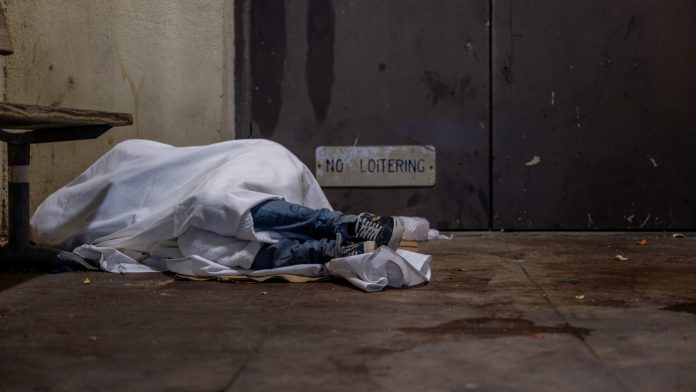
An unhoused resident sleeps on a dimly lit porch on the steps of a school in Austin. This week, all staff at the United States Interagency Council on Homelessness, which coordinates homelessness policy across the federal government, were put on leave.

Brandon Bell/Getty Images


hide caption

toggle caption

Brandon Bell/Getty Images

A tiny agency that coordinates homelessness policy across the federal government has been effectively shut down, with all its staff put on administrative leave.

“The irony here is that the U.S. Interagency Council on Homelessness is designed for government efficiency,” said Jeff Olivet, the body’s most recent executive director under President Biden.

Congress created it in 1987, he said, “to make sure that the federal response to homelessness is coordinated, is efficient, and reduces duplication across federal agencies.”

There were fewer than 20 employees and a budget of just over $4 million. But President Trump included it in an executive order last month on whittling parts of the federal bureaucracy to the “maximum extent” allowed by law.

Legally, the homeless agency’s authorization continues until 2028. But DOGE, the cost-cutting team overseen by Elon Musk, told its employees Monday that they’d be put on leave the next day, according to an email from one employee that was shared with NPR.

The agency helped cities manage record-high homelessness

Part of the agency’s mandate is to help states and localities manage homelessness, and Olivet said that under his leadership, it focused on the record-high number of people living outside.

“Even at a time where we saw overall homelessness going up in many places,” he said, “in those communities like Dallas and Phoenix and Chicago and others, we were able to see significant reductions, or at least not increases in unsheltered homelessness.”

The agency also coordinated an intensive push to bring down homelessness among veterans, making sure they were provided housing and healthcare. Over a decade, Olivet said, veterans homelessness dropped by more than half.

“The U.S. Interagency Council on Homelessness has been vital in shaping effective policy to end homelessness,” Ann Oliva, CEO of the National Alliance to End Homelessness, said in a statement.

But the Trump administration plans to take a dramatically different approach to the problem.

Shutting down the agency will make it easier for Trump to shift homelessness policy

For decades, since the first Bush administration, there was bipartisan support for getting people housing first and then offering whatever mental or addiction treatments they needed. But there’s been a growing conservative backlash to that as homelessness rates have steadily risen.

During Trump’s first term, his appointee tried to steer the U.S. Interagency Council on Homelessness more toward treatment options than permanent housing. But the executive director is the only political appointee at the small agency, and all others are career staff.

“He was really working against the current,” said Devon Kurtz of the Cicero Institute, a conservative think tank. “Ultimately, the inertia of it was such that it continued to be sort of a single mouthpiece for housing first.”

Kurtz supports a dramatic shift away from a housing first policy, and thinks that can happen more easily without the homeless agency.

It’s not clear if there will be a legal challenge to the move. Democratic members of Congress objected to Trump’s targeting of the agency, calling it “nonsensical.”

“At a time when housing costs and homelessness are on a historic rise, we need an all-hands-on-deck approach to ensuring every American has a safe and stable place to rest their head at night,” Rep. Emanuel Cleaver II of Missouri said in a statement to NPR. “Unfortunately, attacks on the [agency], along with damaging cuts to federal housing programs and staff, and the President’s tumultuous tariffs, will only exacerbate this country’s housing and homelessness crisis.”

For these veterans, the secret to crossing political divides starts with a beer : NPR

0

In an effort to reach across political divides, a group of vets has been holding regular gatherings to talk about it all over a beer.  They call the events “Pints and Patriotism.”  NPR went to one recent meeting to gauge the mood.

Trump administration says it is suing Maine over transgender athletes in girls’ sports : NPR

0

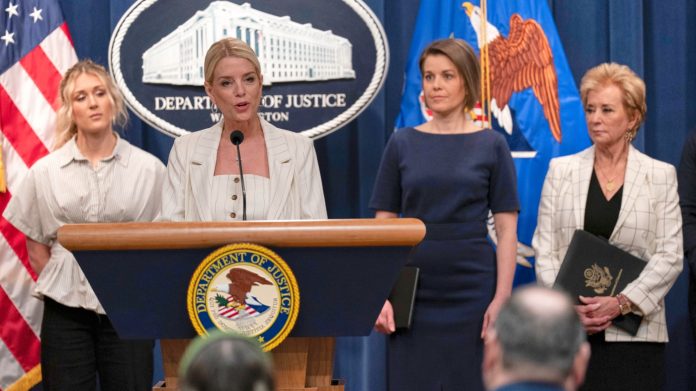
Attorney General Pam Bondi spoke at the Justice Department on Wednesday to announce that the administration is suing Maine for not complying with the government’s push to ban transgender athletes in girls sports. She was accompanied by (from left) Riley Gaines, Rep. Laurel Libby, R-Maine, and Education Secretary Linda McMahon.

Jose Luis Magana/AP


hide caption

toggle caption

Jose Luis Magana/AP

The Justice Department is suing Maine for allowing transgender student athletes to play in girls’ and women’s school sports — a policy that the administration says disregards President Trump’s executive order aiming to ban that access.

It’s the latest development in an ongoing fight over the issue between the state’s leaders and the administration following Trump’s February order, which calls on the federal government “to rescind all funds from educational programs that deprive women and girls of fair athletic opportunities.”

Attorney General Pam Bondi announced the lawsuit Wednesday and said the state’s actions had violated Title IX, the 1972 law that prohibits sex-based discrimination at schools that receive federal funding. Maine has done so, the Justice Department alleges, by “discriminating against women by failing to protect women in women’s sports.”

“By prioritizing gender identity over biological reality, Maine’s policies deprive girl athletes of fair competition, deny them equal athletic opportunities, and expose them to heightened risks of physical injury and psychological harm,” the lawsuit said.

Bondi announced the lawsuit at the Justice Department, where she appeared alongside Riley Gaines, the former University of Kentucky swimmer who has emerged as a vocal critic of transgender athletes in girls’ and women’s sports.

The suit highlights multiple examples where transgender students participated in girls’ sports in Maine and outperformed their competitors. The lawsuit described an instance where an individual, referred to as “Student B,” placed first in a girls’ cross-country race, and pointed out that the same score would have ranked 43rd in the boys’ division.

It is unclear how many transgender students are currently participating in school athletics in Maine. The Maine Principals’ Association, MPA, which governs the state’s athletics, has said there are just two transgender athletes involved in girls’ high school sports this year. The DOJ’s suit refers to at least three transgender athletes.

Maine’s Democratic Gov. Janet Mills responded to the legal challenge by promising to “vigorously defend” the state against the DOJ’s effort.

“Today is the latest, expected salvo in an unprecedented campaign to pressure the State of Maine to ignore the Constitution and abandon the rule of law,” Mills said in a statement. “This matter has never been about school sports or the protection of women and girls, as has been claimed, it is about states rights and defending the rule of law against a federal government bent on imposing its will, instead of upholding the law.”

Just days after Trump signed his executive order, the MPA announced that it would continue to follow state law over the federal order.

“The executive order and our Maine state Human Rights Act are in conflict,” said MPA executive director Mike Burnham, adding that the organization “will continue to follow state law as it pertains to gender identity.”

Weeks later, Mills defended the decision during an exchange with Trump at the White House, where the president threatened to take away the state’s federal funding if it didn’t comply with the order. In response, Mills said, “See you in court.”

Since then, the administration has made multiple attempts to cut federal funding to Maine. The Department of Education has said it is moving to halt the state’s federal funding for K-12 education. The Department of Agriculture has also sought to freeze funds, but a federal judge has temporarily blocked that action.

Protesters tasered at Marjorie Taylor Greene town hall : NPR

0

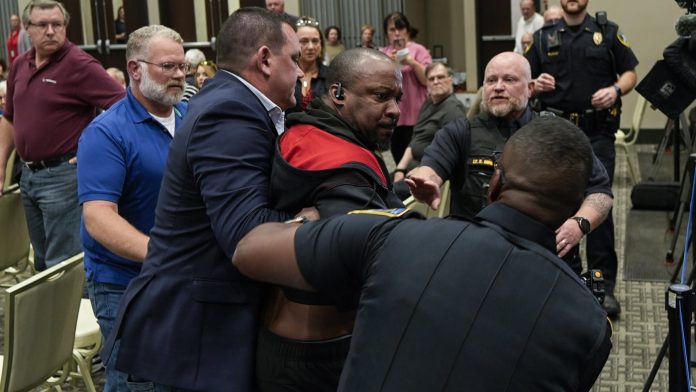
Police forcibly removed several protesters from Rep. Marjorie Taylor Greene’s Tuesday town hall in Acworth, Ga.

Mike Stewart/AP


hide caption

toggle caption

Mike Stewart/AP

Police arrested and stun-gunned several protesters at a town hall in Rep. Marjorie Taylor Greene’s Georgia district on Tuesday, the latest — and most extreme — example of such an event devolving into chaos in recent weeks.

Greene, a Republican and staunch supporter of President Trump, was interrupted multiple times as she addressed constituents at a community center in Acworth, Ga. on Tuesday night, speaking about Trump’s agenda, playing clips from Congressional hearings and answering pre-selected audience questions.

Starting just seconds into her remarks, and every few minutes over the next hour, some half a dozen attendees either waved signs or shouted interruptions. It is not clear what each of them said, though one chanted “Free Kilmar” — an apparent reference to the Maryland man mistakenly sent to an El Salvador prison — while others called Greene a “terrorist” and yelled expletives at her.

All were quickly escorted out of the room by multiple police officers as the crowd cheered and Greene waved — and in some cases — shouted goodbye. She also referenced the protest under way on the street outside, which the Associated Press reports attracted some 100 people: “Protest is outside … Have fun out there!”

“This is a town hall, this is not a political rally, this is not a protest,” Greene said over applause after the first person was removed from the room. “If you want to shout and chant, we will have you removed just like that man was thrown out. We will not tolerate it.”

The Acworth Police Department said in a statement that approximately six attendees were escorted from the premises without issue, and three people were arrested.

Police said they had planned for such disruptions after discovering online posts that suggested “the potential for disruptive behavior” at the town hall. They said Greene’s staff also pre-screened attendees to confirm that they lived in her district, but that one of the people arrested did not.

Two men, ages 40 and 45, were arrested for battery and obstruction of a law enforcement officer, while a 28-year-old woman was arrested for vulgar language in violation of a city ordinance. Police said two of the people arrested were also stunned with Tasers because officers were “threatened, physically resisted, and harmed in the process.”

A video of one of those incidents shows a man trying to shove several officers off of him as they walk him away from the seats. A brief scuffle ensues in which at least four officers try to hold him back, but he breaks free and seems to be walking out the door when one of the officers fires a Taser. The man can be seen lying in the doorway as the crowd applauds.

In their statement, police accused the individuals of creating an “imminent public safety threat for all in attendance” and putting “members of our beloved police department in a no-win situation in front of numerous media outlets.”

“It is disappointing that a very small number of people actively worked to create a temporary disruption to what was otherwise a completely peaceful event,” the department said.

Greene later said police had “conducted themselves in textbook fashion” and praised them for removing the protesters, saying “that’s exactly what I wanted to happen.”

“How people should handle their business is in the voting booth,” Greene told reporters. “There’s no reason for screaming, yelling, ridiculous outrageous protesting — that disrupts the entire event for every single person that is there.”

Greene accused the protesters of being funded by Democrats, but also acknowledged that Democrats have been targeted too, referencing the arson attack on Pennsylvania Gov. Josh Shapiro’s residence over the weekend.

“It shouldn’t be this way for any elected leader, no matter what political party they represent,” Greene added.

Rep. Marjorie Taylor Greene speaks at her town hall.

Marjorie Taylor Greene said later that people should make their dissent heard in the voting booth, not at town hall meetings.

Mike Stewart/AP


hide caption

toggle caption

Mike Stewart/AP

It wasn’t the only contentious town hall that night

Greene wasn’t the only lawmaker who got heckled at their town hall in the past two days.

Also on Tuesday, Iowa Republican Sen. Chuck Grassley was grilled by a room full of constituents frustrated that he is not doing more to stand up to Trump.

At the Fort Madison event — a stop on Grassley’s 45th annual 99-county tour of Iowa — multiple people pressed the senator about topics including tariffs and immigration enforcement, particularly the Trump administration’s refusal to facilitate the return of mistakenly deported Kilmar Armando Abrego Garcia, as ordered by the Supreme Court.

As Grassley tried to defend his position, members of the audience grew increasingly angry in their questions.

“Why won’t you do your job, senator?” one man asked, as many people in the room clapped.

Grassley stood silently as another attendee in the front row reminded him of his constitutional oath of office, reading it out loud from a scrap of paper and asking if he was still acting upon it.

Grassley said he is “trying to recapture the constitutional authority” to regulate interstate foreign commerce by introducing a bill that he said would fix “some of the mistakes that Democratic Congress has made in 1963” — prompting loud groans and shouts of “no” from listeners.

Sen. Chuck Grassley, R-Iowa, takes questions at a town hall.

Sen. Chuck Grassley, R-Iowa, takes questions at a town hall in Fort Madison, Iowa on Tuesday.

Hannah Fingerhut/AP/Hannah Fingerhut/AP


hide caption

toggle caption

Hannah Fingerhut/AP/Hannah Fingerhut/AP

Also on Tuesday, Republican Rep. Brian Mast was booed by attendees at a town hall in Jupiter, Fla., according to social media footage. WPTV News also posted a video of a man who it said was escorted out of the event.

It’s not only Republicans who are getting pushback from their home districts.

Rep. Laura Friedman, a California Democrat, was repeatedly interrupted by frustrated constituents during a Monday town hall in Los Angeles. The Daily Beast reports that hecklers accused her of not doing enough to confront Trump, with one yelling, “I don’t believe that you have pushed hard enough.”

“I am doing literally everything that I know how and that I think will actually make a difference,” Friedman responded.

Recent weeks have seen a number of lawmakers confronted by angry constituents at town halls from Nebraska to North Carolina — where the scene got so tense that Republican Rep. Chuck Edwards had to be escorted out by security.

Some Republicans are turning away from in-person town halls

Some Republicans have turned to virtual town halls — or paused them altogether — as their constituents grow increasingly frustrated with the Trump administration’s actions and politicians’ responses.

In early March, after several especially heated events — including those of Texas Rep. Keith Self and Kansas Sen. Roger Marshall, both Republicans — Trump publicly accused “paid ‘troublemakers’ ” of attending Republican town halls.

Shortly after, multiple media outlets reported that Rep. Richard Hudson, R-N.C. — the chair of the House Republicans’ campaign arm — told Republicans to stop holding in-person town halls because they were turning into such spectacles, a directive that House Speaker Mike Johnson has publicly echoed.

“They’re professional protesters,” Johnson told reporters that same week. “So why would we give them a forum to do that right now?”

He also said, “We’ve seen this movie before,” an apparent reference to a similar trend of angry constituents confronting Republicans at town halls nationwide in 2017, during Trump’s first term.

Republican Rep. Derrick Van Orden of Wisconsin is one of the lawmakers who have canceled in-person town halls in recent weeks. In late March, community members asked questions of an empty chair after he declined their invitation. Republican Rep. Lauren Boebert of Colorado held a town hall by telephone around the same time, calling it a convenient way to reach more people.

“For me personally, it’s not safe to do an in-person town hall,” she told member station CPR News afterward. “I’m happy to do tele-town halls.”

Democrats appear eager to fill the void by increasing their number of town halls and specifically targeting Republican-held districts. The party posted on Facebook last week that Democrats have held 71 town halls in 35 states in three weeks as part of what it is calling a “nationwide blitz.”

“Here’s the bottom line: If Republicans won’t meet their constituents, Democrats will,” it added.

Judge finds ‘probable cause’ to hold U.S. in contempt over deportations : NPR

0

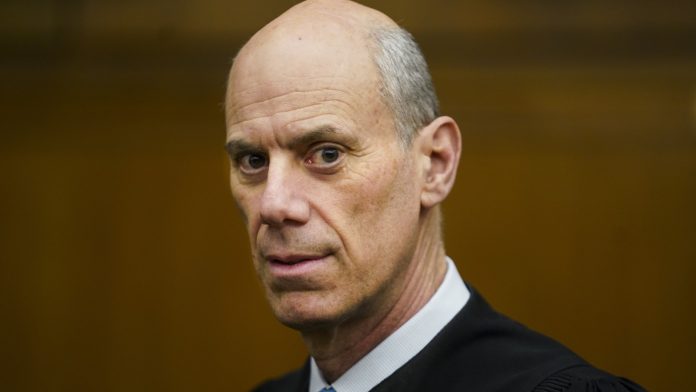
U.S. District Judge James Boasberg, chief judge of the United States District Court for the District of Columbia.

Carolyn Van Houten/The Washington Post via Getty Images


hide caption

toggle caption

Carolyn Van Houten/The Washington Post via Getty Images

Judge James Boasberg of the U.S. District Court in the District of Columbia ruled Wednesday that there is “probable cause” to find the Trump administration in criminal contempt of court for violating his order last month to immediately pause any deportations under the Alien Enemies Act.

President Trump on March 15 invoked the 1798 Alien Enemies Act to target members of Tren de Aragua, a Venezuelan prison gang that Trump says is invading the U.S.

The government sent several planeloads of alleged gang members to El Salvador immediately after invoking the act, including 137 people under the act, the White House said at the time.

The flights happened just after the American Civil Liberties Union and Democracy Forward sued the Trump administration over its use of the Alien Enemies Act. They said the administration removed people without due process.

Boasberg imposed a temporary restraining order barring deportations that evening — but the planes still arrived in El Salvador. The Justice Department argued that Boasberg had overstepped his authority by inserting himself into questions of foreign policy.

But Boasberg wasn’t convinced.

He said that while he issued the order temporarily pausing the flight, “those individuals were on planes being flown overseas, having been spirited out of the United States by the Government before they could vindicate their due-process rights by contesting their removability in a federal court, as the law requires.”

“The Court ultimately determines that the Government’s actions on that day demonstrate a willful disregard for its Order, sufficient for the Court to conclude that probable cause exists to find the Government in criminal contempt,” Boasberg wrote on Wednesday. “The Court does not reach such conclusion lightly or hastily; indeed, it has given Defendants ample opportunity to rectify or explain their actions. None of their responses has been satisfactory.”

Government faces April 23 deadline

Boasberg gave the federal government until April 23 to respond to try to “purge their contempt” and prove they did not violate his temporary restraining order.

Alternatively, the government must provide the name of the person or people who chose not to halt Alien Enemies Act deportations out of the U.S. despite his order — and Boasberg said he would refer them for prosecution.

An order of criminal contempt is a crime and can carry a fine or prison sentence.

The Supreme Court weighed in on the case last week, saying the ACLU and Democracy Forward should have brought their suits in a different court, and under a different statute. But it didn’t rule on the underlying constitutionality of Trump’s invocation of the Alien Enemies Act, and also said any alleged gang members deported under the act need to be given notice of deportation and the opportunity to contest it.

“That Court’s later determination that the TRO suffered from a legal defect, however, does not excuse the Government’s violation,” Boasberg said about the Supreme Court’s opinion, referring to his temporary restraining order. “If a party chooses to disobey the order — rather than wait for it to be reversed through the judicial process — such disobedience is punishable as contempt, notwithstanding any later-revealed deficiencies in the order.”

“The Constitution does not tolerate willful disobedience of judicial orders — especially by officials of a coordinate branch who have sworn an oath to uphold it,” he added.

Democracy Forward, one of the groups suing to block the order, said it would continue to defend its clients and fight for their due process.

“Today’s decision affirms what we have long known: the government’s conduct in this case is unlawful and a threat to people and our constitution,” Skye Perryman, president and CEO of Democracy Forward, said in a statement.

Former President Biden returns to public stage to advocate for Social Security

0

Former President Biden returned to the public stage in Chicago Tuesday night to speak before a national gathering of disability advocates focused on protecting and strengthening Social Security.